


 Скачать презентацию Chapter 6 A Study of an Ecosystem Leaving
3debb23586dbe1ec75b14269aecc3e97.ppt
- Количество слайдов: 28
 Chapter 6: A Study of an Ecosystem Leaving Certificate Biology Higher Level
 Study of an Ecosystem • Broad Overview of a Selected Ecosystem • Observation and Scientific Study of a Selected Ecosystem • Organism Distribution • Choice of Habitat • Organism Adaptations • Organism Role in Energy Transfer • Analysis
 A Broad Overview of a Selected Ecosystem • Choose your ecosystem and visit it • Suitable ecosystems: – hedgerow – stream – rock pool – rocky seashore – old wall – small woodland – small meadow – freshwater pond – waste land – an overgrown garden – soil – peatland – grassland
 Broad Overview of a Selected Ecosystem • “Select and visit one ecosystem”: • Hedgerow: – Physical properties: • • Acts as a boundary to the field It is a large hedgerow Provides good protection from the weather It can be classed as a very small woodland area – General presence of life: • Flora: many trees and shrubs, plants, and grasses • Fauna: herbivores, birds and predators
 Observation and Scientific Study of a Selected Ecosystem • “Identify any five fauna and any five flora using simple keys”: – Fauna: • • • Beetles Butterflies Hoverflies Snails Ladybirds Hare Foxes Badgers Hedgehog Mice – Flora: • • • Hawthorn Blackthorn Gorse Blackberry bramble Fuschia Holly Rowan (Mountain ash) Ash saplings Hazel Willow
 Observation and Scientific Study of a Selected Ecosystem • “Identify a variety of habitats within the selected ecosystem”: – There a number of habitats in the selected ecosystem of the hedgerow – Each habitat is simply a measured subsection of the hedgerow – for example every 5 m of the hedgerow along with, for example, 5 m of the field either side of the hedge – Identifying a range of habitats from the hedgerow involves choosing habitat areas at random and mapping them
 Ecology Apparatus • “Identify and use various apparatus required for collection methods in an ecological study” – – – Mammal trap Pitfall trap Cryptozoic trap Beating tray Pooter Nets (to include – sweep net, insect net, plankton net or fish net) – Direct search – Tullgren funnel
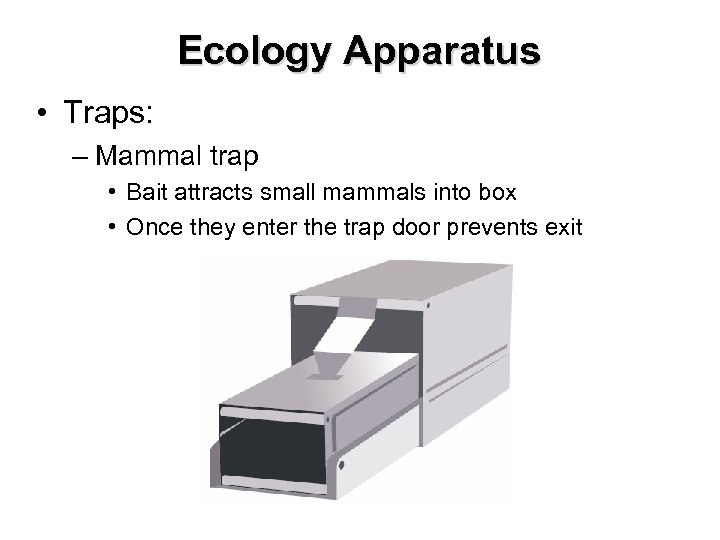 Ecology Apparatus • Traps: – Mammal trap • Bait attracts small mammals into box • Once they enter the trap door prevents exit
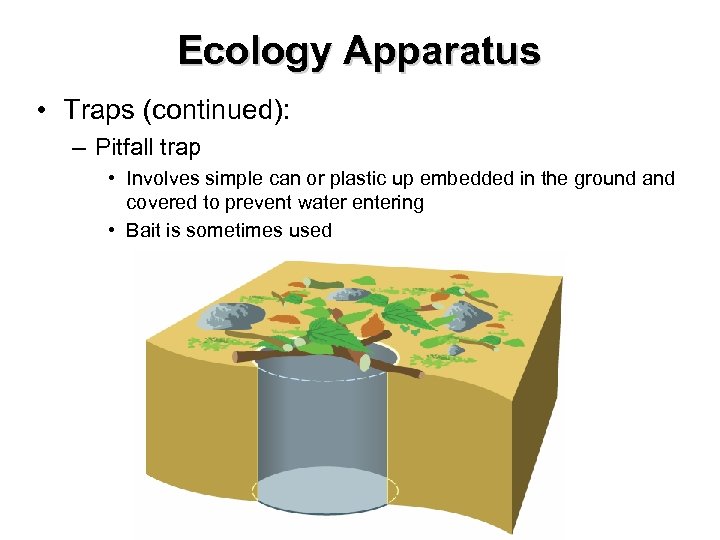 Ecology Apparatus • Traps (continued): – Pitfall trap • Involves simple can or plastic up embedded in the ground and covered to prevent water entering • Bait is sometimes used
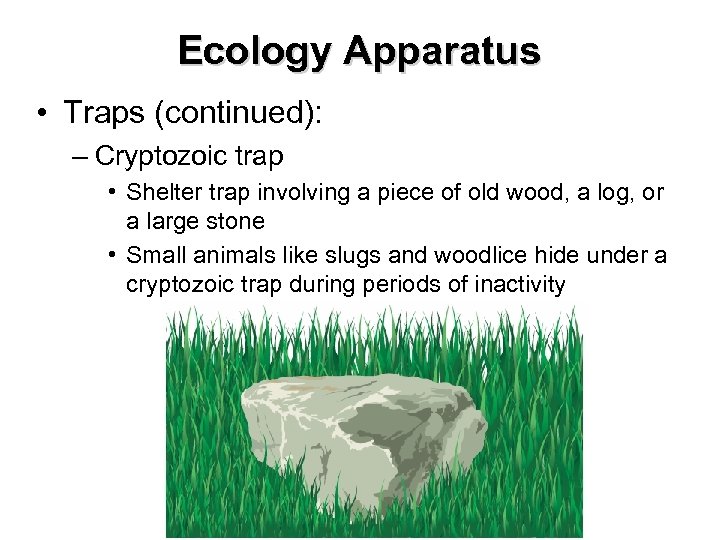 Ecology Apparatus • Traps (continued): – Cryptozoic trap • Shelter trap involving a piece of old wood, a log, or a large stone • Small animals like slugs and woodlice hide under a cryptozoic trap during periods of inactivity
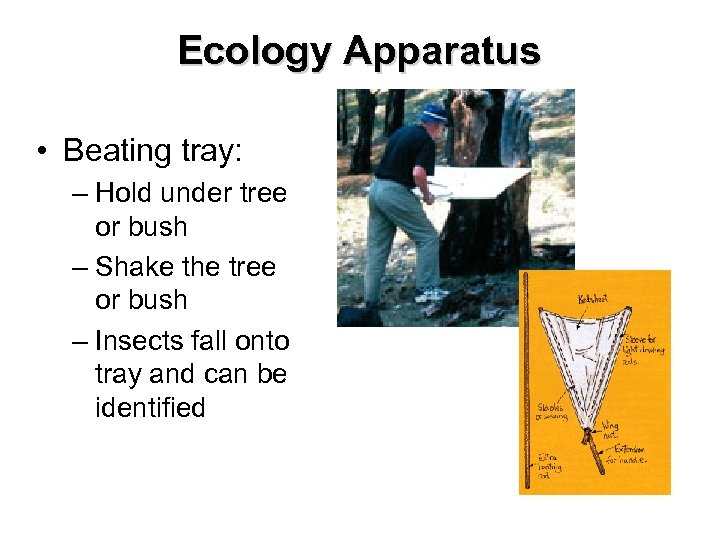 Ecology Apparatus • Beating tray: – Hold under tree or bush – Shake the tree or bush – Insects fall onto tray and can be identified
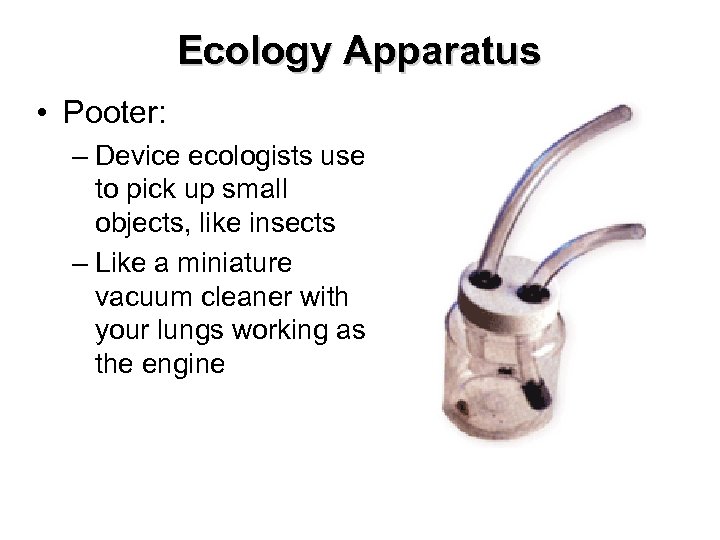 Ecology Apparatus • Pooter: – Device ecologists use to pick up small objects, like insects – Like a miniature vacuum cleaner with your lungs working as the engine
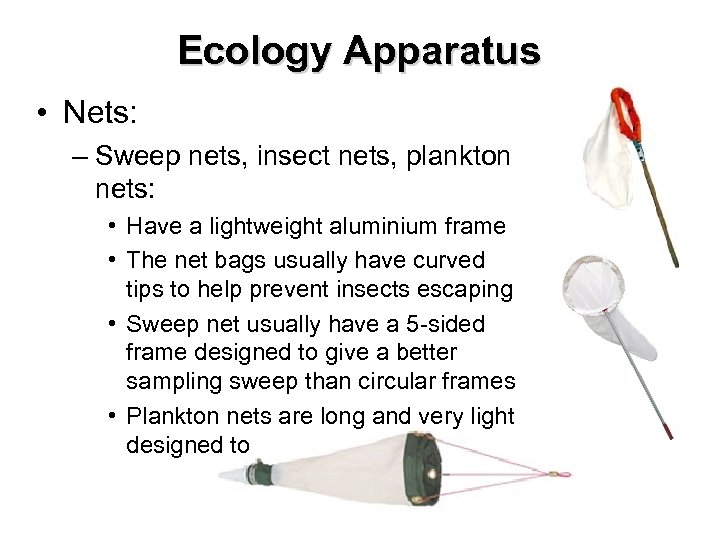 Ecology Apparatus • Nets: – Sweep nets, insect nets, plankton nets: • Have a lightweight aluminium frame • The net bags usually have curved tips to help prevent insects escaping • Sweep net usually have a 5 -sided frame designed to give a better sampling sweep than circular frames • Plankton nets are long and very light designed to
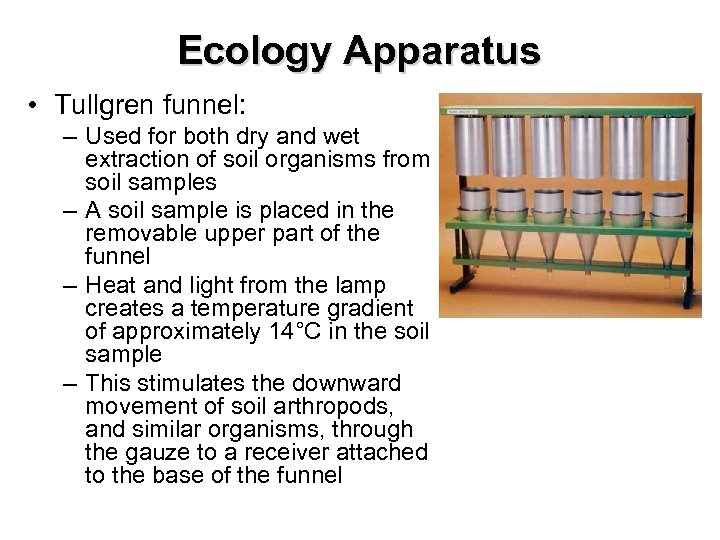 Ecology Apparatus • Tullgren funnel: – Used for both dry and wet extraction of soil organisms from soil samples – A soil sample is placed in the removable upper part of the funnel – Heat and light from the lamp creates a temperature gradient of approximately 14°C in the soil sample – This stimulates the downward movement of soil arthropods, and similar organisms, through the gauze to a receiver attached to the base of the funnel
 Organism Distribution • Use qualitative and quantitative surveys of plants and animals in your ecosystem – Qualitative survey: • Record of presence/absence of organism – Quantitative survey of flora and stationary/slow-moving fauna: • Subjective estimate – educated guess which is inaccurate • Objective estimate – accurate (two methods) – Quadrats – Transects
 Organism Distribution • Objective estimation: Quadrats – Squares with sides of either 1, 0. 5, or 0. 25 m – Thrown randomly in habitat over shoulder – Two measurements taken with quadrat: • Percentage cover: estimate of the ground in quadrat covered by each species of interest • Frequency: chance of finding a named species with any one throw of the quadrat – Limitations: • Animals can move fast and not remain in the quadrat • Limited by species size, e. g. trees and large animals
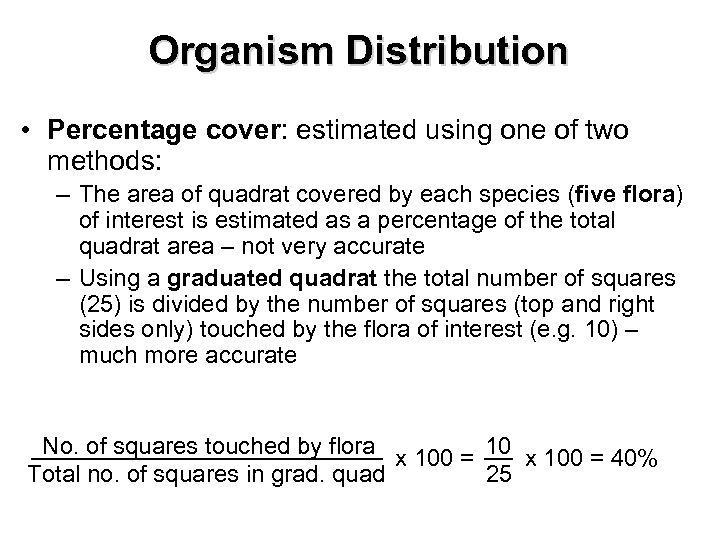 Organism Distribution • Percentage cover: estimated using one of two methods: – The area of quadrat covered by each species (five flora) of interest is estimated as a percentage of the total quadrat area – not very accurate – Using a graduated quadrat the total number of squares (25) is divided by the number of squares (top and right sides only) touched by the flora of interest (e. g. 10) – much more accurate No. of squares touched by flora 10 x 100 = 40% 25 Total no. of squares in grad. quad
 Organism Distribution • Frequency: chance of finding a named species with any throw – Record presence/absence of each species with each quadrat throw – no counting involved – This method is quick and percentages of organisms can be calculated easily – The more throws and frequency checks you do, the more accurate your end-frequency percentage results will be – Limitations: • Dependent on the organism size and quadrat size • Presumes that organisms are evenly distributed
 Organism Distribution • Transects: used in gradient habitats, e. g. seashore – Not random – you decide where to place the transect – Type 1: Line transect: • Plants/animals touching the string/rope (marked at regular intervals) are recorded • Limitations: only samples narrow strip of habitat – Type 2: Belt transect: • Two parallel ropes with squares made from 1 m lengths of ropes attaching the two main ropes together • Contents studied in same way as normal quadrats and graduated quadrats: percentage cover and frequency. • Limitations: same limitations as those of quadrats
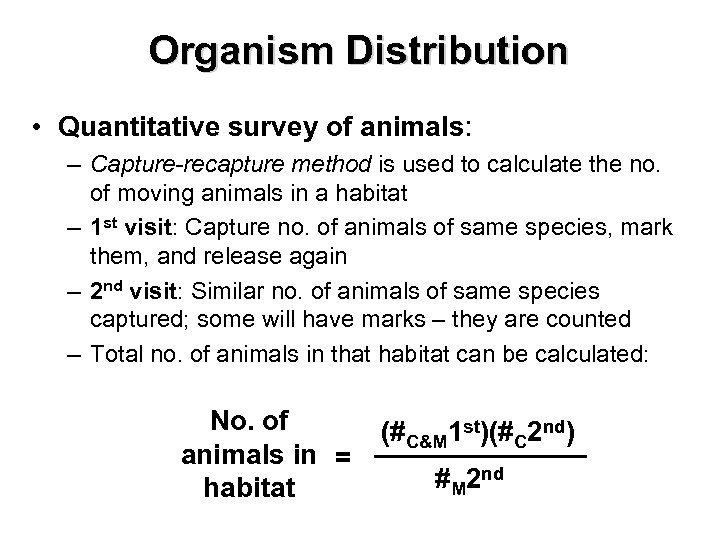 Organism Distribution • Quantitative survey of animals: – Capture-recapture method is used to calculate the no. of moving animals in a habitat – 1 st visit: Capture no. of animals of same species, mark them, and release again – 2 nd visit: Similar no. of animals of same species captured; some will have marks – they are counted – Total no. of animals in that habitat can be calculated: No. of animals in = habitat (#C&M 1 st)(#C 2 nd) #M 2 nd
 Organism Distribution • Quantitative survey of plants: – Use one of two methods: • Frequency: presence/absence recorded as a % • Percentage cover: approximate % of the area of the quadrat that is occupied by plant species OR the number of plants touching top and right sides of graduated quadrat
 Organism Distribution • Sources of error in studying an ecosystem: – Human error – especially when estimating frequency – Changing conditions – seasonal variations – Accidental discovery – by a walker instead of an ecologist – Sample size – more samples, better accuracy
 Experiment to conduct a quantitative study of plants and animals of a sample area of a selected ecosystem • LC HL 2006: – “Describe how you carried out a quantitative survey of a named animal in the ecosystem that you have studied. ”
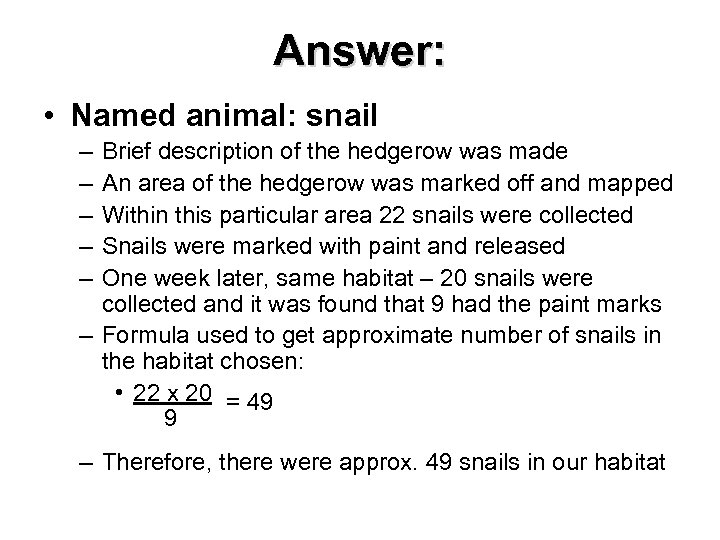 Answer: • Named animal: snail – – – Brief description of the hedgerow was made An area of the hedgerow was marked off and mapped Within this particular area 22 snails were collected Snails were marked with paint and released One week later, same habitat – 20 snails were collected and it was found that 9 had the paint marks – Formula used to get approximate number of snails in the habitat chosen: • 22 x 20 = 49 9 – Therefore, there were approx. 49 snails in our habitat
 Choice of Habitat • Study the effects of abiotic factors on the suitability of an organism to its habitat • You must study at least 3 abiotic factors: – p. H – percentage air in soil – temperature – percentage water in soil – light intensity – percentage humus – water current – salinity – air current – degree of exposure – dissolved oxygen – slope – mineral content • Then describe how each of the 3 you chose affects your ecosystem
 Organism Adaptations • Adaptations are necessary for an organism to survive new conditions • Adaptations may be structural, competitive, or behavioural • Describe ONE adaptation of an organism you studied in your habitat – Snail has a protective shell – Ladybird has a red covering to warn birds that it is poisonous to eat – Blackthorn has thorn to protect its fruits
 Organism Role in Energy Transfer • Identify where each organism in your habitat is positioned in the food chain/food web • From the data collected on your field trip construct a food chain, food web, and pyramid of numbers
 Analysis • Learn to analyse, assess, and discuss your results and conclusions • Is there any relationship between the results and conclusions of your study and local ecological issues • Prepare a portfolio/report/project (no less than 1, 000 words, no more than 2, 500 words)