 Скачать презентацию Chapter 5 Urbanization and Economic Situation Change Section
aa05dcb2aef98038b27a4d07406c29ac.ppt
- Количество слайдов: 29



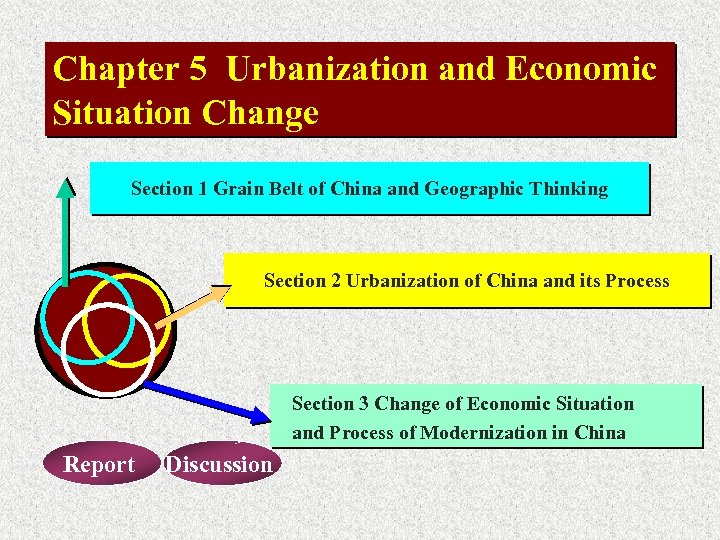
Chapter 5 Urbanization and Economic Situation Change Section 1 Grain Belt of China and Geographic Thinking Section 2 Urbanization of China and its Process Section 3 Change of Economic Situation and Process of Modernization in China Report Discussion
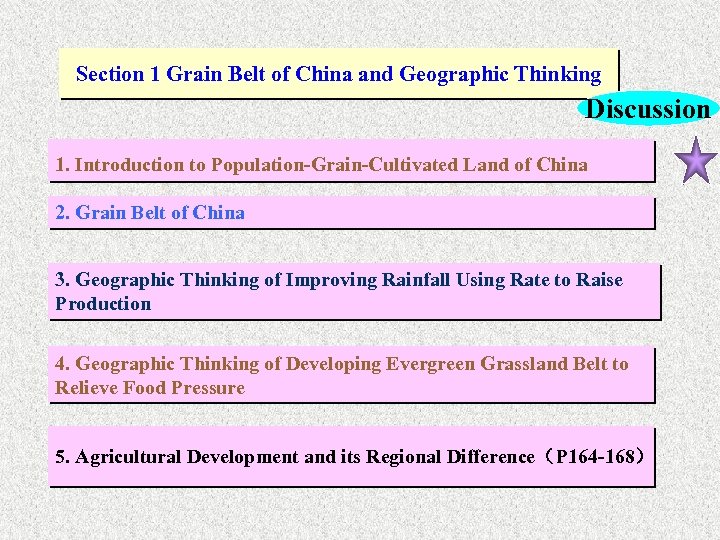
Section 1 Grain Belt of China and Geographic Thinking Discussion 1. Introduction to Population-Grain-Cultivated Land of China 2. Grain Belt of China 3. Geographic Thinking of Improving Rainfall Using Rate to Raise Production 4. Geographic Thinking of Developing Evergreen Grassland Belt to Relieve Food Pressure 5. Agricultural Development and its Regional Difference(P 164 -168)
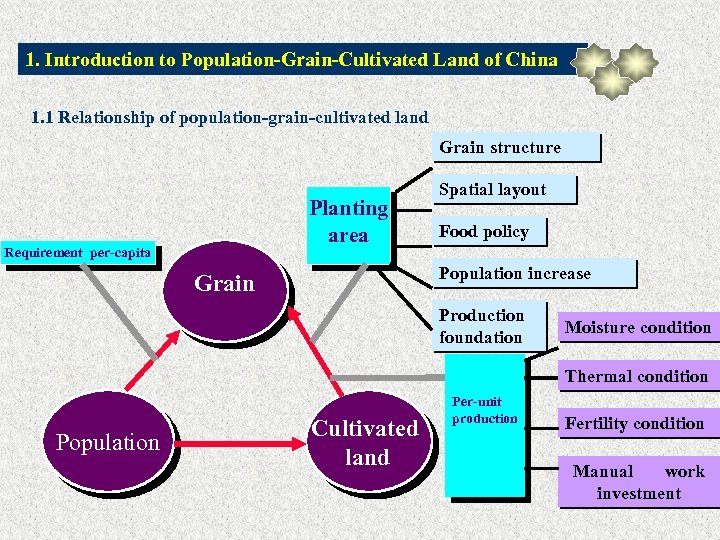
1. Introduction to Population-Grain-Cultivated Land of China 1. 1 Relationship of population-grain-cultivated land Grain structure Planting area Requirement per-capita Spatial layout Food policy Population increase Grain Production foundation Moisture condition Thermal condition Population Cultivated land Per-unit production Fertility condition Manual work investment
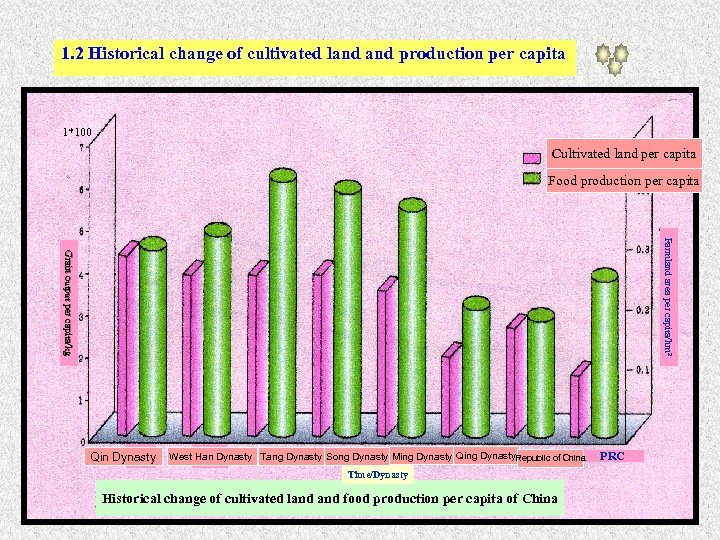
1. 2 Historical change of cultivated land production per capita 1*100 Cultivated land per capita Food production per capita Farmland area per capita/hm 2 Grain output per capita/kg Qin Dynasty West Xihan Han Dynasty Tang Dynasty Song Dynasty Ming Dynasty Qing Dynasty. Republic of China Time/Dynasty Historical change of cultivated land food production per capita of China PRC
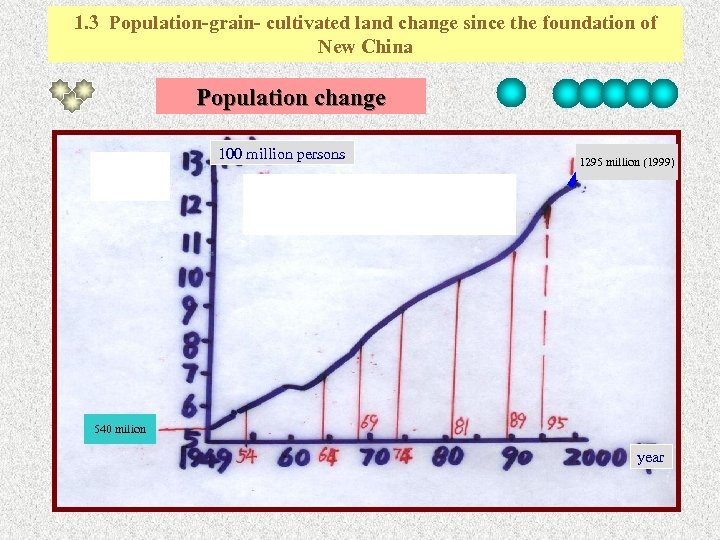
1. 3 Population-grain- cultivated land change since the foundation of New China Population change 100 million persons 1295 million (1999) 540 milion year
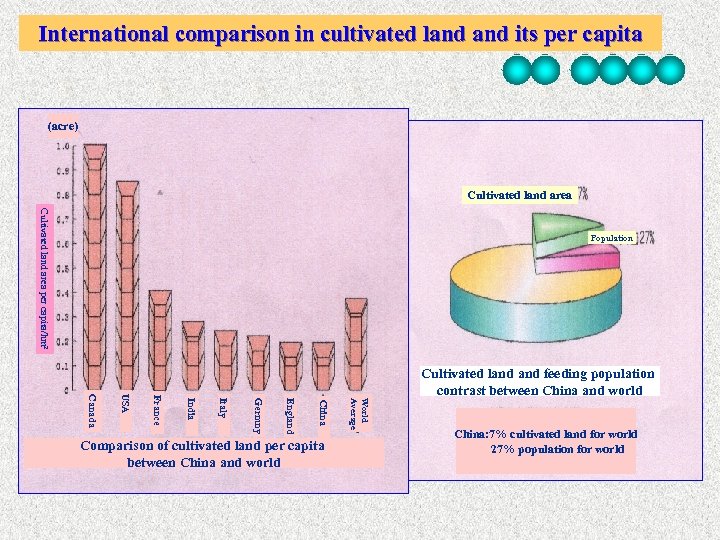
International comparison in cultivated land its per capita (acre) Cultivated land area per capita/hm 2 Population Comparison of cultivated land per capita between China and world World Average China England Germny Italy India France USA Canada Cultivated land feeding population contrast between China and world China: 7% cultivated land for world 27% population for world
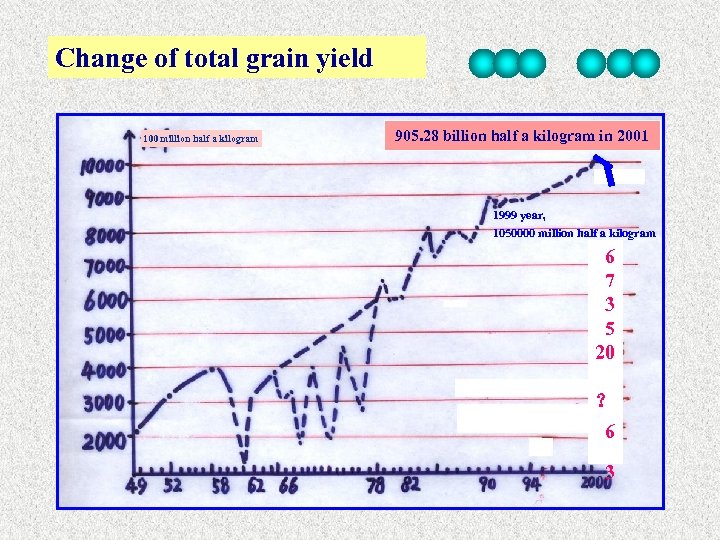
Change of total grain yield 100 million half a kilogram 905. 28 billion half a kilogram in 2001 1999 year, 1050000 million half a kilogram 6 7 3 5 20 ? 6 3
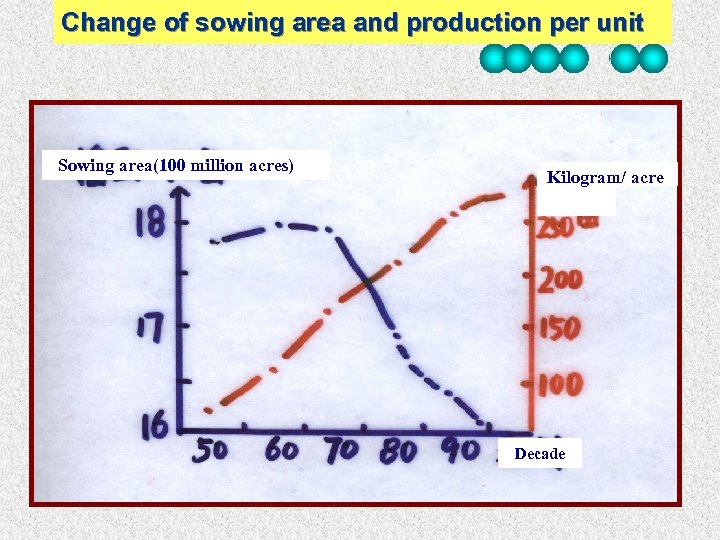
Change of sowing area and production per unit Sowing area(100 million acres) Kilogram/ acre Decade
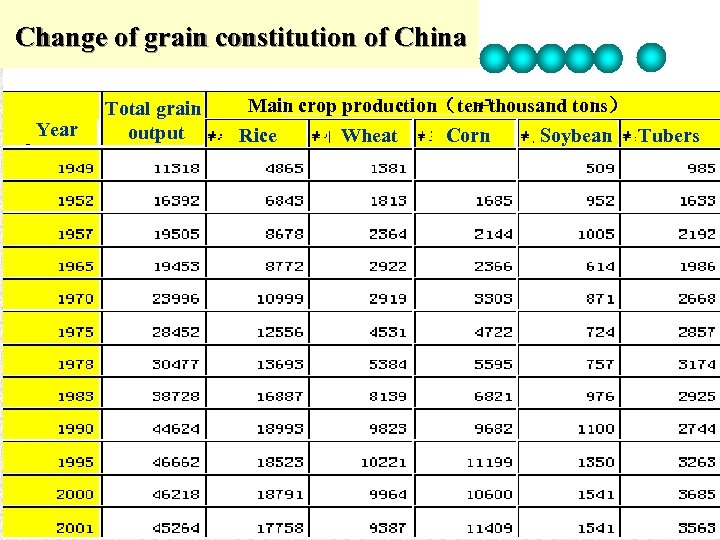
Change of grain constitution of China Year Total grain output Main crop production(ten thousand tons) Rice Wheat Corn Soybean Tubers
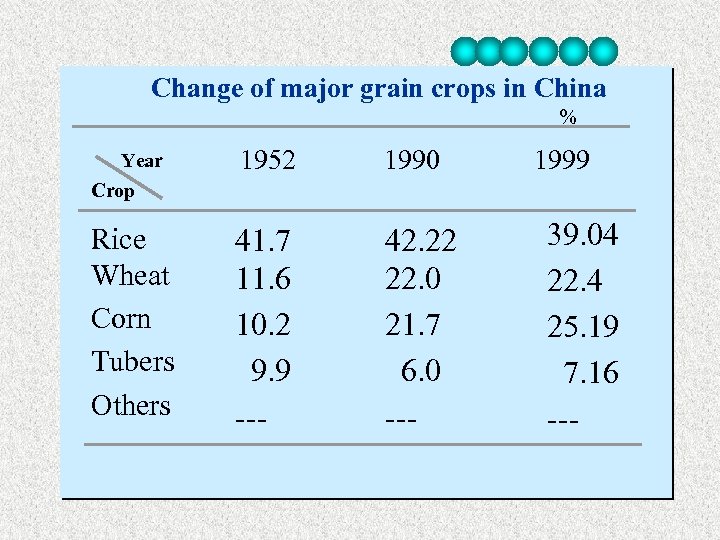
Change of major grain crops in China % Year Crop 1952 1990 Rice Wheat Corn Tubers Others 41. 7 11. 6 10. 2 9. 9 --- 42. 22 22. 0 21. 7 6. 0 --- 1999 39. 04 22. 4 25. 19 7. 16 ---
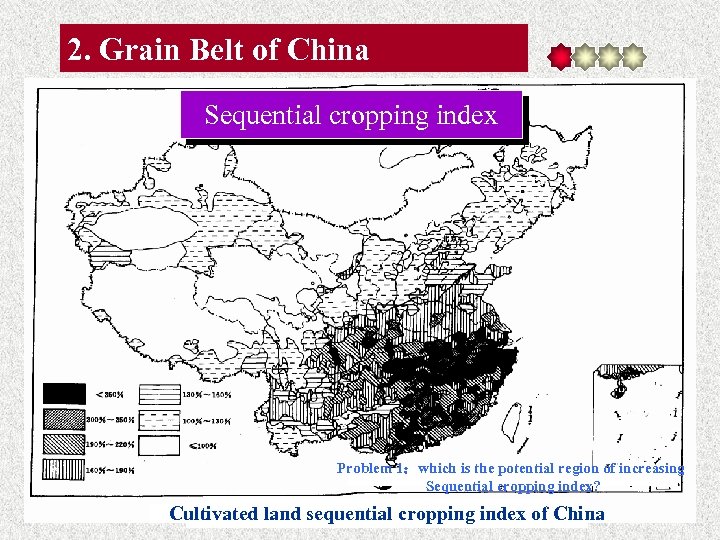
2. Grain Belt of China 复种指数 Sequential cropping index Problem 1:which is the potential region of increasing Sequential cropping index? Cultivated land sequential cropping index of China
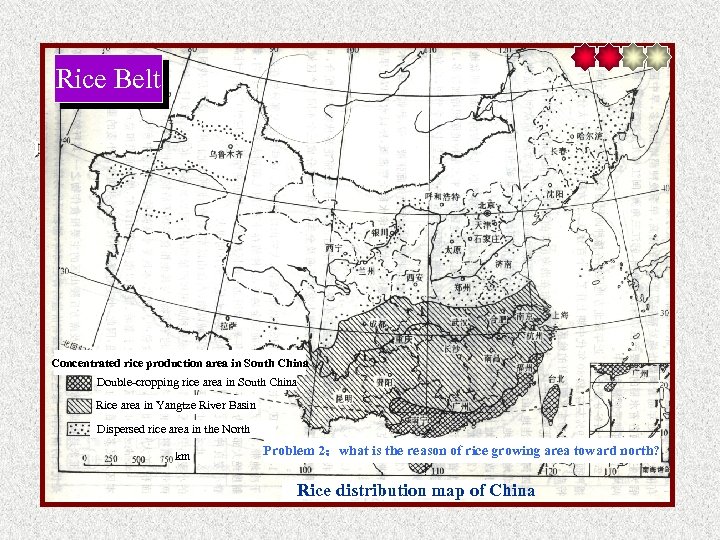
Rice Belt 中国粮食分布. 水稻 Concentrated rice production area in South China Double-cropping rice area in South China Rice area in Yangtze River Basin Dispersed rice area in the North km Problem 2:what is the reason of rice growing area toward north? Rice distribution map of China
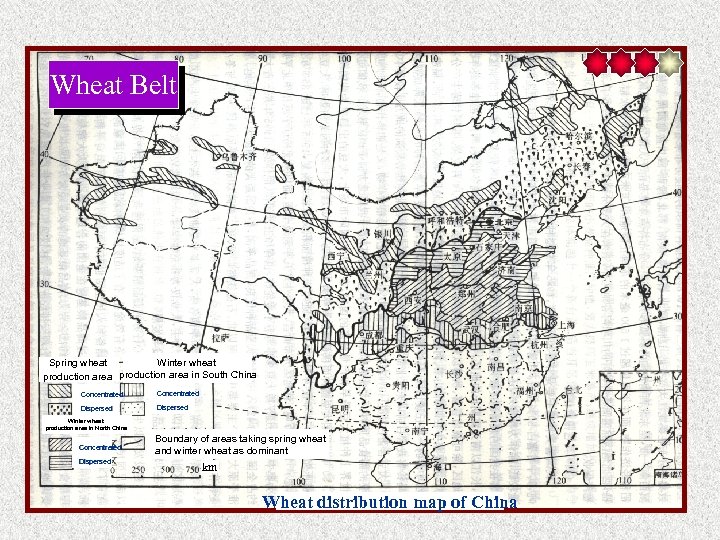
Wheat Belt Spring wheat Winter wheat production area in South China Concentrated Dispersed Winter wheat production area in North China Concentrated Dispersed Boundary of areas taking spring wheat and winter wheat as dominant km Wheat distribution map of China
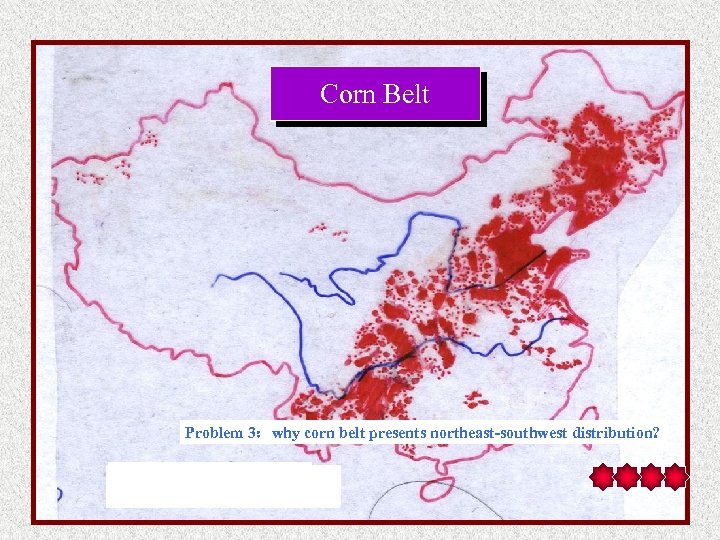
Corn Belt Problem 3:why corn belt presents northeast-southwest distribution?
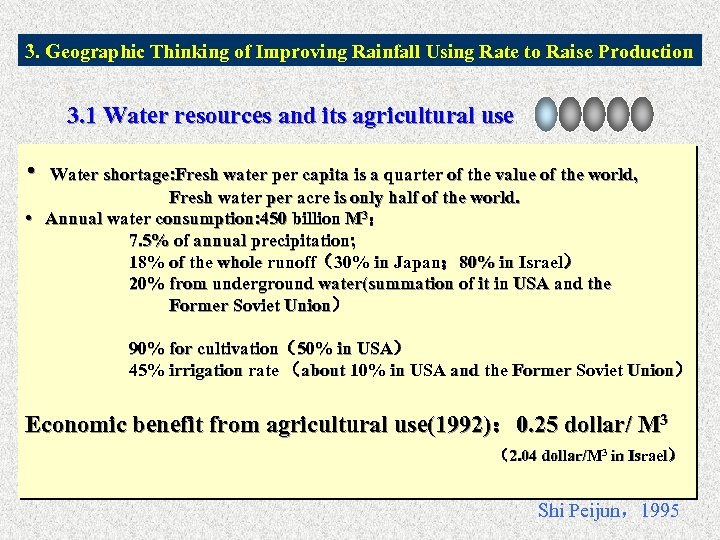
3. Geographic Thinking of Improving Rainfall Using Rate to Raise Production 3. 1 Water resources and its agricultural use • Water shortage: Fresh water per capita is a quarter of the value of the world, Fresh water per acre is only half of the world. • Annual water consumption: 450 billion M 3: 7. 5% of annual precipitation; 18% of the whole runoff(30% in Japan; 80% in Israel) 20% from underground water(summation of it in USA and the Former Soviet Union) 90% for cultivation(50% in USA) 45% irrigation rate (about 10% in USA and the Former Soviet Union) Economic benefit from agricultural use(1992): 0. 25 dollar/ M 3 (2. 04 dollar/M 3 in Israel) Shi Peijun,1995
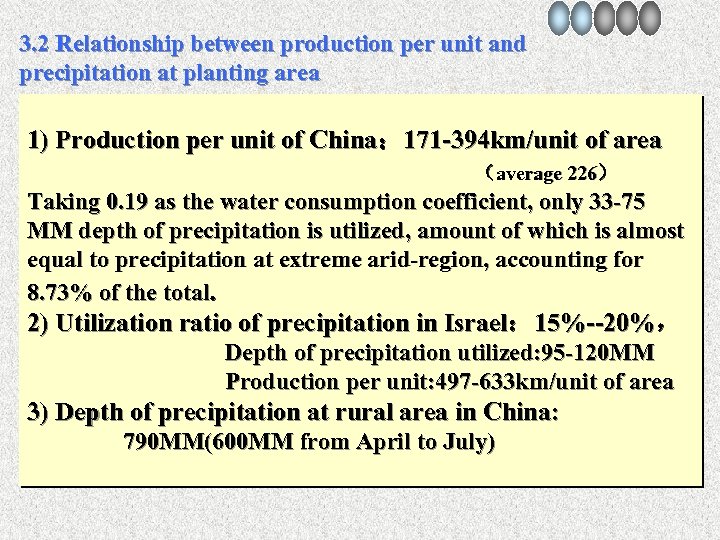
3. 2 Relationship between production per unit and precipitation at planting area 1) Production per unit of China: 171 -394 km/unit of area (average 226) Taking 0. 19 as the water consumption coefficient, only 33 -75 MM depth of precipitation is utilized, amount of which is almost equal to precipitation at extreme arid-region, accounting for 8. 73% of the total. 2) Utilization ratio of precipitation in Israel: 15%--20%, Depth of precipitation utilized: 95 -120 MM Production per unit: 497 -633 km/unit of area 3) Depth of precipitation at rural area in China: 790 MM(600 MM from April to July)
3. 3 Estimate of crop production increasing benefit by more investment into mid-low yield land Mid-west part:According to the eastern level of 300 kg/acre (sowing area), there will be 37. 22 billion kilograms increased at 90% of the sowing area at present. Eastern part: Ensure that the whole area have production at least 300 km/acre. As a result, there will be 26. 15 kilograms increased at 80% of the sowing area at present. Including: 2. 2 billion kilograms at southern provinces, 10. 07 billion kilograms at provinces between Yellow River and Yangtze River 7. 5 billion kilograms at northeast provinces. Those area with production more than 300 kg/acre rely on production increasing against loss from arable land decreasing, counting up to 63. 37 billion kg.
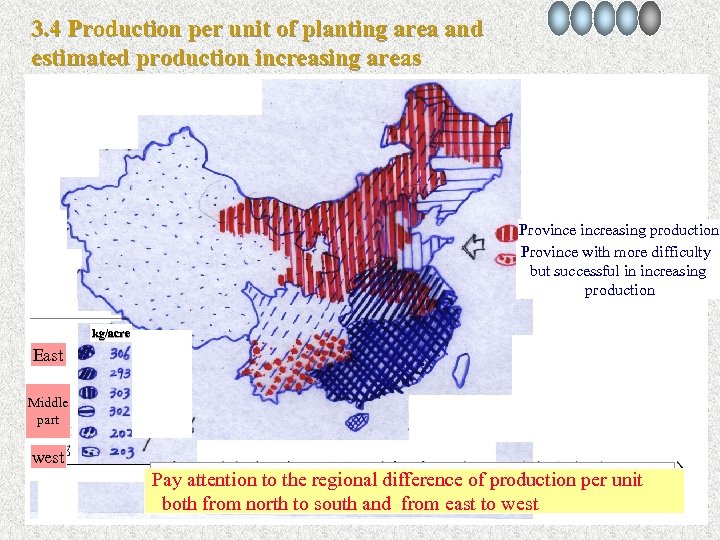
3. 4 Production per unit of planting area and estimated production increasing areas Province increasing production Province with more difficulty 人 but successful in increasing production kg/acre East 人 Middle part 口 west 注意:播种面积单产东西差异与南北差异的差异 Pay attention to the regional difference of production per unit both from north to south and from east to west
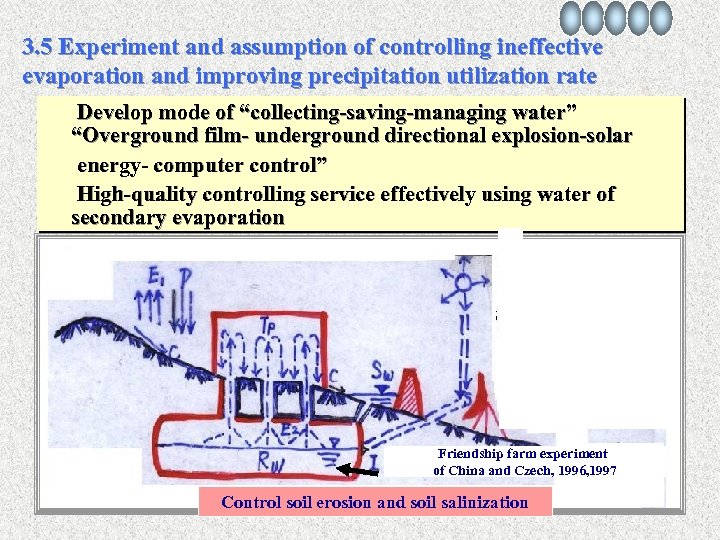
3. 5 Experiment and assumption of controlling ineffective evaporation and improving precipitation utilization rate Develop mode of “collecting-saving-managing water” “Overground film- underground directional explosion-solar energy- computer control” High-quality controlling service effectively using water of secondary evaporation Friendship farm experiment of China and Czech, 1996, 1997 Control soil erosion and soil salinization
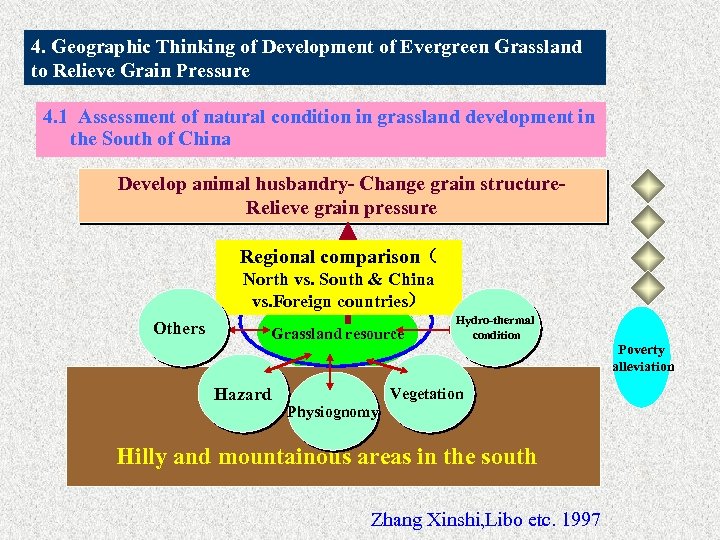
4. Geographic Thinking of Development of Evergreen Grassland to Relieve Grain Pressure 4. 1 Assessment of natural condition in grassland development in the South of China Develop animal husbandry- Change grain structure. Relieve grain pressure Regional comparison( North vs. South & China vs. Foreign countries) Others Grassland resource Hazard Hydro-thermal condition Vegetation Physiognomy Hilly and mountainous areas in the south Zhang Xinshi, Libo etc. 1997 Poverty alleviation
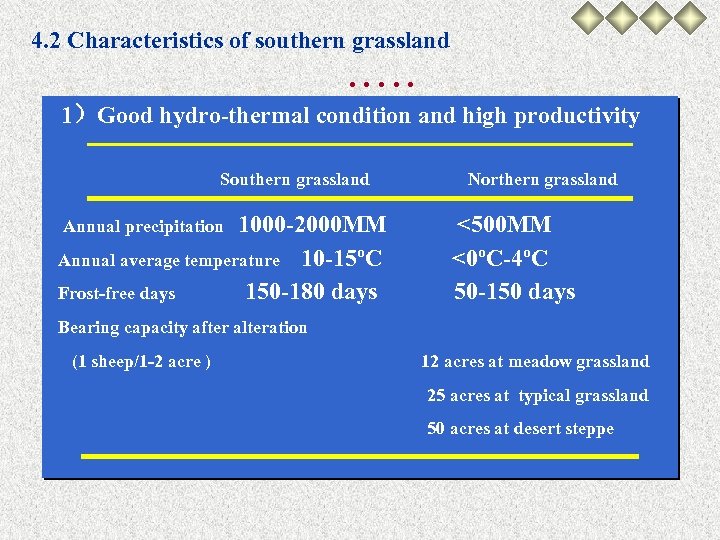
4. 2 Characteristics of southern grassland ····· 1)Good hydro-thermal condition and high productivity Southern grassland 1000 -2000 MM Annual average temperature 10 -15ºC Frost-free days 150 -180 days Annual precipitation Northern grassland <500 MM <0ºC-4ºC 50 -150 days Bearing capacity after alteration (1 sheep/1 -2 acre ) 12 acres at meadow grassland 25 acres at typical grassland 50 acres at desert steppe
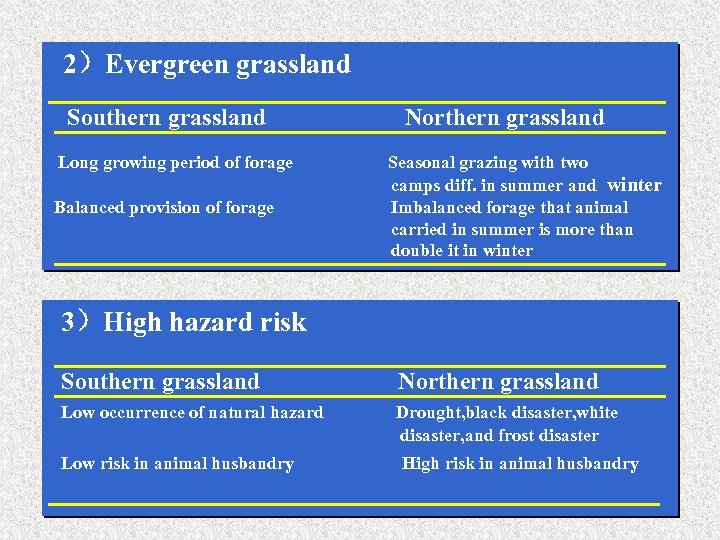
2)Evergreen grassland Southern grassland Long growing period of forage Balanced provision of forage Northern grassland Seasonal grazing with two camps diff. in summer and winter Imbalanced forage that animal carried in summer is more than double it in winter 3)High hazard risk Southern grassland Northern grassland Low occurrence of natural hazard Drought, black disaster, white disaster, and frost disaster Low risk in animal husbandry High risk in animal husbandry
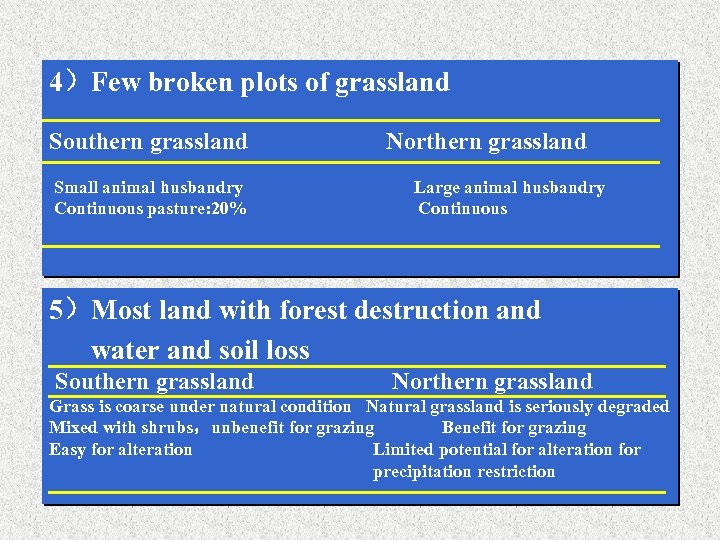
4)Few broken plots of grassland Southern grassland Small animal husbandry Continuous pasture: 20% Northern grassland Large animal husbandry Continuous 5)Most land with forest destruction and water and soil loss Southern grassland Northern grassland Grass is coarse under natural condition Natural grassland is seriously degraded Mixed with shrubs,unbenefit for grazing Benefit for grazing Easy for alteration Limited potential for alteration for precipitation restriction
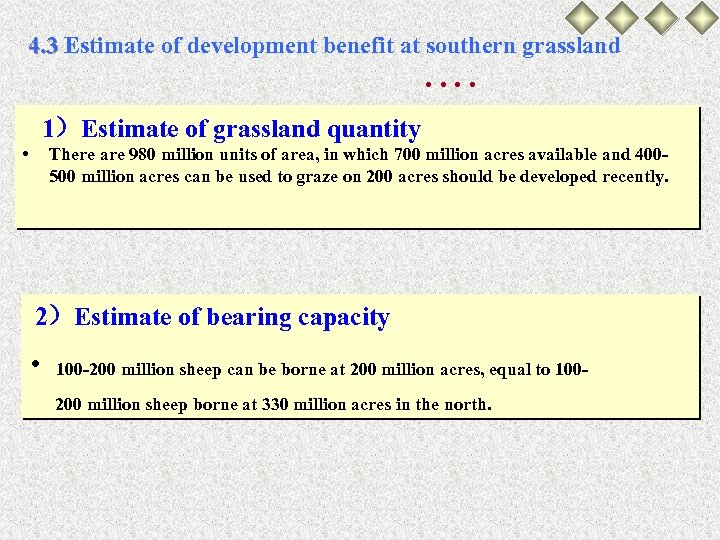
4. 3 Estimate of development benefit at southern grassland ···· 1)Estimate of grassland quantity • There are 980 million units of area, in which 700 million acres available and 400500 million acres can be used to graze on 200 acres should be developed recently. 2)Estimate of bearing capacity • 100 -200 million sheep can be borne at 200 million acres, equal to 100200 million sheep borne at 330 million acres in the north.
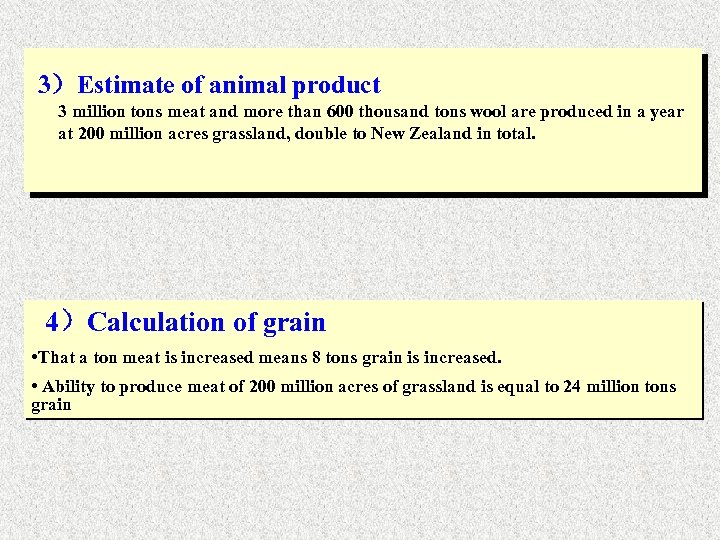
3)Estimate of animal product 3 million tons meat and more than 600 thousand tons wool are produced in a year at 200 million acres grassland, double to New Zealand in total. 4)Calculation of grain • That a ton meat is increased means 8 tons grain is increased. • Ability to produce meat of 200 million acres of grassland is equal to 24 million tons grain
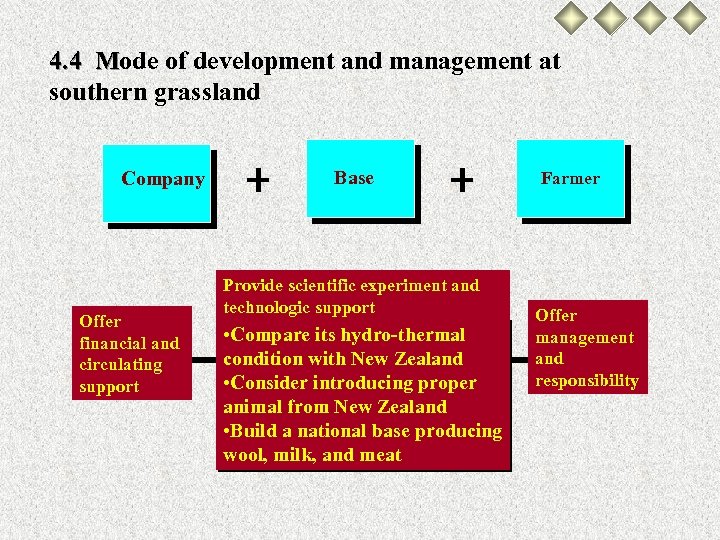
4. 4 Mode of development and management at southern grassland Company Offer financial and circulating support + Base + Provide scientific experiment and technologic support • Compare its hydro-thermal condition with New Zealand • Consider introducing proper animal from New Zealand • Build a national base producing wool, milk, and meat Farmer Offer management and responsibility
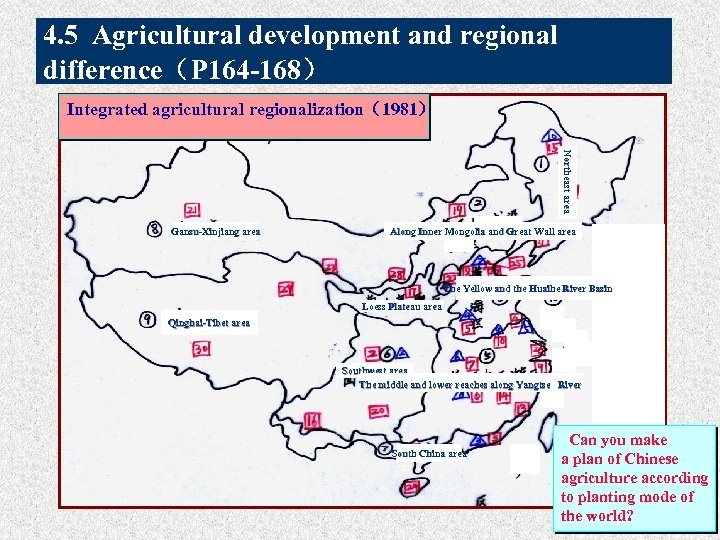
4. 5 Agricultural development and regional difference(P 164 -168) Integrated agricultural regionalization(1981) Northeast area Gansu-Xinjiang area Gansu- Along Inner Mongolia and Great Wall area The Yellow and the Huaihe River Basin Loess Plateau area Qinghai-Tibet Southwest area The middle and lower reaches along Yangtse River South China area Can you make a plan of Chinese agriculture according to planting mode of the world?
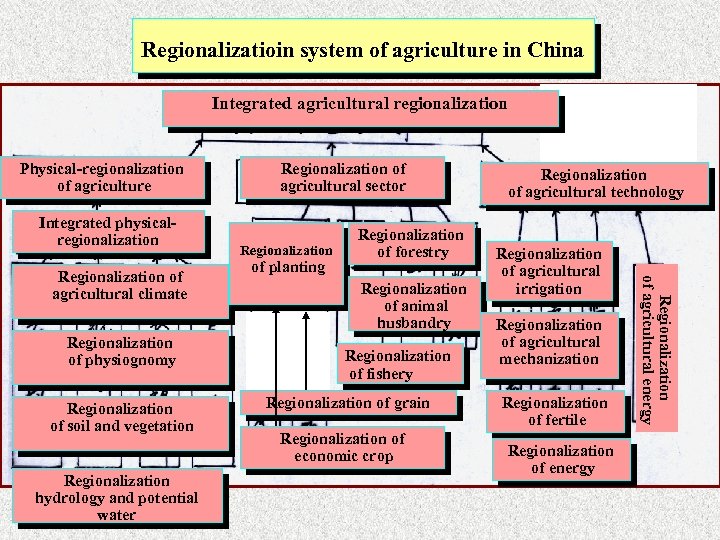
Regionalizatioin system of agriculture in China Integrated agricultural regionalization Physical-regionalization of agriculture Integrated physicalregionalization Regionalization of physiognomy Regionalization of soil and vegetation Regionalization hydrology and potential water Regionalization of planting Regionalization of forestry Regionalization of animal husbandry Regionalization of fishery Regionalization of grain Regionalization of economic crop Regionalization of agricultural technology Regionalization of agricultural irrigation Regionalization of agricultural mechanization Regionalization of fertile Regionalization of energy Regionalization of agricultural climate Regionalization of agricultural sector
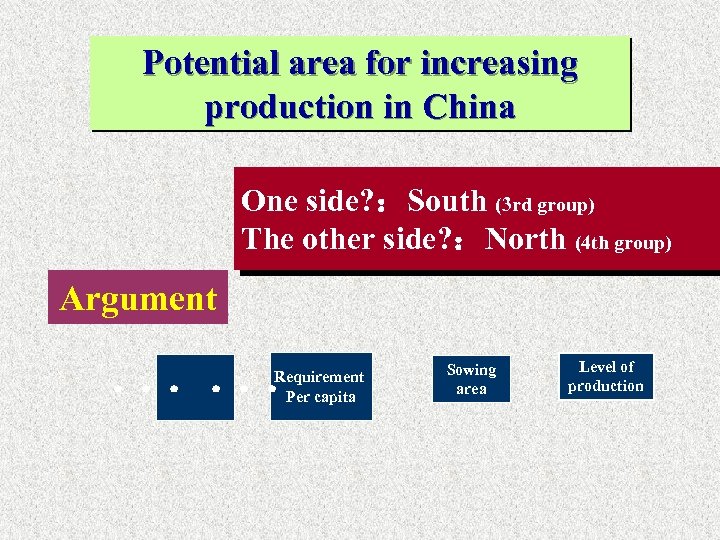
Potential area for increasing production in China One side? :South (3 rd group) The other side? :North (4 th group) Argument Requirement Per capita ··· Sowing area Level of production
Скачать презентацию Chapter 5 Urbanization and Economic Situation Change Section
aa05dcb2aef98038b27a4d07406c29ac.ppt