


 Скачать презентацию Chapter 5 The Presidency Mr Cawthon Copyright
31033444d4baa57127641e9bd75a8ddf.ppt
- Количество слайдов: 29
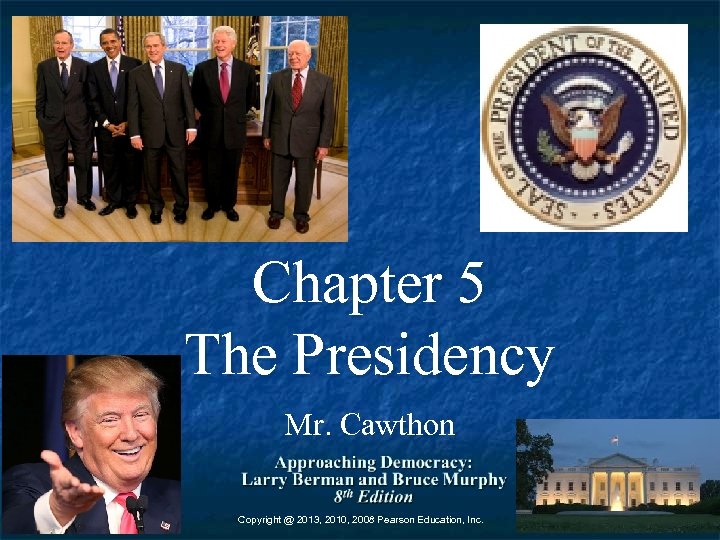 Chapter 5 The Presidency Mr. Cawthon Copyright @ 2013, 2010, 2008 Pearson Education, Inc.
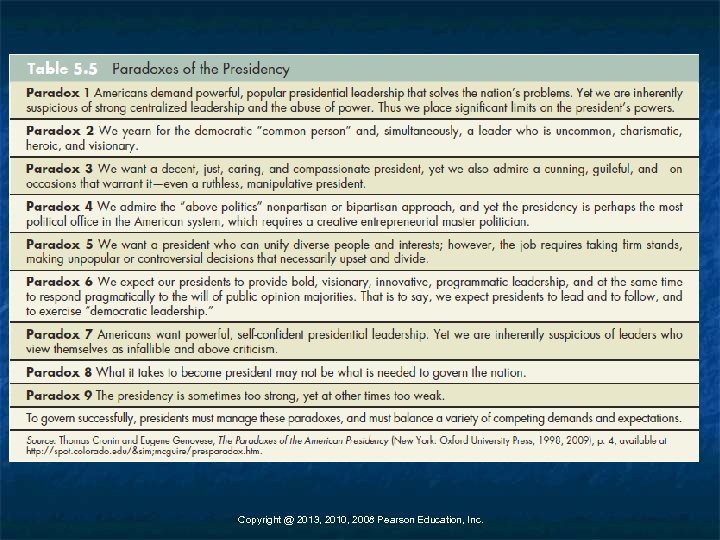
 Learning Objectives n The Presidency and Democracy n 5. 1 How did the framers design a system with an energetic executive to forward the democratic will and, at the same time, protect against antidemocratic tendencies of a single executive? n The Constitutional Design n 5. 2 Why were the framers vague in the description of presidential powers described in the Constitution, and how did this vagueness shape the powers of the president over time? n Functional Roles of the President n 5. 3. How do the roles and responsibilities of the presidency create the paradoxes of the presidency, and how do these paradoxes make it difficult for any president to succeed? n Two Views of Executive Power n 5. 4 What is the key difference between the constructionist and stewardship view of the presidency, and why have modern presidents viewed themselves as stewards? Copyright @ 2013, 2010, 2008 Pearson Education, Inc.
 Learning Objectives n Expanding Presidential Power: Moving Beyond the Constitution n n The Power to Persuade n n 5. 5 How have the powers of the presidency expanded over time, and what factors might explain this expansion? 5. 6 How does a modern president persuade both Congress and the public to go along with his or her agenda? The Institutionalized Presidency n 5. 7 How has the presidential staff grown over time, and how do those who serve the president assist in the day-to-day duties of the office? Copyright @ 2013, 2010, 2008 Pearson Education, Inc.
 L. O. 5. 1 The Presidency and Democracy n Alexander Hamilton identified basic elements in the Constitutional design of the Presidency: Federalist no. 70 (read excerpt pg. 151) Unitary: Centered on one individual executive n Selection by independent body of electors n Fixed term of office (4 yrs) with possibility of reelection n Veto power n Independent executive action permitted n Copyright @ 2013, 2010, 2008 Pearson Education, Inc.
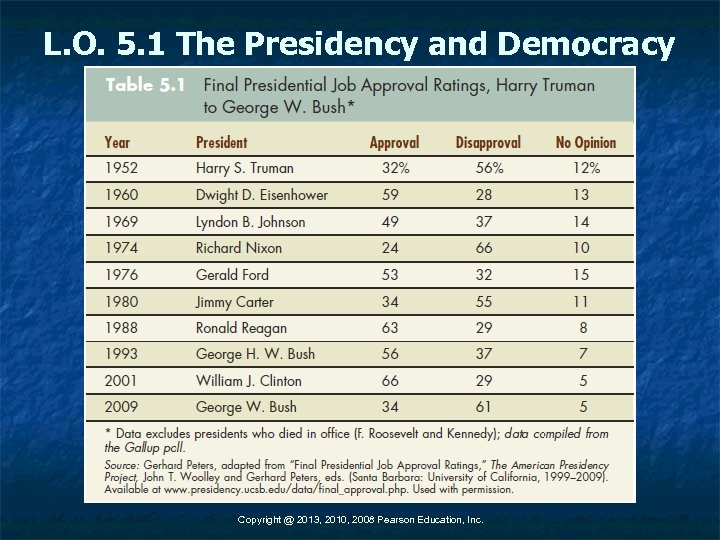 L. O. 5. 1 The Presidency and Democracy Copyright @ 2013, 2010, 2008 Pearson Education, Inc.
 L. O. 5. 2 The Constitutional Design *Only the most stable personality can accept the highs and lows with patience and perform the job with integrity. *The office is one of a paradox of power in one office while promoting the ideals of democracy. n Who Can Be President? You Must be: be at least 35 years old n have lived in the U. S. for at least 14 years n be a natural-born citizen n Copyright @ 2013, 2010, 2008 Pearson Education, Inc.
 5. 2 Constitutional Design n In creating a source of power independent of the Congress but capable of balancing its powers, the framers based the presidency on 7 key principles: pg. 152 n 1. Single presidency: Individual not a cabinet/council n 2. Neither Congress nor the people would elect the president. An independent body of individual electors selected by the state legislatures (electoral college), independent of Congress and the popular vote. It takes a majority 270 of the 538 total electoral votes to win the presidency. Copyright @ 2013, 2010, 2008 Pearson Education, Inc.
 7 Key Principles (continued) n After the November election, members of the electoral college meet to cast their ballots. The votes are sent on to Congress, which tallies the vote and then makes it official. n The candidate who wins the popular vote doesn't always win the election. In the year 2000, more Americans voted for Vice President Al Gore, but George W. Bush had more electoral votes, so he prevailed and won the presidency. Also, Donald Trump currently trails Hillary Clinton in the 2016 popular vote based on polling data. Copyright @ 2013, 2010, 2008 Pearson Education, Inc.
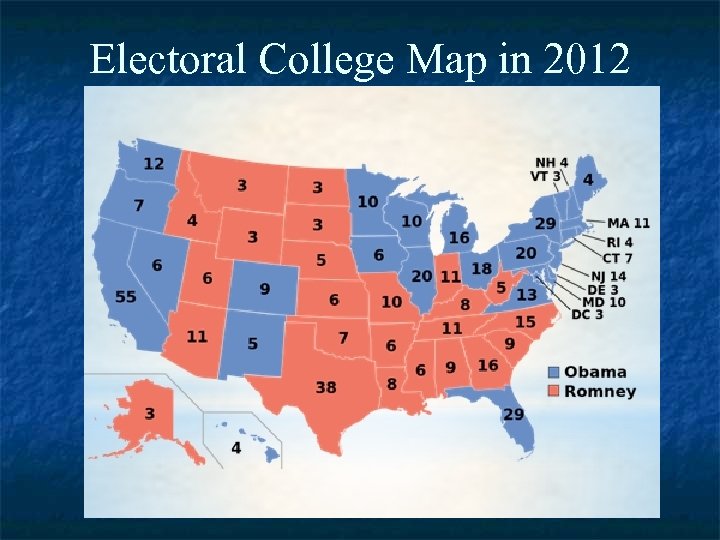 Electoral College Map in 2012
 7 Key Principles (continued) n 3. Fixed term: give stability and constraint n 4. Would be eligible for more than one term, currently restricted to two terms by the 22 nd amendment. n 5. Can be removed by a process of impeachment involving both houses of Congress n 6. Given veto power: enabling the executive to say no to Congress n 7. Not required to appoint an advisory council, allowed to act on his own
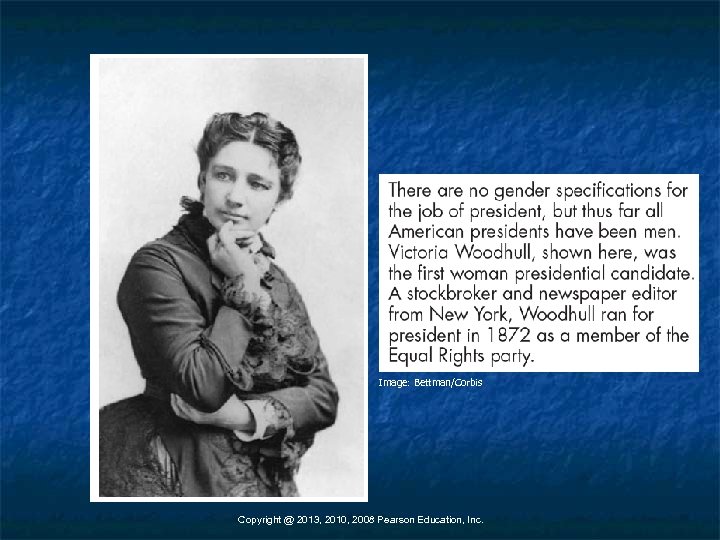 Image: Bettman/Corbis Copyright @ 2013, 2010, 2008 Pearson Education, Inc.
 L. O. 5. 2 The Constitutional Design n Presidential Powers n 1. Veto power When legislation goes to the President there are 4 options: n *sign the bill n *do nothing, allows the bill to become law without his signature n *pocket veto (definition on pg. 154) n *veto the bill with a message of why it was rejected n Signing statements-written proclamations issued by presidents regarding how they intend to interpret a new law.
 n 2. Appointment power: staff the executive branch with trusted allies n 3. Treaty power-negotiate treaties (formal international agreements between sovereign states) with other nations. Examples on pg. 157 n Executive agreements-diplomatic contracts negotiated with other countries that have the legal force of a treaty but don’t require Senate approval or knowledge of.
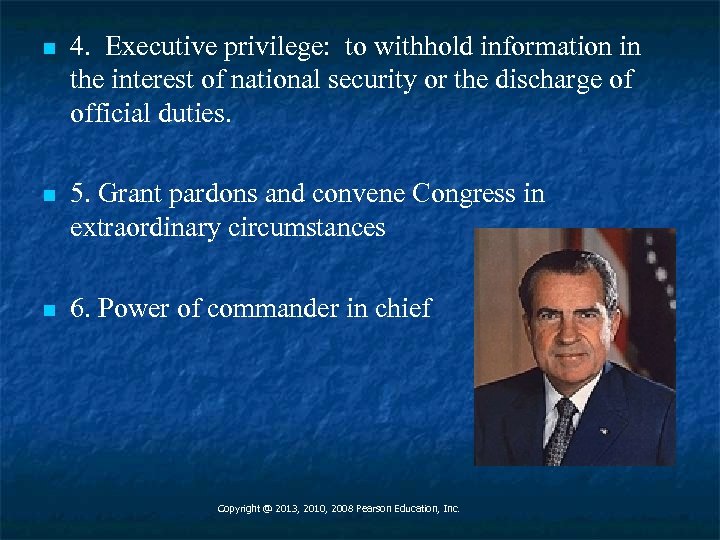 n 4. Executive privilege: to withhold information in the interest of national security or the discharge of official duties. n 5. Grant pardons and convene Congress in extraordinary circumstances n 6. Power of commander in chief Copyright @ 2013, 2010, 2008 Pearson Education, Inc.
 L. O. 5. 3 Roles of the President Chief of State Chief Administrator • The ceremonial head of the gov’t of the U. S. , the symbol of all the people of the nation. Reigns and rules. (awarding medals, patriotic speeches, congratulating astronauts, greeting visitors to the White House) • The President is the chief administrator, or director, of the United States government. Manage the 2. 7 million employees in branch. (manage the 15 executive departments) Chief Executive Chief Diplomat • The Constitution vests the President with “the executive Power” of the which is immensely broad in domestic and foreign affairs. The “most powerful office in the world. ” (appoint cabinet members, pardon criminals, executive orders) • The President is the main architect of American foreign policy and chief spokesperson to the rest of the world (meeting with world leaders, treaties).
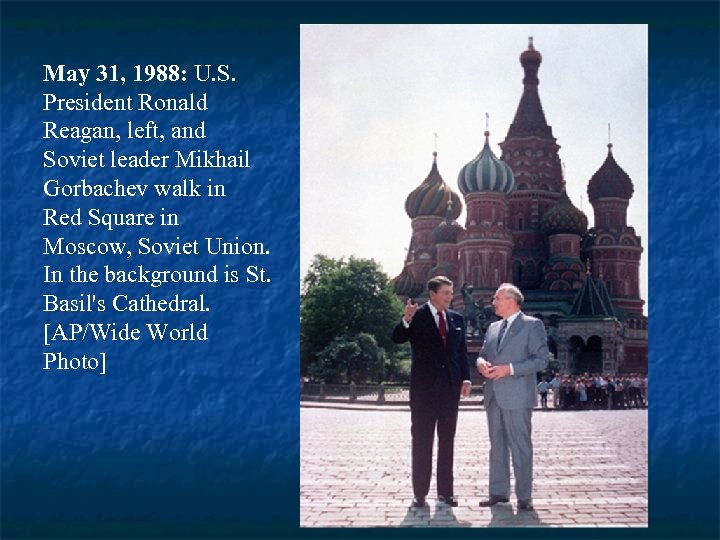 May 31, 1988: U. S. President Ronald Reagan, left, and Soviet leader Mikhail Gorbachev walk in Red Square in Moscow, Soviet Union. In the background is St. Basil's Cathedral. [AP/Wide World Photo]
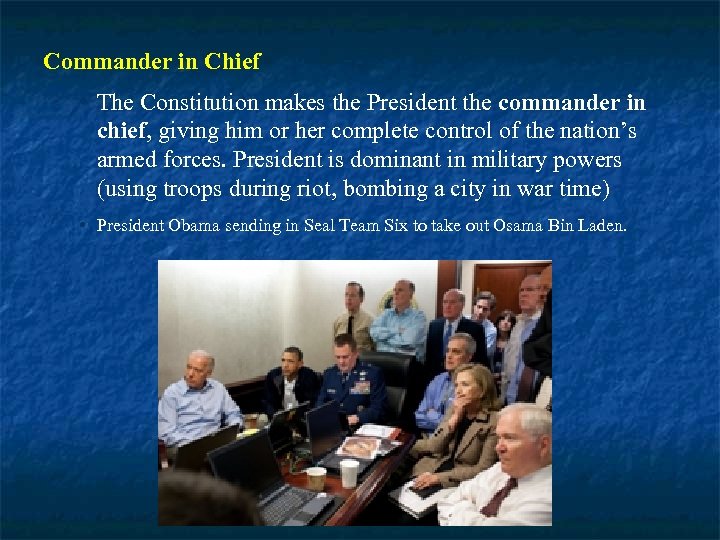 Commander in Chief • The Constitution makes the President the commander in chief, giving him or her complete control of the nation’s armed forces. President is dominant in military powers (using troops during riot, bombing a city in war time) • President Obama sending in Seal Team Six to take out Osama Bin Laden.
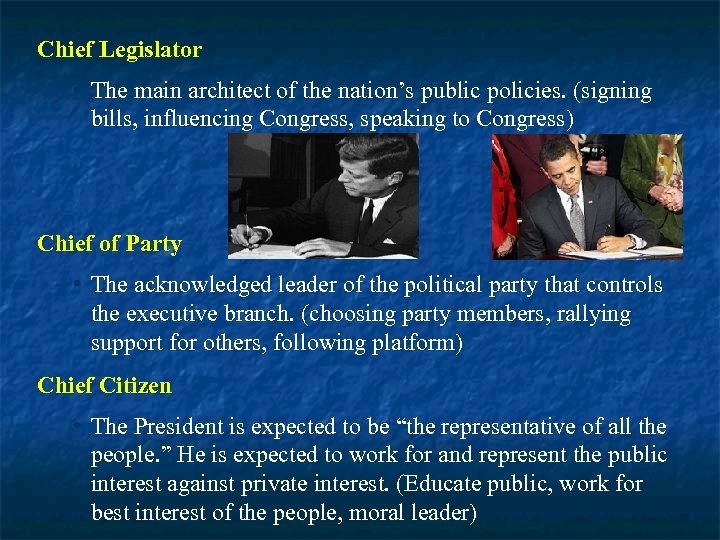 Chief Legislator • The main architect of the nation’s public policies. (signing bills, influencing Congress, speaking to Congress) Chief of Party • The acknowledged leader of the political party that controls the executive branch. (choosing party members, rallying support for others, following platform) Chief Citizen • The President is expected to be “the representative of all the people. ” He is expected to work for and represent the public interest against private interest. (Educate public, work for best interest of the people, moral leader)
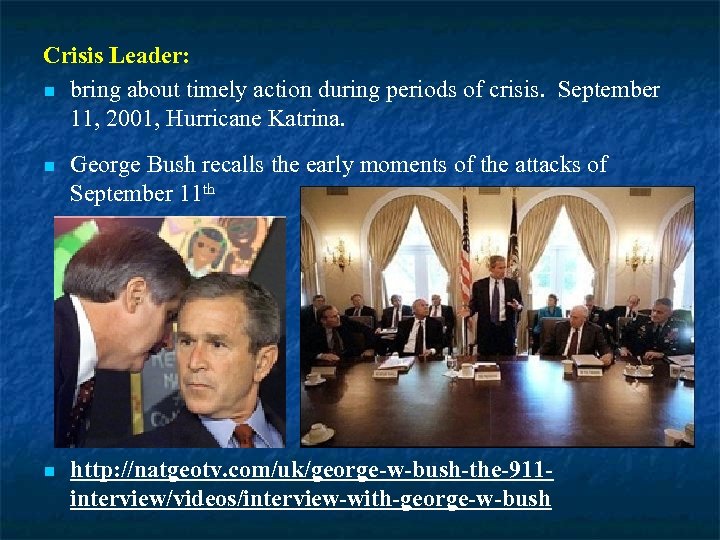 Crisis Leader: n bring about timely action during periods of crisis. September 11, 2001, Hurricane Katrina. n George Bush recalls the early moments of the attacks of September 11 th n http: //natgeotv. com/uk/george-w-bush-the-911 interview/videos/interview-with-george-w-bush
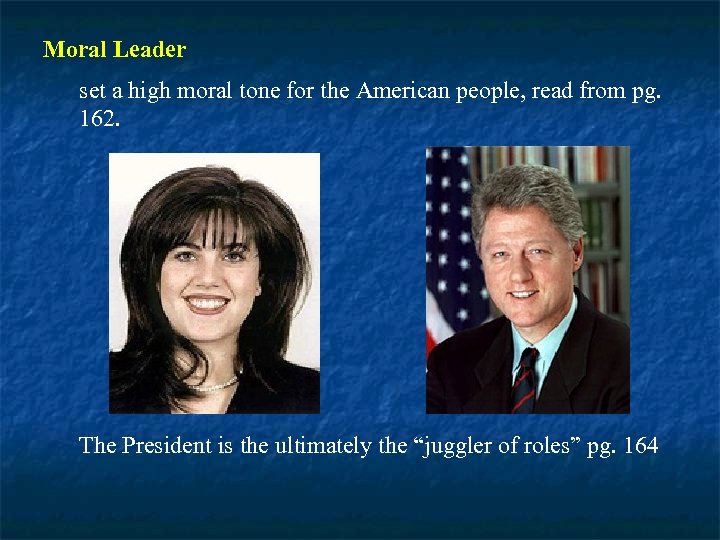 Moral Leader set a high moral tone for the American people, read from pg. 162. The President is the ultimately the “juggler of roles” pg. 164
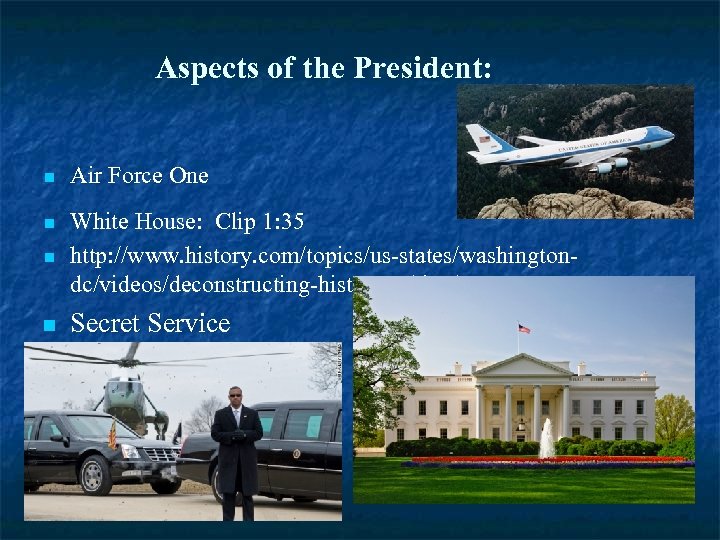 Aspects of the President: n Air Force One n n White House: Clip 1: 35 http: //www. history. com/topics/us-states/washingtondc/videos/deconstructing-history-white-house n Secret Service
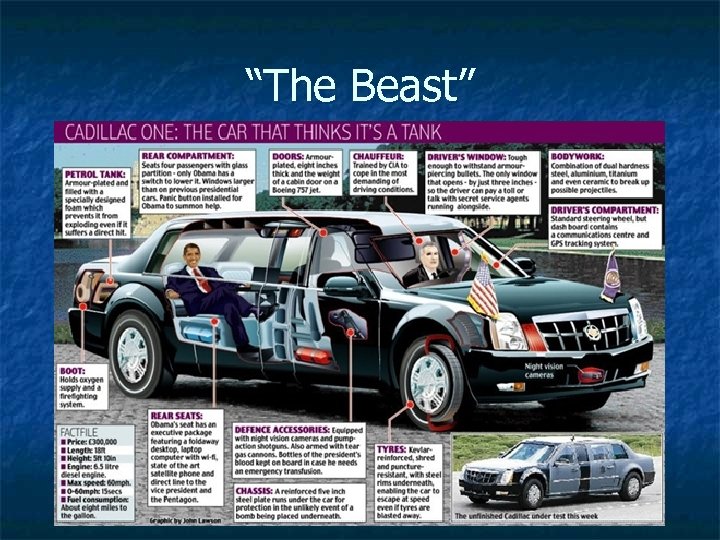 “The Beast”
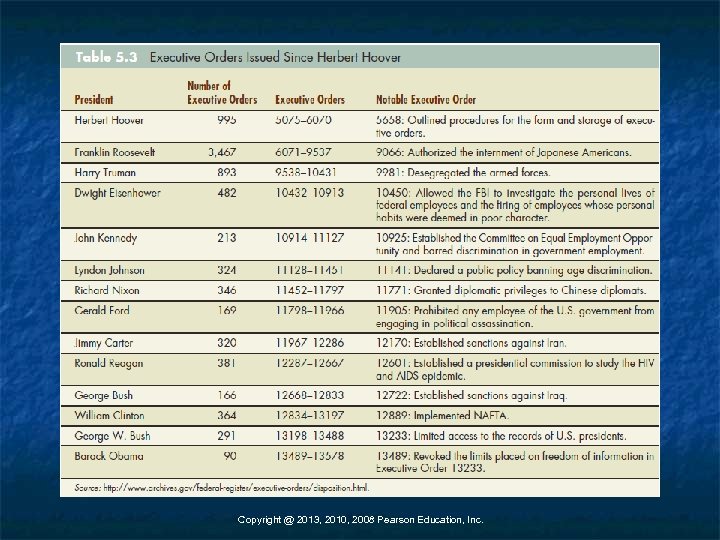 Copyright @ 2013, 2010, 2008 Pearson Education, Inc.
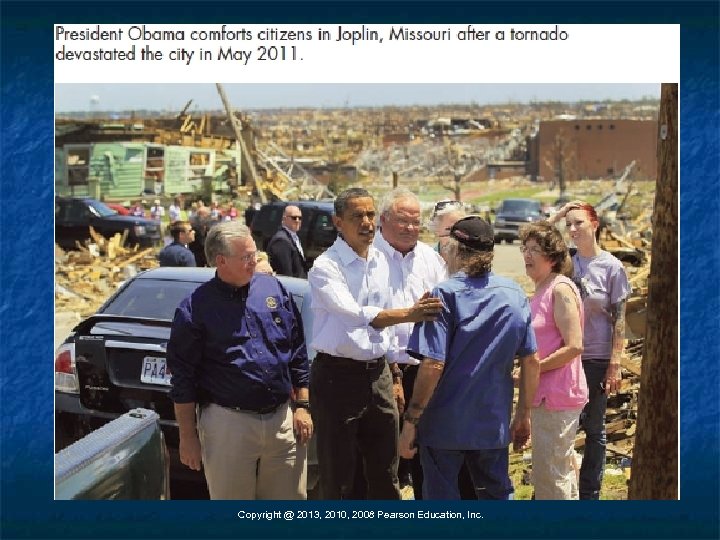 Copyright @ 2013, 2010, 2008 Pearson Education, Inc.
 L. O. 5. 4 Two Views of Executive Power n stewardship view—President has a moral duty to serve popular interests, regardless of specific constitutional or legal authority/ n *Thomas Jefferson and the Louisiana Purchase n *Abe Lincoln during the Civil War taking quick action on national issues due to crisis. n *Woodrow Wilson during WWI, commandeering mine and plants, price fixing, requisitioning supplies n constructionist view—President exercises no power unless granted by the Constitution or Congress. Hoover during Great Depression.
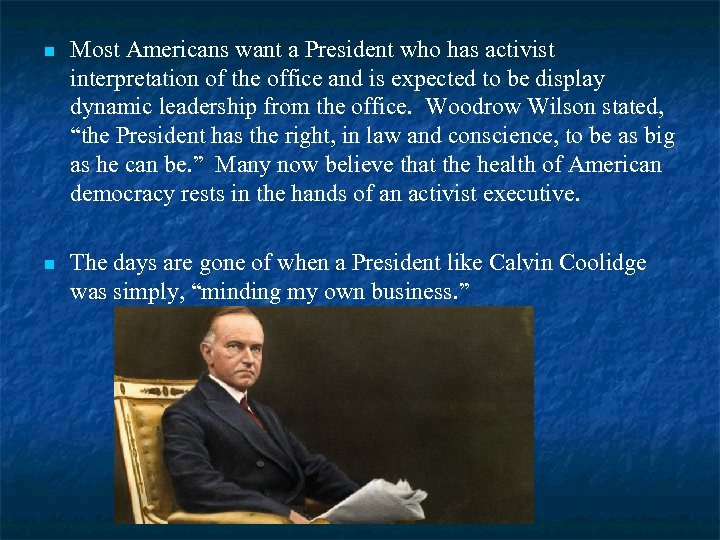 n Most Americans want a President who has activist interpretation of the office and is expected to be display dynamic leadership from the office. Woodrow Wilson stated, “the President has the right, in law and conscience, to be as big as he can be. ” Many now believe that the health of American democracy rests in the hands of an activist executive. n The days are gone of when a President like Calvin Coolidge was simply, “minding my own business. ”
 L. O. 5. 5 Expanding Presidential Power n The Doctrine of Inherent Powers and Presidential Character n Inherent Powers: powers that do not appear in the Constitution but are assumed because of the nature of the government. “take care that the Laws be faithfully executed. ” n n Conducting Foreign Policy and War n Presidential War Powers n n Emancipation Proclamation Japanese Relocation Committing Troops to Vietnam Refer to the bottom of pg. 169 -170 regarding War Powers Resolution
 L. O. 5. 6 The Challenges of Presidential Leadership L. O. 5. 7 The Institutionalized Presidency n For homework complete the following items on the slide: n *How does a modern president persuade both the Congress and the public to go along with his/her agenda? n White House Office: Describe each of the following: n Chief of Staff Executive Office of the President n National Security Council n Council of Economic Advisors n Office of Management and Budget The Cabinet The Vice Presidency n n n
 Copyright @ 2013, 2010, 2008 Pearson Education, Inc.