Скачать презентацию Chapter 5 The Organization of Congress Sec
235207561f8f41b31c375703dfee528f.ppt
- Количество слайдов: 57
 Chapter 5 The Organization of Congress
 Sec. 1 Congressional Membership • Bicameral Legislature Congressional Sessions • Each term of Congress starts on January 3 of odd-numbered years & lasts for 2 years. • Each term is divided into 2 sessions (or meetings). - each last for a year & includes a breaks for vacations and holidays. • Congress remain is session until members vote to adjourn (suspend/ postpone). • Neither the House or Senate can adjourn for more than 3 days w/o the other house approval. • If Congress is adjourned the President may call it back for special session if necessary.
 Opening Day in the House • There a lot more things to do than the Senate because ALL 435 of the House’s members are up for reelection at the same time – Choose a Speaker – Swear in the Speaker – House members are sworn in – Change/adopt rules – Members of the 20 permanent House committees are appointed by vote
 Opening Day in the Senate • There are less things to do because it is a continuous body • Only 1/3 of its members are up for reelection at the same time since its members’ terms are staggered – New/reelected members are sworn in – Vacancies in Senate organization and committees are filled
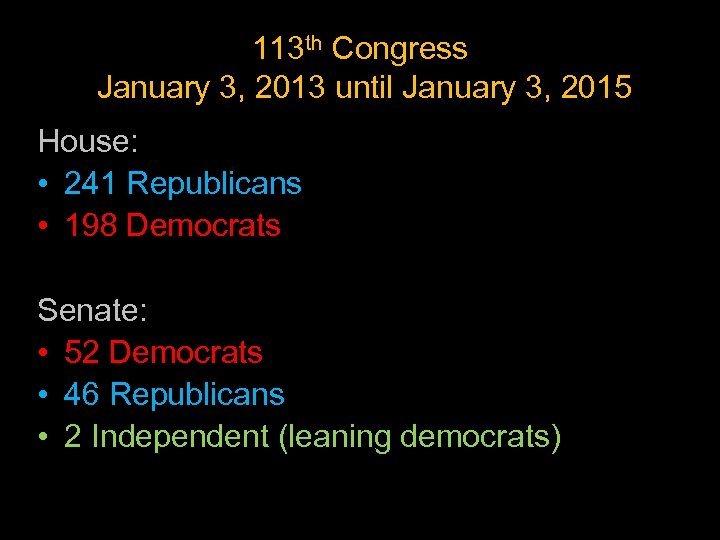 113 th Congress January 3, 2013 until January 3, 2015 House: • 241 Republicans • 198 Democrats Senate: • 52 Democrats • 46 Republicans • 2 Independent (leaning democrats)
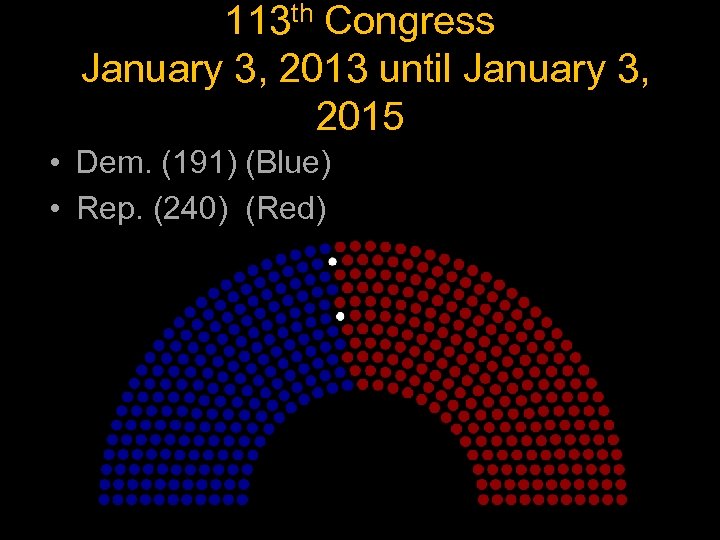 113 th Congress January 3, 2013 until January 3, 2015 • Dem. (191) (Blue) • Rep. (240) (Red)
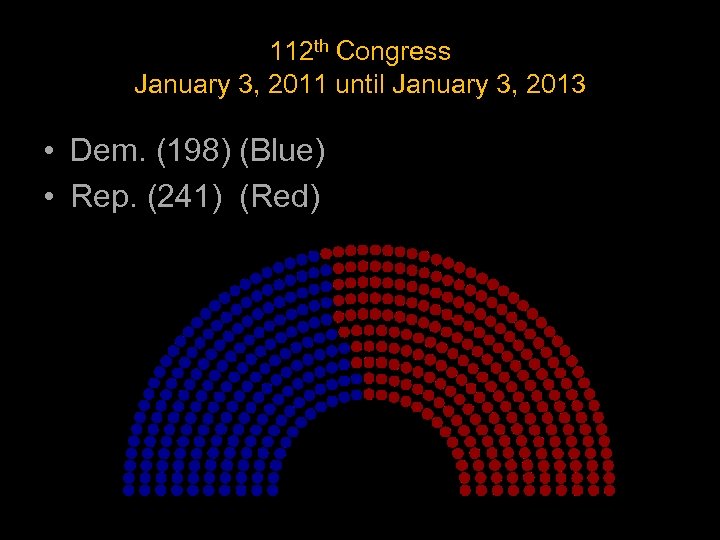 112 th Congress January 3, 2011 until January 3, 2013 • Dem. (198) (Blue) • Rep. (241) (Red)
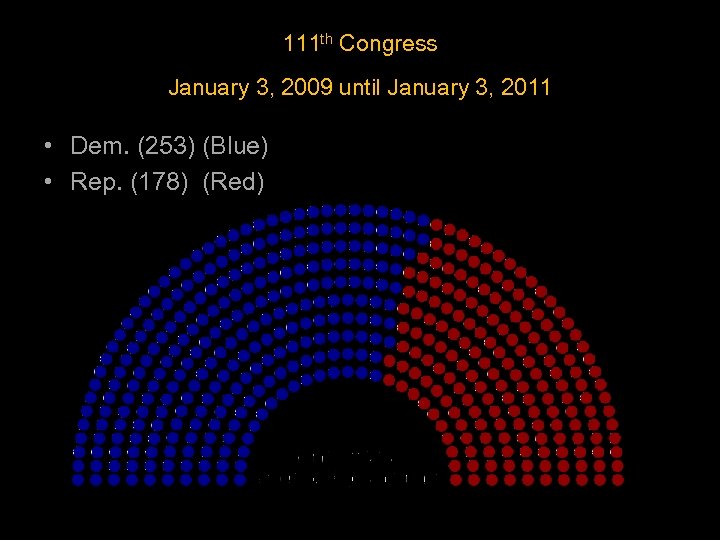 111 th Congress January 3, 2009 until January 3, 2011 • Dem. (253) (Blue) • Rep. (178) (Red)
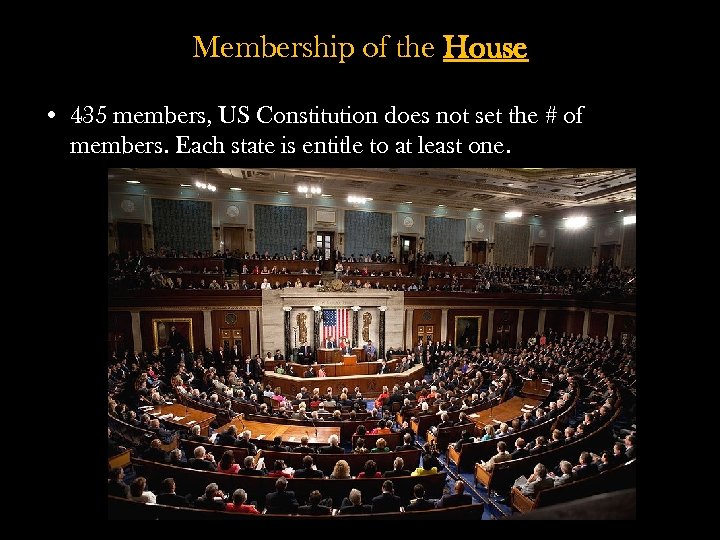 Membership of the House • 435 members, US Constitution does not set the # of members. Each state is entitle to at least one.
 Qualifications • (as stated in the Constitution) • At least 25 years old • US citizens for at least 7 years • Must have legal residents of the state that elects them.
 Term of Office • Elected for 2 years. • Elections are held in November of evennumbered years. • Term begins January 3.
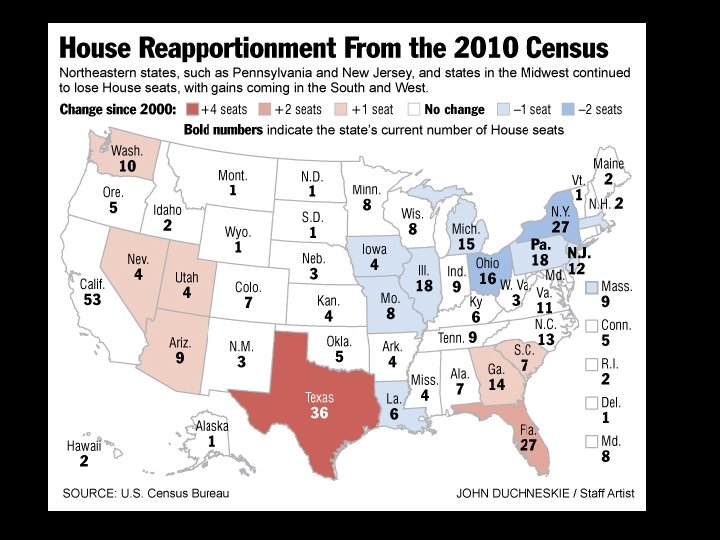
 Representation and Reapportionment • Representation based on census. • Population of each states determines the # of representatives this is called reapportionment. • Initially, the House had 64, 186 (1810), and 435 (1911). • Reapportionment Act of 1929 -limited the # to 435 divided by the 50 states.
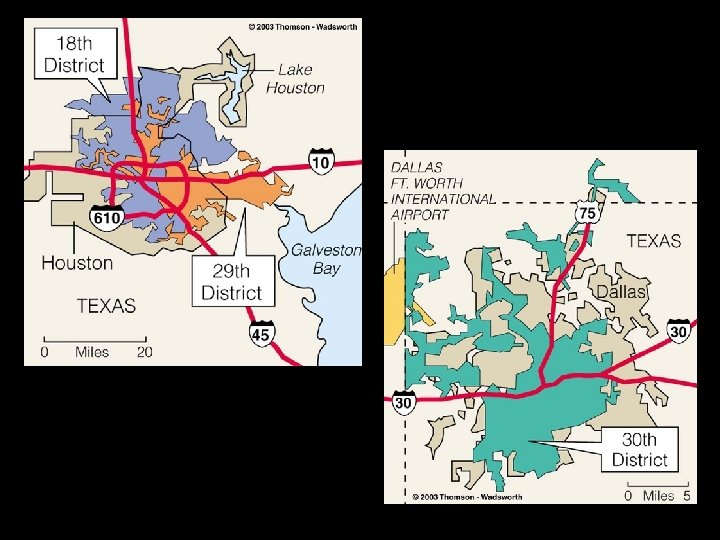
 Congressional Redistricting • After each state has their reapportioned representation, then each state legislature sets up congressional districts – one for each representative …. Redistricting.
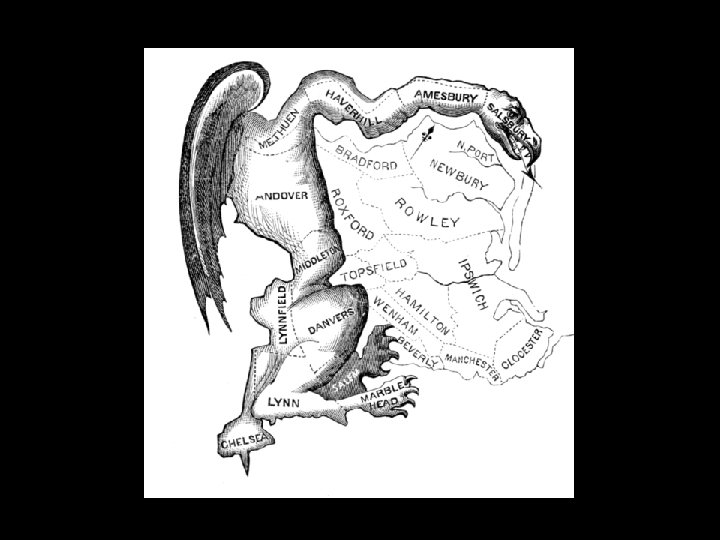
 • Gerrymandering- Political party controlling the state government draws a district’s boundaries to gain an advantage in elections. • Districts have irregular shapes • Elbridge Gerry- (Democratic- Republican) Gov. of Massachusetts - gave his party a gig political advantage over Federalist - created a district line that looked like a salamander Albert Stuart added the head, wings, and claws.
 • Packing and Cracking are ways to “Gerrymander” • “Packing” means drawing the lines so they include as many of the opposite party’s voters as possible. (the opposite party has less votes) • “Cracking” means diving an opponent’s voter into other districts, to weaken the opponent’s voter base.
 • http: //youtu. be/Mky 11 UJb 9 AY •
 Florida Congressional Districts • http: //www. govtrack. us/congress/findyourr eps. xpd? state=FL
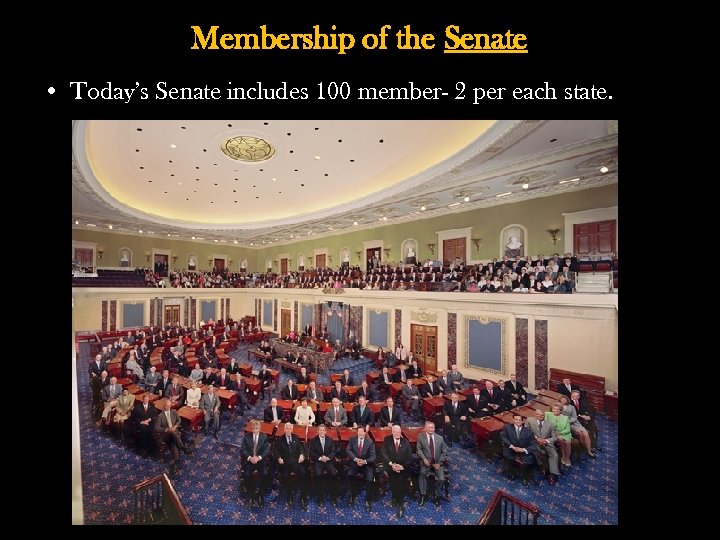 Membership of the Senate • Today’s Senate includes 100 member- 2 per each state.
![Senators (FL) • Sen. Marco Rubio [R-FL] • Sen. Bill Nelson [D-FL]](https://present5.com/presentation/235207561f8f41b31c375703dfee528f/image-22.jpg "Senators (FL) • Sen. Marco Rubio [R-FL] • Sen. Bill Nelson [D-FL]") Senators (FL) • Sen. Marco Rubio [R-FL] • Sen. Bill Nelson [D-FL]
Senators (FL) • Sen. Marco Rubio [R-FL] • Sen. Bill Nelson [D-FL]
 Qualification/ Term of Office • At least 30 years • Citizens of the US for at least 9 years before election. • Legal residents of the state they represent. • Terms of office – Elections are held in November even number years. Term begins in January 3. 6 -years term. If Senator resigns or dies the state may authorize the governor to appoint someone to fill the vacancy until the next election.
 • Salary and Benefits- both houses set their own salaries. 27 th Amend. prohibits Congress from giving itself a pay raise. Any new congressional salary will take effect after an intervening election. • “Franking Privilege”- in addition to salary members enjoy a # of resources and benefits.
 • Privileges of Members- The Const. provides certain privileges. They are free of arrest “in all cases except treason, felony, and breach of the peace”, when they are attending or on their way to or from Congress. • Exclusion-both houses may judge member’s qualification and decide whether to seat them. Each house may refuse to seat an elected member by a majority of vote. • Also, each house may “punish its own members for disorderly behavior” by a majority vote and expel a legislator by a two-thirds vote. • Censure- is a vote of formal disapproval of a member’s actions.
 The Members of Congress • Congress includes 535 voting members. • 4 delegated in the House- 1 each from District of Columbia, Guan, American Samoa, and the Virgin Islands • 1 Commissioner from Puerto Rico ( they can’t vote on issues) • They do attend sessions, introduce bills, speak in debates, and vote in committees.
 • Characteristics- Almost half are lawyers, the rest come from business, banking and education. • Both representatives have been white, middle-aged males. • Average is usually over 50.
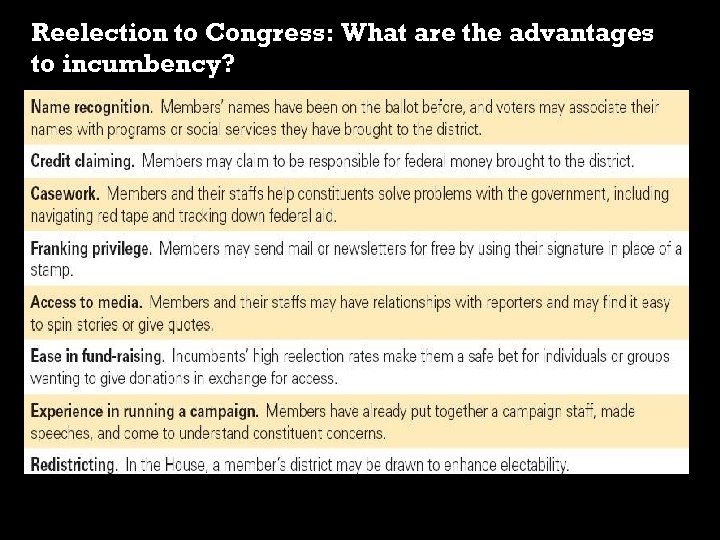 Reelection to Congress: What are the advantages to incumbency?
 Sec. 2 The House of Representatives Rules of Lawmaking • Complex Rules- Rulings are based on precedent. Both houses print their rules every 2 yrs. • Committee Work- In the House they are more important than in the Senate. Representatives form small groups. Each representative tends to specialize in a few issues/ areas that are important to the constituents. • Party Affiliation- Rep. sit to the right and Dem. to the left. • In each house the majority party leader controls the flow of legislative work, and appoints committee chairs.
 House Leadership • 1. 2. 3. 4. 5. 6. Organized leadership coordinates the work of the 435 member. These leaders serve 6 purposes: Organize and unify party members Schedule the work of the House Make sure that lawmakers are present for key floor votes Distribute and collect information Keep the House in touch with the president Influence lawmakers to support the policies of their political party.
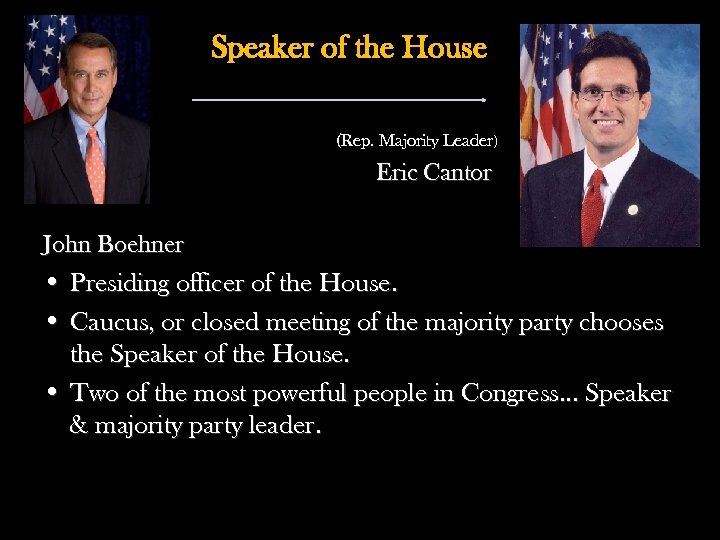 Speaker of the House • • (Rep. Majority Leader) Eric Cantor John Boehner • Presiding officer of the House. • Caucus, or closed meeting of the majority party chooses the Speaker of the House. • Two of the most powerful people in Congress… Speaker & majority party leader.
 Job of the Speaker: 1. Presiding over the sessions of the House, can influence proceeding by influencing which members to recognize first. 2. Appoints members of some committees, schedule bills for action, and refers bills to the proper committee. 3. Follows Vice-President in line of succession to the presidency.
 House Floor Leaders • The Speaker’s top assistant is the majority leader. • His/ her job is to plan the party’s legislative program, steer important bills, and make sure chairperson of the committees finish their work. • This leader has help from the whips- they serve as assistant floor leaders in the House. • Their job is to watch how majority-party members intend to vote on bills, persuade them to vote as the party wishes, and to see that party members are present to vote.
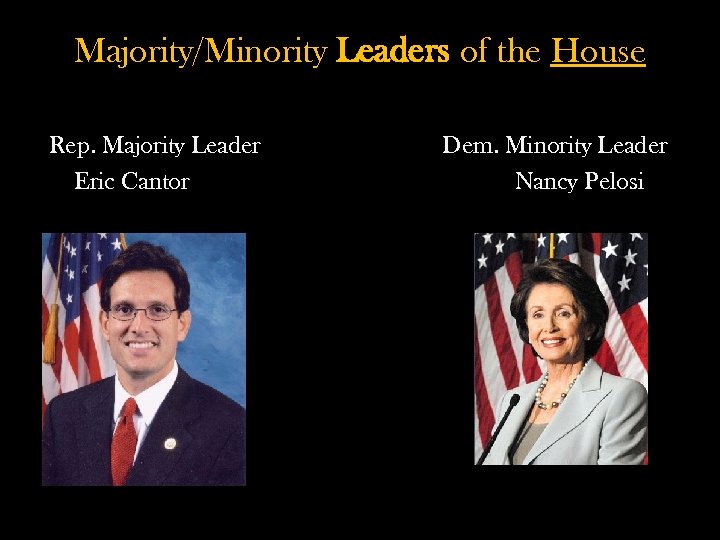 Majority/Minority Leaders of the House Rep. Majority Leader Eric Cantor Dem. Minority Leader Nancy Pelosi
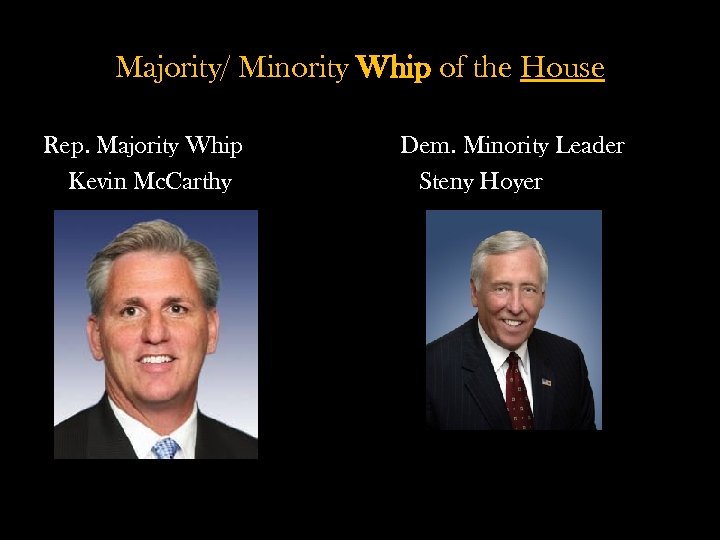 Majority/ Minority Whip of the House Rep. Majority Whip Kevin Mc. Carthy Dem. Minority Leader Steny Hoyer
 Lawmaking in the House • House is on session from Monday-Friday. • Mondays are routine work. Friday not much is done because representatives go back to their districts for the weekend.
 How House Bills are Scheduled • 1. 2. 3. All laws start as a bill (a proposed law) Process: Representatives drop it into the hopper (accessible box near the front of the chamber) The Speaker sends it to the appropriate committee for study, discussion, and review. -of the thousands of bills introduced during each legislative term, only 10 to 20% go to the house for a vote. Bills that make it are put on one of the House calendars. Calendars list bills that are up for consideration. - Union Calendar- lists bills dealing with money issues. - Private Calendar – deals w/ individual people and places. - Consent Calendar- any bill that the house gives unanimous consent to debate out of regular order. - Discharged Calendar- is used for petitions to discharge a bill from committee.
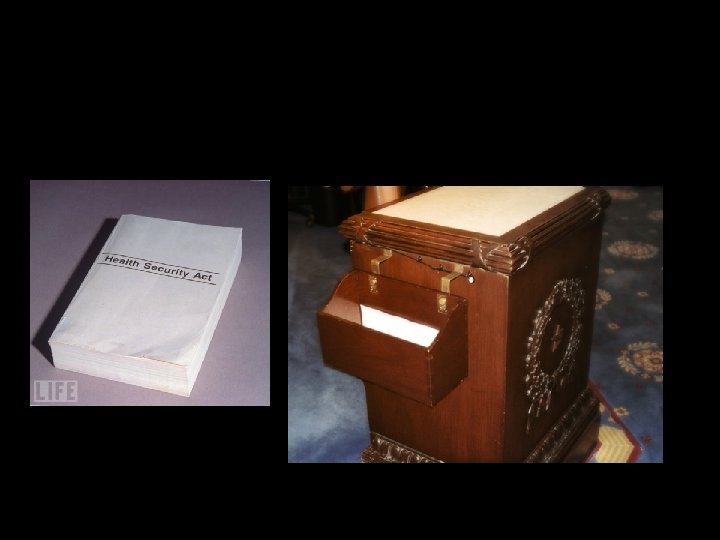 Hopper
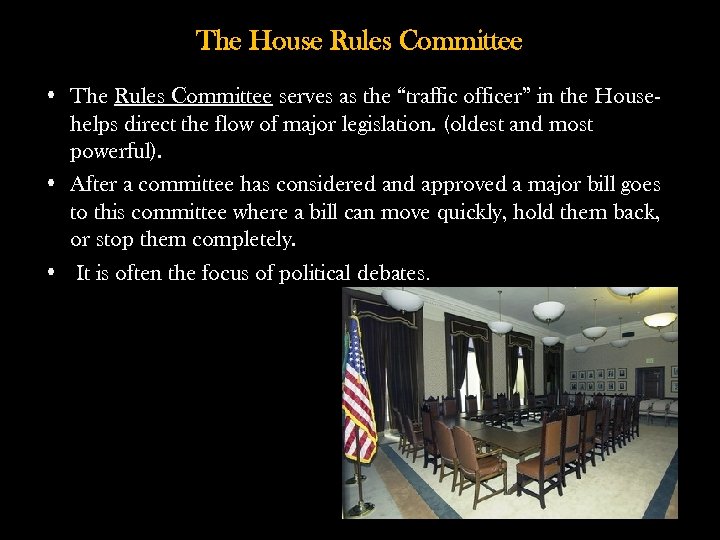 The House Rules Committee • The Rules Committee serves as the “traffic officer” in the Househelps direct the flow of major legislation. (oldest and most powerful). • After a committee has considered and approved a major bill goes to this committee where a bill can move quickly, hold them back, or stop them completely. • It is often the focus of political debates.
 Function of the Rules Committee • Major bills that reach the floor of the House for debate and for a vote do so by a “rule’- or special order- from the Rules Committee. • Once bills pass this committee they enter on the Union Calendar of House Calendar, • These calendars have so many bills that if they are taken in the order of entrance they will never reach the floor before the end of the legislative session. • To resolve this, the chairperson of the committee that sent the bill to the Rules Com. may ask for it to move ahead of other bills and to be sent to the House floor. • Rules Com. can stop a bill from going to the House floor for a vote making it the most powerful House committee.
 Other Purposes of the Rules Committee • Settle disputes among other house committees • Can delay or block bills that representatives and House leaders do not want to come to a vote on the floor. A Quorum for Business • Quorum is a the minimum # of members who must be present to permit a legislative body to take official action. • A regular session, a quorum consist of the majority of the house (218 members). • When the house meets to debate and amend legislation it may often sit as a Committee of the Whole w/ 100 members. • It can not pass a bill but can make changes.
 Sec. 3 The Senate • The rules are different than in the House. • The atmosphere is more informal, the purpose is that in the Senate, senators have more freedom to express their ideas. • They allow unlimited debates, they may debate for days, weeks, and months. • The Senate has no Speaker, the VP of the US presides the Senate, but can only vote to break a tie.
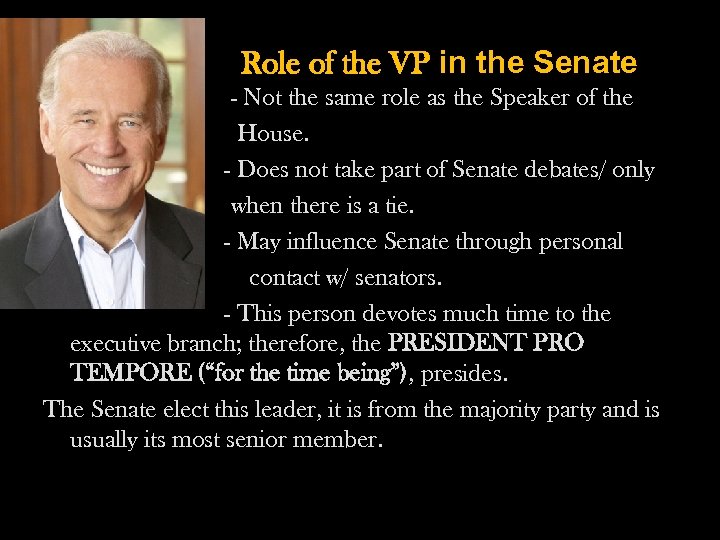 Joe Biden – Role of the VP in the Senate - Not the same role as the Speaker of the House. - Does not take part of Senate debates/ only when there is a tie. - May influence Senate through personal contact w/ senators. - This person devotes much time to the executive branch; therefore, the PRESIDENT PRO TEMPORE (“for the time being”), presides. The Senate elect this leader, it is from the majority party and is usually its most senior member.
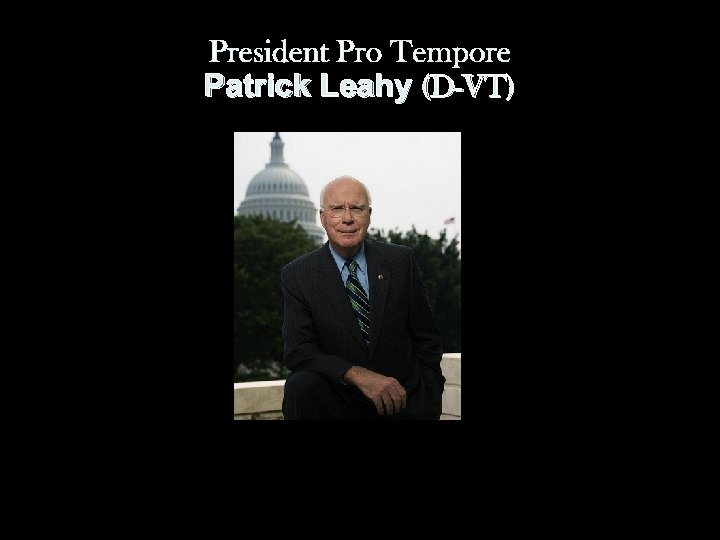 Patrick Leahy (D-VT)
 Majority and Minority Floor Leaders • Most important of the Senate. • Elected by the members of their political parties. • The majority leader job is to guide the party’s bills through the Senate. • To do this the he or she plans the Senate’s work schedule and agenda consulting the minority leader. • The majority leader is responsible for making the majority party members attend sessions and support the bills. • The minority leader develops criticisms of the majority party’s bills and tries to keep senators in the minority party working together.
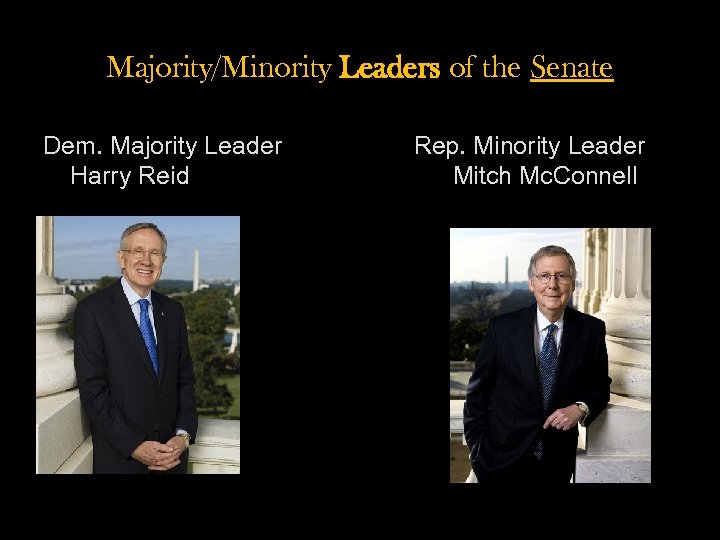 Majority/Minority Leaders of the Senate Dem. Majority Leader Harry Reid Rep. Minority Leader Mitch Mc. Connell
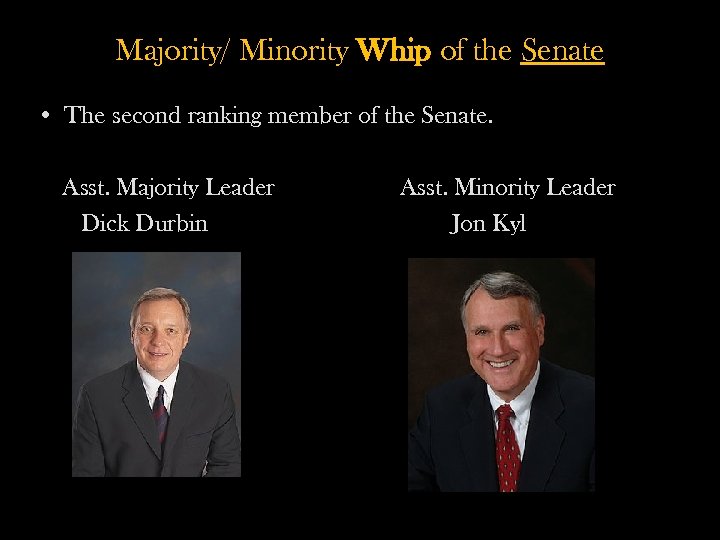 Majority/ Minority Whip of the Senate • The second ranking member of the Senate. Asst. Majority Leader Dick Durbin Asst. Minority Leader Jon Kyl
 How Senate Bills are Scheduled • Senate has only 2 calendars. • The Calendar of General Orders- list all the bills the Senate will consider. • Executive Calendar- schedules treaties and nominations.
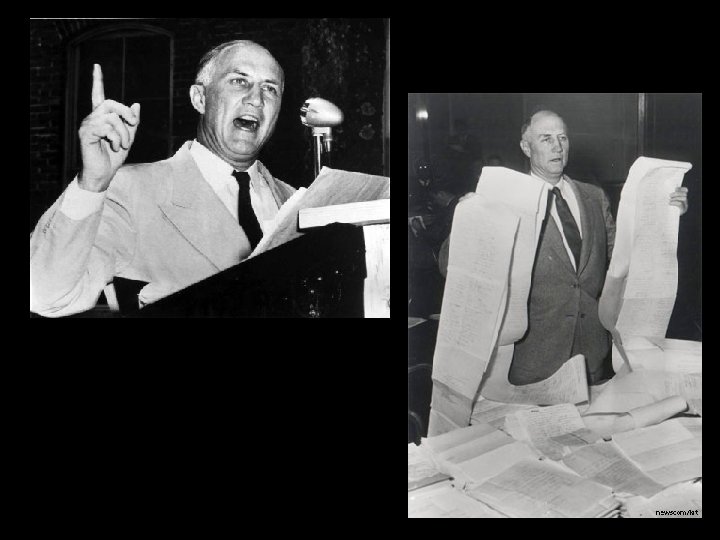
 Filibuster • One why Senator can stop a bill they oppose is to filibuster against it. • This means to cut a legislative process and prevent a vote. • The process includes talking continuously delaying issues in committee. • Can be stopped when three-fifths of the Senate (60 member) votes for cloture. • Cloture – process that allows each senator to speak only 1 hr on a bill under debate. • This is not use very often in Senate now, new Senate rules allow other matters to continue during a filibuster. • Longest: Se. Strom Thurmond (SC)- spoke against Civil Rights Act of 1957 for 24 hrs and 18 minutes.
 Congressional Committees Purpose of Committees • 1. 2. 3. The House/ Senate depend on committees to do their job… committees help member of Congress to do their job. Allows member of Congress to divide their work among smaller groups Committees select the bills that should move on. Committees hold public meeting and investigations.
 Kinds of Committees 1. Standing: - Most standing comm. have subcommittees. - Each specialize in a category of its standing committee's responsibility - Usually they continue from one Congress to the next, although the majority party can make changes to the rules. - Ex. the 104 Congress limited most committee to no more than 5 subcommittees. 2. Select Committees: - Study one specific issue and report their findings to the Senate or House. 1. matter of great public concern 2. overlooked problems, such as hunger. 3. Interest groups problems (special groups such as small business owners) - Select Intelligence Committee
 3. Joint Committees: - May be temporary or permanent - Coordinates the work for both houses. - Most committees have been set up to study matters such as atomic energy, defense and taxation. - this committee does not have authority to deal directly with bills or propose legislation. 4. Conference Committees: - Is a temporary committee set up when the house and Senate have passes different versions of the same bill. - Members of the committee, called conferers, usually come from the House and Senate standing committees to answer questions. - The job of the committee is to solve the two different versions of the bill. -The Committee resolve the problem by bargaining over each section of the bill. - A majority of the conferers, from each house must accept the final compromise bill- called conference report, before it can be sent to the floor of the House or Senate. - When it reach the floor, it must be considered as a whole and can not be changes.
 Choosing Committee Members • Members play a key role in committees b/c they influence national policy making. • Also, they can increase the changes for reelection. • The most important committees in the House are Rules, Ways and Means, and Appropriations. • In the Senate, Foreign Relations, Finance, Appropriations. • Seniority System- the chairperson of each committee is usually the member from the majority party w/ the longest uninterrupted service on a particular committee
 Sec. 5 Staff and Support Agencies • Personal staff work directly with individual senators and representatives. • Committee staff work with House and Senate committees. • Administrative staff “called AA” they run the lawmaker’s office, supervises the lawmaker’s schedule, and gives advice on political matters. • Legislative staff or “LAs” are makes certain that the lawmaker is well informed about the many bills that person must deals. - Does research, draft bills, studies bills currently in Congress and writes speeches and articles for the lawmaker. • Caseworkers, they handle the many requests for help from people in a lawmaker’s state or district.
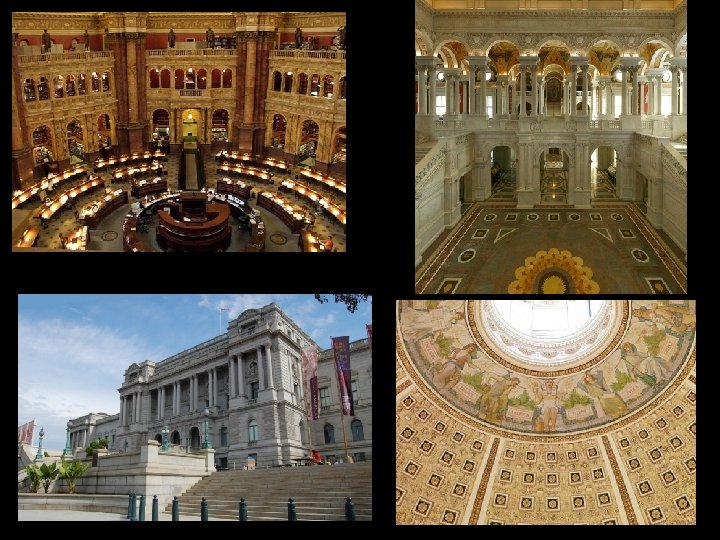
 Support Agencies • Library of Congress- contains 100 million items (books, music, journals, films, photographs, and maps). - it has a Congressional Research Service (CRS) with hundreds of employees. • Congressional Budget Office (CBO)- established in 1974, to coordinate the budget-making work of Congress, study the budget proposals proposed by the President. • General Accounting Office (GAO)- answer specific questions, testify before committees, provide legal opinion on bills …. etc • Government Printing Office (GPO)- largest printing plan in the world. Print all the legal documents for the government. Bills, speeches, official statistical information …. etc