


 Скачать презентацию Chapter 5 Temperature and Heat Sections 5 1
8af0a81d3533bb4cb1759fede51fe454.ppt
- Количество слайдов: 68
 Chapter 5 Temperature and Heat Sections 5. 1 -5. 7
 Temperature • “Hot” & “Cold” are relative terms. • Temperature depends on the kinetic (motion) energy of the molecules of a substance. • Temperature is a measure of the average kinetic energy of the molecules of a substance. Copyright © Houghton Mifflin Company. All rights reserved. Section 5. 1 5|2
 Thermometer • Thermometer - an instrument that utilizes the physical properties of materials for the purpose of accurately determining temperature • Thermal expansion is the physical property most commonly used to measure temperature. – Expansion/contraction of metal – Expansion/contraction of mercury or alcohol Copyright © Houghton Mifflin Company. All rights reserved. Section 5. 1 5|3
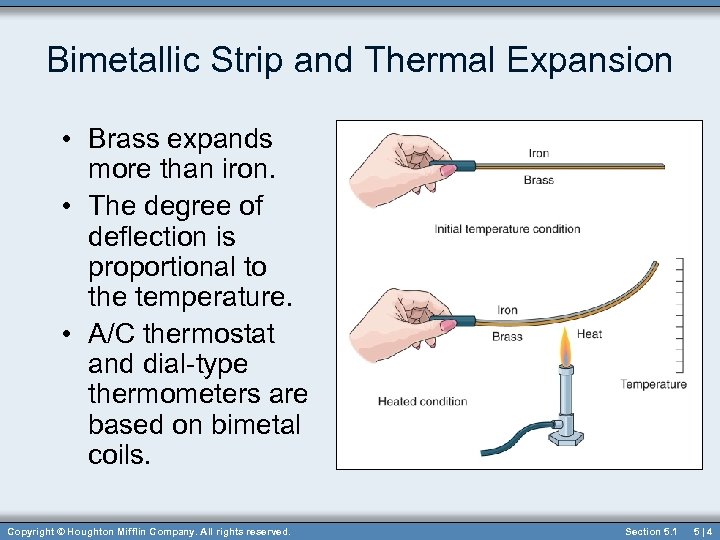 Bimetallic Strip and Thermal Expansion • Brass expands more than iron. • The degree of deflection is proportional to the temperature. • A/C thermostat and dial-type thermometers are based on bimetal coils. Copyright © Houghton Mifflin Company. All rights reserved. Section 5. 1 5|4
 Liquid-in-glass Thermometer • Thermometers are calibrated to two reference points (ice point & steam point. ) – Ice point – the temperature of a mixture of pure ice and water at normal atmospheric pressure – Steam point – the temperature at which pure water boils at normal atmospheric pressure • Usually contains either mercury or red (colored) alcohol Copyright © Houghton Mifflin Company. All rights reserved. Section 5. 1 5|5
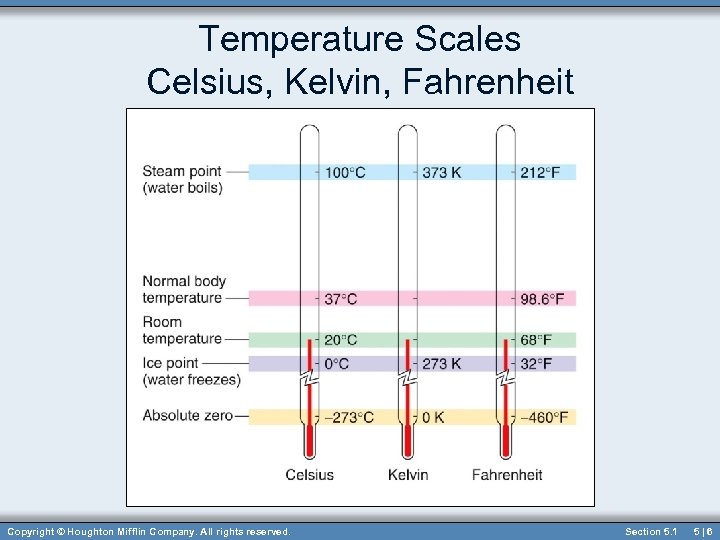 Temperature Scales Celsius, Kelvin, Fahrenheit Copyright © Houghton Mifflin Company. All rights reserved. Section 5. 1 5|6
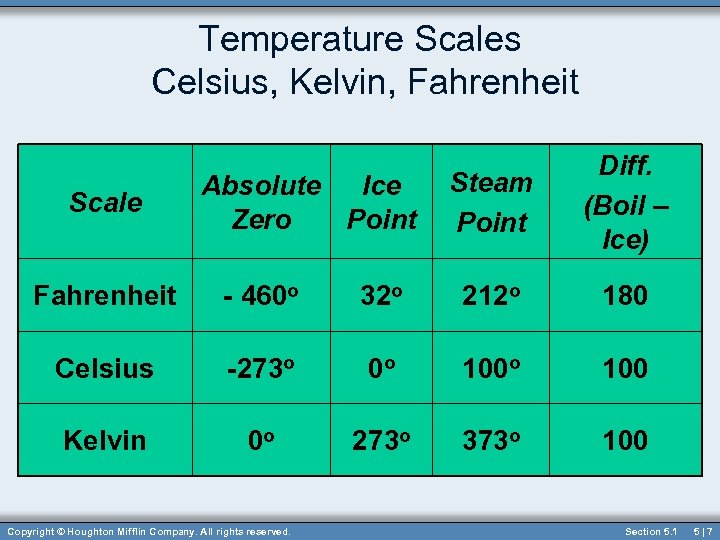 Temperature Scales Celsius, Kelvin, Fahrenheit Scale Absolute Ice Zero Point Steam Point Diff. (Boil – Ice) Fahrenheit - 460 o 32 o 212 o 180 Celsius -273 o 0 o 100 Kelvin 0 o 273 o 373 o 100 Copyright © Houghton Mifflin Company. All rights reserved. Section 5. 1 5|7
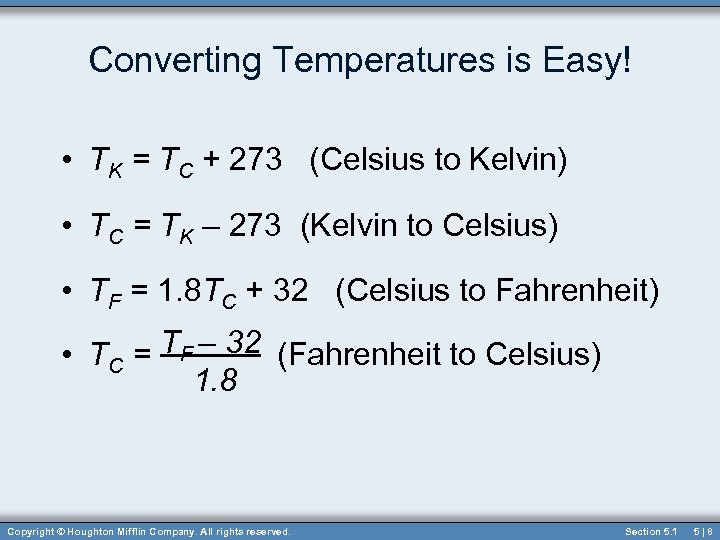 Converting Temperatures is Easy! • TK = TC + 273 (Celsius to Kelvin) • TC = TK – 273 (Kelvin to Celsius) • TF = 1. 8 TC + 32 (Celsius to Fahrenheit) • TC = TF – 32 (Fahrenheit to Celsius) 1. 8 Copyright © Houghton Mifflin Company. All rights reserved. Section 5. 1 5|8
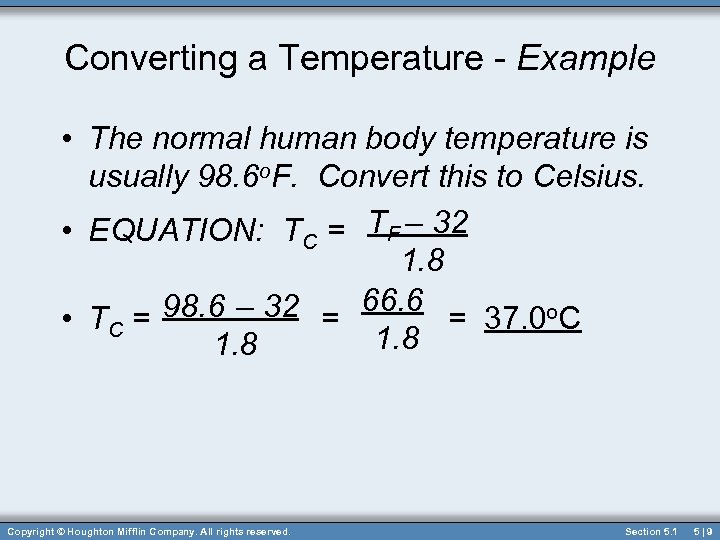 Converting a Temperature - Example • The normal human body temperature is usually 98. 6 o. F. Convert this to Celsius. • EQUATION: TC = TF – 32 1. 8 98. 6 – 32 = 66. 6 = 37. 0 o. C • TC = 1. 8 Copyright © Houghton Mifflin Company. All rights reserved. Section 5. 1 5|9
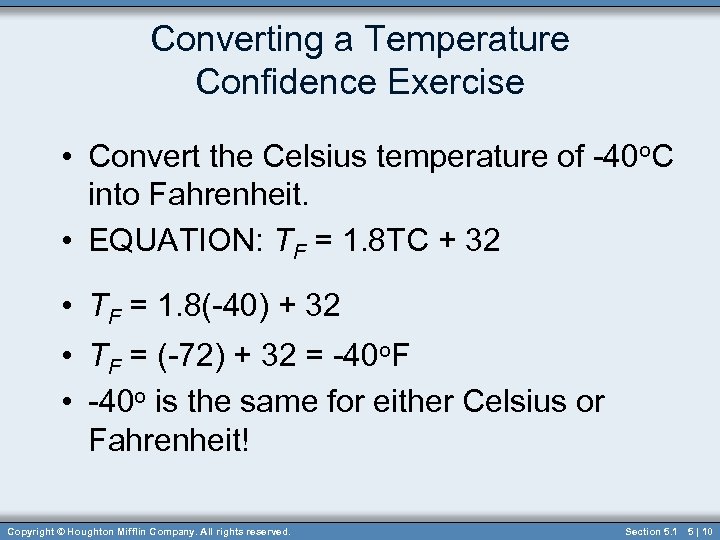 Converting a Temperature Confidence Exercise • Convert the Celsius temperature of -40 o. C into Fahrenheit. • EQUATION: TF = 1. 8 TC + 32 • TF = 1. 8(-40) + 32 • TF = (-72) + 32 = -40 o. F • -40 o is the same for either Celsius or Fahrenheit! Copyright © Houghton Mifflin Company. All rights reserved. Section 5. 1 5 | 10
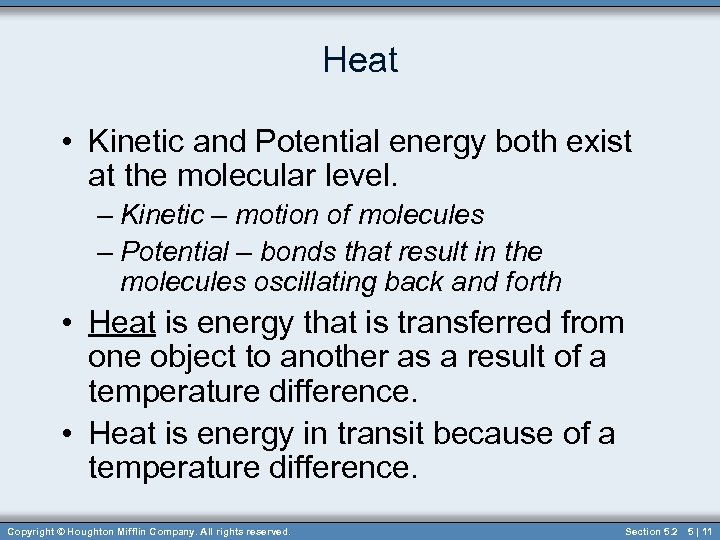 Heat • Kinetic and Potential energy both exist at the molecular level. – Kinetic – motion of molecules – Potential – bonds that result in the molecules oscillating back and forth • Heat is energy that is transferred from one object to another as a result of a temperature difference. • Heat is energy in transit because of a temperature difference. Copyright © Houghton Mifflin Company. All rights reserved. Section 5. 2 5 | 11
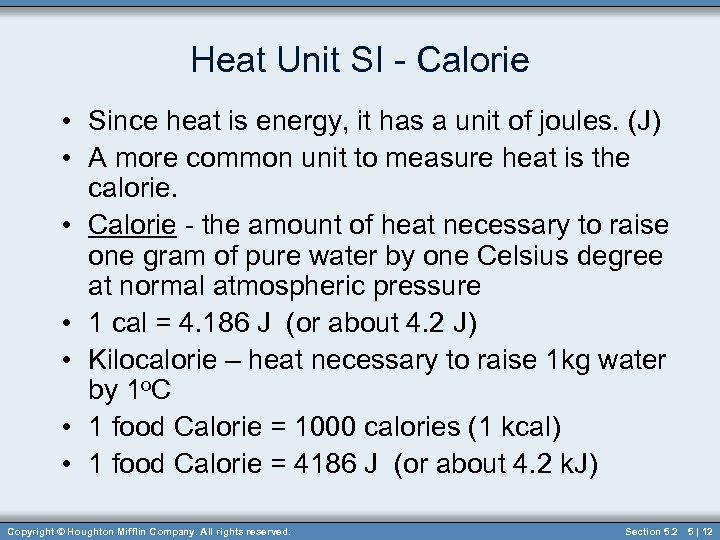 Heat Unit SI - Calorie • Since heat is energy, it has a unit of joules. (J) • A more common unit to measure heat is the calorie. • Calorie - the amount of heat necessary to raise one gram of pure water by one Celsius degree at normal atmospheric pressure • 1 cal = 4. 186 J (or about 4. 2 J) • Kilocalorie – heat necessary to raise 1 kg water by 1 o. C • 1 food Calorie = 1000 calories (1 kcal) • 1 food Calorie = 4186 J (or about 4. 2 k. J) Copyright © Houghton Mifflin Company. All rights reserved. Section 5. 2 5 | 12
 Heat Unit British - Btu • British thermal unit (Btu) – the amount of heat to raise one pound of water 1 o. F • 1 Btu = 1055 J = 0. 25 kcal = 0. 00029 k. Wh • A/C units are generally rated in the number of Btu’s removed per hour. • Heating units are generally rated in the number of Btu’s supplied per hour. Copyright © Houghton Mifflin Company. All rights reserved. Section 5. 2 5 | 13
 Expansion/Contraction with D’s in Temperature • In general, most matter, solids, liquids, and gases will expand with an increase in temperature (and contract with a decrease in temperature. ) • Water is an exception to this rule – (ice floats!) Copyright © Houghton Mifflin Company. All rights reserved. Section 5. 2 5 | 14
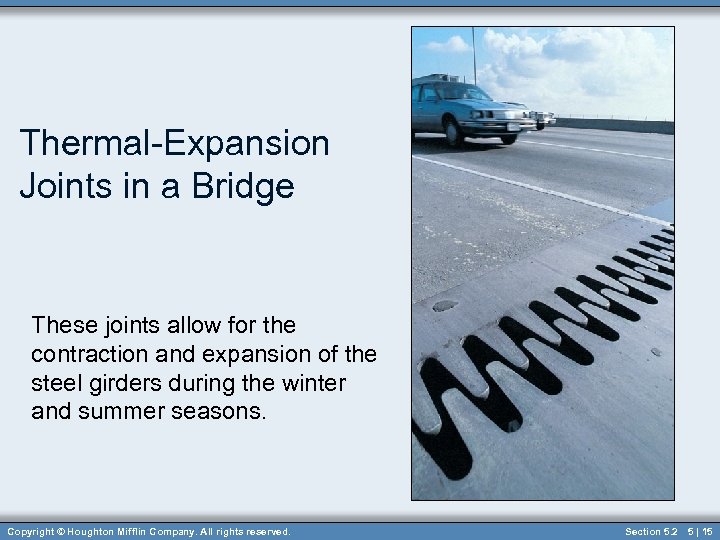 Thermal-Expansion Joints in a Bridge These joints allow for the contraction and expansion of the steel girders during the winter and summer seasons. Copyright © Houghton Mifflin Company. All rights reserved. Section 5. 2 5 | 15
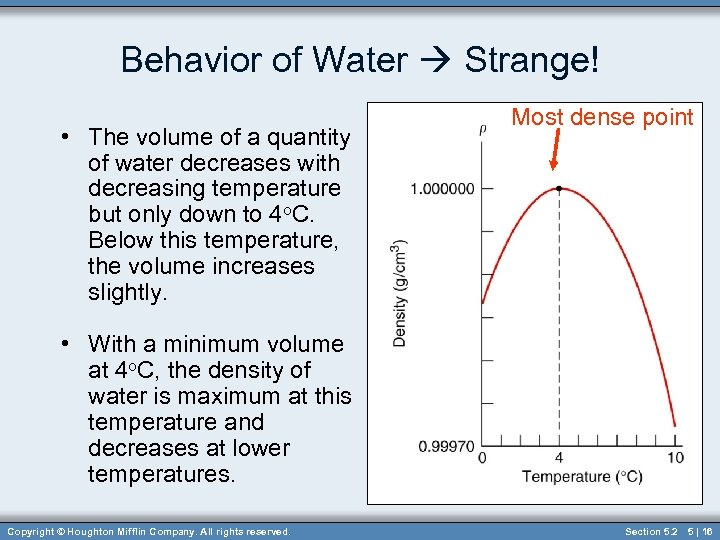 Behavior of Water Strange! • The volume of a quantity of water decreases with decreasing temperature but only down to 4 o. C. Below this temperature, the volume increases slightly. Most dense point • With a minimum volume at 4 o. C, the density of water is maximum at this temperature and decreases at lower temperatures. Copyright © Houghton Mifflin Company. All rights reserved. Section 5. 2 5 | 16
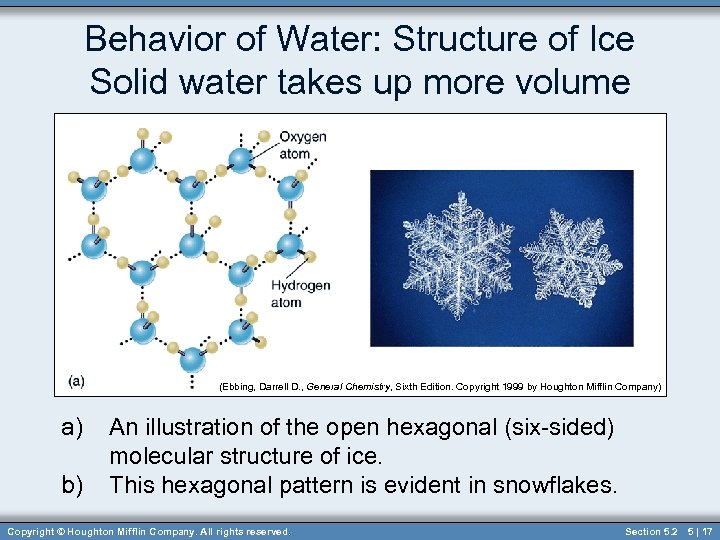 Behavior of Water: Structure of Ice Solid water takes up more volume (Ebbing, Darrell D. , General Chemistry, Sixth Edition. Copyright 1999 by Houghton Mifflin Company) a) b) An illustration of the open hexagonal (six-sided) molecular structure of ice. This hexagonal pattern is evident in snowflakes. Copyright © Houghton Mifflin Company. All rights reserved. Section 5. 2 5 | 17
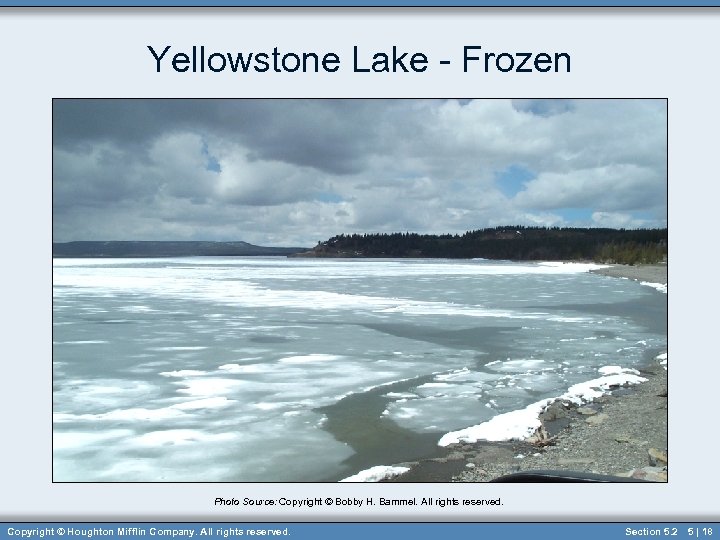 Yellowstone Lake - Frozen Photo Source: Copyright © Bobby H. Bammel. All rights reserved. Copyright © Houghton Mifflin Company. All rights reserved. Section 5. 2 5 | 18
 Specific Heat (Capacity) • If equal quantities of heat are added to equal masses of two metals (iron and aluminum, for example) – would the temperature of each rise the same number of degrees? -- NO! • Different substances have different properties. • Specific Heat – the amount of heat necessary to raise the temperature of one kilogram of the substance 1 o. C Copyright © Houghton Mifflin Company. All rights reserved. Section 5. 3 5 | 19
 Specific Heat (Capacity) • The greater the specific heat of a substance, the greater is the amount of heat required to raise the temperature of a unit of mass. • Put another way, the greater the specific heat of a substance the greater its capacity to store more heat energy • Water has a very high heat capacity, therefore can store large amounts of heat. Copyright © Houghton Mifflin Company. All rights reserved. Section 5. 3 5 | 20
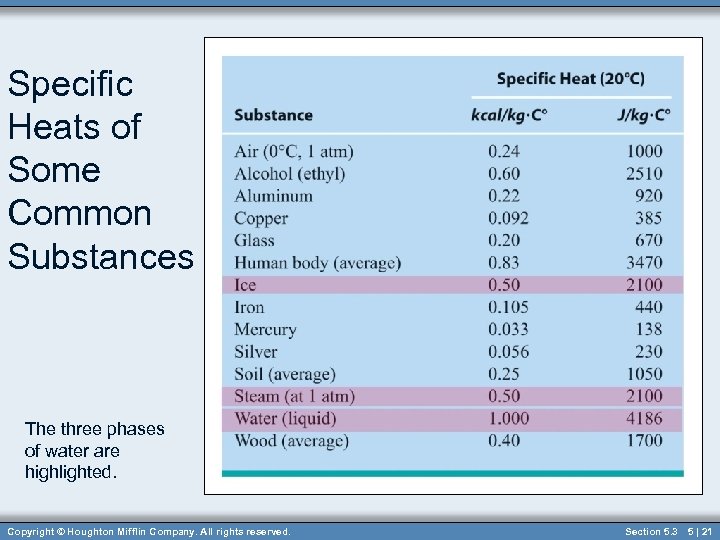 Specific Heats of Some Common Substances The three phases of water are highlighted. Copyright © Houghton Mifflin Company. All rights reserved. Section 5. 3 5 | 21
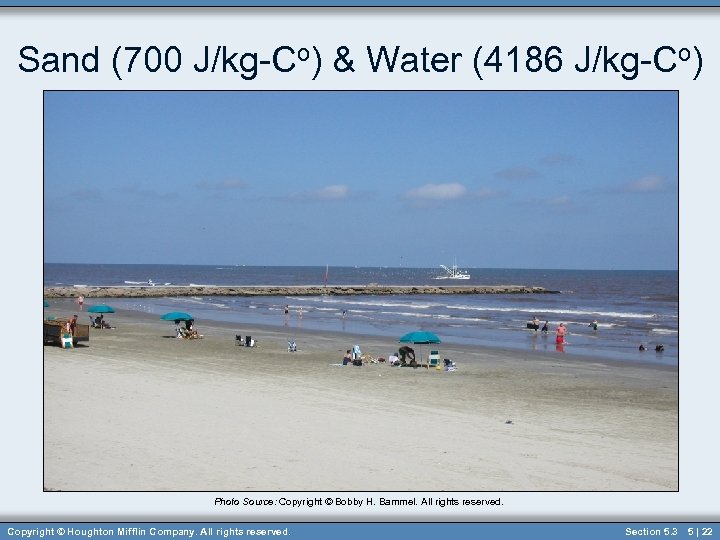 Sand (700 J/kg-Co) & Water (4186 J/kg-Co) Photo Source: Copyright © Bobby H. Bammel. All rights reserved. Copyright © Houghton Mifflin Company. All rights reserved. Section 5. 3 5 | 22
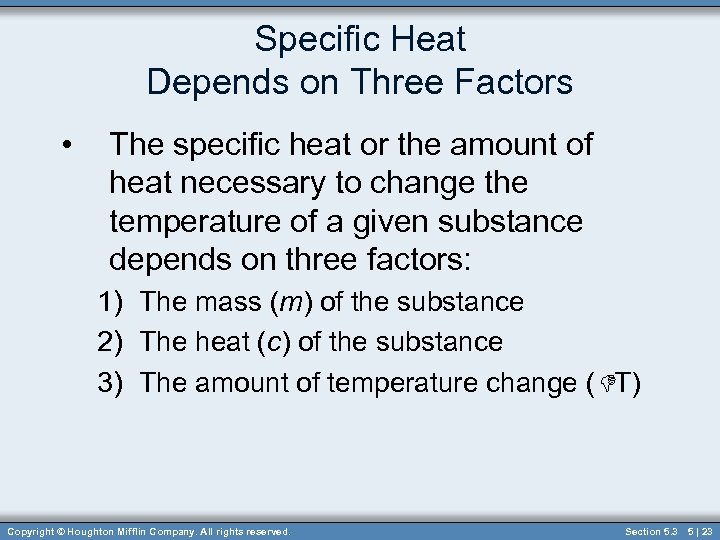 Specific Heat Depends on Three Factors • The specific heat or the amount of heat necessary to change the temperature of a given substance depends on three factors: 1) The mass (m) of the substance 2) The heat (c) of the substance 3) The amount of temperature change (DT) Copyright © Houghton Mifflin Company. All rights reserved. Section 5. 3 5 | 23
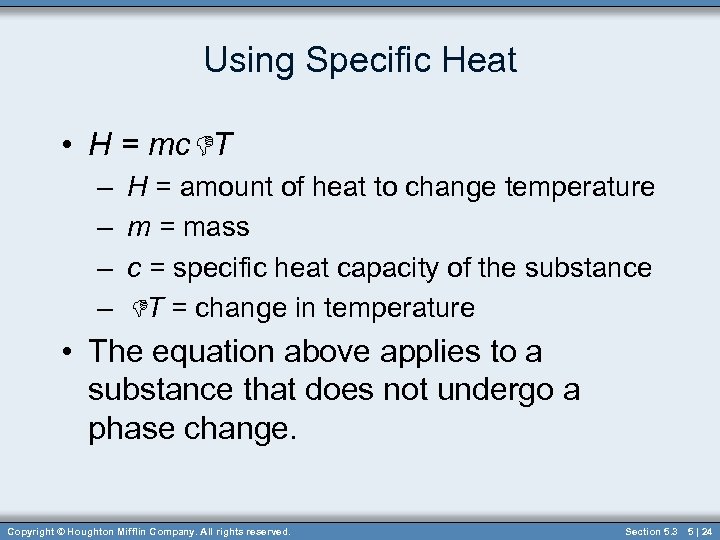 Using Specific Heat • H = mc. DT – – H = amount of heat to change temperature m = mass c = specific heat capacity of the substance DT = change in temperature • The equation above applies to a substance that does not undergo a phase change. Copyright © Houghton Mifflin Company. All rights reserved. Section 5. 3 5 | 24
 Using Specific Heat - Example • How much heat in kcal does it take to heat 80 kg of bathwater from 12 o. C to 42 o. C? • GIVEN: m = 80 kg, DT = 30 Co, c = 1. 00 kcal/kg. Co (known value for water) • H = mc. DT = (80 kg)(1. 00 kcal/kg. Co)(30 Co) • Heat needed = 2. 4 x 10³ kcal Copyright © Houghton Mifflin Company. All rights reserved. Section 5. 3 5 | 25
 Electricity costs to heat water • Heat needed = 2. 4 x 10³ kcal • Convert to k. Wh • (2. 4 x 10³ 0. 00116 k. Wh kcal) = 2. 8 k. Wh kcal • At 10 cents per k. Wh, it will cost 28 cents to heat the water in the bathtub. Copyright © Houghton Mifflin Company. All rights reserved. Section 5. 3 5 | 26
 Using Specific Heat Confidence Exercise • How much heat needs to be removed from a liter of water at 20 o. C so that is will cool to 5 o. C ? • GIVEN: 1 liter water = 1 kg = m • DT = 15 o. C; c = 1. 00 kcal/kg. Co • H = mc. DT = (1 kg)(1. 00 kcal/kg. Co)(15 Co) • Heat removed = 15 kcal Copyright © Houghton Mifflin Company. All rights reserved. Section 5. 3 5 | 27
 Latent Heat • Phases of matter solid, liquid, or gas • When a pot of water is heated to 100 o. C, some of the water will begin to change to steam. • As heat continues to be added more water turns to steam but the temperature of the water remains at 100 o. C. • Where does all this additional heat go? • Basically this heat goes into breaking the bonds between the molecules and separating the molecules. Copyright © Houghton Mifflin Company. All rights reserved. Section 5. 3 5 | 28
 Latent Heat • Hence, during a phase change (liquid to gas), the heat energy must be used to separate the molecules rather than add to their kinetic energy. • The heat associated with a phase change (either solid to liquid or liquid to gas) is called latent (“hidden”) heat. Copyright © Houghton Mifflin Company. All rights reserved. Section 5. 3 5 | 29
 Latent Heats • Latent Heat of Fusion (Lf) – the amount of heat required to change one kilogram of a substance from the solid to liquid phase at the melting point temperature – Occurs at the melting/freezing point – Lf for water = 80 kcal/kg • Latent Heat of Vaporization (Lv) – the amount of heat required to change one kilogram of a substance from the liquid to the gas phase at the boiling point temperature – Occurs at the boiling point – Lv for water = 540 kcal/kg Copyright © Houghton Mifflin Company. All rights reserved. Section 5. 3 5 | 30
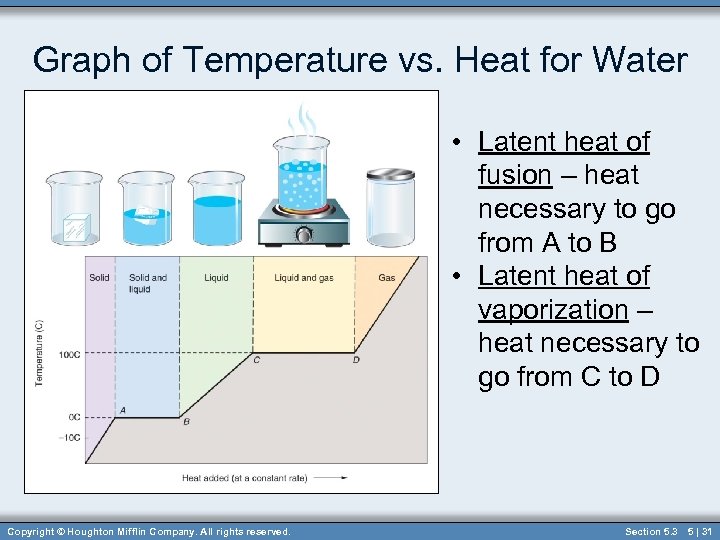 Graph of Temperature vs. Heat for Water • Latent heat of fusion – heat necessary to go from A to B • Latent heat of vaporization – heat necessary to go from C to D Copyright © Houghton Mifflin Company. All rights reserved. Section 5. 3 5 | 31
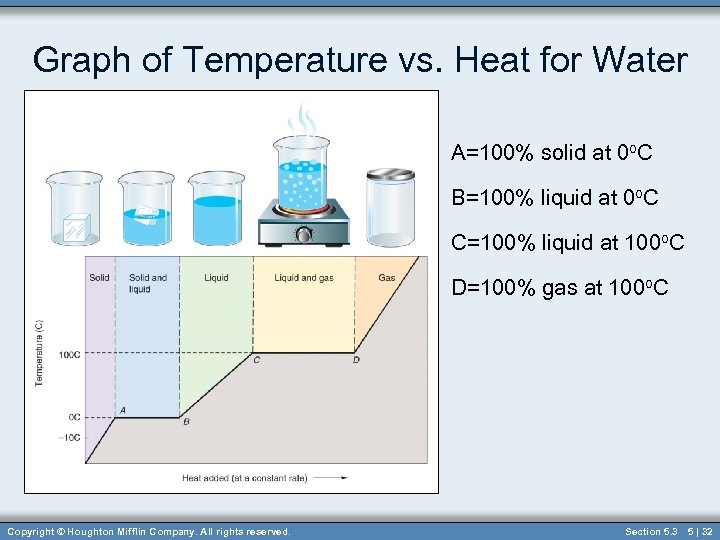 Graph of Temperature vs. Heat for Water A=100% solid at 0 o. C B=100% liquid at 0 o. C C=100% liquid at 100 o. C D=100% gas at 100 o. C Copyright © Houghton Mifflin Company. All rights reserved. Section 5. 3 5 | 32
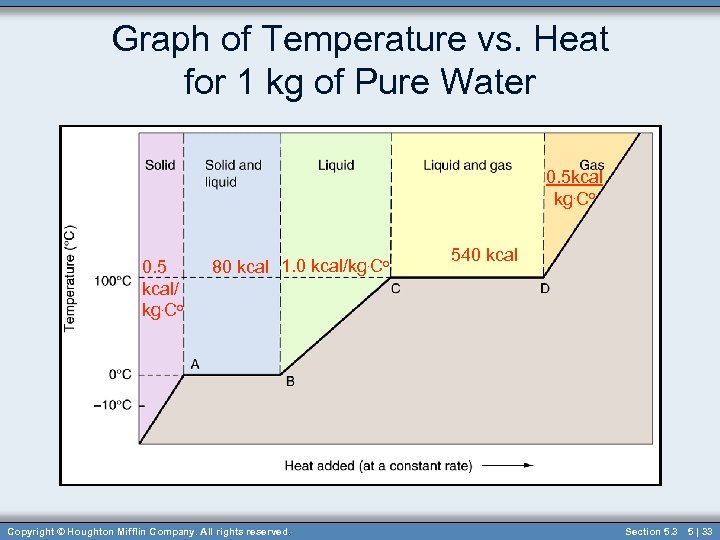 Graph of Temperature vs. Heat for 1 kg of Pure Water 0. 5 kcal kg. Co 0. 5 kcal/ kg. Co 80 kcal 1. 0 kcal/kg. Co Copyright © Houghton Mifflin Company. All rights reserved. 540 kcal Section 5. 3 5 | 33
 Other phase changes • Sublimation – when a substance changes directly from solid to gas (dry ice CO 2 gas, mothballs, solid air fresheners) • Deposition – when a substance changes directly from gas to solid (ice crystals that form on house windows in the winter) Copyright © Houghton Mifflin Company. All rights reserved. Section 5. 3 5 | 34
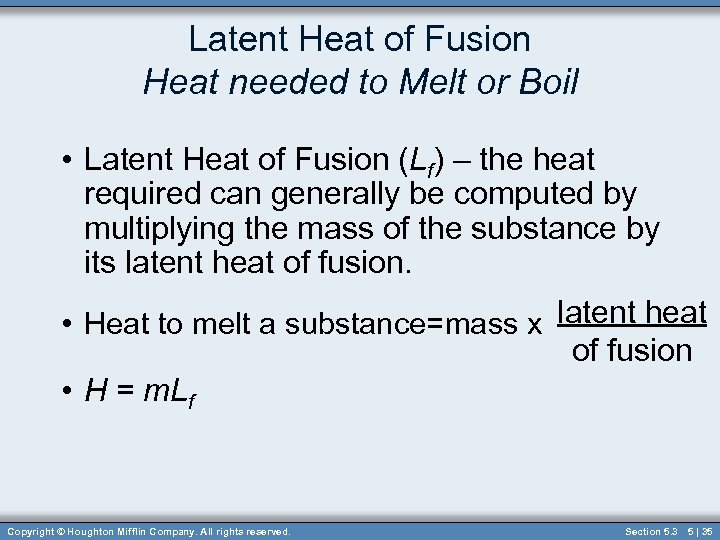 Latent Heat of Fusion Heat needed to Melt or Boil • Latent Heat of Fusion (Lf) – the heat required can generally be computed by multiplying the mass of the substance by its latent heat of fusion. • Heat to melt a substance=mass x latent heat of fusion • H = m. Lf Copyright © Houghton Mifflin Company. All rights reserved. Section 5. 3 5 | 35
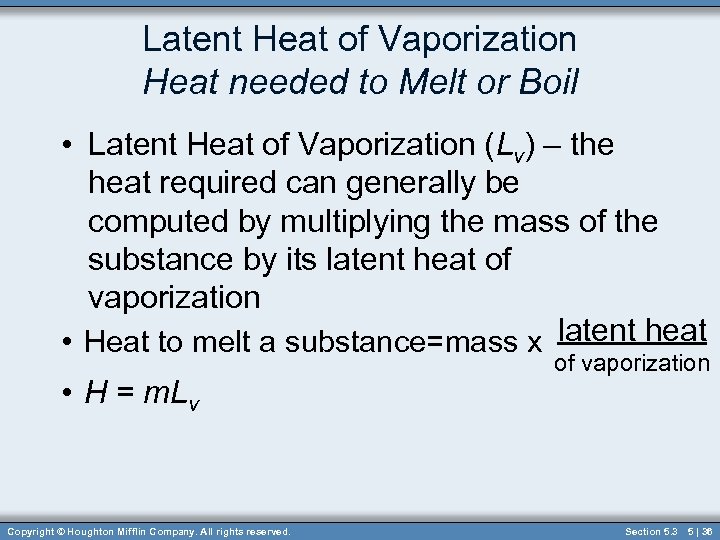 Latent Heat of Vaporization Heat needed to Melt or Boil • Latent Heat of Vaporization (Lv) – the heat required can generally be computed by multiplying the mass of the substance by its latent heat of vaporization • Heat to melt a substance=mass x latent heat • H = m. Lv Copyright © Houghton Mifflin Company. All rights reserved. of vaporization Section 5. 3 5 | 36
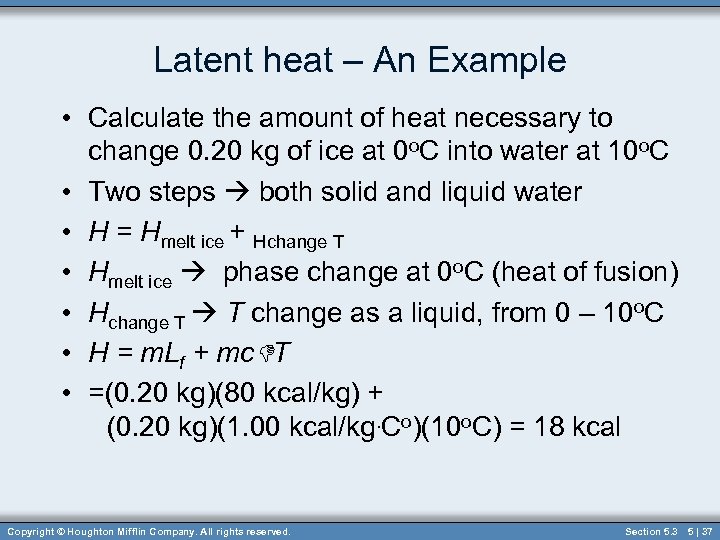 Latent heat – An Example • Calculate the amount of heat necessary to change 0. 20 kg of ice at 0 o. C into water at 10 o. C • Two steps both solid and liquid water • H = Hmelt ice + Hchange T • Hmelt ice phase change at 0 o. C (heat of fusion) • Hchange T T change as a liquid, from 0 – 10 o. C • H = m. Lf + mc. DT • =(0. 20 kg)(80 kcal/kg) + (0. 20 kg)(1. 00 kcal/kg. Co)(10 o. C) = 18 kcal Copyright © Houghton Mifflin Company. All rights reserved. Section 5. 3 5 | 37
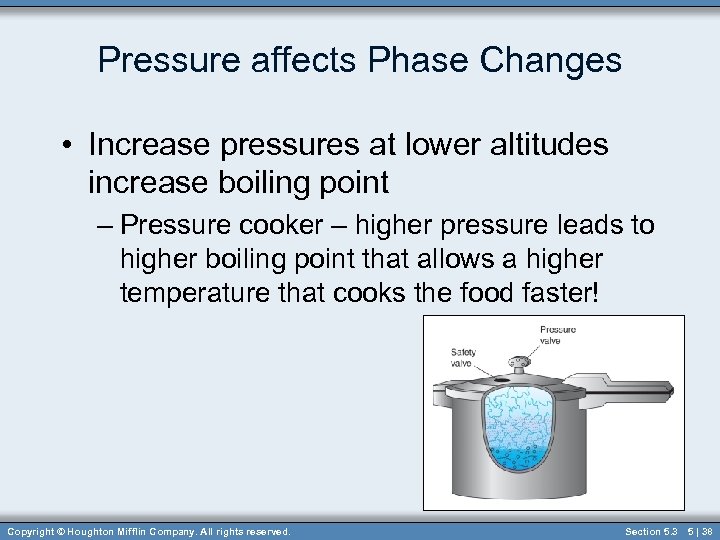 Pressure affects Phase Changes • Increase pressures at lower altitudes increase boiling point – Pressure cooker – higher pressure leads to higher boiling point that allows a higher temperature that cooks the food faster! Copyright © Houghton Mifflin Company. All rights reserved. Section 5. 3 5 | 38
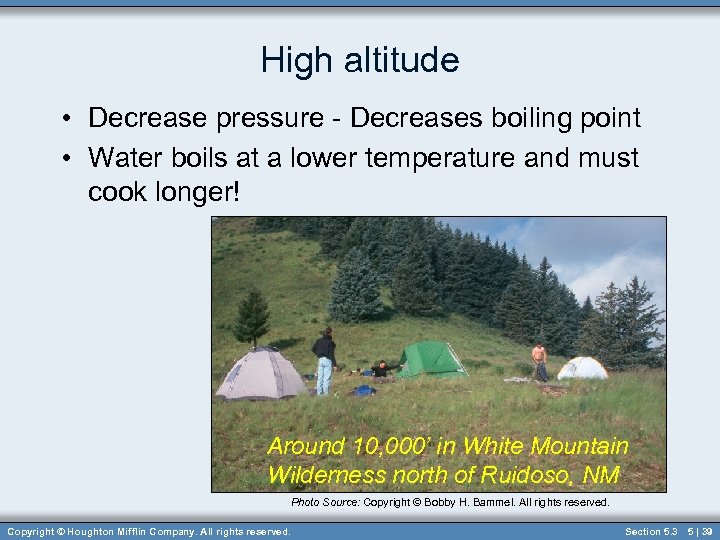 High altitude • Decrease pressure - Decreases boiling point • Water boils at a lower temperature and must cook longer! Around 10, 000’ in White Mountain Wilderness north of Ruidoso, NM Photo Source: Copyright © Bobby H. Bammel. All rights reserved. Copyright © Houghton Mifflin Company. All rights reserved. Section 5. 3 5 | 39
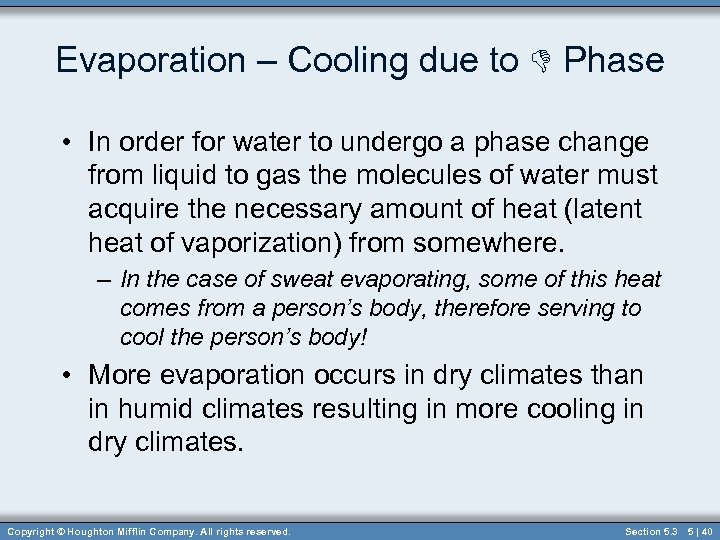 Evaporation – Cooling due to D Phase • In order for water to undergo a phase change from liquid to gas the molecules of water must acquire the necessary amount of heat (latent heat of vaporization) from somewhere. – In the case of sweat evaporating, some of this heat comes from a person’s body, therefore serving to cool the person’s body! • More evaporation occurs in dry climates than in humid climates resulting in more cooling in dry climates. Copyright © Houghton Mifflin Company. All rights reserved. Section 5. 3 5 | 40
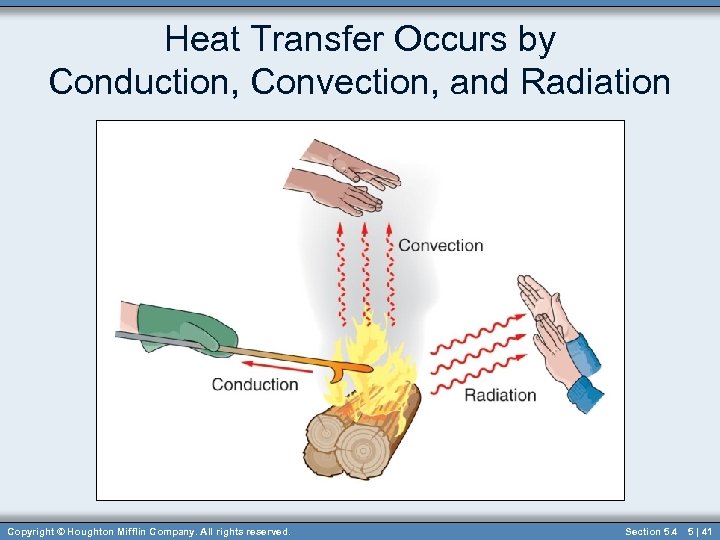 Heat Transfer Occurs by Conduction, Convection, and Radiation Copyright © Houghton Mifflin Company. All rights reserved. Section 5. 4 5 | 41
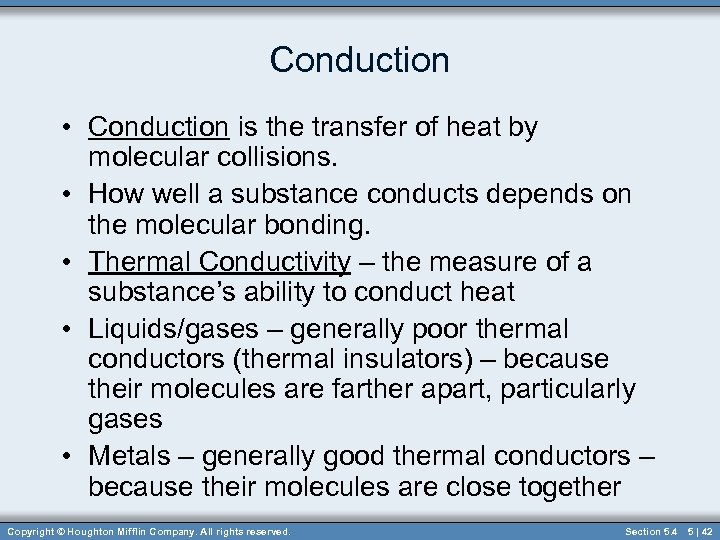 Conduction • Conduction is the transfer of heat by molecular collisions. • How well a substance conducts depends on the molecular bonding. • Thermal Conductivity – the measure of a substance’s ability to conduct heat • Liquids/gases – generally poor thermal conductors (thermal insulators) – because their molecules are farther apart, particularly gases • Metals – generally good thermal conductors – because their molecules are close together Copyright © Houghton Mifflin Company. All rights reserved. Section 5. 4 5 | 42
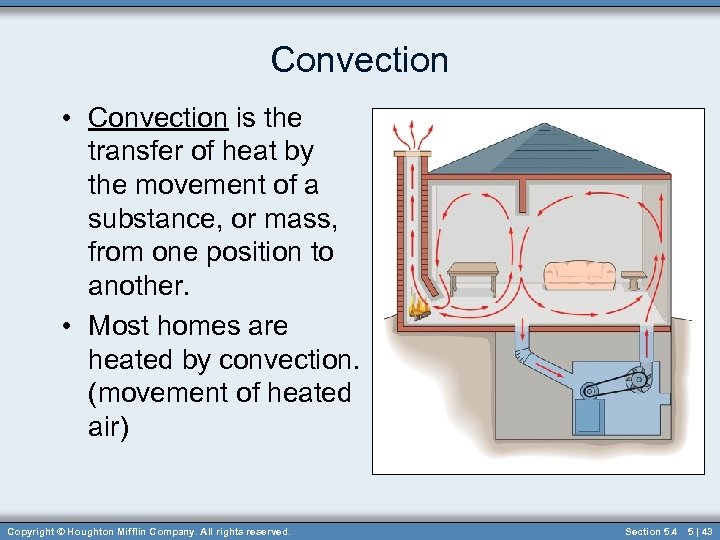 Convection • Convection is the transfer of heat by the movement of a substance, or mass, from one position to another. • Most homes are heated by convection. (movement of heated air) Copyright © Houghton Mifflin Company. All rights reserved. Section 5. 4 5 | 43
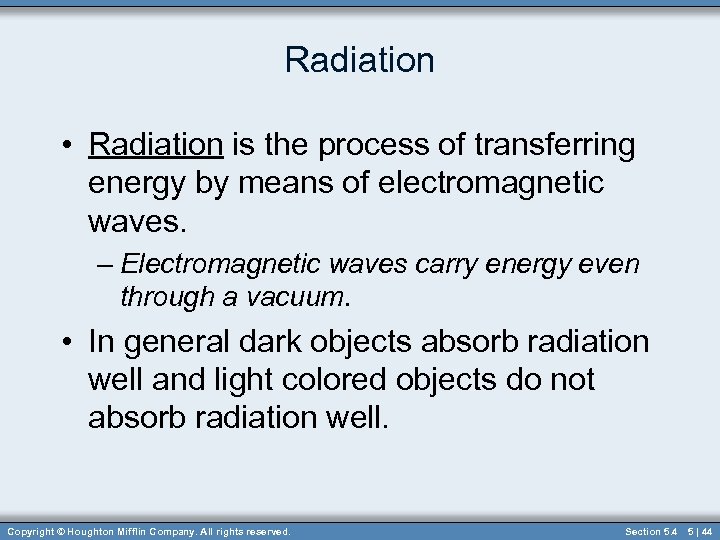 Radiation • Radiation is the process of transferring energy by means of electromagnetic waves. – Electromagnetic waves carry energy even through a vacuum. • In general dark objects absorb radiation well and light colored objects do not absorb radiation well. Copyright © Houghton Mifflin Company. All rights reserved. Section 5. 4 5 | 44
 Insulation • Good insulating material generally has an abundance of open air space to inhibit the movement of heat. – Goose down sleeping bags • House insulation (spun fiberglass) – Pot holders (fabric with batting) – Double paned windows – void between glass panes Copyright © Houghton Mifflin Company. All rights reserved. Section 5. 4 5 | 45
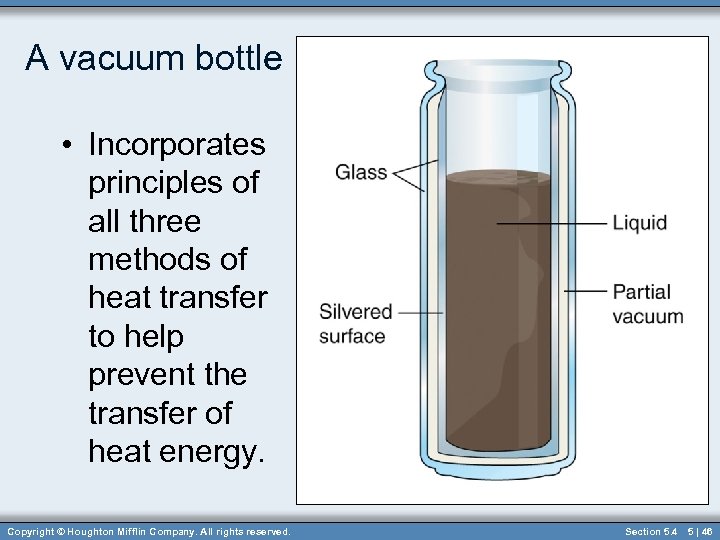 A vacuum bottle • Incorporates principles of all three methods of heat transfer to help prevent the transfer of heat energy. Copyright © Houghton Mifflin Company. All rights reserved. Section 5. 4 5 | 46
 A Vacuum (thermos) Bottle • Partial vacuum between the double walls minimizes the conduction and convection of heat energy. • The silvered inner surface of the inner glass container minimizes heat transfer by radiation. • Thus, a quality vacuum (thermos) bottle is designed to either keep cold foods cold or hot foods hot. Copyright © Houghton Mifflin Company. All rights reserved. Section 5. 4 5 | 47
 Phases of Matter • Solid, Liquid, and Gas – the three common phases of matter • Pressure and Temperature (P&T) determine in which phase a substance exists. • Example at normal room P & T: – Copper is solid – Water is liquid – Oxygen is a gas Copyright © Houghton Mifflin Company. All rights reserved. Section 5. 4 5 | 48
 Solids (molecules vibrate) • Have a definite shape and volume • Crystalline Solid (minerals) – the molecules are arranged in a particular repeating pattern – Upon heating the molecules gain kinetic energy (vibrate more). The more heat the more/bigger the vibrations and the solids expand. • Amorphous Solid (glass) – lack an ordered molecular structure – Gradually become softer as heat is added (no definite melting temperature) Copyright © Houghton Mifflin Company. All rights reserved. Section 5. 4 5 | 49
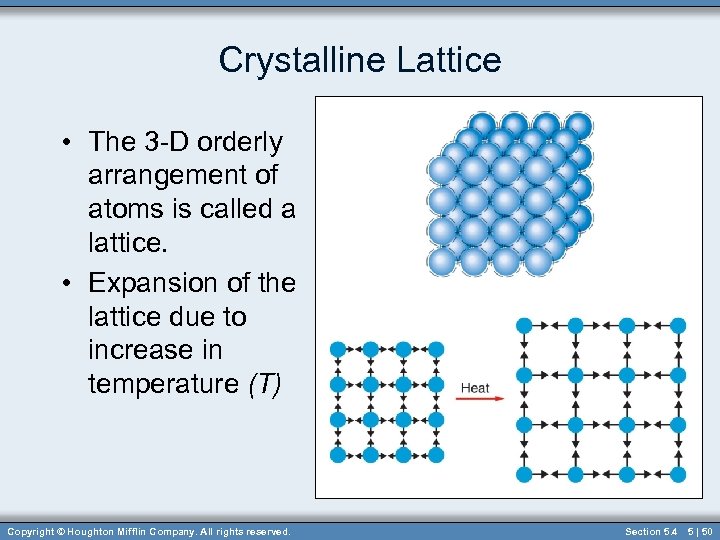 Crystalline Lattice • The 3 -D orderly arrangement of atoms is called a lattice. • Expansion of the lattice due to increase in temperature (T) Copyright © Houghton Mifflin Company. All rights reserved. Section 5. 4 5 | 50
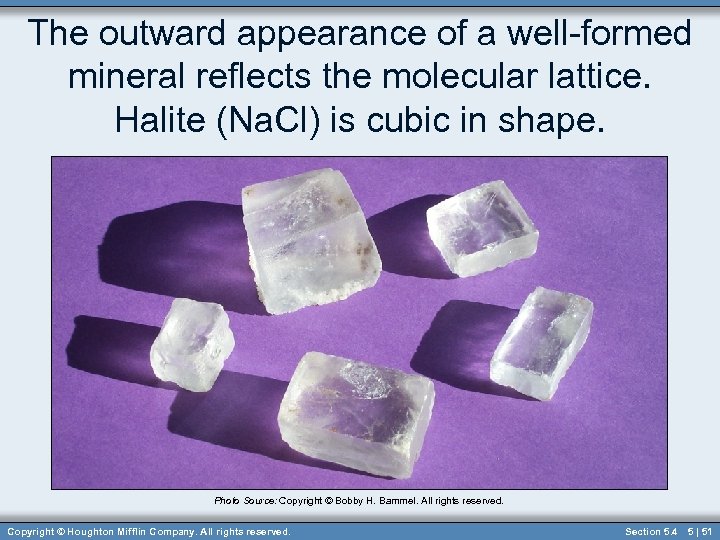 The outward appearance of a well-formed mineral reflects the molecular lattice. Halite (Na. Cl) is cubic in shape. Photo Source: Copyright © Bobby H. Bammel. All rights reserved. Copyright © Houghton Mifflin Company. All rights reserved. Section 5. 4 5 | 51
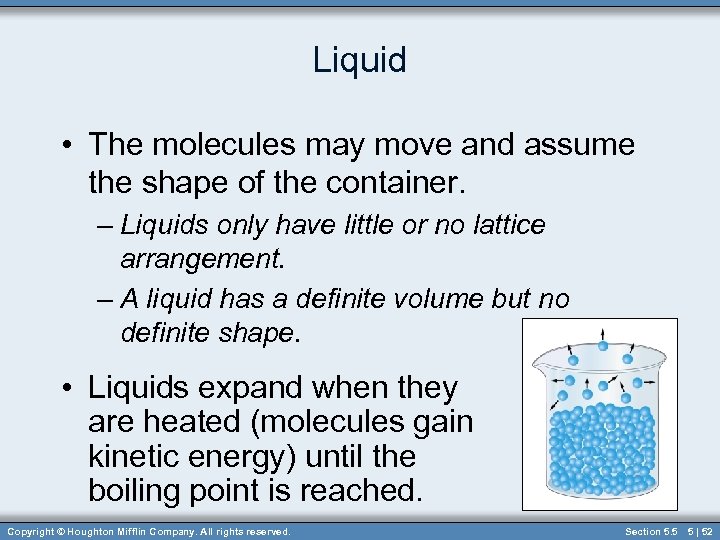 Liquid • The molecules may move and assume the shape of the container. – Liquids only have little or no lattice arrangement. – A liquid has a definite volume but no definite shape. • Liquids expand when they are heated (molecules gain kinetic energy) until the boiling point is reached. Copyright © Houghton Mifflin Company. All rights reserved. Section 5. 5 5 | 52
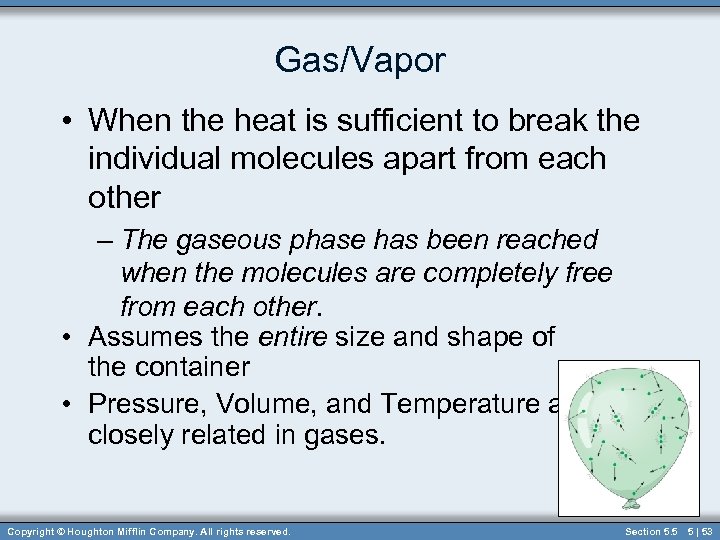 Gas/Vapor • When the heat is sufficient to break the individual molecules apart from each other – The gaseous phase has been reached when the molecules are completely free from each other. • Assumes the entire size and shape of the container • Pressure, Volume, and Temperature are closely related in gases. Copyright © Houghton Mifflin Company. All rights reserved. Section 5. 5 5 | 53
 Plasma • If a gas continues to be heated, eventually the molecules and atoms will be ripped apart due to the extreme kinetic energy. • Plasma – an extremely hot gas of electrically charged particles • Plasmas exist inside our sun and other very hot stars. • The ionosphere of the Earth’s outer atmosphere is a plasma. • Plasmas are considered another phase of matter. Copyright © Houghton Mifflin Company. All rights reserved. Section 5. 5 5 | 54
 Kinetic Theory of Gases • A gas consists of molecules moving independently in all directions at high speeds. • The higher the temperature the higher the average speed of the molecules. • The gas molecules collide with each other and the walls of the container. • The distance between molecules is, on average, large when compared to the size of the molecules. Copyright © Houghton Mifflin Company. All rights reserved. Section 5. 6 5 | 55
 Pressure (Gas) • The result of the collisions of billions of gas molecules on the wall of a container (a balloon or ball for example) more gas molecules more collisions more force on the container therefore more pressure Copyright © Houghton Mifflin Company. All rights reserved. Section 5. 6 5 | 56
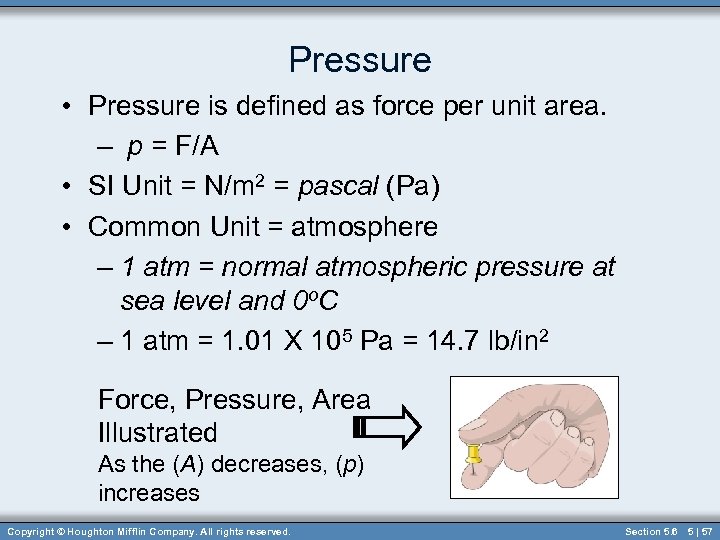 Pressure • Pressure is defined as force per unit area. – p = F/A • SI Unit = N/m 2 = pascal (Pa) • Common Unit = atmosphere – 1 atm = normal atmospheric pressure at sea level and 0 o. C – 1 atm = 1. 01 X 105 Pa = 14. 7 lb/in 2 Force, Pressure, Area Illustrated As the (A) decreases, (p) increases Copyright © Houghton Mifflin Company. All rights reserved. Section 5. 6 5 | 57
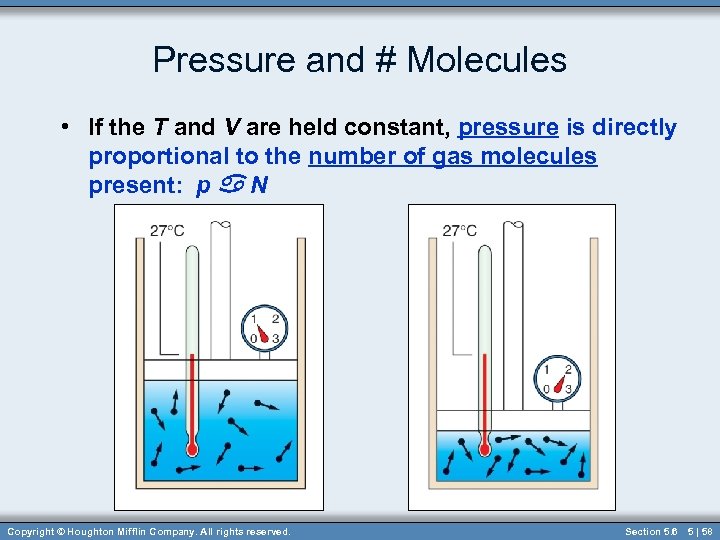 Pressure and # Molecules • If the T and V are held constant, pressure is directly proportional to the number of gas molecules present: p a N Copyright © Houghton Mifflin Company. All rights reserved. Section 5. 6 5 | 58
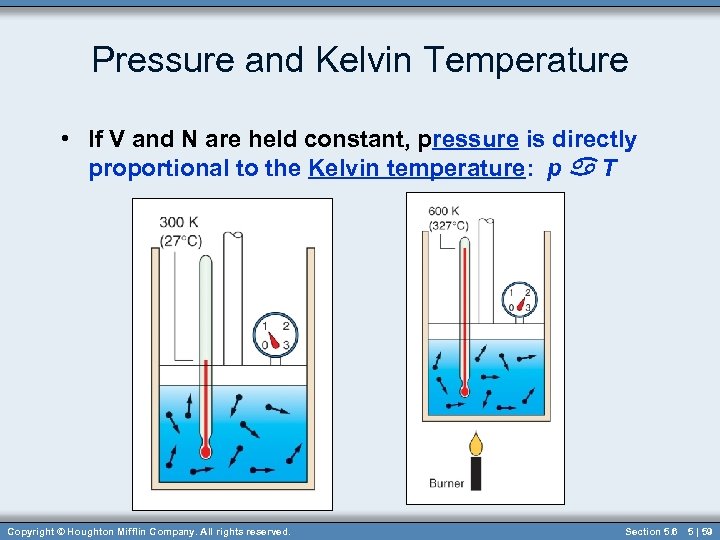 Pressure and Kelvin Temperature • If V and N are held constant, pressure is directly proportional to the Kelvin temperature: p a T Copyright © Houghton Mifflin Company. All rights reserved. Section 5. 6 5 | 59
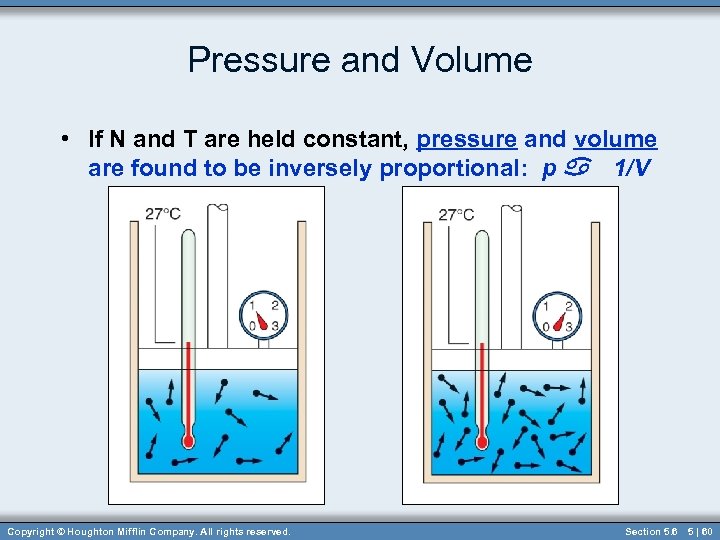 Pressure and Volume • If N and T are held constant, pressure and volume are found to be inversely proportional: p a 1/V Copyright © Houghton Mifflin Company. All rights reserved. Section 5. 6 5 | 60
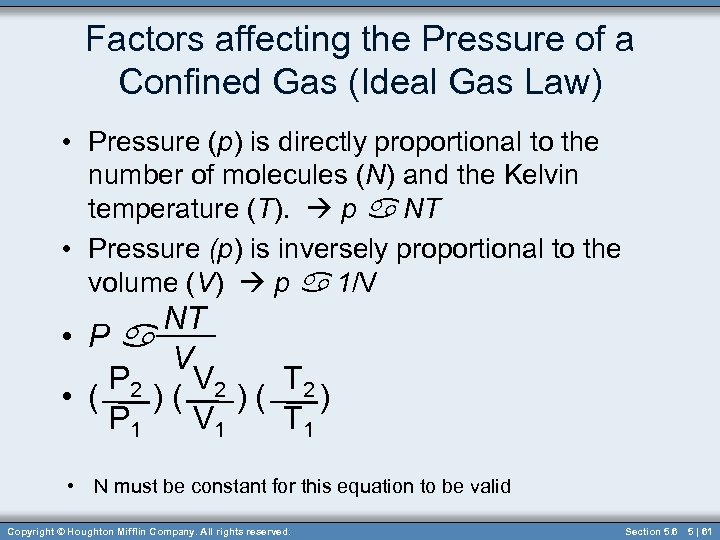 Factors affecting the Pressure of a Confined Gas (Ideal Gas Law) • Pressure (p) is directly proportional to the number of molecules (N) and the Kelvin temperature (T). p a NT • Pressure (p) is inversely proportional to the volume (V) p a 1/V NT • Pa V P 2 V 2 T 2 • ( )( )( ) P 1 V 1 T 1 • N must be constant for this equation to be valid Copyright © Houghton Mifflin Company. All rights reserved. Section 5. 6 5 | 61
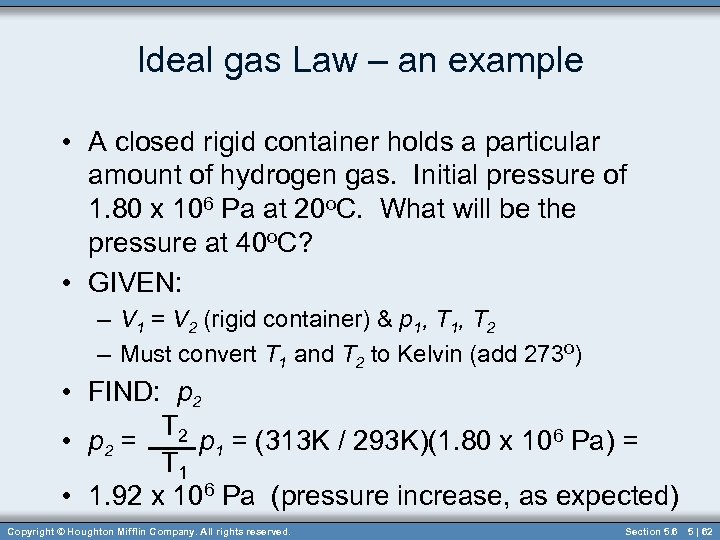 Ideal gas Law – an example • A closed rigid container holds a particular amount of hydrogen gas. Initial pressure of 1. 80 x 106 Pa at 20 o. C. What will be the pressure at 40 o. C? • GIVEN: – V 1 = V 2 (rigid container) & p 1, T 2 – Must convert T 1 and T 2 to Kelvin (add 273 o) • FIND: p 2 T 2 • p 2 = p 1 = (313 K / 293 K)(1. 80 x 106 Pa) = T 1 • 1. 92 x 106 Pa (pressure increase, as expected) Copyright © Houghton Mifflin Company. All rights reserved. Section 5. 6 5 | 62
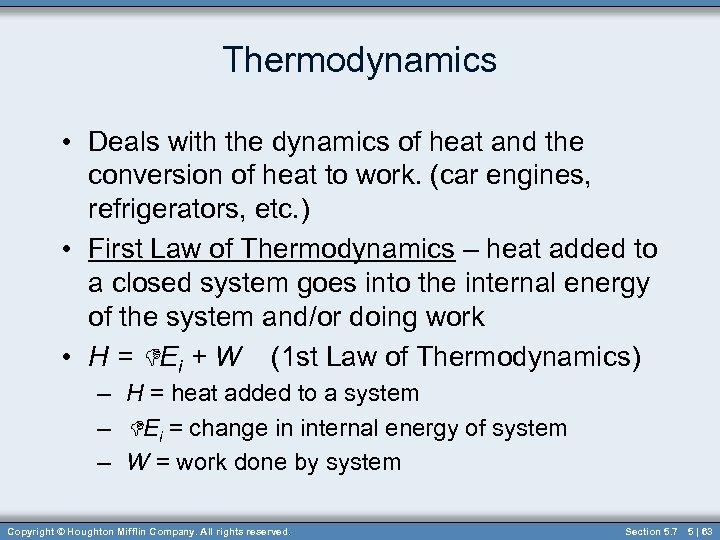 Thermodynamics • Deals with the dynamics of heat and the conversion of heat to work. (car engines, refrigerators, etc. ) • First Law of Thermodynamics – heat added to a closed system goes into the internal energy of the system and/or doing work • H = DEi + W (1 st Law of Thermodynamics) – H = heat added to a system – DEi = change in internal energy of system – W = work done by system Copyright © Houghton Mifflin Company. All rights reserved. Section 5. 7 5 | 63
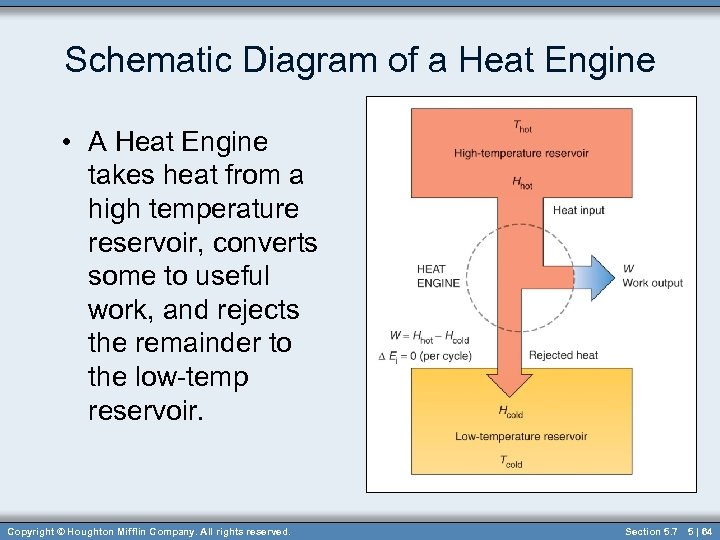 Schematic Diagram of a Heat Engine • A Heat Engine takes heat from a high temperature reservoir, converts some to useful work, and rejects the remainder to the low-temp reservoir. Copyright © Houghton Mifflin Company. All rights reserved. Section 5. 7 5 | 64
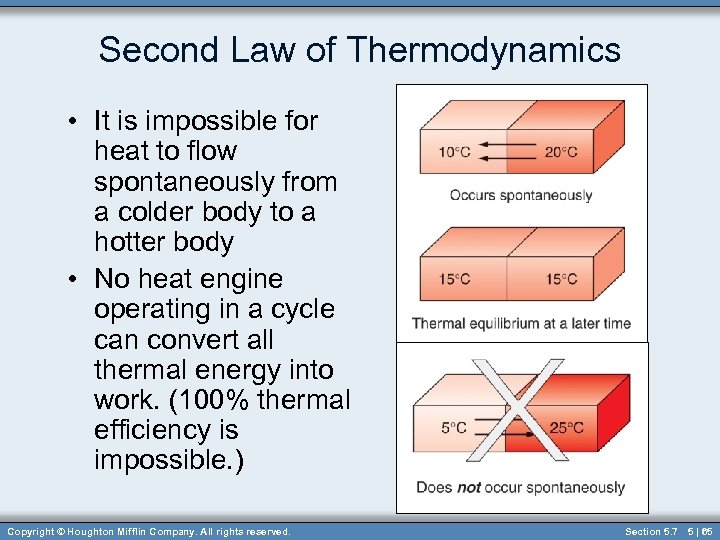 Second Law of Thermodynamics • It is impossible for heat to flow spontaneously from a colder body to a hotter body • No heat engine operating in a cycle can convert all thermal energy into work. (100% thermal efficiency is impossible. ) Copyright © Houghton Mifflin Company. All rights reserved. Section 5. 7 5 | 65
 Third Law of Thermodynamics • It is impossible to attain a temperature of absolute zero. • Absolute zero is the lower limit of temperature. Copyright © Houghton Mifflin Company. All rights reserved. Section 5. 7 5 | 66
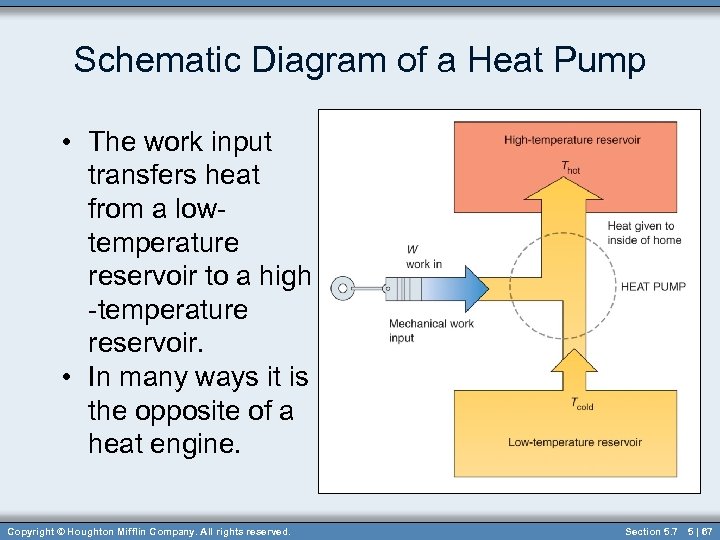 Schematic Diagram of a Heat Pump • The work input transfers heat from a lowtemperature reservoir to a high -temperature reservoir. • In many ways it is the opposite of a heat engine. Copyright © Houghton Mifflin Company. All rights reserved. Section 5. 7 5 | 67
 Entropy • The change in entropy indicates whether or not a process can take place naturally. – Entropy is associated with the second law. • Entropy is a measure of the disorder of a system. – Most natural processes lead to an increase in disorder. (Entropy increases. ) – Energy must be expended to decrease entropy. • Since heat naturally flows from high to low, the entire universe should eventually cool down to a final common temperature. Copyright © Houghton Mifflin Company. All rights reserved. Section 5. 7 5 | 68