


 Скачать презентацию CHAPTER 5 Retail Market Strategy Mc Graw-Hill Irwin CHAPTER
e56d346afa7c291ed18542d5080de6b9.ppt
- Количество слайдов: 33
 CHAPTER 5 Retail Market Strategy Mc. Graw-Hill/Irwin CHAPTER 05 Copyright © 2012 by The Mc. Graw-Hill Companies, Inc. All rights reserved. Copyright © 2014 Mc. Graw-Hill Education. All rights reserved. No reproduction or distribution without the prior written consent of Mc. Graw-Hill Education.
 Questions • What is a retailing strategy? • How can a retailer build a sustainable competitive advantage? • What steps do retailers go through to develop a strategy? • What different strategic growth opportunities can retailers pursue? • What retailers are best positioned to become global retailers? 5 -
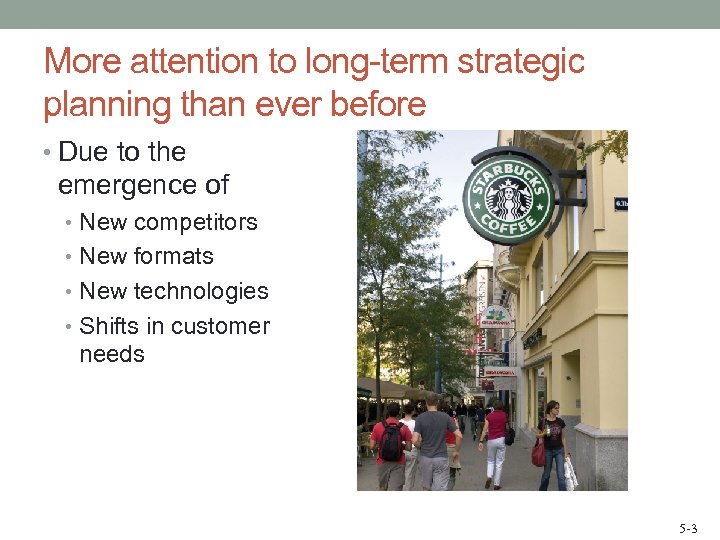 More attention to long-term strategic planning than ever before • Due to the emergence of • New competitors • New formats • New technologies • Shifts in customer needs 5 -3
 Elements in Retail Strategy • Target Market • the market segment(s) toward which the retailer plans to focus its resources and retail mix • Retail Format • the nature of the retailer’s operations—its retail mix • Sustainable Competitive Advantage • an advantage over the competition that is not easily duplicated and can be maintained over a long time. © image 100 Ltd 5 -
 Retail Market • Retail market: • A group of consumers with similar needs and a group of retailers that satisfy those needs using a similar retail channel and format. 5 -
 Criteria For Selecting A Target Market • Attractiveness -- large, growing, • Little competition • More profits • Consistent with your competitive advantages Rim Light / Photo. Link / Getty Images 5 -6
 Can A Retailer Develop a Sustainable Competitive Advantage by: • Dropping the Price of Your Merchandise? • Building a Store at the Best Location? • Deciding to Sell Some Hot Merchandise? • Increasing Your Level of Advertising? • Attracting Better Sales Associates by Paying Higher Wages? • Providing Better Customer Service? 5 -
 Sources of Competitive Advantage More Sustainable • Location • Customer loyalty • Customer service • Exclusive merchandise • Low-cost supply chain management • Information systems • Buying power with vendors • Committed employees Less Sustainable • Better computers • More employees • More merchandise • Greater assortments • Lower prices • More advertising • More promotions • Cleaner stores 5 -8
 Customer Loyalty • More than simply liking one retailer over another • Customers will be reluctant to patronize competitive retailers • Retailers build loyalty by: • Developing a strong brand for the store or store brands • Developing clear and precise positioning strategies • Creating an emotional attachment with customers through loyalty programs 5 -
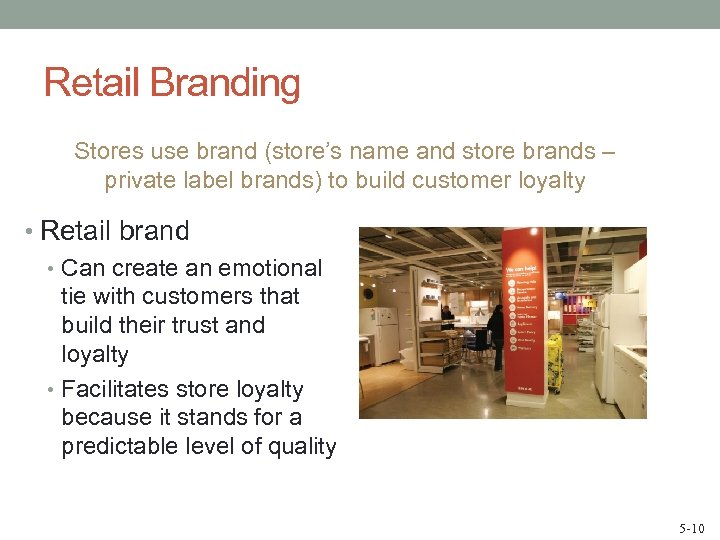 Retail Branding Stores use brand (store’s name and store brands – private label brands) to build customer loyalty • Retail brand • Can create an emotional tie with customers that build their trust and loyalty • Facilitates store loyalty because it stands for a predictable level of quality 5 -10
 Approaches for Building Customer Loyalty • Brand Image • Positioning • Unique Merchandise • Customer Service • Customer Relationship Management Programs 5 -
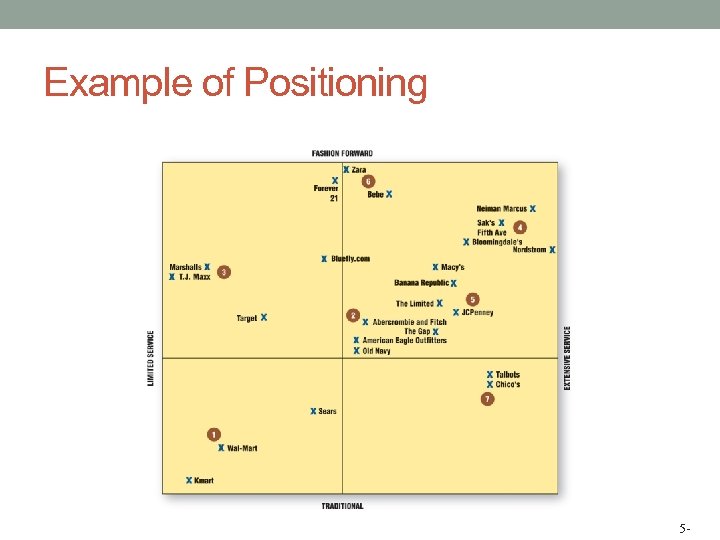 Example of Positioning 5 -
 Vendor Relationships • Low Cost - Efficiency Through Coordination • Electronic Data Interchange (EDI) • Collaborative Planning and Forecasting to Reduce Inventory and Distribution Costs • Exclusive Sale of Desirable Brands • Special Treatment • Early Delivery of New Styles • Shipment of Scare Merchandise 5 -
 Human Resources Management • “Employees are key to build a sustainable competitive advantage” • Strategies for Recruiting and Retaining Talented Employees • Employee Branding • Develop positive organizational culture 5 -
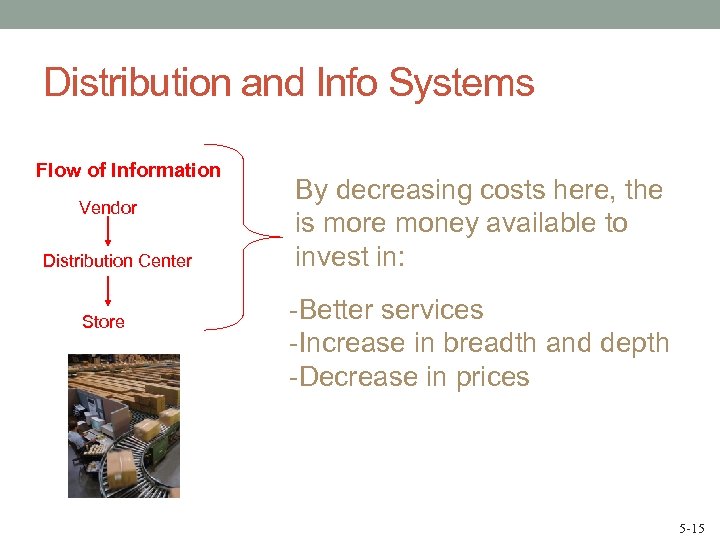 Distribution and Info Systems Flow of Information Vendor Distribution Center Store By decreasing costs here, the is more money available to invest in: -Better services -Increase in breadth and depth -Decrease in prices 5 -15
 Location • What are three most important things in retailing? • “location, location” • Location is a competitive advantage • A high density of Starbucks stores • Creates a top-of-mind awareness • makes it very difficult for a competitor to enter a market and find a good locations 5 -
 Growth Strategies • Market Penetration • Market Expansion • Retail Format Development • Diversification • Related vs. Unrelated Ryan Mc. Vay/Getty Images 5 -
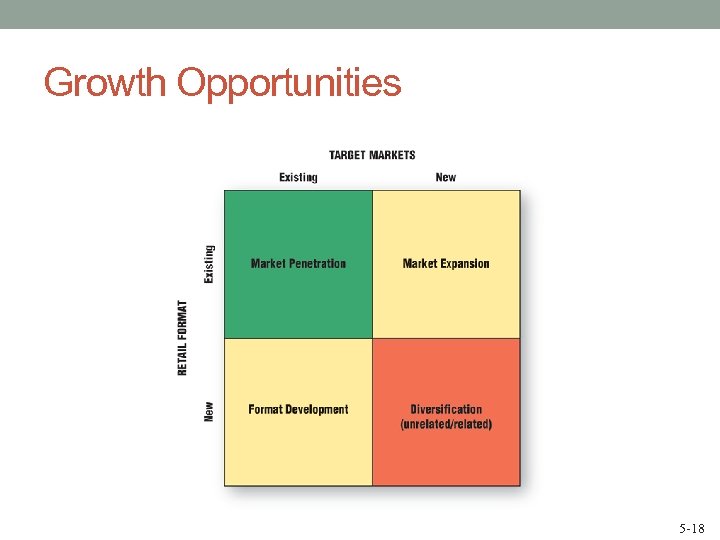 Growth Opportunities 5 -18
 Market Penetration • Attract customers from target market – Walgreens “on every corner” • Get current customer to visit store more often or buy on each visit Cross Selling – sales associates in one department sell complimentary merchandise from other departments Example: Manicurist sells services plus hand lotion or nail polish Example: Salesperson sells leaf blower directs customer to electrical department to purchase a 100 foot extension cord. 5 -
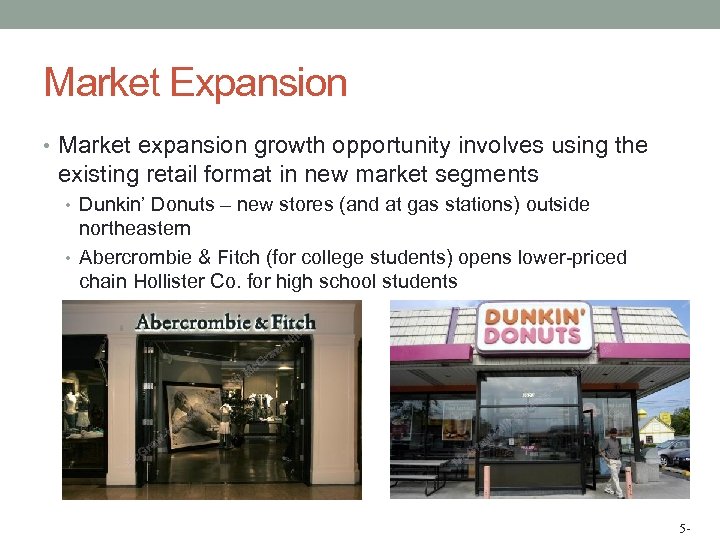 Market Expansion • Market expansion growth opportunity involves using the existing retail format in new market segments • Dunkin’ Donuts – new stores (and at gas stations) outside northeastern • Abercrombie & Fitch (for college students) opens lower-priced chain Hollister Co. for high school students 5 -
 Retail Format Development • Develops a new retail format with a different retail mix for the same target market • Multi-channel retailing • UK based TESCO: • Tesco Express: small stores located close to where customers live and work • Tesco Metro: bring convenience to city center location by specializing in ready-to-eat meals • Tesco Superstores: traditional stores • Tesco Extra: one-stop destination with the widest range of food and non-food products 5 -
 Diversification • Introduces a new retail format toward a market segment that is not currently served by the retailer • Related diversification • Unrelated diversification • Vertical integration into wholesaling or manufacturing 5 -
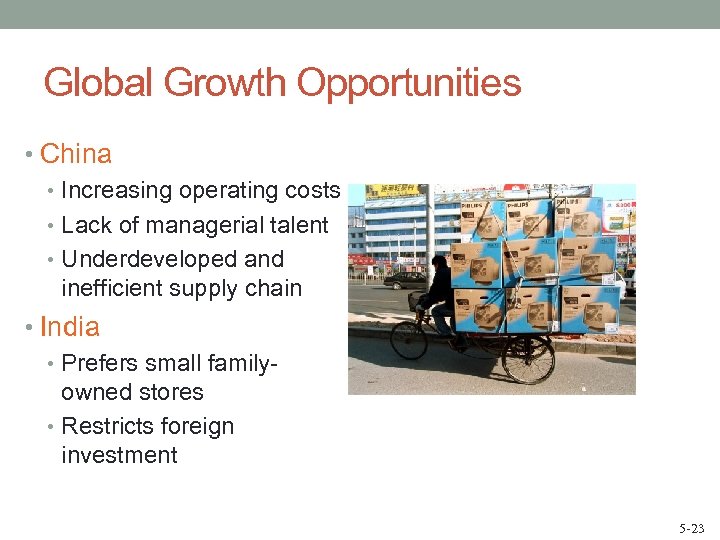 Global Growth Opportunities • China • Increasing operating costs • Lack of managerial talent • Underdeveloped and inefficient supply chain • India • Prefers small familyowned stores • Restricts foreign investment 5 -23
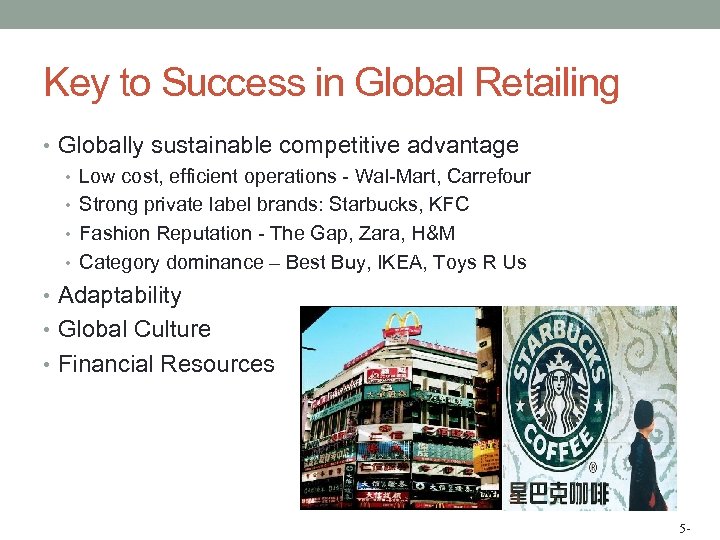 Key to Success in Global Retailing • Globally sustainable competitive advantage • Low cost, efficient operations - Wal-Mart, Carrefour • Strong private label brands: Starbucks, KFC • Fashion Reputation - The Gap, Zara, H&M • Category dominance – Best Buy, IKEA, Toys R Us • Adaptability • Global Culture • Financial Resources 5 -
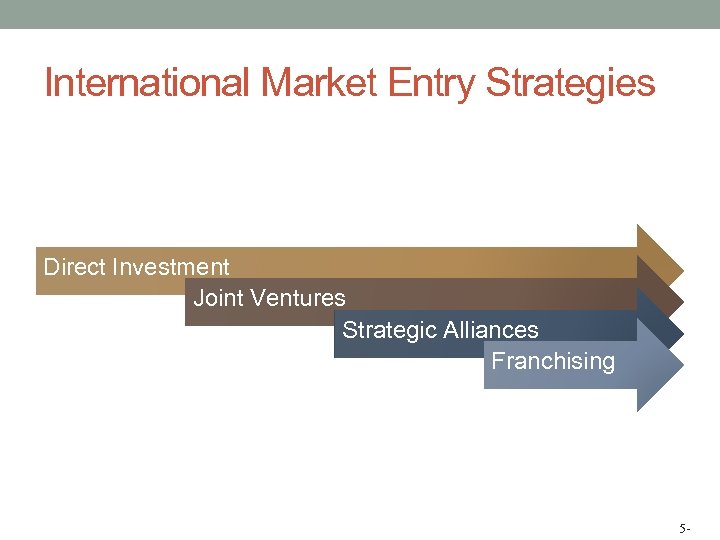 International Market Entry Strategies Direct Investment Joint Ventures Strategic Alliances Franchising 5 -
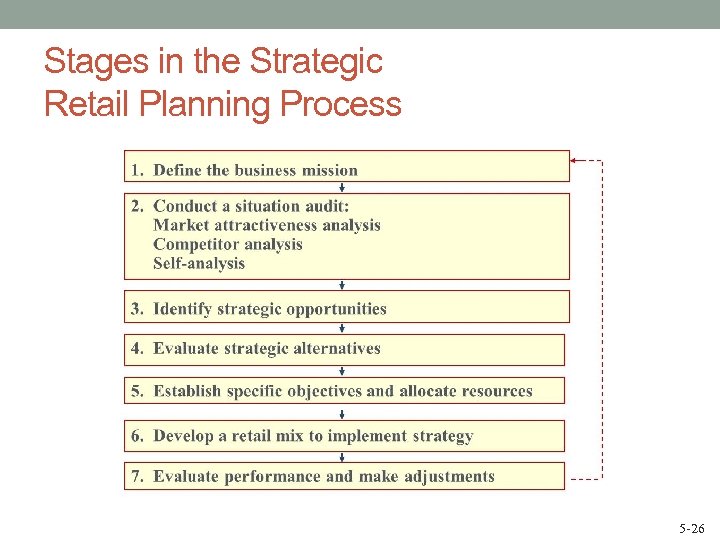 Stages in the Strategic Retail Planning Process 5 -26
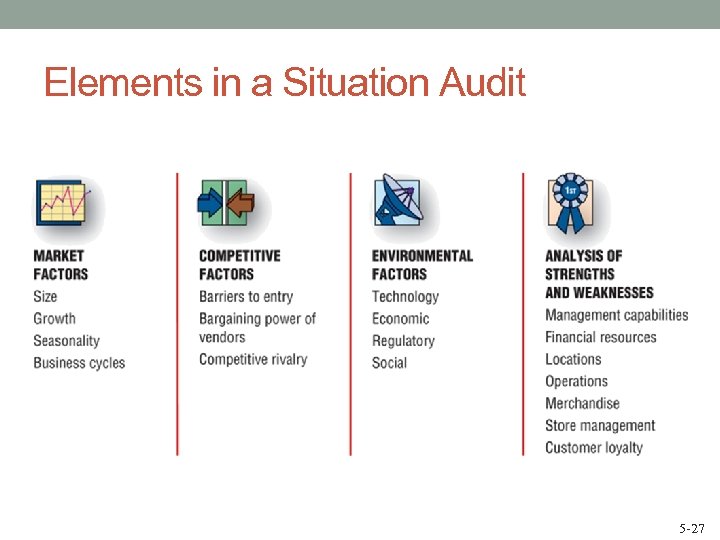 Elements in a Situation Audit 5 -27
 Market Factors • Market size – large markets attractive to large retail firms • Growth – typically more attractive than mature or declining • Seasonality – can be an issue as resources are necessary during peak season only • Business cycles – retail markets can be affected by economic conditions – military base towns 5 -
 Competitive Factors • Barriers to entry • Scale economies of big box retailers • Service and unique, high-end products of small retailers • Bargaining power of vendors • Markets are less attractive when only a few vendors control the merchandise sold within it 5 -
 Competitive Factors • Competitive rivalry • Defines the frequency and intensity of reactions to actions undertaken by competitors • Conditions leading to intense rivalry: a large number of same size retailers, slow growth, high fixed costs, a lack of perceived differences between competing retailers 5 -
 Questions for Analyzing the Environment • New developments or changes -- technologies, regulations, social factors, economic conditions • Likelihood changes will occur • Key factors determining change • Impact of change on retail market firm, competitors 5 -
 Performing a Self-Analysis • At what is our company good? • In which of these areas is our company better than our competitors? • In which of these areas does our company’s unique capabilities provide a sustainable advantage or a basis for developing one? Stockbyte/Punchstock Images 5 -
 Keywords • brand image Set of associations consumers have about a brand that are usually organized around some meaningful themes. • positioning The design and implementation of a retail mix to create in the customer’s mind an image of the retailer relative to its competitors. Also called brand building. 5 -