 Скачать презентацию Chapter 5 Regression BPS — 3 rd Ed
daa257bdd6885a6fe3d053ba2df3f8ce.ppt
- Количество слайдов: 24



Chapter 5 Regression BPS - 3 rd Ed. Chapter 5 1
Linear Regression u. Objective: To quantify the linear relationship between an explanatory variable (x) and response variable (y). u. We can then predict the average response for all subjects with a given value of the explanatory variable. BPS - 3 rd Ed. Chapter 5 2
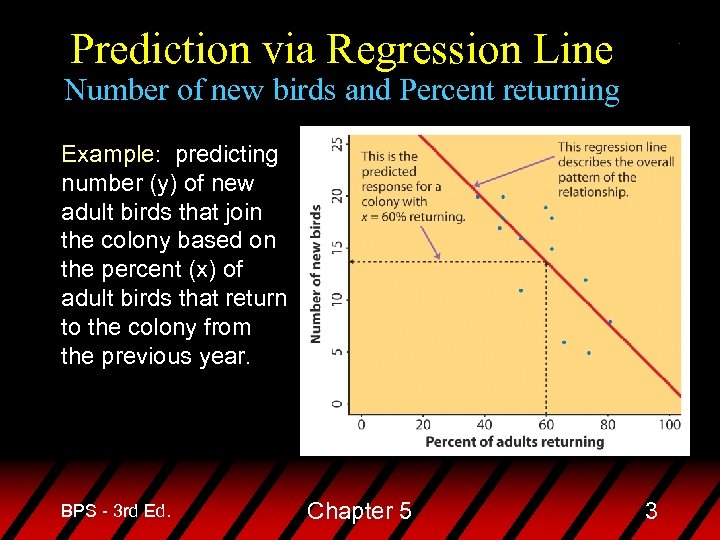
Prediction via Regression Line Number of new birds and Percent returning Example: predicting number (y) of new adult birds that join the colony based on the percent (x) of adult birds that return to the colony from the previous year. BPS - 3 rd Ed. Chapter 5 3
Least Squares u Used to determine the “best” line u We want the line to be as close as possible to the data points in the vertical (y) direction (since that is what we are trying to predict) u Least Squares: use the line that minimizes the sum of the squares of the vertical distances of the data points from the line BPS - 3 rd Ed. Chapter 5 4
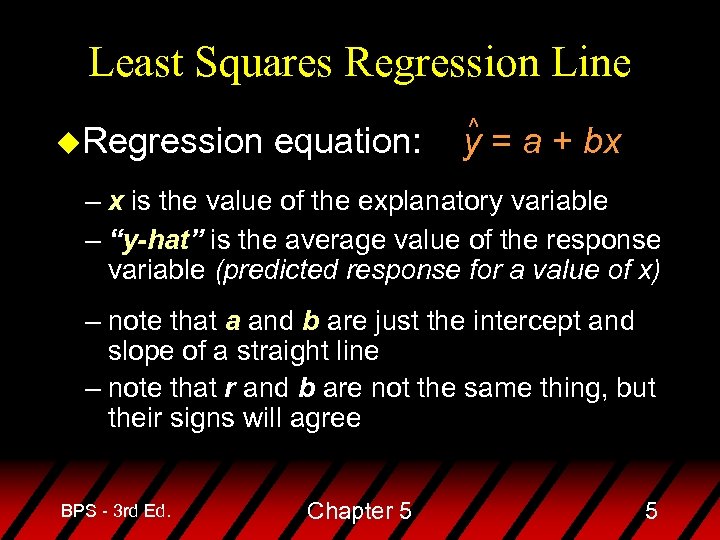
Least Squares Regression Line u. Regression equation: ^ y = a + bx – x is the value of the explanatory variable – “y-hat” is the average value of the response variable (predicted response for a value of x) – note that a and b are just the intercept and slope of a straight line – note that r and b are not the same thing, but their signs will agree BPS - 3 rd Ed. Chapter 5 5
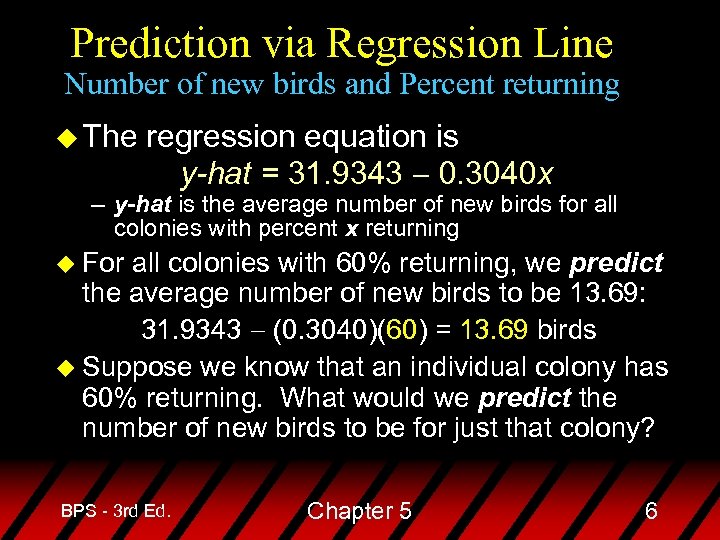
Prediction via Regression Line Number of new birds and Percent returning u The regression equation is y-hat = 31. 9343 0. 3040 x – y-hat is the average number of new birds for all colonies with percent x returning u For all colonies with 60% returning, we predict the average number of new birds to be 13. 69: 31. 9343 (0. 3040)(60) = 13. 69 birds u Suppose we know that an individual colony has 60% returning. What would we predict the number of new birds to be for just that colony? BPS - 3 rd Ed. Chapter 5 6
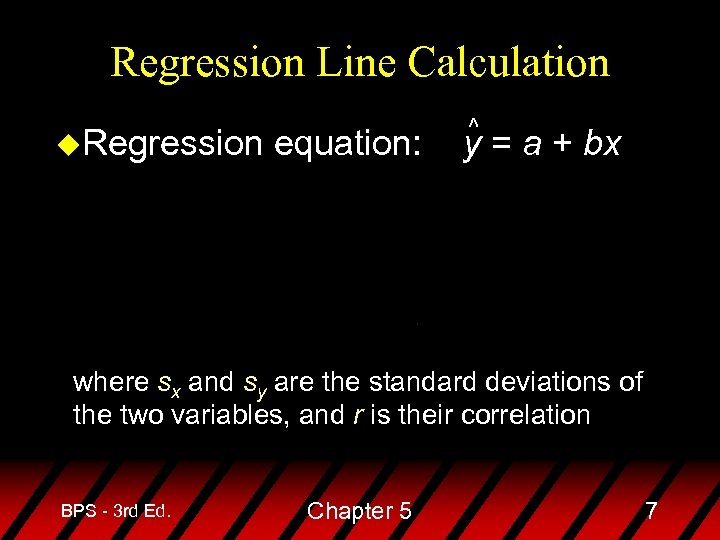
Regression Line Calculation u. Regression equation: ^ y = a + bx where sx and sy are the standard deviations of the two variables, and r is their correlation BPS - 3 rd Ed. Chapter 5 7
Regression Calculation Case Study Per Capita Gross Domestic Product and Average Life Expectancy for Countries in Western Europe BPS - 3 rd Ed. Chapter 5 8
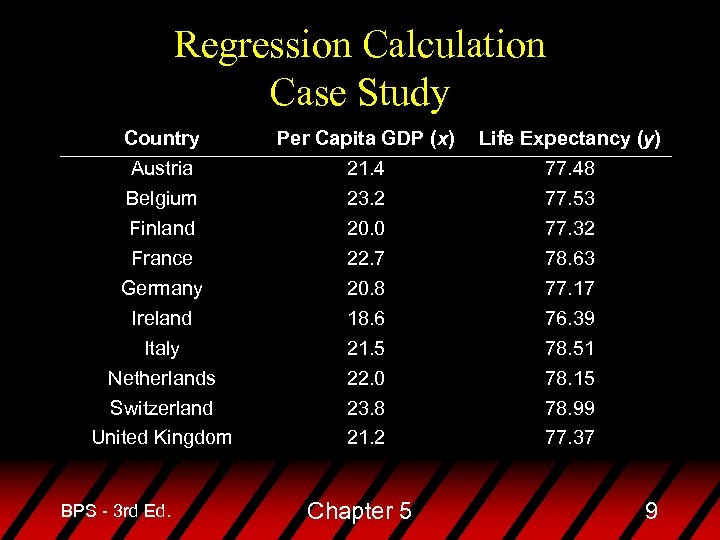
Regression Calculation Case Study Country Austria Belgium Finland France Germany Ireland Italy Netherlands Switzerland United Kingdom BPS - 3 rd Ed. Per Capita GDP (x) 21. 4 23. 2 20. 0 22. 7 20. 8 18. 6 21. 5 22. 0 23. 8 21. 2 Chapter 5 Life Expectancy (y) 77. 48 77. 53 77. 32 78. 63 77. 17 76. 39 78. 51 78. 15 78. 99 77. 37 9
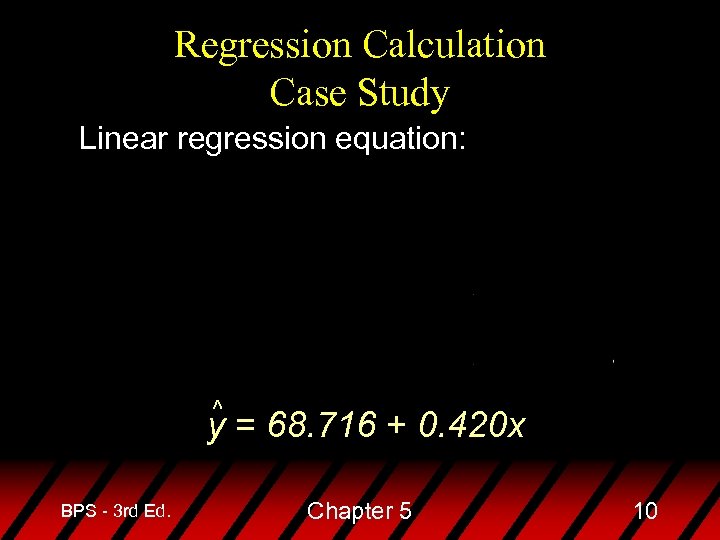
Regression Calculation Case Study Linear regression equation: ^ y = 68. 716 + 0. 420 x BPS - 3 rd Ed. Chapter 5 10
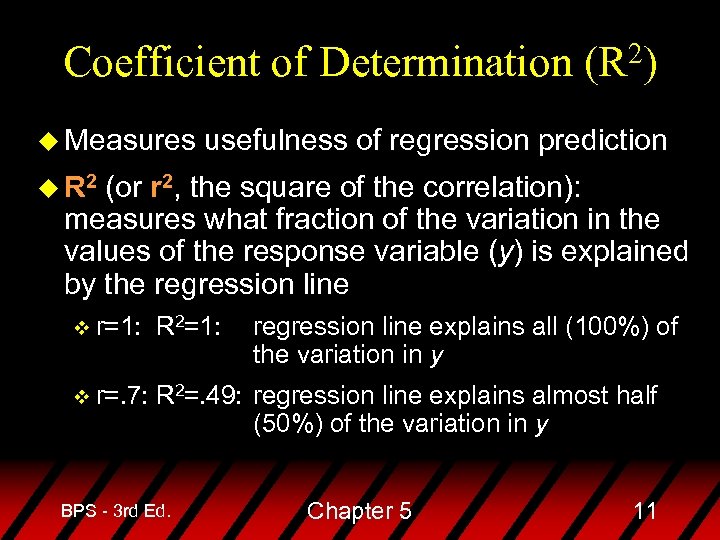
Coefficient of Determination u Measures 2) (R usefulness of regression prediction u R 2 (or r 2, the square of the correlation): measures what fraction of the variation in the values of the response variable (y) is explained by the regression line v r=1: R 2=1: v r=. 7: R 2=. 49: regression line explains almost half (50%) of the variation in y BPS - 3 rd Ed. regression line explains all (100%) of the variation in y Chapter 5 11
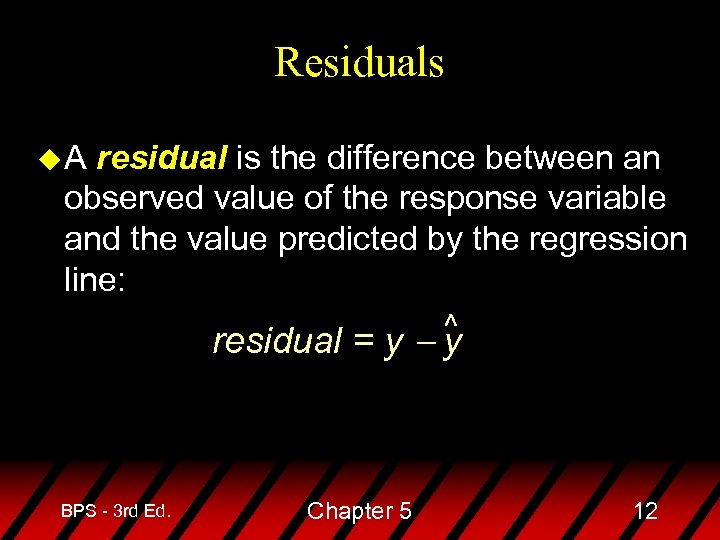
Residuals u. A residual is the difference between an observed value of the response variable and the value predicted by the regression line: residual = y BPS - 3 rd Ed. Chapter 5 ^ y 12
Residuals u. A residual plot is a scatterplot of the regression residuals against the explanatory variable – used to assess the fit of a regression line – look for a “random” scatter around zero BPS - 3 rd Ed. Chapter 5 13
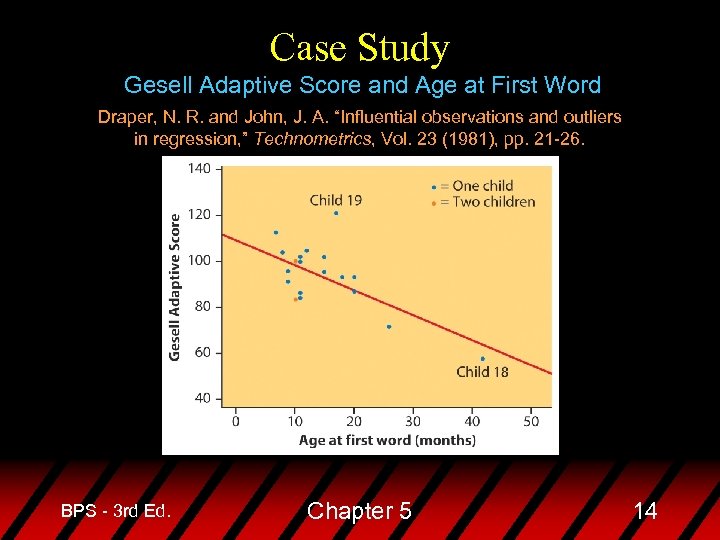
Case Study Gesell Adaptive Score and Age at First Word Draper, N. R. and John, J. A. “Influential observations and outliers in regression, ” Technometrics, Vol. 23 (1981), pp. 21 -26. BPS - 3 rd Ed. Chapter 5 14
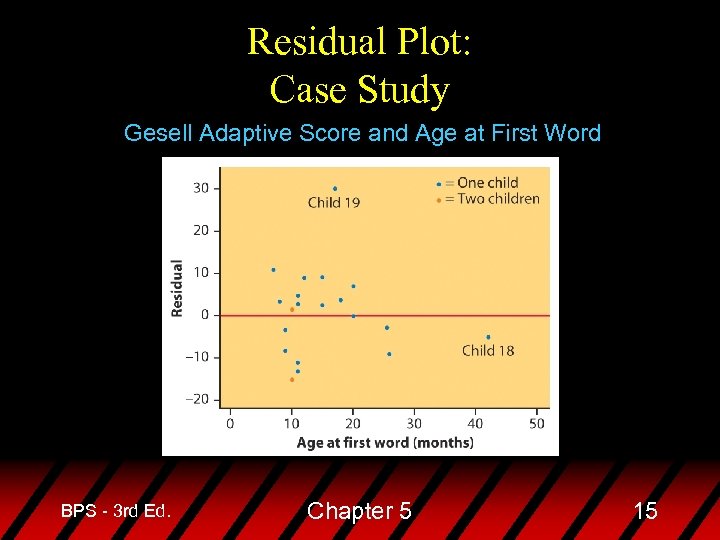
Residual Plot: Case Study Gesell Adaptive Score and Age at First Word BPS - 3 rd Ed. Chapter 5 15
Outliers and Influential Points u An outlier is an observation that lies far away from the other observations – outliers in the y direction have large residuals – outliers in the x direction are often influential for the least-squares regression line, meaning that the removal of such points would markedly change the equation of the line BPS - 3 rd Ed. Chapter 5 16
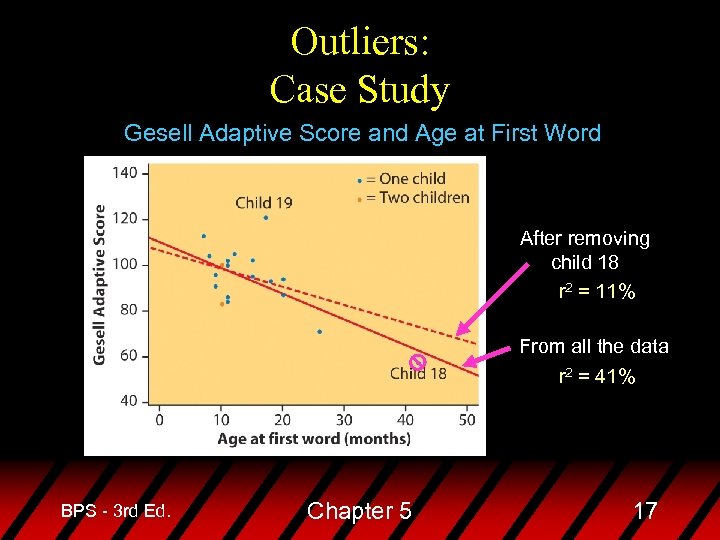
Outliers: Case Study Gesell Adaptive Score and Age at First Word After removing child 18 r 2 = 11% From all the data r 2 = 41% BPS - 3 rd Ed. Chapter 5 17
Cautions about Correlation and Regression u only describe linear relationships u are both affected by outliers u always plot the data before interpreting u beware of extrapolation – predicting outside of the range of x u beware of lurking variables – have important effect on the relationship among the variables in a study, but are not included in the study u association does not imply causation BPS - 3 rd Ed. Chapter 5 18
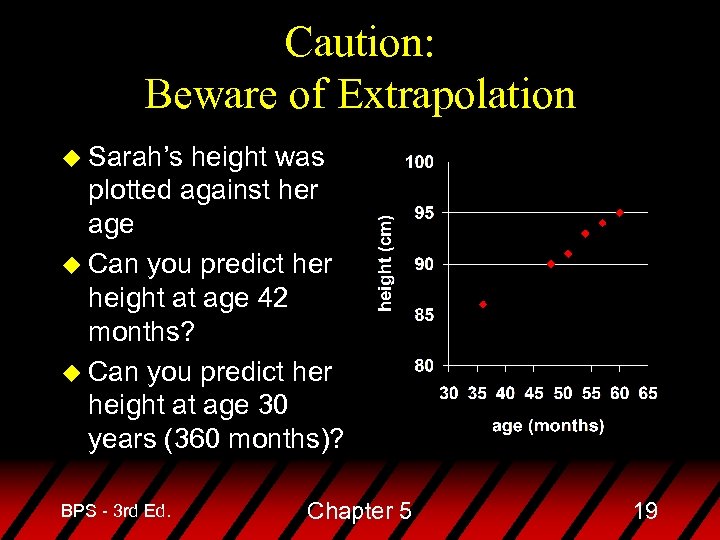
Caution: Beware of Extrapolation u Sarah’s height was plotted against her age u Can you predict her height at age 42 months? u Can you predict her height at age 30 years (360 months)? BPS - 3 rd Ed. Chapter 5 19
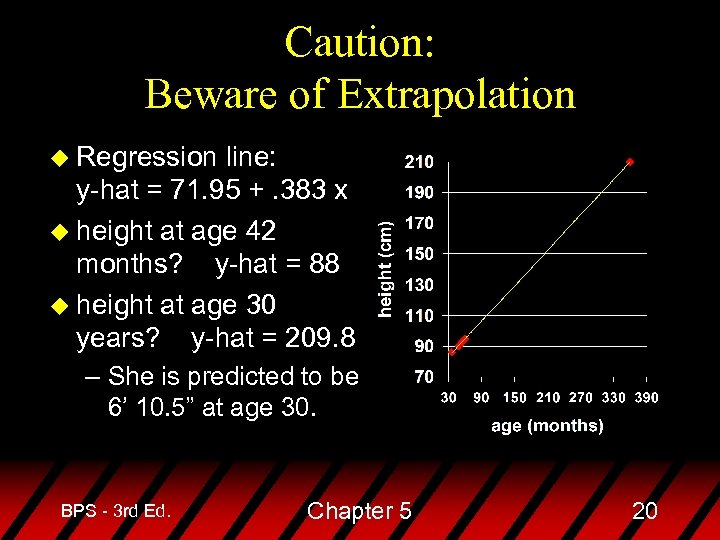
Caution: Beware of Extrapolation u Regression line: y-hat = 71. 95 +. 383 x u height at age 42 months? y-hat = 88 u height at age 30 years? y-hat = 209. 8 – She is predicted to be 6’ 10. 5” at age 30. BPS - 3 rd Ed. Chapter 5 20
Caution: Beware of Lurking Variables Meditation and Aging (Noetic Sciences Review, Summer 1993, p. 28) u Explanatory variable: observed meditation practice (yes/no) u Response: level of age-related enzyme u general concern for one’s well being may also be affecting the response (and the decision to try meditation) BPS - 3 rd Ed. Chapter 5 21
Caution: Correlation Does Not Imply Causation Even very strong correlations may not correspond to a real causal relationship (changes in x actually causing changes in y). (correlation may be explained by a lurking variable) BPS - 3 rd Ed. Chapter 5 22
Caution: Correlation Does Not Imply Causation Social Relationships and Health House, J. , Landis, K. , and Umberson, D. “Social Relationships and Health, ” Science, Vol. 241 (1988), pp 540 -545. Does lack of social relationships cause people to become ill? (there was a strong correlation) u Or, are unhealthy people less likely to establish and maintain social relationships? (reversed relationship) u Or, is there some other factor that predisposes people both to have lower social activity and become ill? u BPS - 3 rd Ed. Chapter 5 23
Evidence of Causation u. A properly conducted experiment establishes the connection (chapter 8) u Other considerations: – The association is strong – The association is consistent v The connection happens in repeated trials v The connection happens under varying conditions – Higher doses are associated with stronger responses – Alleged cause precedes the effect in time – Alleged cause is plausible (reasonable explanation) BPS - 3 rd Ed. Chapter 5 24
Скачать презентацию Chapter 5 Regression BPS — 3 rd Ed
daa257bdd6885a6fe3d053ba2df3f8ce.ppt