 Скачать презентацию CHAPTER 5 Probability What Are the Chances 5
e44e131c0b1bd44661bdd933c989ee2e.ppt
- Количество слайдов: 20



CHAPTER 5 Probability: What Are the Chances? 5. 1 Randomness, Probability, and Simulation The Practice of Statistics, 5 th Edition Starnes, Tabor, Yates, Moore Bedford Freeman Worth Publishers
Randomness, Probability, and Simulation Learning Objectives After this section, you should be able to: ü INTERPRET probability as a long-run relative frequency. ü USE simulation to MODEL chance behavior. The Practice of Statistics, 5 th Edition 2
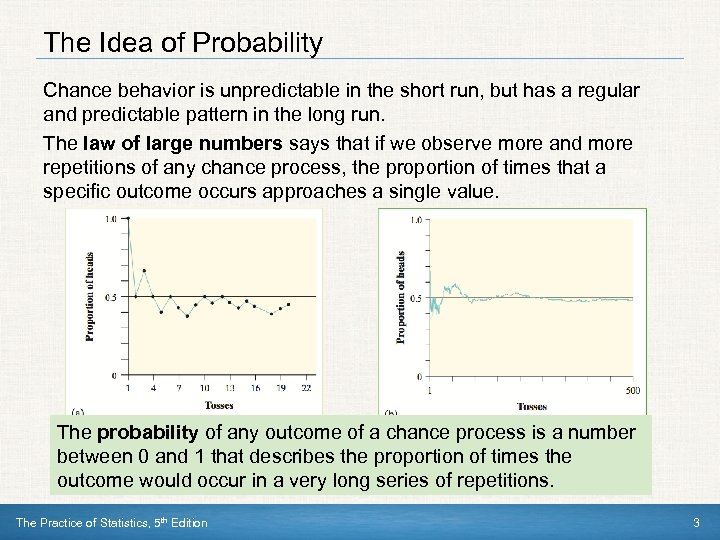
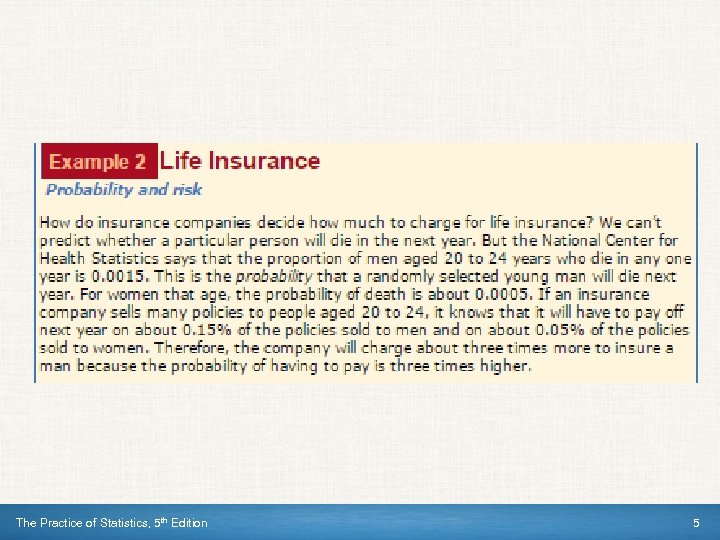
The Idea of Probability Chance behavior is unpredictable in the short run, but has a regular and predictable pattern in the long run. The law of large numbers says that if we observe more and more repetitions of any chance process, the proportion of times that a specific outcome occurs approaches a single value. The probability of any outcome of a chance process is a number between 0 and 1 that describes the proportion of times the outcome would occur in a very long series of repetitions. The Practice of Statistics, 5 th Edition 3
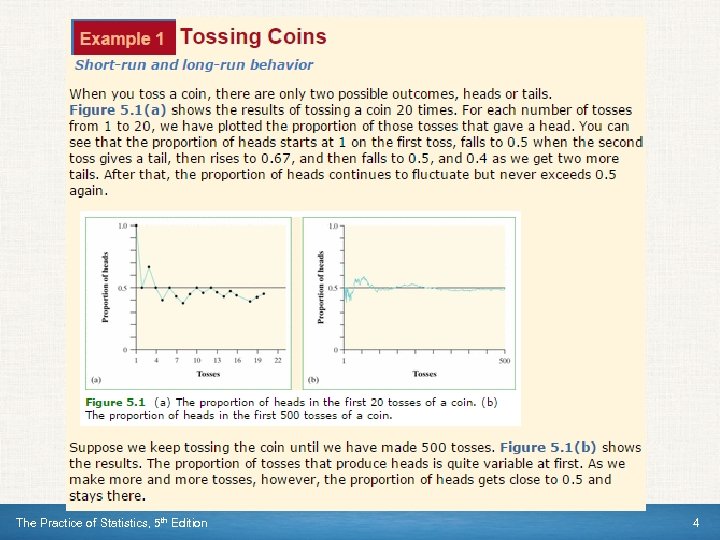
The Practice of Statistics, 5 th Edition 4
The Practice of Statistics, 5 th Edition 5
• CYU on p. 292 The Practice of Statistics, 5 th Edition 6
The Practice of Statistics, 5 th Edition 7
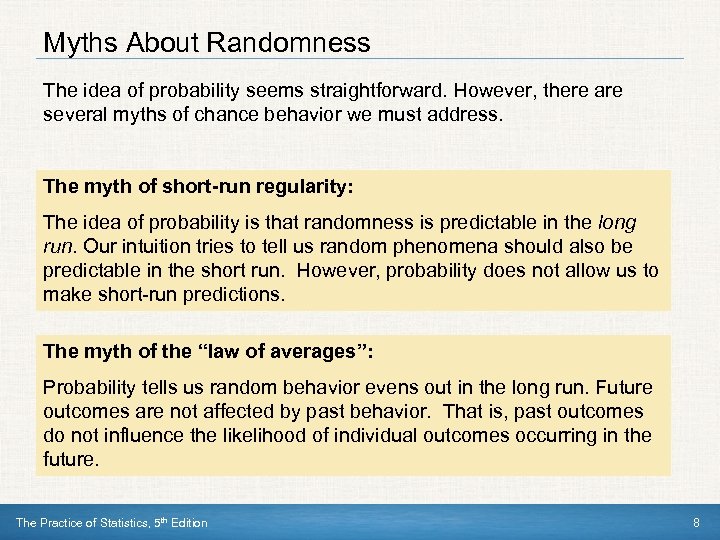
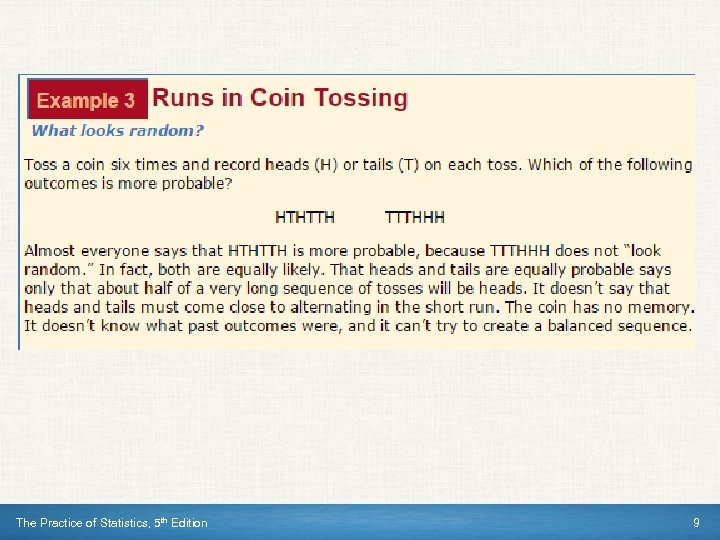
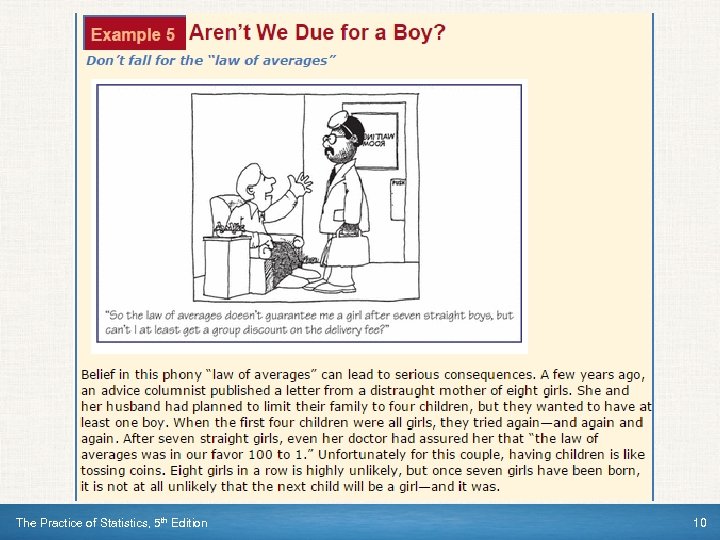
Myths About Randomness The idea of probability seems straightforward. However, there are several myths of chance behavior we must address. The myth of short-run regularity: The idea of probability is that randomness is predictable in the long run. Our intuition tries to tell us random phenomena should also be predictable in the short run. However, probability does not allow us to make short-run predictions. The myth of the “law of averages”: Probability tells us random behavior evens out in the long run. Future outcomes are not affected by past behavior. That is, past outcomes do not influence the likelihood of individual outcomes occurring in the future. The Practice of Statistics, 5 th Edition 8
The Practice of Statistics, 5 th Edition 9
The Practice of Statistics, 5 th Edition 10
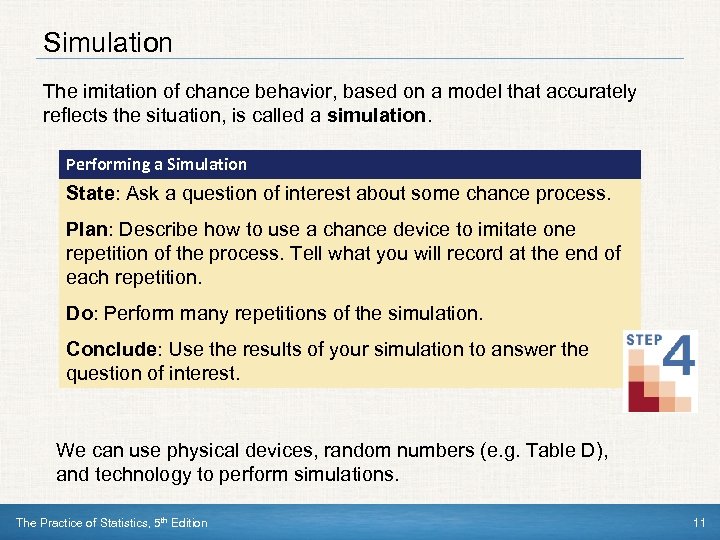
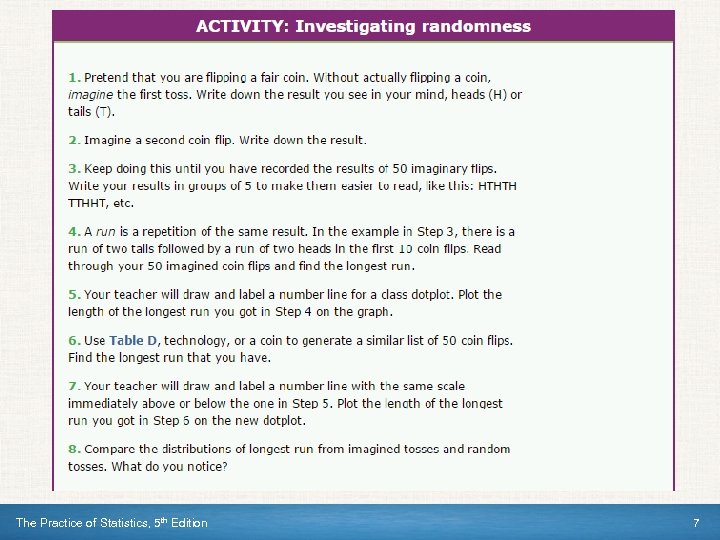
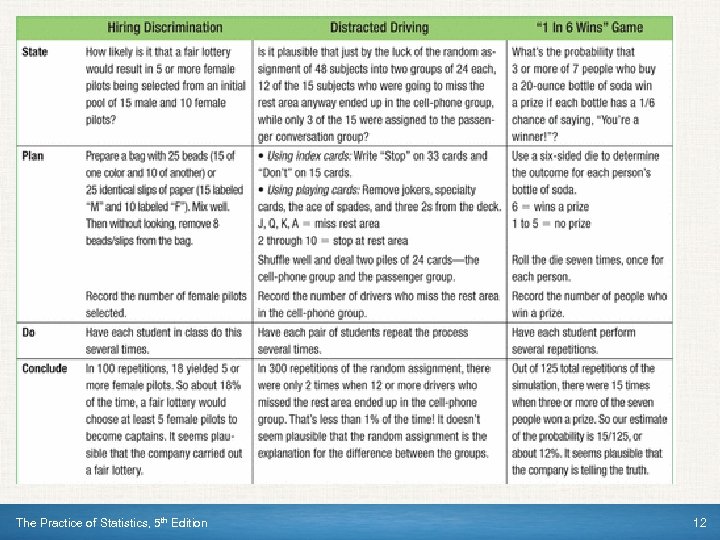
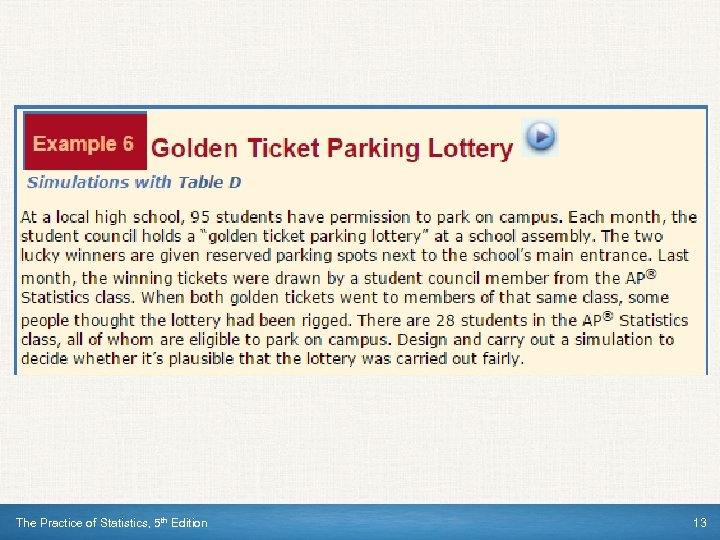
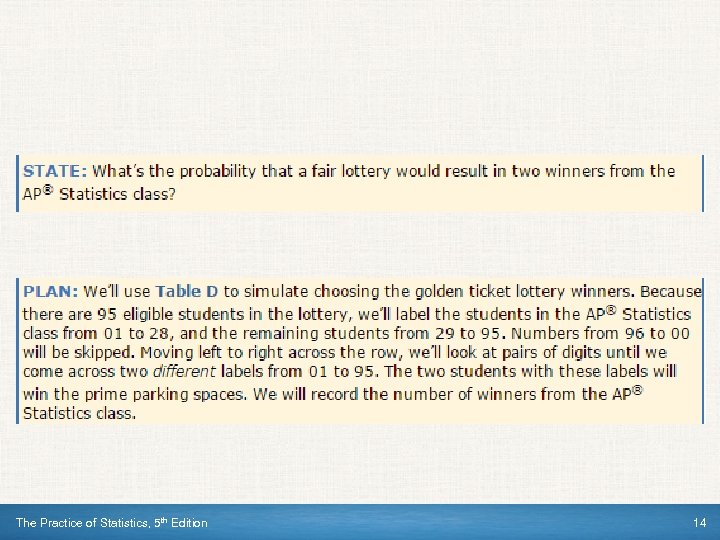
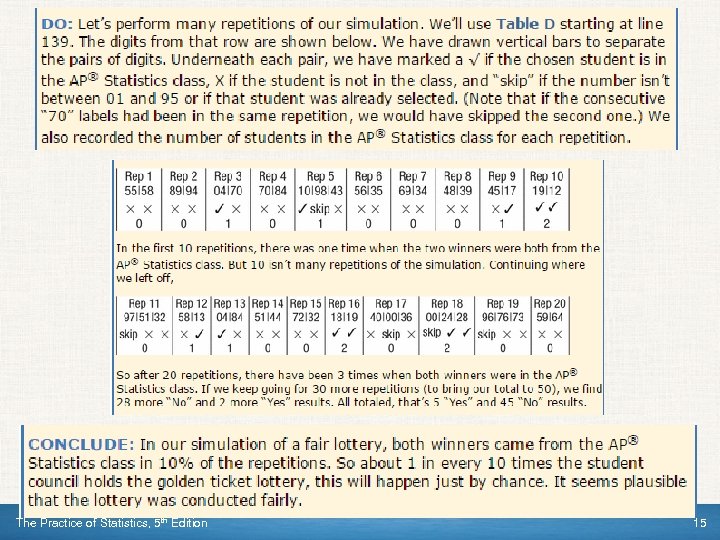
Simulation The imitation of chance behavior, based on a model that accurately reflects the situation, is called a simulation. Performing a Simulation State: Ask a question of interest about some chance process. Plan: Describe how to use a chance device to imitate one repetition of the process. Tell what you will record at the end of each repetition. Do: Perform many repetitions of the simulation. Conclude: Use the results of your simulation to answer the question of interest. We can use physical devices, random numbers (e. g. Table D), and technology to perform simulations. The Practice of Statistics, 5 th Edition 11
The Practice of Statistics, 5 th Edition 12
The Practice of Statistics, 5 th Edition 13
The Practice of Statistics, 5 th Edition 14
The Practice of Statistics, 5 th Edition 15
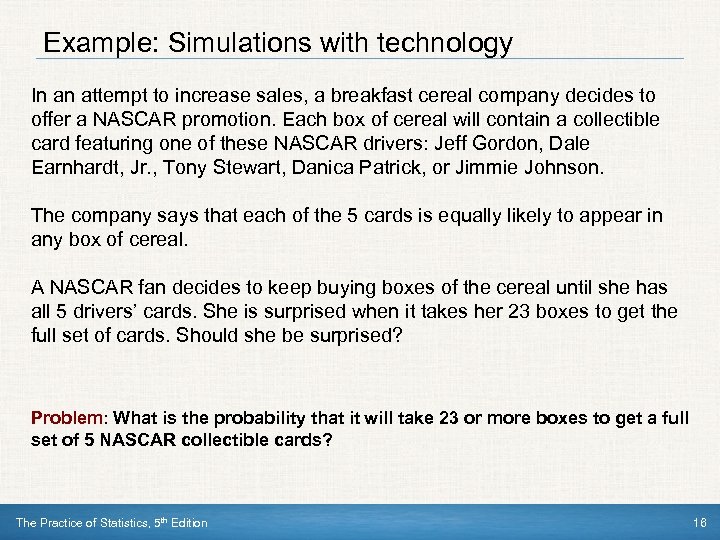
Example: Simulations with technology In an attempt to increase sales, a breakfast cereal company decides to offer a NASCAR promotion. Each box of cereal will contain a collectible card featuring one of these NASCAR drivers: Jeff Gordon, Dale Earnhardt, Jr. , Tony Stewart, Danica Patrick, or Jimmie Johnson. The company says that each of the 5 cards is equally likely to appear in any box of cereal. A NASCAR fan decides to keep buying boxes of the cereal until she has all 5 drivers’ cards. She is surprised when it takes her 23 boxes to get the full set of cards. Should she be surprised? Problem: What is the probability that it will take 23 or more boxes to get a full set of 5 NASCAR collectible cards? The Practice of Statistics, 5 th Edition 16
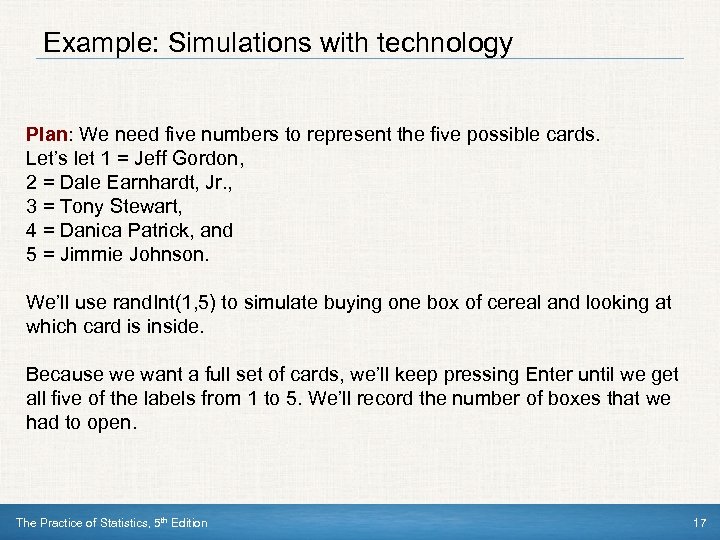
Example: Simulations with technology Plan: We need five numbers to represent the five possible cards. Let’s let 1 = Jeff Gordon, 2 = Dale Earnhardt, Jr. , 3 = Tony Stewart, 4 = Danica Patrick, and 5 = Jimmie Johnson. We’ll use rand. Int(1, 5) to simulate buying one box of cereal and looking at which card is inside. Because we want a full set of cards, we’ll keep pressing Enter until we get all five of the labels from 1 to 5. We’ll record the number of boxes that we had to open. The Practice of Statistics, 5 th Edition 17
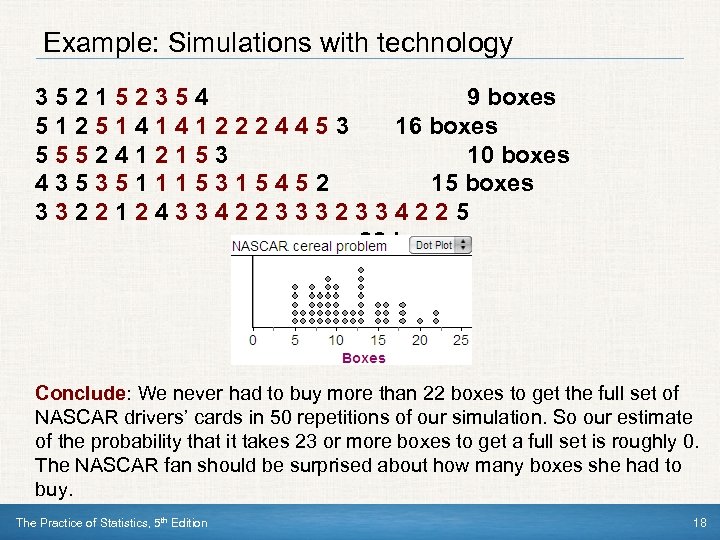
Example: Simulations with technology 352152354 9 boxes 5125141412224453 16 boxes 5552412153 10 boxes 435351115315452 15 boxes 3322124334223332334225 22 boxes Conclude: We never had to buy more than 22 boxes to get the full set of NASCAR drivers’ cards in 50 repetitions of our simulation. So our estimate of the probability that it takes 23 or more boxes to get a full set is roughly 0. The NASCAR fan should be surprised about how many boxes she had to buy. The Practice of Statistics, 5 th Edition 18
• CYU on p. 299 The Practice of Statistics, 5 th Edition 19
Randomness, Probability, and Simulation Section Summary In this section, we learned how to… ü INTERPRET probability as a long-run relative frequency. ü USE simulation to MODEL chance behavior. The Practice of Statistics, 5 th Edition 20
Скачать презентацию CHAPTER 5 Probability What Are the Chances 5
e44e131c0b1bd44661bdd933c989ee2e.ppt