 Скачать презентацию Chapter 5 Probability Created by Kathy Fritz
38f47de46ebaa7b9cada6630987cf8d3.ppt
- Количество слайдов: 77



Chapter 5 Probability Created by Kathy Fritz
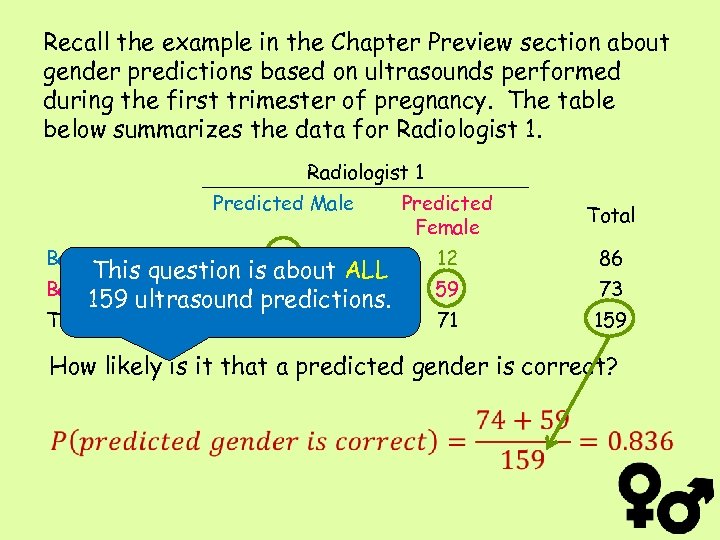
Can ultrasound accurately predict the gender of a baby? The paper “The Use of Three-Dimensional Ultrasound for Fetal Gender Determination in the First Trimester” (The British Journal of Radiology [2003]: 448 -451) describes a study of ultrasound gender prediction. An experienced radiologist looked at 159 first trimester ultrasound images and made a gender prediction for each one. When each baby was born, the ultrasound gender prediction was compared to the baby’s actual gender. This table summarizes the resulting data:
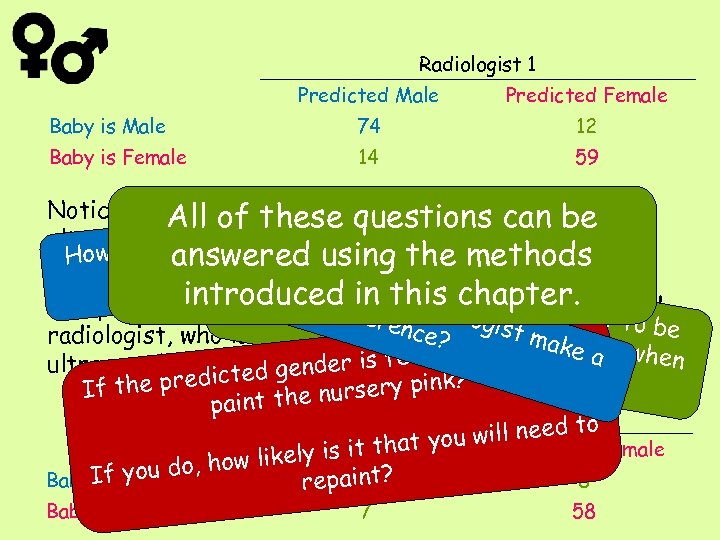
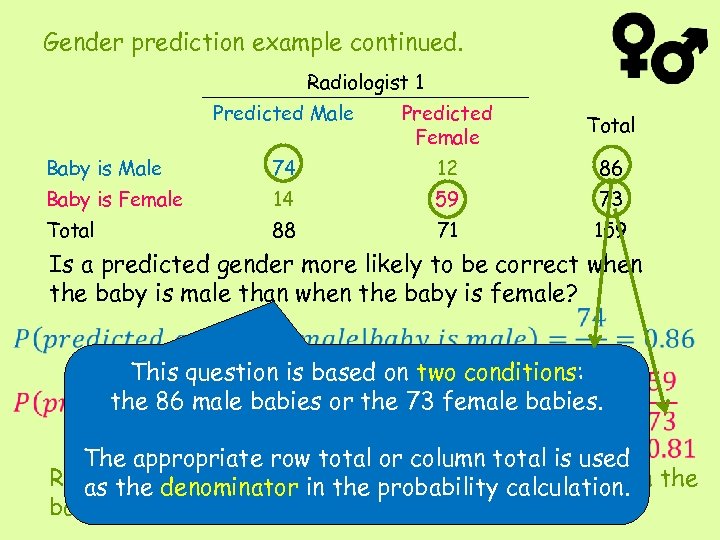
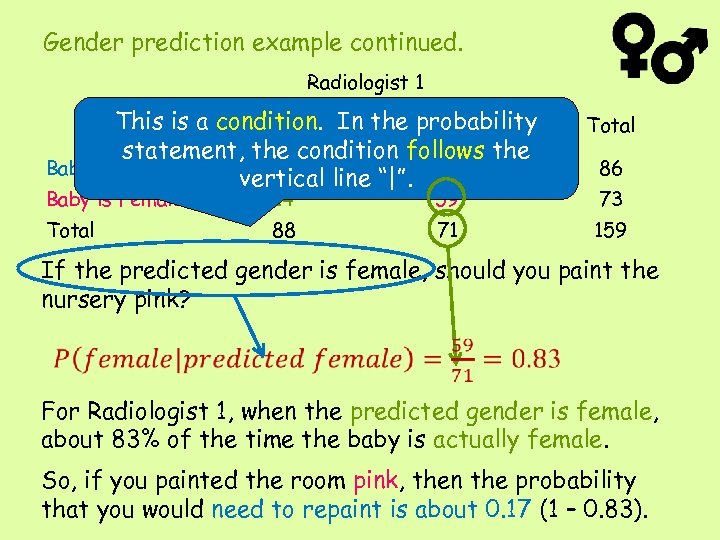
Radiologist 1 Predicted Male Predicted Female Baby is Male 74 12 Baby is Female 14 59 Notice that the gender prediction based can be All of these dicted questions on the ultrasoundy Doitstt a. NOTralways correct. image is t a p e is e h likel answeredcusing the methods hearp Is rsk r t? How co eill o ict ed e ender is or g f c rec ge t d in e ra nder mo e introducedhethtdpredictionsrbylia second thisi chapter. wf n The paper also included gender he b olo d i fe kely to renc abygiis t be s mml the ba e a ak th radiologist, who looked at 154 first? trimestereou a by is s ould y male, fhmale? e a n when e ultrasound inmages. gender is fe d e predicte If th rsery pink? u paint the n Radiologist 2 will need to u Predictedhat yo Predicted Female is it t Male likely how you If Male do, nt Baby is 8 repai 81 ? Baby is Female 7 58
Interpreting Probabilities Probability Relative Frequency Law of Large Numbers Basic Properties
Probability We often find ourselves in situations where the To quantify the outcome is uncertain: likelihood of an occurrence, a number between 0 and 1 can be assigned to an outcome. When a ticketed passenger shows up at the airport, she faces. A probability outcomes: (1) she is able to 1 take the two possible is a number between 0 and that flight, reflects the likelihood seat as a resultof some or (2) she is denied a of occurrence of overbooking by the airline and must take a later flight. outcome. Based on her past experience, the passenger believes that the chance of being denied a seat is small or unlikely.
Subjective Approach to Probability The subjective interpretation of probability is when a probability is interpreted as a personal measure of the strength of the belief that an outcome will occur. A probability of 1 represents a belief that the outcome will certainly occur. A probability of 0 represents a belief that the outcome will certainly NOT occur. All other probabilities fall between these Because different people may have different two extremes. subjective beliefs, they may assign different probabilities to the same outcome.
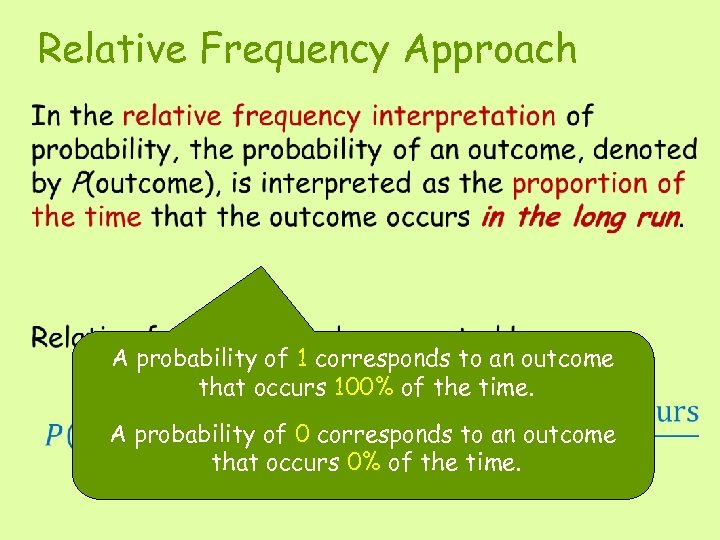
Relative Frequency Approach • A probability of 1 corresponds to an outcome that occurs 100% of the time. A probability of 0 corresponds to an outcome that occurs 0% of the time.
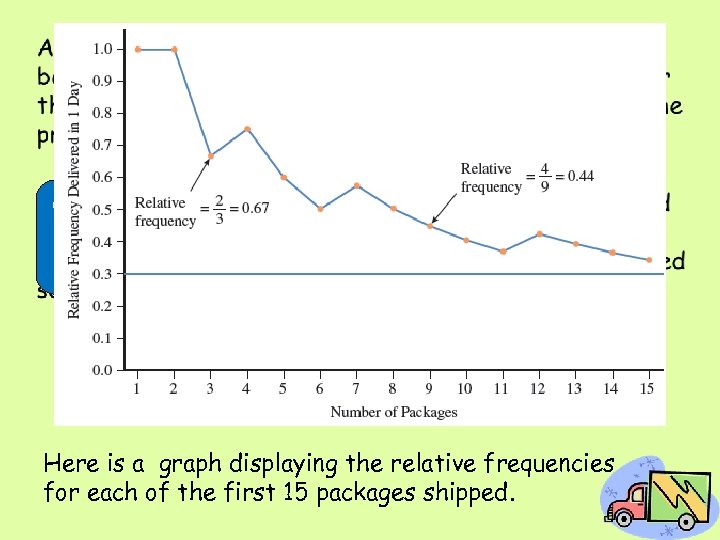
• One way to interpret this probability would be to say that in the long run, about 30 out of every 100 packages shipped arrive in 1 day. Here is a graph displaying the relative frequencies for each of the first 15 packages shipped.
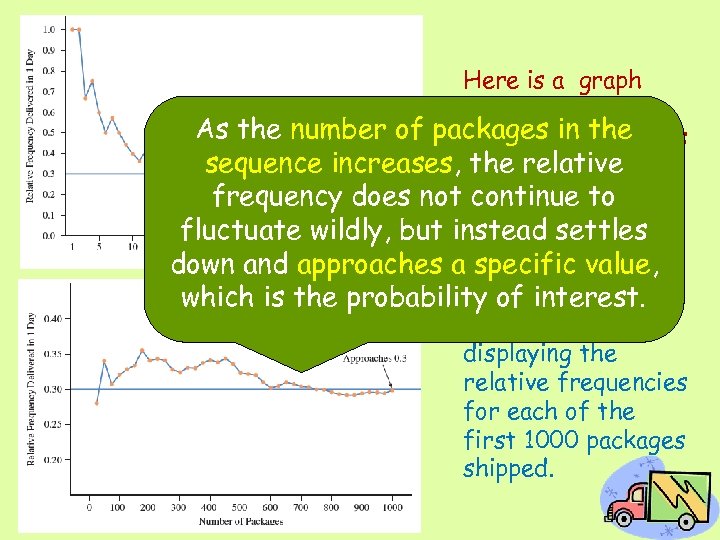
Here is a graph displaying the As the number of packages frequencies relative in the sequence increases, for each of the relative frequency does not first 50 packages continue to shipped. fluctuate wildly, but instead settles down and approaches a specific value, which is the probability of interest. Here is a graph displaying the relative frequencies for each of the first 1000 packages shipped.
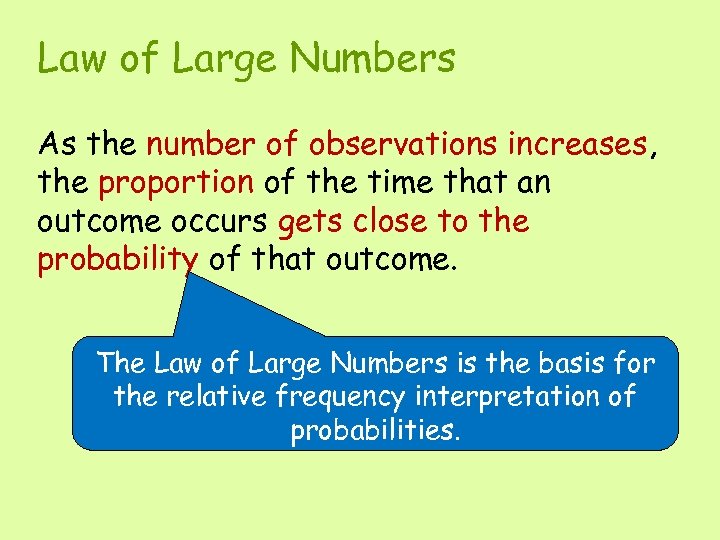
Law of Large Numbers As the number of observations increases, the proportion of the time that an outcome occurs gets close to the probability of that outcome. The Law of Large Numbers is the basis for the relative frequency interpretation of probabilities.
Some Basic Properties of Probability 1. The probability of any outcome is a number between 0 and 1. 2. If outcomes can’t occur at the same time, then the probability that any one of them will occur is the sum of their individual probabilities.
A large auto center sells cars made by different manufacturers. Two these are Honda and Toyota. of many Suppose: P(Honda) = 0. 25 and P(Toyota) = 0. 14 An interpretation for this two Why don’t these value Consider the make of Honda and Toyota and 1? Can the outcomesaboutnextout of every is that the 25 have sold. of probabilities car a sum happen at the same time? 100 cars sold would be Hondas. What is the probability that the next car sold is either a Honda or a Toyota? P(Honda or Toyota) = 0. 25 + 0. 14 = 0. 39
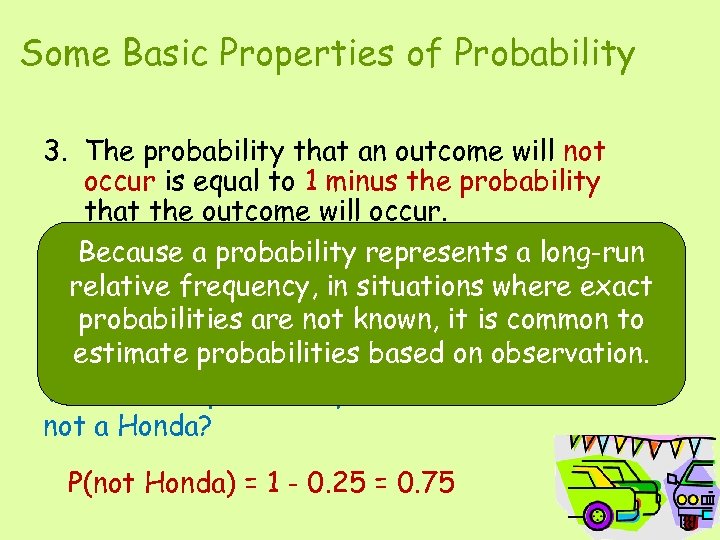
Some Basic Properties of Probability 3. The probability that an outcome will not occur is equal to 1 minus the probability that the outcome will occur. Because a probability represents a long-run relative car dealership (P(Honda) = 0. 25): Recall the frequency, in situations where exact probabilities are not known, it is common to estimate probabilities based on observation. What is the probability that the next car sold is not a Honda? P(not Honda) = 1 - 0. 25 = 0. 75
Computing Probabilities Chance Experiment Sample Space Event Classical Approach to Probability
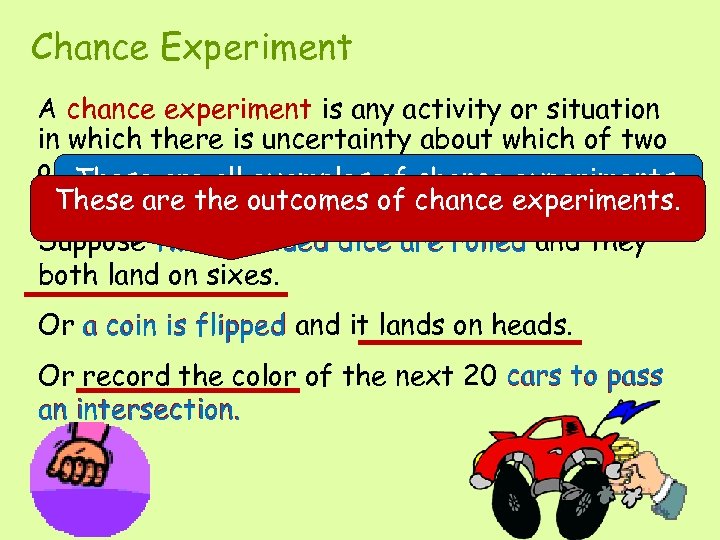
Chance Experiment A chance experiment is any activity or situation in which there is uncertainty about which of two or more possibleexamples of chance experiments. These are all outcomes will result. These are the outcomes of chance experiments. Suppose two six-sided dice are rolled and they both land on sixes. Or a coin is flipped and it lands on heads. Or record the color of the next 20 cars to pass an intersection.
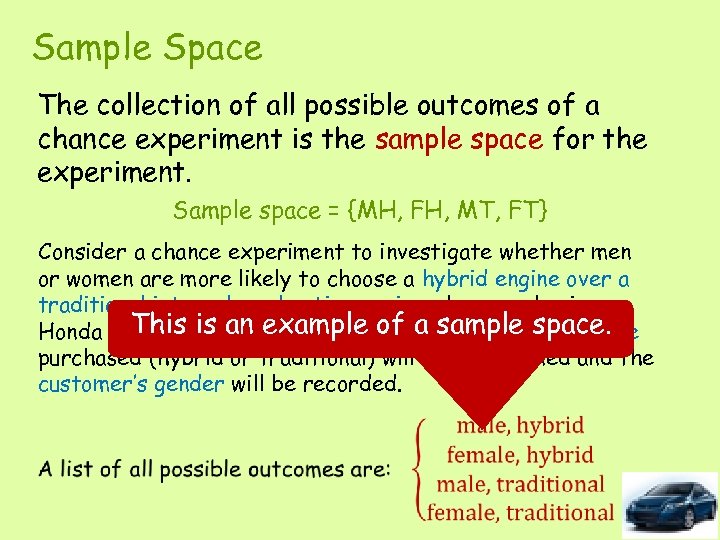
Sample Space The collection of all possible outcomes of a chance experiment is the sample space for the experiment. Sample space = {MH, FH, MT, FT} Consider a chance experiment to investigate whether men or women are more likely to choose a hybrid engine over a traditional internal combustion engine when purchasing a This is an example of a The type of vehicle Honda Civic at a particular dealership. sample space. purchased (hybrid or traditional) will be determined and the customer’s gender will be recorded.
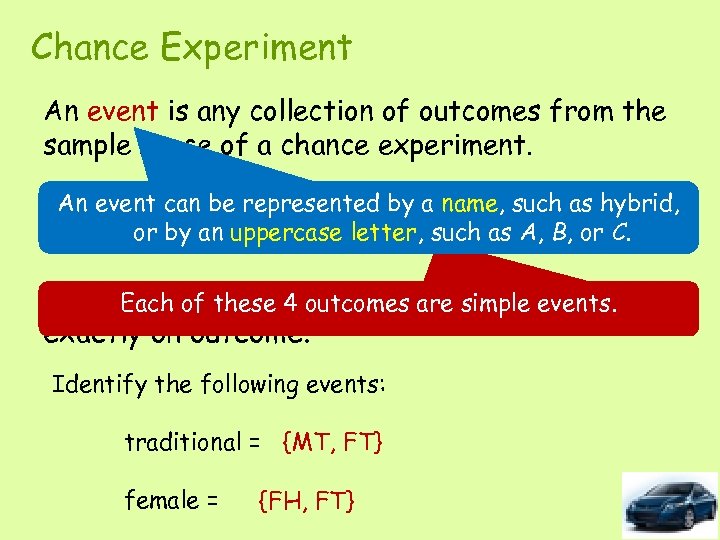
Chance Experiment An event is any collection of outcomes from the sample space of a chance experiment. Recall the can be represented by a name, such asahybrid, An event situation in which a person purchases Honda Civic: or by Sample space letter, such. MT, FT} or C. an uppercase = {MH, FH, as A, B, A simple event is anoutcomes are simple events. Each of these 4 event consisting of exactly on outcome. Identify the following events: traditional = {MT, FT} female = {FH, FT}
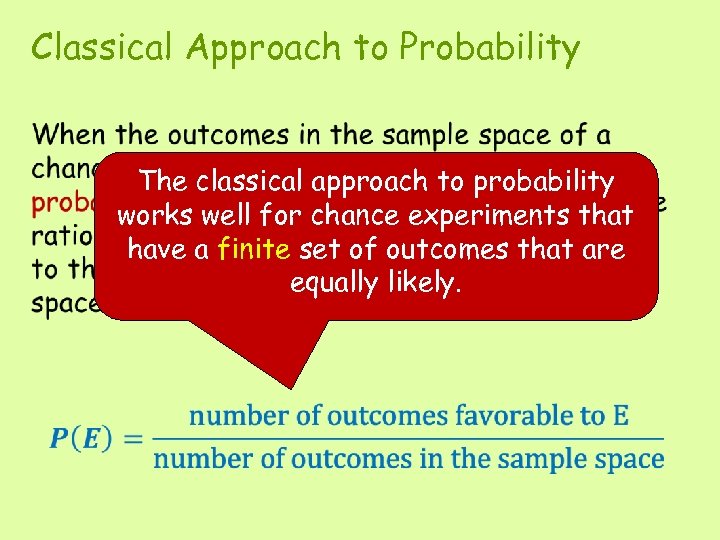
Classical Approach to Probability • The classical approach to probability works well for chance experiments that have a finite set of outcomes that are equally likely.
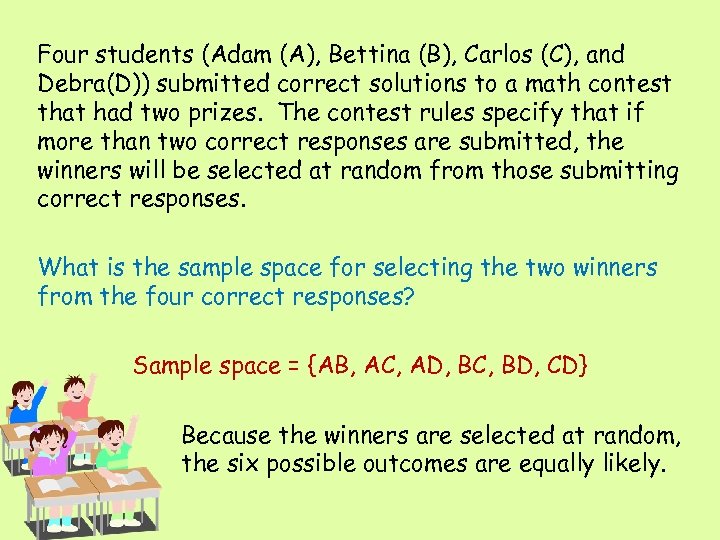
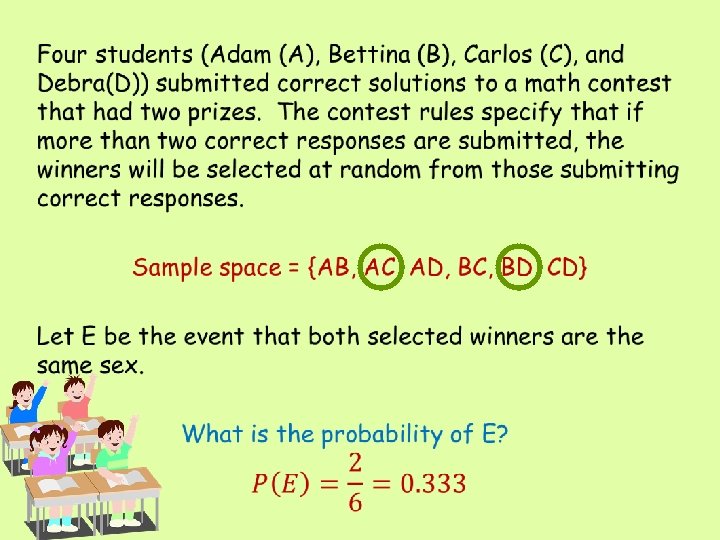
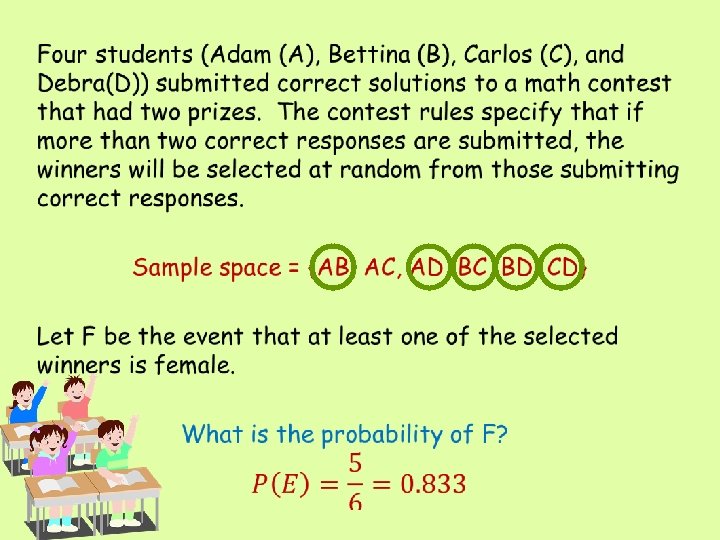
Four students (Adam (A), Bettina (B), Carlos (C), and Debra(D)) submitted correct solutions to a math contest that had two prizes. The contest rules specify that if more than two correct responses are submitted, the winners will be selected at random from those submitting correct responses. What is the sample space for selecting the two winners from the four correct responses? Sample space = {AB, AC, AD, BC, BD, CD} Because the winners are selected at random, the six possible outcomes are equally likely.
•
•
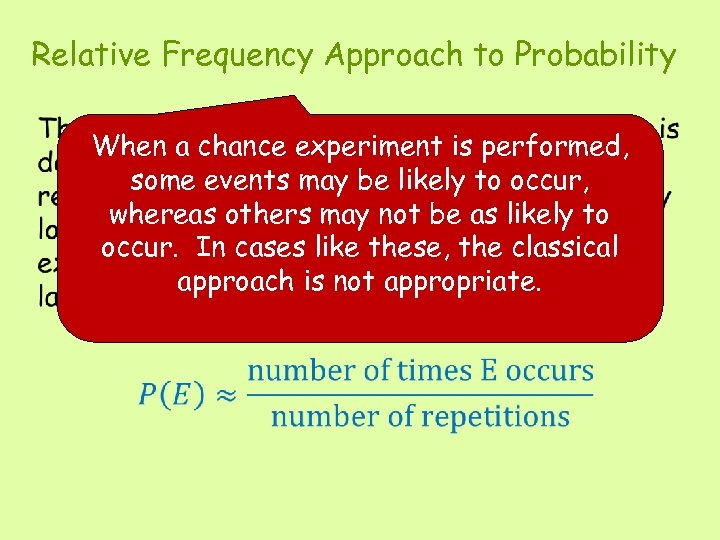
Relative Frequency Approach to Probability • When a chance experiment is performed, some events may be likely to occur, whereas others may not be as likely to occur. In cases like these, the classical approach is not appropriate.
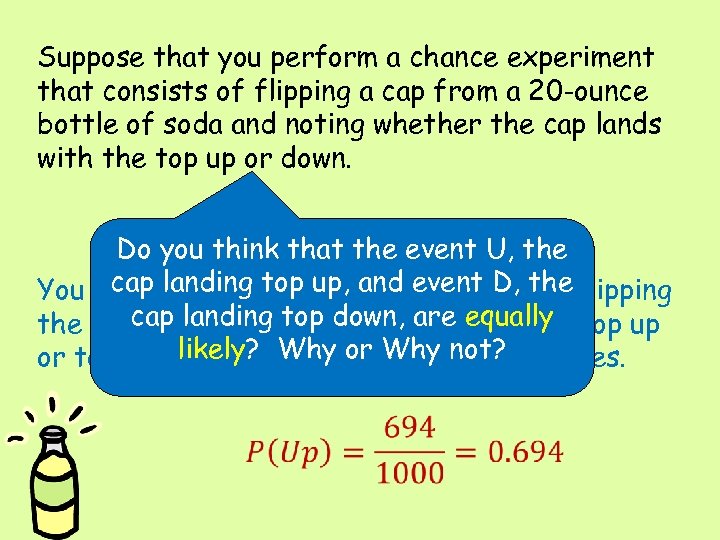
Suppose that you perform a chance experiment that consists of flipping a cap from a 20 -ounce bottle of soda and noting whether the cap lands with the top up or down. Do you think that the event U, the cap out this chance experiment by You carrylanding top up, and event D, the flipping the capcap landing top down, are equally top up 1000 times and record if it lands likely? Why or Why up 694 or top down. The cap lands top not? times.
Probabilities of More Complex Events Union Intersection Complement Mutually Exclusive Events Independents Events
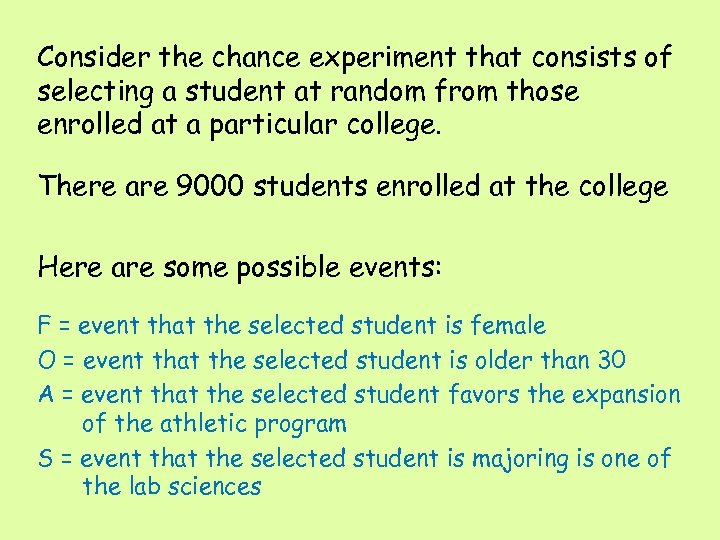
Consider the chance experiment that consists of selecting a student at random from those enrolled at a particular college. There are 9000 students enrolled at the college Here are some possible events: F = event that the selected student is female O = event that the selected student is older than 30 A = event that the selected student favors the expansion of the athletic program S = event that the selected student is majoring is one of the lab sciences
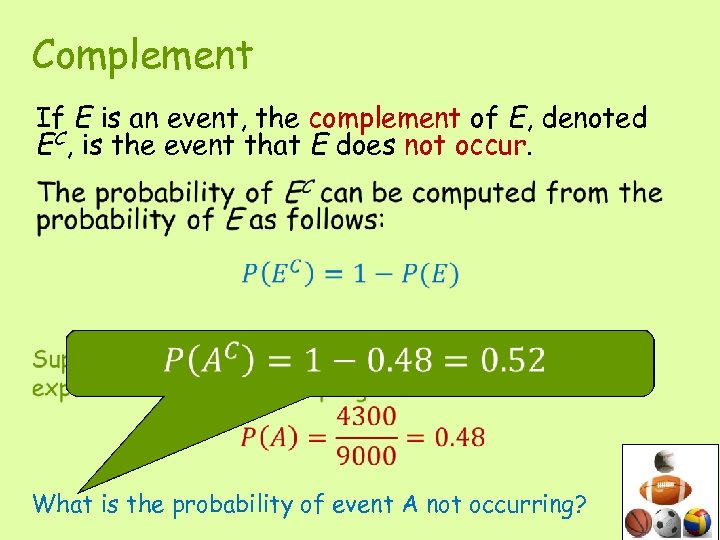
Complement If E is an event, the complement of E, denoted EC, is the event that E does not occur. What is the probability of event A not occurring?
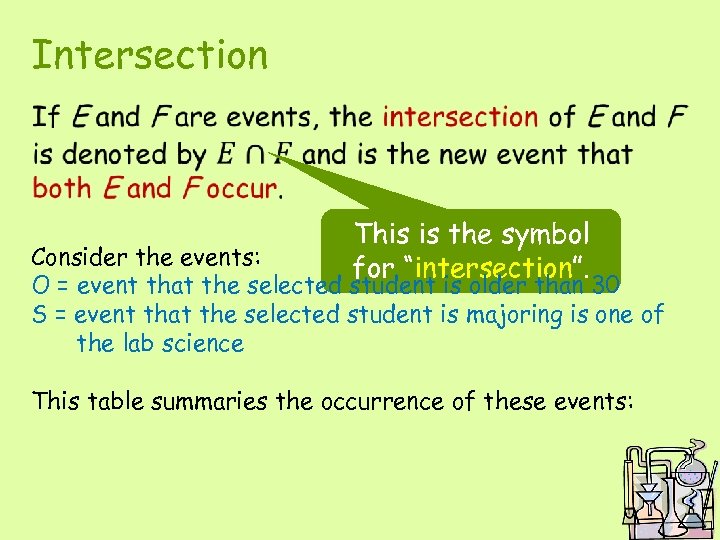
Intersection • This is the symbol for “intersection”. Consider the events: O = event that the selected student is older than 30 S = event that the selected student is majoring is one of the lab science This table summaries the occurrence of these events:
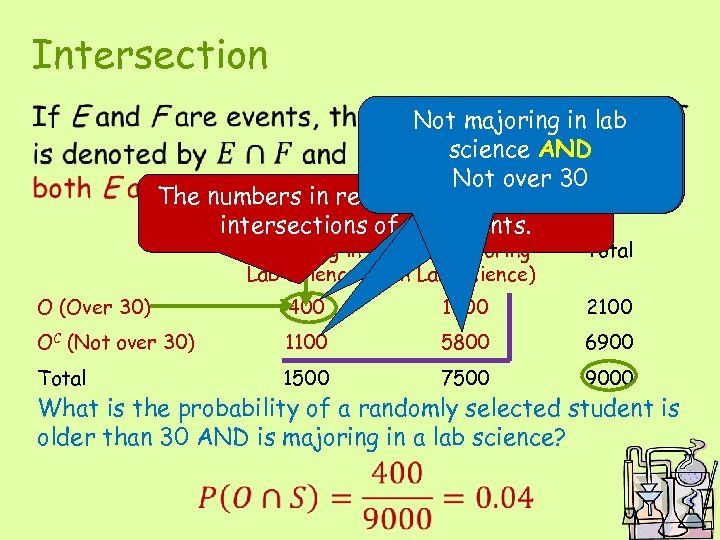
Intersection • Majoring in lab Not majoring science AND Not over 30 Over 30 The numbers in red corresponds to the S SC intersections of the events. (Majoring in Lab Science) (Not Majoring in Lab Science) Total O (Over 30) 400 1700 2100 OC (Not over 30) 1100 5800 6900 Total 1500 7500 9000 What is the probability of a randomly selected student is older than 30 AND is majoring in a lab science?
Union • This is the symbol for “union”. Consider the events: O = event that the selected student is older than 30 A = event that the selected student favors the expansion of the athletic program This table summaries the occurrence of these events:
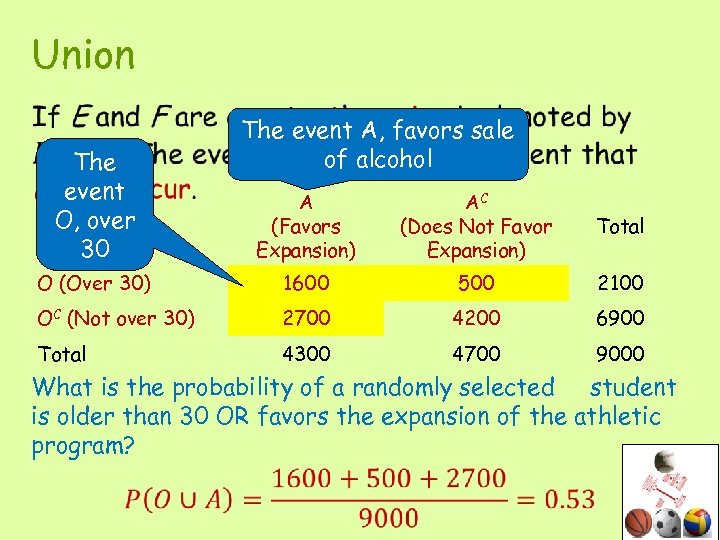
Union • The event O, over 30 The event A, favors sale of alcohol A (Favors Expansion) AC (Does Not Favor Expansion) Total O (Over 30) 1600 500 2100 OC (Not over 30) 2700 4200 6900 Total 4300 4700 9000 What is the probability of a randomly selected student is older than 30 OR favors the expansion of the athletic program?
Hypothetical 1000 You can use tables to compute the probability of an intersection of two events and the probability of a union of two events. In many situations, you may was possible because a ONLY know the In the previous examples, this probabilities of be selected at random and becauseis student was to some events. In this case, it oftennumber of students falling into each of the cells the possible to create a “hypothetical 1000” of the use the table to compute table and then appropriate table were given. probabilities.
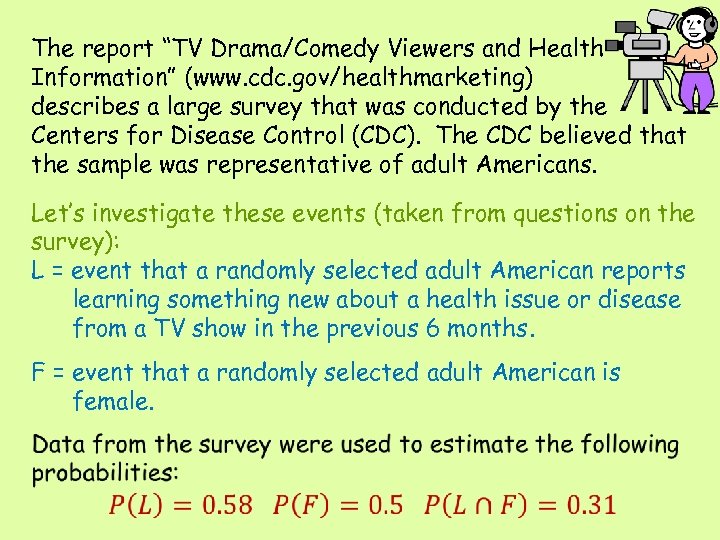
The report “TV Drama/Comedy Viewers and Health Information” (www. cdc. gov/healthmarketing) describes a large survey that was conducted by the Centers for Disease Control (CDC). The CDC believed that the sample was representative of adult Americans. Let’s investigate these events (taken from questions on the survey): L = event that a randomly selected adult American reports learning something new about a health issue or disease from a TV show in the previous 6 months. F = event that a randomly selected adult American is female.
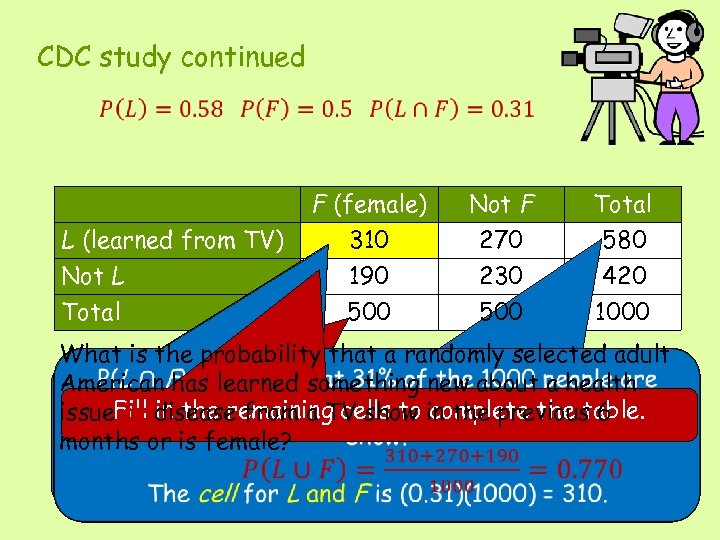
CDC study continued F (female) L (learned from TV) Not L Total Not F Total 310 270 580 190 500 230 500 420 1000 What is the probability that a randomly selected adult P(L) tells you that 58% of the new people health American has learned something 1000 about ashould be P(F) by labeling rows androw that F columns of the table. 500 = Put Begin tells you from thecells tois (0. 50)(1000)table. complete the issue. Fill disease L row: TV show in the previous 6 or in the remaining (0. 58)(1000) = 580. a in the and the “hypothetical 1000” in the bottom right cell. months or is female? that the Not F row is 1000 - 500 = 500 The L row and the Not L row have a sum of 1000.
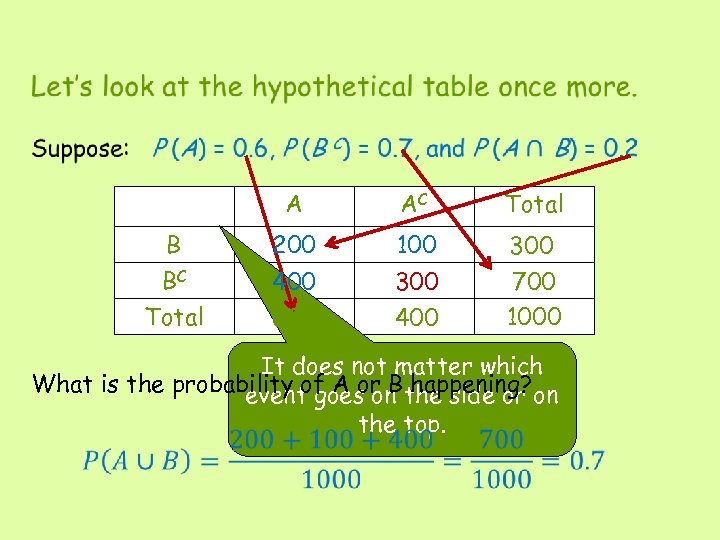
• A B BC Total AC Total 200 100 300 400 600 300 400 700 1000 It does not matter which What is the probability of A or Bthe side or on event goes on happening? the top.
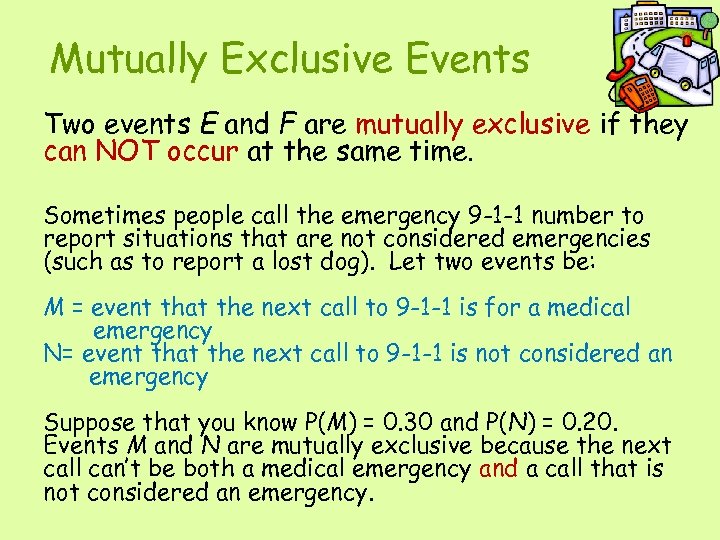
Mutually Exclusive Events Two events E and F are mutually exclusive if they can NOT occur at the same time. Sometimes people call the emergency 9 -1 -1 number to report situations that are not considered emergencies (such as to report a lost dog). Let two events be: M = event that the next call to 9 -1 -1 is for a medical emergency N= event that the next call to 9 -1 -1 is not considered an emergency Suppose that you know P(M) = 0. 30 and P(N) = 0. 20. Events M and N are mutually exclusive because the next call can’t be both a medical emergency and a call that is not considered an emergency.
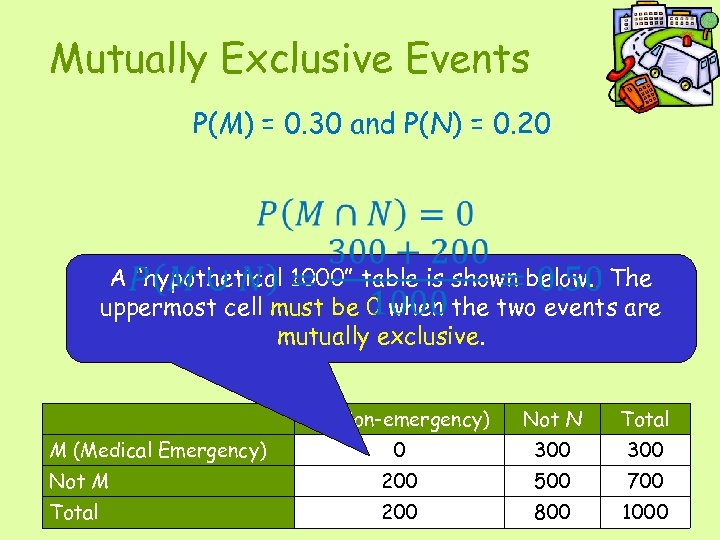
Mutually Exclusive Events P(M) = 0. 30 and P(N) = 0. 20 A “hypothetical 1000” table is shown below. The uppermost cell must be 0 when the two events are mutually exclusive. N (Non-emergency) Not N Total 0 300 Not M 200 500 700 Total 200 800 1000 M (Medical Emergency)
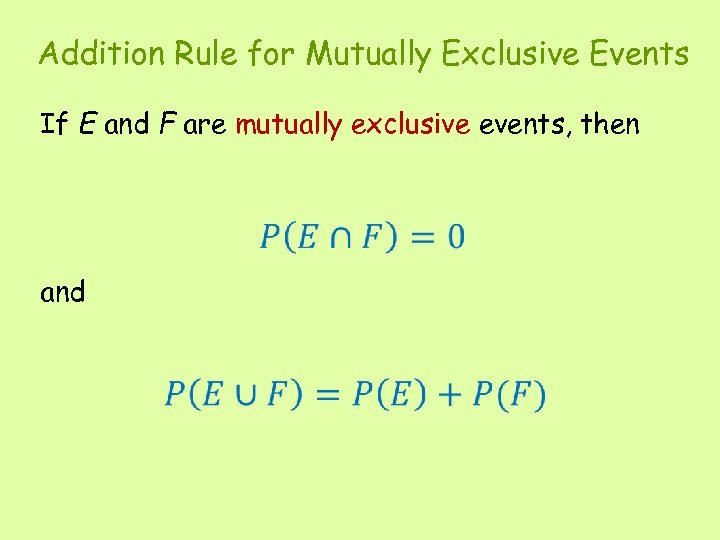
Addition Rule for Mutually Exclusive Events If E and F are mutually exclusive events, then and
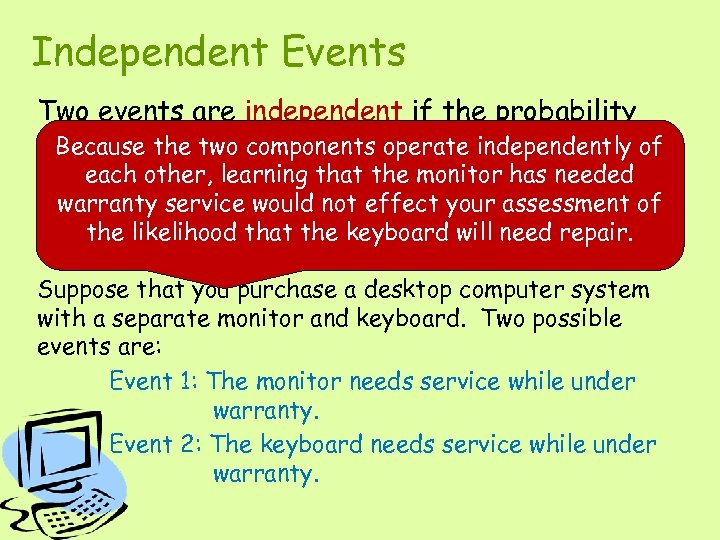
Independent Events Two events are independent if the probability Because event components operate independently of that one the twooccurs is not affected by each other, learning that the monitor has needed knowledge of whether the other event has warranty occurred. service would not effect your assessment of the likelihood that the keyboard will need repair. Suppose that you purchase a desktop computer system with a separate monitor and keyboard. Two possible events are: Event 1: The monitor needs service while under warranty. Event 2: The keyboard needs service while under warranty.
Dependent Events Two events are dependent if knowing that one event has occurred changes the probability that the other event occurs. Consider a university’s course registration process, which divides students into 12 priority groups. Overall, only 10% of all students receive all requested classes, but 75% of those in the first priority group receive all requested classes. You would say that the probability that a randomly selected student at this university receives all requested class is 0. 10. However, if you know that the selected student is in the first priority group, you revise the probability that the student receives all requested classes to 0. 75. These two events are said to be dependent events.
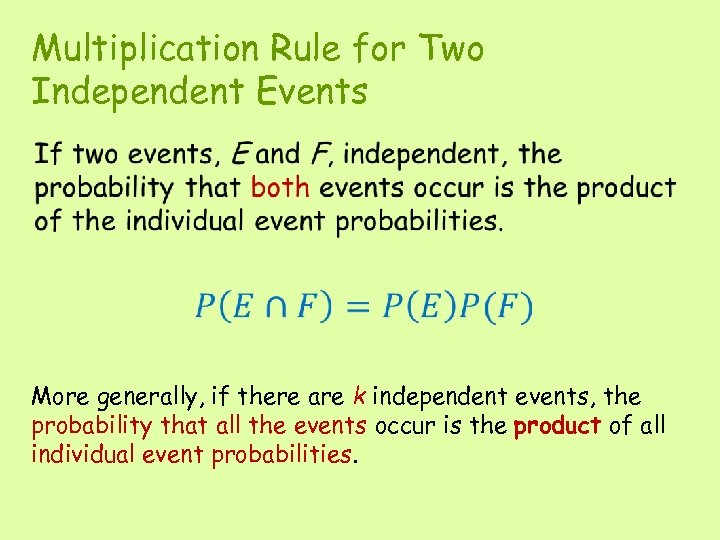
Multiplication Rule for Two Independent Events • More generally, if there are k independent events, the probability that all the events occur is the product of all individual event probabilities.
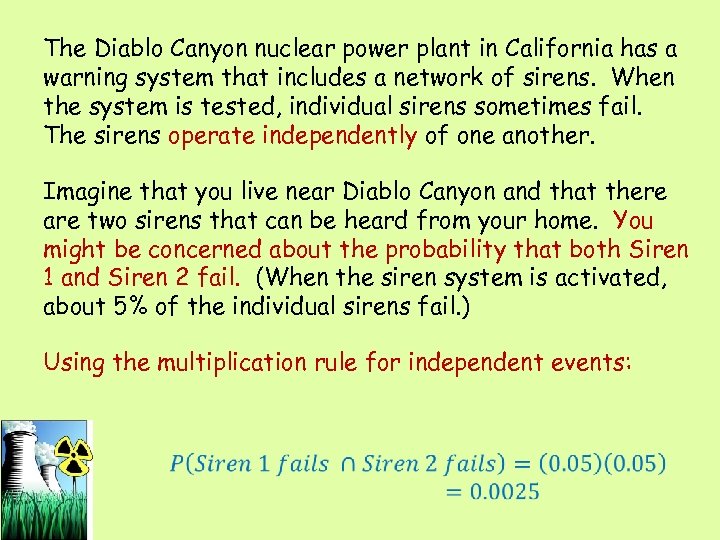
The Diablo Canyon nuclear power plant in California has a warning system that includes a network of sirens. When the system is tested, individual sirens sometimes fail. The sirens operate independently of one another. Imagine that you live near Diablo Canyon and that there are two sirens that can be heard from your home. You might be concerned about the probability that both Siren 1 and Siren 2 fail. (When the siren system is activated, about 5% of the individual sirens fail. ) Using the multiplication rule for independent events:
Conditional Probability
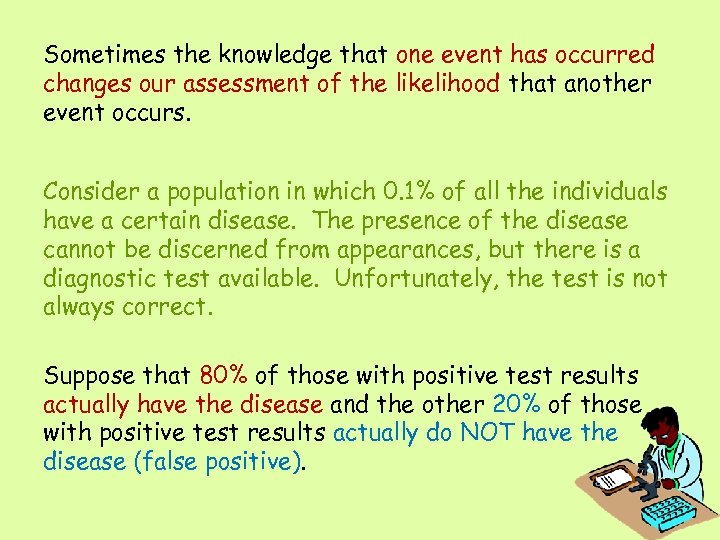
Sometimes the knowledge that one event has occurred changes our assessment of the likelihood that another event occurs. Consider a population in which 0. 1% of all the individuals have a certain disease. The presence of the disease cannot be discerned from appearances, but there is a diagnostic test available. Unfortunately, the test is not always correct. Suppose that 80% of those with positive test results actually have the disease and the other 20% of those with positive test results actually do NOT have the disease (false positive).
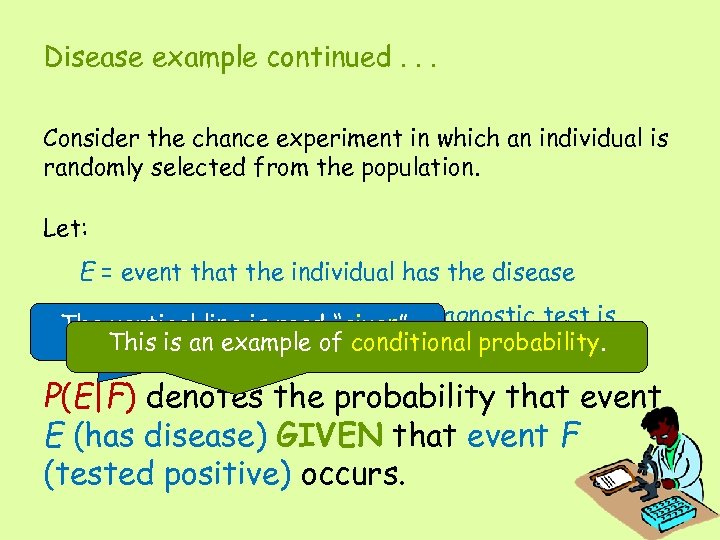
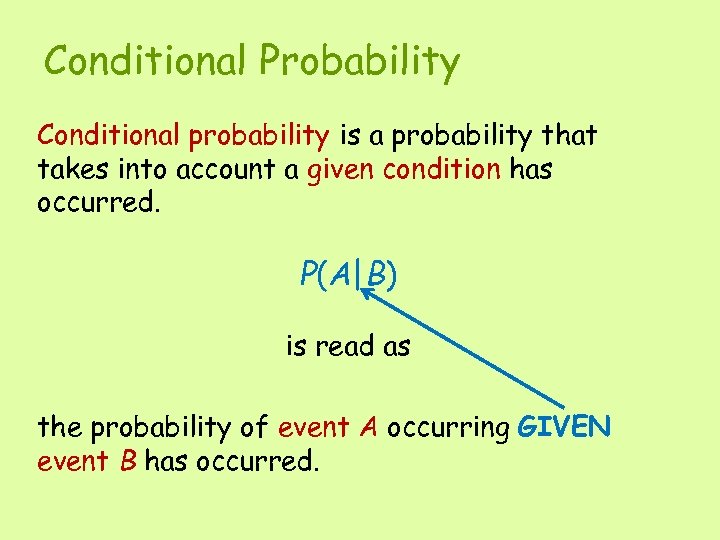
Disease example continued. . . Consider the chance experiment in which an individual is randomly selected from the population. Let: E = event that the individual has the disease F event that is read “given”. The=vertical line the individual's diagnostic test is This is an example of conditional probability. positive P(E|F) denotes the probability that event E (has disease) GIVEN that event F (tested positive) occurs.
Conditional Probability Conditional probability is a probability that takes into account a given condition has occurred. P(A|B) is read as the probability of event A occurring GIVEN event B has occurred.
Recall the example in the Chapter Preview section about gender predictions based on ultrasounds performed during the first trimester of pregnancy. The table below summarizes the data for Radiologist 1 Predicted Male Baby is Male Predicted Female Total 74 12 86 59 73 71 159 This question is about ALL Baby is Female 14 159 ultrasound predictions. Total 88 How likely is it that a predicted gender is correct?
Gender prediction example continued. Radiologist 1 Predicted Male Total Baby is Male 74 12 86 Baby is Female 14 59 73 Total Predicted Female 88 71 159 Is a predicted gender more likely to be correct when the baby is male than when the baby is female? This question is based on two conditions: the 86 male babies or the 73 female babies. The appropriate row total or column total is used Radiologist 1 is slightly in the likely to be correct when the as the denominator more probability calculation. baby is male than when the baby is female.
Gender prediction example continued. Radiologist 1 Predicted This is a Predicted Male the probability condition. In Female statement, the condition follows the Baby is Male 74 vertical line “|”. 12 Total 86 Baby is Female 14 59 73 Total 88 71 159 If the predicted gender is female, should you paint the nursery pink? For Radiologist 1, when the predicted gender is female, about 83% of the time the baby is actually female. So, if you painted the room pink, then the probability that you would need to repaint is about 0. 17 (1 – 0. 83).
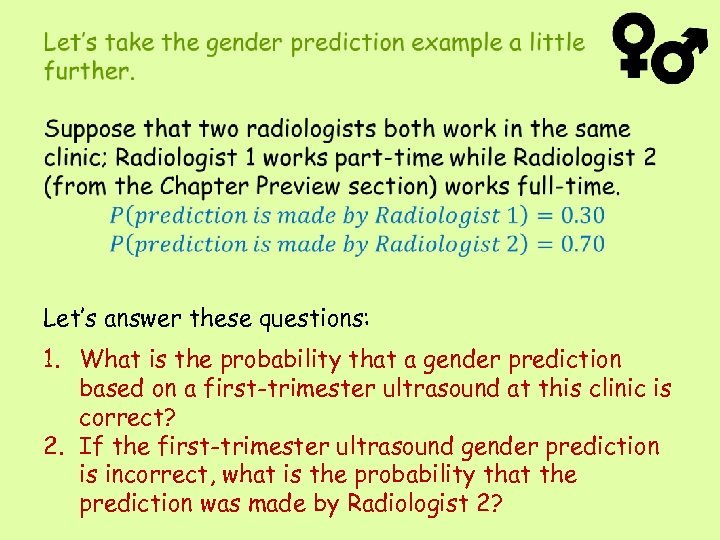
Let’s answer these questions: 1. What is the probability that a gender prediction based on a first-trimester ultrasound at this clinic is correct? 2. If the first-trimester ultrasound gender prediction is incorrect, what is the probability that the prediction was made by Radiologist 2?
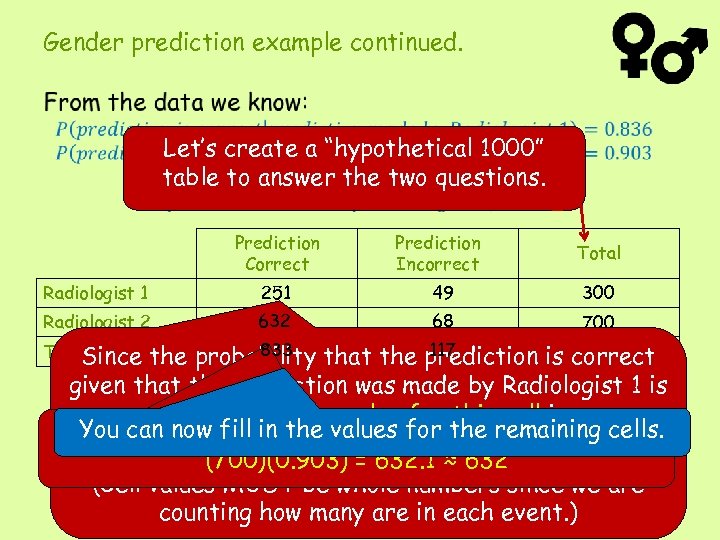
Gender prediction example continued. Let’s create a “hypothetical 1000” table to answer the two questions. Prediction Correct Prediction Incorrect Total Radiologist 1 251 49 300 Radiologist 2 632 68 700 833 117 1000 the probability that the prediction is correct given that the prediction was made by Radiologist 1 is 0. 836, then the value for this cell is: You can. Similarly, the value for this cell is: now fill in the values for the remaining cells. (300)(0. 836) = 250. 8 ≈ 251 (700)(0. 903) = 632. 1 ≈ 632 (Cell values MUST be whole numbers since we are counting how many are in each event. ) Total Since
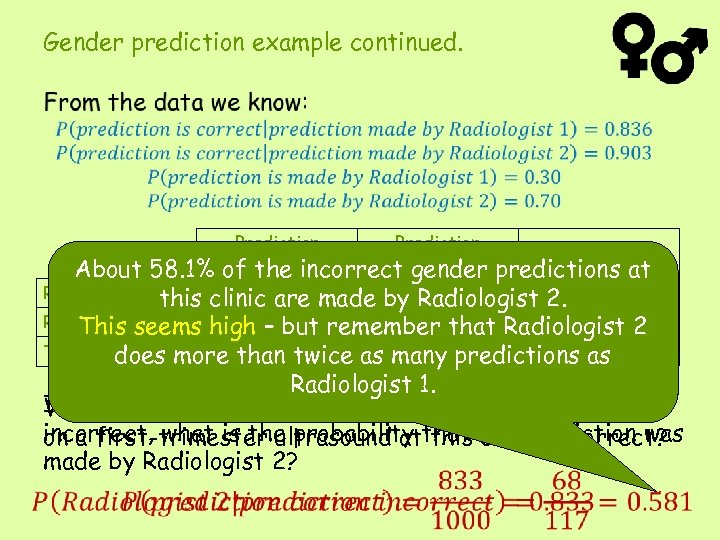
Gender prediction example continued. Prediction Incorrect of. Correct the incorrect gender Total About 58. 1% predictions at 251 49 Radiologist 1 this clinic are made by Radiologist 2. 300 68 Radiologistseems high 632 700 This 2 – but remember that Radiologist 2 833 117 Total does more than twice as many predictions 1000 as Radiologist 1. If theis the probabilityultrasound gender prediction is What first-trimester that a gender prediction based incorrect, what is the probability that the prediction was on a first-trimester ultrasound at this clinic is correct? made by Radiologist 2?
Calculating Probabilities – A More Formal Approach
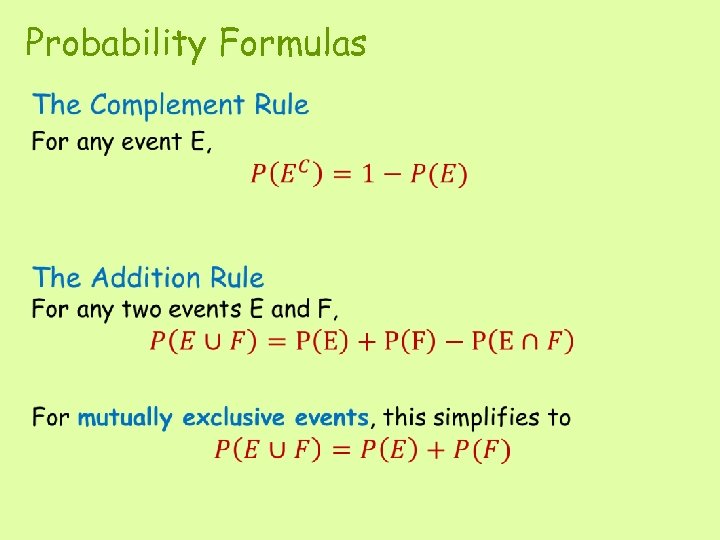
Probability Formulas •
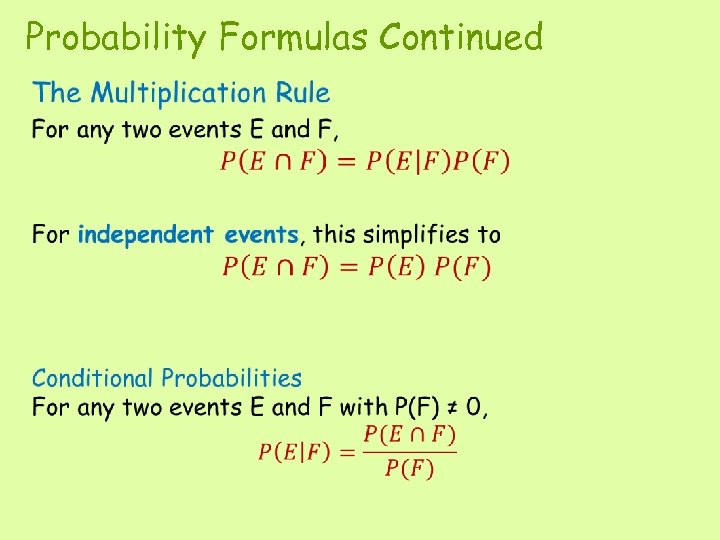
Probability Formulas Continued •
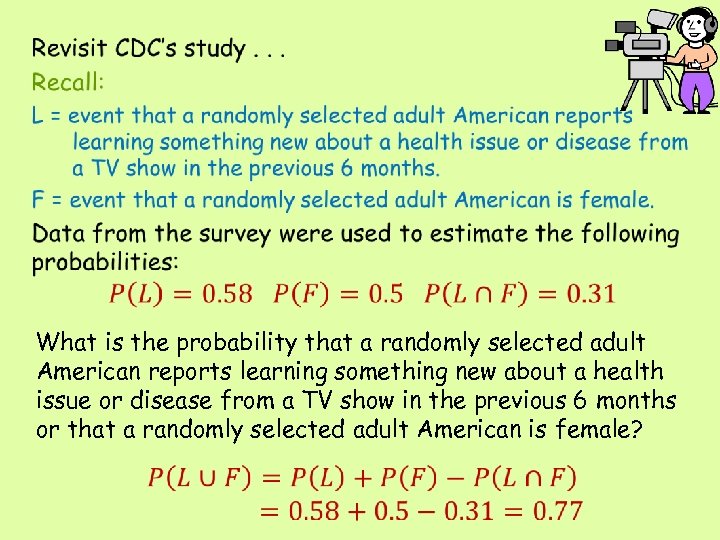
• What is the probability that a randomly selected adult American reports learning something new about a health issue or disease from a TV show in the previous 6 months or that a randomly selected adult American is female?
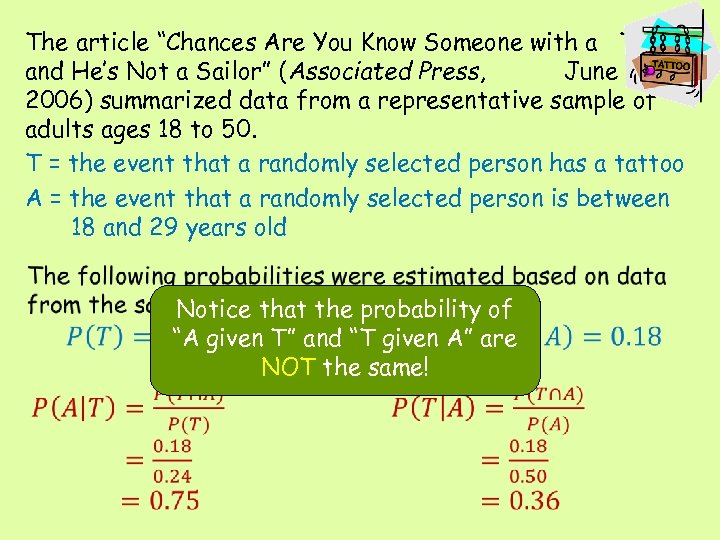
The article “Chances Are You Know Someone with a Tattoo, and He’s Not a Sailor” (Associated Press, June 11, 2006) summarized data from a representative sample of adults ages 18 to 50. T = the event that a randomly selected person has a tattoo A = the event that a randomly selected person is between 18 and 29 years old Notice that the probability of “A given T” and “T given A” are NOT the same!
Another Approach to Probability A large electronics store sells two different portable DVD players, Brand 1 and Brand 2. Based on past records, the store manager reports that 70% of the DVD players sold are Brand 1 and 30% are Brand 2. The manager also reports that 20% of the people who buy Brand 1 also purchase an extended warranty, and 40% of the people who buy Brand 2 purchase an extended warranty. Consider selecting a person at random from those who purchased a DVD player from this store, what is the probability that the person purchased extended warranty? One way to do this problem would be to set up a Hypothetical 1000 table.
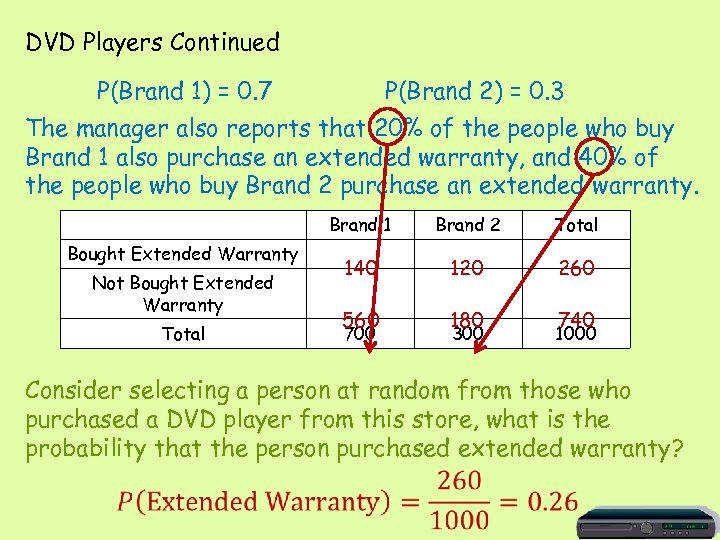
DVD Players Continued P(Brand 1) = 0. 7 P(Brand 2) = 0. 3 The manager also reports that 20% of the people who buy Brand 1 also purchase an extended warranty, and 40% of the people who buy Brand 2 purchase an extended warranty. Brand 1 Bought Extended Warranty Not Bought Extended Warranty Total Brand 2 Total 140 120 260 560 180 700 300 740 1000 Consider selecting a person at random from those who purchased a DVD player from this store, what is the probability that the person purchased extended warranty?
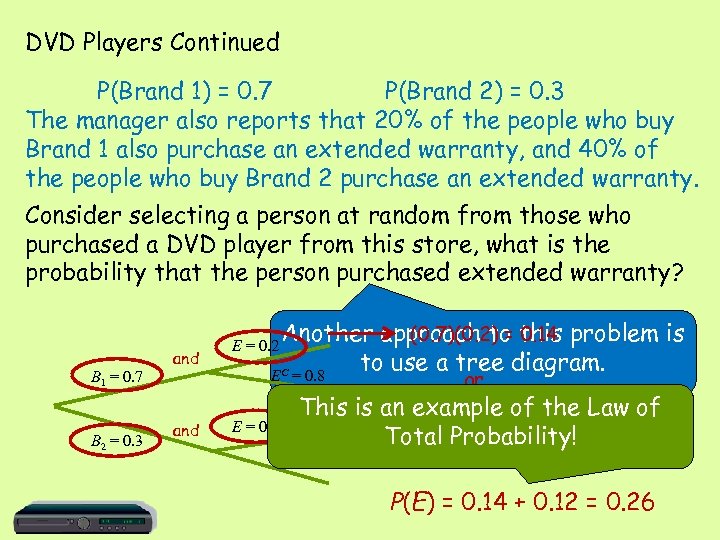
DVD Players Continued P(Brand 1) = 0. 7 P(Brand 2) = 0. 3 The manager also reports that 20% of the people who buy Brand 1 also purchase an extended warranty, and 40% of the people who buy Brand 2 purchase an extended warranty. Consider selecting a person at random from those who purchased a DVD player from this store, what is the probability that the person purchased extended warranty? B 1 = 0. 7 B 2 = 0. 3 and (0. 7)(0. 2) = 0. 14 Another approach to this problem is to use a tree diagram. EC = 0. 8 E = 0. 2 or E = 0. 4 This is an example of the Law of (0. 3)(0. 4) = 0. 12 Total Probability! EC = 0. 6 P(E) = 0. 14 + 0. 12 = 0. 26
The Law of Total Probability •

Let’s consider another type of problem. . . Suppose the conditional probability of “a positive test result given that the person has cancer” is known. However, you would like to know the converse probability. That is, you would like to know the probability of the person having cancer given a positive test result. This formula was discovered in the 1700’s by the Reverend Thomas probability is the reversal A converse Bayes, an English Presbyterian minister. probability. of a conditional This converse probability can be computed using Bayes’ Rule.
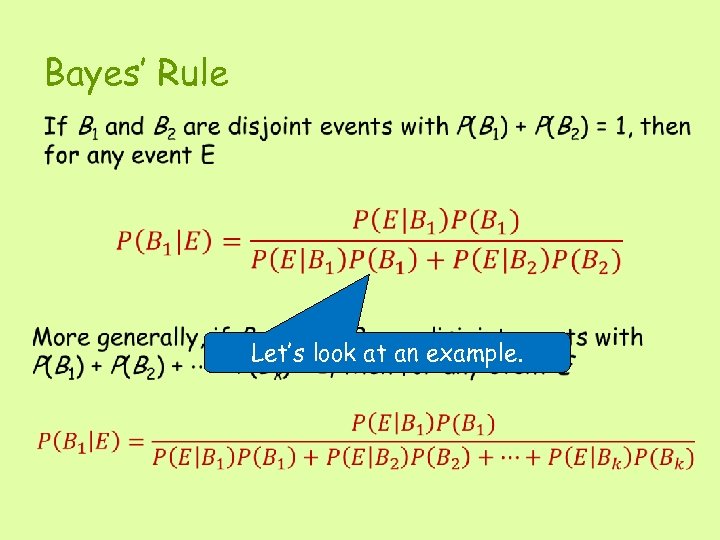
Bayes’ Rule • Let’s look at an example.
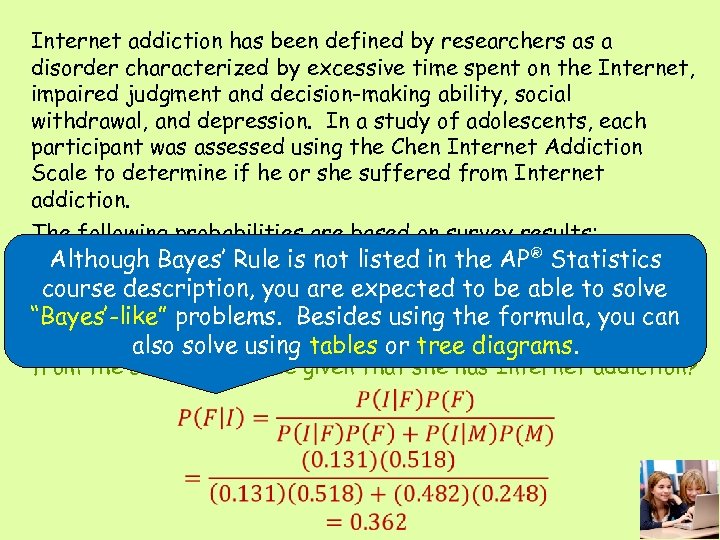
Internet addiction has been defined by researchers as a disorder characterized by excessive time spent on the Internet, impaired judgment and decision-making ability, social withdrawal, and depression. In a study of adolescents, each participant was assessed using the Chen Internet Addiction Scale to determine if he or she suffered from Internet addiction. The following probabilities are based on survey results: Although Bayes’ Rule is not listed in=the AP® Statistics P(F) = 0. 518 P(M) 0. 482 course description, you are expected to be able to solve P(I|F) = 0. 131 P(I|M)= 0. 248 “Bayes’-like” problems. Besides using the formula, you can What is the probability that a randomly selected adolescent also solve using tables or tree diagrams. from the survey is female given that she has Internet addiction?
Probability as a Basis for Making Decisions
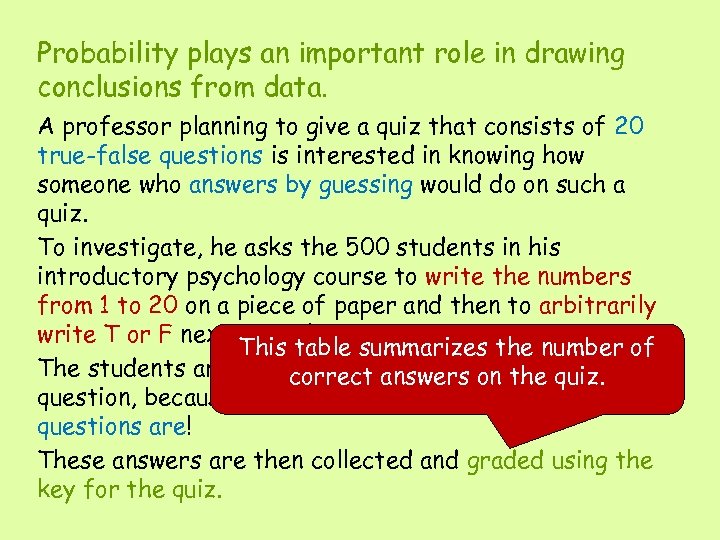
Probability plays an important role in drawing conclusions from data. A professor planning to give a quiz that consists of 20 true-false questions is interested in knowing how someone who answers by guessing would do on such a quiz. To investigate, he asks the 500 students in his introductory psychology course to write the numbers from 1 to 20 on a piece of paper and then to arbitrarily write T or F next to each number. This table summarizes the number of The students are forced to guess at the answer to each correct answers on the quiz. question, because they are not even told what the questions are! These answers are then collected and graded using the key for the quiz.
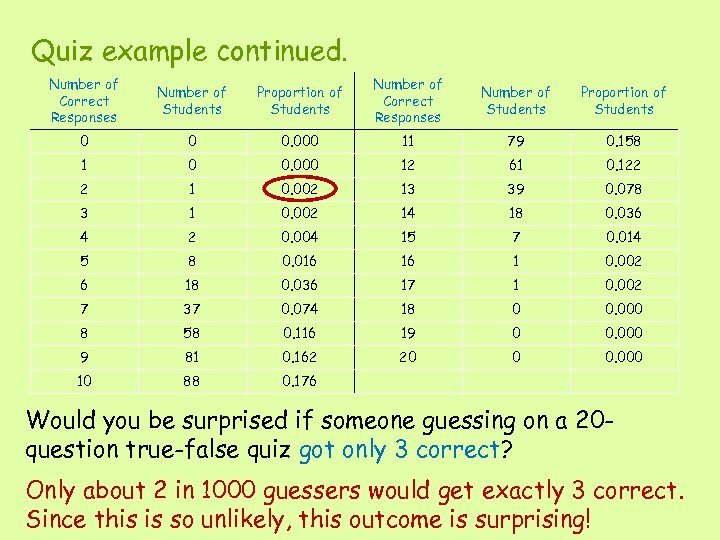
Quiz example continued. Number of Correct Responses Number of Students Proportion of Students 0 0 0. 000 11 79 0. 158 1 0 0. 000 12 61 0. 122 2 1 0. 002 13 39 0. 078 3 1 0. 002 14 18 0. 036 4 2 0. 004 15 7 0. 014 5 8 0. 016 16 1 0. 002 6 18 0. 036 17 1 0. 002 7 37 0. 074 18 0 0. 000 8 58 0. 116 19 0 0. 000 9 81 0. 162 20 0 0. 000 10 88 0. 176 Would you be surprised if someone guessing on a 20 question true-false quiz got only 3 correct? Only about 2 in 1000 guessers would get exactly 3 correct. Since this is so unlikely, this outcome is surprising!
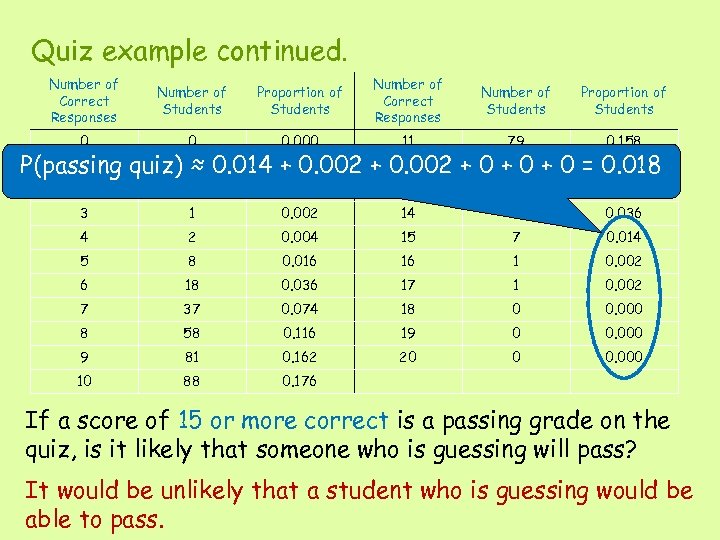
Quiz example continued. Number of Correct Responses Number of Students Proportion of Students 0 0 0. 000 11 79 0. 158 2 1 0. 002 13 39 0. 078 3 1 0. 002 14 18 0. 036 4 2 0. 004 15 7 0. 014 5 8 0. 016 16 1 0. 002 6 18 0. 036 17 1 0. 002 7 37 0. 074 18 0 0. 000 8 58 0. 116 19 0 0. 000 9 81 0. 162 20 0 0. 000 10 88 0. 176 1 0. 000 12 0. 122 P(passing quiz) 0 0. 014 + 0. 002 + 0 +610 + 0 = 0. 018 ≈ If a score of 15 or more correct is a passing grade on the quiz, is it likely that someone who is guessing will pass? It would be unlikely that a student who is guessing would be able to pass.
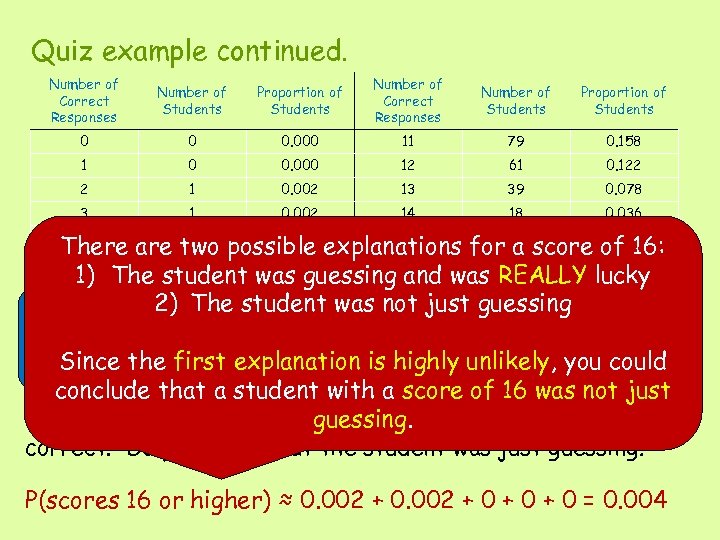
Quiz example continued. Number of Correct Responses Number of Students Proportion of Students 0 0 0. 000 11 79 0. 158 1 0 0. 000 12 61 0. 122 2 1 0. 002 13 39 0. 078 3 1 0. 002 14 18 0. 036 4 2 0. 004 15 0. 014 There are two possible explanations for 7 score of 16: a 5 8 0. 016 16 1 0. 002 1) The student was guessing 17 was REALLY lucky and 6 18 0. 036 1 0. 002 The student was not just guessing 7 0. 074 18 0 Begin by 2) 37 assuming that the student was guessing 0. 000 and 8 58 0. 116 19 0 determine whether a score at least as high as 16 0. 000 is a 9 81 0. 162 20 0 0. 000 Since the first explanation isoccurrence. likely or 0. 176 likely highly unlikely, you could an 10 88 conclude that a student with a score of 16 was not just guessing. The professor actually gives the quiz, and a student scores 16 correct. Do you think that the student was just guessing? P(scores 16 or higher) ≈ 0. 002 + 0 + 0 = 0. 004
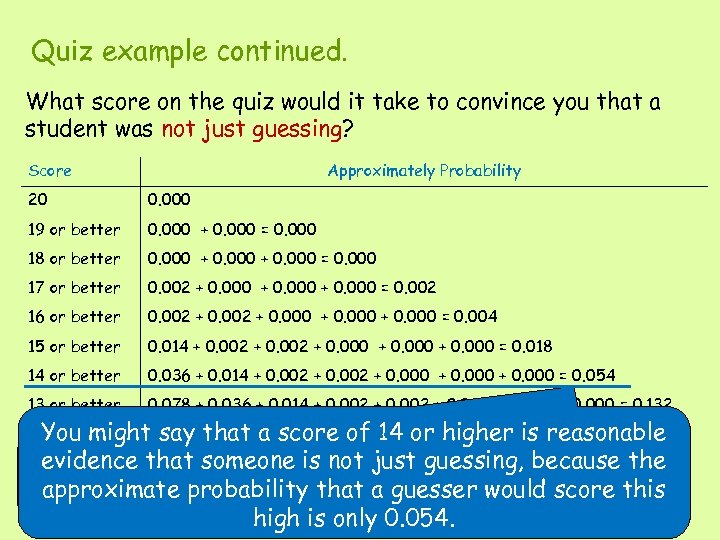
Quiz example continued. What score on the quiz would it take to convince you that a student was not just guessing? Score Approximately Probability 20 0. 000 19 or better 0. 000 + 0. 000 = 0. 000 18 or better 0. 000 + 0. 000 = 0. 000 17 or better 0. 002 + 0. 000 = 0. 002 16 or better 0. 002 + 0. 000 = 0. 004 15 or better 0. 014 + 0. 002 + 0. 000 = 0. 018 14 or better 0. 036 + 0. 014 + 0. 002 + 0. 000 = 0. 054 13 or better 0. 078 + 0. 036 + 0. 014 + 0. 002 + 0. 000 = 0. 132 You might say that a score of 14 or higher is reasonable Consider this table showing approximate probabilitiesthe evidence that someone is not just guessing, because for a certain score guesser would score this approximate probability that a or higher. high is only 0. 054.
Estimating Probabilities Empirically and Using Simulation
Estimating Probabilities Empirically It is fairly common practice to use observed longrun proportions to estimate probabilities. The process used to estimate probabilities is simple: 1. Observe a large number of chance outcomes under controlled circumstances. 2. Interpreting probability as a long-run relative frequency, estimate the probability of an event by using the observed proportion of occurrence.
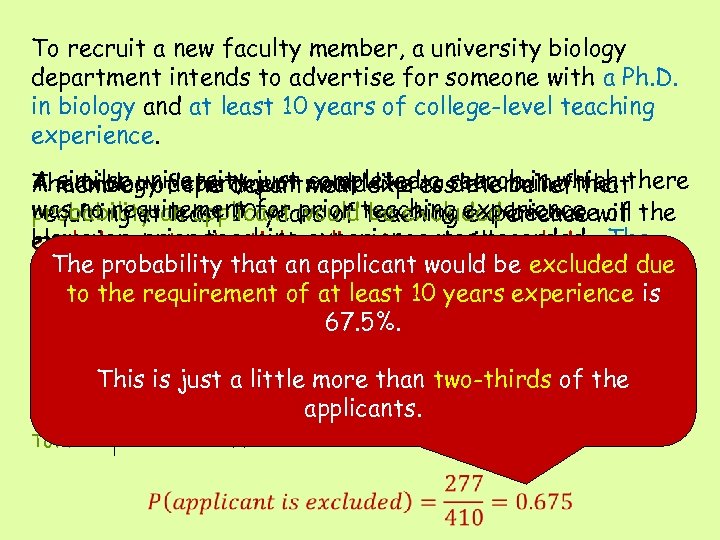
To recruit a new faculty member, a university biology department intends to advertise for someone with a Ph. D. in biology and at least 10 years of college-level teaching experience. The biology department completedto search in which A similar university just would expressdetermine there member of the department like a the belief that was no requirement for would teaching experience of probability an applicant prior teaching experience. will the requiring at least 10 years of be excluded because However, prior teaching experience was recorded. more experience requirement. exclude most potential applicants and will exclude The probability than male in the following table. resulting data is summarizedapplicants. be excluded due female applicants that an applicant would to the requirement of at least 10 years experience is Number of Applicants Less than 10 years 67. 5%. or more years 10 Total experience 277 138 This is just 178 little more than two-thirds of the a 112 290 applicants. 21 Female 99 120 Male Total 410
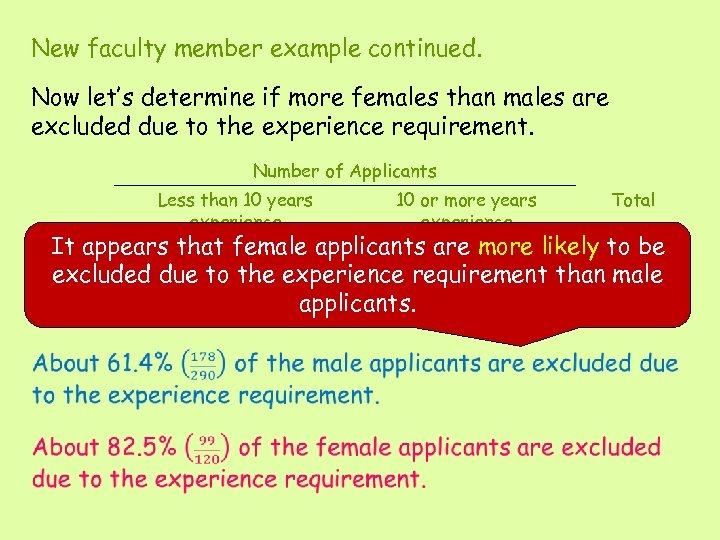
New faculty member example continued. Now let’s determine if more females than males are excluded due to the experience requirement. Number of Applicants It Male Less than 10 years experience 10 or more years experience Total appears that 178 female applicants are more likely to be 112 290 excluded due to the experience requirement than male Female 99 21 120 applicants. 138 Total 277 410
Estimating Probabilities by Using Simulation provides a way to estimate probabilities when: • You are unable to determine probabilities analytically • You do not have the time or resources to determine probabilities • It is impractical to estimate probabilities empirically by observation Simulations involves generating “observations” in a situation that is similar to the real situation of interest.
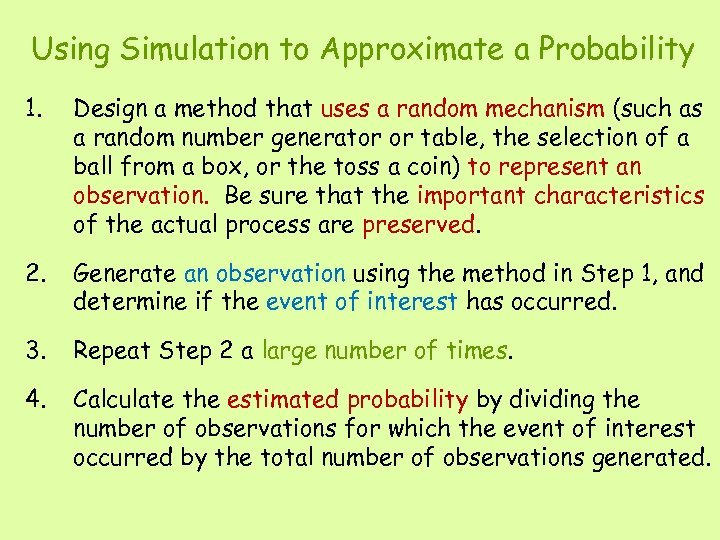
Using Simulation to Approximate a Probability 1. Design a method that uses a random mechanism (such as a random number generator or table, the selection of a ball from a box, or the toss a coin) to represent an observation. Be sure that the important characteristics of the actual process are preserved. 2. Generate an observation using the method in Step 1, and determine if the event of interest has occurred. 3. Repeat Step 2 a large number of times. 4. Calculate the estimated probability by dividing the number of observations for which the event of interest occurred by the total number of observations generated.
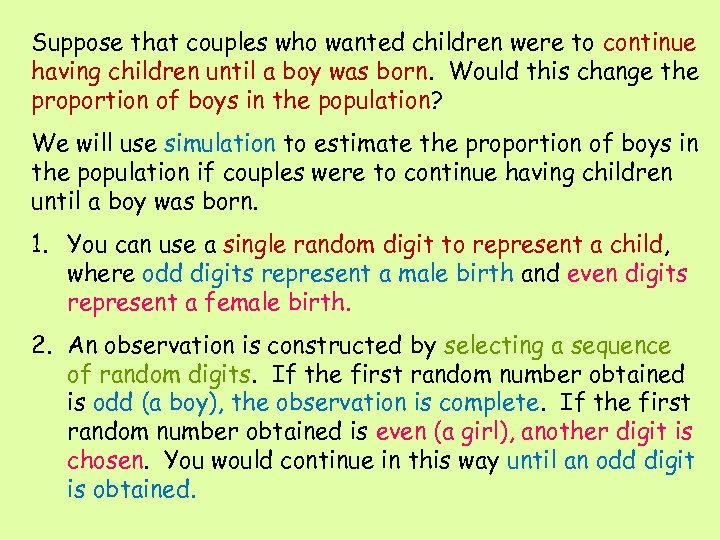
Suppose that couples who wanted children were to continue having children until a boy was born. Would this change the proportion of boys in the population? We will use simulation to estimate the proportion of boys in the population if couples were to continue having children until a boy was born. 1. You can use a single random digit to represent a child, where odd digits represent a male birth and even digits represent a female birth. 2. An observation is constructed by selecting a sequence of random digits. If the first random number obtained is odd (a boy), the observation is complete. If the first random number obtained is even (a girl), another digit is chosen. You would continue in this way until an odd digit is obtained.
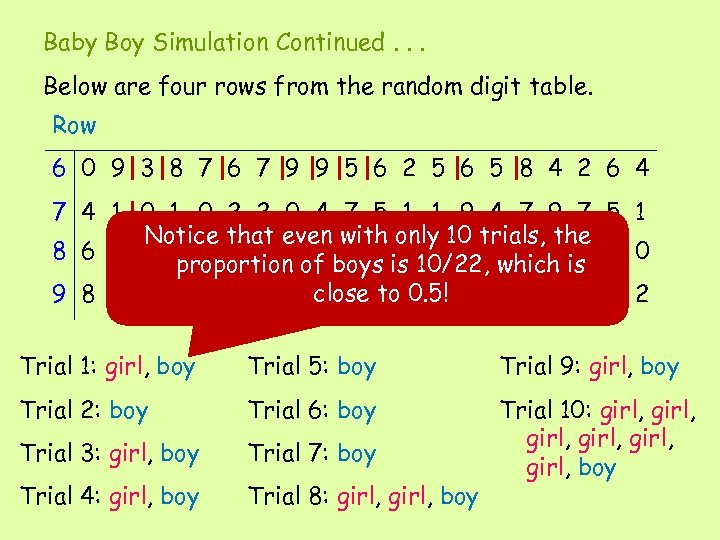
Baby Boy Simulation Continued. . . Below are four rows from the random digit table. Row 6 0 9 3 8 7 6 7 9 9 5 6 2 5 6 5 8 4 2 6 4 7 4 1 0 2 2 0 4 7 5 1 1 9 4 7 9 7 5 1 Notice that even with only 10 trials, the 8 6 4 7 3 6 3 4 5 1 2 3 1 1 8 0 0 4 8 2 0 proportion of boys is 10/22, which is 9 8 0 2 8 7 9 3 8 close 4 2 0 8 9 1 2 3 3 2 4 0 to 0. 5! Trial 1: girl, boy Trial 5: boy Trial 9: girl, boy Trial 2: boy Trial 6: boy Trial 3: girl, boy Trial 7: boy Trial 4: girl, boy Trial 8: girl, boy Trial 10: girl, girl, boy
Скачать презентацию Chapter 5 Probability Created by Kathy Fritz
38f47de46ebaa7b9cada6630987cf8d3.ppt