 Скачать презентацию Chapter 5 Non monoticic rules Based on slides
851ba45f97900a365dc82e565f308121.ppt
- Количество слайдов: 28



Chapter 5 Non monoticic rules Based on slides from Grigoris Antoniou and Frank van Harmelen
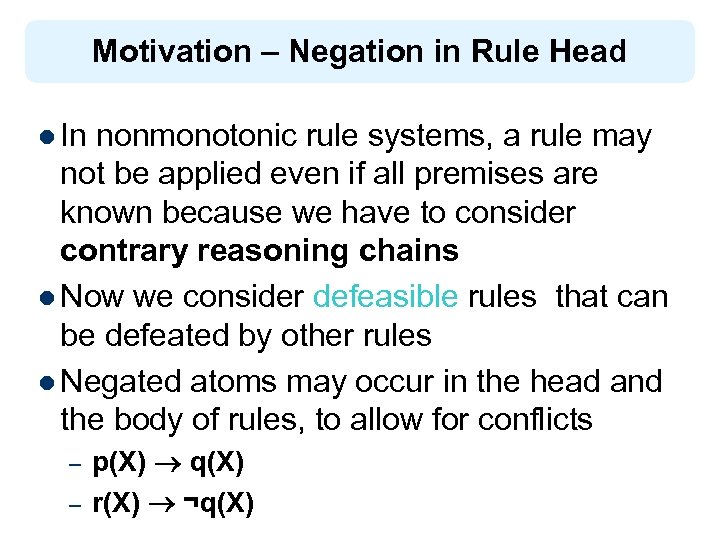
Motivation – Negation in Rule Head l In nonmonotonic rule systems, a rule may not be applied even if all premises are known because we have to consider contrary reasoning chains l Now we consider defeasible rules that can be defeated by other rules l Negated atoms may occur in the head and the body of rules, to allow for conflicts – – p(X) q(X) r(X) ¬q(X)
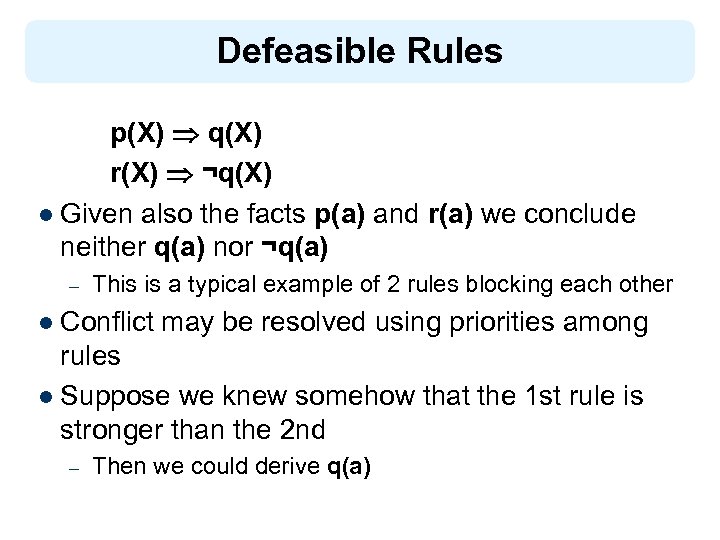
Defeasible Rules p(X) q(X) r(X) ¬q(X) l Given also the facts p(a) and r(a) we conclude neither q(a) nor ¬q(a) – This is a typical example of 2 rules blocking each other l Conflict may be resolved using priorities among rules l Suppose we knew somehow that the 1 st rule is stronger than the 2 nd – Then we could derive q(a)
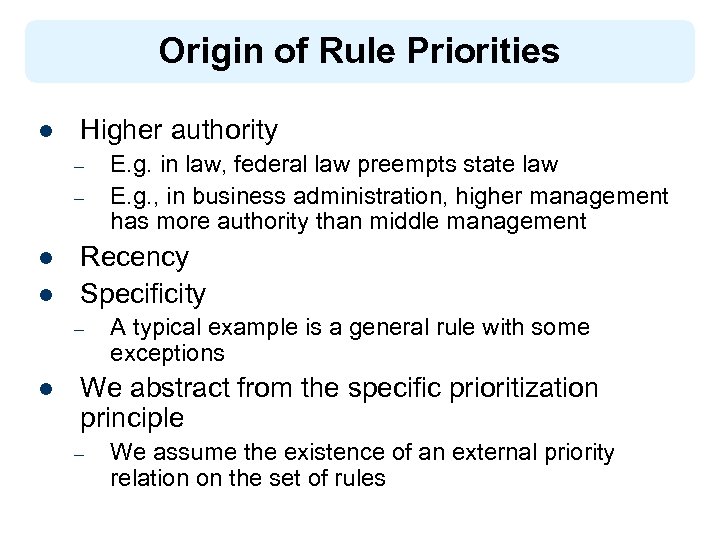
Origin of Rule Priorities l Higher authority – – l l Recency Specificity – l E. g. in law, federal law preempts state law E. g. , in business administration, higher management has more authority than middle management A typical example is a general rule with some exceptions We abstract from the specific prioritization principle – We assume the existence of an external priority relation on the set of rules
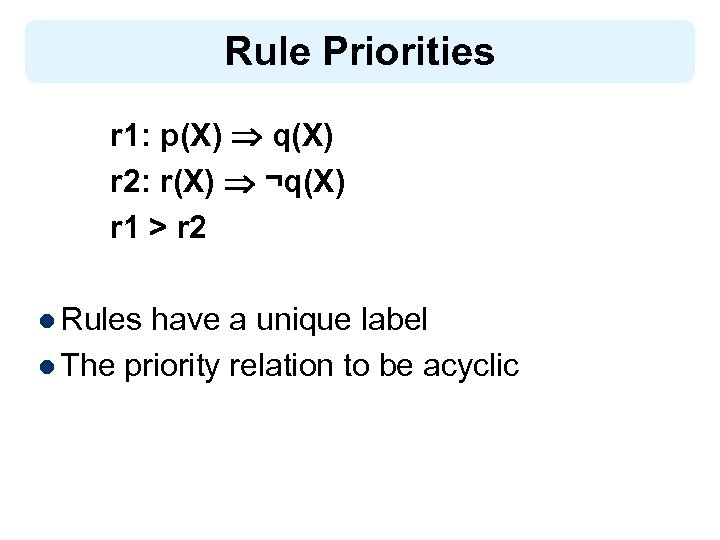
Rule Priorities r 1: p(X) q(X) r 2: r(X) ¬q(X) r 1 > r 2 l Rules have a unique label l The priority relation to be acyclic
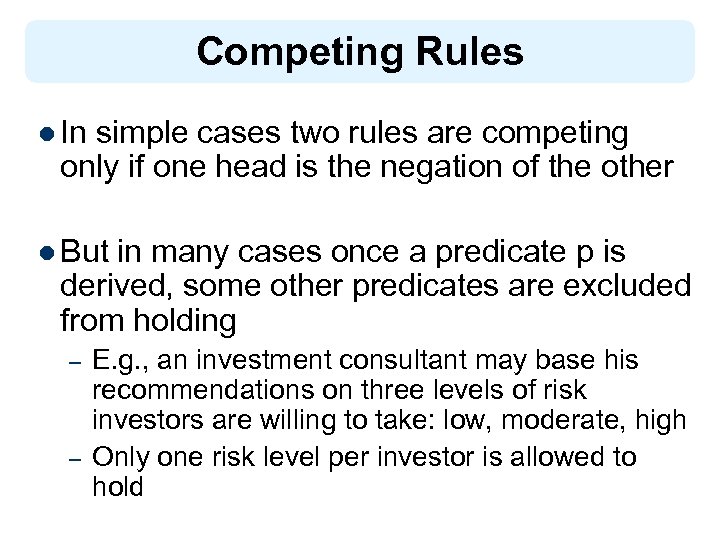
Competing Rules l In simple cases two rules are competing only if one head is the negation of the other l But in many cases once a predicate p is derived, some other predicates are excluded from holding – – E. g. , an investment consultant may base his recommendations on three levels of risk investors are willing to take: low, moderate, high Only one risk level per investor is allowed to hold
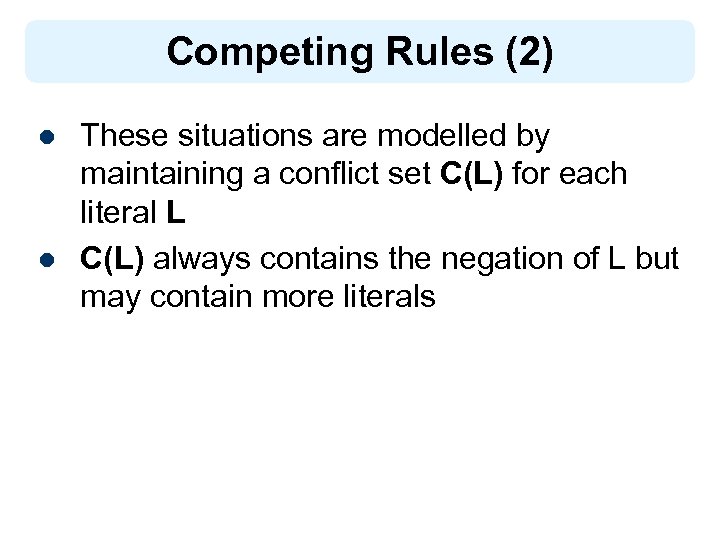
Competing Rules (2) l l These situations are modelled by maintaining a conflict set C(L) for each literal L C(L) always contains the negation of L but may contain more literals
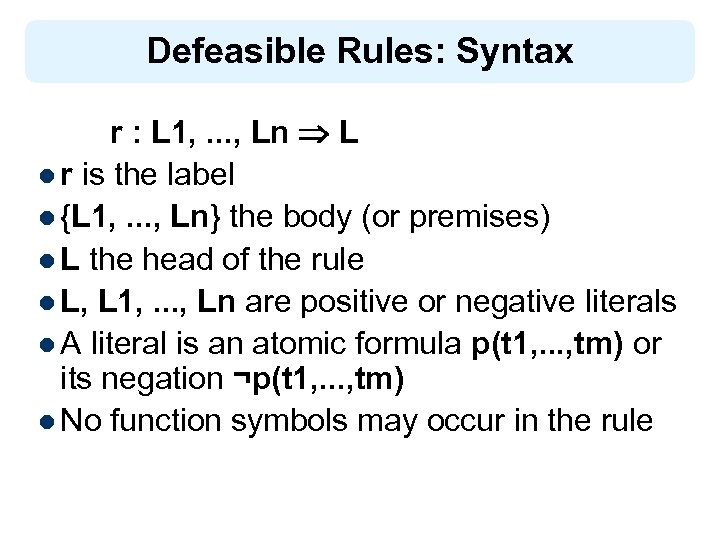
Defeasible Rules: Syntax r : L 1, . . . , Ln L l r is the label l {L 1, . . . , Ln} the body (or premises) l L the head of the rule l L, L 1, . . . , Ln are positive or negative literals l A literal is an atomic formula p(t 1, . . . , tm) or its negation ¬p(t 1, . . . , tm) l No function symbols may occur in the rule
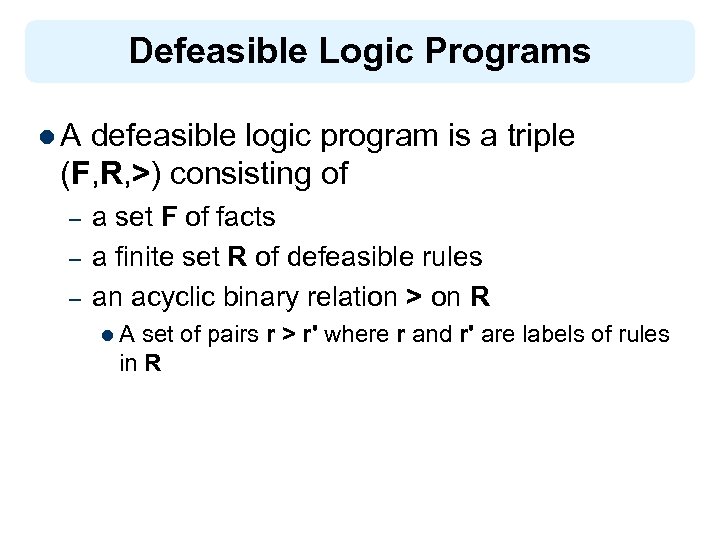
Defeasible Logic Programs l. A defeasible logic program is a triple (F, R, >) consisting of – – – a set F of facts a finite set R of defeasible rules an acyclic binary relation > on R l. A set of pairs r > r' where r and r' are labels of rules in R
Lecture Outline 1. 2. 3. 4. 5. 6. 7. 8. Introduction Monotonic Rules: Example Monotonic Rules: Syntax & Semantics DLP: Description Logic Programs SWRL: Semantic Web Rules Language Nonmonotonic Rules: Syntax Nonmonotonic Rules: Example Rule. ML: XML-Based Syntax
Brokered Trade l Brokered trades take place via an independent third party, the broker l The broker matches the buyer’s requirements and the sellers’ capabilities, and proposes a transaction when both parties can be satisfied by the trade l The application is apartment renting an activity that is common and often tedious and time-consuming
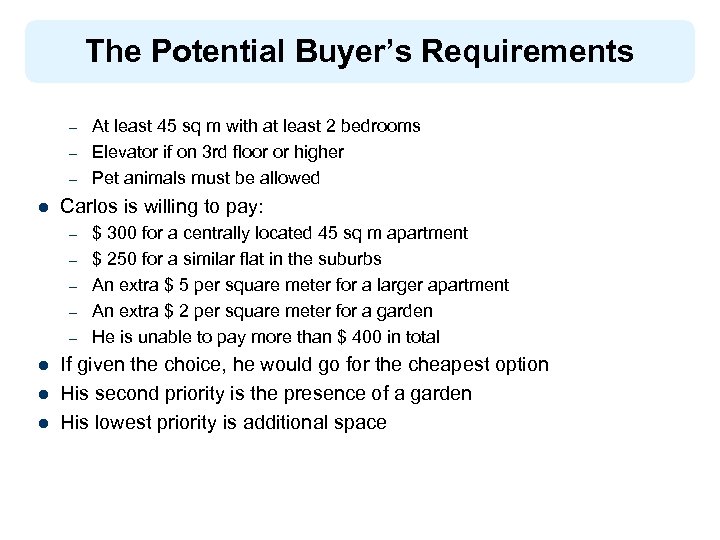
The Potential Buyer’s Requirements – – – l Carlos is willing to pay: – – – l l l At least 45 sq m with at least 2 bedrooms Elevator if on 3 rd floor or higher Pet animals must be allowed $ 300 for a centrally located 45 sq m apartment $ 250 for a similar flat in the suburbs An extra $ 5 per square meter for a larger apartment An extra $ 2 per square meter for a garden He is unable to pay more than $ 400 in total If given the choice, he would go for the cheapest option His second priority is the presence of a garden His lowest priority is additional space
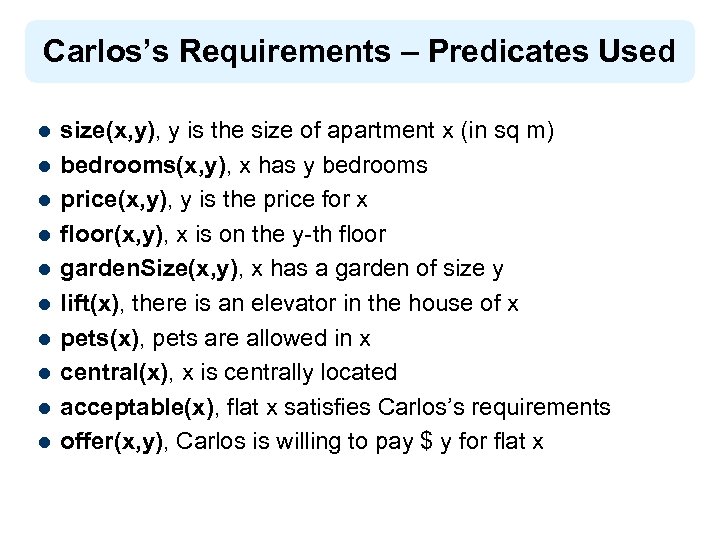
Carlos’s Requirements – Predicates Used l l l l l size(x, y), y is the size of apartment x (in sq m) bedrooms(x, y), x has y bedrooms price(x, y), y is the price for x floor(x, y), x is on the y-th floor garden. Size(x, y), x has a garden of size y lift(x), there is an elevator in the house of x pets(x), pets are allowed in x central(x), x is centrally located acceptable(x), flat x satisfies Carlos’s requirements offer(x, y), Carlos is willing to pay $ y for flat x
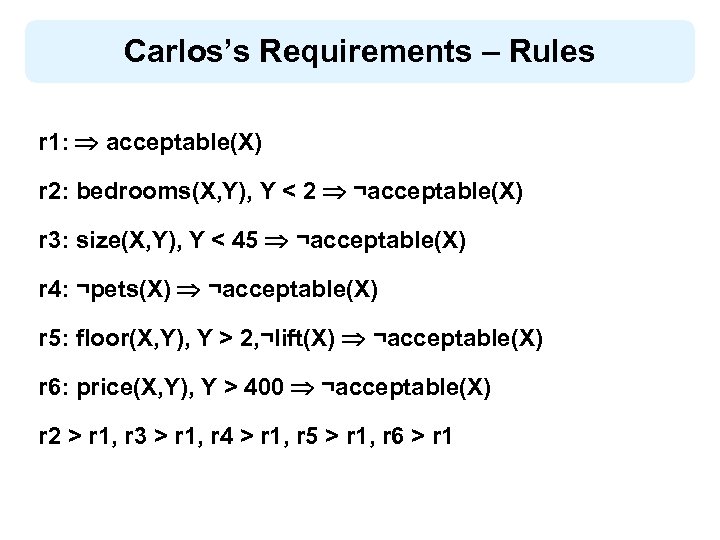
Carlos’s Requirements – Rules r 1: acceptable(X) r 2: bedrooms(X, Y), Y < 2 ¬acceptable(X) r 3: size(X, Y), Y < 45 ¬acceptable(X) r 4: ¬pets(X) ¬acceptable(X) r 5: floor(X, Y), Y > 2, ¬lift(X) ¬acceptable(X) r 6: price(X, Y), Y > 400 ¬acceptable(X) r 2 > r 1, r 3 > r 1, r 4 > r 1, r 5 > r 1, r 6 > r 1
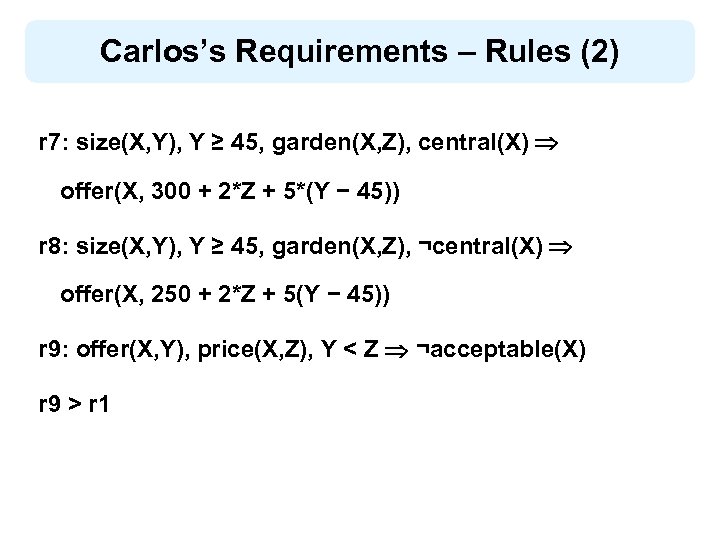
Carlos’s Requirements – Rules (2) r 7: size(X, Y), Y ≥ 45, garden(X, Z), central(X) offer(X, 300 + 2*Z + 5*(Y − 45)) r 8: size(X, Y), Y ≥ 45, garden(X, Z), ¬central(X) offer(X, 250 + 2*Z + 5(Y − 45)) r 9: offer(X, Y), price(X, Z), Y < Z ¬acceptable(X) r 9 > r 1
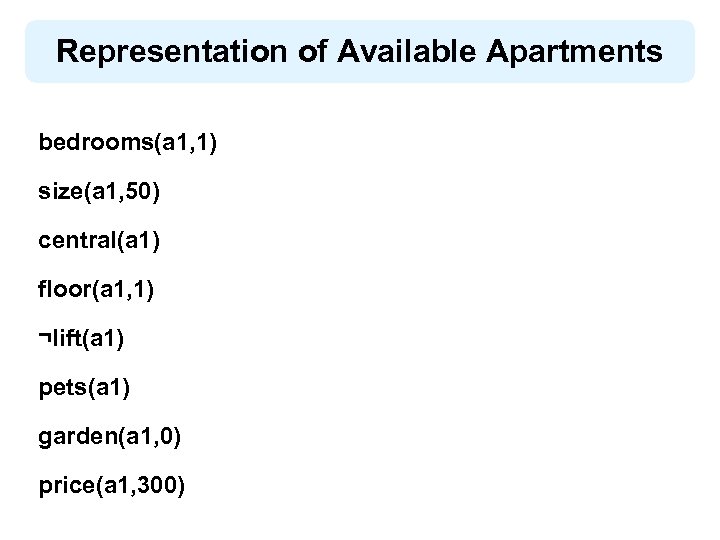
Representation of Available Apartments bedrooms(a 1, 1) size(a 1, 50) central(a 1) floor(a 1, 1) ¬lift(a 1) pets(a 1) garden(a 1, 0) price(a 1, 300)
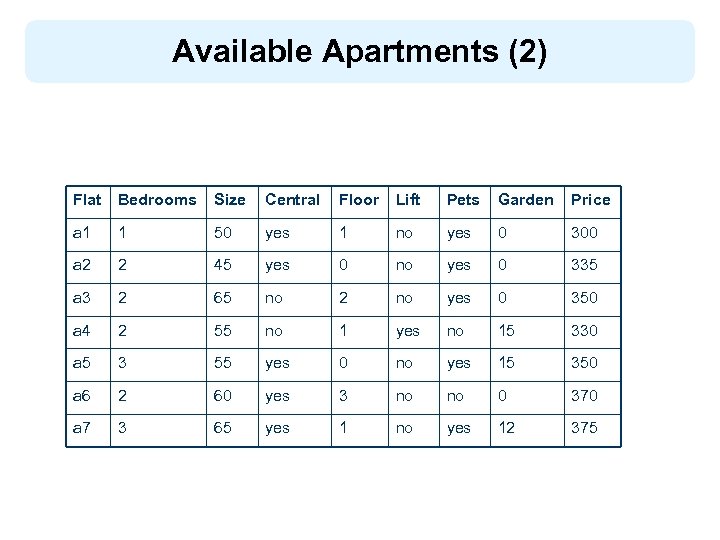
Available Apartments (2) Flat Bedrooms Size Central Floor Lift Pets Garden Price a 1 1 50 yes 1 no yes 0 300 a 2 2 45 yes 0 no yes 0 335 a 3 2 65 no 2 no yes 0 350 a 4 2 55 no 1 yes no 15 330 a 5 3 55 yes 0 no yes 15 350 a 6 2 60 yes 3 no no 0 370 a 7 3 65 yes 1 no yes 12 375
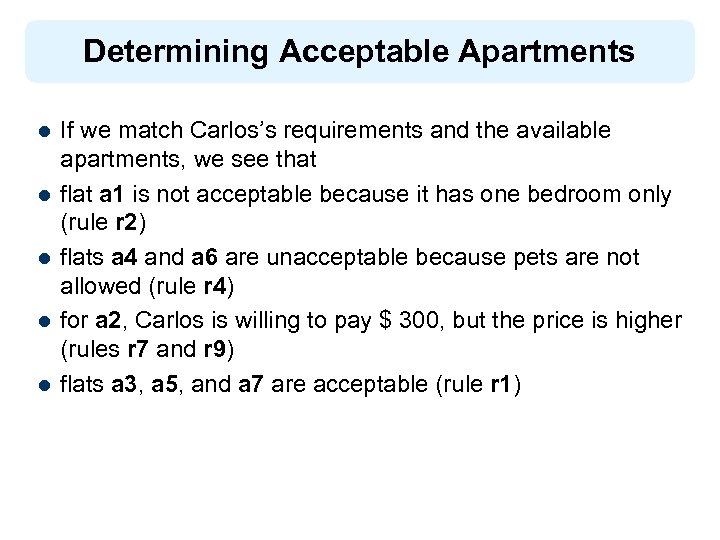
Determining Acceptable Apartments l l l If we match Carlos’s requirements and the available apartments, we see that flat a 1 is not acceptable because it has one bedroom only (rule r 2) flats a 4 and a 6 are unacceptable because pets are not allowed (rule r 4) for a 2, Carlos is willing to pay $ 300, but the price is higher (rules r 7 and r 9) flats a 3, a 5, and a 7 are acceptable (rule r 1)
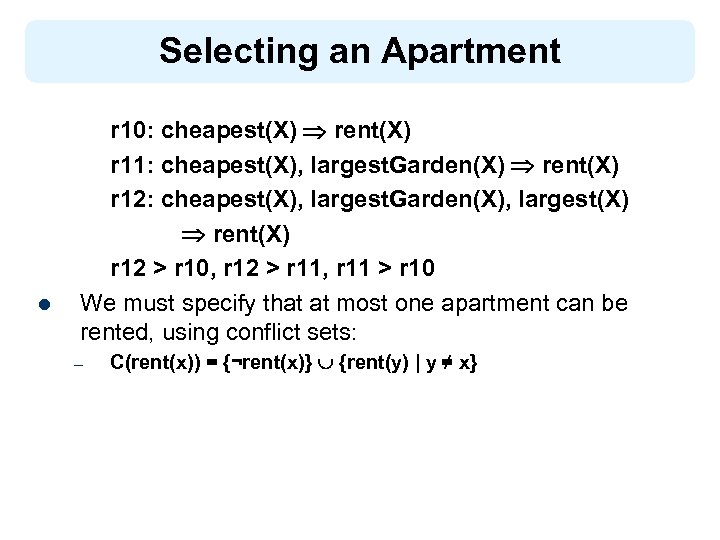
Selecting an Apartment l r 10: cheapest(X) rent(X) r 11: cheapest(X), largest. Garden(X) rent(X) r 12: cheapest(X), largest. Garden(X), largest(X) rent(X) r 12 > r 10, r 12 > r 11, r 11 > r 10 We must specify that at most one apartment can be rented, using conflict sets: – C(rent(x)) = {¬rent(x)} {rent(y) | y ≠ x}
Lecture Outline 1. 2. 3. 4. 5. 6. 7. 8. Introduction Monotonic Rules: Example Monotonic Rules: Syntax & Semantics DLP: Description Logic Programs SWRL: Semantic Web Rules Language Nonmonotonic Rules: Syntax Nonmonotonic Rules: Example Rule. ML: XML-Based Syntax
Rule. ML l In accordance with the Semantic Web vision: – l l Rule. ML is an important standardization effort for rule markup on the Web. Actually a family of rule markup languages, corresponding to different kinds of rule languages: – l Make rules machine-accessible. derivation rules, integrity constraints, reaction rules Kernel: Datalog (function-free Horn logic)
Rule. ML (2) l XML – – based in the form of XML schemas DTDs for earlier versions l Straightforward correspondence between Rule. ML elements and rule components
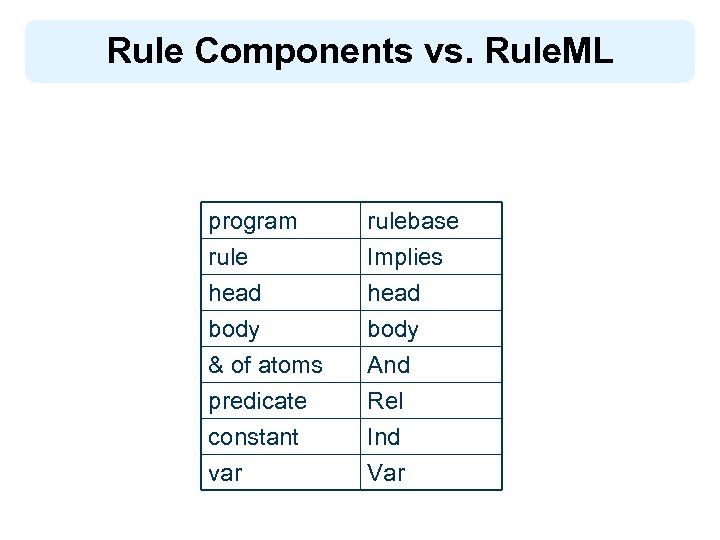
Rule Components vs. Rule. ML program rule head body rulebase Implies head body & of atoms predicate constant var And Rel Ind Var
An Example l The discount for a customer buying a product is 7. 5 percent if the customer is premium and the product is luxury.
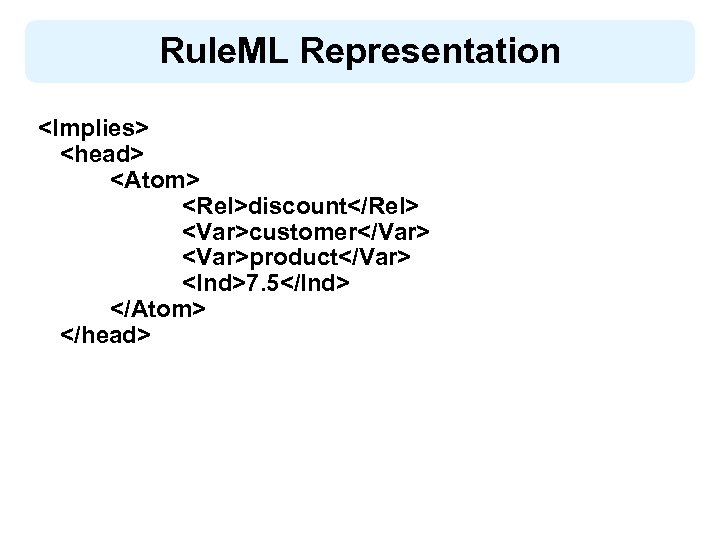
Rule. ML Representation <Implies> <head> <Atom> <Rel>discount</Rel> <Var>customer</Var> <Var>product</Var> <Ind>7. 5</Ind> </Atom> </head>
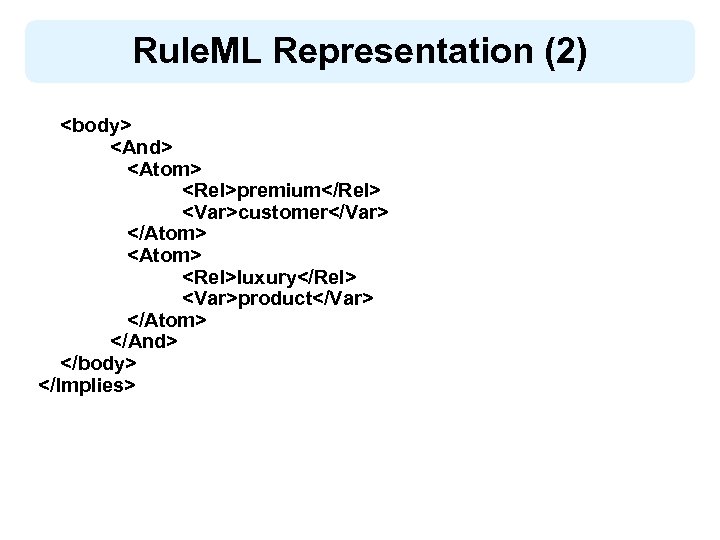
Rule. ML Representation (2) <body> <And> <Atom> <Rel>premium</Rel> <Var>customer</Var> </Atom> <Rel>luxury</Rel> <Var>product</Var> </Atom> </And> </body> </Implies>
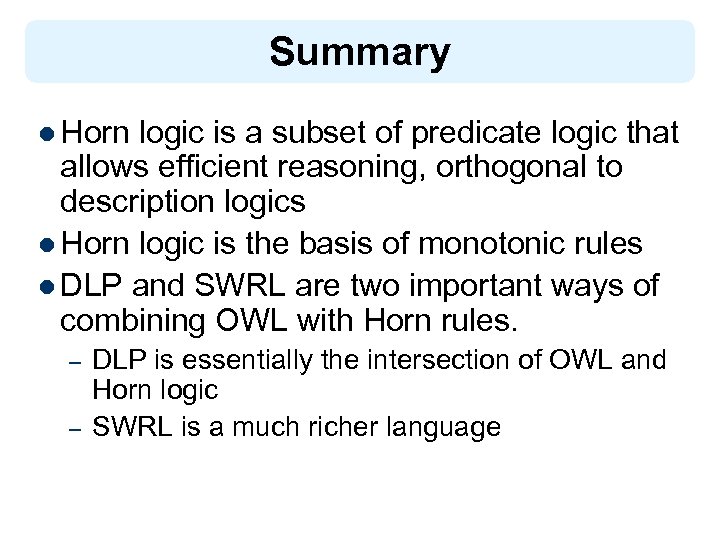
Summary l Horn logic is a subset of predicate logic that allows efficient reasoning, orthogonal to description logics l Horn logic is the basis of monotonic rules l DLP and SWRL are two important ways of combining OWL with Horn rules. – – DLP is essentially the intersection of OWL and Horn logic SWRL is a much richer language
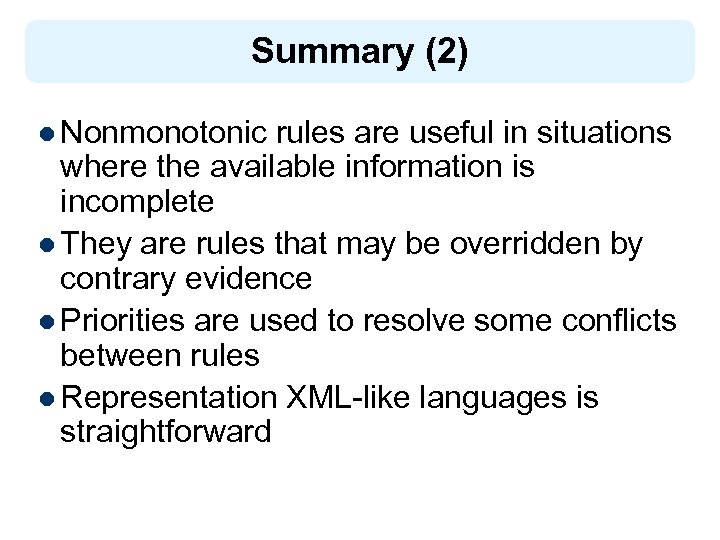
Summary (2) l Nonmonotonic rules are useful in situations where the available information is incomplete l They are rules that may be overridden by contrary evidence l Priorities are used to resolve some conflicts between rules l Representation XML-like languages is straightforward
Скачать презентацию Chapter 5 Non monoticic rules Based on slides
851ba45f97900a365dc82e565f308121.ppt