 Скачать презентацию Chapter 5 Logic and Inference Rules Based on
3652e7fc70c25727ec16e0212d259e0a.ppt
- Количество слайдов: 61



Chapter 5 Logic and Inference: Rules Based on slides from Grigoris Antoniou and Frank van Harmelen
Lecture Outline 1. 2. 3. 4. 5. 6. 7. Introduction Monotonic Rules: Example Monotonic Rules: Syntax & Semantics Nonmonotonic Rules: Syntax Nonmonotonic Rules: Example A DTD For Monotonic Rules A DTD For Nonmonotonic Rules
Motivation l Description logic is good for somethings, not so good for others l OWL has some limitations l Many people want to express knowledge in rules l There are several efforts that impact the Semantic Web – – Rule. ML SWRL N 3 logic Rules in Jena and other software packages
Knowledge Representation The subjects presented so far were related to the representation of knowledge l Knowledge Representation was studied long before the emergence of WWW in AI l Logic is still the foundation of KR, particularly in the form of predicate logic (first-order logic) l
The Importance of Logic l l l High-level language for expressing knowledge High expressive power Well-understood formal semantics Precise notion of logical consequence Proof systems that can automatically derive statements syntactically from a set of premises
The Importance of Logic l There exist proof systems for which semantic logical consequence coincides with syntactic derivation within the proof system – l Predicate logic is unique in the sense that sound and complete proof systems do exist. – l l Soundness & completeness Not for more expressive logics (higher-order logics) trace the proof that leads to a logical consequence. Logic can provide explanations for answers – By tracing a proof
Specializations of Predicate Logic: RDF and OWL l RDF/S and OWL (Lite and DL) are specializations of predicate logic – correspond roughly to a description logic They define reasonable subsets of logic l Trade-off between the expressive power and the computational complexity: l – The more expressive the language, the less efficient the corresponding proof systems
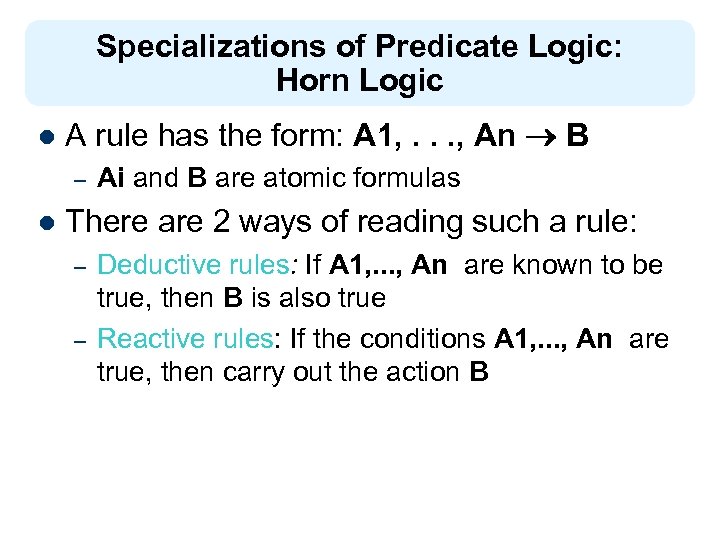
Specializations of Predicate Logic: Horn Logic l A rule has the form: A 1, . . . , An B – l Ai and B are atomic formulas There are 2 ways of reading such a rule: – – Deductive rules: If A 1, . . . , An are known to be true, then B is also true Reactive rules: If the conditions A 1, . . . , An are true, then carry out the action B
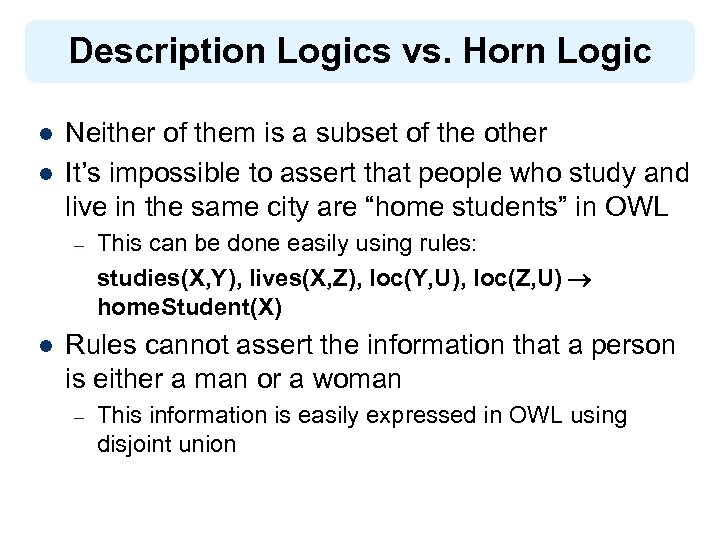
Description Logics vs. Horn Logic l l Neither of them is a subset of the other It’s impossible to assert that people who study and live in the same city are “home students” in OWL – l This can be done easily using rules: studies(X, Y), lives(X, Z), loc(Y, U), loc(Z, U) home. Student(X) Rules cannot assert the information that a person is either a man or a woman – This information is easily expressed in OWL using disjoint union
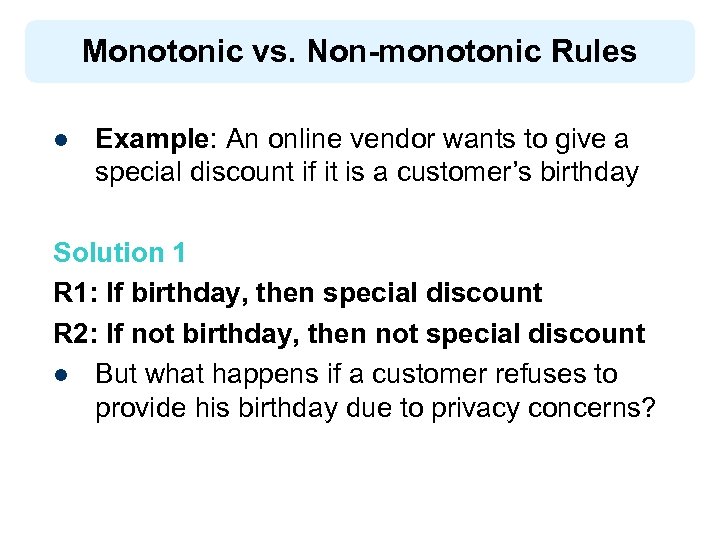
Monotonic vs. Non-monotonic Rules l Example: An online vendor wants to give a special discount if it is a customer’s birthday Solution 1 R 1: If birthday, then special discount R 2: If not birthday, then not special discount l But what happens if a customer refuses to provide his birthday due to privacy concerns?
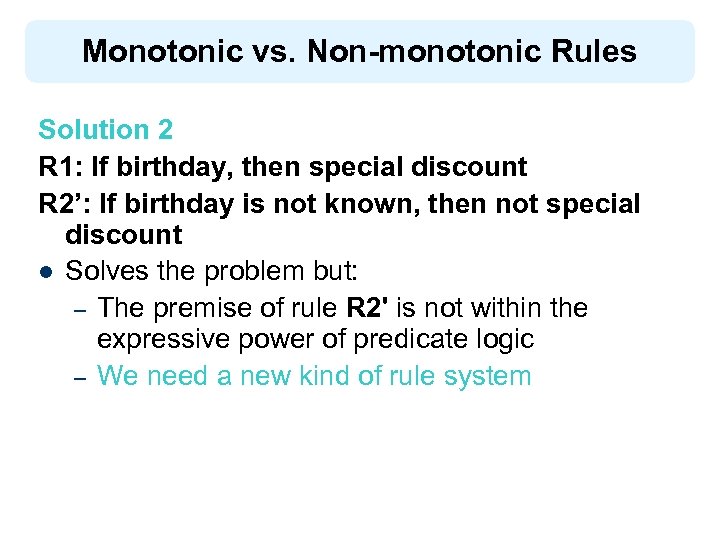
Monotonic vs. Non-monotonic Rules Solution 2 R 1: If birthday, then special discount R 2’: If birthday is not known, then not special discount l Solves the problem but: – The premise of rule R 2' is not within the expressive power of predicate logic – We need a new kind of rule system
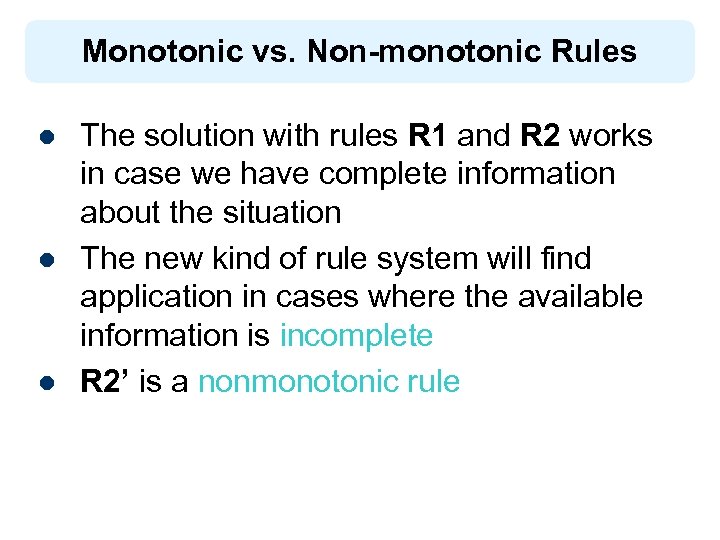
Monotonic vs. Non-monotonic Rules l l l The solution with rules R 1 and R 2 works in case we have complete information about the situation The new kind of rule system will find application in cases where the available information is incomplete R 2’ is a nonmonotonic rule
Exchange of Rules l Exchange of rules across different applications – l l E. g. , an online store advertises its pricing, refund, and privacy policies, expressed using rules The Semantic Web approach is to express the knowledge in a machine-accessible way using one of the Web languages we have already discussed We show rules can be expressed in XML-like languages (“rule markup languages”)
Lecture Outline 1. 2. 3. 4. 5. 6. 7. Introduction Monotonic Rules: Example Monotonic Rules: Syntax & Semantics Nonmonotonic Rules: Syntax Nonmonotonic Rules: Example A DTD For Monotonic Rules A DTD For Nonmonotonic Rules
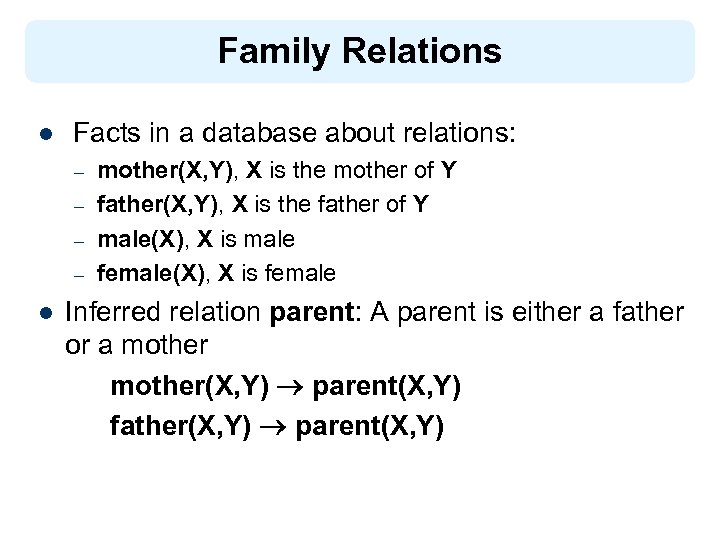
Family Relations l Facts in a database about relations: – – l mother(X, Y), X is the mother of Y father(X, Y), X is the father of Y male(X), X is male female(X), X is female Inferred relation parent: A parent is either a father or a mother(X, Y) parent(X, Y) father(X, Y) parent(X, Y)
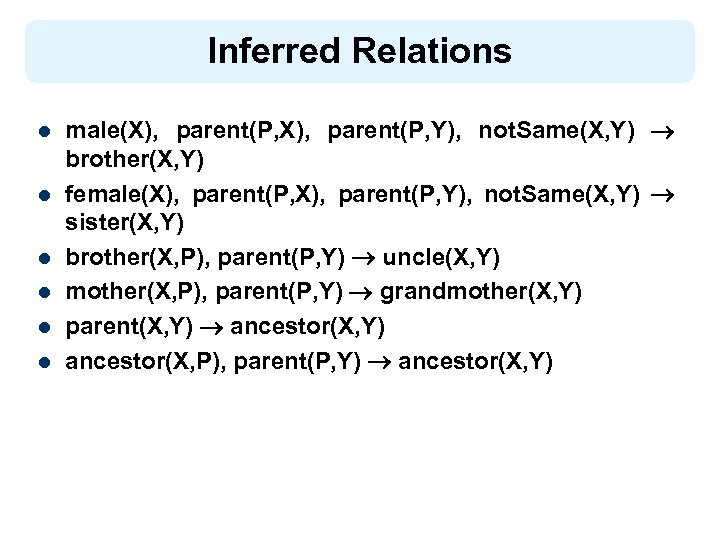
Inferred Relations l l l male(X), parent(P, Y), not. Same(X, Y) brother(X, Y) female(X), parent(P, Y), not. Same(X, Y) sister(X, Y) brother(X, P), parent(P, Y) uncle(X, Y) mother(X, P), parent(P, Y) grandmother(X, Y) parent(X, Y) ancestor(X, Y) ancestor(X, P), parent(P, Y) ancestor(X, Y)
Lecture Outline 1. 2. 3. 4. 5. 6. 7. Introduction Monotonic Rules: Example Monotonic Rules: Syntax & Semantics Nonmonotonic Rules: Syntax Nonmonotonic Rules: Example A DTD For Monotonic Rules A DTD For Nonmonotonic Rules
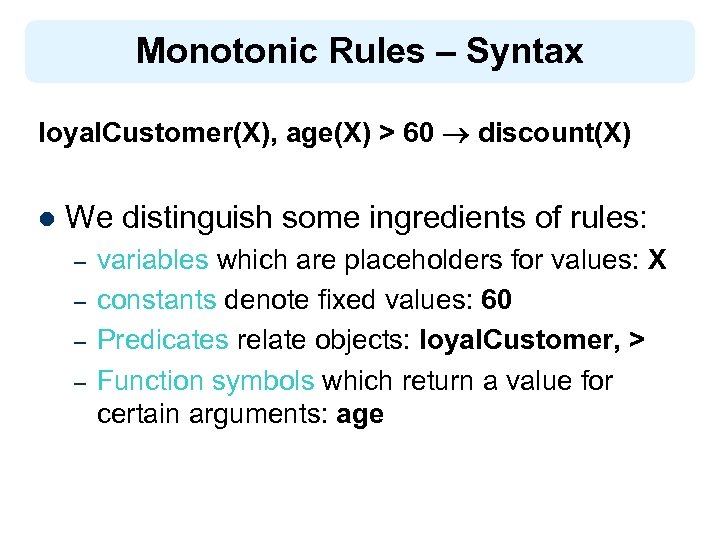
Monotonic Rules – Syntax loyal. Customer(X), age(X) > 60 discount(X) l We distinguish some ingredients of rules: – – variables which are placeholders for values: X constants denote fixed values: 60 Predicates relate objects: loyal. Customer, > Function symbols which return a value for certain arguments: age
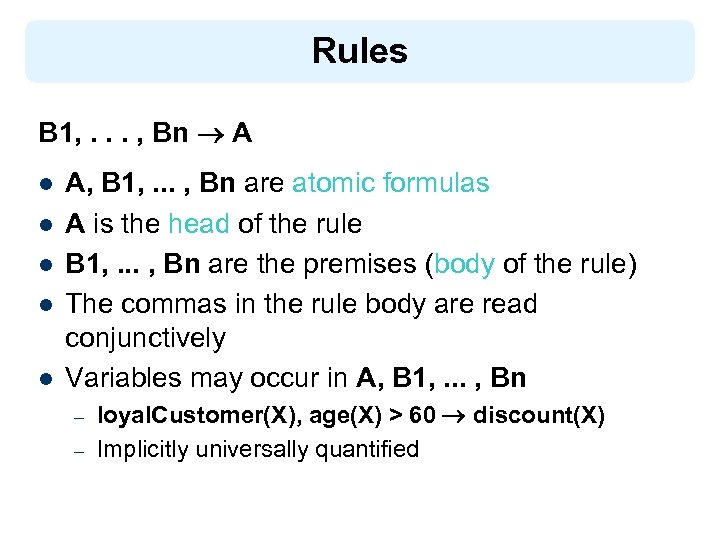
Rules B 1, . . . , Bn A l l l A, B 1, . . . , Bn are atomic formulas A is the head of the rule B 1, . . . , Bn are the premises (body of the rule) The commas in the rule body are read conjunctively Variables may occur in A, B 1, . . . , Bn – – loyal. Customer(X), age(X) > 60 discount(X) Implicitly universally quantified
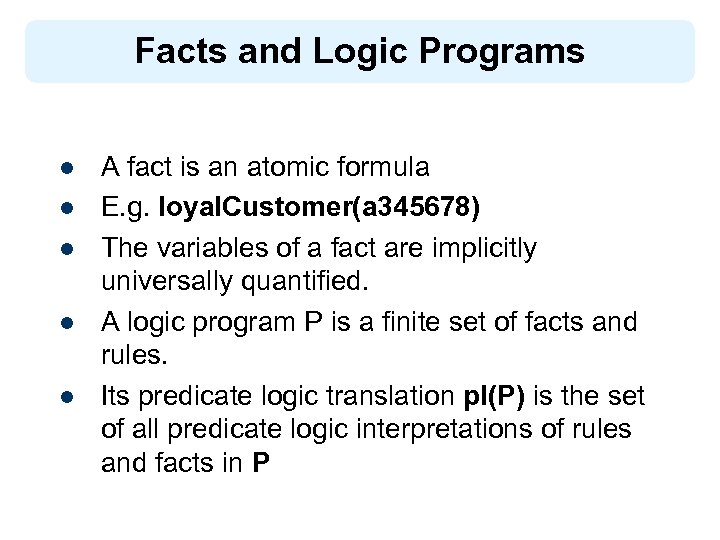
Facts and Logic Programs l l l A fact is an atomic formula E. g. loyal. Customer(a 345678) The variables of a fact are implicitly universally quantified. A logic program P is a finite set of facts and rules. Its predicate logic translation pl(P) is the set of all predicate logic interpretations of rules and facts in P
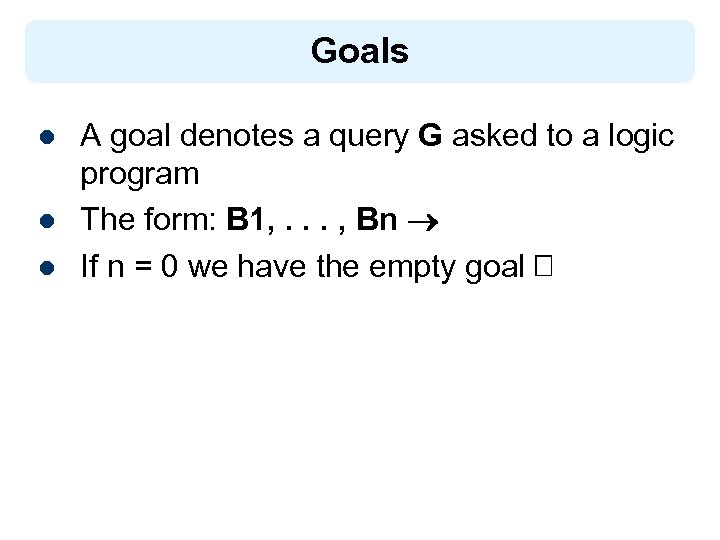
Goals l l l A goal denotes a query G asked to a logic program The form: B 1, . . . , Bn If n = 0 we have the empty goal
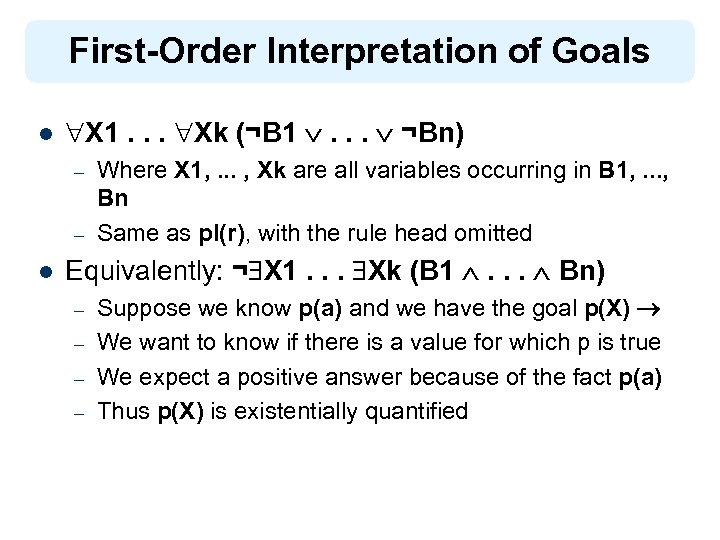
First-Order Interpretation of Goals l X 1. . . Xk (¬B 1 . . . ¬Bn) – – l Where X 1, . . . , Xk are all variables occurring in B 1, . . . , Bn Same as pl(r), with the rule head omitted Equivalently: ¬ X 1. . . Xk (B 1 . . . Bn) – – Suppose we know p(a) and we have the goal p(X) We want to know if there is a value for which p is true We expect a positive answer because of the fact p(a) Thus p(X) is existentially quantified
Why Negate the Formula? l We use a proof technique from mathematics called proof by contradiction: – l Prove that A follows from B by assuming that A is false and deriving a contradiction, when combined with B In logic programming we prove that a goal can be answered positively by negating the goal and proving that we get a contradiction using the logic program – E. g. , given the following logic program we get a logical contradiction
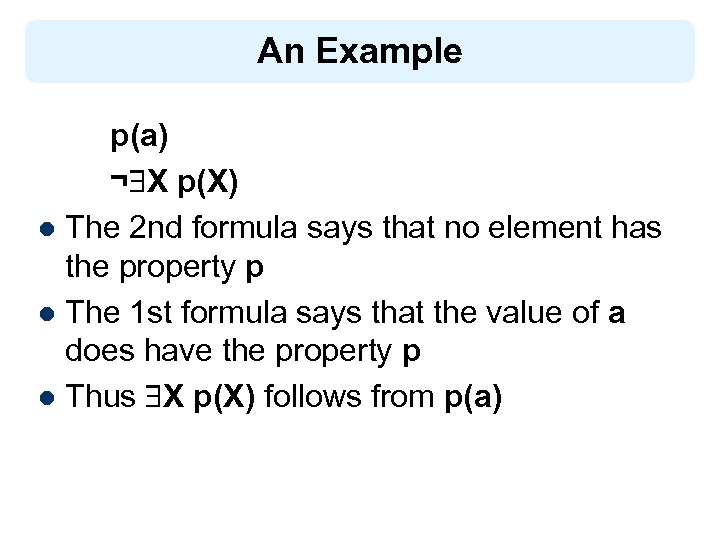
An Example p(a) ¬ X p(X) l The 2 nd formula says that no element has the property p l The 1 st formula says that the value of a does have the property p l Thus X p(X) follows from p(a)
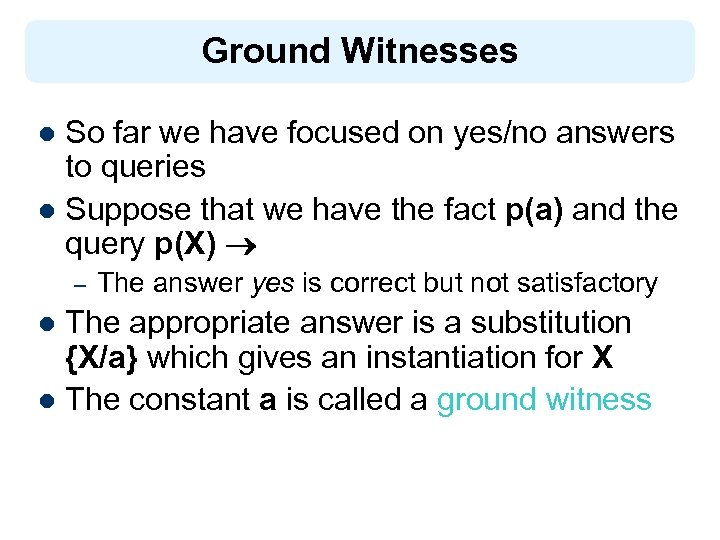
Ground Witnesses So far we have focused on yes/no answers to queries l Suppose that we have the fact p(a) and the query p(X) l – The answer yes is correct but not satisfactory The appropriate answer is a substitution {X/a} which gives an instantiation for X l The constant a is called a ground witness l
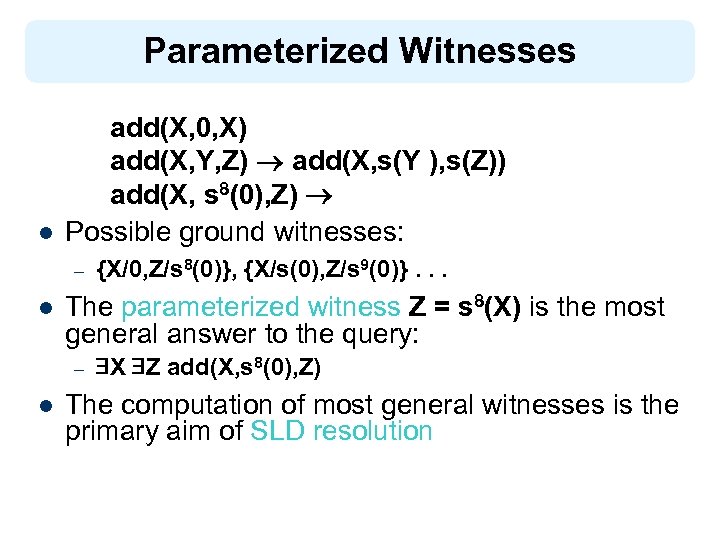
Parameterized Witnesses l add(X, 0, X) add(X, Y, Z) add(X, s(Y ), s(Z)) add(X, s 8(0), Z) Possible ground witnesses: – l The parameterized witness Z = s 8(X) is the most general answer to the query: – l {X/0, Z/s 8(0)}, {X/s(0), Z/s 9(0)}. . . X Z add(X, s 8(0), Z) The computation of most general witnesses is the primary aim of SLD resolution
Lecture Outline 1. 2. 3. 4. 5. 6. 7. Introduction Monotonic Rules: Example Monotonic Rules: Syntax & Semantics Nonmonotonic Rules: Syntax Nonmonotonic Rules: Example A DTD For Monotonic Rules A DTD For Nonmonotonic Rules
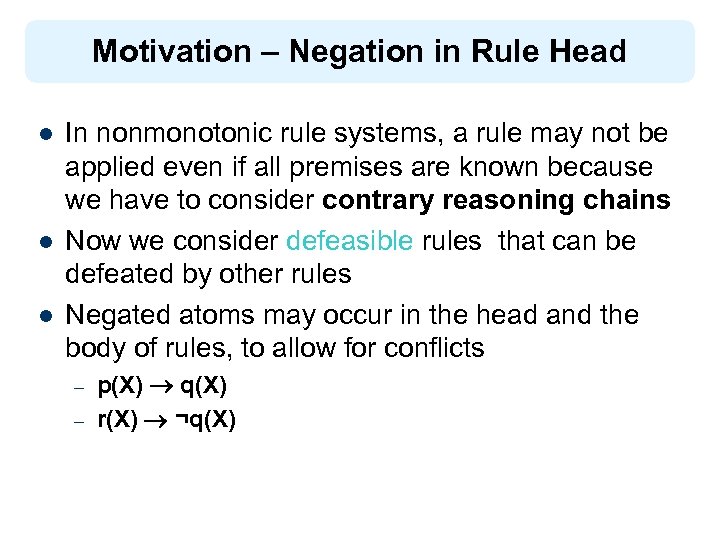
Motivation – Negation in Rule Head l l l In nonmonotonic rule systems, a rule may not be applied even if all premises are known because we have to consider contrary reasoning chains Now we consider defeasible rules that can be defeated by other rules Negated atoms may occur in the head and the body of rules, to allow for conflicts – – p(X) q(X) r(X) ¬q(X)
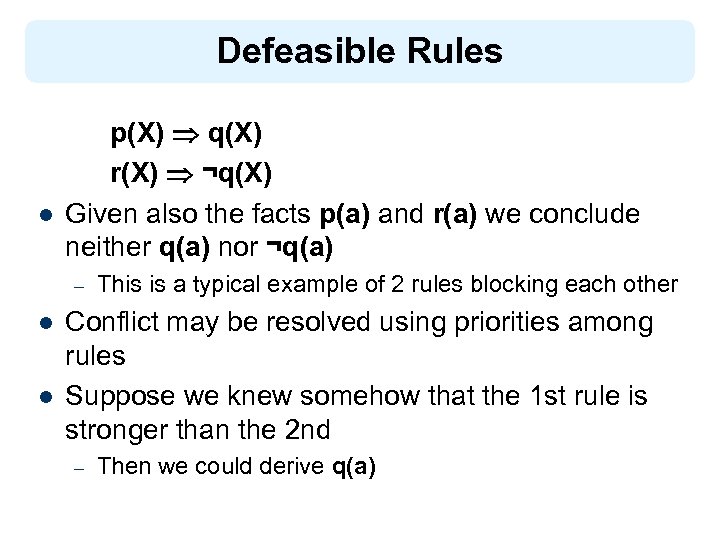
Defeasible Rules l p(X) q(X) r(X) ¬q(X) Given also the facts p(a) and r(a) we conclude neither q(a) nor ¬q(a) – l l This is a typical example of 2 rules blocking each other Conflict may be resolved using priorities among rules Suppose we knew somehow that the 1 st rule is stronger than the 2 nd – Then we could derive q(a)
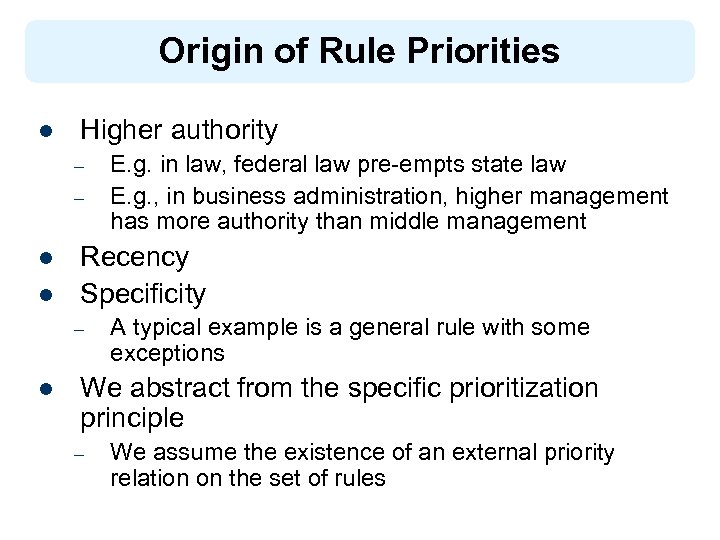
Origin of Rule Priorities l Higher authority – – l l Recency Specificity – l E. g. in law, federal law pre-empts state law E. g. , in business administration, higher management has more authority than middle management A typical example is a general rule with some exceptions We abstract from the specific prioritization principle – We assume the existence of an external priority relation on the set of rules
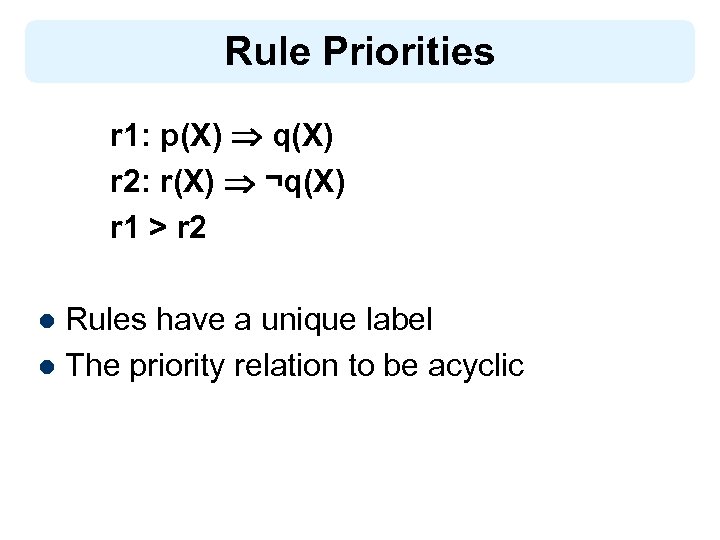
Rule Priorities r 1: p(X) q(X) r 2: r(X) ¬q(X) r 1 > r 2 Rules have a unique label l The priority relation to be acyclic l
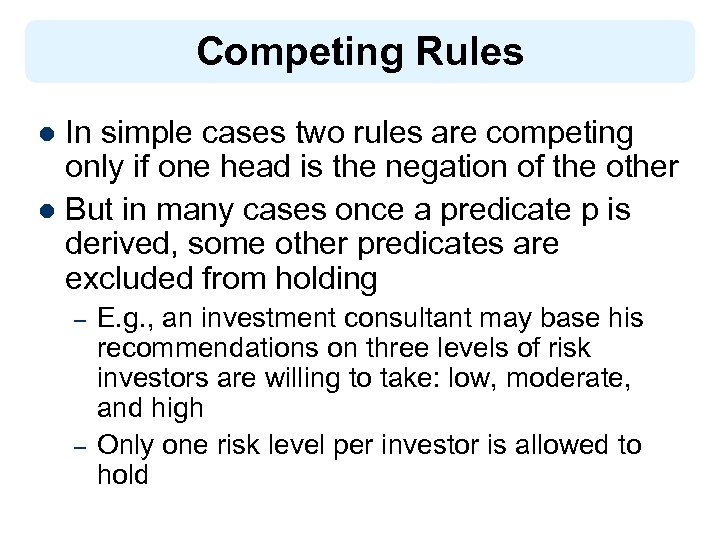
Competing Rules In simple cases two rules are competing only if one head is the negation of the other l But in many cases once a predicate p is derived, some other predicates are excluded from holding l – – E. g. , an investment consultant may base his recommendations on three levels of risk investors are willing to take: low, moderate, and high Only one risk level per investor is allowed to hold
Competing Rules (2) l l These situations are modelled by maintaining a conflict set C(L) for each literal L C(L) always contains the negation of L but may contain more literals
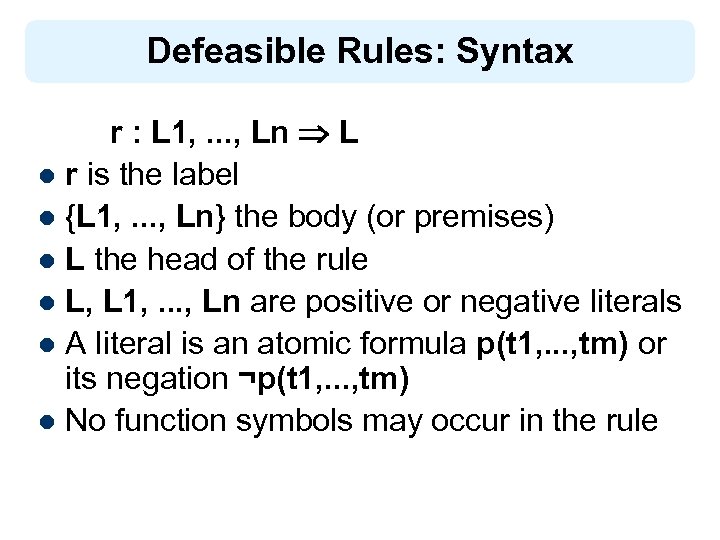
Defeasible Rules: Syntax r : L 1, . . . , Ln L l r is the label l {L 1, . . . , Ln} the body (or premises) l L the head of the rule l L, L 1, . . . , Ln are positive or negative literals l A literal is an atomic formula p(t 1, . . . , tm) or its negation ¬p(t 1, . . . , tm) l No function symbols may occur in the rule
Defeasible Logic Programs l A defeasible logic program is a triple (F, R, >) consisting of – a set F of facts – a finite set R of defeasible rules – an acyclic binary relation > on R l. A set of pairs r > r' where r and r' are labels of rules in R
Lecture Outline 1. 2. 3. 4. 5. 6. 7. Introduction Monotonic Rules: Example Monotonic Rules: Syntax & Semantics Nonmonotonic Rules: Syntax Nonmonotonic Rules: Example A DTD For Monotonic Rules A DTD For Nonmonotonic Rules
Brokered Trade Brokered trades take place via an independent third party, the broker l The broker matches the buyer’s requirements and the sellers’ capabilities, and proposes a transaction when both parties can be satisfied by the trade l The application is apartment renting an activity that is common and often tedious and time-consuming l
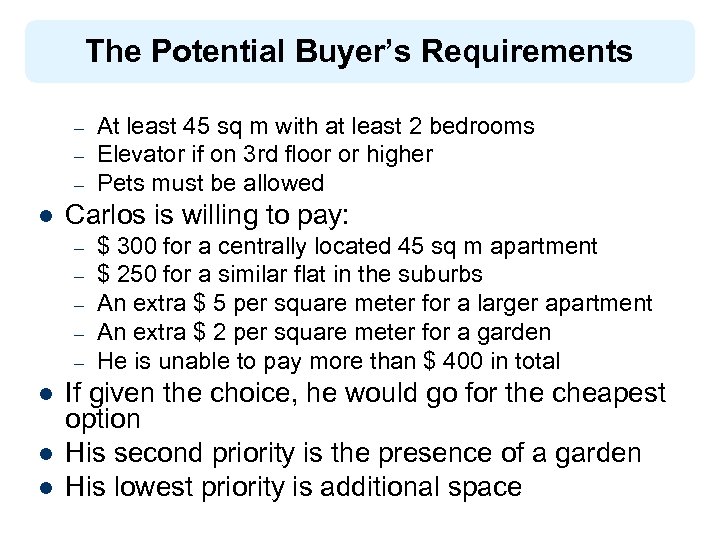
The Potential Buyer’s Requirements – – – l Carlos is willing to pay: – – – l l l At least 45 sq m with at least 2 bedrooms Elevator if on 3 rd floor or higher Pets must be allowed $ 300 for a centrally located 45 sq m apartment $ 250 for a similar flat in the suburbs An extra $ 5 per square meter for a larger apartment An extra $ 2 per square meter for a garden He is unable to pay more than $ 400 in total If given the choice, he would go for the cheapest option His second priority is the presence of a garden His lowest priority is additional space
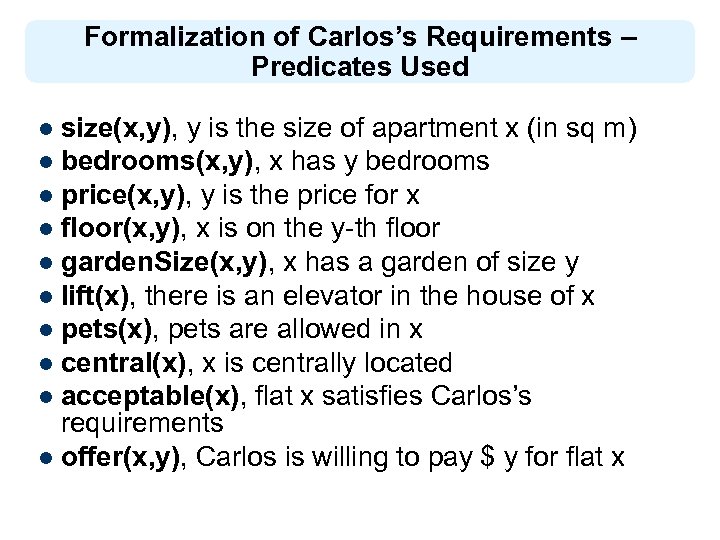
Formalization of Carlos’s Requirements – Predicates Used l size(x, y), y is the size of apartment x (in sq m) l bedrooms(x, y), x has y bedrooms l price(x, y), y is the price for x l floor(x, y), x is on the y-th floor l garden. Size(x, y), x has a garden of size y l lift(x), there is an elevator in the house of x l pets(x), pets are allowed in x l central(x), x is centrally located l acceptable(x), flat x satisfies Carlos’s requirements l offer(x, y), Carlos is willing to pay $ y for flat x
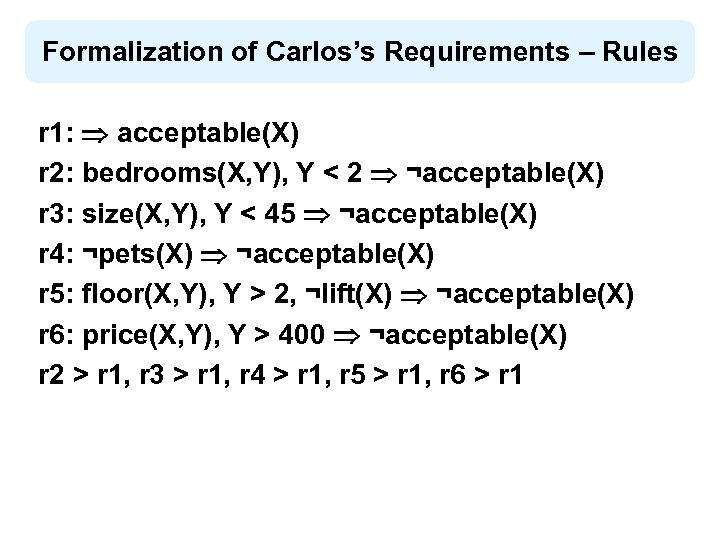
Formalization of Carlos’s Requirements – Rules r 1: acceptable(X) r 2: bedrooms(X, Y), Y < 2 ¬acceptable(X) r 3: size(X, Y), Y < 45 ¬acceptable(X) r 4: ¬pets(X) ¬acceptable(X) r 5: floor(X, Y), Y > 2, ¬lift(X) ¬acceptable(X) r 6: price(X, Y), Y > 400 ¬acceptable(X) r 2 > r 1, r 3 > r 1, r 4 > r 1, r 5 > r 1, r 6 > r 1
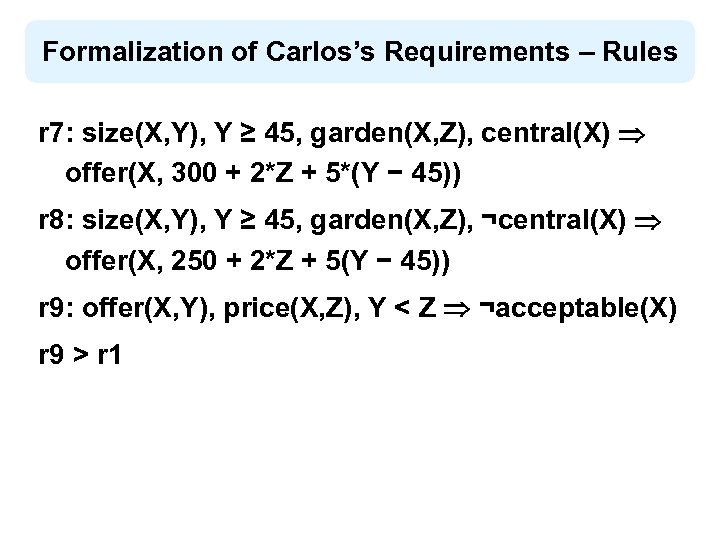
Formalization of Carlos’s Requirements – Rules r 7: size(X, Y), Y ≥ 45, garden(X, Z), central(X) offer(X, 300 + 2*Z + 5*(Y − 45)) r 8: size(X, Y), Y ≥ 45, garden(X, Z), ¬central(X) offer(X, 250 + 2*Z + 5(Y − 45)) r 9: offer(X, Y), price(X, Z), Y < Z ¬acceptable(X) r 9 > r 1
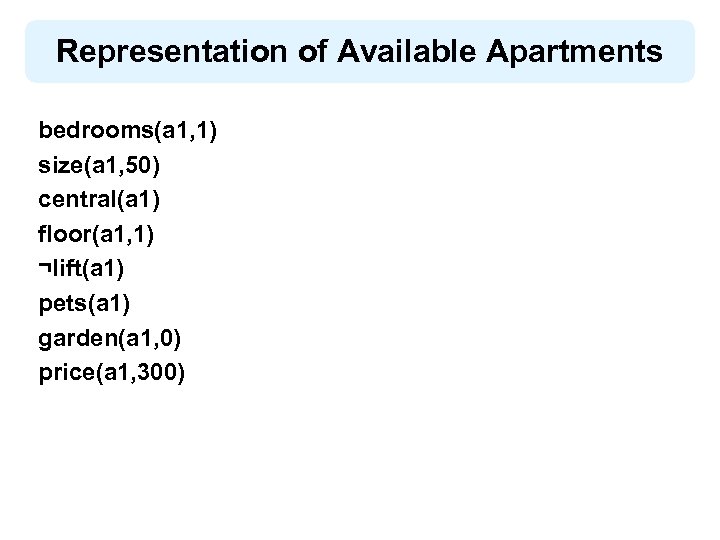
Representation of Available Apartments bedrooms(a 1, 1) size(a 1, 50) central(a 1) floor(a 1, 1) ¬lift(a 1) pets(a 1) garden(a 1, 0) price(a 1, 300)
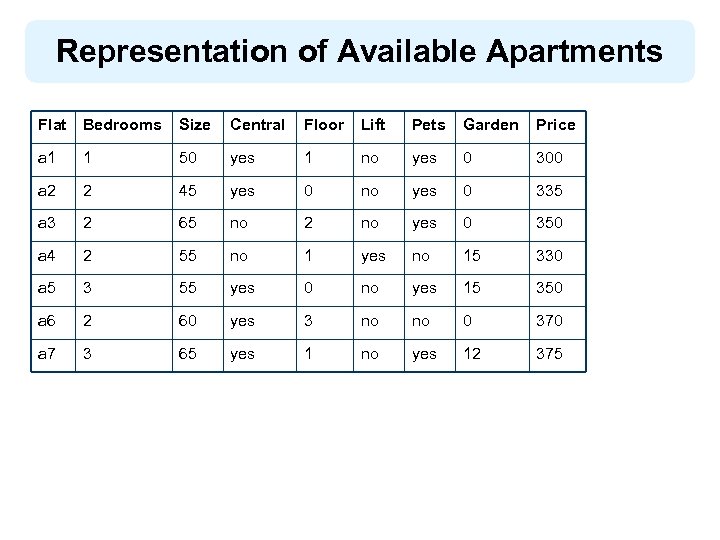
Representation of Available Apartments Flat Bedrooms Size Central Floor Lift Pets Garden Price a 1 1 50 yes 1 no yes 0 300 a 2 2 45 yes 0 no yes 0 335 a 3 2 65 no 2 no yes 0 350 a 4 2 55 no 1 yes no 15 330 a 5 3 55 yes 0 no yes 15 350 a 6 2 60 yes 3 no no 0 370 a 7 3 65 yes 1 no yes 12 375
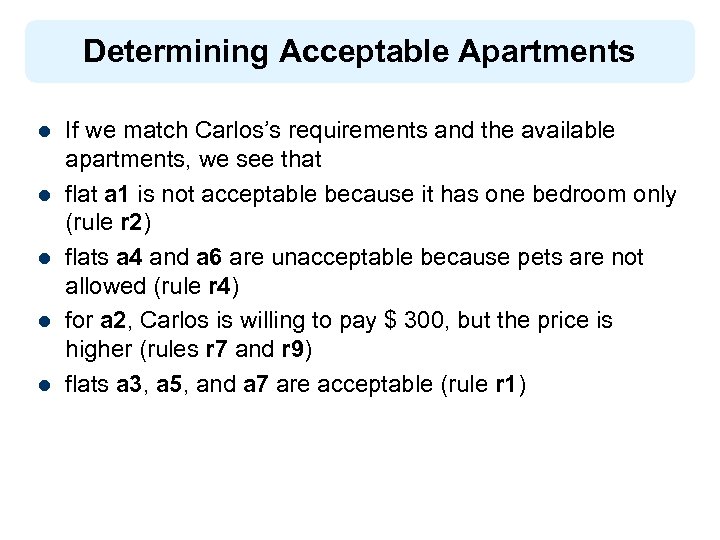
Determining Acceptable Apartments l l l If we match Carlos’s requirements and the available apartments, we see that flat a 1 is not acceptable because it has one bedroom only (rule r 2) flats a 4 and a 6 are unacceptable because pets are not allowed (rule r 4) for a 2, Carlos is willing to pay $ 300, but the price is higher (rules r 7 and r 9) flats a 3, a 5, and a 7 are acceptable (rule r 1)
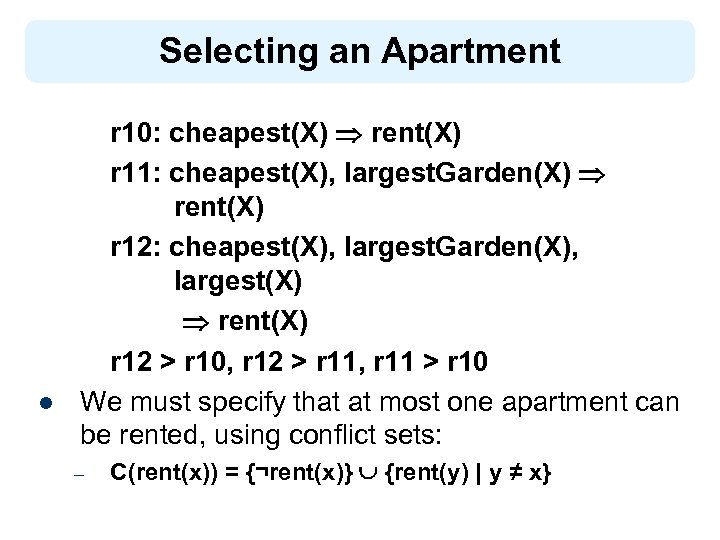
Selecting an Apartment l r 10: cheapest(X) rent(X) r 11: cheapest(X), largest. Garden(X) rent(X) r 12: cheapest(X), largest. Garden(X), largest(X) rent(X) r 12 > r 10, r 12 > r 11, r 11 > r 10 We must specify that at most one apartment can be rented, using conflict sets: – C(rent(x)) = {¬rent(x)} {rent(y) | y ≠ x}
Lecture Outline 1. 2. 3. 4. 5. 6. 7. Introduction Monotonic Rules: Example Monotonic Rules: Syntax & Semantics Nonmonotonic Rules: Syntax Nonmonotonic Rules: Example A DTD For Monotonic Rules A DTD For Nonmonotonic Rules
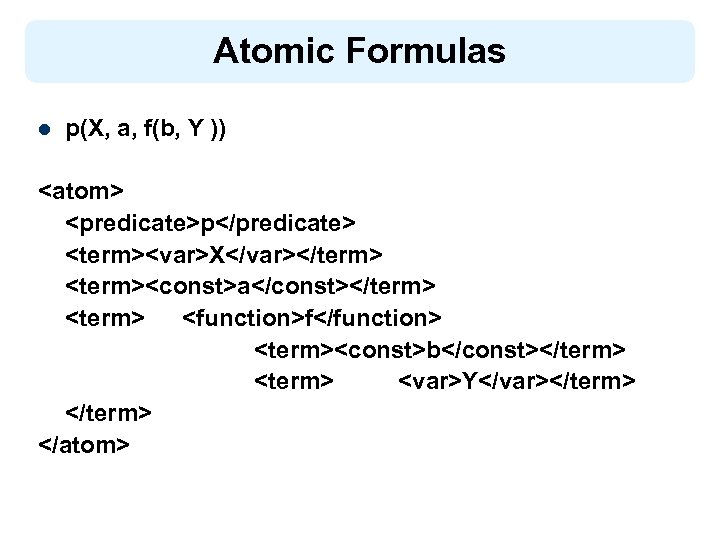
Atomic Formulas l p(X, a, f(b, Y )) <atom> <predicate>p</predicate> <term><var>X</var></term> <term><const>a</const></term> <function>f</function> <term><const>b</const></term> <var>Y</var></term> </atom>
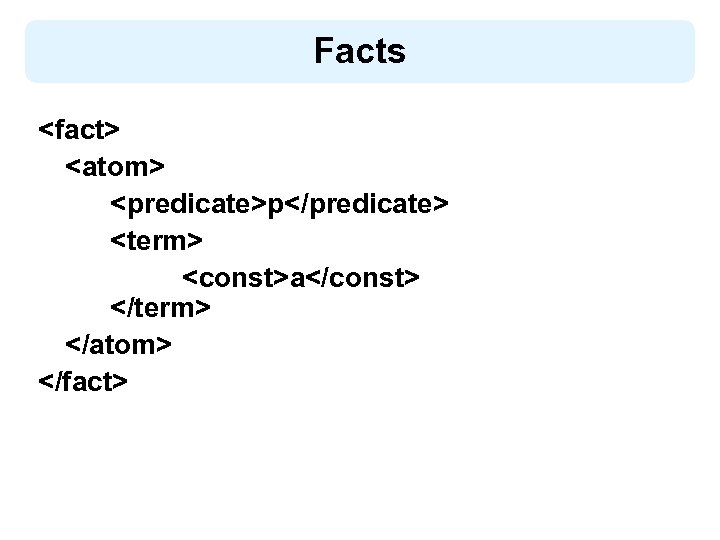
Facts <fact> <atom> <predicate>p</predicate> <term> <const>a</const> </term> </atom> </fact>
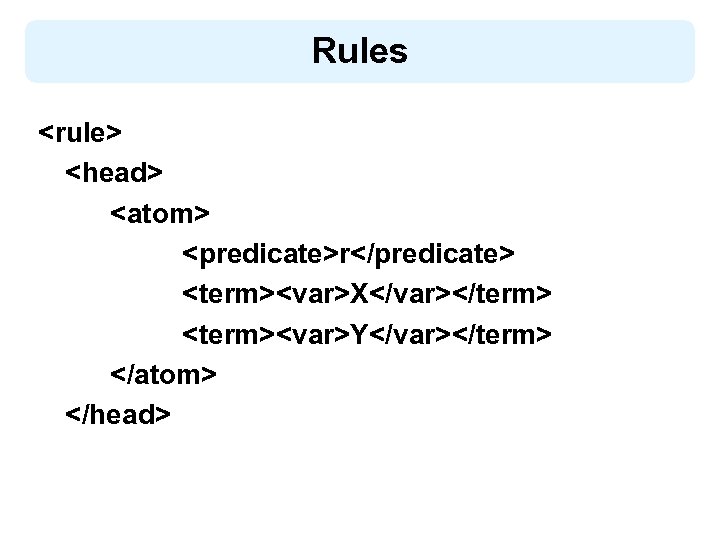
Rules <rule> <head> <atom> <predicate>r</predicate> <term><var>X</var></term> <term><var>Y</var></term> </atom> </head>
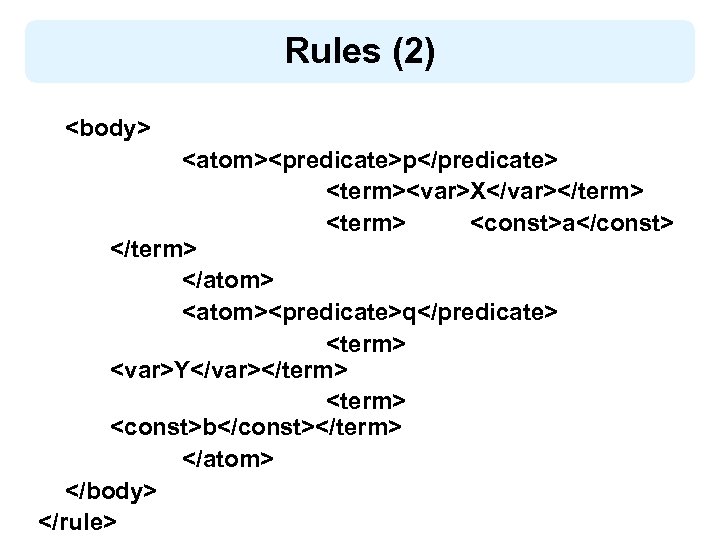
Rules (2) <body> <atom><predicate>p</predicate> <term><var>X</var></term> <const>a</const> </term> </atom> <atom><predicate>q</predicate> <term> <var>Y</var></term> <const>b</const></term> </atom> </body> </rule>
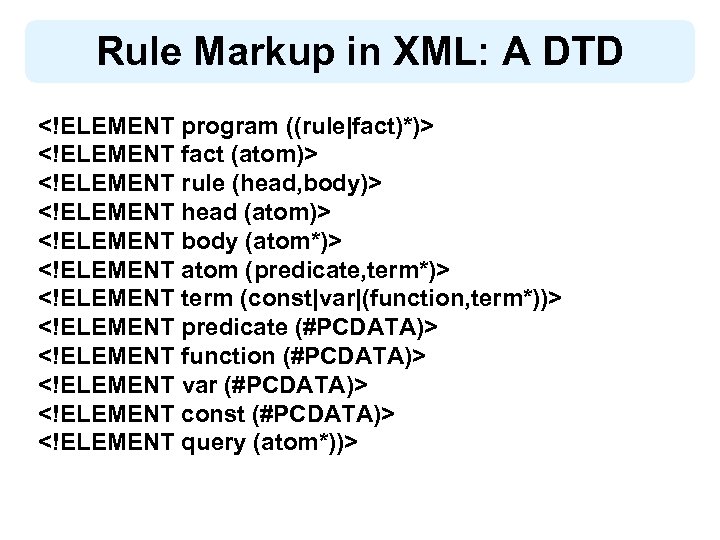
Rule Markup in XML: A DTD <!ELEMENT program ((rule|fact)*)> <!ELEMENT fact (atom)> <!ELEMENT rule (head, body)> <!ELEMENT head (atom)> <!ELEMENT body (atom*)> <!ELEMENT atom (predicate, term*)> <!ELEMENT term (const|var|(function, term*))> <!ELEMENT predicate (#PCDATA)> <!ELEMENT function (#PCDATA)> <!ELEMENT var (#PCDATA)> <!ELEMENT const (#PCDATA)> <!ELEMENT query (atom*))>
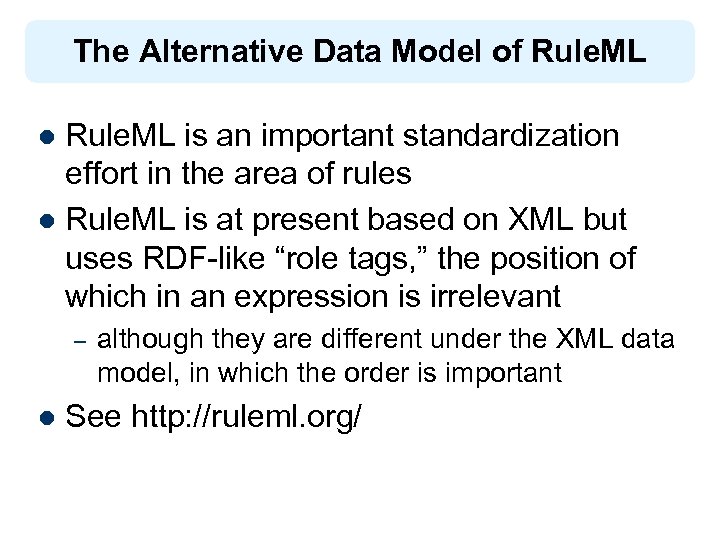
The Alternative Data Model of Rule. ML is an important standardization effort in the area of rules l Rule. ML is at present based on XML but uses RDF-like “role tags, ” the position of which in an expression is irrelevant l – l although they are different under the XML data model, in which the order is important See http: //ruleml. org/
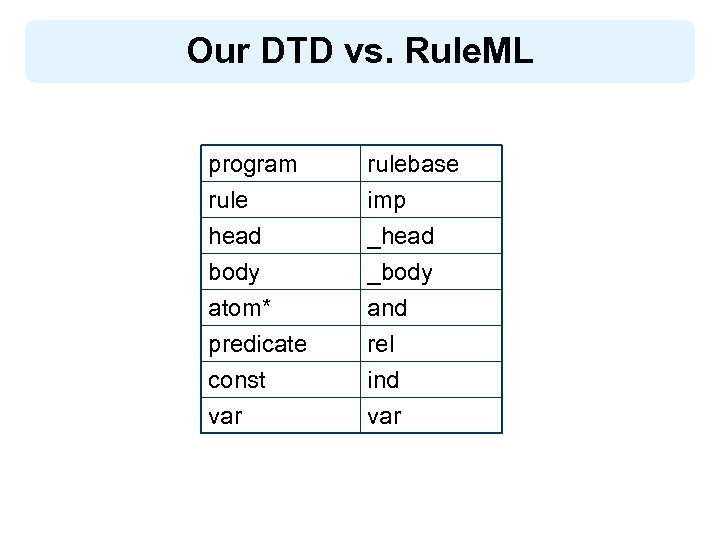
Our DTD vs. Rule. ML program rule head body rulebase imp _head _body atom* predicate const var and rel ind var
Lecture Outline 1. 2. 3. 4. 5. 6. 7. Introduction Monotonic Rules: Example Monotonic Rules: Syntax & Semantics Nonmonotonic Rules: Syntax Nonmonotonic Rules: Example A DTD For Monotonic Rules A DTD For Nonmonotonic Rules
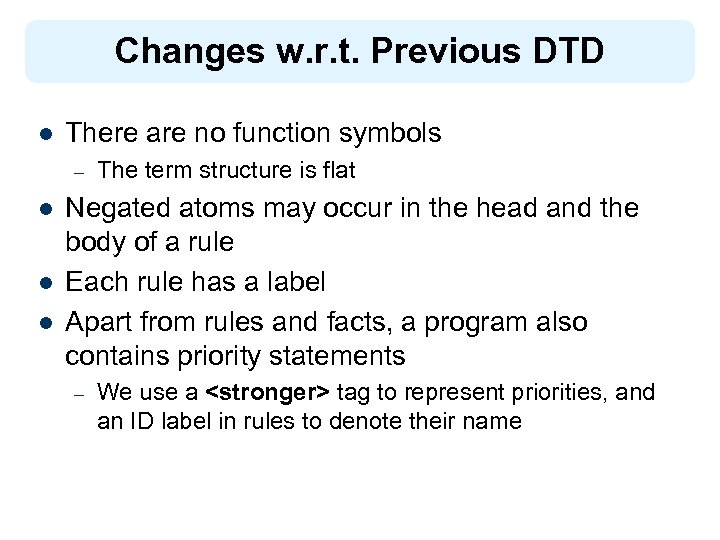
Changes w. r. t. Previous DTD l There are no function symbols – l l l The term structure is flat Negated atoms may occur in the head and the body of a rule Each rule has a label Apart from rules and facts, a program also contains priority statements – We use a <stronger> tag to represent priorities, and an ID label in rules to denote their name
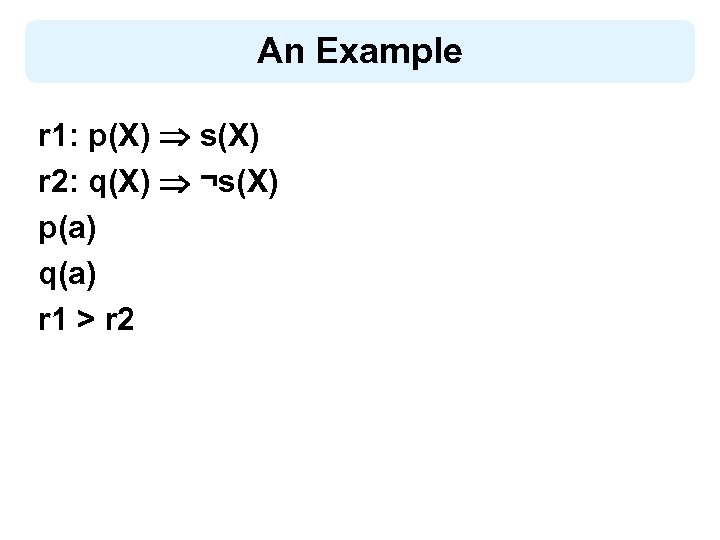
An Example r 1: p(X) s(X) r 2: q(X) ¬s(X) p(a) q(a) r 1 > r 2
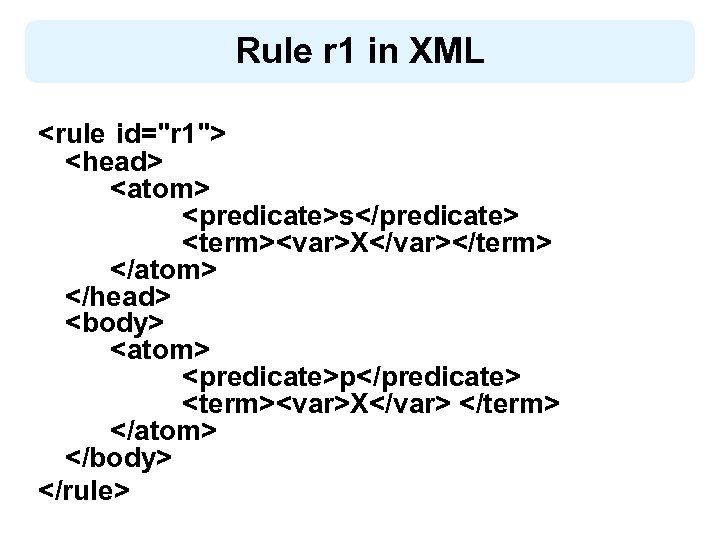
Rule r 1 in XML <rule id="r 1"> <head> <atom> <predicate>s</predicate> <term><var>X</var></term> </atom> </head> <body> <atom> <predicate>p</predicate> <term><var>X</var> </term> </atom> </body> </rule>
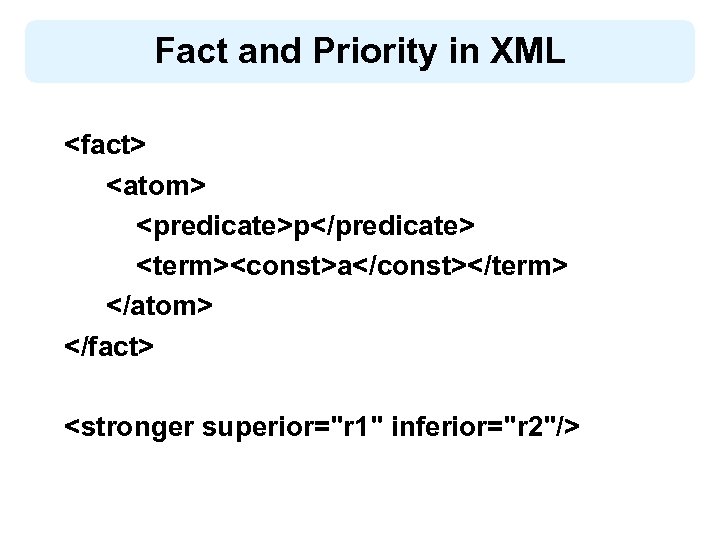
Fact and Priority in XML <fact> <atom> <predicate>p</predicate> <term><const>a</const></term> </atom> </fact> <stronger superior="r 1" inferior="r 2"/>
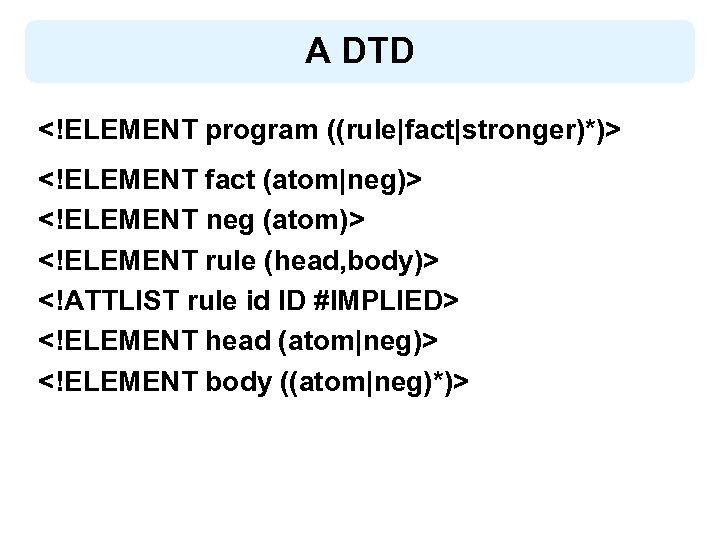
A DTD <!ELEMENT program ((rule|fact|stronger)*)> <!ELEMENT fact (atom|neg)> <!ELEMENT neg (atom)> <!ELEMENT rule (head, body)> <!ATTLIST rule id ID #IMPLIED> <!ELEMENT head (atom|neg)> <!ELEMENT body ((atom|neg)*)>
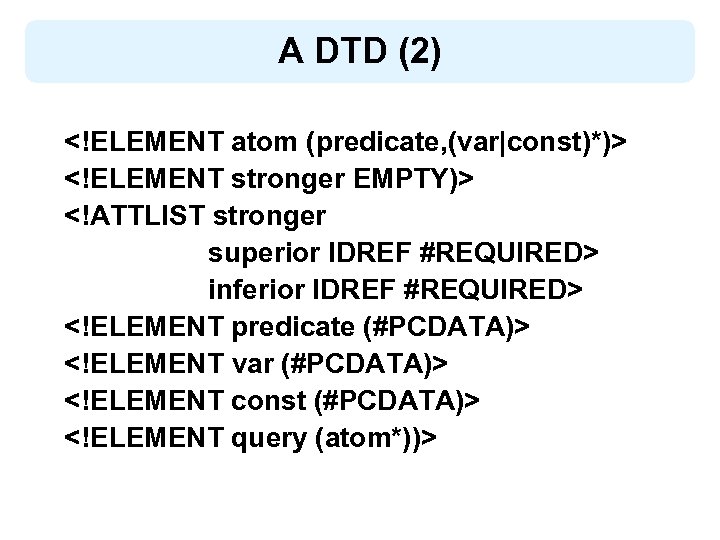
A DTD (2) <!ELEMENT atom (predicate, (var|const)*)> <!ELEMENT stronger EMPTY)> <!ATTLIST stronger superior IDREF #REQUIRED> inferior IDREF #REQUIRED> <!ELEMENT predicate (#PCDATA)> <!ELEMENT var (#PCDATA)> <!ELEMENT const (#PCDATA)> <!ELEMENT query (atom*))>
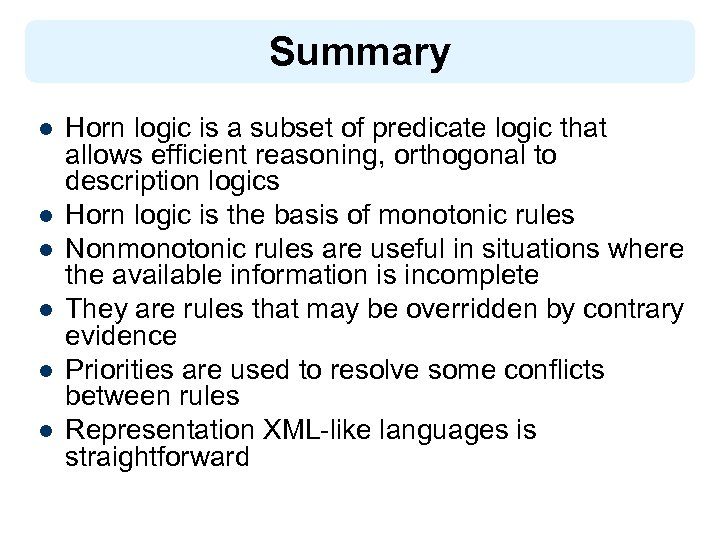
Summary l l l Horn logic is a subset of predicate logic that allows efficient reasoning, orthogonal to description logics Horn logic is the basis of monotonic rules Nonmonotonic rules are useful in situations where the available information is incomplete They are rules that may be overridden by contrary evidence Priorities are used to resolve some conflicts between rules Representation XML-like languages is straightforward
Скачать презентацию Chapter 5 Logic and Inference Rules Based on
3652e7fc70c25727ec16e0212d259e0a.ppt