


 Скачать презентацию CHAPTER 5 How Do Risk and Term Structure
a327848907421707b4f431f6f386f691.ppt
- Количество слайдов: 63
 CHAPTER 5 How Do Risk and Term Structure Affect Interest Rates? Copyright © 2012 Pearson Prentice Hall. All rights reserved.
 Chapter Preview In the last chapter, we examined interest rates, but made a big assumption—there is only one economy-wide interest rate. Of course, that isn’t really the case. In this chapter, we will examine the different rates that we observe for financial products. © 2012 Pearson Prentice Hall. All rights reserved. 5 -1
 Chapter Preview We will fist examine bonds that offer similar payment streams but differ in price. The price differences are due to the risk structure of interest rates. We will examine in detail what this risk structure looks like and ways to examine it. © 2012 Pearson Prentice Hall. All rights reserved. 5 -2
 Chapter Preview Next, we will look at the different rates required on bonds with different maturities. That is, we typically observe higher rates on longer-term bonds. This is known as the term structure of interest rates. To study this, we usually look at Treasury bonds to minimize the impact of other risk factors. © 2012 Pearson Prentice Hall. All rights reserved. 5 -3
 Chapter Preview § So, in sum, we will examine how the individual risk of a bond affects its required rate. We also explore how the general level of interest rates varies with the maturity of the debt instruments. Topics include: ─ Risk Structure of Interest Rates ─ Term Structure of Interest Rates © 2012 Pearson Prentice Hall. All rights reserved. 5 -4
 Risk Structure of Interest Rates § To start this discussion, we first examine the yields for several categories of longterm bonds over the last 90 years. § You should note several aspects regarding these rates, related to different bond categories and how this has changed through time. © 2012 Pearson Prentice Hall. All rights reserved. 5 -5
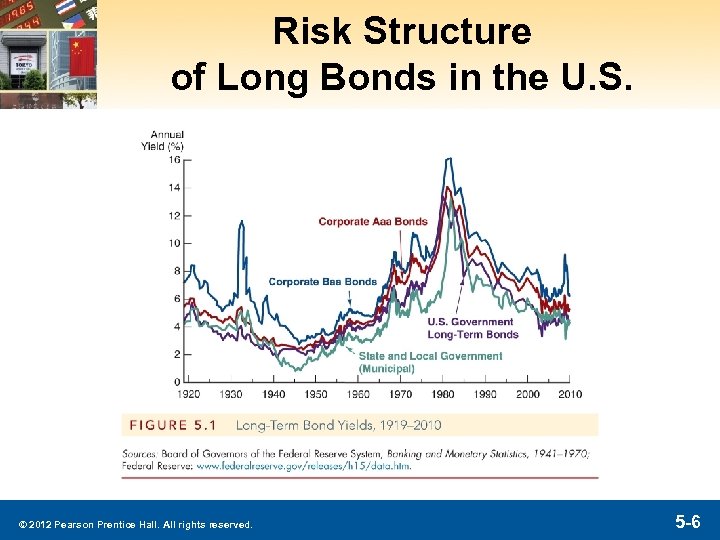 Risk Structure of Long Bonds in the U. S. © 2012 Pearson Prentice Hall. All rights reserved. 5 -6
 Risk Structure of Long Bonds in the U. S. The figure shows two important features of the interest-rate behavior of bonds. § Rates on different bond categories change from one year to the next. § Spreads on different bond categories change from one year to the next. © 2012 Pearson Prentice Hall. All rights reserved. 5 -7
 Factors Affecting Risk Structure of Interest Rates To further examine these features, we will look at three specific risk factors. § Default Risk § Liquidity § Income Tax Considerations © 2012 Pearson Prentice Hall. All rights reserved. 5 -8
 Default Risk Factor § One attribute of a bond that influences its interest rate is its risk of default, which occurs when the issuer of the bond is unable or unwilling to make interest payments when promised. § U. S. Treasury bonds have usually been considered to have no default risk because the federal government can always increase taxes to pay off its obligations (or just print money). Bonds like these with no default risk are called defaultfree bonds. © 2012 Pearson Prentice Hall. All rights reserved. 5 -9
 Default Risk Factor (cont. ) § The spread between the interest rates on bonds with default risk and default-free bonds, called the risk premium, indicates how much additional interest people must earn in order to be willing to hold that risky bond. § A bond with default risk will always have a positive risk premium, and an increase in its default risk will raise the risk premium. © 2012 Pearson Prentice Hall. All rights reserved. 5 -10
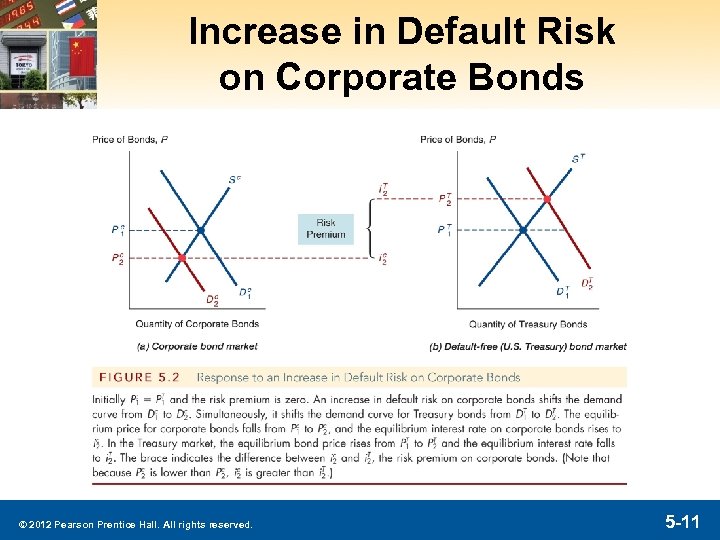 Increase in Default Risk on Corporate Bonds © 2012 Pearson Prentice Hall. All rights reserved. 5 -11
 Analysis of Figure 5. 2: Increase in Default on Corporate Bonds § Corporate Bond Market 1. 2. 3. Re on corporate bonds , Dc shifts left Risk of corporate bonds , Dc shifts left Pc , ic § Treasury Bond Market 1. 2. Relative Re on Treasury bonds , DT shifts right Relative risk of Treasury bonds , DT shifts right PT , i. T § Outcome ─ Risk premium, ic - i. T, rises © 2012 Pearson Prentice Hall. All rights reserved. 5 -12
 Default Risk Factor (cont. ) § Default risk is an important component of the size of the risk premium. § Because of this, bond investors would like to know as much as possible about the default probability of a bond. § One way to do this is to use the measures provided by credit-rating agencies: Moody’s and S&P are examples. © 2012 Pearson Prentice Hall. All rights reserved. 5 -13
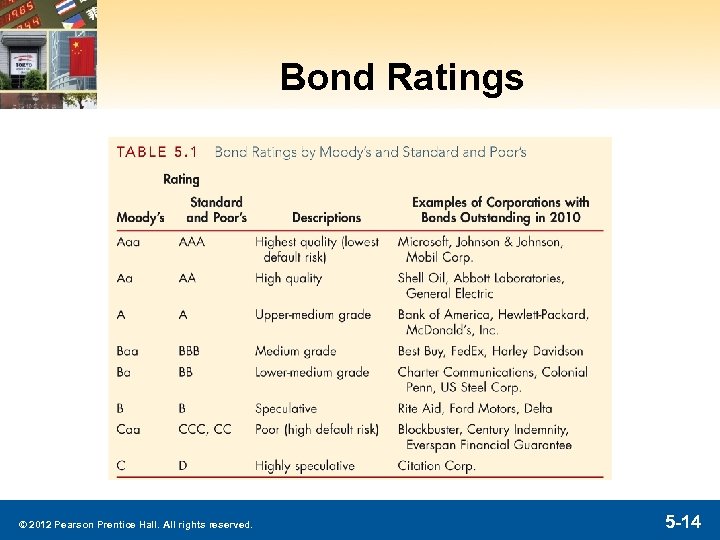 Bond Ratings © 2012 Pearson Prentice Hall. All rights reserved. 5 -14
 Case: The Subprime Collapse and the Baa-Treasury Spread § Starting in 2007, the subprime mortgage market collapsed, leading to large losses for financial institutions. § Because of the questions raised about the quality of Baa bonds, the demand for lower-credit bonds fell, and a “flight- to-quality” followed (demand for T-securities increased. § Result: Baa-Treasury spread increased from 185 bps to 545 bps. © 2012 Pearson Prentice Hall. All rights reserved. 5 -15
 Liquidity Factor § Another attribute of a bond that influences its interest rate is its liquidity; a liquid asset is one that can be quickly and cheaply converted into cash if the need arises. The more liquid an asset is, the more desirable it is (higher demand), holding everything else constant. © 2012 Pearson Prentice Hall. All rights reserved. 5 -16
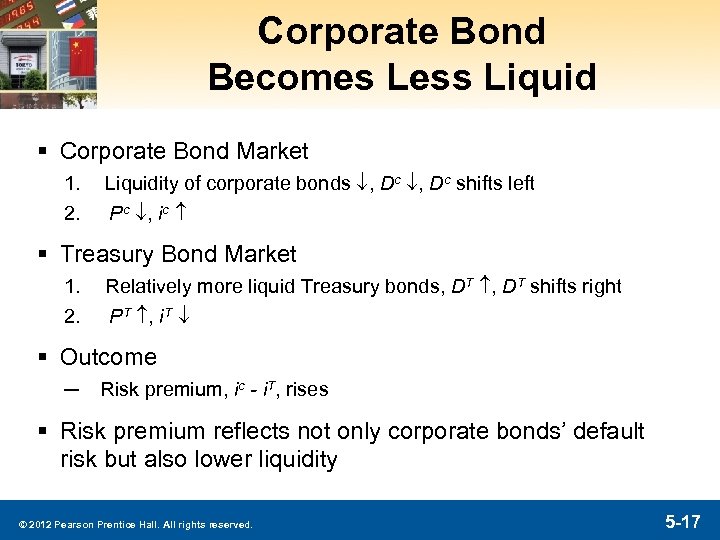 Corporate Bond Becomes Less Liquid § Corporate Bond Market 1. Liquidity of corporate bonds , Dc shifts left 2. Pc , ic § Treasury Bond Market 1. 2. Relatively more liquid Treasury bonds, DT shifts right PT , i. T § Outcome ─ Risk premium, ic - i. T, rises § Risk premium reflects not only corporate bonds’ default risk but also lower liquidity © 2012 Pearson Prentice Hall. All rights reserved. 5 -17
 Liquidity Factor (cont. ) § The differences between interest rates on corporate bonds and Treasury bonds (that is, the risk premiums) reflect not only the corporate bond’s default risk but its liquidity too. This is why a risk premium is sometimes called a risk and liquidity premium. © 2012 Pearson Prentice Hall. All rights reserved. 5 -18
 Income Taxes Factor § An odd feature of Figure 5. 1 is that municipal bonds tend to have a lower rate the Treasuries. Why? § Munis certainly can default. Orange County (California) is a recent example from the early 1990 s. § Munis are not as liquid a Treasuries. © 2012 Pearson Prentice Hall. All rights reserved. 5 -19
 Income Taxes Factor § However, interest payments on municipal bonds are exempt from federal income taxes, a factor that has the same effect on the demand for municipal bonds as an increase in their expected return. § Treasury bonds are exempt from state and local income taxes, while interest payments from corporate bonds are fully taxable. © 2012 Pearson Prentice Hall. All rights reserved. 5 -20
 Income Taxes Factor § For example, suppose you are in the 35% tax bracket. From a 10%-coupon Treasury bond, you only net $65 of the coupon payment because of taxes § However, from an 8%-coupon muni, you net the full $80. For the higher return, you are willing to hold a riskier muni (to a point). © 2012 Pearson Prentice Hall. All rights reserved. 5 -21
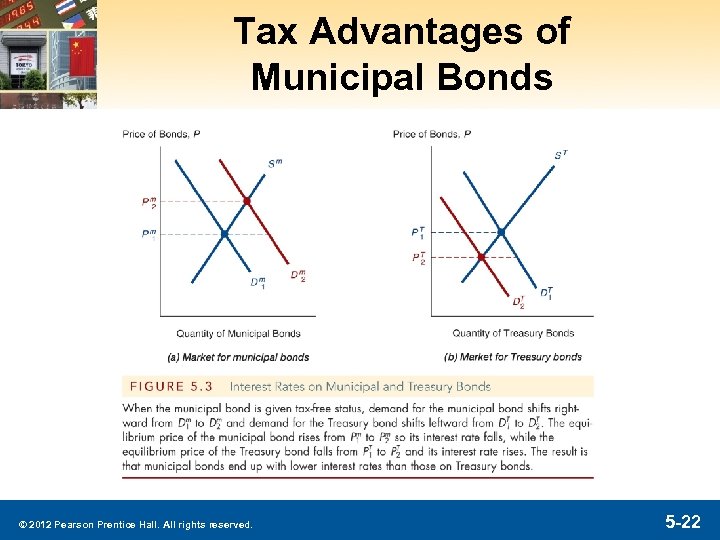 Tax Advantages of Municipal Bonds © 2012 Pearson Prentice Hall. All rights reserved. 5 -22
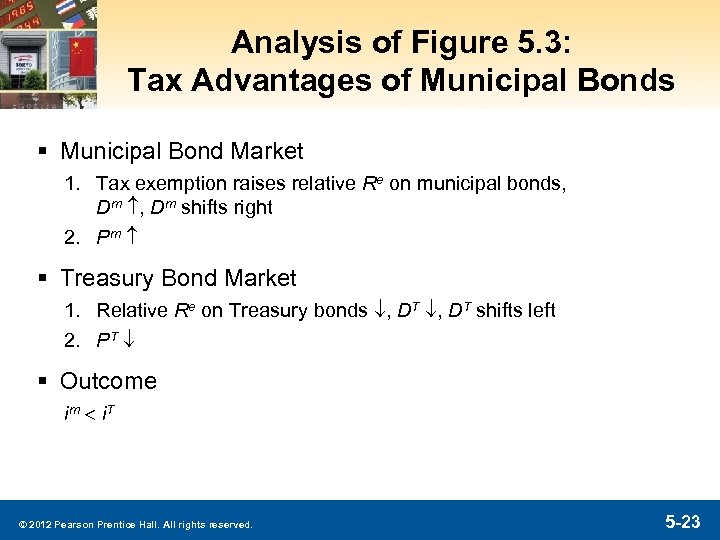 Analysis of Figure 5. 3: Tax Advantages of Municipal Bonds § Municipal Bond Market 1. Tax exemption raises relative Re on municipal bonds, Dm shifts right 2. Pm § Treasury Bond Market 1. Relative Re on Treasury bonds , DT shifts left 2. PT § Outcome im i. T © 2012 Pearson Prentice Hall. All rights reserved. 5 -23
 Case: Bush Tax Cut and Possible Repeal on Bond Interest Rates § The 2001 tax cut called for a reduction in the top tax bracket, from 39% to 35% over a 10 -year period. § This reduces the advantage of municipal debt over T-securities since the interest on T-securities is now taxed at a lower rate. © 2012 Pearson Prentice Hall. All rights reserved. 5 -24
 Case: Bush Tax Cut and Possible Repeal on Bond Interest Rates § If the Bush tax cuts are repealed under President Obama, our analysis would reverse. The advantage of municipal debt would increase relative to T-securities, since the interest on T-securities would be taxed at a higher rate. © 2012 Pearson Prentice Hall. All rights reserved. 5 -25
 Term Structure of Interest Rates Now that we understand risk, liquidity, and taxes, we turn to another important influence on interest rates—maturity. Bonds with different maturities tend to have different required rates, all else equal. © 2012 Pearson Prentice Hall. All rights reserved. 5 -26
 The WSJ: Following the News For example, the WSJ publishes a plot of the yield curve (rates at different maturities) for Treasury securities. The picture on page 97 of your text is a typical example, from May 14, 2010. What is the 3 -month rate? The two-year rate? What is the shape of the curve? © 2012 Pearson Prentice Hall. All rights reserved. 5 -27
 Term Structure Facts to Be Explained Besides explaining the shape of the yield curve, a good theory must explain why: § Interest rates for different maturities move together. We see this on the next slide. © 2012 Pearson Prentice Hall. All rights reserved. 5 -28
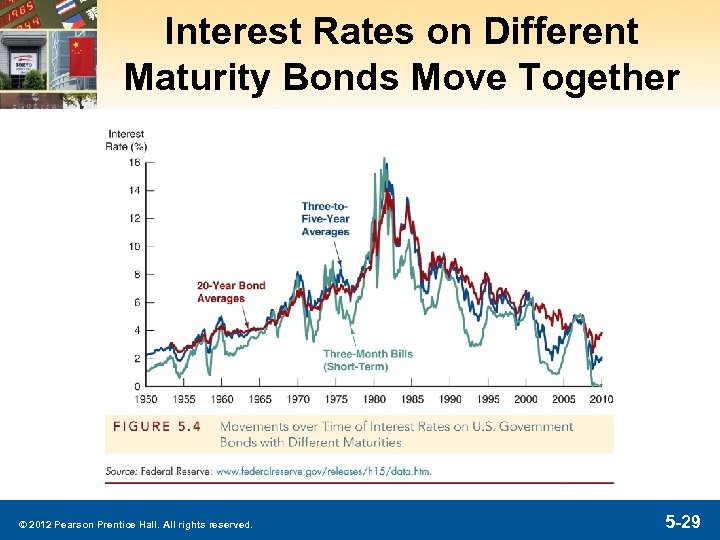 Interest Rates on Different Maturity Bonds Move Together © 2012 Pearson Prentice Hall. All rights reserved. 5 -29
 Term Structure Facts to Be Explained Besides explaining the shape of the yield curve, a good theory must explain why: § Interest rates for different maturities move together. § Yield curves tend to have steep upward slope when short rates are low and downward slope when short rates are high. § Yield curve is typically upward sloping. © 2012 Pearson Prentice Hall. All rights reserved. 5 -30
 Three Theories of Term Structure 1. Expectations Theory ─ Pure Expectations Theory explains 1 and 2, but not 3 2. Market Segmentation Theory ─ Market Segmentation Theory explains 3, but not 1 and 2 3. Liquidity Premium Theory ─ Solution: Combine features of both Pure Expectations Theory and Market Segmentation Theory to get Liquidity Premium Theory and explain all facts © 2012 Pearson Prentice Hall. All rights reserved. 5 -31
 Expectations Theory § Key Assumption: Bonds of different maturities are perfect substitutes § Implication: Re on bonds of different maturities are equal © 2012 Pearson Prentice Hall. All rights reserved. 5 -32
 Expectations Theory To illustrate what this means, consider two alternative investment strategies for a twoyear time horizon. 1. Buy $1 of one-year bond, and when it matures, buy another one-year bond with your money. 2. Buy $1 of two-year bond and hold it. © 2012 Pearson Prentice Hall. All rights reserved. 5 -33
 Expectations Theory The important point of this theory is that if the Expectations Theory is correct, your expected wealth is the same (at the start) for both strategies. Of course, your actual wealth may differ, if rates change unexpectedly after a year. We show the details of this in the next few slides. © 2012 Pearson Prentice Hall. All rights reserved. 5 -34
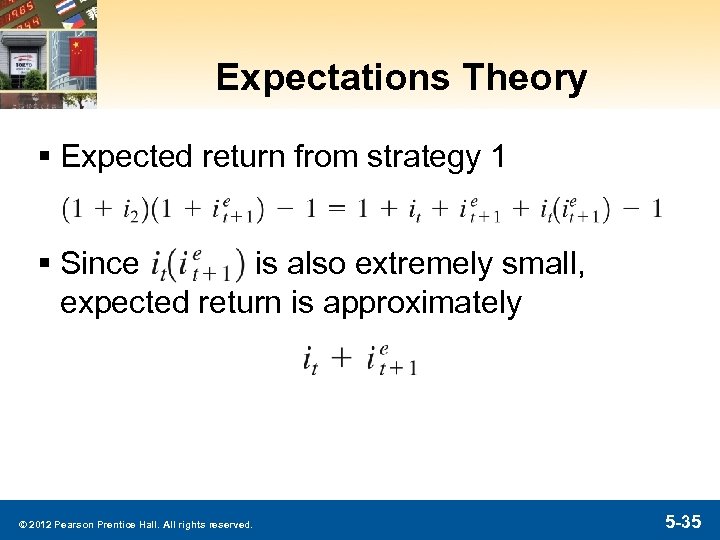 Expectations Theory § Expected return from strategy 1 § Since is also extremely small, expected return is approximately © 2012 Pearson Prentice Hall. All rights reserved. 5 -35
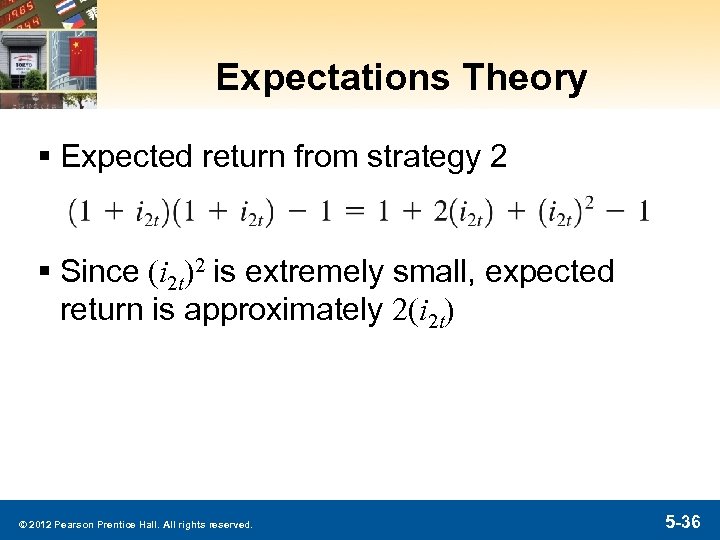 Expectations Theory § Expected return from strategy 2 § Since (i 2 t)2 is extremely small, expected return is approximately 2(i 2 t) © 2012 Pearson Prentice Hall. All rights reserved. 5 -36
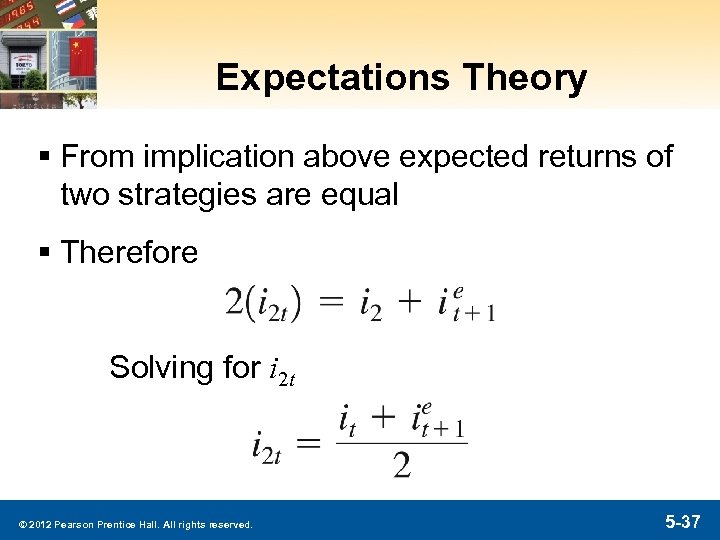 Expectations Theory § From implication above expected returns of two strategies are equal § Therefore Solving for i 2 t © 2012 Pearson Prentice Hall. All rights reserved. 5 -37
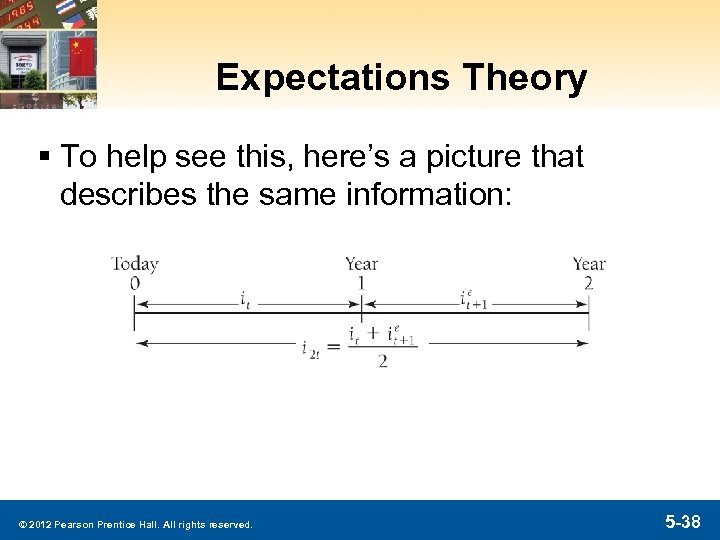 Expectations Theory § To help see this, here’s a picture that describes the same information: © 2012 Pearson Prentice Hall. All rights reserved. 5 -38
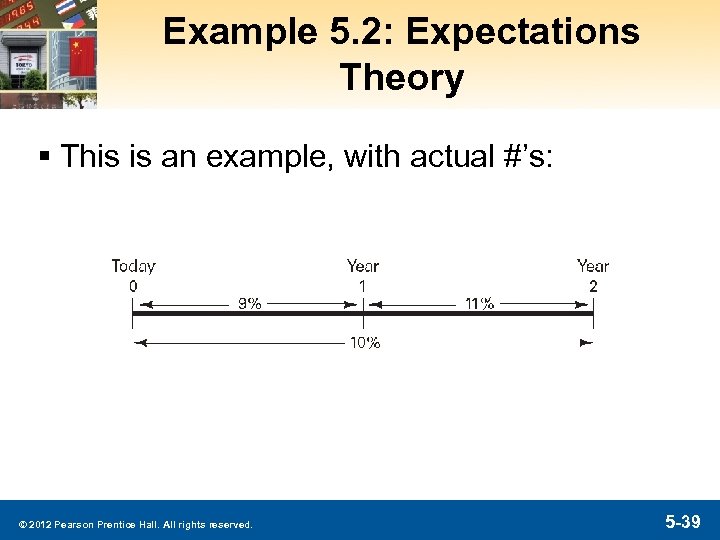 Example 5. 2: Expectations Theory § This is an example, with actual #’s: © 2012 Pearson Prentice Hall. All rights reserved. 5 -39
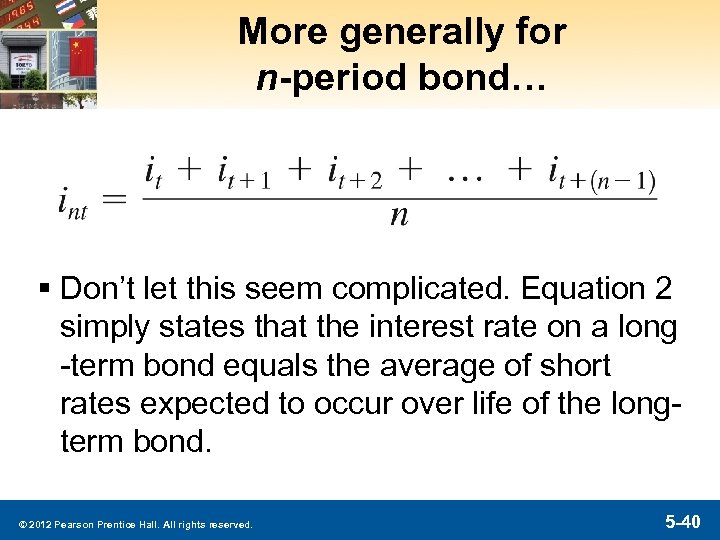 More generally for n-period bond… § Don’t let this seem complicated. Equation 2 simply states that the interest rate on a long -term bond equals the average of short rates expected to occur over life of the longterm bond. © 2012 Pearson Prentice Hall. All rights reserved. 5 -40
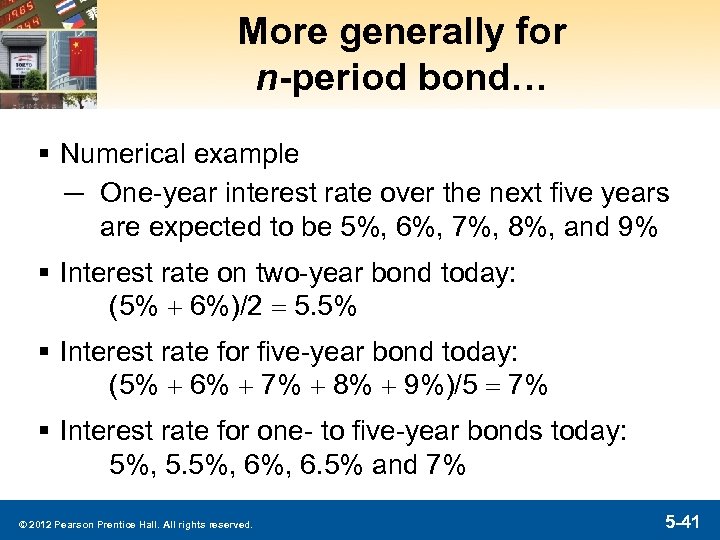 More generally for n-period bond… § Numerical example ─ One-year interest rate over the next five years are expected to be 5%, 6%, 7%, 8%, and 9% § Interest rate on two-year bond today: (5% + 6%)/2 = 5. 5% § Interest rate for five-year bond today: (5% + 6% + 7% + 8% + 9%)/5 = 7% § Interest rate for one- to five-year bonds today: 5%, 5. 5%, 6. 5% and 7% © 2012 Pearson Prentice Hall. All rights reserved. 5 -41
 Expectations Theory and Term Structure Facts § Explains why yield curve has different slopes 1. When short rates are expected to rise in future, average of future short rates = int is above today's short rate; therefore yield curve is upward sloping. 2. When short rates expected to stay same in future, average of future short rates same as today’s, and yield curve is flat. 3. Only when short rates expected to fall will yield curve be downward sloping. © 2012 Pearson Prentice Hall. All rights reserved. 5 -42
 Expectations Theory and Term Structure Facts § Pure expectations theory explains fact 1— that short and long rates move together 1. Short rate rises are persistent 2. If it today, iet+1, iet+2 etc. average of future rates int 3. Therefore: it int (i. e. , short and long rates move together) © 2012 Pearson Prentice Hall. All rights reserved. 5 -43
 Expectations Theory and Term Structure Facts § Explains fact 2—that yield curves tend to have steep slope when short rates are low and downward slope when short rates are high 1. When short rates are low, they are expected to rise to normal level, and long rate = average of future short rates will be well above today's short rate; yield curve will have steep upward slope. 2. When short rates are high, they will be expected to fall in future, and long rate will be below current short rate; yield curve will have downward slope. © 2012 Pearson Prentice Hall. All rights reserved. 5 -44
 Expectations Theory and Term Structure Facts § Doesn’t explain fact 3—that yield curve usually has upward slope ─ Short rates are as likely to fall in future as rise, so average of expected future short rates will not usually be higher than current short rate: therefore, yield curve will not usually slope upward. © 2012 Pearson Prentice Hall. All rights reserved. 5 -45
 Market Segmentation Theory § Key Assumption: Bonds of different maturities are not substitutes at all § Implication: Markets are completely segmented; interest rate at each maturity are determined separately © 2012 Pearson Prentice Hall. All rights reserved. 5 -46
 Market Segmentation Theory § Explains fact 3—that yield curve is usually upward sloping ─ People typically prefer short holding periods and thus have higher demand for short-term bonds, which have higher prices and lower interest rates than long bonds § Does not explain fact 1 or fact 2 because its assumes long-term and short-term rates are determined independently. © 2012 Pearson Prentice Hall. All rights reserved. 5 -47
 Liquidity Premium Theory § Key Assumption: Bonds of different maturities are substitutes, but are not perfect substitutes § Implication: Modifies Pure Expectations Theory with features of Market Segmentation Theory © 2012 Pearson Prentice Hall. All rights reserved. 5 -48
 Liquidity Premium Theory § Investors prefer short-term rather than longterm bonds. This implies that investors must be paid positive liquidity premium, int, to hold long term bonds. © 2012 Pearson Prentice Hall. All rights reserved. 5 -49
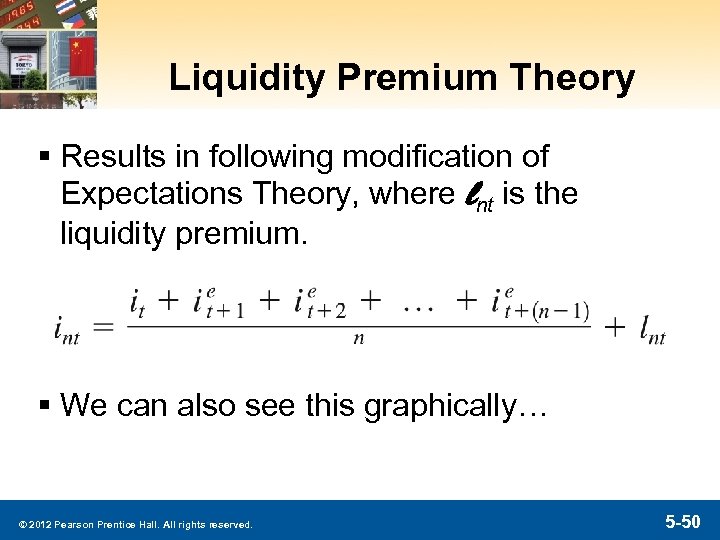 Liquidity Premium Theory § Results in following modification of Expectations Theory, where lnt is the liquidity premium. § We can also see this graphically… © 2012 Pearson Prentice Hall. All rights reserved. 5 -50
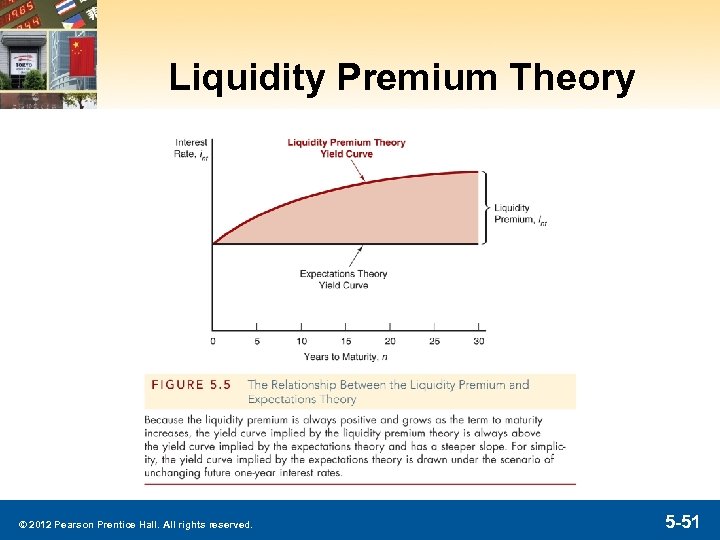 Liquidity Premium Theory © 2012 Pearson Prentice Hall. All rights reserved. 5 -51
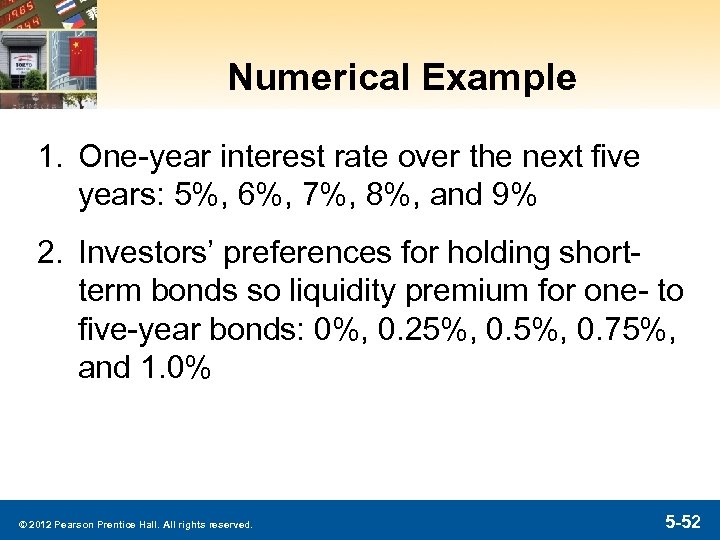 Numerical Example 1. One-year interest rate over the next five years: 5%, 6%, 7%, 8%, and 9% 2. Investors’ preferences for holding shortterm bonds so liquidity premium for one- to five-year bonds: 0%, 0. 25%, 0. 75%, and 1. 0% © 2012 Pearson Prentice Hall. All rights reserved. 5 -52
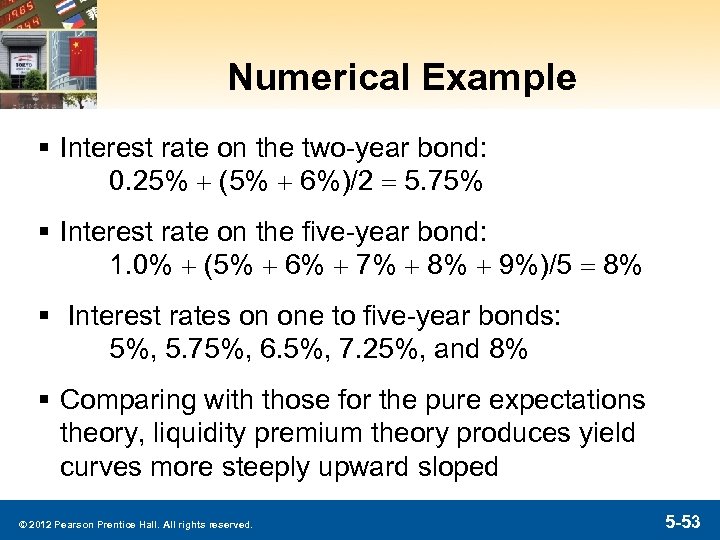 Numerical Example § Interest rate on the two-year bond: 0. 25% + (5% + 6%)/2 = 5. 75% § Interest rate on the five-year bond: 1. 0% + (5% + 6% + 7% + 8% + 9%)/5 = 8% § Interest rates on one to five-year bonds: 5%, 5. 75%, 6. 5%, 7. 25%, and 8% § Comparing with those for the pure expectations theory, liquidity premium theory produces yield curves more steeply upward sloped © 2012 Pearson Prentice Hall. All rights reserved. 5 -53
 Liquidity Premium Theory: Term Structure Facts § Explains All 3 Facts ─ Explains fact 3—that usual upward sloped yield curve by liquidity premium for long-term bonds ─ Explains fact 1 and fact 2 using same explanations as pure expectations theory because it has average of future short rates as determinant of long rate © 2012 Pearson Prentice Hall. All rights reserved. 5 -54
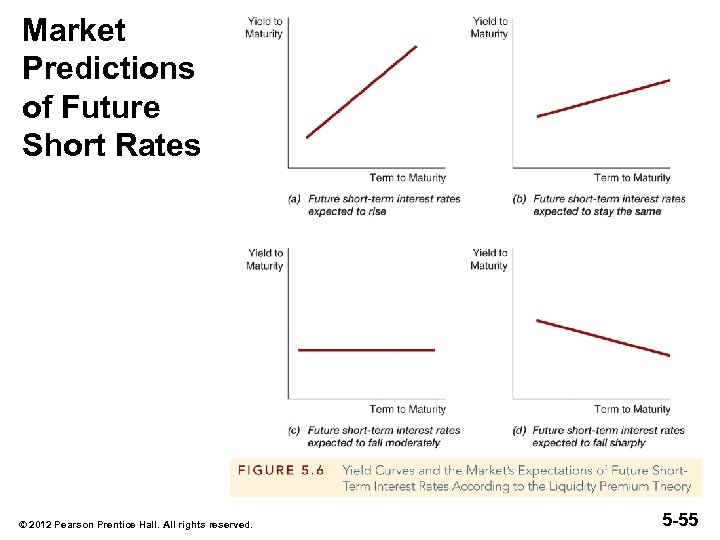 Market Predictions of Future Short Rates © 2012 Pearson Prentice Hall. All rights reserved. 5 -55
 Evidence on the Term Structure § Initial research (early 1980 s) found little useful information in the yield curve for predicting future interest rates. § Recently, more discriminating tests show that the yield curve has a lot of information about very short-term and long-term rates, but says little about medium-term rates. © 2012 Pearson Prentice Hall. All rights reserved. 5 -56
 Case: Interpreting Yield Curves § The picture on the next slide illustrates several yield curves that we have observed for U. S. Treasury securities in recent years. § What do they tell us about the public’s expectations of future rates? © 2012 Pearson Prentice Hall. All rights reserved. 5 -57
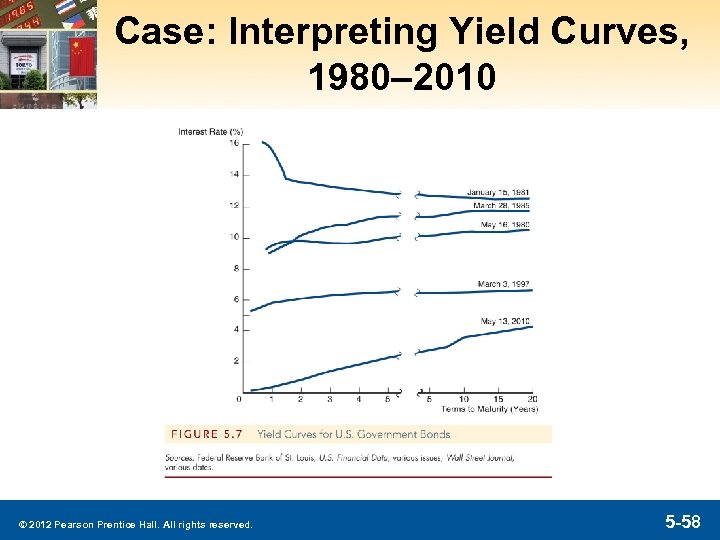 Case: Interpreting Yield Curves, 1980– 2010 © 2012 Pearson Prentice Hall. All rights reserved. 5 -58
 Case: Interpreting Yield Curves § The steep downward curve in 1981 suggested that short-term rates were expected to decline in the near future. This played-out, with rates dropping by 300 bps in 3 months. § The upward curve in 1985 suggested a rate increase in the near future. © 2012 Pearson Prentice Hall. All rights reserved. 5 -59
 Case: Interpreting Yield Curves § The slightly upward slopes from 1985 through (about) 2006 is explained by liquidity premiums. Short-term rates were stable, with longer-term rates including a liquidity premium (explaining the upward slope). § The steep upward slope in 2010 suggests short term rates in the future will rise. © 2012 Pearson Prentice Hall. All rights reserved. 5 -60
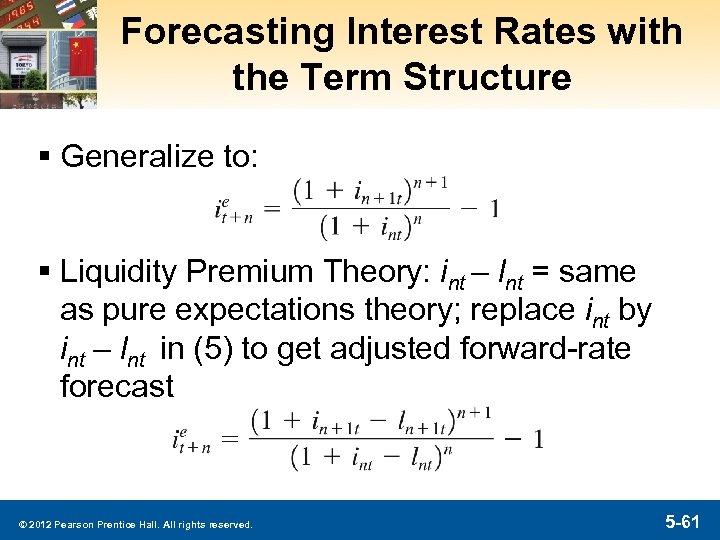 Forecasting Interest Rates with the Term Structure § Generalize to: § Liquidity Premium Theory: int – lnt = same as pure expectations theory; replace int by int – lnt in (5) to get adjusted forward-rate forecast © 2012 Pearson Prentice Hall. All rights reserved. 5 -61
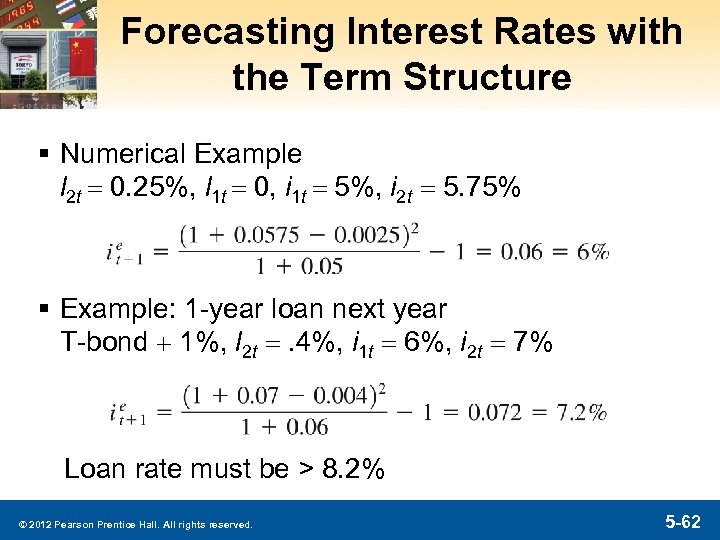 Forecasting Interest Rates with the Term Structure § Numerical Example l 2 t = 0. 25%, l 1 t = 0, i 1 t = 5%, i 2 t = 5. 75% § Example: 1 -year loan next year T-bond + 1%, l 2 t =. 4%, i 1 t = 6%, i 2 t = 7% Loan rate must be > 8. 2% © 2012 Pearson Prentice Hall. All rights reserved. 5 -62