 Скачать презентацию CHAPTER 5 DEVELOPMENT STRATEGIES Chapter Objectives 2
7dd0a8fd68c78bb5db911dc3c75e71d4.ppt
- Количество слайдов: 66



CHAPTER 5 DEVELOPMENT STRATEGIES
Chapter Objectives 2 Describe the concept of Software as a Service Define Web 2. 0 and cloud computing Explain software acquisition alternatives, including traditional and Web-based software development strategies Describe software outsourcing options, including offshore outsourcing and the role of service providers
Chapter Objectives 3 Explain advantages and disadvantages of inhouse software development Explain cost-benefit analysis and financial analysis tools Explain the differences between a request for proposal (RFP) and a request for quotation (RFQ) Describe the system requirements document
Chapter Objectives 4 Explain the transition from systems analysis to systems design, and the importance of prototyping Discuss guidelines for systems design Describe software development trends
Introduction 5 Chapter 7 describes the remaining activities in the systems analysis phase The chapter also describes the transition to systems design, prototyping, and systems design guidelines The chapter concludes with a discussion of trends in software development
Development Strategies Overview 6 Selecting the best development path is an important decision that requires companies to consider three key topics The impact of the Internet Software outsourcing options In-house software development alternatives
The Impact of the Internet 7 The Internet has triggered enormous changes in business methods and operations, and software acquisition is no exception This section examines a trend that views Software as a Service, the changing market-place for software, and how Web-based development compares to traditional methods
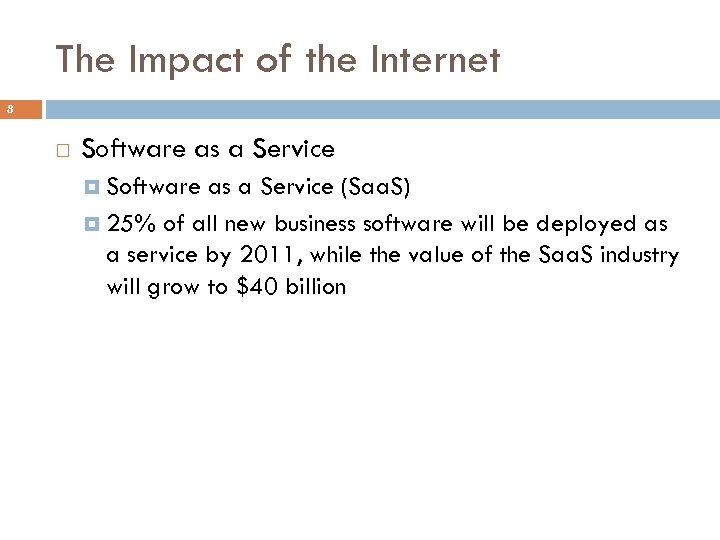
The Impact of the Internet 8 Software as a Service (Saa. S) 25% of all new business software will be deployed as a service by 2011, while the value of the Saa. S industry will grow to $40 billion
The Impact of the Internet 9 Traditional vs. Web-Based Systems Development As a systems analyst, you must consider whether development will take place in a Web-centric framework, or in a traditional environment In an Internet-based system, the Web becomes an integral part of the application, rather than just a communication channel
The Impact of the Internet 10 Traditional vs. Web-Based Systems Development Two major Web-based development environments are IBM’s Web. Sphere and Microsoft’s. NET Although there is a major trend toward Webbased systems, many firms rely on traditional systems
The Impact of the Internet 11 Traditional vs. Web-Based Systems Development Traditional System development design is influenced by compatibility issues Systems are designed to run on local and wide-area company networks Systems often utilize Internet links and resources, but Webbased features are treated as enhancements rather than core elements of the design
The Impact of the Internet 12 Traditional vs. Web-Based Systems Development Web-based Systems development are developed and delivered in an Internetbased framework such as. NET or Web. Sphere Internet-based development treats the Web as the platform, rather than just a communication channel Web-based software usually requires additional layers, called middleware
The Impact of the Internet 13 Looking to the Future: Web 2. 0 and Cloud Computing The Web 2. 0 platform will enhance interactive experiences including wikis and blogs, and social networking applications Cloud computing could bring enormous computing power to business and personal Internet users
Outsourcing 14 Outsourcing - a company that contracts with another company to provide services, saves cost Can refer to relatively minor programming tasks, the rental of software from a service provider, the outsourcing of a basic business process (often called business process outsourcing, or BPO), or the handling of a company’s entire IT function
Outsourcing 15 India and China. Why? Government’s support and promotion Japan’s decision to move most of its software development processes to China some large foreign organizations set u R&D centers in China English speaking Affordable Highly skilled Educated
Outsourcing 16 India and China. Why? World class Information Technology and networking facilities Friendly laws Well paid taxes Stable political environment World class certified software companies.
Outsourcing 17 The Growth of Outsourcing Traditionally, firms outsourced IT tasks as a way of controlling costs and dealing with rapid technological change Outsourcing has become part of an overall IT strategy for many organizations
Outsourcing 18 The Growth of Outsourcing A firm that offers outsourcing solutions is called a service provider Application service providers (ASP) Internet business services (IBS) Also called managed hosting
Outsourcing 19 Outsourcing Fees A fixed fee model (flat rate) uses a set fee based on a specified level of service and user support A subscription model has a variable fee based on the number of users or workstations that have access to the application A usage model or transaction model charges a variable fee based on the volume of transactions or operations performed by the application
Outsourcing 20 Outsourcing Issues and Concerns Mission-critical IT systems should be out-sourced only if the result is a cost-attractive, reliable, business solution that fits the company’s long-term business strategy Outsourcing also can affect day-to-day company operations and can raise some concerns
Outsourcing 21 Outsourcing Issues and Concerns A company must review carefully issues relating to insurance, potential liability, licensing and information ownership, warranties, and disaster recovery Outsourcing can be especially attractive to a company whose volume fluctuates widely, such as a defense contractor
Outsourcing 22 Offshore Outsourcing Offshore outsourcing – global outsourcing Many firms are sending IT work overseas at an increasing rate The main reason for offshore outsourcing is the same as domestic outsourcing: lower bottom-line costs Offshore outsourcing, however, involves some unique risks and concerns
23 In-House Software Development Options A company can choose to develop its own systems, or purchase, possibly customize, and implement a software package The most important consideration is total cost of ownership (TCO) Companies also develop user applications designed around commercial software packages
24 In-House Software Development Options Make or Buy Decision The choice between developing versus purchasing software often is called a make or buy, or build or buy decision The company’s IT department makes, builds, and develops in-house software A software package is obtained from a vendor or application service provider.
25 In-House Software Development Options Make or Buy Decision Companies that develop software for sale are called software vendors Value-added reseller (VAR) Horizontal application Vertical application
26 In-House Software Development Options Developing Software In-House Satisfy unique business requirements Minimize changes in business procedures and policies Meet constraints of existing systems Meet constraints of existing technology Develop internal resources and capabilities
27 In-House Software Development Options Purchasing a Software Package Lower costs Requires less time to implement Proven reliability and performance benchmarks Require less technical development staff Future upgrades provided by the vendor Input from other companies
28 In-House Software Development Options Customizing a Software Package 1. 2. 3. You can purchase a basic package that vendors will customize to suit your needs You can negotiate directly with the software vendor to make enhancements to meet your needs by paying for the changes You can purchase the package and make your own modifications, if this is permissible under the terms of the software license
29 In-House Software Development Options Creating User Applications User application User interface Help desk or information center (IC) Screen generators Report generators Read-only properties
Role of the Systems Analyst 30 The company must decide whether to use an outsourcing option, develop software in-house, acquire a software package, develop user applications, or select some combination of these solutions The decision will affect the remaining SDLC phases and your involvement as a systems analyst When selecting hardware and software, systems analysts often work as an evaluation and selection team
Role of the Systems Analyst 31 A team approach ensures that critical factors are not overlooked and that a sound choice is made The primary objective of the evaluation and selection team is to eliminate system alternatives that will not meet requirements, rank the system alternatives that are feasible, and present the viable alternatives to management for a final decision
Analyzing Cost and Benefits 32 Now, at the end of the systems analysis phase of the SDLC, you must apply financial analysis tools and techniques to evaluate development strategies and decide how the project will move forward An accurate forecast of TCO is critical, because nearly 80 percent of total IT costs occur after the purchase of hardware and software
Analyzing Cost and Benefits 33 Financial Analysis Tools Payback Analysis Return on investment (ROI) Net present value (NPV)
Analyzing Cost and Benefits 34 Cost-Benefit Analysis Checklist List each development strategy being considered Identify all costs and benefits for each alternative. Be sure to indicate when costs will be incurred and benefits realized Consider future growth and the need for scalability Include support costs for hardware and software
Analyzing Cost and Benefits 35 Cost-Benefit Analysis Checklist Analyze various software licensing options, including fixed fees and formulas based on the number of users or transactions Apply the financial analysis tools to each alternative Study the results and prepare a report to management
The Software Acquisition Process 36 Step 1: Evaluate the Information System Requirements Identify key features Consider network and web-related issues Estimate volume and future growth Specify hardware, software, or personnel constraints
The Software Acquisition Process 37 Step 1: Evaluate the Information System Requirements Prepare a request for proposal or quotation Request for proposal (RFP) Evaluation model Request for quotation (RFQ)
The Software Acquisition Process 38 Step 2: Identify Potential Vendors or Outsourcing Options The Internet is a primary marketplace Another approach is to work with a consulting firm Another valuable resource is the Internet bulletin board system that contains thousands of forums, called newsgroups
The Software Acquisition Process 39 Step 3: Evaluate the Alternatives Existing users Application testing Benchmarking - benchmark Match each package against the RFP features and rank the choices
The Software Acquisition Process 40 Step 4: Perform Cost-Benefit Analysis Identify and calculate TCO for each option you are considering When you purchase software, what you are buying is a software license If you purchase a software package, consider a supplemental maintenance agreement
The Software Acquisition Process 41 Step 5: Prepare a Recommendation You should prepare a recommendation that evaluates and describes the alternatives, together with the costs, benefits, advantages, and disadvantages of each option At this point, you may be required to submit a formal system requirements document and deliver a presentation
The Software Acquisition Process 42 Step 6: Implement the Solution Implementation tasks will depend on the solution selected Before the new software becomes operational, you must complete all implementation steps, including loading, configuring, and testing the software; training users; and converting data files to the new system’s format
Completion of Systems Analysis Tasks 43 To complete the systems analysis phase, you must prepare the system requirements document and your presentation to management
Completion of Systems Analysis Tasks 44 System Requirements Document The system requirements document, or software requirements specification, contains the requirements for the new system, describes the alternatives that were considered, and makes a specific recommendation to management Like a contract Format and organize it so it is easy to read and use
Completion of Systems Analysis Tasks 45 Presentation to Management Begin your presentation with a brief overview of the purpose and primary objectives of the system project, the objectives of this presentation, and what decisions need to be made Summarize the primary viable alternatives. For each alternative, describe the costs, advantages, and disadvantages
Completion of Systems Analysis Tasks 46 Presentation to Management Explain why the evaluation and selection team chose the recommended alternative Allow time for discussion and for questions and answers Obtain a final decision from management or agree on a timetable for the next step in the process
Completion of Systems Analysis Tasks 47 Presentation to Management Depending on their decision, your next task as a systems analyst will be one of the following 1. 2. 3. 4. 5. Implement an outsourcing alternative Develop an in-house system Purchase or customize a software package Perform additional systems analysis work Stop all further work
The Transition to Systems Design 48 If management decides to develop the system inhouse, then the transition to the systems design phase begins Preparing for Systems Design Tasks It is essential to have an accurate and understandable system requirements document
The Transition to Systems Design 49 The Relationship between Logical and Physical Design The logical design defines the functions and features of the system and the relationships among its components The physical design of an information system is a plan for the actual implementation of the system
Systems Design Guidelines 50 The systems analyst must understand the logical design of the system before beginning the physical design of any one component Data design User interface Architecture System design specification
Systems Design Guidelines 51 Systems Design Objectives The goal of systems design is to build a system that is effective, reliable, and maintainable A system is reliable if it adequately handles errors A system is maintainable if it is well designed, flexible, and developed with future modifications in mind
Systems Design Guidelines 52 Systems Design Objectives User Considerations Carefully consider any point where users receive output from, or provide input to, the system Anticipate future needs of the users, the system, and the organization – hard-coded Provide flexibility Parameter, default
Systems Design Guidelines 53 Systems Design Objectives Data Considerations Data should be entered into the system where and when it occurs because delays cause data errors Data should be verified when it is entered, to catch errors immediately Automated methods of data entry should be used whenever possible
Systems Design Guidelines 54 Systems Design Objectives Data Considerations Access for data entry should be controlled and all entries or changes to critical data values should be reported – audit trail Every instance of entry and change to data should be logged
Systems Design Guidelines 55 Systems Design Objectives Data Considerations Data should be entered into a system only once Data duplication should be avoided
Systems Design Guidelines 56 Systems Design Objectives Architecture Use considerations a modular design Design modules that perform a single function are easier to understand, implement, and maintain
Systems Design Guidelines 57 Design Trade-Offs Design goals often conflict with each other Most design trade-off decisions that you will face come down to the basic conflict of quality versus cost Avoid decisions that achieve short-term savings but might mean higher costs later
Prototyping 58 Prototyping produces an early, rapidly constructed working version of the proposed information system, called a prototype Prototyping allows users to examine a model that accurately represents system outputs, interfaces, and processes
Prototyping 59 Prototyping Methods System prototyping Design prototyping Throwaway prototyping
Prototyping 60 Prototyping Methods Prototyping offers many benefits Users and systems developers can avoid misunderstandings Managers can evaluate a working model more effectively than a paper specification Consider The potential problems rapid pace of development can create quality problems In very complex systems, the prototype becomes unwieldy and difficult to manage
Prototyping 61 Prototyping Tools Systems analysts can use powerful tools to develop prototypes CASE tools Application generators Report generators Screen generators Fourth-generation language (4 GL) Fourth-generation environment
Prototyping 62 Limitations of Prototypes A prototype is a functioning system, but it is less efficient than a fully developed system Systems developers can upgrade the prototype into the final information system by adding the necessary capability Otherwise, the prototype is discarded
Software Development Trends 63 A review of current online topics being discussed in the IT community Software quality will be more important than ever Project management will be a major focus of IT managers
Software Development Trends 64 Many software development tools and technologies are in transition Service-oriented Loose Growth architecture (SOA) coupling in open-source software Web services Programmers will continue to use dynamic languages
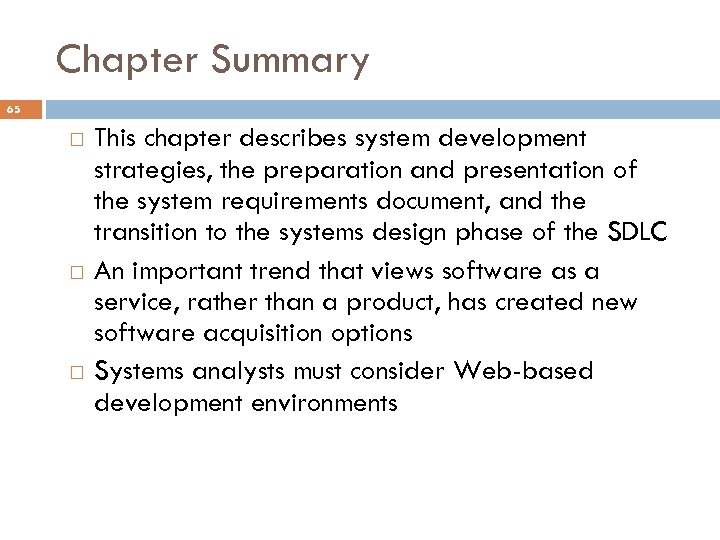
Chapter Summary 65 This chapter describes system development strategies, the preparation and presentation of the system requirements document, and the transition to the systems design phase of the SDLC An important trend that views software as a service, rather than a product, has created new software acquisition options Systems analysts must consider Web-based development environments
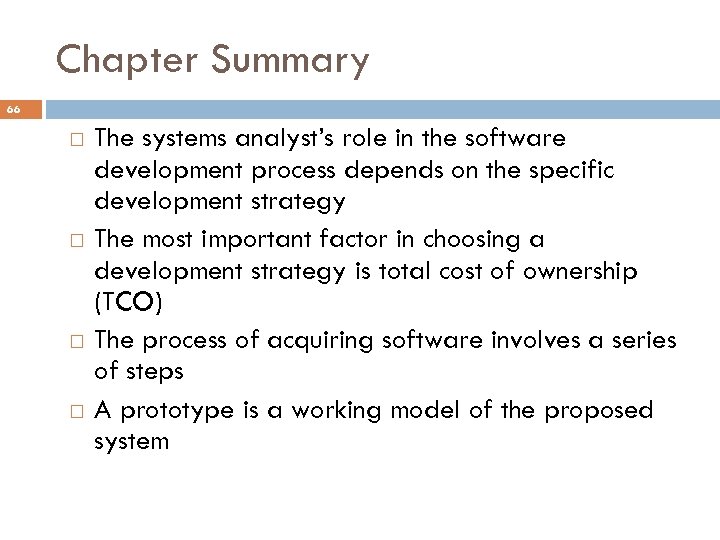
Chapter Summary 66 The systems analyst’s role in the software development process depends on the specific development strategy The most important factor in choosing a development strategy is total cost of ownership (TCO) The process of acquiring software involves a series of steps A prototype is a working model of the proposed system
Скачать презентацию CHAPTER 5 DEVELOPMENT STRATEGIES Chapter Objectives 2
7dd0a8fd68c78bb5db911dc3c75e71d4.ppt