 Скачать презентацию Chapter 5 Civil Rights and Public Policy Pearson
9096fa09e0fc00d82dfe4d4446734c06.ppt
- Количество слайдов: 25



Chapter 5 Civil Rights and Public Policy Pearson Education, Inc. , Longman © 2008
Introduction l Civil Rights – Definition: policies designed to protect people against arbitrary or discriminatory treatment by government officials or individuals l Racial Discrimination l Gender Discrimination l Discrimination based on age, disability, sexual orientation and other factors Pearson Education, Inc. , Longman © 2008
Two Centuries of Struggle l Conceptions of Equality – Equal opportunity: same chances – Equal results: same rewards l Early American Views of Equality l The Constitution and Inequality – Equality is not in the original Constitution. – First mention of equality in the 14 th Amendment: “…equal protection of the laws” Pearson Education, Inc. , Longman © 2008
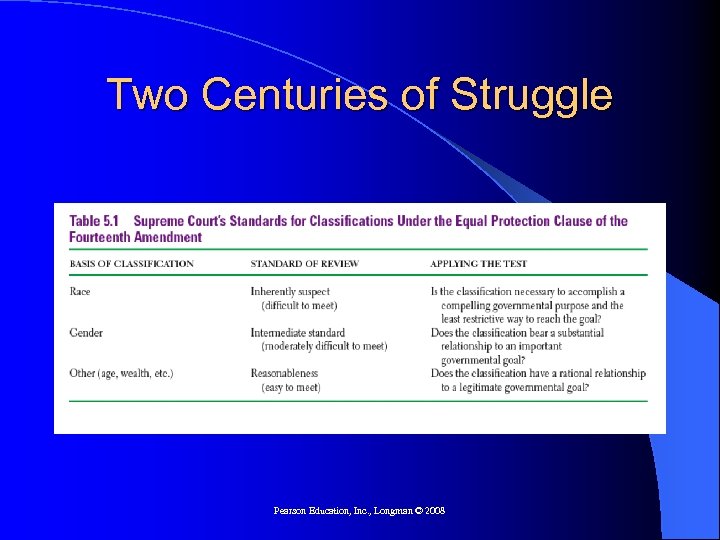
Two Centuries of Struggle Pearson Education, Inc. , Longman © 2008
Race, the Constitution, and Public Policy l The Era of Slavery – Dred Scott v. Sandford (1857) Slaves had no rights. l Invalidated Missouri Compromise l – The Civil War – The Thirteenth Amendment Ratified after Union won the Civil War l Outlawed slavery l Pearson Education, Inc. , Longman © 2008
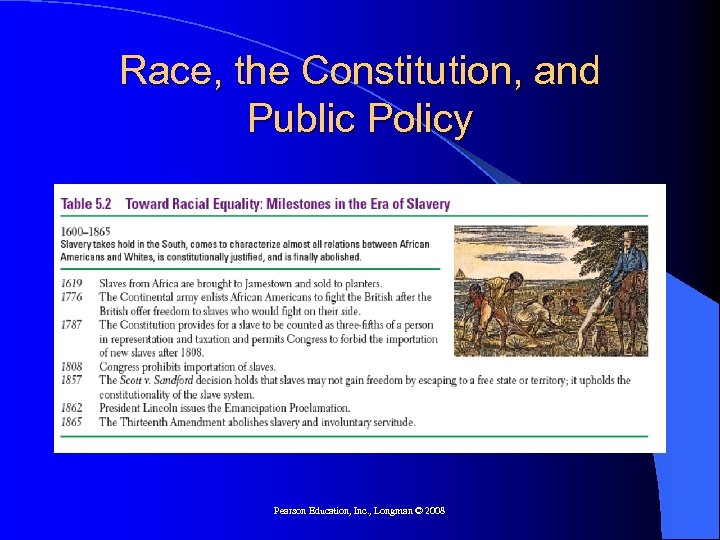
Race, the Constitution, and Public Policy Pearson Education, Inc. , Longman © 2008
Race, the Constitution, and Public Policy l The Era of Reconstruction and Resegregation – Jim Crow or segregational laws l Relegated African Americans to separate facilities – Plessy v. Ferguson (1896) l Upheld the constitutionality of “equal but separate accommodations” Pearson Education, Inc. , Longman © 2008
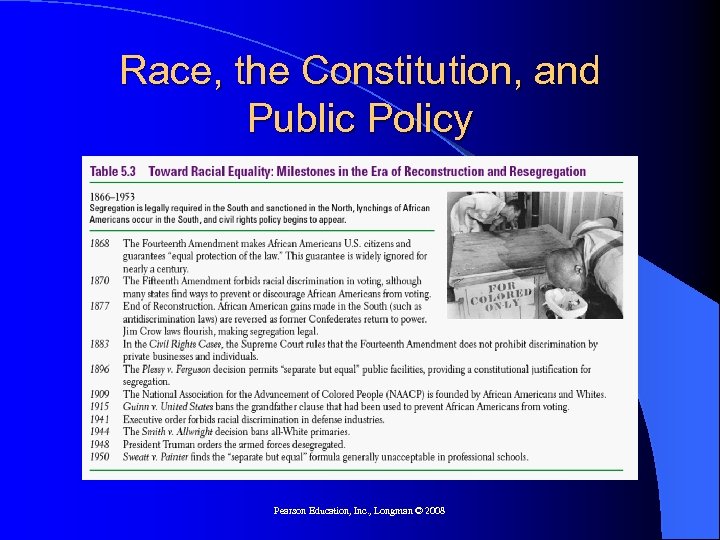
Race, the Constitution, and Public Policy Pearson Education, Inc. , Longman © 2008
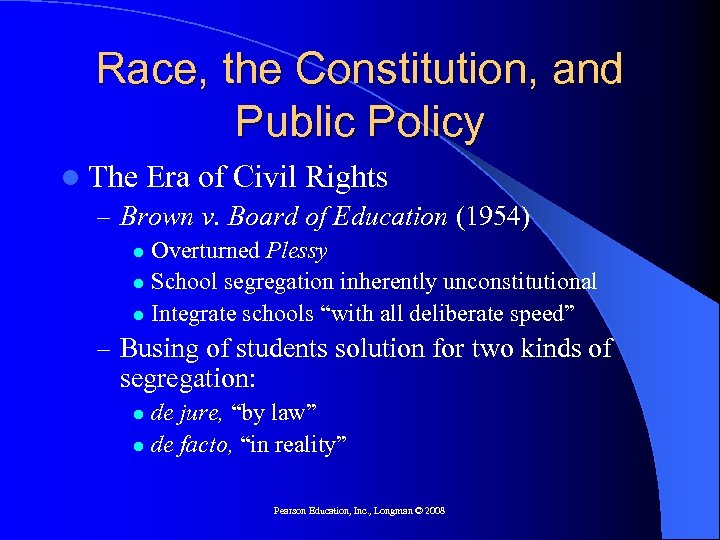
Race, the Constitution, and Public Policy l The Era of Civil Rights – Brown v. Board of Education (1954) Overturned Plessy l School segregation inherently unconstitutional l Integrate schools “with all deliberate speed” l – Busing of students solution for two kinds of segregation: de jure, “by law” l de facto, “in reality” l Pearson Education, Inc. , Longman © 2008
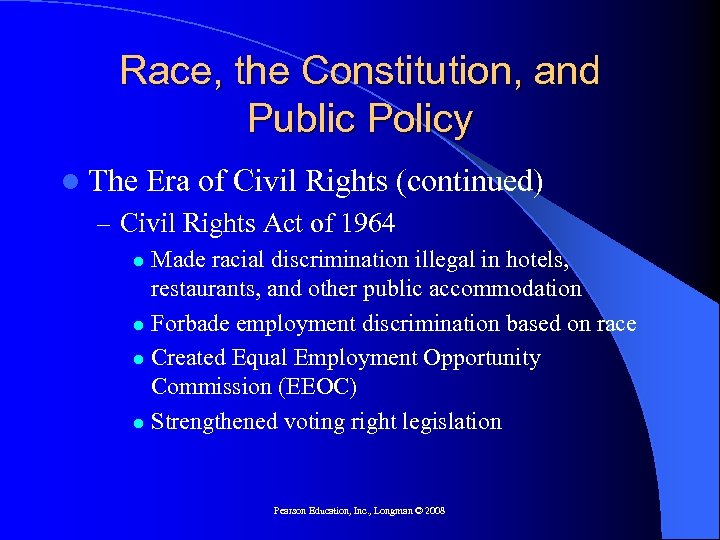
Race, the Constitution, and Public Policy l The Era of Civil Rights (continued) – Civil Rights Act of 1964 Made racial discrimination illegal in hotels, restaurants, and other public accommodation l Forbade employment discrimination based on race l Created Equal Employment Opportunity Commission (EEOC) l Strengthened voting right legislation l Pearson Education, Inc. , Longman © 2008
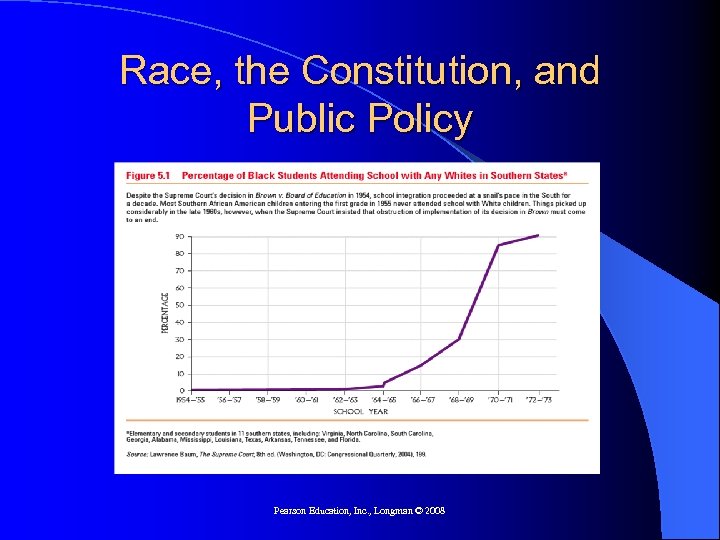
Race, the Constitution, and Public Policy Pearson Education, Inc. , Longman © 2008
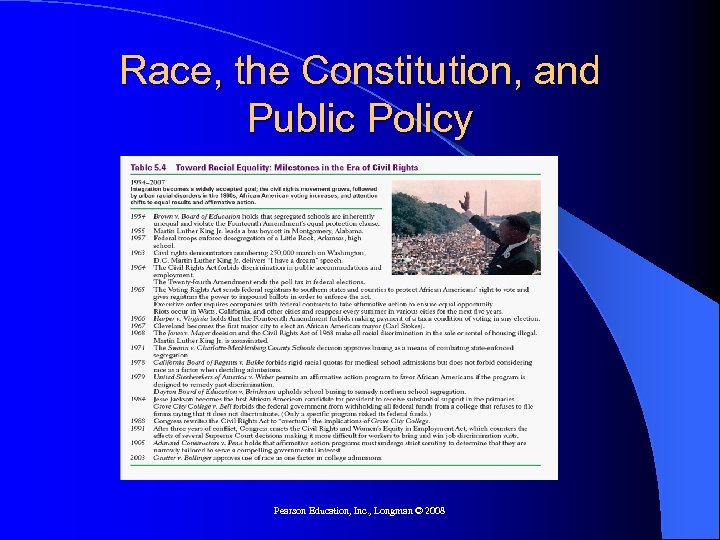
Race, the Constitution, and Public Policy Pearson Education, Inc. , Longman © 2008
Race, the Constitution, and Public Policy l Getting and Using the Right to Vote – Suffrage: the legal right to vote – Fifteenth Amendment: extended suffrage to African Americans – Poll Taxes: small taxes levied on the right to vote – White Primary: Only whites were allowed to vote in the party primaries. Pearson Education, Inc. , Longman © 2008
Race, the Constitution, and Public Policy l Getting and Using the Right to Vote – Smith v. Allwright (1944): ended white primaries – Twenty-fourth Amendment: eliminated poll taxes for federal elections – Harper v. Virginia State Board of Elections (1966): no poll taxes at all – Voting Rights Act of 1965: helped end formal and informal barriers to voting Pearson Education, Inc. , Longman © 2008
Race, the Constitution, and Public Policy l Other Minority Groups – Native Americans l Santa Clara Pueblo v. Martinez (1978) – Hispanic Americans l Mexican American Legal Defense and Education Fund – Asian Americans l Korematsu v. United States (1944) Pearson Education, Inc. , Longman © 2008
Women, the Constitution, and Public Policy l The Battle for the Vote – Nineteenth Amendment: extended suffrage to women in 1920 l The “Doldrums”: 1920 -1960 – Laws were designed to protect women, and protect men from competition with women. – Equal Rights Amendment first introduced in Congress in 1923 Pearson Education, Inc. , Longman © 2008
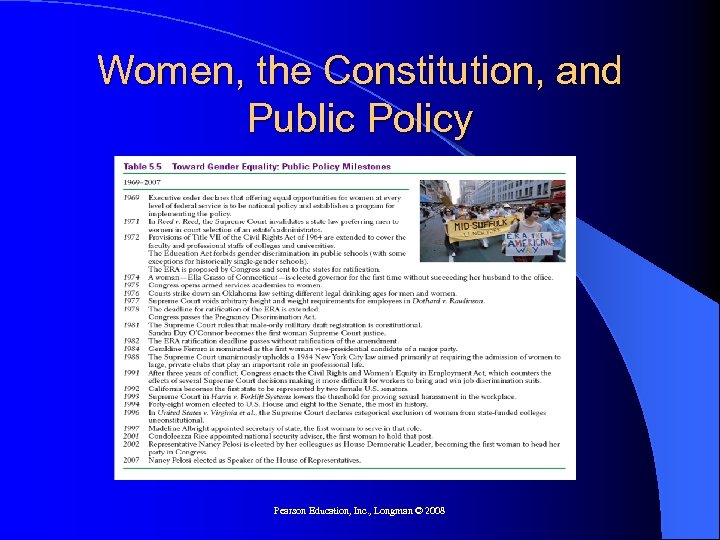
Women, the Constitution, and Public Policy Pearson Education, Inc. , Longman © 2008
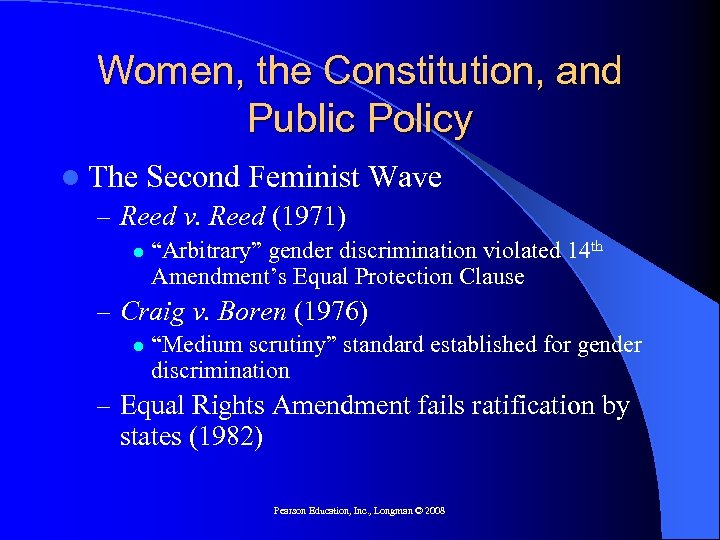
Women, the Constitution, and Public Policy l The Second Feminist – Reed v. Reed (1971) l Wave “Arbitrary” gender discrimination violated 14 th Amendment’s Equal Protection Clause – Craig v. Boren (1976) l “Medium scrutiny” standard established for gender discrimination – Equal Rights Amendment fails ratification by states (1982) Pearson Education, Inc. , Longman © 2008
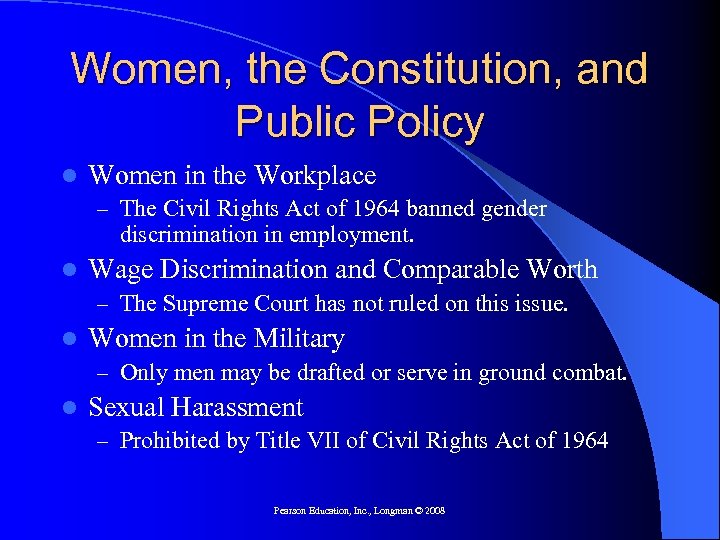
Women, the Constitution, and Public Policy l Women in the Workplace – The Civil Rights Act of 1964 banned gender discrimination in employment. l Wage Discrimination and Comparable Worth – The Supreme Court has not ruled on this issue. l Women in the Military – Only men may be drafted or serve in ground combat. l Sexual Harassment – Prohibited by Title VII of Civil Rights Act of 1964 Pearson Education, Inc. , Longman © 2008
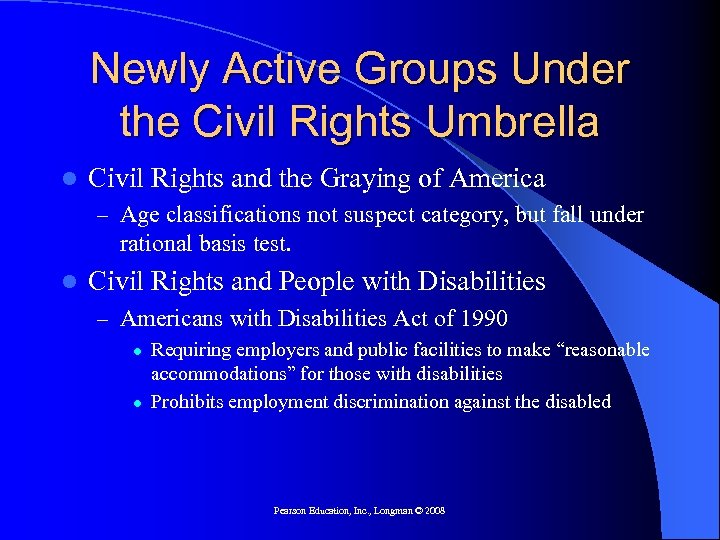
Newly Active Groups Under the Civil Rights Umbrella l Civil Rights and the Graying of America – Age classifications not suspect category, but fall under rational basis test. l Civil Rights and People with Disabilities – Americans with Disabilities Act of 1990 l l Requiring employers and public facilities to make “reasonable accommodations” for those with disabilities Prohibits employment discrimination against the disabled Pearson Education, Inc. , Longman © 2008
Newly Active Groups Under the Civil Rights Umbrella l Gay and Lesbian Rights – Bowers v. Hardwick (1986) – Lawrence v. Texas (2003) Overturned Bowers l Private homosexual acts are protected by the Constitution l – Gay marriage l Many state constitutions amended to prohibit practice Pearson Education, Inc. , Longman © 2008
Affirmative Action Definition: a policy designed to give special attention to or compensatory treatment of members of some previously disadvantaged group l In education l – Regents of the University of California v. Bakke (1978) l l Racial set asides unconstitutional Race could be considered in admissions – Grutter v. Bollinger (2003) l Race could be considered a “plus” in admissions Pearson Education, Inc. , Longman © 2008
Affirmative Action l In employment – United Steelworks v. Weber (1979) l Quotas to remedy past discrimination are constitutional. – Adarand Constructors v. Pena (1995) To be constitutional, affirmative action must be “narrowly tailored” to meet a “compelling governmental interest. ” l Did not ban affirmative action, but severely limited its reach l Pearson Education, Inc. , Longman © 2008
Understanding Civil Rights and Public Policy l Civil Rights and Democracy – Equality favors majority rule. – Suffrage gave many groups political power. l Civil Rights and the Scope of Government – Civil rights laws increase the size and power of government. – Civil rights protect individuals against collective discrimination. Pearson Education, Inc. , Longman © 2008
Summary l Racial minorities and women have struggled for equality since the beginning of the republic. l Constitutional amendments and civil rights legislation guarantee voting and freedom from discrimination. l Civil rights have expanded to new groups. Pearson Education, Inc. , Longman © 2008
Скачать презентацию Chapter 5 Civil Rights and Public Policy Pearson
9096fa09e0fc00d82dfe4d4446734c06.ppt