 Скачать презентацию Chapter 5 Basic Concepts of Relational Database Instructor
05ebe21adc50e9d0483e646c75e434fa.ppt
- Количество слайдов: 34



Chapter 5 Basic Concepts of Relational Database Instructor: Churee Techawut CS (204)321 Database System I
Outlines 1) Relational Database 2) Relational Data Model 3) Relational Database Constraints and Relational Database Schemas 4) Update Operations on Relations 5) Relational Algebra
Relational Database v Definition (by C. J. Date) “ A relational database is a database that is perceived by its users as a collection of tables. It is not just a database in which the data is physically stored as tables. ” Note: Relation is a mathematical term for a table.
Relational Data Model v Concepts § The relational model of data is based on the concept of a Relation. § A relation is a mathematical concept based on the ideas of sets. § The strength of the relational approach to data management comes from the formal foundation provided by theory of relations. § We review the essentials of the relational approach in this chapter.
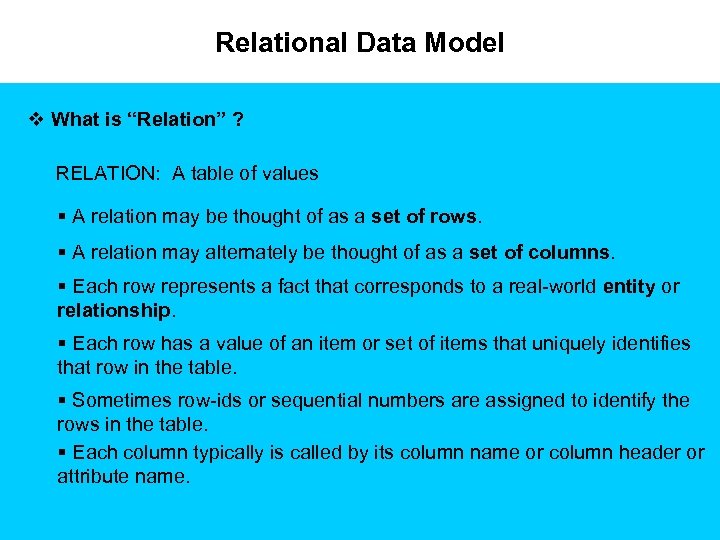
Relational Data Model v What is “Relation” ? RELATION: A table of values § A relation may be thought of as a set of rows. § A relation may alternately be thought of as a set of columns. § Each row represents a fact that corresponds to a real-world entity or relationship. § Each row has a value of an item or set of items that uniquely identifies that row in the table. § Sometimes row-ids or sequential numbers are assigned to identify the rows in the table. § Each column typically is called by its column name or column header or attribute name.
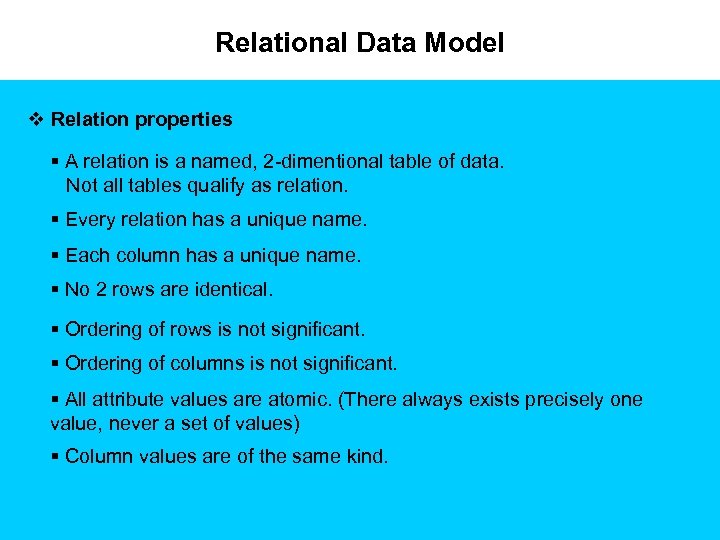
Relational Data Model v Relation properties § A relation is a named, 2 -dimentional table of data. Not all tables qualify as relation. § Every relation has a unique name. § Each column has a unique name. § No 2 rows are identical. § Ordering of rows is not significant. § Ordering of columns is not significant. § All attribute values are atomic. (There always exists precisely one value, never a set of values) § Column values are of the same kind.
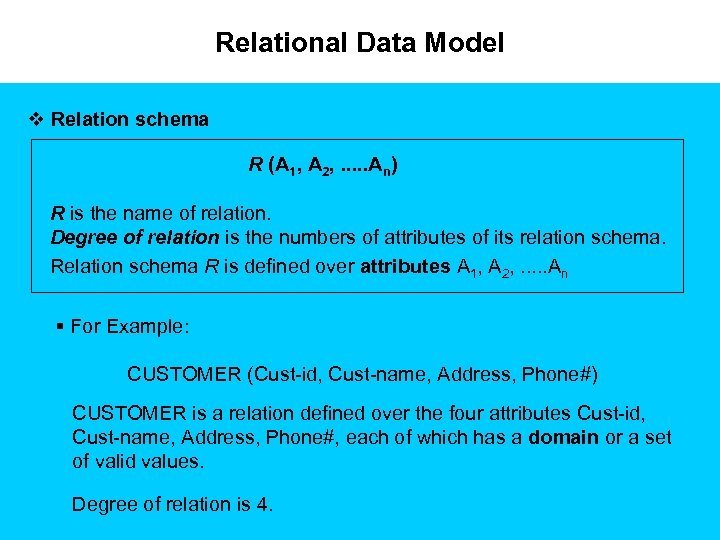
Relational Data Model v Relation schema R (A 1, A 2, . . . An) R is the name of relation. Degree of relation is the numbers of attributes of its relation schema. Relation schema R is defined over attributes A 1, A 2, . . . An § For Example: CUSTOMER (Cust-id, Cust-name, Address, Phone#) CUSTOMER is a relation defined over the four attributes Cust-id, Cust-name, Address, Phone#, each of which has a domain or a set of valid values. Degree of relation is 4.
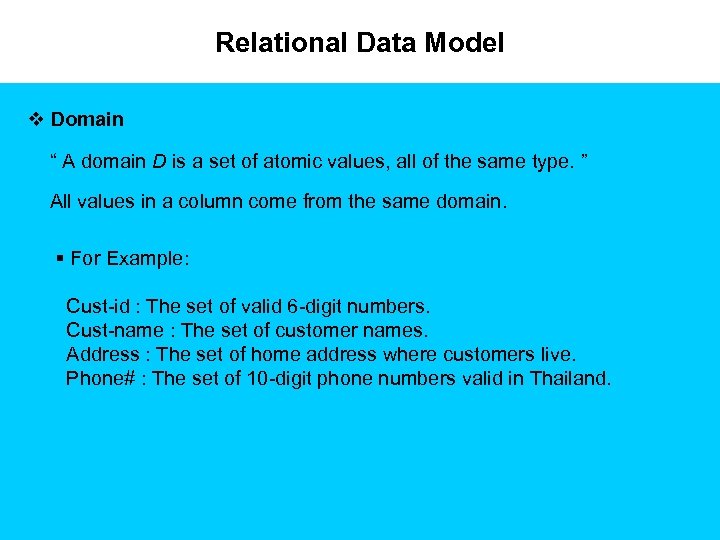
Relational Data Model v Domain “ A domain D is a set of atomic values, all of the same type. ” All values in a column come from the same domain. § For Example: Cust-id : The set of valid 6 -digit numbers. Cust-name : The set of customer names. Address : The set of home address where customers live. Phone# : The set of 10 -digit phone numbers valid in Thailand.
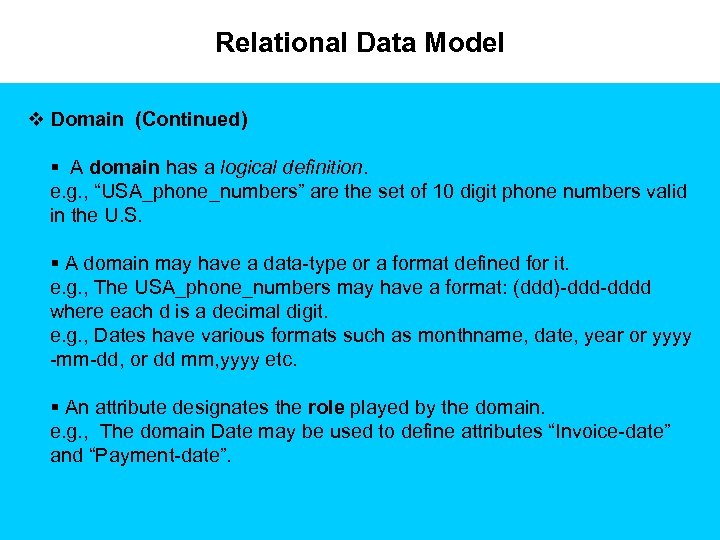
Relational Data Model v Domain (Continued) § A domain has a logical definition. e. g. , “USA_phone_numbers” are the set of 10 digit phone numbers valid in the U. S. § A domain may have a data-type or a format defined for it. e. g. , The USA_phone_numbers may have a format: (ddd)-dddd where each d is a decimal digit. e. g. , Dates have various formats such as monthname, date, year or yyyy -mm-dd, or dd mm, yyyy etc. § An attribute designates the role played by the domain. e. g. , The domain Date may be used to define attributes “Invoice-date” and “Payment-date”.
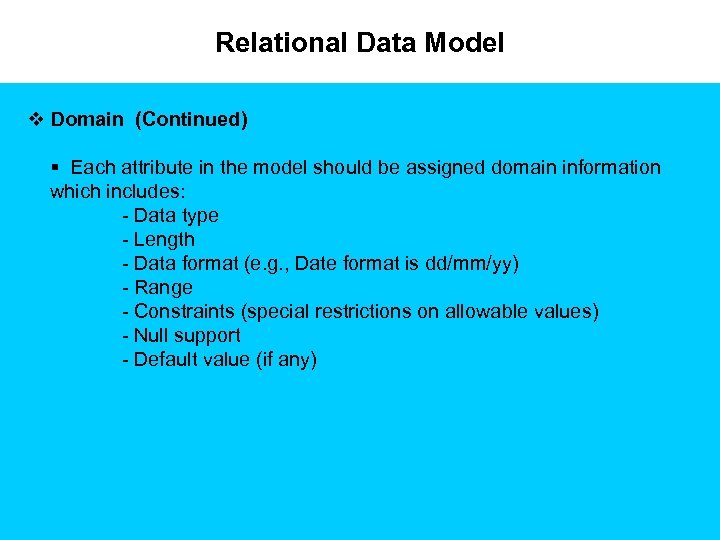
Relational Data Model v Domain (Continued) § Each attribute in the model should be assigned domain information which includes: - Data type - Length - Data format (e. g. , Date format is dd/mm/yy) - Range - Constraints (special restrictions on allowable values) - Null support - Default value (if any)
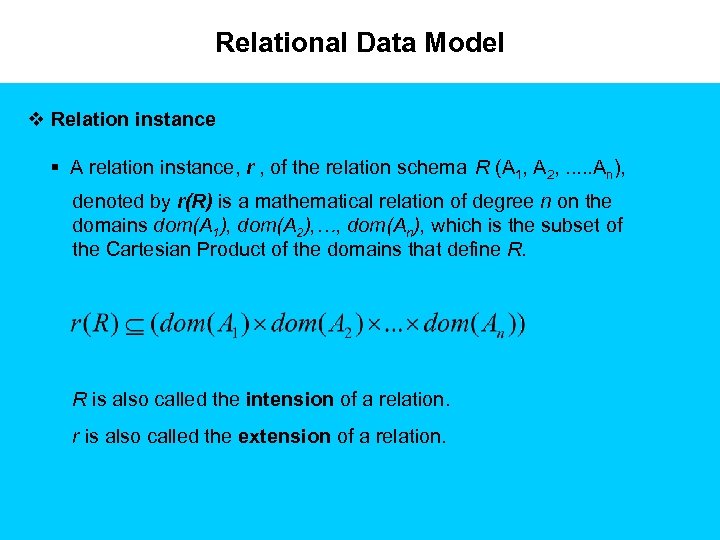
Relational Data Model v Relation instance § A relation instance, r , of the relation schema R (A 1, A 2, . . . An), denoted by r(R) is a mathematical relation of degree n on the domains dom(A 1), dom(A 2), …, dom(An), which is the subset of the Cartesian Product of the domains that define R. R is also called the intension of a relation. r is also called the extension of a relation.
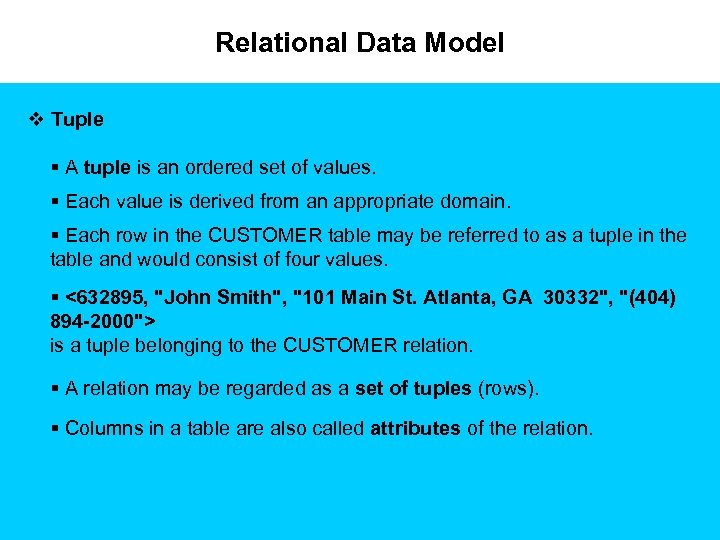
Relational Data Model v Tuple § A tuple is an ordered set of values. § Each value is derived from an appropriate domain. § Each row in the CUSTOMER table may be referred to as a tuple in the table and would consist of four values. § <632895, "John Smith", "101 Main St. Atlanta, GA 30332", "(404) 894 -2000"> is a tuple belonging to the CUSTOMER relation. § A relation may be regarded as a set of tuples (rows). § Columns in a table are also called attributes of the relation.
Relational Data Model v Tuple (Continued) We refer to component values of a tuple t by t[Ai] = vi (the value of attribute Ai for tuple t). Similarly, t[Au, Av, . . . , Aw] refers to the subtuple of t containing the values of attributes Au, Av, . . . , Aw, respectively.
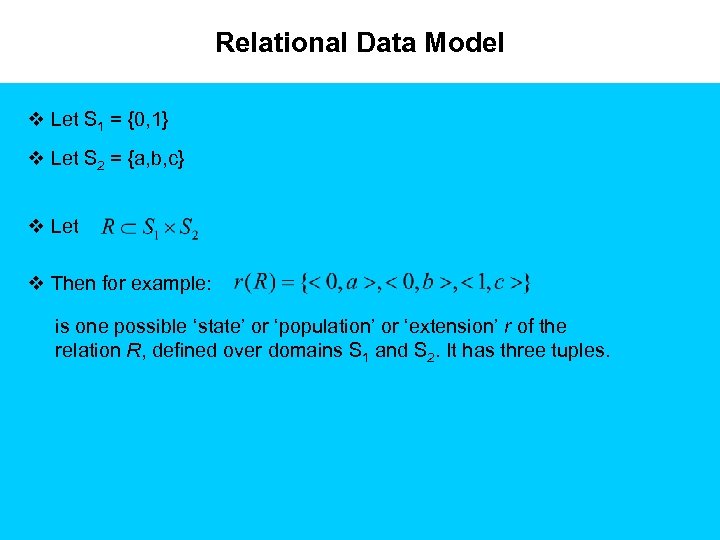
Relational Data Model v Let S 1 = {0, 1} v Let S 2 = {a, b, c} v Let v Then for example: is one possible ‘state’ or ‘population’ or ‘extension’ r of the relation R, defined over domains S 1 and S 2. It has three tuples.
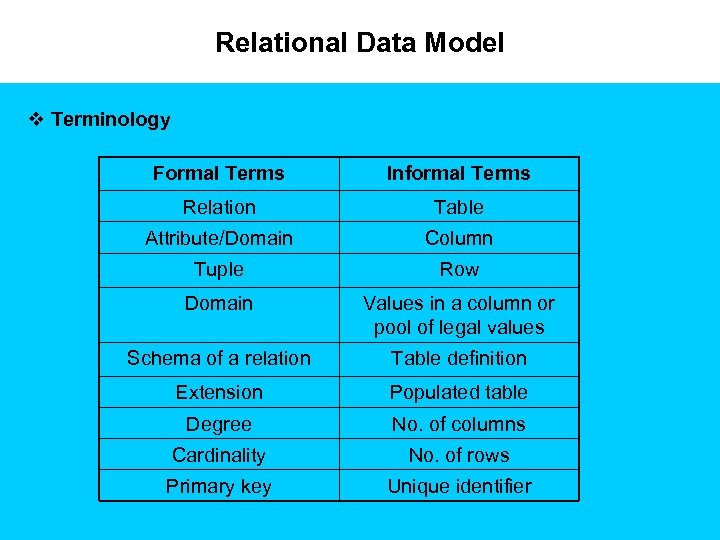
Relational Data Model v Terminology Formal Terms Informal Terms Relation Table Attribute/Domain Column Tuple Row Domain Values in a column or pool of legal values Schema of a relation Table definition Extension Populated table Degree No. of columns Cardinality No. of rows Primary key Unique identifier
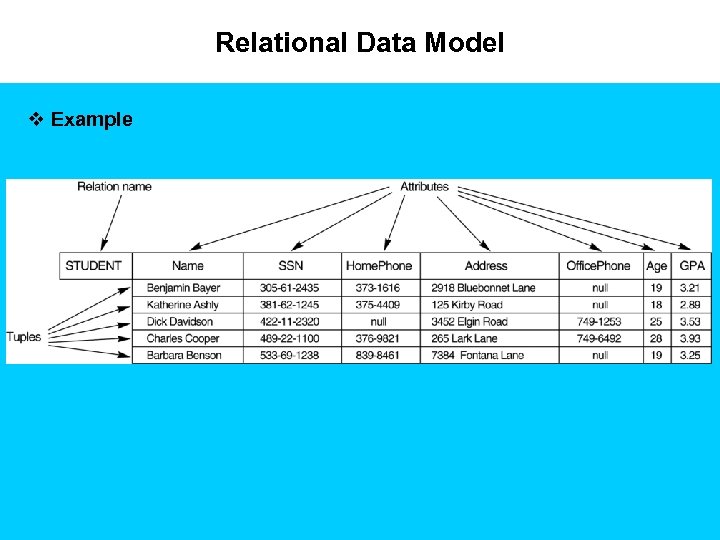
Relational Data Model v Example
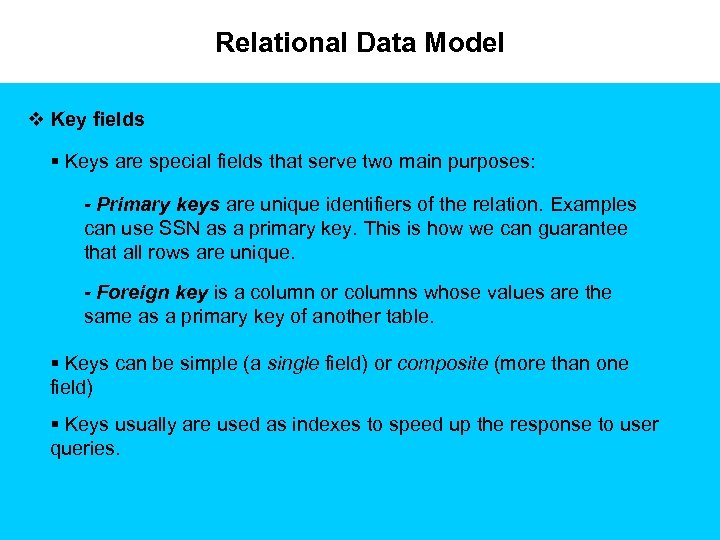
Relational Data Model v Key fields § Keys are special fields that serve two main purposes: - Primary keys are unique identifiers of the relation. Examples can use SSN as a primary key. This is how we can guarantee that all rows are unique. - Foreign key is a column or columns whose values are the same as a primary key of another table. § Keys can be simple (a single field) or composite (more than one field) § Keys usually are used as indexes to speed up the response to user queries.
Relational Constraints v What are relational constraints? “ Constraints are conditions that must hold on all valid relation instances. ” (Elmasri&Navathe, 2000) “ Restrictions on data that can be specified on a relational database schema. ” (Date, 2000) v There are three main types of constraints: § Key constraints § Entity integrity constraints § Referential integrity constraints
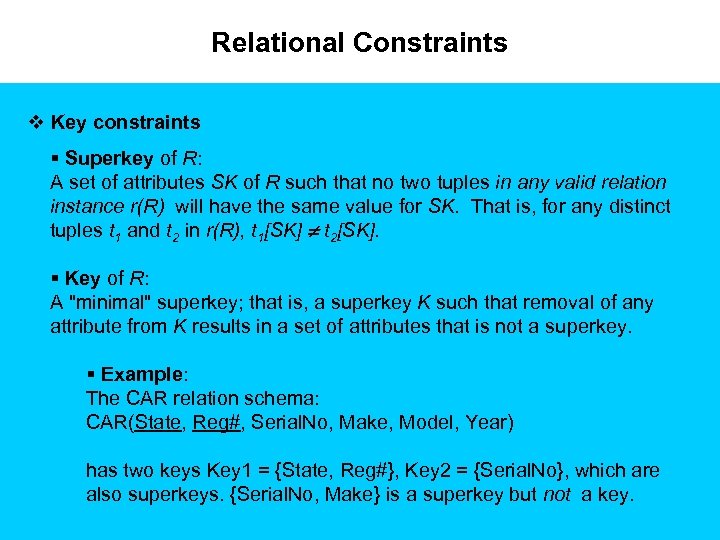
Relational Constraints v Key constraints § Superkey of R: A set of attributes SK of R such that no two tuples in any valid relation instance r(R) will have the same value for SK. That is, for any distinct tuples t 1 and t 2 in r(R), t 1[SK] t 2[SK]. § Key of R: A "minimal" superkey; that is, a superkey K such that removal of any attribute from K results in a set of attributes that is not a superkey. § Example: The CAR relation schema: CAR(State, Reg#, Serial. No, Make, Model, Year) has two keys Key 1 = {State, Reg#}, Key 2 = {Serial. No}, which are also superkeys. {Serial. No, Make} is a superkey but not a key.
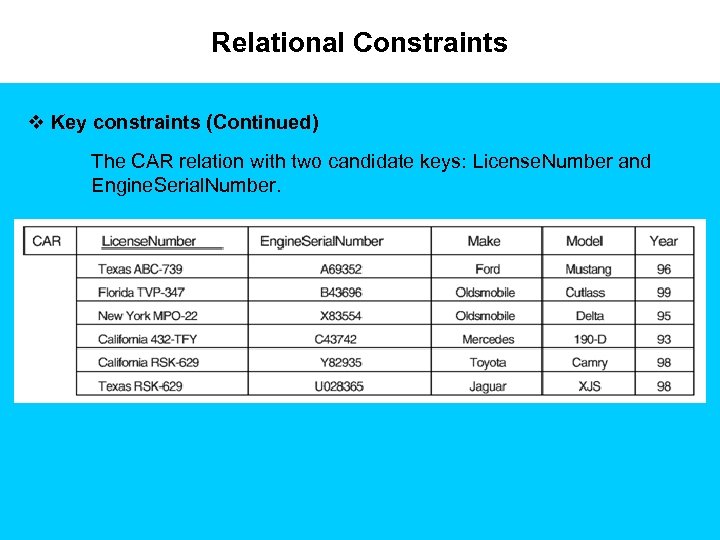
Relational Constraints v Key constraints (Continued) The CAR relation with two candidate keys: License. Number and Engine. Serial. Number.
Relational Constraints v Key constraints (Continued) § A relation schema may have more than 1 key. Each of the keys is called a candidate key. One of the candidate keys are designated as the primary key of the relation. § If a relation has several candidate keys, one is chosen arbitrarily to be the primary key. The primary key attributes are underlined.
Relational Constraints v Entity integrity constraints § Relational Database Schema: A set S of relation schemas that belong to the same database. S is the name of the database. S = {R 1, R 2, . . . , Rn} § Entity Integrity: The primary key attributes PK of each relation schema R in S cannot have null values in any tuple of r(R). This is because primary key values are used to identify the individual tuples. t[PK] null for any tuple t in r(R) § Note: Other attributes of R may be similarly constrained to disallow null values, even though they are not members of the primary key.
Relational Constraints v Entity integrity constraints (Continued) § A Null is created by making no entry at all, so a null denotes the absence of a value. § A null can have any of the following meanings: - The value does not exist - The value exists, but it is not known. - The value is unknown, or it is not applicable.
Relational Constraints v Referential integrity constraints § A constraint involving two relations (the previous constraints involve a single relation). § Used to specify a relationship among tuples in two relations: the referencing relation and the referenced relation. § Tuples in the referencing relation R 1 have attributes FK (called foreign key attributes) that reference the primary key attributes PK of the referenced relation R 2. A tuple t 1 in R 1 is said to reference a tuple t 2 in R 2 if t 1[FK] = t 2[PK]. § A referential integrity constraint can be displayed in a relational database schema as a directed arc from R 1. FK to R 2.
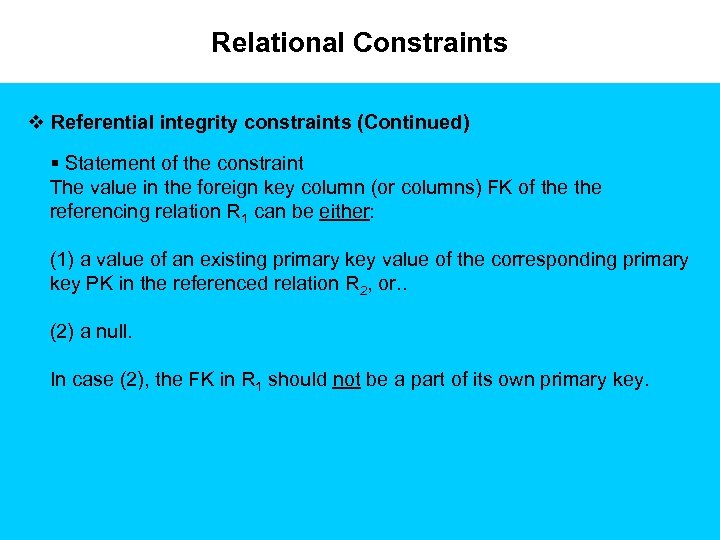
Relational Constraints v Referential integrity constraints (Continued) § Statement of the constraint The value in the foreign key column (or columns) FK of the referencing relation R 1 can be either: (1) a value of an existing primary key value of the corresponding primary key PK in the referenced relation R 2, or. . (2) a null. In case (2), the FK in R 1 should not be a part of its own primary key.
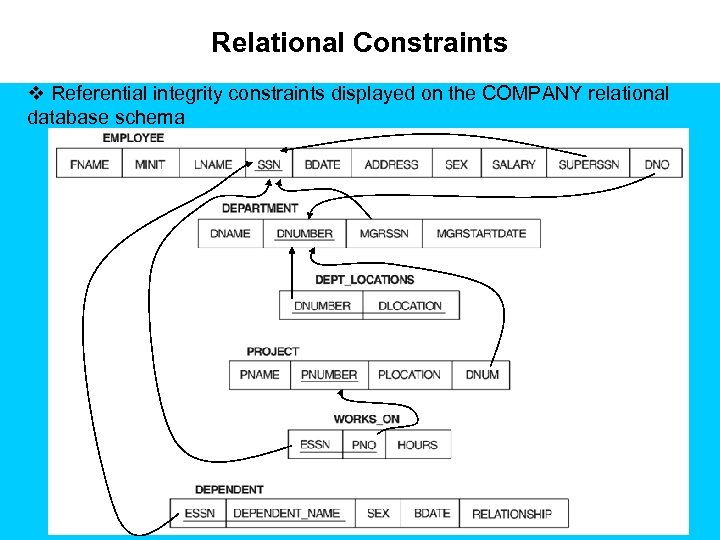
Relational Constraints v Referential integrity constraints displayed on the COMPANY relational database schema
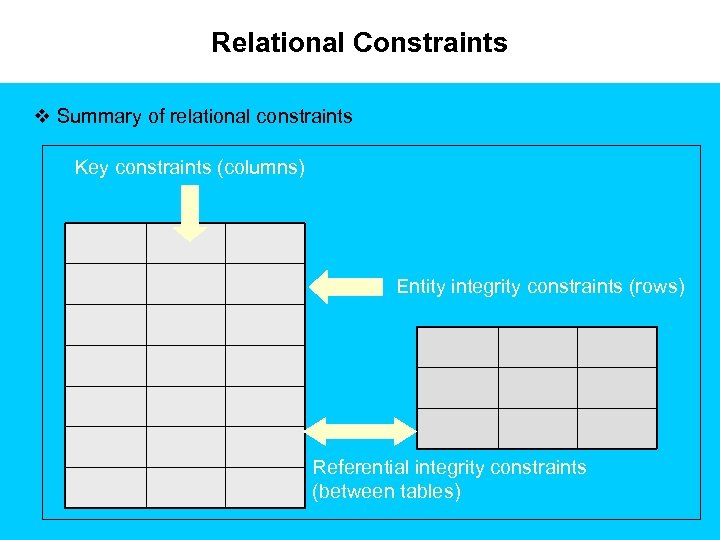
Relational Constraints v Summary of relational constraints Key constraints (columns) Entity integrity constraints (rows) Referential integrity constraints (between tables)
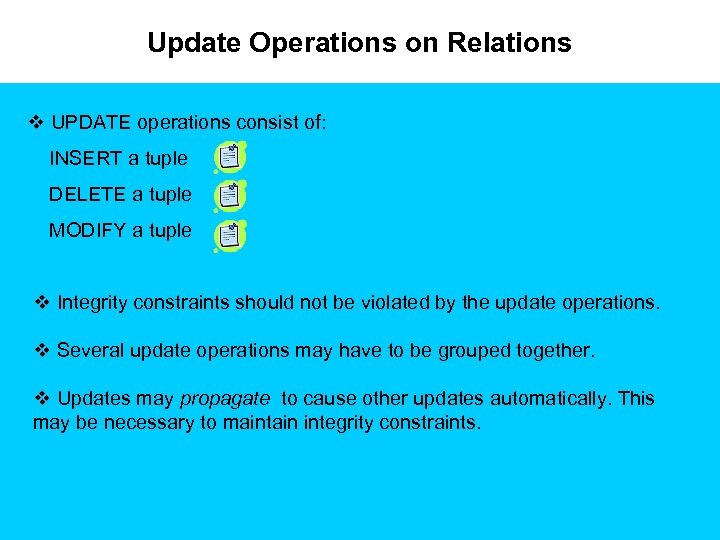
Update Operations on Relations v UPDATE operations consist of: INSERT a tuple DELETE a tuple MODIFY a tuple v Integrity constraints should not be violated by the update operations. v Several update operations may have to be grouped together. v Updates may propagate to cause other updates automatically. This may be necessary to maintain integrity constraints.
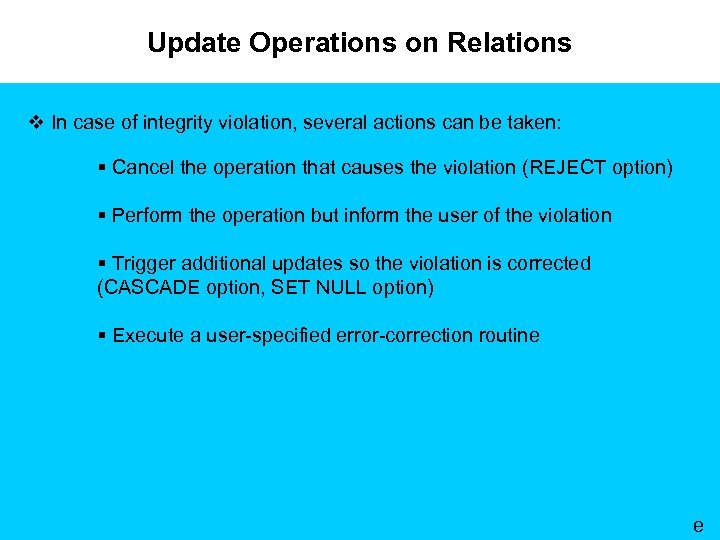
Update Operations on Relations v In case of integrity violation, several actions can be taken: § Cancel the operation that causes the violation (REJECT option) § Perform the operation but inform the user of the violation § Trigger additional updates so the violation is corrected (CASCADE option, SET NULL option) § Execute a user-specified error-correction routine e
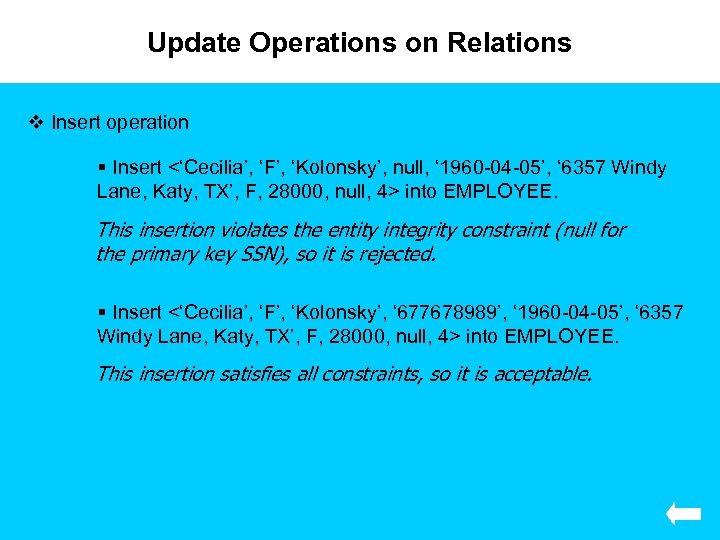
Update Operations on Relations v Insert operation § Insert <‘Cecilia’, ‘F’, ‘Kolonsky’, null, ‘ 1960 -04 -05’, ‘ 6357 Windy Lane, Katy, TX’, F, 28000, null, 4> into EMPLOYEE. This insertion violates the entity integrity constraint (null for the primary key SSN), so it is rejected. § Insert <‘Cecilia’, ‘F’, ‘Kolonsky’, ‘ 677678989’, ‘ 1960 -04 -05’, ‘ 6357 Windy Lane, Katy, TX’, F, 28000, null, 4> into EMPLOYEE. This insertion satisfies all constraints, so it is acceptable.
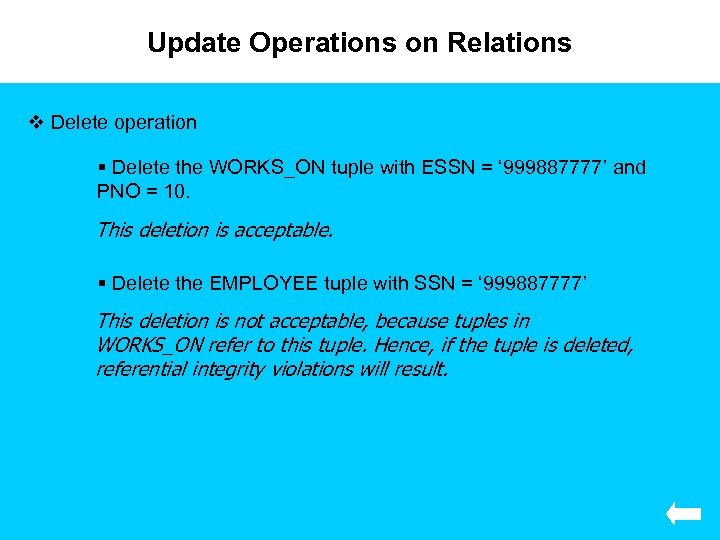
Update Operations on Relations v Delete operation § Delete the WORKS_ON tuple with ESSN = ‘ 999887777’ and PNO = 10. This deletion is acceptable. § Delete the EMPLOYEE tuple with SSN = ‘ 999887777’ This deletion is not acceptable, because tuples in WORKS_ON refer to this tuple. Hence, if the tuple is deleted, referential integrity violations will result.
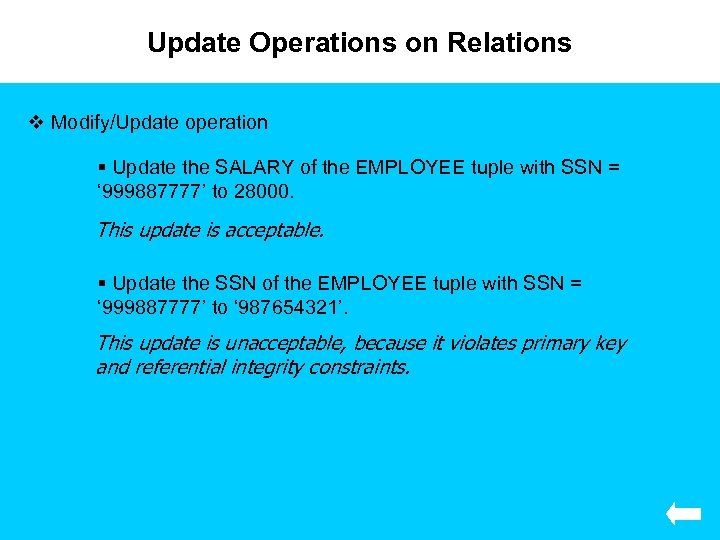
Update Operations on Relations v Modify/Update operation § Update the SALARY of the EMPLOYEE tuple with SSN = ‘ 999887777’ to 28000. This update is acceptable. § Update the SSN of the EMPLOYEE tuple with SSN = ‘ 999887777’ to ‘ 987654321’. This update is unacceptable, because it violates primary key and referential integrity constraints.
Relational Algebra v Relational algebra is a set of operations to manipulate data and enable the user to specify basic retrieval requests. v The result of a retrieval is a new relation, which may have been formed from one or more relations. v Three groups of relational algebra operations: § Unary relational operations § Binary relational operations § Set theoretic operations
Relational Algebra v Unary relational operations: § The SELECT operation § The PROJECT operation
Скачать презентацию Chapter 5 Basic Concepts of Relational Database Instructor
05ebe21adc50e9d0483e646c75e434fa.ppt