


 Скачать презентацию Chapter 5 1 Service enterprises perform services
8716345f2fb322e2253c9060f3c1cce2.ppt
- Количество слайдов: 53
 Chapter 5 1
 Service enterprises perform services as their primary source of revenue. Merchandising companies buy and sell merchandise. 2
 Differences Between a Service Business and a Merchandising Company § In a merchandising company, the primary source of revenues is the sale of merchandise, referred to as sales revenue or sales. § Unlike expenses for a service company, expenses for a merchandising company are divided into two categories: o Cost of goods sold - the total cost of merchandise sold during the period. o Operating expenses - selling and administrative expenses.
 Calculating Net Income--A measure of the overall performance of a business entity.
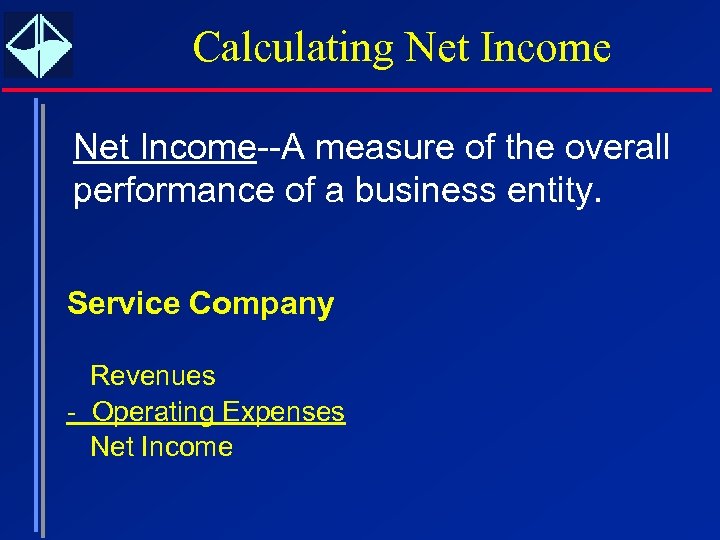 Calculating Net Income--A measure of the overall performance of a business entity. Service Company Revenues - Operating Expenses Net Income
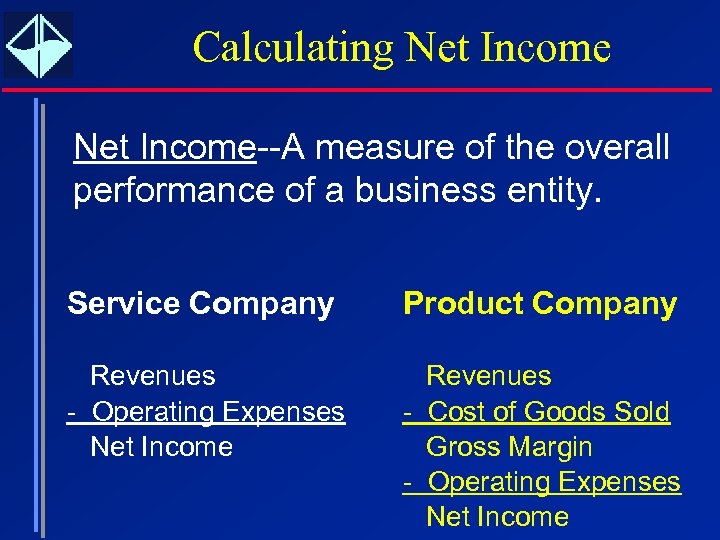 Calculating Net Income--A measure of the overall performance of a business entity. Service Company Product Company Revenues - Operating Expenses Net Income Revenues - Cost of Goods Sold Gross Margin - Operating Expenses Net Income
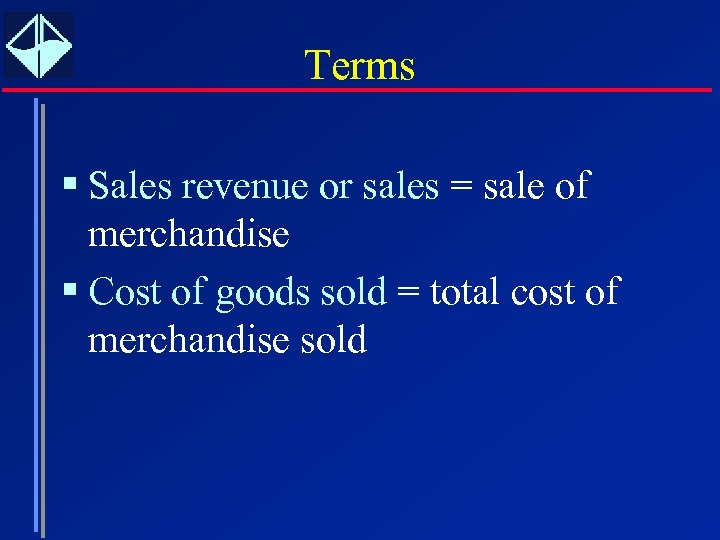 Terms § Sales revenue or sales = sale of merchandise § Cost of goods sold = total cost of merchandise sold
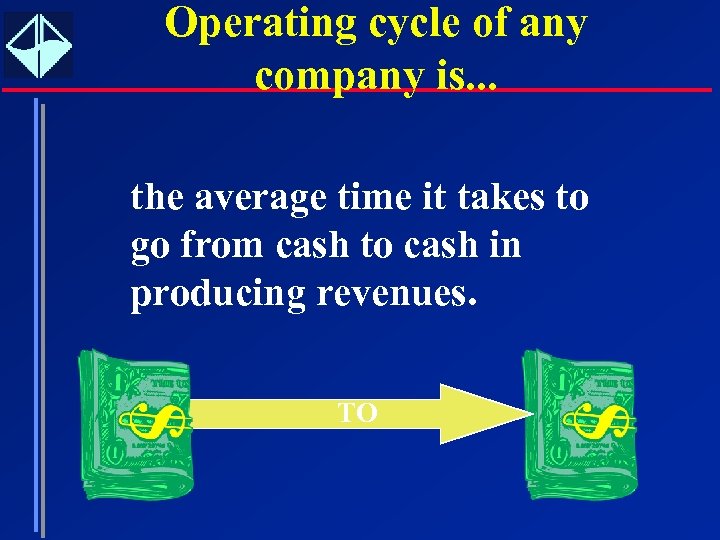 Operating cycle of any company is. . . the average time it takes to go from cash to cash in producing revenues. TO
 Operating cycle of a merchandising company is. . . § Ordinarily longer than that of a service company; § Purchase of merchandise and its sale lengthens the cycle.
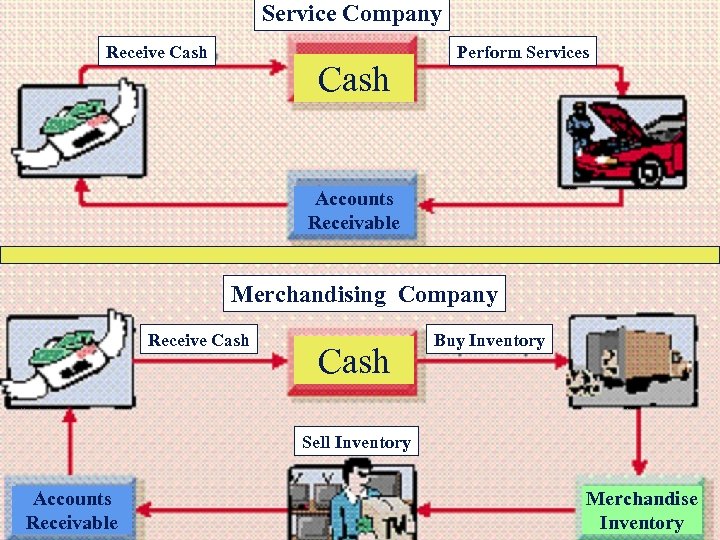 Service Company Receive Cash Perform Services Accounts Receivable Merchandising Company Receive Cash Buy Inventory Sell Inventory Accounts Receivable Merchandise Inventory 10
 Inventory • The Inventory account is one of the largest assets for any company. • The determination of which goods should be included in inventory at the end of a period is “Inventory Cutoff. ” • Inventory errors will affect the financial statements for 2 years.
 What Is Charged to Merchandise Inventory? § All costs needed to get inventory to a company and ready to sell • +Freight-In • +Special Permits § Only costs associated with merchandise purchased for resale - not assets acquired for use, such as supplies
 Transportation Costs • The cost of inbound transportation is added to the cost of inventory. • For the perpetual method, the cost must be added to the Inventory account to reflect actual cost of acquiring inventory. • For the periodic method, a Freight-In account is used.
 Inventory Control Methods • Perpetual Inventory Method--A system of accounting in which cost of goods sold and inventory are adjusted when the merchandise is purchased or sold. • Periodic Inventory Method--A system of accounting in which the cost of goods sold and inventory are adjusted at the end of the accounting period.
 • First: Let’s look at the whole process assuming Perpetual Inventory
 Perpetual Inventory • Transaction records of every sale or purchase are required to account for inventory. • The perpetual method is similar to how you would account for cash. • The Inventory account should represent the amount of inventory on hand at any time.
 Merchandise Purchases On May 4 the company bought $ 3, 800 worth of merchandise from PW Audio Supply, Inc. Task: Record the purchase by getting information from the Purchase Invoice. The Purchase Invoice is the buyer’s copy of the sales invoice.
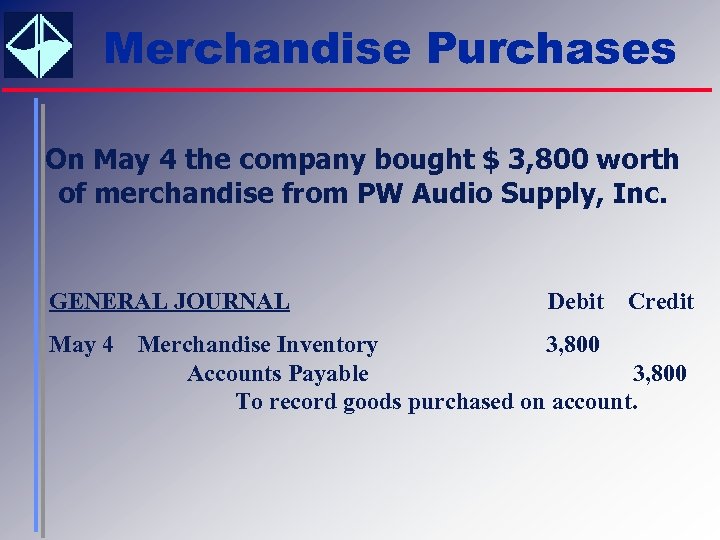 Merchandise Purchases On May 4 the company bought $ 3, 800 worth of merchandise from PW Audio Supply, Inc. GENERAL JOURNAL May 4 Debit Credit Merchandise Inventory 3, 800 Accounts Payable 3, 800 To record goods purchased on account.
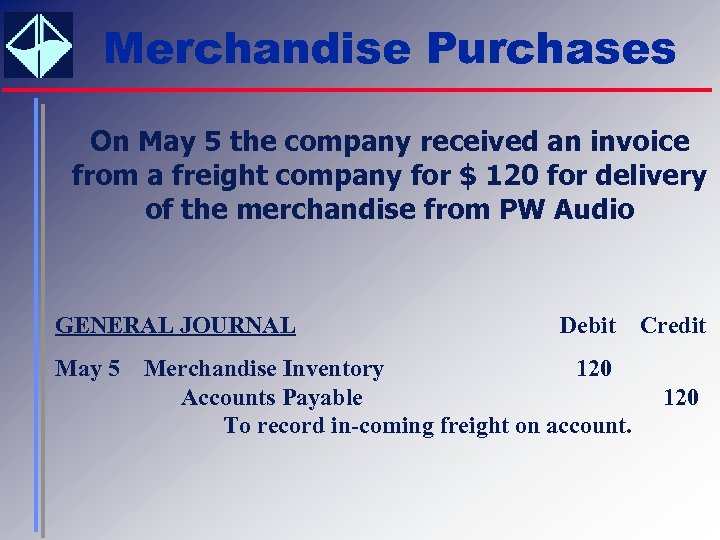 Merchandise Purchases On May 5 the company received an invoice from a freight company for $ 120 for delivery of the merchandise from PW Audio GENERAL JOURNAL Debit May 5 Merchandise Inventory 120 Accounts Payable To record in-coming freight on account. Credit 120
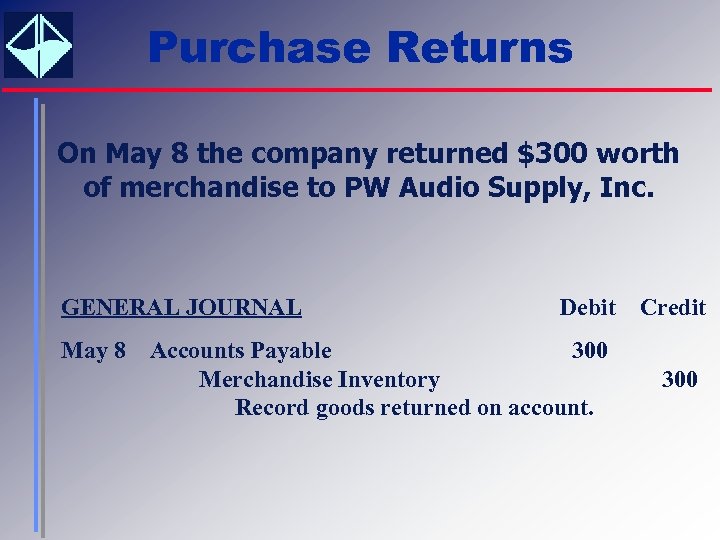 Purchase Returns On May 8 the company returned $300 worth of merchandise to PW Audio Supply, Inc. GENERAL JOURNAL May 8 Debit Accounts Payable 300 Merchandise Inventory Record goods returned on account. Credit 300
 Purchase Discounts A purchase discount is a reduction in the purchase price, usually when payment is made within a specified period. Purchase discounts reduce the net cost of the purchases account. For perpetual inventory, a purchase discount reduces inventory by the same amount.
 Purchase Discount Example: On March 1, the Morris Company purchased (received) 10 accounting books for $100 each. The terms of the contract were 2/10, n/30. Write down the journal entry made Mar. 1 and the entry made on Mar. 10 for the payment to the supplier.
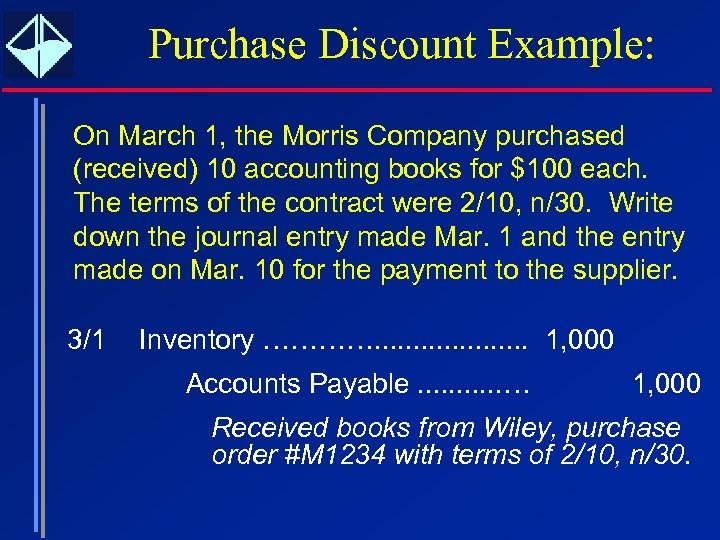 Purchase Discount Example: On March 1, the Morris Company purchased (received) 10 accounting books for $100 each. The terms of the contract were 2/10, n/30. Write down the journal entry made Mar. 1 and the entry made on Mar. 10 for the payment to the supplier. 3/1 Inventory …………. . . . . 1, 000 Accounts Payable. . . … 1, 000 Received books from Wiley, purchase order #M 1234 with terms of 2/10, n/30.
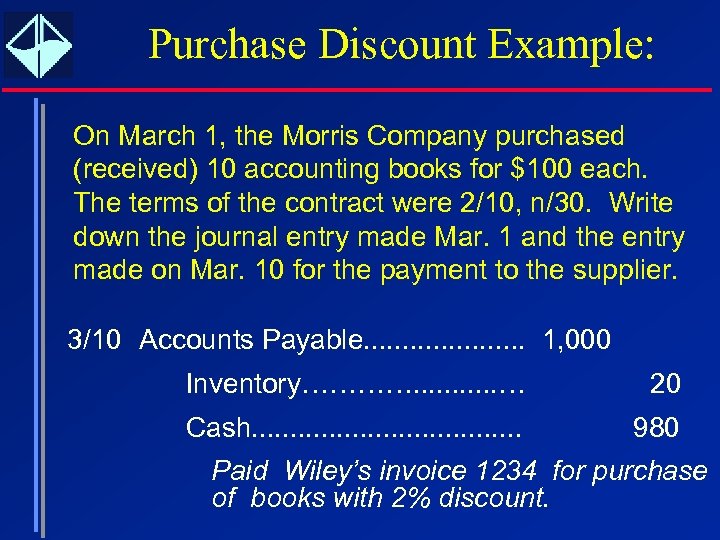 Purchase Discount Example: On March 1, the Morris Company purchased (received) 10 accounting books for $100 each. The terms of the contract were 2/10, n/30. Write down the journal entry made Mar. 1 and the entry made on Mar. 10 for the payment to the supplier. 3/10 Accounts Payable. . . . . 1, 000 Inventory…………. . . … 20 Cash. . . . . 980 Paid Wiley’s invoice 1234 for purchase of books with 2% discount.
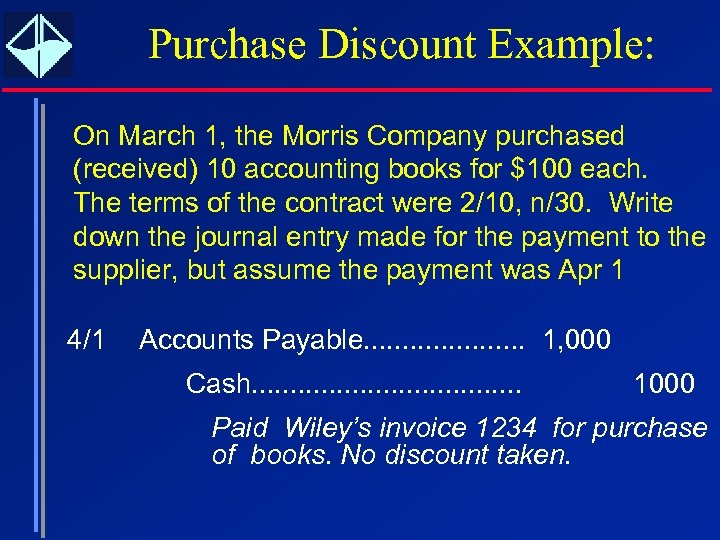 Purchase Discount Example: On March 1, the Morris Company purchased (received) 10 accounting books for $100 each. The terms of the contract were 2/10, n/30. Write down the journal entry made for the payment to the supplier, but assume the payment was Apr 1 4/1 Accounts Payable. . . . . 1, 000 Cash. . . . . 1000 Paid Wiley’s invoice 1234 for purchase of books. No discount taken.
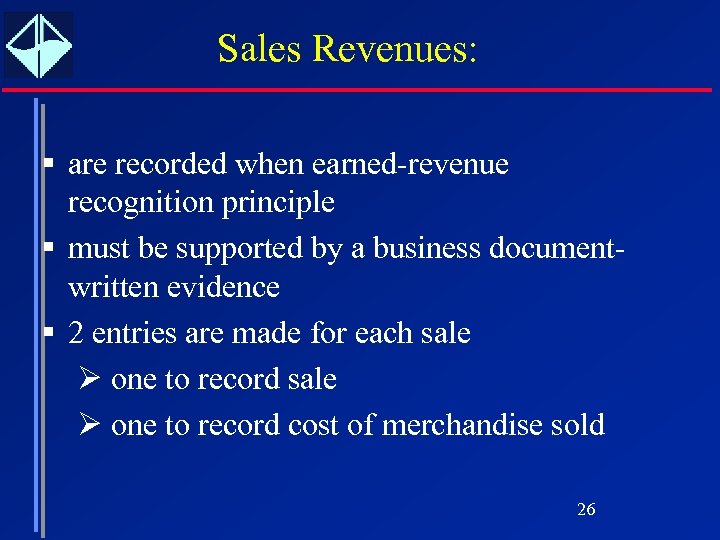 Sales Revenues: § are recorded when earned-revenue recognition principle § must be supported by a business documentwritten evidence § 2 entries are made for each sale Ø one to record cost of merchandise sold 26
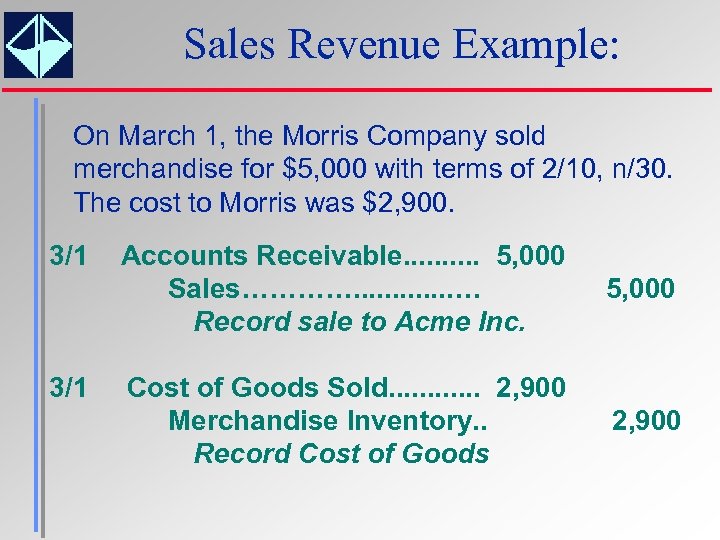 Sales Revenue Example: On March 1, the Morris Company sold merchandise for $5, 000 with terms of 2/10, n/30. The cost to Morris was $2, 900. 3/1 Accounts Receivable. . 5, 000 Sales…………. . . … Record sale to Acme Inc. 5, 000 Cost of Goods Sold. . . 2, 900 Merchandise Inventory. . Record Cost of Goods 2, 900
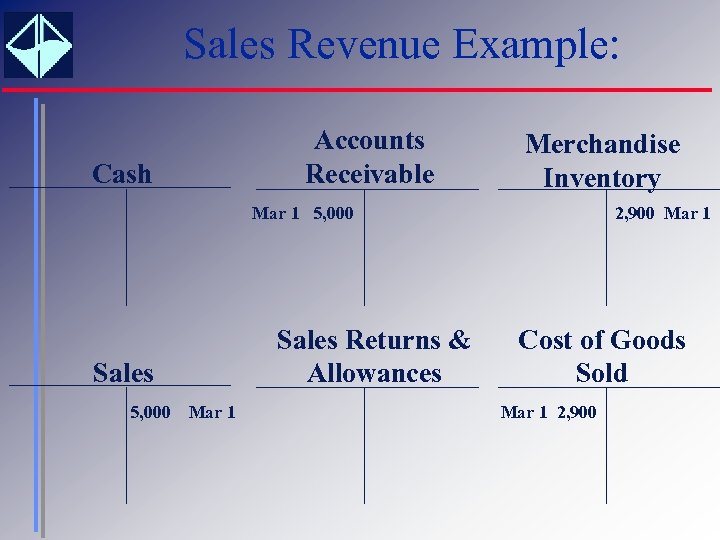 Sales Revenue Example: Accounts Receivable Cash Merchandise Inventory Mar 1 5, 000 Sales Returns & Allowances Sales 5, 000 Mar 1 2, 900 Mar 1 Cost of Goods Sold Mar 1 2, 900
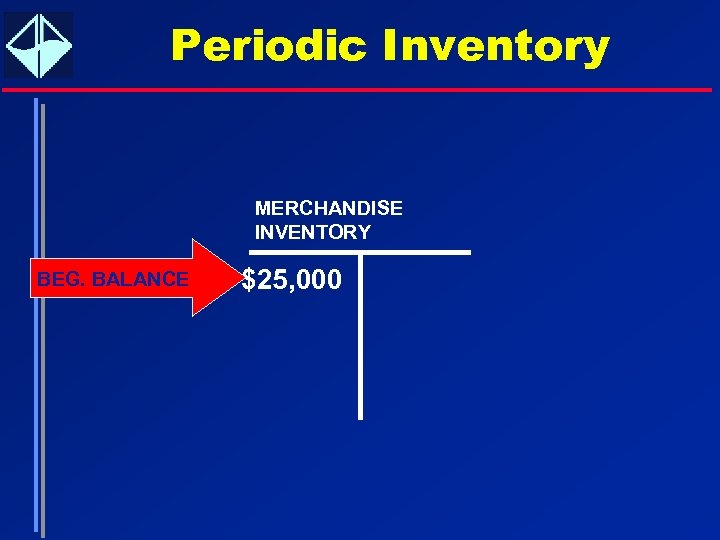
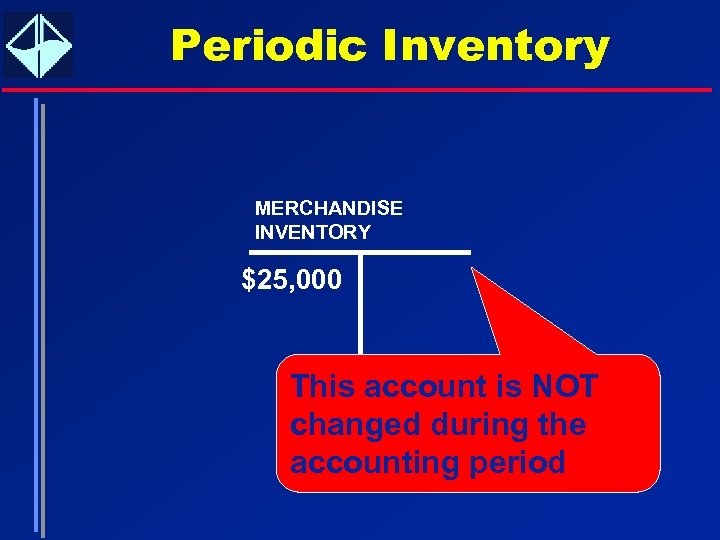
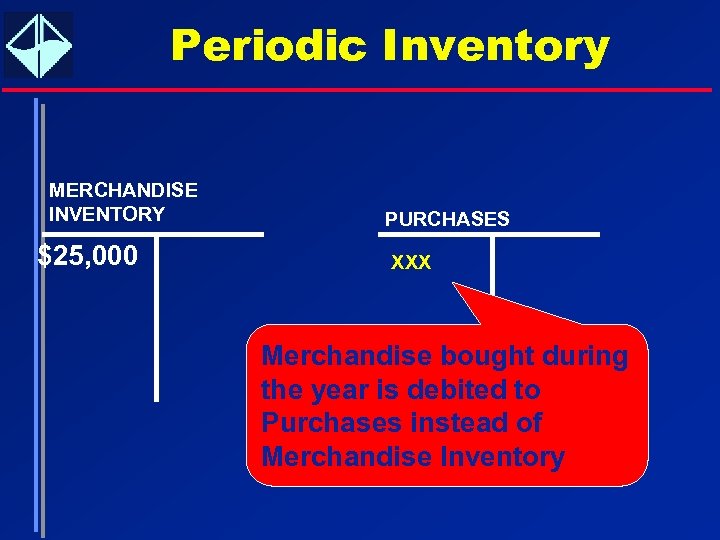
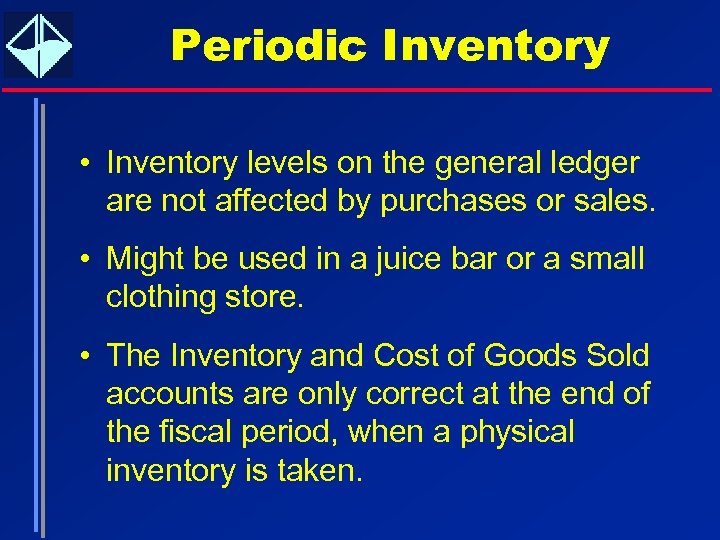 Periodic Inventory • Inventory levels on the general ledger are not affected by purchases or sales. • Might be used in a juice bar or a small clothing store. • The Inventory and Cost of Goods Sold accounts are only correct at the end of the fiscal period, when a physical inventory is taken.
 Cost of Goods Sold -Periodic Method A running account of changes in inventory is not maintained. Separate accounts are used to record – Purchases – Freight in, – Purchase returns – Discounts Cost of goods sold is calculated at end of period.
 Periodic Inventory MERCHANDISE INVENTORY BEG. BALANCE $25, 000
 Periodic Inventory MERCHANDISE INVENTORY $25, 000 This account is NOT changed during the accounting period
 Periodic Inventory MERCHANDISE INVENTORY $25, 000 PURCHASES XXX Merchandise bought during the year is debited to Purchases instead of Merchandise Inventory
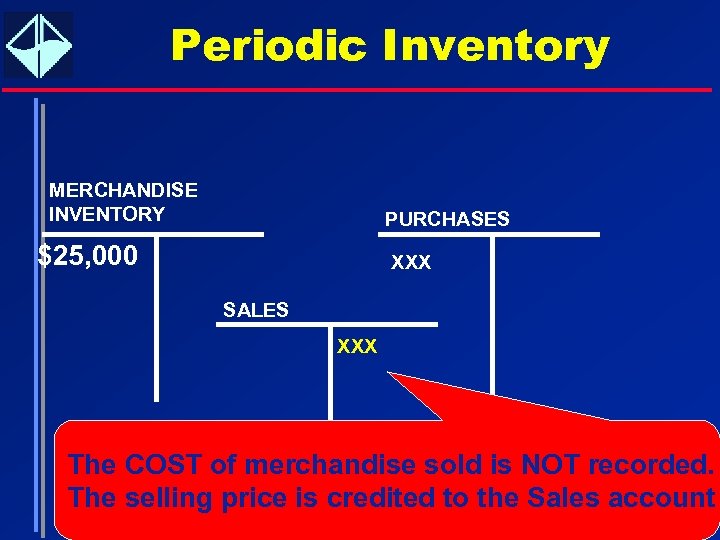 Periodic Inventory MERCHANDISE INVENTORY PURCHASES $25, 000 XXX SALES XXX The COST of merchandise sold is NOT recorded. The selling price is credited to the Sales account
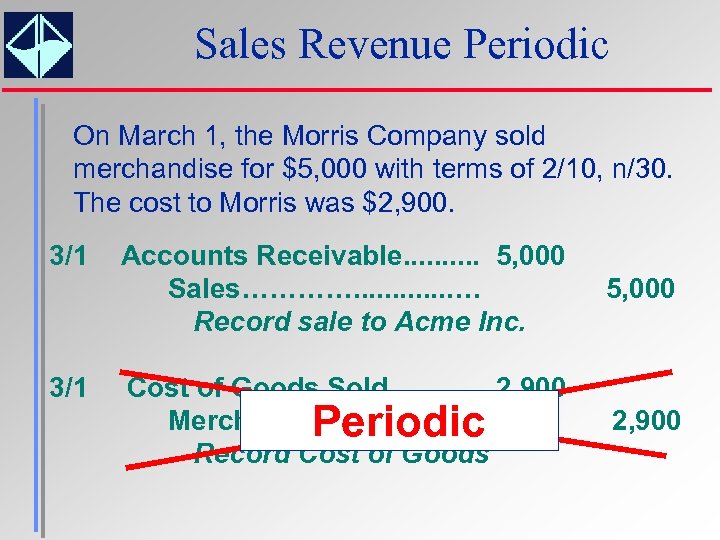 Sales Revenue Periodic On March 1, the Morris Company sold merchandise for $5, 000 with terms of 2/10, n/30. The cost to Morris was $2, 900. 3/1 Accounts Receivable. . 5, 000 Sales…………. . . … Record sale to Acme Inc. 5, 000 Cost of Goods Sold. . . 2, 900 Merchandise Inventory. . Periodic Record Cost of Goods 2, 900
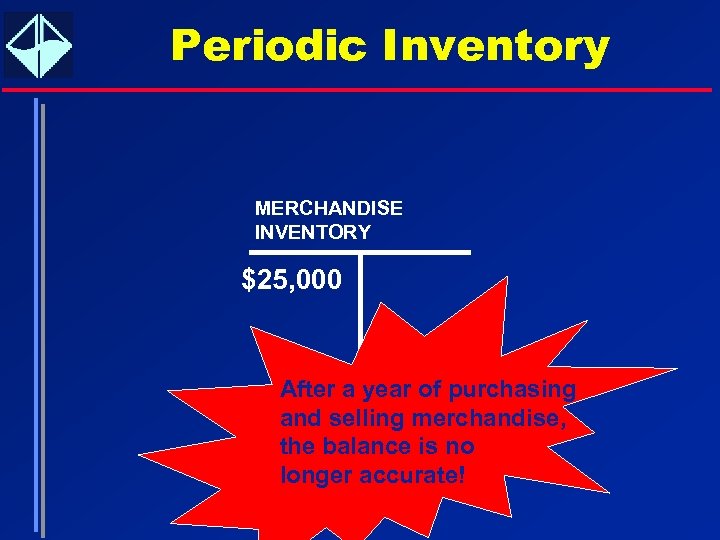 Periodic Inventory MERCHANDISE INVENTORY $25, 000 After a year of purchasing and selling merchandise, the balance is no longer accurate!
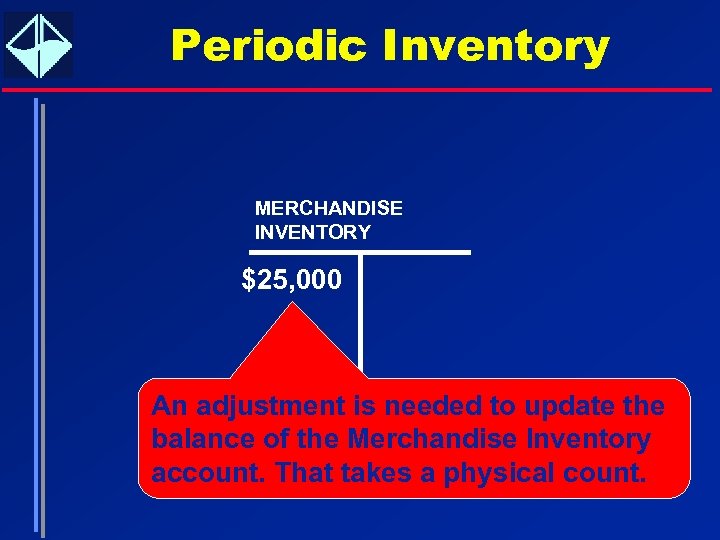 Periodic Inventory MERCHANDISE INVENTORY $25, 000 An adjustment is needed to update the balance of the Merchandise Inventory account. That takes a physical count.
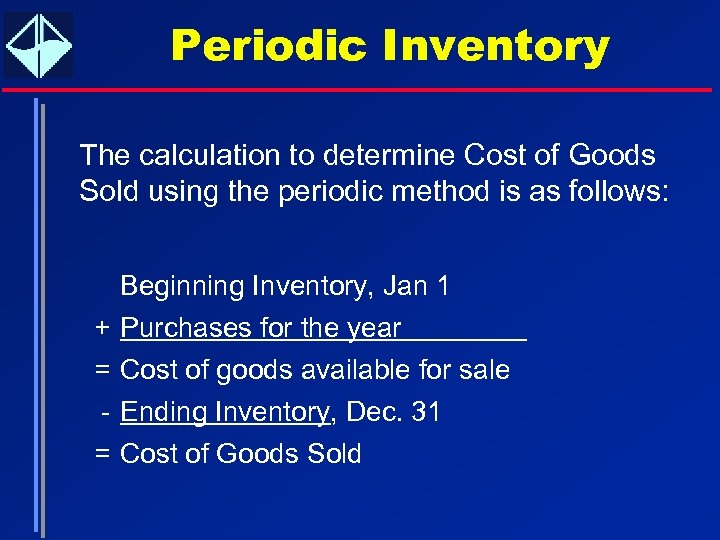 Periodic Inventory The calculation to determine Cost of Goods Sold using the periodic method is as follows: Beginning Inventory, Jan 1 + Purchases for the year = Cost of goods available for sale - Ending Inventory, Dec. 31 = Cost of Goods Sold
 What Is the Sales Returns and Allowances Account? ü Contra Revenue Account to sales ü Used to show much came back in returns and allowances § Excessive returns and allowances suggest: § inferior merchandise § inefficiencies in filing orders § errors in billing customers § mistakes in delivery or shipment of goods
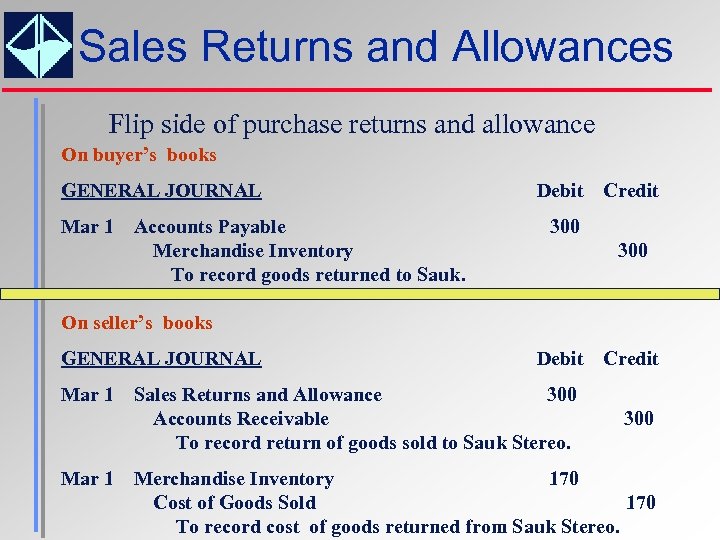 Sales Returns and Allowances Flip side of purchase returns and allowance On buyer’s books GENERAL JOURNAL Mar 1 Accounts Payable Merchandise Inventory To record goods returned to Sauk. Debit Credit 300 On seller’s books GENERAL JOURNAL Mar 1 Debit Sales Returns and Allowance 300 Accounts Receivable To record return of goods sold to Sauk Stereo. Credit 300 Merchandise Inventory 170 Cost of Goods Sold 170 To record cost of goods returned from Sauk Stereo.
 What Is the Sales Discount Account? • Contra Revenue Account to sales • Used to disclose amount of cash discounts given to customers
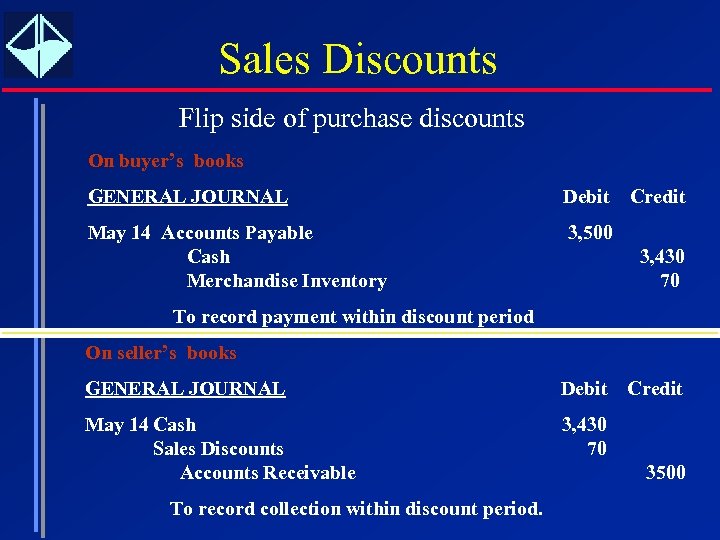 Sales Discounts Flip side of purchase discounts On buyer’s books GENERAL JOURNAL Debit May 14 Accounts Payable Cash Merchandise Inventory Credit 3, 500 3, 430 70 To record payment within discount period On seller’s books GENERAL JOURNAL Debit May 14 Cash Sales Discounts Accounts Receivable 3, 430 70 To record collection within discount period. Credit 3500
 Transportation Costs LOOK OUT !!! It’s not For the part of inventory! Outbound freight
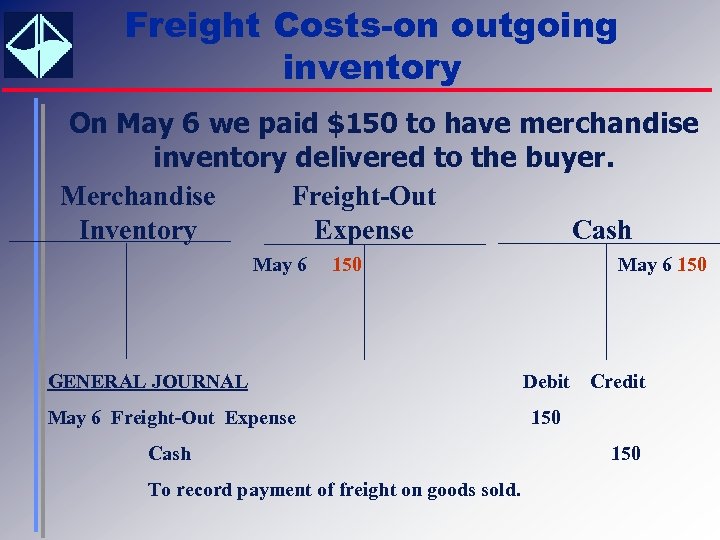 Freight Costs-on outgoing inventory On May 6 we paid $150 to have merchandise inventory delivered to the buyer. Freight-Out Merchandise Expense Inventory Cash May 6 150 GENERAL JOURNAL May 6 Freight-Out Expense Cash To record payment of freight on goods sold. May 6 150 Debit Credit 150
 Two Forms Of Income Statements • Single-step income statement • Multiple-step income statement
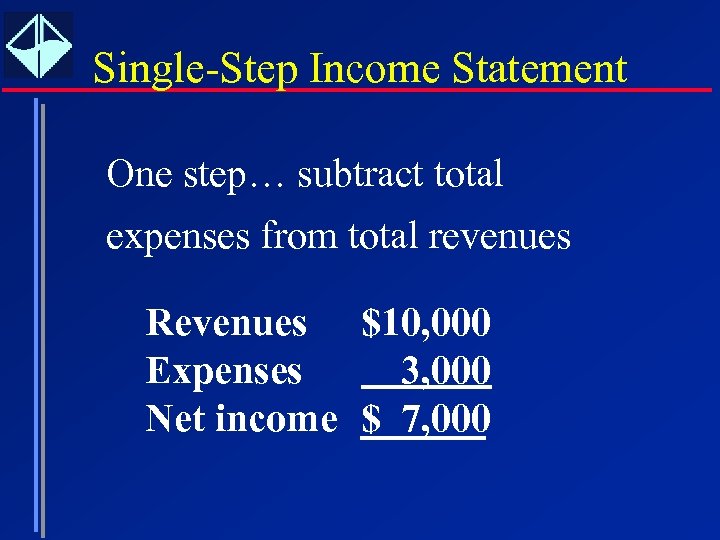 Single-Step Income Statement One step… subtract total expenses from total revenues Revenues $10, 000 Expenses 3, 000 Net income $ 7, 000
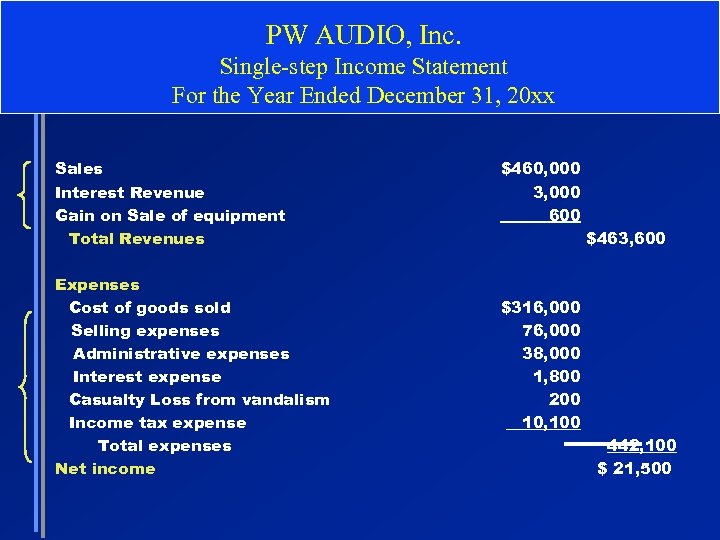 PW AUDIO, Inc. Single-step Income Statement For the Year Ended December 31, 20 xx Sales Interest Revenue Gain on Sale of equipment Total Revenues Expenses Cost of goods sold Selling expenses Administrative expenses Interest expense Casualty Loss from vandalism Income tax expense Total expenses Net income $460, 000 3, 000 600 $463, 600 $316, 000 76, 000 38, 000 1, 800 200 10, 100 442, 100 $ 21, 500
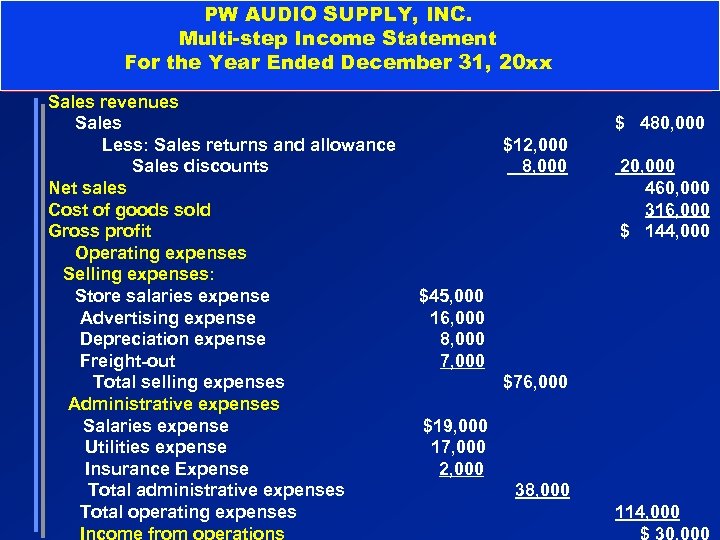 PW AUDIO SUPPLY, INC. Multi-step Income Statement For the Year Ended December 31, 20 xx Sales revenues Sales Less: Sales returns and allowance Sales discounts Net sales Cost of goods sold Gross profit Operating expenses Selling expenses: Store salaries expense Advertising expense Depreciation expense Freight-out Total selling expenses Administrative expenses Salaries expense Utilities expense Insurance Expense Total administrative expenses Total operating expenses Income from operations $ 480, 000 $12, 000 8, 000 20, 000 460, 000 316, 000 $ 144, 000 $45, 000 16, 000 8, 000 7, 000 $76, 000 $19, 000 17, 000 2, 000 38, 000 114, 000 $ 30, 000
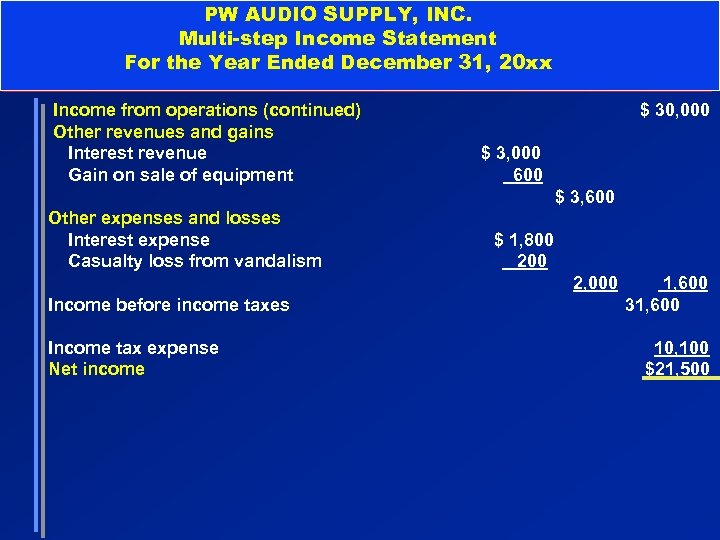 PW AUDIO SUPPLY, INC. Multi-step Income Statement For the Year Ended December 31, 20 xx Income from operations (continued) Other revenues and gains Interest revenue Gain on sale of equipment $ 30, 000 $ 3, 000 600 $ 3, 600 Other expenses and losses Interest expense Casualty loss from vandalism $ 1, 800 2, 000 Income before income taxes Income tax expense Net income 1, 600 31, 600 10, 100 $21, 500
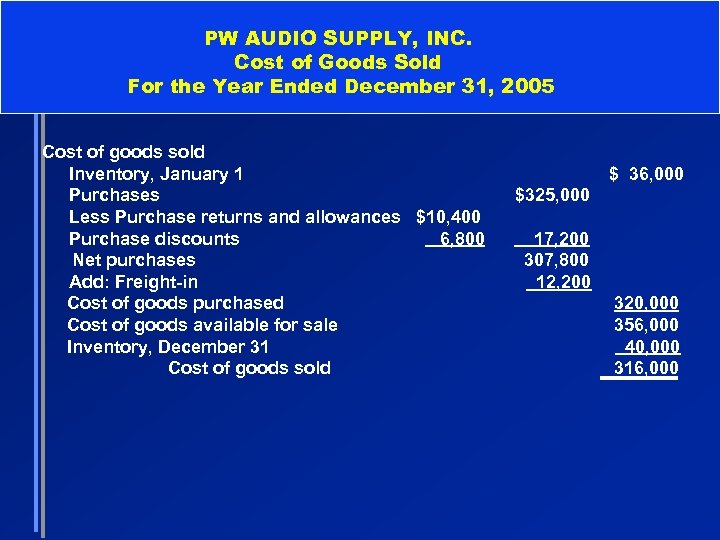 PW AUDIO SUPPLY, INC. Cost of Goods Sold For the Year Ended December 31, 2005 Cost of goods sold Inventory, January 1 Purchases Less Purchase returns and allowances $10, 400 Purchase discounts 6, 800 Net purchases Add: Freight-in Cost of goods purchased Cost of goods available for sale Inventory, December 31 Cost of goods sold $ 36, 000 $325, 000 17, 200 307, 800 12, 200 320, 000 356, 000 40, 000 316, 000
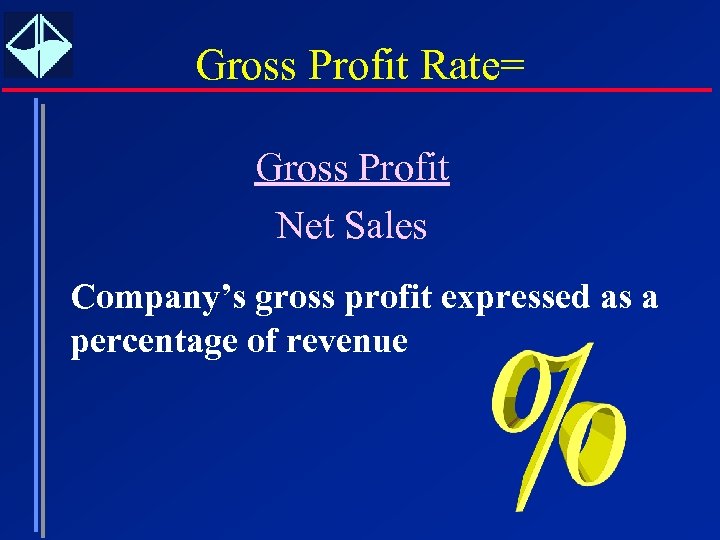 Gross Profit Rate= Gross Profit Net Sales Company’s gross profit expressed as a percentage of revenue
 Profit Margin Ratio Measures the percentage of each dollar of sales that results in net income Profit Margin Ratio = Net Income Net Sales Higher value suggests favorable return on each dollar of sales.
 Now, that wasn’t so bad! Was it?