


 Скачать презентацию Chapter 46 Animal Reproduction Power Point Lecture Presentations
46_lecture_presentation_0.ppt
- Количество слайдов: 81
 Chapter 46 Animal Reproduction Power. Point® Lecture Presentations for Biology Eighth Edition Neil Campbell and Jane Reece Lectures by Chris Romero, updated by Erin Barley with contributions from Joan Sharp Copyright © 2008 Pearson Education, Inc. , publishing as Pearson Benjamin Cummings
 Overview: Pairing Up for Sexual Reproduction • Each earthworm produces sperm and eggs; in a few weeks, new worms will hatch from fertilized eggs. • Animal reproduction takes many forms. • Aspects of animal form and function can be viewed broadly as adaptations contributing to reproductive success. Copyright © 2008 Pearson Education, Inc. , publishing as Pearson Benjamin Cummings
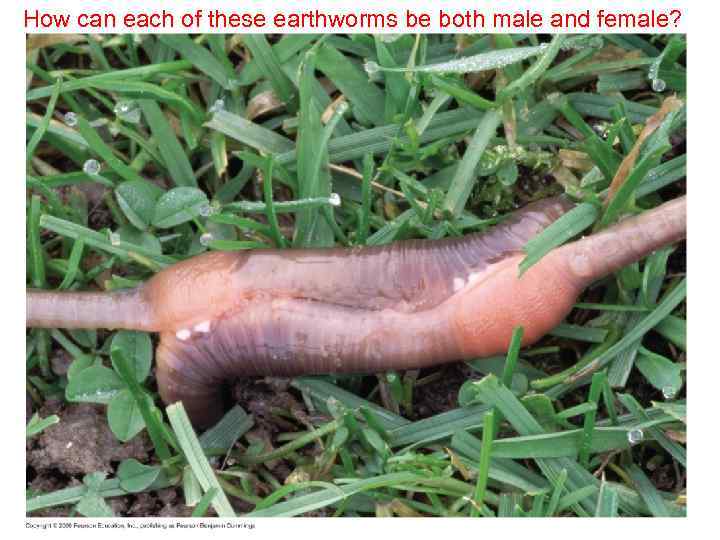 How can each of these earthworms be both male and female?
 Both asexual and sexual reproduction occur in the animal kingdom • Sexual reproduction is the creation of an offspring by fusion of a male gamete (sperm) and female gamete (egg) to form a zygote. • Asexual reproduction is creation of offspring without the fusion of egg and sperm. One parent clones offspring. • Many invertebrates reproduce asexually by fission = separation of a parent into two or more individuals of about the same size. Copyright © 2008 Pearson Education, Inc. , publishing as Pearson Benjamin Cummings
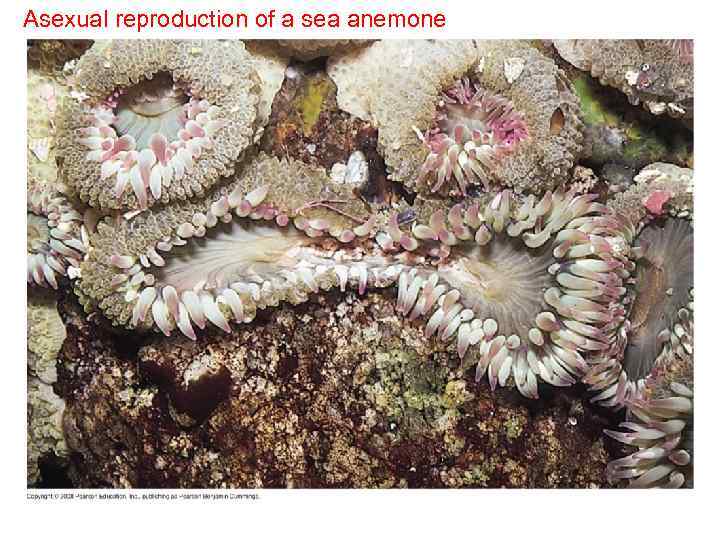 Asexual reproduction of a sea anemone
 Asexual Reproduction • Budding = new individuals arise from outgrowths of existing ones. • Fragmentation = breaking of the body into pieces, some or all of which develop into adults. • Fragmentation must be accompanied by regeneration = regrowth of lost body parts. • Parthenogenesis is the development of a new individual from an unfertilized egg. Copyright © 2008 Pearson Education, Inc. , publishing as Pearson Benjamin Cummings
 Sexual Reproduction: An Evolutionary Enigma • Sexual females have half as many daughters as asexual females; this is the “twofold cost” of sexual reproduction. • Despite this, almost all eukaryotic species reproduce sexually. Copyright © 2008 Pearson Education, Inc. , publishing as Pearson Benjamin Cummings
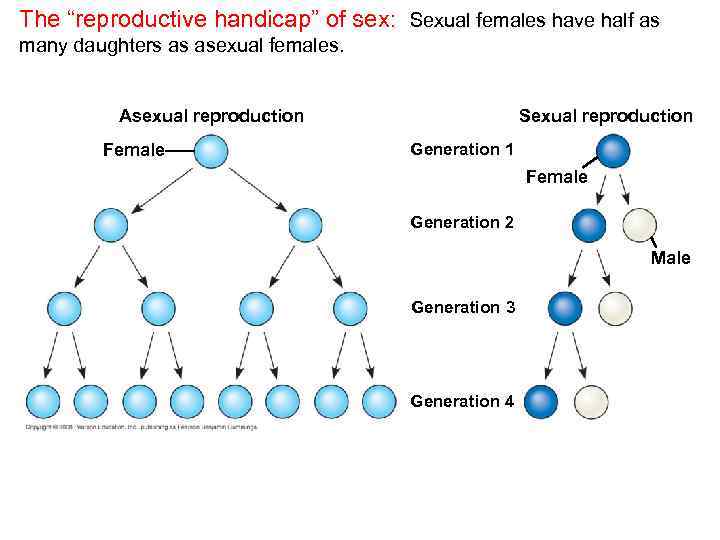 The “reproductive handicap” of sex: Sexual females have half as many daughters as asexual females. Sexual reproduction Asexual reproduction Female Generation 1 Female Generation 2 Male Generation 3 Generation 4
 Sexual reproduction - Variety • Sexual reproduction results in genetic recombination, which provides potential advantages: – An increase in variation in offspring, providing an increase in the reproductive success of parents in changing environments – An increase in the rate of adaptation – A shuffling of genes and the elimination of harmful genes from a population. Copyright © 2008 Pearson Education, Inc. , publishing as Pearson Benjamin Cummings
 Reproductive Cycles and Patterns • Ovulation is the release of mature eggs at the midpoint of a female cycle. • Most animals exhibit reproductive cycles related to changing seasons. • Reproductive cycles are controlled by hormones and environmental cues. • Animals may reproduce asexually or sexually, or they may alternate these methods. Copyright © 2008 Pearson Education, Inc. , publishing as Pearson Benjamin Cummings
 • Sexual reproduction is a special problem for organisms that seldom encounter a mate. • One solution is hermaphroditism = each individual has BOTH male and female reproductive systems. • Some hermaphrodites can self-fertilize. Copyright © 2008 Pearson Education, Inc. , publishing as Pearson Benjamin Cummings
 • Individuals of some species undergo sex reversals. • Some species exhibit male to female reversal (for example, certain oysters), while others exhibit female to male reversal (for example, a coral reef fish). Copyright © 2008 Pearson Education, Inc. , publishing as Pearson Benjamin Cummings
 Fertilization depends on mechanisms that bring together sperm and eggs of the same species • The mechanisms of fertilization, the union of egg and sperm, play an important part in sexual reproduction. • In external fertilization, eggs shed by the female are fertilized by sperm in the external environment. Copyright © 2008 Pearson Education, Inc. , publishing as Pearson Benjamin Cummings
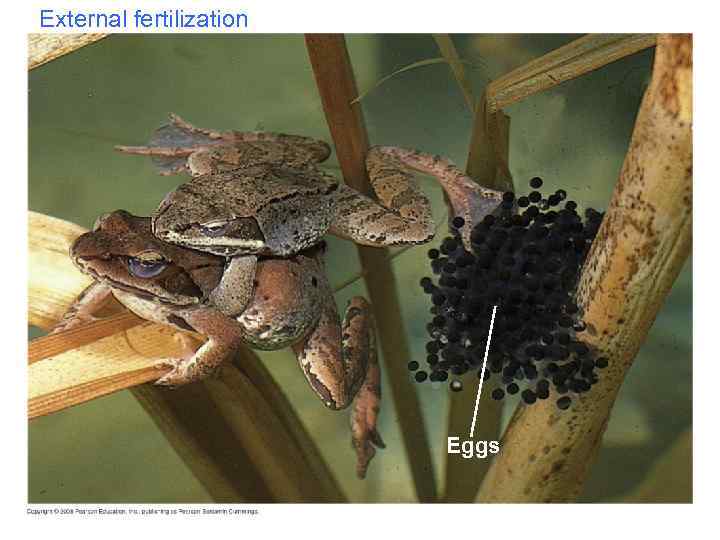 External fertilization Eggs
 • In internal fertilization, sperm are deposited in or near the female reproductive tract, and fertilization occurs within the tract. • Internal fertilization requires behavioral interactions and compatible copulatory organs. • All fertilization requires critical timing, often mediated by environmental cues, pheromones, and/or courtship behavior. Copyright © 2008 Pearson Education, Inc. , publishing as Pearson Benjamin Cummings
 Ensuring the Survival of Offspring • All species produce more offspring than the environment can handle, and the proportion that survives is quite small. • Species with external fertilization produce more gametes than species with internal fertilization. Copyright © 2008 Pearson Education, Inc. , publishing as Pearson Benjamin Cummings
 • Species with internal fertilization provide greater protection of the embryos and more parental care. • The embryos of some terrestrial animals develop in amniote eggs with protective layers. • Some other animals retain the embryo, which develops inside the female. • In many animals, parental care helps ensure survival of offspring. Copyright © 2008 Pearson Education, Inc. , publishing as Pearson Benjamin Cummings
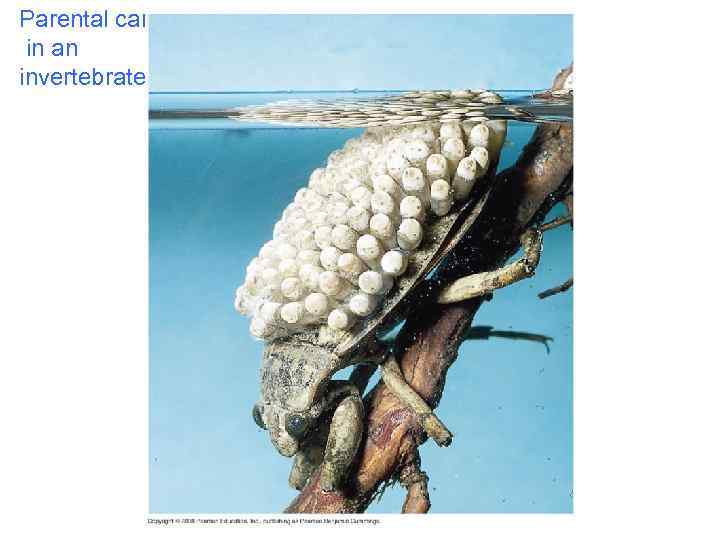 Parental care in an invertebrate
 Animal Gamete Production and Delivery • To reproduce sexually, animals must have systems that produce gametes. • In most species individuals have gonads = sex organs that produce gametes. • Some simple systems do not have gonads, but gametes form from undifferentiated tissue. • The most complex systems contain many sets of accessory tubes and glands that carry, nourish, and protect gametes and developing embryos. Copyright © 2008 Pearson Education, Inc. , publishing as Pearson Benjamin Cummings
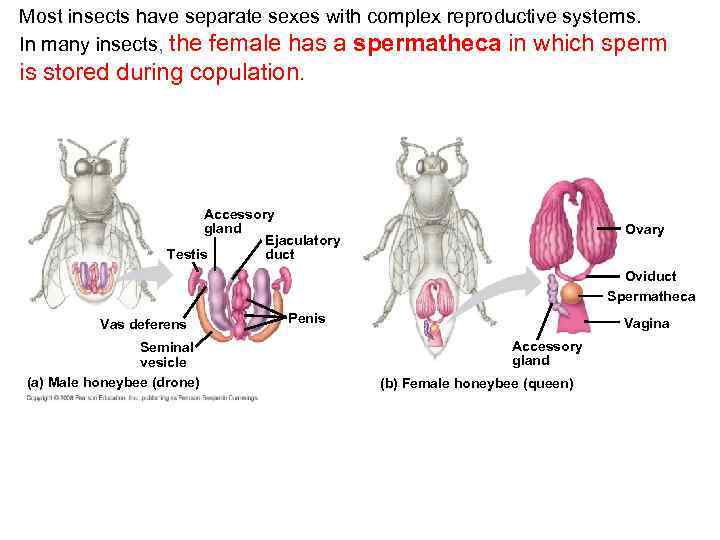 Most insects have separate sexes with complex reproductive systems. In many insects, the female has a spermatheca in which sperm is stored during copulation. Accessory gland Ejaculatory duct Testis Ovary Oviduct Spermatheca Vas deferens Seminal vesicle (a) Male honeybee (drone) Penis Vagina Accessory gland (b) Female honeybee (queen)
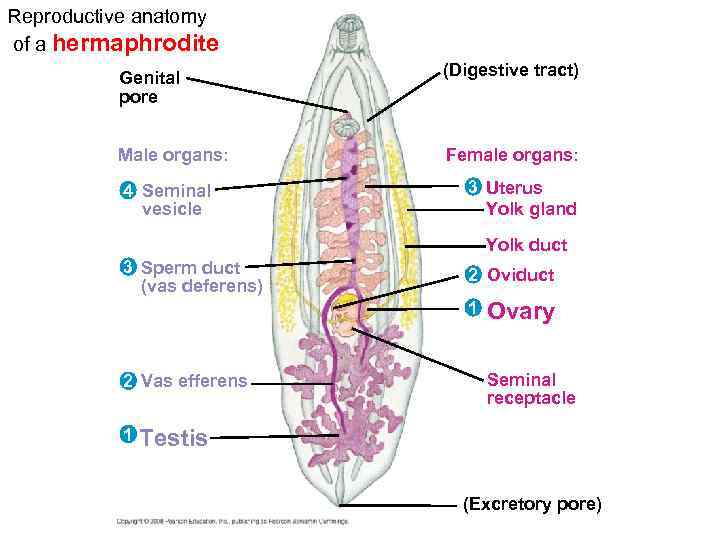 Reproductive anatomy of a hermaphrodite Genital pore (Digestive tract) Male organs: Female organs: 4 Seminal vesicle 3 Uterus Yolk gland Yolk duct 3 Sperm duct (vas deferens) 2 Oviduct 1 2 Vas efferens 1 Ovary Seminal receptacle Testis (Excretory pore)
 • A cloaca is a common opening between the external environment and the digestive, excretory, and reproductive systems. • A cloaca is common in nonmammalian vertebrates; mammals usually have a separate opening to the digestive tract. Copyright © 2008 Pearson Education, Inc. , publishing as Pearson Benjamin Cummings
 Reproductive organs produce and transport gametes • The following section focuses on the human reproductive system. Copyright © 2008 Pearson Education, Inc. , publishing as Pearson Benjamin Cummings
 Ovaries = Female Gonads • The female gonads, the ovaries, lie in the abdominal cavity. • Each ovary contains many follicles, which are egg chambers consisting of a partially developed egg, called an oocyte, surrounded by support cells. • Once a month, an oocyte develops into an ovum (egg) by the process of oogenesis. Copyright © 2008 Pearson Education, Inc. , publishing as Pearson Benjamin Cummings
 • Ovulation expels an egg cell from the follicle. • The remaining follicular tissue grows within the ovary, forming a mass called the corpus luteum. • The corpus luteum secretes hormones that help to maintain pregnancy. • If the egg is not fertilized, the corpus luteum degenerates. Copyright © 2008 Pearson Education, Inc. , publishing as Pearson Benjamin Cummings
 Oviducts and Uterus • The egg cell travels from the ovary to the uterus via an oviduct, or fallopian tube. • Cilia in the oviduct convey the egg to the uterus, also called the womb. • The uterus lining, the endometrium, has many blood vessels. • The uterus narrows at the cervix, then opens into the vagina. Copyright © 2008 Pearson Education, Inc. , publishing as Pearson Benjamin Cummings
 Mammary Glands • The mammary glands are not part of the reproductive system but are important to mammalian reproduction. • Within the glands, small sacs of epithelial tissue secrete milk. Copyright © 2008 Pearson Education, Inc. , publishing as Pearson Benjamin Cummings
 Testes = Male Gonads • The testes consist of highly coiled tubes surrounded by connective tissue. Sperm form in these seminiferous tubules. Leydig cells produce hormones and are scattered between the tubules. • Production of normal sperm cannot occur at the body temperatures of most mammals. So the testes are held outside the abdominal cavity in the scrotum, where the temperature is lower than in the abdominal cavity. Copyright © 2008 Pearson Education, Inc. , publishing as Pearson Benjamin Cummings
 Ducts • From the seminiferous tubules of a testis, mature sperm pass into the coiled tubules of the epididymis. • During ejaculation, sperm are propelled through the muscular vas deferens and the ejaculatory duct, and then exit the penis through the urethra. Copyright © 2008 Pearson Education, Inc. , publishing as Pearson Benjamin Cummings
 Accessory Glands • Semen is composed of sperm plus secretions from three sets of accessory glands. • The two seminal vesicles contribute about 60% of the total volume of semen. • The prostate gland secretes its products directly into the urethra through several small ducts. • The bulbourethral glands secrete a clear mucus before ejaculation that neutralizes acidic urine remaining in the urethra. Copyright © 2008 Pearson Education, Inc. , publishing as Pearson Benjamin Cummings
 The timing and pattern of meiosis in mammals differ for males and females • Gametogenesis = the production of gametes by meiosis. This differs in females and males • Sperm are small and motile and are produced throughout the life of a sexually mature male. • Spermatogenesis is production of mature sperm. Copyright © 2008 Pearson Education, Inc. , publishing as Pearson Benjamin Cummings
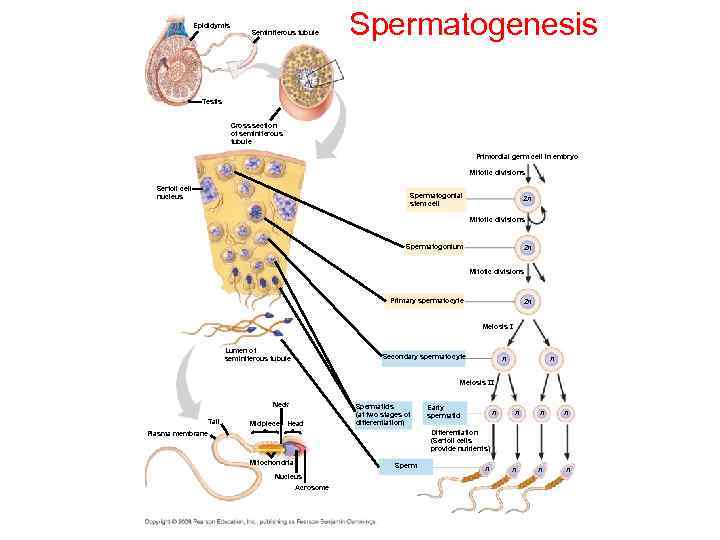 Epididymis Seminiferous tubule Spermatogenesis Testis Cross section of seminiferous tubule Primordial germ cell in embryo Mitotic divisions Sertoli cell nucleus Spermatogonial stem cell 2 n Mitotic divisions Spermatogonium 2 n Mitotic divisions Primary spermatocyte 2 n Meiosis I Lumen of seminiferous tubule Secondary spermatocyte n n Meiosis II Neck Tail Midpiece Head Spermatids (at two stages of differentiation) Early spermatid n n n Differentiation (Sertoli cells provide nutrients) Plasma membrane Mitochondria Sperm Nucleus Acrosome n n
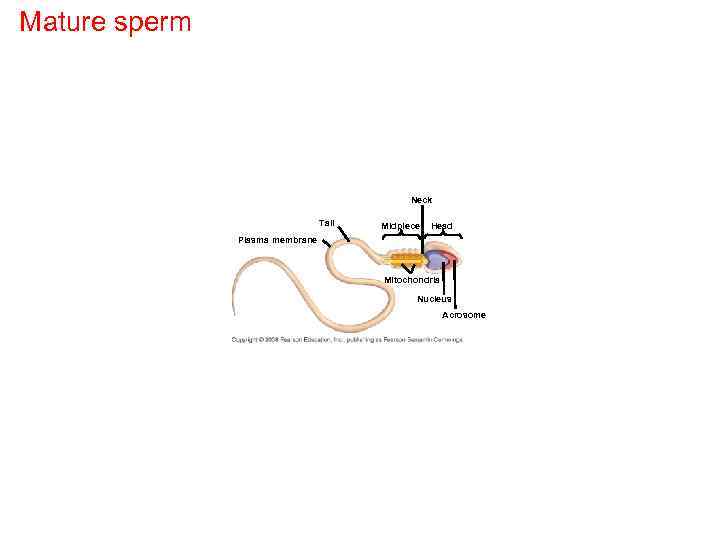 Mature sperm Neck Tail Midpiece Head Plasma membrane Mitochondria Nucleus Acrosome
 • Eggs contain stored nutrients and are much larger. • Oogenesis is development of mature oocytes (eggs) and can take many years. Copyright © 2008 Pearson Education, Inc. , publishing as Pearson Benjamin Cummings
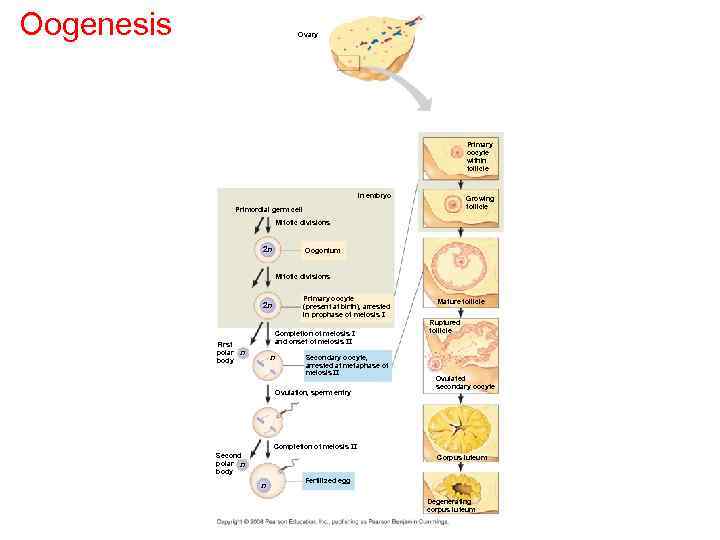 Oogenesis Ovary Primary oocyte within follicle In embryo Growing follicle Primordial germ cell Mitotic divisions 2 n Oogonium Mitotic divisions Primary oocyte (present at birth), arrested in prophase of meiosis I 2 n Completion of meiosis I and onset of meiosis II First polar n body n Secondary oocyte, arrested at metaphase of meiosis II Ovulation, sperm entry Mature follicle Ruptured follicle Ovulated secondary oocyte Completion of meiosis II Second polar n body Corpus luteum n Fertilized egg Degenerating corpus luteum
 Spermatogenesis vs. Oogenesis • Spermatogenesis differs from oogenesis: – In oogenesis, one egg forms from each cycle of meiosis; in spermatogenesis four sperm form from each cycle of meiosis. – Oogenesis ceases later in life in females; spermatogenesis continues throughout the adult life of males. – Oogenesis has long interruptions; spermatogenesis produces sperm from precursor cells in a continuous sequence. Copyright © 2008 Pearson Education, Inc. , publishing as Pearson Benjamin Cummings
 The interplay of tropic and sex hormones regulates mammalian reproduction • Human reproduction is coordinated by hormones from the hypothalamus, anterior pituitary, and gonads. • Gonadotropin-releasing hormone (Gn. RH) is secreted by the hypothalamus and directs the release of FSH and LH from the anterior pituitary. • FSH and LH regulate processes in the gonads and the production of sex hormones. Copyright © 2008 Pearson Education, Inc. , publishing as Pearson Benjamin Cummings
 • The sex hormones are androgens, estrogens, and progesterone. • Sex hormones regulate: – The development of primary sex characteristics during embryogenesis – The development of secondary sex characteristics at puberty – Sexual behavior and sex drive. Copyright © 2008 Pearson Education, Inc. , publishing as Pearson Benjamin Cummings
 Hormonal Control of the Male Reproductive System • FSH promotes the activity of Sertoli cells, which nourish developing sperm and are located within the seminiferous tubules. • LH regulates Leydig cells, which secrete testosterone and other androgen hormones, which in turn promote spermatogenesis. Copyright © 2008 Pearson Education, Inc. , publishing as Pearson Benjamin Cummings
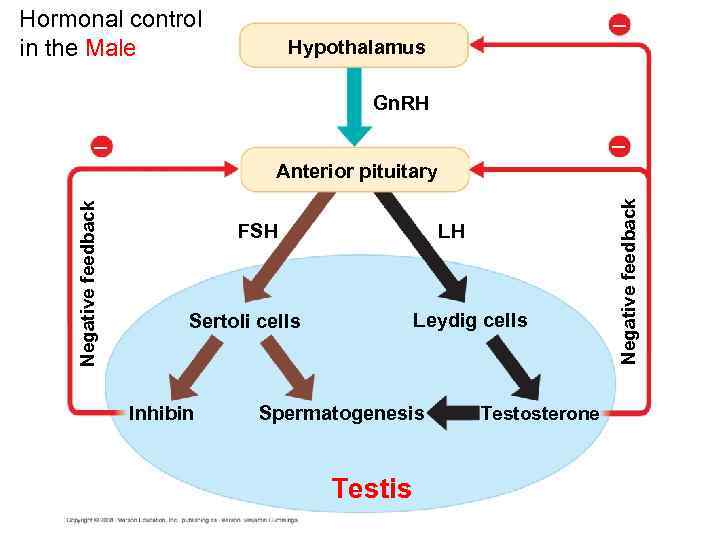 Hormonal control in the Male – Hypothalamus Gn. RH – – FSH LH Leydig cells Sertoli cells Inhibin Spermatogenesis Testosterone Negative feedback Anterior pituitary
 • Testosterone regulates the production of Gn. RH, FSH, and LH through negative feedback mechanisms. • Sertoli cells secrete the hormone inhibin, which reduces FSH secretion from the anterior pituitary. Copyright © 2008 Pearson Education, Inc. , publishing as Pearson Benjamin Cummings
 The Reproductive Cycles of Females • In females, the secretion of hormones and the reproductive events they regulate are cyclic. • Prior to ovulation, the endometrium = uterine lining, thickens with blood vessels in preparation for embryo implantation. • If an embryo does not implant in the endometrium, the endometrium is shed in a process called menstruation. Copyright © 2008 Pearson Education, Inc. , publishing as Pearson Benjamin Cummings
 • Hormones closely link the two cycles of female reproduction: – Changes in the uterus / uterine lining with blood vessels define the menstrual cycle (also called the uterine cycle). – Changes in the ovaries / follicle / egg chamber define the ovarian cycle. Copyright © 2008 Pearson Education, Inc. , publishing as Pearson Benjamin Cummings
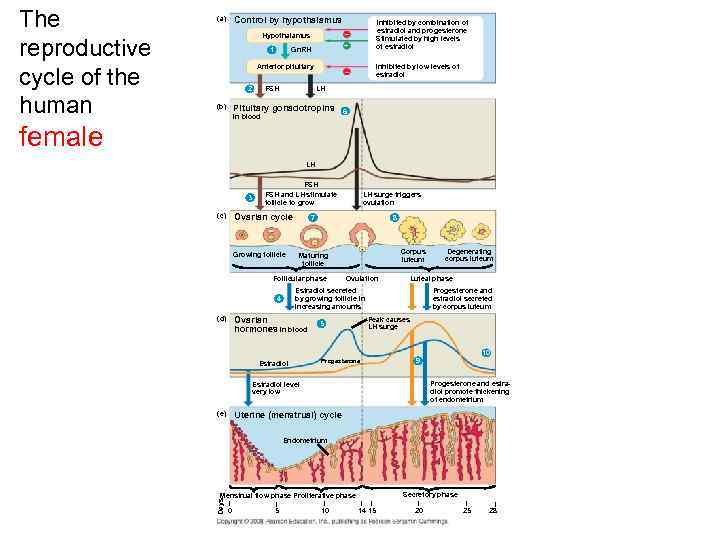 The reproductive cycle of the human Control by hypothalamus (a) Hypothalamus – Gn. RH + Inhibited by combination of estradiol and progesterone Stimulated by high levels of estradiol – Inhibited by low levels of estradiol 1 Anterior pituitary FSH 2 (b) LH Pituitary gonadotropins in blood 6 female LH FSH 3 FSH and LH stimulate follicle to grow Ovarian cycle (c) Growing follicle 7 8 Corpus luteum Maturing follicle Follicular phase Ovulation Ovarian hormones in blood Degenerating corpus luteum Luteal phase Estradiol secreted by growing follicle in increasing amounts 4 (d) LH surge triggers ovulation Progesterone and estradiol secreted by corpus luteum Peak causes LH surge 5 10 Estradiol 9 Progesterone and estradiol promote thickening of endometrium Estradiol level very low Uterine (menstrual) cycle (e) Endometrium Secretory phase Days Menstrual flow phase Proliferative phase | 0 | 5 | 10 | | 14 15 | 20 | 25 | 28
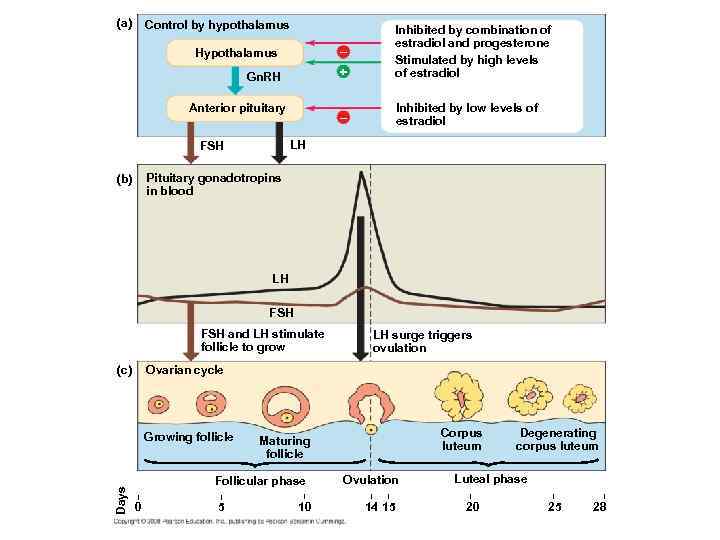 (a) Control by hypothalamus Hypothalamus – Gn. RH + Inhibited by combination of estradiol and progesterone Stimulated by high levels of estradiol – Inhibited by low levels of estradiol Anterior pituitary LH FSH Pituitary gonadotropins in blood (b) LH FSH and LH stimulate follicle to grow Ovarian cycle (c) Growing follicle Days LH surge triggers ovulation Corpus luteum Maturing follicle Follicular phase | | | 0 5 10 Ovulation | | 14 15 Degenerating corpus luteum Luteal phase | 20 | 25 | 28
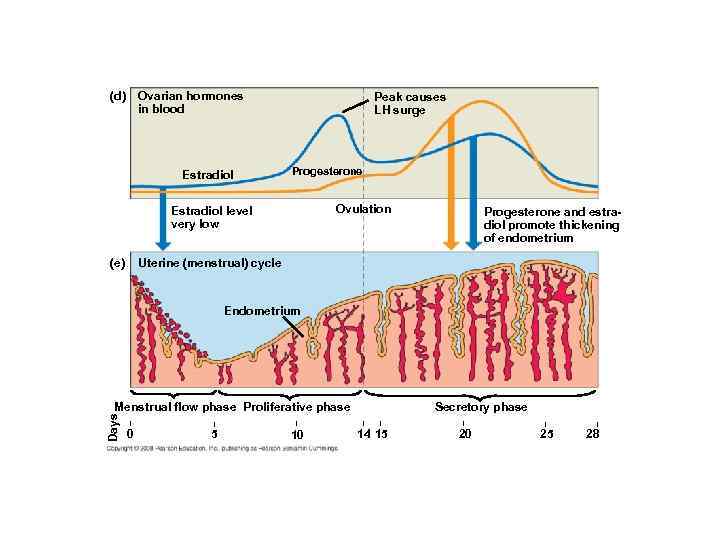 (d) Ovarian hormones in blood Estradiol Peak causes LH surge Progesterone Ovulation Estradiol level very low (e) Progesterone and estradiol promote thickening of endometrium Uterine (menstrual) cycle Endometrium Days Menstrual flow phase Proliferative phase | 0 | | 5 10 Secretory phase | | 14 15 | 20 | 25 | 28
 The Ovarian Cycle • The sequential release of Gn. RH then FSH and LH stimulates follicle growth. • Follicle growth and an increase in the hormone estradiol characterize the follicular phase of the ovarian cycle. • The follicular phase ends at ovulation, and the secondary oocyte is released. Copyright © 2008 Pearson Education, Inc. , publishing as Pearson Benjamin Cummings
 • Following ovulation, the follicular tissue left behind transforms into the corpus luteum; this is the luteal phase. • The corpus luteum disintegrates, and ovarian steroid hormones decrease. Copyright © 2008 Pearson Education, Inc. , publishing as Pearson Benjamin Cummings
 The Uterine (Menstrual) Cycle • Hormones coordinate the uterine cycle with the ovarian cycle: – Thickening of the endometrium during the proliferative phase coordinates with the follicular phase. – Secretion of nutrients during the secretory phase coordinates with the luteal phase. – Shedding of the endometrium during the menstrual flow phase coordinates with the growth of new ovarian follicles. Copyright © 2008 Pearson Education, Inc. , publishing as Pearson Benjamin Cummings
 • A new cycle begins if no embryo implants in the endometrium. • Cells of the uterine lining can sometimes migrate to an abnormal, or ectopic, location. • Swelling of these cells in response to hormone stimulation results in a disorder called endometriosis. Copyright © 2008 Pearson Education, Inc. , publishing as Pearson Benjamin Cummings
 Menopause • After about 500 cycles, human females undergo menopause, the cessation of ovulation and menstruation. • Menopause is very unusual among animals. • Menopause might have evolved to allow a mother to provide better care for her children and grandchildren. Copyright © 2008 Pearson Education, Inc. , publishing as Pearson Benjamin Cummings
 Menstrual vs Estrous Cycles • Menstrual cycles are characteristic of humans and some other primates: – The endometrium is shed from the uterus in a bleeding called menstruation – Sexual receptivity is not limited to a timeframe. Copyright © 2008 Pearson Education, Inc. , publishing as Pearson Benjamin Cummings
 • Estrous cycles are characteristic of most mammals: – The endometrium is reabsorbed by the uterus – Sexual receptivity is limited to a “heat” period – The length and frequency of estrus cycles varies from species to species. Copyright © 2008 Pearson Education, Inc. , publishing as Pearson Benjamin Cummings
 In placental mammals, an embryo develops fully within the mother’s uterus • An egg develops into an embryo in a series of predictable events. Copyright © 2008 Pearson Education, Inc. , publishing as Pearson Benjamin Cummings
 Conception, Embryonic Development, and Birth • Conception = fertilization of an egg by a sperm, occurs in the oviduct. • The resulting zygote begins to divide by mitosis in a process called cleavage. • Division of cells gives rise to a blastocyst, a ball of cells with a cavity. Copyright © 2008 Pearson Education, Inc. , publishing as Pearson Benjamin Cummings
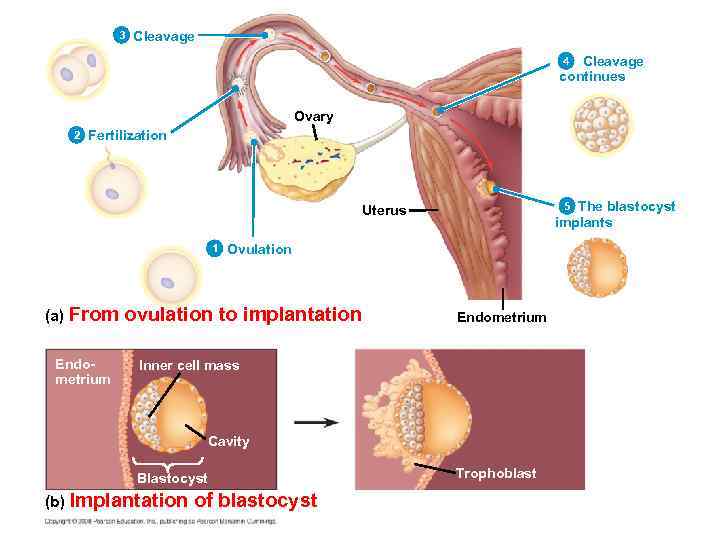 3 Cleavage continues 4 Ovary 2 Fertilization The blastocyst implants 5 Uterus 1 (a) From Endometrium Ovulation ovulation to implantation Endometrium Inner cell mass Cavity Blastocyst (b) Implantation of blastocyst Trophoblast
 • After blastocyst formation, the embryo implants into the endometrium. • The embryo releases human chorionic gonadotropin (h. CG), which prevents menstruation. • Pregnancy, or gestation, is the condition of carrying one or more embryos in the uterus. • Duration of pregnancy in other species correlates with body size and maturity of the young at birth. Copyright © 2008 Pearson Education, Inc. , publishing as Pearson Benjamin Cummings
 • Pregnancies can terminate spontaneously due to chromosomal or developmental abnormalities. • An ectopic pregnancy occurs when a fertilized egg begins to develop in the fallopian tube. Copyright © 2008 Pearson Education, Inc. , publishing as Pearson Benjamin Cummings
 First Trimester • Human gestation can be divided into three trimesters of about three months each. • The first trimester is the time of most radical change for both the mother and the embryo. • During implantation, the endometrium grows over the blastocyst. Copyright © 2008 Pearson Education, Inc. , publishing as Pearson Benjamin Cummings
 • During its first 2 to 4 weeks, the embryo obtains nutrients directly from the endometrium. • Meanwhile, the outer layer of the blastocyst, called the trophoblast, mingles with the endometrium and eventually forms the placenta. • Blood from the embryo travels to the placenta through arteries of the umbilical cord and returns via the umbilical vein. Copyright © 2008 Pearson Education, Inc. , publishing as Pearson Benjamin Cummings
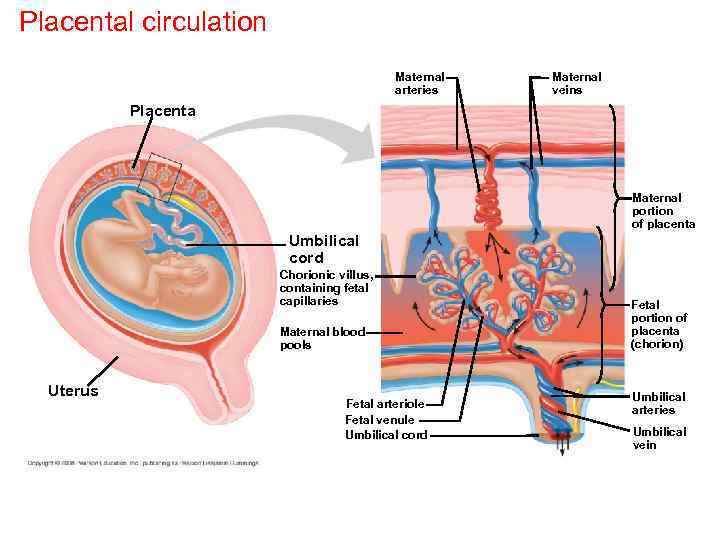 Placental circulation Maternal arteries Maternal veins Placenta Maternal portion of placenta Umbilical cord Chorionic villus, containing fetal capillaries Maternal blood pools Uterus Fetal arteriole Fetal venule Umbilical cord Fetal portion of placenta (chorion) Umbilical arteries Umbilical vein
 • Splitting of the embryo during the first month of development results in genetically identical twins. Release and fertilization of two eggs results in fraternal and genetically distinct twins. • The first trimester is the main period of organogenesis = development of the body organs. • All the major structures are present by 8 weeks, and the embryo is called a fetus. Copyright © 2008 Pearson Education, Inc. , publishing as Pearson Benjamin Cummings
 • Changes occur in the mother: – Growth of the placenta – Cessation of ovulation and the menstrual cycle – Breast enlargement – Nausea is also very common. Copyright © 2008 Pearson Education, Inc. , publishing as Pearson Benjamin Cummings
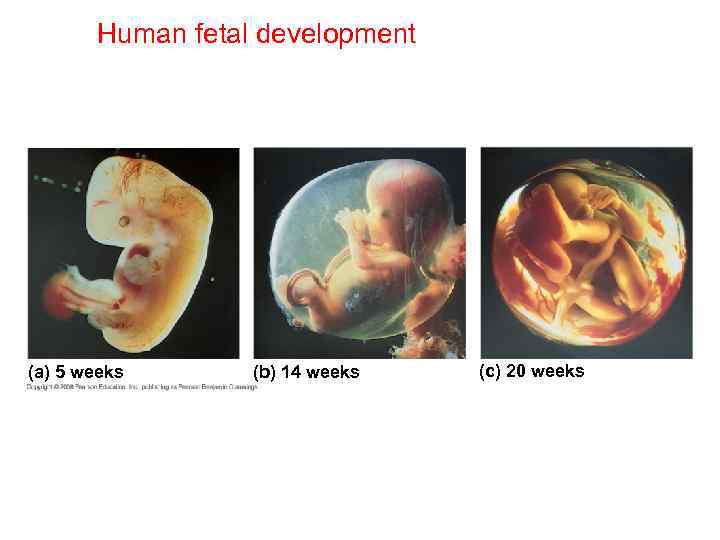 Human fetal development (a) 5 weeks (b) 14 weeks (c) 20 weeks
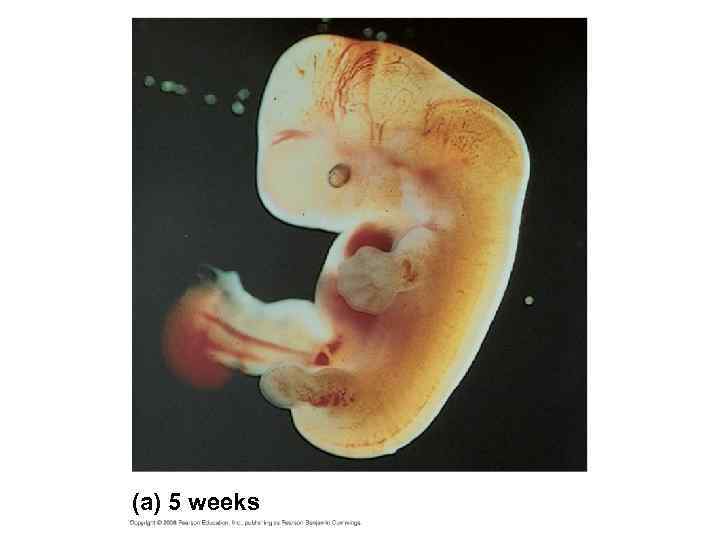 (a) 5 weeks
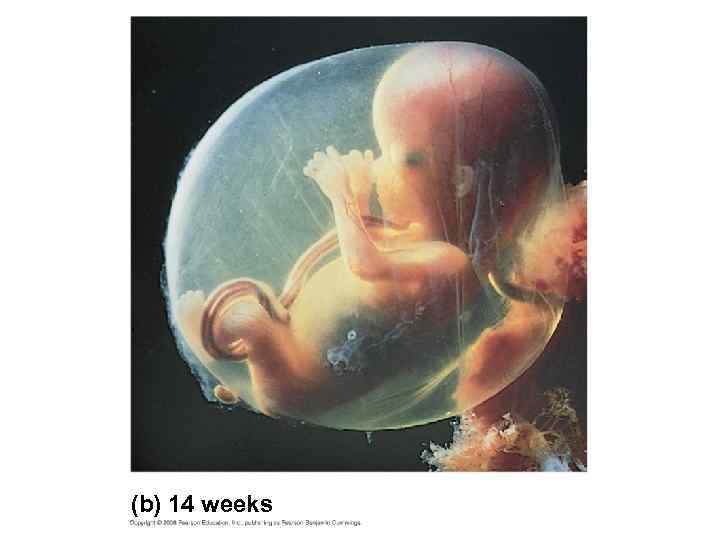 (b) 14 weeks
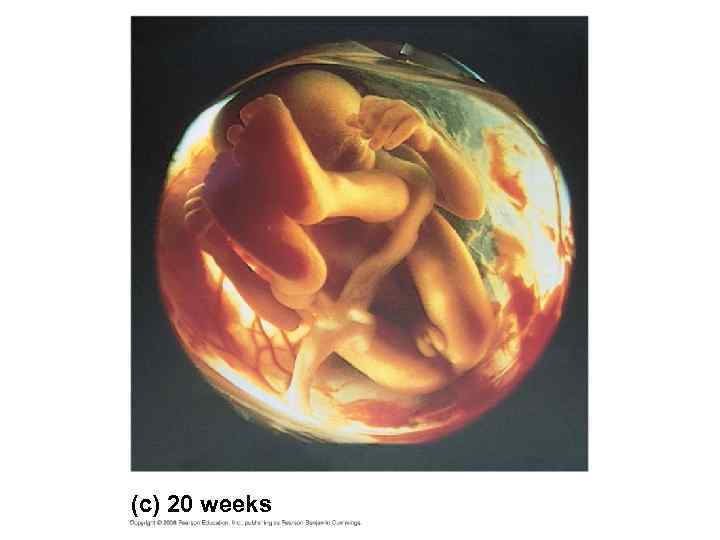 (c) 20 weeks
 Second Trimester • During the second trimester: – The fetus grows and is very active – The mother may feel fetal movements – The uterus grows enough for the pregnancy to become obvious. Copyright © 2008 Pearson Education, Inc. , publishing as Pearson Benjamin Cummings
 Third Trimester • During the third trimester, the fetus grows and fills the space within the embryonic membranes. • A complex interplay of local regulators and hormones induces and regulates labor, the process by which childbirth occurs. Copyright © 2008 Pearson Education, Inc. , publishing as Pearson Benjamin Cummings
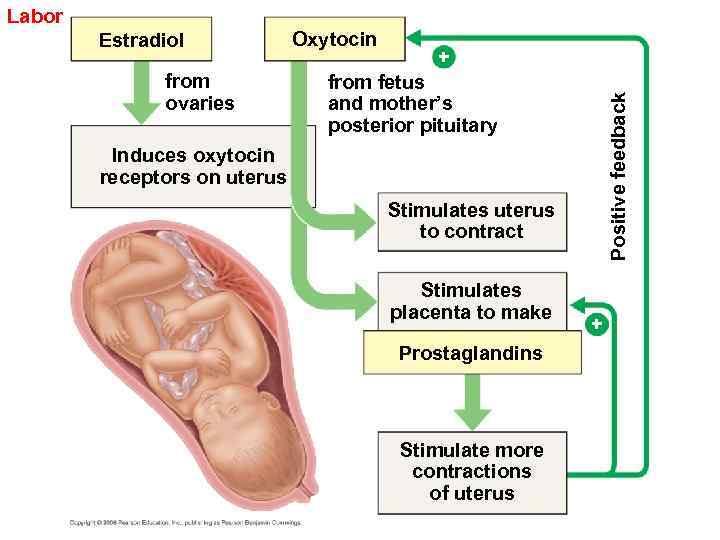 Labor from ovaries Oxytocin + from fetus and mother’s posterior pituitary Positive feedback Estradiol Induces oxytocin receptors on uterus Stimulates uterus to contract Stimulates placenta to make Prostaglandins Stimulate more contractions of uterus +
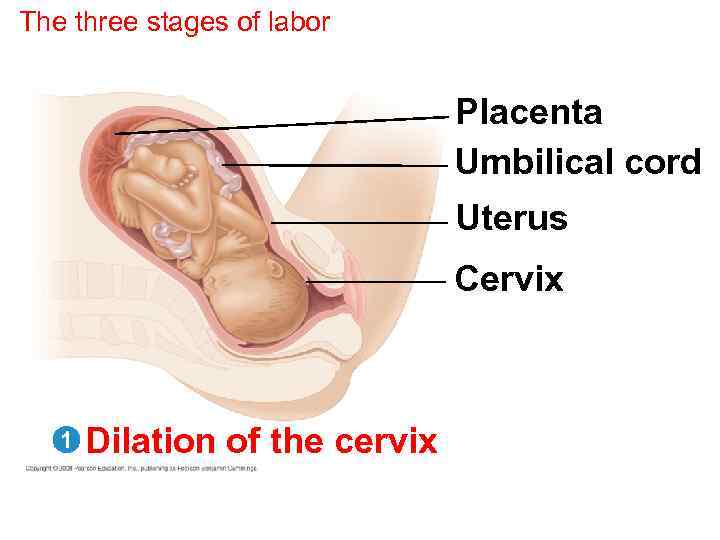 The three stages of labor Placenta Umbilical cord Uterus Cervix 1 Dilation of the cervix
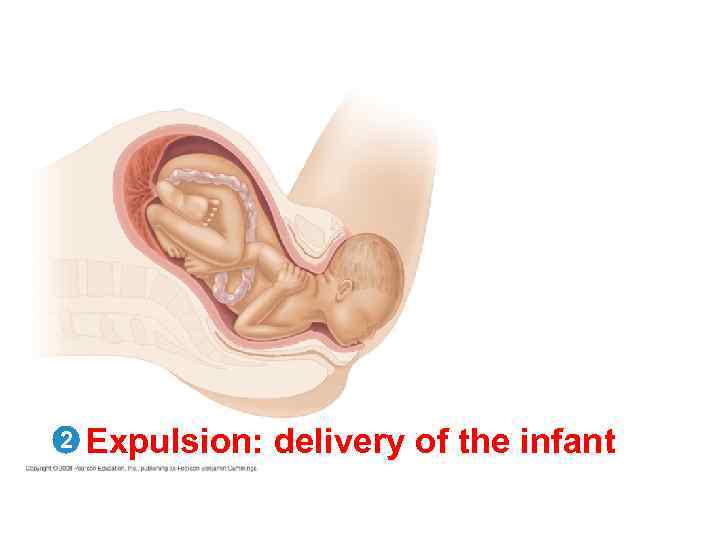 2 Expulsion: delivery of the infant
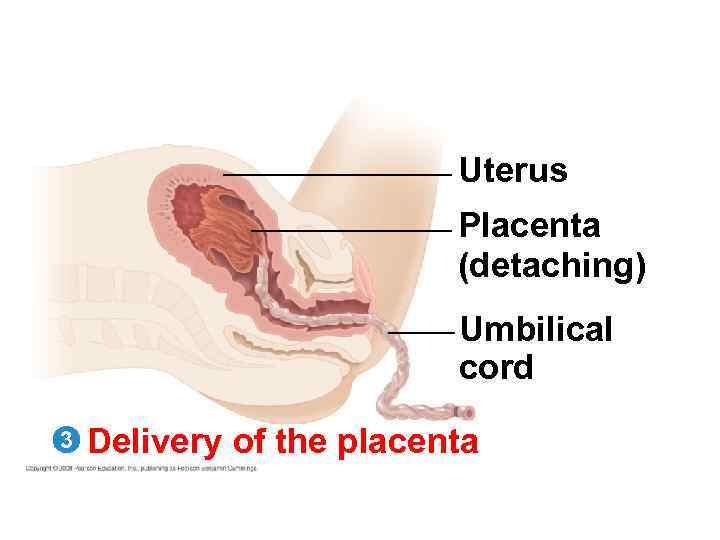 Uterus Placenta (detaching) Umbilical cord 3 Delivery of the placenta
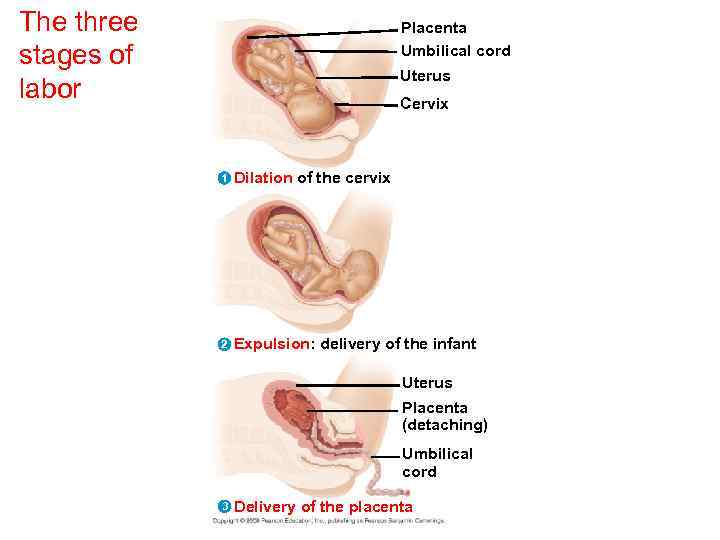 The three stages of labor Placenta Umbilical cord Uterus Cervix 1 Dilation of the cervix 2 Expulsion: delivery of the infant Uterus Placenta (detaching) Umbilical cord 3 Delivery of the placenta
 • Birth, or parturition, is brought about by a series of strong, rhythmic uterine contractions. • First the baby is delivered, and then the placenta. • Lactation = the production of milk. This is unique to mammals. Copyright © 2008 Pearson Education, Inc. , publishing as Pearson Benjamin Cummings
 Maternal Immune Tolerance of the Embryo and Fetus • A woman’s acceptance of her “foreign” offspring is not fully understood. • It may be due to suppression of the immune response in her uterus. Copyright © 2008 Pearson Education, Inc. , publishing as Pearson Benjamin Cummings
 Detecting Disorders During Pregnancy • Amniocentesis and chorionic villus sampling are invasive techniques in which amniotic fluid or fetal cells are obtained for genetic analysis. • Noninvasive procedures usually use ultrasound imaging to detect fetal condition. • Genetic testing of the fetus poses ethical questions and can present parents with difficult decisions. Copyright © 2008 Pearson Education, Inc. , publishing as Pearson Benjamin Cummings
 Treating Infertility • Modern technology can provide infertile couples with assisted reproductive technologies. • In vitro fertilization (IVF) mixes eggs with sperm in culture dishes and returns the embryo to the uterus at the 8 cell stage. • Sperm are injected directly into an egg in a type of IVF called intracytoplasmic sperm injection (ICSI). Copyright © 2008 Pearson Education, Inc. , publishing as Pearson Benjamin Cummings
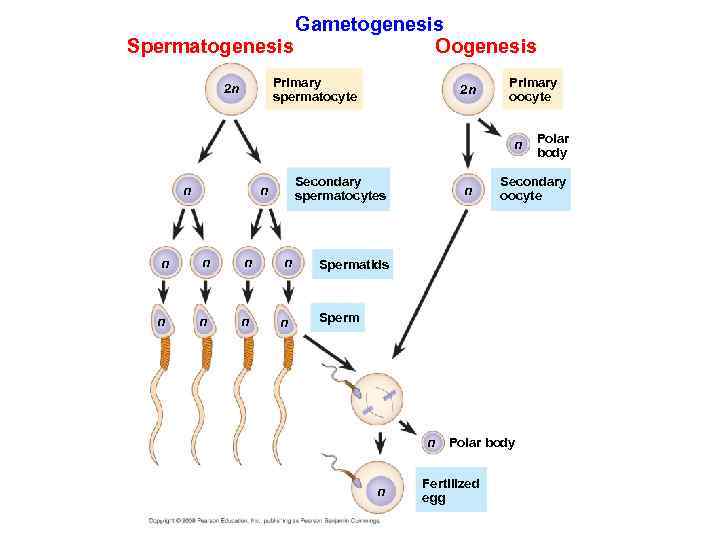 Gametogenesis Oogenesis Spermatogenesis Primary spermatocyte 2 n 2 n Primary oocyte n Polar body n Secondary spermatocytes n n n n n Secondary oocyte Spermatids Sperm n Polar body n Fertilized egg
 You should now be able to: 1. Distinguish between asexual and sexual reproduction. 2. Explain how hermaphroditism may be advantageous to animals that have difficulty encountering a member of the opposite sex. 3. Describe various ways in which animals may protect developing embryos. 4. Using diagrams, identify and state the function of each component of the male and female reproductive systems. Copyright © 2008 Pearson Education, Inc. , publishing as Pearson Benjamin Cummings
 5. Describe oogenesis and spermatogenesis; describe three major differences between them. 6. Explain how the uterine and ovarian cycles are synchronized and describe the functions of the hormones involved. 7. List the various methods of contraception, how each works. 8. Describe techniques that allow us to learn about the health and genetics of a fetus. Copyright © 2008 Pearson Education, Inc. , publishing as Pearson Benjamin Cummings