


 Скачать презентацию CHAPTER 4 Win-Win Negotiation Expanding the Pie 4
c8239b02b7ac2bd553919af2deff4107.ppt
- Количество слайдов: 10
 CHAPTER 4 Win-Win Negotiation: Expanding the Pie 4 -1
 CHAPTER 4 4 -2 Faulty Perceptions of Win-Win Negotiation • • Compromise Even split Satisfaction Building a relationship Instructor’s Manual with Overheads to accompany The Mind and Heart of the Negotiator 5/e (Thompson) Copyright © 2012 Pearson Education, Inc. publishing as Prentice Hall
 CHAPTER 4 4 -3 Telltale Signs of Win-Win Potential • • Does the negotiation contain more than one issue? Can other issues be brought in? Can side deals be made? Do parties have different preferences across negotiation issues? Instructor’s Manual with Overheads to accompany The Mind and Heart of the Negotiator 5/e (Thompson) Copyright © 2012 Pearson Education, Inc. publishing as Prentice Hall
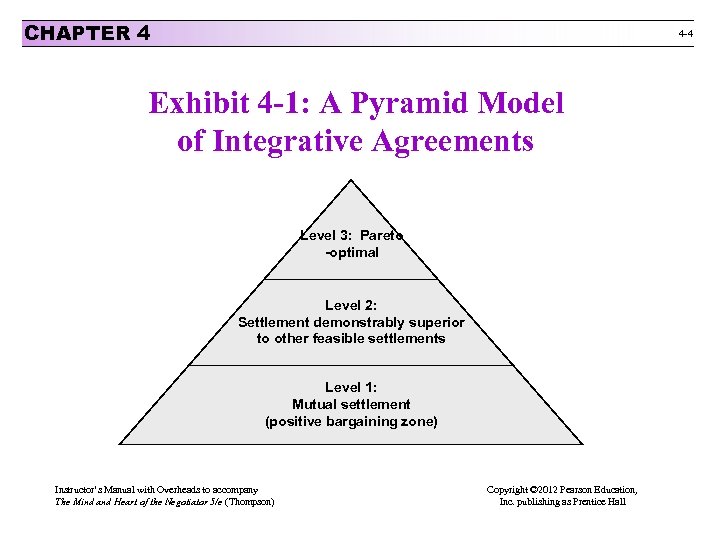 CHAPTER 4 4 -4 Exhibit 4 -1: A Pyramid Model of Integrative Agreements Level 3: Pareto -optimal Level 2: Settlement demonstrably superior to other feasible settlements Level 1: Mutual settlement (positive bargaining zone) Instructor’s Manual with Overheads to accompany The Mind and Heart of the Negotiator 5/e (Thompson) Copyright © 2012 Pearson Education, Inc. publishing as Prentice Hall
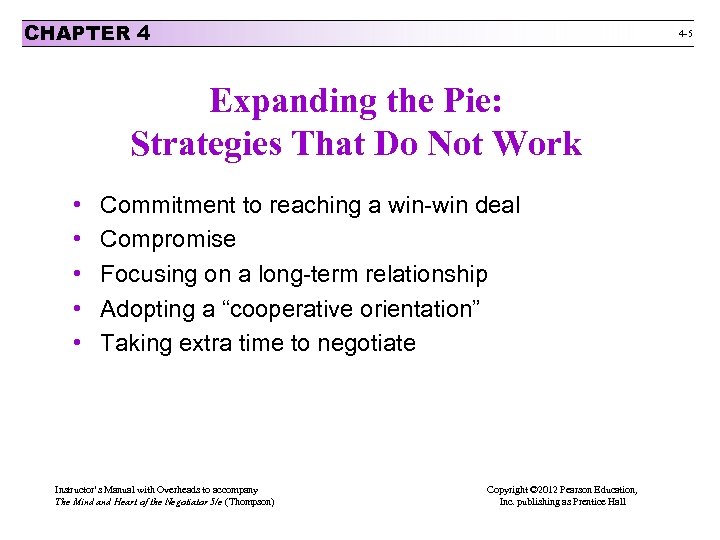 CHAPTER 4 4 -5 Expanding the Pie: Strategies That Do Not Work • • • Commitment to reaching a win-win deal Compromise Focusing on a long-term relationship Adopting a “cooperative orientation” Taking extra time to negotiate Instructor’s Manual with Overheads to accompany The Mind and Heart of the Negotiator 5/e (Thompson) Copyright © 2012 Pearson Education, Inc. publishing as Prentice Hall
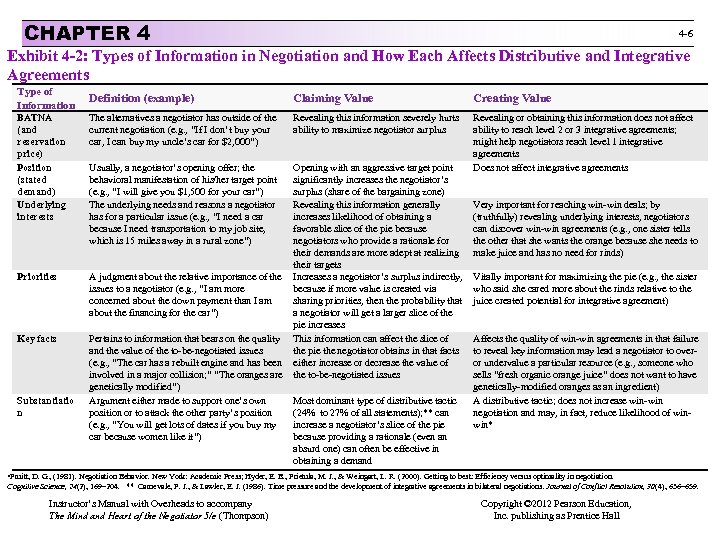 CHAPTER 4 4 -6 Exhibit 4 -2: Types of Information in Negotiation and How Each Affects Distributive and Integrative Agreements Type of Information BATNA (and reservation price) Position (stated demand) Underlying interests Priorities Key facts Substantiatio n Definition (example) Claiming Value Creating Value The alternatives a negotiator has outside of the current negotiation (e. g. , “If I don’t buy your car, I can buy my uncle’s car for $2, 000”) Revealing this information severely hurts ability to maximize negotiator surplus Revealing or obtaining this information does not affect ability to reach level 2 or 3 integrative agreements; might help negotiators reach level 1 integrative agreements Does not affect integrative agreements Usually, a negotiator’s opening offer; the behavioral manifestation of his/her target point (e. g. , “I will give you $1, 500 for your car”) The underlying needs and reasons a negotiator has for a particular issue (e. g. , “I need a car because I need transportation to my job site, which is 15 miles away in a rural zone”) Opening with an aggressive target point significantly increases the negotiator’s surplus (share of the bargaining zone) Revealing this information generally increases likelihood of obtaining a favorable slice of the pie because negotiators who provide a rationale for their demands are more adept at realizing their targets A judgment about the relative importance of the Increases a negotiator’s surplus indirectly, issues to a negotiator (e. g. , “I am more because if more value is created via concerned about the down payment than I am sharing priorities, then the probability that about the financing for the car”) a negotiator will get a larger slice of the pie increases Pertains to information that bears on the quality This information can affect the slice of and the value of the to-be-negotiated issues the pie the negotiator obtains in that facts (e. g. , “The car has a rebuilt engine and has been either increase or decrease the value of involved in a major collision; ” “The oranges are the to-be-negotiated issues genetically modified”) Argument either made to support one’s own Most dominant type of distributive tactic position or to attack the other party’s position (24% to 27% of all statements); ** can (e. g. , “You will get lots of dates if you buy my increase a negotiator’s slice of the pie car because women like it”) because providing a rationale (even an absurd one) can often be effective in obtaining a demand Very important for reaching win-win deals; by (truthfully) revealing underlying interests, negotiators can discover win-win agreements (e. g. , one sister tells the other that she wants the orange because she needs to make juice and has no need for rinds) Vitally important for maximizing the pie (e. g. , the sister who said she cared more about the rinds relative to the juice created potential for integrative agreement) Affects the quality of win-win agreements in that failure to reveal key information may lead a negotiator to over- or undervalue a particular resource (e. g. , someone who sells “fresh organic orange juice” does not want to have genetically-modified oranges as an ingredient) A distributive tactic; does not increase win-win negotiation and may, in fact, reduce likelihood of winwin* • Pruitt, D. G. , (1981). Negotiation Behavior. New York: Academic Press; Hyder, E. B. , Prietula, M. J. , & Weingart, L. R. (2000). Getting to best: Efficiency versus optimality in negotiation. Cognitive Science, 24(2), 169– 204. ** Carnevale, P. J. , & Lawler, E. J. (1986). Time pressure and the development of integrative agreements in bilateral negotiations. Journal of Conflict Resolution, 30(4), 636– 659. Instructor’s Manual with Overheads to accompany The Mind and Heart of the Negotiator 5/e (Thompson) Copyright © 2012 Pearson Education, Inc. publishing as Prentice Hall
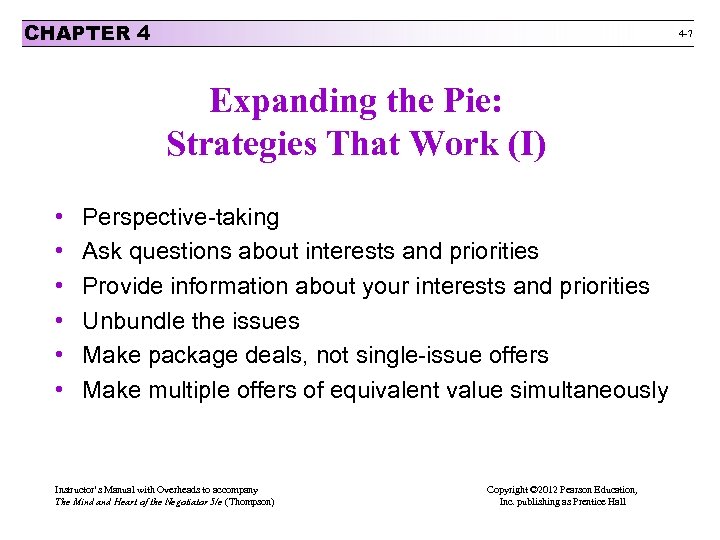 CHAPTER 4 4 -7 Expanding the Pie: Strategies That Work (I) • • • Perspective-taking Ask questions about interests and priorities Provide information about your interests and priorities Unbundle the issues Make package deals, not single-issue offers Make multiple offers of equivalent value simultaneously Instructor’s Manual with Overheads to accompany The Mind and Heart of the Negotiator 5/e (Thompson) Copyright © 2012 Pearson Education, Inc. publishing as Prentice Hall
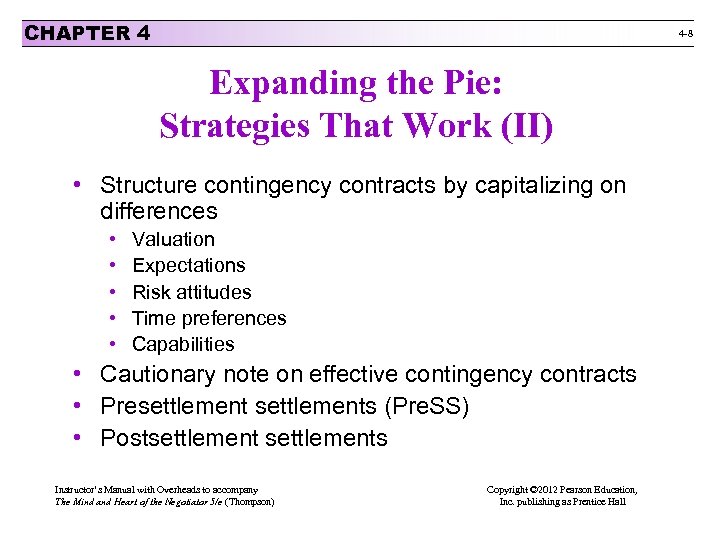 CHAPTER 4 4 -8 Expanding the Pie: Strategies That Work (II) • Structure contingency contracts by capitalizing on differences • • • Valuation Expectations Risk attitudes Time preferences Capabilities • Cautionary note on effective contingency contracts • Presettlements (Pre. SS) • Postsettlements Instructor’s Manual with Overheads to accompany The Mind and Heart of the Negotiator 5/e (Thompson) Copyright © 2012 Pearson Education, Inc. publishing as Prentice Hall
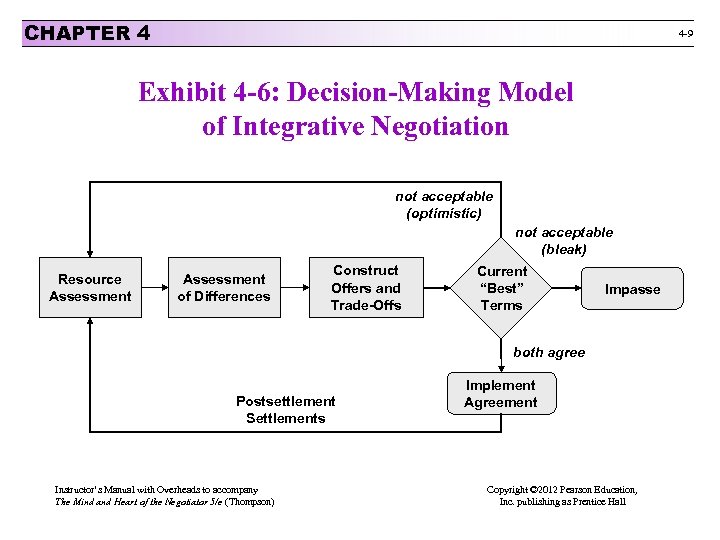 CHAPTER 4 4 -9 Exhibit 4 -6: Decision-Making Model of Integrative Negotiation not acceptable (optimistic) not acceptable (bleak) Resource Assessment of Differences Construct Offers and Trade-Offs Current “Best” Terms Impasse both agree Postsettlement Settlements Instructor’s Manual with Overheads to accompany The Mind and Heart of the Negotiator 5/e (Thompson) Implement Agreement Copyright © 2012 Pearson Education, Inc. publishing as Prentice Hall
 CHAPTER 4 • All rights reserved. No part of this publication may be reproduced, stored in a retrieval system, or transmitted, in any form or by any means, electronic, mechanical, photocopying, recording, or otherwise, without the prior written permission of the publisher. Printed in the United States of America. • Copyright © 2012 Pearson Education, Inc. publishing as Prentice Hall 4 -10