


 Скачать презентацию CHAPTER 4 The Financial Environment Markets Institutions and
20a3185e9d433c86edb8a3ebff18c094.ppt
- Количество слайдов: 29
 CHAPTER 4 The Financial Environment: Markets, Institutions, and Interest Rates n n Financial markets Types of financial institutions Determinants of interest rates Yield curves 4 -1
 What is a market? n n A market is a venue where goods and services are exchanged. A financial market is a place where individuals and organizations wanting to borrow funds are brought together with those having a surplus of funds. 4 -2
 Types of financial markets n n n Physical assets vs. Financial assets Money vs. Capital Primary vs. Secondary Spot vs. Futures Public vs. Private 4 -3
 How is capital transferred between savers and borrowers? n n n Direct transfers Investment banking house Financial intermediaries 4 -4
 Types of financial intermediaries n n n n Commercial banks Savings and loan associations Mutual savings banks Credit unions Pension funds Life insurance companies Mutual funds 4 -5
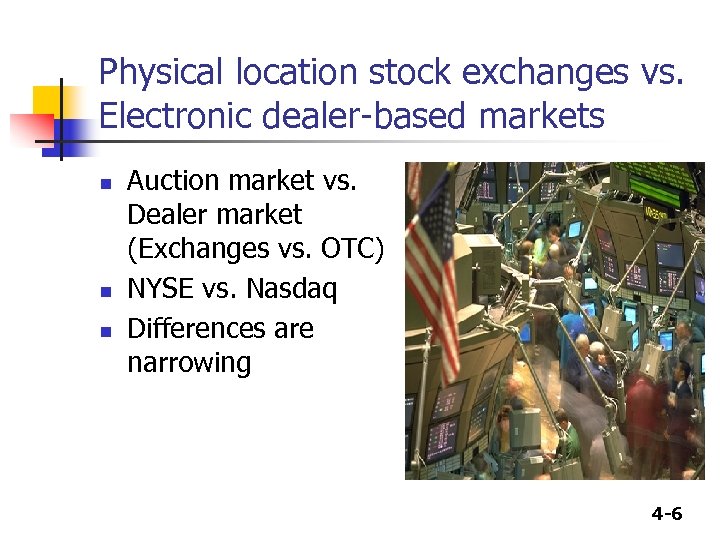 Physical location stock exchanges vs. Electronic dealer-based markets n n n Auction market vs. Dealer market (Exchanges vs. OTC) NYSE vs. Nasdaq Differences are narrowing 4 -6
 The cost of money n n The price, or cost, of debt capital is the interest rate. The price, or cost, of equity capital is the required return. The required return investors expect is composed of compensation in the form of dividends and capital gains. 4 -7
 What four factors affect the cost of money? n n Production opportunities Time preferences for consumption Risk Expected inflation 4 -8
 “Nominal” vs. “Real” rates k = represents any nominal rate k* = represents the “real” risk-free rate of interest. Like a T-bill rate, if there was no inflation. Typically ranges from 1% to 4% per year. k. RF = represents the rate of interest on Treasury securities. 4 -9
 Determinants of interest rates k = k* + IP + DRP + LP + MRP k k* IP DRP LP MRP = = = required return on a debt security real risk-free rate of interest inflation premium default risk premium liquidity premium maturity risk premium 4 -10
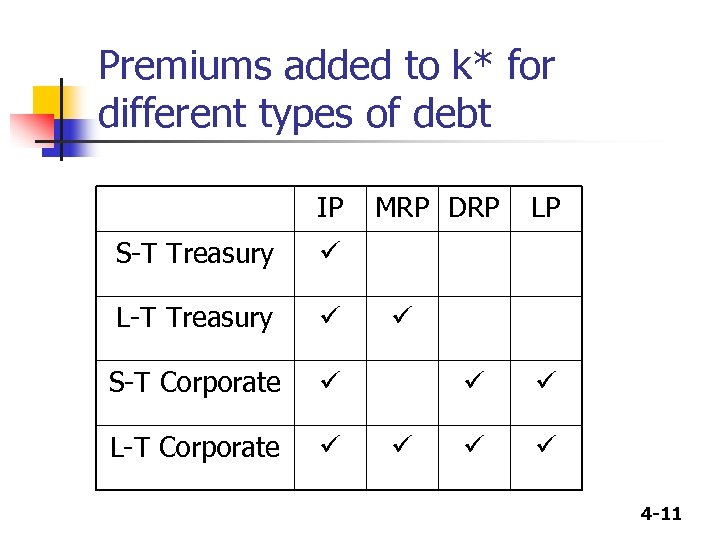 Premiums added to k* for different types of debt IP S-T Treasury S-T Corporate LP L-T Treasury MRP DRP 4 -11
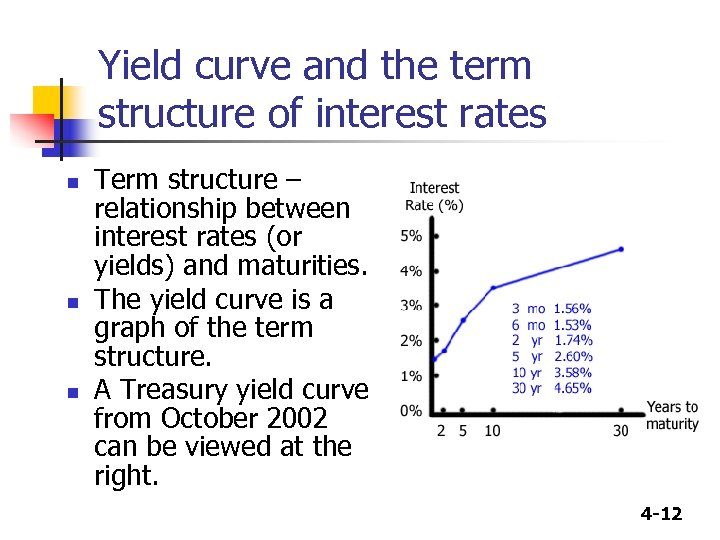 Yield curve and the term structure of interest rates n n n Term structure – relationship between interest rates (or yields) and maturities. The yield curve is a graph of the term structure. A Treasury yield curve from October 2002 can be viewed at the right. 4 -12
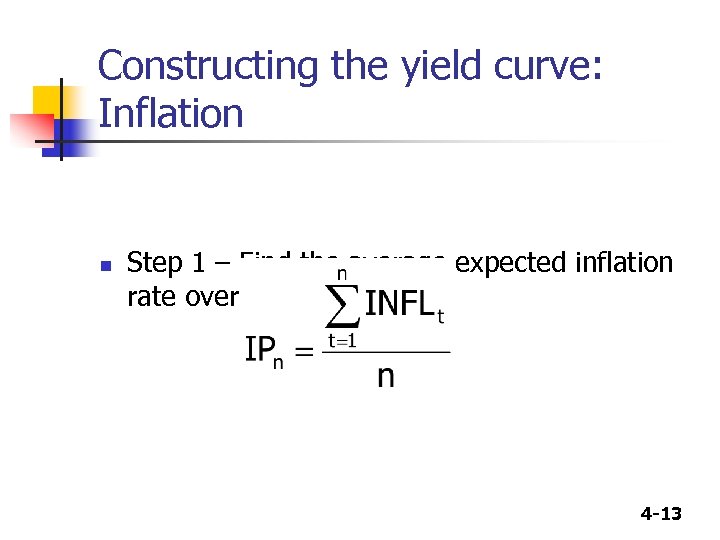 Constructing the yield curve: Inflation n Step 1 – Find the average expected inflation rate over years 1 to n: 4 -13
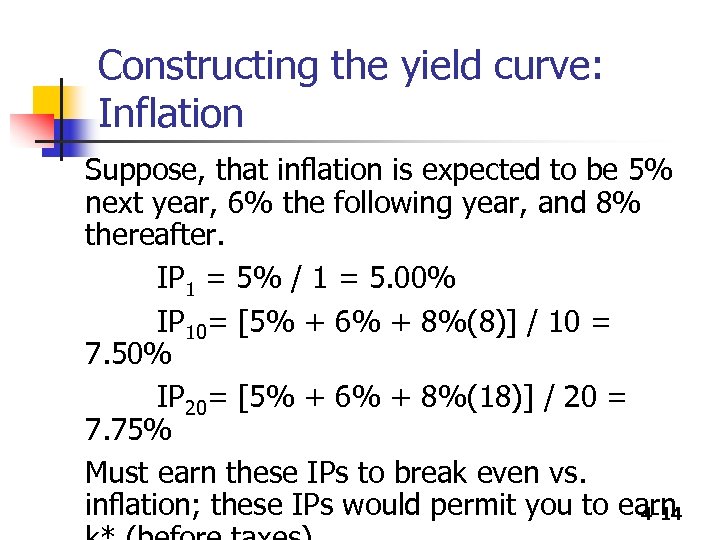 Constructing the yield curve: Inflation Suppose, that inflation is expected to be 5% next year, 6% the following year, and 8% thereafter. IP 1 = 5% / 1 = 5. 00% IP 10= [5% + 6% + 8%(8)] / 10 = 7. 50% IP 20= [5% + 6% + 8%(18)] / 20 = 7. 75% Must earn these IPs to break even vs. inflation; these IPs would permit you to earn 4 -14
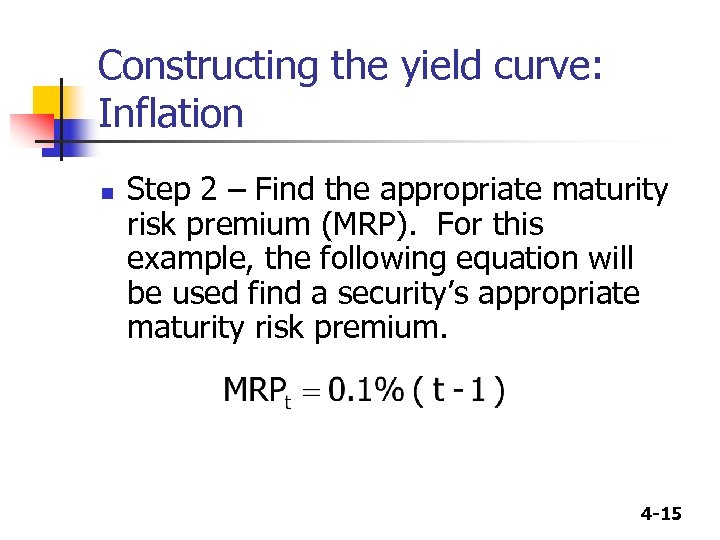 Constructing the yield curve: Inflation n Step 2 – Find the appropriate maturity risk premium (MRP). For this example, the following equation will be used find a security’s appropriate maturity risk premium. 4 -15
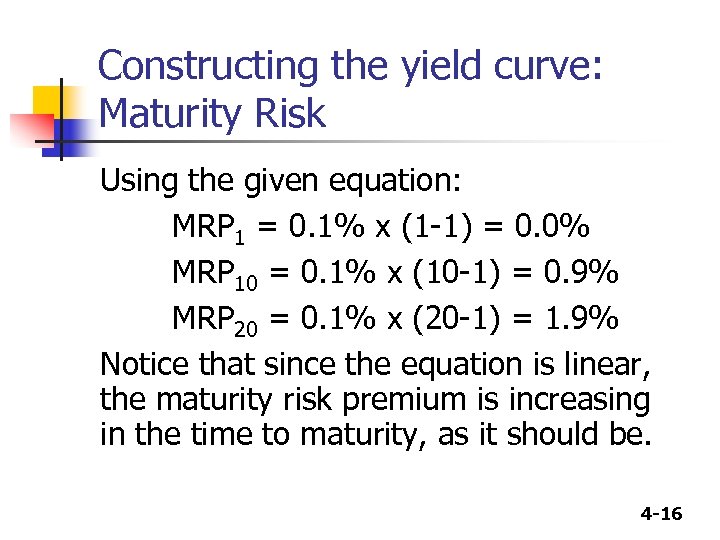 Constructing the yield curve: Maturity Risk Using the given equation: MRP 1 = 0. 1% x (1 -1) = 0. 0% MRP 10 = 0. 1% x (10 -1) = 0. 9% MRP 20 = 0. 1% x (20 -1) = 1. 9% Notice that since the equation is linear, the maturity risk premium is increasing in the time to maturity, as it should be. 4 -16
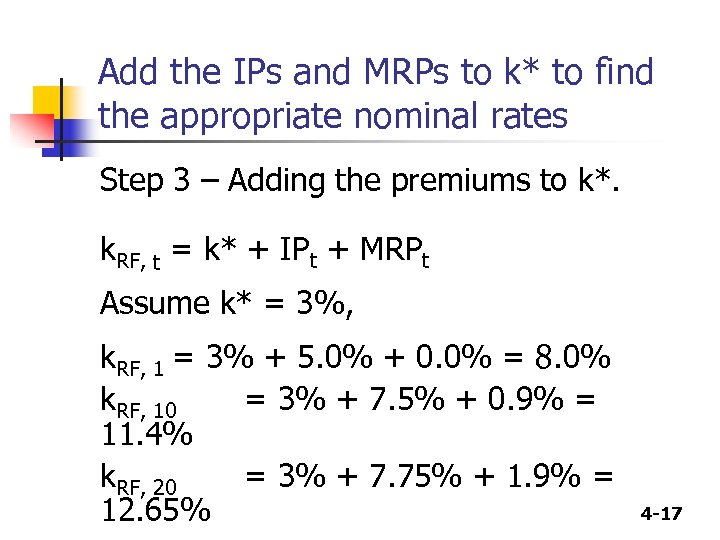 Add the IPs and MRPs to k* to find the appropriate nominal rates Step 3 – Adding the premiums to k*. k. RF, t = k* + IPt + MRPt Assume k* = 3%, k. RF, 1 = 3% + 5. 0% + 0. 0% = 8. 0% k. RF, 10 = 3% + 7. 5% + 0. 9% = 11. 4% k. RF, 20 = 3% + 7. 75% + 1. 9% = 12. 65% 4 -17
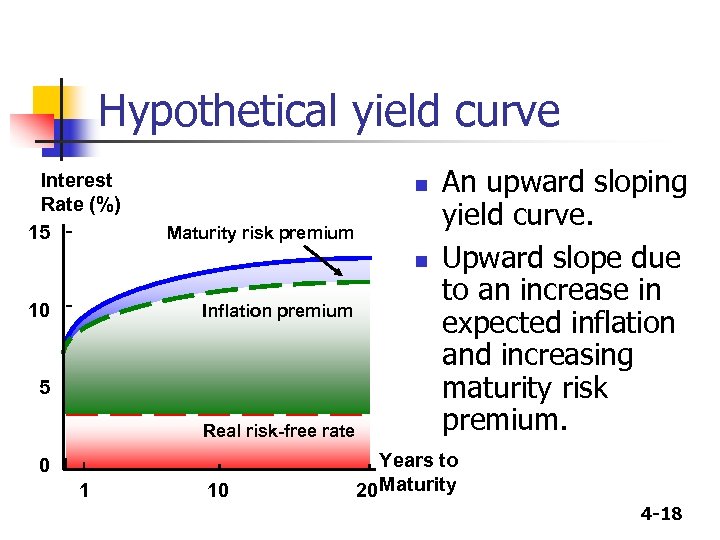 Hypothetical yield curve Interest Rate (%) 15 n Maturity risk premium n 10 Inflation premium 5 Real risk-free rate 0 1 10 An upward sloping yield curve. Upward slope due to an increase in expected inflation and increasing maturity risk premium. Years to 20 Maturity 4 -18
 What is the relationship between the Treasury yield curve and the yield curves for corporate issues? n n Corporate yield curves are higher than that of Treasury securities, though not necessarily parallel to the Treasury curve. The spread between corporate and Treasury yield curves widens as the corporate bond rating decreases. 4 -19
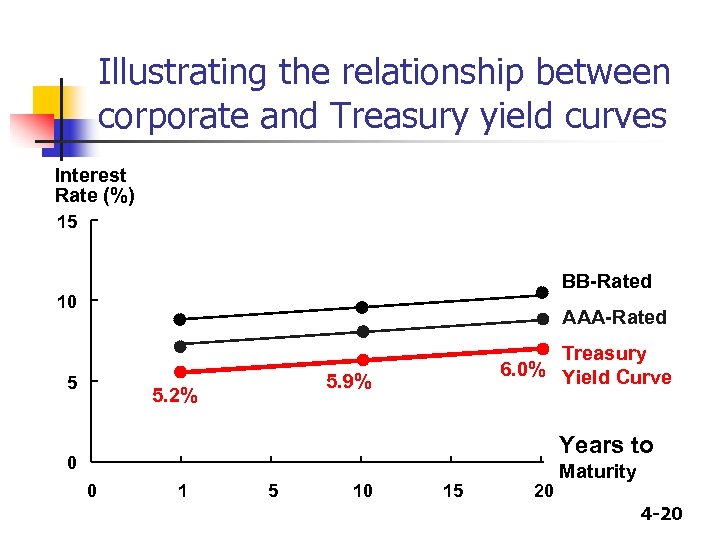 Illustrating the relationship between corporate and Treasury yield curves Interest Rate (%) 15 BB-Rated 10 AAA-Rated 5 Treasury 6. 0% Yield Curve 5. 9% 5. 2% Years to 0 0 1 5 10 15 20 Maturity 4 -20
 Pure Expectations Hypothesis n n The PEH contends that the shape of the yield curve depends on investor’s expectations about future interest rates. If interest rates are expected to increase, L-T rates will be higher than S-T rates, and vice-versa. Thus, the yield curve can slope up, down, or even bow. 4 -21
 Assumptions of the PEH n n n Assumes that the maturity risk premium for Treasury securities is zero. Long-term rates are an average of current and future short-term rates. If PEH is correct, you can use the yield curve to “back out” expected future interest rates. 4 -22
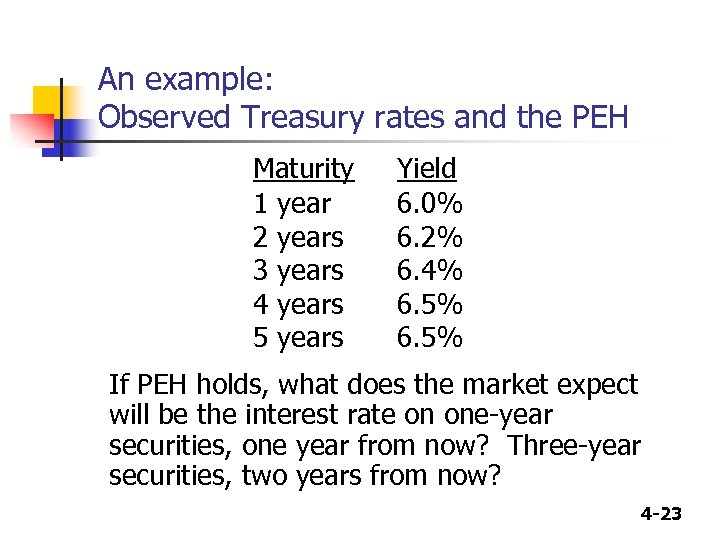 An example: Observed Treasury rates and the PEH Maturity 1 year 2 years 3 years 4 years 5 years Yield 6. 0% 6. 2% 6. 4% 6. 5% If PEH holds, what does the market expect will be the interest rate on one-year securities, one year from now? Three-year securities, two years from now? 4 -23
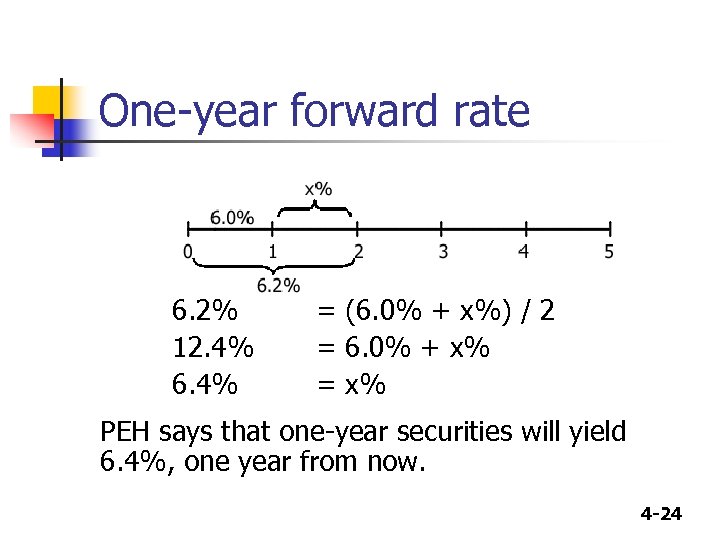 One-year forward rate 6. 2% 12. 4% 6. 4% = (6. 0% + x%) / 2 = 6. 0% + x% = x% PEH says that one-year securities will yield 6. 4%, one year from now. 4 -24
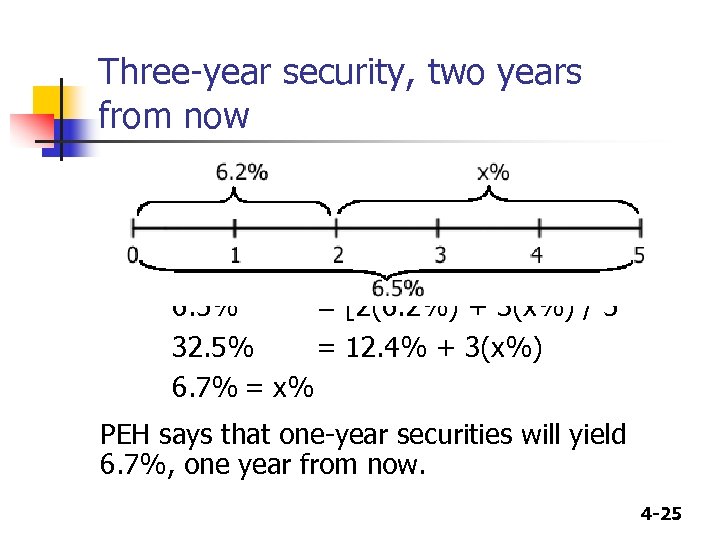 Three-year security, two years from now 6. 5% = [2(6. 2%) + 3(x%) / 5 32. 5% = 12. 4% + 3(x%) 6. 7% = x% PEH says that one-year securities will yield 6. 7%, one year from now. 4 -25
 Conclusions about PEH n n n Some would argue that the MRP ≠ 0, and hence the PEH is incorrect. Most evidence supports the general view that lenders prefer S-T securities, and view L-T securities as riskier. Thus, investors demand a MRP to get them to hold L-T securities (i. e. , MRP > 0). 4 -26
 Other factors that influence interest rate levels n n Federal reserve policy Federal budget surplus or deficit Level of business activity International factors 4 -27
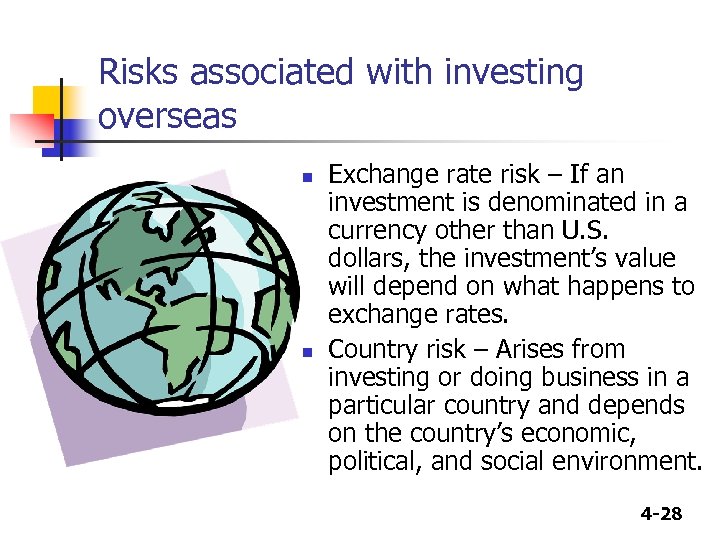 Risks associated with investing overseas n n Exchange rate risk – If an investment is denominated in a currency other than U. S. dollars, the investment’s value will depend on what happens to exchange rates. Country risk – Arises from investing or doing business in a particular country and depends on the country’s economic, political, and social environment. 4 -28
 Factors that cause exchange rates to fluctuate n n Changes in relative inflation Changes in country risk 4 -29