


 Скачать презентацию CHAPTER 4 Pesticide Formulations Chapter 4 National Pesticide
1b4002a7db7c0ab90e5e708ad27ed907.ppt
- Количество слайдов: 51
 CHAPTER 4 Pesticide Formulations Chapter 4 National Pesticide Applicator Certification Core Manual
 CHAPTER 4 Pesticide Formulations This module will help you: v Recognize formulation abbreviations v Identify formulation advantages and disadvantages v Understand role of adjuvants
 Important Definitions v Active Ingredient (Ai) - the actual chemical in the product mixture that controls the pest v Inert Ingredient - other materials added with the AI when the product is formulated v Phytotoxicity - plant damage v Adjuvant - product added to spray tank to assist pesticide in its application
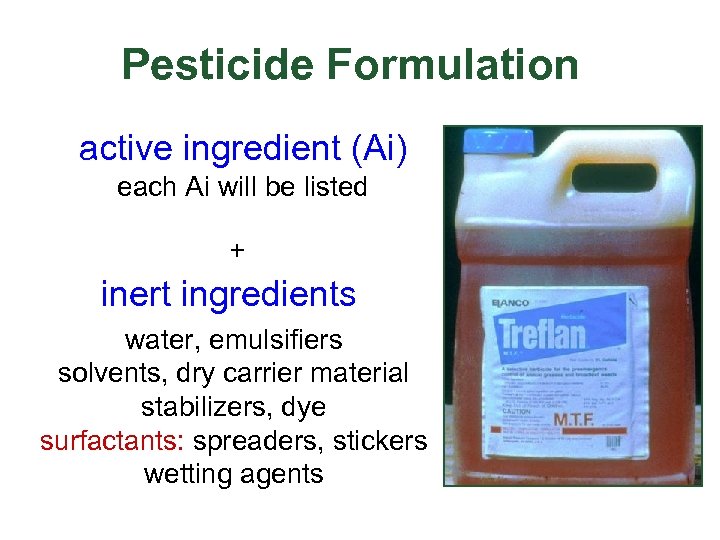 Pesticide Formulation active ingredient (Ai) each Ai will be listed + inert ingredients water, emulsifiers solvents, dry carrier material stabilizers, dye surfactants: spreaders, stickers wetting agents
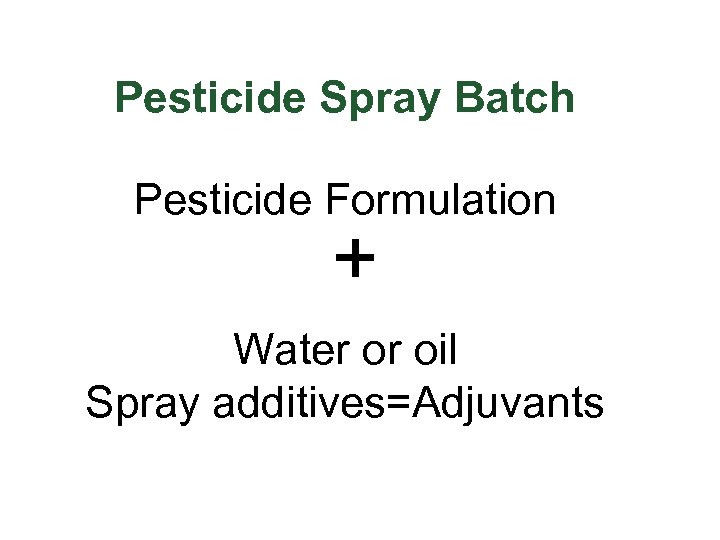 Pesticide Spray Batch Pesticide Formulation + Water or oil Spray additives=Adjuvants
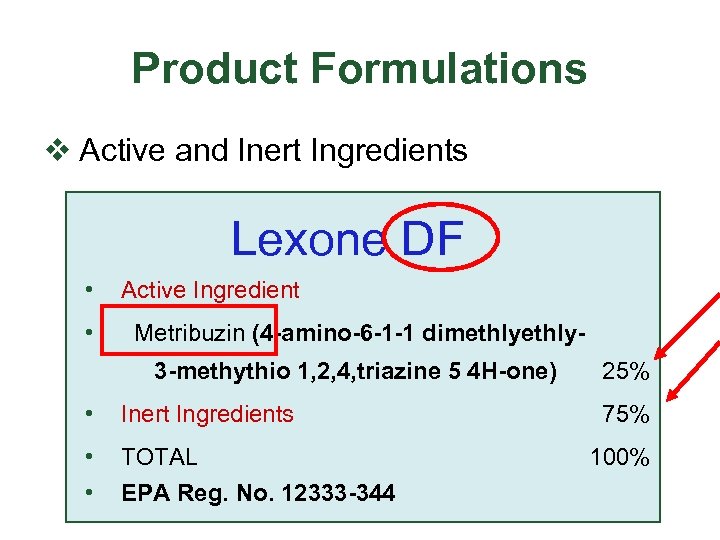 Product Formulations v Active and Inert Ingredients Lexone DF • • Active Ingredient Metribuzin (4 -amino-6 -1 -1 dimethly 3 -methythio 1, 2, 4, triazine 5 4 H-one) • Inert Ingredients • • TOTAL EPA Reg. No. 12333 -344 25% 75% 100%
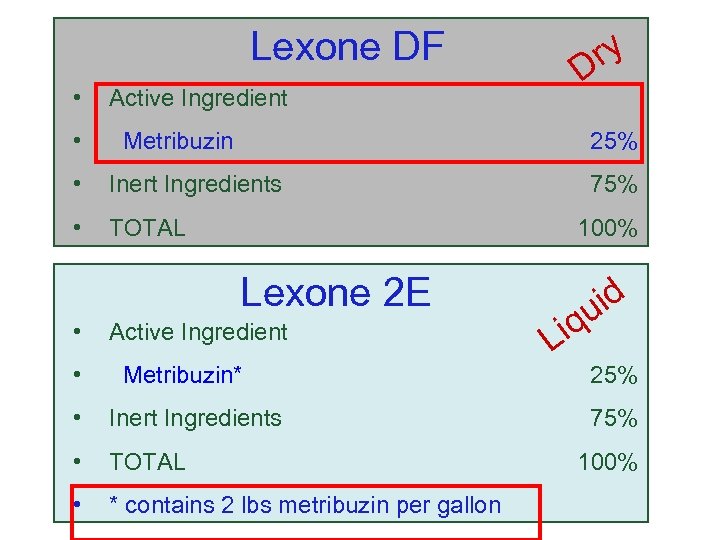 Lexone DF • • Active Ingredient ry D Metribuzin 25% • Inert Ingredients • TOTAL 100% Lexone 2 E • • 75% Active Ingredient Metribuzin* • Inert Ingredients • TOTAL • * contains 2 lbs metribuzin per gallon iq L id u 25% 75% 100%
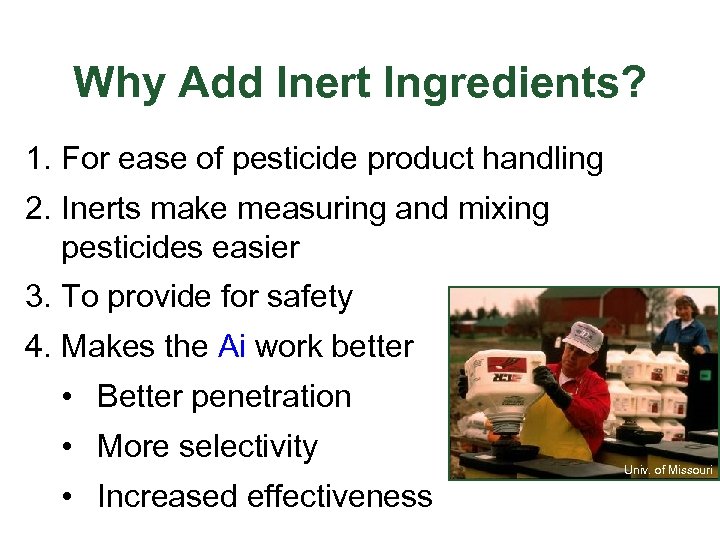 Why Add Inert Ingredients? 1. For ease of pesticide product handling 2. Inerts make measuring and mixing pesticides easier 3. To provide for safety 4. Makes the Ai work better • Better penetration • More selectivity • Increased effectiveness Univ. of Missouri
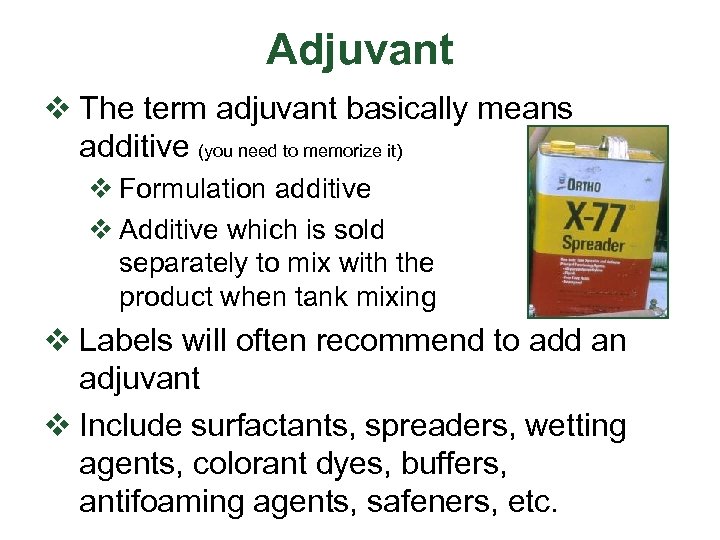 Adjuvant v The term adjuvant basically means additive (you need to memorize it) v Formulation additive v Additive which is sold separately to mix with the product when tank mixing v Labels will often recommend to add an adjuvant v Include surfactants, spreaders, wetting agents, colorant dyes, buffers, antifoaming agents, safeners, etc.
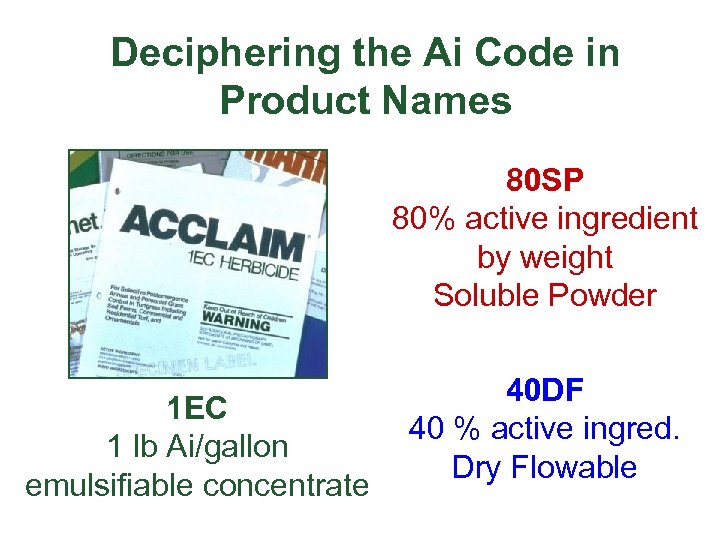 Deciphering the Ai Code in Product Names 80 SP 80% active ingredient by weight Soluble Powder 1 EC 1 lb Ai/gallon emulsifiable concentrate 40 DF 40 % active ingred. Dry Flowable
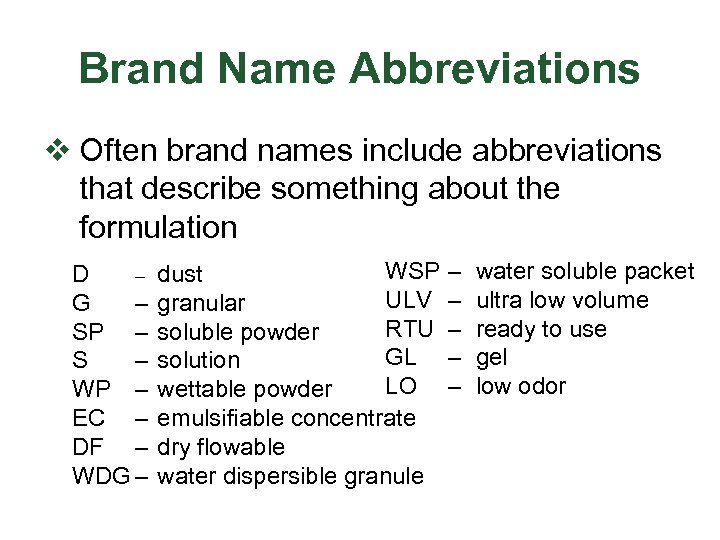 Brand Name Abbreviations v Often brand names include abbreviations that describe something about the formulation D – G – SP – S – WP – EC – DF – WDG – WSP dust ULV granular RTU soluble powder GL solution LO wettable powder emulsifiable concentrate dry flowable water dispersible granule – – – water soluble packet ultra low volume ready to use gel low odor
 Selecting a Formulation v Evaluate advantages and disadvantages v Do you have the right application equipment? v Can the formulation be applied when and where it is needed? v Will the formulation reach the target pest and be there long enough?
 Spray Mix Terminology v solution v suspension v emulsion How does it really mix in the spray tank?
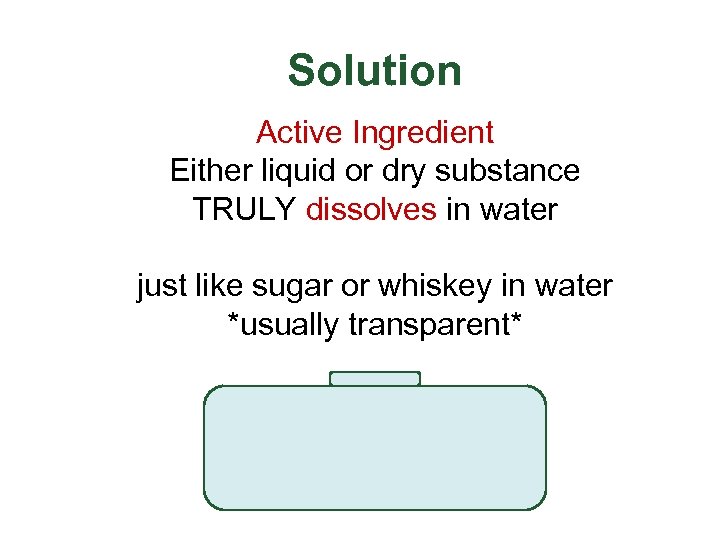 Solution Active Ingredient Either liquid or dry substance TRULY dissolves in water just like sugar or whiskey in water *usually transparent*
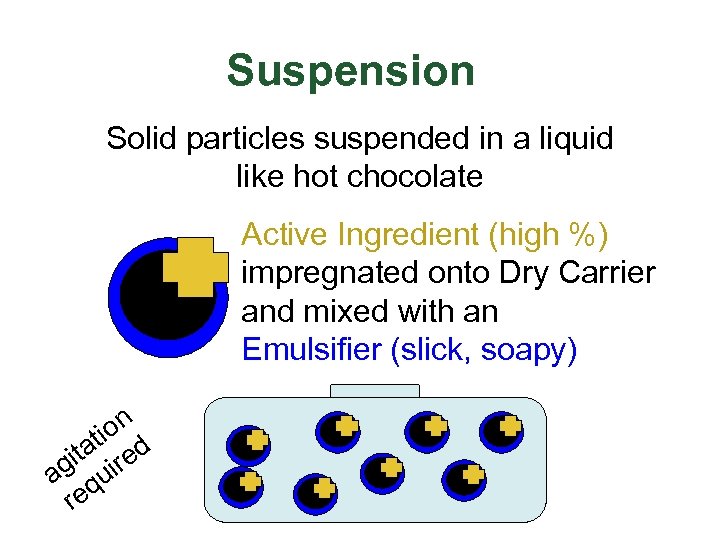 Suspension Solid particles suspended in a liquid like hot chocolate Active Ingredient (high %) impregnated onto Dry Carrier and mixed with an Emulsifier (slick, soapy) ion at ed git uir a q re
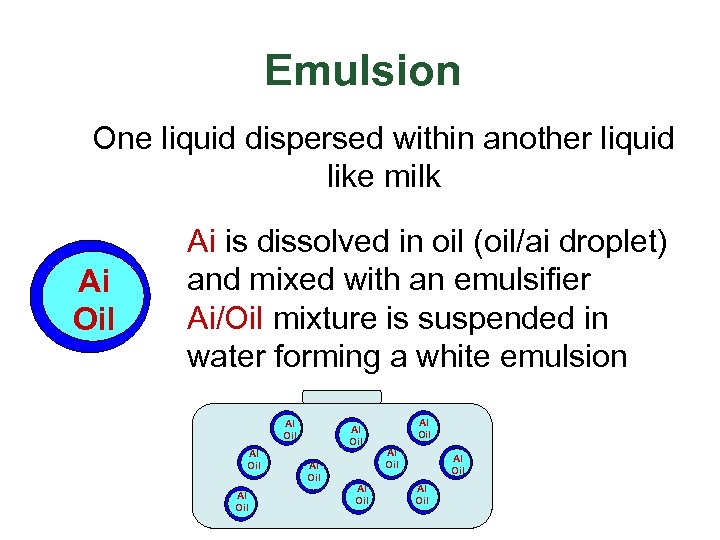 Emulsion One liquid dispersed within another liquid like milk Ai Oil Ai is dissolved in oil (oil/ai droplet) and mixed with an emulsifier Ai/Oil mixture is suspended in water forming a white emulsion AI Oil AI Oil AI Oil
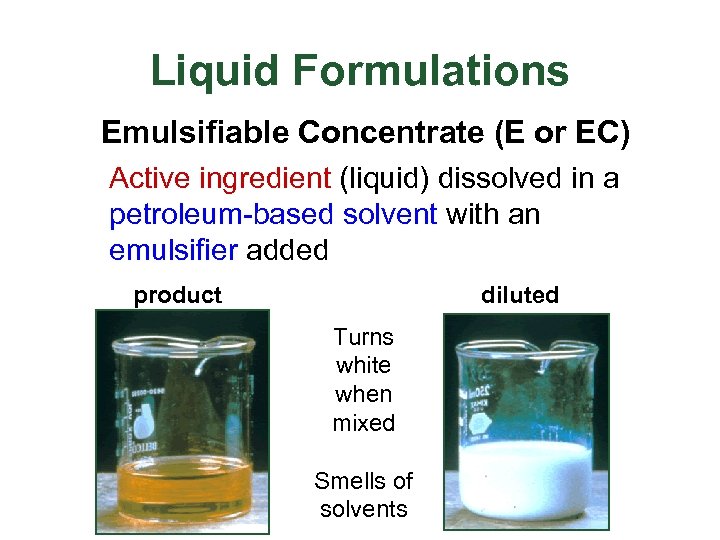 Liquid Formulations Emulsifiable Concentrate (E or EC) Active ingredient (liquid) dissolved in a petroleum-based solvent with an emulsifier added product diluted Turns white when mixed Smells of solvents
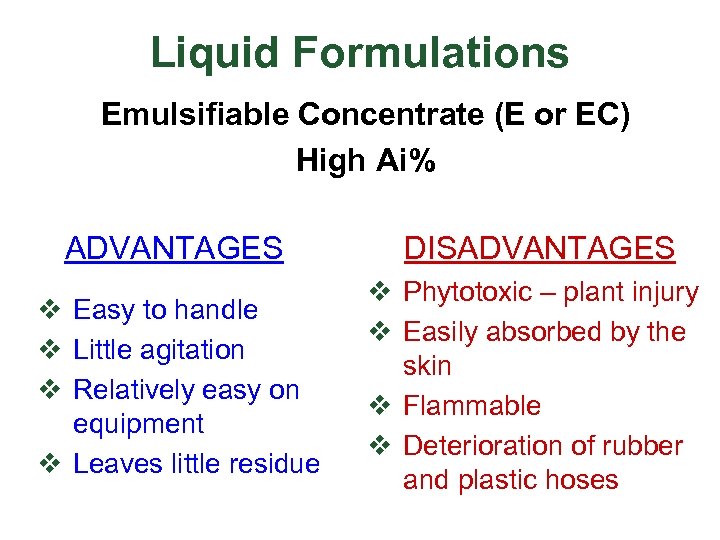 Liquid Formulations Emulsifiable Concentrate (E or EC) High Ai% ADVANTAGES DISADVANTAGES v Easy to handle v Little agitation v Relatively easy on equipment v Leaves little residue v Phytotoxic – plant injury v Easily absorbed by the skin v Flammable v Deterioration of rubber and plastic hoses
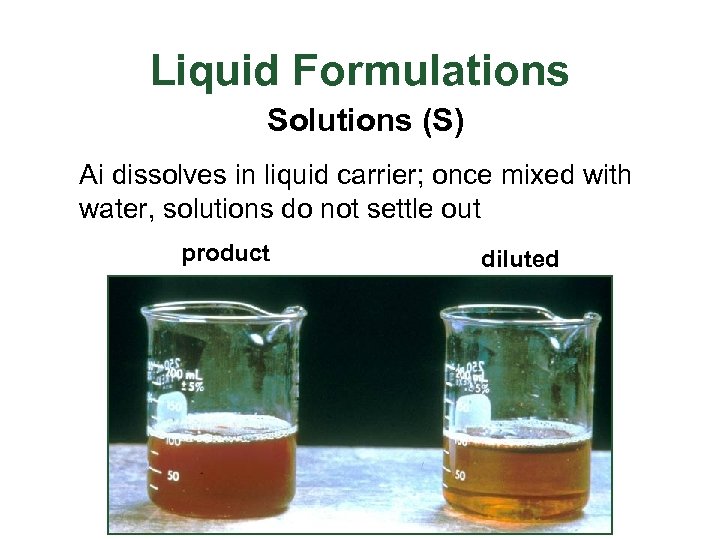 Liquid Formulations Solutions (S) Ai dissolves in liquid carrier; once mixed with water, solutions do not settle out product diluted
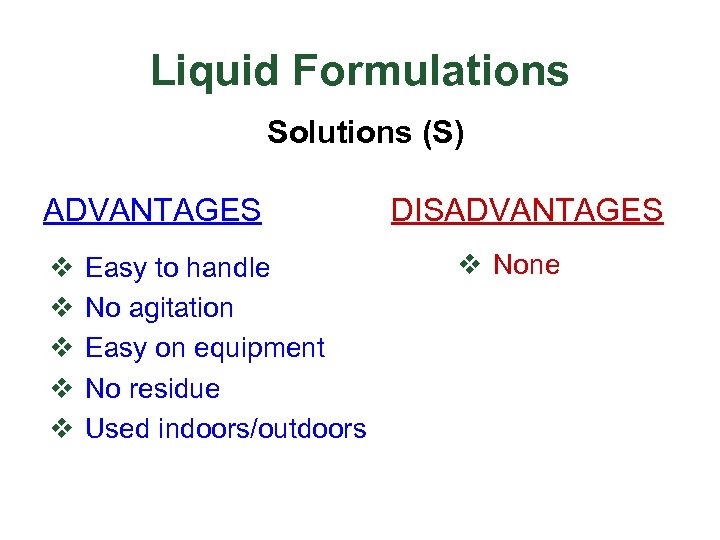 Liquid Formulations Solutions (S) ADVANTAGES v v v Easy to handle No agitation Easy on equipment No residue Used indoors/outdoors DISADVANTAGES v None
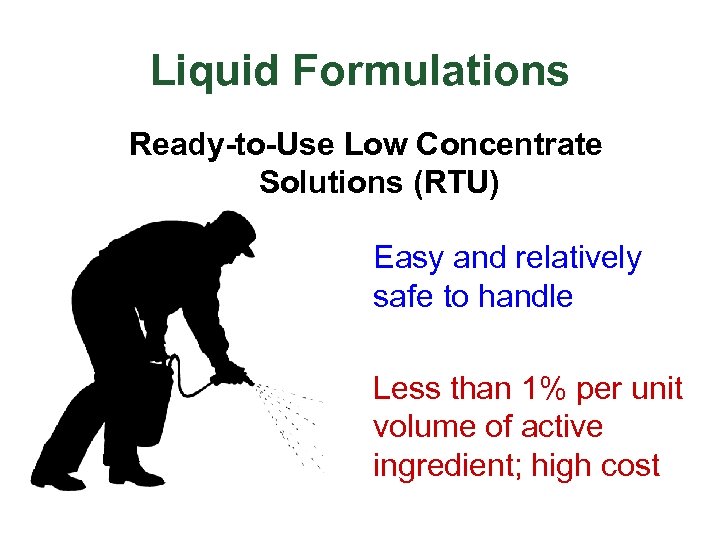 Liquid Formulations Ready-to-Use Low Concentrate Solutions (RTU) Easy and relatively safe to handle Less than 1% per unit volume of active ingredient; high cost
 Liquid Formulations Ultra-Low Volume (ULV) v Special-purpose formulation v Almost 100% active ingredient v Agriculture, forestry, mosquito control
 Liquid Formulations Ultra-Low Volume (ULV) ADVANTAGES v v v DISADVANTAGES Easy to handle Little or no agitation Easy on equipment No residue Used indoors/outdoors v High drift hazard v Specialized equipment needed v Solvent wear on rubber and plastic v Calibration critical
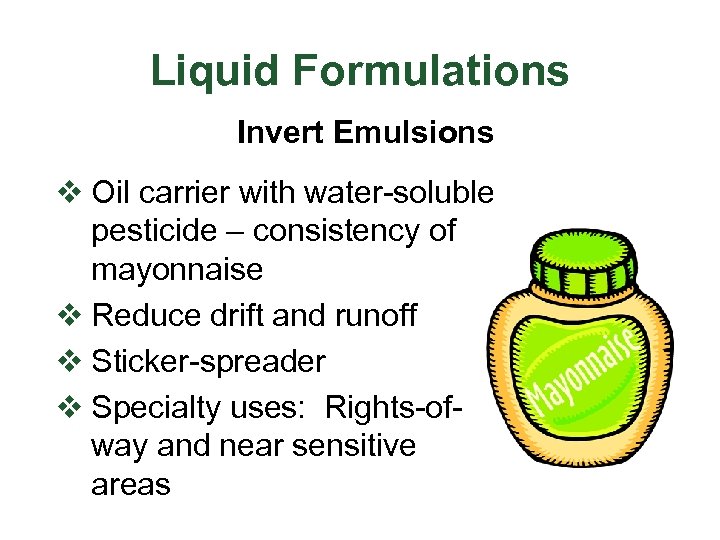 Liquid Formulations Invert Emulsions v Oil carrier with water-soluble pesticide – consistency of mayonnaise v Reduce drift and runoff v Sticker-spreader v Specialty uses: Rights-ofway and near sensitive areas
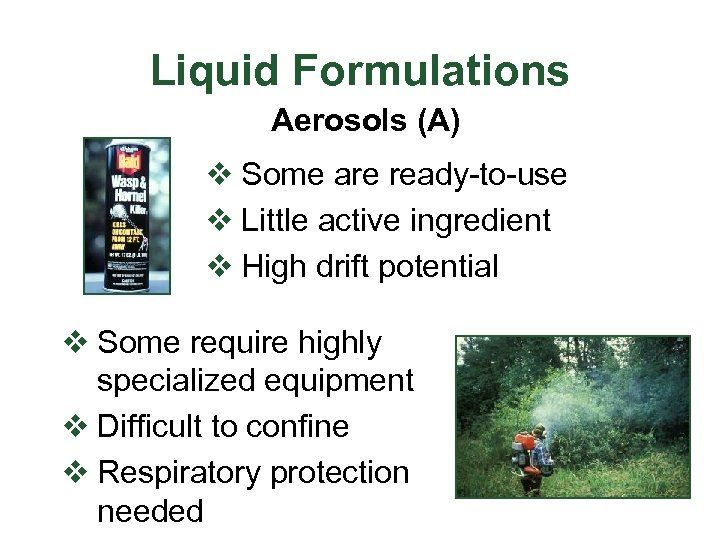 Liquid Formulations Aerosols (A) v Some are ready-to-use v Little active ingredient v High drift potential v Some require highly specialized equipment v Difficult to confine v Respiratory protection needed
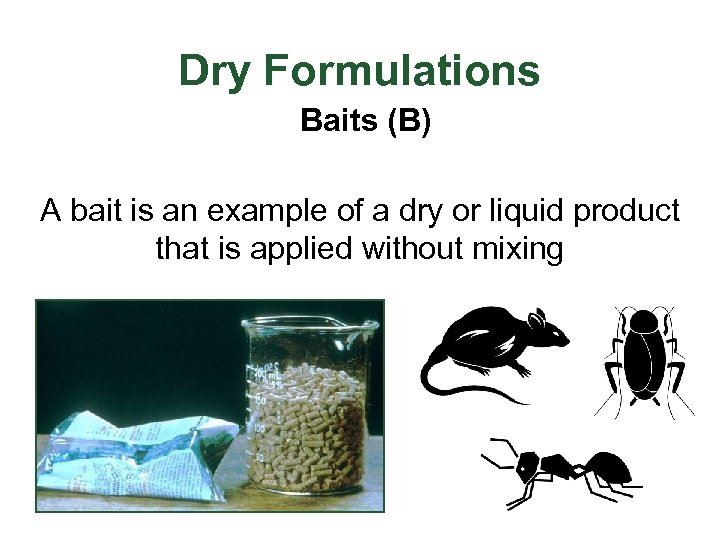 Dry Formulations Baits (B) A bait is an example of a dry or liquid product that is applied without mixing
 Dry or Solid Formulations Baits (B) ADVANTAGES v Ready to use v Coverage not critical v Control pest that move in and out of area DISADVANTAGES v Attractive to children v May kill domestic animals and wildlife v Dead pest odors v Old bait may serve as food source if inactive
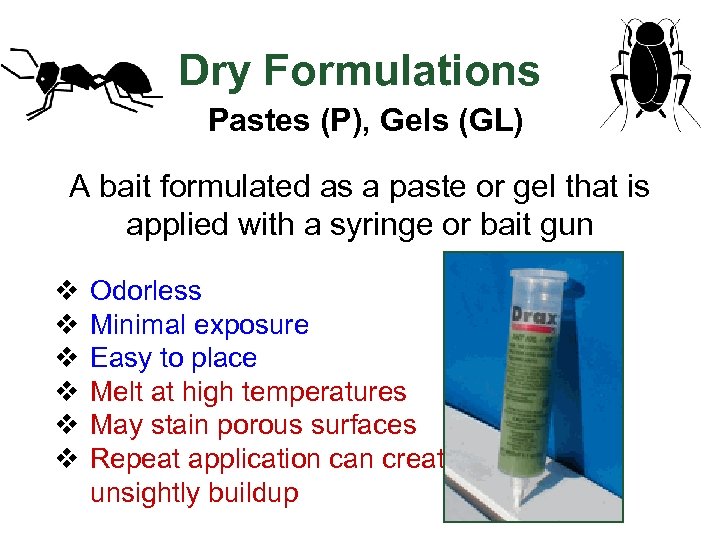 Dry Formulations Pastes (P), Gels (GL) A bait formulated as a paste or gel that is applied with a syringe or bait gun v v v Odorless Minimal exposure Easy to place Melt at high temperatures May stain porous surfaces Repeat application can create unsightly buildup
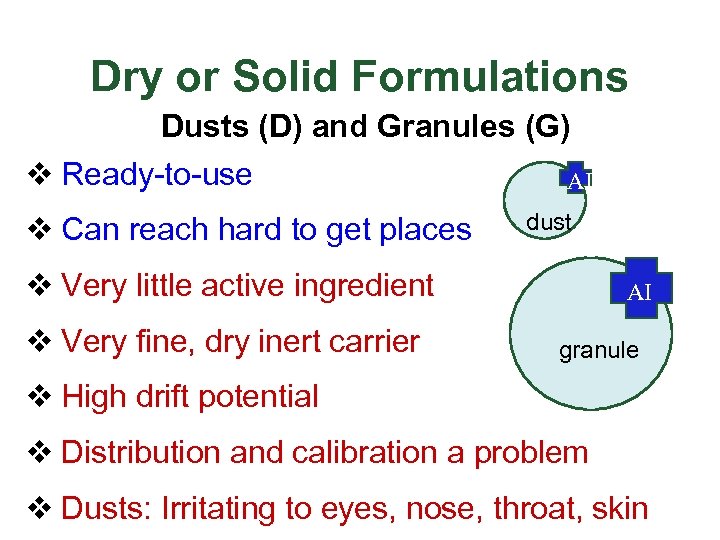 Dry or Solid Formulations Dusts (D) and Granules (G) v Ready-to-use v Can reach hard to get places AI dust v Very little active ingredient v Very fine, dry inert carrier AI granule v High drift potential v Distribution and calibration a problem v Dusts: Irritating to eyes, nose, throat, skin
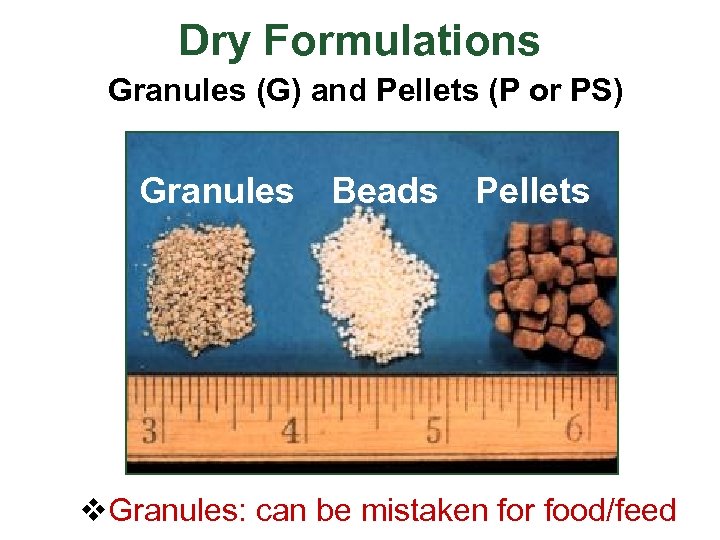 Dry Formulations Granules (G) and Pellets (P or PS) Granules Beads Pellets v. Granules: can be mistaken for food/feed
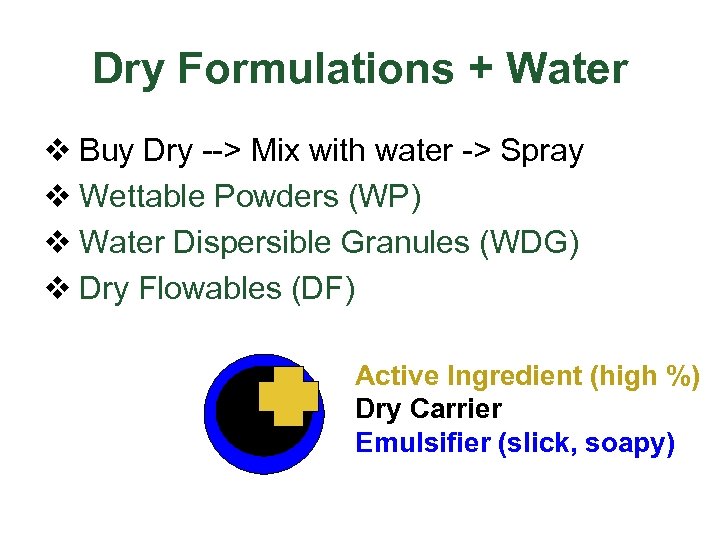 Dry Formulations + Water v Buy Dry --> Mix with water -> Spray v Wettable Powders (WP) v Water Dispersible Granules (WDG) v Dry Flowables (DF) Active Ingredient (high %) Dry Carrier Emulsifier (slick, soapy)
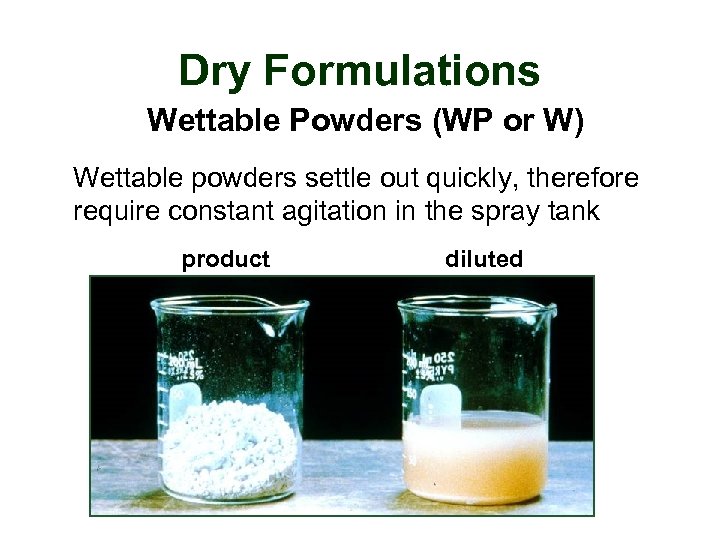 Dry Formulations Wettable Powders (WP or W) Wettable powders settle out quickly, therefore require constant agitation in the spray tank product diluted
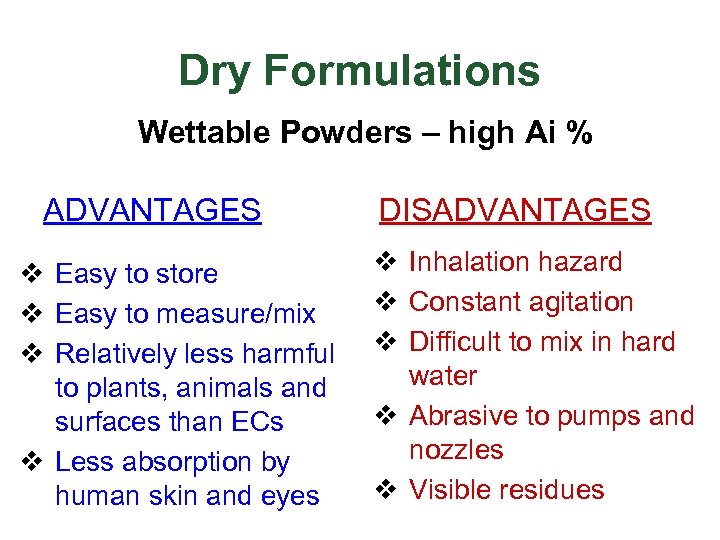 Dry Formulations Wettable Powders – high Ai % ADVANTAGES v Easy to store v Easy to measure/mix v Relatively less harmful to plants, animals and surfaces than ECs v Less absorption by human skin and eyes DISADVANTAGES v Inhalation hazard v Constant agitation v Difficult to mix in hard water v Abrasive to pumps and nozzles v Visible residues
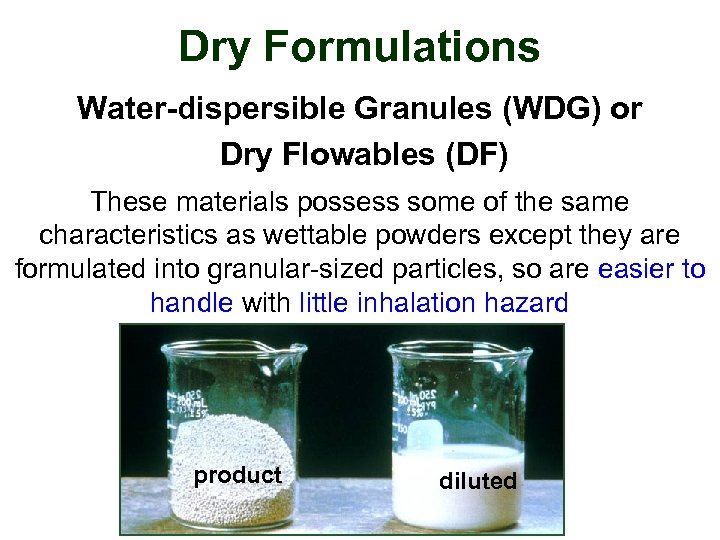 Dry Formulations Water-dispersible Granules (WDG) or Dry Flowables (DF) These materials possess some of the same characteristics as wettable powders except they are formulated into granular-sized particles, so are easier to handle with little inhalation hazard product diluted
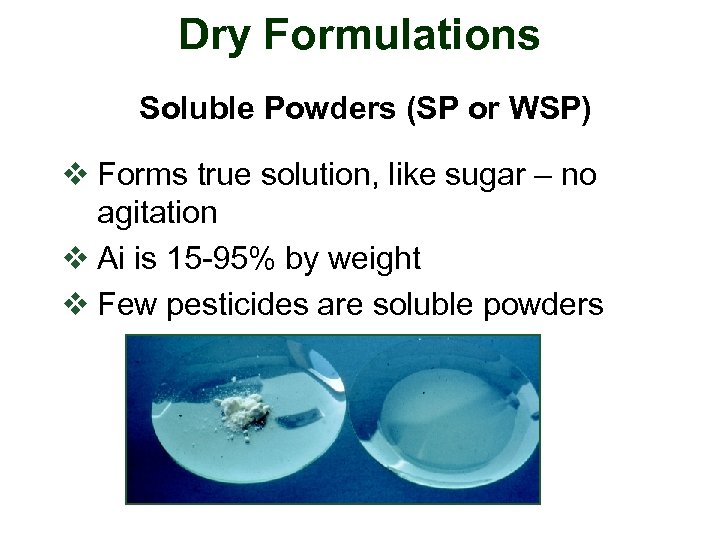 Dry Formulations Soluble Powders (SP or WSP) v Forms true solution, like sugar – no agitation v Ai is 15 -95% by weight v Few pesticides are soluble powders
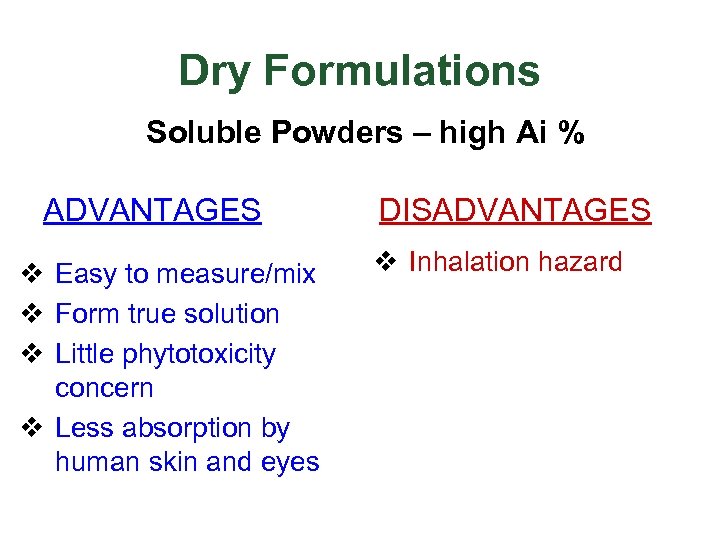 Dry Formulations Soluble Powders – high Ai % ADVANTAGES v Easy to measure/mix v Form true solution v Little phytotoxicity concern v Less absorption by human skin and eyes DISADVANTAGES v Inhalation hazard
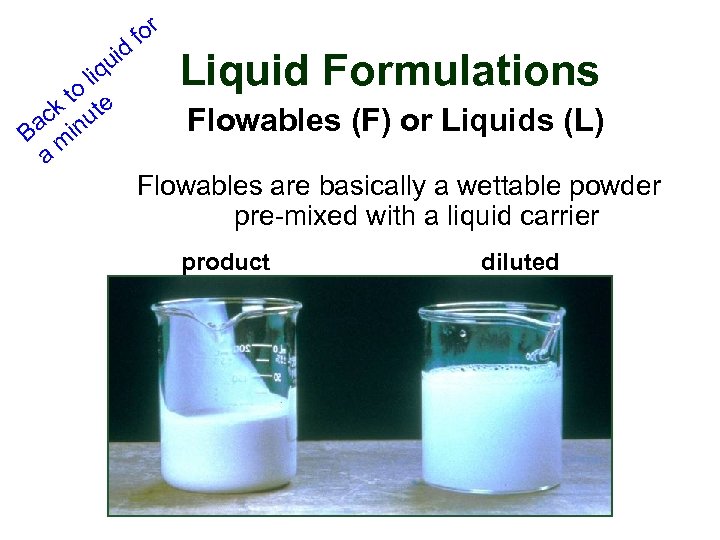 d ui q li to e ck nut Ba mi a or f Liquid Formulations Flowables (F) or Liquids (L) Flowables are basically a wettable powder pre-mixed with a liquid carrier product diluted
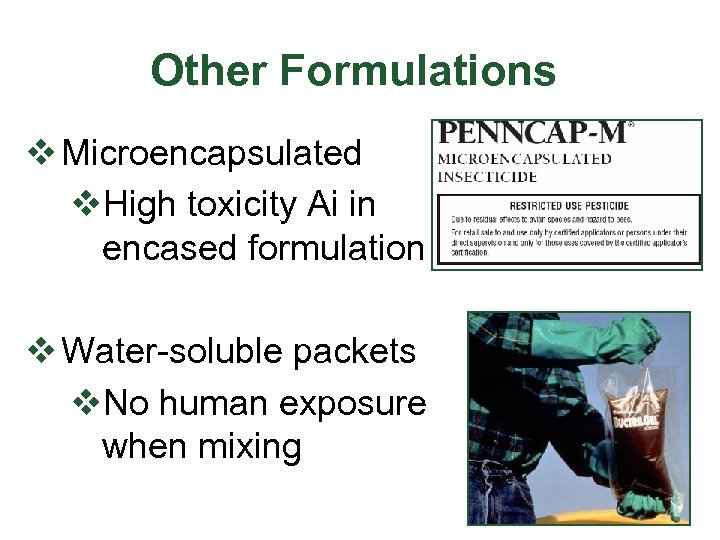 Other Formulations v Microencapsulated v. High toxicity Ai in encased formulation v Water-soluble packets v. No human exposure when mixing
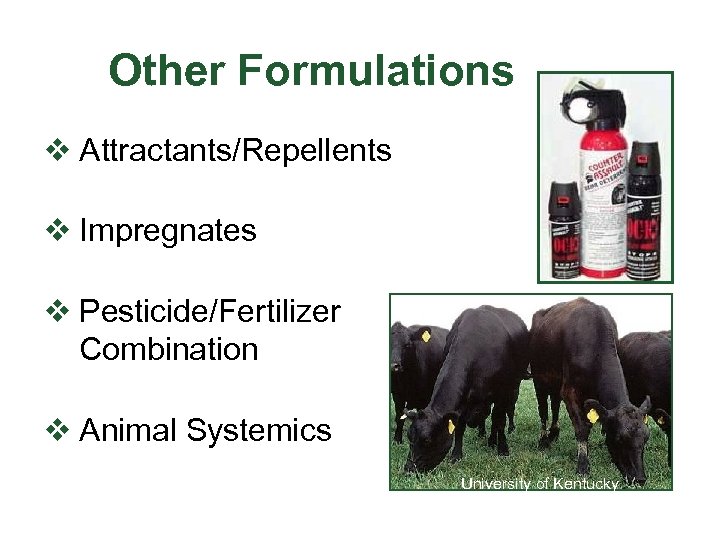 Other Formulations v Attractants/Repellents v Impregnates v Pesticide/Fertilizer Combination v Animal Systemics University of Kentucky
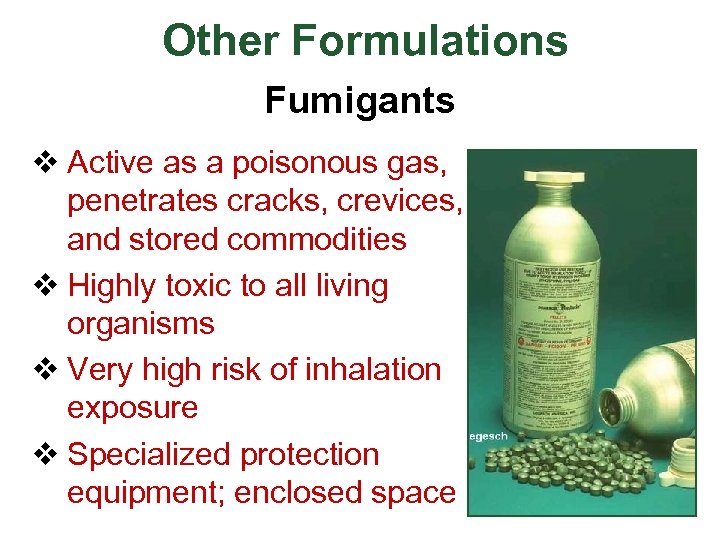 Other Formulations Fumigants v Active as a poisonous gas, penetrates cracks, crevices, and stored commodities v Highly toxic to all living organisms v Very high risk of inhalation exposure v Specialized protection equipment; enclosed space
 Pesticide Mixtures v Tank mixing multiple products is legal unless prohibited by the label v Manufacturer only warranties their product alone or product mixtures listed on the label v Manufacture notes known incompatibilities on label v Incompatibility v Heat, clumping, precipitate v Inactivity of active ingredients v Increased phytotoxicity v Use Jar-Test to test for incompatibility v Field incompatibility can still occur
 Adjuvants purchased additives to add to tank mix or added during formulation process Surfactants - group Others v Wetting agents v v v v Spreaders v Emulsifiers v Stickers/Extenders Buffers Compatibility agents Defoaming agents Colorants/dyes Safeners Thickeners
 Adjuvants How to choose the right one? v Read the pesticide label for recommendations v Some may prohibit use of an adjuvant v Don’t use industrial products or household detergents v Test before you spend $$ v Remember, many pesticide products contain an adjuvant
 CHAPTER 4 Formulation Summary v Active and inert ingredients v Dry and liquid formulations v Adjuvants v Choose a pesticide formulation that will best suit your pest problem and target site
 CHAPTER 4 Formulation Summary v Choose a pesticide formulation that will best suit your pest problem and target site v Safety, ease of use v Human exposure concerns v Phytotoxicity; visible residues v Application equipment considerations
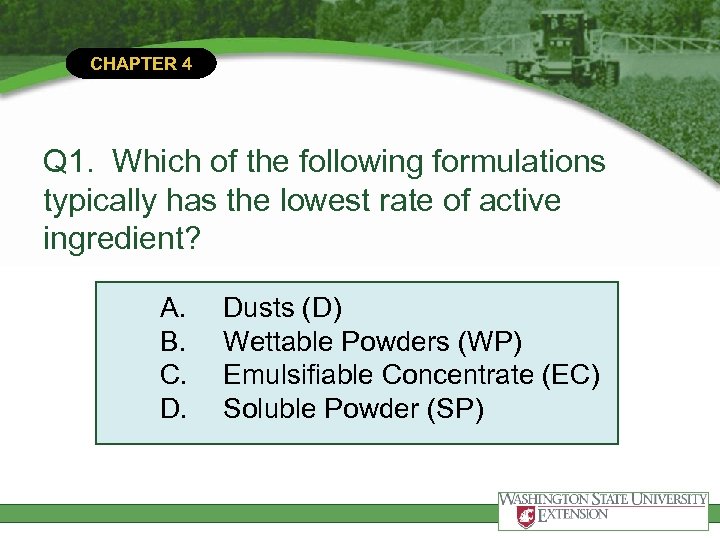 CHAPTER 4 Q 1. Which of the following formulations typically has the lowest rate of active ingredient? A. B. C. D. Dusts (D) Wettable Powders (WP) Emulsifiable Concentrate (EC) Soluble Powder (SP)
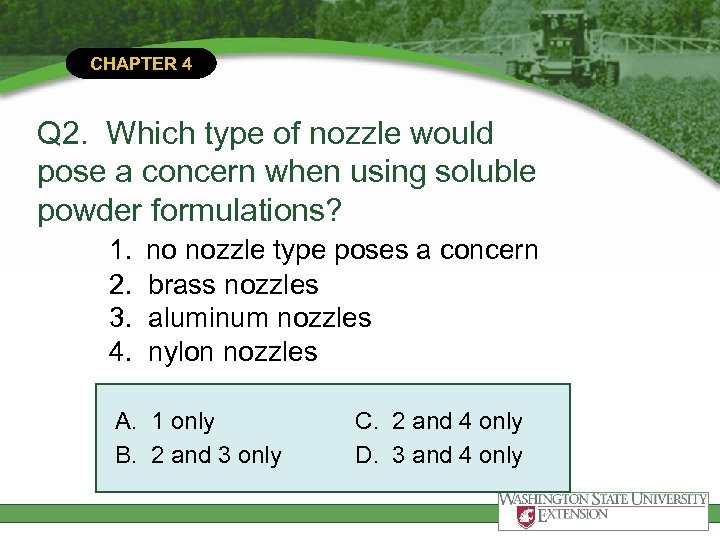 CHAPTER 4 Q 2. Which type of nozzle would pose a concern when using soluble powder formulations? 1. 2. 3. 4. no nozzle type poses a concern brass nozzles aluminum nozzles nylon nozzles A. 1 only B. 2 and 3 only C. 2 and 4 only D. 3 and 4 only
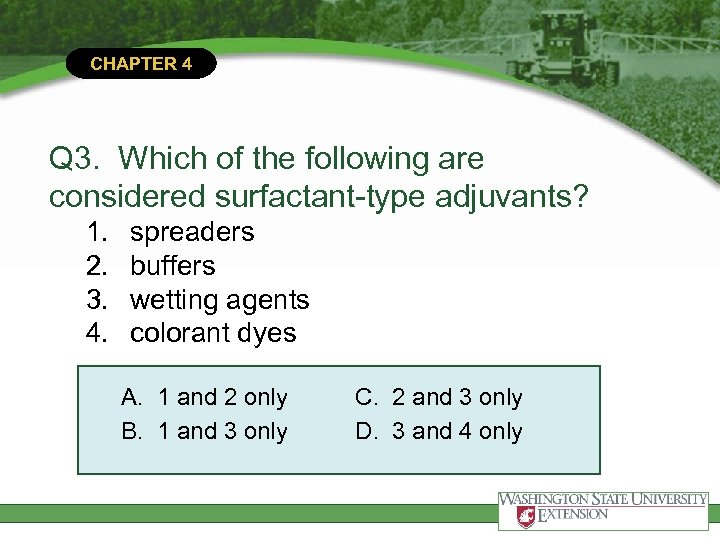 CHAPTER 4 Q 3. Which of the following are considered surfactant-type adjuvants? 1. 2. 3. 4. spreaders buffers wetting agents colorant dyes A. 1 and 2 only B. 1 and 3 only C. 2 and 3 only D. 3 and 4 only
 CHAPTER 4 Acknowledgements v Washington State University Urban IPM and Pesticide Safety Education Program authored this presentation v Illustrations were provided by Nevada Dept. of Agriculture, University of Missouri-Lincoln, Virginia Tech. , Washington Dept. of Agriculture, Washington State University
 CHAPTER 4 Acknowledgements v Presentation was reviewed by Beth Long, University of Tennessee; Ed Crow, Maryland Dept. of Agriculture; Jeanne Kasai, US EPA; and Susan Whitney King, University of Delaware v Narration was provided by Drex Rhoades, Washington State University Information Department
 CHAPTER 4 Support for this project was made possible through EPA Office of Pesticide Program cooperative agreements with the Council for Agricultural, Science and Technology, and the National Association of State Departments of Agriculture Research Foundation. The views expressed herein are those of the authors and do not necessarily represent the views and policies of the EPA.