


 Скачать презентацию Chapter 4 Network Layer A note on the
66aadd42fcd0875bd529514b07a3d4e3.ppt
- Количество слайдов: 134
 Chapter 4 Network Layer A note on the use of these ppt slides: We’re making these slides freely available to all (faculty, students, readers). They’re in Power. Point form so you can add, modify, and delete slides (including this one) and slide content to suit your needs. They obviously represent a lot of work on our part. In return for use, we only ask the following: q If you use these slides (e. g. , in a class) in substantially unaltered form, that you mention their source (after all, we’d like people to use our book!) q If you post any slides in substantially unaltered form on a www site, that you note that they are adapted from (or perhaps identical to) our slides, and note our copyright of this material. Computer Networking: A Top Down Approach Featuring the Internet, 3 rd edition. Jim Kurose, Keith Ross Addison-Wesley, July 2004. Thanks and enjoy! JFK/KWR All material copyright 1996 -2004 J. F Kurose and K. W. Ross, All Rights Reserved Network Layer 1
 Chapter 4: Network Layer Chapter goals: r understand principles behind network layer services: m routing (path selection) m dealing with scale m how a router works m advanced topics: IPv 6, mobility r instantiation and implementation in the Internet Network Layer 2
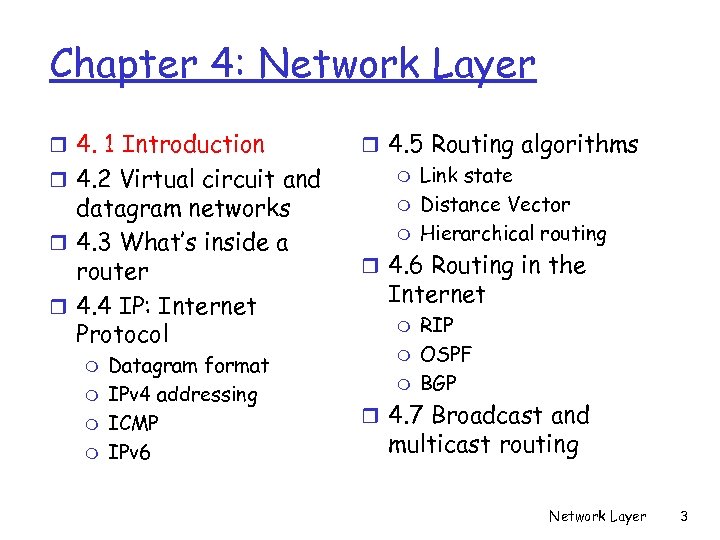 Chapter 4: Network Layer r 4. 1 Introduction r 4. 2 Virtual circuit and datagram networks r 4. 3 What’s inside a router r 4. 4 IP: Internet Protocol m m Datagram format IPv 4 addressing ICMP IPv 6 r 4. 5 Routing algorithms m Link state m Distance Vector m Hierarchical routing r 4. 6 Routing in the Internet m m m RIP OSPF BGP r 4. 7 Broadcast and multicast routing Network Layer 3
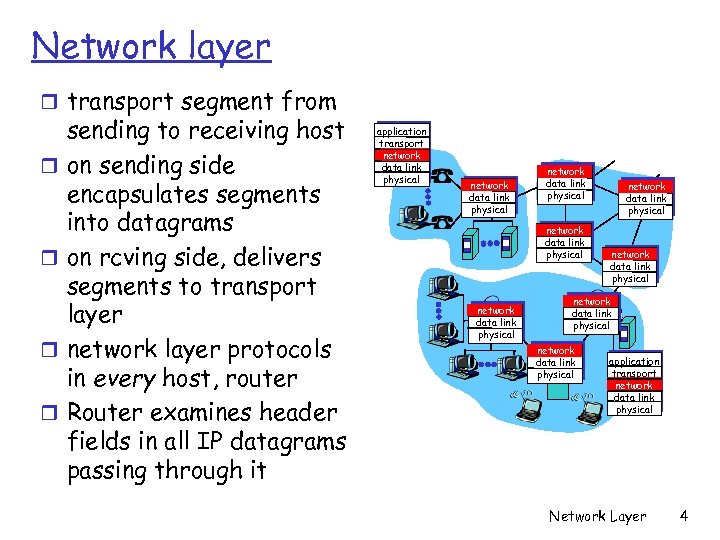 Network layer r transport segment from r r sending to receiving host on sending side encapsulates segments into datagrams on rcving side, delivers segments to transport layer network layer protocols in every host, router Router examines header fields in all IP datagrams passing through it application transport network data link physical network data link physical network data link physical application transport network data link physical Network Layer 4
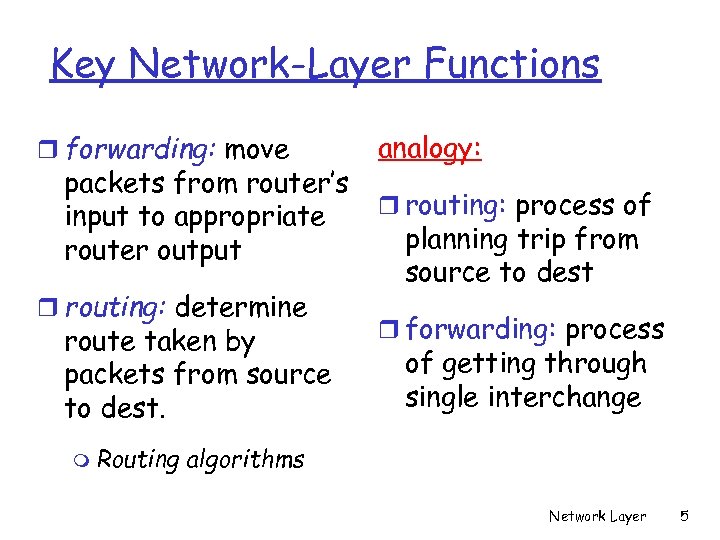 Key Network-Layer Functions r forwarding: move packets from router’s input to appropriate router output r routing: determine route taken by packets from source to dest. m Routing analogy: r routing: process of planning trip from source to dest r forwarding: process of getting through single interchange algorithms Network Layer 5
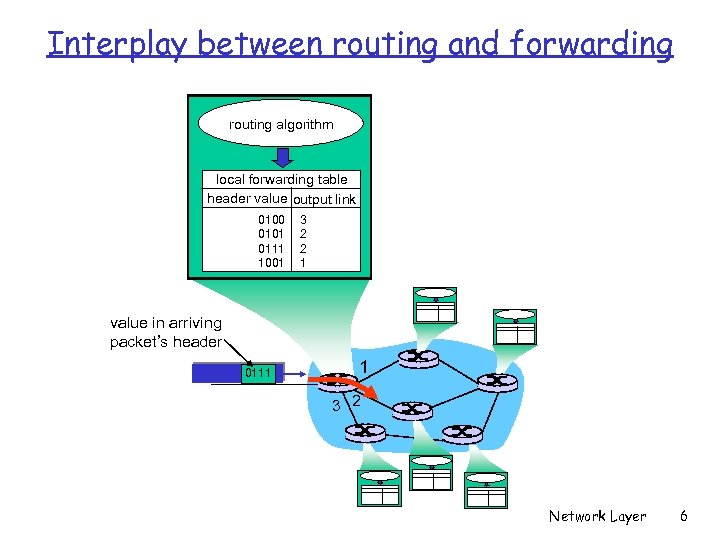 Interplay between routing and forwarding routing algorithm local forwarding table header value output link 0100 0101 0111 1001 3 2 2 1 value in arriving packet’s header 0111 1 3 2 Network Layer 6
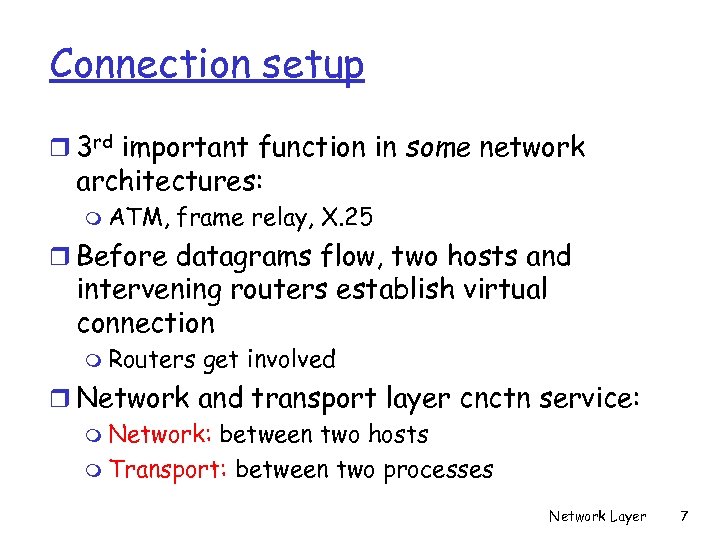 Connection setup r 3 rd important function in some network architectures: m ATM, frame relay, X. 25 r Before datagrams flow, two hosts and intervening routers establish virtual connection m Routers get involved r Network and transport layer cnctn service: m Network: between two hosts m Transport: between two processes Network Layer 7
 Network service model Q: What service model for “channel” transporting datagrams from sender to rcvr? Example services for individual datagrams: r guaranteed delivery r Guaranteed delivery with less than 40 msec delay Example services for a flow of datagrams: r In-order datagram delivery r Guaranteed minimum bandwidth to flow r Restrictions on changes in interpacket spacing Network Layer 8
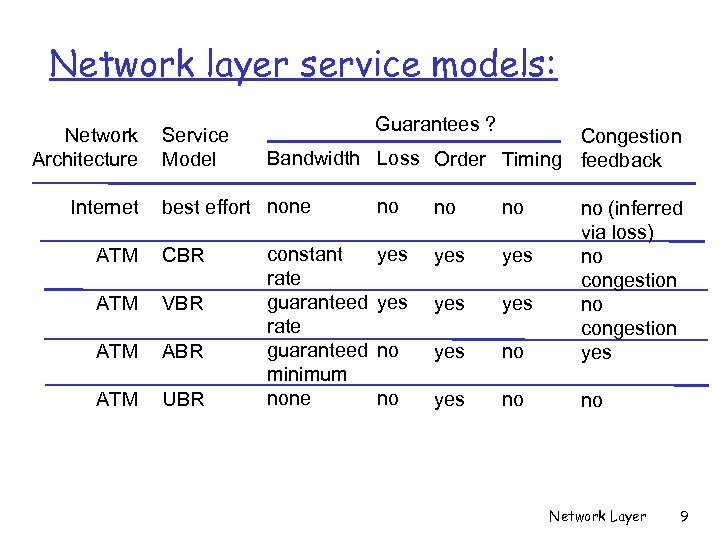 Network layer service models: Network Architecture Internet Service Model Guarantees ? Congestion Bandwidth Loss Order Timing feedback best effort none ATM CBR ATM VBR ATM ABR ATM UBR constant rate guaranteed minimum none no no no yes yes yes no no (inferred via loss) no congestion yes no no Network Layer 9
 Chapter 4: Network Layer r 4. 1 Introduction r 4. 2 Virtual circuit and datagram networks r 4. 3 What’s inside a router r 4. 4 IP: Internet Protocol m m Datagram format IPv 4 addressing ICMP IPv 6 r 4. 5 Routing algorithms m Link state m Distance Vector m Hierarchical routing r 4. 6 Routing in the Internet m m m RIP OSPF BGP r 4. 7 Broadcast and multicast routing Network Layer 10
 Network layer connection and connection-less service r Datagram network provides network-layer connectionless service r VC network provides network-layer connection service r Analogous to the transport-layer services, but: m Service: host-to-host m No choice: network provides one or the other m Implementation: in the core Network Layer 11
 Virtual circuits “source-to-dest path behaves much like telephone circuit” m m performance-wise network actions along source-to-dest path r call setup, teardown for each call before data can flow r each packet carries VC identifier (not destination host address) r every router on source-dest path maintains “state” for each passing connection r link, router resources (bandwidth, buffers) may be allocated to VC Network Layer 12
 VC implementation A VC consists of: 1. 2. 3. Path from source to destination VC numbers, one number for each link along path Entries in forwarding tables in routers along path r Packet belonging to VC carries a VC number. r VC number must be changed on each link. m New VC number comes from forwarding table Network Layer 13
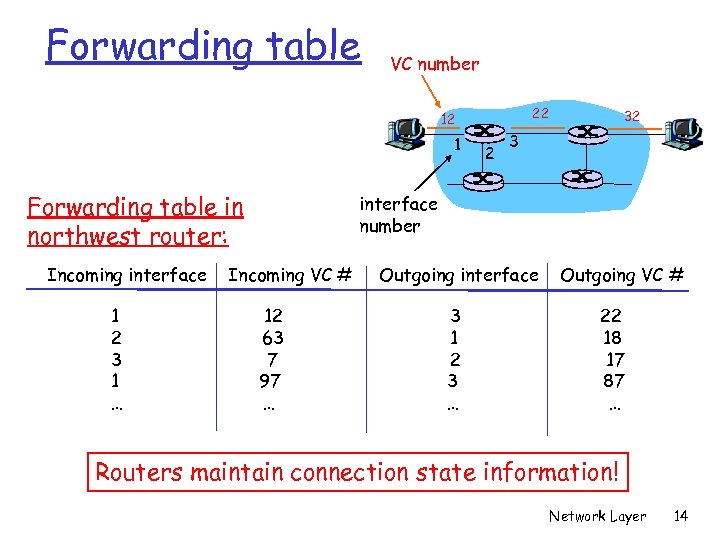 Forwarding table VC number 22 12 1 Forwarding table in northwest router: Incoming interface 1 2 3 1 … 2 32 3 interface number Incoming VC # 12 63 7 97 … Outgoing interface 3 1 2 3 … Outgoing VC # 22 18 17 87 … Routers maintain connection state information! Network Layer 14
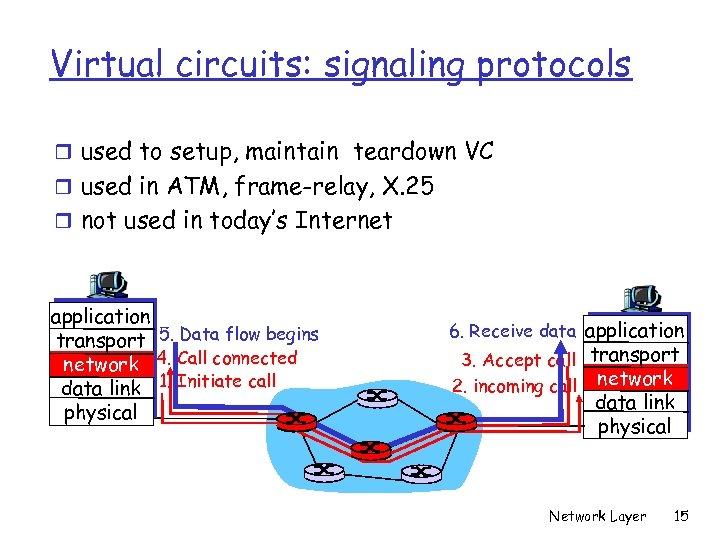 Virtual circuits: signaling protocols r used to setup, maintain teardown VC r used in ATM, frame-relay, X. 25 r not used in today’s Internet application transport 5. Data flow begins network 4. Call connected data link 1. Initiate call physical 6. Receive data application 3. Accept call transport 2. incoming call network data link physical Network Layer 15
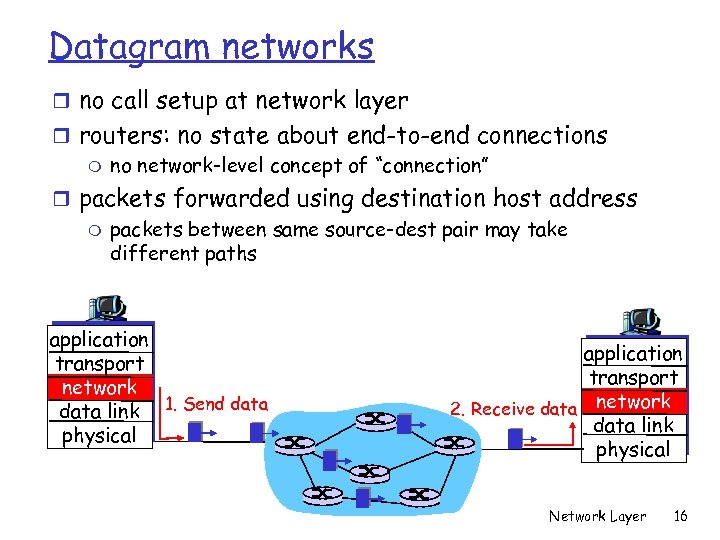 Datagram networks r no call setup at network layer r routers: no state about end-to-end connections m no network-level concept of “connection” r packets forwarded using destination host address m packets between same source-dest pair may take different paths application transport network data link 1. Send data physical application transport 2. Receive data network data link physical Network Layer 16
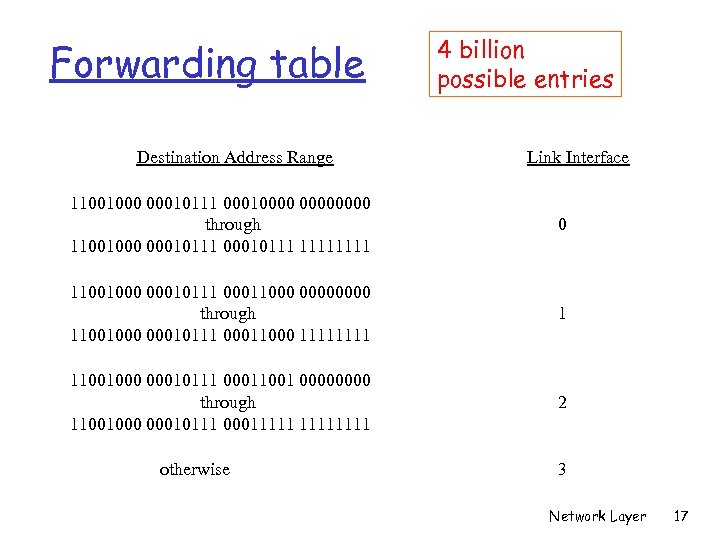 Forwarding table Destination Address Range 4 billion possible entries Link Interface 11001000 00010111 00010000 through 11001000 00010111 1111 0 11001000 00010111 00011000 0000 through 11001000 00010111 00011000 1111 1 11001000 00010111 00011001 0000 through 11001000 00010111 00011111 2 otherwise 3 Network Layer 17
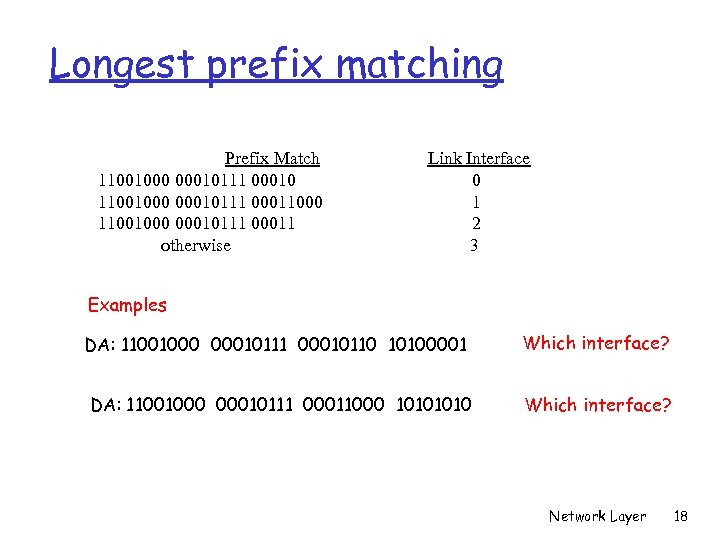 Longest prefix matching Prefix Match 11001000 00010111 00010 11001000 00010111 00011000 11001000 00010111 00011 otherwise Link Interface 0 1 2 3 Examples DA: 11001000 00010111 00010110 10100001 Which interface? DA: 11001000 00010111 00011000 1010 Which interface? Network Layer 18
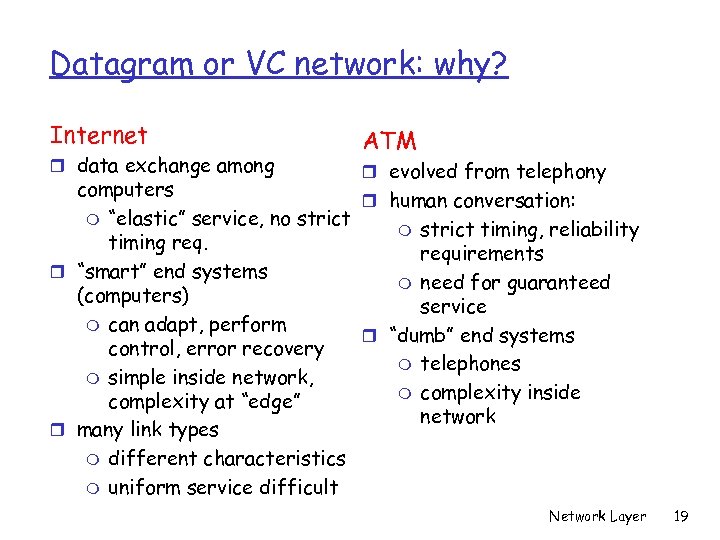 Datagram or VC network: why? Internet r data exchange among ATM r evolved from telephony computers r human conversation: m “elastic” service, no strict m strict timing, reliability timing requirements r “smart” end systems m need for guaranteed (computers) service m can adapt, perform r “dumb” end systems control, error recovery m telephones m simple inside network, m complexity inside complexity at “edge” network r many link types m different characteristics m uniform service difficult Network Layer 19
 Chapter 4: Network Layer r 4. 1 Introduction r 4. 2 Virtual circuit and datagram networks r 4. 3 What’s inside a router r 4. 4 IP: Internet Protocol m m Datagram format IPv 4 addressing ICMP IPv 6 r 4. 5 Routing algorithms m Link state m Distance Vector m Hierarchical routing r 4. 6 Routing in the Internet m m m RIP OSPF BGP r 4. 7 Broadcast and multicast routing Network Layer 20
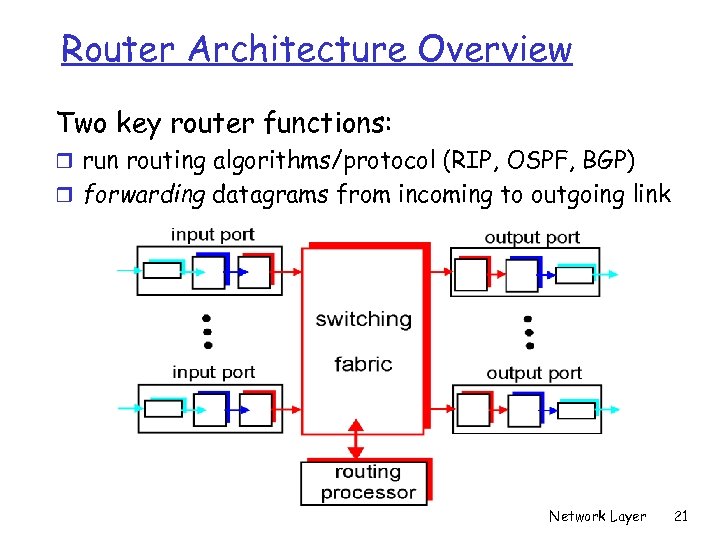 Router Architecture Overview Two key router functions: r run routing algorithms/protocol (RIP, OSPF, BGP) r forwarding datagrams from incoming to outgoing link Network Layer 21
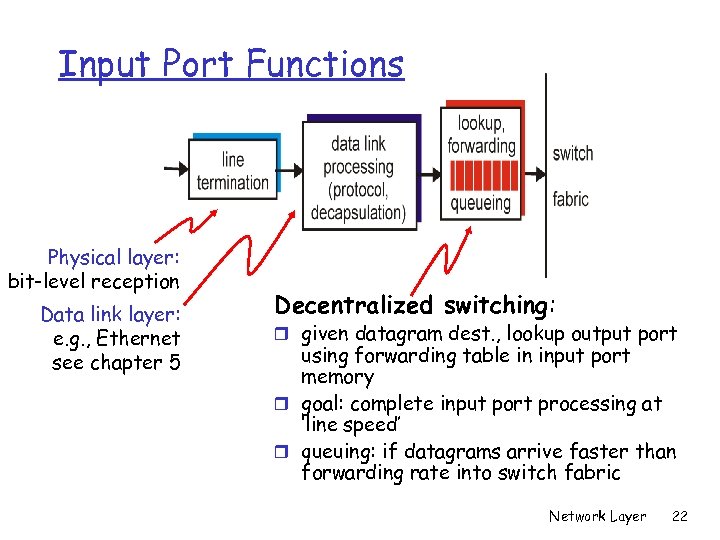 Input Port Functions Physical layer: bit-level reception Data link layer: e. g. , Ethernet see chapter 5 Decentralized switching: r given datagram dest. , lookup output port using forwarding table in input port memory r goal: complete input port processing at ‘line speed’ r queuing: if datagrams arrive faster than forwarding rate into switch fabric Network Layer 22
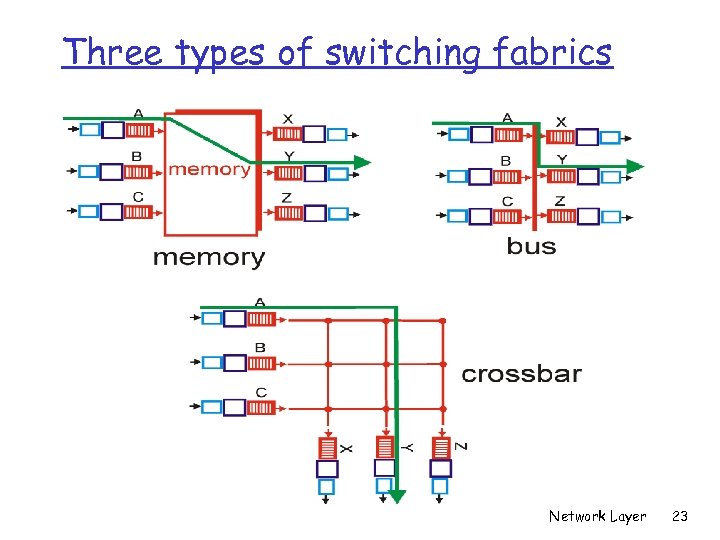 Three types of switching fabrics Network Layer 23
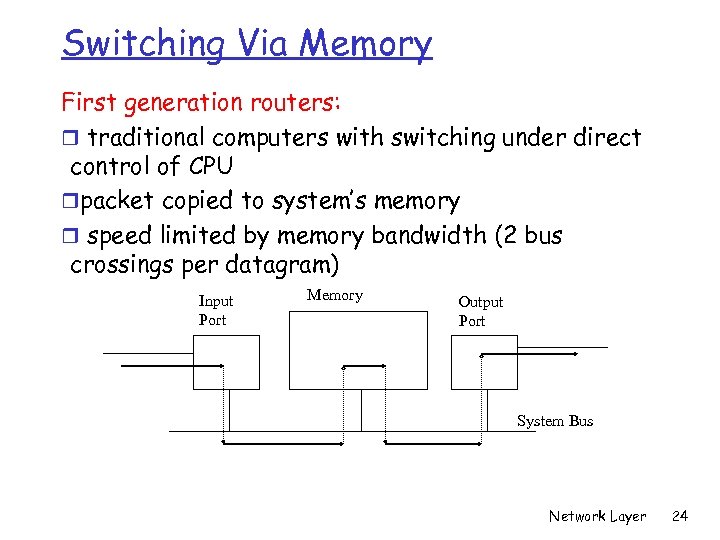 Switching Via Memory First generation routers: r traditional computers with switching under direct control of CPU rpacket copied to system’s memory r speed limited by memory bandwidth (2 bus crossings per datagram) Input Port Memory Output Port System Bus Network Layer 24
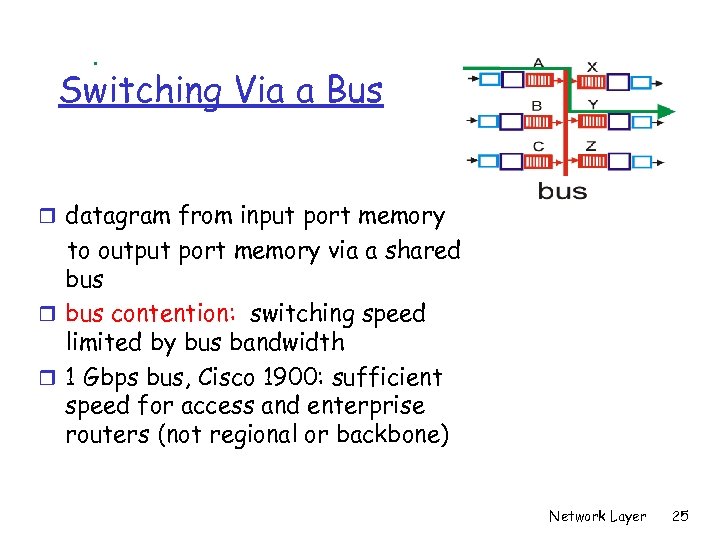 Switching Via a Bus r datagram from input port memory to output port memory via a shared bus r bus contention: switching speed limited by bus bandwidth r 1 Gbps bus, Cisco 1900: sufficient speed for access and enterprise routers (not regional or backbone) Network Layer 25
 Switching Via An Interconnection Network r overcome bus bandwidth limitations r Banyan networks, other interconnection nets initially developed to connect processors in multiprocessor r Advanced design: fragmenting datagram into fixed length cells, switch cells through the fabric. r Cisco 12000: switches Gbps through the interconnection network Network Layer 26
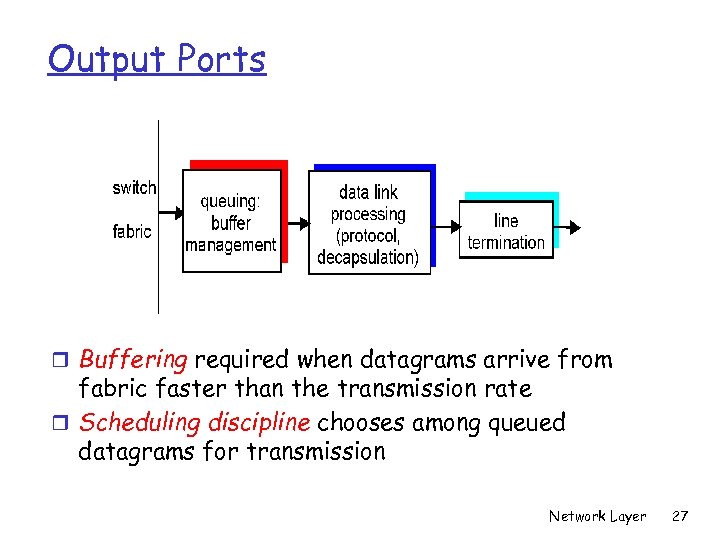 Output Ports r Buffering required when datagrams arrive from fabric faster than the transmission rate r Scheduling discipline chooses among queued datagrams for transmission Network Layer 27
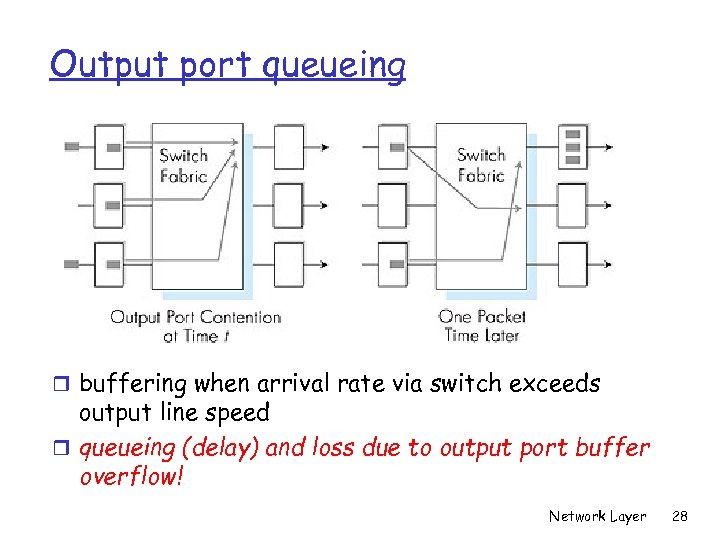 Output port queueing r buffering when arrival rate via switch exceeds output line speed r queueing (delay) and loss due to output port buffer overflow! Network Layer 28
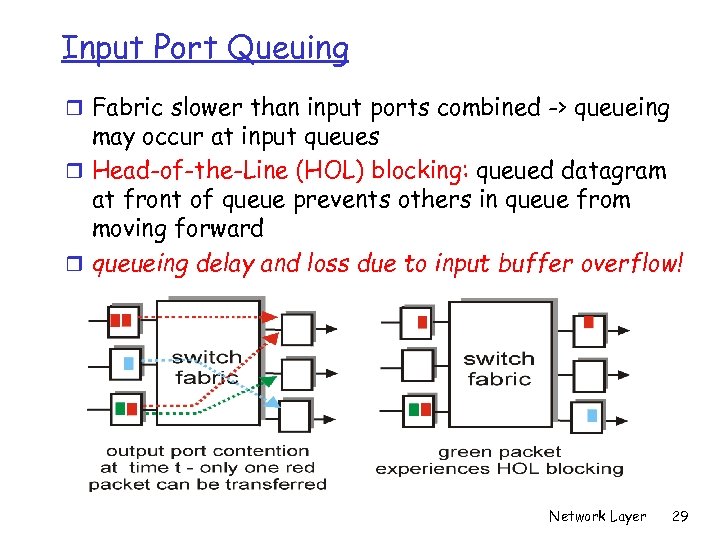 Input Port Queuing r Fabric slower than input ports combined -> queueing may occur at input queues r Head-of-the-Line (HOL) blocking: queued datagram at front of queue prevents others in queue from moving forward r queueing delay and loss due to input buffer overflow! Network Layer 29
 Chapter 4: Network Layer r 4. 1 Introduction r 4. 2 Virtual circuit and datagram networks r 4. 3 What’s inside a router r 4. 4 IP: Internet Protocol m m Datagram format IPv 4 addressing ICMP IPv 6 r 4. 5 Routing algorithms m Link state m Distance Vector m Hierarchical routing r 4. 6 Routing in the Internet m m m RIP OSPF BGP r 4. 7 Broadcast and multicast routing Network Layer 30
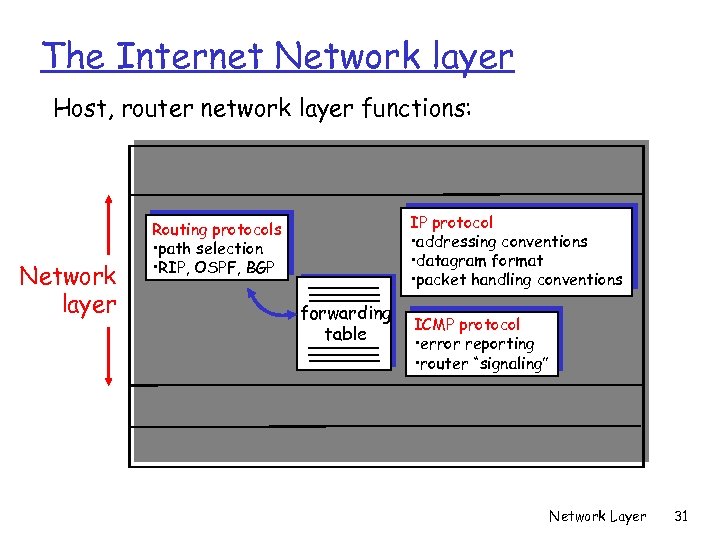 The Internet Network layer Host, router network layer functions: Transport layer: TCP, UDP Network layer IP protocol • addressing conventions • datagram format • packet handling conventions Routing protocols • path selection • RIP, OSPF, BGP forwarding table ICMP protocol • error reporting • router “signaling” Link layer physical layer Network Layer 31
 Chapter 4: Network Layer r 4. 1 Introduction r 4. 2 Virtual circuit and datagram networks r 4. 3 What’s inside a router r 4. 4 IP: Internet Protocol m m Datagram format IPv 4 addressing ICMP IPv 6 r 4. 5 Routing algorithms m Link state m Distance Vector m Hierarchical routing r 4. 6 Routing in the Internet m m m RIP OSPF BGP r 4. 7 Broadcast and multicast routing Network Layer 32
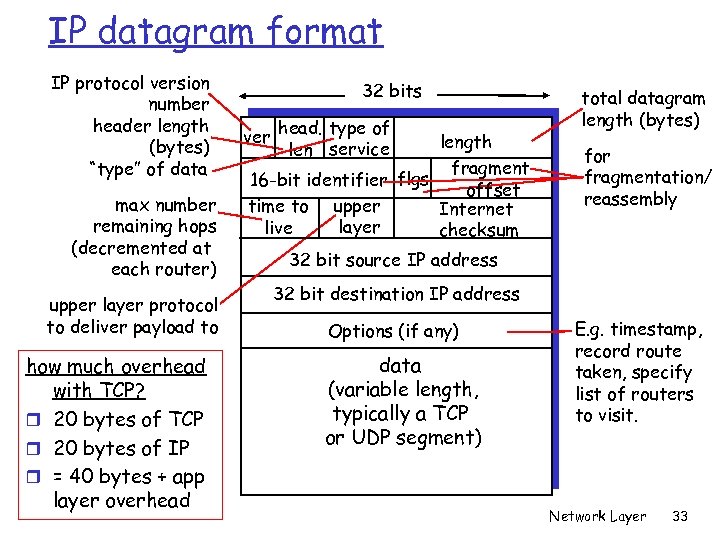 IP datagram format IP protocol version number header length (bytes) “type” of data max number remaining hops (decremented at each router) upper layer protocol to deliver payload to how much overhead with TCP? r 20 bytes of TCP r 20 bytes of IP r = 40 bytes + app layer overhead 32 bits ver head. type of len service length fragment 16 -bit identifier flgs offset upper time to Internet layer live checksum total datagram length (bytes) for fragmentation/ reassembly 32 bit source IP address 32 bit destination IP address Options (if any) data (variable length, typically a TCP or UDP segment) E. g. timestamp, record route taken, specify list of routers to visit. Network Layer 33
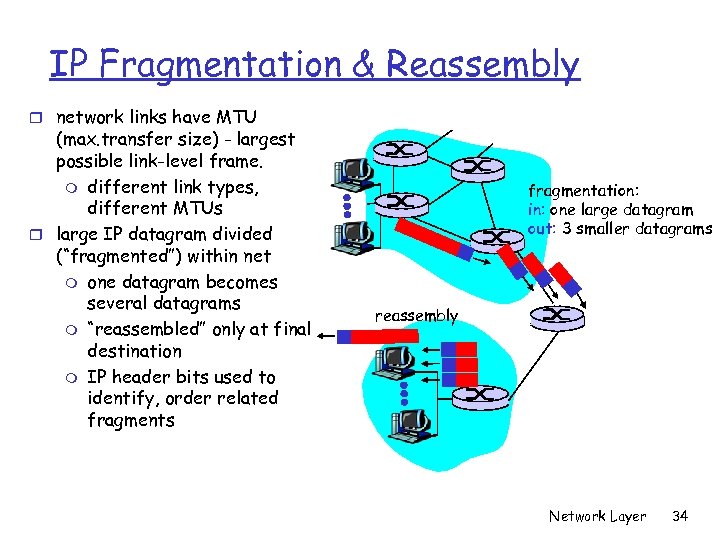 IP Fragmentation & Reassembly r network links have MTU (max. transfer size) - largest possible link-level frame. m different link types, different MTUs r large IP datagram divided (“fragmented”) within net m one datagram becomes several datagrams m “reassembled” only at final destination m IP header bits used to identify, order related fragments fragmentation: in: one large datagram out: 3 smaller datagrams reassembly Network Layer 34
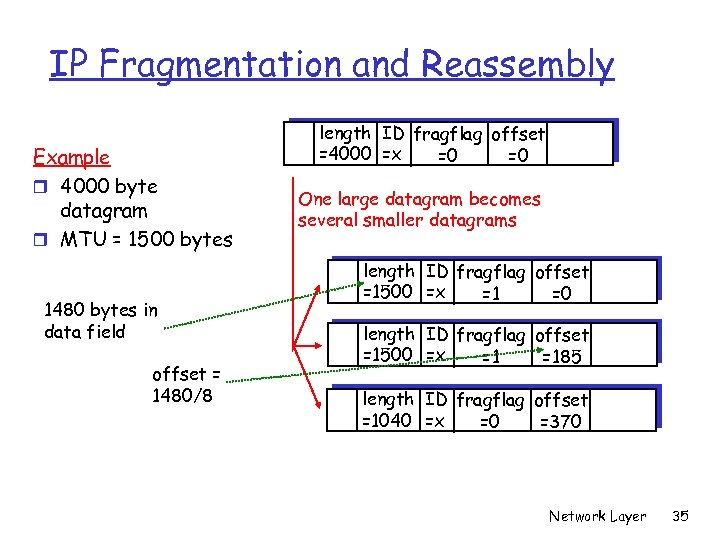 IP Fragmentation and Reassembly Example r 4000 byte datagram r MTU = 1500 bytes 1480 bytes in data field offset = 1480/8 length ID fragflag offset =4000 =x =0 =0 One large datagram becomes several smaller datagrams length ID fragflag offset =1500 =x =1 =0 length ID fragflag offset =1500 =x =1 =185 length ID fragflag offset =1040 =x =0 =370 Network Layer 35
 Chapter 4: Network Layer r 4. 1 Introduction r 4. 2 Virtual circuit and datagram networks r 4. 3 What’s inside a router r 4. 4 IP: Internet Protocol m m Datagram format IPv 4 addressing ICMP IPv 6 r 4. 5 Routing algorithms m Link state m Distance Vector m Hierarchical routing r 4. 6 Routing in the Internet m m m RIP OSPF BGP r 4. 7 Broadcast and multicast routing Network Layer 36
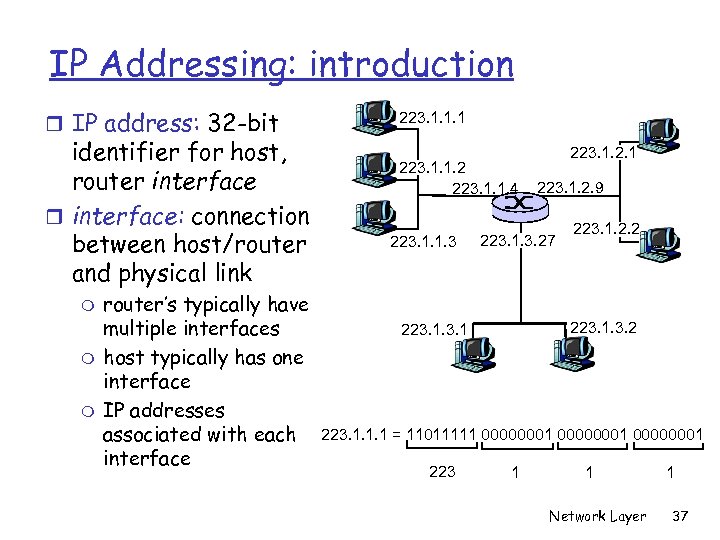 IP Addressing: introduction r IP address: 32 -bit identifier for host, router interface: connection between host/router and physical link m m m router’s typically have multiple interfaces host typically has one interface IP addresses associated with each interface 223. 1. 1. 1 223. 1. 1. 2 223. 1. 1. 4 223. 1. 1. 3 223. 1. 2. 1 223. 1. 2. 9 223. 1. 3. 27 223. 1. 2. 2 223. 1. 1. 1 = 11011111 00000001 223 1 1 Network Layer 1 37
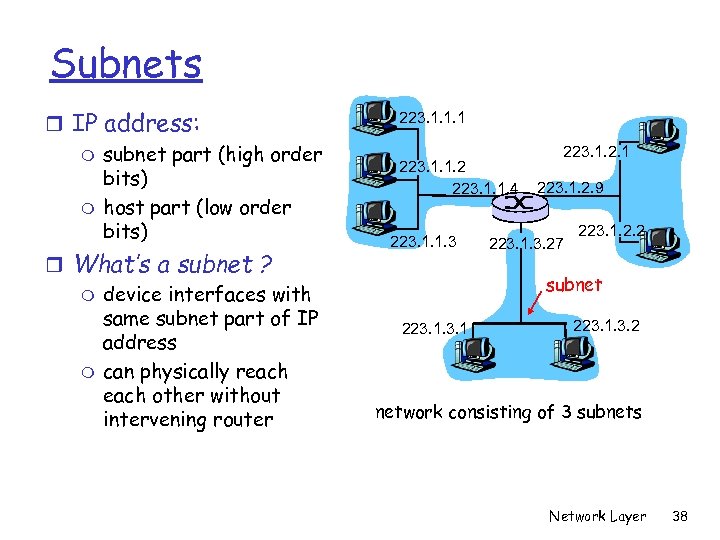 Subnets r IP address: m subnet part (high order bits) m host part (low order bits) r What’s a subnet ? m device interfaces with same subnet part of IP address m can physically reach other without intervening router 223. 1. 1. 1 223. 1. 1. 2 223. 1. 1. 4 223. 1. 1. 3 223. 1. 2. 1 223. 1. 2. 9 223. 1. 3. 27 223. 1. 2. 2 subnet 223. 1. 3. 2 network consisting of 3 subnets Network Layer 38
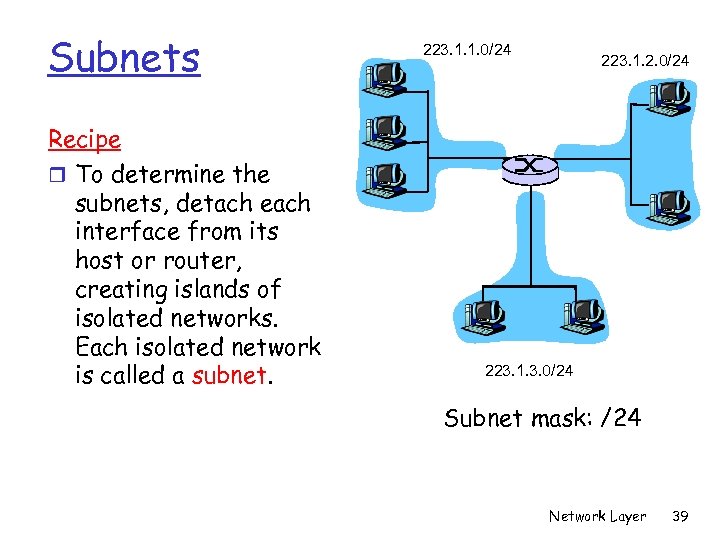 Subnets Recipe r To determine the subnets, detach each interface from its host or router, creating islands of isolated networks. Each isolated network is called a subnet. 223. 1. 1. 0/24 223. 1. 2. 0/24 223. 1. 3. 0/24 Subnet mask: /24 Network Layer 39
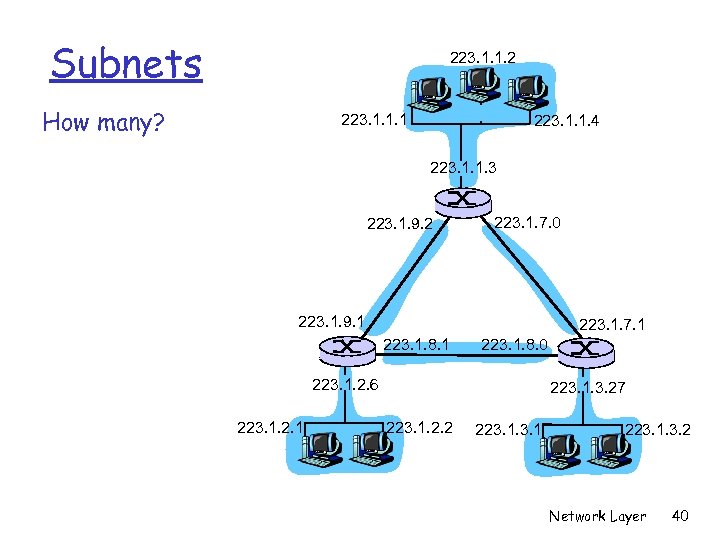 Subnets 223. 1. 1. 2 How many? 223. 1. 1. 1 223. 1. 1. 4 223. 1. 1. 3 223. 1. 9. 2 223. 1. 7. 0 223. 1. 9. 1 223. 1. 7. 1 223. 1. 8. 0 223. 1. 2. 6 223. 1. 2. 1 223. 1. 3. 27 223. 1. 2. 2 223. 1. 3. 2 Network Layer 40
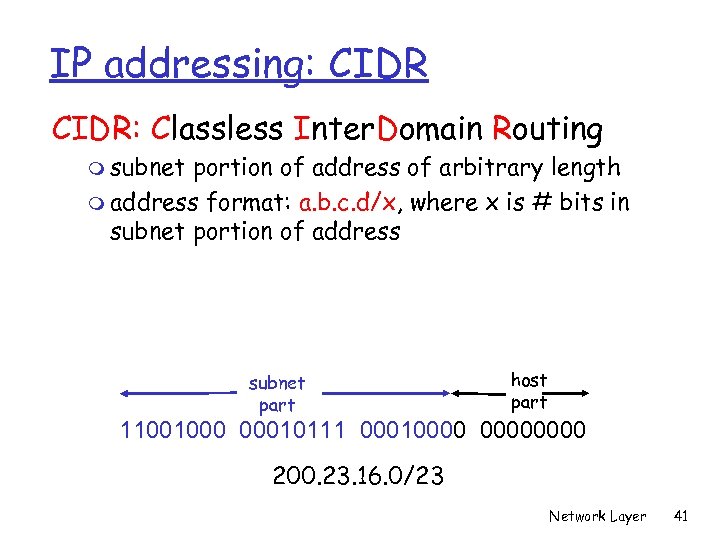 IP addressing: CIDR: Classless Inter. Domain Routing m subnet portion of address of arbitrary length m address format: a. b. c. d/x, where x is # bits in subnet portion of address subnet part host part 11001000 00010111 00010000 200. 23. 16. 0/23 Network Layer 41
 IP addresses: how to get one? Q: How does host get IP address? r hard-coded by system admin in a file m Wintel: control-panel->network->configuration>tcp/ip->properties m UNIX: /etc/rc. config r DHCP: Dynamic Host Configuration Protocol: dynamically get address from as server m “plug-and-play” (more in next chapter) Network Layer 42
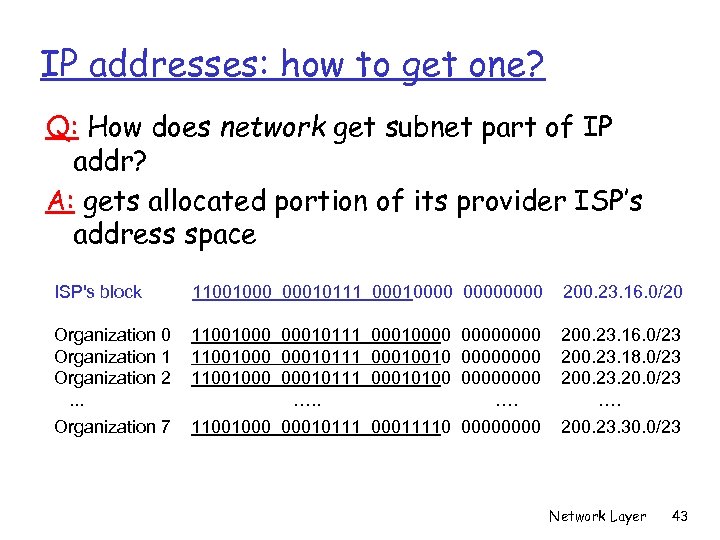 IP addresses: how to get one? Q: How does network get subnet part of IP addr? A: gets allocated portion of its provider ISP’s address space ISP's block 11001000 00010111 00010000 200. 23. 16. 0/20 Organization 1 Organization 2. . . 11001000 00010111 00010000 11001000 00010111 00010010 0000 11001000 00010111 00010100 0000 …. 200. 23. 16. 0/23 200. 23. 18. 0/23 200. 23. 20. 0/23 …. Organization 7 11001000 00010111 00011110 0000 200. 23. 30. 0/23 Network Layer 43
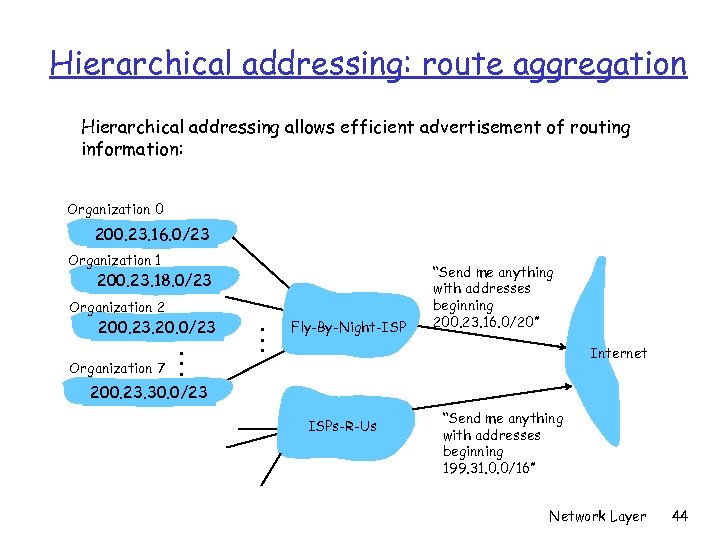 Hierarchical addressing: route aggregation Hierarchical addressing allows efficient advertisement of routing information: Organization 0 200. 23. 16. 0/23 Organization 1 200. 23. 18. 0/23 Organization 2 200. 23. 20. 0/23 Organization 7 . . . Fly-By-Night-ISP “Send me anything with addresses beginning 200. 23. 16. 0/20” Internet 200. 23. 30. 0/23 ISPs-R-Us “Send me anything with addresses beginning 199. 31. 0. 0/16” Network Layer 44
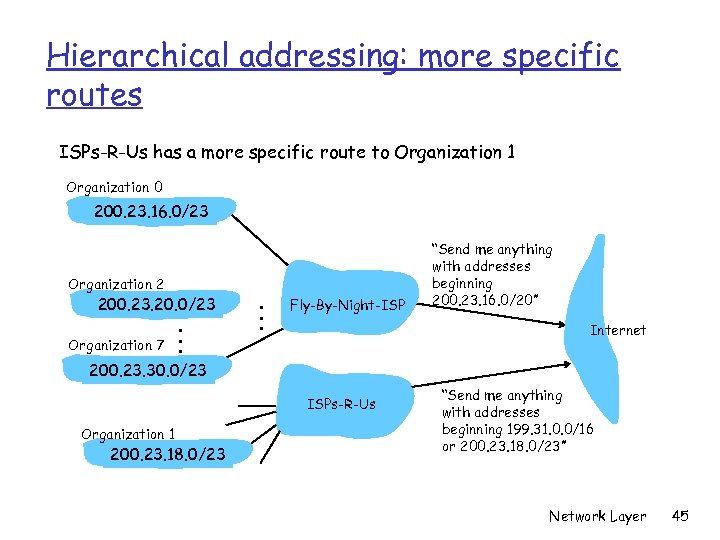 Hierarchical addressing: more specific routes ISPs-R-Us has a more specific route to Organization 1 Organization 0 200. 23. 16. 0/23 Organization 2 200. 23. 20. 0/23 Organization 7 . . . Fly-By-Night-ISP “Send me anything with addresses beginning 200. 23. 16. 0/20” Internet 200. 23. 30. 0/23 ISPs-R-Us Organization 1 200. 23. 18. 0/23 “Send me anything with addresses beginning 199. 31. 0. 0/16 or 200. 23. 18. 0/23” Network Layer 45
 IP addressing: the last word. . . Q: How does an ISP get block of addresses? A: ICANN: Internet Corporation for Assigned Names and Numbers m allocates addresses m manages DNS m assigns domain names, resolves disputes Network Layer 46
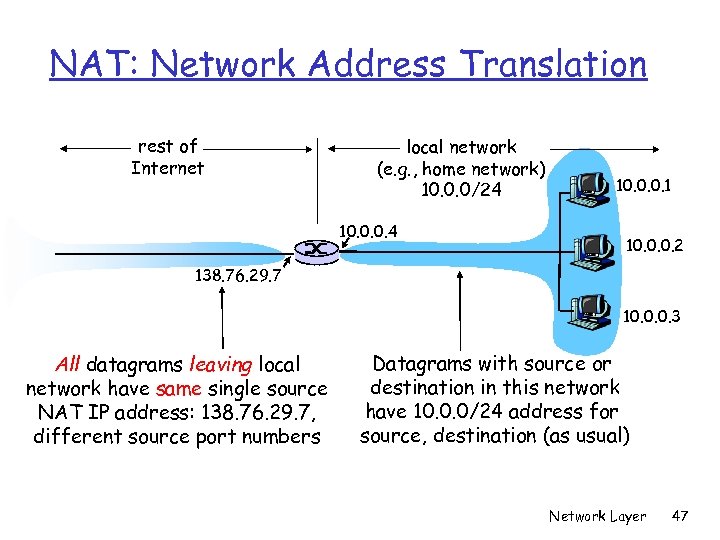 NAT: Network Address Translation rest of Internet local network (e. g. , home network) 10. 0. 0/24 10. 0. 0. 1 10. 0. 0. 2 138. 76. 29. 7 10. 0. 0. 3 All datagrams leaving local network have same single source NAT IP address: 138. 76. 29. 7, different source port numbers Datagrams with source or destination in this network have 10. 0. 0/24 address for source, destination (as usual) Network Layer 47
 NAT: Network Address Translation r Motivation: local network uses just one IP address as far as outside world is concerned: m no need to be allocated range of addresses from ISP: - just one IP address is used for all devices m can change addresses of devices in local network without notifying outside world m can change ISP without changing addresses of devices in local network m devices inside local net not explicitly addressable, visible by outside world (a security plus). Network Layer 48
 NAT: Network Address Translation Implementation: NAT router must: m outgoing datagrams: replace (source IP address, port #) of every outgoing datagram to (NAT IP address, new port #). . . remote clients/servers will respond using (NAT IP address, new port #) as destination addr. m remember (in NAT translation table) every (source IP address, port #) to (NAT IP address, new port #) translation pair m incoming datagrams: replace (NAT IP address, new port #) in dest fields of every incoming datagram with corresponding (source IP address, port #) stored in NAT table Network Layer 49
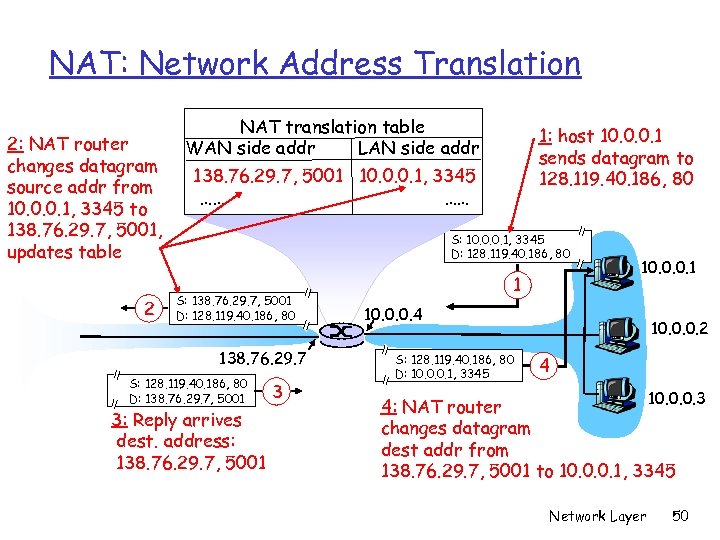 NAT: Network Address Translation 2: NAT router changes datagram source addr from 10. 0. 0. 1, 3345 to 138. 76. 29. 7, 5001, updates table 2 NAT translation table WAN side addr LAN side addr 1: host 10. 0. 0. 1 sends datagram to 128. 119. 40. 186, 80 138. 76. 29. 7, 5001 10. 0. 0. 1, 3345 …… …… S: 10. 0. 0. 1, 3345 D: 128. 119. 40. 186, 80 S: 138. 76. 29. 7, 5001 D: 128. 119. 40. 186, 80 138. 76. 29. 7 S: 128. 119. 40. 186, 80 D: 138. 76. 29. 7, 5001 3: Reply arrives dest. address: 138. 76. 29. 7, 5001 3 1 10. 0. 0. 4 S: 128. 119. 40. 186, 80 D: 10. 0. 0. 1, 3345 10. 0. 0. 2 4 10. 0. 0. 3 4: NAT router changes datagram dest addr from 138. 76. 29. 7, 5001 to 10. 0. 0. 1, 3345 Network Layer 50
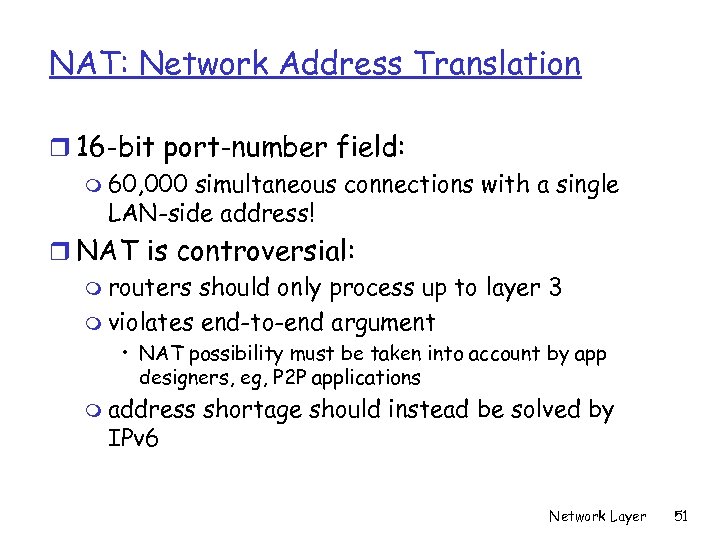 NAT: Network Address Translation r 16 -bit port-number field: m 60, 000 simultaneous connections with a single LAN-side address! r NAT is controversial: m routers should only process up to layer 3 m violates end-to-end argument • NAT possibility must be taken into account by app designers, eg, P 2 P applications m address IPv 6 shortage should instead be solved by Network Layer 51
 Chapter 4: Network Layer r 4. 1 Introduction r 4. 2 Virtual circuit and datagram networks r 4. 3 What’s inside a router r 4. 4 IP: Internet Protocol m m Datagram format IPv 4 addressing ICMP IPv 6 r 4. 5 Routing algorithms m Link state m Distance Vector m Hierarchical routing r 4. 6 Routing in the Internet m m m RIP OSPF BGP r 4. 7 Broadcast and multicast routing Network Layer 52
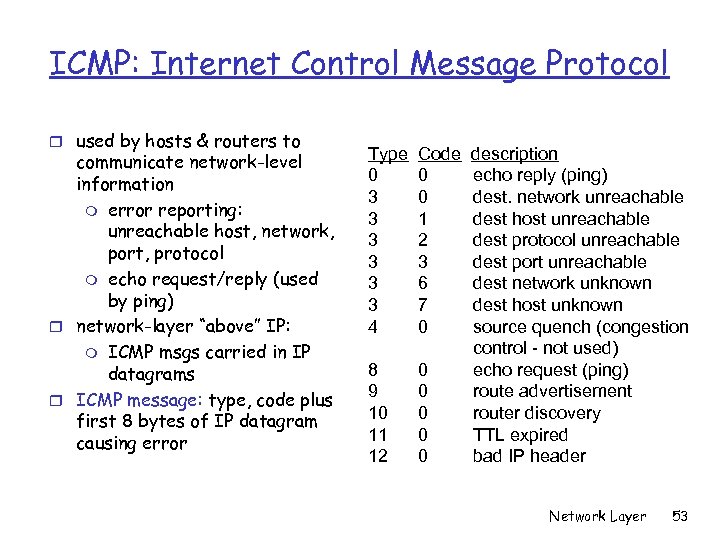 ICMP: Internet Control Message Protocol r used by hosts & routers to communicate network-level information m error reporting: unreachable host, network, port, protocol m echo request/reply (used by ping) r network-layer “above” IP: m ICMP msgs carried in IP datagrams r ICMP message: type, code plus first 8 bytes of IP datagram causing error Type 0 3 3 3 4 Code 0 0 1 2 3 6 7 0 8 9 10 11 12 0 0 0 description echo reply (ping) dest. network unreachable dest host unreachable dest protocol unreachable dest port unreachable dest network unknown dest host unknown source quench (congestion control - not used) echo request (ping) route advertisement router discovery TTL expired bad IP header Network Layer 53
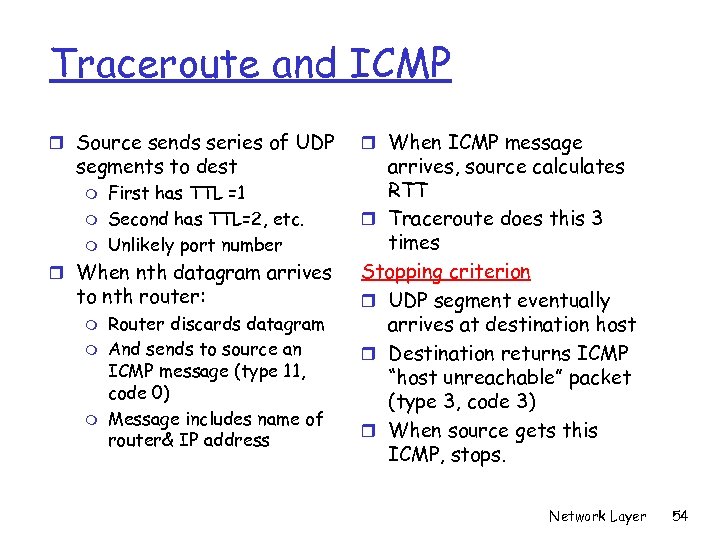 Traceroute and ICMP r Source sends series of UDP segments to dest m m m First has TTL =1 Second has TTL=2, etc. Unlikely port number r When nth datagram arrives to nth router: m m m Router discards datagram And sends to source an ICMP message (type 11, code 0) Message includes name of router& IP address r When ICMP message arrives, source calculates RTT r Traceroute does this 3 times Stopping criterion r UDP segment eventually arrives at destination host r Destination returns ICMP “host unreachable” packet (type 3, code 3) r When source gets this ICMP, stops. Network Layer 54
 Chapter 4: Network Layer r 4. 1 Introduction r 4. 2 Virtual circuit and datagram networks r 4. 3 What’s inside a router r 4. 4 IP: Internet Protocol m m Datagram format IPv 4 addressing ICMP IPv 6 r 4. 5 Routing algorithms m Link state m Distance Vector m Hierarchical routing r 4. 6 Routing in the Internet m m m RIP OSPF BGP r 4. 7 Broadcast and multicast routing Network Layer 55
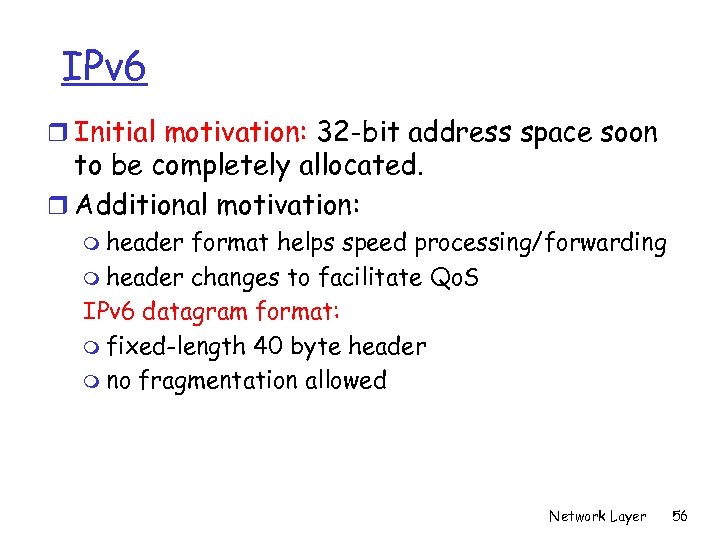 IPv 6 r Initial motivation: 32 -bit address space soon to be completely allocated. r Additional motivation: m header format helps speed processing/forwarding m header changes to facilitate Qo. S IPv 6 datagram format: m fixed-length 40 byte header m no fragmentation allowed Network Layer 56
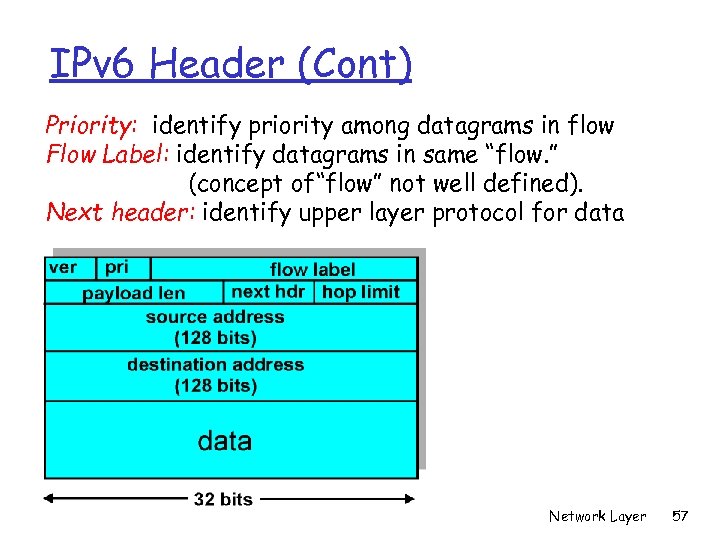 IPv 6 Header (Cont) Priority: identify priority among datagrams in flow Flow Label: identify datagrams in same “flow. ” (concept of“flow” not well defined). Next header: identify upper layer protocol for data Network Layer 57
 Other Changes from IPv 4 r Checksum: removed entirely to reduce processing time at each hop r Options: allowed, but outside of header, indicated by “Next Header” field r ICMPv 6: new version of ICMP m additional message types, e. g. “Packet Too Big” m multicast group management functions Network Layer 58
 Transition From IPv 4 To IPv 6 r Not all routers can be upgraded simultaneous m no “flag days” m How will the network operate with mixed IPv 4 and IPv 6 routers? r Tunneling: IPv 6 carried as payload in IPv 4 datagram among IPv 4 routers Network Layer 59
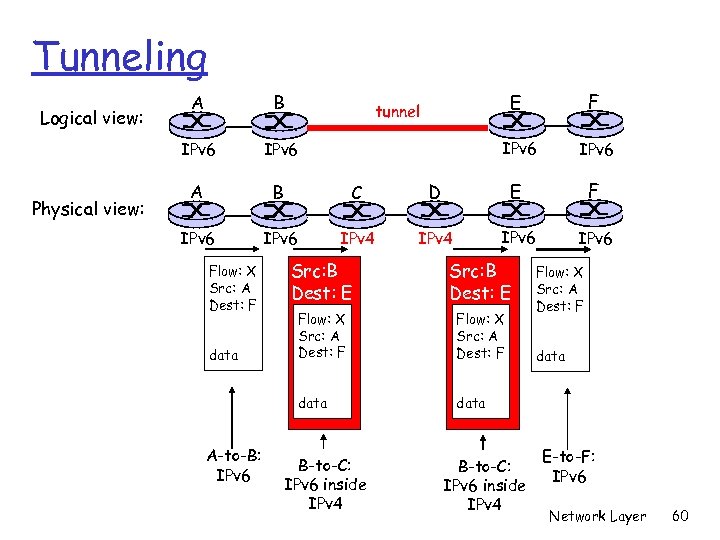 Tunneling Physical view: B C IPv 6 IPv 4 F IPv 6 D E F IPv 4 IPv 6 A E IPv 6 B IPv 6 Logical view: A tunnel data A-to-B: IPv 6 Src: B Dest: E Flow: X Src: A Dest: F data B-to-C: IPv 6 inside IPv 4 Flow: X Src: A Dest: F data E-to-F: IPv 6 Network Layer 60
 Chapter 4: Network Layer r 4. 1 Introduction r 4. 2 Virtual circuit and datagram networks r 4. 3 What’s inside a router r 4. 4 IP: Internet Protocol m m Datagram format IPv 4 addressing ICMP IPv 6 r 4. 5 Routing algorithms m Link state m Distance Vector m Hierarchical routing r 4. 6 Routing in the Internet m m m RIP OSPF BGP r 4. 7 Broadcast and multicast routing Network Layer 61
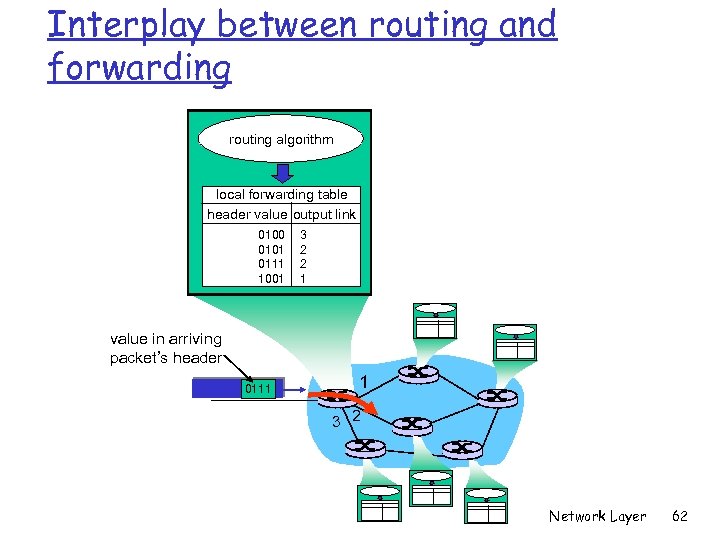 Interplay between routing and forwarding routing algorithm local forwarding table header value output link 0100 0101 0111 1001 3 2 2 1 value in arriving packet’s header 0111 1 3 2 Network Layer 62
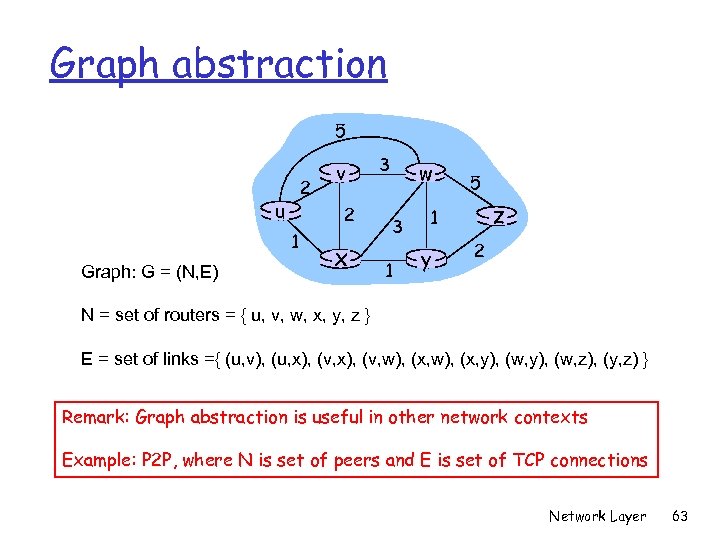 Graph abstraction 5 2 u 2 1 Graph: G = (N, E) v x 3 w 3 1 5 z 1 y 2 N = set of routers = { u, v, w, x, y, z } E = set of links ={ (u, v), (u, x), (v, w), (x, y), (w, z), (y, z) } Remark: Graph abstraction is useful in other network contexts Example: P 2 P, where N is set of peers and E is set of TCP connections Network Layer 63
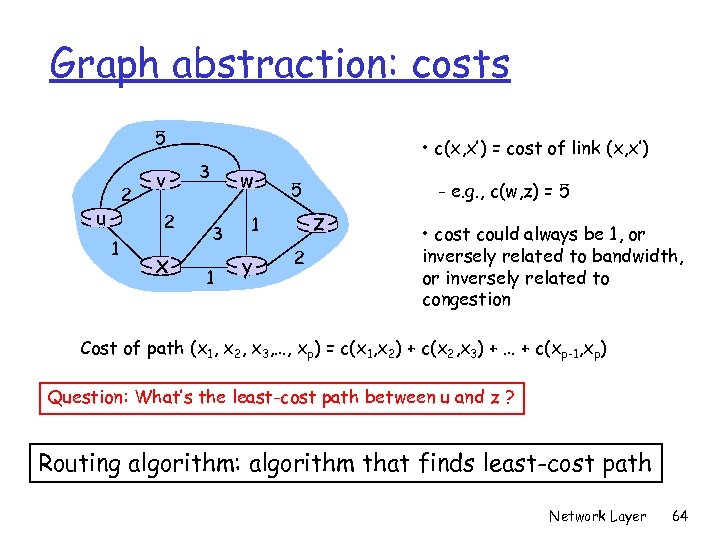 Graph abstraction: costs 5 2 u v 2 1 x • c(x, x’) = cost of link (x, x’) 3 w 3 1 5 z 1 y - e. g. , c(w, z) = 5 2 • cost could always be 1, or inversely related to bandwidth, or inversely related to congestion Cost of path (x 1, x 2, x 3, …, xp) = c(x 1, x 2) + c(x 2, x 3) + … + c(xp-1, xp) Question: What’s the least-cost path between u and z ? Routing algorithm: algorithm that finds least-cost path Network Layer 64
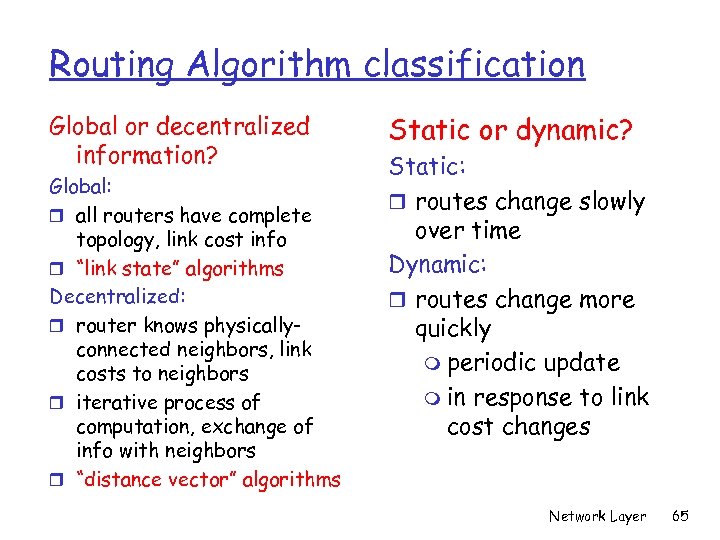 Routing Algorithm classification Global or decentralized information? Global: r all routers have complete topology, link cost info r “link state” algorithms Decentralized: r router knows physicallyconnected neighbors, link costs to neighbors r iterative process of computation, exchange of info with neighbors r “distance vector” algorithms Static or dynamic? Static: r routes change slowly over time Dynamic: r routes change more quickly m periodic update m in response to link cost changes Network Layer 65
 Chapter 4: Network Layer r 4. 1 Introduction r 4. 2 Virtual circuit and datagram networks r 4. 3 What’s inside a router r 4. 4 IP: Internet Protocol m m Datagram format IPv 4 addressing ICMP IPv 6 r 4. 5 Routing algorithms m Link state m Distance Vector m Hierarchical routing r 4. 6 Routing in the Internet m m m RIP OSPF BGP r 4. 7 Broadcast and multicast routing Network Layer 66
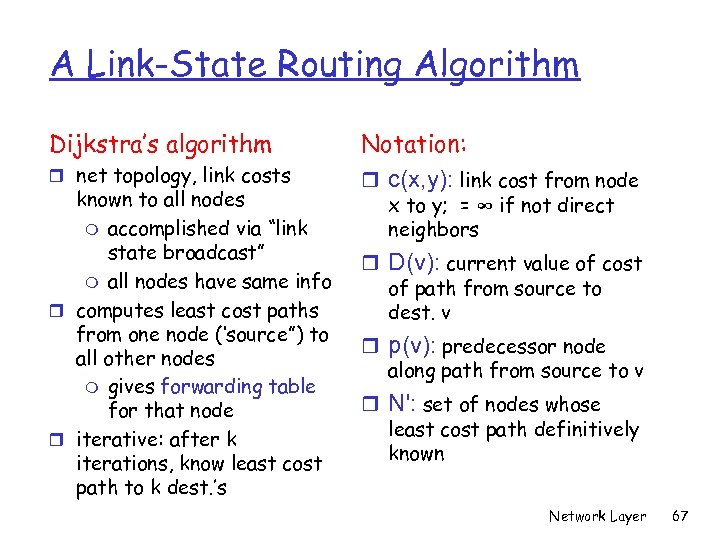 A Link-State Routing Algorithm Dijkstra’s algorithm r net topology, link costs known to all nodes m accomplished via “link state broadcast” m all nodes have same info r computes least cost paths from one node (‘source”) to all other nodes m gives forwarding table for that node r iterative: after k iterations, know least cost path to k dest. ’s Notation: r c(x, y): link cost from node x to y; = ∞ if not direct neighbors r D(v): current value of cost of path from source to dest. v r p(v): predecessor node along path from source to v r N': set of nodes whose least cost path definitively known Network Layer 67
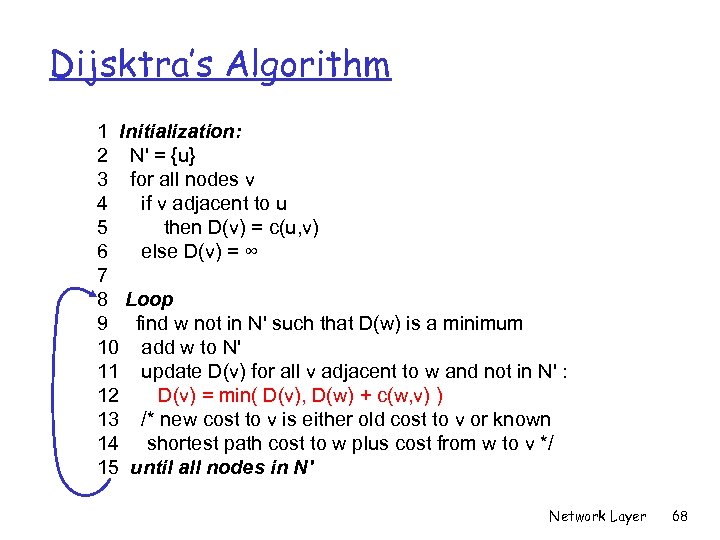 Dijsktra’s Algorithm 1 Initialization: 2 N' = {u} 3 for all nodes v 4 if v adjacent to u 5 then D(v) = c(u, v) 6 else D(v) = ∞ 7 8 Loop 9 find w not in N' such that D(w) is a minimum 10 add w to N' 11 update D(v) for all v adjacent to w and not in N' : 12 D(v) = min( D(v), D(w) + c(w, v) ) 13 /* new cost to v is either old cost to v or known 14 shortest path cost to w plus cost from w to v */ 15 until all nodes in N' Network Layer 68
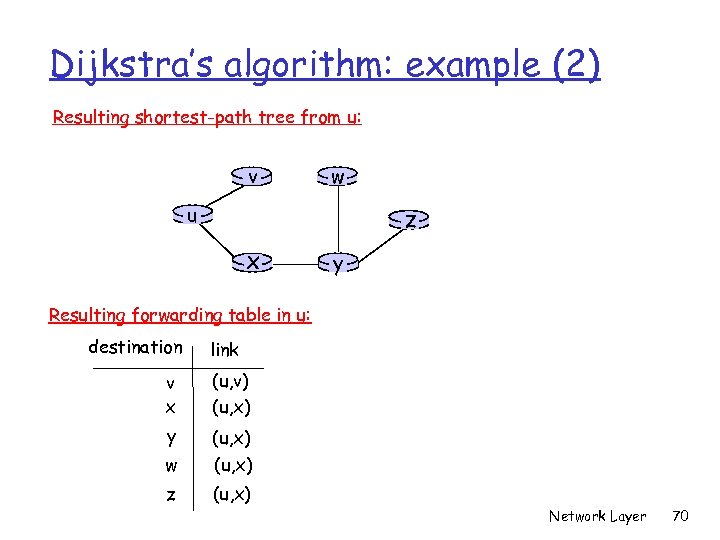
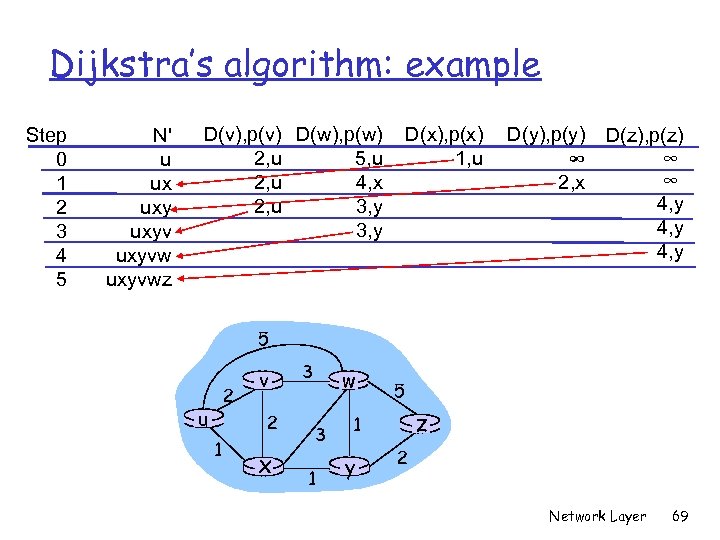 Dijkstra’s algorithm: example Step 0 1 2 3 4 5 N' u ux uxyvwz D(v), p(v) D(w), p(w) 2, u 5, u 2, u 4, x 2, u 3, y D(x), p(x) 1, u D(y), p(y) ∞ 2, x D(z), p(z) ∞ ∞ 4, y 5 2 u v 2 1 x 3 w 3 1 5 z 1 y 2 Network Layer 69
 Dijkstra’s algorithm: example (2) Resulting shortest-path tree from u: v w u z x y Resulting forwarding table in u: destination link v x (u, v) (u, x) y (u, x) w (u, x) z (u, x) Network Layer 70
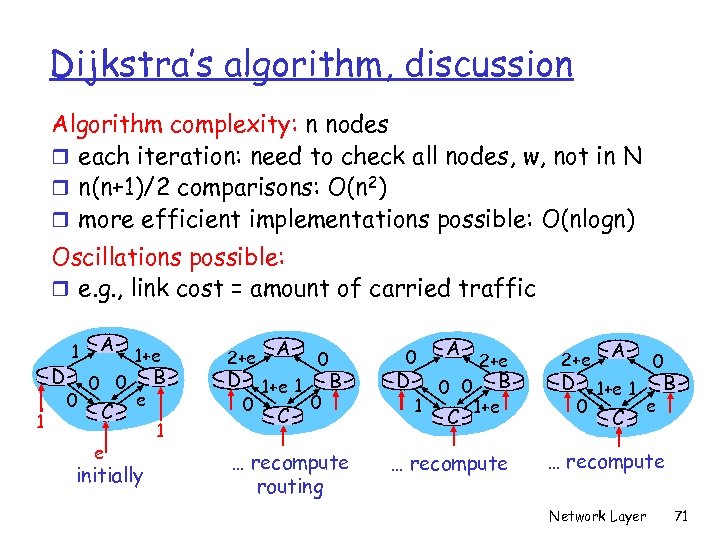 Dijkstra’s algorithm, discussion Algorithm complexity: n nodes r each iteration: need to check all nodes, w, not in N r n(n+1)/2 comparisons: O(n 2) r more efficient implementations possible: O(nlogn) Oscillations possible: r e. g. , link cost = amount of carried traffic D 1 1 0 A 0 0 C e 1+e e initially B 1 2+e A 0 D 1+e 1 B 0 0 C … recompute routing 0 D 1 A 0 0 C 2+e B 1+e … recompute 2+e A 0 D 1+e 1 B e 0 C … recompute Network Layer 71
 Chapter 4: Network Layer r 4. 1 Introduction r 4. 2 Virtual circuit and datagram networks r 4. 3 What’s inside a router r 4. 4 IP: Internet Protocol m m Datagram format IPv 4 addressing ICMP IPv 6 r 4. 5 Routing algorithms m Link state m Distance Vector m Hierarchical routing r 4. 6 Routing in the Internet m m m RIP OSPF BGP r 4. 7 Broadcast and multicast routing Network Layer 72
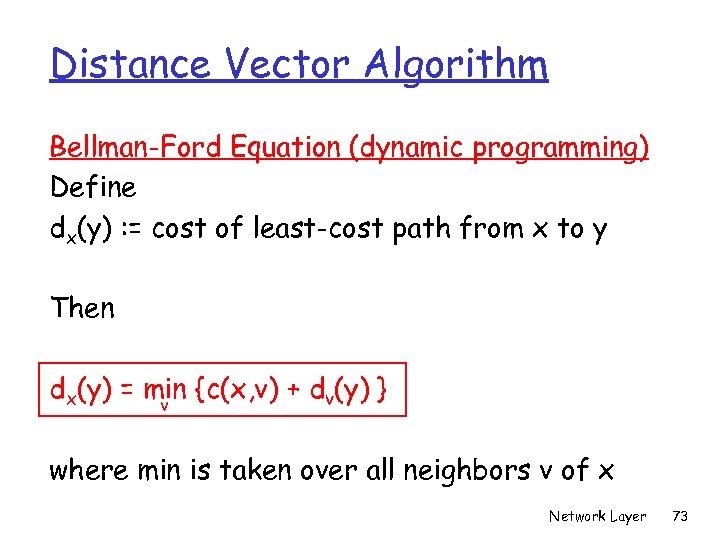 Distance Vector Algorithm Bellman-Ford Equation (dynamic programming) Define dx(y) : = cost of least-cost path from x to y Then dx(y) = min {c(x, v) + dv(y) } v where min is taken over all neighbors v of x Network Layer 73
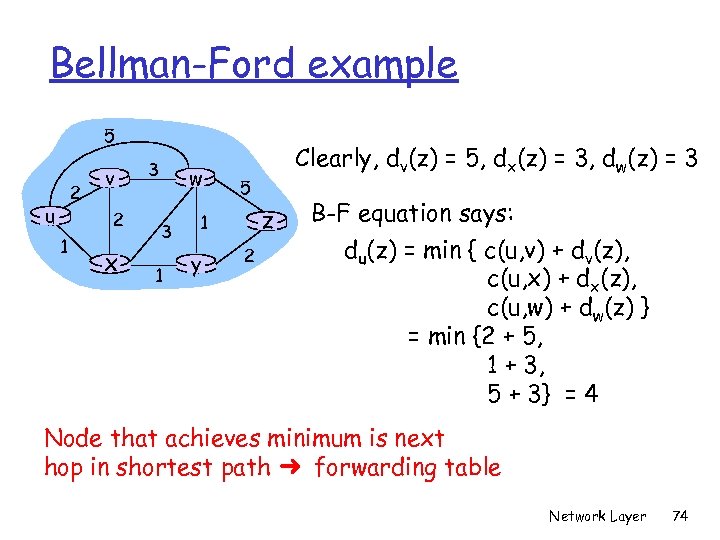 Bellman-Ford example 5 2 u v 2 1 x 3 w 3 1 5 z 1 y Clearly, dv(z) = 5, dx(z) = 3, dw(z) = 3 2 B-F equation says: du(z) = min { c(u, v) + dv(z), c(u, x) + dx(z), c(u, w) + dw(z) } = min {2 + 5, 1 + 3, 5 + 3} = 4 Node that achieves minimum is next hop in shortest path ➜ forwarding table Network Layer 74
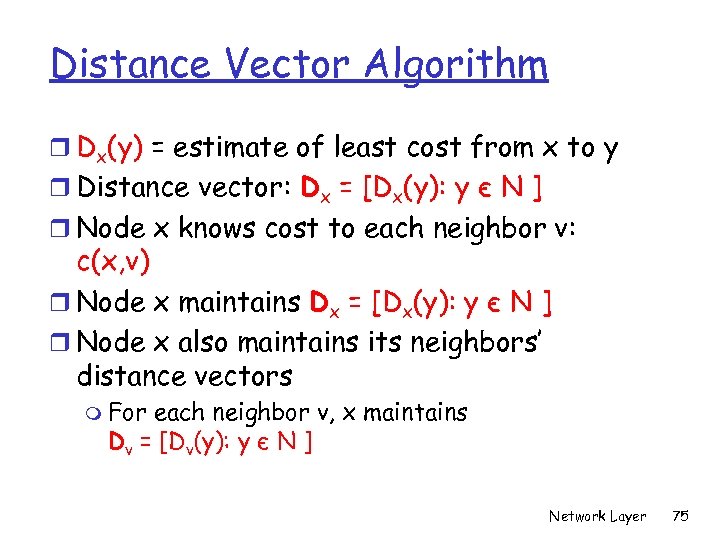 Distance Vector Algorithm r Dx(y) = estimate of least cost from x to y r Distance vector: Dx = [Dx(y): y є N ] r Node x knows cost to each neighbor v: c(x, v) r Node x maintains Dx = [Dx(y): y є N ] r Node x also maintains its neighbors’ distance vectors m For each neighbor v, x maintains Dv = [Dv(y): y є N ] Network Layer 75
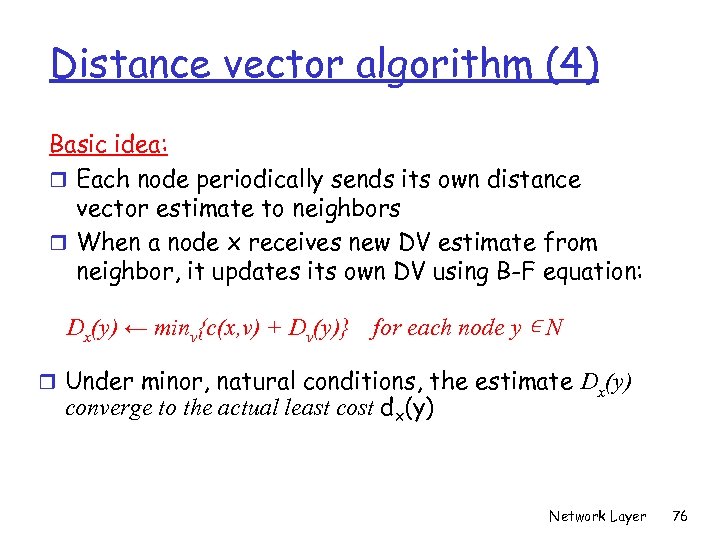 Distance vector algorithm (4) Basic idea: r Each node periodically sends its own distance vector estimate to neighbors r When a node x receives new DV estimate from neighbor, it updates its own DV using B-F equation: Dx(y) ← minv{c(x, v) + Dv(y)} for each node y ∊ N r Under minor, natural conditions, the estimate Dx(y) converge to the actual least cost dx(y) Network Layer 76
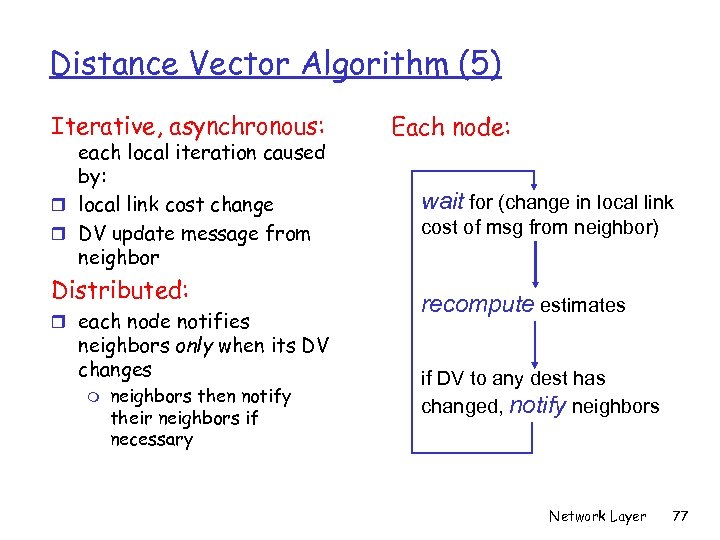 Distance Vector Algorithm (5) Iterative, asynchronous: each local iteration caused by: r local link cost change r DV update message from neighbor Distributed: r each node notifies neighbors only when its DV changes m neighbors then notify their neighbors if necessary Each node: wait for (change in local link cost of msg from neighbor) recompute estimates if DV to any dest has changed, notify neighbors Network Layer 77
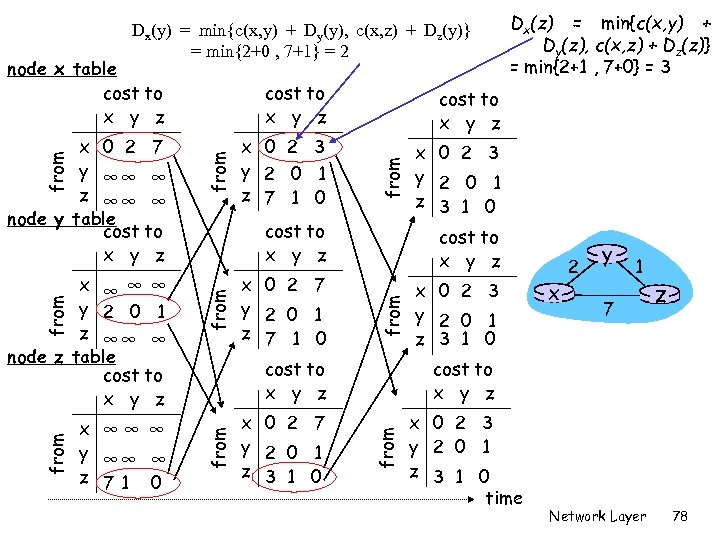 Dx(y) = min{c(x, y) + Dy(y), c(x, z) + Dz(y)} = min{2+0 , 7+1} = 2 node x table cost to x y z x ∞∞ ∞ y ∞∞ ∞ z 71 0 from x 0 2 7 y 2 0 1 z 7 1 0 cost to x y z x 0 2 7 y 2 0 1 z 3 1 0 x 0 2 3 y 2 0 1 z 3 1 0 cost to x y z x 0 2 3 y 2 0 1 z 3 1 0 x 2 y 1 7 z cost to x y z from x ∞ ∞ ∞ y 2 0 1 z ∞∞ ∞ node z table cost to x y z x 0 2 3 y 2 0 1 z 7 1 0 cost to x y z from x 0 2 7 y ∞∞ ∞ z ∞∞ ∞ node y table cost to x y z Dx(z) = min{c(x, y) + Dy(z), c(x, z) + Dz(z)} = min{2+1 , 7+0} = 3 x 0 2 3 y 2 0 1 z 3 1 0 time Network Layer 78
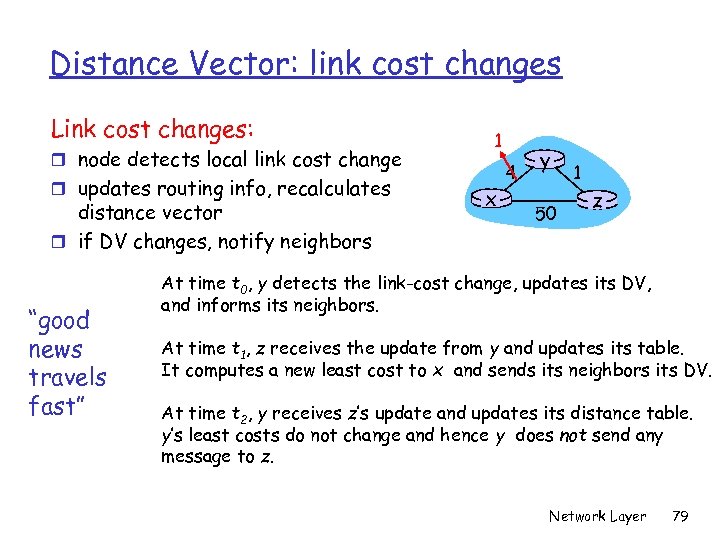 Distance Vector: link cost changes Link cost changes: r node detects local link cost change r updates routing info, recalculates distance vector r if DV changes, notify neighbors “good news travels fast” 1 x 4 y 50 1 z At time t 0, y detects the link-cost change, updates its DV, and informs its neighbors. At time t 1, z receives the update from y and updates its table. It computes a new least cost to x and sends its neighbors its DV. At time t 2, y receives z’s update and updates its distance table. y’s least costs do not change and hence y does not send any message to z. Network Layer 79
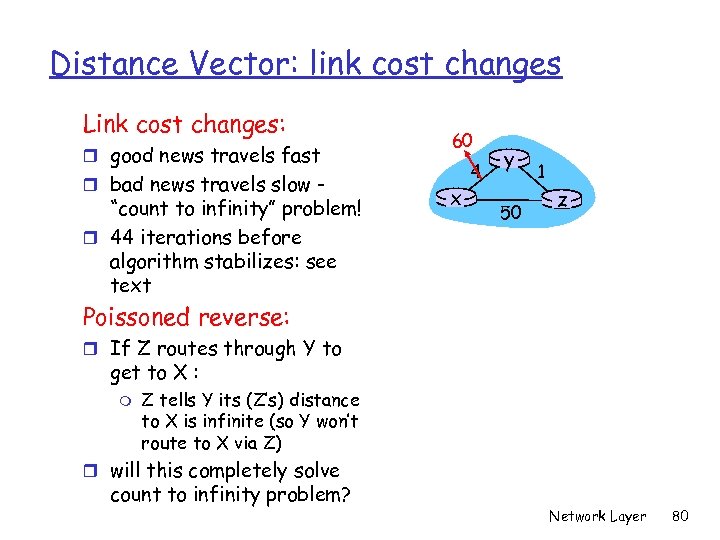 Distance Vector: link cost changes Link cost changes: r good news travels fast r bad news travels slow - “count to infinity” problem! r 44 iterations before algorithm stabilizes: see text 60 x 4 y 50 1 z Poissoned reverse: r If Z routes through Y to get to X : m Z tells Y its (Z’s) distance to X is infinite (so Y won’t route to X via Z) r will this completely solve count to infinity problem? Network Layer 80
 Comparison of LS and DV algorithms Message complexity r LS: with n nodes, E links, O(n. E) msgs sent r DV: exchange between neighbors only m convergence time varies Speed of Convergence r LS: O(n 2) algorithm requires O(n. E) msgs m may have oscillations r DV: convergence time varies m may be routing loops m count-to-infinity problem Robustness: what happens if router malfunctions? LS: m m node can advertise incorrect link cost each node computes only its own table DV: m m DV node can advertise incorrect path cost each node’s table used by others • error propagate thru network Network Layer 81
 Chapter 4: Network Layer r 4. 1 Introduction r 4. 2 Virtual circuit and datagram networks r 4. 3 What’s inside a router r 4. 4 IP: Internet Protocol m m Datagram format IPv 4 addressing ICMP IPv 6 r 4. 5 Routing algorithms m Link state m Distance Vector m Hierarchical routing r 4. 6 Routing in the Internet m m m RIP OSPF BGP r 4. 7 Broadcast and multicast routing Network Layer 82
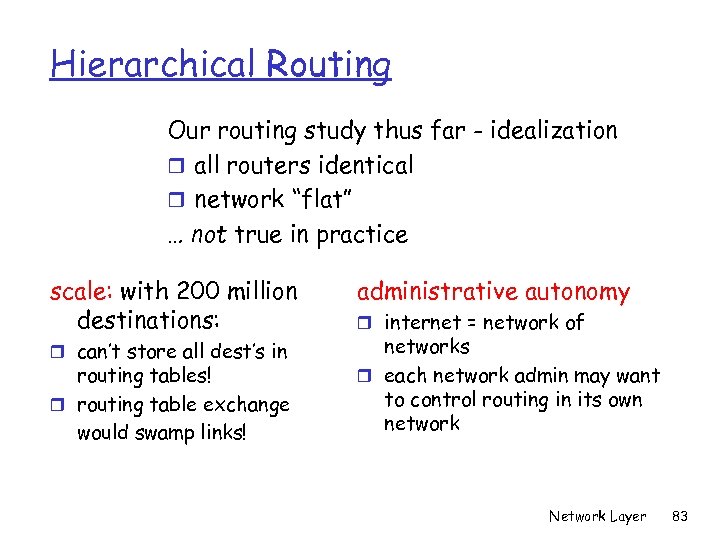 Hierarchical Routing Our routing study thus far - idealization r all routers identical r network “flat” … not true in practice scale: with 200 million destinations: r can’t store all dest’s in routing tables! r routing table exchange would swamp links! administrative autonomy r internet = network of networks r each network admin may want to control routing in its own network Network Layer 83
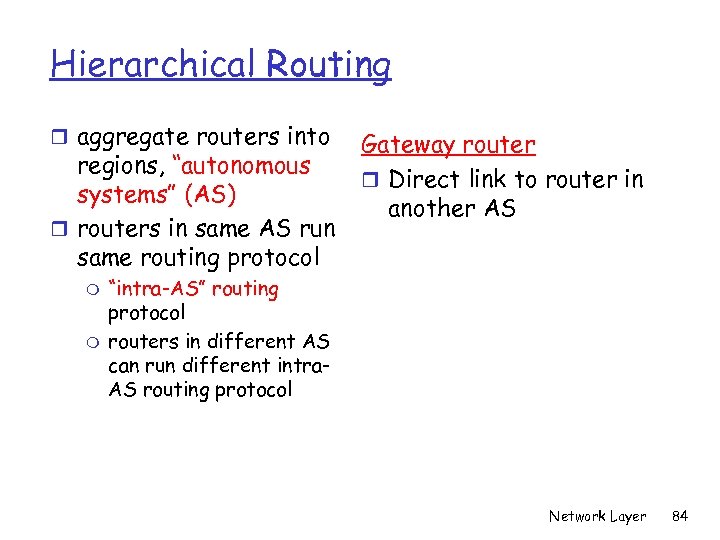 Hierarchical Routing r aggregate routers into regions, “autonomous systems” (AS) r routers in same AS run same routing protocol m m Gateway router r Direct link to router in another AS “intra-AS” routing protocol routers in different AS can run different intra. AS routing protocol Network Layer 84
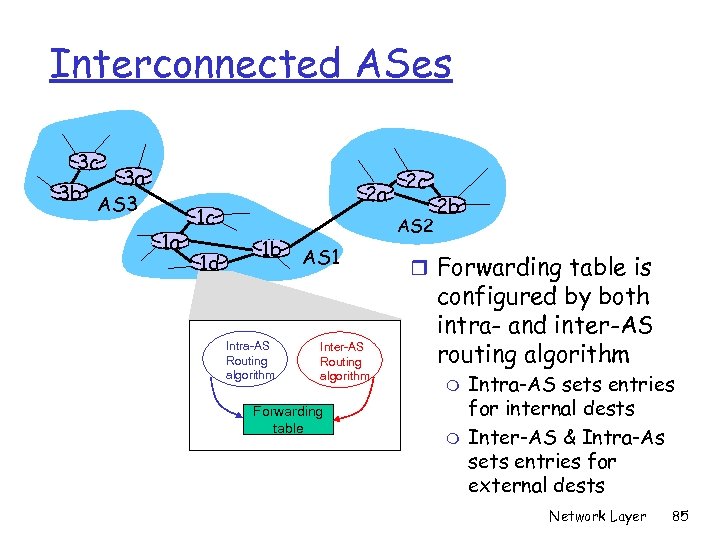 Interconnected ASes 3 c 3 a 3 b AS 3 1 a 2 a 1 c 1 d 1 b Intra-AS Routing algorithm 2 c AS 2 AS 1 Inter-AS Routing algorithm Forwarding table 2 b r Forwarding table is configured by both intra- and inter-AS routing algorithm m m Intra-AS sets entries for internal dests Inter-AS & Intra-As sets entries for external dests Network Layer 85
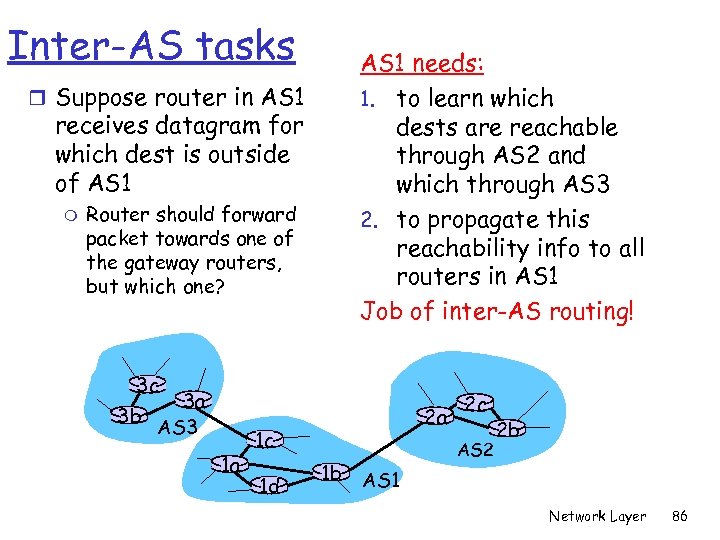 Inter-AS tasks AS 1 needs: 1. to learn which dests are reachable through AS 2 and which through AS 3 2. to propagate this reachability info to all routers in AS 1 Job of inter-AS routing! r Suppose router in AS 1 receives datagram for which dest is outside of AS 1 m Router should forward packet towards one of the gateway routers, but which one? 3 c 3 a 3 b AS 3 1 a 2 a 1 c 1 d 1 b 2 c AS 2 2 b AS 1 Network Layer 86
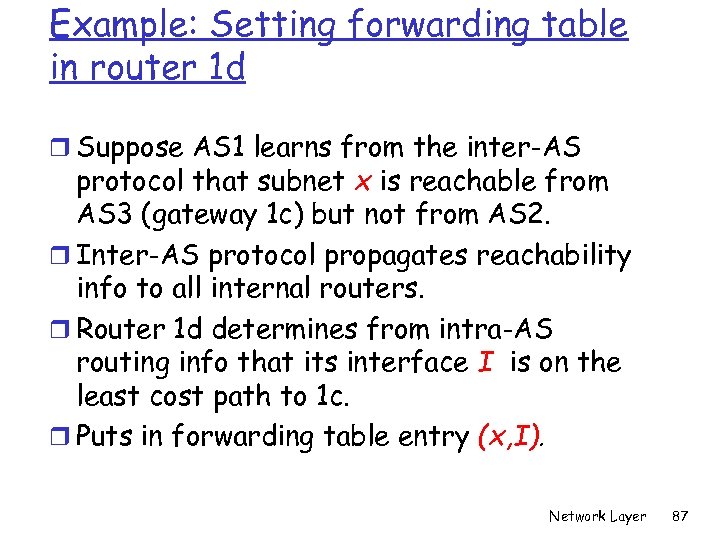 Example: Setting forwarding table in router 1 d r Suppose AS 1 learns from the inter-AS protocol that subnet x is reachable from AS 3 (gateway 1 c) but not from AS 2. r Inter-AS protocol propagates reachability info to all internal routers. r Router 1 d determines from intra-AS routing info that its interface I is on the least cost path to 1 c. r Puts in forwarding table entry (x, I). Network Layer 87
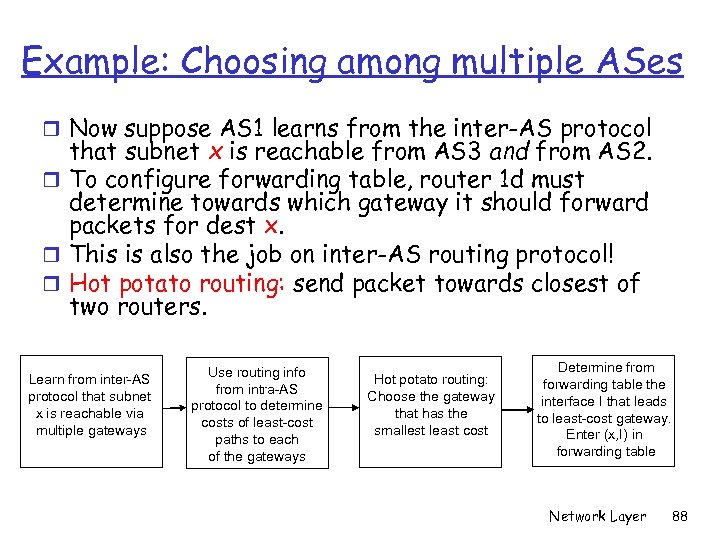 Example: Choosing among multiple ASes r Now suppose AS 1 learns from the inter-AS protocol that subnet x is reachable from AS 3 and from AS 2. r To configure forwarding table, router 1 d must determine towards which gateway it should forward packets for dest x. r This is also the job on inter-AS routing protocol! r Hot potato routing: send packet towards closest of two routers. Learn from inter-AS protocol that subnet x is reachable via multiple gateways Use routing info from intra-AS protocol to determine costs of least-cost paths to each of the gateways Hot potato routing: Choose the gateway that has the smallest least cost Determine from forwarding table the interface I that leads to least-cost gateway. Enter (x, I) in forwarding table Network Layer 88
 Chapter 4: Network Layer r 4. 1 Introduction r 4. 2 Virtual circuit and datagram networks r 4. 3 What’s inside a router r 4. 4 IP: Internet Protocol m m Datagram format IPv 4 addressing ICMP IPv 6 r 4. 5 Routing algorithms m Link state m Distance Vector m Hierarchical routing r 4. 6 Routing in the Internet m m m RIP OSPF BGP r 4. 7 Broadcast and multicast routing Network Layer 89
 Intra-AS Routing r Also known as Interior Gateway Protocols (IGP) r Most common Intra-AS routing protocols: m RIP: Routing Information Protocol m OSPF: Open Shortest Path First m IGRP: Interior Gateway Routing Protocol (Cisco proprietary) Network Layer 90
 Chapter 4: Network Layer r 4. 1 Introduction r 4. 2 Virtual circuit and datagram networks r 4. 3 What’s inside a router r 4. 4 IP: Internet Protocol m m Datagram format IPv 4 addressing ICMP IPv 6 r 4. 5 Routing algorithms m Link state m Distance Vector m Hierarchical routing r 4. 6 Routing in the Internet m m m RIP OSPF BGP r 4. 7 Broadcast and multicast routing Network Layer 91
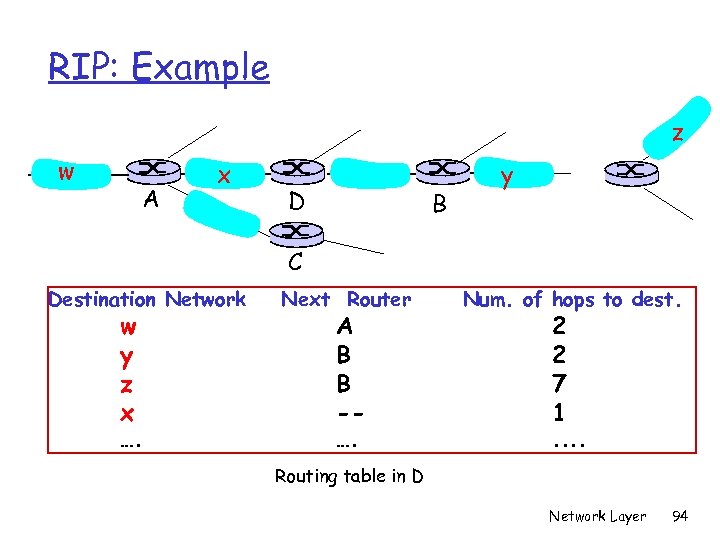
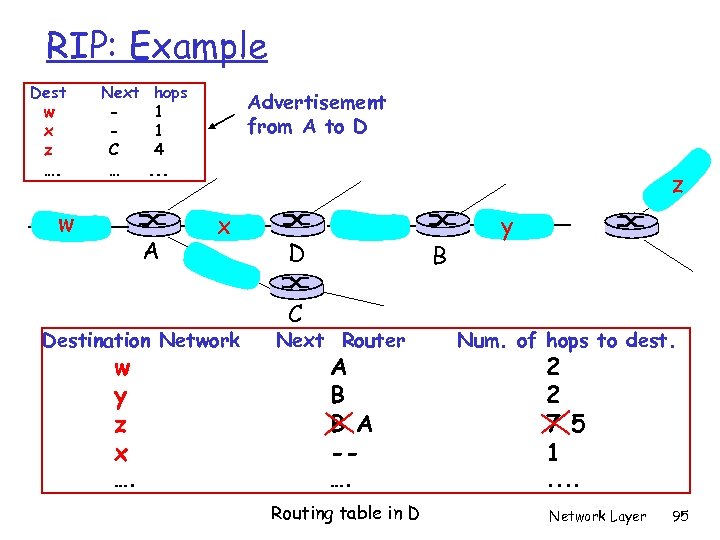
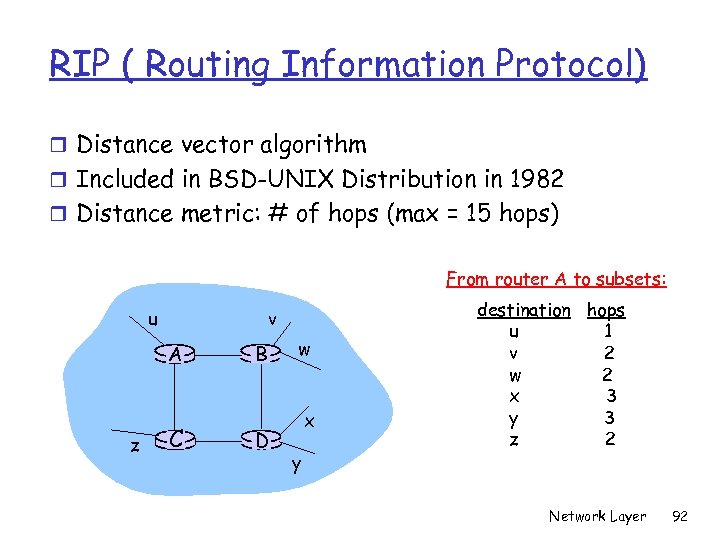 RIP ( Routing Information Protocol) r Distance vector algorithm r Included in BSD-UNIX Distribution in 1982 r Distance metric: # of hops (max = 15 hops) From router A to subsets: u v A z C B D w x y destination hops u 1 v 2 w 2 x 3 y 3 z 2 Network Layer 92
 RIP advertisements r Distance vectors: exchanged among neighbors every 30 sec via Response Message (also called advertisement) r Each advertisement: list of up to 25 destination nets within AS Network Layer 93
 RIP: Example z w A x D B y C Destination Network w y z x …. Next Router Num. of hops to dest. …. . . A B B -- 2 2 7 1 Routing table in D Network Layer 94
 RIP: Example Dest w x z …. Next C … w hops 1 1 4. . . A Advertisement from A to D z x Destination Network w y z x …. D B C y Next Router Num. of hops to dest. …. . . A B B A -- Routing table in D 2 2 7 5 1 Network Layer 95
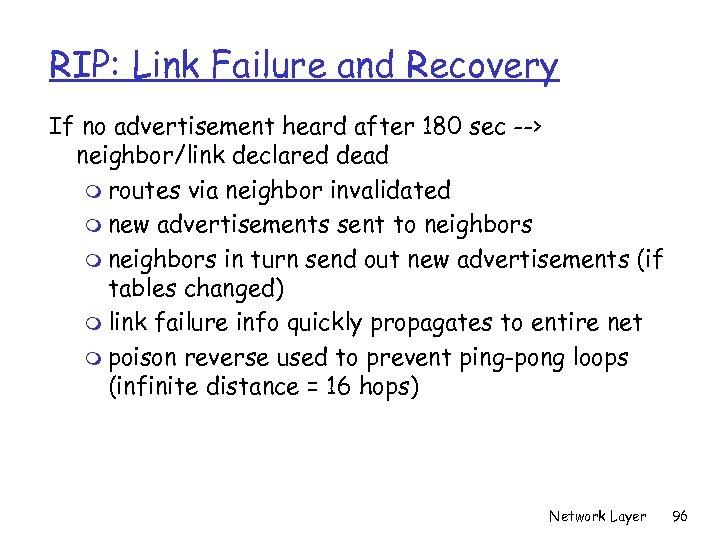 RIP: Link Failure and Recovery If no advertisement heard after 180 sec --> neighbor/link declared dead m routes via neighbor invalidated m new advertisements sent to neighbors m neighbors in turn send out new advertisements (if tables changed) m link failure info quickly propagates to entire net m poison reverse used to prevent ping-pong loops (infinite distance = 16 hops) Network Layer 96
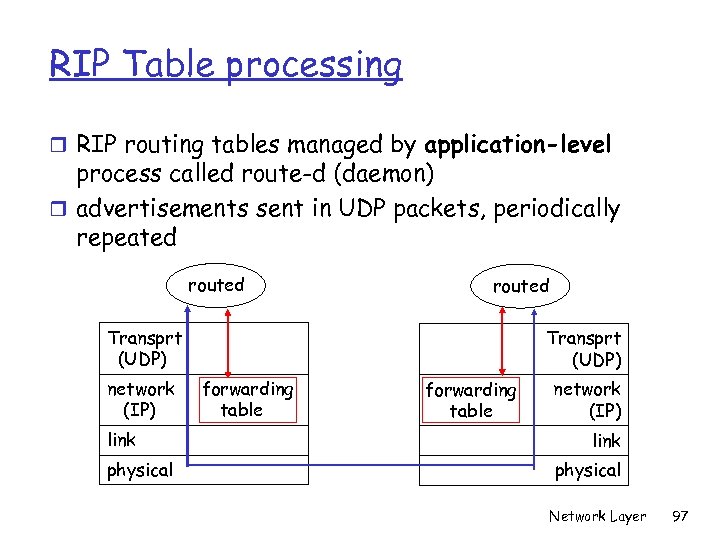 RIP Table processing r RIP routing tables managed by application-level process called route-d (daemon) r advertisements sent in UDP packets, periodically repeated routed Transprt (UDP) network (IP) link physical Transprt (UDP) forwarding table network (IP) link physical Network Layer 97
 Chapter 4: Network Layer r 4. 1 Introduction r 4. 2 Virtual circuit and datagram networks r 4. 3 What’s inside a router r 4. 4 IP: Internet Protocol m m Datagram format IPv 4 addressing ICMP IPv 6 r 4. 5 Routing algorithms m Link state m Distance Vector m Hierarchical routing r 4. 6 Routing in the Internet m m m RIP OSPF BGP r 4. 7 Broadcast and multicast routing Network Layer 98
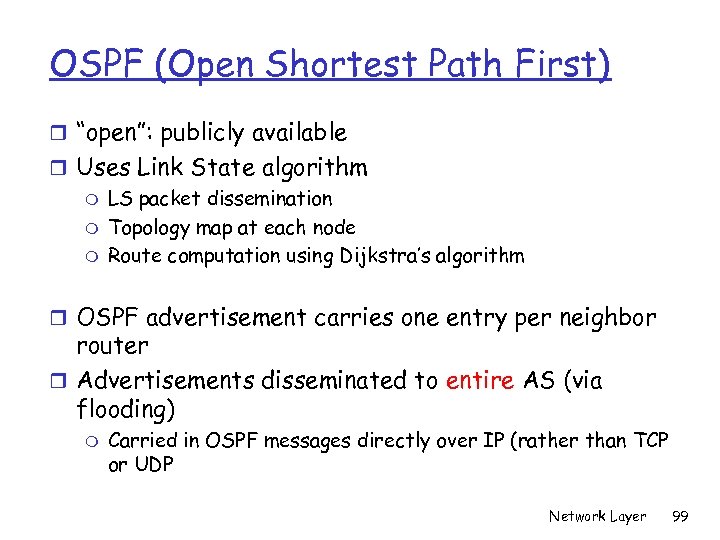 OSPF (Open Shortest Path First) r “open”: publicly available r Uses Link State algorithm m LS packet dissemination m Topology map at each node m Route computation using Dijkstra’s algorithm r OSPF advertisement carries one entry per neighbor router r Advertisements disseminated to entire AS (via flooding) m Carried in OSPF messages directly over IP (rather than TCP or UDP Network Layer 99
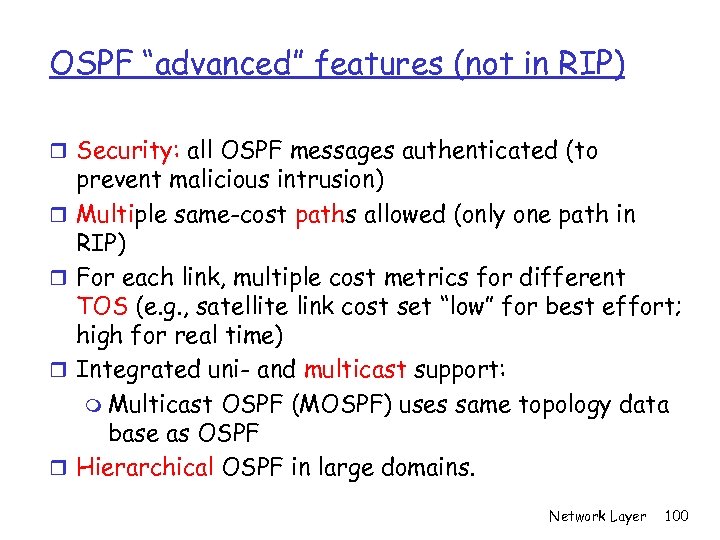 OSPF “advanced” features (not in RIP) r Security: all OSPF messages authenticated (to r r prevent malicious intrusion) Multiple same-cost paths allowed (only one path in RIP) For each link, multiple cost metrics for different TOS (e. g. , satellite link cost set “low” for best effort; high for real time) Integrated uni- and multicast support: m Multicast OSPF (MOSPF) uses same topology data base as OSPF Hierarchical OSPF in large domains. Network Layer 100
 Hierarchical OSPF Network Layer 101
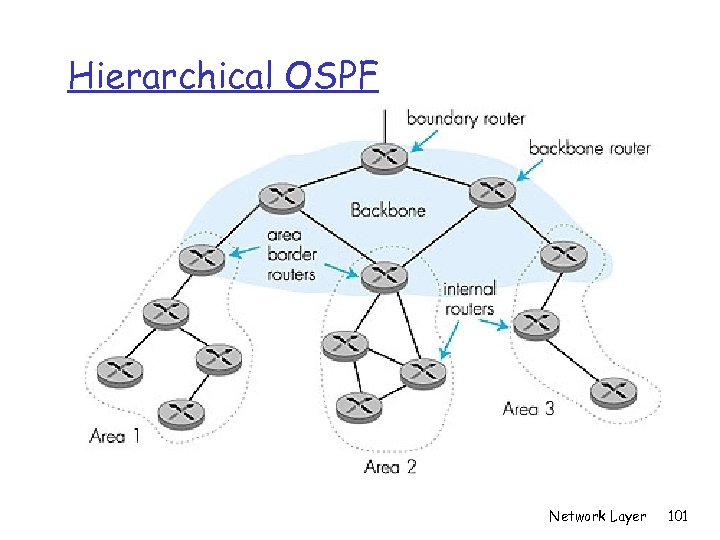
 Hierarchical OSPF r Two-level hierarchy: local area, backbone. m Link-state advertisements only in area m each nodes has detailed area topology; only know direction (shortest path) to nets in other areas. r Area border routers: “summarize” distances to nets in own area, advertise to other Area Border routers. r Backbone routers: run OSPF routing limited to backbone. r Boundary routers: connect to other AS’s. Network Layer 102
 Chapter 4: Network Layer r 4. 1 Introduction r 4. 2 Virtual circuit and datagram networks r 4. 3 What’s inside a router r 4. 4 IP: Internet Protocol m m Datagram format IPv 4 addressing ICMP IPv 6 r 4. 5 Routing algorithms m Link state m Distance Vector m Hierarchical routing r 4. 6 Routing in the Internet m m m RIP OSPF BGP r 4. 7 Broadcast and multicast routing Network Layer 103
 Internet inter-AS routing: BGP r BGP (Border Gateway Protocol): the de facto standard r BGP provides each AS a means to: 1. 2. 3. Obtain subnet reachability information from neighboring ASs. Propagate the reachability information to all routers internal to the AS. Determine “good” routes to subnets based on reachability information and policy. r Allows a subnet to advertise its existence to rest of the Internet: “I am here” Network Layer 104
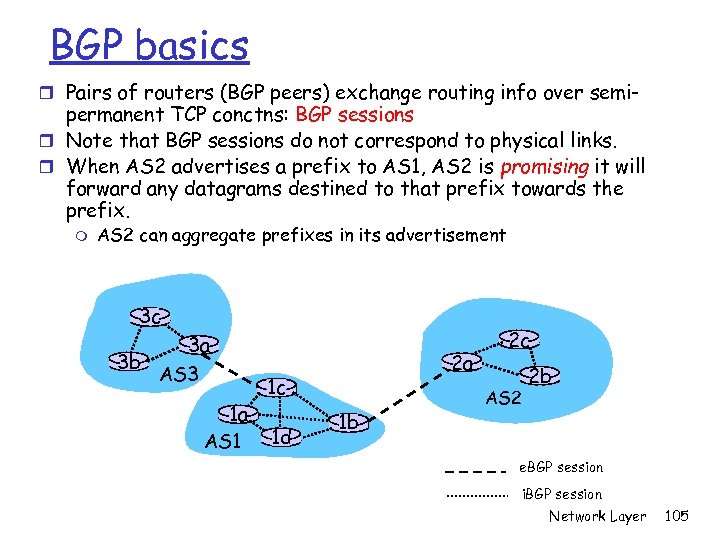 BGP basics r Pairs of routers (BGP peers) exchange routing info over semi- permanent TCP conctns: BGP sessions r Note that BGP sessions do not correspond to physical links. r When AS 2 advertises a prefix to AS 1, AS 2 is promising it will forward any datagrams destined to that prefix towards the prefix. m AS 2 can aggregate prefixes in its advertisement 3 c 3 a 3 b AS 3 1 a AS 1 2 a 1 c 1 d 1 b 2 c AS 2 2 b e. BGP session i. BGP session Network Layer 105
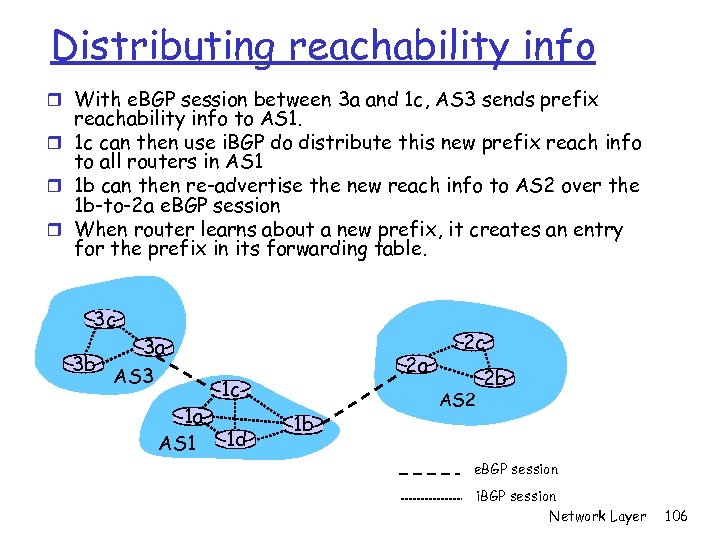 Distributing reachability info r With e. BGP session between 3 a and 1 c, AS 3 sends prefix reachability info to AS 1. r 1 c can then use i. BGP do distribute this new prefix reach info to all routers in AS 1 r 1 b can then re-advertise the new reach info to AS 2 over the 1 b-to-2 a e. BGP session r When router learns about a new prefix, it creates an entry for the prefix in its forwarding table. 3 c 3 a 3 b AS 3 1 a AS 1 2 a 1 c 1 d 1 b 2 c AS 2 2 b e. BGP session i. BGP session Network Layer 106
 Path attributes & BGP routes r When advertising a prefix, advert includes BGP attributes. m prefix + attributes = “route” r Two important attributes: m AS-PATH: contains the ASs through which the advert for the prefix passed: AS 67 AS 17 m NEXT-HOP: Indicates the specific internal-AS router to next-hop AS. (There may be multiple links from current AS to next-hop-AS. ) r When gateway router receives route advert, uses import policy to accept/decline. Network Layer 107
 BGP route selection r Router may learn about more than 1 route to some prefix. Router must select route. r Elimination rules: 1. 2. 3. 4. Local preference value attribute: policy decision Shortest AS-PATH Closest NEXT-HOP router: hot potato routing Additional criteria Network Layer 108
 BGP messages r BGP messages exchanged using TCP. r BGP messages: m OPEN: opens TCP connection to peer and authenticates sender m UPDATE: advertises new path (or withdraws old) m KEEPALIVE keeps connection alive in absence of UPDATES; also ACKs OPEN request m NOTIFICATION: reports errors in previous msg; also used to close connection Network Layer 109
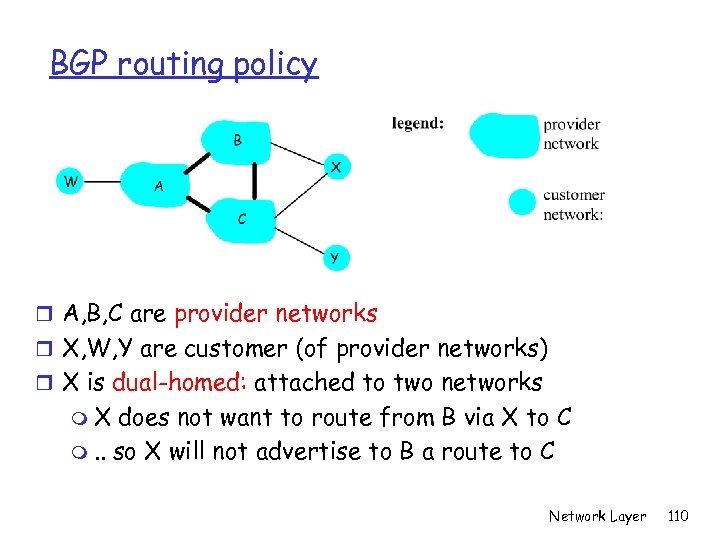 BGP routing policy r A, B, C are provider networks r X, W, Y are customer (of provider networks) r X is dual-homed: attached to two networks m. X does not want to route from B via X to C m. . so X will not advertise to B a route to C Network Layer 110
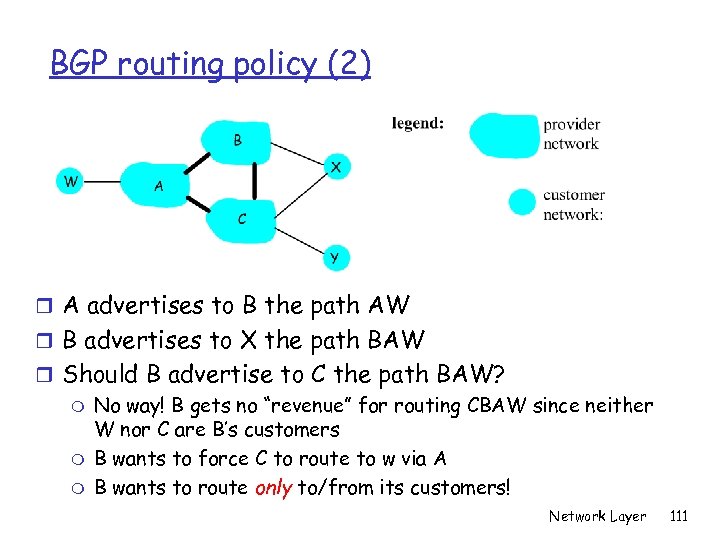 BGP routing policy (2) r A advertises to B the path AW r B advertises to X the path BAW r Should B advertise to C the path BAW? m No way! B gets no “revenue” for routing CBAW since neither W nor C are B’s customers m B wants to force C to route to w via A m B wants to route only to/from its customers! Network Layer 111
 Why different Intra- and Inter-AS routing ? Policy: r Inter-AS: admin wants control over how its traffic routed, who routes through its net. r Intra-AS: single admin, so no policy decisions needed Scale: r hierarchical routing saves table size, reduced update traffic Performance: r Intra-AS: can focus on performance r Inter-AS: policy may dominate over performance Network Layer 112
 Chapter 4: Network Layer r 4. 1 Introduction r 4. 2 Virtual circuit and datagram networks r 4. 3 What’s inside a router r 4. 4 IP: Internet Protocol m m Datagram format IPv 4 addressing ICMP IPv 6 r 4. 5 Routing algorithms m Link state m Distance Vector m Hierarchical routing r 4. 6 Routing in the Internet m m m RIP OSPF BGP r 4. 7 Broadcast and multicast routing Network Layer 113
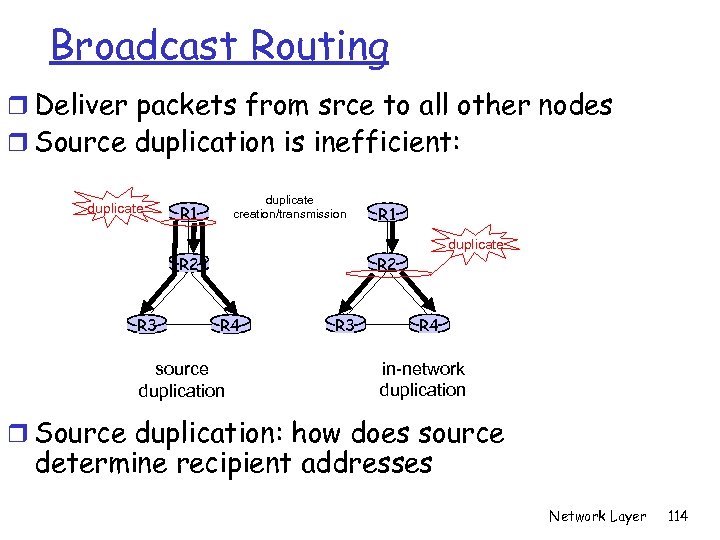 Broadcast Routing r Deliver packets from srce to all other nodes r Source duplication is inefficient: duplicate creation/transmission R 1 duplicate R 2 R 3 R 1 R 4 source duplication R 3 R 4 in-network duplication r Source duplication: how does source determine recipient addresses Network Layer 114
 In-network duplication r Flooding: when node receives brdcst pckt, sends copy to all neighbors m Problems: cycles & broadcast storm r Controlled flooding: node only brdcsts pkt if it hasn’t brdcst same packet before m Node keeps track of pckt ids already brdcsted m Or reverse path forwarding (RPF): only forward pckt if it arrived on shortest path between node and source r Spanning tree m No redundant packets received by any node Network Layer 115
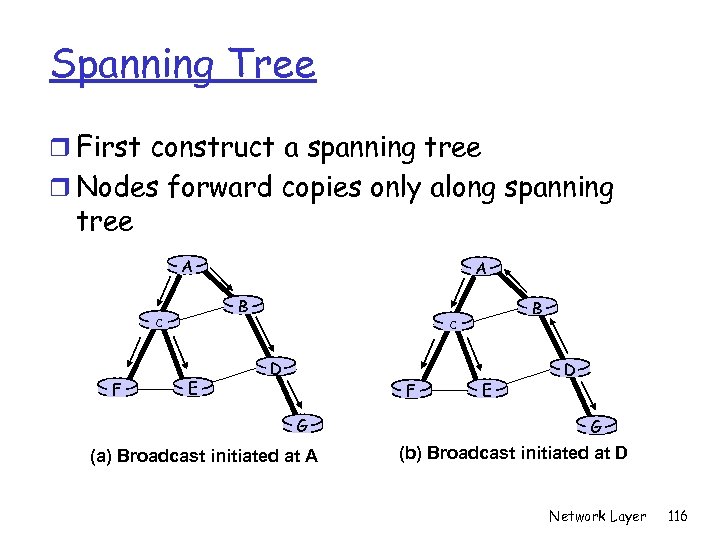 Spanning Tree r First construct a spanning tree r Nodes forward copies only along spanning tree A B c F A E B c D F G (a) Broadcast initiated at A E D G (b) Broadcast initiated at D Network Layer 116
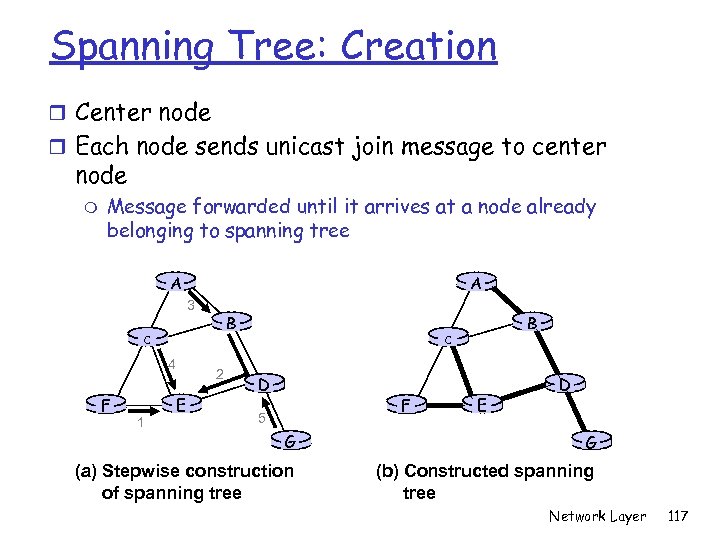 Spanning Tree: Creation r Center node r Each node sends unicast join message to center node m Message forwarded until it arrives at a node already belonging to spanning tree A A 3 B c 4 F 1 2 E B c D F 5 E D G G (a) Stepwise construction of spanning tree (b) Constructed spanning tree Network Layer 117
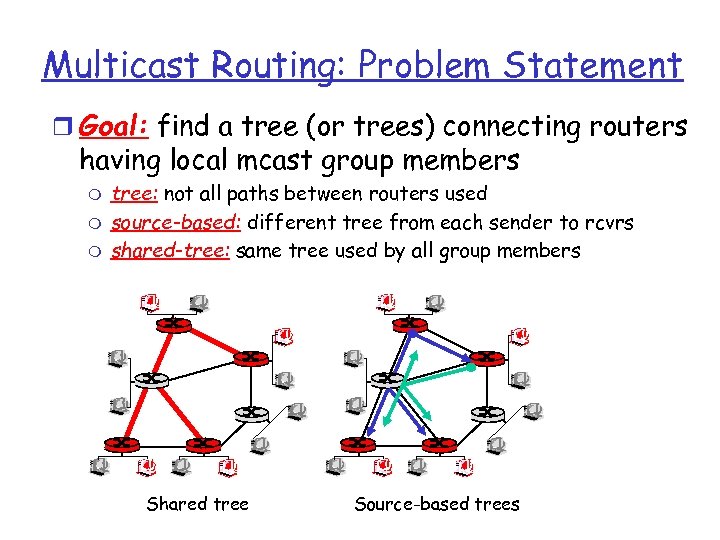 Multicast Routing: Problem Statement r Goal: find a tree (or trees) connecting routers having local mcast group members m m m tree: not all paths between routers used source-based: different tree from each sender to rcvrs shared-tree: same tree used by all group members Shared tree Source-based trees
 Approaches for building mcast trees Approaches: r source-based tree: one tree per source m shortest path trees m reverse path forwarding r group-shared tree: group uses one tree m minimal spanning (Steiner) m center-based trees …we first look at basic approaches, then specific protocols adopting these approaches
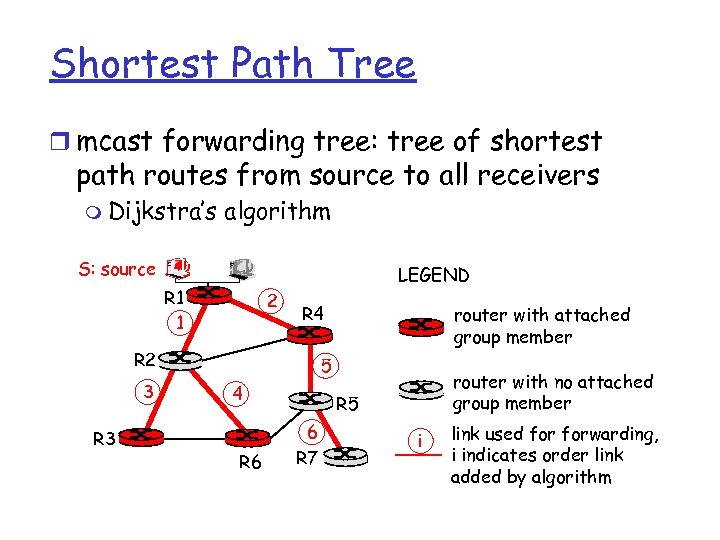 Shortest Path Tree r mcast forwarding tree: tree of shortest path routes from source to all receivers m Dijkstra’s algorithm S: source LEGEND R 1 1 2 R 4 R 2 3 R 3 router with attached group member 5 4 R 6 router with no attached group member R 5 6 R 7 i link used forwarding, i indicates order link added by algorithm
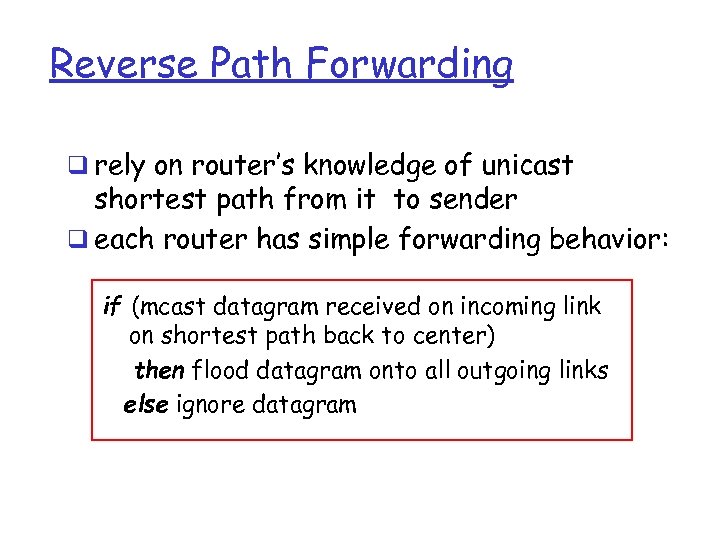 Reverse Path Forwarding q rely on router’s knowledge of unicast shortest path from it to sender q each router has simple forwarding behavior: if (mcast datagram received on incoming link on shortest path back to center) then flood datagram onto all outgoing links else ignore datagram
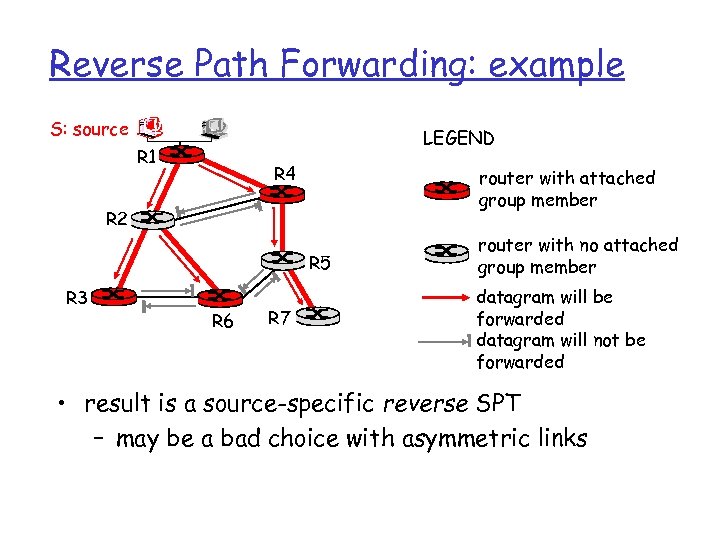 Reverse Path Forwarding: example S: source LEGEND R 1 R 4 router with attached group member R 2 R 5 R 3 R 6 R 7 router with no attached group member datagram will be forwarded datagram will not be forwarded • result is a source-specific reverse SPT – may be a bad choice with asymmetric links
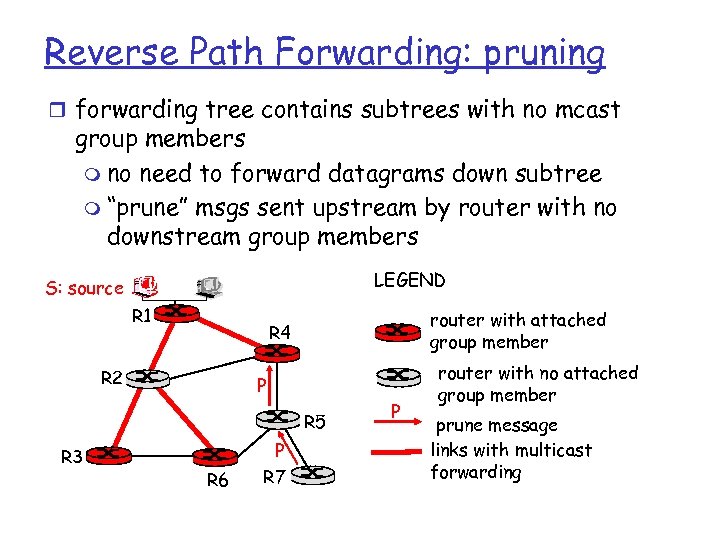 Reverse Path Forwarding: pruning r forwarding tree contains subtrees with no mcast group members m no need to forward datagrams down subtree m “prune” msgs sent upstream by router with no downstream group members LEGEND S: source R 1 router with attached group member R 4 R 2 P R 5 R 3 R 6 P R 7 P router with no attached group member prune message links with multicast forwarding
 Shared-Tree: Steiner Tree r Steiner Tree: minimum cost tree connecting all routers with attached group members r problem is NP-complete r excellent heuristics exists r not used in practice: m computational complexity m information about entire network needed m monolithic: rerun whenever a router needs to join/leave
 Center-based trees r single delivery tree shared by all r one router identified as “center” of tree r to join: m edge router sends unicast join-msg addressed to center router m join-msg “processed” by intermediate routers and forwarded towards center m join-msg either hits existing tree branch for this center, or arrives at center m path taken by join-msg becomes new branch of tree for this router
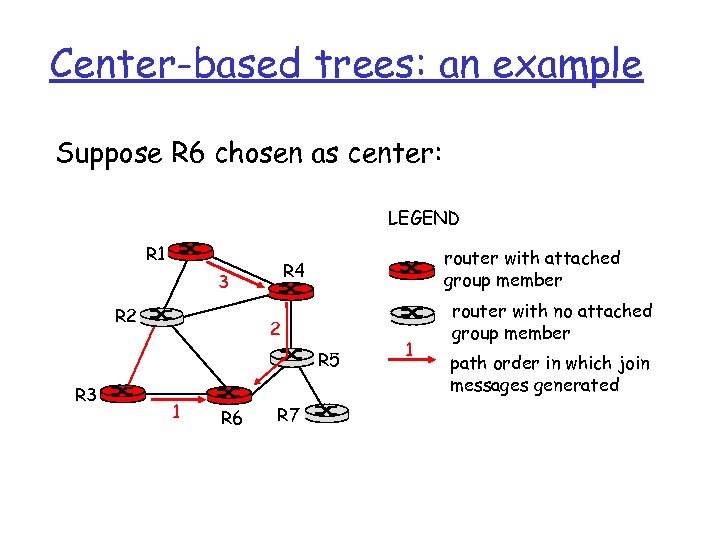 Center-based trees: an example Suppose R 6 chosen as center: LEGEND R 1 3 R 2 router with attached group member R 4 2 R 5 R 3 1 R 6 R 7 1 router with no attached group member path order in which join messages generated
 Internet Multicasting Routing: DVMRP r DVMRP: distance vector multicast routing protocol, RFC 1075 r flood and prune: reverse path forwarding, source-based tree m RPF tree based on DVMRP’s own routing tables constructed by communicating DVMRP routers m no assumptions about underlying unicast m initial datagram to mcast group flooded everywhere via RPF m routers not wanting group: send upstream prune msgs
 DVMRP: continued… r soft state: DVMRP router periodically (1 min. ) “forgets” branches are pruned: m mcast data again flows down unpruned branch m downstream router: reprune or else continue to receive data r routers can quickly regraft to tree m following IGMP join at leaf r odds and ends m commonly implemented in commercial routers m Mbone routing done using DVMRP
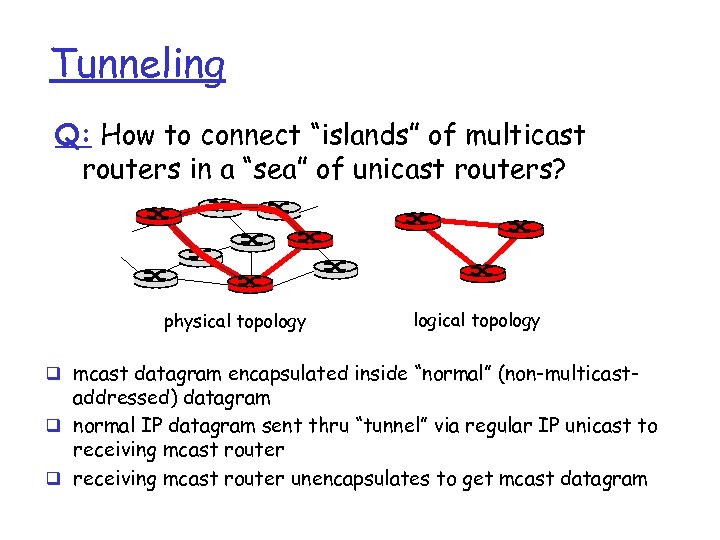 Tunneling Q: How to connect “islands” of multicast routers in a “sea” of unicast routers? physical topology logical topology q mcast datagram encapsulated inside “normal” (non-multicast- addressed) datagram q normal IP datagram sent thru “tunnel” via regular IP unicast to receiving mcast router q receiving mcast router unencapsulates to get mcast datagram
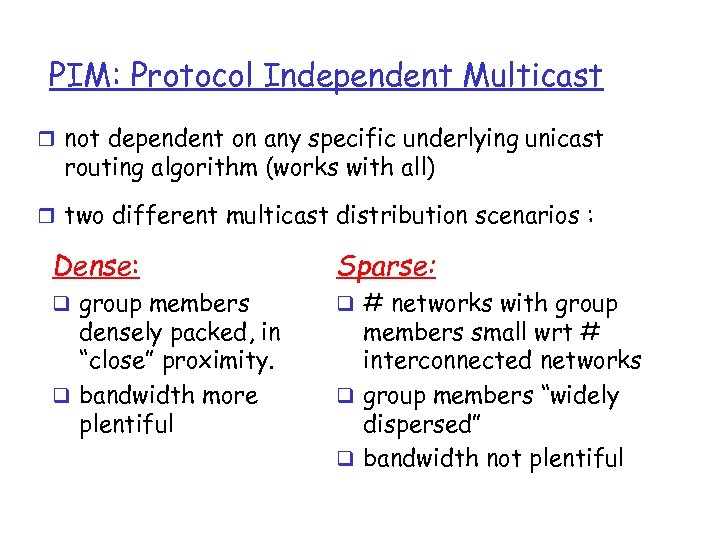 PIM: Protocol Independent Multicast r not dependent on any specific underlying unicast routing algorithm (works with all) r two different multicast distribution scenarios : Dense: Sparse: q group members q # networks with group densely packed, in “close” proximity. q bandwidth more plentiful members small wrt # interconnected networks q group members “widely dispersed” q bandwidth not plentiful
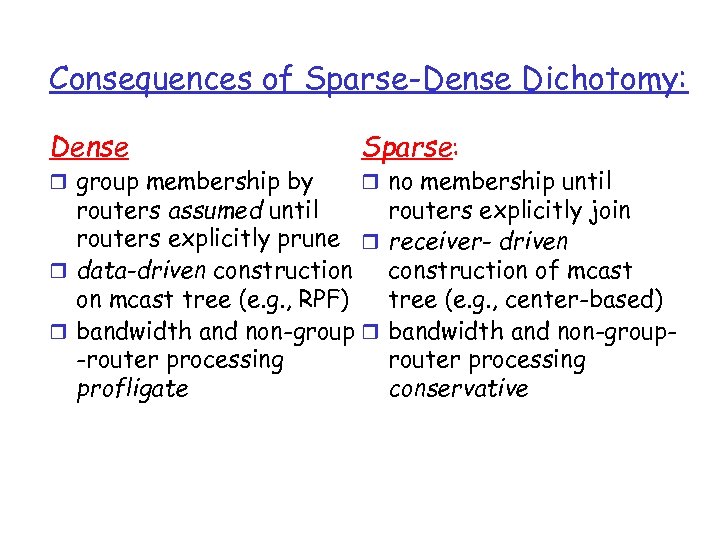 Consequences of Sparse-Dense Dichotomy: Dense r group membership by Sparse: r no membership until routers assumed until routers explicitly prune r r data-driven construction on mcast tree (e. g. , RPF) r bandwidth and non-group r -router processing profligate routers explicitly join receiver- driven construction of mcast tree (e. g. , center-based) bandwidth and non-grouprouter processing conservative
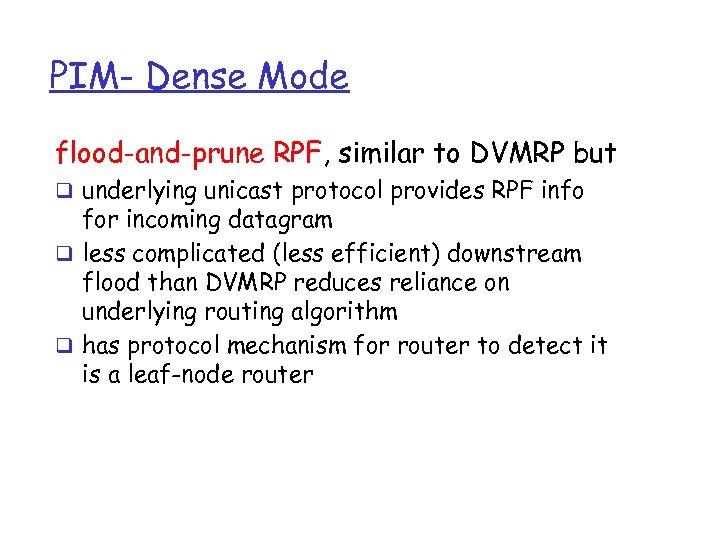 PIM- Dense Mode flood-and-prune RPF, similar to DVMRP but q underlying unicast protocol provides RPF info for incoming datagram q less complicated (less efficient) downstream flood than DVMRP reduces reliance on underlying routing algorithm q has protocol mechanism for router to detect it is a leaf-node router
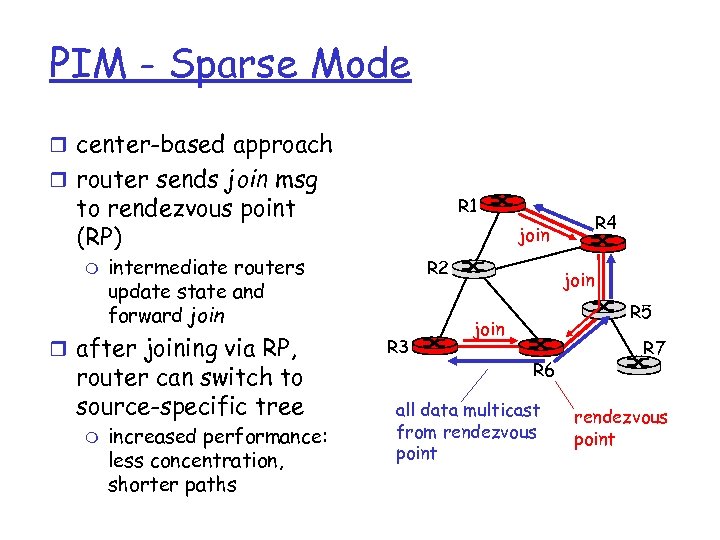 PIM - Sparse Mode r center-based approach r router sends join msg to rendezvous point (RP) m router can switch to source-specific tree increased performance: less concentration, shorter paths R 4 join intermediate routers update state and forward join r after joining via RP, m R 1 R 2 R 3 join R 5 join R 6 all data multicast from rendezvous point R 7 rendezvous point
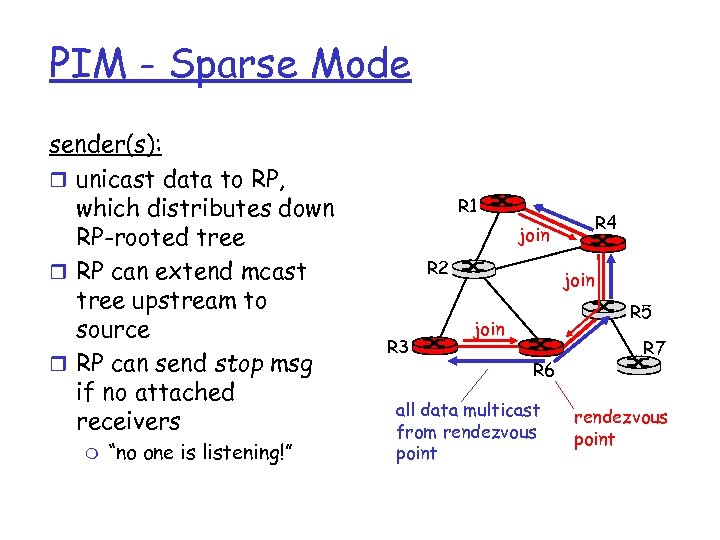 PIM - Sparse Mode sender(s): r unicast data to RP, which distributes down RP-rooted tree r RP can extend mcast tree upstream to source r RP can send stop msg if no attached receivers m “no one is listening!” R 1 R 4 join R 2 R 3 join R 5 join R 6 all data multicast from rendezvous point R 7 rendezvous point