


 Скачать презентацию Chapter 4 Network Layer A note on the
9ef599b5fc6c6b606cba7d6064af006a.ppt
- Количество слайдов: 29
 Chapter 4 Network Layer A note on the use of these ppt slides: We’re making these slides freely available to all (faculty, students, readers). They’re in Power. Point form so you can add, modify, and delete slides (including this one) and slide content to suit your needs. They obviously represent a lot of work on our part. In return for use, we only ask the following: q If you use these slides (e. g. , in a class) in substantially unaltered form, that you mention their source (after all, we’d like people to use our book!) q If you post any slides in substantially unaltered form on a www site, that you note that they are adapted from (or perhaps identical to) our slides, and note our copyright of this material. Computer Networking: A Top Down Approach Featuring the Internet, 3 rd edition. Jim Kurose, Keith Ross Addison-Wesley, July 2004. Thanks and enjoy! JFK/KWR All material copyright 1996 -2004 J. F Kurose and K. W. Ross, All Rights Reserved Network Layer 1
 Chapter 4: Network Layer Chapter goals: r understand principles behind network layer services: m routing (path selection) m dealing with scale m how a router works m advanced topics: IPv 6, mobility r instantiation and implementation in the Internet Network Layer 2
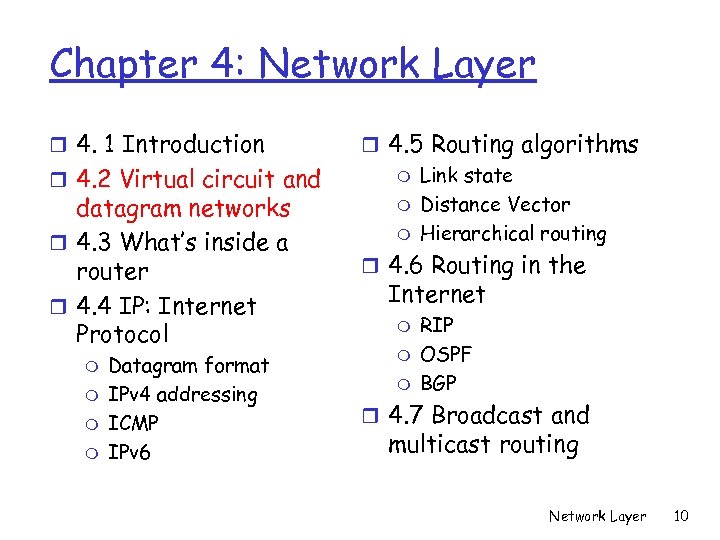
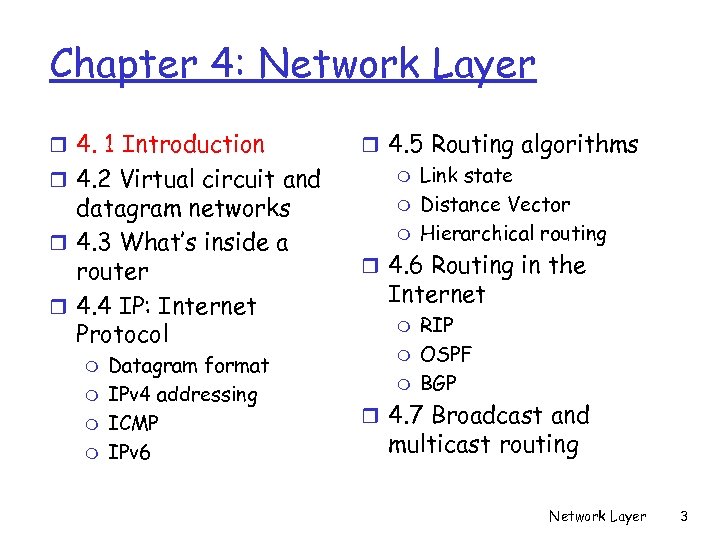 Chapter 4: Network Layer r 4. 1 Introduction r 4. 2 Virtual circuit and datagram networks r 4. 3 What’s inside a router r 4. 4 IP: Internet Protocol m m Datagram format IPv 4 addressing ICMP IPv 6 r 4. 5 Routing algorithms m Link state m Distance Vector m Hierarchical routing r 4. 6 Routing in the Internet m m m RIP OSPF BGP r 4. 7 Broadcast and multicast routing Network Layer 3
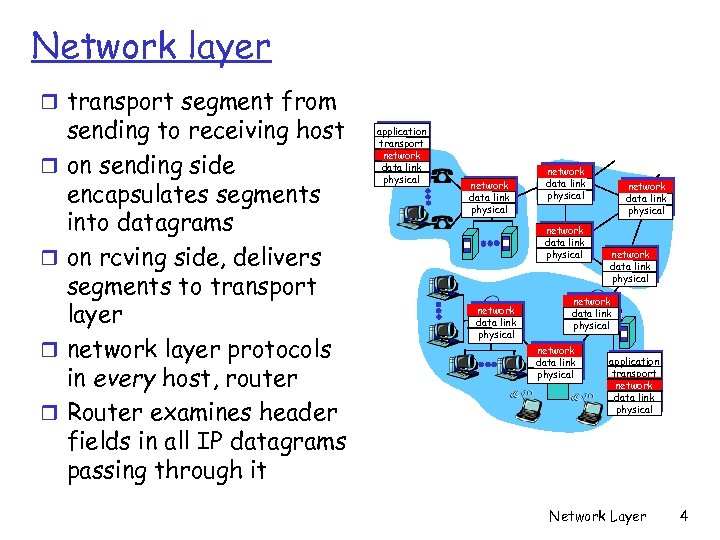 Network layer r transport segment from r r sending to receiving host on sending side encapsulates segments into datagrams on rcving side, delivers segments to transport layer network layer protocols in every host, router Router examines header fields in all IP datagrams passing through it application transport network data link physical network data link physical network data link physical application transport network data link physical Network Layer 4
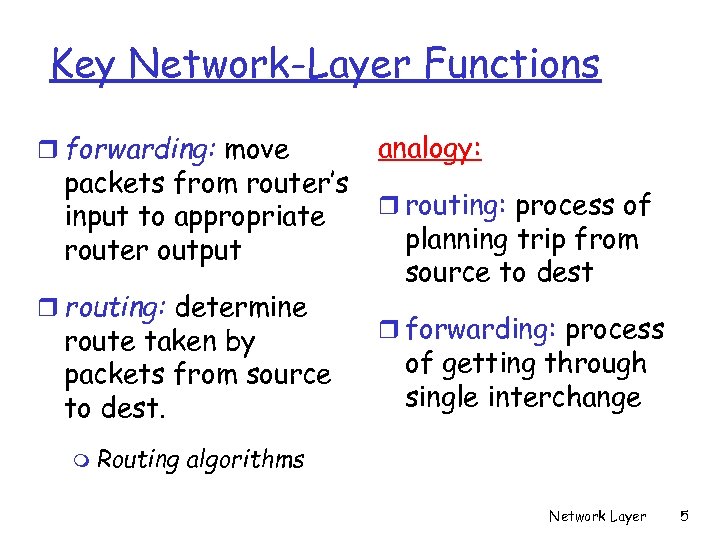 Key Network-Layer Functions r forwarding: move packets from router’s input to appropriate router output r routing: determine route taken by packets from source to dest. m Routing analogy: r routing: process of planning trip from source to dest r forwarding: process of getting through single interchange algorithms Network Layer 5
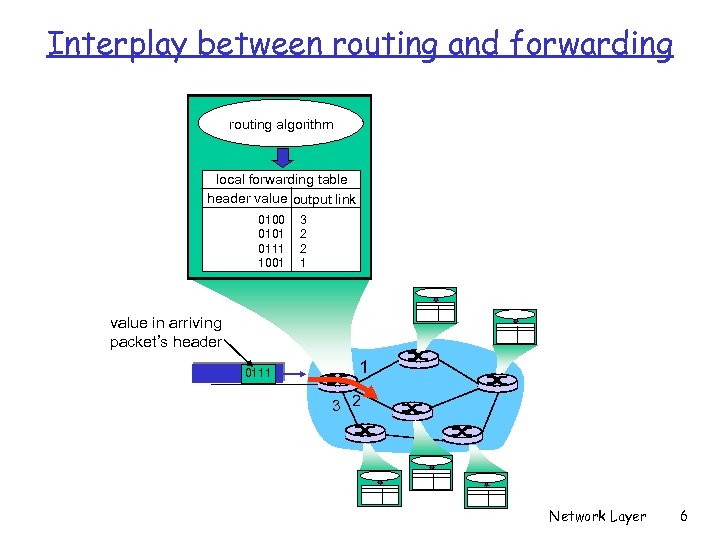 Interplay between routing and forwarding routing algorithm local forwarding table header value output link 0100 0101 0111 1001 3 2 2 1 value in arriving packet’s header 0111 1 3 2 Network Layer 6
 Connection setup r 3 rd important function in some network architectures: m ATM, frame relay, X. 25 r Before datagrams flow, two hosts and intervening routers establish virtual connection m Routers get involved r Network and transport layer cnctn service: m Network: between two hosts m Transport: between two processes Network Layer 7
 Network service model Q: What service model for “channel” transporting datagrams from sender to rcvr? Example services for individual datagrams: r guaranteed delivery r Guaranteed delivery with less than 40 msec delay Example services for a flow of datagrams: r In-order datagram delivery r Guaranteed minimum bandwidth to flow r Restrictions on changes in interpacket spacing Network Layer 8
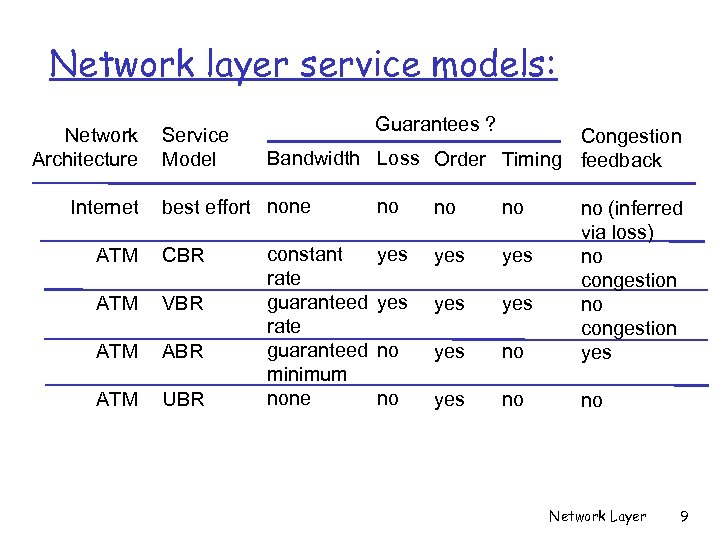 Network layer service models: Network Architecture Internet Service Model Guarantees ? Congestion Bandwidth Loss Order Timing feedback best effort none ATM CBR ATM VBR ATM ABR ATM UBR constant rate guaranteed minimum none no no no yes yes yes no no (inferred via loss) no congestion yes no no Network Layer 9
 Chapter 4: Network Layer r 4. 1 Introduction r 4. 2 Virtual circuit and datagram networks r 4. 3 What’s inside a router r 4. 4 IP: Internet Protocol m m Datagram format IPv 4 addressing ICMP IPv 6 r 4. 5 Routing algorithms m Link state m Distance Vector m Hierarchical routing r 4. 6 Routing in the Internet m m m RIP OSPF BGP r 4. 7 Broadcast and multicast routing Network Layer 10
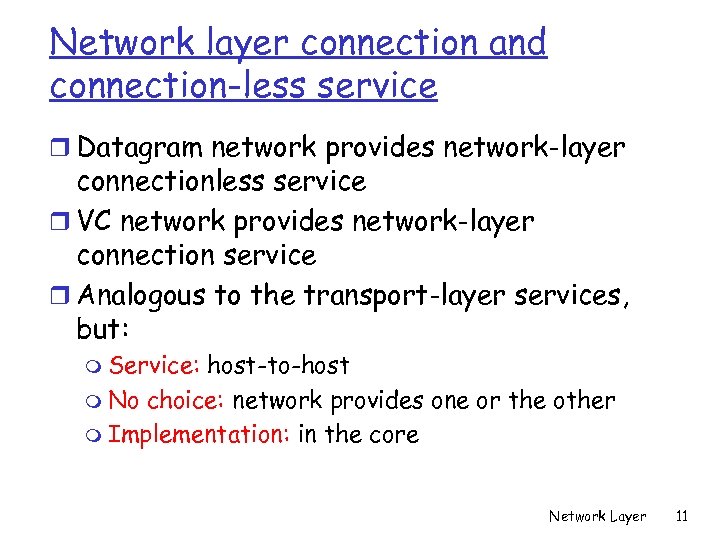 Network layer connection and connection-less service r Datagram network provides network-layer connectionless service r VC network provides network-layer connection service r Analogous to the transport-layer services, but: m Service: host-to-host m No choice: network provides one or the other m Implementation: in the core Network Layer 11
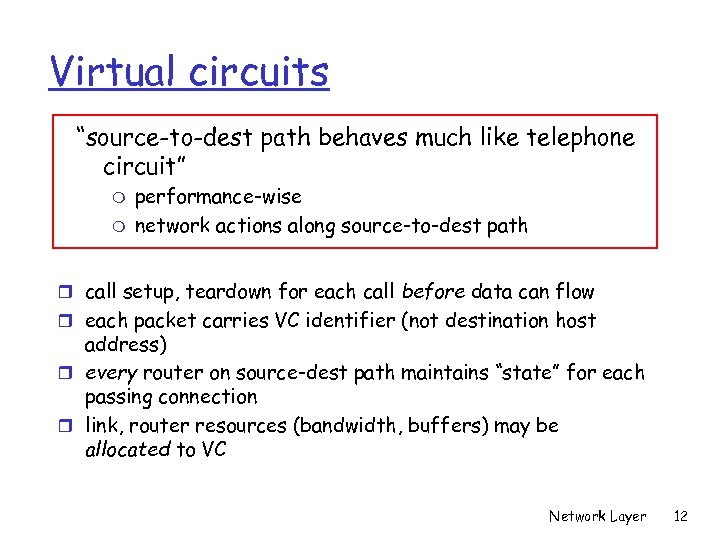 Virtual circuits “source-to-dest path behaves much like telephone circuit” m m performance-wise network actions along source-to-dest path r call setup, teardown for each call before data can flow r each packet carries VC identifier (not destination host address) r every router on source-dest path maintains “state” for each passing connection r link, router resources (bandwidth, buffers) may be allocated to VC Network Layer 12
 VC implementation A VC consists of: 1. 2. 3. Path from source to destination VC numbers, one number for each link along path Entries in forwarding tables in routers along path r Packet belonging to VC carries a VC number. r VC number must be changed on each link. m New VC number comes from forwarding table Network Layer 13
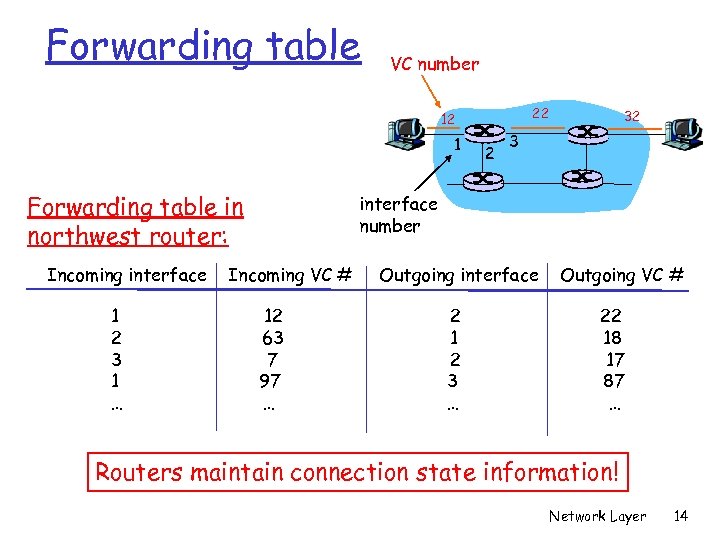 Forwarding table VC number 22 12 1 Forwarding table in northwest router: Incoming interface 1 2 3 1 … 2 32 3 interface number Incoming VC # 12 63 7 97 … Outgoing interface 2 1 2 3 … Outgoing VC # 22 18 17 87 … Routers maintain connection state information! Network Layer 14
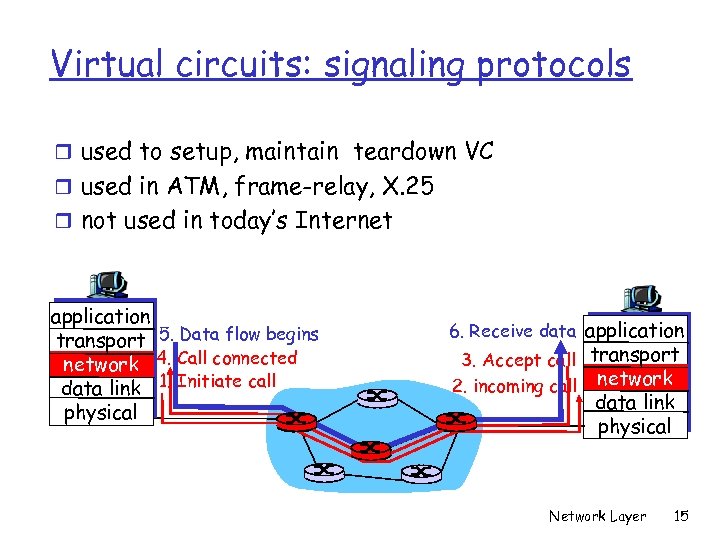 Virtual circuits: signaling protocols r used to setup, maintain teardown VC r used in ATM, frame-relay, X. 25 r not used in today’s Internet application transport 5. Data flow begins network 4. Call connected data link 1. Initiate call physical 6. Receive data application 3. Accept call transport 2. incoming call network data link physical Network Layer 15
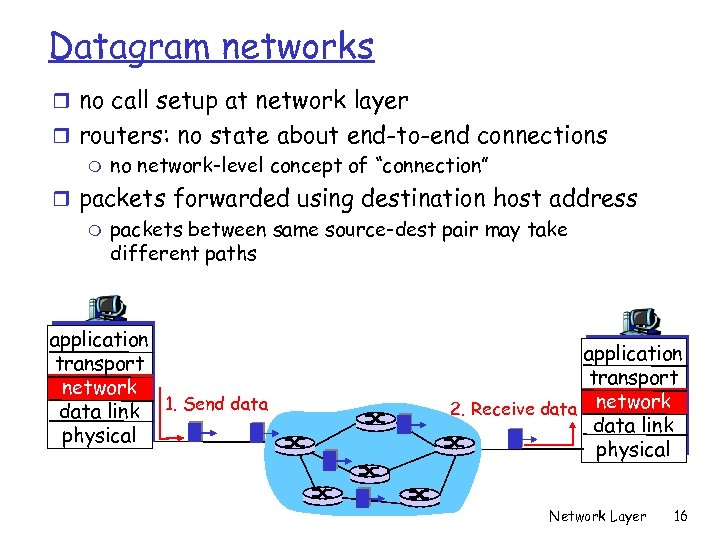 Datagram networks r no call setup at network layer r routers: no state about end-to-end connections m no network-level concept of “connection” r packets forwarded using destination host address m packets between same source-dest pair may take different paths application transport network data link 1. Send data physical application transport 2. Receive data network data link physical Network Layer 16
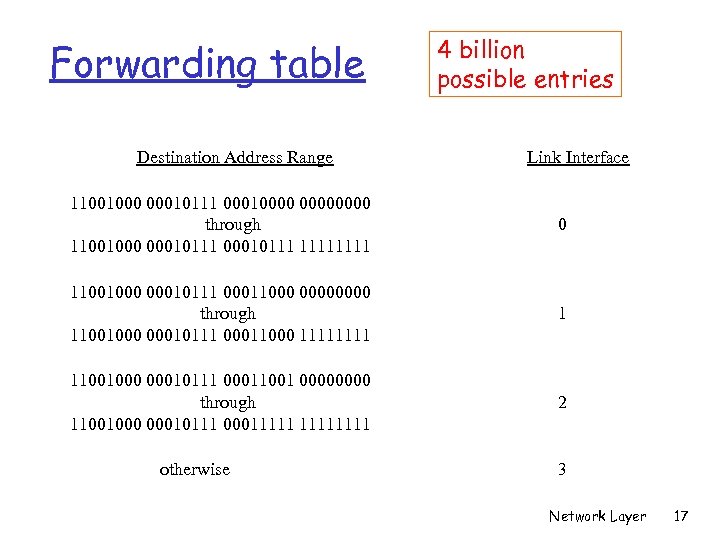 Forwarding table Destination Address Range 4 billion possible entries Link Interface 11001000 00010111 00010000 through 11001000 00010111 1111 0 11001000 00010111 00011000 0000 through 11001000 00010111 00011000 1111 1 11001000 00010111 00011001 0000 through 11001000 00010111 00011111 2 otherwise 3 Network Layer 17
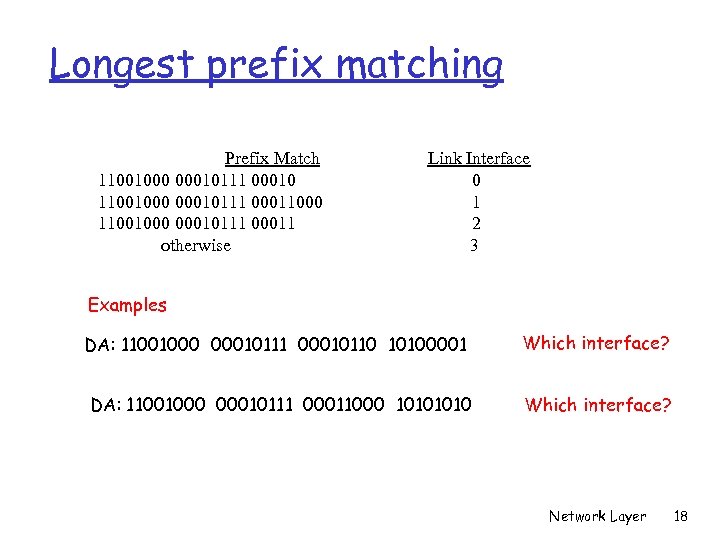 Longest prefix matching Prefix Match 11001000 00010111 00010 11001000 00010111 00011000 11001000 00010111 00011 otherwise Link Interface 0 1 2 3 Examples DA: 11001000 00010111 00010110 10100001 Which interface? DA: 11001000 00010111 00011000 1010 Which interface? Network Layer 18
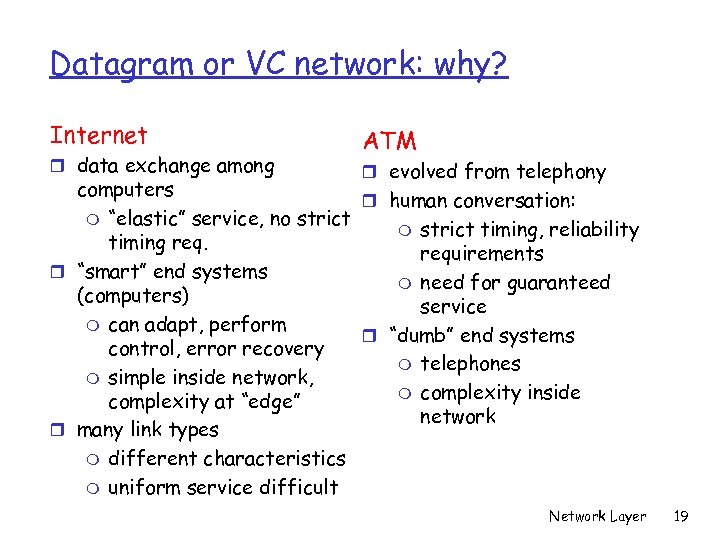 Datagram or VC network: why? Internet r data exchange among ATM r evolved from telephony computers r human conversation: m “elastic” service, no strict m strict timing, reliability timing requirements r “smart” end systems m need for guaranteed (computers) service m can adapt, perform r “dumb” end systems control, error recovery m telephones m simple inside network, m complexity inside complexity at “edge” network r many link types m different characteristics m uniform service difficult Network Layer 19
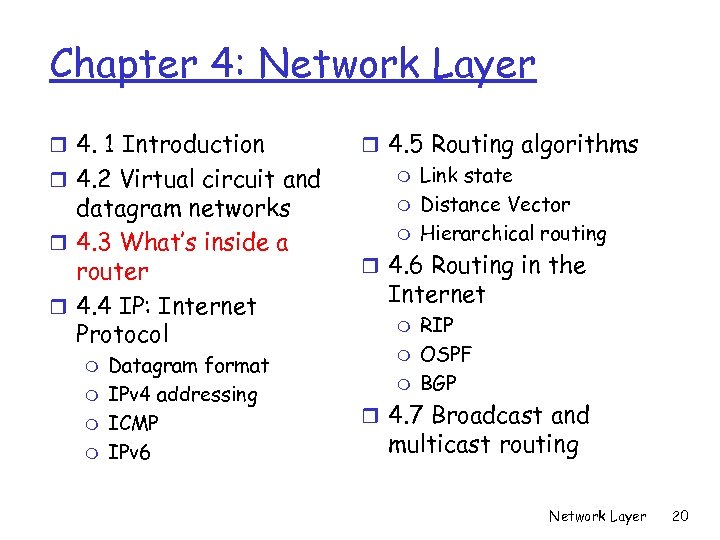 Chapter 4: Network Layer r 4. 1 Introduction r 4. 2 Virtual circuit and datagram networks r 4. 3 What’s inside a router r 4. 4 IP: Internet Protocol m m Datagram format IPv 4 addressing ICMP IPv 6 r 4. 5 Routing algorithms m Link state m Distance Vector m Hierarchical routing r 4. 6 Routing in the Internet m m m RIP OSPF BGP r 4. 7 Broadcast and multicast routing Network Layer 20
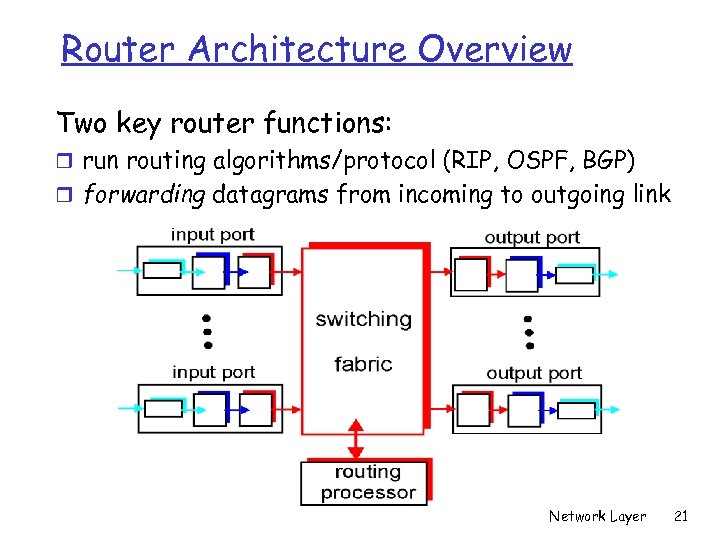 Router Architecture Overview Two key router functions: r run routing algorithms/protocol (RIP, OSPF, BGP) r forwarding datagrams from incoming to outgoing link Network Layer 21
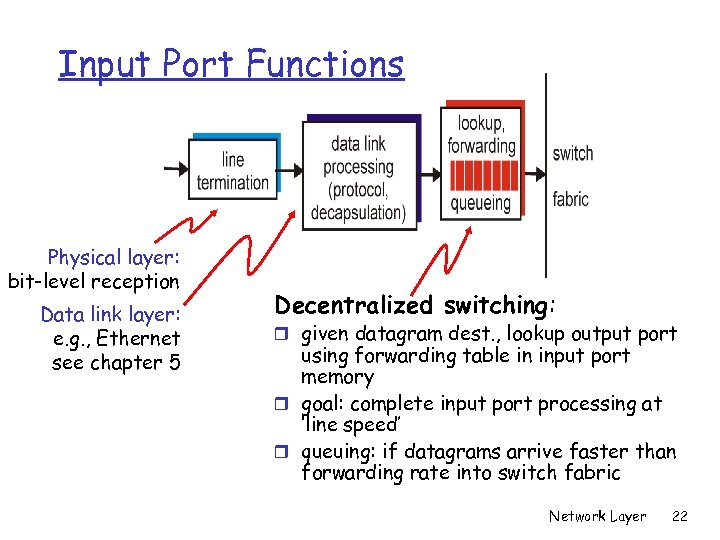 Input Port Functions Physical layer: bit-level reception Data link layer: e. g. , Ethernet see chapter 5 Decentralized switching: r given datagram dest. , lookup output port using forwarding table in input port memory r goal: complete input port processing at ‘line speed’ r queuing: if datagrams arrive faster than forwarding rate into switch fabric Network Layer 22
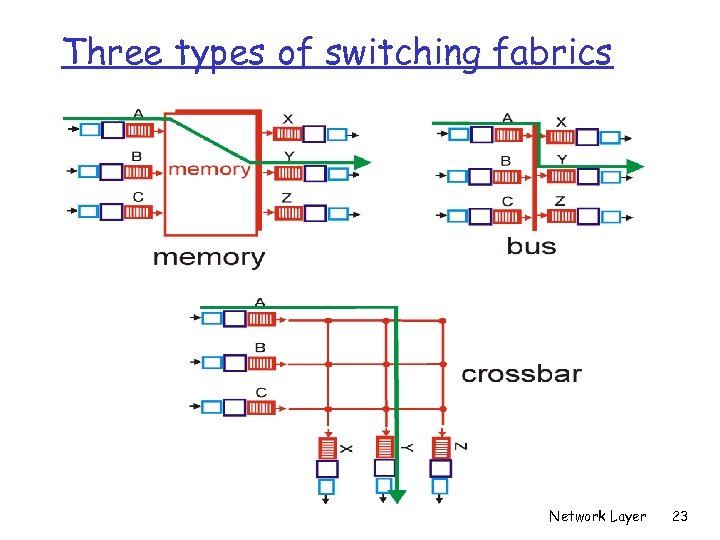 Three types of switching fabrics Network Layer 23
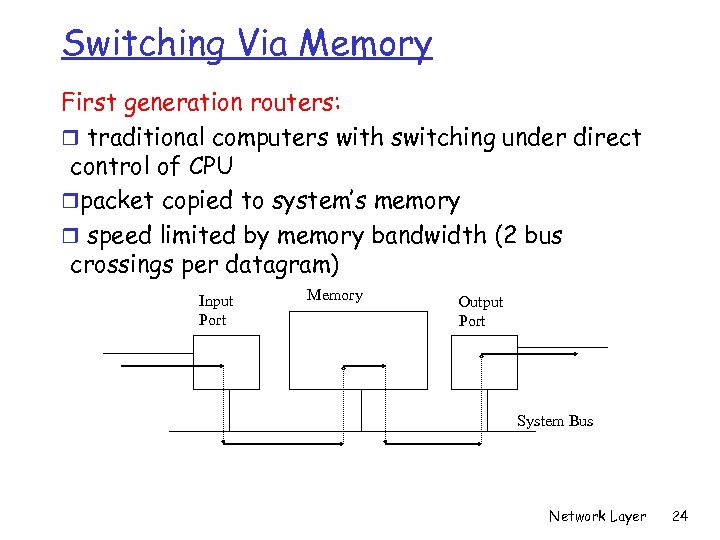 Switching Via Memory First generation routers: r traditional computers with switching under direct control of CPU rpacket copied to system’s memory r speed limited by memory bandwidth (2 bus crossings per datagram) Input Port Memory Output Port System Bus Network Layer 24
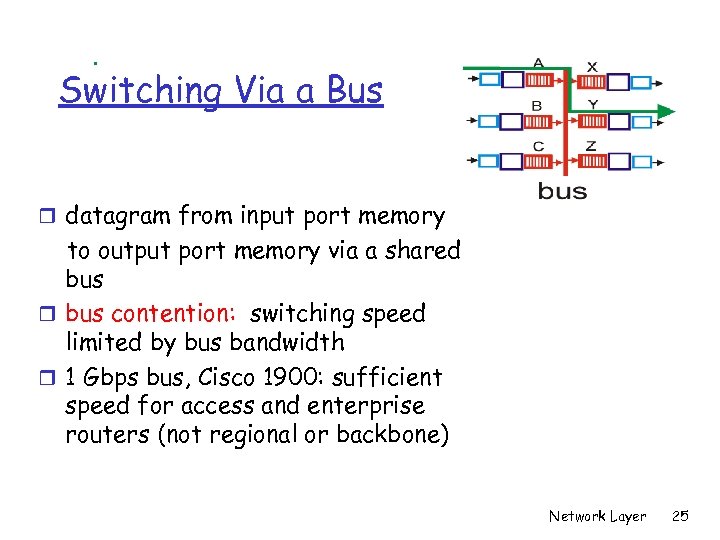 Switching Via a Bus r datagram from input port memory to output port memory via a shared bus r bus contention: switching speed limited by bus bandwidth r 1 Gbps bus, Cisco 1900: sufficient speed for access and enterprise routers (not regional or backbone) Network Layer 25
 Switching Via An Interconnection Network r overcome bus bandwidth limitations r Banyan networks, other interconnection nets initially developed to connect processors in multiprocessor r Advanced design: fragmenting datagram into fixed length cells, switch cells through the fabric. r Cisco 12000: switches Gbps through the interconnection network Network Layer 26
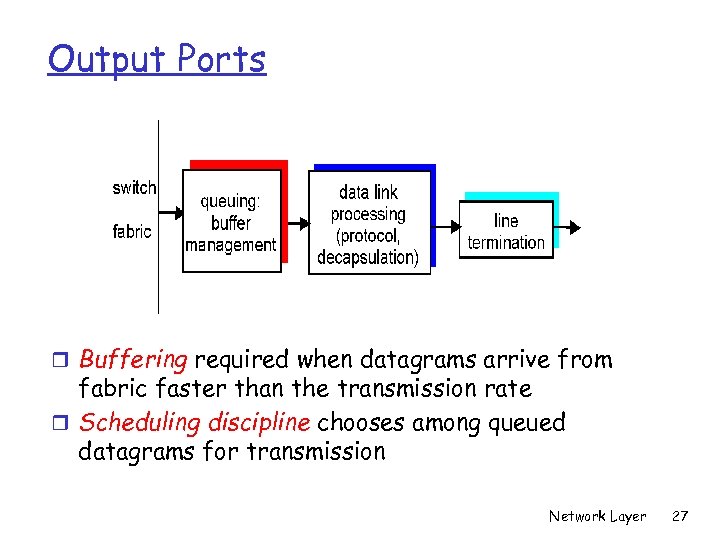 Output Ports r Buffering required when datagrams arrive from fabric faster than the transmission rate r Scheduling discipline chooses among queued datagrams for transmission Network Layer 27
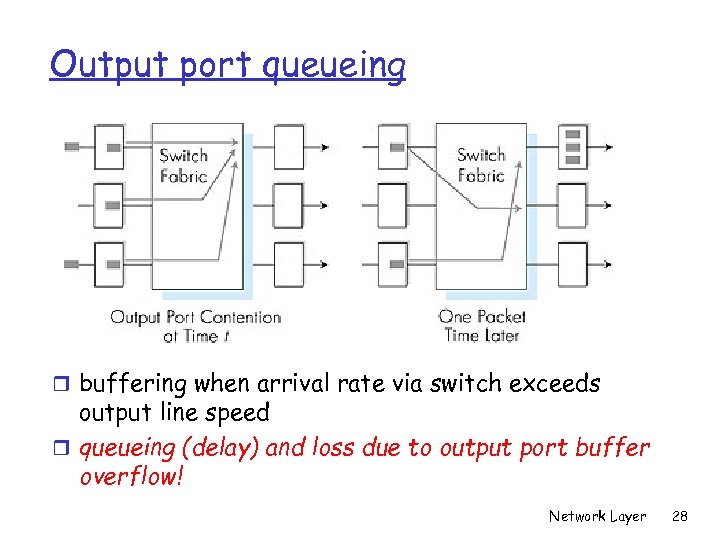 Output port queueing r buffering when arrival rate via switch exceeds output line speed r queueing (delay) and loss due to output port buffer overflow! Network Layer 28
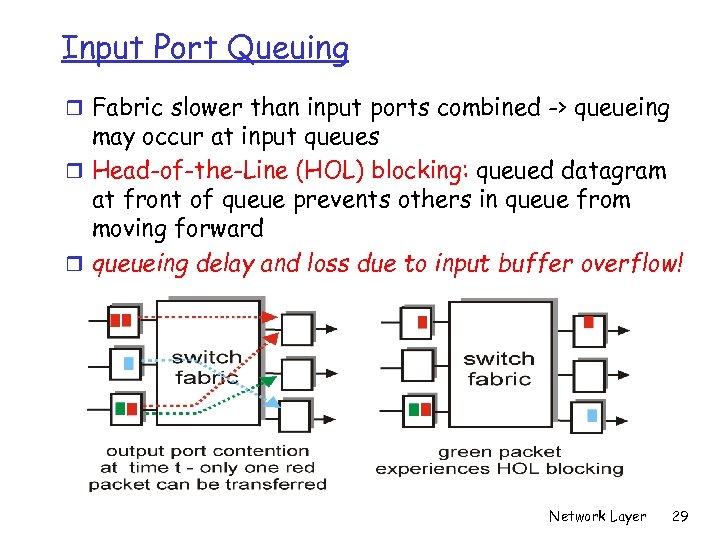 Input Port Queuing r Fabric slower than input ports combined -> queueing may occur at input queues r Head-of-the-Line (HOL) blocking: queued datagram at front of queue prevents others in queue from moving forward r queueing delay and loss due to input buffer overflow! Network Layer 29