


 Скачать презентацию Chapter 4 Money and Inflation Continued CHAPTER
f9845c432cdde902e6a13703f79246e4.ppt
- Количество слайдов: 24
 Chapter 4: Money and Inflation § Continued CHAPTER 4 Money and Inflation slide 0
 Money demand the nominal interest rate § In the quantity theory of money, the demand for real money balances depends only on real income Y. § Another determinant of money demand: the nominal interest rate, i. § the opportunity cost of holding money (instead of bonds or other interest-earning assets). § Hence, Δi Δ in money demand. CHAPTER 4 Money and Inflation slide 1
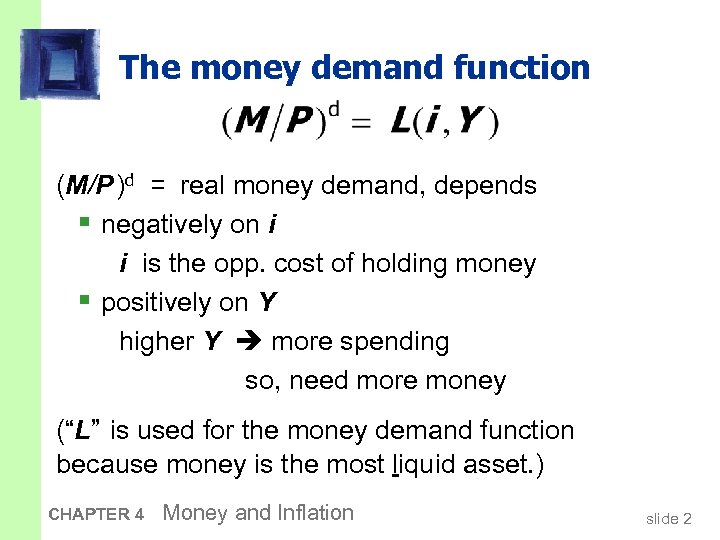 The money demand function (M/P )d = real money demand, depends § negatively on i i is the opp. cost of holding money § positively on Y higher Y more spending so, need more money (“L” is used for the money demand function because money is the most liquid asset. ) CHAPTER 4 Money and Inflation slide 2
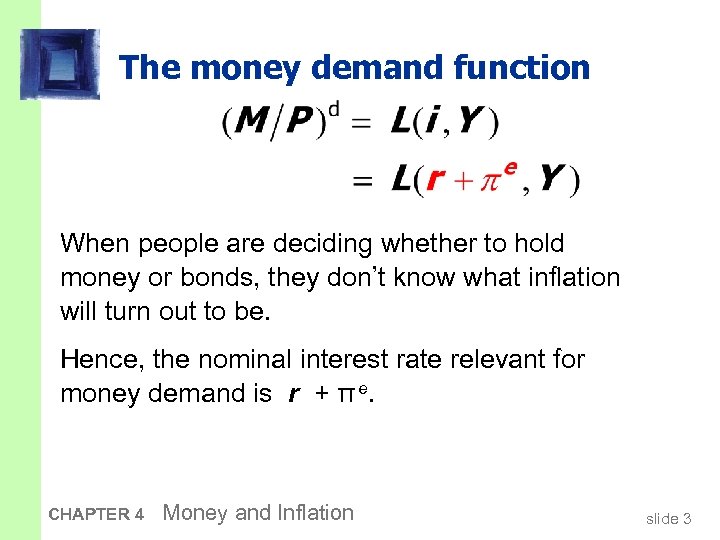 The money demand function When people are deciding whether to hold money or bonds, they don’t know what inflation will turn out to be. Hence, the nominal interest rate relevant for money demand is r + π e. CHAPTER 4 Money and Inflation slide 3
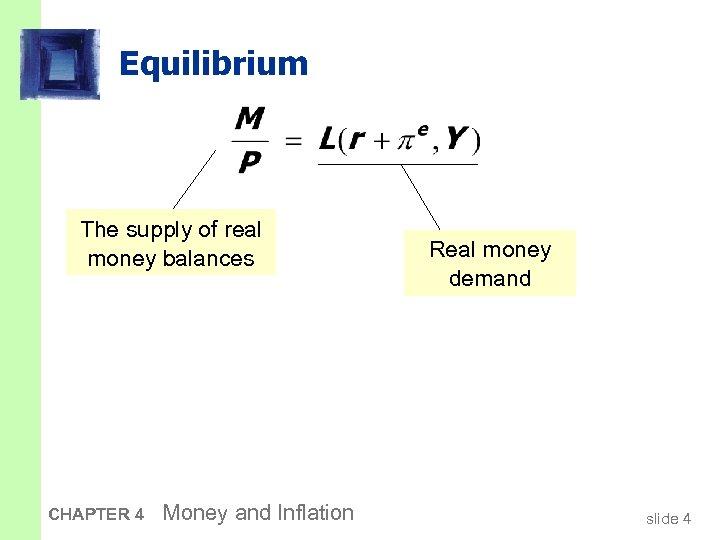 Equilibrium The supply of real money balances CHAPTER 4 Money and Inflation Real money demand slide 4
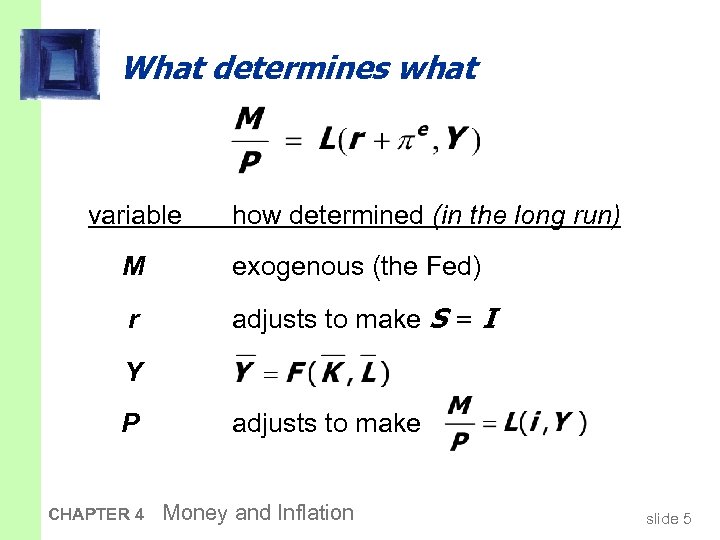 What determines what variable how determined (in the long run) M exogenous (the Fed) r adjusts to make S = I Y P CHAPTER 4 adjusts to make Money and Inflation slide 5
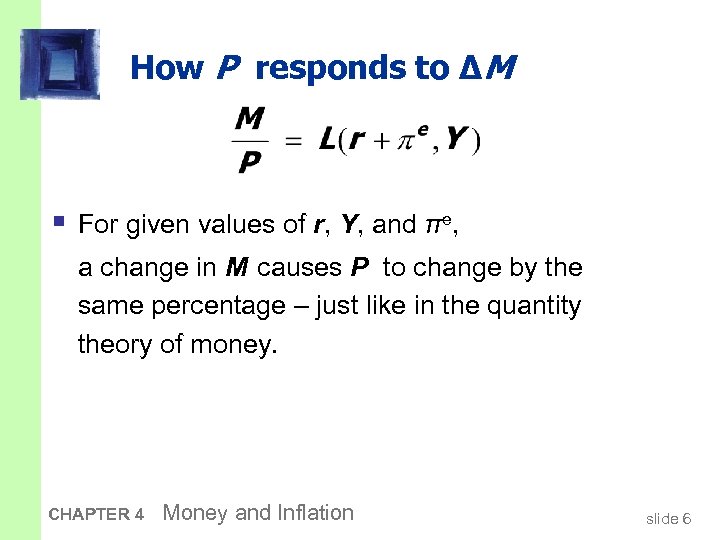 How P responds to ΔM § For given values of r, Y, and πe, a change in M causes P to change by the same percentage – just like in the quantity theory of money. CHAPTER 4 Money and Inflation slide 6
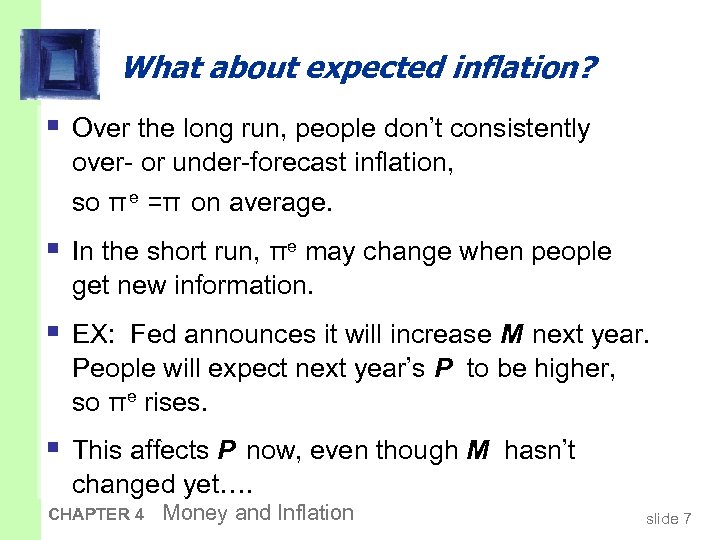 What about expected inflation? § Over the long run, people don’t consistently over- or under-forecast inflation, so π e =π on average. § In the short run, πe may change when people get new information. § EX: Fed announces it will increase M next year. People will expect next year’s P to be higher, so πe rises. § This affects P now, even though M hasn’t changed yet…. CHAPTER 4 Money and Inflation slide 7
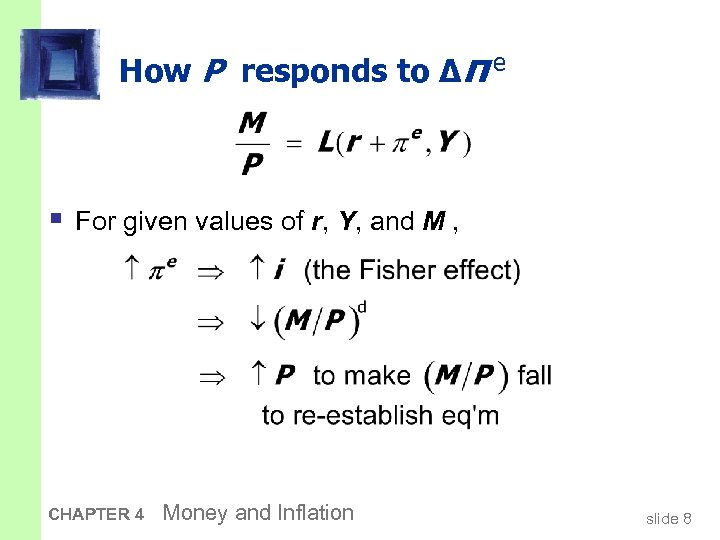 How P responds to Δπ e § For given values of r, Y, and M , CHAPTER 4 Money and Inflation slide 8
 Discussion question Why is inflation bad? § What costs does inflation impose on society? List all the ones you can think of. § Focus on the long run. § Think like an economist. CHAPTER 4 Money and Inflation slide 9
 A common misperception § Common misperception: inflation reduces real wages § This is true only in the short run, when nominal wages are fixed by contracts. § (Chap. 3) In the long run, the real wage is determined by labor supply and the marginal product of labor, not the price level or inflation rate. § Consider the data… CHAPTER 4 Money and Inflation slide 10
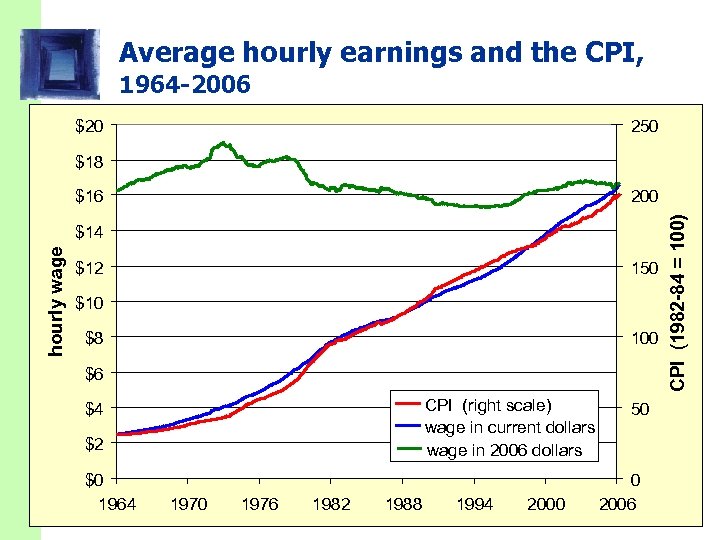 Average hourly earnings and the CPI, 1964 -2006 $20 250 $18 200 hourly wage $14 $12 150 $10 $8 100 $6 CPI (right scale) wage in current dollars wage in 2006 dollars $4 $2 $0 1964 CHAPTER 4 1970 1976 1982 Money and Inflation 1988 1994 2000 CPI (1982 -84 = 100) $16 50 0 2006 slide 11
 The classical view of inflation § The classical view: A change in the price level is merely a change in the units of measurement. So why, then, is inflation a social problem? CHAPTER 4 Money and Inflation slide 12
 The social costs of inflation …fall into two categories: 1. costs when inflation is expected 2. costs when inflation is different than people had expected CHAPTER 4 Money and Inflation slide 13
 § If we live in an economy where all prices are indexed to inflation, then the social cost of inflation would be minimal. The Costs of Expected Inflation § Suppose there is a monthly inflation rate of 1% (= 12% annual) and everybody in the economy expects this monthly inflation rate throughout the year. CHAPTER 4 Money and Inflation slide 14
 The costs of expected inflation: 1. Shoe-leather cost § def: the costs and inconveniences of reducing money balances to avoid the costs of inflation. § ↑ πe ↑ i ↓ real money balances § Remember: In the long run, inflation does not affect real income or real spending. § So, same monthly spending but lower average money holdings means more frequent trips to the bank to withdraw smaller amounts of cash. CHAPTER 4 Money and Inflation slide 15
 The costs of expected inflation: 2. Menu costs § def: The costs of changing prices. § Examples: § cost of printing new menus § cost of printing & mailing new catalogs § The higher is inflation, the more frequently firms must change their prices and incur these costs. CHAPTER 4 Money and Inflation slide 16
 The costs of expected inflation: 3. Relative price distortions § Firms facing menu costs change prices infrequently. § Example: A firm issues new catalog each January. As the general price level rises throughout the year, the firm’s relative price will fall. § Different firms change their prices at different times, leading to relative price distortions… …causing microeconomic inefficiencies in the allocation of resources. CHAPTER 4 Money and Inflation slide 17
 The costs of expected inflation: 4. Unfair tax treatment Some taxes are not adjusted to account for inflation, such as the capital gains tax. Example: § Jan 1: you buy $10, 000 worth of IBM stock § Dec 31: you sell the stock for $11, 000, so your nominal capital gain is $1000 (10%). § Suppose π = 10% during the year. Your real capital gain is $0. § But the govt requires you to pay taxes on your $1000 nominal gain!! CHAPTER 4 Money and Inflation slide 18
 The costs of expected inflation: 5. General inconvenience § Inflation makes it harder to compare nominal values from different time periods. § This complicates long-range financial planning. CHAPTER 4 Money and Inflation slide 19
 Additional cost of unexpected inflation: Arbitrary redistribution of purchasing power § Many long-term contracts not indexed, but based on π e. § If π turns out different from π e, then some gain at others’ expense. Example: borrowers & lenders § If π > πe, then (i - π) < (I - π e) and purchasing power is transferred from lenders to borrowers. § If π < π e, then purchasing power is transferred from borrowers to lenders. CHAPTER 4 Money and Inflation slide 20
 Example § You borrow $100. π e = 5%, you agree to pay $108 § (r. EA =i- πe =3%) Next year: § π = 10% you are better off. Your payment doesn’t even pay for inflation rate. § (r. EP=i- π =8 -10=-2%) § π = 2% you are worse off. Real interest rate is higher than 3%. § (r. EP=i- π =8 -2=6%) CHAPTER 4 Money and Inflation slide 21
 Additional cost of unexpected inflation: Arbitrary redistribution of purchasing power Fixed pension (retirement salary): If you are on a fixed pension (adjusted for π e ), the real purchasing power of your income ↓ when π > π e ↑ when π < π e CHAPTER 4 Money and Inflation slide 22
 Additional cost of high inflation: Increased uncertainty § When inflation is high, it’s more variable and unpredictable: π turns out different from π e more often, and the differences tend to be larger (though not systematically positive or negative) § Arbitrary redistributions of wealth become more likely. § This creates higher uncertainty, making risk averse people worse off. CHAPTER 4 Money and Inflation slide 23