


 Скачать презентацию Chapter 4 Life in the Colonies Life in
a05109b046f33d2514c2bbd45a0aac00.ppt
- Количество слайдов: 58
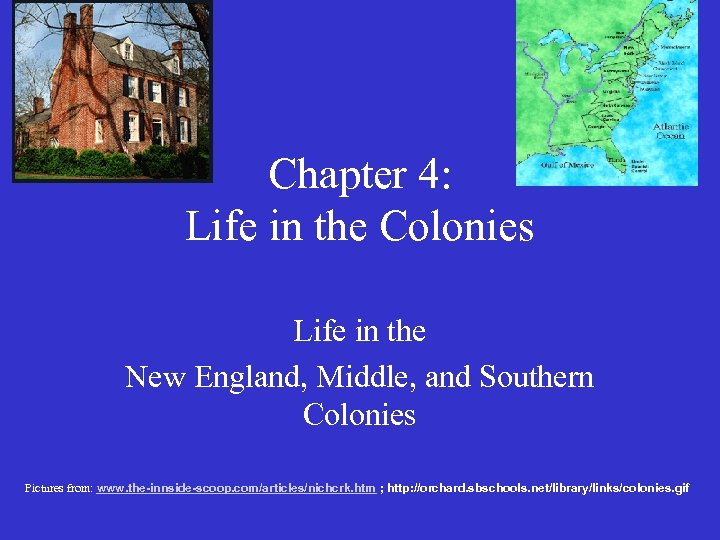 Chapter 4: Life in the Colonies Life in the New England, Middle, and Southern Colonies Pictures from: www. the-innside-scoop. com/articles/nichcrk. htm ; http: //orchard. sbschools. net/library/links/colonies. gif
 Section 1: Governing The Colonies How did English ideas about government and trade affect the colonies? Picutres from: historymedren. about. com/. . . /blpxkingjohn. htm ; www. kipar. org/. . . /galleries_1680 e. html
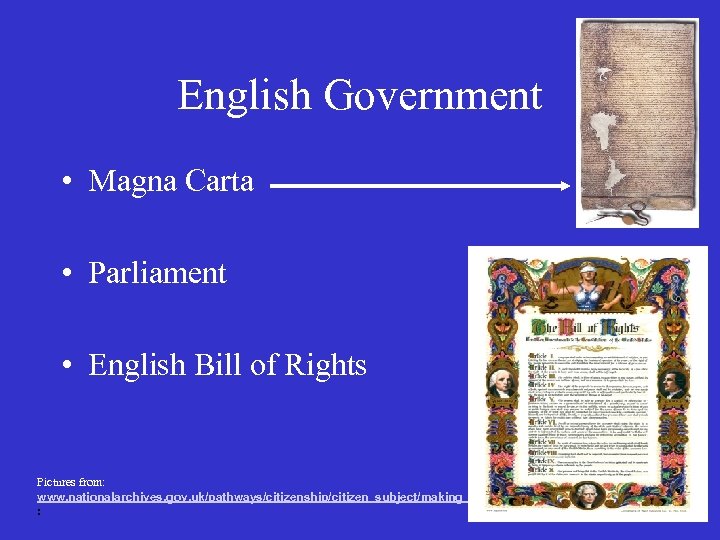 English Government • Magna Carta • Parliament • English Bill of Rights Pictures from: www. nationalarchives. gov. uk/pathways/citizenship/citizen_subject/making_history_citizen. htm :
 Question #1: What was the Magna Carta? Describe what role it played in the English government? The Magna Carta was a document that King John was forced to sign in 1215. It was the 1 st document to place restrictions on an English King. It limited the monarchs right to levy taxes w/out consulting the nobles. It also protected the right to own private property.
 Question #3: What was the English Bill of Rights? Who helped get them passed, who signed them into action? What did it boost? In 1688 Mary & William ruled and signed into law the English Bill of Rights. It was a written list of Freedoms such as Parliament needed to be consulted before the King or Queen could use govt. money, freedom of speech, can not have or raise an army in time of peace w/out consent of Parliament. Govt. promises to protect certain freedoms.
 Question #5: How was the power of the English monarchs limited? The monarch needed Parliament’s permission to raise taxes or an army. Parliament was allowed to meet regularly.
 The Right To Vote Which groups of people were permitted to vote in colonial elections? Which were not permitted to vote? White males, over the age of 21 who owned property Women, N-As, A-As, and children
 Colonial Self Government • Colonists saw how a limited monarchy and representative government worked in Europe and wanted it for the colonies. • House of Burgesses (VA) • General Court (MA) • General Assembly (PA)
 John Peter Zenger • Publisher of New York Weekly Journal • Printed Articles criticizing the governor of NY Arrested for libel • Zenger found not guilty of libel • WHY?
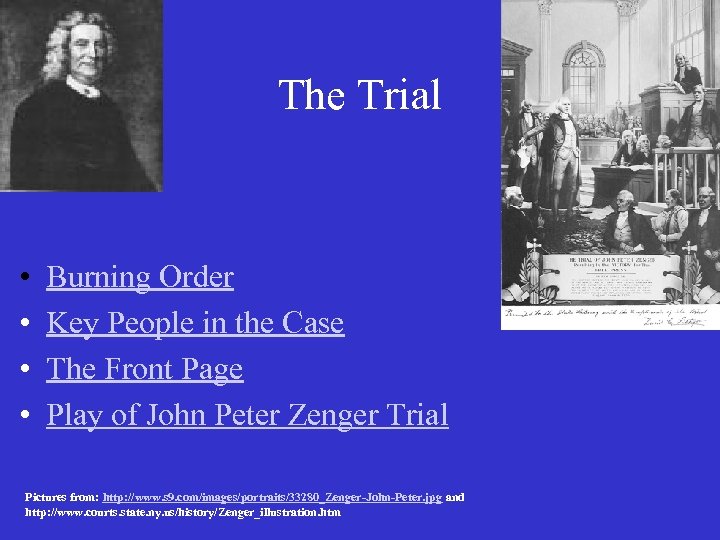 The Trial • • Burning Order Key People in the Case The Front Page Play of John Peter Zenger Trial Pictures from: http: //www. s 9. com/images/portraits/33280_Zenger-John-Peter. jpg and http: //www. courts. state. ny. us/history/Zenger_illustration. htm
 The Navigation Acts • • Regulated Trade Mercantilism 1651 Parliament passes 1 st Navigation Act These promoted the concept of mercantilism
 Navigation Act Stated: • Shipments from Europe to English colonies had to go through England first • Any imports to England from the colonies had to come from ships built and owned by British subjects • The colonies could sell key products such as tobacco, and sugar only to ENGLAND
 Advantages of the Navigation Acts • Created jobs for English workers • Benefited the colonies because traders had a sure market for their goods • Shipping industry in New England increased
 Negative Affects • Laws Favored English merchants • Felt they could make more money if they had authority to trade with other countries • Smuggling grew
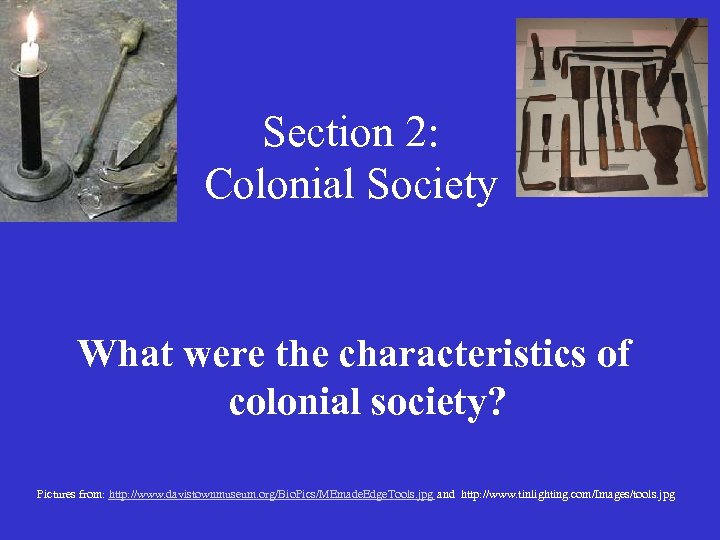 Section 2: Colonial Society What were the characteristics of colonial society? Pictures from: http: //www. davistownmuseum. org/Bio. Pics/MEmade. Edge. Tools. jpg and http: //www. tinlighting. com/Images/tools. jpg
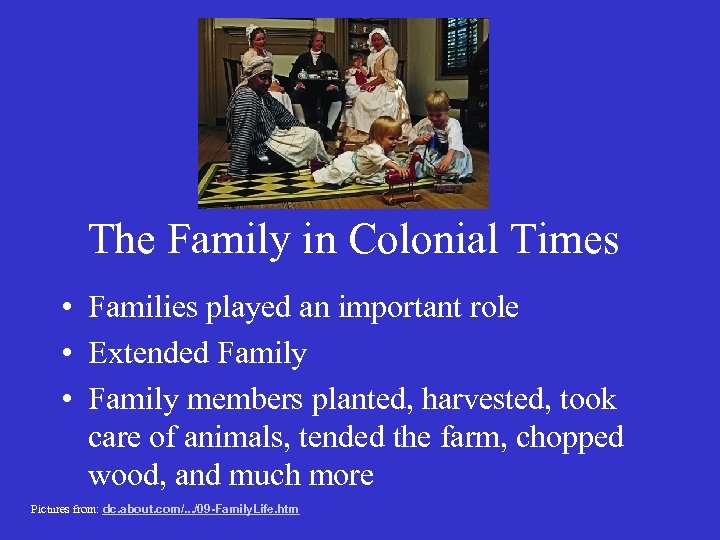 The Family in Colonial Times • Families played an important role • Extended Family • Family members planted, harvested, took care of animals, tended the farm, chopped wood, and much more Pictures from: dc. about. com/. . . /09 -Family. Life. htm
 Extended Family: is a family that includes, in addition to the parents and their children, other members such as grandparents, aunts, uncles, and cousins Question # 14: Members of a large family could perform some of the many tasks that had to be done on a large farm.
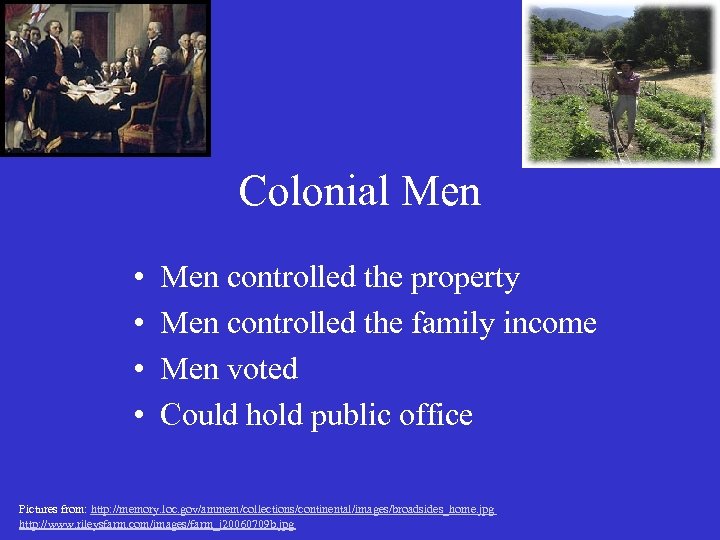 Colonial Men • • Men controlled the property Men controlled the family income Men voted Could hold public office Pictures from: http: //memory. loc. gov/ammem/collections/continental/images/broadsides_home. jpg http: //www. rileysfarm. com/images/farm_j 20060709 b. jpg
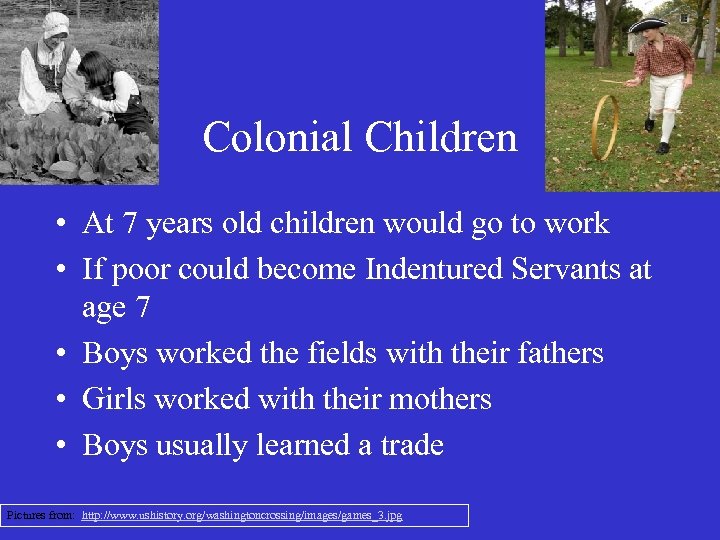 Colonial Children • At 7 years old children would go to work • If poor could become Indentured Servants at age 7 • Boys worked the fields with their fathers • Girls worked with their mothers • Boys usually learned a trade Pictures from: http: //www. ushistory. org/washingtoncrossing/images/games_3. jpg
 Question #16 How did the jobs of boys and girls differ? Boys tended to do work in the field with men, girls usually did house work alongside the women. Boys sometimes lived away from home and worked as apprentices. Girls sometimes became servants in wealthy households.
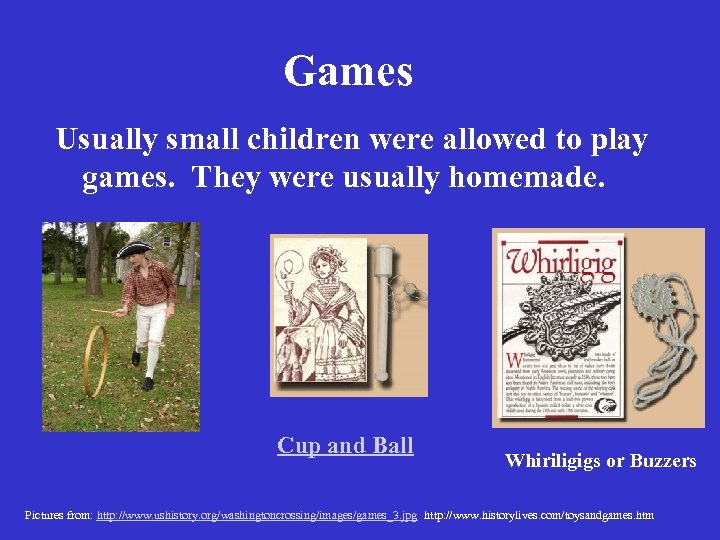 Games Usually small children were allowed to play games. They were usually homemade. Cup and Ball Whiriligigs or Buzzers Pictures from: http: //www. ushistory. org/washingtoncrossing/images/games_3. jpg http: //www. historylives. com/toysandgames. htm
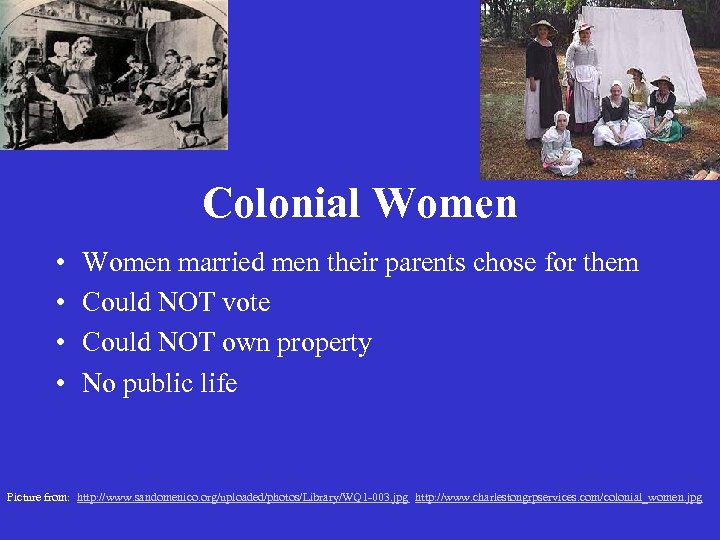 Colonial Women • • Women married men their parents chose for them Could NOT vote Could NOT own property No public life Picture from: http: //www. sandomenico. org/uploaded/photos/Library/WQ 1 -003. jpg http: //www. charlestongrpservices. com/colonial_women. jpg
 Question 15 What roles did women play in colonial society? What rights did they have or not have? They cooked, cleaned, did laundry, fed the chickens, kept the garden, millked the cows, took care of the children, and sometimes had to work in the fields. Women could not vote, hold office, own property, or keep any money they earned.
 Gentry • Wealthy merchants, plantation owners, ministers, royal officials, lawyers • Controlled government especially in the South
 Middle Class • Small Farmers, artisans • Could Vote • Sometimes held office
 Indentured Servants • Signed a contract to work from 4 -10 years for anyone who paid for his/her passage to the Americas • They aspired to become part of the Middle class once their indenture was over • Ireland Germany 1700’s
 Social Classes • • Gentry Middle Class Indentured Servants Free A-As, N-A, Slaves
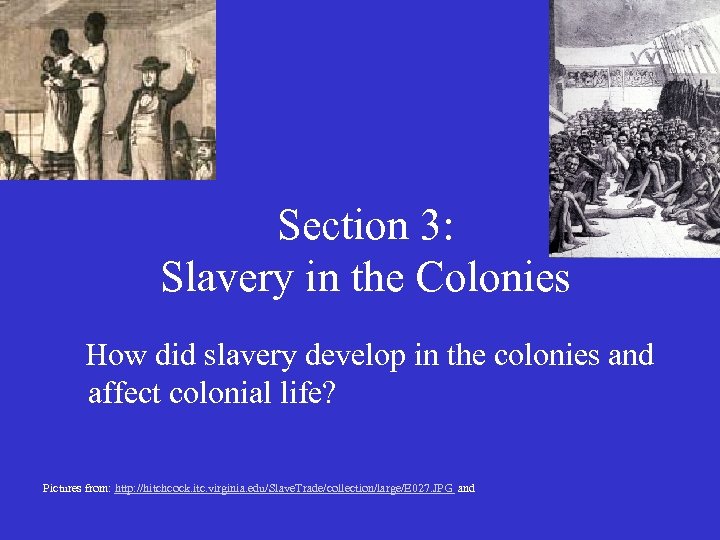 Section 3: Slavery in the Colonies How did slavery develop in the colonies and affect colonial life? Pictures from: http: //hitchcock. itc. virginia. edu/Slave. Trade/collection/large/E 027. JPG and
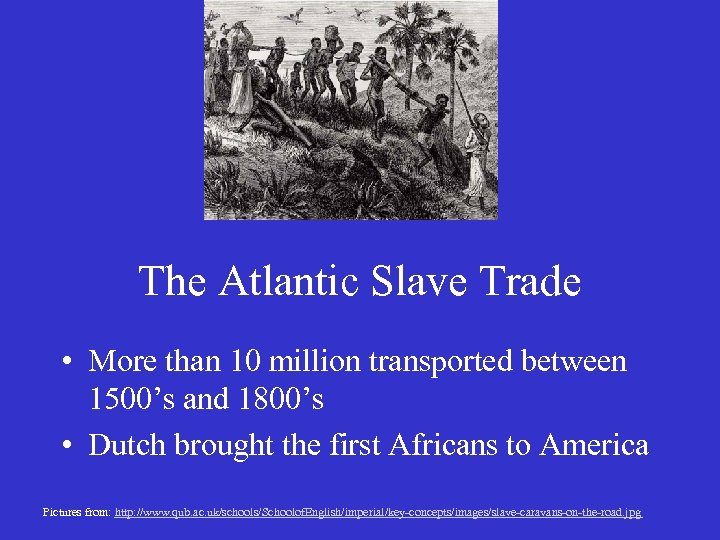 The Atlantic Slave Trade • More than 10 million transported between 1500’s and 1800’s • Dutch brought the first Africans to America Pictures from: http: //www. qub. ac. uk/schools/Schoolof. English/imperial/key-concepts/images/slave-caravans-on-the-road. jpg
 The Atlantic Slave Trade Cont. • The Portuguese and Spanish claimed their mark on the West coast of Africa • England later claims a stake in the slave trade • The Portuguese, Spanish, and English fight for territory on the West Coast especially Ghana
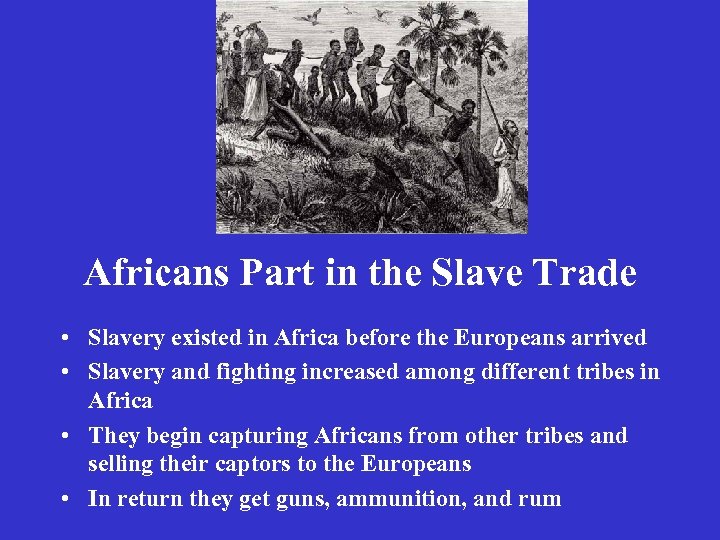 Africans Part in the Slave Trade • Slavery existed in Africa before the Europeans arrived • Slavery and fighting increased among different tribes in Africa • They begin capturing Africans from other tribes and selling their captors to the Europeans • In return they get guns, ammunition, and rum
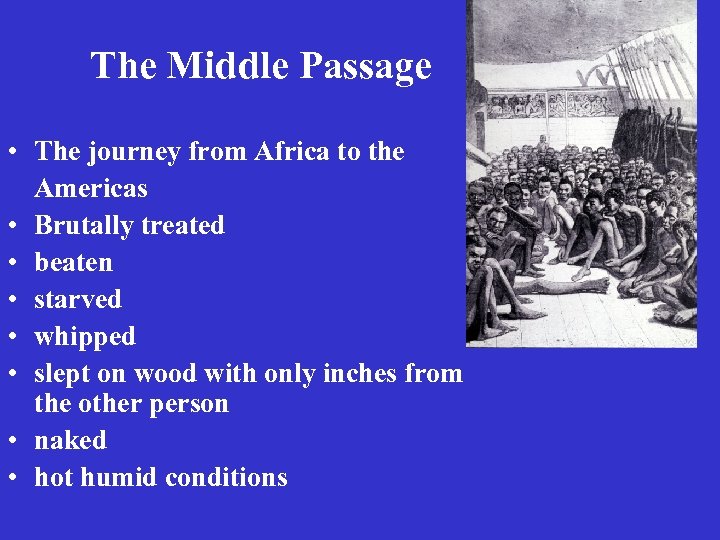 The Middle Passage • The journey from Africa to the Americas • Brutally treated • beaten • starved • whipped • slept on wood with only inches from the other person • naked • hot humid conditions
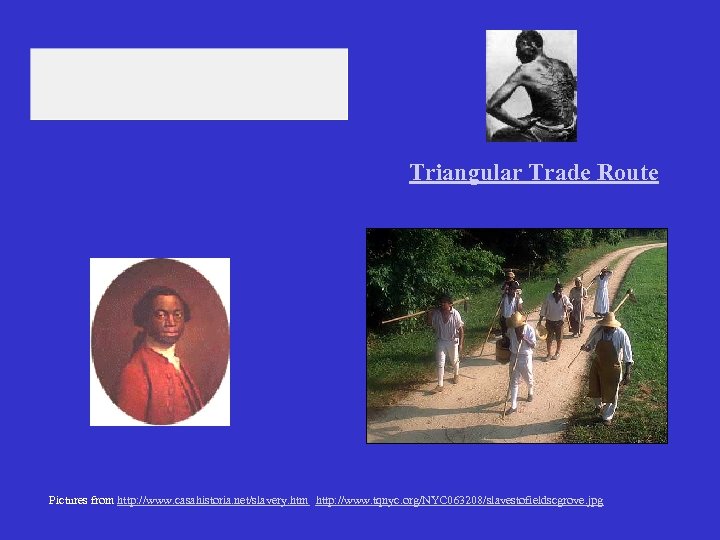 Triangular Trade Route Pictures from http: //www. casahistoria. net/slavery. htm http: //www. tqnyc. org/NYC 063208/slavestofieldscgrove. jpg
 Triangular Trade • 3 Way trade between the colonies, the islands of the Caribbean, and Africa • Africa traded slaves to the islands • The islands sent sugar and molasses to Africa • NE sent lumber, dried fish, flour to the islands • Islands sent to NE molasses, sugar and slaves
 Racism • The belief that one race is superior or inferior to another • The whites used this as an excuse to enslave Africans • Racism can be against any race it is not exclusive to the African race
 Question #28 • The slave codes were designed to restrict travel and communication among enslaved people. • The codes were intended to prevent slave revolts.
 Question #29 • Africans brought language, skill in crafts, musical styles, clothing, food, and many other things.
 Slave Codes • One law at a time • Strict laws that restricted the rights & activities of slaves • Slaves could not: • Meet in groups of 3 or more • Could not learn to read or write • Could not own a gun or other weapons • Could not marry • If a master killed a slave he would not be put in prison • If a slave went to jail they could not speak at their trial
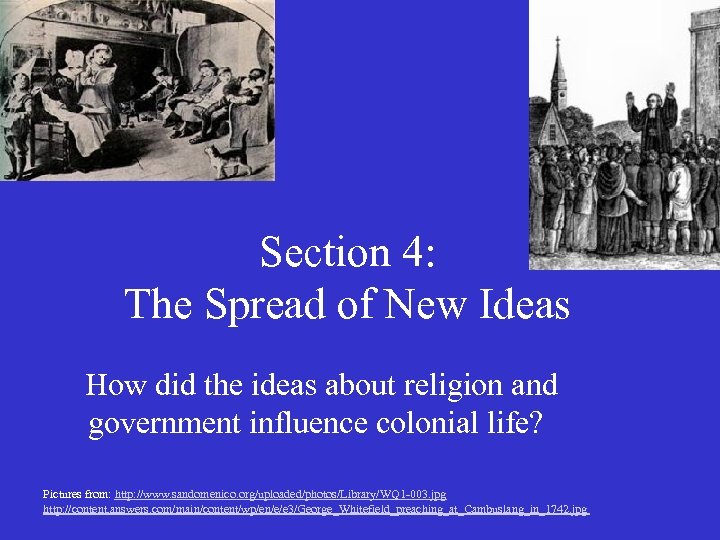 Section 4: The Spread of New Ideas How did the ideas about religion and government influence colonial life? Pictures from: http: //www. sandomenico. org/uploaded/photos/Library/WQ 1 -003. jpg http: //content. answers. com/main/content/wp/en/e/e 3/George_Whitefield_preaching_at_Cambuslang_in_1742. jpg
 The Importance of Education • Found its beginnings in Puritan laws • Parents required to teach children and servants to read • Every town with 50 or more families were required to have an elementary school • 100 families or more you were required to have a grammar school for older children
 Public Schools • MA was the first to enforce and encourage public schooling • Puritan schools were given both private and public money • Puritan schools children went to learn to read the bible • Towns could pay a fine to not set up a school if they had 50 or more families
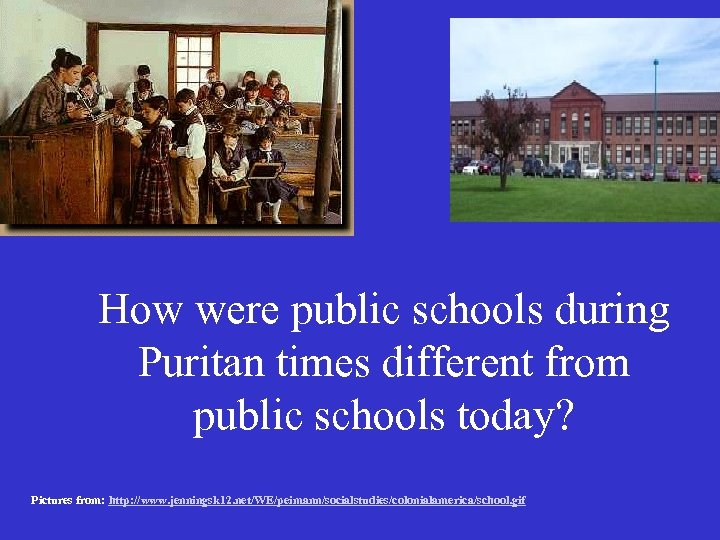 How were public schools during Puritan times different from public schools today? Pictures from: http: //www. jenningsk 12. net/WE/peimann/socialstudies/colonialamerica/school. gif
 Schooling in the South • Towns were separated by great distances • Wealthy children were tutored on plantations • Poorer children did not go to school but worked on the farm • Most girls did not receive a formal education
 African Americans and Education • Most colonial schools in the north were strictly for whites only • Anglican church in NY did run a school for free A-A but they were ridiculed and the church was burnt down • In the South it was against the law to teach A-A to learn to read or write
 Beyond Grammar School • Boys were almost always the only ones during early colonial times to attend colleges • Harvard College in MA opened in 1638 • 1693 William and Mary College in VA
 Question # 35 How did education differ for boys and girls? Boys received more education than girls and studied many more subjects
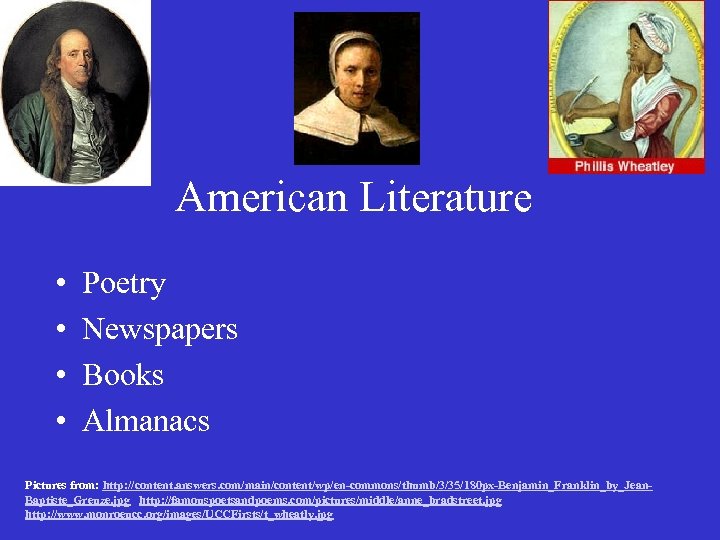 American Literature • • Poetry Newspapers Books Almanacs Pictures from: http: //content. answers. com/main/content/wp/en-commons/thumb/3/35/180 px-Benjamin_Franklin_by_Jean. Baptiste_Greuze. jpg http: //famouspoetsandpoems. com/pictures/middle/anne_bradstreet. jpg http: //www. monroeucc. org/images/UCCFirsts/t_wheatly. jpg
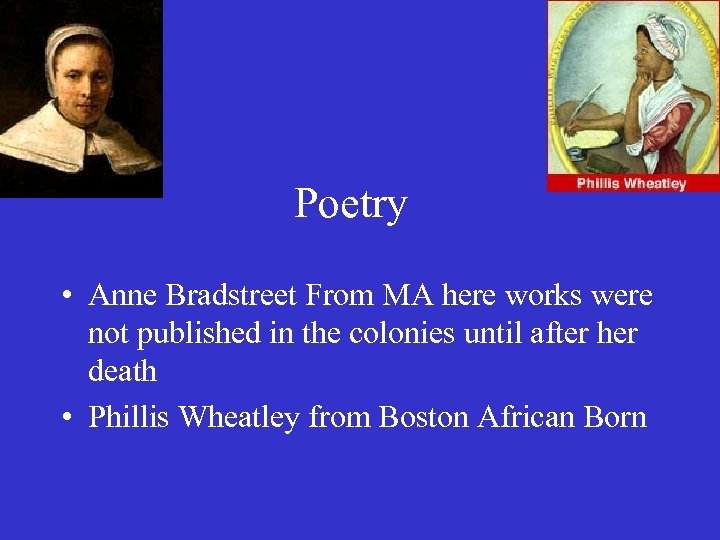 Poetry • Anne Bradstreet From MA here works were not published in the colonies until after her death • Phillis Wheatley from Boston African Born
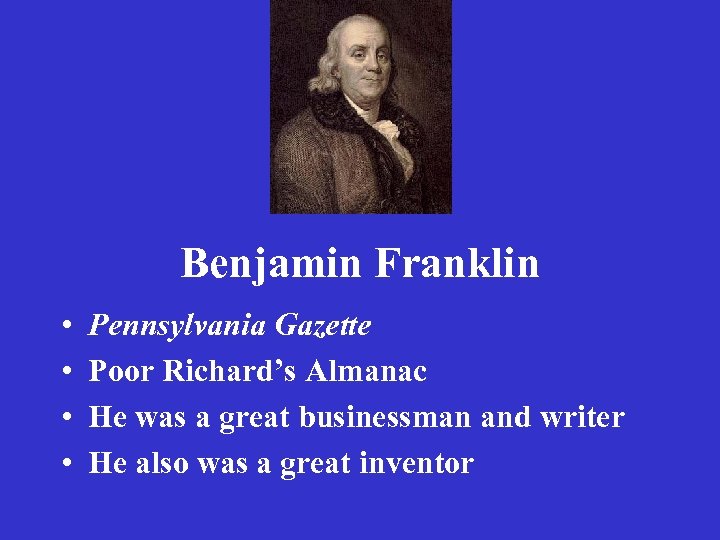 Benjamin Franklin • • Pennsylvania Gazette Poor Richard’s Almanac He was a great businessman and writer He also was a great inventor
 The Great Awakening • Period of Religious Revival • 1730’s & 1740’s • Began as a reaction against the decline of religious importance in the colonies • Tolerance of different religions increased
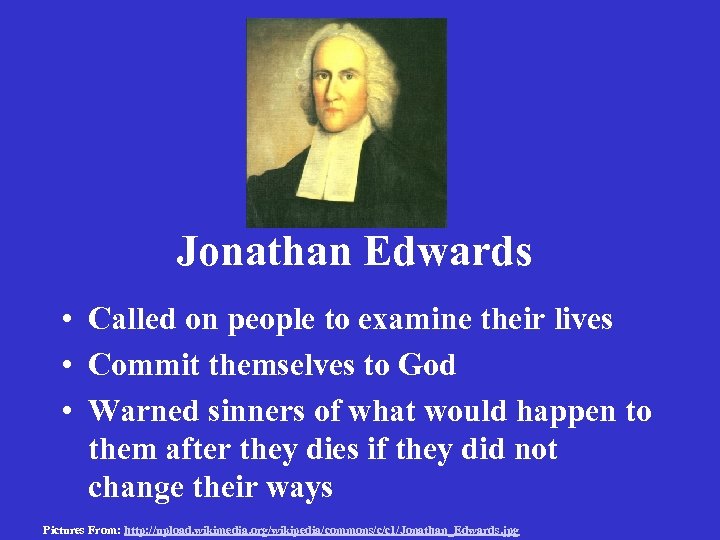 Jonathan Edwards • Called on people to examine their lives • Commit themselves to God • Warned sinners of what would happen to them after they dies if they did not change their ways Pictures From: http: //upload. wikimedia. org/wikipedia/commons/c/c 1/Jonathan_Edwards. jpg
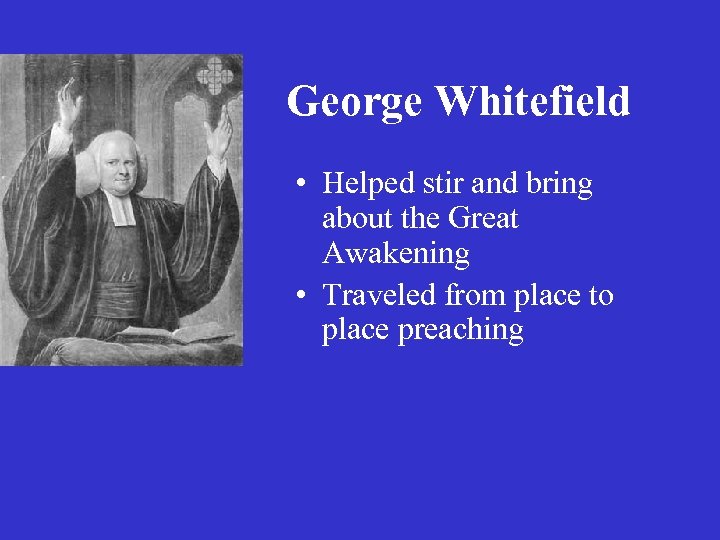 George Whitefield • Helped stir and bring about the Great Awakening • Traveled from place to place preaching
 Impact of the Great Awakening • Led to the rise of many new churches • Methodists and Baptists • Presbyterian, Dutch Reformed, and Congregationalist split • Led to more tolerance of religious differences
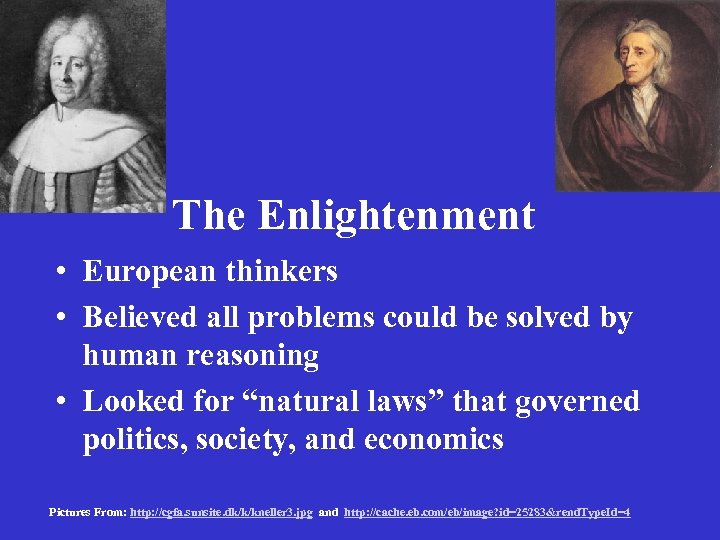 The Enlightenment • European thinkers • Believed all problems could be solved by human reasoning • Looked for “natural laws” that governed politics, society, and economics Pictures From: http: //cgfa. sunsite. dk/k/kneller 3. jpg and http: //cache. eb. com/eb/image? id=25283&rend. Type. Id=4
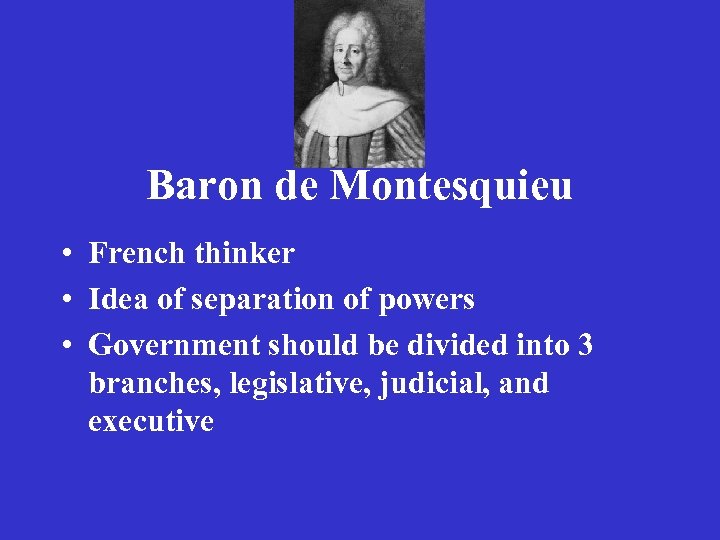 Baron de Montesquieu • French thinker • Idea of separation of powers • Government should be divided into 3 branches, legislative, judicial, and executive
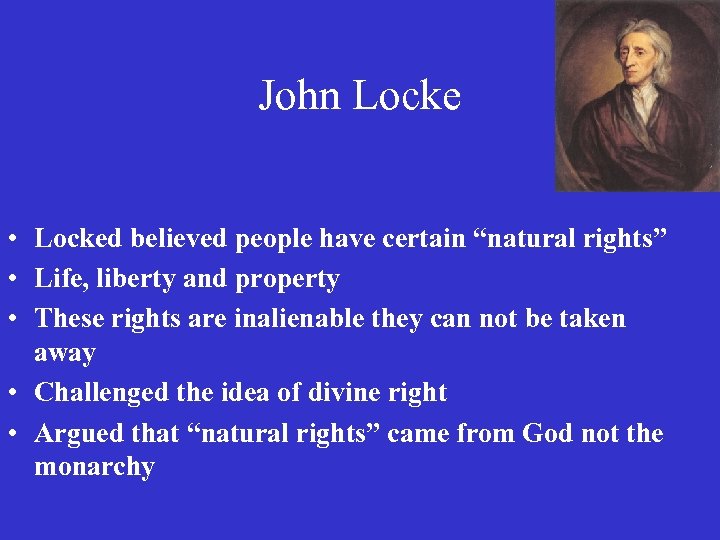 John Locke • Locked believed people have certain “natural rights” • Life, liberty and property • These rights are inalienable they can not be taken away • Challenged the idea of divine right • Argued that “natural rights” came from God not the monarchy
 Question #40 Natural rights were rights that belong to every human being from birth LIFE, LIBERTY, PROPERTY John Locke believed in this
 Question #41 Divine Rights: the belief that monarchs get their authority to rule directly from God Question #42 Montesquieu believed that there should be division of power in government into separate branches so that no one branch becomes too powerful