


 Скачать презентацию Chapter 4 Inventory Management Text 7 Introduction to
0c82f133fb1cc96efa1aa1270a9bbfb8.ppt
- Количество слайдов: 29
 Chapter 4 Inventory Management Text 7 Introduction to Inventory Text 8 Contemporary Approaches to Inventory Management Supplementary Reading: Costs Associated with Inventory Management
 Learning objective o o To understand the concept of inventory To understand the classification of inventory To learn the contemporary approaches of inventory management, such as ABC analysis, JIT and VMI To be familiar with the costs associated with inventory
 Text 7 Introduction to Inventory Key Terms 关键词汇 o inventory 库存 o finish goods 产成品 o raw material 原材料 o part and component 零部件 o work-in-process (WIP) 在制品库存,半成品 o MRO (maintenance/repair/operating) 维修库存 o cycle inventory 周转库存 o safety (buffer)inventory 安全(缓冲)库存 o in-transit inventory 在途库存 o speculative inventory 投机库存 o dead inventory 呆滞库存
 What Is Inventory o o o Inventory refers to stocks of good that are maintained for a variety of purposes, such as for resale to others, as well as to support manufacturing or assembling processes Inventory applied to finished goods, raw materials, parts and components, MRO (maintenance/repair/operating) and WIP (work-in -process). Why companies need to hold inventories?
 reasons for holding inventories o Meet demand Read this paragraph and answer: What does “stock-out” means? o o Keep operations running Lead time What is “lead time”? Please read the paragraph and find out o Quantity discounts
 Inventory Classifications o o o Inventory is most frequently classified as cycle (base) stock safety (buffer) stock in-transit (pipeline) stock speculative stock dead stock
 o o o Cycle (base) stock Cycle, or base stock refers to inventory that is needed to satisfy normal demand during the course of an order cycle. If demand lead time is constant, only cycle stock is necessary.
 Safety (buffer) inventory o o o Safety or buffer inventory referred to inventory that is held in addition to cycle stock to guard against uncertainty in demand and/or lead time. the higher the level of buffer inventory, the better the firm’s customer service. This occurs because the firm suffers fewer “stock-outs”.
 Transit inventory o o o Transit inventories result from the need to transport items or material from one location to another. That means, transit inventory refers to goods on their way The increase of transit time for these inventories would lead to an increase in the size of the transit inventory.
 Speculative inventory o o firms sometimes purchase and hold inventory that is in excess of their current need for a possible future event. Such events may include a price increase, a seasonal increase in demand.
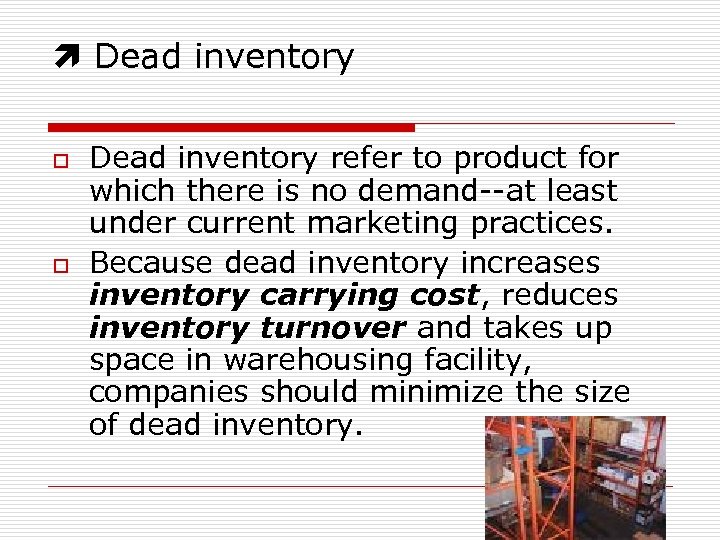 Dead inventory o o Dead inventory refer to product for which there is no demand--at least under current marketing practices. Because dead inventory increases inventory carrying cost, reduces inventory turnover and takes up space in warehousing facility, companies should minimize the size of dead inventory.
 Notes: o o 1. If the products are “stock-out” (when customer’s order cannot be immediately filled from existing inventory), the customer might get them from other sources. 如果产品处于缺 货状态(现有库存无法立即满足客户订货需求),客 户可能会从其他途径取得货物。 2. Cycle stock refers to inventory that is needed to satisfy normal demand during the course of an order cycle. If demand lead time is constant, only cycle stock is necessary. 周转库存是指那些用于满足一个订货周 期内正常需求的库存。如果需求和提前期是不变的, 那么只有周转库存是必需的。
 o o 3. Safety or buffer inventory referred to inventory that is held in addition to cycle stock to guard against uncertainty in demand and/or lead time. 安全(缓冲库存) 是指周转库存之外的额外存货,以应对需求和提前 期的不稳定性。 4. This tactic is commonly used by retailers, who always build up inventory months before the demand for their products will be unusually high (i. e. , at Halloween, Christmas). 零售商们常使用这种策略,他们总是 提前几个月就储备库存以应对产品需求量的提高( 例如万圣节,圣诞节)。
 o 5. Because dead inventory increases inventory carrying cost, reduces inventory turnover and takes up space in warehousing facility, companies should minimize the size of dead inventory. 因为呆滞库存会增加 库存持有成本,减慢库存周转,并且占用仓 储空间,所以企业应该将呆滞库存减到最低。
 Topics for discussion: o o 1. Some people believe inventory only refers to the stock company is holding inside its warehouse, do you agree? If not, what else can also be called the company’s inventory? 2. Why companies have to keep inventory? Do you think it is possible for a company to keep zero inventory and still maintain normal operation?
 Text 8 Contemporary Approaches to Inventory Management Key Terms 关键词汇 o inventory management 库存管理 o ABC analysis of inventory ABC库存分析 o inventory level 库存水平 o inventory cost 库存成本 o Just-in-Time (JIT) 准时制 o Vendor-Managed Inventory (VMI) 供应商管 理库存 o inventory turnover 库存周转率
 ABC Analysis of Inventory o o ABC analysis of inventory recognizes that inventories are not of equal value to a firm and that, as a result, all inventory should not be managed in the same way. According to ABC analysis, 20 percent of all inventory items represent 80 percent of inventory costs.
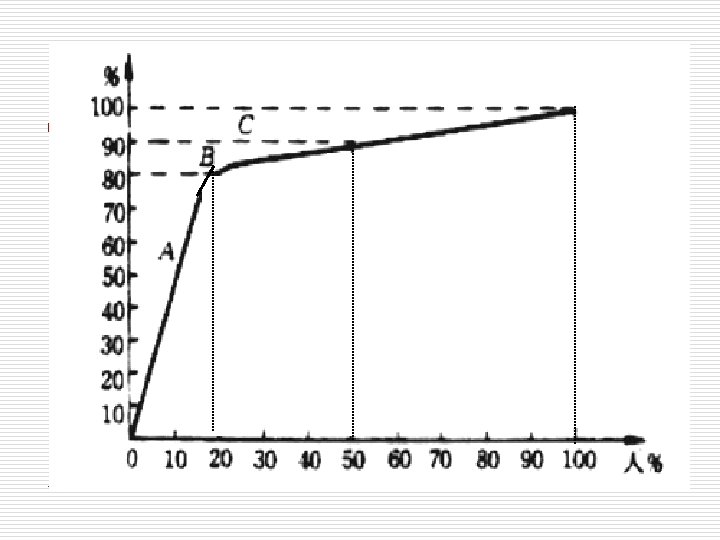
 A, B, C ITEMS o o o A firm can control 80 percent of its inventory costs by monitoring and controlling 20 percent of its inventory The top 20 percent of the firm’s most costly items are termed “A” items Items that are extremely inexpensive or have low demand are termed “C” items w “B” items falling in between A and C items. B items usually represent about 30 percent of the total inventory items and 15 percent of the costs. C items generally consist 50 percent of all inventory items but only around 5 percent of the costs
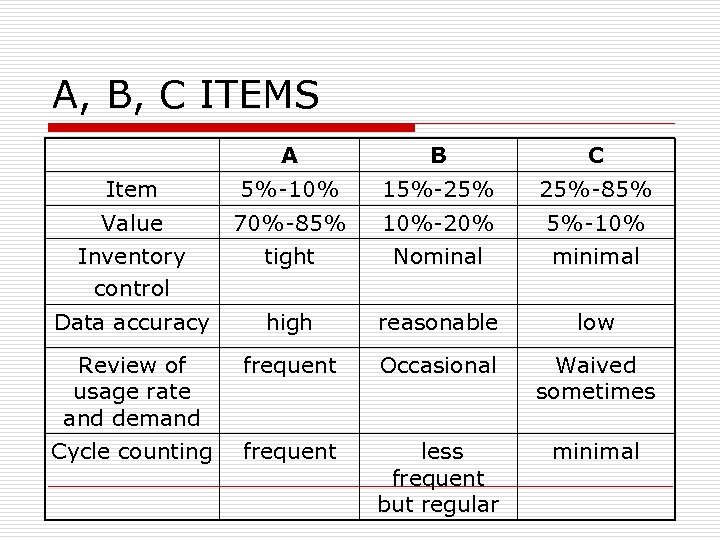 A, B, C ITEMS A B C Item 5%-10% 15%-25% 25%-85% Value 70%-85% 10%-20% 5%-10% Inventory control tight Nominal minimal Data accuracy high reasonable low Review of usage rate and demand frequent Occasional Waived sometimes Cycle counting frequent less frequent but regular minimal
 Just-in-Time (JIT approach) o o o The JIT approach seeks to minimize inventory by reducing safety stock, as well as by having the required amount of materials arrive at the production location at the exact time that they are needed. inventories has to be keep to the lowest level, if it can’t not be totally eliminated. emphasis on low (no) safety inventory, the supplier must deliver high-quality materials to the production line on time.
 Vendor-Managed Inventory (VMI) o o o the vendor (can be manufacturer or other kind of supplier) is responsible for maintaining the distributor’s inventory levels. The vendor has access to the distributor’s inventory data and is responsible for generating purchase orders. This access is accomplished electronically by Electronic Data Interchange (EDI) and / or Internet. What benefits can VMI bring to the vendors and their customers (distributor and retailer )?
 Answer: o o The adoption of VMI helps distributor and retailer to reduced stock-out and achieve higher inventory turnover At the same time, vendor benefit from better demand forecasting because of early access to data of its customer
 Notes o o 1. This approach recognizes that inventories are not of equal value to a firm and that, as a result, all inventory should not be managed in the same way. ABC存货分析方法 认为不同的存货对企业的价值是不一样的,因而, 不能对所有的存货用同一种方法进行管理。 2. The JIT approach seeks to minimize inventory by reducing safety stock, as well as by having the required amount of materials arrive at the production location at the exact time that they are needed. 准时制 方法是通过减少安全库存来达到缩减总库存量。
 o o 3. Because of the system’s emphasis on low (no) safety inventory, the supplier must deliver high-quality materials to the production line on time. Defective materials may result in a production line shutdown and cause big lose for the producer. 因为这一系统 强调低甚至零安全库存,所以供应商必须准时将高质 量的材料送达生产线。有缺陷的材料可能会导致生产 线停顿,对生产企业造成重大损失。 4. In traditional inventory management, placing replenishment orders is the responsibility of the party using inventory, such as a distributor or retailer. 在传统的库存 管理中,下补货单是存货使用方,如分销商、零售商 的职责。
 o 5. The adoption of VMI helps distributor and retailer to reduced stock-out and achieve higher inventory turnover, and at the same time, vendor benefit from better demand forecasting because of early access to data of its customer. 采用供应商管理库存的方法帮助 分销商和零售商减少缺货并且提高了库存周转率。 同时,供应商也从中得到好处,因为他们可以更早 地得到顾客的数据信息,这样他们就能做出更好的 需求预测。
 Exercises: Please translate the following English sentences into Chinese o o o 1. Inventory applied to finished goods, raw materials, parts and components, MRO (maintenance/repair/operating) and WIP (work-in-process). 2. Generally, the higher the level of buffer inventory, the better the firm’s customer service. This occurs because the firm suffers fewer “stock-outs”. 3. According to ABC analysis, 20 percent of all inventory items represent 80 percent of inventory costs. Therefore, a firm can control 80 percent of its inventory costs by monitoring and controlling 20 percent of its inventory.
 o o 4. The JIT approach views inventories as waste, therefore, has to be keep to the lowest level, if it can’t not be totally eliminated. 5. Under vendor-management inventory (VMI), by contrast, the vendor (can be manufacturer or other kind of supplier) is responsible for maintaining the distributor’s inventory levels.
 Debate Propositions o According to Text 8, the JIT approach brings benefits to the manufacturers, they can have the required amount of materials arrive at the production location at the exact right time, and keep little even zero inventory. But that means the suppliers have to deliver their materials more often to meet this requirement, and their cost will be higher than before. It seems they don’t get any benefit form it, so the JIT is an unfair practice for the suppliers. Do you agree?