


 Скачать презентацию Chapter 4 Intellectual Property 1 — Chapter
e00cf60f9057faadab456326b1b20f60.ppt
- Количество слайдов: 93
 Chapter 4: Intellectual Property 1 -
 Chapter Overview (1/2) • • • Introduction Intellectual property rights Protecting intellectual property Fair use New restrictions on use 1 -2
 Chapter Overview (2/2) Peer-to-peer networks and cyberlockers Protections for software Open-source software Legitimacy of intellectual property protection for software • Creative Commons • • 1 -3
 4. 1 Introduction 1 -4
 Information Technology Changing Intellectual Property Landscape • Value of intellectual properties much greater than value of media – Creating first copy is costly – Duplicates cost almost nothing • Illegal copying pervasive – Internet allows copies to spread quickly and widely • In light of advances in information technology, how should we treat intellectual property? 1 -5
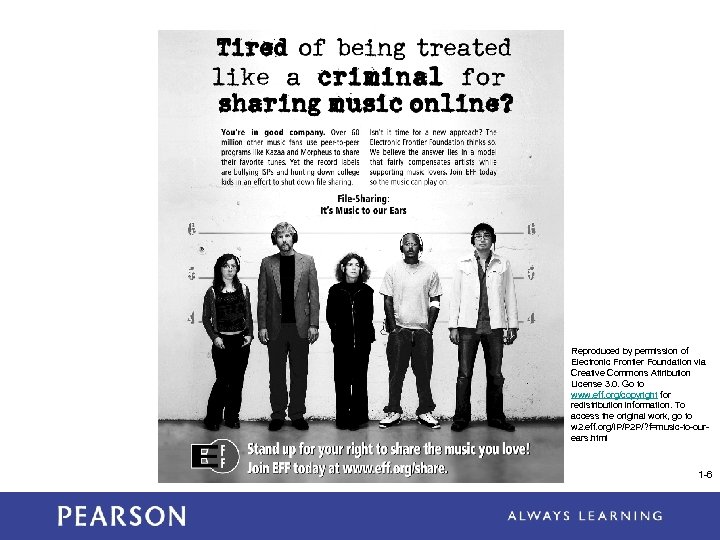 Reproduced by permission of Electronic Frontier Foundation via Creative Commons Attribution License 3. 0. Go to www. eff. org/copyright for redistribution information. To access the original work, go to w 2. eff. org/IP/P 2 P/? f=music-to-ourears. html 1 -6
 4. 2 Intellectual Property Rights 1 -7
 What Is Intellectual Property? • Intellectual property: any unique product of the human intellect that has commercial value – Books, songs, movies – Paintings, drawings – Inventions, chemical formulas, computer programs • Intellectual property ≠ physical manifestation • Does right to own property extend to intellectual property? 1 -8
 Property Rights • Locke: The Second Treatise of Government • People have a right… – to property in their own person – to their own labor – to things which they remove from Nature through their labor • As long as… – nobody claims more property than they can use – after someone removes something from common state, there is plenty left over 1 -9
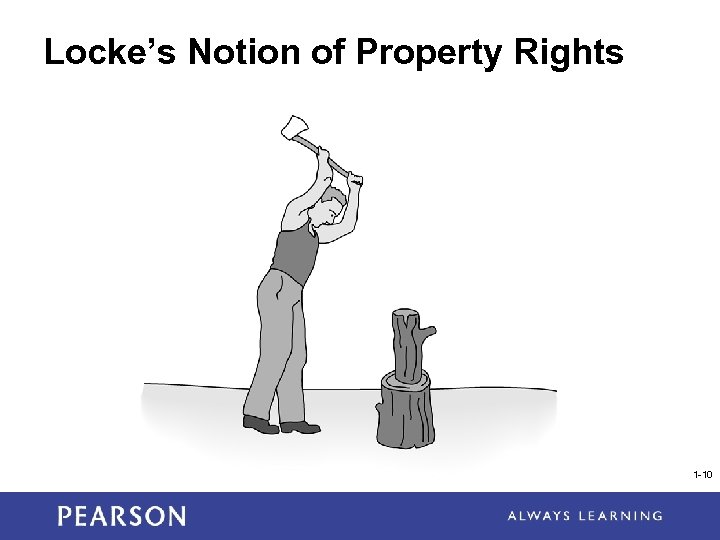 Locke’s Notion of Property Rights 1 -10
 Expanding the Argument to Intellectual Property • Writing a play akin to making a belt buckle • Belt buckle – Mine ore – Smelt it down – Cast it • Writing a play – “Mine” words from English language – “Smelt” them into prose – “Cast” them into a complete play 1 -11
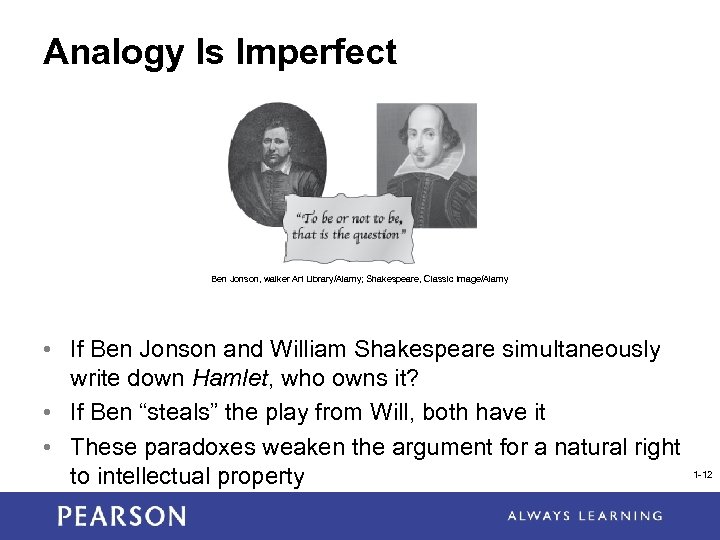 Analogy Is Imperfect Ben Jonson, walker Art Library/Alamy; Shakespeare, Classic Image/Alamy • If Ben Jonson and William Shakespeare simultaneously write down Hamlet, who owns it? • If Ben “steals” the play from Will, both have it • These paradoxes weaken the argument for a natural right 1 -12 to intellectual property 1 -12
 Benefits of Intellectual Property Protection • Some people are altruistic; some are not • Allure of wealth can be an incentive for speculative work • Authors of U. S. Constitution recognized benefits to limited intellectual property protection 1 -13
 Limits to Intellectual Property Protection • Giving creators rights to their inventions stimulates creativity • Society benefits most when inventions in public domain • Congress has struck compromise by giving authors and inventors rights for a limited time 1 -14
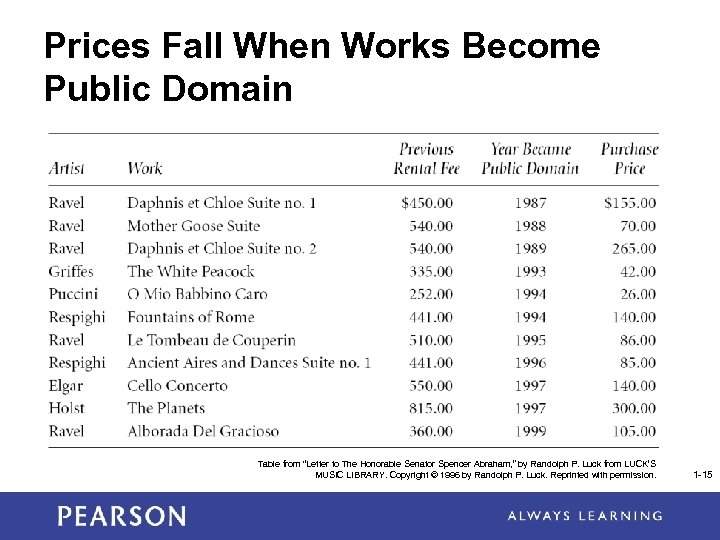 Prices Fall When Works Become Public Domain Table from “Letter to The Honorable Senator Spencer Abraham, ” by Randolph P. Luck from LUCK’S MUSIC LIBRARY. Copyright © 1996 by Randolph P. Luck. Reprinted with permission. 1 -15
 4. 3 Protecting Intellectual Property 1 -16
 Trade Secret • Confidential piece of intellectual property that gives company a competitive advantage • Never expires • Not appropriate for all intellectual properties • Reverse engineering allowed • May be compromised when employees leave firm 1 -17
 Trademark, Service Mark • • • Trademark: Identifies goods Service mark: Identifies services Company can establish a “brand name” Does not expire If brand name becomes common noun, trademark may be lost • Companies advertise to protect their trademarks • Companies also protect trademarks by contacting those who misuse them 1 -18
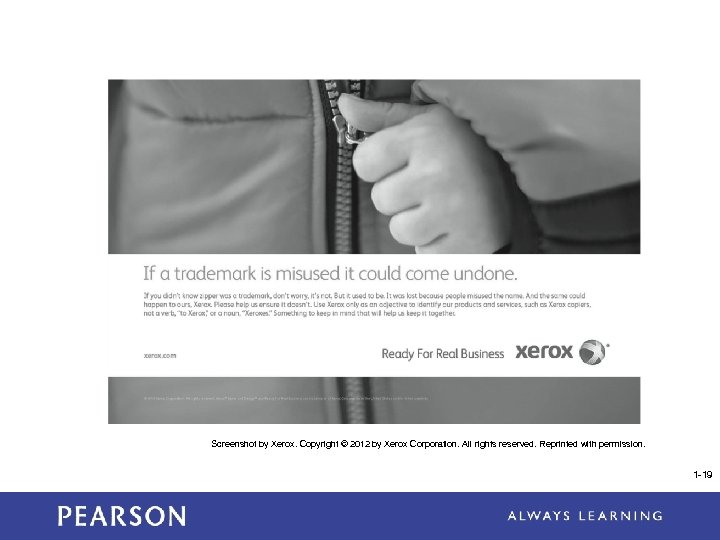 Screenshot by Xerox. Copyright © 2012 by Xerox Corporation. All rights reserved. Reprinted with permission. 1 -19
 Patent • A public document that provides detailed description of invention • Provides owner with exclusive right to the invention • Owner can prevent others from making, using, or selling invention for 20 years 1 -20
 Copyright • Provides owner of an original work five rights – Reproduction – Distribution – Public display – Public performance – Production of derivative works • Copyright-related industries represent 6% of U. S. gross domestic product (> $900 billion/yr) • Copyright protection has expanded greatly since 1790 1 -21
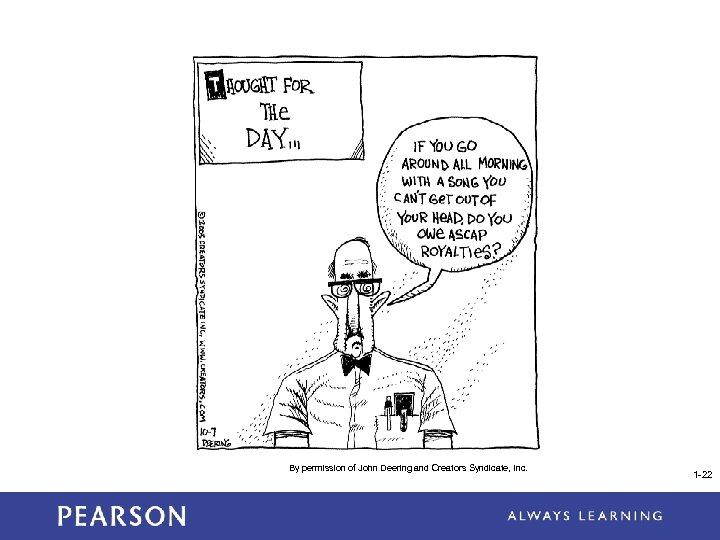 By permission of John Deering and Creators Syndicate, Inc. 1 -22
 Key Court Cases and Legislation • • Gershwin Publishing v. Columbia Artists Basic Books v. Kinko’s Graphics Davey Jones Locker No Electronic Theft Act 1 -23
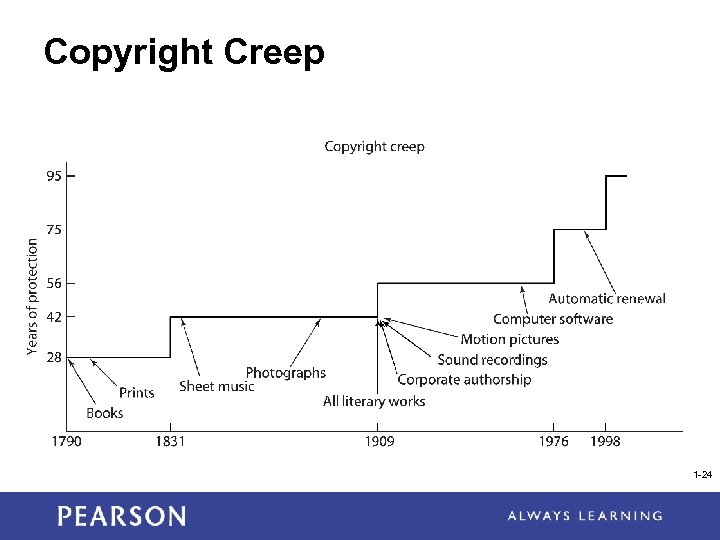 Copyright Creep 1 -24
 Copyright Creep • Since 1790, protection for books extended from 28 years to 95 years or more • Some say latest extension done to prevent Disney characters from becoming public domain • Group of petitioners challenged the Copyright Term Extension Act of 1998, arguing Congress exceeded Constitutional power • U. S. Supreme Court ruling – CTEA does not create perpetual copyrights – CTEA is constitutional 1 -25
 4. 4 Fair Use 1 -26
 Fair Use Concept • Sometimes legal to reproduce a copyrighted work without permission • Courts consider four factors – Purpose and character of use – Nature of work – Amount of work being copied – Affect on market for work 1 -27
 Sony v. Universal City Studios • Sony introduced Betamax VCR (1975) • People started time shifting TV shows • Movie studios sued Sony for copyright infringements • U. S. Supreme Court ruled (5 -4) that time shifting is fair use 1 -28
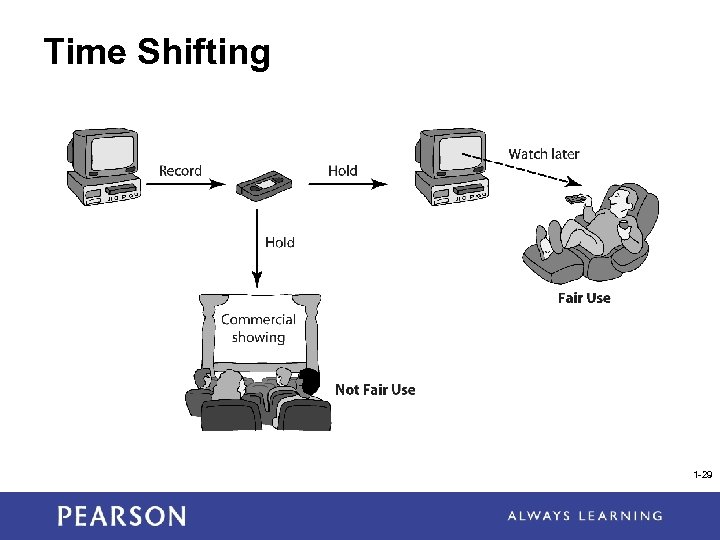 Time Shifting 1 -29
 Digital Recording Technology • Copying from vinyl records to cassette tapes introduced hiss and distortions • Introduction of compact disc a boon for music industry – Cheaper to produce than vinyl records – Higher quality – Higher price higher profits • BUT it’s possible to make a perfect copy of a CD 1 -30
 Audio Home Recording Act of 1992 • Protects rights of consumers to make copies of analog or digital recordings for personal, noncommercial use – Backup copy – Give to family member • Digital audio recorders must incorporate Serial Copyright Management System (SCMS), so consumers can’t make a copy of a copy 1 -31
 RIAA v. Diamond Multimedia • MP 3 compression allowed songs to be stored in 10% of the space, with little degradation • Diamond introduced Rio MP 3 player (1998) • People started space shifting their music • RIAA started legal action against Diamond for violation of the Audio Home Recording Act • U. S. Court of Appeals, 9 th Circuit, affirmed that space shifting is consistent with copyright law 1 -32
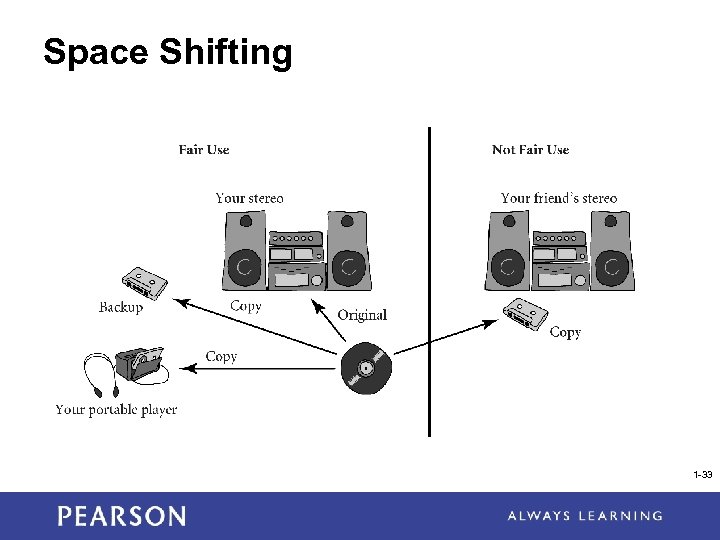 Space Shifting 1 -33
 Kelly v. Arriba Soft • Kelly: Photographer maintained Web site with copyrighted photos • Arriba Soft: Created search engine that returned thumbnail images • Kelly sued Arriba Soft for copyright infringement • U. S. Court of Appeals, 9 th Circuit, affirmed that it was fair use 1 -34
 Google Books • Google announced plan to scan millions of books held by several huge libraries, creating searchable database of all words • If public domain book, system returns PDF • If under copyright, user can see a few sentences; system provides links to libraries and online booksellers • Authors Guild and publishers sued Google for copyright infringement (copying books for commercial reasons) • Out-of-court settlement reached 1 -35
 Benefits of Proposed Settlement • Google would pay $125 million to resolve legal claims of authors and publishers and establish Book Rights Registry • Readers would have much easier access to out-of-print books at U. S. public libraries and university libraries • University libraries could purchase subscriptions giving their students access to collections of some of world’s greatest libraries • Authors and publishers would receive payments earned from online access of their books, plus share of advertising revenues 1 -36
 Criticisms of Proposed Settlement • Google should have gone to court – Google had a good case that its use was a fair use, based on precedent of Kelly v. Arriba Soft – If Google had been found not guilty of copyright infringement, it could have given public access to books at lower rates • Agreement gives Google a virtual monopoly over orphaned works • Potential chilling effect of Google tracking the pages that people are viewing 1 -37
 Court Rejects Proposed Settlement • March 2011: U. S. District Court for Southern District of New York rejected proposed settlement • Judge ruled agreement would have: – Given Google significant advantage over competitors – Rewarded Google for “wholesale copying of copyrighted words without permission” – Given Google liberal rights over orphaned works 1 -38
 4. 5 New Restrictions on Use 1 -39
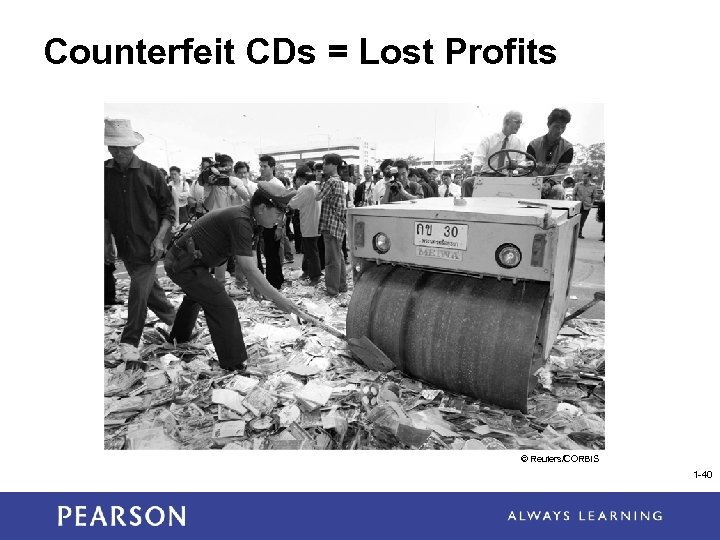 Counterfeit CDs = Lost Profits © Reuters/CORBIS 1 -40
 Digital Millennium Copyright Act • • First big revision of copyright law since 1976 Brought U. S. into compliance with Europe Extended length of copyright Extended copyright protection to music broadcast over Internet • Made it illegal for anyone to – Circumvent encryption schemes placed on digital media – Circumvent copy controls, even for fair use purposes 1 -41
 Digital Rights Management • Actions owners of intellectual property in digital form take to protect their rights • Approaches – Encrypt digital content – Mark digital content so devices can recognize content as copy-protected 1 -42
 Secure Digital Music Initiative • Goals – Create copy-protected CDs – Secure digital music downloads • Consortium of 200 companies developed “digital watermarking” scheme • Failed – Internet copying became huge before SDMI ready – Some SDMI sponsors were electronics companies – Digital watermarking encryption cracked 1 -43
 Sony BMG Music Entertainment Rootkit • Millions of audio CDs shipped with Extended Copy Protection, a DRM system • Prevented users from – Ripping audio tracks into MP 3 format – Making more than 3 backup copies • Relied upon Windows “rootkit” that hid files and processes; usually only hackers use rootkits • Huge public outcry once secret uncovered • Sony BMG stopped production and compensated consumers 1 -44
 Encrypting DVDs • Contents of DVDs encrypted using Content Scramble System (CSS) • Need decryption keys to view a DVD • Jon Johansen wrote a decryption program for Linux • 2600 Magazine published the code • Motion picture studios sued 2600 Magazine and won • Johansen tried in Norway and found not guilty 1 -45
 Foiling HD-DVD Encryption • Hardware, software, and entertainment companies created Advanced Access Content System to encrypt HD-DVDs • Encryption key posted on Digg. com • AACS leaned on Digg. com to censor postings containing key • Digg users fought back • AACS “expired” the key and issued a new one • A month later, a Digg user posted the new key 1 -46
 Criticisms of Digital Rights Management • • Any technological “fix” is bound to fail DRM undermines fair use DRM could reduce competition Some schemes make anonymous access impossible 1 -47
 Online Music Stores Employed Digital Rights Management • When i. Tunes Music Store opened, all music was protected with a DRM scheme called Fair. Play • Fair. Play blocked users from freely exchanging purchased music – Songs couldn’t be played on more than 5 different computers – Songs couldn’t be copied onto CDs more than 7 times • Songs purchased from i. Tunes Store wouldn’t play on non -Apple devices • DRM-protected music purchased from other online retailers couldn’t be played on i. Pod 1 -48
 Online Music Stores Drop Digital Rights Management • Consumers complained about restrictions associated with DRM • European governments put pressure on Apple to license Fair. Play or stop using DRM • Amazon reached an agreement with all four major music labels to sell DRM-free music • Apple followed suit in 2009 1 -49
 Microsoft Xbox One • Microsoft announced cloud-based gaming experience for Xbox One (June 2013) – User could play any game without disc in tray – Automatic software updates of every Xbox One • Controversial features of licensing arrangement – Disc could be shared only once – Second-hand market restricted – Xbox consoles would have to check in every 24 hours • Microsoft backtracked – No need to connect to Internet – Freedom to lend, rent, buy, sell discs – Disc must be in tray to play game 1 -50
 4. 6 Peer-to-Peer Networks and Cyberlockers 1 -51
 Peer-to-Peer Networks • Peer-to-peer network – Transient network – Connects computers running same networking program – Computers can access files stored on each other’s hard drives • How P 2 P networks facilitate data exchange – Give each user access to data stored in many other computers – Support simultaneous file transfers among arbitrary pairs of computers – Allow users to identify systems with faster file exchange speeds 1 -52
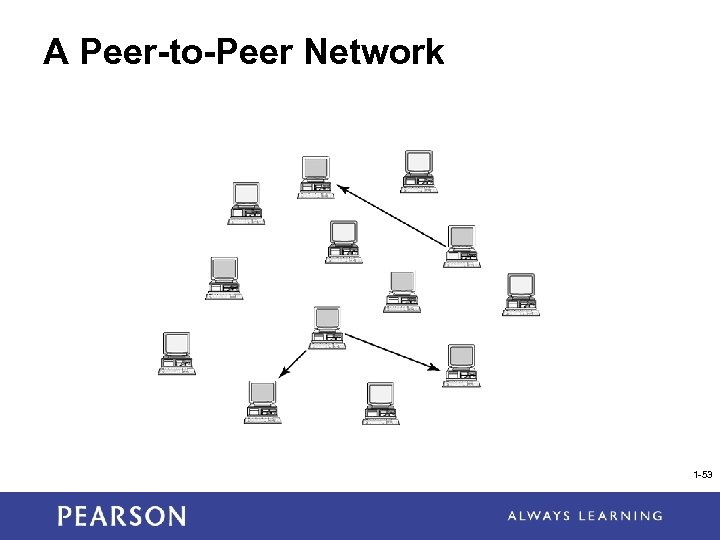 A Peer-to-Peer Network 1 -53
 Cyberlockers • Also called file-hosting services or cloud storage services • Internet-based file-sharing services • Allow users to upload and download password-protected files • Support workgroup collaboration • Make sharing of copyrighted material easy 1 -54
 Napster • • • Peer-to-peer music exchange network Began operation in 1999 Sued by RIAA for copyright violations Courts ruled in favor of RIAA Went off-line in July 2001 Re-emerged in 2003 as a subscription music service 1 -55
 Fast. Track • Second-generation peer-to-peer network technology • Used by Ka. Za. A and Grokster • Distributes index among large number of “supernodes” • Cannot be shut down as easily as Napster 1 -56
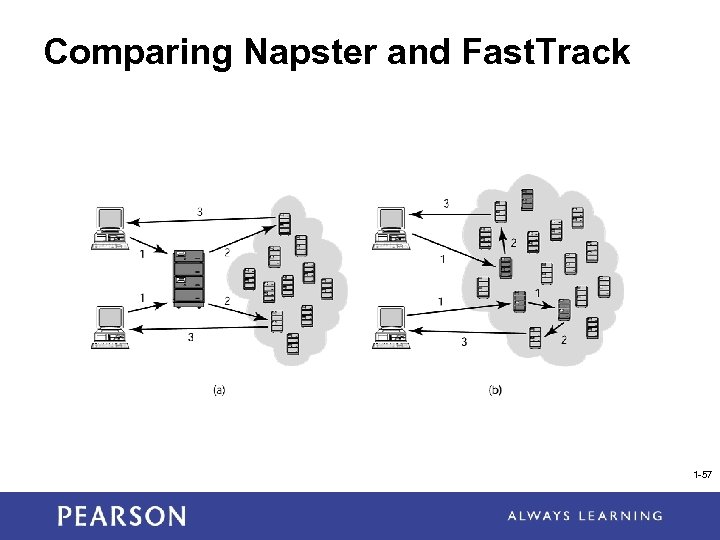 Comparing Napster and Fast. Track 1 -57
 Bit. Torrent • Broadband connections: download much faster than upload • Bit. Torrent speeds downloading – Files broken into pieces – Different pieces downloaded from different computers • Used for downloading large files – Computer programs – Television shows – Movies 1 -58
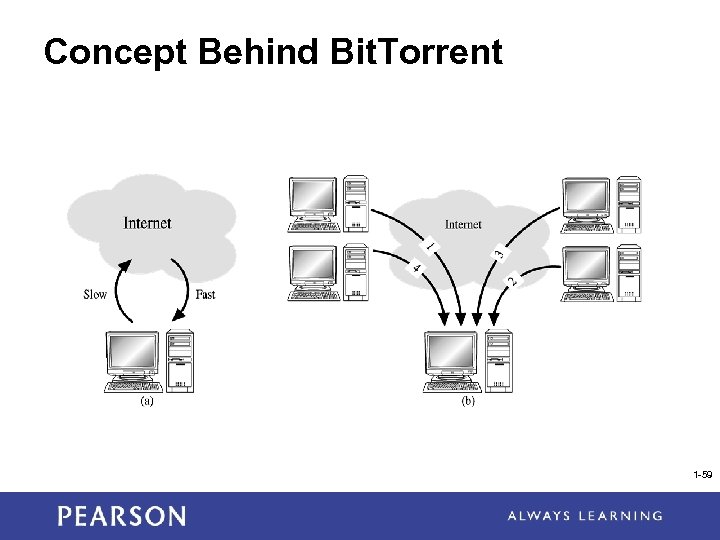 Concept Behind Bit. Torrent 1 -59
 RIAA Lawsuits • April 2003: RIAA warned file swappers they could face legal penalties • RIAA subpoenaed Verizon for identities of people suspected of running supernodes • Judge ruled in favor of Verizon • September 2003: RIAA sued 261 individuals • December 2003: U. S. Court of Appeals ruled Verizon did not have to give customer names to RIAA 1 -60
 Huge Jury Judgments Overturned • Jammie Thomas-Rassert – Federal jury ordered her to pay $1. 92 million – Damages reduced to $54, 000 • Joel Tenenbaum – Jury ordered him to pay $675, 000 – Judge reduced award to $67, 500 • Does RIAA have to prove someone actually copied the songs that people made available on Kazaa? – New York decision: No – Massachusetts, Arizona decisions: Yes 1 -61
 MGM v. Grokster • Entertainment industry interests sued Grokster and Stream. Cast for the copyright infringements of their users • Lower courts – Ruled in favor of Grokster and Stream. Cast – Cited Sony v. Universal City Studios as a precedent • U. S. Supreme Court – Reversed the lower court ruling in June 2005 – Proper precedent Gershwin Publishing v. Columbia Artists 1 -62
 Legal Action Against The Pirate Bay • • • The Pirate Bay started in Stockholm, Sweden One of world’s biggest Bit. Torrent file-sharing sites People download songs, movies, TV shows, etc. After 2006 raid by police, popularity increased In 2008 the International Federation of the Phonographic Industry sued four individuals connected with site Defendants said The Pirate Bay just a search engine Found guilty; sentence to prison and fined $6. 5 million Meanwhile, The Pirate Bay still operational More than 150 proxy servers all over the world 1 -63
 PRO-IP Act • Gives federal law enforcement agencies right to seize domain names of sites facilitating copyright infringement • Operation In Our Sites (2010) – Seized domain names of 10 Web sites making available full-run movies – Seized several hundred more domain names over next 1 ½ years 1 -64
 Megaupload Shutdown • Megaupload a prominent cyberlocker – More than 180 million registered users – Once world’s 13 th most popular Web site – Source of movies, TV shows, songs, games • FBI used PRO-IP Act to shut down Megaupload (January 2012) • File. Sonic and File. Serve responded by disabling sharing functionality 1 -65
 Legal Music Services on the Internet • • Subscription services for legal downloading Some based on monthly fee; some free Consumers pay for each download Apple’s i. Tunes Music Store leading service, surpassing Wal. Mart as top music retailer in United States • Still, illegal downloading far more popular than legal music services 1 -66
 4. 7 Protections for Software 1 -67
 Software Copyrights • Copyright protection began 1964 • What gets copyrighted? – Expression of idea, not idea itself – Object program, not source program • Companies treat source code as a trade secret 1 -68
 Violations of Software Copyrights • Copying a program to give or sell to someone else • Preloading a program onto the hard disk of a computer being sold • Distributing a program over the Internet 1 -69
 Important Court Cases • Apple Computer v. Franklin Computer – Established that object programs are copyrightable • Sega v. Accolate – Established that disassembling object code to determine technical specifications is fair use 1 -70
 Safe Software Development • Reverse engineering okay • Companies must protect against unconscious copying • Solution: “clean room” software development strategy – Team 1 analyzes competitor’s program and writes specification – Team 2 uses specification to develop software 1 -71
 Software Patents (1/3) • Until 1981, Patent Office refused to grant software patents – Saw programs as mathematical algorithms, not processes or machines • U. S. Supreme Court decision led to first software patent in 1981 • Further court rulings led to patents being granted for wider range of software 1 -72
 Software Patents (2/3) • Thousands of software patents now exist – Microsoft files ~3, 000 applications annually – Licensing patents a source of revenue • Secondary market for software patents – Patent trolls: Companies that specialize in buying patents and enforcing patent rights – Companies would rather settle out of court than spend time and money going to trial – RIM didn’t settle quickly; ended up paying $612 million 1 -73
 Software Patents (3/3) • Critics say too many patents have been issued – Patent Office doesn’t know about prior art, so it issues bad software patents – Obvious inventions get patents • Companies with new products fear getting sued for patent infringement – Build stockpiles of patents as defense mechanism – Software patents used as legal weapons • Bezos: software patents should expire in 3 -5 years 1 -74
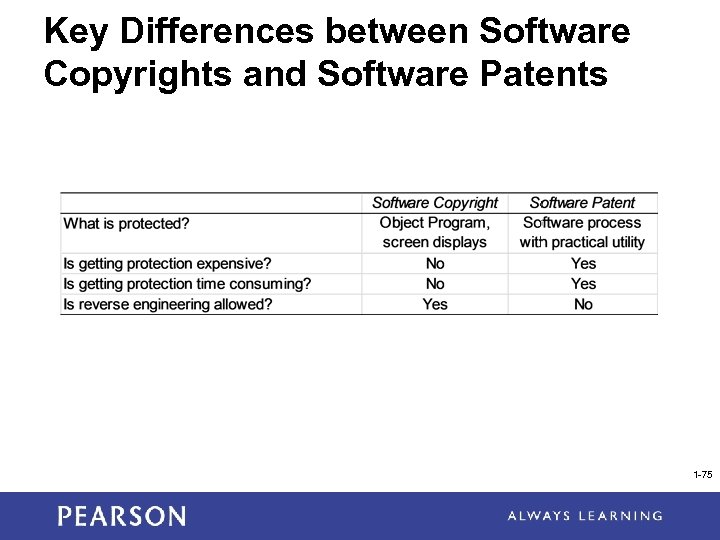 Key Differences between Software Copyrights and Software Patents 1 -75
 4. 8 Open-Source Software 1 -76
 Criticisms of Proprietary Software • Increasingly harsh measures being taken to enforce copyrights • Copyrights are not serving their purpose of promoting progress • It is wrong to allow someone to “own” a piece of intellectual property 1 -77
 Open-Source Definition • No restrictions preventing others from selling or giving away software • Source code included in distribution • No restrictions preventing others from modifying source code • No restrictions regarding how people can use software • Same rights apply to everyone receiving redistributions of the software (copyleft) 1 -78
 Beneficial Consequences of Open. Source Software • Gives everyone opportunity to improve program • New versions of programs appear more frequently • Eliminates tension between obeying law and helping others • Programs belong to entire community • Shifts focus from manufacturing to service 1 -79
 Examples of Open-Source Software • • BIND Apache Sendmail Android operating system for smartphones Firefox and Chrome Open. Office. org Perl, Python, Ruby, TCL/TK, PHP, Zope GNU compilers for C, C++, Objective-C, Fortran, Java, and Ada 1 -80
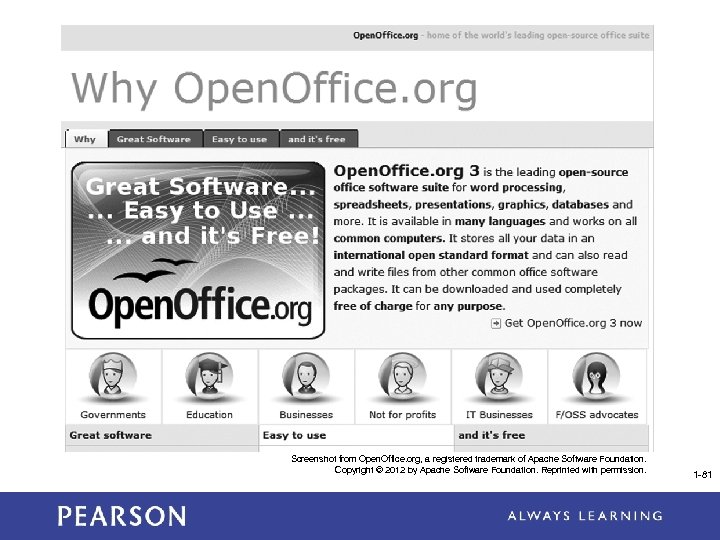 Screenshot from Open. Office. org, a registered trademark of Apache Software Foundation. Copyright © 2012 by Apache Software Foundation. Reprinted with permission. 1 -81
 GNU Project and Linux • GNU Project – Begun by Richard Stallman in 1984 – Goal: Develop open-source, Unix-like operating system – Most components developed in late 1980 s • Linux – Linus Torvalds wrote Unix-like kernel in 1991 – Combined with GNU components to make an O. S. – Commonly called Linux 1 -82
 Impact of Open-Source Software • Linux an alternative to proprietary versions of Unix • Linux operating system on 95% of the world’s 500 fastest supercomputers 1 -83
 Crititique of the Open-Source Software Movement • Without critical mass of developers, quality can be poor • Without an “owner, ” incompatible versions may arise • Relatively weak graphical user interface • Poor mechanism for stimulating innovation (no companies will spend billions on new programs) 1 -84
 4. 9 Legitimacy of Intellectual Property Protection for Software 1 -85
 Do We Have the Right System in Place? • Software licenses typically prevent you from making copies of software to sell or give away • Software licenses are legal agreements • Not discussing morality of breaking the law • Discussing whether society should give intellectual property protection to software 1 -86
 Rights-based Analysis • “Just deserts” argument – Programming is hard work that only a few can do – Programmers should be rewarded for their labor – They ought to be able to own their programs • Criticism of “just deserts” argument – Why does labor imply ownership? – Can imagine a just society in which all labor went to common good – Intellectual property not like physical property 1 -87
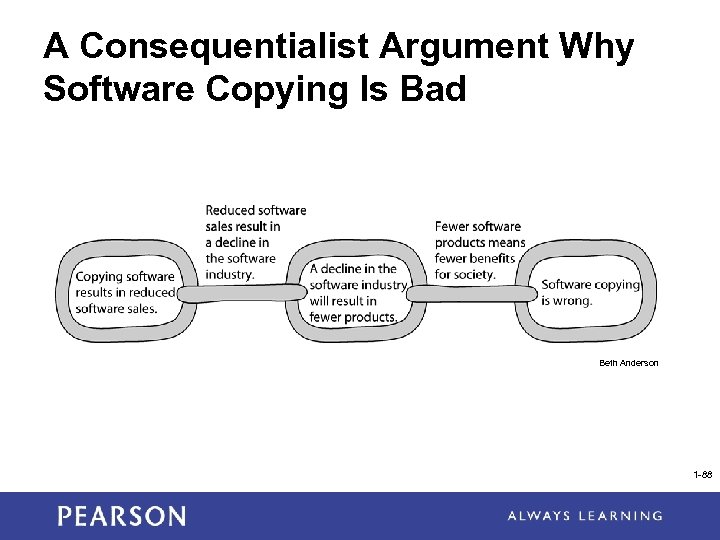 A Consequentialist Argument Why Software Copying Is Bad Beth Anderson 1 -88
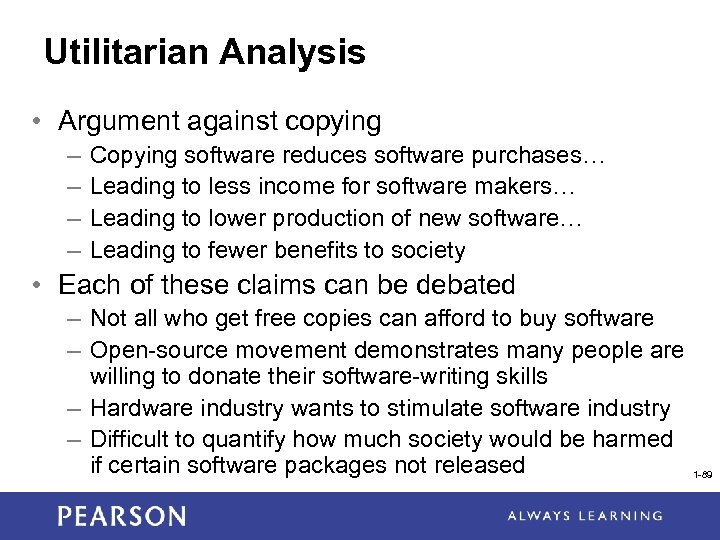 Utilitarian Analysis • Argument against copying – – Copying software reduces software purchases… Leading to less income for software makers… Leading to lower production of new software… Leading to fewer benefits to society • Each of these claims can be debated – Not all who get free copies can afford to buy software – Open-source movement demonstrates many people are willing to donate their software-writing skills – Hardware industry wants to stimulate software industry – Difficult to quantify how much society would be harmed if certain software packages not released 1 -89
 Conclusion • Natural rights argument weak • Utilitarian argument not strong, either • Nevertheless, society has granted copyright protection to owners of computer programs • Breaking the law is wrong unless there is a strong overriding moral obligation or consequence 1 -90
 4. 10 Creative Commons 1 -91
 Streamlining Creative Re-use • Under current copyright law, eligible works are copyrighted the moment they are created • No copyright notice does not mean it’s okay to copy • Must contact people before using work • That slows down creative re-use • Free Creative Commons license indicates – Which kinds of copying are okay – Which rights are being retained • Flickr and Magnatune two well-known sites using Creative Commons licenses 1 -92
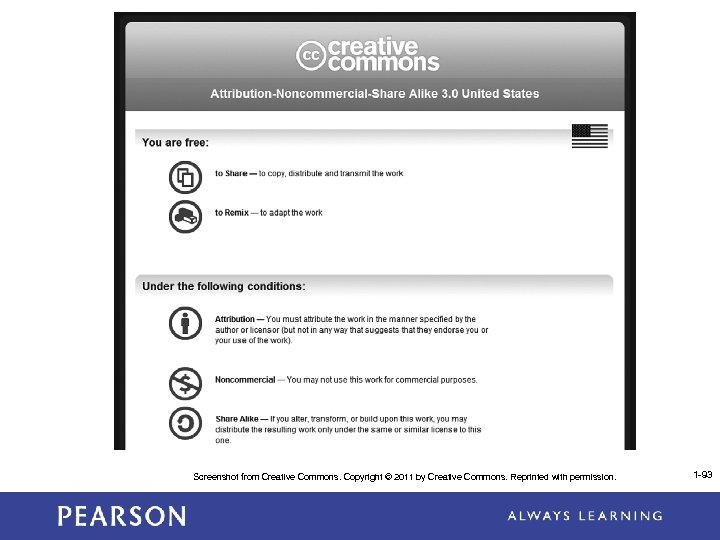 Screenshot from Creative Commons. Copyright © 2011 by Creative Commons. Reprinted with permission. 1 -93