


 Скачать презентацию Chapter 4 Individual and Market Demand Chapter 4
37cd287100139ad0eb0d2f43ab1b947e.ppt
- Количество слайдов: 59
 Chapter 4 Individual and Market Demand Chapter 4 1
 Topics to be Discussed n Individual Demand n Income and Substitution Effects n Market Demand n Consumer Surplus n Network Externalities n Empirical Estimation of Demand Chapter 4 2
 Individual Demand n Price Changes l Chapter 4 Using the figures developed in the previous chapter, the impact of a change in the price of food can be illustrated using indifference curves. 3
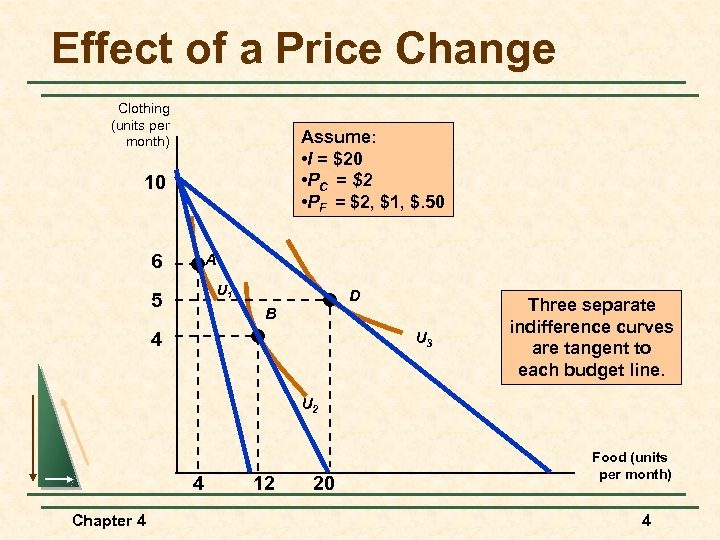 Effect of a Price Change Clothing (units per month) Assume: • I = $20 • PC = $2 • PF = $2, $1, $. 50 10 A 6 U 1 5 D B U 3 4 Three separate indifference curves are tangent to each budget line. U 2 4 Chapter 4 12 20 Food (units per month) 4
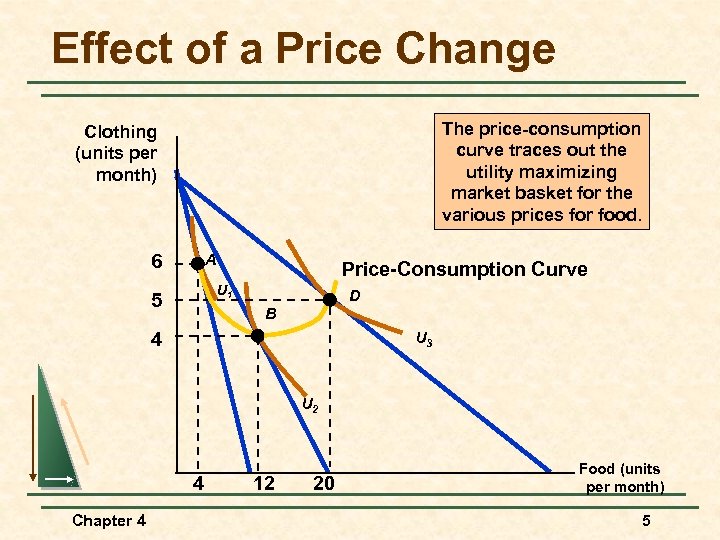 Effect of a Price Change The price-consumption curve traces out the utility maximizing market basket for the various prices for food. Clothing (units per month) A 6 Price-Consumption Curve U 1 5 D B U 3 4 U 2 4 Chapter 4 12 20 Food (units per month) 5
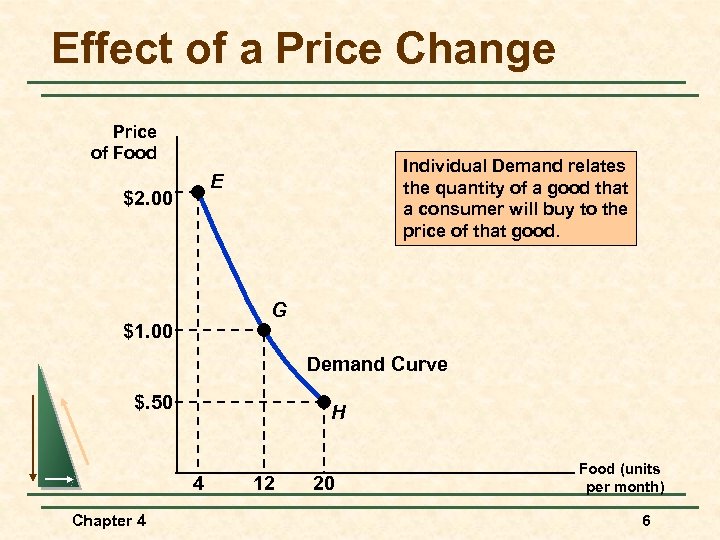 Effect of a Price Change Price of Food Individual Demand relates the quantity of a good that a consumer will buy to the price of that good. E $2. 00 G $1. 00 Demand Curve $. 50 H 4 Chapter 4 12 20 Food (units per month) 6
 Individual Demand The Individual Demand Curve n Two Important Properties of Demand Curves 1) The level of utility that can be attained changes as we move along the curve. Chapter 4 7
 Individual Demand The Individual Demand Curve n Two Important Properties of Demand Curves 2) At every point on the demand curve, the consumer is maximizing utility by satisfying the condition that the MRS of food for clothing equals the ratio of the prices of food and clothing. Chapter 4 8
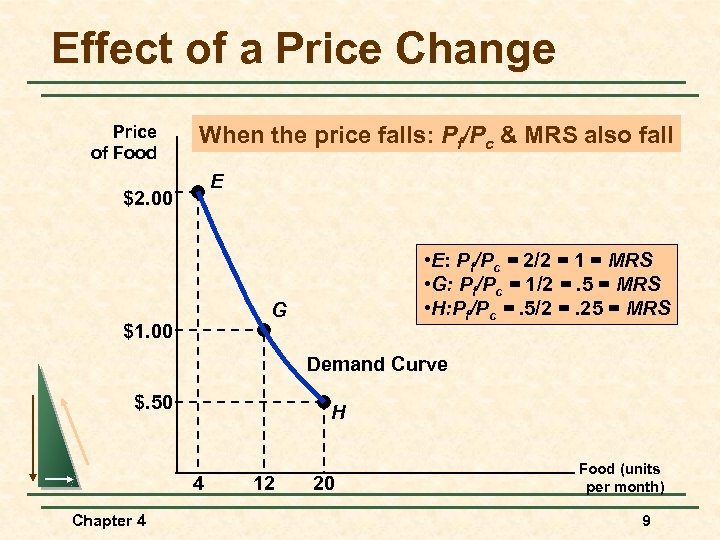 Effect of a Price Change Price of Food When the price falls: Pf/Pc & MRS also fall E $2. 00 • E: Pf/Pc = 2/2 = 1 = MRS • G: Pf/Pc = 1/2 =. 5 = MRS • H: Pf/Pc =. 5/2 =. 25 = MRS G $1. 00 Demand Curve $. 50 H 4 Chapter 4 12 20 Food (units per month) 9
 Individual Demand n Income Changes l Chapter 4 Using the figures developed in the previous chapter, the impact of a change in the income can be illustrated using indifference curves. 10
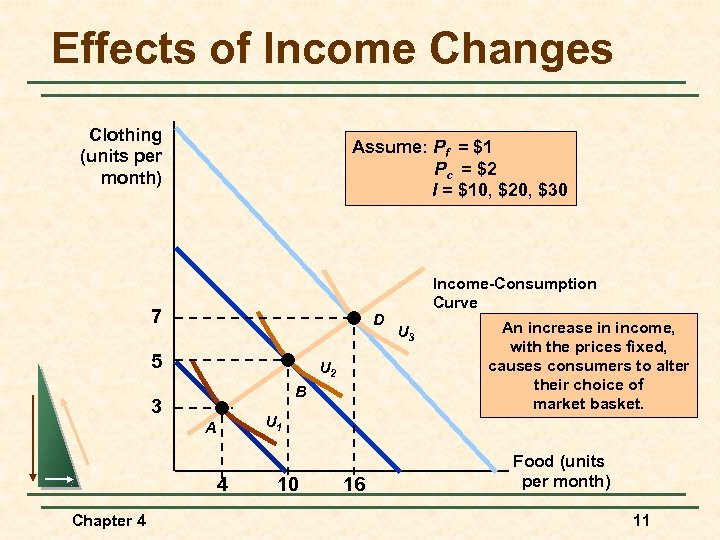 Effects of Income Changes Clothing (units per month) Assume: Pf = $1 Pc = $2 I = $10, $20, $30 7 D 5 U 2 B 3 U 1 A 4 Chapter 4 10 16 Income-Consumption Curve U 3 An increase in income, with the prices fixed, causes consumers to alter their choice of market basket. Food (units per month) 11
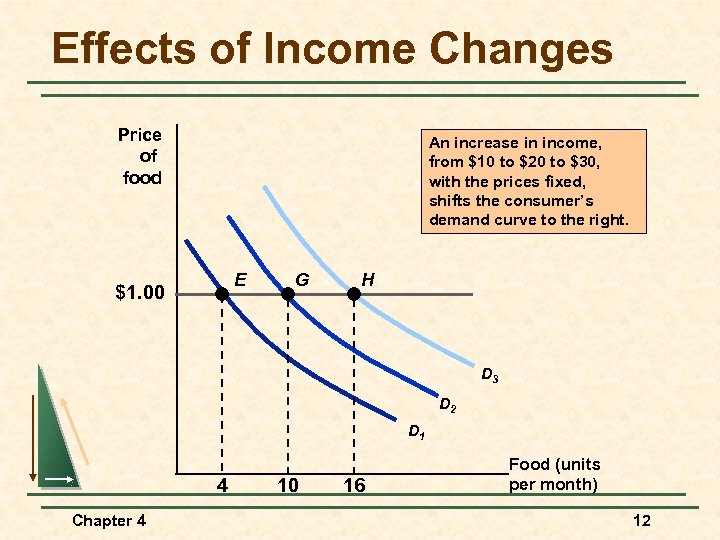 Effects of Income Changes Price of food An increase in income, from $10 to $20 to $30, with the prices fixed, shifts the consumer’s demand curve to the right. E $1. 00 G H D 3 D 2 D 1 4 Chapter 4 10 16 Food (units per month) 12
 Individual Demand n Income Changes l The income-consumption curve traces out the utility-maximizing combinations of food and clothing associated with every income level. Chapter 4 13
 Individual Demand n Income Changes l An increase in income shifts the budget line to the right, increasing consumption along the income-consumption curve. l Simultaneously, the increase in income shifts the demand curve to the right. Chapter 4 14
 Individual Demand Normal Good vs. Inferior Good n Income Changes l Chapter 4 When the income-consumption curve has a positive slope: u The quantity demanded increases with income. u The income elasticity of demand is positive. u The good is a normal good. 15
 Individual Demand Normal Good vs. Inferior Good n Income Changes l Chapter 4 When the income-consumption curve has a negative slope: u The quantity demanded decreases with income. u The income elasticity of demand is negative. u The good is an inferior good. 16
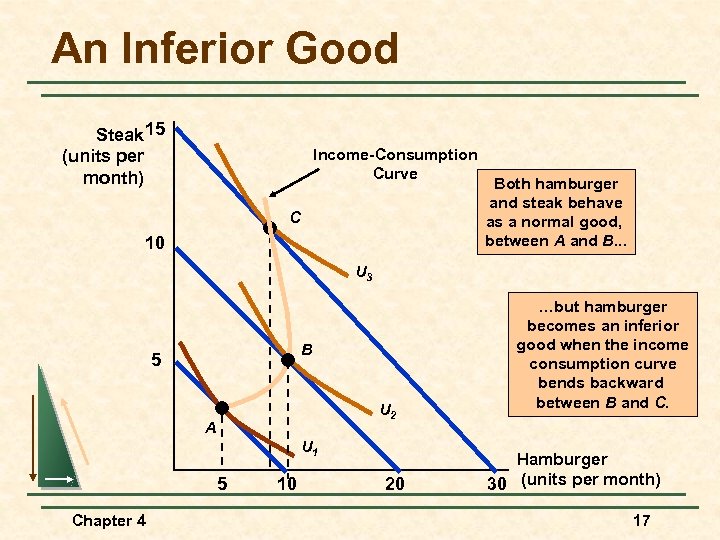 An Inferior Good Steak 15 (units per month) Income-Consumption Curve C 10 Both hamburger and steak behave as a normal good, between A and B. . . U 3 B 5 U 2 A U 1 5 Chapter 4 10 20 …but hamburger becomes an inferior good when the income consumption curve bends backward between B and C. Hamburger 30 (units per month) 17
 Individual Demand n Engel Curves l Engel curves relate the quantity of good consumed to income. l If the good is a normal good, the Engel curve is upward sloping. l If the good is an inferior good, the Engel curve is downward sloping. Chapter 4 18
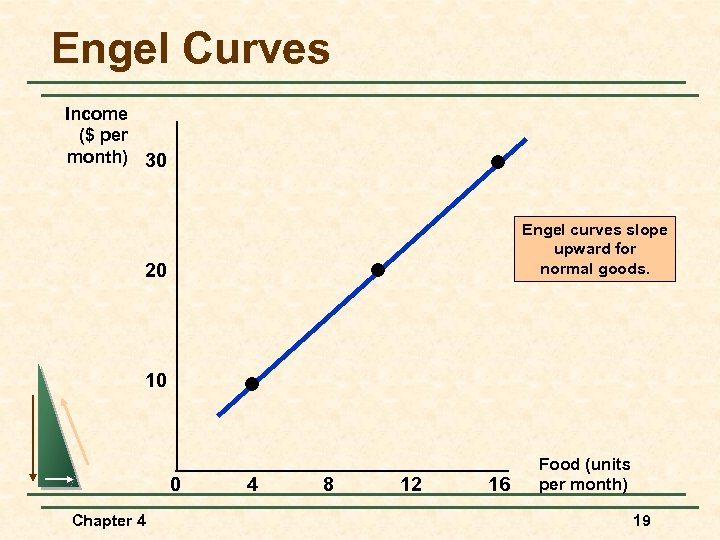 Engel Curves Income ($ per month) 30 Engel curves slope upward for normal goods. 20 10 0 Chapter 4 4 8 12 16 Food (units per month) 19
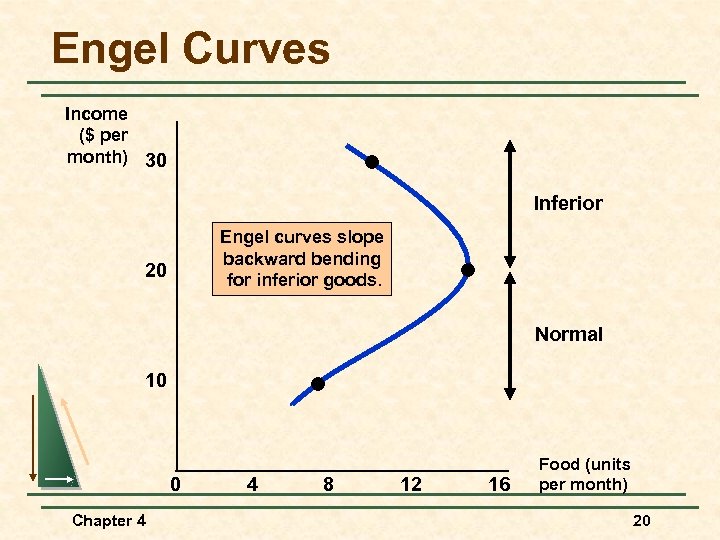 Engel Curves Income ($ per month) 30 Inferior Engel curves slope backward bending for inferior goods. 20 Normal 10 0 Chapter 4 4 8 12 16 Food (units per month) 20
 Individual Demand Substitutes and Complements 1) Two goods are considered substitutes if an increase (decrease) in the price of one leads to an increase (decrease) in the quantity demanded of the other. u Chapter 4 e. g. movie tickets and video rentals 21
 Individual Demand Substitutes and Complements 2) Two goods are considered complements if an increase (decrease) in the price of one leads to a decrease (increase) in the quantity demanded of the other. u Chapter 4 e. g. gasoline and motor oil 22
 Individual Demand Substitutes and Complements 3) Two goods are independent when a change in the price of one good has no effect on the quantity demanded of the other Chapter 4 23
 Income and Substitution Effects n A fall in the price of a good has two effects: Substitution & Income l Substitution Effect u Chapter 4 Consumers will tend to buy more of the good that has become relatively cheaper, and less of the good that is now relatively more expensive. 24
 Income and Substitution Effects n A fall in the price of a good has two effects: Substitution & Income l Income Effect u. Consumers experience an increase in real purchasing power when the price of one good falls, thus increasing consumption. Chapter 4 25
 Income and Substitution Effects n Substitution Effect l The substitution effect is the change in an item’s consumption associated with a change in the price of the item, with the level of utility held constant. l When the price of an item declines, the substitution effect always leads to an increase in the quantity of the item demanded. Chapter 4 26
 Income and Substitution Effects n Income Effect l The income effect is the change in an item’s consumption brought about by the increase in purchasing power, with the price of the item held constant. l When a person’s income increases, the quantity demanded for the product may increase or decrease. Chapter 4 27
 Income and Substitution Effects n Income Effect l Even with inferior goods, the income effect is rarely large enough to outweigh the substitution effect. Chapter 4 28
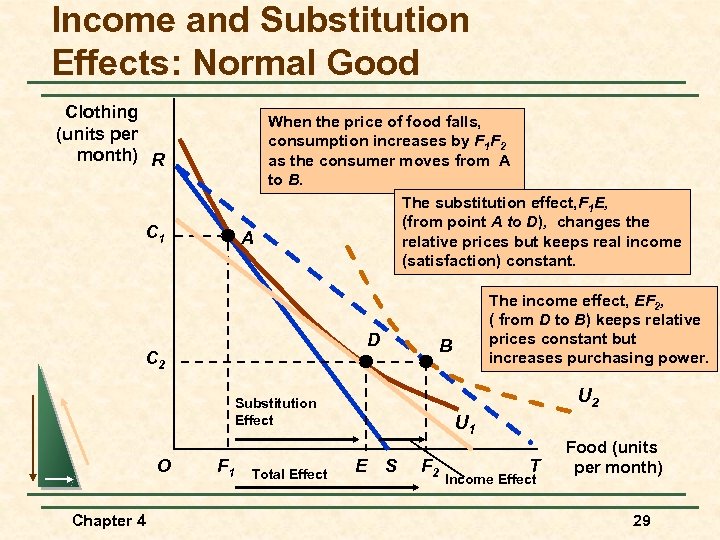 Income and Substitution Effects: Normal Good Clothing (units per month) R When the price of food falls, consumption increases by F 1 F 2 as the consumer moves from A to B. The substitution effect, F 1 E, (from point A to D), changes the A relative prices but keeps real income (satisfaction) constant. C 1 D C 2 B U 2 Substitution Effect O Chapter 4 F 1 Total Effect The income effect, EF 2, ( from D to B) keeps relative prices constant but increases purchasing power. U 1 E S F 2 T Income Effect Food (units per month) 29
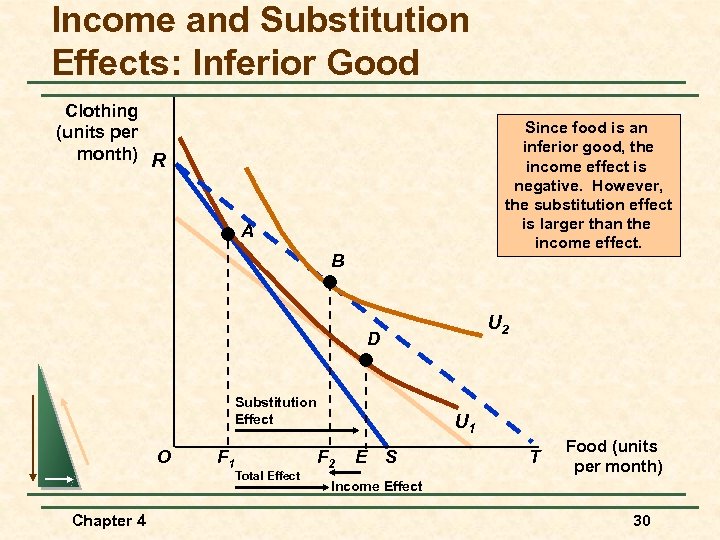 Income and Substitution Effects: Inferior Good Clothing (units per month) R Since food is an inferior good, the income effect is negative. However, the substitution effect is larger than the income effect. A B U 2 D Substitution Effect O Chapter 4 F 1 Total Effect U 1 F 2 E S T Food (units per month) Income Effect 30
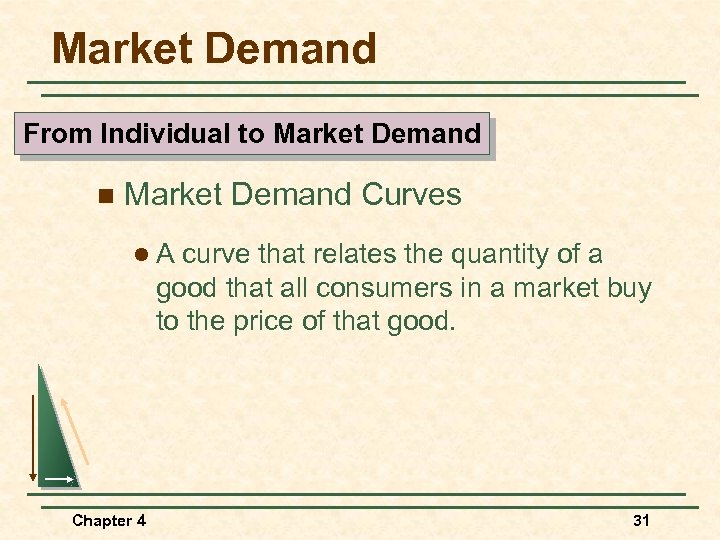 Market Demand From Individual to Market Demand n Market Demand Curves l. A curve that relates the quantity of a good that all consumers in a market buy to the price of that good. Chapter 4 31
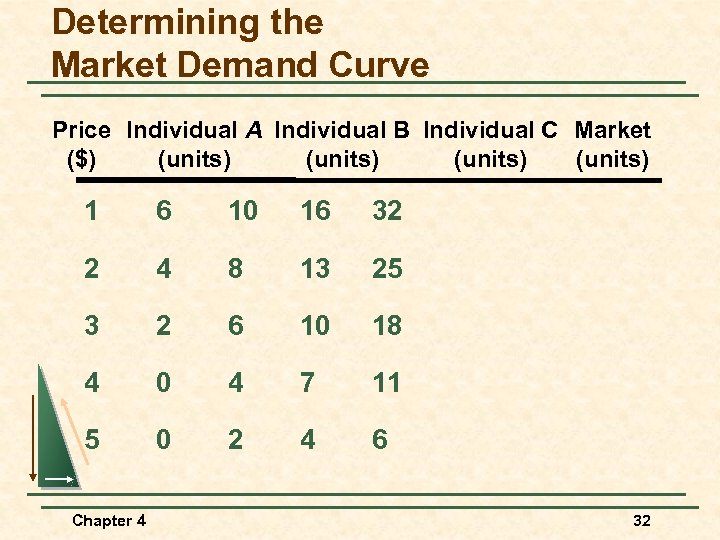 Determining the Market Demand Curve Price Individual A Individual B Individual C Market ($) (units) 1 6 10 16 32 2 4 8 13 25 3 2 6 10 18 4 0 4 7 11 5 0 2 4 6 Chapter 4 32
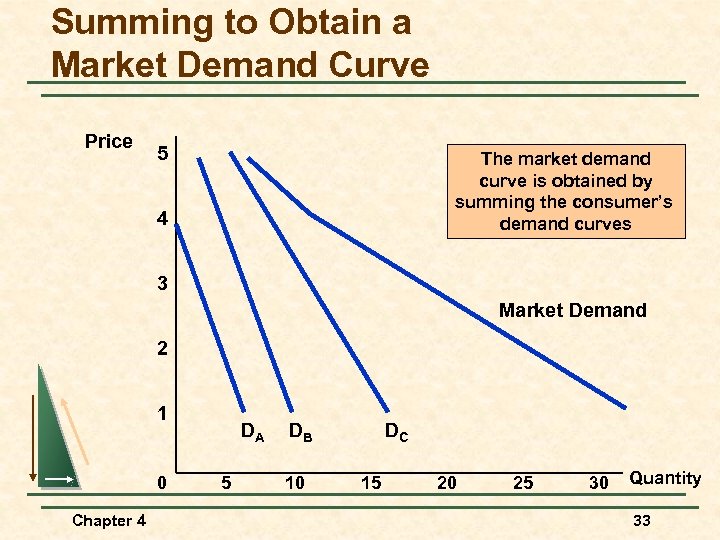 Summing to Obtain a Market Demand Curve Price 5 The market demand curve is obtained by summing the consumer’s demand curves 4 3 Market Demand 2 1 0 Chapter 4 DA 5 DB 10 DC 15 20 25 30 Quantity 33
 Market Demand n Two Important Points 1) The market demand will shift to the right as more consumers enter the market. 2) Factors that influence the demands of many consumers will also affect the market demand. Chapter 4 34
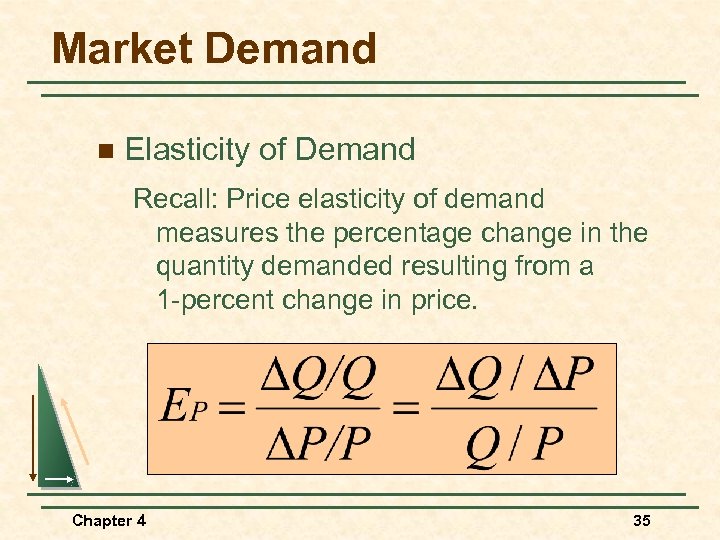 Market Demand n Elasticity of Demand Recall: Price elasticity of demand measures the percentage change in the quantity demanded resulting from a 1 -percent change in price. Chapter 4 35
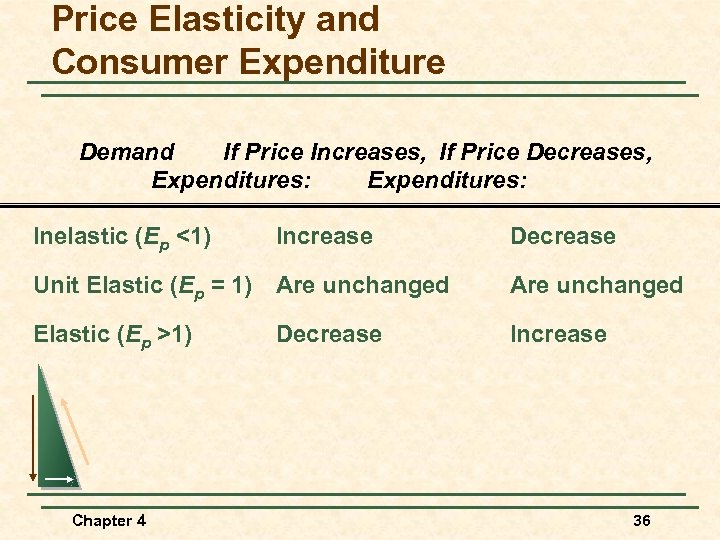 Price Elasticity and Consumer Expenditure Demand If Price Increases, If Price Decreases, Expenditures: Inelastic (Ep <1) Increase Decrease Unit Elastic (Ep = 1) Are unchanged Elastic (Ep >1) Increase Chapter 4 Decrease 36
 Market Demand n Point Elasticity of Demand l Chapter 4 For large price changes (e. g. 20%), the value of elasticity will depend upon where the price and quantity lie on the demand curve. 37
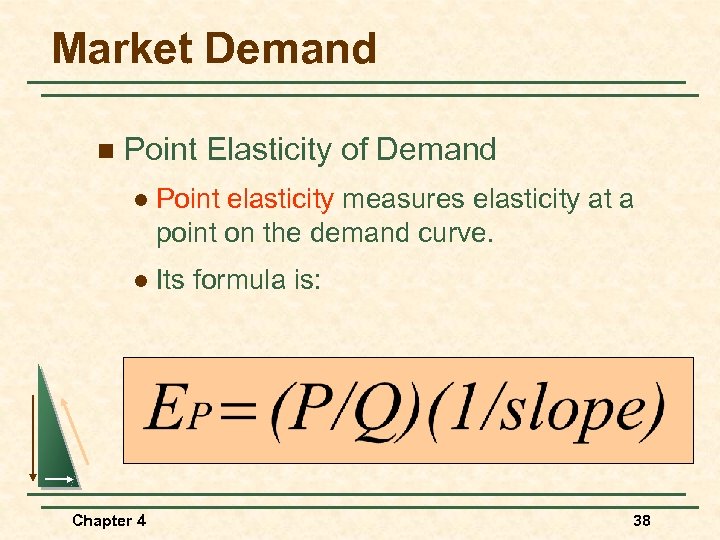 Market Demand n Point Elasticity of Demand l Point elasticity measures elasticity at a point on the demand curve. l Its formula is: Chapter 4 38
 Market Demand n Problems Using Point Elasticity l We may need to calculate price elasticity over portion of the demand curve rather than at a single point. l The price and quantity used as the base will alter the price elasticity of demand. Chapter 4 39
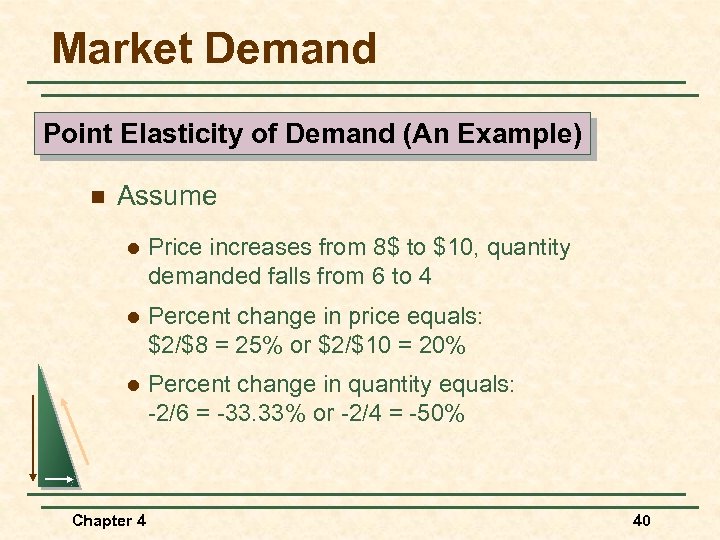 Market Demand Point Elasticity of Demand (An Example) n Assume l Price increases from 8$ to $10, quantity demanded falls from 6 to 4 l Percent change in price equals: $2/$8 = 25% or $2/$10 = 20% l Percent change in quantity equals: -2/6 = -33. 33% or -2/4 = -50% Chapter 4 40
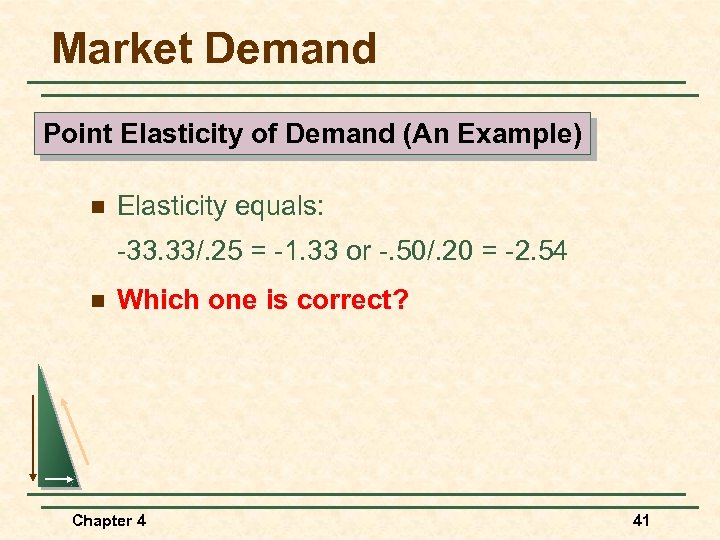 Market Demand Point Elasticity of Demand (An Example) n Elasticity equals: -33. 33/. 25 = -1. 33 or -. 50/. 20 = -2. 54 n Which one is correct? Chapter 4 41
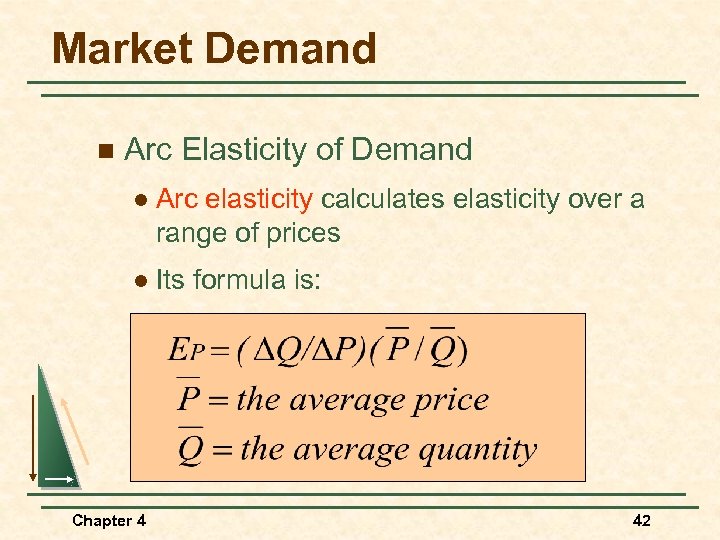 Market Demand n Arc Elasticity of Demand l Arc elasticity calculates elasticity over a range of prices l Its formula is: Chapter 4 42
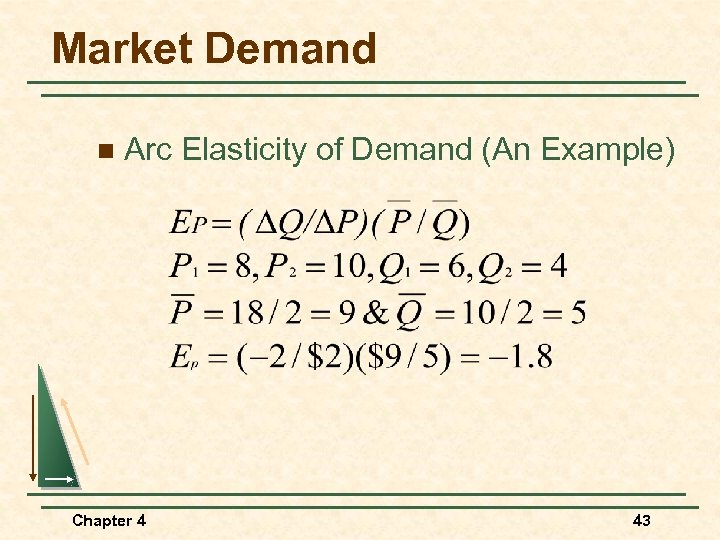 Market Demand n Arc Elasticity of Demand (An Example) Chapter 4 43
 Consumer Surplus n Consumer Surplus l The difference between the maximum amount a consumer is willing to pay for a good and the amount actually paid. Chapter 4 44
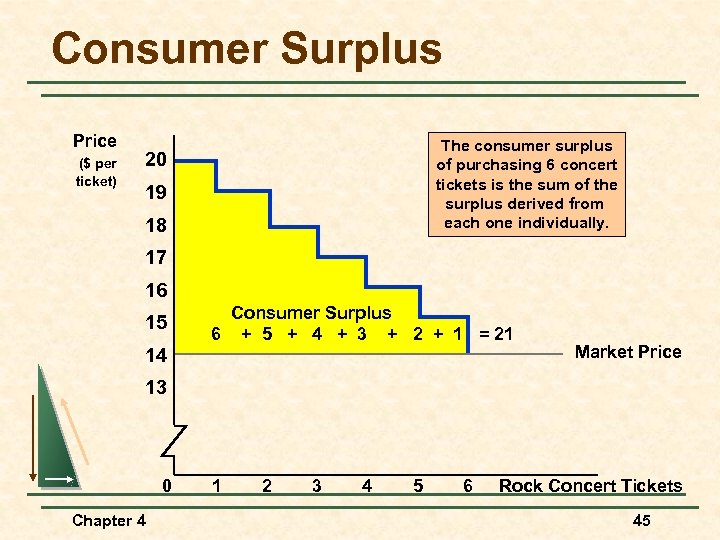 Consumer Surplus Price ($ per ticket) The consumer surplus of purchasing 6 concert tickets is the sum of the surplus derived from each one individually. 20 19 18 17 16 15 14 Consumer Surplus 6 + 5 + 4 + 3 + 2 + 1 = 21 Market Price 13 0 Chapter 4 1 2 3 4 5 6 Rock Concert Tickets 45
 Consumer Surplus n The stepladder demand curve can be converted into a straight-line demand curve by making the units of the good smaller. Chapter 4 46
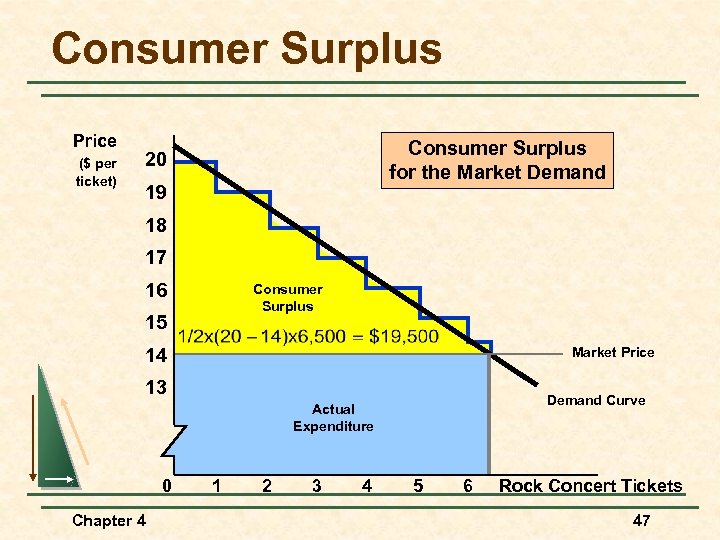 Consumer Surplus Price ($ per ticket) Consumer Surplus for the Market Demand 20 19 18 17 16 Consumer Surplus 15 14 Market Price 13 Demand Curve Actual Expenditure 0 Chapter 4 1 2 3 4 5 6 Rock Concert Tickets 47
 Network Externalities n Up to this point we have assumed that people’s demands for a good are independent of one another. n If fact, a person’s demand may be affected by the number of other people who have purchased the good. Chapter 4 48
 Network Externalities n If this is the case, a network externality exists. n Network externalities can be positive or negative. Chapter 4 49
 Network Externalities n A positive network externality exists if the quantity of a good demanded by a consumer increases in response to an increase in purchases by other consumers. n Negative network externalities are just the opposite. Chapter 4 50
 Network Externalities n The Bandwagon Effect l This is the desire to be in style, to have a good because almost everyone else has it, or to indulge in a fad. l This is the major objective of marketing and advertising campaigns (e. g. toys, clothing). Chapter 4 51
 Network Externalities n The Snob Effect l If the network externality is negative, a snob effect exists. n The snob effect refers to the desire to own exclusive or unique goods. n The quantity demanded of a “snob” good is higher the fewer the people who own it. Chapter 4 52
 Empirical Estimation of Demand n The Statistical Approach to Demand Estimation l Surveys l Properly applied, the statistical approach to demand estimation can enable one to sort out the effects of variables on the quantity demanded of a product. l “Least-squares” regression is one approach. Chapter 4 53
 Summary n Individual consumers’ demand curves for a commodity can be derived from information about their tastes for all goods and services and from their budget constraints. n Engel curves describe the relationship between the quantity of a good consumed and income. Chapter 4 54
 Summary n Two goods are substitutes if an increase in the price of one good leads to an increase in the quantity demanded of the other. They are complements if the quantity demanded of the other declines. Chapter 4 55
 Summary n Two goods are substitutes if an increase in the price of one good leads to an increase in the quantity demanded of the other. They are complements if the quantity demanded of the other declines. n The effect of a price change on the quantity demanded can be broken into a substitution effect and an income effect. Chapter 4 56
 Summary n The market demand curve is the horizontal summation of the individual demand curves for all consumers. n The percent change in quantity demanded that results from a one percent change in price determines elasticity of demand. Chapter 4 57
 Summary n There is a network externality when one person’s demand is affected directly by the purchasing decisions of other consumers. n A number of methods can be used to obtain information about consumer demand. Chapter 4 58
 End of Chapter 4 59