 Скачать презентацию Chapter 4 Greedy Algorithms Slides by Kevin Wayne
ef492a3027be26ea8a41dd2e5b372687.ppt
- Количество слайдов: 41




Chapter 4 Greedy Algorithms Slides by Kevin Wayne. Copyright © 2005 Pearson-Addison Wesley. All rights reserved. 1
4. 1 Interval Scheduling
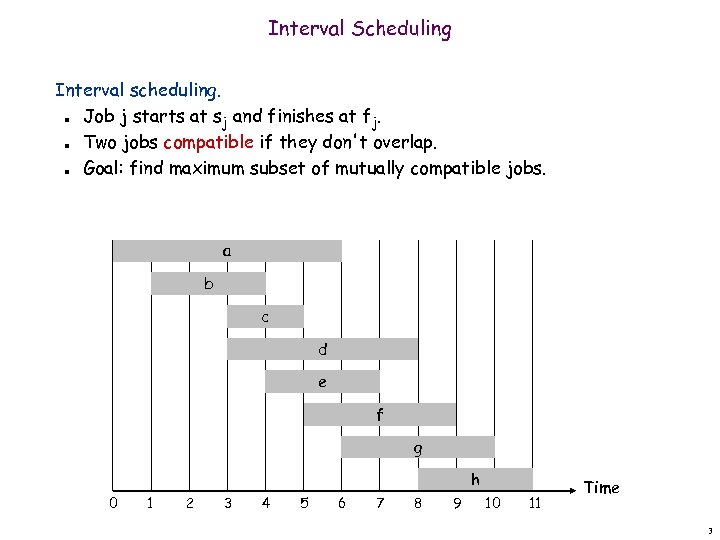
Interval Scheduling Interval scheduling. Job j starts at sj and finishes at fj. Two jobs compatible if they don't overlap. Goal: find maximum subset of mutually compatible jobs. n n n a b c d e f g h 0 1 2 3 4 5 6 7 8 9 10 11 Time 3
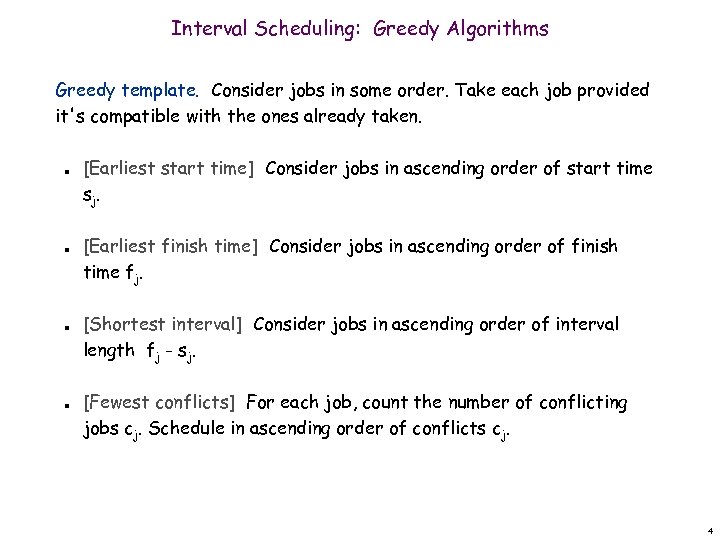
Interval Scheduling: Greedy Algorithms Greedy template. Consider jobs in some order. Take each job provided it's compatible with the ones already taken. n n [Earliest start time] Consider jobs in ascending order of start time sj. [Earliest finish time] Consider jobs in ascending order of finish time fj. [Shortest interval] Consider jobs in ascending order of interval length fj - sj. [Fewest conflicts] For each job, count the number of conflicting jobs cj. Schedule in ascending order of conflicts cj. 4
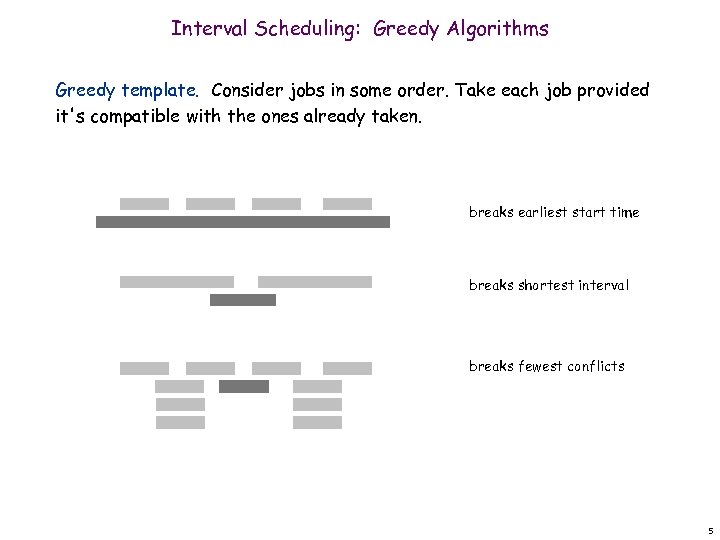
Interval Scheduling: Greedy Algorithms Greedy template. Consider jobs in some order. Take each job provided it's compatible with the ones already taken. breaks earliest start time breaks shortest interval breaks fewest conflicts 5
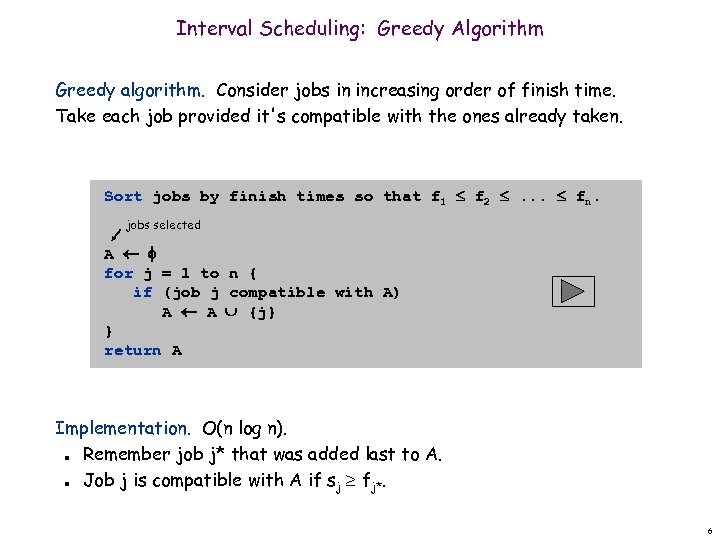
Interval Scheduling: Greedy Algorithm Greedy algorithm. Consider jobs in increasing order of finish time. Take each job provided it's compatible with the ones already taken. Sort jobs by finish times so that f 1 f 2 . . . fn. jobs selected A for j = 1 to n { if (job j compatible with A) A A {j} } return A Implementation. O(n log n). Remember job j* that was added last to A. Job j is compatible with A if sj fj*. n n 6
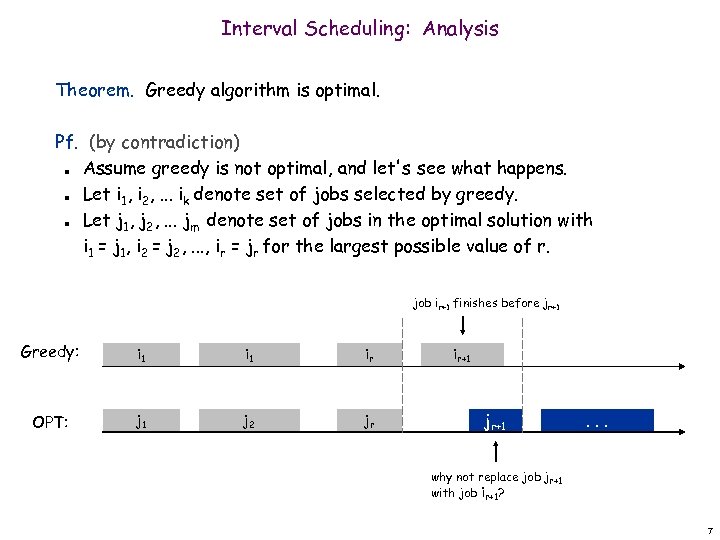
Interval Scheduling: Analysis Theorem. Greedy algorithm is optimal. Pf. (by contradiction) Assume greedy is not optimal, and let's see what happens. Let i 1, i 2, . . . ik denote set of jobs selected by greedy. Let j 1, j 2, . . . jm denote set of jobs in the optimal solution with i 1 = j 1, i 2 = j 2, . . . , ir = jr for the largest possible value of r. n n n job ir+1 finishes before jr+1 Greedy: i 1 ir OPT: j 1 j 2 jr ir+1 jr+1 . . . why not replace job jr+1 with job ir+1? 7
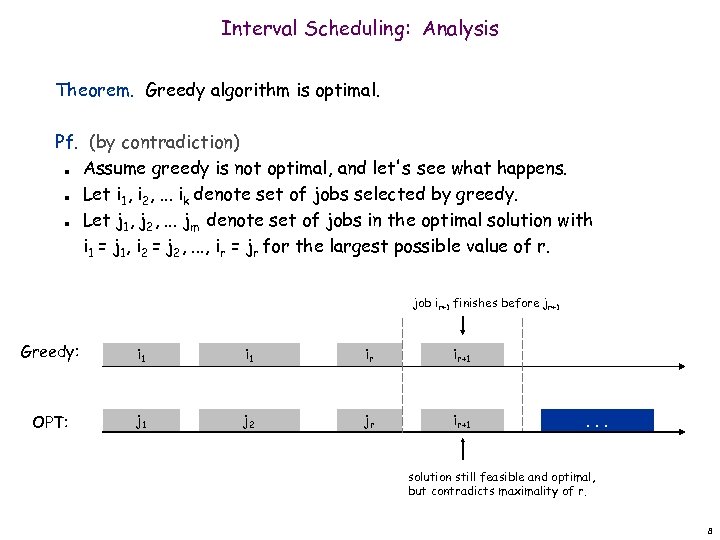
Interval Scheduling: Analysis Theorem. Greedy algorithm is optimal. Pf. (by contradiction) Assume greedy is not optimal, and let's see what happens. Let i 1, i 2, . . . ik denote set of jobs selected by greedy. Let j 1, j 2, . . . jm denote set of jobs in the optimal solution with i 1 = j 1, i 2 = j 2, . . . , ir = jr for the largest possible value of r. n n n job ir+1 finishes before jr+1 Greedy: i 1 ir ir+1 OPT: j 1 j 2 jr ir+1 . . . solution still feasible and optimal, but contradicts maximality of r. 8
4. 1 Interval Partitioning
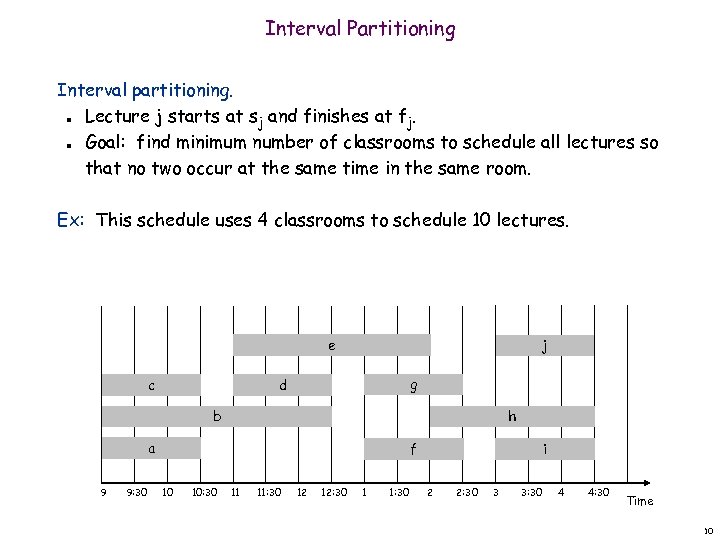
Interval Partitioning Interval partitioning. Lecture j starts at sj and finishes at fj. Goal: find minimum number of classrooms to schedule all lectures so that no two occur at the same time in the same room. n n Ex: This schedule uses 4 classrooms to schedule 10 lectures. e c j g d b h a 9 9: 30 f 10 10: 30 11 11: 30 12 12: 30 1 1: 30 i 2 2: 30 3 3: 30 4 4: 30 Time 10
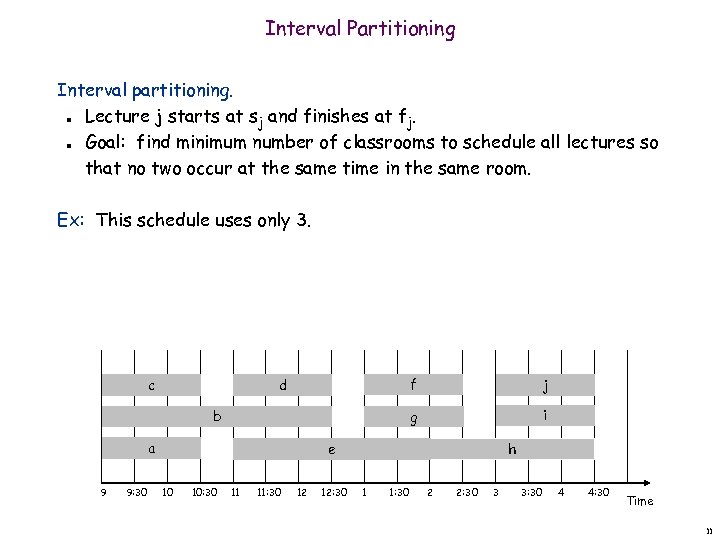
Interval Partitioning Interval partitioning. Lecture j starts at sj and finishes at fj. Goal: find minimum number of classrooms to schedule all lectures so that no two occur at the same time in the same room. n n Ex: This schedule uses only 3. f d b a 9 9: 30 j g c i h e 10 10: 30 11 11: 30 12 12: 30 1 1: 30 2 2: 30 3 3: 30 4 4: 30 Time 11
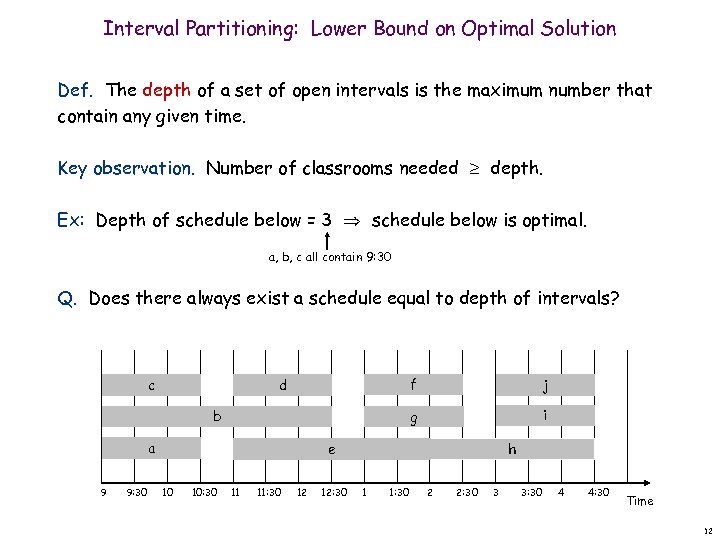
Interval Partitioning: Lower Bound on Optimal Solution Def. The depth of a set of open intervals is the maximum number that contain any given time. Key observation. Number of classrooms needed depth. Ex: Depth of schedule below = 3 schedule below is optimal. a, b, c all contain 9: 30 Q. Does there always exist a schedule equal to depth of intervals? f d b a 9 9: 30 j g c i h e 10 10: 30 11 11: 30 12 12: 30 1 1: 30 2 2: 30 3 3: 30 4 4: 30 Time 12
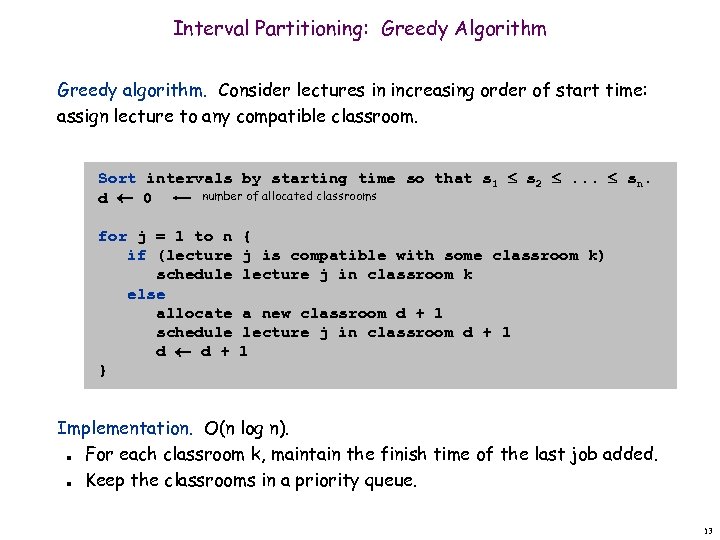
Interval Partitioning: Greedy Algorithm Greedy algorithm. Consider lectures in increasing order of start time: assign lecture to any compatible classroom. Sort intervals by starting time so that s 1 s 2 . . . sn. number of allocated classrooms d 0 for j = 1 to n if (lecture schedule else allocate schedule d d + } { j is compatible with some classroom k) lecture j in classroom k a new classroom d + 1 lecture j in classroom d + 1 1 Implementation. O(n log n). For each classroom k, maintain the finish time of the last job added. Keep the classrooms in a priority queue. n n 13
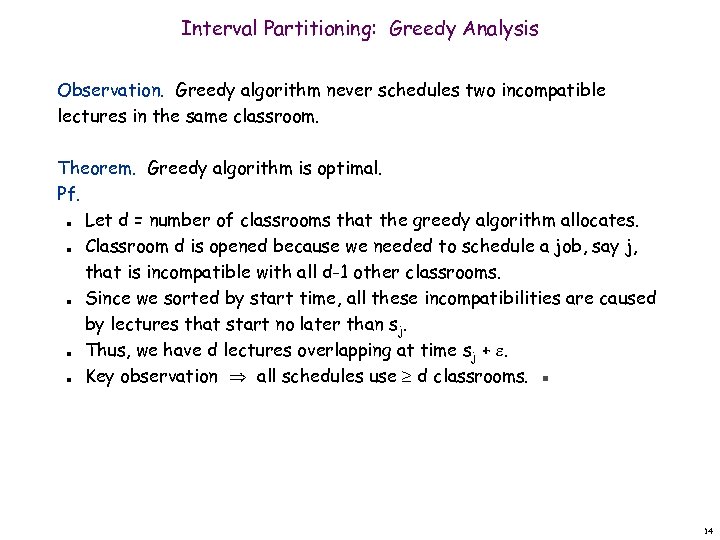
Interval Partitioning: Greedy Analysis Observation. Greedy algorithm never schedules two incompatible lectures in the same classroom. Theorem. Greedy algorithm is optimal. Pf. Let d = number of classrooms that the greedy algorithm allocates. Classroom d is opened because we needed to schedule a job, say j, that is incompatible with all d-1 other classrooms. Since we sorted by start time, all these incompatibilities are caused by lectures that start no later than sj. Thus, we have d lectures overlapping at time sj + . Key observation all schedules use d classrooms. ▪ n n n 14
4. 2 Scheduling to Minimize Lateness
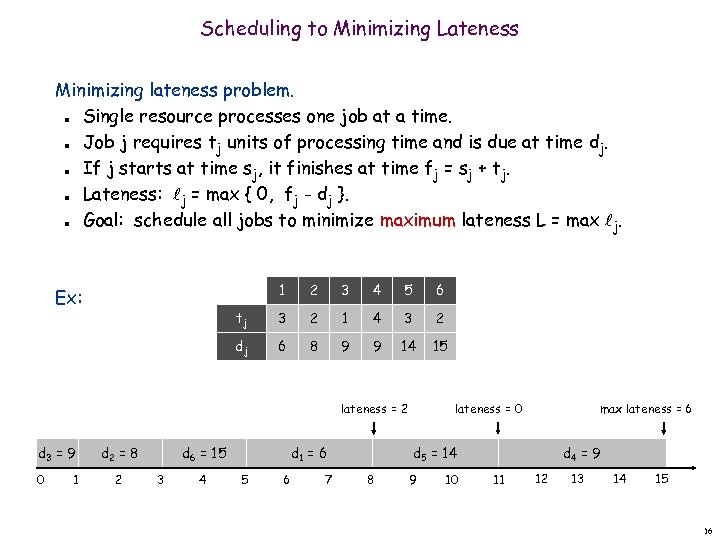
Scheduling to Minimizing Lateness Minimizing lateness problem. Single resource processes one job at a time. Job j requires tj units of processing time and is due at time dj. If j starts at time sj, it finishes at time fj = sj + tj. Lateness: j = max { 0, fj - dj }. Goal: schedule all jobs to minimize maximum lateness L = max j. n n n 1 2 3 4 5 6 tj 3 2 1 4 3 2 dj Ex: 6 8 9 9 14 15 lateness = 2 d 3 = 9 0 1 d 2 = 8 2 d 6 = 15 3 4 d 1 = 6 5 6 7 lateness = 0 max lateness = 6 d 5 = 14 8 9 10 d 4 = 9 11 12 13 14 15 16
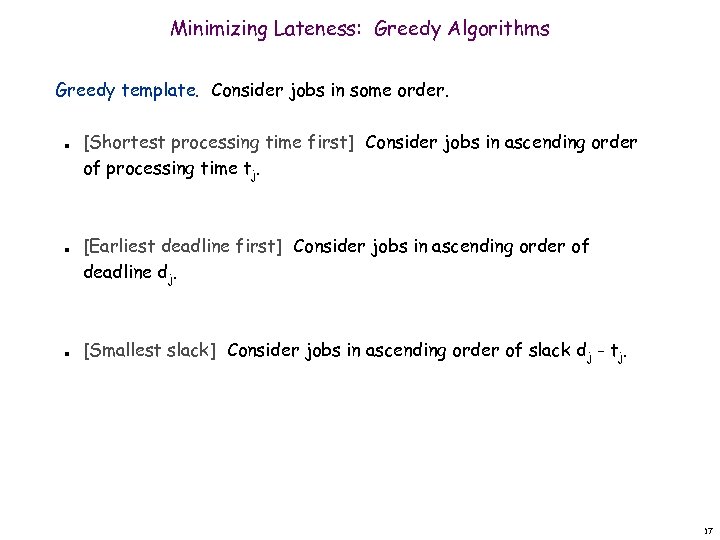
Minimizing Lateness: Greedy Algorithms Greedy template. Consider jobs in some order. n n n [Shortest processing time first] Consider jobs in ascending order of processing time tj. [Earliest deadline first] Consider jobs in ascending order of deadline dj. [Smallest slack] Consider jobs in ascending order of slack dj - tj. 17
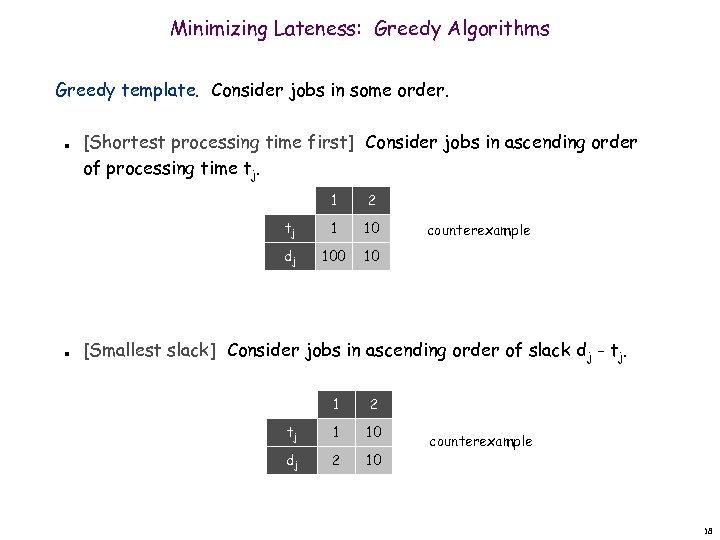
Minimizing Lateness: Greedy Algorithms Greedy template. Consider jobs in some order. n [Shortest processing time first] Consider jobs in ascending order of processing time tj. 1 tj 1 10 dj n 2 100 10 counterexample [Smallest slack] Consider jobs in ascending order of slack dj - tj. 1 2 tj 1 10 dj 2 10 counterexample 18
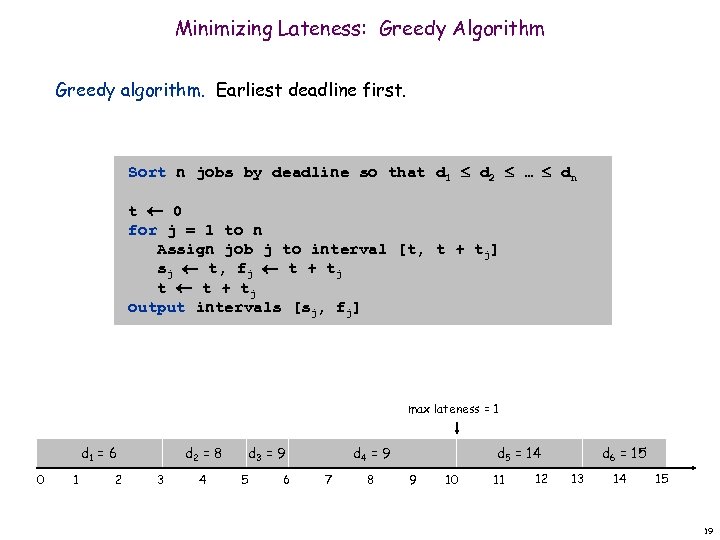
Minimizing Lateness: Greedy Algorithm Greedy algorithm. Earliest deadline first. Sort n jobs by deadline so that d 1 d 2 … dn t 0 for j = 1 to n Assign job j to interval [t, t + tj] sj t, fj t + tj t t + tj output intervals [sj, fj] max lateness = 1 d 1 = 6 0 1 2 d 2 = 8 3 4 d 3 = 9 5 6 d 4 = 9 7 8 d 5 = 14 9 10 11 12 d 6 = 15 13 14 15 19
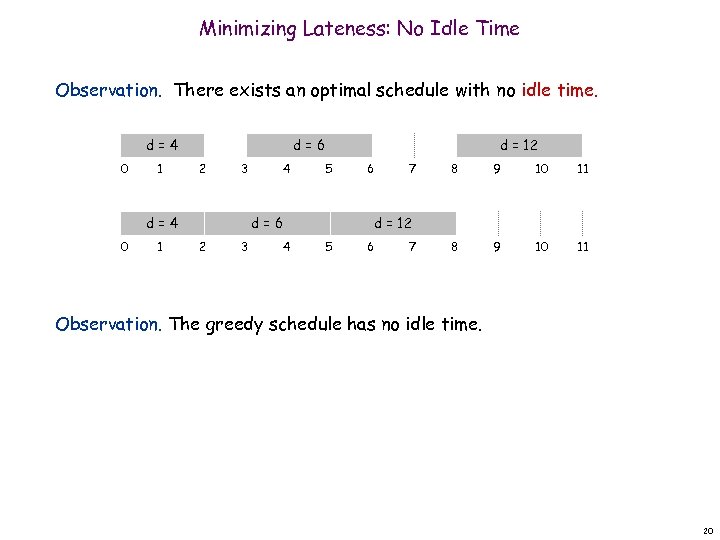
Minimizing Lateness: No Idle Time Observation. There exists an optimal schedule with no idle time. d=4 0 1 d=6 2 3 d=4 0 1 4 d = 12 5 d=6 2 3 6 7 8 9 10 11 d = 12 4 5 6 7 Observation. The greedy schedule has no idle time. 20
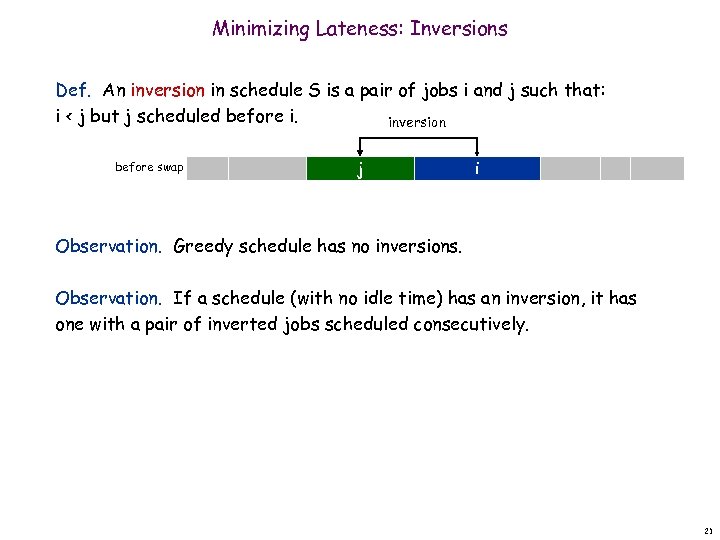
Minimizing Lateness: Inversions Def. An inversion in schedule S is a pair of jobs i and j such that: i < j but j scheduled before i. inversion before swap j i Observation. Greedy schedule has no inversions. Observation. If a schedule (with no idle time) has an inversion, it has one with a pair of inverted jobs scheduled consecutively. 21
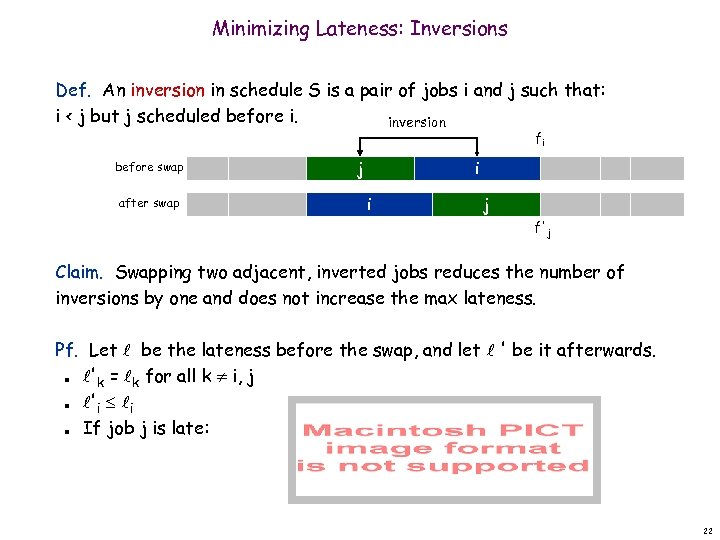
Minimizing Lateness: Inversions Def. An inversion in schedule S is a pair of jobs i and j such that: i < j but j scheduled before i. inversion fi before swap after swap j i i j f'j Claim. Swapping two adjacent, inverted jobs reduces the number of inversions by one and does not increase the max lateness. Pf. Let be the lateness before the swap, and let ' be it afterwards. 'k = k for all k i, j 'i i If job j is late: n n n 22
Minimizing Lateness: Analysis of Greedy Algorithm Theorem. Greedy schedule S is optimal. Pf. Define S* to be an optimal schedule that has the fewest number of inversions, and let's see what happens. Can assume S* has no idle time. If S* has no inversions, then S = S*. If S* has an inversion, let i-j be an adjacent inversion. – swapping i and j does not increase the maximum lateness and strictly decreases the number of inversions – this contradicts definition of S* ▪ n n n 23
Greedy Analysis Strategies Greedy algorithm stays ahead. Show that after each step of the greedy algorithm, its solution is at least as good as any other algorithm's. Exchange argument. Gradually transform any solution to the one found by the greedy algorithm without hurting its quality. Structural. Discover a simple "structural" bound asserting that every possible solution must have a certain value. Then show that your algorithm always achieves this bound. 24

Coin Changing Greed is good. Greed is right. Greed works. Greed clarifies, cuts through, and captures the essence of the evolutionary spirit. - Gordon Gecko (Michael Douglas)
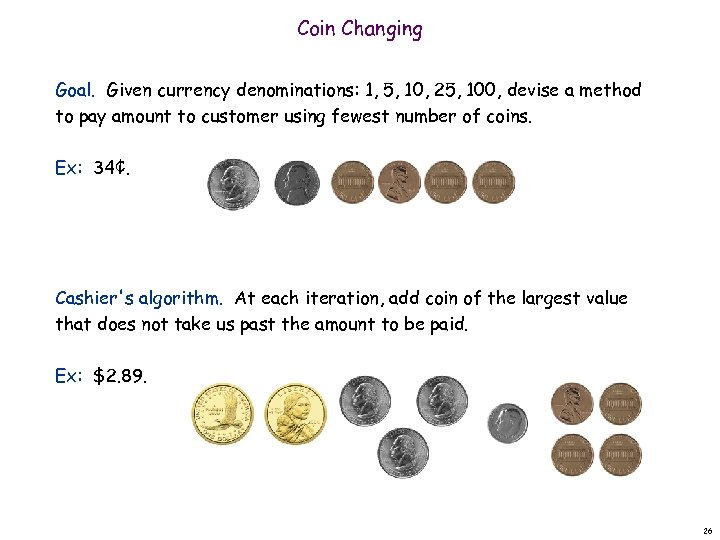
Coin Changing Goal. Given currency denominations: 1, 5, 10, 25, 100, devise a method to pay amount to customer using fewest number of coins. Ex: 34¢. Cashier's algorithm. At each iteration, add coin of the largest value that does not take us past the amount to be paid. Ex: $2. 89. 26
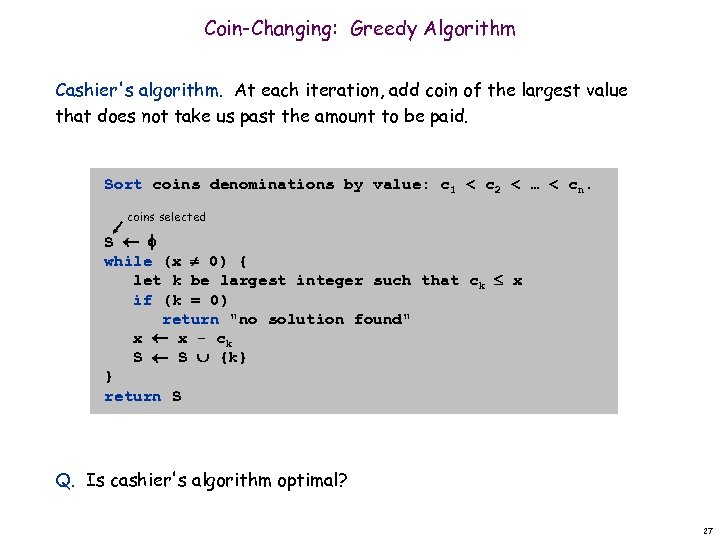
Coin-Changing: Greedy Algorithm Cashier's algorithm. At each iteration, add coin of the largest value that does not take us past the amount to be paid. Sort coins denominations by value: c 1 < c 2 < … < cn. coins selected S while (x 0) { let k be largest integer such that ck x if (k = 0) return "no solution found" x x - ck S S {k} } return S Q. Is cashier's algorithm optimal? 27
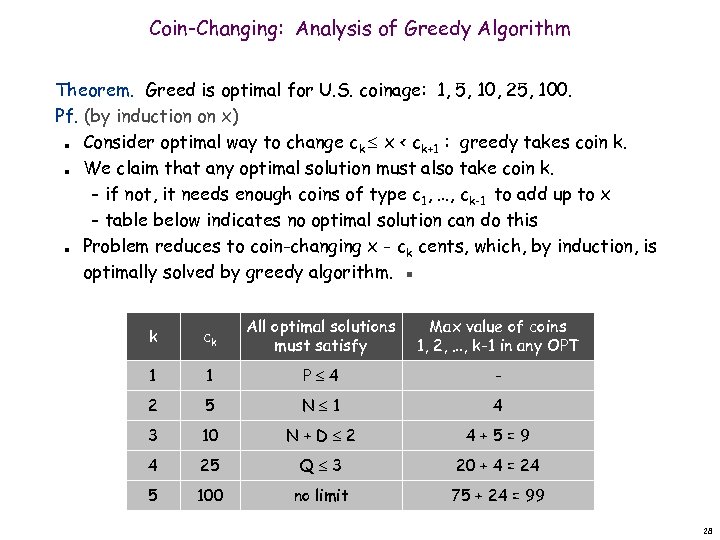
Coin-Changing: Analysis of Greedy Algorithm Theorem. Greed is optimal for U. S. coinage: 1, 5, 10, 25, 100. Pf. (by induction on x) Consider optimal way to change ck x < ck+1 : greedy takes coin k. We claim that any optimal solution must also take coin k. – if not, it needs enough coins of type c 1, …, ck-1 to add up to x – table below indicates no optimal solution can do this Problem reduces to coin-changing x - ck cents, which, by induction, is optimally solved by greedy algorithm. ▪ n n n k ck All optimal solutions must satisfy Max value of coins 1, 2, …, k-1 in any OPT 1 1 P 4 - 2 5 N 1 4 3 10 N+D 2 4+5=9 4 25 Q 3 20 + 4 = 24 5 100 no limit 75 + 24 = 99 28
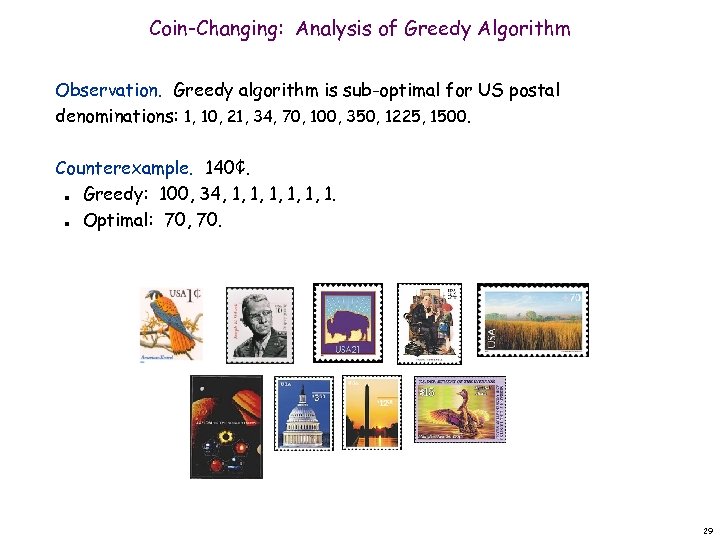
Coin-Changing: Analysis of Greedy Algorithm Observation. Greedy algorithm is sub-optimal for US postal denominations: 1, 10, 21, 34, 70, 100, 350, 1225, 1500. Counterexample. 140¢. Greedy: 100, 34, 1, 1, 1. Optimal: 70, 70. n n 29
Selecting Breakpoints
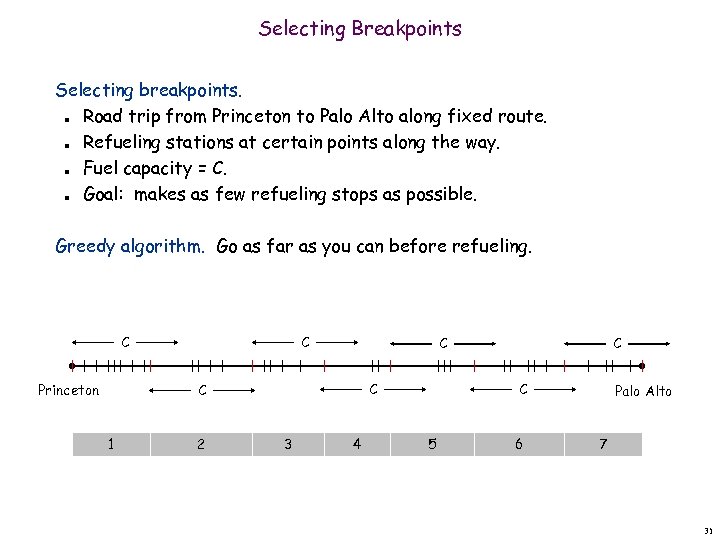
Selecting Breakpoints Selecting breakpoints. Road trip from Princeton to Palo Alto along fixed route. Refueling stations at certain points along the way. Fuel capacity = C. Goal: makes as few refueling stops as possible. n n Greedy algorithm. Go as far as you can before refueling. C Princeton C C 1 2 3 4 C C 5 6 Palo Alto 7 31
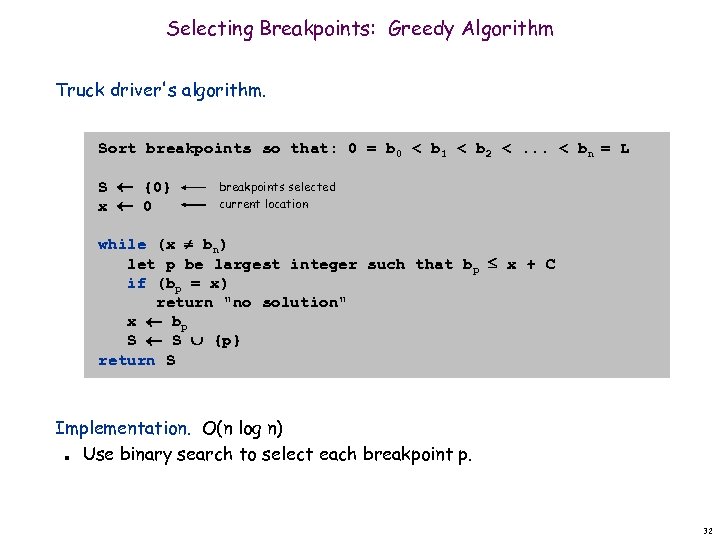
Selecting Breakpoints: Greedy Algorithm Truck driver's algorithm. Sort breakpoints so that: 0 = b 0 < b 1 < b 2 <. . . < bn = L S {0} x 0 breakpoints selected current location while (x bn) let p be largest integer such that bp x + C if (bp = x) return "no solution" x bp S S {p} return S Implementation. O(n log n) Use binary search to select each breakpoint p. n 32
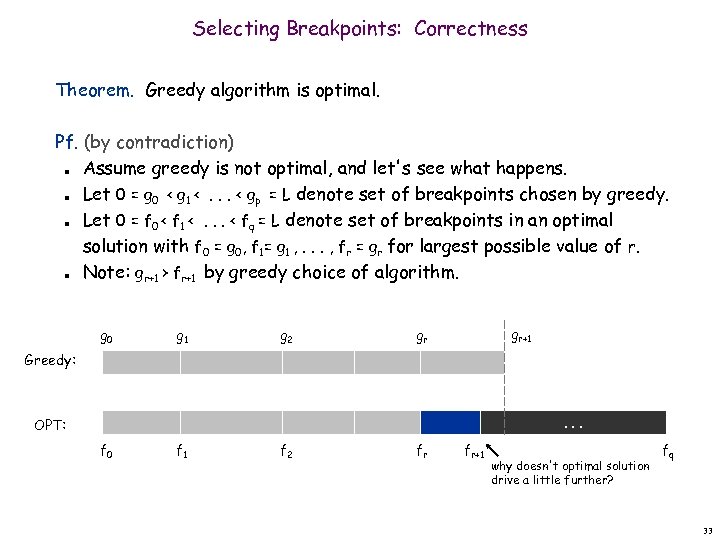
Selecting Breakpoints: Correctness Theorem. Greedy algorithm is optimal. Pf. (by contradiction) Assume greedy is not optimal, and let's see what happens. Let 0 = g 0 < g 1 <. . . < gp = L denote set of breakpoints chosen by greedy. Let 0 = f 0 < f 1 <. . . < fq = L denote set of breakpoints in an optimal solution with f 0 = g 0, f 1= g 1 , . . . , fr = gr for largest possible value of r. Note: gr+1 > fr+1 by greedy choice of algorithm. n n g 0 g 1 g 2 gr+1 gr Greedy: . . . OPT: f 0 f 1 f 2 fr fr+1 why doesn't optimal solution drive a little further? fq 33
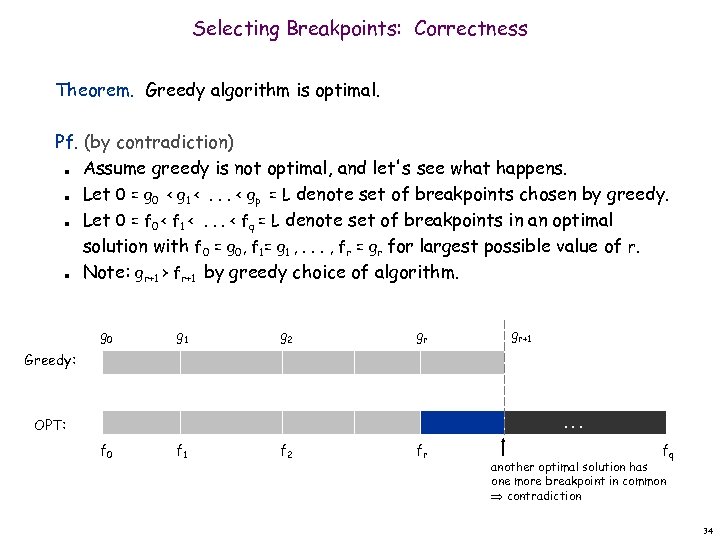
Selecting Breakpoints: Correctness Theorem. Greedy algorithm is optimal. Pf. (by contradiction) Assume greedy is not optimal, and let's see what happens. Let 0 = g 0 < g 1 <. . . < gp = L denote set of breakpoints chosen by greedy. Let 0 = f 0 < f 1 <. . . < fq = L denote set of breakpoints in an optimal solution with f 0 = g 0, f 1= g 1 , . . . , fr = gr for largest possible value of r. Note: gr+1 > fr+1 by greedy choice of algorithm. n n g 0 g 1 g 2 gr gr+1 Greedy: . . . OPT: f 0 f 1 f 2 fr fq another optimal solution has one more breakpoint in common contradiction 34
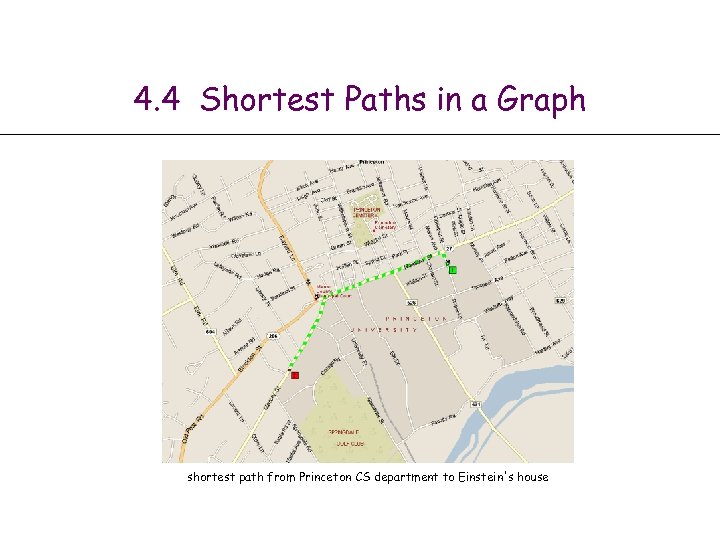
4. 4 Shortest Paths in a Graph shortest path from Princeton CS department to Einstein's house

Edsger W. Dijkstra The question of whether computers can think is like the question of whether submarines can swim. Do only what only you can do. In their capacity as a tool, computers will be but a ripple on the surface of our culture. In their capacity as intellectual challenge, they are without precedent in the cultural history of mankind. The use of COBOL cripples the mind; its teaching should, therefore, be regarded as a criminal offence. APL is a mistake, carried through to perfection. It is the language of the future for the programming techniques of the past: it creates a new generation of coding bums. 36
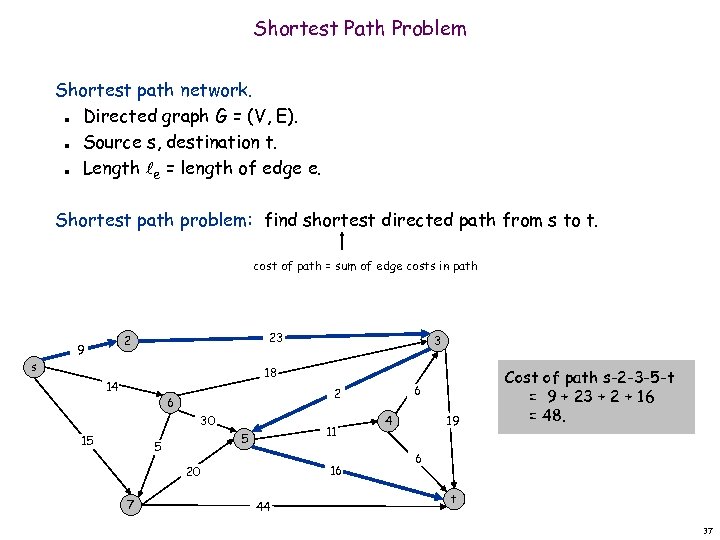
Shortest Path Problem Shortest path network. Directed graph G = (V, E). Source s, destination t. Length e = length of edge e. n n n Shortest path problem: find shortest directed path from s to t. cost of path = sum of edge costs in path 23 2 9 s 3 18 14 2 6 30 15 11 5 5 16 20 7 6 44 19 4 Cost of path s-2 -3 -5 -t = 9 + 23 + 2 + 16 = 48. 6 t 37
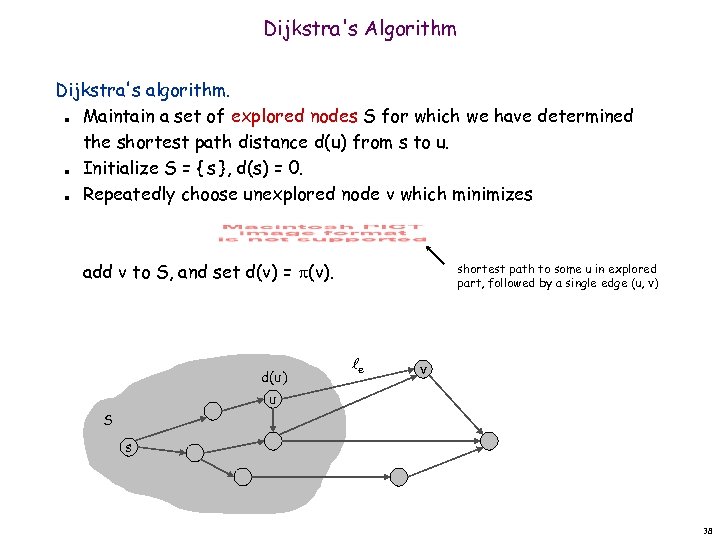
Dijkstra's Algorithm Dijkstra's algorithm. Maintain a set of explored nodes S for which we have determined the shortest path distance d(u) from s to u. Initialize S = { s }, d(s) = 0. Repeatedly choose unexplored node v which minimizes n n n add v to S, and set d(v) = (v). d(u) shortest path to some u in explored part, followed by a single edge (u, v) e v u S s 38
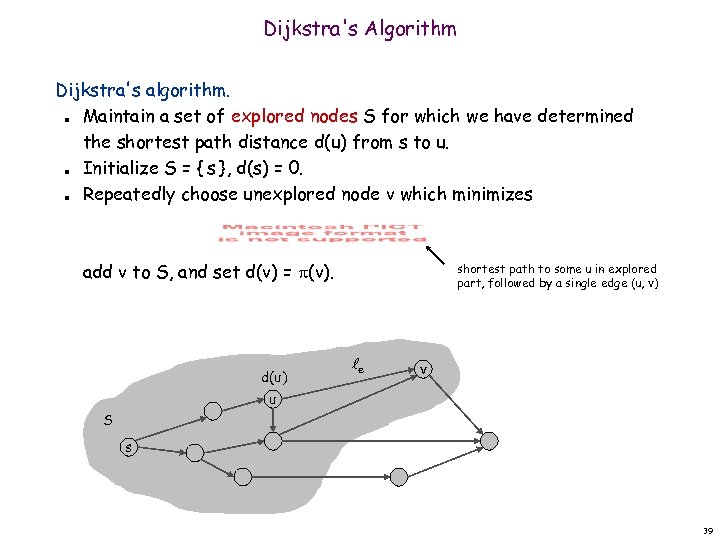
Dijkstra's Algorithm Dijkstra's algorithm. Maintain a set of explored nodes S for which we have determined the shortest path distance d(u) from s to u. Initialize S = { s }, d(s) = 0. Repeatedly choose unexplored node v which minimizes n n n add v to S, and set d(v) = (v). d(u) shortest path to some u in explored part, followed by a single edge (u, v) e v u S s 39
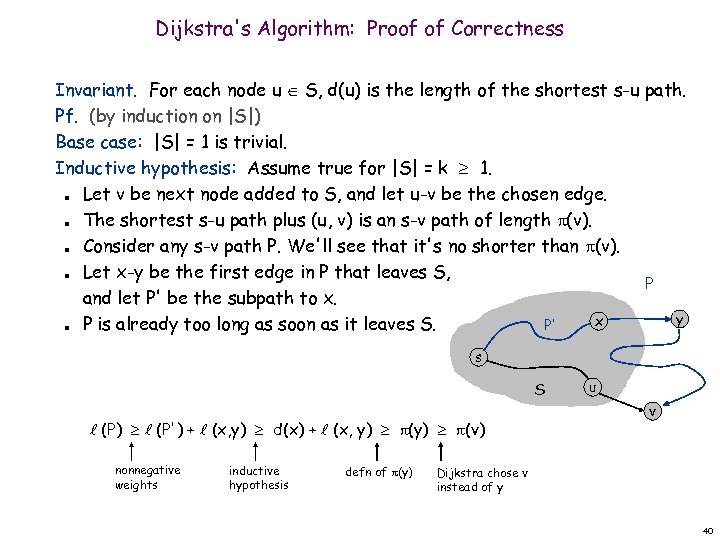
Dijkstra's Algorithm: Proof of Correctness Invariant. For each node u S, d(u) is the length of the shortest s-u path. Pf. (by induction on |S|) Base case: |S| = 1 is trivial. Inductive hypothesis: Assume true for |S| = k 1. Let v be next node added to S, and let u-v be the chosen edge. The shortest s-u path plus (u, v) is an s-v path of length (v). Consider any s-v path P. We'll see that it's no shorter than (v). Let x-y be the first edge in P that leaves S, P and let P' be the subpath to x. y x P is already too long as soon as it leaves S. P' n n n s S (P) (P') + (x, y) d(x) + (x, y) (v) nonnegative weights inductive hypothesis defn of (y) u v Dijkstra chose v instead of y 40
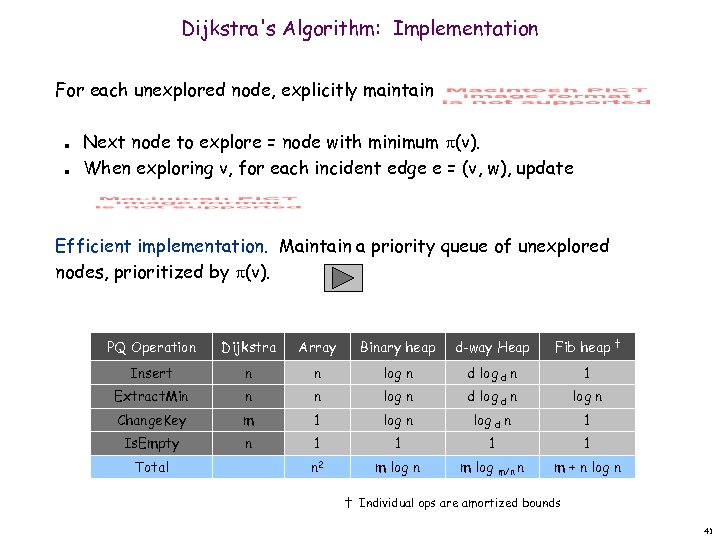
Dijkstra's Algorithm: Implementation For each unexplored node, explicitly maintain n n Next node to explore = node with minimum (v). When exploring v, for each incident edge e = (v, w), update Efficient implementation. Maintain a priority queue of unexplored nodes, prioritized by (v). Priority Queue PQ Operation Dijkstra Array Binary heap d-way Heap Insert n n log n d log d n 1 Extract. Min n n log n d log d n log n Change. Key m 1 log n log d n 1 Is. Empty n 1 1 n 2 m log n Total m log m/n n Fib heap † m + n log n † Individual ops are amortized bounds 41
Скачать презентацию Chapter 4 Greedy Algorithms Slides by Kevin Wayne
ef492a3027be26ea8a41dd2e5b372687.ppt