


 Скачать презентацию Chapter 4 Consumer Learning and Memory Snapshot
4f4d7d481757776fab73ec779e461e7e.ppt
- Количество слайдов: 35
 Chapter 4 Consumer Learning and Memory
 Snapshot from the Marketplace z. Today, companies combat consumer brandswitching by offering rewards programs. z. Frequent-shopper programs’ rewards are instrumental in the consumer learning process for building customer loyalty. z. Companies ranging from airlines and hotels to grocery chains offer myriads of rewards, including preferential prices, frequent-flier miles and free hotel nights, gifts, or even Foursquare “badges. ”
 What is Learning? z. Consumption of products and services is a result of a learning process. z. Consumer behavior includes learning as both adaptive and problem-solving activity. z. As we come to discover that certain behaviors produce results that are more satisfying than others, we reassess our purchasing strategies and behavior.
 Q. 1. Define Learning.
 Definition of Learning z. A process by which changes occur in the content or organization of a person’s longterm memory z. Connecting categories to behaviors that have adaptive value in terms of consumer goals.
 Q. 2. What are the four qualifications of learning?
 Learning Qualifications y. Learning is not directly observable. y. Behavioral changes are brought about by experience. y. Effects are relatively long term y. Learning covers both overt activities and cognitive processes.
 Q. 3. What are the different types of learning?
 Learning Qualifications y. Incidental learning y. Learning by description y. Vicarious learning y. Direct experience
 Range of Learning Situations z. Learning occurs in situations ranging from low to high levels of consumer involvement. y. Low-involvement learning x. Case where we are less motivated to attend to or process material to be learned y. High-involvement learning x. Case where we are motivated to diligently process the information to be learned
 Q. 4. What are the various Behavioral Learning theories?
 Learning Theories z. Three learning theories are particularly applicable to consumer behavior: y. Classical Conditioning: involves linking a conditioned stimulus and an unconditioned stimulus y. Operant Conditioning: learning is driven by the positive or negative consequences of behavior
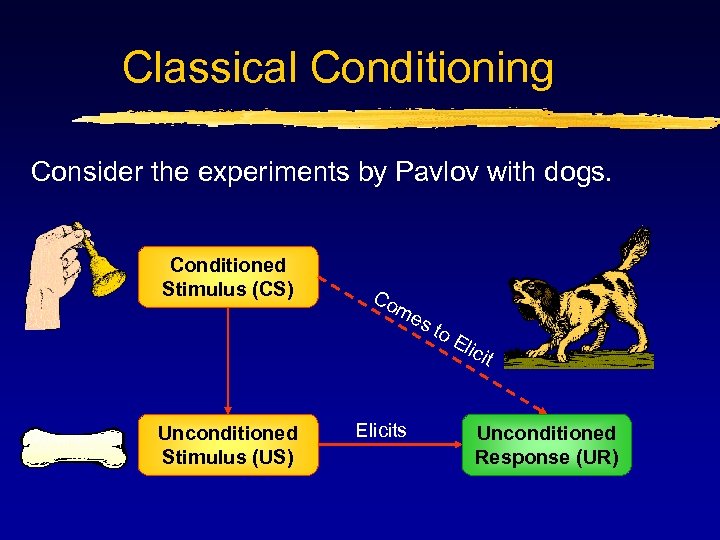 Classical Conditioning Consider the experiments by Pavlov with dogs. Conditioned Stimulus (CS) Unconditioned Stimulus (US) Co me Elicits st o. E lici t Unconditioned Response (UR)
 Classical Conditioning and Formation of Associations z. Learning, according to this view, is a process of establishing linkages between two concepts, or a fusing of two separate items to form a new and unique entity different from either. z. In a consumer behavior context: y. Conditioned stimuli include products, brands, and stores y. Unconditioned stimuli might include celebrities, music, and humor.
 Learning Principles Under Classical Conditioning z. Four conditions must prevail for connections to be formed: y. Repetition: Frequency of pairing a conditioned an unconditioned stimulus y. Contiguity: Spatial or temporal nearness of objects y. Contingency: The conditioned stimulus should precede the unconditioned stimulus y. Congruity: Sequentially presented cues must be related
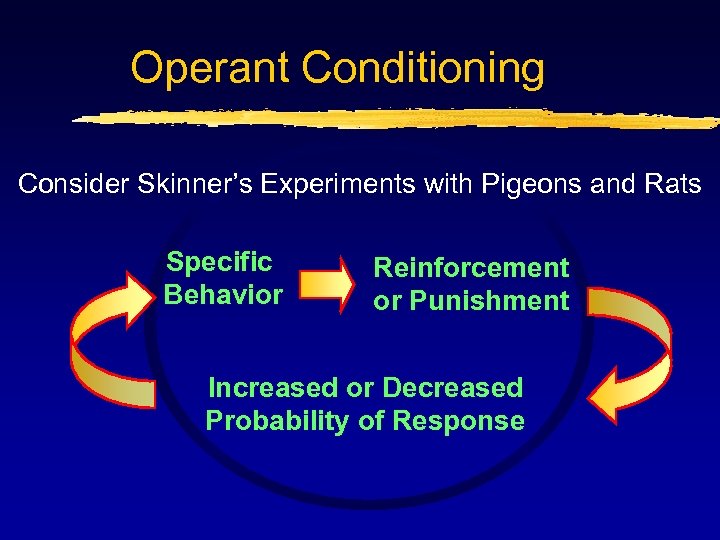 Operant Conditioning Consider Skinner’s Experiments with Pigeons and Rats Specific Behavior Reinforcement or Punishment Increased or Decreased Probability of Response
 How Operant Conditioning Works z. Operant conditioning proposes a sequence in which behavior occurs first. It is then reinforced (or punished). z. Reinforcement or punishment are instrumental in bringing about desired behavioral changes.
 Learning Principles Under Operant Conditioning z Learning occurs via trial and error. y. Positive reinforcement: an inducement to repeat a behavior in order to receive a reward y. Negative reinforcement: an inducement to repeat a behavior in order to remove an adverse situation y. Punishment: an aversive consequence that decreases the likelihood a particular response will recur
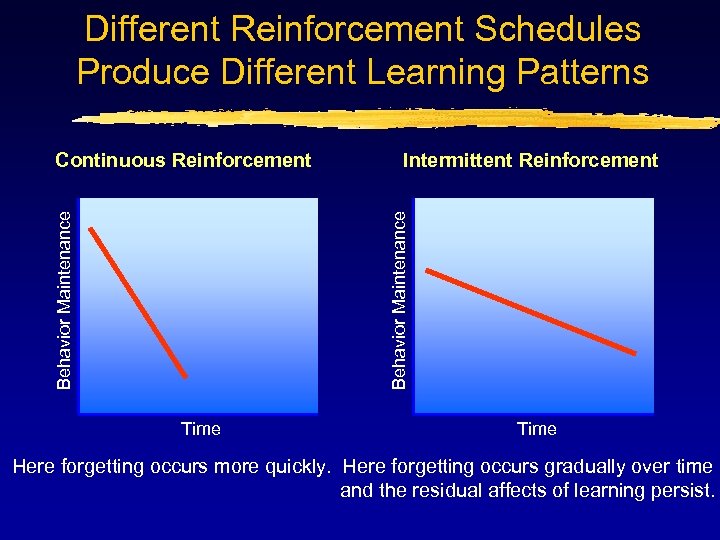 Different Reinforcement Schedules Produce Different Learning Patterns Intermittent Reinforcement Behavior Maintenance Continuous Reinforcement Time Here forgetting occurs more quickly. Here forgetting occurs gradually over time and the residual affects of learning persist.
 Practice Schedules z. Timing exerts important influences on learning. y. Massed practice condenses a learning schedule into a brief time span. x Tends to produce greater initial learning y. Spaced practice paces learning over time intervals. x Tends to produce learning that is longer lasting
 Challenges in Applying Operant Conditioning z. Behavior must first occur before it can be rewarded. To accomplish this, two approaches can be employed. y. Behavior shaping breaks down a complex behavior into a series of simple component actions and reinforces learners at each successive step. y. Ecological design involves calculated design of physical space and other facets of the environment to attain a desired consumer response.
 Applications of Conditioning Theories: Stimulus Generalization and Discrimination z. Stimulus Generalization y. Our tendency to assign commonality to similar stimuli x. Our response to one stimulus becomes extended to other similar stimuli x. Case in point: Halo effect z. Stimulus Discrimination y. Our tendency to distinguish between similar— but non-identical—stimuli x. Gives marketers the opportunity to differentiate their products
 Cognitive Learning z. Humans are not locked into a ceaselessly repetitive stimulus-response behavior mode. Rather, we have the ability to think, analyze, associate, learn consequences, and solve problems. z. We may act differently in each case based on perceived circumstances.
 Classical Conditioning Revisited z. Renewed interest in classical conditioning has produced Neo. Pavlovian Conditioning: a viewpoint that reshapes traditional classical conditioning into a fully cognitive theory.
 Neo-Pavlovian Conditioning z. Learned associations are not simple, but rather rich and complex, involving relationships among multiple objects or events. z. This concept views conditioned learning as not mere acquisition of new reflexes, but rather as cognitive procurement of new knowledge about the environment, where one stimulus provides information about another.
 Learning & Hemispheric Specialization of the Brain z. A view that the left and right hemispheres of the brain process, organize, and encode information differently y. Left Hemisphere x. Specializes in analytical thinking, verbalization, and algebraic calculations y. Right Hemisphere x. Specializes in interpreting and recognizing visual patterns
 Learning-Related Concepts z Vicarious learning: behavior change due to observing the activity of others and the consequences of their behavior z Learning curve (Experience effect): tasks become easier and are performed more quickly as the number of repetitions increases z Brand loyalty: consistent purchase of a specific brand within a product category z Brand parity: a belief that no significant differences exist among brands
 Memory and Retention z. Mnemonic devices: auditory or visual aids that promote retention of material by identifying it with some easily-remembered symbols z. Google effect: y. In the case of information that is easily found online, we tend to remember where it can be found rather than recall the information itself y. In the case of less-easily-found information online, we tend to remember the information itself.
 Q. 5. Define Memories.
 Memories y. Key elements from our and others’ experiences that we store.
 Q. 6. What are the types of Memory?
 The Structure of Memory z. Memory consists of three storage systems: y. Sensory memory: a storage system where incoming data undergo preliminary processing y. Short-term memory: a storage system that momentarily holds acquired information x. If information is significant, it may undergo: • Rehearsal • Encoding y. Long-term memory: an information warehouse where data are organized and extendedly stored x. Knowledge structures: forming chunks composed of related bits of information
 Q. 7. Why do we forget?
 Why we forget y. Memory fades y. Absentmindedness y. Blocking y. Misattribution y. Bias y. Persistence
 Information Retrieval, Extinction, & Forgetting z Information retrieval: sifting through memory to activate stored information y. Retrieval cues z Extinction: when a behavior ceases because it no longer brings rewards or prevents punishments z Forgetting: when knowledge recedes into the mind’s unconscious recesses and cannot be recalled z Retroactive interference: when recent learning interferes with recall of previous learning y. Misinformation effect z Proactive interference: when prior learning interferes with recall of recent learning