


 Скачать презентацию Chapter 4 Capturing the Requirements Shari L Pfleeger
d75205c623e4119dd471da2373c0d6d9.ppt
- Количество слайдов: 55
 Chapter 4 Capturing the Requirements Shari L. Pfleeger Joanne M. Atlee 4 th Edition
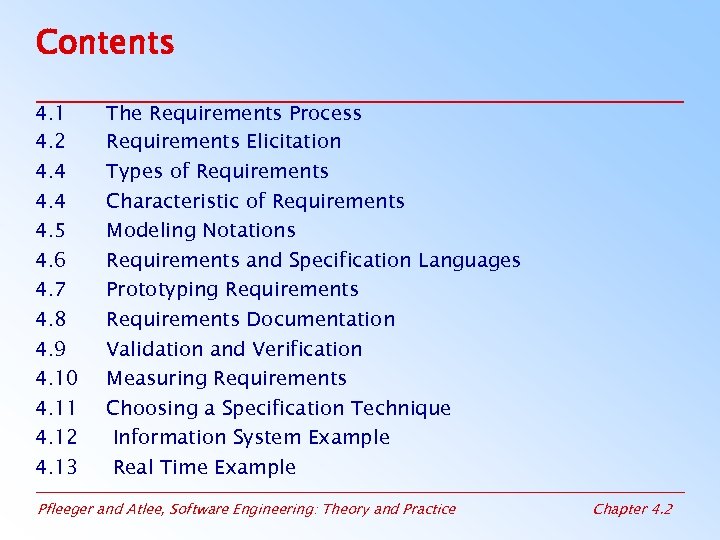 Contents 4. 1 4. 2 4. 4 4. 5 4. 6 4. 7 4. 8 4. 9 4. 10 4. 11 4. 12 4. 13 The Requirements Process Requirements Elicitation Types of Requirements Characteristic of Requirements Modeling Notations Requirements and Specification Languages Prototyping Requirements Documentation Validation and Verification Measuring Requirements Choosing a Specification Technique Information System Example Real Time Example Pfleeger and Atlee, Software Engineering: Theory and Practice Chapter 4. 2
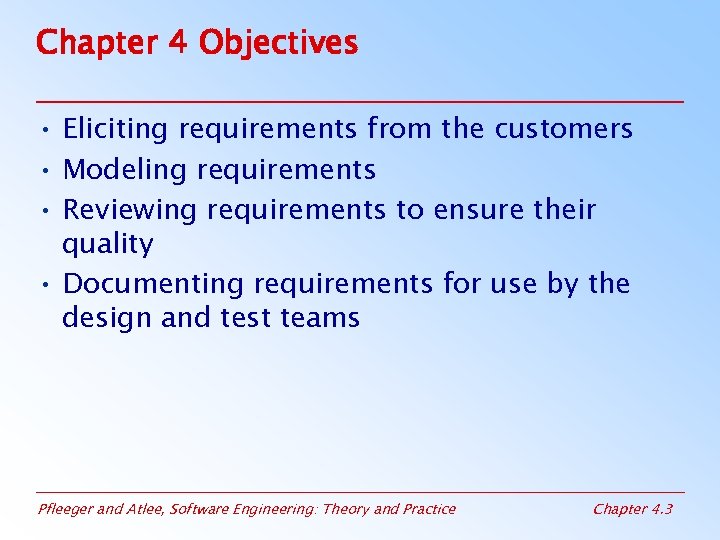 Chapter 4 Objectives • Eliciting requirements from the customers • Modeling requirements • Reviewing requirements to ensure their quality • Documenting requirements for use by the design and test teams Pfleeger and Atlee, Software Engineering: Theory and Practice Chapter 4. 3
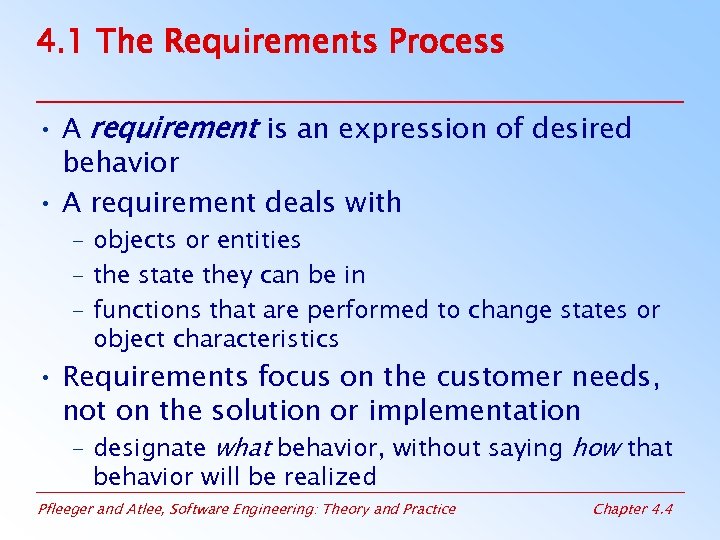 4. 1 The Requirements Process • A requirement is an expression of desired behavior • A requirement deals with – objects or entities – the state they can be in – functions that are performed to change states or object characteristics • Requirements focus on the customer needs, not on the solution or implementation – designate what behavior, without saying how that behavior will be realized Pfleeger and Atlee, Software Engineering: Theory and Practice Chapter 4. 4
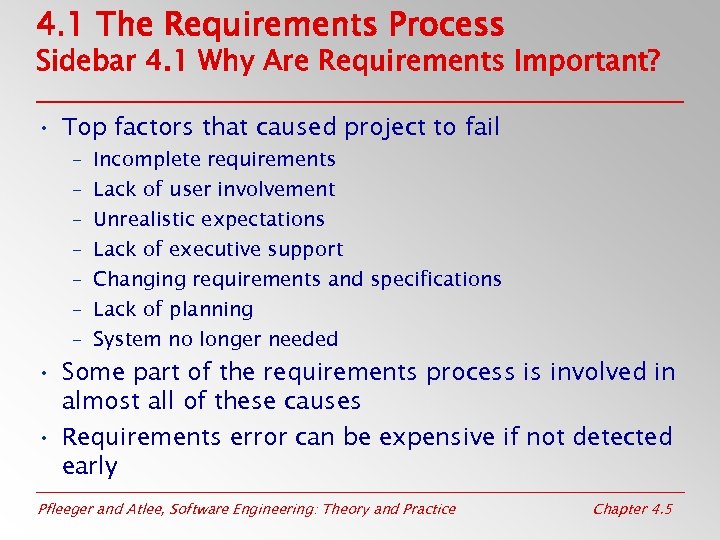 4. 1 The Requirements Process Sidebar 4. 1 Why Are Requirements Important? • Top factors that caused project to fail – – – – Incomplete requirements Lack of user involvement Unrealistic expectations Lack of executive support Changing requirements and specifications Lack of planning System no longer needed • Some part of the requirements process is involved in almost all of these causes • Requirements error can be expensive if not detected early Pfleeger and Atlee, Software Engineering: Theory and Practice Chapter 4. 5
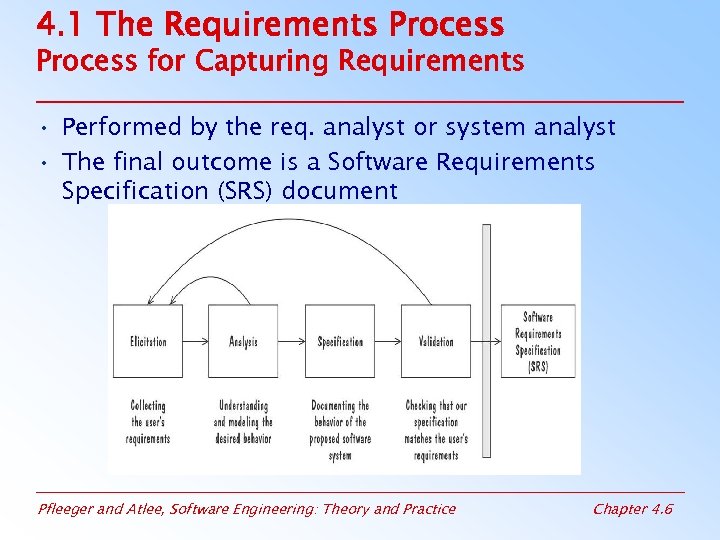 4. 1 The Requirements Process for Capturing Requirements • Performed by the req. analyst or system analyst • The final outcome is a Software Requirements Specification (SRS) document Pfleeger and Atlee, Software Engineering: Theory and Practice Chapter 4. 6
 4. 2 Requirements Elicitation • Customers do not always undertand what their needs and problems are • It is important to discuss the requirements with everyone who has a stake in the system • Come up with agreement on what the requirements are – If we can not agree on what the requirements are, then the project is doomed to fail Pfleeger and Atlee, Software Engineering: Theory and Practice Chapter 4. 7
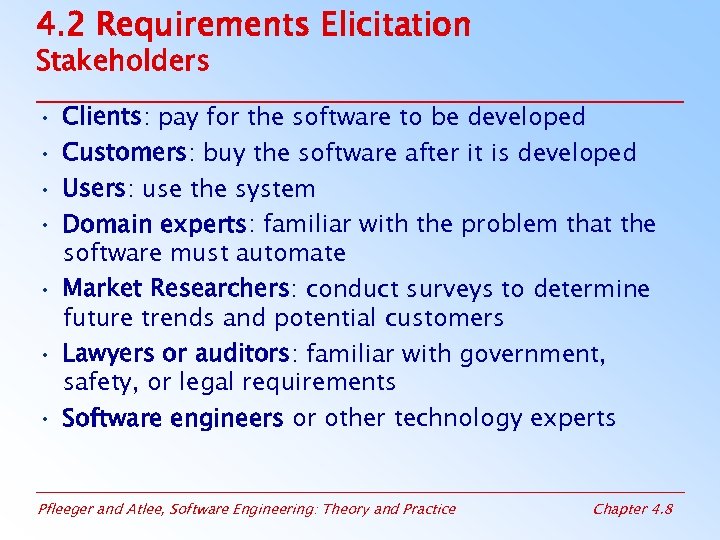 4. 2 Requirements Elicitation Stakeholders • • Clients: pay for the software to be developed Customers: buy the software after it is developed Users: use the system Domain experts: familiar with the problem that the software must automate • Market Researchers: conduct surveys to determine future trends and potential customers • Lawyers or auditors: familiar with government, safety, or legal requirements • Software engineers or other technology experts Pfleeger and Atlee, Software Engineering: Theory and Practice Chapter 4. 8
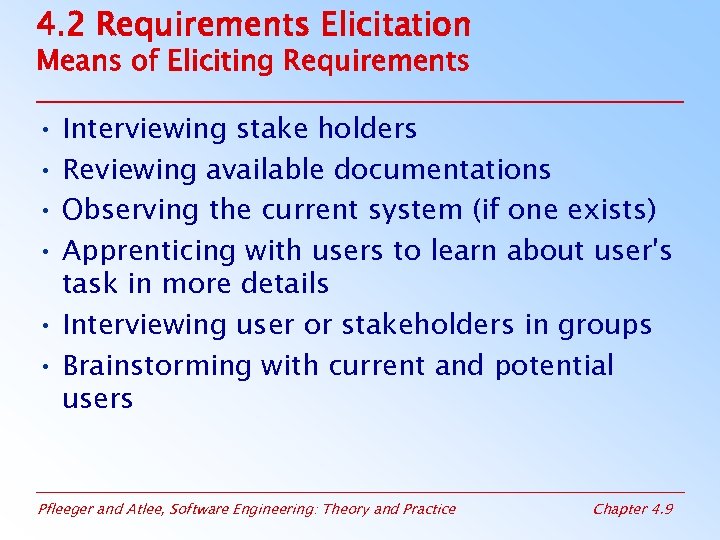 4. 2 Requirements Elicitation Means of Eliciting Requirements • Interviewing stake holders • Reviewing available documentations • Observing the current system (if one exists) • Apprenticing with users to learn about user's task in more details • Interviewing user or stakeholders in groups • Brainstorming with current and potential users Pfleeger and Atlee, Software Engineering: Theory and Practice Chapter 4. 9
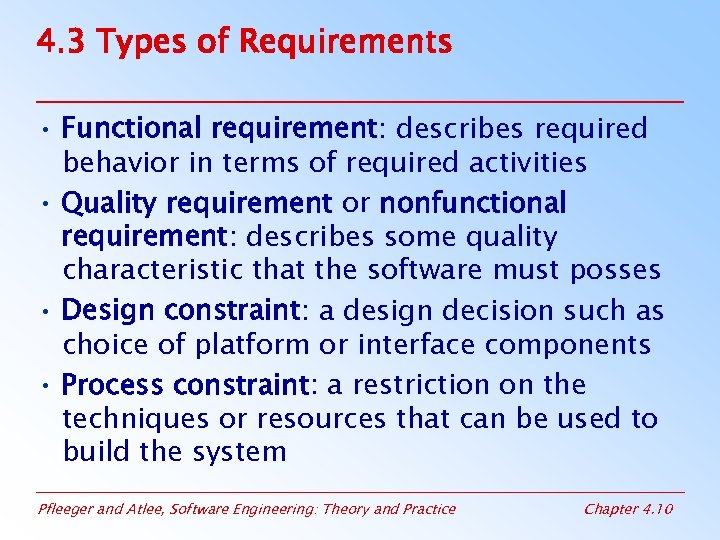 4. 3 Types of Requirements • Functional requirement: describes required behavior in terms of required activities • Quality requirement or nonfunctional requirement: describes some quality characteristic that the software must posses • Design constraint: a design decision such as choice of platform or interface components • Process constraint: a restriction on the techniques or resources that can be used to build the system Pfleeger and Atlee, Software Engineering: Theory and Practice Chapter 4. 10
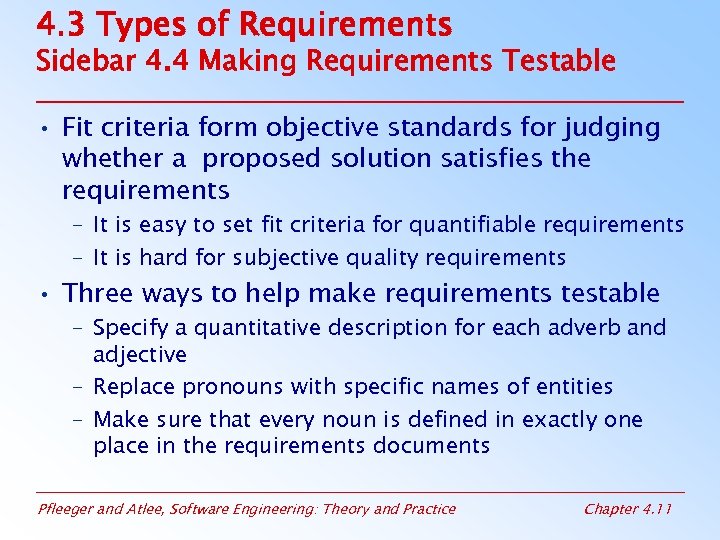 4. 3 Types of Requirements Sidebar 4. 4 Making Requirements Testable • Fit criteria form objective standards for judging whether a proposed solution satisfies the requirements – It is easy to set fit criteria for quantifiable requirements – It is hard for subjective quality requirements • Three ways to help make requirements testable – Specify a quantitative description for each adverb and adjective – Replace pronouns with specific names of entities – Make sure that every noun is defined in exactly one place in the requirements documents Pfleeger and Atlee, Software Engineering: Theory and Practice Chapter 4. 11
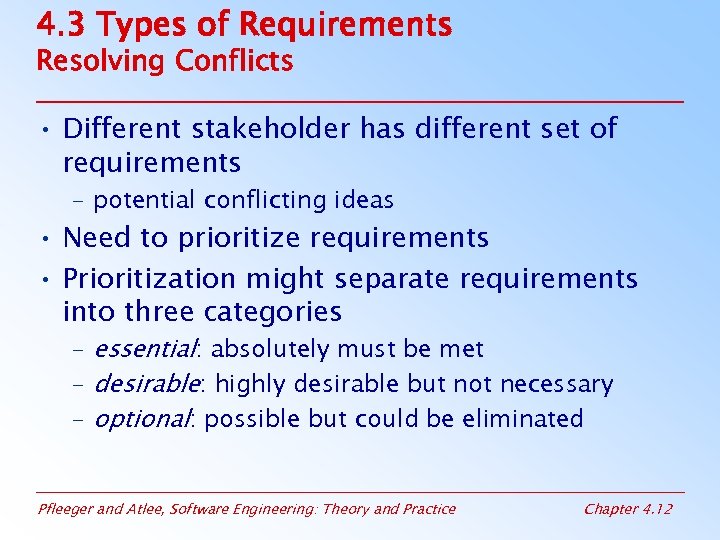 4. 3 Types of Requirements Resolving Conflicts • Different stakeholder has different set of requirements – potential conflicting ideas • Need to prioritize requirements • Prioritization might separate requirements into three categories – essential: absolutely must be met – desirable: highly desirable but not necessary – optional: possible but could be eliminated Pfleeger and Atlee, Software Engineering: Theory and Practice Chapter 4. 12
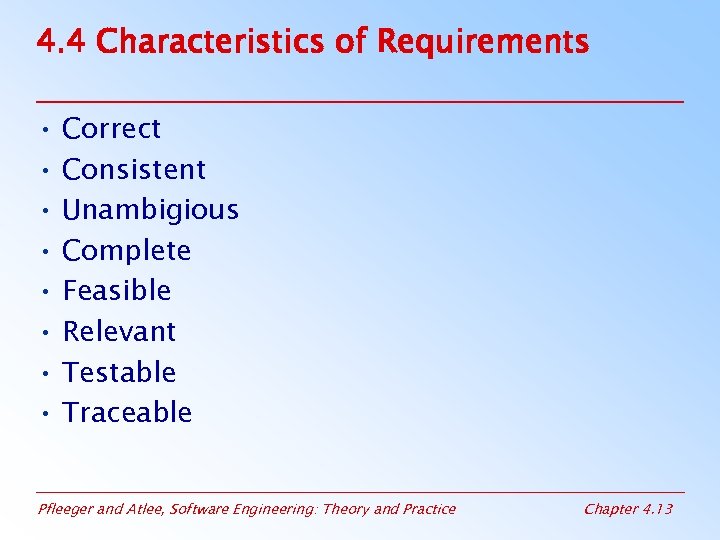 4. 4 Characteristics of Requirements • Correct • Consistent • Unambigious • Complete • Feasible • Relevant • Testable • Traceable Pfleeger and Atlee, Software Engineering: Theory and Practice Chapter 4. 13
 4. 5 Modeling Notations • It is important to have standard notations for modeling, documenting, and communicating decisions • Modeling helps us to understand requirements thoroughly – Holes in the models reveal unknown or ambiguous behavior – Multiple, conflicting outputs to the same input reveal inconsistencies in the requirements Pfleeger and Atlee, Software Engineering: Theory and Practice Chapter 4. 14
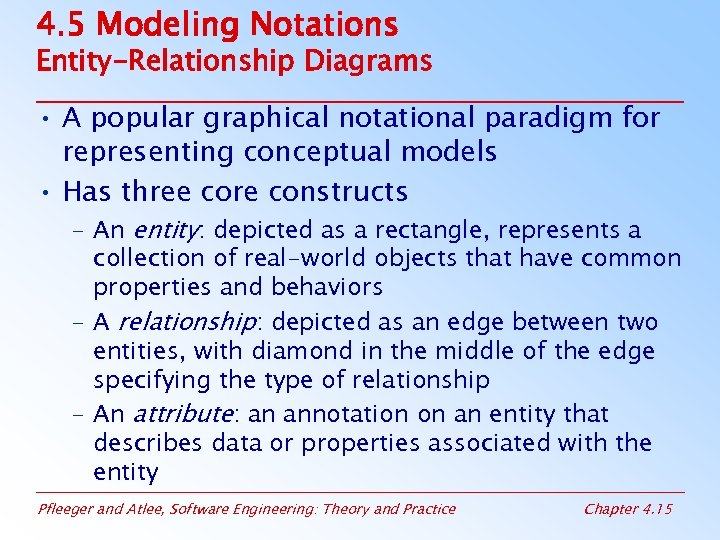 4. 5 Modeling Notations Entity-Relationship Diagrams • A popular graphical notational paradigm for representing conceptual models • Has three core constructs – An entity: depicted as a rectangle, represents a collection of real-world objects that have common properties and behaviors – A relationship: depicted as an edge between two entities, with diamond in the middle of the edge specifying the type of relationship – An attribute: an annotation on an entity that describes data or properties associated with the entity Pfleeger and Atlee, Software Engineering: Theory and Practice Chapter 4. 15
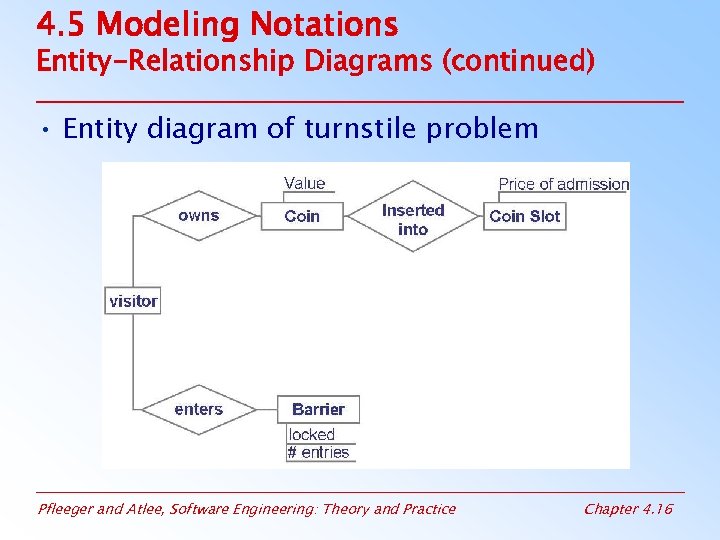 4. 5 Modeling Notations Entity-Relationship Diagrams (continued) • Entity diagram of turnstile problem Pfleeger and Atlee, Software Engineering: Theory and Practice Chapter 4. 16
 4. 5 Modeling Notations Entity-Relationship Diagrams (continued) • ER diagrams are popular because – they provide an overview of the problem to be addressed – the view is relatively stable when changes are made to the problem's requirements • ER diagram is likely to be used to model a problem early in the requirements process Pfleeger and Atlee, Software Engineering: Theory and Practice Chapter 4. 17
 4. 5 Modeling Notations ER Diagrams Example: UML Class Diagram • UML (Unified Modeling Language) is a collection of notations used to document software specifications and designs • It represents a system in terms of – objects: akin to entities, organized in classes that have an inheritance hierarchy – methods: actions on the object's variables • The class diagram is the flagship model in any UML specification – A sophisticated ER diagram relating the classes (entities) in the specification Pfleeger and Atlee, Software Engineering: Theory and Practice Chapter 4. 18
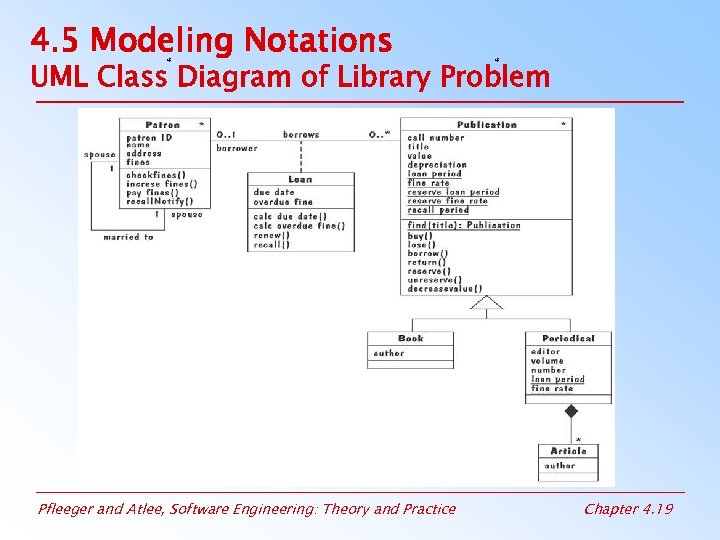 4. 5 Modeling Notations UML Class Diagram of Library Problem Pfleeger and Atlee, Software Engineering: Theory and Practice Chapter 4. 19
 4. 5 Modeling Notations UML Class Diagram (continued) • Attributes and operations are associated with the class rather than instances of the class • A class-scope attribute represented as an underlined attribute, is a data value that is shared by all instances of the class • A class-scope operation written as underlined operation, is an operation performed by the abstract class rather than by class instances • An association, marked as a line between two classes, indicates a relationship between classes' entities Pfleeger and Atlee, Software Engineering: Theory and Practice Chapter 4. 20
 4. 5 Modeling Notations UML Class Diagram (continued) • Aggregate association is an association that represents interaction, or events that involve objects in the associated (marked with white diamond) – “has-a” relationship • Composition association is a special type of aggregation, in which instances of the compound class are physically constructed from instances of component classes (marked with black diamond) Pfleeger and Atlee, Software Engineering: Theory and Practice Chapter 4. 21
 4. 5 Modeling Notations Event Traces • A graphical description of a sequence of events that are exchanged between real-world entities – Vertical line: the timeline of distinct entity, whose name appear at the top of the line – Horizontal line: an event or interaction between the two entities bounding the line – Time progresses from top to bottom • Each graph depicts a single trace, representing one of several possible behaviors • Traces have a semantic that is relatively precise, simple and easy to understand Pfleeger and Atlee, Software Engineering: Theory and Practice Chapter 4. 22
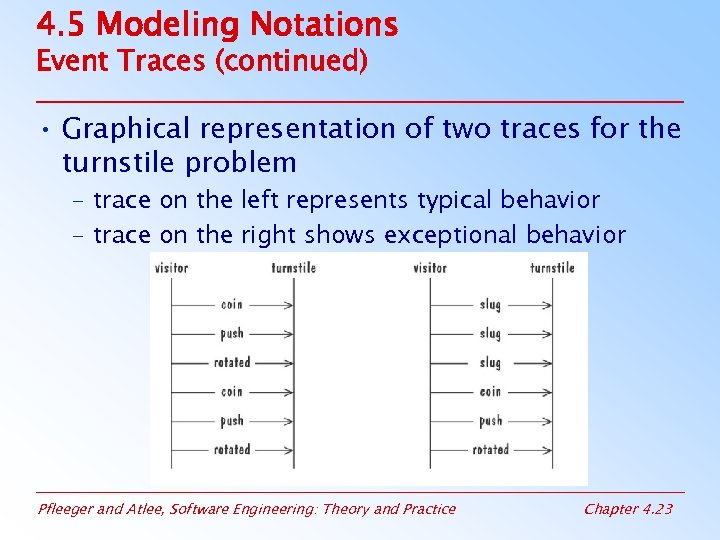 4. 5 Modeling Notations Event Traces (continued) • Graphical representation of two traces for the turnstile problem – trace on the left represents typical behavior – trace on the right shows exceptional behavior Pfleeger and Atlee, Software Engineering: Theory and Practice Chapter 4. 23
 4. 5 Modeling Notations Event Traces Exampe: Message Sequence Chart • An enhanced event-trace notation, with facilities for creating and destroying entities, specifiying actions and timers, and composing traces – Vertical line represents a participating entity – A message is depicted as an arrow from the sending entity to the receiving entity – Actions are specified as labeled rectangles positioned on an entity's execution line – Conditions are important states in an entity's evolution, represented as labeled hexagon Pfleeger and Atlee, Software Engineering: Theory and Practice Chapter 4. 24
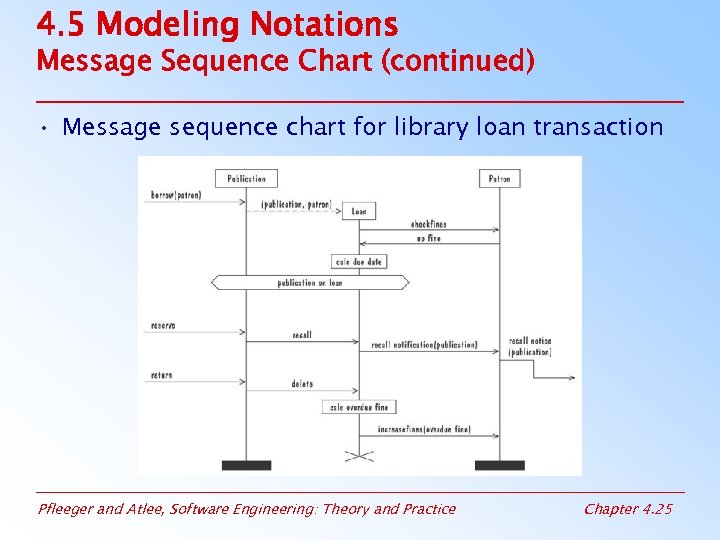 4. 5 Modeling Notations Message Sequence Chart (continued) • Message sequence chart for library loan transaction Pfleeger and Atlee, Software Engineering: Theory and Practice Chapter 4. 25
 4. 5 Modeling Notations State Machines • A graphical description of all dialog between the system and its environment – Node (state) represents a stable set of conditions that exists between event occurences – Edge (transition) represents a change in behavior or condition due to the occurrence of an event • Useful both for specifying dynamic behavior and for describing how behavior should change in response to the history of events that have already occurred Pfleeger and Atlee, Software Engineering: Theory and Practice Chapter 4. 26
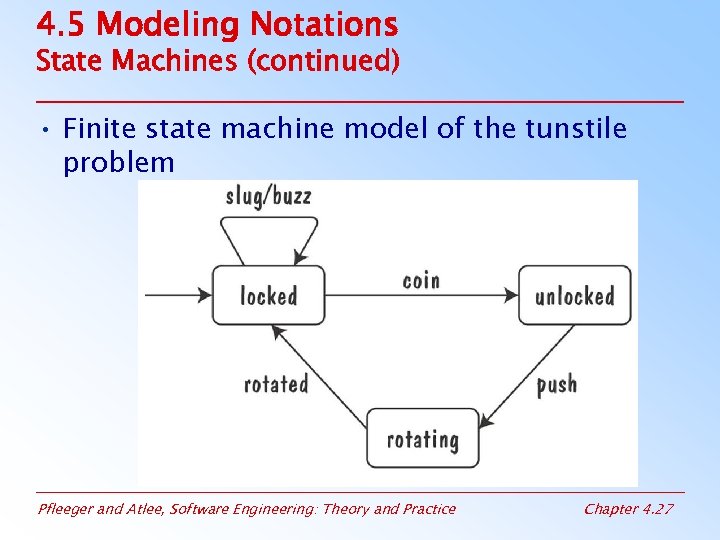 4. 5 Modeling Notations State Machines (continued) • Finite state machine model of the tunstile problem Pfleeger and Atlee, Software Engineering: Theory and Practice Chapter 4. 27
 4. 5 Modeling Notations Data-Flow Diagrams • ER diagram, event trace, state machines depict only lower-level behaviors • A data-flow diagram (DFD) models functionality and the flow of data from one function to another – A buble represents a process – An arrow represents data flow – A data store: a formal repository or database of information – Rectangles represent actors: entities that provide input data or receive the output result Pfleeger and Atlee, Software Engineering: Theory and Practice Chapter 4. 28
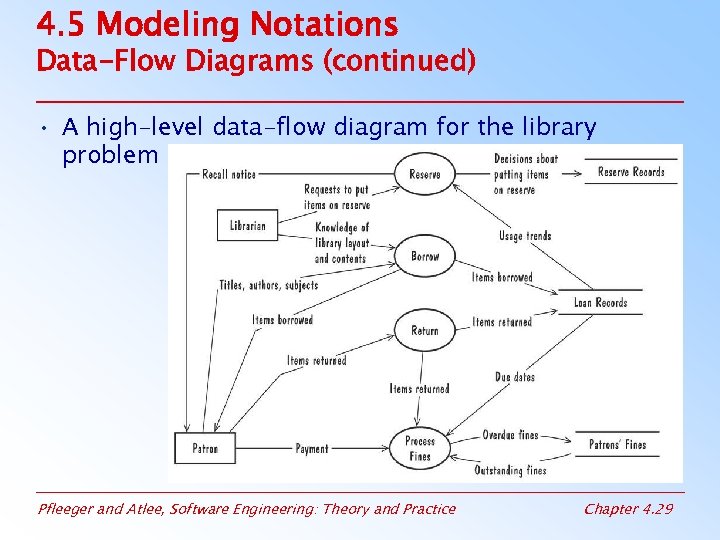 4. 5 Modeling Notations Data-Flow Diagrams (continued) • A high-level data-flow diagram for the library problem Pfleeger and Atlee, Software Engineering: Theory and Practice Chapter 4. 29
 4. 5 Modeling Notations Data-Flow Diagrams (continued) • Advantage: – Provides an intuitive model of a proposed system's high-level functionality and of the data dependencies among various processes • Disadvantage: – Can be aggravatingly ambiguous to a software developer who is less familiar with the problem being modeled Pfleeger and Atlee, Software Engineering: Theory and Practice Chapter 4. 30
 4. 5 Modeling Notations Data-Flow Diagrams Example: Use Cases • Components – A large box: system boundary – Stick figures outside the box: actors, both human and systems – Each oval inside the box: a use case that represents some major required functionality and its variant – A line between an actor and use case: the actor participates in the use case • Use cases do not model all the tasks, instead they are used to specify user views of essential system behavior Pfleeger and Atlee, Software Engineering: Theory and Practice Chapter 4. 31
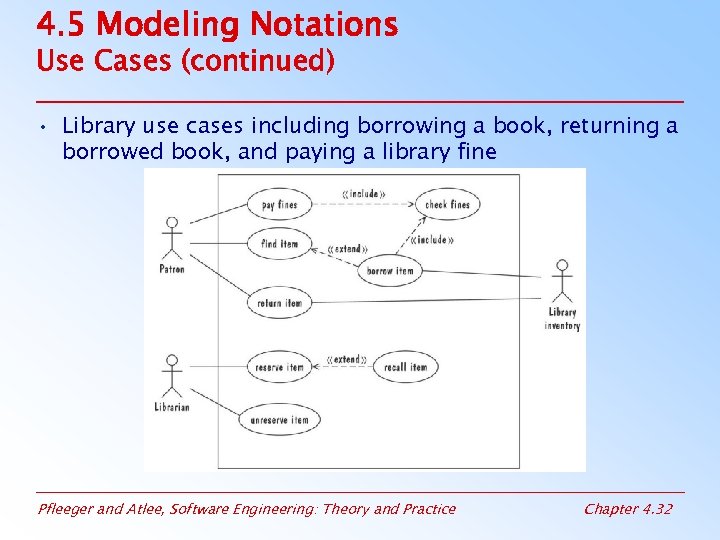 4. 5 Modeling Notations Use Cases (continued) • Library use cases including borrowing a book, returning a borrowed book, and paying a library fine Pfleeger and Atlee, Software Engineering: Theory and Practice Chapter 4. 32
 4. 5 Modeling Notations Functions and Relations • Formal methods or approach: mathematically based specification and design techniques • Formal methods model requirements or software behavior as a collection of mathematical functions or relations – Functions specify the state of the system's execution, and output – A relation is used whenever an input value maps more than one ouput value • Functional method is consistent and complete Pfleeger and Atlee, Software Engineering: Theory and Practice Chapter 4. 33
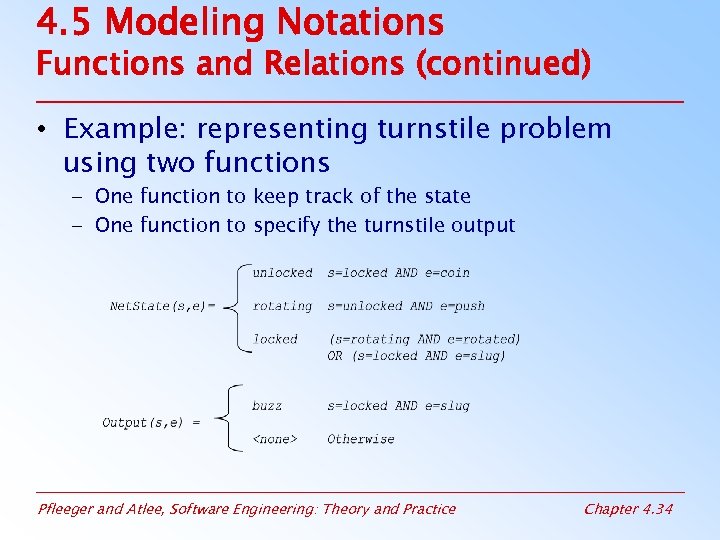 4. 5 Modeling Notations Functions and Relations (continued) • Example: representing turnstile problem using two functions – One function to keep track of the state – One function to specify the turnstile output Pfleeger and Atlee, Software Engineering: Theory and Practice Chapter 4. 34
 4. 5 Modeling Notations Functions and Relations Example: Decision Tables • It is a tabular representation of a functional specification that maps events and conditions to appropriate reponses or action • The specification is formal because the inputs (events and conditions) and outputs (actions) may be expressed in natural language • If there is n input conditions, there are 2 n possible combination of input conditions • Combinations map to the same set of result can be combined into a single column Pfleeger and Atlee, Software Engineering: Theory and Practice Chapter 4. 35
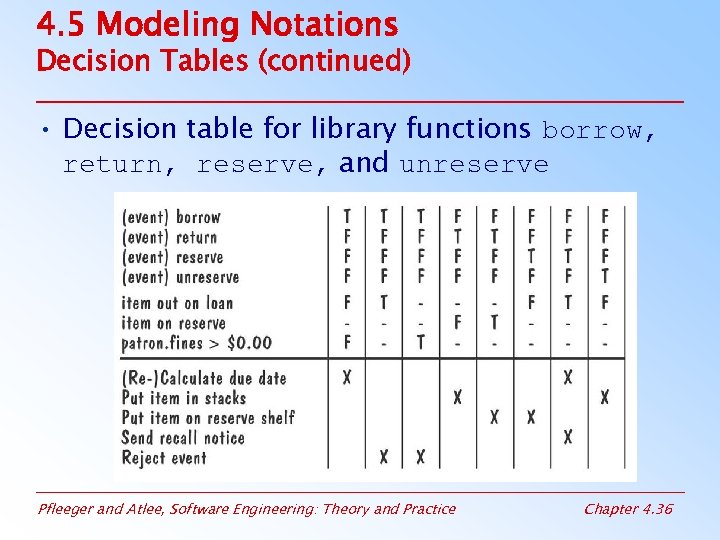 4. 5 Modeling Notations Decision Tables (continued) • Decision table for library functions borrow, return, reserve, and unreserve Pfleeger and Atlee, Software Engineering: Theory and Practice Chapter 4. 36
 4. 7 Prototyping Requirements Building a Prototype • To elicit the details of proposed system • To solicit feedback from potential users about – what aspects they would like to see improve – which features are not so useful – what functionality is missing • Determine whether the customer's problem has a feasible solution • Assist in exploring options for otimizing quality requirements Pfleeger and Atlee, Software Engineering: Theory and Practice Chapter 4. 37
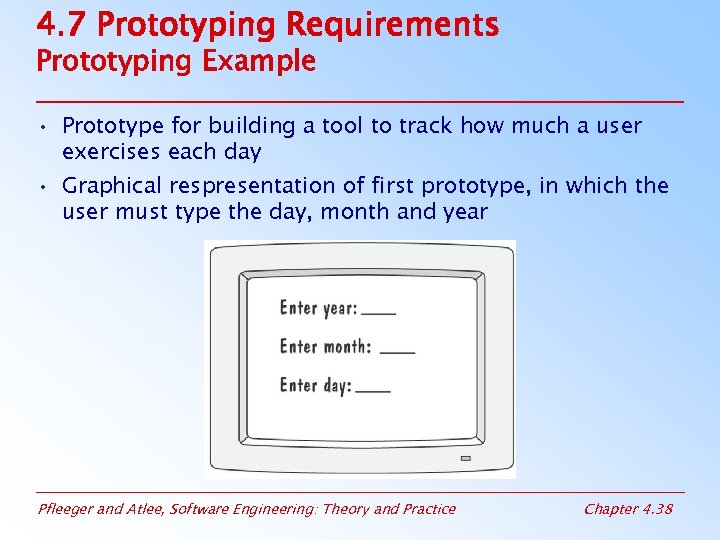 4. 7 Prototyping Requirements Prototyping Example • Prototype for building a tool to track how much a user exercises each day • Graphical respresentation of first prototype, in which the user must type the day, month and year Pfleeger and Atlee, Software Engineering: Theory and Practice Chapter 4. 38
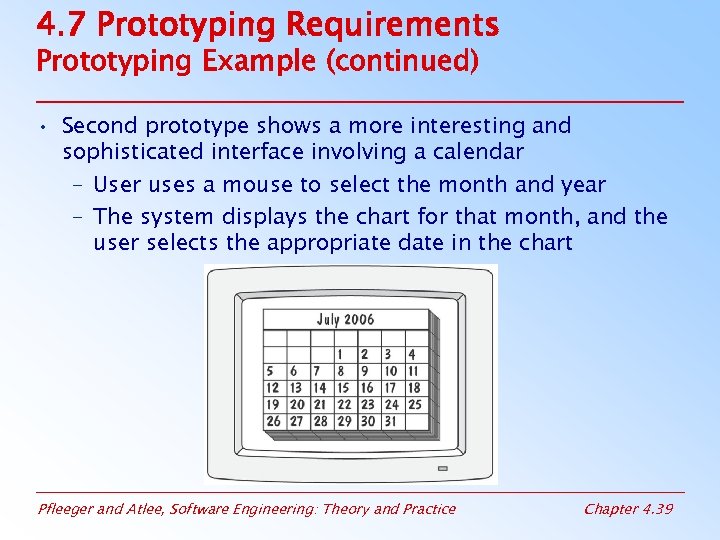 4. 7 Prototyping Requirements Prototyping Example (continued) • Second prototype shows a more interesting and sophisticated interface involving a calendar – User uses a mouse to select the month and year – The system displays the chart for that month, and the user selects the appropriate date in the chart Pfleeger and Atlee, Software Engineering: Theory and Practice Chapter 4. 39
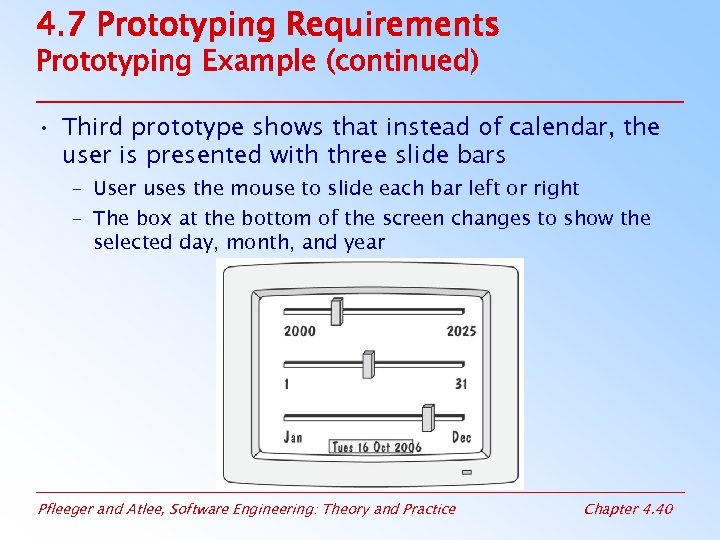 4. 7 Prototyping Requirements Prototyping Example (continued) • Third prototype shows that instead of calendar, the user is presented with three slide bars – User uses the mouse to slide each bar left or right – The box at the bottom of the screen changes to show the selected day, month, and year Pfleeger and Atlee, Software Engineering: Theory and Practice Chapter 4. 40
 4. 7 Prototyping Requirements Approaches to Prototyping • Throwaway approach – Developed to learn more about a problem or a proposed solution, and that is never intended to be part of the delivered software – Allow us to write “quick-and-dirty” • Evolutionary approach – Developed not only to help us answer questions but also to be incorporated into the final product – Prototype has to eventually exhibit the quality requirements of the final product, and these qualities cannot be retrofitted • Both techniques are sometimes called rapid prototyping Pfleeger and Atlee, Software Engineering: Theory and Practice Chapter 4. 41
 4. 7 Prototyping Requirements Prototyping vs. Modeling • Prototyping – Good for answering questions about the user interfaces • Modeling – Quickly answer questions about constraints on the order in which events should occur, or about the synchronization of activities Pfleeger and Atlee, Software Engineering: Theory and Practice Chapter 4. 42
 4. 8 Requirements Documentation Requirement Definition: Steps Documenting Process • Outline the general purpose and scope of the system, including relevant benefits, objectives, and goals • Describe the background and the rationale behind proposal for new system • Describe the essential characteristics of an accepatable solution • Describe the environment in which the system will operate • Outline a description of the proposal, if the customer has a proposal for solving the problem • List any assumptions we make about how the environment behaves Pfleeger and Atlee, Software Engineering: Theory and Practice Chapter 4. 43
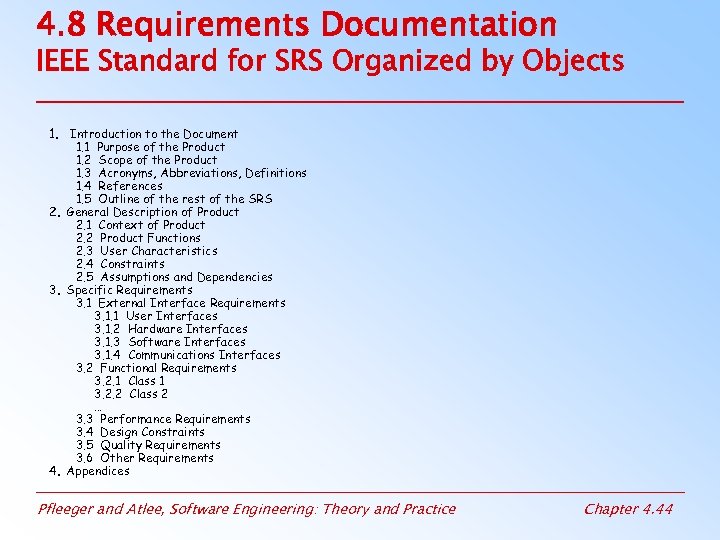 4. 8 Requirements Documentation IEEE Standard for SRS Organized by Objects 1. Introduction to the Document 1. 1 Purpose of the Product 1. 2 Scope of the Product 1. 3 Acronyms, Abbreviations, Definitions 1. 4 References 1. 5 Outline of the rest of the SRS 2. General Description of Product 2. 1 Context of Product 2. 2 Product Functions 2. 3 User Characteristics 2. 4 Constraints 2. 5 Assumptions and Dependencies 3. Specific Requirements 3. 1 External Interface Requirements 3. 1. 1 User Interfaces 3. 1. 2 Hardware Interfaces 3. 1. 3 Software Interfaces 3. 1. 4 Communications Interfaces 3. 2 Functional Requirements 3. 2. 1 Class 1 3. 2. 2 Class 2 … 3. 3 Performance Requirements 3. 4 Design Constraints 3. 5 Quality Requirements 3. 6 Other Requirements 4. Appendices Pfleeger and Atlee, Software Engineering: Theory and Practice Chapter 4. 44
 4. 8 Requirements Documentation Process Management and Requirements Traceability • Process managemet is a set of procedures that track – the requirements that define what the system should do – the design modules that are generated from the requirement – the program code that implements the design – the tests that verify the functionality of the system – the documents that describe the system • It provides the threads that tie the system parts together Pfleeger and Atlee, Software Engineering: Theory and Practice Chapter 4. 45
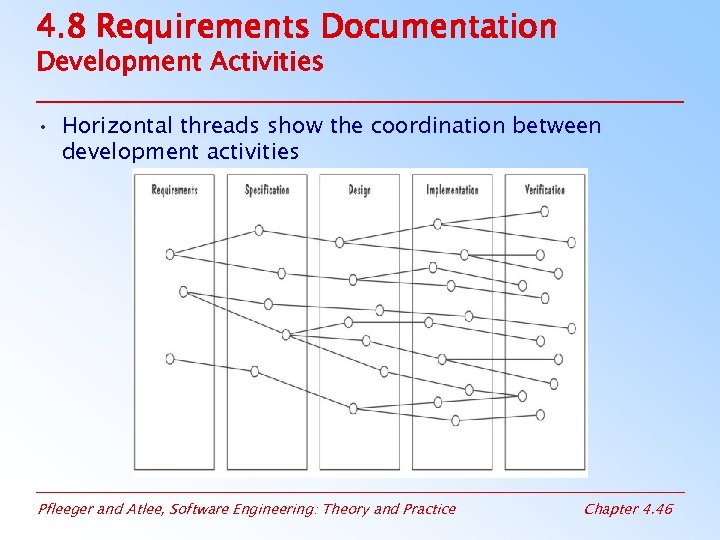 4. 8 Requirements Documentation Development Activities • Horizontal threads show the coordination between development activities Pfleeger and Atlee, Software Engineering: Theory and Practice Chapter 4. 46
 4. 9 Validation and Verification • In requirements validation, we check that our requirements definition accurately reflects the customer's needs • In verification, we check that one document or artifact conforms to another • Verification ensures that we build the system right, whereas validation ensures that we build the right system Pfleeger and Atlee, Software Engineering: Theory and Practice Chapter 4. 47
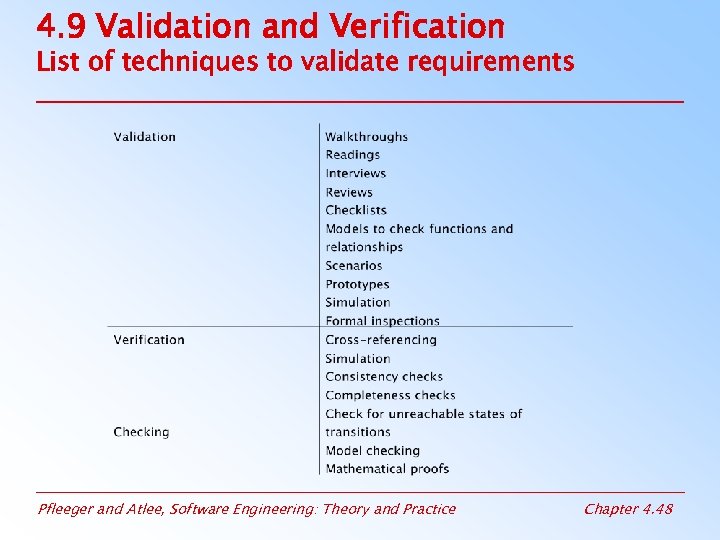 4. 9 Validation and Verification List of techniques to validate requirements Pfleeger and Atlee, Software Engineering: Theory and Practice Chapter 4. 48
 4. 9 Validation and Verification Requirements Review • Review the stated goals and objectives of the system • Compare the requirements with the goals and objectives • Review the environment in which the system is to operate • Review the information flow and proposed functions • Assess and document the risk, discuss and compare alternatives • Testing the system: how the requirements will be revalidated as the requirements grow and change Pfleeger and Atlee, Software Engineering: Theory and Practice Chapter 4. 49
 4. 9 Validation and Verification • Check that the requirements-specification document corresponds to the requirementsdefinition • Make sure that if we implement a system that meets the specification, then the system will satisfy the customer's requirements • Ensure that each requirement in the definition document is traceable to the specification Pfleeger and Atlee, Software Engineering: Theory and Practice Chapter 4. 50
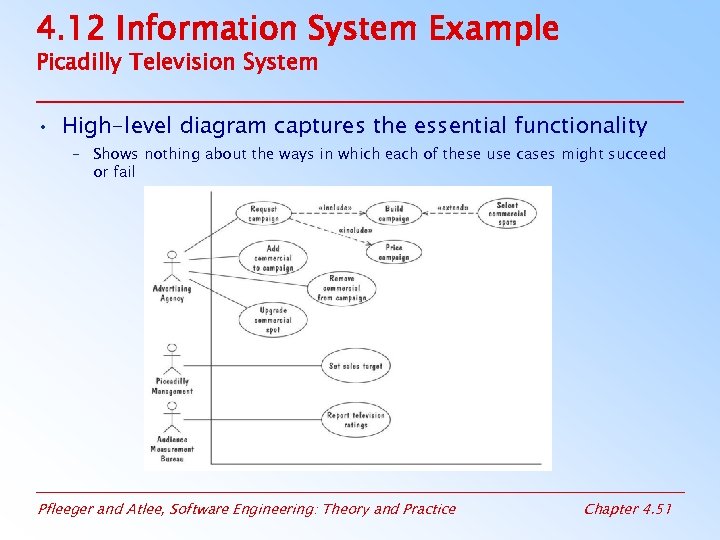 4. 12 Information System Example Picadilly Television System • High-level diagram captures the essential functionality – Shows nothing about the ways in which each of these use cases might succeed or fail Pfleeger and Atlee, Software Engineering: Theory and Practice Chapter 4. 51
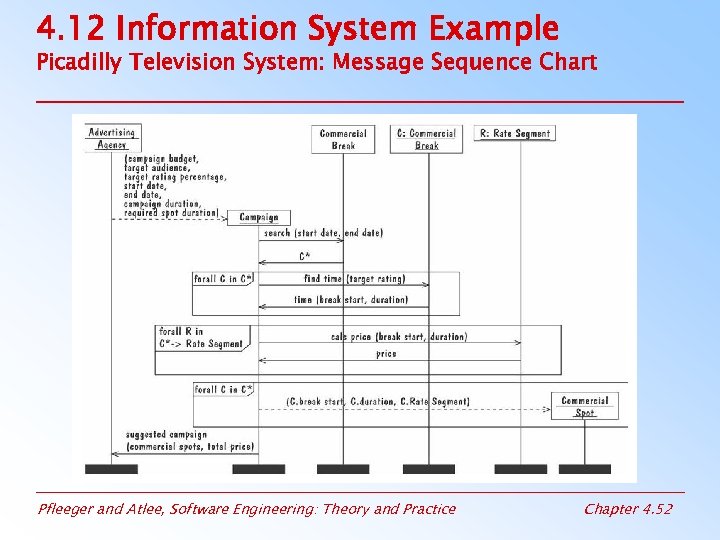 4. 12 Information System Example Picadilly Television System: Message Sequence Chart Pfleeger and Atlee, Software Engineering: Theory and Practice Chapter 4. 52
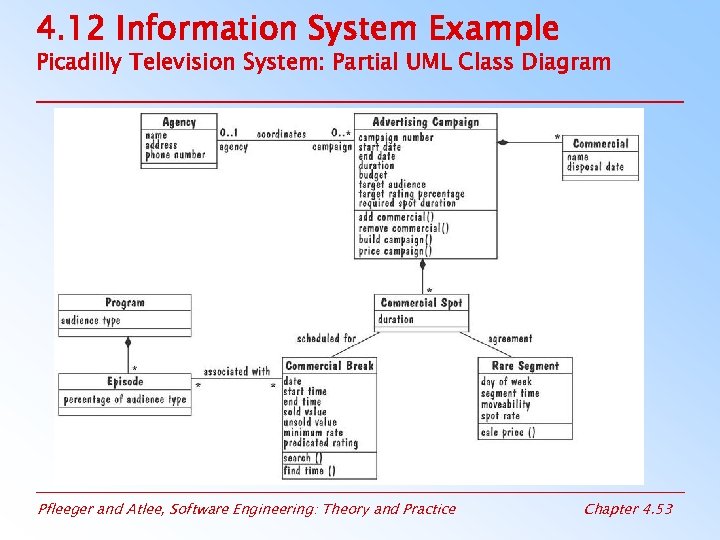 4. 12 Information System Example Picadilly Television System: Partial UML Class Diagram Pfleeger and Atlee, Software Engineering: Theory and Practice Chapter 4. 53
 4. 13 Real-Time Example • Ariane-5 failed due to requirement validation not done properly – Requirements validation could have played a crucial role in preventing the rocket's explosion • Two criteria that are especially important for specifying a system such as Ariane-5 – Testability/simulation and runtime safety – SDL was rated “strong” for testability/simulation and runtime safety Pfleeger and Atlee, Software Engineering: Theory and Practice Chapter 4. 54
 4. 14 What This Chapter Means for You • It is essential that the requirements definition and specification documents describe the problem, leaving solution selection to designer • There are variety of sources and means for eliciting requirements • There are many different types of definition and specification techniques • The specification techniques also differ in terms of their tool support, maturity, understandability, ease of use, and mathematical formality • Requirements questions can be answered using models or prototypes • Requirements must be validated to ensure that they accurately reflect the customer's expectations Pfleeger and Atlee, Software Engineering: Theory and Practice Chapter 4. 55