


 Скачать презентацию Chapter 4 Atmospheric Pressure and wind
81eac9de1a66b050c988fe874344ea99.ppt
- Количество слайдов: 109
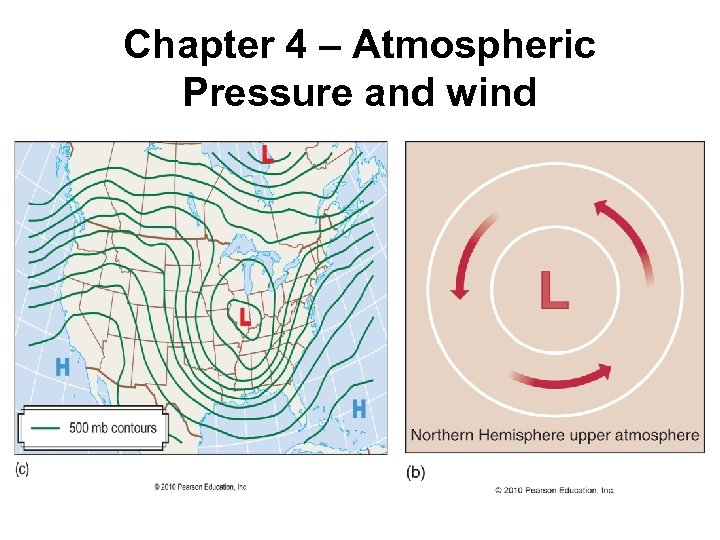 Chapter 4 – Atmospheric Pressure and wind
 Recall: Pressure General Characteristics • Pressure is defined as force per unit area
 Recall: Pressure General Characteristics • Pressure is defined as force per unit area • Pressure comes in different units: - Pascals(Pa), milibars(mb), inches of mercury (in Hg), pounds per square inch (psi)
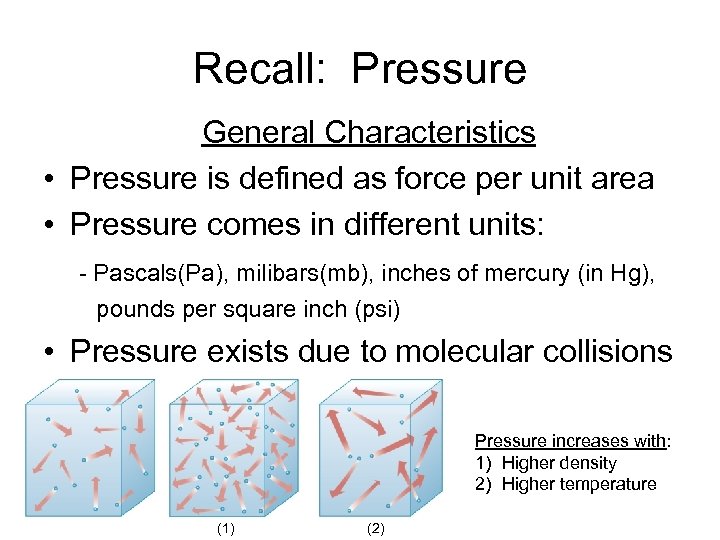 Recall: Pressure General Characteristics • Pressure is defined as force per unit area • Pressure comes in different units: - Pascals(Pa), milibars(mb), inches of mercury (in Hg), pounds per square inch (psi) • Pressure exists due to molecular collisions Pressure increases with: 1) Higher density 2) Higher temperature (1) (2)
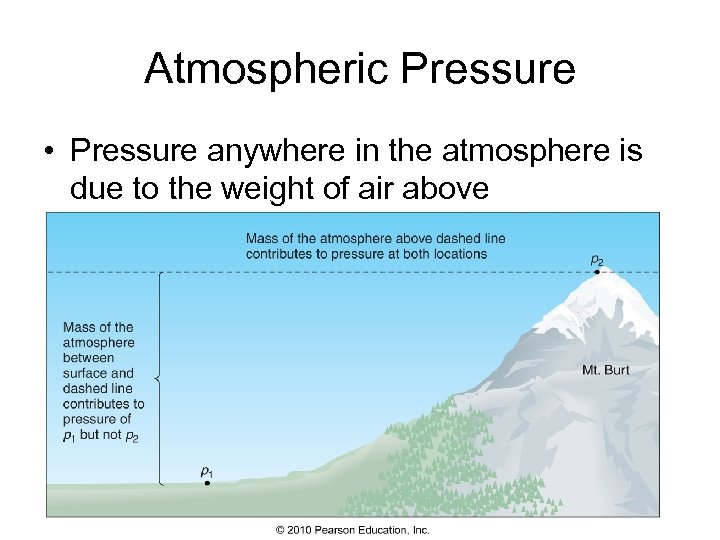 Atmospheric Pressure • Pressure anywhere in the atmosphere is due to the weight of air above
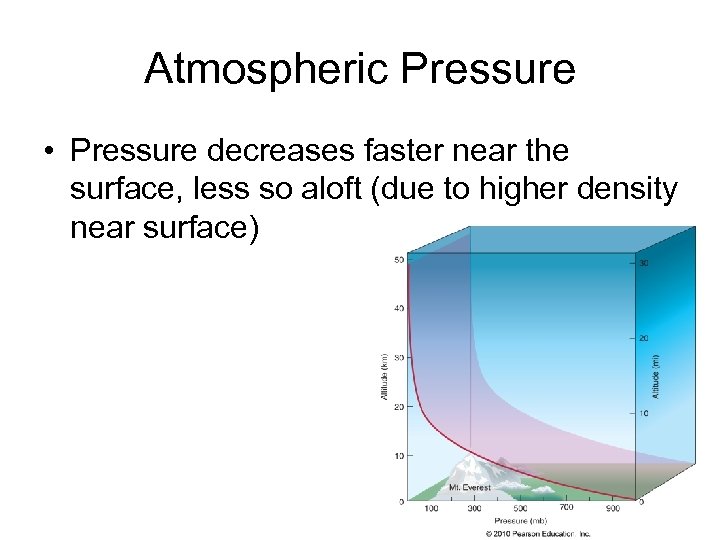 Atmospheric Pressure • Pressure decreases faster near the surface, less so aloft (due to higher density near surface)
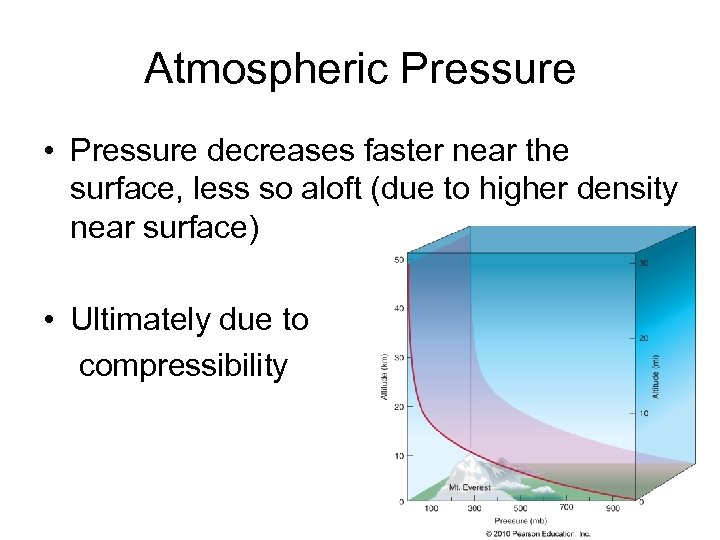 Atmospheric Pressure • Pressure decreases faster near the surface, less so aloft (due to higher density near surface) • Ultimately due to compressibility
 Atmospheric Pressure • The nature of atmospheric pressure explains much, including: 1) My exploding bag of chips
 Atmospheric Pressure • The nature of atmospheric pressure explains much, including: 1) My exploding bag of chips 2) The gravity-defying upside-down cup of water (and the straw trick)
 Atmospheric Pressure • The nature of atmospheric pressure explains much, including: 1) My exploding bag of chips 2) The gravity-defying upside-down cup of water (and the straw trick) 3) Why flight attendants aren’t worried about airplane doors being opened at cruising altitude
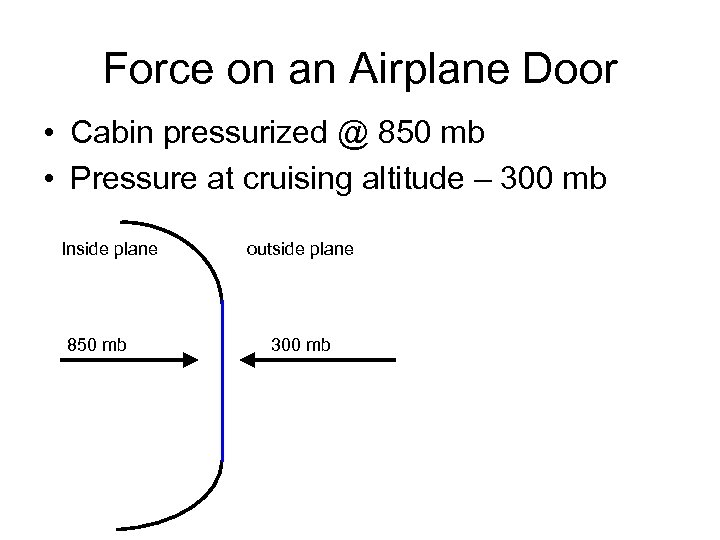 Force on an Airplane Door • Cabin pressurized @ 850 mb • Pressure at cruising altitude – 300 mb Inside plane 850 mb outside plane 300 mb
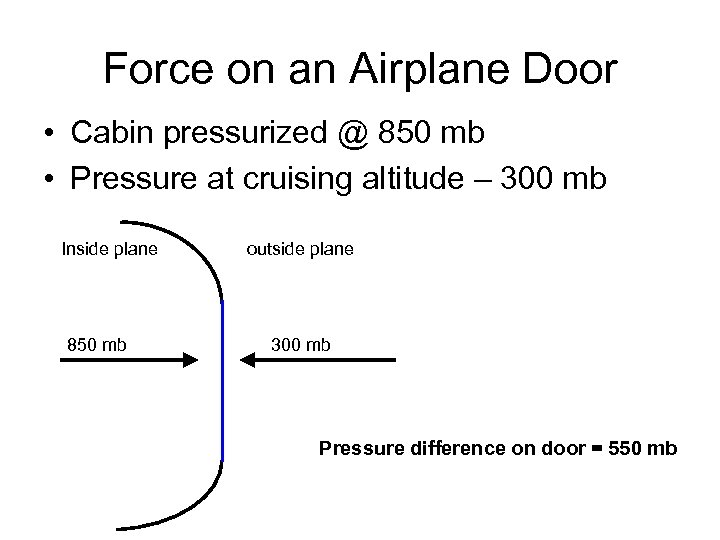 Force on an Airplane Door • Cabin pressurized @ 850 mb • Pressure at cruising altitude – 300 mb Inside plane 850 mb outside plane 300 mb Pressure difference on door = 550 mb
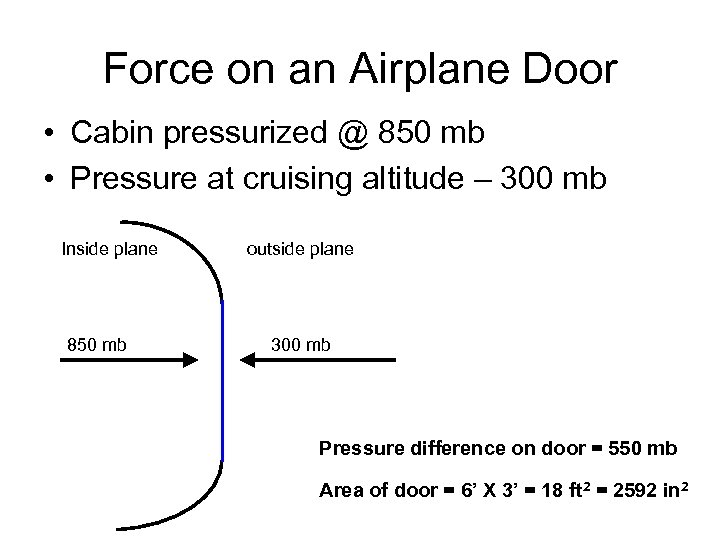 Force on an Airplane Door • Cabin pressurized @ 850 mb • Pressure at cruising altitude – 300 mb Inside plane 850 mb outside plane 300 mb Pressure difference on door = 550 mb Area of door = 6’ X 3’ = 18 ft 2 = 2592 in 2
 Force on an Airplane Door • 550 mb pushing on 2592 in 2
 Force on an Airplane Door • 550 mb pushing on 2592 in 2 • 1 mb = 0. 0145 psi (unit conversion)
 Force on an Airplane Door • 550 mb pushing on 2592 in 2 • 1 mb = 0. 0145 psi (unit conversion) • 550 mb = 8 psi
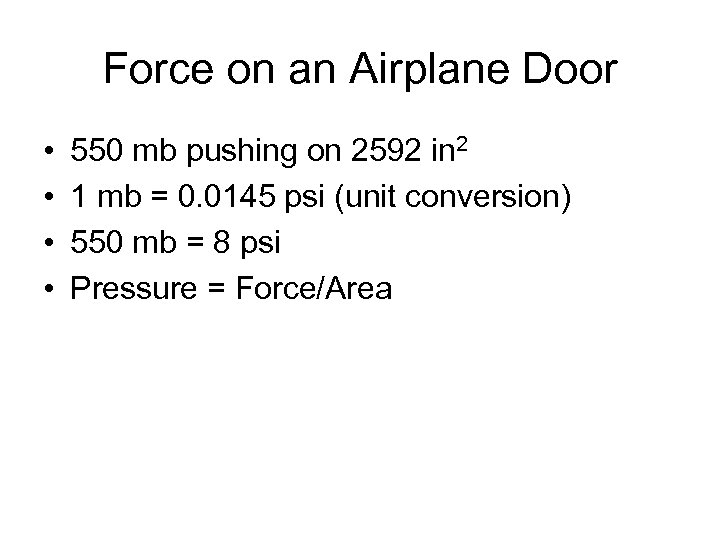 Force on an Airplane Door • • 550 mb pushing on 2592 in 2 1 mb = 0. 0145 psi (unit conversion) 550 mb = 8 psi Pressure = Force/Area
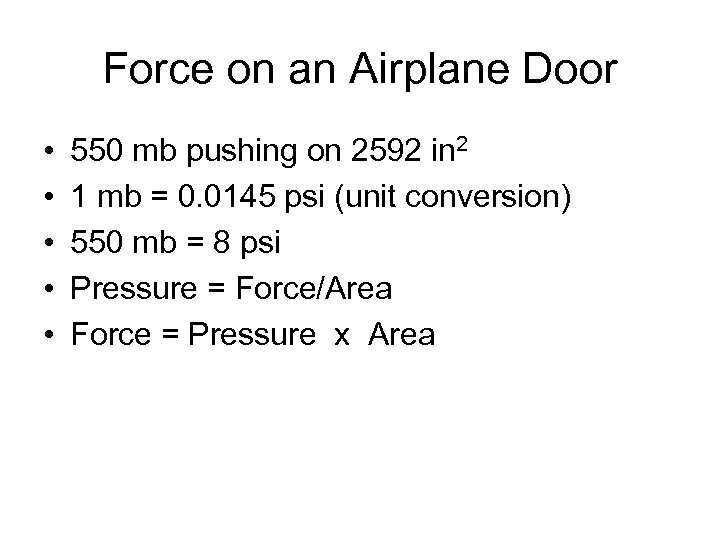 Force on an Airplane Door • • • 550 mb pushing on 2592 in 2 1 mb = 0. 0145 psi (unit conversion) 550 mb = 8 psi Pressure = Force/Area Force = Pressure x Area
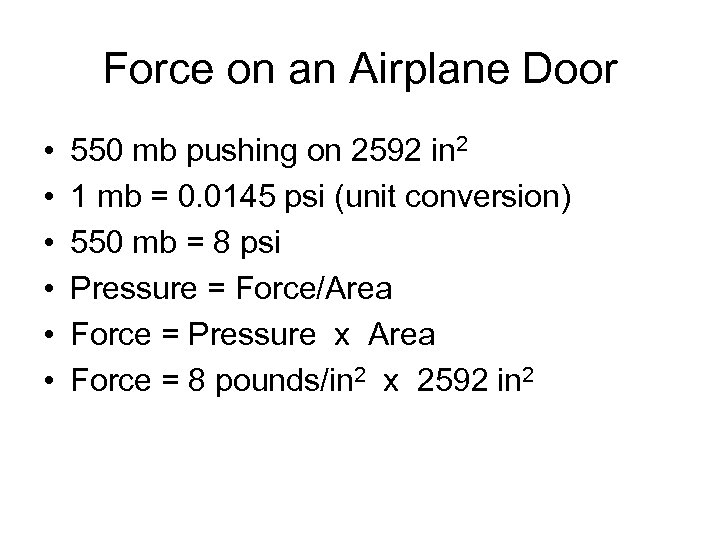 Force on an Airplane Door • • • 550 mb pushing on 2592 in 2 1 mb = 0. 0145 psi (unit conversion) 550 mb = 8 psi Pressure = Force/Area Force = Pressure x Area Force = 8 pounds/in 2 x 2592 in 2
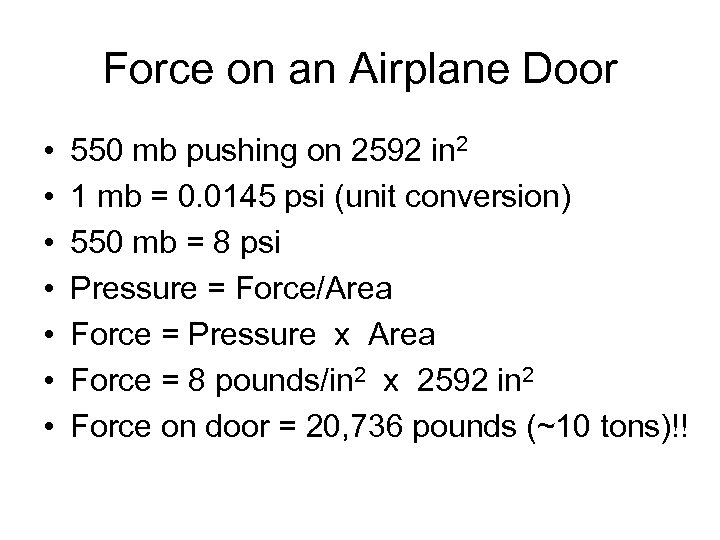 Force on an Airplane Door • • 550 mb pushing on 2592 in 2 1 mb = 0. 0145 psi (unit conversion) 550 mb = 8 psi Pressure = Force/Area Force = Pressure x Area Force = 8 pounds/in 2 x 2592 in 2 Force on door = 20, 736 pounds (~10 tons)!!
 Atmospheric Pressure • The nature of atmospheric pressure explains much, including: 1) My exploding bag of chips 2) The gravity-defying upside-down cup of water (and the straw trick) 3) Why flight attendants aren’t worried about airplane doors being opened at cruising altitude 4) The incredible can crushing power of atmospheric surface pressure
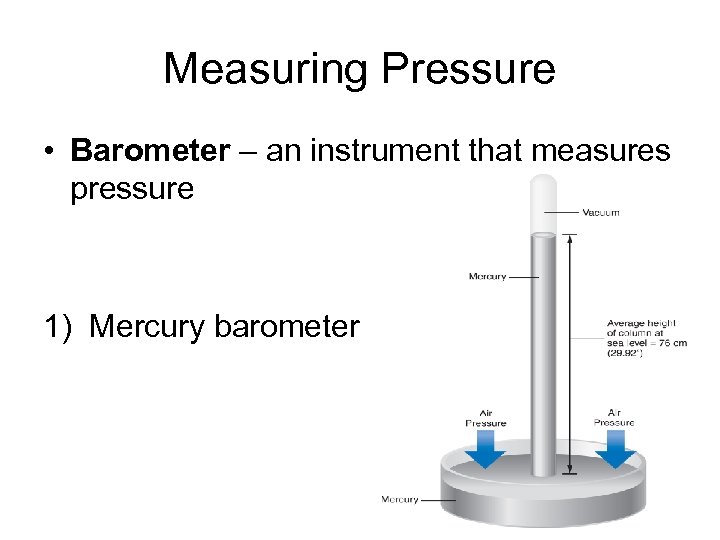 Measuring Pressure • Barometer – an instrument that measures pressure 1) Mercury barometer
 Corrections to Mercury Barometer Readings 1) Correction for altitude (standardized to sea level)
 Corrections to Mercury Barometer Readings 1) Correction for altitude (standardized to sea level) 2) Correction for temperature (standardized to 32 o. F)
 Corrections to Mercury Barometer Readings 1) Correction for altitude (standardized to sea level) 2) Correction for temperature (standardized to 32 o. F) 3) Correction for gravity difference with respect to latitude (earth’s not a sphere? ) (standardized to 45 o. N)
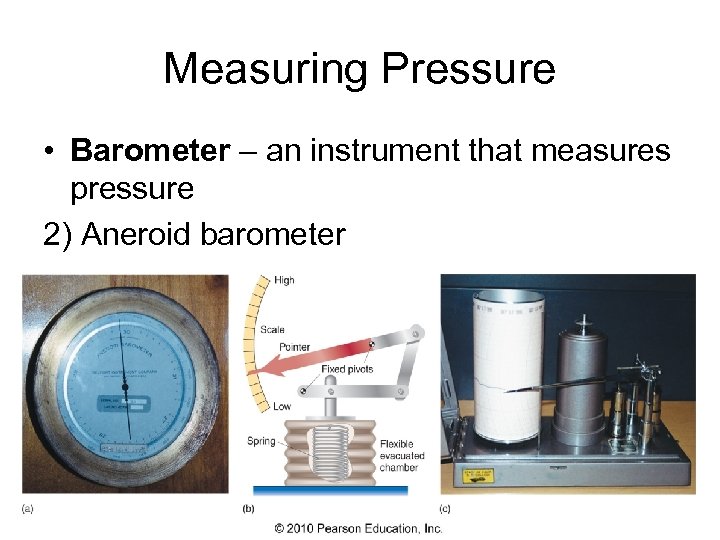 Measuring Pressure • Barometer – an instrument that measures pressure 2) Aneroid barometer
 Horizontal Pressure Distribution • Pressure gradients (change in pressure with distance) cause air to move Wind!!!
 Horizontal Pressure Distribution • Pressure gradients (change in pressure with distance) cause air to move Wind!!! • This wind is a direct application of how force equals mass times acceleration (F=m*a)
 Horizontal Pressure Distribution • Pressure gradients (change in pressure with distance) cause air to move Wind!!! • This wind is a direct application of how force equals mass times acceleration (F=m*a) • In the case of wind, the force (F) is the pressure gradient force
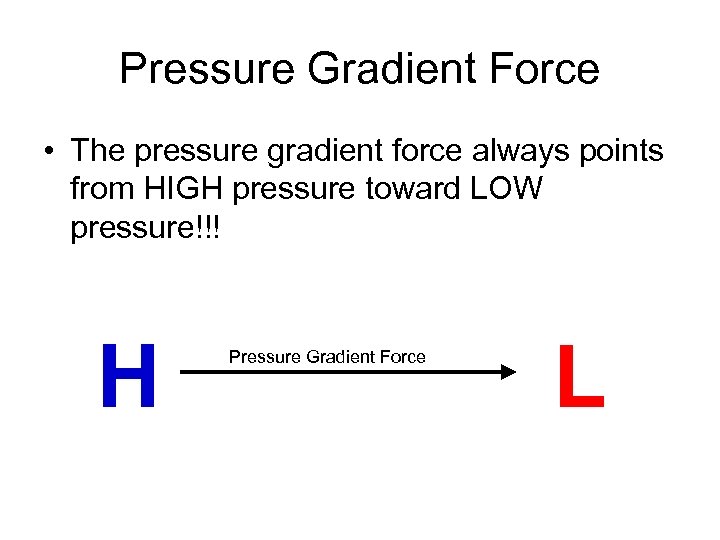 Pressure Gradient Force • The pressure gradient force always points from HIGH pressure toward LOW pressure!!! H Pressure Gradient Force L
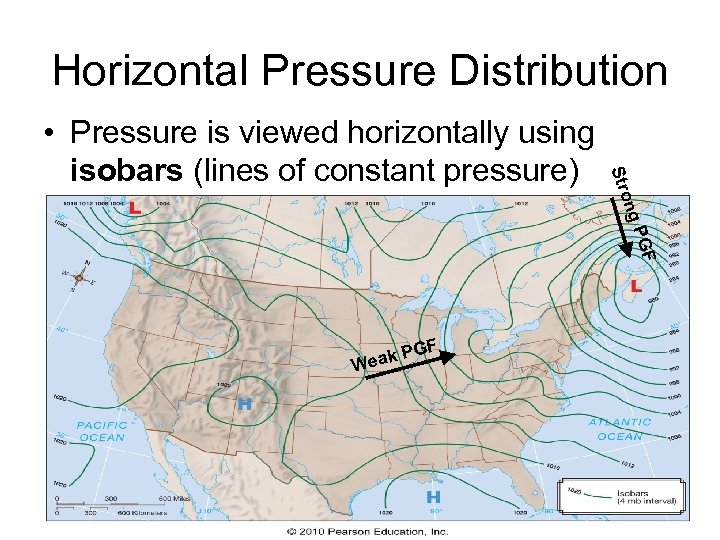 Horizontal Pressure Distribution GF g. P n Stro • Pressure is viewed horizontally using isobars (lines of constant pressure) GF P Weak
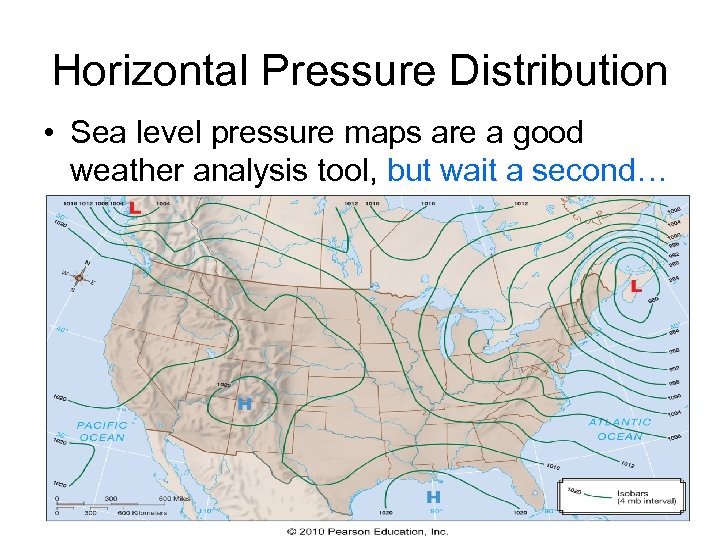 Horizontal Pressure Distribution • Sea level pressure maps are a good weather analysis tool, but wait a second…
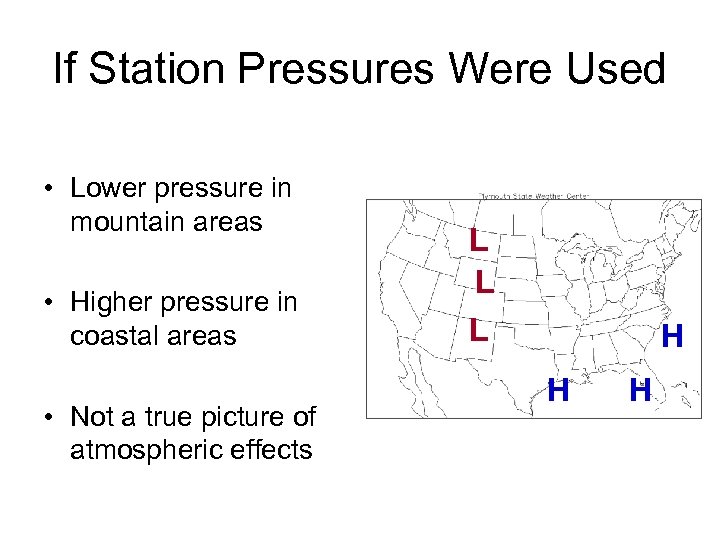 If Station Pressures Were Used • Lower pressure in mountain areas • Higher pressure in coastal areas • Not a true picture of atmospheric effects L L L H H H
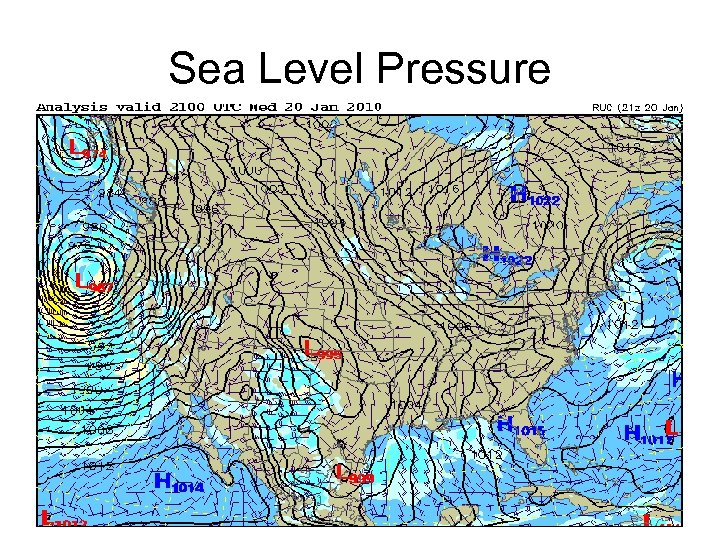
 Sea Level Pressure • Surface pressure observations are “reduced” to sea level (10 mb/100 meters is typical in lower atmosphere)
 Sea Level Pressure • Surface pressure observations are “reduced” to sea level (10 mb/100 meters is typical in lower atmosphere) • These sea level pressure values are the numbers on sea level pressure maps
 Sea Level Pressure • Surface pressure observations are “reduced” to sea level (10 mb/100 meters is typical in lower atmosphere) • These sea level pressure values are the numbers on sea level pressure maps • The effects of elevation are removed, revealing a more useful horizontal pressure distribution
 Sea Level Pressure • Why do we care? SLP maps are an important weather analysis tool: - Low pressure centers (cyclones) - High pressure centers (anticyclones) - Troughs - Ridges All of the above associated with various weather
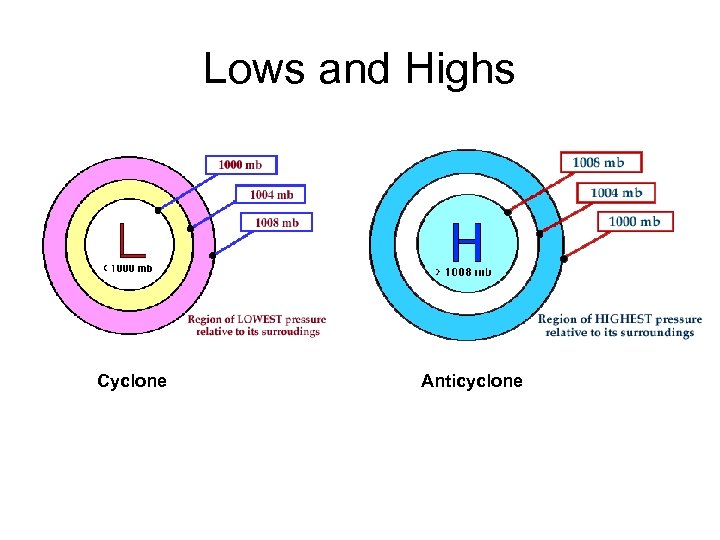 Lows and Highs Cyclone Anticyclone
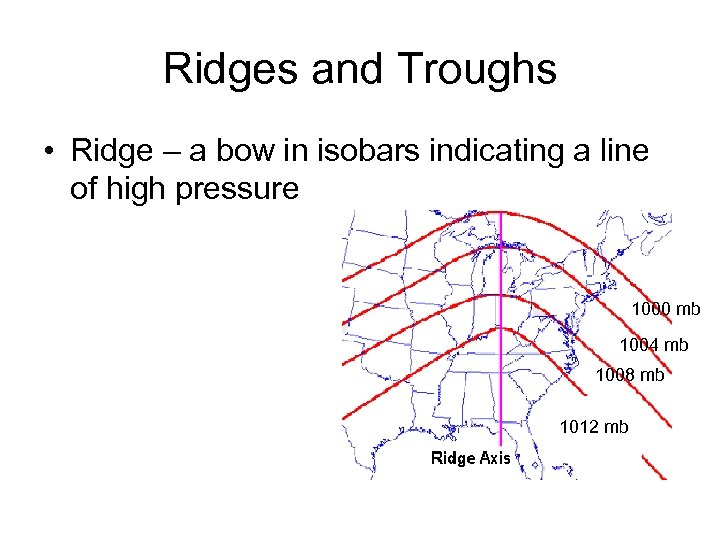 Ridges and Troughs • Ridge – a bow in isobars indicating a line of high pressure 1000 mb 1004 mb 1008 mb 1012 mb
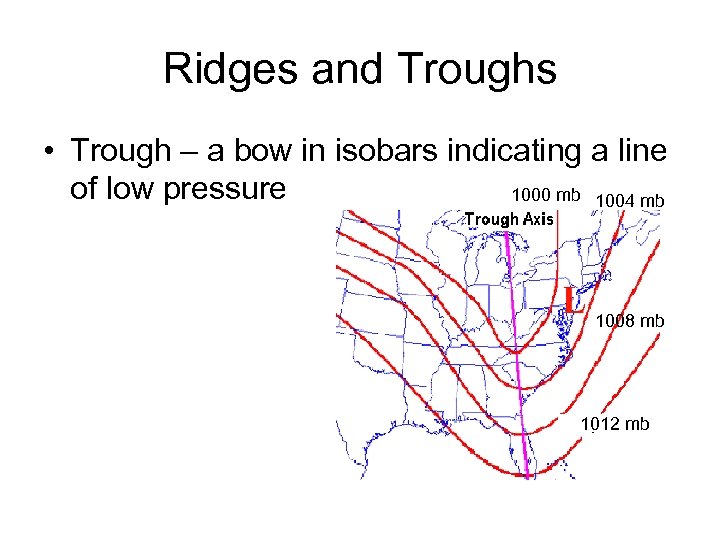 Ridges and Troughs • Trough – a bow in isobars indicating a line of low pressure 1000 mb 1004 mb 1008 mb 1012 mb
 Sea Level Pressure
 Vertical Pressure Distribution • Pressure always decreases with height
 Vertical Pressure Distribution • Pressure always decreases with height • Fastest near the surface
 Vertical Pressure Distribution • Pressure always decreases with height • Fastest near the surface • Vertical pressure gradients many times greater than horizontal pressure gradients
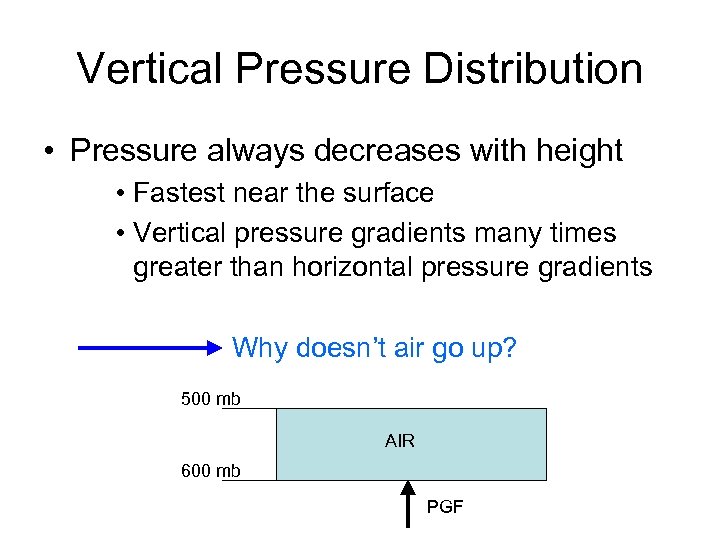 Vertical Pressure Distribution • Pressure always decreases with height • Fastest near the surface • Vertical pressure gradients many times greater than horizontal pressure gradients Why doesn’t air go up? 500 mb AIR 600 mb PGF
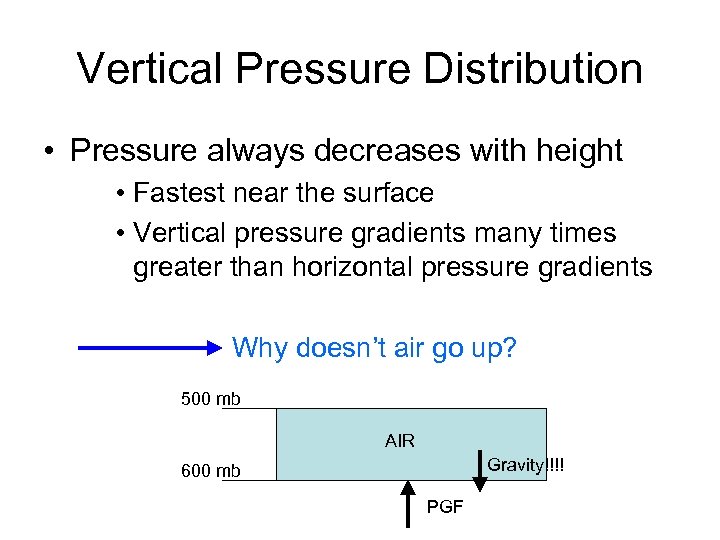 Vertical Pressure Distribution • Pressure always decreases with height • Fastest near the surface • Vertical pressure gradients many times greater than horizontal pressure gradients Why doesn’t air go up? 500 mb AIR Gravity!!!! 600 mb PGF
 Hydrostatic Balance • Hydrostatic balance (or equilibrium) is the balance between the pressure gradient and gravity forces in the vertical
 Hydrostatic Balance • Hydrostatic balance (or equilibrium) is the balance between the pressure gradient and gravity forces in the vertical • Exists almost always in the atmosphere
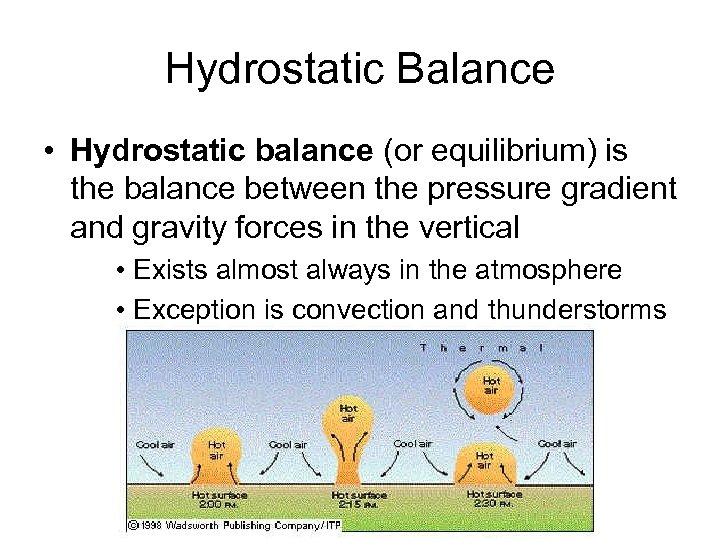 Hydrostatic Balance • Hydrostatic balance (or equilibrium) is the balance between the pressure gradient and gravity forces in the vertical • Exists almost always in the atmosphere • Exception is convection and thunderstorms
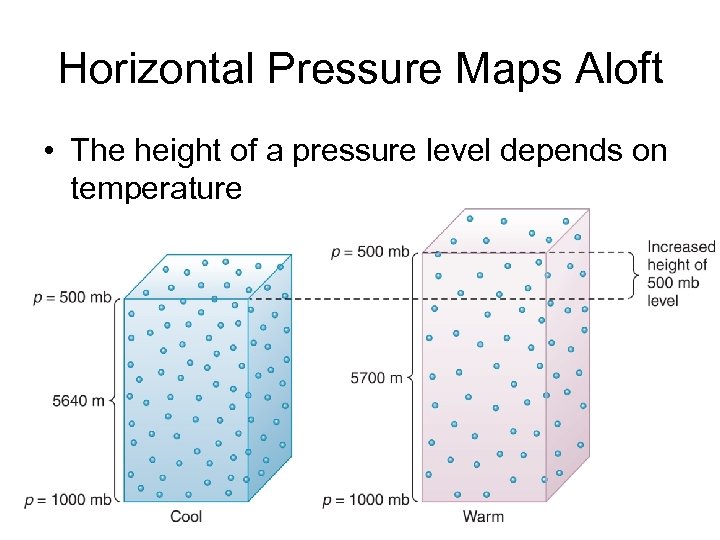 Horizontal Pressure Maps Aloft • The height of a pressure level depends on temperature
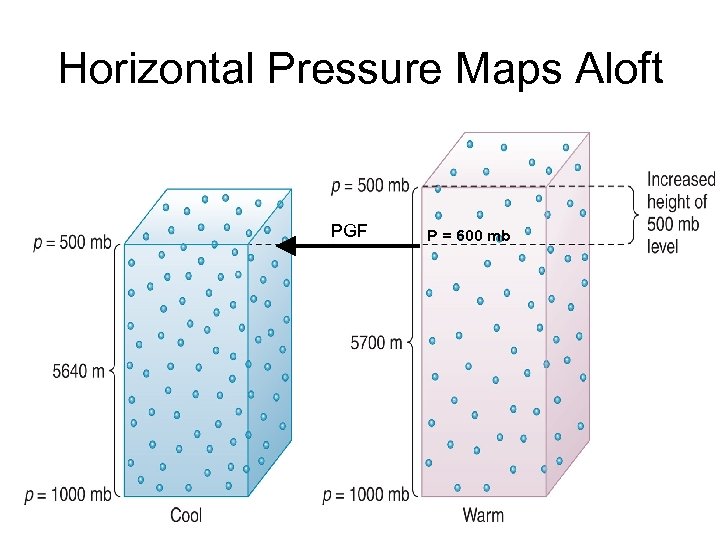 Horizontal Pressure Maps Aloft PGF P = 600 mb
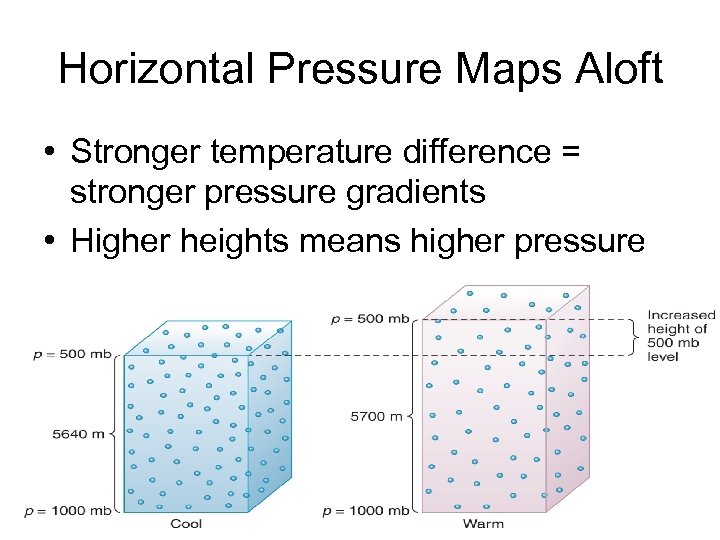 Horizontal Pressure Maps Aloft • Stronger temperature difference = stronger pressure gradients • Higher heights means higher pressure
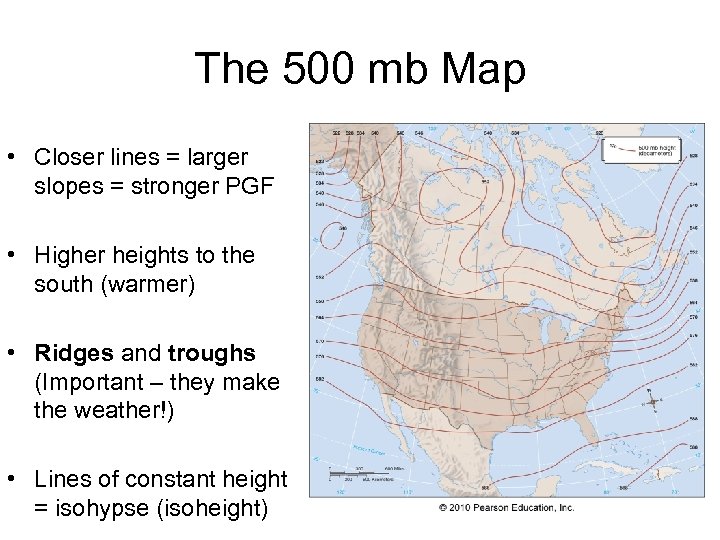 The 500 mb Map • Closer lines = larger slopes = stronger PGF • Higher heights to the south (warmer) • Ridges and troughs (Important – they make the weather!) • Lines of constant height = isohypse (isoheight)
 Other Standard Pressure Levels • In addition to 500 mb, other standard levels are: 850 mb - 1500 m (5000’) 700 mb - 3000 m (10000’) 300 mb - 10000 m (33000’)
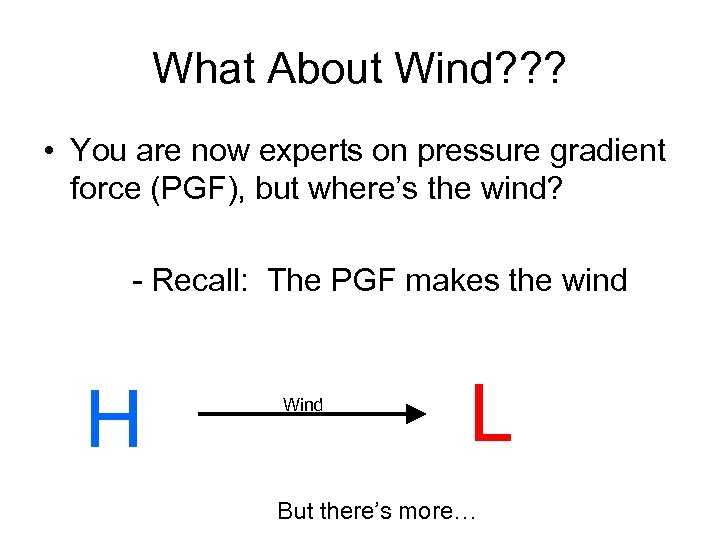 What About Wind? ? ? • You are now experts on pressure gradient force (PGF), but where’s the wind? - Recall: The PGF makes the wind H Wind L But there’s more…
 Forces Affecting the Wind • Pressure gradient force (PGF, directed from high pressure to low pressure)
 Forces Affecting the Wind • Pressure gradient force (PGF, directed from high pressure to low pressure) • The Coriolis Force 1) Due to earth’s rotation 2) Known as an apparent force 3) Conservation of angular momentum (N-S) 4) Centrifugal force (E-W)
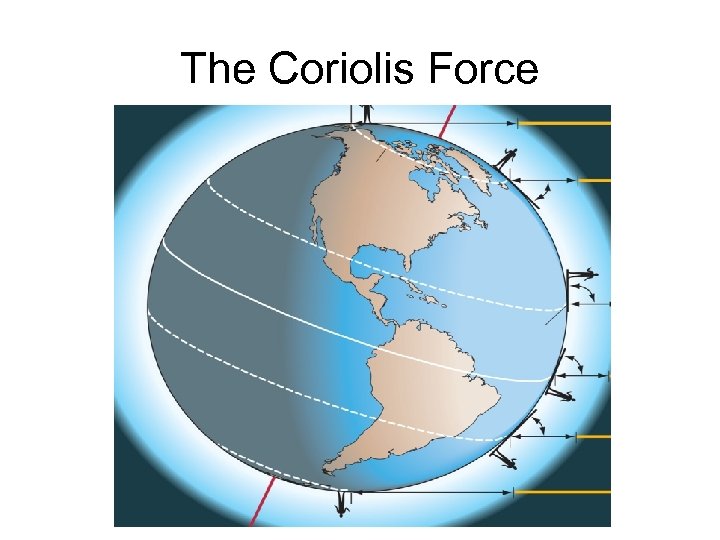
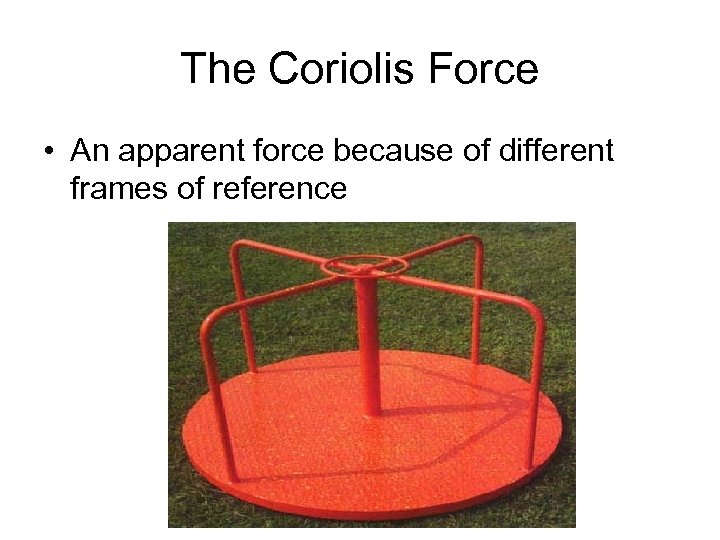 The Coriolis Force • An apparent force because of different frames of reference
 The Coriolis Force • In the N-S direction, conservation of angular momentum produces the Coriolis Force
 The Coriolis Force • In the N-S direction, conservation of angular momentum produces the Coriolis Force Think figure skaters…
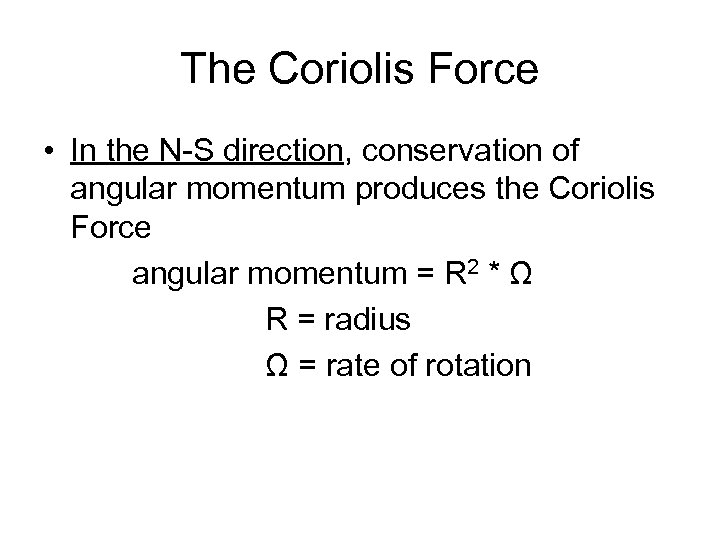 The Coriolis Force • In the N-S direction, conservation of angular momentum produces the Coriolis Force angular momentum = R 2 * Ω R = radius Ω = rate of rotation
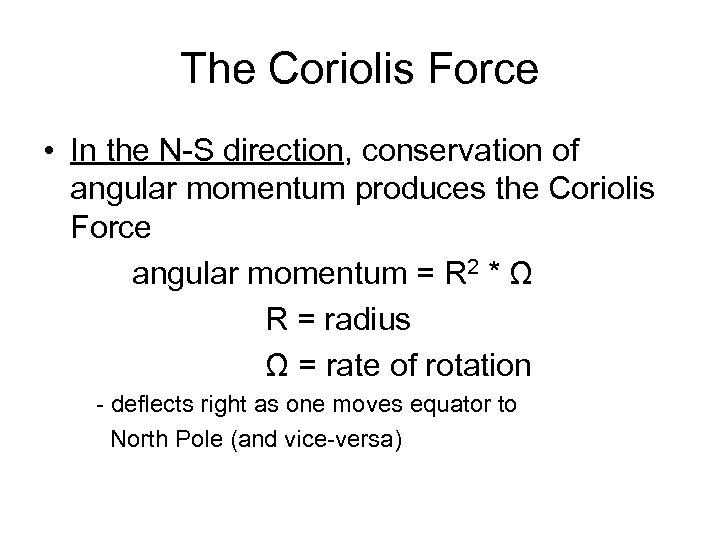 The Coriolis Force • In the N-S direction, conservation of angular momentum produces the Coriolis Force angular momentum = R 2 * Ω R = radius Ω = rate of rotation - deflects right as one moves equator to North Pole (and vice-versa)
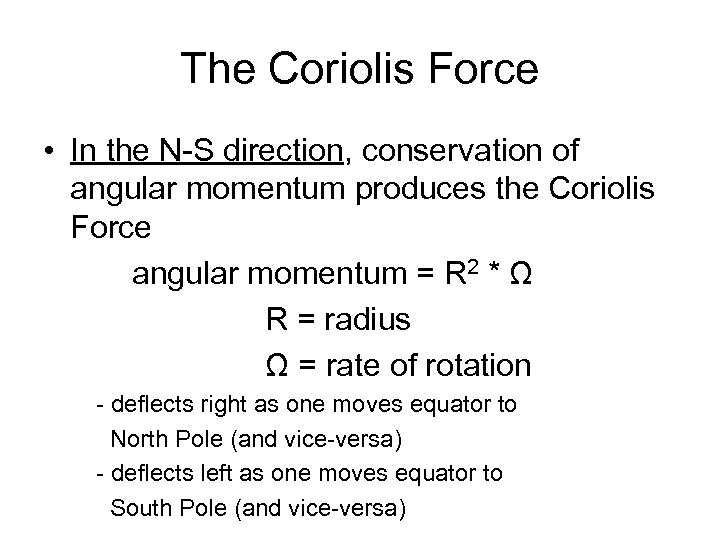 The Coriolis Force • In the N-S direction, conservation of angular momentum produces the Coriolis Force angular momentum = R 2 * Ω R = radius Ω = rate of rotation - deflects right as one moves equator to North Pole (and vice-versa) - deflects left as one moves equator to South Pole (and vice-versa)
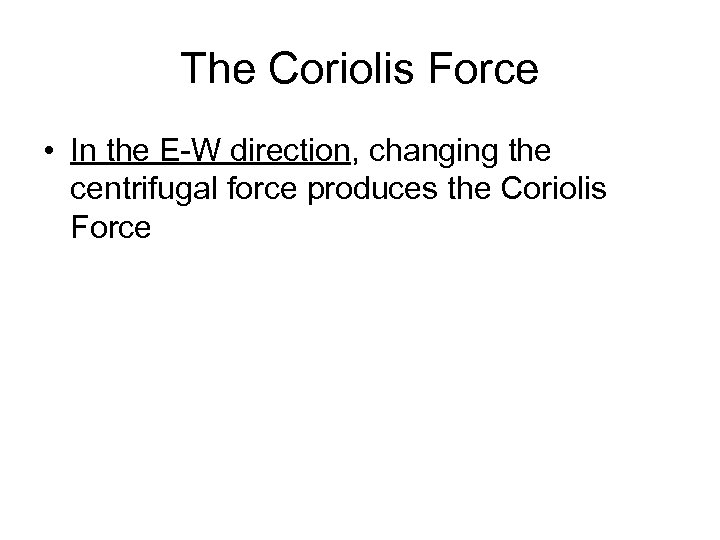 The Coriolis Force • In the E-W direction, changing the centrifugal force produces the Coriolis Force
 The Coriolis Force • In the E-W direction, changing the centrifugal force produces the Coriolis Force - Think about those spinning chairs at the carnival…
 The Coriolis Force • In the E-W direction, changing the centrifugal force produces the Coriolis Force - Think about those spinning chairs at the carnival… - Wanna lose weight? Run really fast around the equator (but don’t go the wrong way…)
 The Coriolis Force • In the E-W direction, changing the centrifugal force produces the Coriolis Force Northern Hemisphere - deflects right as one moves east - deflects right as one moves west Southern Hemisphere - deflects left as one moves east - deflects left as one moves west
 The Coriolis Force • Main points to remember: 1) Coriolis Force deflects moving things right (NH) or left (SH)
 The Coriolis Force
 The Coriolis Force • Main points to remember: 1) Coriolis Force deflects moving things right (NH) or left (SH) 2) There is no Coriolis Force at the equator, and it is maximum at the poles
 The Coriolis Force • Main points to remember: 1) Coriolis Force deflects moving things right (NH) or left (SH) 2) There is no Coriolis Force at the equator, and it is maximum at the poles 3) The Coriolis Force is proportional to speed
 The Coriolis Force • Main points to remember: 1) Coriolis Force deflects moving things right (NH) or left (SH) 2) There is no Coriolis Force at the equator, and it is maximum at the poles 3) The Coriolis Force is proportional to speed 4) The Coriolis Forces changes only direction, not speed
 The Coriolis Force • Main points to remember: 5) Coriolis force is slow to act (noticeable only after a few hours)
 Forces Affecting the Wind • Pressure gradient force (PGF, directed from high pressure to low pressure) • The Coriolis Force 1) Due to earth’s rotation 2) Known as an apparent force 3) Conservation of angular momentum (N-S) 4) Centrifugal force (E-W) • Friction (from the ground, within the planetary boundary layer)
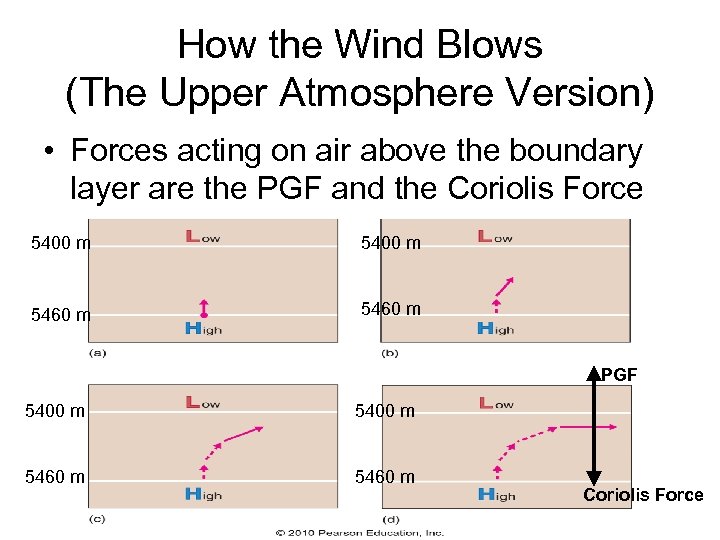 How the Wind Blows (The Upper Atmosphere Version) • Forces acting on air above the boundary layer are the PGF and the Coriolis Force 5400 m 5460 m PGF 5400 m 5460 m Coriolis Force
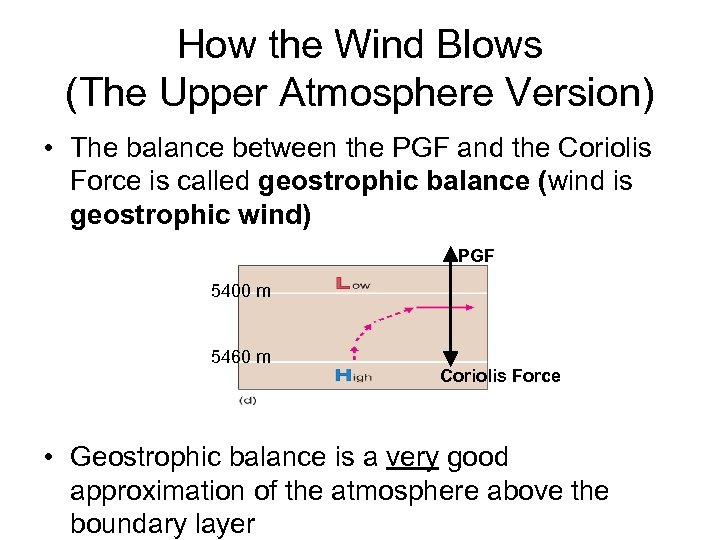 How the Wind Blows (The Upper Atmosphere Version) • The balance between the PGF and the Coriolis Force is called geostrophic balance (wind is geostrophic wind) PGF 5400 m 5460 m Coriolis Force • Geostrophic balance is a very good approximation of the atmosphere above the boundary layer
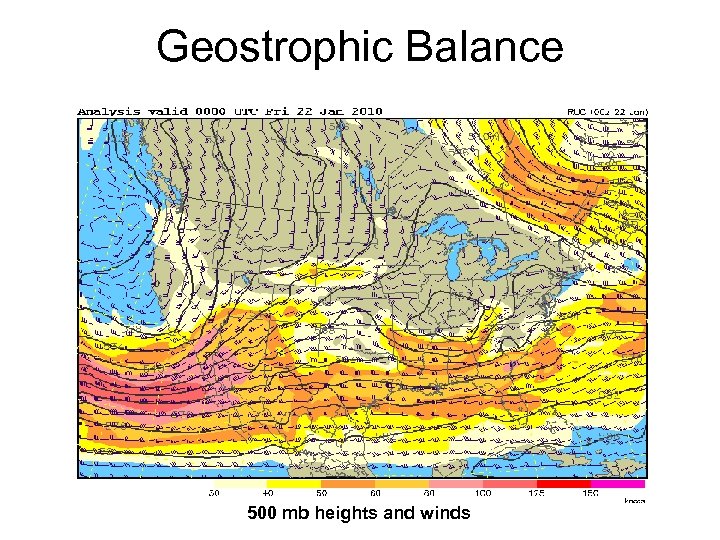 Geostrophic Balance 500 mb heights and winds
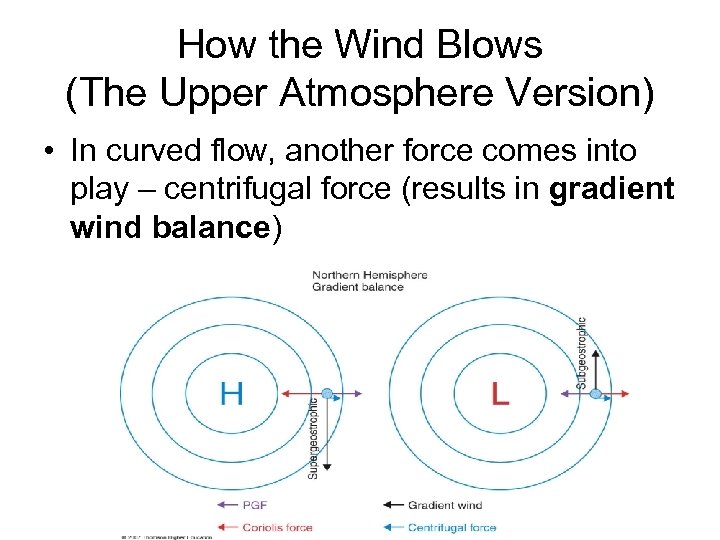 How the Wind Blows (The Upper Atmosphere Version) • In curved flow, another force comes into play – centrifugal force (results in gradient wind balance)
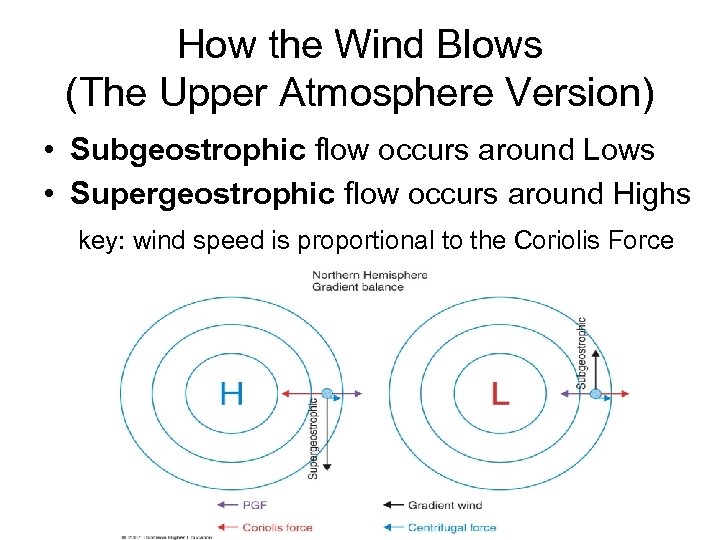 How the Wind Blows (The Upper Atmosphere Version) • Subgeostrophic flow occurs around Lows • Supergeostrophic flow occurs around Highs key: wind speed is proportional to the Coriolis Force
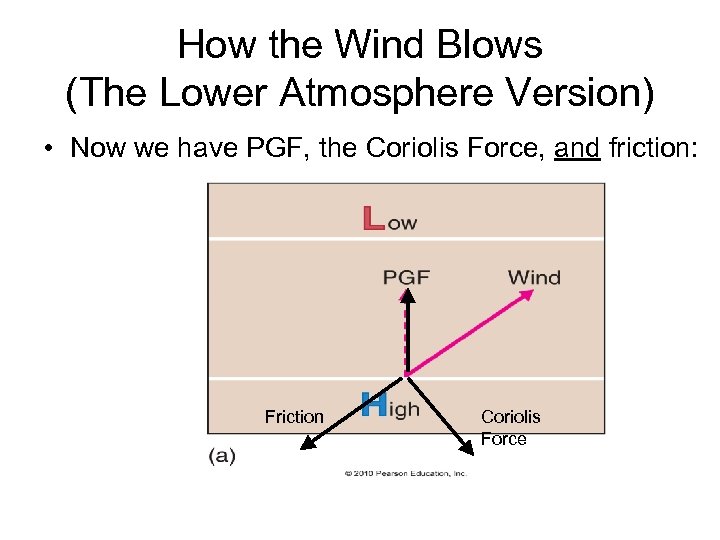 How the Wind Blows (The Lower Atmosphere Version) • Now we have PGF, the Coriolis Force, and friction: Friction Coriolis Force
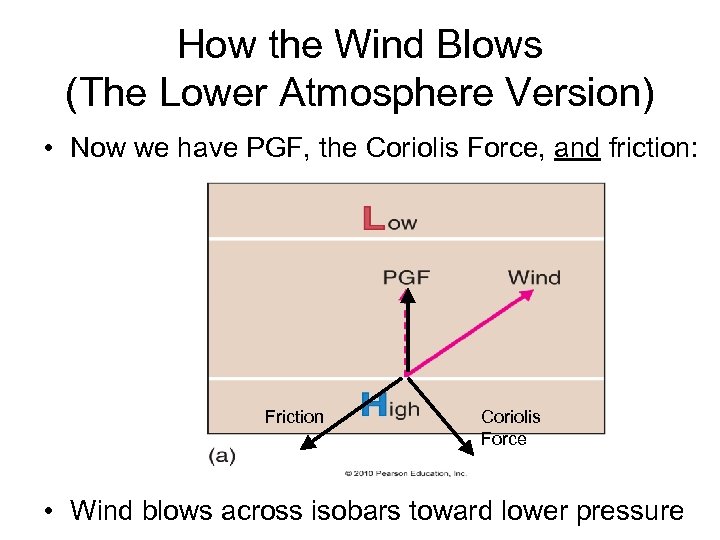 How the Wind Blows (The Lower Atmosphere Version) • Now we have PGF, the Coriolis Force, and friction: Friction Coriolis Force • Wind blows across isobars toward lower pressure
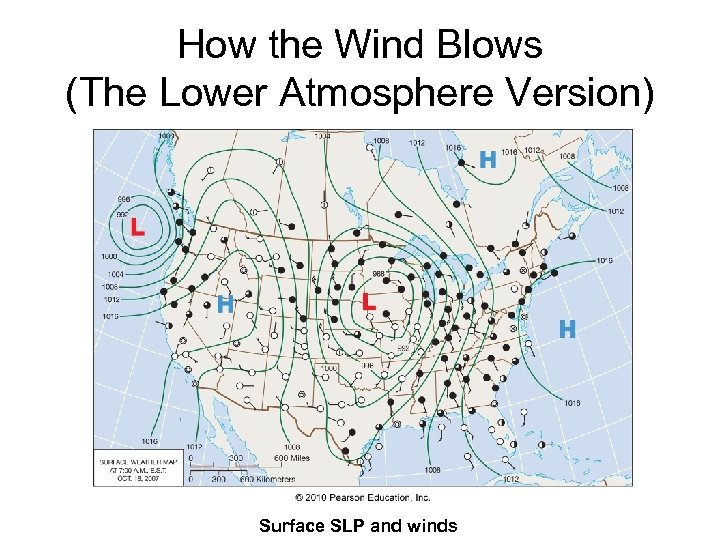 How the Wind Blows (The Lower Atmosphere Version) Surface SLP and winds
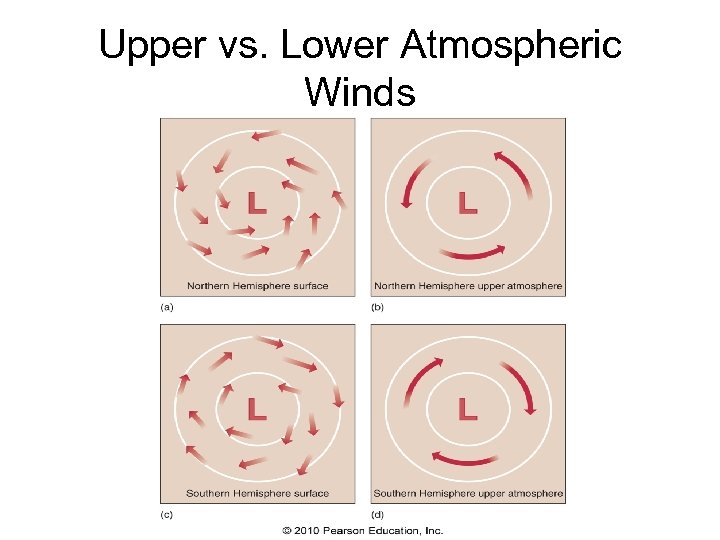 Upper vs. Lower Atmospheric Winds
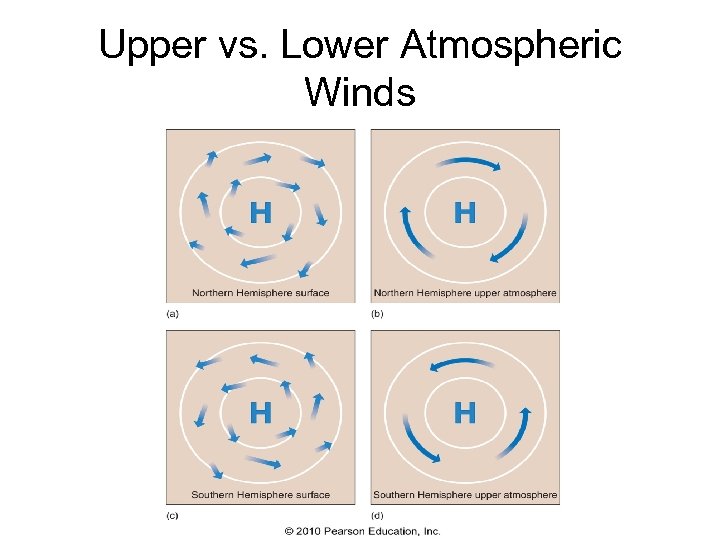 Upper vs. Lower Atmospheric Winds
 Cyclostrophic Balance • Wind field achieves a balance between the centrifugal force and the PGF
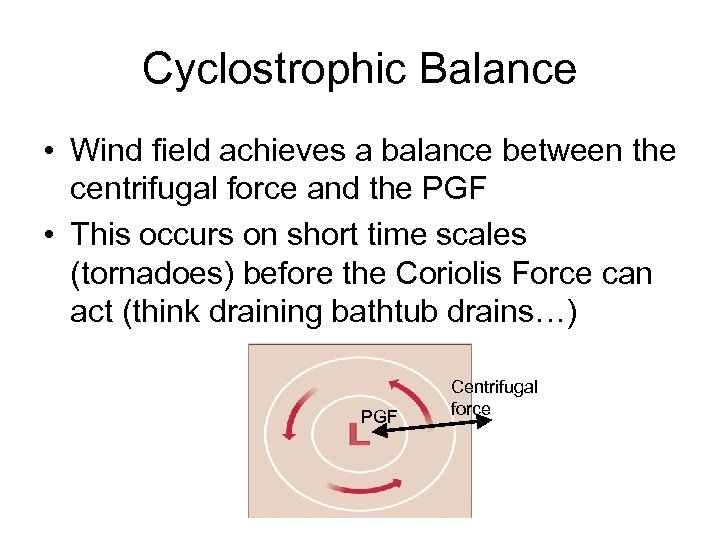 Cyclostrophic Balance • Wind field achieves a balance between the centrifugal force and the PGF • This occurs on short time scales (tornadoes) before the Coriolis Force can act (think draining bathtub drains…) PGF Centrifugal force
 Measuring Wind • Both wind speed and direction are measured
 Measuring Wind • Both wind speed and direction are measured direction: measured as the direction where the wind blows from in degrees clockwise from North
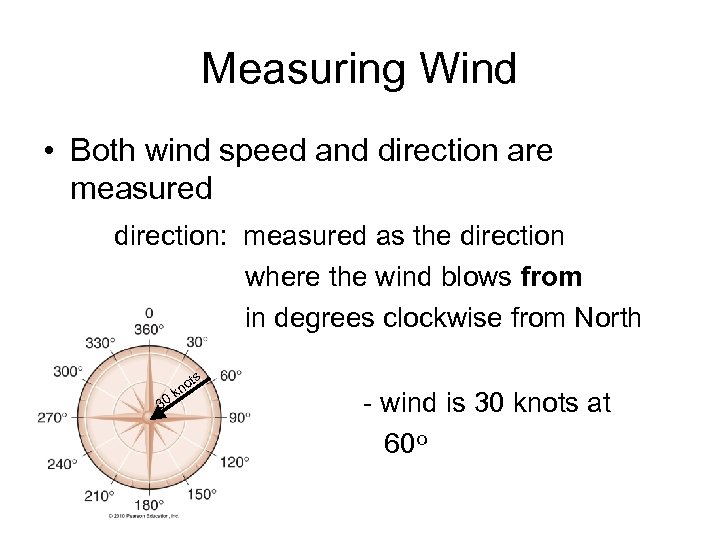 Measuring Wind • Both wind speed and direction are measured direction: measured as the direction where the wind blows from in degrees clockwise from North ts 30 o kn - wind is 30 knots at 60 o
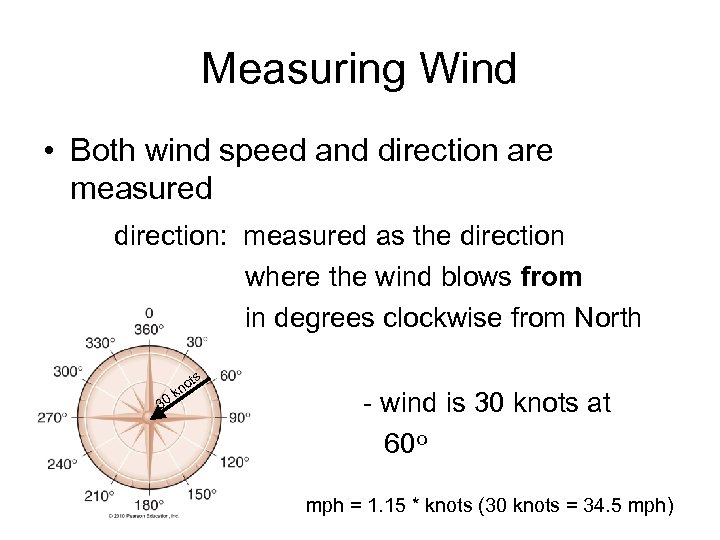 Measuring Wind • Both wind speed and direction are measured direction: measured as the direction where the wind blows from in degrees clockwise from North ts 30 o kn - wind is 30 knots at 60 o mph = 1. 15 * knots (30 knots = 34. 5 mph)
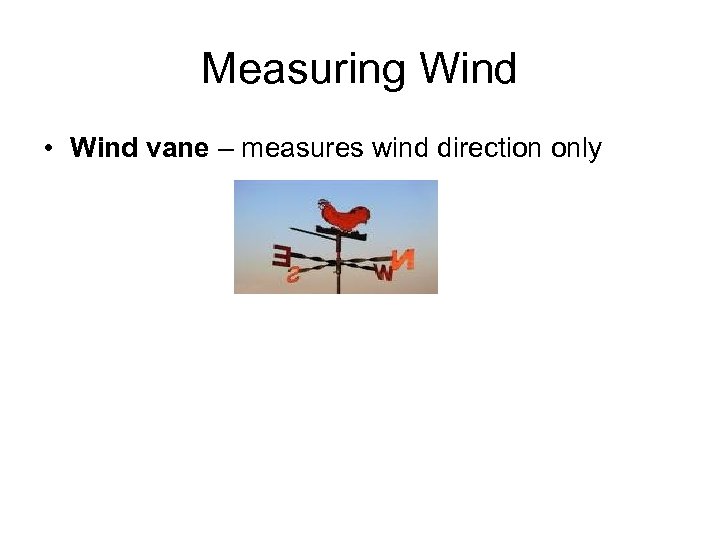 Measuring Wind • Wind vane – measures wind direction only
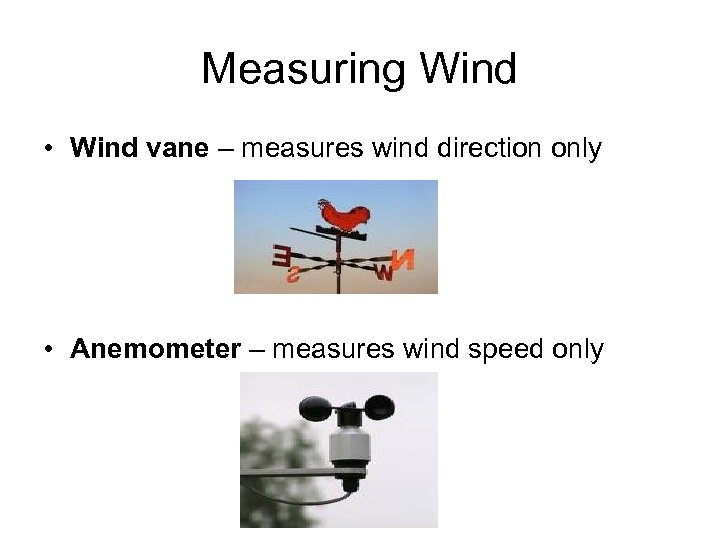 Measuring Wind • Wind vane – measures wind direction only • Anemometer – measures wind speed only
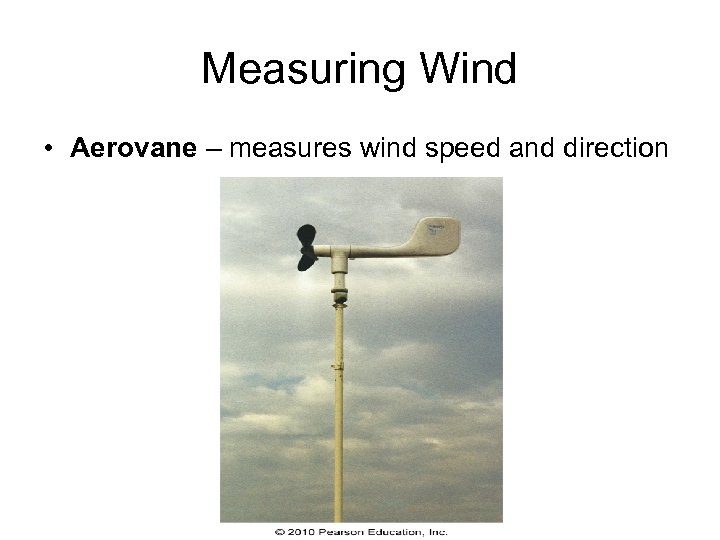 Measuring Wind • Aerovane – measures wind speed and direction
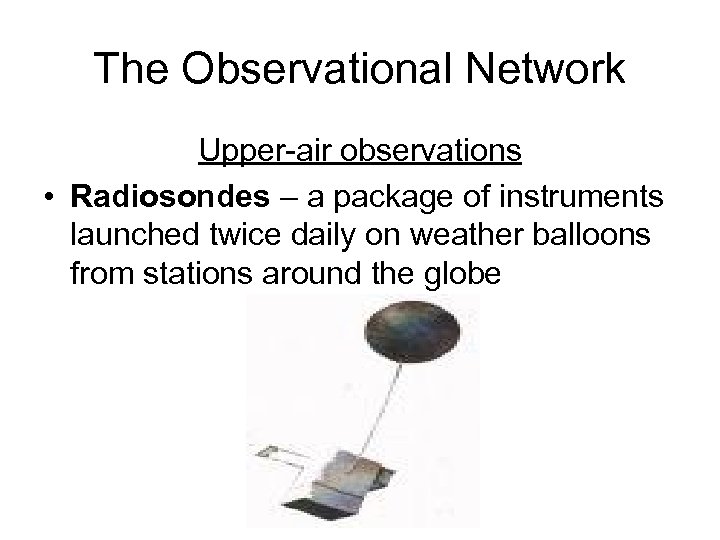 The Observational Network Upper-air observations • Radiosondes – a package of instruments launched twice daily on weather balloons from stations around the globe
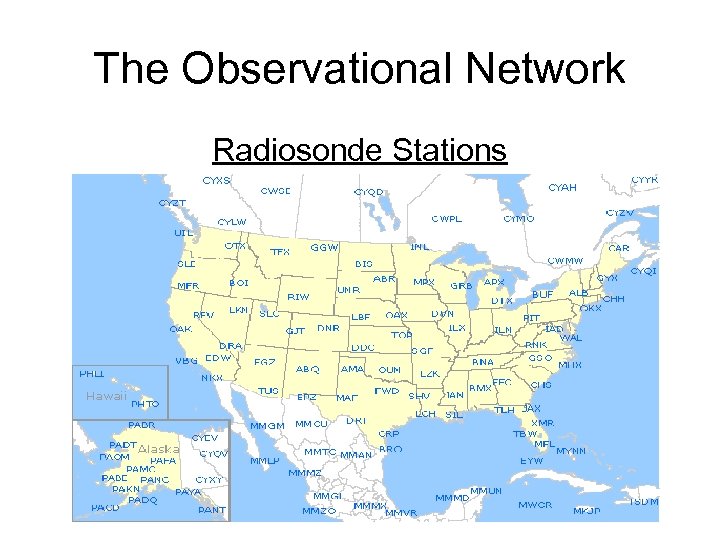 The Observational Network Radiosonde Stations
 Radiosondes • Launched globally at 0000 UTC and 1200 UTC – Universal Time Coordiante – same time everywhere on earth (as opposed to local time) Local Lubbock time = UTC time – 6 hours (CST) = UTC time – 5 hours (CDT)
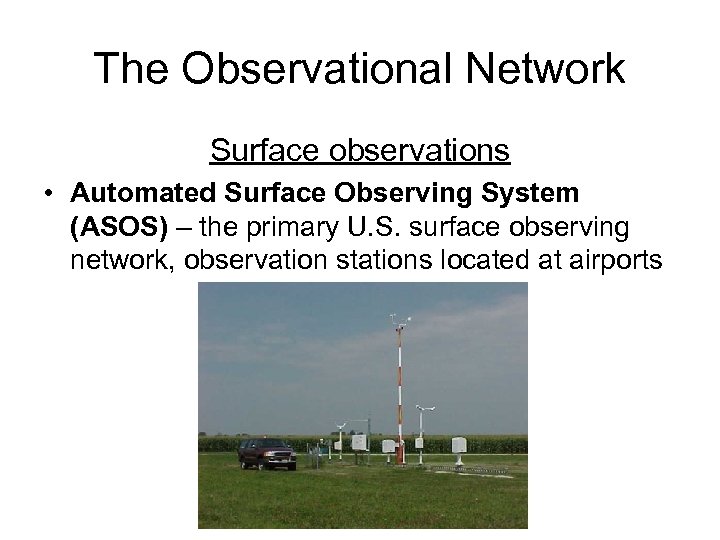 The Observational Network Surface observations • Automated Surface Observing System (ASOS) – the primary U. S. surface observing network, observation stations located at airports
 ASOS Observation Stations • Observations are reported hourly, except in the case of severe or unusual weather
 ASOS Observation Stations • Observations are reported hourly, except in the case of severe or unusual weather • Observations are coded in METAR format: METAR KTTN 051853 Z 04011 KT 1/2 SM VCTS SN FZFG BKN 003 OVC 010 M 02/M 02 A 3006 RMK AO 2 TSB 40 SLP 176 P 0002
 The Observational Network Surface observations • Hundreds of other surface observational networks exist that provide different amounts of observation types at various time intervals (i. e. West Texas Mesonet)
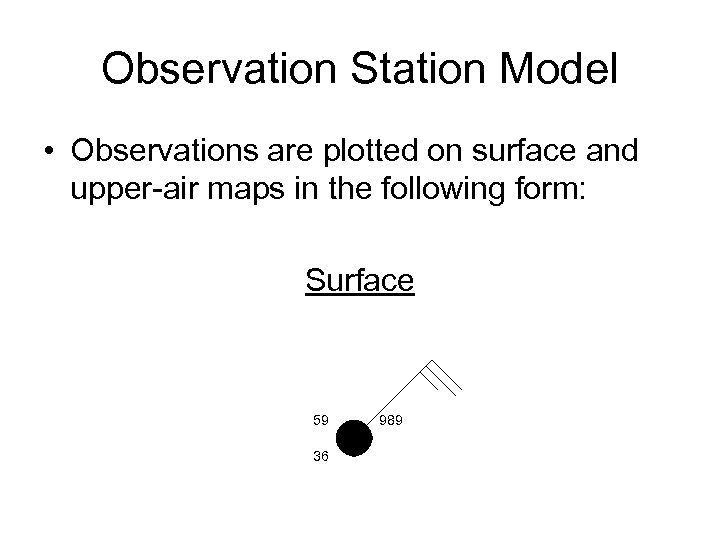 Observation Station Model • Observations are plotted on surface and upper-air maps in the following form: Surface 59 36 989
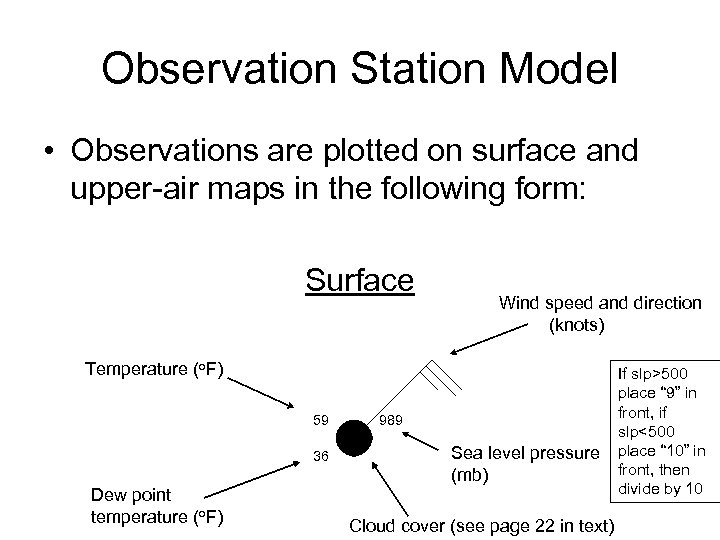 Observation Station Model • Observations are plotted on surface and upper-air maps in the following form: Surface Wind speed and direction (knots) Temperature (o. F) 59 36 Dew point temperature (o. F) 989 Sea level pressure (mb) Cloud cover (see page 22 in text) If slp>500 place “ 9” in front, if slp<500 place “ 10” in front, then divide by 10
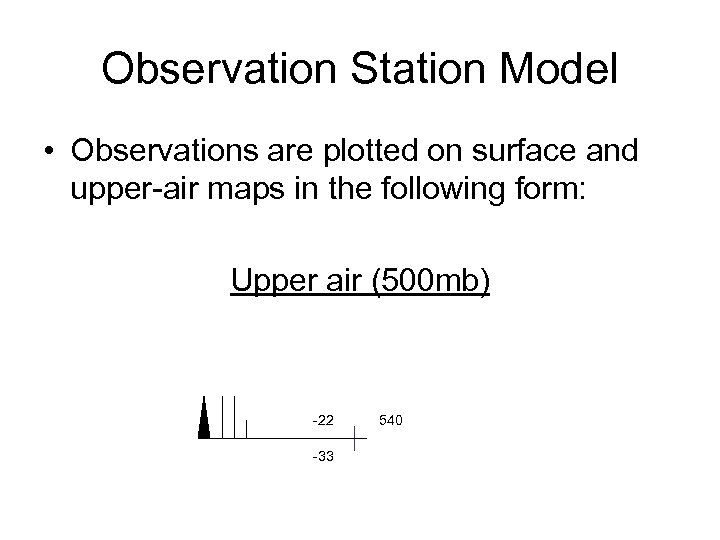 Observation Station Model • Observations are plotted on surface and upper-air maps in the following form: Upper air (500 mb) -22 -33 540
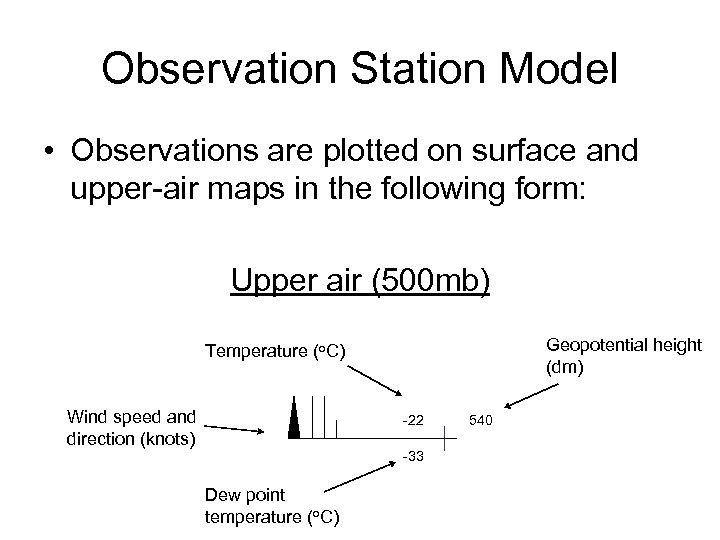 Observation Station Model • Observations are plotted on surface and upper-air maps in the following form: Upper air (500 mb) Geopotential height (dm) Temperature (o. C) Wind speed and direction (knots) -22 -33 Dew point temperature (o. C) 540
 Dew Point Temperature • The temperature to which the air must be cooled to achieve saturation (also called dew point)
 Dew Point Temperature • The temperature to which the air must be cooled to achieve saturation (also called dew point) - The closer the dew point to the temperature, the more humid the air
 Dew Point Temperature • The temperature to which the air must be cooled to achieve saturation (also called dew point) - The closer the dew point to the temperature, the more humid the air - This difference is called the dew point depression
 Dew Point: Key Idea • The dew point corresponds to the amount of water vapor in the air: - Higher dew point: More water vapor! - Lower dew point: Less water vapor!
 Dew Point: Key Idea • The dew point corresponds to the amount of water vapor in the air: - Higher dew point: More water vapor! - Lower dew point: Less water vapor! - 60 o. F+ dew points: noticeably humid - Less than 40 o. F dew points: fairly dry