


 Скачать презентацию Chapter 4 Advertisement in Electronic Commerce Prentice
4a6dd54d0e427ec94c24efe0dc37bd7a.ppt
- Количество слайдов: 39
 Chapter 4 Advertisement in Electronic Commerce © Prentice Hall, 2000 1
 Learning Objectives z. Describe the objectives of Web advertisement, its types and characteristics z. Describe the major advertisement methods used on the Web, ranging from banners to chat rooms z. Describe various Web advertisement strategies z. Describe various types of promotions on the Web z. Discuss the benefits of push technology and intelligent agents © Prentice Hall, 2000 2
 Learning Objectives (cont. ) z. Understand the major economic issues related to Web advertisement z. Describe the issues involved in measuring the success of Web advertisement as it relates to different ad pricing methods z. Compare paper and electronic catalogs and describe customized catalogs z. Describe Web advertisement implementation issues ranging from ad agencies to the use of intelligent agents © Prentice Hall, 2000 3
 Opening Vignette : CD-Max Uses E-mail Lists to Advertise z. CD- Max Enterprises y. A two-person business specializing in CD-ROM development y. Operates a resource site for information delivery y. Generated an e-mail list of site visitors xthe list is also valuable to other advertisers x 50 lists were created to fit different advertisers xoutsourced the job of creating and maintaining the lists, and selling them to potential advertisers, to Net. Creation which developed 275 lists from the names collected at CD-Max xthe list sales “surpassed” the company’s expectations xselling e-mail lists has become a lucrative business © Prentice Hall, 2000 4
 Web Advertising z. Advertising is an attempt to disseminate information in order to affect a buyer-seller transaction z. Why Internet Advertisement? y. Three-quarters of PC users gave up some television time y. Internet users are well educated with highincome, which makes them a desired target for advertisers y. Ads can be updated any time with a minimal cost; therefore they are timely and very accurate © Prentice Hall, 2000 5
 Web Advertising (cont. ) z. Why Internet Advertisement? y. Ads can reach very large numbers of potential buyers all over the world y. Online ads are much cheaper in comparison to television, newspaper, or radio ads. Such ads are expensive since they are determined by space occupied, how many days (times) they are shown, and on how many national and local television stations and newspapers they are posted. y. Web ads can be media rich, including voice and video y. Web ads can be interactive and targeted y. The use of the Internet is growing very rapidly © Prentice Hall, 2000 6
 Web Advertising (cont. ) z. Internet Advertising Terminology y. Ad views y. Banner y. Clicks (or ad clicks) y. Click Ratio y. Cookie y. CPM y Effective Frequency y Hit y Impressions y Reach y Visit © Prentice Hall, 2000 7
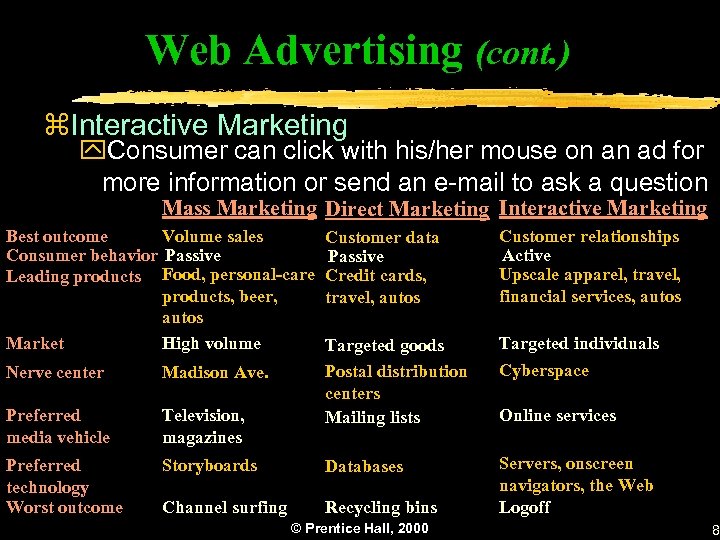 Web Advertising (cont. ) z. Interactive Marketing y. Consumer can click with his/her mouse on an ad for more information or send an e-mail to ask a question Mass Marketing Direct Marketing Interactive Marketing Volume sales Best outcome Consumer behavior Passive Leading products Food, personal-care products, beer, autos High volume Market Customer data Passive Credit cards, travel, autos Customer relationships Active Upscale apparel, travel, financial services, autos Targeted goods Postal distribution centers Mailing lists Targeted individuals Cyberspace Servers, onscreen navigators, the Web Logoff Nerve center Madison Ave. Preferred media vehicle Television, magazines Preferred technology Worst outcome Storyboards Databases Channel surfing Recycling bins © Prentice Hall, 2000 Online services 8
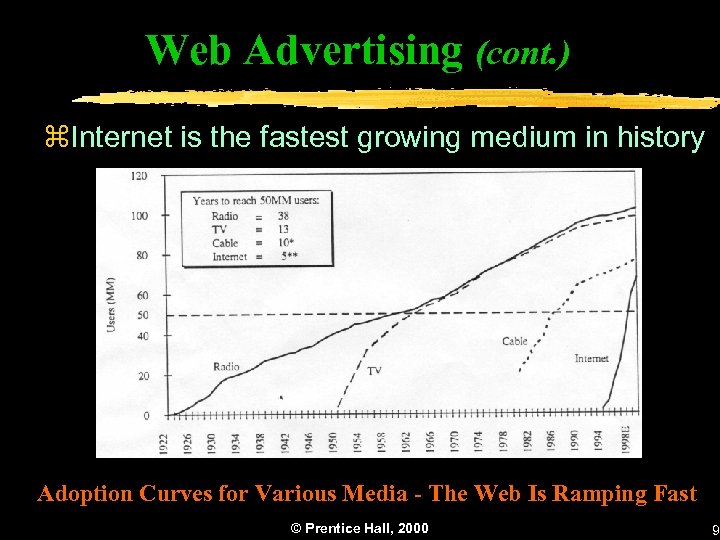 Web Advertising (cont. ) z. Internet is the fastest growing medium in history Adoption Curves for Various Media - The Web Is Ramping Fast © Prentice Hall, 2000 9
 Web Advertising (cont. ) z. Targeted Advertisement (one-to-one) y. The Double Click (DC) Approach x 3 M Corp. wants to advertise its $10, 000 multimedia projectors x. DC monitored people browsing the Web sites of cooperating companies xthen matches them against a database xthen finds those people working for advertising agencies or using Unix system (potential buyers) xthen builds a dossier on you, your spending, and your computing habits using “a cookie” xprepares an ad for 3 M projectors xtargeted for people whose profile matches what is needed for 3 M © Prentice Hall, 2000 10
 Web Advertising (cont. ) z. Pros of Internet Advertisement y. Internet advertisements are accessed on demand 24 hours a day, 365 days a year, and costs are the same regardless of audience location y. Accessed primarily because of interest in the content, so market segmentation opportunity is large y. Opportunity to create one-to-one direct marketing relationship with the consumer y. Multimedia will increasingly make Web sites more attractive and compelling © Prentice Hall, 2000 11
 Web Advertising (cont. ) z. Pros of Internet Advertisement y. Distribution costs are low (just technology cost), so millions of consumers are reached at the same cost as that of reaching one y. Advertising and content can be updated, supplemented, or changed at any time, and are therefore always up-to-date y. Ease of logical navigation — you click when and where you want, and spend as much time as you desire there © Prentice Hall, 2000 12
 Advertising Methods z. Banners y. Banners are everywhere y. Keyword banners y. Random banners y. Benefits xbe customized to the target audience xbe customized to one-to-one targeted advertisement xutilize “force advertising” marketing strategy z. Banner Swapping y. Direct link between one’s site to the other site y. Ad space bartering © Prentice Hall, 2000 13
 Advertising Methods (cont. ) z. Banner Exchanges y. Swapping is a problem : a match is frequently not possible y. Banner exchange organizations xa firm submits a banner xreceives credit when shows others’ banners xcan purchase additional display credits xspecify what type of site the banner can be displayed on xuse the credit to advertise on others’ sites xcredit ratio of approximately 2: 1 x. Example : Link Exchange offers help in banner design, provides membership in newsgroups, delivers HTML tutorials, and even runs contests. It acts as a banner-ad clearing house for more than 200, 000 small Web sites. It also monitors the content of the ads of all its members. © Prentice Hall, 2000 14
 Advertising Methods (cont. ) z. Paid Advertising and Ad Agencies y. Advantage of using banners xability to customize them to the target audience xability to decide which market segments to focus on xbe customized to one-to-one targeted advertisement x“forced advertising” marketing strategy is utilized z. Splash Screen y. Capture the user’s attention y. Promotion or lead-in y. Major advantage : create innovative multimedia © Prentice Hall, 2000 15
 Advertising Methods (cont. ) z. URL (Universal Resource Locators) y. Advantages: xminimal cost is associated with it xsubmit your URL to a search engine and be listed xkeyword search is used y. Disadvantages: xsearch engines index their listings differently xmeta tags can be complicated © Prentice Hall, 2000 16
 Advertising Methods (cont. ) z. E-mail y. Several million users can be reached directly y. Purchase e-mail addresses y. Send the company information; low cost y. A wide variety of audiences; customer database y. Problem: Junk mail or spamming y. Target a group of people that you know something about © Prentice Hall, 2000 17
 Advertising Methods (cont. ) z. Chat Rooms y. Virtual meeting ground y. Can be added to a business site for free y. Allows advertisers to cycle through messages and target the chatter again and again y. Advertising can become more thematic y. More effective than banners y. Used in one-to-one connection © Prentice Hall, 2000 18
 Advertisement Strategies z. Internet-base Ad Design y. Advertisements should be visually appealing y. Advertisements must be targeted to specific groups or to individual consumers y. Advertisements must emphasize brands and a firm’s image y. Advertisements must be part of an overall marketing strategy y. Advertisements should be seamlessly linked with the ordering process y. Designing Internet ads involve the following factors: © Prentice Hall, 2000 19
 Advertisement Strategies (cont. ) z. Internet-based Ad Design: Important Factors y. Page-Loading Speed x. Graphics and tables should be simple and meaningful. They need to match standard monitors. x. Thumbnail (icons graphs) are useful. y. Business Content x. Clear and concise text is needed. A compelling page title and header text is useful. x. The amount of requested information for registration should be minimal. © Prentice Hall, 2000 20
 Advertisement Strategies (cont. ) z. Internet-base Ad Design: Important Factors y. Navigation Efficiency x. Well-labeled, accurate, meaningful links are a must. x. Site must be compatible with browsers, software, etc. y. Security and Privacy x. Security and privacy must be assured. x. Option for rejecting cookies is a must. y. Marketing/Customer Focus x. Clear terms and conditions of the purchases, including delivery information, return policy, etc. must be provided. x. Confirmation page after a purchase, is needed. © Prentice Hall, 2000 21
 Advertisement Strategies (cont. ) z. Passive Pull Strategy y. Customer will visit a site if it provides helpful and attractive contents and display y. Effective and economical way to advertise, unidentified potential customers worldwide y. Advertising World is a non-commercial site that can guide the process of finding the customer’s wish y. Yahoo is a portal search engine site which can be regarded an effective aid for advertisement © Prentice Hall, 2000 22
 Advertisement Strategies (cont. ) z. Active Push Strategy y. Sending e-mails to the relevant people y. Obtaining the mailing list is the process of identifying target customers y. Mailing list generation is done in companies by using agent technology and cookies as well as by filling out questionnaires (by customers) © Prentice Hall, 2000 23
 Advertisement Strategies (cont. ) z. Ad as a Commodity y. Cyber. Gold xexchange of direct payment made by the advertisers for viewing ads xconsumers fill out questionnaires x. Cyber. Gold distributes targeted banners xthe reader clicks the banner to read it and, passing some tests on its content, is paid for the effort © Prentice Hall, 2000 24
 Implementing the Strategies z. Customized Ad Strategy y. Filtering the irrelevant information by providing customized ads y. One-to-One advertisement y. Customized ads can be found in Point. Cast xpersonalized news and information by category (Channel) xpackaged by content providers, assembled by Point. Cast, delivered on screen savers or at prearranged times © Prentice Hall, 2000 25
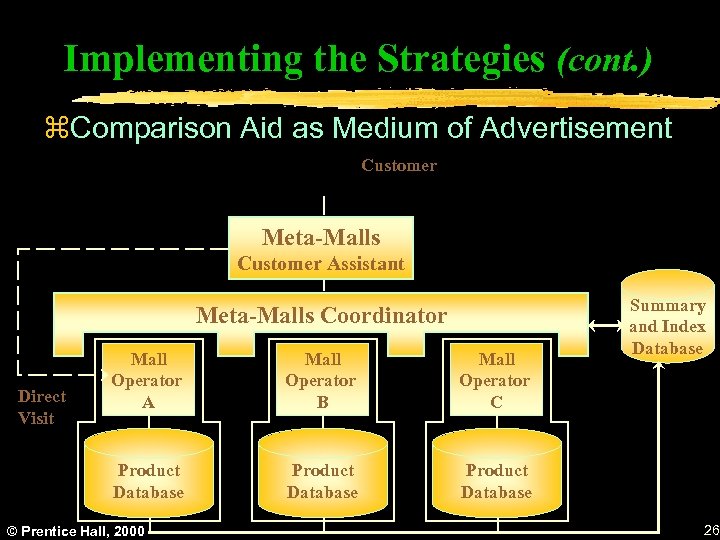 Implementing the Strategies (cont. ) z. Comparison Aid as Medium of Advertisement Customer Meta-Malls Customer Assistant Meta-Malls Coordinator Mall Operator B Mall Operator C Product Database Direct Visit Mall Operator A Product Database Summary and Index Database Product Database © Prentice Hall, 2000 26
 Online Events, Promotions and Attractions z. How to entice Web surfers to read Internet ads y. There are dozens of innovative ideas; here are some examples : 1 Yoyodyne Inc. conducts give-away games, discounts, contests & sweepstakes. Its entrants agree to read product information of advertisers ranging from Major League Baseball to Sprint communication. 2 Netzero and others offer free Internet access in exchange for viewing ads. 3 www. egghead. com uses real people to help you. www. lucent. com uses live people to talk to you over the phone and then “push” material and ads to your computer. © Prentice Hall, 2000 27
 Online Events, Promotions and Attractions (cont. ) 4 Cyber. Gold (www. cybergold. com), Goldmine (www. goldmine. com) and others connect you with advertisers who pay you real money to read ads and explore the Web. 5 Netstakes runs sweepstakes that requires no skills; in contrast with contests. You register only once and can randomly win prizes (see http: //webstakes. com). Prizes are given away in different categories. The site is divided into channels, each has several sponsors. They pay Netstakes to send them traffic. Netstakes runs online ads both on the Web and in several hundred thousand e-mail lists that people requested to be on. 6 Free PCs will be given soon in exchange for obligation to read ads. © Prentice Hall, 2000 28
 Push Technology z. Benefit : instead of spending hours searching the Web, people can have the information they are interested in delivered automatically to their desktop via Web technology and the Internet z. Pre-specification profile, selection of appropriate content, and download selection z 4 types of push technology yself-service delivery yaggregated delivery ymediated delivery ydirect delivery © Prentice Hall, 2000 29
 Push Technology (cont. ) z. Pointcasting y. Analogous to mass customization y. Transmits the most relevant information directly to the user z. Push on the Intranet y. Companies use push technology to set up their own channels to pointcast important internal information to either their own employees (on intranets) and/or their supply chain partners (on extranets) z. The Future of Push Technology y. Drawback : the bandwidth requirements are large y. Experts’ prediction : the technology will never fly © Prentice Hall, 2000 30
 Intelligent Agents z. Product Brokering y. Knows the customer’s profile y. Tailors an ad to the customers, or asks them if they would like to receive product information y. Alerts the users to new releases, recommends products based on past selections, or constraints specified by the buyers © Prentice Hall, 2000 31
 Economics and Effectiveness of Advertisement Payments are based on: z. Exposure Models (CPM) z. Click Through z. Interactivity z. Actual Purchase z. Other Methods © Prentice Hall, 2000 32
 Online Catalogs z. To merchants, the objective of catalogs is advertisement and promotion z. The purpose of catalogs to customers is providing a source of information and price comparisons z. Consist of product database, directory and search capability and presentation function z. Replication of text in paper catalogs z. More dynamic, customized and integrated © Prentice Hall, 2000 33
 Online Catalogs (cont. ) 1) Dynamics of information presentation y. Static Catalogs: The catalog is presented in textual description and static pictures. y. Dynamic Catalogs: The catalog is presented in motion pictures and graphics and possibly sound. 2) Customization y. Ready-made Catalogs: Merchants offer the same catalog to any customer. y. Customized Catalogs: Deliver customized contents and display depending upon the characteristics of customers. © Prentice Hall, 2000 34
 Online Catalogs (cont. ) z 3) Integration with business processes y. Integration with order taking and fulfillment y. Integration with electronic payment y. Integration with intranet workflow y. Integration with inventory and accounting system y. Integration with supplier’s extranet y. Relationship to paper catalogs © Prentice Hall, 2000 35
 Customized Catalog z Identify the interesting parts out of the whole catalog z Tool for aiding customers to concentrate on their needs z Live. Commerce ycreating catalogs with branded, value-added capabilities ylocate the information ycompose their order yindividualized prices, products, and display formats z Let the system automatically identify the characteristics of customers based on the transaction records © Prentice Hall, 2000 36
 Special Advertisement Topics z. To Advertise or Not z. How Much to Advertise z. Auditing and Analyzing Web Traffic z. Self Monitoring of Traffic z. Internet Standards z. Localization © Prentice Hall, 2000 37
 Special Advertisement Topics (cont. ) z. The Major Web Ad Players y. Advertising agencies and Web site developers y. Finding market research providers y. Traffic measurement and analysis companies y. Networks/rep firms y. Order processing and support © Prentice Hall, 2000 38
 Managerial Issues z. Make Vs. Buy (Ad agencies) z. Finding the Most Visited Sites z. Company Research z. Commitment to Web Advertising z. Ethical Issues z. Integration : Advertisement, Ordering, Other Processes © Prentice Hall, 2000 39