


 Скачать презентацию Chapter 4 1 4 2 notes Demand Demand
4afc3b8107ae623ae6b5068c87c785f9.ppt
- Количество слайдов: 13
 Chapter 4. 1/4. 2 notes Demand
 Demand • • • the desire, ability, and willingness to buy a product a microeconomic concept Law of Demand – when price goes up, quantity demanded goes down and vice versa. P = Price Qd = quantity demanded
 • • • demand schedule – listing that shows the various quantities demanded at each price Demand curve – a graph showing the information from a schedule Market Demand Curve –shows the quantities demanded by everyone
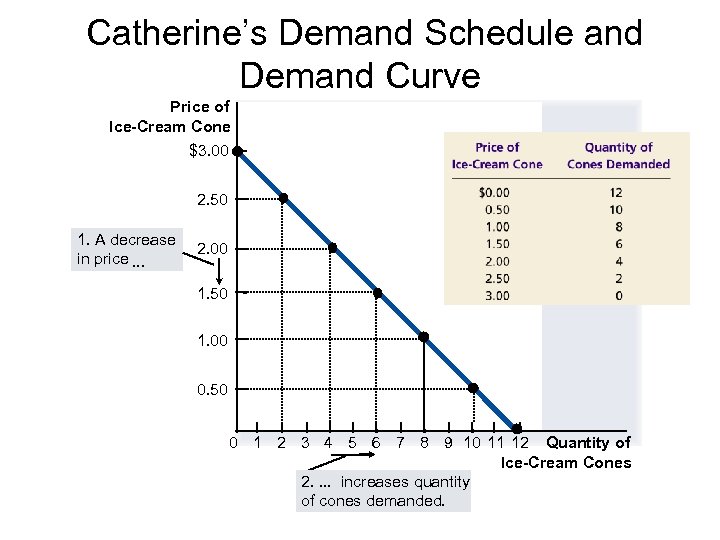 Catherine’s Demand Schedule and Demand Curve Price of Ice-Cream Cone $3. 00 2. 50 1. A decrease in price. . . 2. 00 1. 50 1. 00 0. 50 0 1 2 3 4 5 6 7 8 9 10 11 12 Quantity of Ice-Cream Cones 2. . increases quantity of cones demanded.
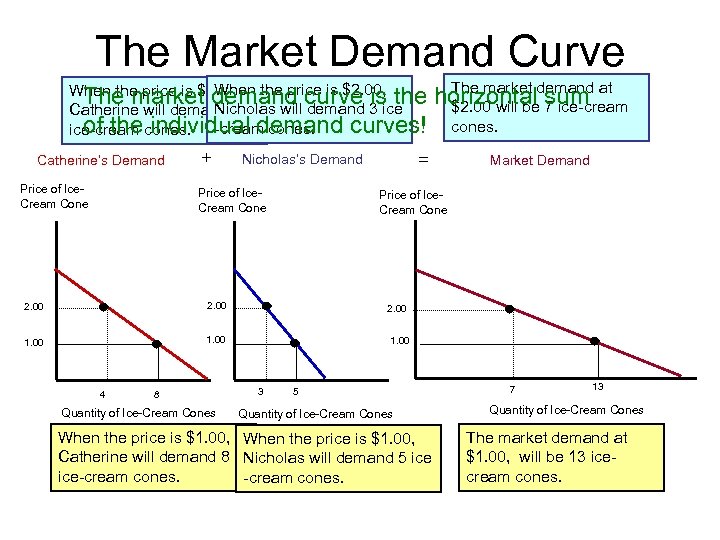 The Market Demand Curve When the price is $2. 00, the The market demand curve 3 ice is Nicholas will demand Catherine will demand 4 of the individual demand curves! ice-cream cones. Catherine’s Demand Price of Ice. Cream Cone + = Nicholas’s Demand Price of Ice. Cream Cone The market horizontaldemand at sum $2. 00 will be 7 ice-cream cones. Market Demand Price of Ice. Cream Cone 2. 00 1. 00 4 8 Quantity of Ice-Cream Cones 3 5 Quantity of Ice-Cream Cones When the price is $1. 00, Catherine will demand 8 Nicholas will demand 5 ice-cream cones. 7 13 Quantity of Ice-Cream Cones The market demand at $1. 00, will be 13 icecream cones.
 Chapter 4 vocab • Please have this done by tomorrow (2/19) • Go ahead and work on it • Remember – 100 3 x 5 cards donation = 2 points on ONE TEST
 Change in the Quantity Demanded • • a movement along the demand curve because of a change in P The only thing that changes Qd directly is a change in P!!!
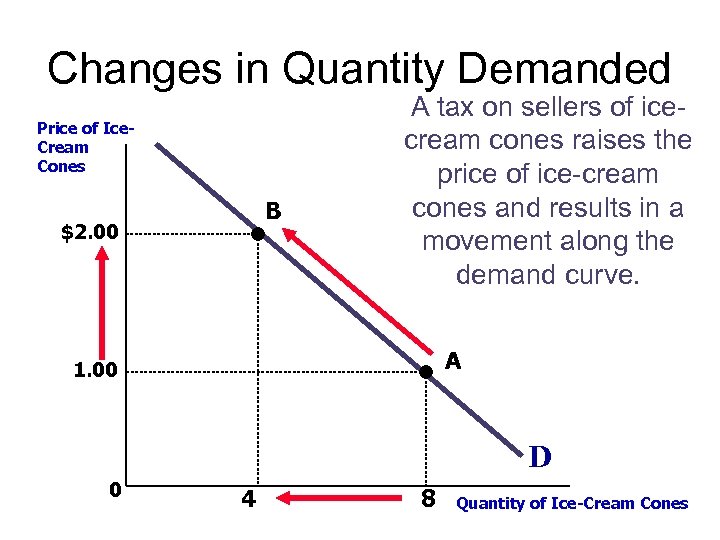 Changes in Quantity Demanded Price of Ice. Cream Cones B $2. 00 A tax on sellers of icecream cones raises the price of ice-cream cones and results in a movement along the demand curve. A 1. 00 D 0 4 8 Quantity of Ice-Cream Cones
 Change in Demand • • • the entire demand curve shifts Increase in D = shift right Decrease in D = shift left
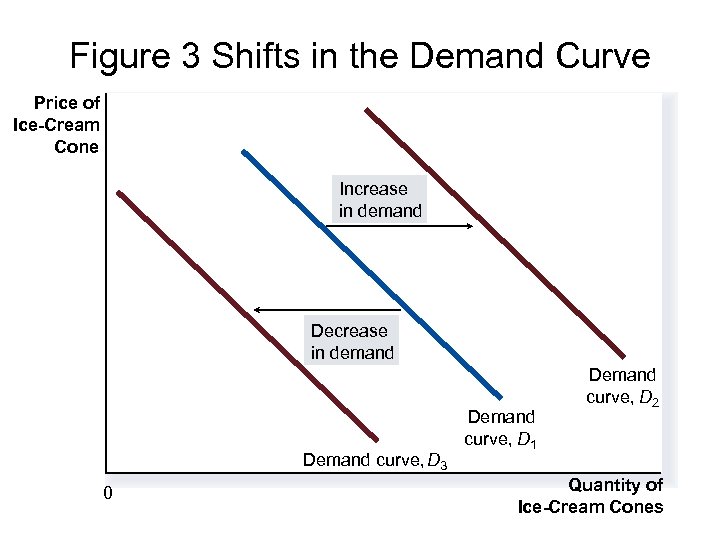 Figure 3 Shifts in the Demand Curve Price of Ice-Cream Cone Increase in demand Demand curve, D 3 0 Demand curve, D 1 Demand curve, D 2 Quantity of Ice-Cream Cones
 Reasons D curve shifts • • Consumer Income – if incomes go up, D increases Consumer Tastes – development of new products, people get tired of a product, etc. Change in Expectations – way people think about the future; Ex: buy more now if you think P will go up later Number of Consumers: more = Increase in D; less = Decrease in D
 • Substitutes – can be used in place of other products; If P of 1 goes up, D of 2 up Ex: margarine and butter • Complements – related goods; the use of one good increases the use of the other. If P of 1 goes up, D of 2 goes down Ex: hot dogs, hot dog buns
 Normal vs. Inferior Goods • Normal good – goods that consumers demand more of when their incomes rise. • Ex: steak • Inferior good – goods that consumers demand less of when their incomes rise. • Ex: Ramen noodles