Скачать презентацию Chapter 37 The Stormy Sixties 1960 -1968
43a4523362e271e3777c1a97babc8d6b.ppt
- Количество слайдов: 73
 Chapter 37 The Stormy Sixties 1960 -1968
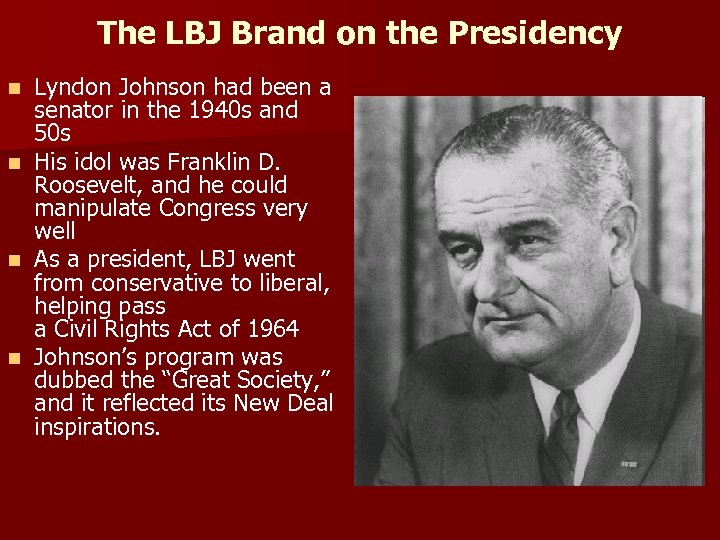 The LBJ Brand on the Presidency n n Lyndon Johnson had been a senator in the 1940 s and 50 s His idol was Franklin D. Roosevelt, and he could manipulate Congress very well As a president, LBJ went from conservative to liberal, helping pass a Civil Rights Act of 1964 Johnson’s program was dubbed the “Great Society, ” and it reflected its New Deal inspirations.
 Civil Rights Act of 1964 • Kennedy’s legislation bogged down in the Senate. After his Johnson assassination in November of 1963. President ____ used his legislative skills to push the bill through. He signed it into law on July 2, 1964 after 87 days of ______. filibuster • Gave all citizens equal access to restaurants, parks, libraries, and theaters. • Put more force behind school desegregation laws. • Required private employers to end discrimination in the workplace. Equal Employment Opportunity Commission • ______________________ works to end discrimination based on race, religion, gender, and national origin in the workplace.
 Johnson Battles Goldwater in 1964 n In 1964, LBJ was opposed by Republican Arizona senator Barry Goldwater who attacked the federal income tax, the Social Security system, the Tennessee Valley Authority, civil rights legislation, the nuclear test-ban treaty, and the Great Society. n However, Johnson used the Tonkin Gulf Incident, in which North Vietnamese ships allegedly fired on American ships, to attack (at least partially) Vietnam, and he also got approval for the Tonkin Gulf Resolution, which gave him a virtual blank check on what he could do in affairs in Vietnam. n But on election day, Johnson won a huge landslide over Goldwater to stay president 486 to 52
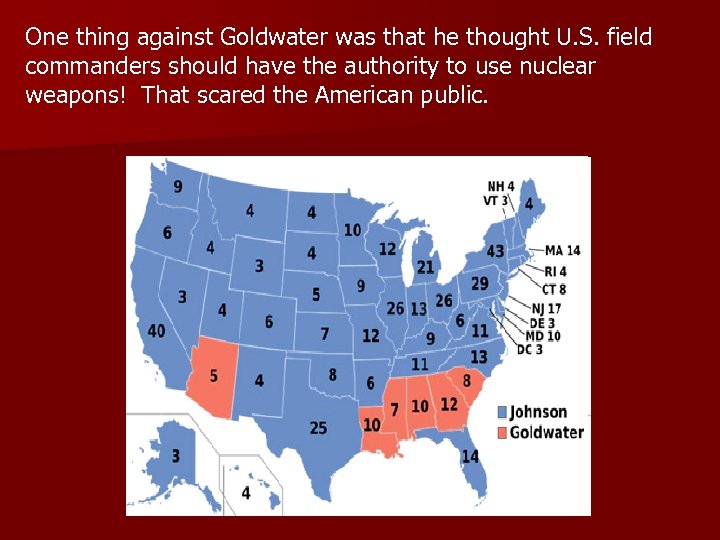 One thing against Goldwater was that he thought U. S. field commanders should have the authority to use nuclear weapons! That scared the American public.
 https: //www. youtube. com/watch? v=d. DTBnsqx. Z 3 k The “Daisy Ad” was one of the first political attack ads on television. This was supposed to scare Americans into voting for Johnson because it suggested that Goldwater would lead America into nuclear Armageddon.
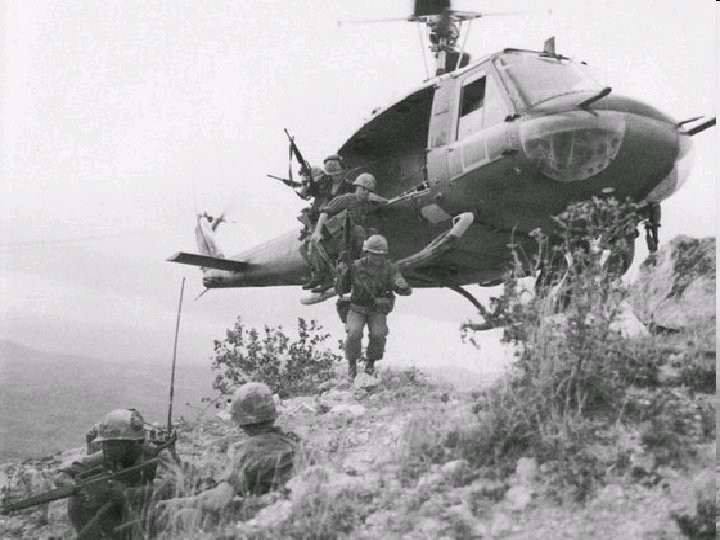
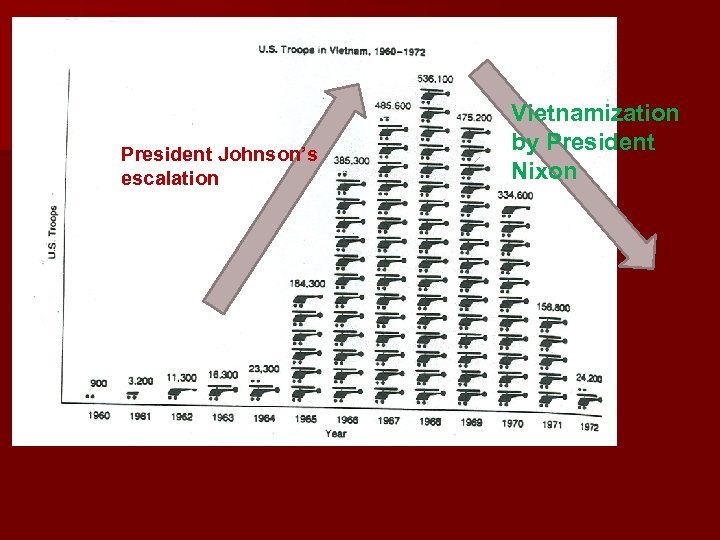
 American Escalation On August 4, 1964, The American destroyer, the Maddox, was patrolling the Gulf of Tonkin and was Johnson “torpedoed”. President ______ ordered retaliatory air strikes against North Vietnam. He also asked that Congress pass the Tonkin Gulf Resolution ____________. This gave the president the authority to “take all necessary measures to repel any armed attack against the forces of the United States and to prevent further aggression. ” Johnson said the Tonkin Gulf Resolution was like “grandma’s nightshirt-it covered everything” In 1965, the U. S. had 12, 000 troops in South Vietnam, by 1968 there were 540, 000 _____. However there was never a declaration of war by Congress.
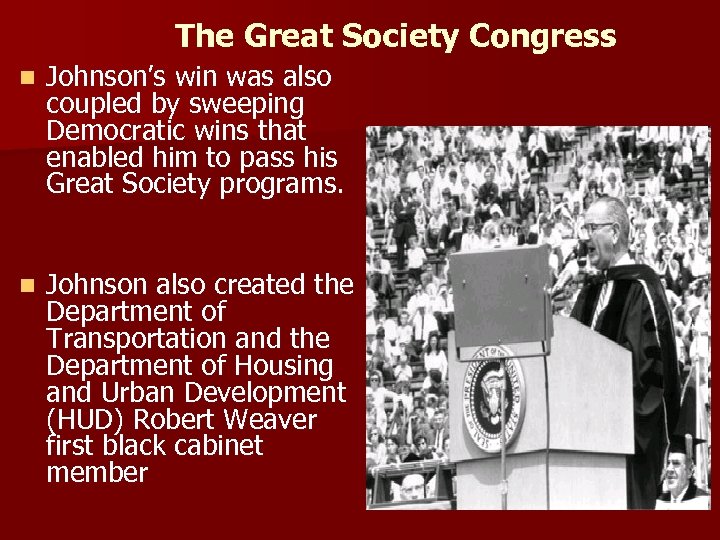 The Great Society Congress n Johnson’s win was also coupled by sweeping Democratic wins that enabled him to pass his Great Society programs. n Johnson also created the Department of Transportation and the Department of Housing and Urban Development (HUD) Robert Weaver first black cabinet member
 LBJ also wanted aid to education ($1 billion to elementary and secondary schools), medical care for the elderly and indigent, immigration reform, and a new voting rights bill. Johnson gave money to students, not schools. Also gave $1 billion for redevelopment of Appalachian Mountains In 1965, new programs called Medicare and Medicaid were installed The Immigration and Nationality Act of 1965 abolished the “national origin” quota and doubled the number of immigrants allowed to enter the U. S. annually, up to 290, 000.
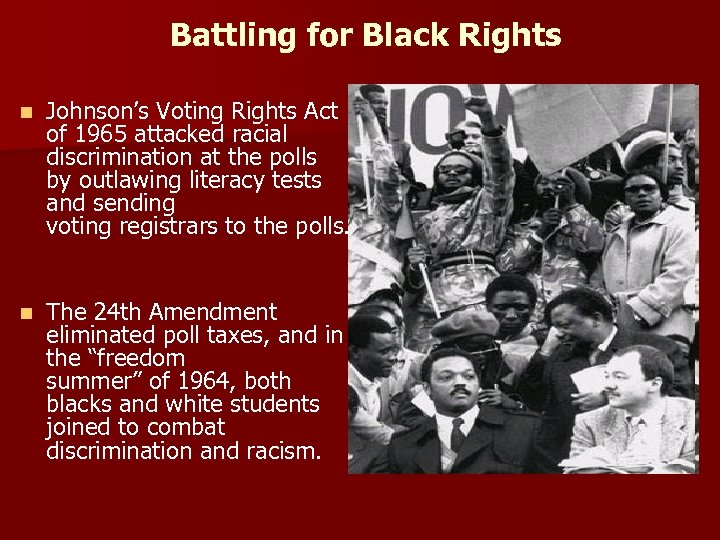 Battling for Black Rights n Johnson’s Voting Rights Act of 1965 attacked racial discrimination at the polls by outlawing literacy tests and sending voting registrars to the polls. n The 24 th Amendment eliminated poll taxes, and in the “freedom summer” of 1964, both blacks and white students joined to combat discrimination and racism.
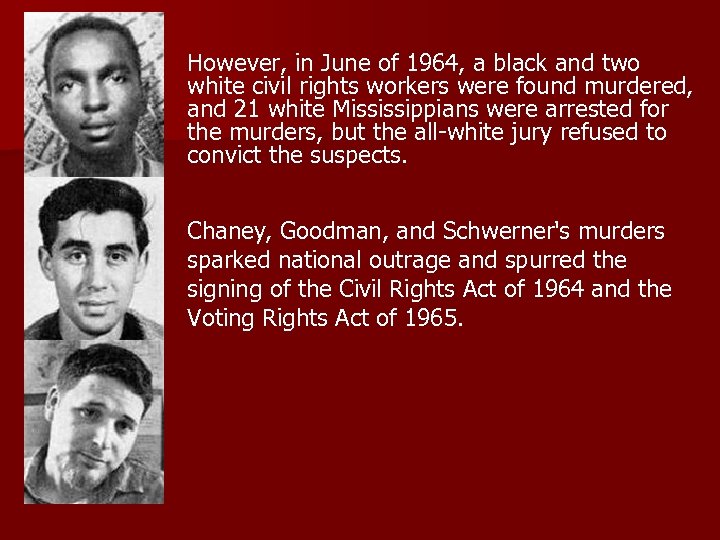 However, in June of 1964, a black and two white civil rights workers were found murdered, and 21 white Mississippians were arrested for the murders, but the all-white jury refused to convict the suspects. Chaney, Goodman, and Schwerner's murders sparked national outrage and spurred the signing of the Civil Rights Act of 1964 and the Voting Rights Act of 1965.
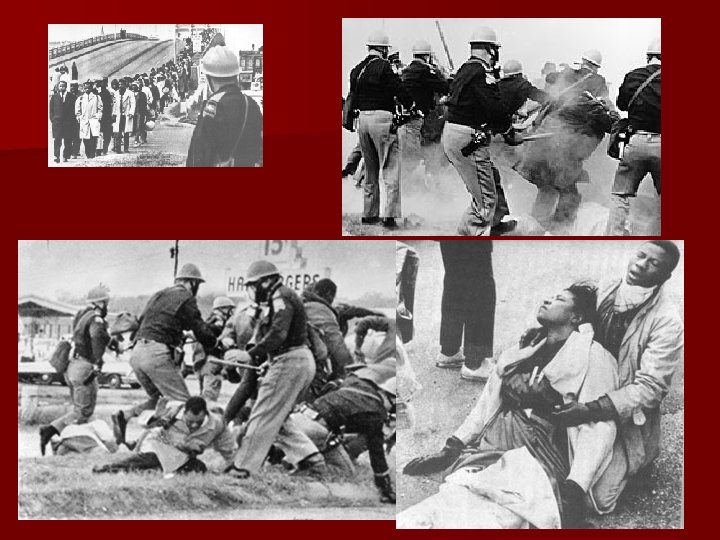
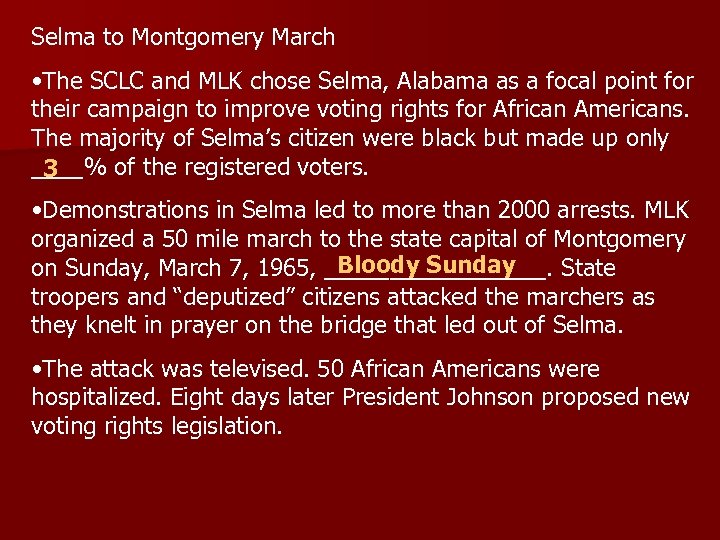 Selma to Montgomery March • The SCLC and MLK chose Selma, Alabama as a focal point for their campaign to improve voting rights for African Americans. The majority of Selma’s citizen were black but made up only ____% of the registered voters. 3 • Demonstrations in Selma led to more than 2000 arrests. MLK organized a 50 mile march to the state capital of Montgomery Bloody Sunday on Sunday, March 7, 1965, _________. State troopers and “deputized” citizens attacked the marchers as they knelt in prayer on the bridge that led out of Selma. • The attack was televised. 50 African Americans were hospitalized. Eight days later President Johnson proposed new voting rights legislation.
 Voting Rights Act of 1965 • Sent federal examiners to register voters in the South. Literacy Tests Outlawed _________ in counties where less than half of the adults had been allowed to vote. • Within a year _____ African Americans had registered 200, 000 as new voters. • The number of black elected officials in the South increased from 100 in 1965 to ______ in 1990. 5000
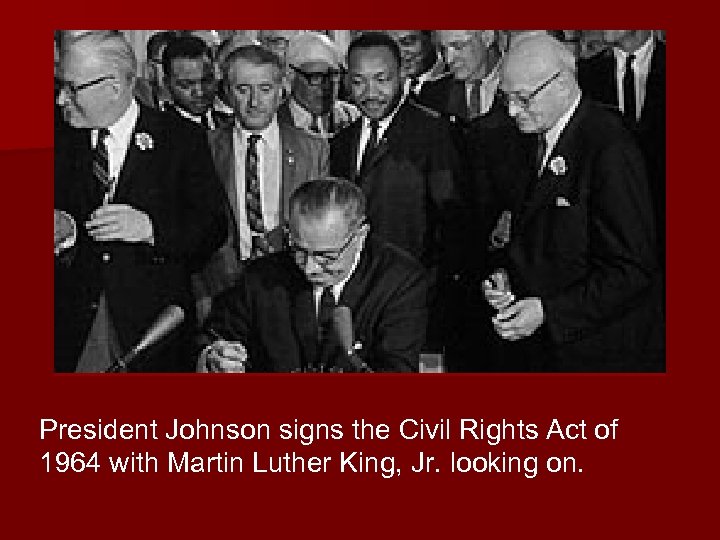 President Johnson signs the Civil Rights Act of 1964 with Martin Luther King, Jr. looking on.
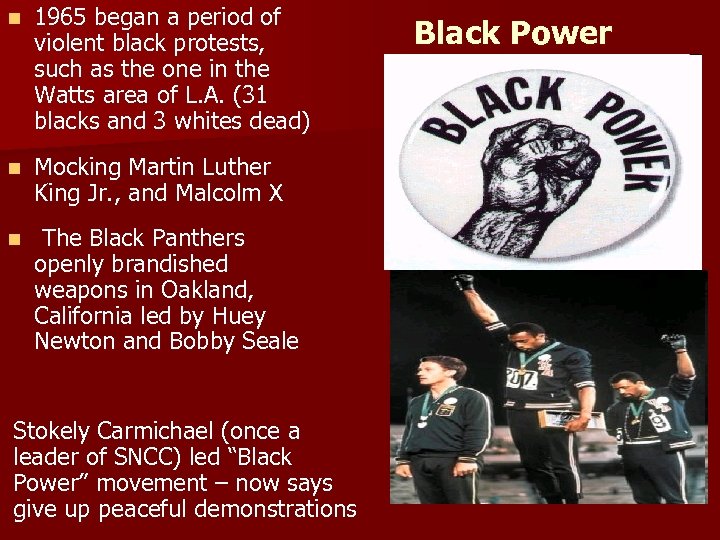 n 1965 began a period of violent black protests, such as the one in the Watts area of L. A. (31 blacks and 3 whites dead) n Mocking Martin Luther King Jr. , and Malcolm X n The Black Panthers openly brandished weapons in Oakland, California led by Huey Newton and Bobby Seale Stokely Carmichael (once a leader of SNCC) led “Black Power” movement – now says give up peaceful demonstrations Black Power
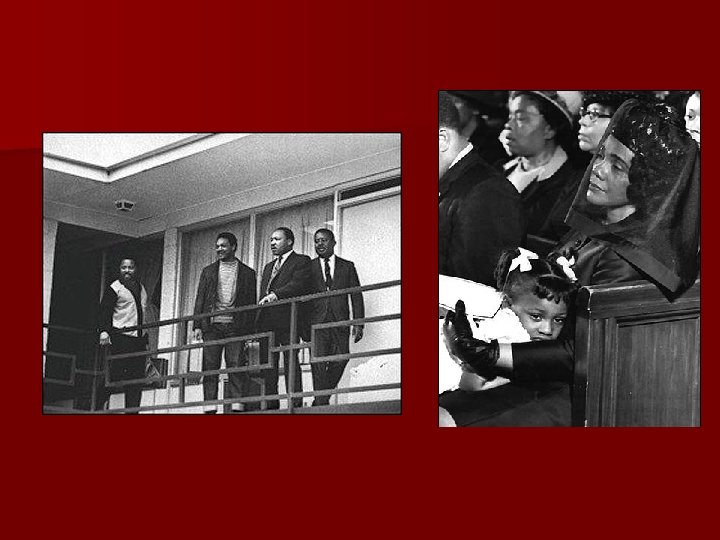
 Black Power became a rallying cry by blacks seeking more rights, but just as they were getting them, more riots broke out, and nervous whites threatened with retaliation. Carmichael said Black Power “will smash everything Western civilization has created. ” Assassination of MLK • April 4, 1968 - Memphis, Tennessee. Assassinated while standing on the balcony of his hotel. • His death touched off riots in more that 100 American cities. James Earl Ray • _________ was captured 2 months later and confessed but three days later recanted his confession. He maintained his innocence until his death in 1998. The King Family • _________ supported Ray and believed in his innocence.
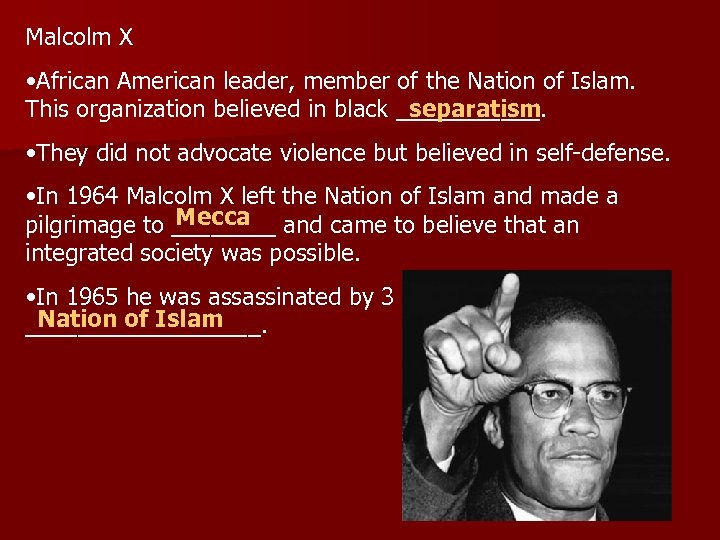 Malcolm X • African American leader, member of the Nation of Islam. separatism This organization believed in black ______. • They did not advocate violence but believed in self-defense. • In 1964 Malcolm X left the Nation of Islam and made a Mecca pilgrimage to ____ and came to believe that an integrated society was possible. • In 1965 he was assassinated by 3 members of the Nation of Islam _________.
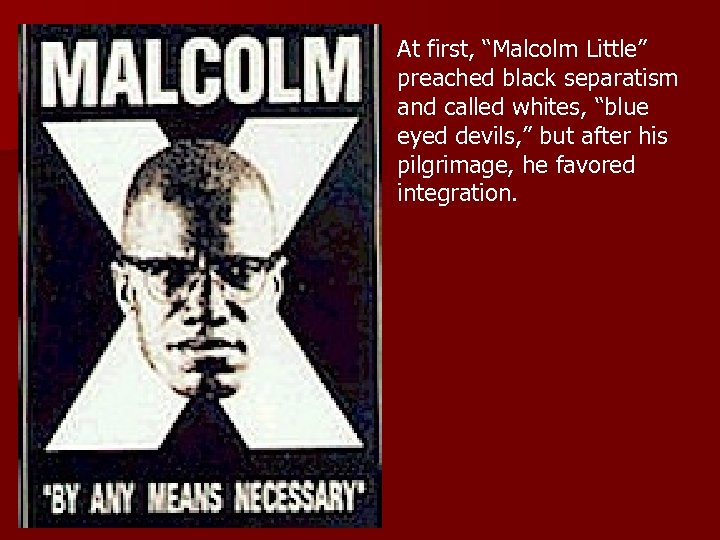 At first, “Malcolm Little” preached black separatism and called whites, “blue eyed devils, ” but after his pilgrimage, he favored integration.
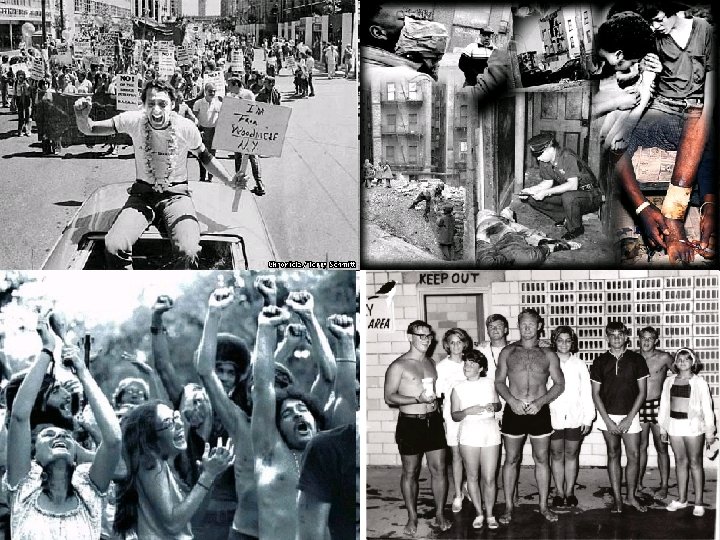
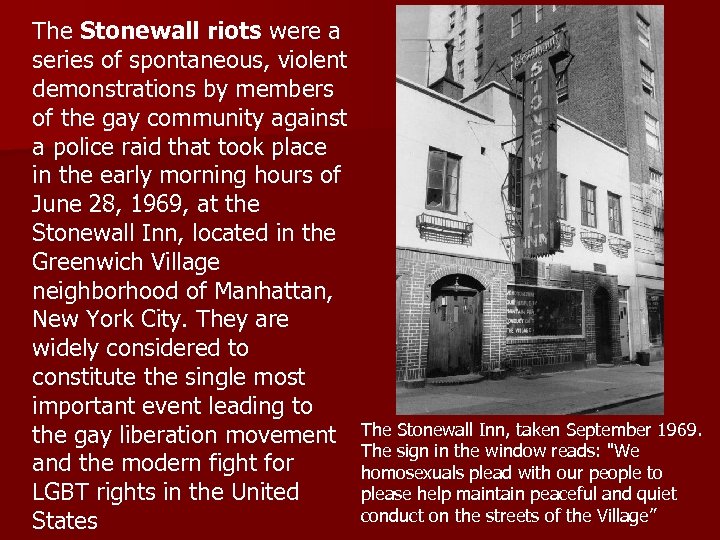 The Stonewall riots were a series of spontaneous, violent demonstrations by members of the gay community against a police raid that took place in the early morning hours of June 28, 1969, at the Stonewall Inn, located in the Greenwich Village neighborhood of Manhattan, New York City. They are widely considered to constitute the single most important event leading to the gay liberation movement and the modern fight for LGBT rights in the United States The Stonewall Inn, taken September 1969. The sign in the window reads: "We homosexuals plead with our people to please help maintain peaceful and quiet conduct on the streets of the Village”
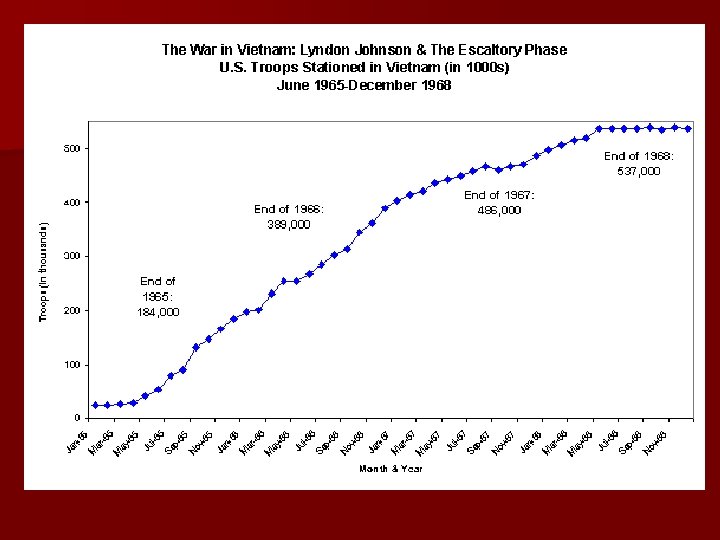
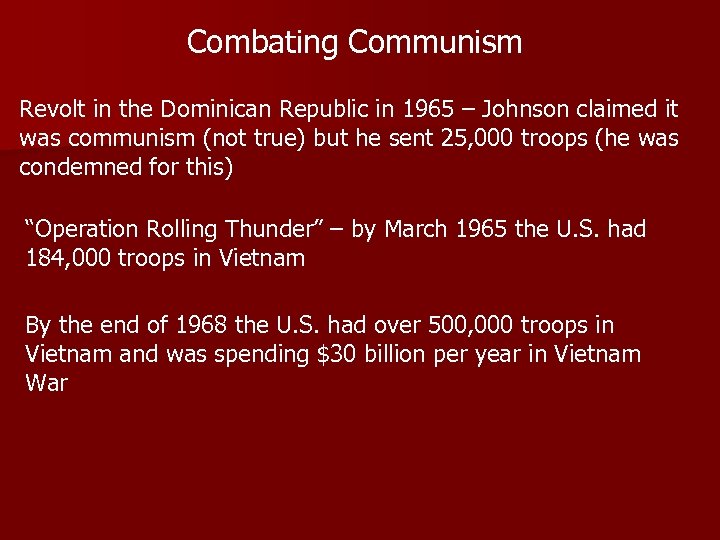 Combating Communism Revolt in the Dominican Republic in 1965 – Johnson claimed it was communism (not true) but he sent 25, 000 troops (he was condemned for this) “Operation Rolling Thunder” – by March 1965 the U. S. had 184, 000 troops in Vietnam By the end of 1968 the U. S. had over 500, 000 troops in Vietnam and was spending $30 billion per year in Vietnam War
 Vietnam n The American-backed Diem government had shakily and corruptly ruled Vietnam since 1954, but it was threatened by the communist Viet Cong movement led by Ho Chi Minh. n JFK slowly sent more and more U. S. troops to Vietnam to “maintain order, ” but they usually fought and died, despite the fact that it was “Vietnam’s war. n America was floundering in Vietnam and was being condemned for its actions there, and French leader Charles de Gaulle also ordered NATO off French soil in 1966.
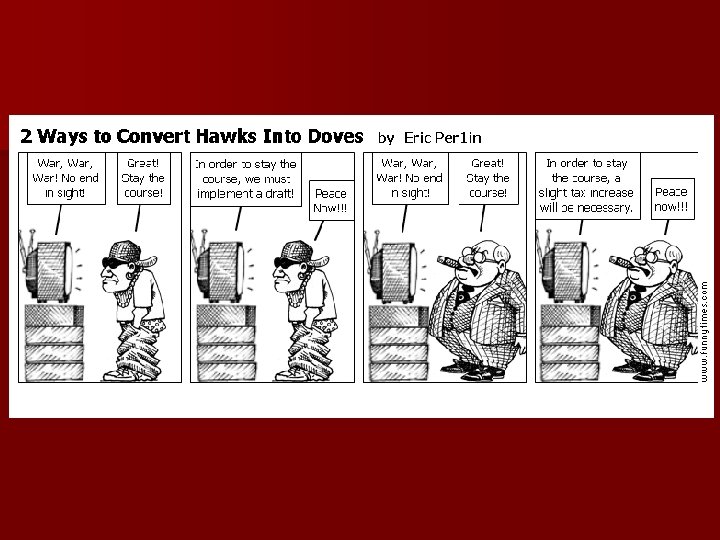
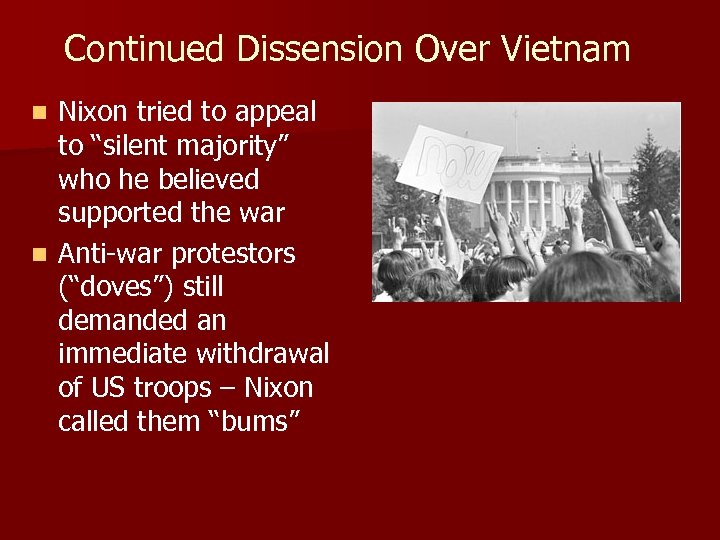
 In the Six-Day War (June 1967), Israel stunned the world by defeating Egypt (and its Soviet backers) and gaining new territory in the Sinai Peninsula, the Golan Heights, the Gaza Strip, and the West Bank of the Jordan River, including Jerusalem. Meanwhile, numerous protests in America went against the Vietnam War and the draft. Opposition was headed by the influential Senate Committee of Foreign Relations, headed by Senator William Fullbright of Arkansas. “Doves” (peace lovers) and “Hawks” (war supporters) clashed.
 Both sides (the U. S. and North Vietnam) did try to have intervals of quiet time in bombings, but they merely used those as excuses to funnel more troops into the area. Johnson also ordered the CIA to spy on domestic antiwar activists, and he encouraged the FBI to use its Counterintelligence Program (“Cointelpro”) against the peace movement. More and more, America was trapped in an awful Vietnam War, and it couldn’t get out, thus feeding more and more hatred and resentment of American Public
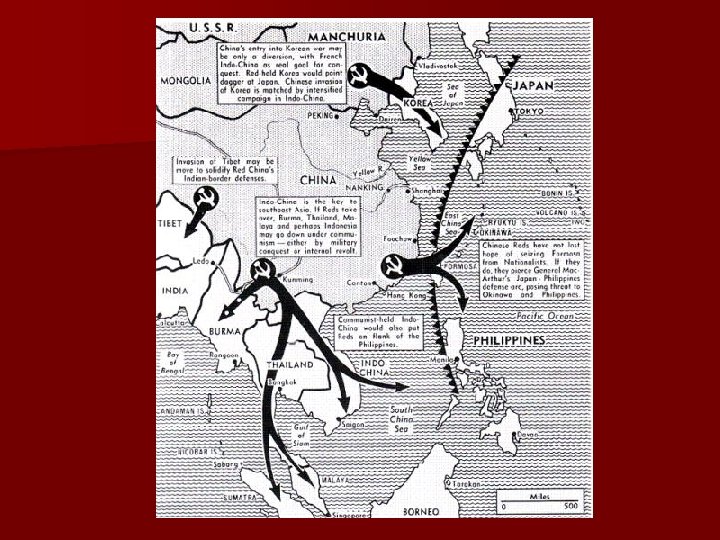
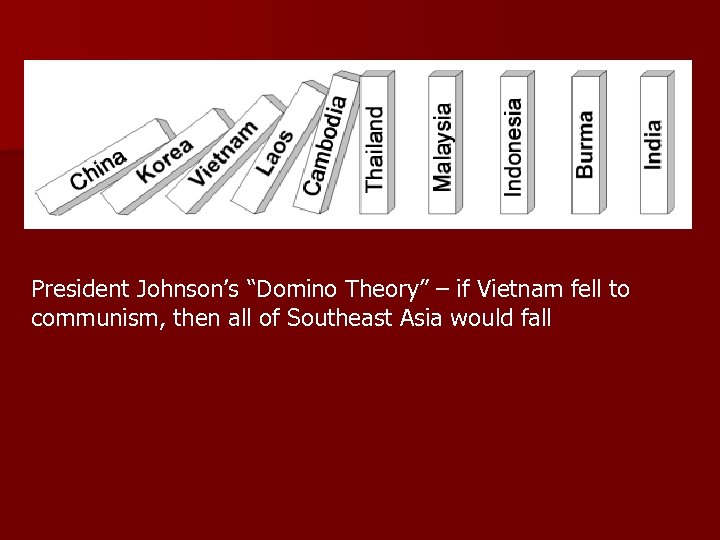 President Johnson’s “Domino Theory” – if Vietnam fell to communism, then all of Southeast Asia would fall
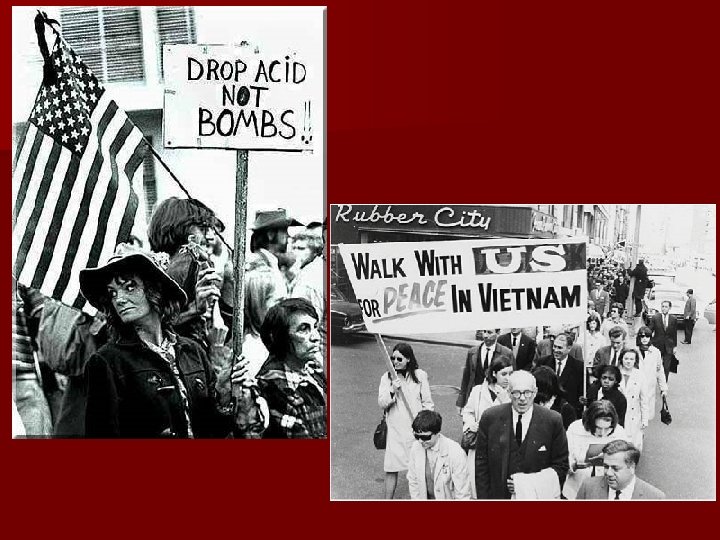
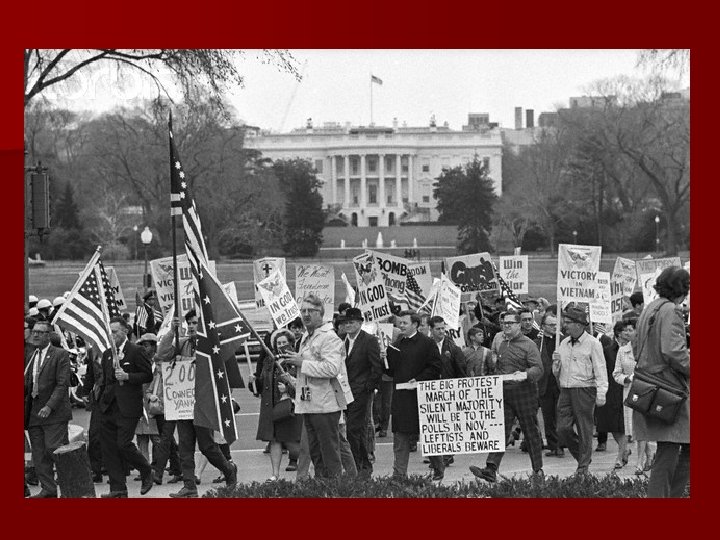
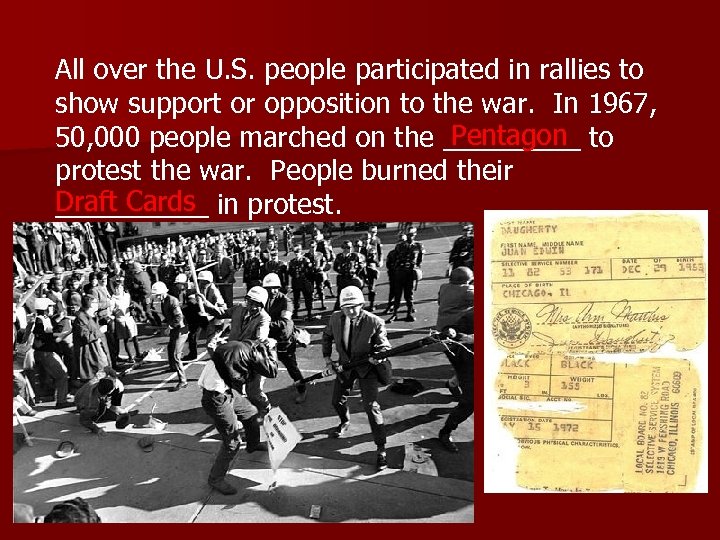 All over the U. S. people participated in rallies to show support or opposition to the war. In 1967, Pentagon 50, 000 people marched on the _____ to protest the war. People burned their Draft Cards in protest. _____
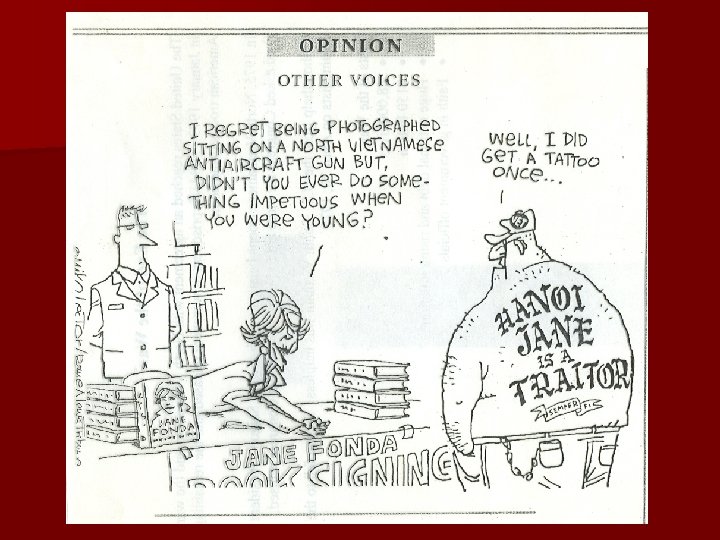
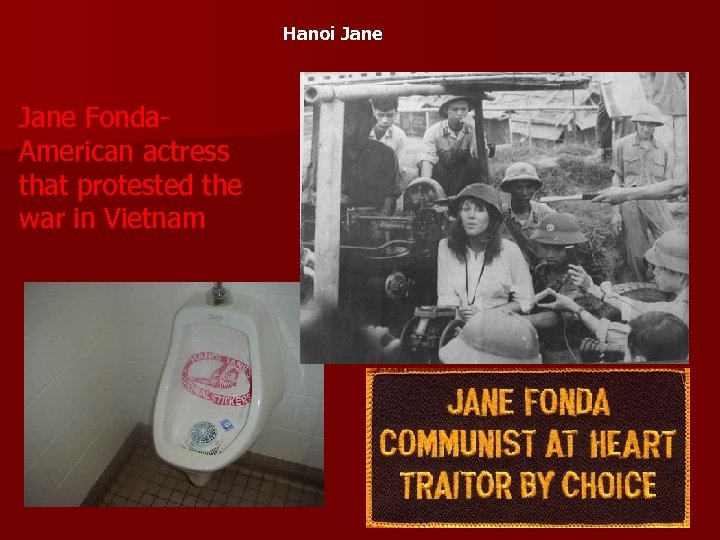 Hanoi Jane Fonda. American actress that protested the war in Vietnam
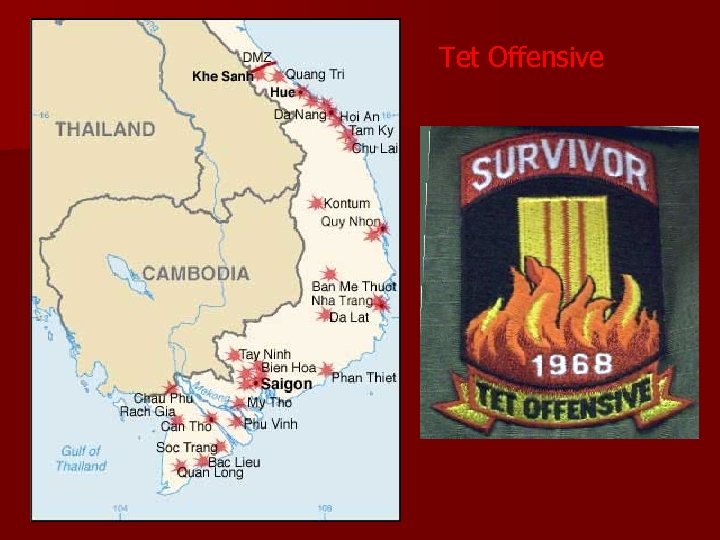
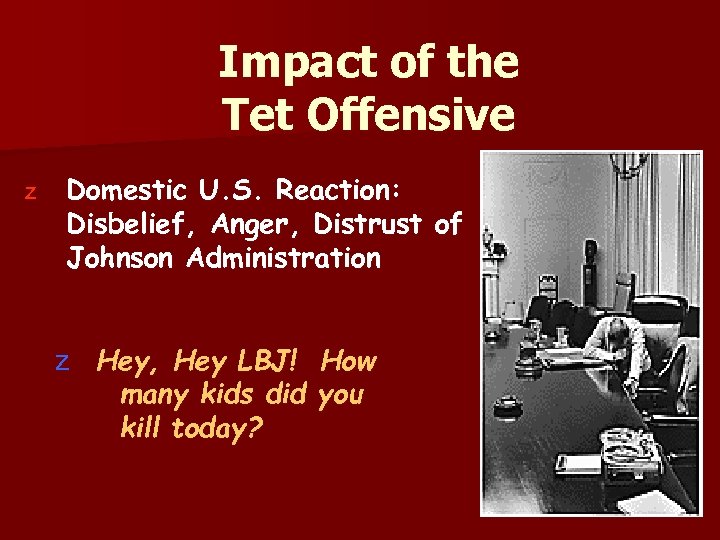
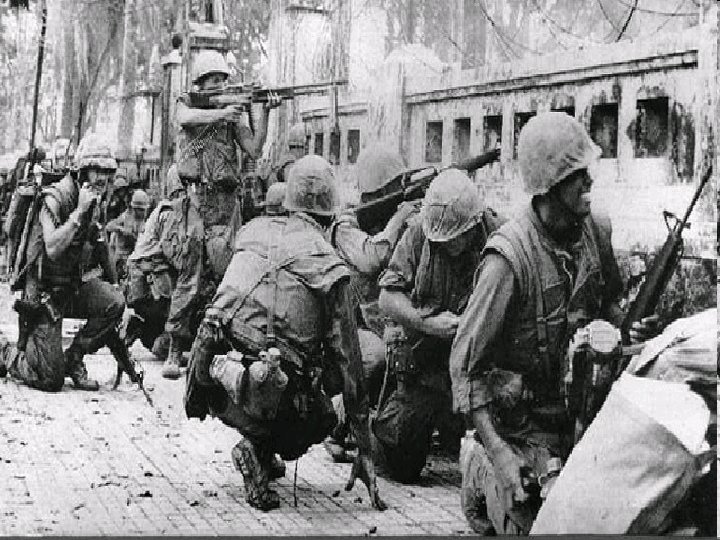
 1968: Year of Crisis The U. S. claimed to be winning the war in Vietnam. Nightly news programs kept track of the ______. Body Count The increasing number of dead Vietcong and North Vietnamese was used as evidence of our success and most Americans believed that the war was coming to an end. Tet Offensive ______- In January 1968, the communists launched a massive offensive against over 100 towns in S. Vietnam, By April, the Americans and ARVN has retaken the towns and the Tet Offensive was a military failure. However, it was obvious that the war was nowhere new ending and this led to controversy at home
 Tet Offensive
 Impact of the Tet Offensive z Domestic U. S. Reaction: Disbelief, Anger, Distrust of Johnson Administration z Hey, Hey LBJ! How many kids did you kill today?
 Vietnam continued Johnson was personally suffering at the American casualties, and he wept as he signed condolence letters and even prayed with Catholic monks in a nearby church—at night, secretly. And, the fact that North Vietnam had almost taken over Saigon in a blistering attack called the Tet Offensive didn’t help either. n Johnson also saw a challenge for the Democratic ticket from Eugene Mc. Carthy and Robert Kennedy, and the nation, as well as the Democratic party, was starting to be split by Vietnam. – LBJ refused to sign an order for more troops to Vietnam. n Then, on March 31, 1968, Johnson declared that he would stop sending in troops to Vietnam and that he would not run in 1968, shocking America. n
 Robert Kennedy assassinated June 6, 1968 by an Arab named Sirhan (Kennedy would most likely have been the Democratic nominee for President in 1968
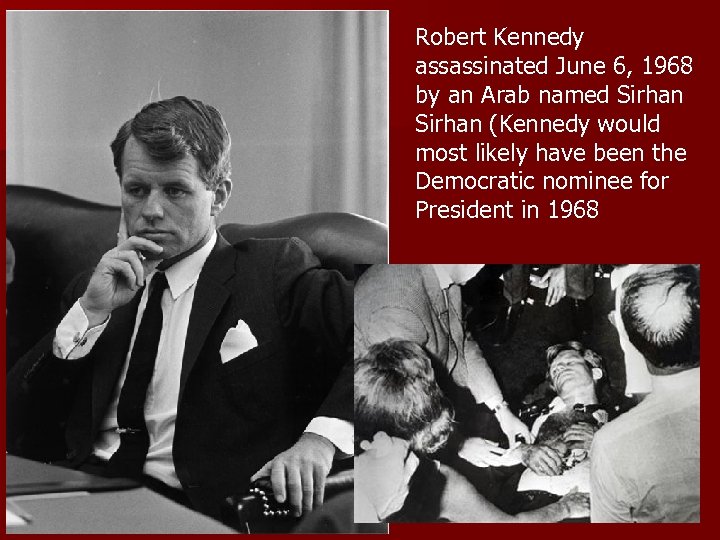
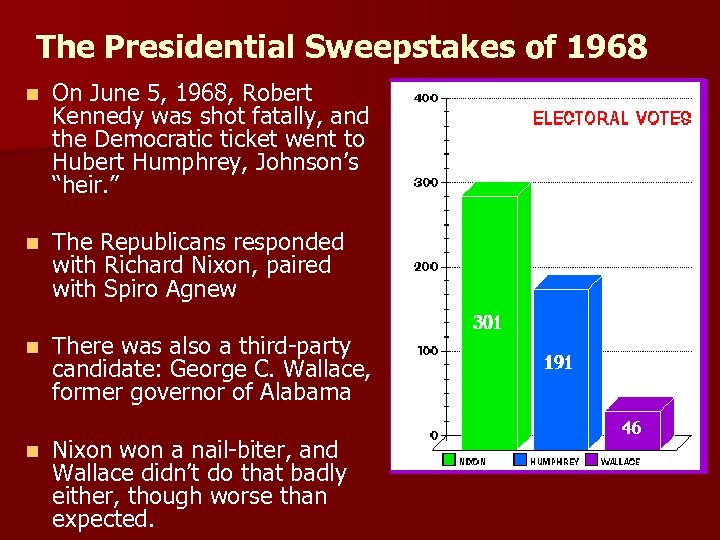 The Presidential Sweepstakes of 1968 n On June 5, 1968, Robert Kennedy was shot fatally, and the Democratic ticket went to Hubert Humphrey, Johnson’s “heir. ” n The Republicans responded with Richard Nixon, paired with Spiro Agnew n There was also a third-party candidate: George C. Wallace, former governor of Alabama n Nixon won a nail-biter, and Wallace didn’t do that badly either, though worse than expected.
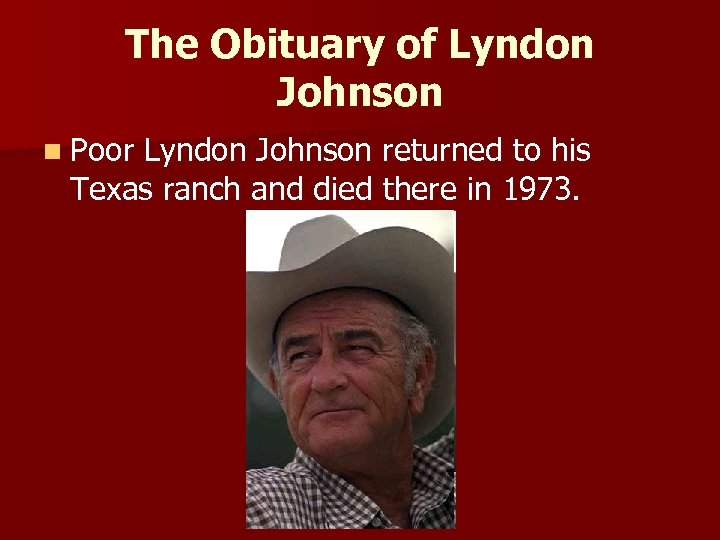 The Obituary of Lyndon Johnson n Poor Lyndon Johnson returned to his Texas ranch and died there in 1973.
 The Cultural Upheaval of the 1960 s n In the 60 s, the youth of America experimented with sex, drugs, and defiance. n They protested against conventional wisdom, authority, and traditional beliefs n Movies like The Wild One with Marlon Brando and Rebel without a Cause starring James Dean also showed this belief. Essentially, they championed the “ne’er-do-well” and the outcast. n Kids tried drugs, “did their own thing” in new institutions, and rejected patriotism; “Trust no one over 30”
 Dr. Alfred Kinsey had published Sexual Behavior in the Human Male, and estimated that 10% of all American males were gay. The birth control pill was introduced in 1960. The Manhattan Society, founded in L. A. in 1951, pioneered gay rights. Students for a Democratic Society, once against war, later spawned an underground terrorist group called the Weathermen. However, the “counterculture” of the youths of the 1960 s did significantly weaken existing values, ideas, and beliefs. https: //www. youtube. com/watch? v=St. Fhv. AIv 3 Js Woodstock
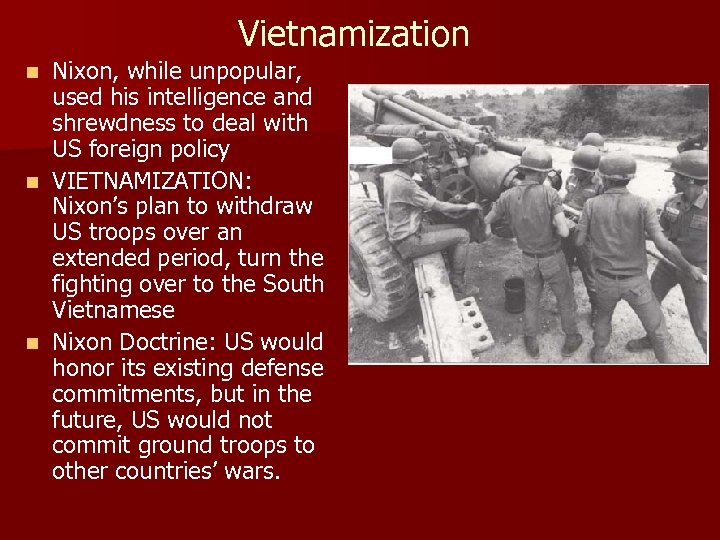 Vietnamization Nixon, while unpopular, used his intelligence and shrewdness to deal with US foreign policy n VIETNAMIZATION: Nixon’s plan to withdraw US troops over an extended period, turn the fighting over to the South Vietnamese n Nixon Doctrine: US would honor its existing defense commitments, but in the future, US would not commit ground troops to other countries’ wars. n
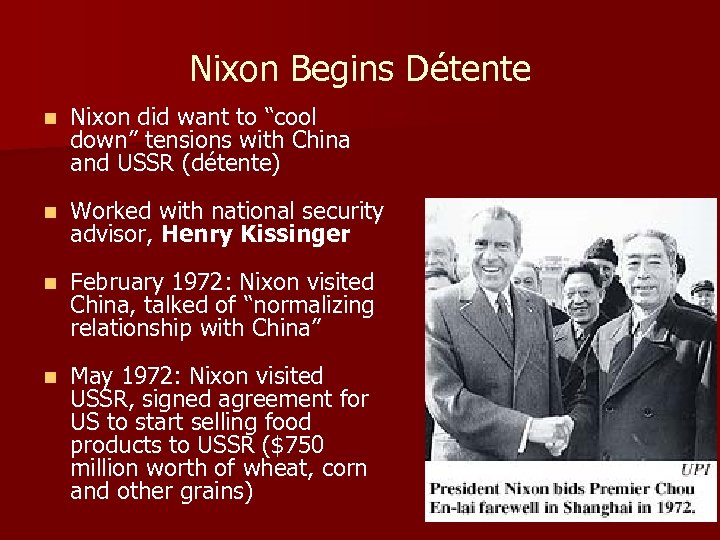 Nixon Begins Détente n Nixon did want to “cool down” tensions with China and USSR (détente) n Worked with national security advisor, Henry Kissinger n February 1972: Nixon visited China, talked of “normalizing relationship with China” n May 1972: Nixon visited USSR, signed agreement for US to start selling food products to USSR ($750 million worth of wheat, corn and other grains)
 Détente continued n US and USSR began anti-ballistic missile (ABM) treaties and arms-reduction negotiations: SALT (Strategic Arms Limitation Talks) n Started to slow nuclear arms race n However, both countries continued to develop weapons potential – Over 16, 000 nuclear warheads deployed by each side by end of 1980 s n Nixon continued to try to quell Communism – CIA involved in assassination of democratically elected Salvador Allende in Chile, supported dictator Augosto Pinochet after
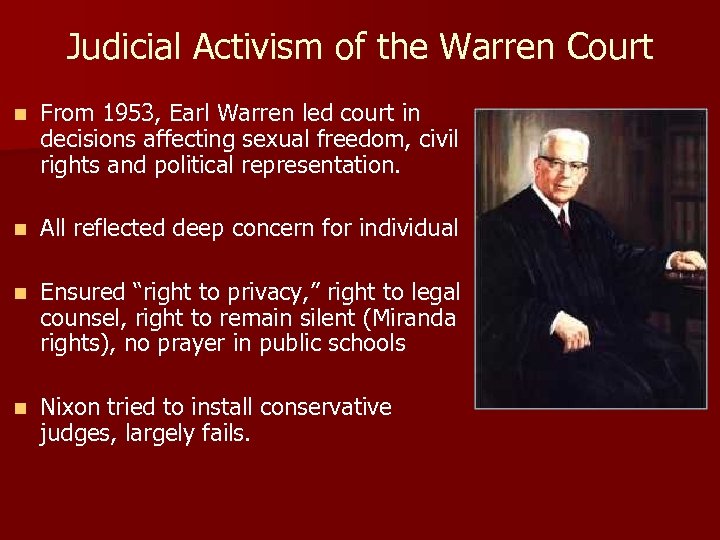 Judicial Activism of the Warren Court n From 1953, Earl Warren led court in decisions affecting sexual freedom, civil rights and political representation. n All reflected deep concern for individual n Ensured “right to privacy, ” right to legal counsel, right to remain silent (Miranda rights), no prayer in public schools n Nixon tried to install conservative judges, largely fails.
 Griswold v. Connecticut (1965) – the Supreme Court struck down a Connecticut law that prohibited the use of contraceptives even among married couples – the Court maintained that individuals have a right to privacy Gideon v. Wainwright (1963) – the Court held that all defendants in serious criminal cases had the right to a lawyer even if they couldn’t afford one Escobedo v. Illinois (1964) – Court ruled that citizens have the right to counsel (lawyer) during a police interrogation (before they are charged with a crime) Miranda v. Arizona (1966) – suspects must be informed (and understand) his/her right to remain silent and his/her right to have an attorney present during questioning
 Engel v. Vitale (1962) - determined that it is unconstitutional for state officials to compose an official school prayer and encourage its recitation in public schools School District of Abington Township v. Schempp (1963) – school sponsored Bible reading and prayer in public schools are unconstitutional Reynolds v. Sims (1964) – Supreme Court ruled that state legislature districts had to be roughly equal in population; Warren said, "Legislators represent people, not trees or acres. Legislators are elected by voters, not farms or cities or economic interests. " 1969 – Warren E. Burger replaced Warren (he retired) as chief justice; despite Nixon’s wishes, the Burger Court ruled by legalized abortion in Roe v. Wade (1973)
 Election of 1972 n Vietnam the key issue – North Vietnamese had launched new attacks on South, Nixon had stepped up bombings (12 days before election Kissinger announced “peace is at hand” n Nixon ran against Democrat Mc. Govern – Mc. Govern promised to withdraw all American troops in 90 days, Nixon said he had already quieted war down and a peace would be signed in two days n Nixon won in a landslide n January 1973: North Vietnam agreed to a cease-fire – Really meant American troops would withdraw, but North Vietnam got to keep 145, 000 troops in South.
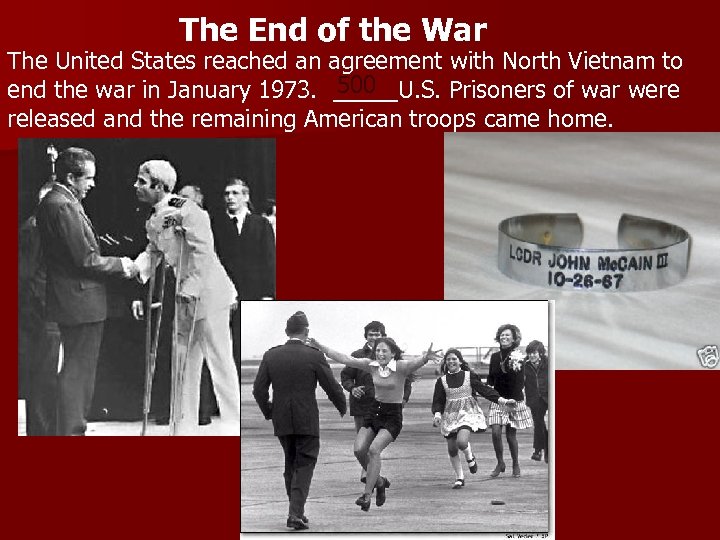 The End of the War The United States reached an agreement with North Vietnam to 500 end the war in January 1973. _____U. S. Prisoners of war were released and the remaining American troops came home.
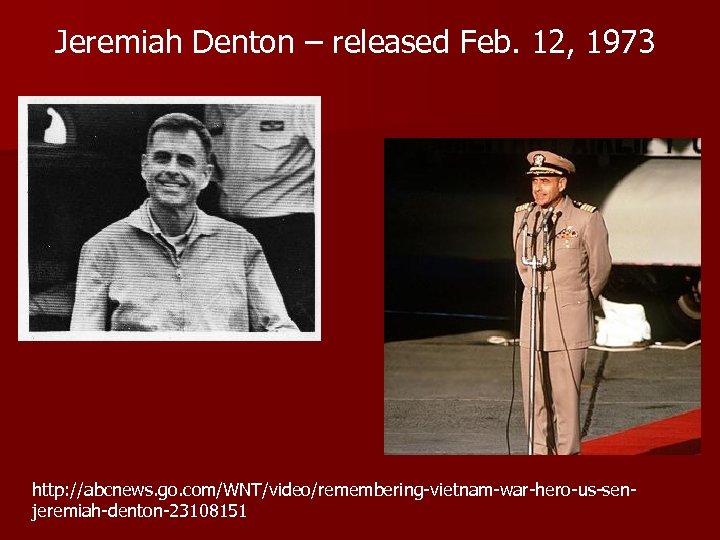 Jeremiah Denton – released Feb. 12, 1973 http: //abcnews. go. com/WNT/video/remembering-vietnam-war-hero-us-senjeremiah-denton-23108151
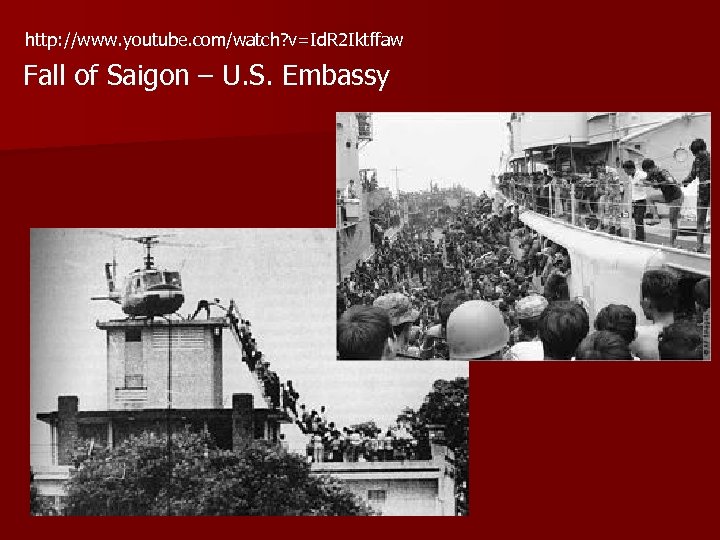 http: //www. youtube. com/watch? v=Id. R 2 Iktffaw Fall of Saigon – U. S. Embassy
 Nixon’s Domestic Policy n Expanded some welfare programs: Food Stamps, Medicaid, Aid to Families with Dependent Children n Encouraged integration of industry through quotas n Development of affirmative action for groups: Admit or hire women and minorities in proportion to presence in pop. n Environmental Protection Agency (EPA) and Occupational Health and Safety Administration (OSHA) – Progress with environment because of Rachel Carson's Silent Spring (exposed poisonous effects of pesticides)
 Nixon was a Republican president and Congress was dominated by Democrats Congress passed appropriations (giving out money) despite Nixon’s veto so he impounded (refused to spend) the money; this is an example of how he expanded his constitutional powers Congress voted in 1972 to raise Social Security benefits; they wanted to protect the elderly against inflation In 1971 Nixon took the U. S. off the Gold Standard and devalued the dollar
 President Johnson’s escalation Vietnamization by President Nixon
 Continued Dissension Over Vietnam Nixon tried to appeal to “silent majority” who he believed supported the war n Anti-war protestors (“doves”) still demanded an immediate withdrawal of US troops – Nixon called them “bums” n
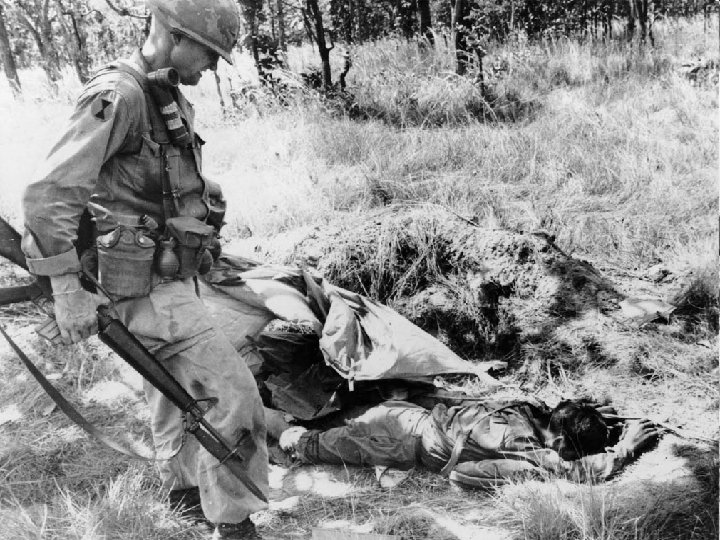
 The Controversy of Vietnam Longest war in American history n By 1970, 40, 000 killed and 250, 000 wounded n 3 rd most costly foreign war in our history n Very unpopular! – Biased draft targeted poor and minorities – Fighting VC nearly impossible – Drug abuse, mutiny and sabotage in army § “Fragging” n
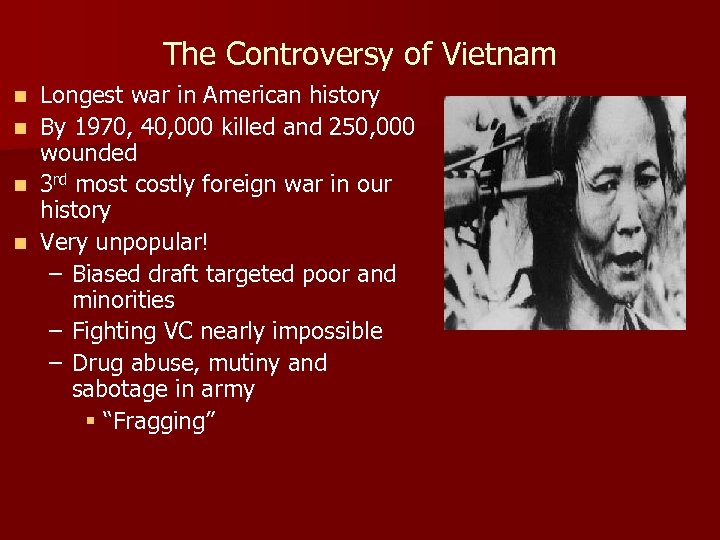
 In the United States military, fragging (from fragmentation grenade) refers to the act of murdering another member, or members of the military, particularly (a) member(s) of one's own command or fighting squad. Additionally, the term can be applied to manipulating the chain of command in order to have an individual, or unit, deliberately killed by placing them into harm's way, with the intended result being their deaths. An example would be to order a single soldier to perform a particularly hazardous task, and repeat the said task until he met his demise. The term originated during the Vietnam War and was most commonly used to mean the assassination of an unpopular officer of one's own fighting unit.
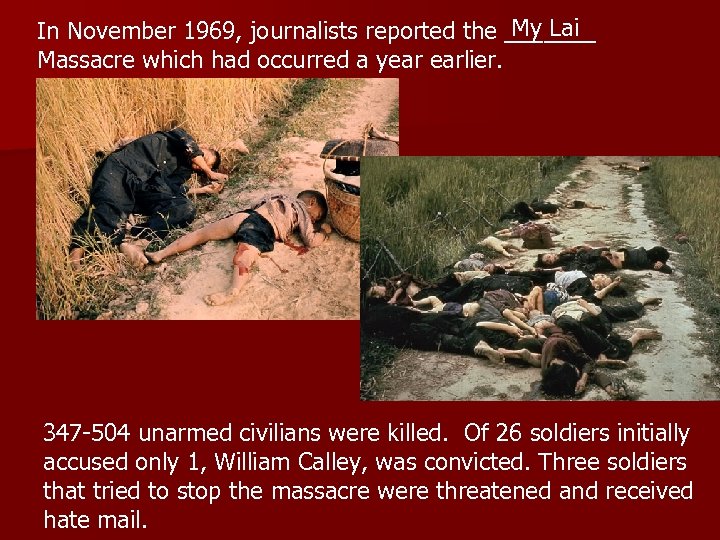 My Lai In November 1969, journalists reported the _______ Massacre which had occurred a year earlier. 347 -504 unarmed civilians were killed. Of 26 soldiers initially accused only 1, William Calley, was convicted. Three soldiers that tried to stop the massacre were threatened and received hate mail.
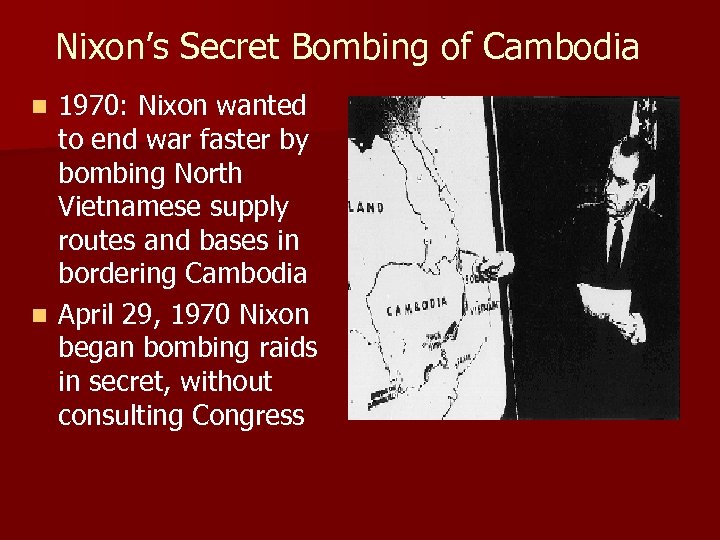 Nixon’s Secret Bombing of Cambodia 1970: Nixon wanted to end war faster by bombing North Vietnamese supply routes and bases in bordering Cambodia n April 29, 1970 Nixon began bombing raids in secret, without consulting Congress n
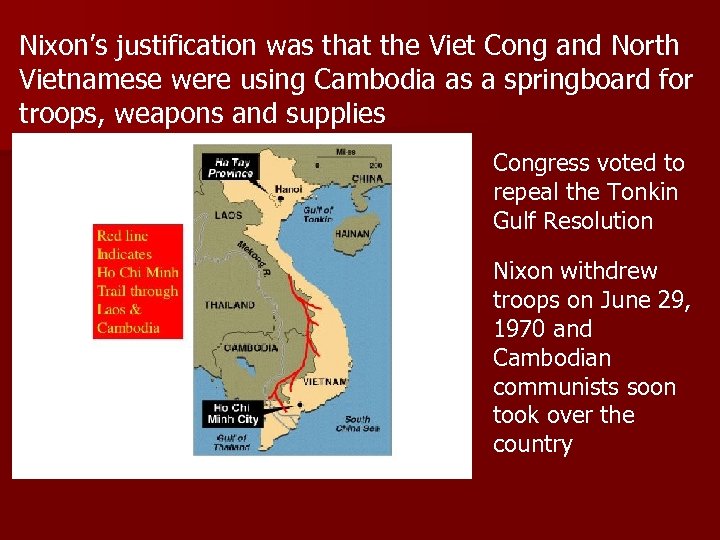 Nixon’s justification was that the Viet Cong and North Vietnamese were using Cambodia as a springboard for troops, weapons and supplies Congress voted to repeal the Tonkin Gulf Resolution Nixon withdrew troops on June 29, 1970 and Cambodian communists soon took over the country
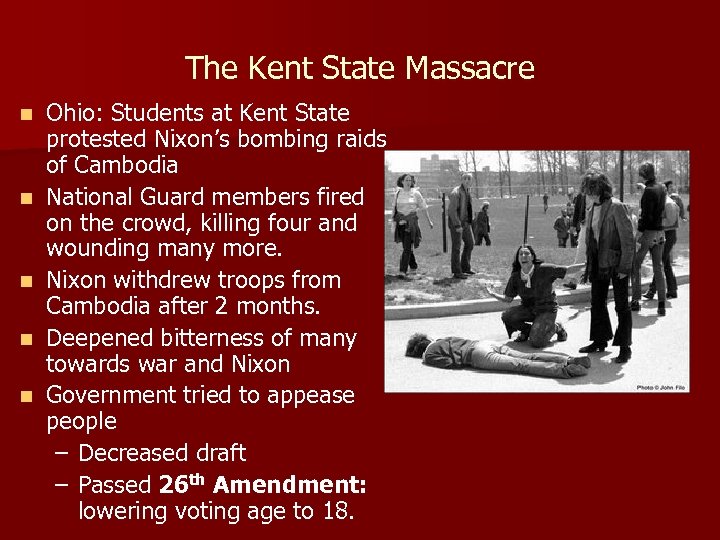 The Kent State Massacre n n n Ohio: Students at Kent State protested Nixon’s bombing raids of Cambodia National Guard members fired on the crowd, killing four and wounding many more. Nixon withdrew troops from Cambodia after 2 months. Deepened bitterness of many towards war and Nixon Government tried to appease people – Decreased draft – Passed 26 th Amendment: lowering voting age to 18.
 The Pentagon Papers n n June 1971: Daniel Ellsberg, former Pentagon official, released “Pentagon Papers” to the NY Times Papers printed top secret information documenting the mistakes of Presidents Kennedy and Johnson in Nixon’s National Security regards to Vietnam Advisor Dr. Henry Kissinger Showed Gulf of Tonkin held secret meetings with incident may have been North Vietnamese officials in provoked by US Paris to negotiate the end of People furious war
 Pentagon Papers, contd n Revealed that Nixon’s bombing raids of Cambodia started well before 1970 and continued after cease-fire with North Vietnam in 1973 – Nixon trying to stop Cambodia from becoming Communist, but did all of this without permission – Destabilized Cambodia: led to rise of Pol Pot responsible for death of 2 million – Cambodia became Communist anyway in 1978 The War Powers Act Congress responded with 1973 War Powers Act (it is the antiblank check) • Limited power of president to make war • President must report to Congress within 48 hours of sending troops, would have to get authorization of Congress • Part of “New Isolationism”: Mood of caution and restraint after Vietnam
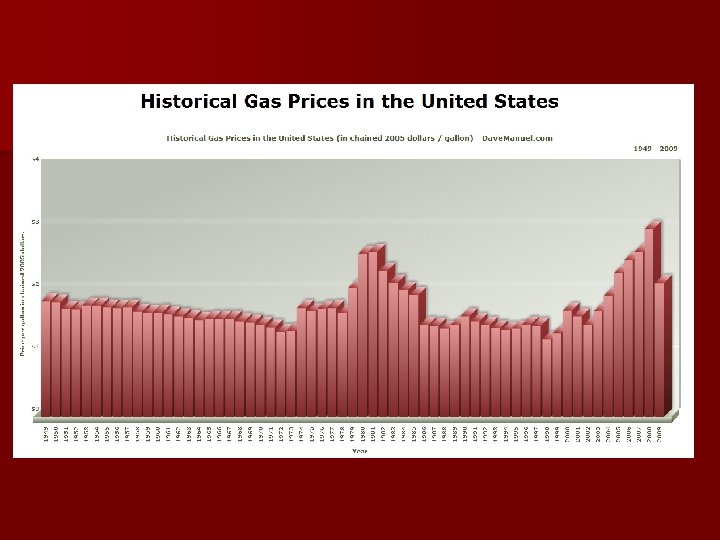
 The Arab Oil Embargo and the Energy Crisis n Oct 1973 Syrians & Egyptians launched surprise attacks on Israel in an attempt to regain territory they lost in the Six Day War in 1967; Arab world upset at US support for Israel (Nixon airlifted $2 billion in war materiels to Israel) n October 1973: OPEC began an embargo of oil to the US or any country supporting Israel n Began “energy crisis” in US – Showed our dependence on Middle Eastern Oil – Even after embargo, OPEC quadrupled prices – End of cheap, available energy – Beginning of US wanting to protect oil supplies in Middle East (Iraq)
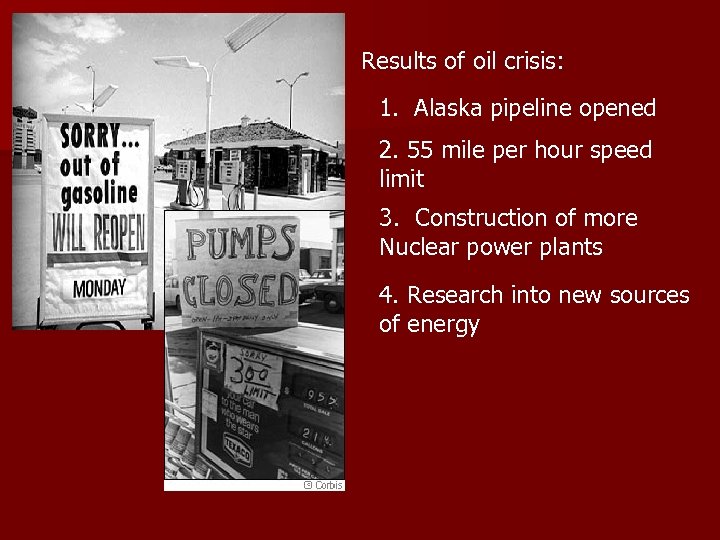 Results of oil crisis: 1. Alaska pipeline opened 2. 55 mile per hour speed limit 3. Construction of more Nuclear power plants 4. Research into new sources of energy