 Скачать презентацию Chapter 36 Partnerships and Special Business Forms
bbe6cbf57de788d67a3ea99a069da536.ppt
- Количество слайдов: 38



Chapter 36 Partnerships and Special Business Forms © 2004 West Legal Studies in Business A Division of Thomson Learning 1
Introduction üPartnerships are governed both by common law and by statutory laws. üAgency Concepts and Partnership Law: § Each partner is deemed to be an agent of the other. § There may be imputation of liability. § Each partner is a fiduciary of the other. © 2004 West Legal Studies in Business A Division of Thomson Learning 2
§ 1: Law Governing Partnerships üPartners are agents and fiduciaries of one another, but differ from agents in that they are also co-owners and share in profits and losses. üSources of Law: § State common law. § Uniform Partnership Act (UPA), adopted by all states in some form. § Revised Uniform Partnership Act (RUPA): adopted by some states. © 2004 West Legal Studies in Business A Division of Thomson Learning 3
§ 2: Definition of Partnership üPartnership is created when two or more persons agree to carry on business for profit as co-owners with equal right to manage and share profits (UPA). üCase 36. 1: Cap Care Group Inc. v. Mc. Donald (2002). © 2004 West Legal Studies in Business A Division of Thomson Learning 4
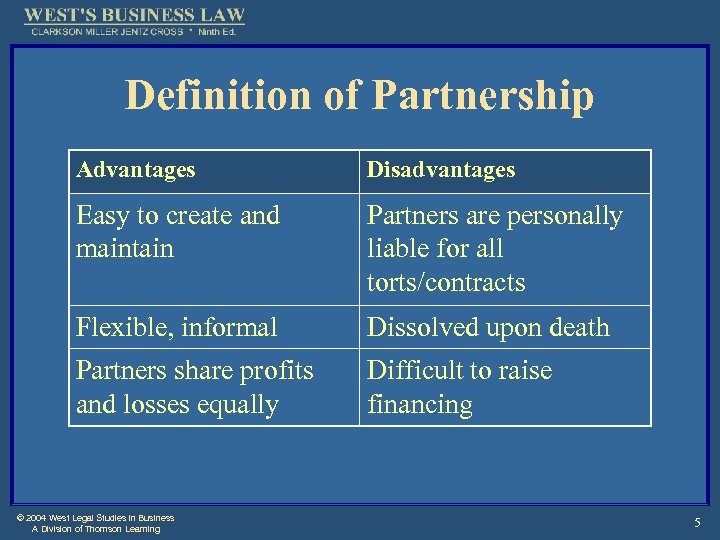
Definition of Partnership Advantages Disadvantages Easy to create and maintain Partners are personally liable for all torts/contracts Flexible, informal Dissolved upon death Partners share profits and losses equally Difficult to raise financing © 2004 West Legal Studies in Business A Division of Thomson Learning 5
Definition of Partnership üIf a commercial enterprise shares profits and losses a partnership will be inferred. Exceptions: Partnership not be inferred if profits received as payment in the following situations: § § Debt by installments of interest on a loan. Wages of an employee. Rent to a landlord. Annuity to a widow or representative of a deceased partner. § Sale of good will. © 2004 West Legal Studies in Business A Division of Thomson Learning 6
§ 3: The Nature of Partnerships üAt common law, the partnership was not a separate legal entity from its owners. üToday, partnership law in many states recognizes a partnership as an independent entity for some purposes. © 2004 West Legal Studies in Business A Division of Thomson Learning 7
![Partnership as an Entity [1] üToday, many states recognize the partnership as a separate](https://present5.com/presentation/bbe6cbf57de788d67a3ea99a069da536/image-8.jpg "Partnership as an Entity [1] üToday, many states recognize the partnership as a separate")
Partnership as an Entity [1] üToday, many states recognize the partnership as a separate legal entity for the following purposes: § To sue and be sued (for federal questions, yes; for state questions, differs). § To have judgments collected against it’s assets, and individual partners’ assets. © 2004 West Legal Studies in Business A Division of Thomson Learning 8
![Partnership as an Entity [2] üPartnerships are recognized as separate legal entities (cont’d): §](https://present5.com/presentation/bbe6cbf57de788d67a3ea99a069da536/image-9.jpg "Partnership as an Entity [2] üPartnerships are recognized as separate legal entities (cont’d): §")
Partnership as an Entity [2] üPartnerships are recognized as separate legal entities (cont’d): § To own partnership property. § To convey partnership property. • At common law -- property owned in tenancy in partnership, all partners had to be named and sign the conveyance. • Under UPA partnership property can be held and sold in firm name. © 2004 West Legal Studies in Business A Division of Thomson Learning 9
![Partnership as an Entity [3] üPartnerships are recognized as separate legal entities (cont’d): §](https://present5.com/presentation/bbe6cbf57de788d67a3ea99a069da536/image-10.jpg "Partnership as an Entity [3] üPartnerships are recognized as separate legal entities (cont’d): §")
Partnership as an Entity [3] üPartnerships are recognized as separate legal entities (cont’d): § For “marshalling of assets. ” • Federal Bankruptcy changes marshaling of assets. § To keep its own books. § File its own federal/state tax returns. üAggregate Theory of Partnership. § Partnership pays no federal income tax. © 2004 West Legal Studies in Business A Division of Thomson Learning 10
§ 4: Partnership Formation üDuration of Partnership. § Partnership for a term. § Partnership at will. Partnership agreements can be oral unless Statute of Frauds requires a written agreement. Practically, agreements should be in writing. üCapacity. Partners must have legal capacity. üCorporations. UPA permits corporations to be a partner. © 2004 West Legal Studies in Business A Division of Thomson Learning 11
Partnership by Estoppel üOccurs when a person who is not a partner holds himself out to 3 rd Parties and the 3 rd Party relies to her detriment. üTwo Aspects of Liability: § Person who mis-represents he is a partner is liable. § Any person consenting to the misrepresentation is also liable. © 2004 West Legal Studies in Business A Division of Thomson Learning 12
Partnership by Estoppel üWhen real partnership exists: § A partner represents a non-partner is in fact a partner, § The non-partner is an agent whose acts are binding on the partner only, not the partnership. üRemember: Partnership by estoppel requires third party reasonably rely on the representation to her detriment. © 2004 West Legal Studies in Business A Division of Thomson Learning 13
§ 5: Partnership Operations üRights of Partners: In the absence of a partnership agreement (oral or written) state statutes govern the partner rights: § Management: equal, each one vote, majority wins; need unanimous consent for some actions. § Partnership Interest: equal profits, losses shared as profits shared. © 2004 West Legal Studies in Business A Division of Thomson Learning 14
![Rights of Partners [1] üRights among partners (cont’d): § Compensation: none. § Inspection of](https://present5.com/presentation/bbe6cbf57de788d67a3ea99a069da536/image-15.jpg "Rights of Partners [1] üRights among partners (cont’d): § Compensation: none. § Inspection of")
Rights of Partners [1] üRights among partners (cont’d): § Compensation: none. § Inspection of the Books: always and also by rep. of deceased partner. § Accounting: when other partner(s) committing fraud, embezzlement, wrongful exclusion, or anytime it is just and reasonable. § Property Rights © 2004 West Legal Studies in Business A Division of Thomson Learning 15
![Rights of Partners [2] üEach partner has a property right, which includes: § An](https://present5.com/presentation/bbe6cbf57de788d67a3ea99a069da536/image-16.jpg "Rights of Partners [2] üEach partner has a property right, which includes: § An")
Rights of Partners [2] üEach partner has a property right, which includes: § An interest in the partnership. § A right in specific partnership property. § A right to participate in the management of the partnership, as mentioned above. © 2004 West Legal Studies in Business A Division of Thomson Learning 16
![Rights of Partners [3] üEach Partner has right to equally share partnership interest: §](https://present5.com/presentation/bbe6cbf57de788d67a3ea99a069da536/image-17.jpg "Rights of Partners [3] üEach Partner has right to equally share partnership interest: §")
Rights of Partners [3] üEach Partner has right to equally share partnership interest: § A proportionate share of the profits earned and a return of capital on the partnership's termination. § A partner may assign his interest. § A partner’s interest is susceptible to a creditor’s lien. Creditors may attach and get a “charging order. ” § Assignment or charging order do not dissolve the firm. © 2004 West Legal Studies in Business A Division of Thomson Learning 17
![Rights of Partners [4] üPartner Has a Right to Partnership Property: (cont’d) § What](https://present5.com/presentation/bbe6cbf57de788d67a3ea99a069da536/image-18.jpg "Rights of Partners [4] üPartner Has a Right to Partnership Property: (cont’d) § What")
Rights of Partners [4] üPartner Has a Right to Partnership Property: (cont’d) § What she originally brought into the partnership, or § Acquired on account of the partnership, or § Purchased with partnership funds. ü Partners are tenants in partnership of all firm property = other partners have rights of survival if one dies and then they account to the deceased partner’s estate for the value of his interest. (*but see RUPA) © 2004 West Legal Studies in Business A Division of Thomson Learning 18
![Rights of Partners [5] üPartner cannot sell, assign or take a particular item of](https://present5.com/presentation/bbe6cbf57de788d67a3ea99a069da536/image-19.jpg "Rights of Partners [5] üPartner cannot sell, assign or take a particular item of")
Rights of Partners [5] üPartner cannot sell, assign or take a particular item of partnership property, nor can individual partner’s creditors seize the property. üCreditors can get a charging order against the partnership for the partner’s interest in the partnership. © 2004 West Legal Studies in Business A Division of Thomson Learning 19
![Duties, Powers and Liabilities of Partners [1] üFiduciary Duties. Partners are fiduciaries and general](https://present5.com/presentation/bbe6cbf57de788d67a3ea99a069da536/image-20.jpg "Duties, Powers and Liabilities of Partners [1] üFiduciary Duties. Partners are fiduciaries and general")
Duties, Powers and Liabilities of Partners [1] üFiduciary Duties. Partners are fiduciaries and general agents of one another and the partnership. üGeneral Agency Powers. Partners have implied authority to conduct ordinary partnership business but need unanimous consent to sell assets or donate to charity. § Case 36. 2: Helpinstill v. Regions Bank (2000). © 2004 West Legal Studies in Business A Division of Thomson Learning 20
![Duties, Powers and Liabilities of Partners [2] üAuthorized vs. Unauthorized Actions. § Liability depends](https://present5.com/presentation/bbe6cbf57de788d67a3ea99a069da536/image-21.jpg "Duties, Powers and Liabilities of Partners [2] üAuthorized vs. Unauthorized Actions. § Liability depends")
Duties, Powers and Liabilities of Partners [2] üAuthorized vs. Unauthorized Actions. § Liability depends on the scope of authority. üJoint Liability for Contracts. If Partner is sued for Partnership debt, Partner has right to insist that other partners be sued with her. © 2004 West Legal Studies in Business A Division of Thomson Learning 21
![Duties, Powers and Liabilities of Partners [3] üJoint and Several Liability for Torts. §](https://present5.com/presentation/bbe6cbf57de788d67a3ea99a069da536/image-22.jpg "Duties, Powers and Liabilities of Partners [3] üJoint and Several Liability for Torts. §")
Duties, Powers and Liabilities of Partners [3] üJoint and Several Liability for Torts. § JSL means 3 rd party can sue either one or all partners. 3 rd party may collect against personal assets of all partners. üLiability of Incoming Partner & Outgoing Partner. New admitted partner has no personal liability for existing partnership debts and obligations. © 2004 West Legal Studies in Business A Division of Thomson Learning 22
§ 6: Partnership Termination üThe termination of a partnership occurs in two stages: § Dissolution (is the legal “death” of the partnership), and § Winding up. (collecting and distributing partnership assets). © 2004 West Legal Studies in Business A Division of Thomson Learning 23
![Dissolution [1] üBy Acts of the Partners: § Partners can agree to Agreement. §](https://present5.com/presentation/bbe6cbf57de788d67a3ea99a069da536/image-24.jpg "Dissolution [1] üBy Acts of the Partners: § Partners can agree to Agreement. §")
Dissolution [1] üBy Acts of the Partners: § Partners can agree to Agreement. § Partner’s Withdrawal. • Partnership for term – breach. • No term -- no breach. § Admission of a new partner. § A transfer of a partner’s interest. • Although the transferee does not become a partner. • By assignment or attachment by creditor. © 2004 West Legal Studies in Business A Division of Thomson Learning 24
![Dissolution [2] üBy Operation of Law: § § Death of a partner. Bankruptcy of](https://present5.com/presentation/bbe6cbf57de788d67a3ea99a069da536/image-25.jpg "Dissolution [2] üBy Operation of Law: § § Death of a partner. Bankruptcy of")
Dissolution [2] üBy Operation of Law: § § Death of a partner. Bankruptcy of partnership. Illegality. © 2004 West Legal Studies in Business A Division of Thomson Learning 25
![Dissolution [3] üBy Judicial Decree: § § § Insanity. Incapacity. Business Impracticality. Improper Conduct.](https://present5.com/presentation/bbe6cbf57de788d67a3ea99a069da536/image-26.jpg "Dissolution [3] üBy Judicial Decree: § § § Insanity. Incapacity. Business Impracticality. Improper Conduct.")
Dissolution [3] üBy Judicial Decree: § § § Insanity. Incapacity. Business Impracticality. Improper Conduct. Other Circumstances (personal dissension). © 2004 West Legal Studies in Business A Division of Thomson Learning 26
Notice of Dissolution üTo avoid liability for apparent authority, apply the agency rules by giving: § Actual notice. § Constructive notice. © 2004 West Legal Studies in Business A Division of Thomson Learning 27
Winding Up üPartners have no authority after dissolution occurs except to: § Complete transactions already begun. § Wind up by collecting and preserving partnership assets, discharging liabilities, and accounting to each partner for the value of his share. üCase 36. 3: Creel v. Lilly (1999). © 2004 West Legal Studies in Business A Division of Thomson Learning 28
![Winding Up [2] üIf partner has violated the partnership agreement, he: § Must pay](https://present5.com/presentation/bbe6cbf57de788d67a3ea99a069da536/image-29.jpg "Winding Up [2] üIf partner has violated the partnership agreement, he: § Must pay")
Winding Up [2] üIf partner has violated the partnership agreement, he: § Must pay damages. § May not participate in winding up. § But other partners may choose to continue. üIf partner dies: § Other partners act as fiduciaries. § Accounting to deceased partner’s estate. § Survivors get paid for their services. © 2004 West Legal Studies in Business A Division of Thomson Learning 29
Distribution of Assets üPartnership obligations are paid in the following order: § § First, 3 rd party creditors. Second, partner loans to partnership. Third, return of capital contributions. Fourth, distribution of the balance, if any to partners. © 2004 West Legal Studies in Business A Division of Thomson Learning 30
![Distribution of Assets [2] üIf liabilities are greater than assets partners bear losses in](https://present5.com/presentation/bbe6cbf57de788d67a3ea99a069da536/image-31.jpg "Distribution of Assets [2] üIf liabilities are greater than assets partners bear losses in")
Distribution of Assets [2] üIf liabilities are greater than assets partners bear losses in proportion in which they shared profits, unless agreed otherwise. üIf one partner does not contribute, other partners are liable for his share and they have the right of contribution against that partner who didn’t pay. © 2004 West Legal Studies in Business A Division of Thomson Learning 31
Partnership Buy-Sell Agreements Partners can agree in advance that, in the event of the death of one of the partners or some other event, what occurs: e. g. , how much the deceased partner or her estate will get for interest, or whether the other partners can acquire the partnership interest. Partnership can buys life insurance to cover this accounting on partner’s death. © 2004 West Legal Studies in Business A Division of Thomson Learning 32
§ 7: Special Business Forms üJoint Venture: two or more entities combine efforts or property for a single transaction or project. üUnless agreed otherwise, JV’s share profits and losses equally. üCommon in international transactions when U. S. companies wish to expand overseas. © 2004 West Legal Studies in Business A Division of Thomson Learning 33
JV Characteristics ü Resembles a partnership and is taxed like a partnership. However, a JV is limited in time and scope, whereas a partnership is an ongoing business. Other differences: § JV members has less implied and apparent authority than partners. § Death of JV member does not terminate JV. ü JV members can specify duration. If not, then JV terminates when purpose is accomplished. © 2004 West Legal Studies in Business A Division of Thomson Learning 34
JV Rights and Liabilities üJV members owe a fiduciary duty to each other (loyalty, no conflicts of interest). üJV members have equal right to manage the business. © 2004 West Legal Studies in Business A Division of Thomson Learning 35
Other Entities üSyndicate (Investment Group): group of individuals getting together to finance a particular project. üJoint Stock Company is a hybrid of partnership and corporation: (1) ownership represented by shares of stock; (2)managed by directors and officers of the company; and (3) can have a perpetual existence. © 2004 West Legal Studies in Business A Division of Thomson Learning 36
![Other Entities [2] üBusiness Trust is created by a written agreement setting forth the](https://present5.com/presentation/bbe6cbf57de788d67a3ea99a069da536/image-37.jpg "Other Entities [2] üBusiness Trust is created by a written agreement setting forth the")
Other Entities [2] üBusiness Trust is created by a written agreement setting forth the interests of the beneficiaries and obligations and powers of trustees. Legal ownership and management of property remains with trustees and profits distributed to the beneficiaries. üCooperative is an association organized to provide a not-for-profit service to members. © 2004 West Legal Studies in Business A Division of Thomson Learning 37
Law on the Web üSmall Business Administration’s Web Site. üLaw Firm of Reinhart et al. for information on business organizations. üLegal Research Exercises on the Web. © 2004 West Legal Studies in Business A Division of Thomson Learning 38
Скачать презентацию Chapter 36 Partnerships and Special Business Forms
bbe6cbf57de788d67a3ea99a069da536.ppt