


 Скачать презентацию Chapter 34 Patients With Special Challenges Developmental
bf6c27b1e57bbd3d9b5db99a1c02f8d1.ppt
- Количество слайдов: 87
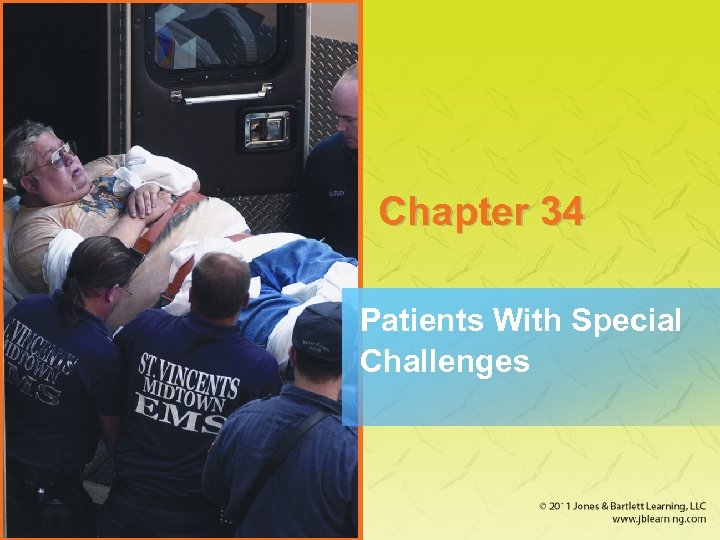 Chapter 34 Patients With Special Challenges
 Developmental Disability (1 of 3) • Mental retardation • Caused by insufficient cognitive development of brain • Inability to learn and socially adapt at a normal developmental rate
 Developmental Disability (2 of 3) • Possible causes – Genetic factors – Congenital infections – Complications at birth – Malnutrition – Environmental factors
 Developmental Disability (3 of 3) • Possible causes (cont’d) – Prenatal drug or alcohol use – Fetal alcohol syndrome – Traumatic brain injury – Poisoning (eg, with lead or other toxins)
 Characteristics of Developmentally Disabled Patients (1 of 2) • Slow to understand or limited vocabulary • Behave immaturely compared to peers
 Characteristics of Developmentally Disabled Patients (2 of 2) • If severe, may have inability to care for themselves, communicate, understand, or respond • Patients with developmental disabilities are susceptible to the same diseases as other patients.
 Autism (1 of 3) • Pervasive developmental disorder characterized by impairment of social interaction – Severe behavioral problems – Repetitive motor activities – Impairment in verbal and nonverbal skills
 Autism (2 of 3) • Wide spectrum of disability • Patients fail to use or understand nonverbal means of communicating. • There is no explanation of why autism develops. – Affects males four times greater than females – Typically diagnosed by age 3 years
 Autism (3 of 3) • Older adults may not be diagnosed. • Patients have medical needs similar to their peers without autism. • Rely on parents or caregivers for information
 Down Syndrome (1 of 4) • A genetic chromosomal defect that can occur during fetal development – Results in mild to severe mental retardation • Associated abnormalities/conditions – Round head with flat occiput – Enlarged, protruding tongue – Slanted, wide-set eyes
 Down Syndrome (2 of 4) • Increased risk for medical complications – As many as 40% may have heart conditions and hearing and vision problems – Two thirds have congenital heart disease
 Down Syndrome (3 of 4) • Intubation may be difficult due to large tongues and small oral and nasal cavities. • Mask ventilation can be challenging—jawthrust maneuver or a nasopharyngeal airway may be necessary.
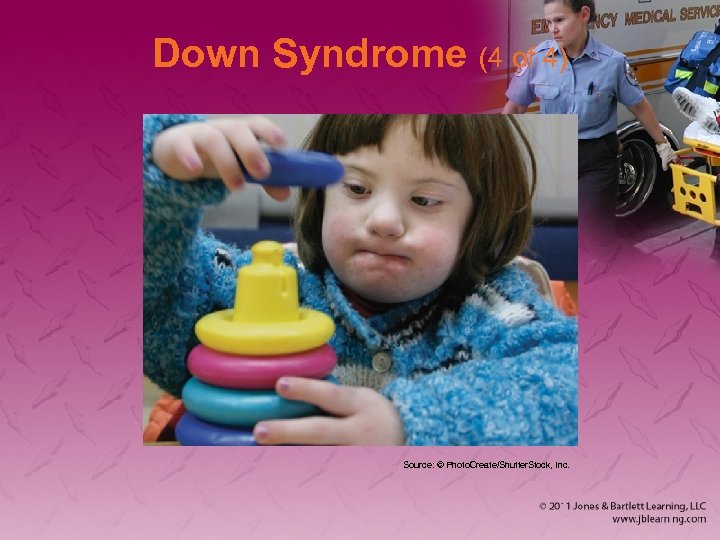 Down Syndrome (4 of 4) Source: © Photo. Create/Shutter. Stock, Inc.
 Patient Interaction (1 of 2) • It is normal to feel uncomfortable. • Treat the patient as you would any other patient. • Approach in a calm, friendly manner. • Establish rapport.
 Patient Interaction (2 of 2) • Introduce team members. • Explain what they are going to do. • Move slowly but deliberately. • Watch carefully for signs of fear. • Be at eye level. • Soothe patient’s anxiety. • Establish trust and communication.
 Brain Injury • Patients with brain injuries may be difficult to treat. • Talk with patient and family. – Get medical history. – Establish what is considered normal for the patient. • Explain procedures and reassure patient.
 Visual Impairment (1 of 4) • Possible causes – Congenital defect – Disease – Injury – Degeneration of the eyeball optic nerve, or nerve pathway (eg, with aging)
 Visual Impairment (2 of 4) • Range in degree of blindness – Peripheral or central vision – Light from dark or shapes • Visual impairments may be difficult to recognize.
 Visual Impairment (3 of 4) • Patient interaction – Make yourself known when you enter. – Introduce yourself and others. – Retrieve any visual aids. – Patient may feel vulnerable and disoriented. – Describe the situation and surroundings to the patient.
 Visual Impairment (4 of 4) • Patient ambulation – Take cane or walker, if used. – May make arrangements for care or accompaniment of service dog. – Patients should be gently guided, never pulled or pushed. – Communicate obstacles in advance.
 Hearing Impairment (1 of 2) • Problems range from slight hearing loss to total deafness. • Sensorineural deafness (nerve damage) is most common. • Conductive hearing loss may be caused by ear wax.
 Hearing Impairment (2 of 2) • Clues that a person could be hearing impaired – Presence of hearing aids – Poor pronunciation of words – Failure to respond to your presence or questions
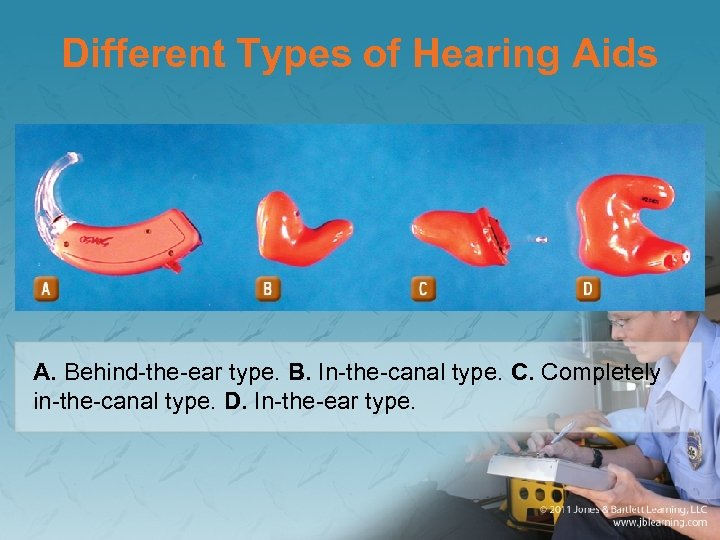 Different Types of Hearing Aids A. Behind-the-ear type. B. In-the-canal type. C. Completely in-the-canal type. D. In-the-ear type.
 Communication With Hearing Impaired Patient (1 of 3) • Use a piece of paper and a writing utensil. • Assist the patient with finding and inserting any hearing aids. • Face the patient while you communicate.
 Communication With Hearing Impaired Patient (2 of 3) • Do not exaggerate your lip movements or look away. • Position yourself approximately 18″ directly in front of the patient. • Most people who are hearing impaired have learned to use body language (eg, hand gestures and lip reading).
 Communication With Hearing Impaired Patient (3 of 3) • Do not speak louder; try lowering the pitch of your voice. • Ask the patient, “How would you like to communicate with me? ” • American sign language may be useful.
 Hearing Aids • Hearing aids make sound louder. • They should fit snugly. – If whistling occurs, the device may not be in far enough. • If the device is not working, you will need to troubleshoot the problem.
 Cerebral Palsy (1 of 5) • Group of disorders characterized by poorly controlled body movement • Possible causes – Damage to the developing brain in utero – Traumatic brain injury – Postpartum infection
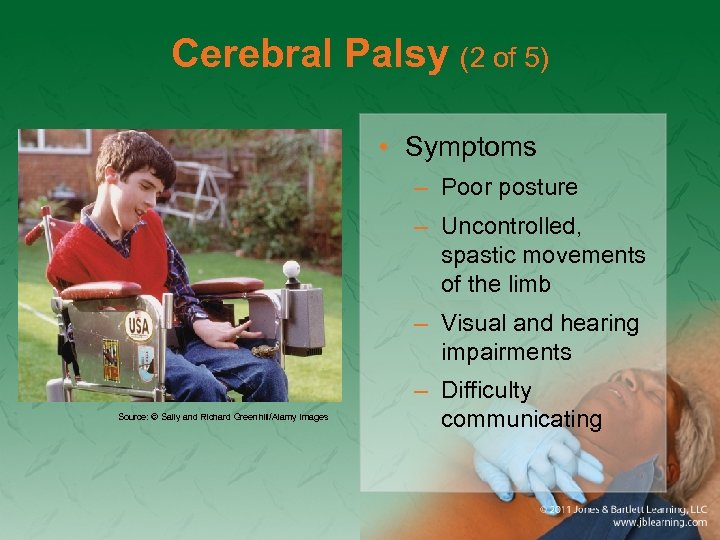 Cerebral Palsy (2 of 5) • Symptoms – Poor posture – Uncontrolled, spastic movements of the limb – Visual and hearing impairments Source: © Sally and Richard Greenhill/Alamy Images – Difficulty communicating
 Cerebral Palsy (3 of 5) • Symptoms (cont’d) – Epilepsy (seizures) – Mental retardation (75% of patients have a developmental delay) – Unsteady gait (ataxia), which may necessitate wheelchair or walker (if so, transport equipment with the patient) – Seizure disorder
 Cerebral Palsy (4 of 5) • Considerations – Observe airway closely. – Do not assume mental disability. – Underdeveloped limbs, prone to injury. – Ataxic or unsteady gait, prone to falls. – Special pillow or chair.
 Cerebral Palsy (5 of 5) • Considerations (cont’d) – Pad the patient to ensure comfort. – Never force extremities into position. – Whenever possible, take walkers or wheelchairs along during transport. – Be prepared for a seizure and keep suctioning available.
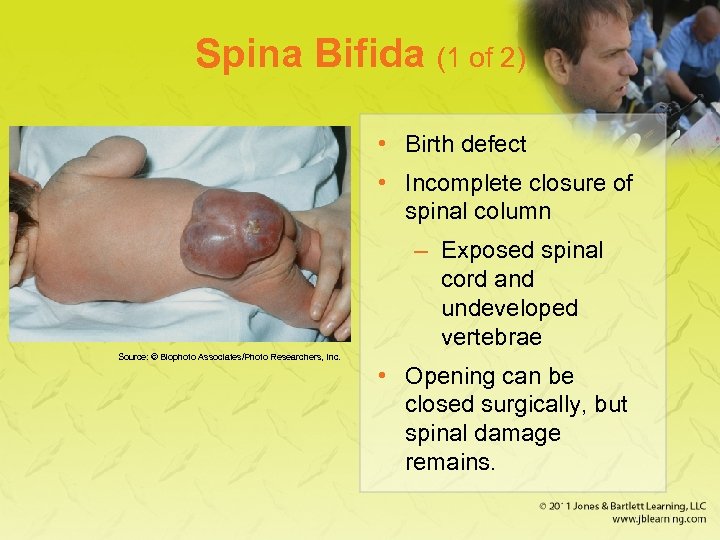 Spina Bifida (1 of 2) • Birth defect • Incomplete closure of spinal column – Exposed spinal cord and undeveloped vertebrae Source: © Biophoto Associates/Photo Researchers, Inc. • Opening can be closed surgically, but spinal damage remains.
 Spina Bifida (2 of 2) • Associated conditions – Hydrocephalus (requires shunt) – Partial or full paralysis of the lower extremities – Loss of bowel and bladder control – Extreme latex allergy
 Paralysis (1 of 3) • Inability to voluntarily move body parts • Causes – Stroke, trauma, birth defects • Normal sensation or hyperesthesia • May cause communication challenges • Diaphragm may not function correctly (requires ventilator).
 Paralysis (2 of 3) • Specialized equipment – Urinary catheters – Tracheotomies – Colostomies – Feeding tubes • Difficulty swallowing (requires suctioning)
 Paralysis (3 of 3) • Each type of spinal cord paralysis requires its own equipment and may have its own complications. • Always take great care when lifting or moving a paralyzed patient. • Ask patients how it is best to move them before you transport them.
 Bariatric Patients • Obesity—excessive body fat – 20% to 30% over ideal weight • Imbalance between food eaten and calories used • May be attributed to low metabolic rate or genetic predisposition • Causes not fully understood
 Severe or Morbid Obesity (1 of 2) • Severe obesity— 50 to 100 lb over the ideal weight • Afflicts about 9 million adult Americans • Persons are often ridiculed publicly and may be victims of discrimination. • Quality of life may be negatively affected.
 Severe or Morbid Obesity (2 of 2) • Associated health problems – Diabetes – Hypertension – Heart disease – Stroke – Chronic joint injuries or osteoarthritis – Complex and extensive medical history
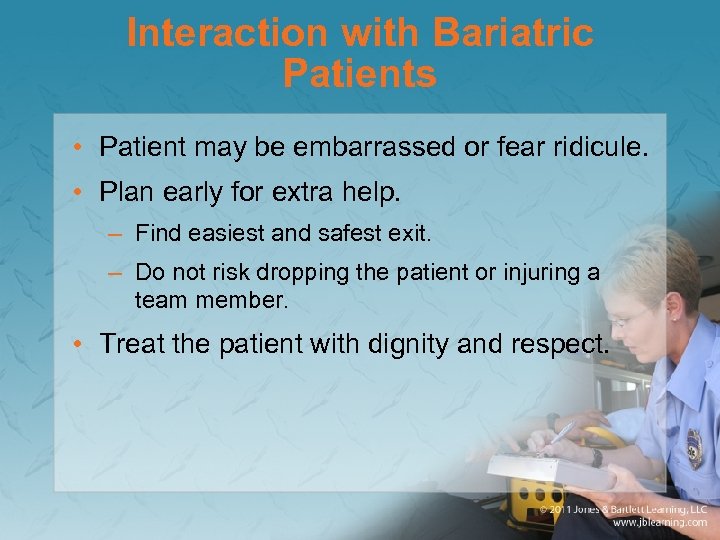 Interaction with Bariatric Patients • Patient may be embarrassed or fear ridicule. • Plan early for extra help. – Find easiest and safest exit. – Do not risk dropping the patient or injuring a team member. • Treat the patient with dignity and respect.
 Bariatric Patients: Lifting and Transporting Considerations (1 of 3) • Ask your patient how it is best to move him or her before attempting to do so. • Avoid trying to lift the patient by one limb, which would risk injury to overtaxed joints. • Coordinate and communicate all moves to all team members prior to starting to lift.
 Bariatric Patients: Lifting and Transporting Considerations (2 of 3) • If the move becomes uncontrolled at any point, stop, reposition, and resume. • Look for pinch or pressure points from equipment (deep venous thrombosis). • Very large patients may have difficulty breathing if you lay the patient in a supine position.
 Bariatric Patients: Lifting and Transporting Considerations (3 of 3) • Specialized equipment is available. – Become familiar with the resources available in your area. • Plan egress routes. • Notify the receiving facility early.
 Patients With Medical Technology Assistance (1 of 2) • Tracheostomy tubes • Mechanical ventilators • Apnea monitors • Internal cardiac pacemakers • Left ventricular assist devices
 Patients With Medical Technology Assistance (2 of 2) • Central venous catheter • Gastrostomy tubes • Shunts • Vagal nerve stimulators • Colostomies and ileostomies
 Tracheostomy Tubes (1 of 6) • Plastic tube placed in a surgical opening from the anterior part of the neck into the trachea • Temporary or permanent • From neck directly into the airway • For patients who depend on home automatic ventilators and have chronic pulmonary illness
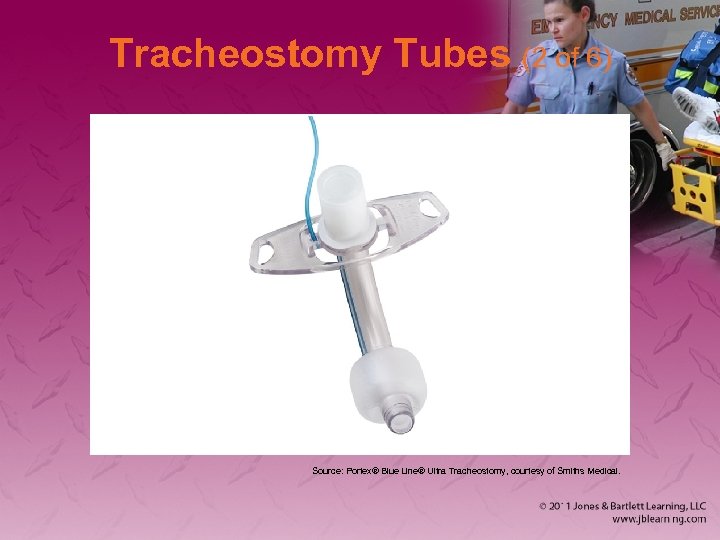 Tracheostomy Tubes (2 of 6) Source: Portex® Blue Line® Ultra Tracheostomy, courtesy of Smiths Medical.
 Tracheostomy Tubes (3 of 6) • Foreign to respiratory tract – Body reacts by building up secretions in and around tube • Tubes are prone to obstruction by mucus or foreign bodies – May lead to cardiopulmonary arrest
 Tracheostomy Tubes (4 of 6) • To recognize cause of obstruction, use the DOPE mnemonic – Displacement, dislodged, or damaged tube – Obstruction of the tube – Pneumothorax, pulmonary problems – Equipment failure
 Tracheostomy Tubes (5 of 6) • Common problems – May be bleeding or air leaking around the tube – Tube can become loose or dislodged. – Opening around the tube may become infected.
 Tracheostomy Tubes (6 of 6) • Management – Maintain an open airway. – Suction tube if necessary to clear a mucous plug. – Maintain the patient in a position of comfort. – Administer supplemental oxygen. – Provide transport to the hospital.
 Mechanical Ventilators (1 of 3) • Used when patients cannot breathe without assistance • Possible causes – Congenital defect – Chronic lung disease – Traumatic brain injury – Muscular dystrophy
 Mechanical Ventilators (2 of 3) • If ventilator malfunctions: – Remove patient from ventilator. – Use a bag-valve-mask device attached to the tracheostomy tube. • Masks are specifically designed for these patients but may not be available in prehospital setting. – Place a face mask over the stoma.
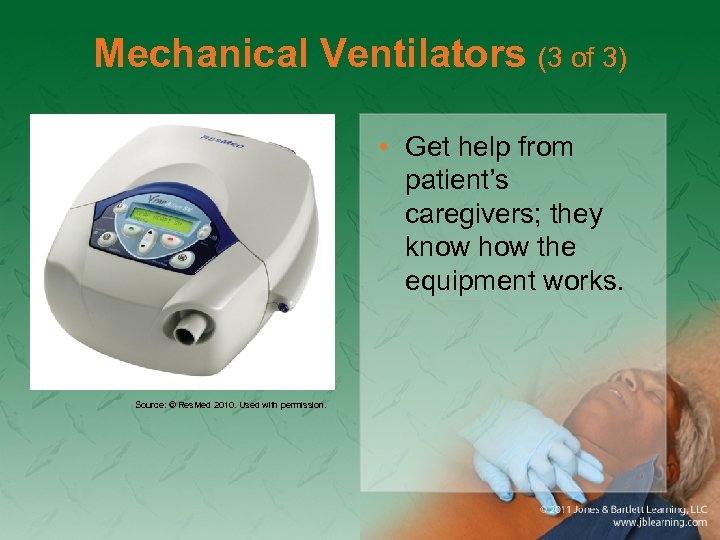 Mechanical Ventilators (3 of 3) • Get help from patient’s caregivers; they know how the equipment works. Source: © Res. Med 2010. Used with permission.
 Apnea Monitors (1 of 3) • Used for infants who are – Premature and have severe gastroesophageal reflux – Family history of SIDS – Life-threatening event
 Apnea Monitors (2 of 3) • Used 2 weeks to 2 months after birth to monitor the respiratory system • Sounds an alarm if the infant experiences bradycardia or apnea
 Apnea Monitors (3 of 3) • Attached with electrodes or belt around the infant’s chest or stomach • Will provide a pulse oximetry reading • Bring the apnea monitor to the receiving hospital with the patient.
 Internal Cardiac Pacemakers • Implanted under skin to regulate heart rate – Nondominant side of the patient’s chest • May include automated implanted defibrillator • Never place defibrillator paddles or pacing patches directly over the implanted device. • Ask the patient about the type of cardiac pacemaker and document.
 Left Ventricular Assist Devices (1 of 2) • Takes over the function of either one or both heart ventricles • Used as a bridge to heart transplantation • Provide support measures and basic care. • Use the caregiver as a resource. • Be prepared to provide CPR.
 Left Ventricular Assist Devices (2 of 2) • Risk factors associated with implantation – Excessive bleeding following the surgery – Infection – Blood clots leading to strokes – Acute heart failure
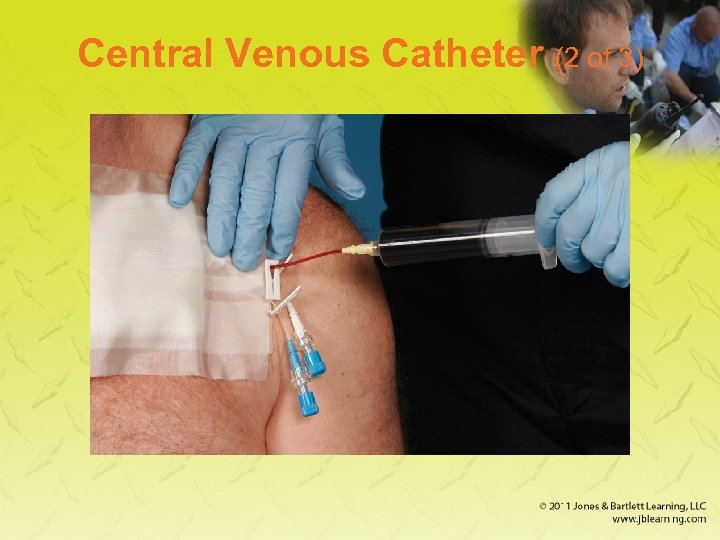
 Central Venous Catheter (1 of 3) • Venous access device (catheter in vena cava) • Used for many types of home care patients • Common locations – Chest – Upper arm – Subclavicular area
 Central Venous Catheter (2 of 3)
 Central Venous Catheter (3 of 3) • Common problems – Broken lines – Infections around the lines – Clotted lines – Bleeding around the line or from the tubing attached to the line
 Gastrostomy Tubes (1 of 4) • Placed directly into the stomach for feeding patients who cannot ingest fluids, food, or medication by mouth – May be inserted through the nose or mouth into the stomach – May be placed surgically – Typically sutured in place
 Gastrostomy Tubes (2 of 4) Source: © DELOCHE/age fotostock.
 Gastrostomy Tubes (3 of 4) • May become dislodged • Assess for signs or symptoms of bleeding into the stomach. – Vague abdominal discomfort – Nausea – Vomiting (especially “coffee ground” emesis) – Blood in emesis
 Gastrostomy Tubes (4 of 4) • Increased risk of aspiration – Always have suction readily available. – Patients with difficulty breathing should be transported while sitting or lying on the right side with head elevated 30°.
 Shunts (1 of 6) • For patients with chronic neurologic conditions • Tubes that extend from the brain to the abdomen to drain excess cerebrospinal fluid • Types – Ventricular peritoneum shunt – Ventricular atrium shunt
 Shunts (2 of 6) • Keep pressure in the skull from building up • Fluid reservoir – A device beneath skin on side of head, behind the ear – Its presence will alert you to the presence of a shunt.
 Shunts (3 of 6) • Blocked/infected shunt may cause changes in mental status and respiratory arrest • Infection may occur within 2 months of insertion
 Shunts (4 of 6) • Signs of distress – Bulging fontanelles (in infants) – Headache – Projectile vomiting – Altered mental status – Irritability – High-pitched cry
 Shunts (5 of 6) • Signs of distress (cont’d) – Fever – Nausea – Difficulty with coordination (walking) – Blurred vision
 Shunts (6 of 6) • Signs of distress (cont’d) – Seizures – Redness along the shunt track – Bradycardia – Heart arrhythmias
 Vagal Nerve Stimulators (1 of 2) • Alternative treatment to medication for seizures • Surgically implanted • Stimulate the vagus nerve to keep seizure activity from occurring
 Vagal Nerve Stimulators (2 of 2) • Used in children older than 12 years • Located under the patient’s skin • About the size of a silver dollar • If you encounter a patient with this device, contact medical control or follow your local protocols.
 Colostomies and Ileostomies (1 of 2) • Procedure that creates opening (stoma) between the small or large intestine and the surface of the body • Allows for elimination of waste products into a clear external bag or pouch – It is emptied or changed frequently.
 Colostomies and Ileostomies (2 of 2) • Assess for dehydration if the patient has been complaining of diarrhea or vomiting. • Area around the stoma is prone to infection with the following signs: – Redness – Warm skin around the stoma – Tenderness with palpation over the colostomy or ileostomy site
 Patient Assessment Guidelines • Interaction with caregiver is important part of patient assessment process. • They are experts on caring for these patients. • Determine patient’s normal baseline status before assessment. • Ask, “What is different today?
 Home Care (1 of 2) • Occurs within home environment • Applies to wide spectrum of needs and services – Needs: Infants, elderly, chronic illness, developmental disability – Services: prepared meals, cleaning, laundry, maintenance, physical therapy, hygiene
 Home Care (2 of 2) • EMS may be called to residence by home care provider. • Obtain baseline health status and history from home care provider.
 Hospice Care and Terminally Ill Patients (1 of 4) • Terminally ill may receive hospice care at a hospice facility or at home. • May have DNR order • May have medical orders for scope of treatment
 Hospice Care and Terminally Ill Patients (2 of 4) • Comfort care – Pain medication may be provided during patient’s last days. – Also called palliative care – Improves quality of life before patient dies
 Hospice Care and Terminally Ill Patients (3 of 4) • Follow local protocol, patient’s wishes, legal documents (eg, DNR) • Bring documentation to the hospital. • Show compassion, understanding, and sensitivity.
 Hospice Care and Terminally Ill Patients (4 of 4) • Ascertain the family’s wishes regarding transport. • Allow family member to accompany the patient. • Follow local protocols for handling the death of a patient.
 Poverty and Homelessness (1 of 2) • Unable to provide for basic needs • Disease prevention strategies absent – Leads to increased probability of disease • Homelessness affects mentally ill, domestic violence victims, addicts, and impoverished families.
 Poverty and Homelessness (2 of 2) • Advocate for all patients. • All health care facilities must provide assessment and treatment regardless of the patient’s ability to pay. • Become familiar with social services resources within your community.