


 Скачать презентацию Chapter 31 Security Protocols in the Internet Mc
e14708638df12ef942dc4d0136910e14.ppt
- Количество слайдов: 27
 Chapter 31 Security Protocols in the Internet Mc. Graw-Hill ©The Mc. Graw-Hill Companies, Inc. , 2004
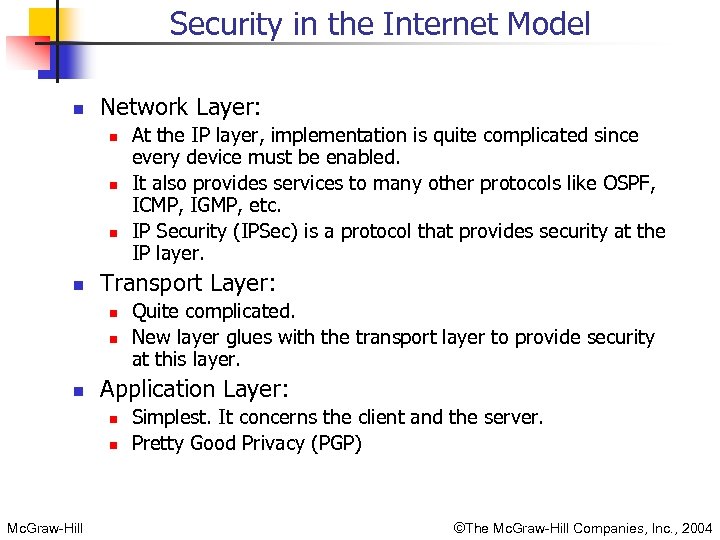 Security in the Internet Model n Network Layer: n n Transport Layer: n n n Quite complicated. New layer glues with the transport layer to provide security at this layer. Application Layer: n n Mc. Graw-Hill At the IP layer, implementation is quite complicated since every device must be enabled. It also provides services to many other protocols like OSPF, ICMP, IGMP, etc. IP Security (IPSec) is a protocol that provides security at the IP layer. Simplest. It concerns the client and the server. Pretty Good Privacy (PGP) ©The Mc. Graw-Hill Companies, Inc. , 2004
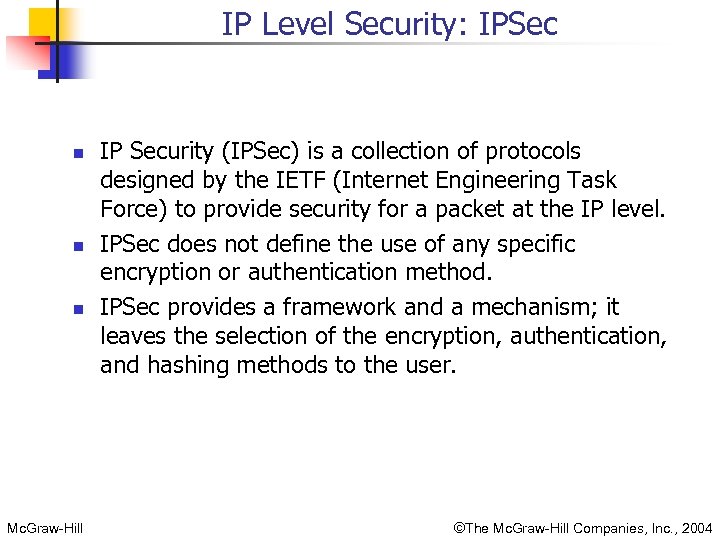 IP Level Security: IPSec n n n Mc. Graw-Hill IP Security (IPSec) is a collection of protocols designed by the IETF (Internet Engineering Task Force) to provide security for a packet at the IP level. IPSec does not define the use of any specific encryption or authentication method. IPSec provides a framework and a mechanism; it leaves the selection of the encryption, authentication, and hashing methods to the user. ©The Mc. Graw-Hill Companies, Inc. , 2004
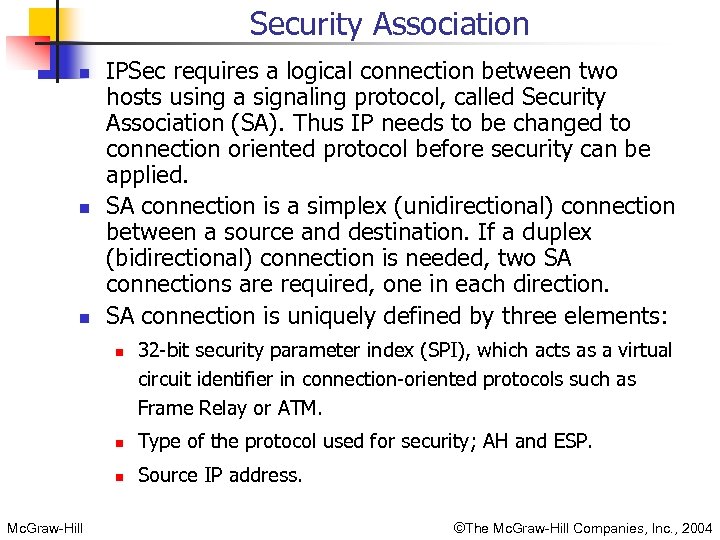 Security Association n IPSec requires a logical connection between two hosts using a signaling protocol, called Security Association (SA). Thus IP needs to be changed to connection oriented protocol before security can be applied. SA connection is a simplex (unidirectional) connection between a source and destination. If a duplex (bidirectional) connection is needed, two SA connections are required, one in each direction. SA connection is uniquely defined by three elements: n 32 -bit security parameter index (SPI), which acts as a virtual circuit identifier in connection-oriented protocols such as Frame Relay or ATM. n n Mc. Graw-Hill Type of the protocol used for security; AH and ESP. Source IP address. ©The Mc. Graw-Hill Companies, Inc. , 2004
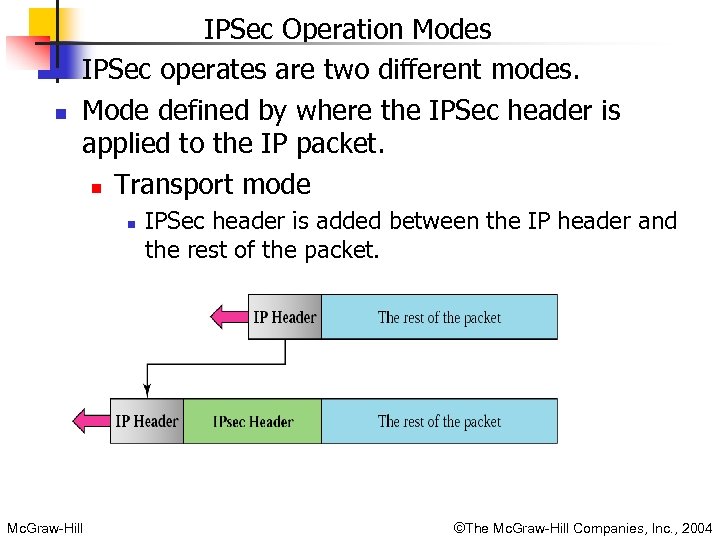 n n IPSec Operation Modes IPSec operates are two different modes. Mode defined by where the IPSec header is applied to the IP packet. n Transport mode n Mc. Graw-Hill IPSec header is added between the IP header and the rest of the packet. ©The Mc. Graw-Hill Companies, Inc. , 2004
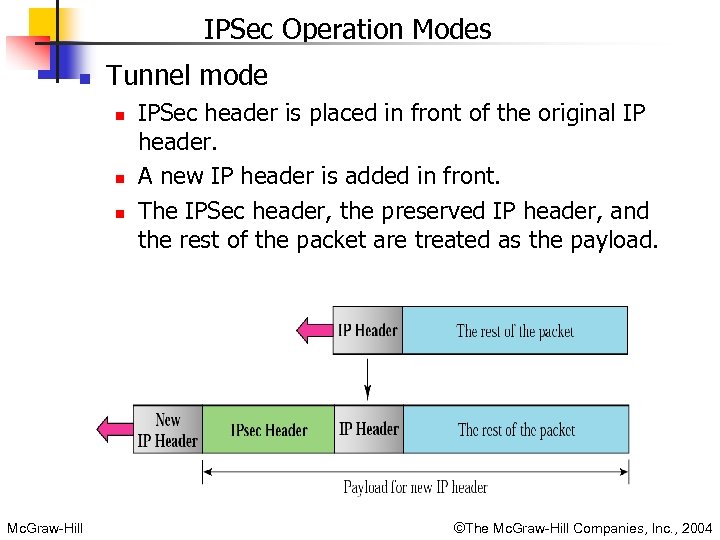 IPSec Operation Modes n Tunnel mode n n n Mc. Graw-Hill IPSec header is placed in front of the original IP header. A new IP header is added in front. The IPSec header, the preserved IP header, and the rest of the packet are treated as the payload. ©The Mc. Graw-Hill Companies, Inc. , 2004
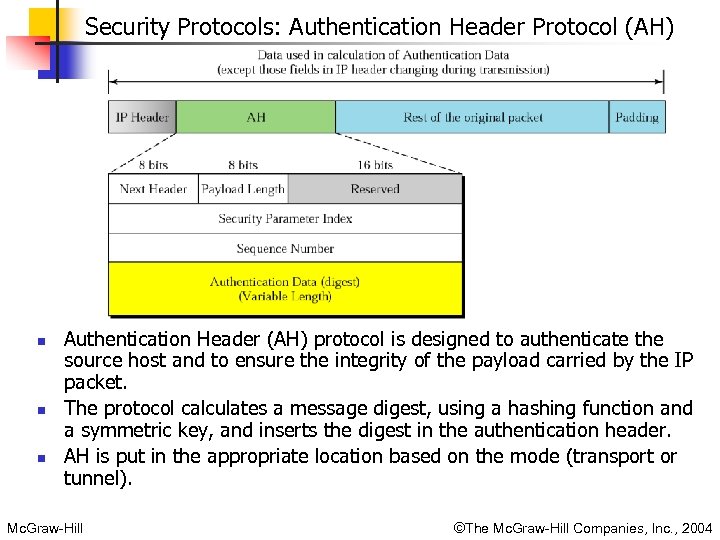 Security Protocols: Authentication Header Protocol (AH) n n n Authentication Header (AH) protocol is designed to authenticate the source host and to ensure the integrity of the payload carried by the IP packet. The protocol calculates a message digest, using a hashing function and a symmetric key, and inserts the digest in the authentication header. AH is put in the appropriate location based on the mode (transport or tunnel). Mc. Graw-Hill ©The Mc. Graw-Hill Companies, Inc. , 2004
 n n When an IP datagram carries an AH, the original value in the protocol field of the IP header is replaced by the value 51. Addition of AH follows these steps: n n n Mc. Graw-Hill AH is added to payload with authentication data field set to zero. Padding may be added to make the total length even for a particular hashing algorithm. Hashing is done on the total packet. Message digest is calculated based only on those fields of IP header that don’t change. Authentication data are included in the AH IP header is added after change the value of protocol field to 51. AH protocol provides source authentication and data integrity, but not privacy. ©The Mc. Graw-Hill Companies, Inc. , 2004
 n n n Next header field: type of payload carried by IP datagram (TCP, UDP, ICMP, etc). Payload length field: Length of AH in 4 -byte multiples. Security parameter index: Plays the role of virtual circuit identifier and is the same for all packets sent during a Security Association connection. Sequence number: Ordering sequence of datagram. A sequence number does not wrap around even after it reaches 232; a new connection must be established. Don’t repeat sequence number even if a packet is retransmitted. Authentication data: Result of applying a hash function to the entire IP datagram except for the fields that are changed during transit (e. g. , time-to-live). Mc. Graw-Hill ©The Mc. Graw-Hill Companies, Inc. , 2004
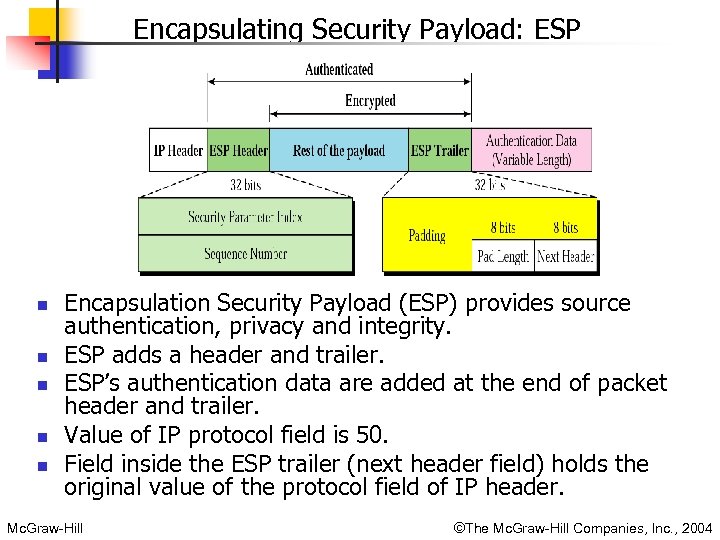 Encapsulating Security Payload: ESP n n n Encapsulation Security Payload (ESP) provides source authentication, privacy and integrity. ESP adds a header and trailer. ESP’s authentication data are added at the end of packet header and trailer. Value of IP protocol field is 50. Field inside the ESP trailer (next header field) holds the original value of the protocol field of IP header. Mc. Graw-Hill ©The Mc. Graw-Hill Companies, Inc. , 2004
 n ESP procedure follows these steps: n n n n Fields n n n n Mc. Graw-Hill ESP trailer is added to the payload. Payload and trailer are encrypted. ESP header is added. ESP header, payload, and ESP trailer are used to create the authentication data. Authentication data are added to the end of the ESP trailer. IP header is added after changing the protocol value to 50. Security Parameter Index Sequence number Padding: Variable length field (0 to 255 bytes) of 0 s serves as padding. Pad length: length defines number of padding bytes. Next header Authentication data: Result of applying an authentication scheme to parts of the datagram. But, IP header is not included in the calculation. Even though, ESP is better than AH, AH is still used because of certain commercial products use them. ©The Mc. Graw-Hill Companies, Inc. , 2004
 Transport Layer Security n n n Transport Layer Security (TLS) was designed to provide security at the transport layer. TLS was derived from a security protocol called Secure Sockets Layer (SSL). TLS is a non-proprietary version of SSL. For transactions on Internet, a browser needs: n Make sure that server belongs to the actual vendor. n Contents of message are not modified during transition. n Mc. Graw-Hill Make sure that the imposter doe not interpret sensitive information such as credit card number. ©The Mc. Graw-Hill Companies, Inc. , 2004
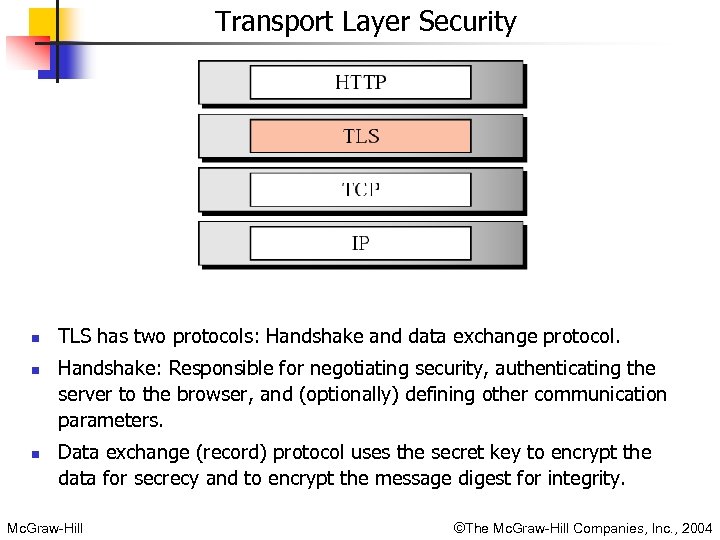 Transport Layer Security n n n TLS has two protocols: Handshake and data exchange protocol. Handshake: Responsible for negotiating security, authenticating the server to the browser, and (optionally) defining other communication parameters. Data exchange (record) protocol uses the secret key to encrypt the data for secrecy and to encrypt the message digest for integrity. Mc. Graw-Hill ©The Mc. Graw-Hill Companies, Inc. , 2004
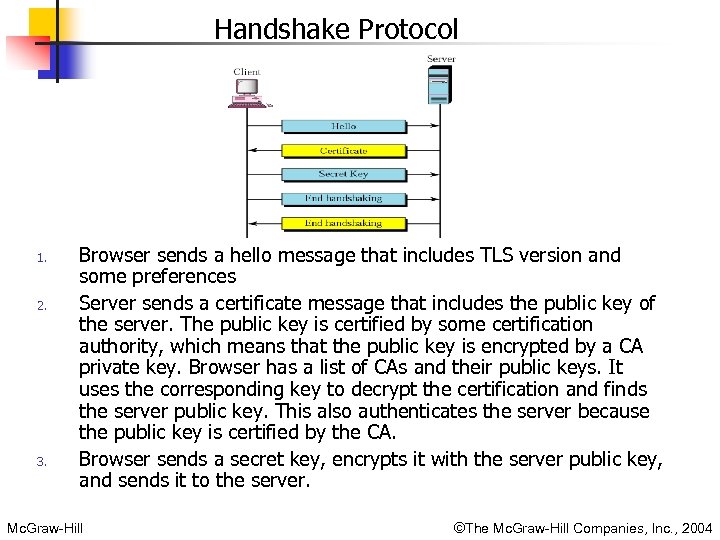 Handshake Protocol 1. 2. 3. Browser sends a hello message that includes TLS version and some preferences Server sends a certificate message that includes the public key of the server. The public key is certified by some certification authority, which means that the public key is encrypted by a CA private key. Browser has a list of CAs and their public keys. It uses the corresponding key to decrypt the certification and finds the server public key. This also authenticates the server because the public key is certified by the CA. Browser sends a secret key, encrypts it with the server public key, and sends it to the server. Mc. Graw-Hill ©The Mc. Graw-Hill Companies, Inc. , 2004
 Handshake Protocol 4. 5. Browser sends a message, encrypted by the secret key, to inform the server that handshaking is terminating from the browser key. Server decrypts the secret key using it private key and decrypts the message using the secret key. It then sends a message, encrypted by the secret key, to inform the browser that handshaking is terminating from the server side. Note that handshaking uses the public key for two purposes: to authenticate the server and to encrypt the secret key, which is used in the data exchange protocol. Mc. Graw-Hill ©The Mc. Graw-Hill Companies, Inc. , 2004
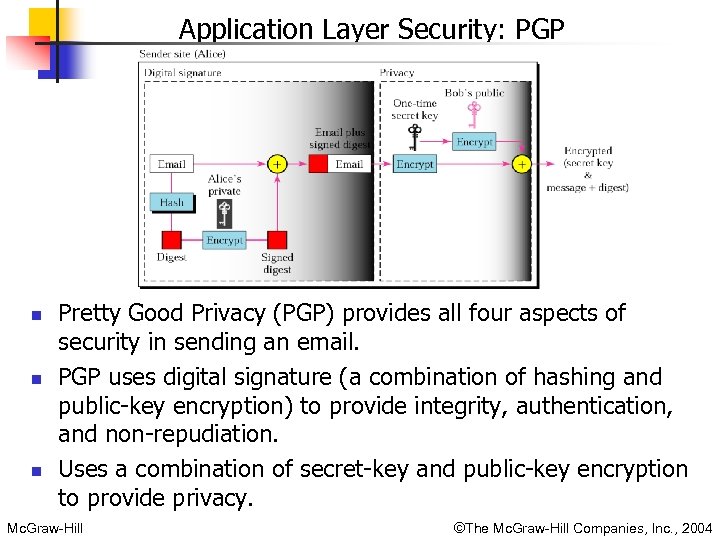 Application Layer Security: PGP n n n Pretty Good Privacy (PGP) provides all four aspects of security in sending an email. PGP uses digital signature (a combination of hashing and public-key encryption) to provide integrity, authentication, and non-repudiation. Uses a combination of secret-key and public-key encryption to provide privacy. Mc. Graw-Hill ©The Mc. Graw-Hill Companies, Inc. , 2004
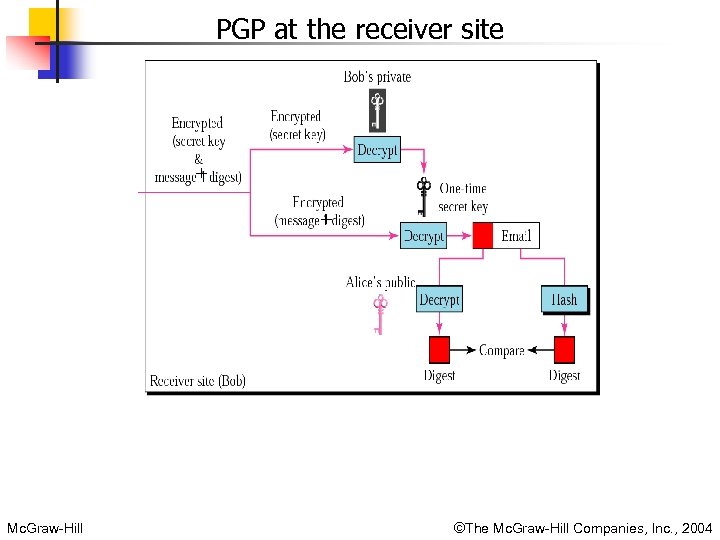 PGP at the receiver site + + Mc. Graw-Hill ©The Mc. Graw-Hill Companies, Inc. , 2004
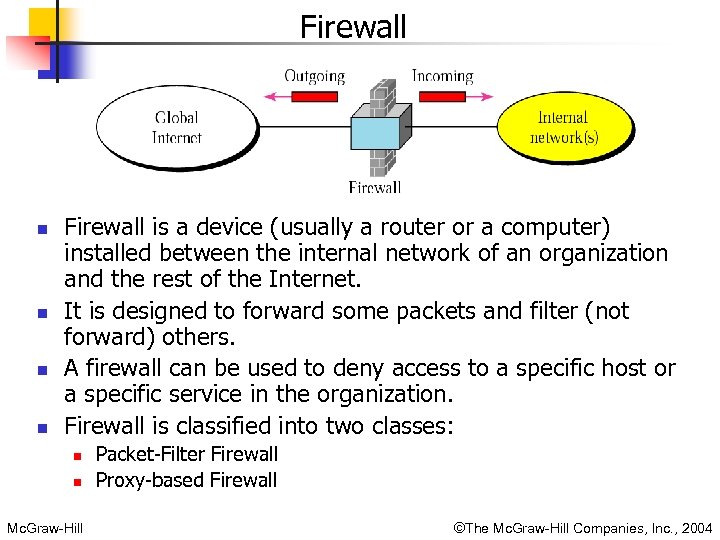 Firewall n n Firewall is a device (usually a router or a computer) installed between the internal network of an organization and the rest of the Internet. It is designed to forward some packets and filter (not forward) others. A firewall can be used to deny access to a specific host or a specific service in the organization. Firewall is classified into two classes: n n Mc. Graw-Hill Packet-Filter Firewall Proxy-based Firewall ©The Mc. Graw-Hill Companies, Inc. , 2004
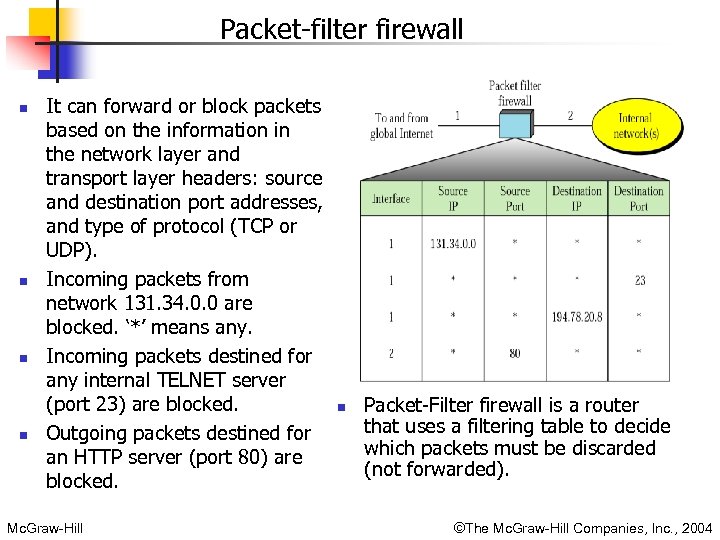 Packet-filter firewall n n It can forward or block packets based on the information in the network layer and transport layer headers: source and destination port addresses, and type of protocol (TCP or UDP). Incoming packets from network 131. 34. 0. 0 are blocked. ‘*’ means any. Incoming packets destined for any internal TELNET server (port 23) are blocked. Outgoing packets destined for an HTTP server (port 80) are blocked. Mc. Graw-Hill n Packet-Filter firewall is a router that uses a filtering table to decide which packets must be discarded (not forwarded). ©The Mc. Graw-Hill Companies, Inc. , 2004
 Proxy firewall n n Filter based on information available at the message itself. A proxy firewall filters at the application layer Situation: Only those Internet users who have previously established business relations with the company can have access; access to other users must be blocked. In this case, a packet-filter firewall is not feasible because it cannot distinguish between different packets arriving at TCP port 80 (HTTP). Testing must be done at the application level (using URLs). Install a proxy computer (sometimes called an application gateway), which stands between the customer (user client) computer and the corporation computer. Mc. Graw-Hill ©The Mc. Graw-Hill Companies, Inc. , 2004
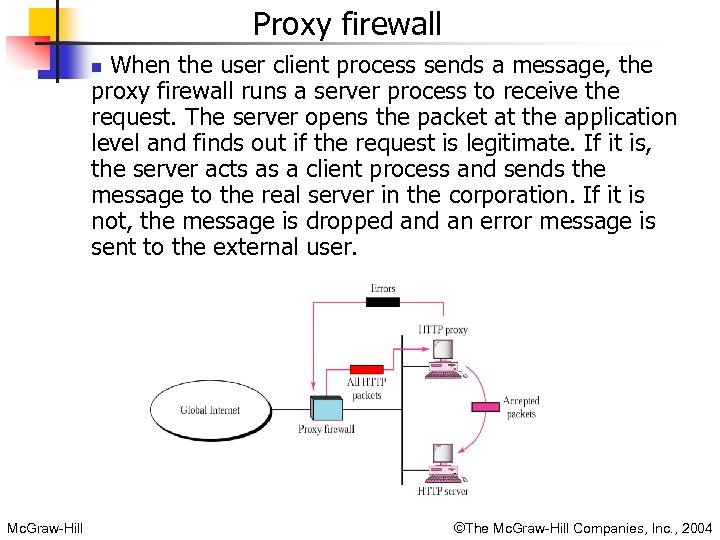 Proxy firewall When the user client process sends a message, the proxy firewall runs a server process to receive the request. The server opens the packet at the application level and finds out if the request is legitimate. If it is, the server acts as a client process and sends the message to the real server in the corporation. If it is not, the message is dropped an error message is sent to the external user. n Mc. Graw-Hill ©The Mc. Graw-Hill Companies, Inc. , 2004
 Virtual Private Networks n n n VPN is a technology that is gaining popularity among large organizations that use the global Internet for both intra- and inter-organization communication, but require privacy in their internal communication. Private network is designed for use inside an organization. It allows access to shared resources and, at the same time, provides privacy. Intranet: Private network which is limited to users inside the organization. Extranet: Same as intranet with one major difference: some resources can be accessed by specific group of users outside the organization under the control of the network administrator. Addressing for private networks: n n n Mc. Graw-Hill Use any address but don’t connect to Internet. Get address from Internet authorities but don’t connect to Internet. Wastage of public addresses. Use reserved addresses [private addresses]. ©The Mc. Graw-Hill Companies, Inc. , 2004
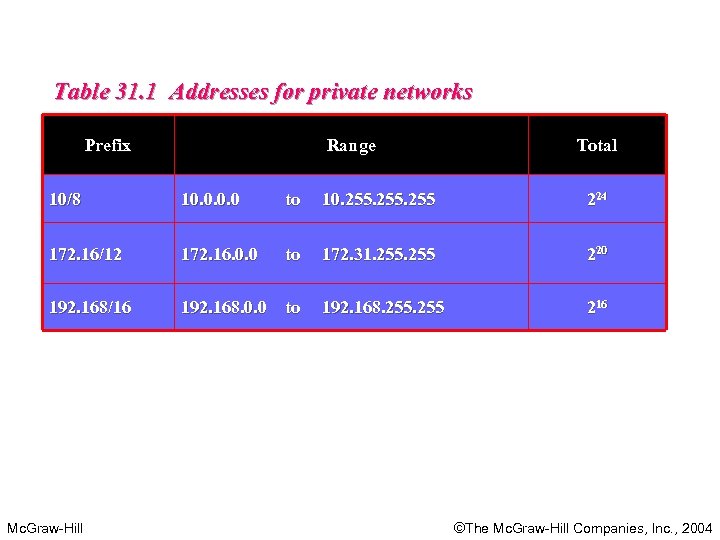 Table 31. 1 Addresses for private networks Prefix Range Total 10/8 10. 0 to 10. 255 224 172. 16/12 172. 16. 0. 0 to 172. 31. 255 220 192. 168/16 192. 168. 0. 0 to 192. 168. 255 216 Mc. Graw-Hill ©The Mc. Graw-Hill Companies, Inc. , 2004
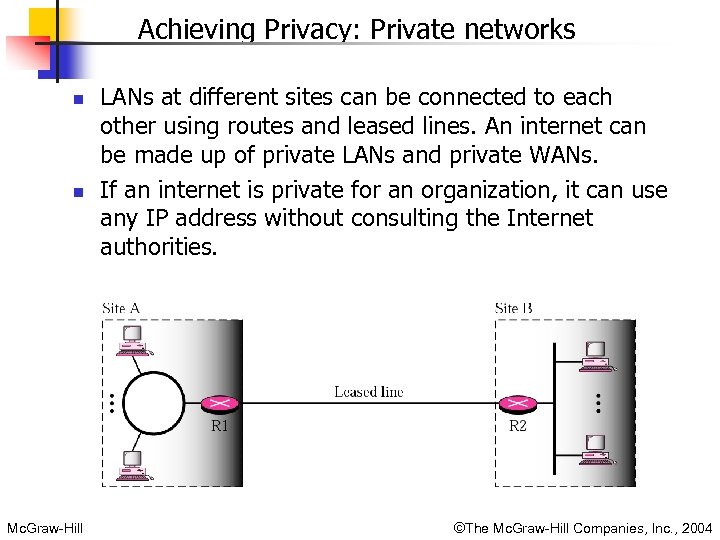 Achieving Privacy: Private networks n n Mc. Graw-Hill LANs at different sites can be connected to each other using routes and leased lines. An internet can be made up of private LANs and private WANs. If an internet is private for an organization, it can use any IP address without consulting the Internet authorities. ©The Mc. Graw-Hill Companies, Inc. , 2004
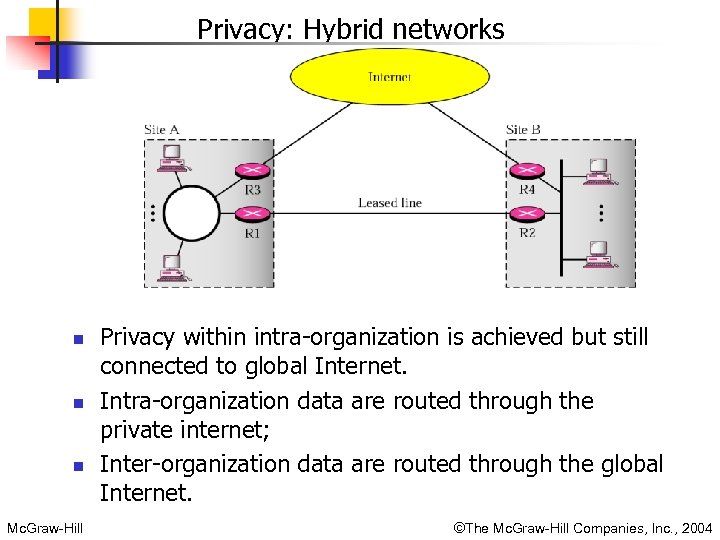 Privacy: Hybrid networks n n n Mc. Graw-Hill Privacy within intra-organization is achieved but still connected to global Internet. Intra-organization data are routed through the private internet; Inter-organization data are routed through the global Internet. ©The Mc. Graw-Hill Companies, Inc. , 2004
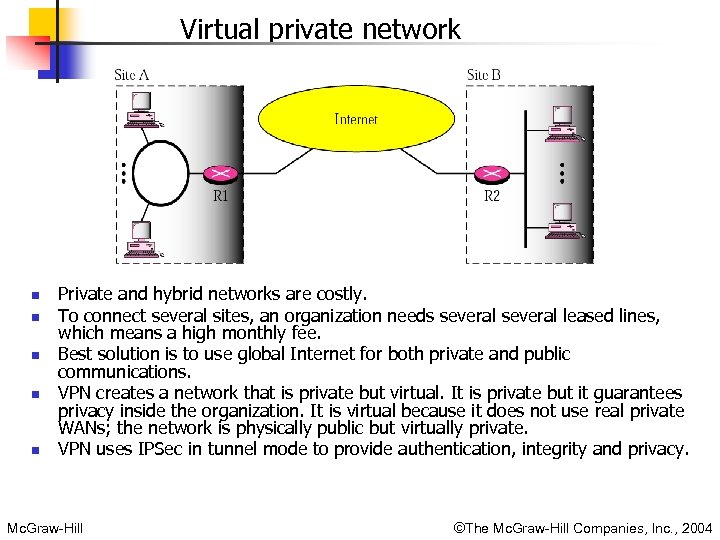 Virtual private network n n n Private and hybrid networks are costly. To connect several sites, an organization needs several leased lines, which means a high monthly fee. Best solution is to use global Internet for both private and public communications. VPN creates a network that is private but virtual. It is private but it guarantees privacy inside the organization. It is virtual because it does not use real private WANs; the network is physically public but virtually private. VPN uses IPSec in tunnel mode to provide authentication, integrity and privacy. Mc. Graw-Hill ©The Mc. Graw-Hill Companies, Inc. , 2004
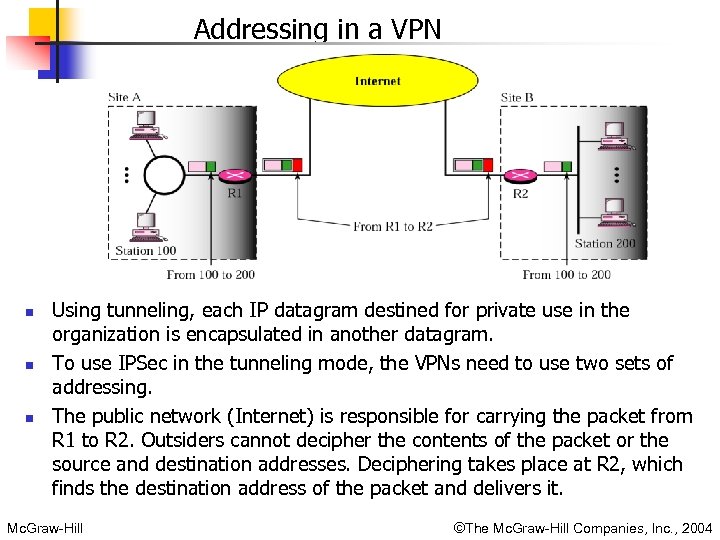 Addressing in a VPN n n n Using tunneling, each IP datagram destined for private use in the organization is encapsulated in another datagram. To use IPSec in the tunneling mode, the VPNs need to use two sets of addressing. The public network (Internet) is responsible for carrying the packet from R 1 to R 2. Outsiders cannot decipher the contents of the packet or the source and destination addresses. Deciphering takes place at R 2, which finds the destination address of the packet and delivers it. Mc. Graw-Hill ©The Mc. Graw-Hill Companies, Inc. , 2004