


 Скачать презентацию Chapter 30 The Making of Industrial Society 1
da58782f565eb6299d8612951ab5195e.ppt
- Количество слайдов: 38
 Chapter 30 The Making of Industrial Society 1 • Copyright © 2007 The Mc. Graw-Hill Companies Inc. Permission Required for Reproduction or Display.
 Overview: The Industrial Revolution n n Energy: coal and steam replace wind, water, human and animal labor Organization: factories over cottage industries Rural agriculture declines, urban manufacturing increases Transportation: trains, automobiles replace animals, watercraft 2 Copyright © 2007 The Mc. Graw-Hill Companies Inc. Permission Required for Reproduction or Display.
 Overview: Creation of New Classes n n The Industrial Middle Class Urban Proletariat Shift in political power Inspiration for new political systems, esp. Marxism 3 Copyright © 2007 The Mc. Graw-Hill Companies Inc. Permission Required for Reproduction or Display.
 Overview: Unexpected Costs of the Industrial Revolution n Genesis of an environmental catastrophe q q n Intellectual origins of human domination over natural resources Unforeseen toxins, occupational hazards Social ills q q Landless proletariat Migrating work forces 4 Copyright © 2007 The Mc. Graw-Hill Companies Inc. Permission Required for Reproduction or Display.
 Genesis of the Industrial Revolution n n Great Britain, 1780 s Followed agricultural revolution q q q Food surplus Disposable income Population increase n n Market Labor supply 5 Copyright © 2007 The Mc. Graw-Hill Companies Inc. Permission Required for Reproduction or Display.
 British Advantages n n Strong banking tradition Natural resources q n Ease of transportation q q n Coal, iron ore Size of country River and canal system Exports to imperial colonies q Esp. machine textiles 6 Copyright © 2007 The Mc. Graw-Hill Companies Inc. Permission Required for Reproduction or Display.
 Cotton-producing Technology n Flying shuttle doubled weaving output q n Spinning jenny (1768) q n without doubling supply of yarn Increased supply of yarn, faster than flying shuttle could process Power loom (1787) met supply of yarn 7 Copyright © 2007 The Mc. Graw-Hill Companies Inc. Permission Required for Reproduction or Display.
 The Growth of Factories n n Massive machinery Supply of labor Transport of raw materials, finished product to markets Concentration in newly built factory towns on rivers 8 Copyright © 2007 The Mc. Graw-Hill Companies Inc. Permission Required for Reproduction or Display.
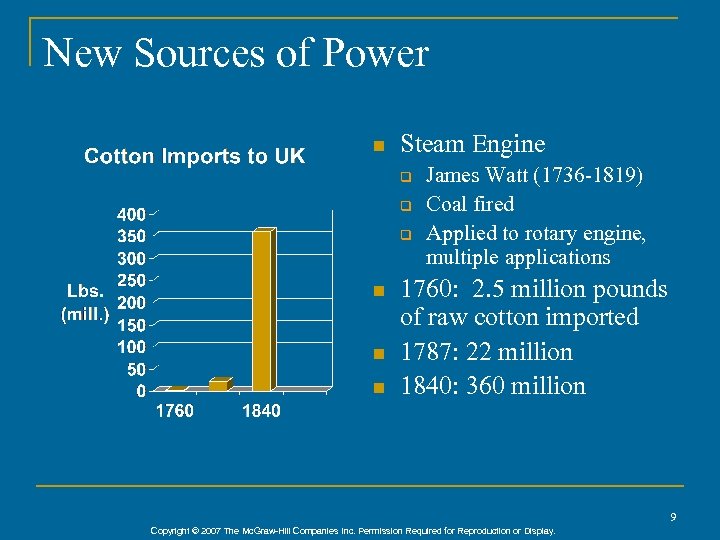 New Sources of Power n Steam Engine q q q n n n James Watt (1736 -1819) Coal fired Applied to rotary engine, multiple applications 1760: 2. 5 million pounds of raw cotton imported 1787: 22 million 1840: 360 million 9 Copyright © 2007 The Mc. Graw-Hill Companies Inc. Permission Required for Reproduction or Display.
 Implications: Slave Labor n n n Cheap cotton from American south Benefit of transatlantic slave trade Irony: early British abolitionism, yet profit motive retained 10 Copyright © 2007 The Mc. Graw-Hill Companies Inc. Permission Required for Reproduction or Display.
 Iron Industry n Henry Cort devises method of refining iron ore (1780 s) q n n First major advance since middle ages 1852 produces more high-quality iron than rest of world combined Synergy with increasing technological development 11 Copyright © 2007 The Mc. Graw-Hill Companies Inc. Permission Required for Reproduction or Display.
 Rail Transport n n n 1804 first steam-powered locomotive Capacity: Ten tons + 70 passengers @ 5 mph The Rocket from Liverpool to Manchester (1830), 16 mph Ripple effect on industrialization Engineering and architecture 12 Copyright © 2007 The Mc. Graw-Hill Companies Inc. Permission Required for Reproduction or Display.
 The Factory System n n n Early modern Europe adopts “putting-out” system Individuals work at home, employers avoid wage restrictions of medieval guilds Rising prices cause factories to replace both guilds and putting-out system q q q Machines too large, expensive for home use Large buildings could house specialized laborers Urbanization guarantees supply of cheap unskilled labor 13 Copyright © 2007 The Mc. Graw-Hill Companies Inc. Permission Required for Reproduction or Display.
 Poor working conditions n n Dramatic shift from rural work rhythms Six days a week, fourteen hours a day Immediate supervision, punishments “Luddite” Protest against machines 1811 -1816 q q n n Name from legend about boy named Ludlam who broke a knitting frame Leader called “King Lud” Masked Luddites destroy machinery, enjoyed popular support 14 Luddites hung in 1813, movement dies out 14 Copyright © 2007 The Mc. Graw-Hill Companies Inc. Permission Required for Reproduction or Display.
 Spread of Industrialization n Development of technical schools for engineers, architects, etc. Government support for large public works projects (canals, rail system) Spreads throughout Germany under Bismarck 15 Copyright © 2007 The Mc. Graw-Hill Companies Inc. Permission Required for Reproduction or Display.
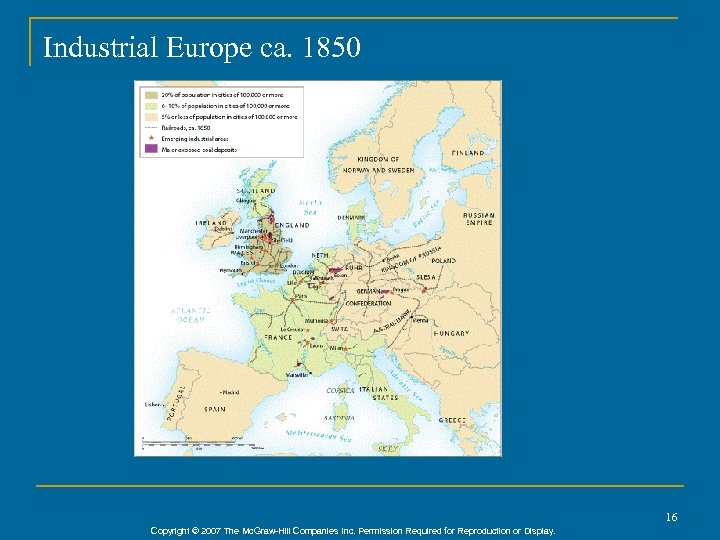 Industrial Europe ca. 1850 16 Copyright © 2007 The Mc. Graw-Hill Companies Inc. Permission Required for Reproduction or Display.
 Mass Production n Eli Whitney (U. S. , 1765 -1825) invents cotton gin (1793), also technique of using machine tools to make interchangeable parts for firearms q n n “the American system” Applied to wide variety of machines Henry Ford, 1913, develops assembly line approach q q Complete automobile chassis every 93 minutes Previously: 728 minutes 17 Copyright © 2007 The Mc. Graw-Hill Companies Inc. Permission Required for Reproduction or Display.
 Industrialization in the United States n 1800 US agrarian q q q n Population 5 million No city larger than 100, 000 6/7 Americans farmers 1860 US industrializing q q q Population 30 million Nine cities 100 K + ½ Americans farmers 18 Copyright © 2007 The Mc. Graw-Hill Companies Inc. Permission Required for Reproduction or Display.
 Factory Discipline (Berlin, 1844) n Workday: 6 am to 7 pm q n n n 2 hours total for meals Lateness: 2 minutes fined ½ hour pay, more than 2 minutes partial shift Conversation prohibited Use of toilets mandatory 19 Copyright © 2007 The Mc. Graw-Hill Companies Inc. Permission Required for Reproduction or Display.
 The Proletariat n n n Lack of clear distinction from cottage industry Ecologically disastrous conditions Coal mines q q q Cave-ins Explosions pollutants 20 Copyright © 2007 The Mc. Graw-Hill Companies Inc. Permission Required for Reproduction or Display.
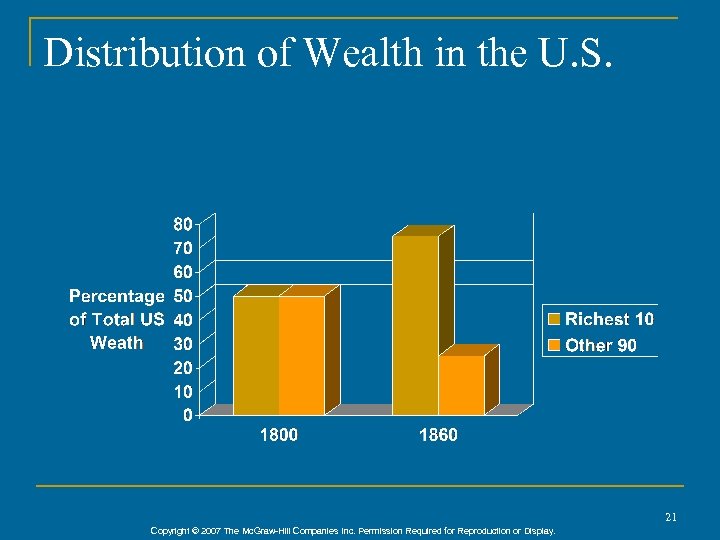 Distribution of Wealth in the U. S. 21 Copyright © 2007 The Mc. Graw-Hill Companies Inc. Permission Required for Reproduction or Display.
 The Industrial Middle Class n n New class, evolved from guild merchants in cities “bourgeoisie” Capitalists Begin to eclipse power and status of agrarian landed classes 22 Copyright © 2007 The Mc. Graw-Hill Companies Inc. Permission Required for Reproduction or Display.
 Big Business n n n Large factories require start-up capital Corporations formed to share risk, maximize profits Britain and France lay foundations for modern corporation, 1850 -1860 s q q Private business owned by hundreds, thousands or even millions of stockholders Investors get dividends if profitable, lose only investments in case of bankruptcy 23 Copyright © 2007 The Mc. Graw-Hill Companies Inc. Permission Required for Reproduction or Display.
 Monopolies, Trusts, and Cartels n Large corporations form blocs to drive out competition, keep prices high q q n John D. Rockefeller controls almost all oil drilling, processing, refining, marketing in U. S. German IG Farben controls 90% of chemical production Governments often slow to control monopolies 24 Copyright © 2007 The Mc. Graw-Hill Companies Inc. Permission Required for Reproduction or Display.
 The Fruits of Industrialization n Technological innovation q n Cheap manufactured goods q n Improved agricultural tools Especially textiles Travel and transportation 25 Copyright © 2007 The Mc. Graw-Hill Companies Inc. Permission Required for Reproduction or Display.
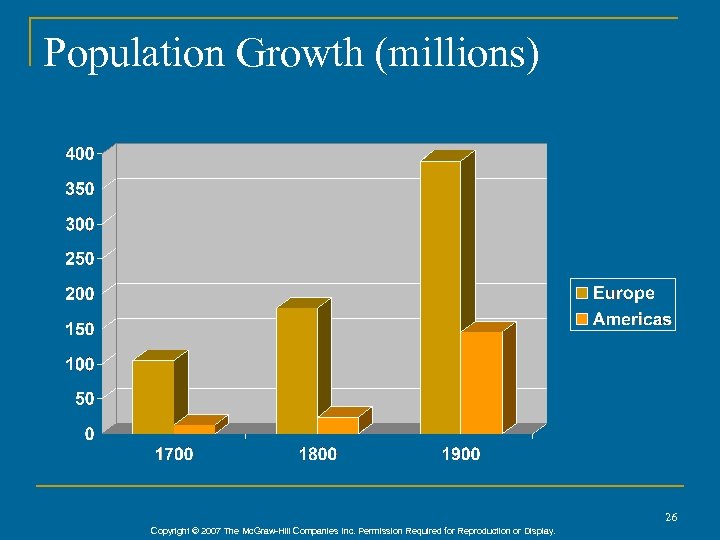 Population Growth (millions) 26 Copyright © 2007 The Mc. Graw-Hill Companies Inc. Permission Required for Reproduction or Display.
 The Demographic Transition n Industrialization results in marked decline of both fertility and mortality Costs of living increase in industrial societies Urbanization proceeds dramatically q q 1800: only 20% of Britons live in towns with population over 10, 000 1900: 75% of Britons live in urban environments 27 Copyright © 2007 The Mc. Graw-Hill Companies Inc. Permission Required for Reproduction or Display.
 Contraception n Ancient and medieval methods: q q q n n Egypt: crocodile dung depository Asia: oral contraceptives (mercury, arsenic) Elsewhere: beeswax, oil paper diaphragms Thomas Malthus (1766 -1834) predicts overpopulation crisis, advocates “moral restraint” Condoms invented in England q Made from animal intestines in 17 th century, latex in 19 th century 28 Copyright © 2007 The Mc. Graw-Hill Companies Inc. Permission Required for Reproduction or Display.
 Development of Slums n n London: 1 million in 1800, 2. 4 million in 1850 Wealthy classes move out to suburbs Industrial slum areas develop in city centers Open gutters as sewage systems q n Danger of Cholera First sewage systems, piped water only in 1848 29 Copyright © 2007 The Mc. Graw-Hill Companies Inc. Permission Required for Reproduction or Display.
 Transcontinental Migrations n 19 th-early 20 th centuries, rapid population growth drives Europeans to Americas q q q 50 million cross Atlantic Britons to avoid urban slums, Irish to avoid potato famines of 1840 s, Jews to abandon Tsarist persecution United States favored destination 30 Copyright © 2007 The Mc. Graw-Hill Companies Inc. Permission Required for Reproduction or Display.
 New Social Classes n n n Economic factors result in decline of slavery Capitalist wealth brings new status to nonaristocratic families New urban classes of professionals Blue-collar factory workers Urban environment also creates new types of diversions q Sporting events 31 Copyright © 2007 The Mc. Graw-Hill Companies Inc. Permission Required for Reproduction or Display.
 Women in the Workforce n n Agricultural, cottage industry work involved women: natural transition But development of men as prime breadwinners, women in private sphere, working cheap labor Double burden: women expected to maintain home as well as work in industry Related to child labor: lack of day care facilities 32 Copyright © 2007 The Mc. Graw-Hill Companies Inc. Permission Required for Reproduction or Display.
 Child Labor n Easily exploited q q n Advantages of size q q n n Low wages: 1/6 to 1/3 of adult male wages High discipline Coal tunnels Gathering loose cotton under machinery Cotton industry, 1838: children 29% of workforce Factory Act of 1833: 9 years minimum working age 33 Copyright © 2007 The Mc. Graw-Hill Companies Inc. Permission Required for Reproduction or Display.
 The Socialist Challenge n n Socialism first used in context of Utopian Socialists Charles Fourier (1772 -1837) and Robert Owen (1771 -1858) Opposed competition of market system Attempted to create small model communities Inspirational for larger social units 34 Copyright © 2007 The Mc. Graw-Hill Companies Inc. Permission Required for Reproduction or Display.
 Karl Marx (1818 -1883) and Friedrich Engels (1820 -1895) n Two major classes: q q n n n Capitalists, who control means of production Proletariat, wageworkers who sell labor Exploitative nature of capitalist system Religion: “opiate of the masses” Argued for an overthrow of capitalists in favor of a “dictatorship of the proletariat” 35 Copyright © 2007 The Mc. Graw-Hill Companies Inc. Permission Required for Reproduction or Display.
 Social Reform and Trade Unions n Socialism had major impact on 19 th century reformers q q n Reduced property requirements for male suffrage Addressed issues of medical insurance, unemploymnet compensation, retirement benefits Trade unions form for collective bargaining q Strikes to address workers’ concerns 36 Copyright © 2007 The Mc. Graw-Hill Companies Inc. Permission Required for Reproduction or Display.
 Industrialization in Russia and Japan n Slower starts on industrial process Russia constructs huge railway network across Siberia under finance minister Count Sergei Witte Japanese government takes initiative by hiring thousands of foreign experts q q Reforms iron inudstry Opens universities, specializing in science and technology 37 Copyright © 2007 The Mc. Graw-Hill Companies Inc. Permission Required for Reproduction or Display.
 Global ramifications n Global division of labor q q n n Rural societies that produce raw materials Urban societies that produce manufactured goods Uneven economic development Developing export dependencies of Latin America, sub-Saharan Africa, south and southeast Asia q Low wages, small domestic markets 38 Copyright © 2007 The Mc. Graw-Hill Companies Inc. Permission Required for Reproduction or Display.