


 Скачать презентацию Chapter 3 Wireless WANs and MANs Introduction
0000c9047881bed18299c5d1e55ea377.ppt
- Количество слайдов: 149
 Chapter 3: Wireless WANs and MANs § Introduction § The Market of Mobile Phone Systems § The Cellular Concept § Cellular Architecture § The First-Generation Cellular Systems § The Second-Generation Cellular Systems § The Third-Generation Cellular Systems § Wireless in Local Loop § Wireless ATM § IEEE 802. 16 Standard § HIPERACCESS 1
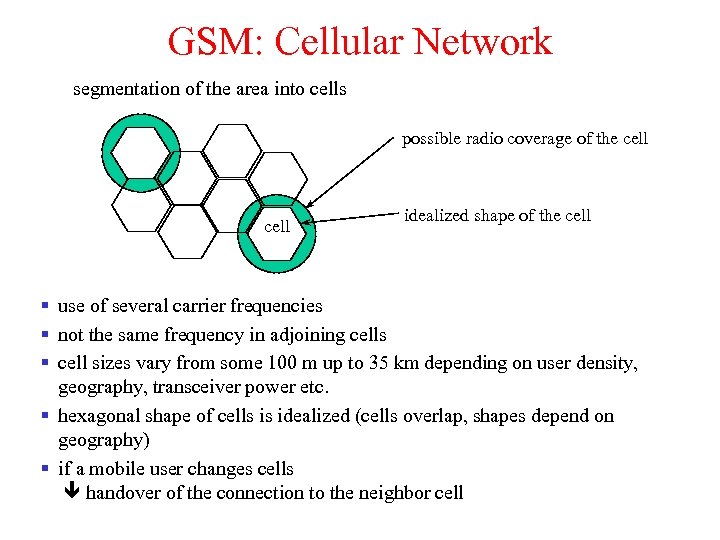
 The Cellular Concept § To utilize space division multiplexing the area covered by a cellular network is divided into cells. § An idealized model of the cellular radio system consists of an array of hexagonal cells with a base station (BS) located at the center of each cell and a number of mobile terminals (MTs) communicate with each other through the base station. • Uplink channels for MTs to communication with the base station • Downlink channels for BS to communicate with MTs. § The cells are designed for frequency reuse. Same frequency can be reused in non-nearby cells. § A cluster is a group of cells which uses the entire radio spectrum. • The cluster size N is the number of cells in each cluster. • Each cell within a cluster is allocated a distinct set of frequencies (channels) and cells labeled with a given number – i. e. co-channels reuse the same channel set. • As the cell size decreases, traffic carrier capacity increases, and thus cells start 2 big and split as system grows.
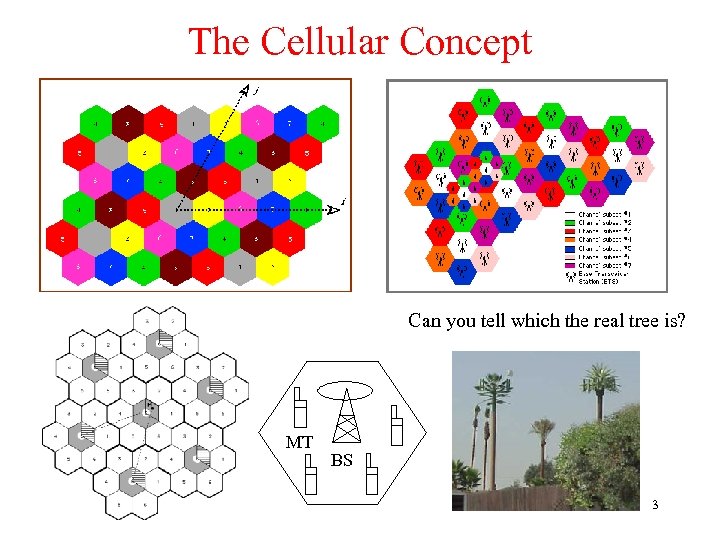 The Cellular Concept Can you tell which the real tree is? MT BS 3
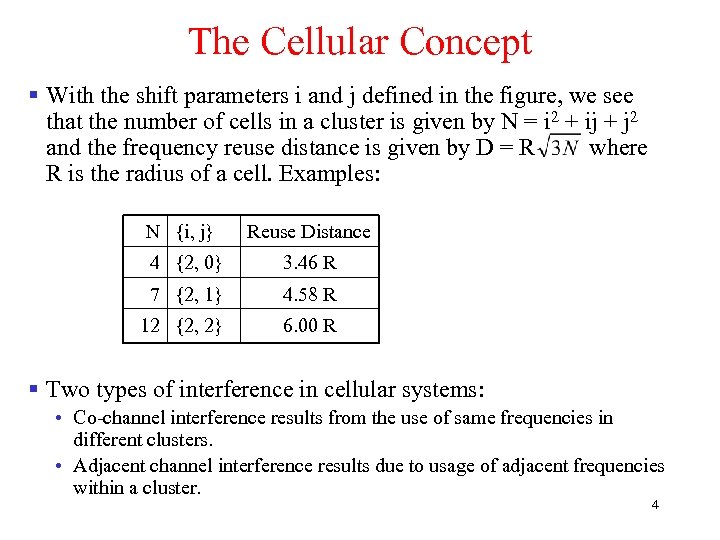 The Cellular Concept § With the shift parameters i and j defined in the figure, we see that the number of cells in a cluster is given by N = i 2 + ij + j 2 and the frequency reuse distance is given by D = R where R is the radius of a cell. Examples: N {i, j} Reuse Distance 4 {2, 0} 3. 46 R 7 {2, 1} 4. 58 R 12 {2, 2} 6. 00 R § Two types of interference in cellular systems: • Co-channel interference results from the use of same frequencies in different clusters. • Adjacent channel interference results due to usage of adjacent frequencies within a cluster. 4
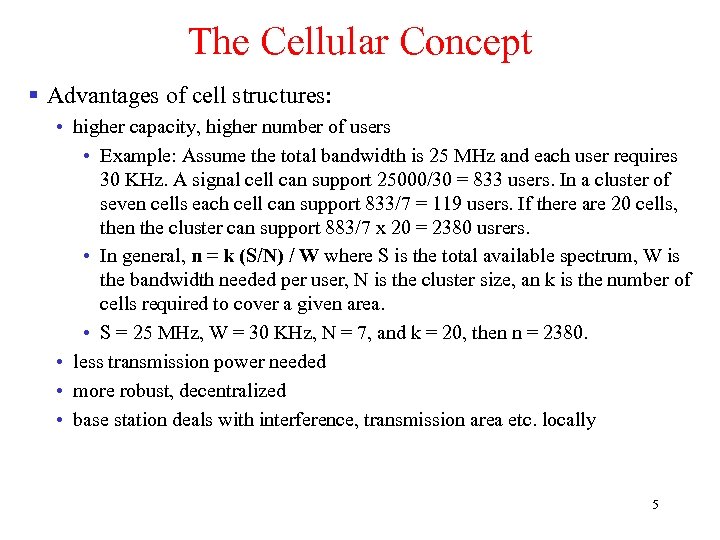 The Cellular Concept § Advantages of cell structures: • higher capacity, higher number of users • Example: Assume the total bandwidth is 25 MHz and each user requires 30 KHz. A signal cell can support 25000/30 = 833 users. In a cluster of seven cells each cell can support 833/7 = 119 users. If there are 20 cells, then the cluster can support 883/7 x 20 = 2380 usrers. • In general, n = k (S/N) / W where S is the total available spectrum, W is the bandwidth needed per user, N is the cluster size, an k is the number of cells required to cover a given area. • S = 25 MHz, W = 30 KHz, N = 7, and k = 20, then n = 2380. • less transmission power needed • more robust, decentralized • base station deals with interference, transmission area etc. locally 5
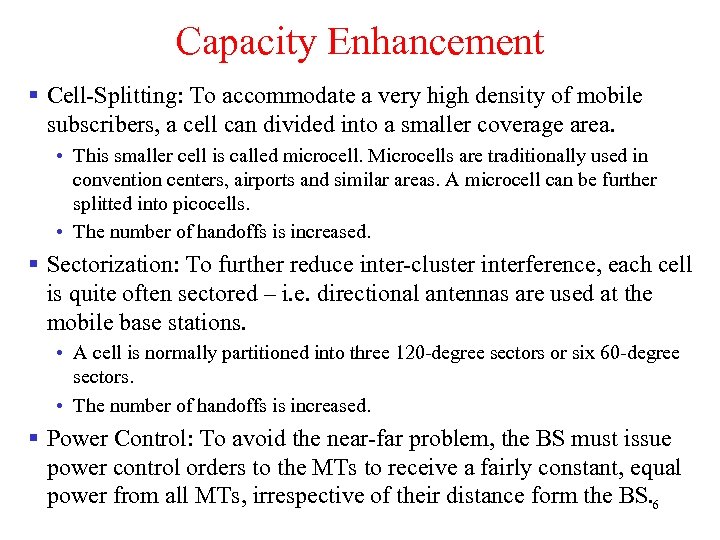 Capacity Enhancement § Cell-Splitting: To accommodate a very high density of mobile subscribers, a cell can divided into a smaller coverage area. • This smaller cell is called microcell. Microcells are traditionally used in convention centers, airports and similar areas. A microcell can be further splitted into picocells. • The number of handoffs is increased. § Sectorization: To further reduce inter-cluster interference, each cell is quite often sectored – i. e. directional antennas are used at the mobile base stations. • A cell is normally partitioned into three 120 -degree sectors or six 60 -degree sectors. • The number of handoffs is increased. § Power Control: To avoid the near-far problem, the BS must issue power control orders to the MTs to receive a fairly constant, equal power from all MTs, irrespective of their distance form the BS. 6
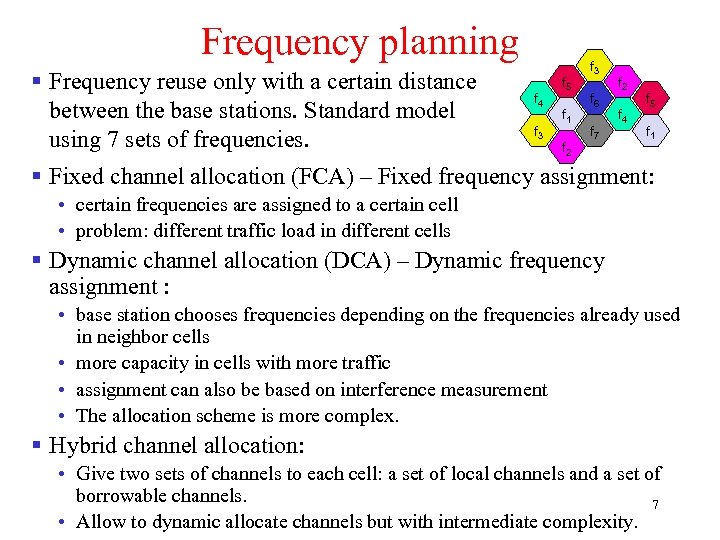 Frequency planning § Frequency reuse only with a certain distance between the base stations. Standard model using 7 sets of frequencies. f 4 f 3 f 5 f 1 f 2 f 3 f 6 f 7 f 2 f 4 f 5 f 1 § Fixed channel allocation (FCA) – Fixed frequency assignment: • certain frequencies are assigned to a certain cell • problem: different traffic load in different cells § Dynamic channel allocation (DCA) – Dynamic frequency assignment : • base station chooses frequencies depending on the frequencies already used in neighbor cells • more capacity in cells with more traffic • assignment can also be based on interference measurement • The allocation scheme is more complex. § Hybrid channel allocation: • Give two sets of channels to each cell: a set of local channels and a set of borrowable channels. 7 • Allow to dynamic allocate channels but with intermediate complexity.
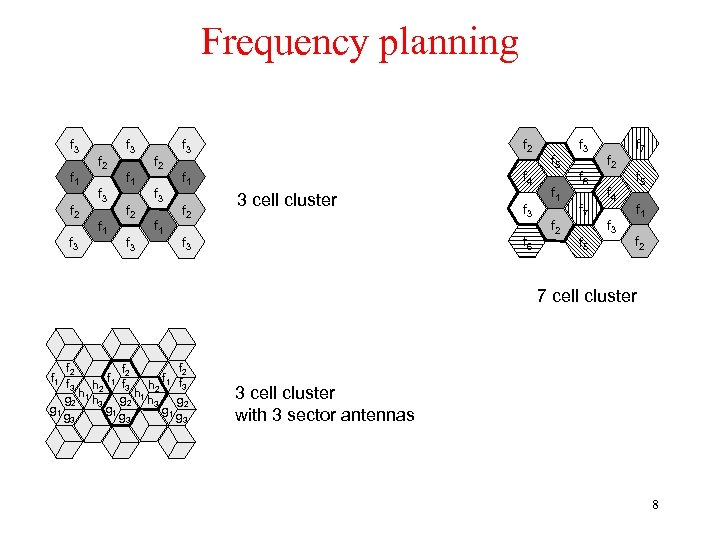 Frequency planning f 3 f 1 f 2 f 3 f 1 f 3 f 2 f 1 f 4 f 2 3 cell cluster f 3 f 6 f 3 f 5 f 1 f 2 f 3 f 6 f 7 f 5 f 2 f 4 f 3 f 7 f 5 f 1 f 2 7 cell cluster f 2 f 2 f 1 f h h 3 3 3 h 2 g 2 1 h 3 g 2 g 1 g 1 g 3 g 3 3 cell cluster with 3 sector antennas 8
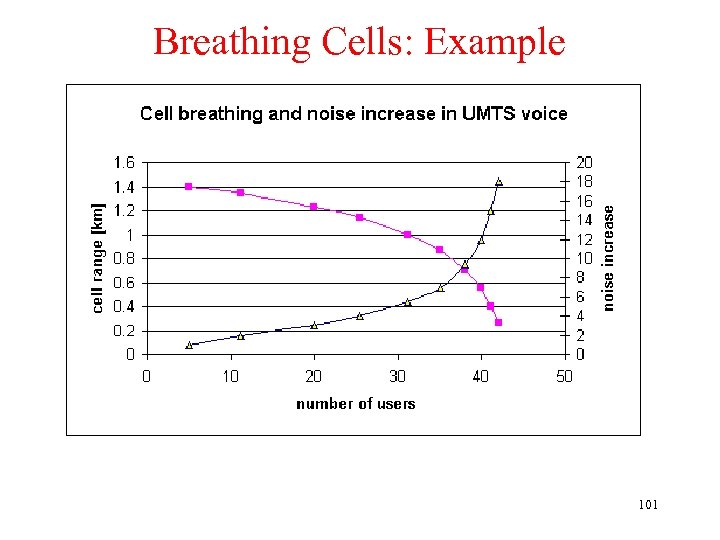
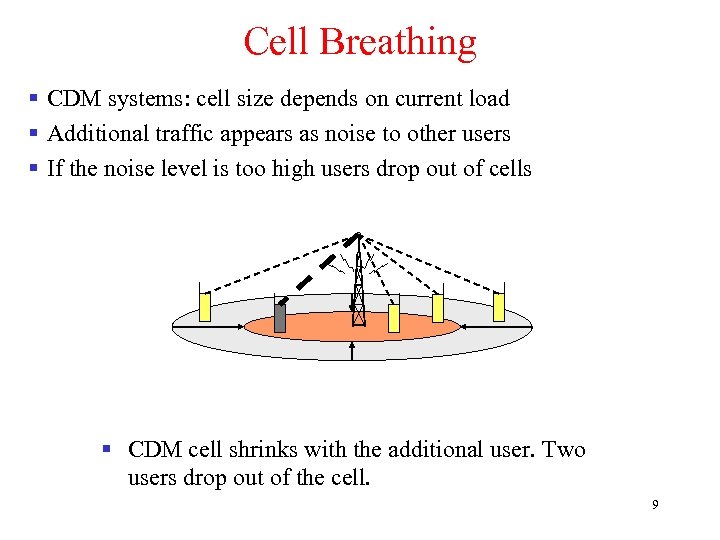 Cell Breathing § CDM systems: cell size depends on current load § Additional traffic appears as noise to other users § If the noise level is too high users drop out of cells § CDM cell shrinks with the additional user. Two users drop out of the cell. 9
 Handoffs § When a user moves from the coverage area of one BS to the adjacent one, a handoff (handover) has to be executed to continue the call. A handoff contains two main parts: • Find an uplink-downlink channel pair from the new cell to carry on the call • Drop the link form the original BS. § Issues involved in Handoffs: • Optimal BS selection • Ping-pong effect: The call gets bounced back and forth in the boundaries between different cells. This should be avoided. • Data loss • Detection of handoff requirement: Three handoff schemes: • Mobile-initiated: An MT monitors the signal strength and requests a handoff when the strength drops below a threshold. • Network-initiated handoff: The BS forces a handoff if the signals from an MT weaken. • Mobile-assisted handoff: An MT evaluates the signal strength and the BS 10 decides the handoff.
 Handoffs § Handoff quality is measured by the following parameters (make sure the carrier to interference ratio (C/I) doesn’t fall below the minimum): • Handoff delay: The signaling during a handoff causes a delay in the transfer of an on-going call from the current cell to the new call. • Duration of interruption: In hard handoff, the channel pair is switched from the current cell to the new cell. • Handoff success: The handoff strategies should maximize the handoff success rate. • Probability of unnecessary handoff: Unnecessary handoffs increase the signaling overhead on the network. § Improved handoff strategies: • Prioritization: handoffs are given priority over new call requests. • Relative signal strength: The signal strength in the new cell is stronger than the current one. • Soft handoffs: A short period of time when more than one BS handles a call can be allowed. • Predictive handoffs: the mobility pattern can be predicted. • Adaptive handoffs: Users may have to be shifted from micro-cell to macro 11 cell.
 Cellular Architecture § Every cell has a Base Station (BS) to which all Mobile Terminals (MTs) in the cell communicate. § A Base Station Controller (BSC) controls a set group of BTSs. Together the BTS and BSC systems are known as the BSS or Base Station System (BSS). The BSC is vital to the BSS system in that it ensures that subscribers can move freely from one cell to another with no loss in signal strength § A BSC is then connected to a Mobile Switching Center (MSC). The MSC acts as an interface between the cellular radio system and the public switched telephone network (PSTN). § The Authentication Center (Au. C) validates the MTs by verifying their identity with the Equipment Identity Register (EIR). § The MSCs are linked through a signaling system 7 (SS 7) network, which controls setting up, managing, and releasing of telephone calls. 12
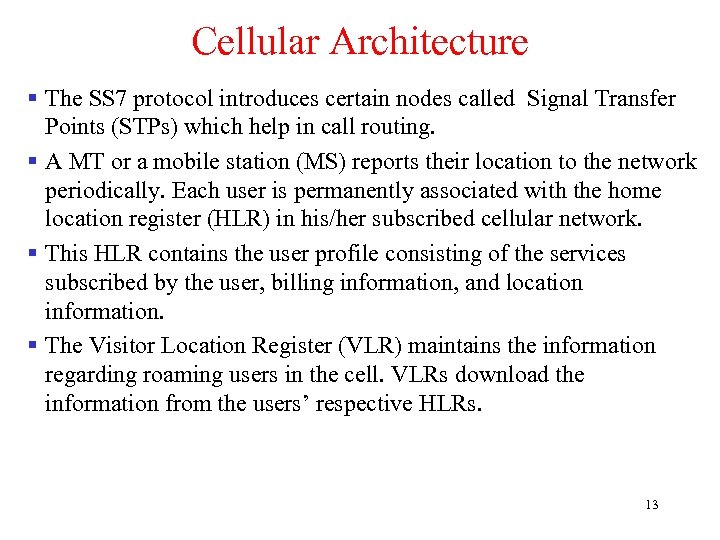 Cellular Architecture § The SS 7 protocol introduces certain nodes called Signal Transfer Points (STPs) which help in call routing. § A MT or a mobile station (MS) reports their location to the network periodically. Each user is permanently associated with the home location register (HLR) in his/her subscribed cellular network. § This HLR contains the user profile consisting of the services subscribed by the user, billing information, and location information. § The Visitor Location Register (VLR) maintains the information regarding roaming users in the cell. VLRs download the information from the users’ respective HLRs. 13
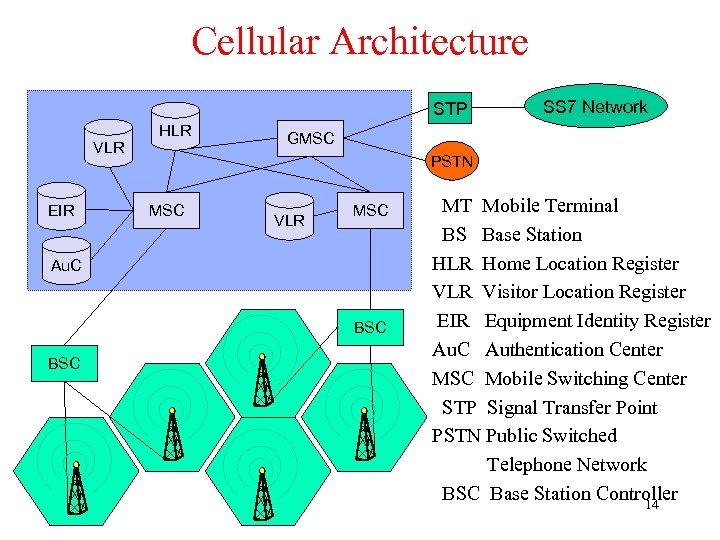 Cellular Architecture STP VLR EIR HLR GMSC PSTN MSC VLR MSC Au. C BSC SS 7 Network MT Mobile Terminal BS Base Station HLR Home Location Register VLR Visitor Location Register EIR Equipment Identity Register Au. C Authentication Center MSC Mobile Switching Center STP Signal Transfer Point PSTN Public Switched Telephone Network BSC Base Station Controller 14
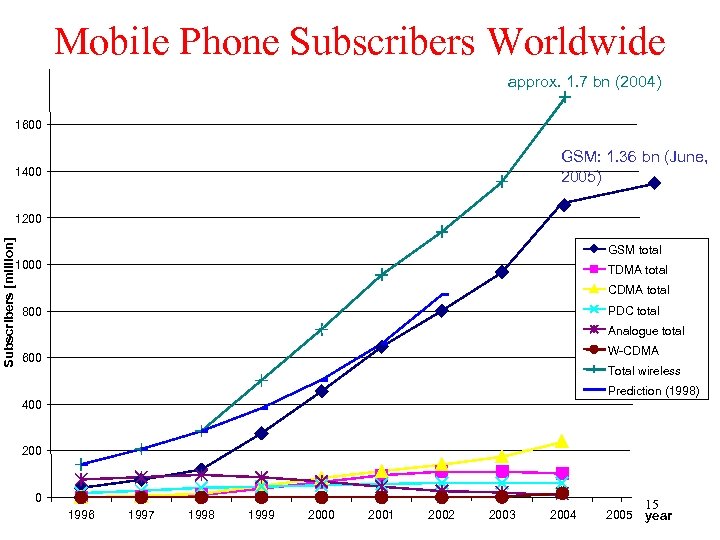 Mobile Phone Subscribers Worldwide approx. 1. 7 bn (2004) 1600 GSM: 1. 36 bn (June, 2005) 1400 Subscribers [million] 1200 GSM total 1000 TDMA total CDMA total PDC total 800 Analogue total W-CDMA 600 Total wireless Prediction (1998) 400 200 0 1996 1997 1998 1999 2000 2001 2002 2003 2004 2005 15 year
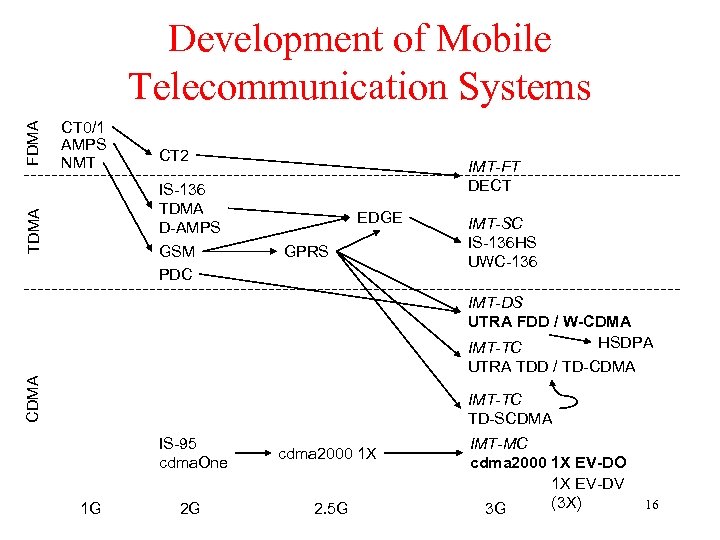 CT 0/1 AMPS NMT CT 2 IS-136 TDMA D-AMPS GSM PDC TDMA FDMA Development of Mobile Telecommunication Systems IMT-FT DECT EDGE GPRS IMT-SC IS-136 HS UWC-136 IMT-DS UTRA FDD / W-CDMA HSDPA IMT-TC CDMA UTRA TDD / TD-CDMA IMT-TC TD-SCDMA IS-95 cdma. One 1 G cdma 2000 1 X 2 G 2. 5 G IMT-MC cdma 2000 1 X EV-DO 1 X EV-DV (3 X) 3 G 16
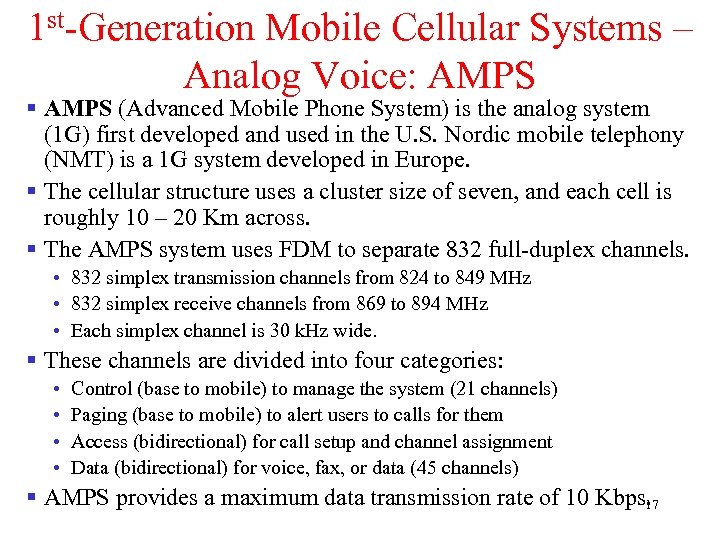 1 st-Generation Mobile Cellular Systems – Analog Voice: AMPS § AMPS (Advanced Mobile Phone System) is the analog system (1 G) first developed and used in the U. S. Nordic mobile telephony (NMT) is a 1 G system developed in Europe. § The cellular structure uses a cluster size of seven, and each cell is roughly 10 – 20 Km across. § The AMPS system uses FDM to separate 832 full-duplex channels. • 832 simplex transmission channels from 824 to 849 MHz • 832 simplex receive channels from 869 to 894 MHz • Each simplex channel is 30 k. Hz wide. § These channels are divided into four categories: • • Control (base to mobile) to manage the system (21 channels) Paging (base to mobile) to alert users to calls for them Access (bidirectional) for call setup and channel assignment Data (bidirectional) for voice, fax, or data (45 channels) § AMPS provides a maximum data transmission rate of 10 Kbps. 7 1
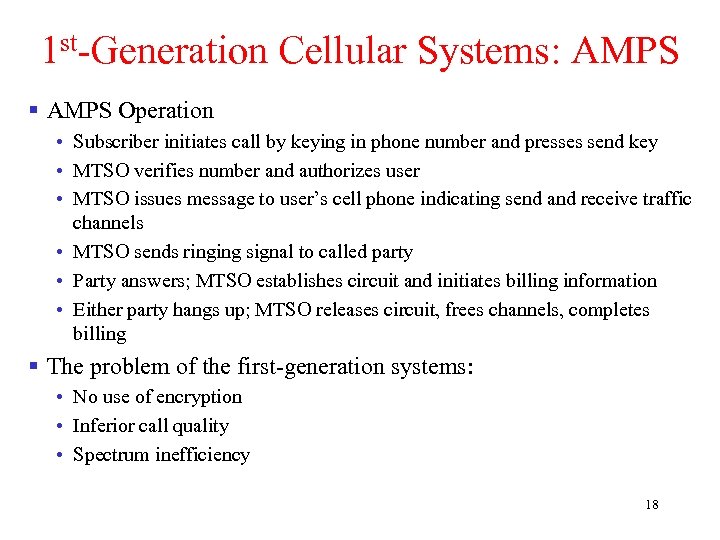 1 st-Generation Cellular Systems: AMPS § AMPS Operation • Subscriber initiates call by keying in phone number and presses send key • MTSO verifies number and authorizes user • MTSO issues message to user’s cell phone indicating send and receive traffic channels • MTSO sends ringing signal to called party • Party answers; MTSO establishes circuit and initiates billing information • Either party hangs up; MTSO releases circuit, frees channels, completes billing § The problem of the first-generation systems: • No use of encryption • Inferior call quality • Spectrum inefficiency 18
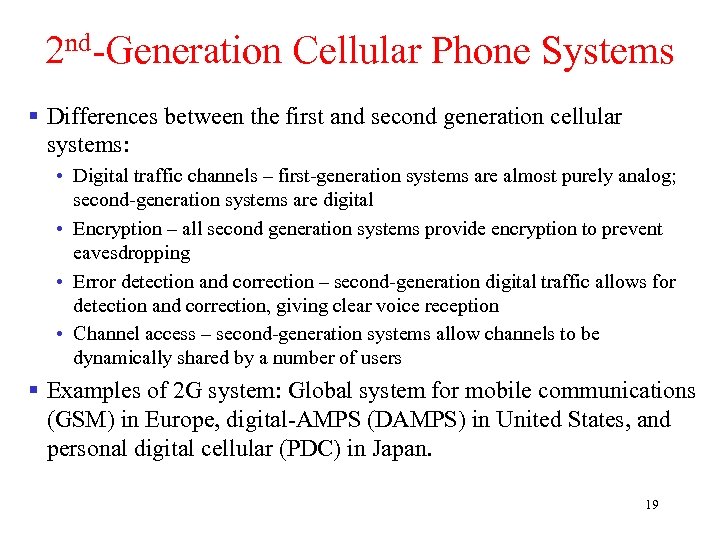 2 nd-Generation Cellular Phone Systems § Differences between the first and second generation cellular systems: • Digital traffic channels – first-generation systems are almost purely analog; second-generation systems are digital • Encryption – all second generation systems provide encryption to prevent eavesdropping • Error detection and correction – second-generation digital traffic allows for detection and correction, giving clear voice reception • Channel access – second-generation systems allow channels to be dynamically shared by a number of users § Examples of 2 G system: Global system for mobile communications (GSM) in Europe, digital-AMPS (DAMPS) in United States, and personal digital cellular (PDC) in Japan. 19
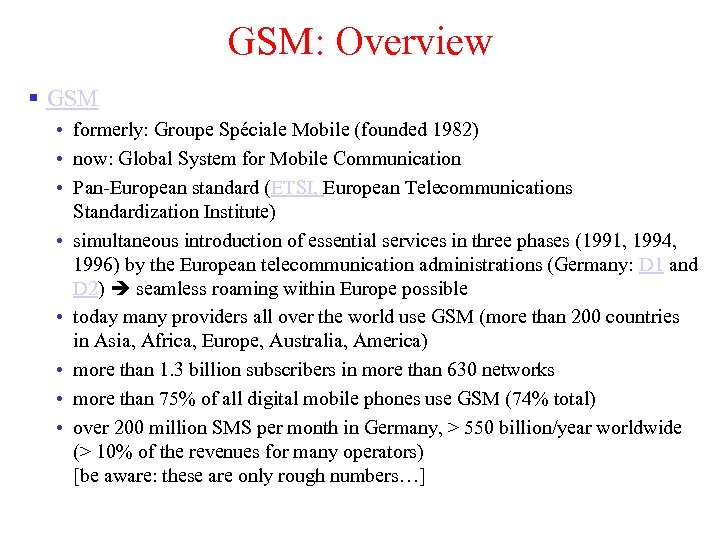 GSM: Overview § GSM • formerly: Groupe Spéciale Mobile (founded 1982) • now: Global System for Mobile Communication • Pan-European standard (ETSI, European Telecommunications Standardization Institute) • simultaneous introduction of essential services in three phases (1991, 1994, 1996) by the European telecommunication administrations (Germany: D 1 and D 2) seamless roaming within Europe possible • today many providers all over the world use GSM (more than 200 countries in Asia, Africa, Europe, Australia, America) • more than 1. 3 billion subscribers in more than 630 networks • more than 75% of all digital mobile phones use GSM (74% total) • over 200 million SMS per month in Germany, > 550 billion/year worldwide (> 10% of the revenues for many operators) [be aware: these are only rough numbers…]
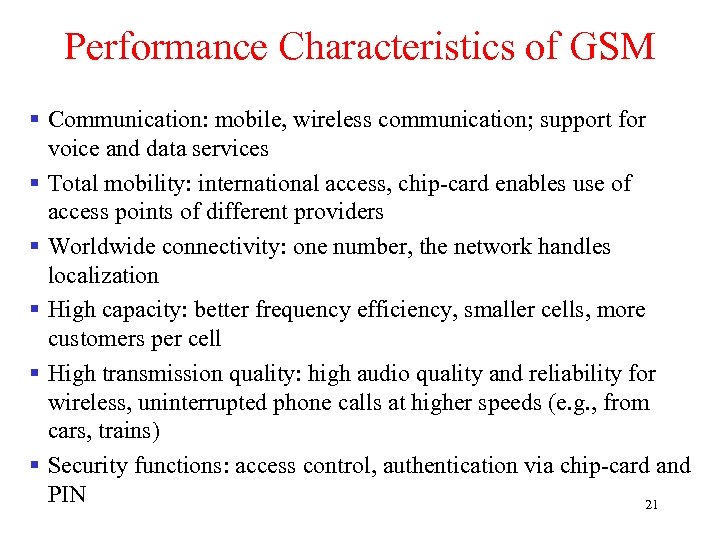 Performance Characteristics of GSM § Communication: mobile, wireless communication; support for voice and data services § Total mobility: international access, chip-card enables use of access points of different providers § Worldwide connectivity: one number, the network handles localization § High capacity: better frequency efficiency, smaller cells, more customers per cell § High transmission quality: high audio quality and reliability for wireless, uninterrupted phone calls at higher speeds (e. g. , from cars, trains) § Security functions: access control, authentication via chip-card and PIN 21
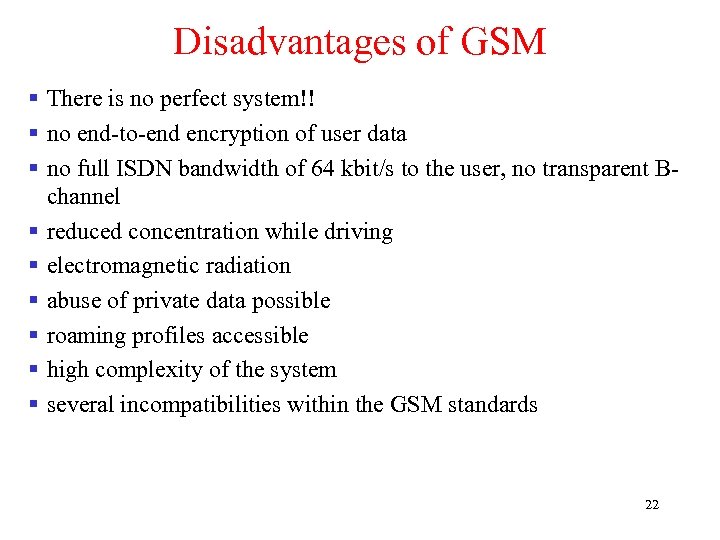 Disadvantages of GSM § There is no perfect system!! § no end-to-end encryption of user data § no full ISDN bandwidth of 64 kbit/s to the user, no transparent Bchannel § reduced concentration while driving § electromagnetic radiation § abuse of private data possible § roaming profiles accessible § high complexity of the system § several incompatibilities within the GSM standards 22
![GSM Frequency Bands Type Channels Uplink [MHz] Downlink [MHz] GSM 850 (Americas) 128 -251](https://present5.com/presentation/0000c9047881bed18299c5d1e55ea377/image-23.jpg "GSM Frequency Bands Type Channels Uplink [MHz] Downlink [MHz] GSM 850 (Americas) 128 -251") GSM Frequency Bands Type Channels Uplink [MHz] Downlink [MHz] GSM 850 (Americas) 128 -251 824 -849 869 -894 GSM 900 0 -124, 955 -1023 876 -915 921 -960 classical extended 124 channels +49 channels 890 -915 880 -915 935 -960 925 -960 GSM 1800 512 -885 1710 -1785 1805 -1880 GSM 1900 (Americs) 512 -810 1850 -1910 1930 -1990 GSM-R (Rail) 955 -1024, 0 -124 876 -915 921 -960 Exclusive 69 channels 876 -880 921 -925 450 -458 460 -468 489 -496 GSM 450/480 479 -486 § Please note: frequency ranges may vary depending on the country! § Channels at the lower/upper edge of a frequency band are typically not used 3 2
GSM Frequency Bands Type Channels Uplink [MHz] Downlink [MHz] GSM 850 (Americas) 128 -251 824 -849 869 -894 GSM 900 0 -124, 955 -1023 876 -915 921 -960 classical extended 124 channels +49 channels 890 -915 880 -915 935 -960 925 -960 GSM 1800 512 -885 1710 -1785 1805 -1880 GSM 1900 (Americs) 512 -810 1850 -1910 1930 -1990 GSM-R (Rail) 955 -1024, 0 -124 876 -915 921 -960 Exclusive 69 channels 876 -880 921 -925 450 -458 460 -468 489 -496 GSM 450/480 479 -486 § Please note: frequency ranges may vary depending on the country! § Channels at the lower/upper edge of a frequency band are typically not used 3 2
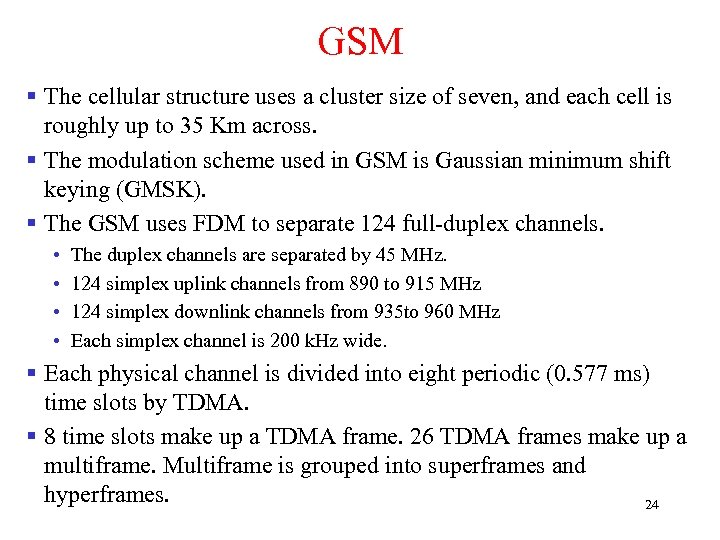 GSM § The cellular structure uses a cluster size of seven, and each cell is roughly up to 35 Km across. § The modulation scheme used in GSM is Gaussian minimum shift keying (GMSK). § The GSM uses FDM to separate 124 full-duplex channels. • • The duplex channels are separated by 45 MHz. 124 simplex uplink channels from 890 to 915 MHz 124 simplex downlink channels from 935 to 960 MHz Each simplex channel is 200 k. Hz wide. § Each physical channel is divided into eight periodic (0. 577 ms) time slots by TDMA. § 8 time slots make up a TDMA frame. 26 TDMA frames make up a multiframe. Multiframe is grouped into superframes and hyperframes. 24
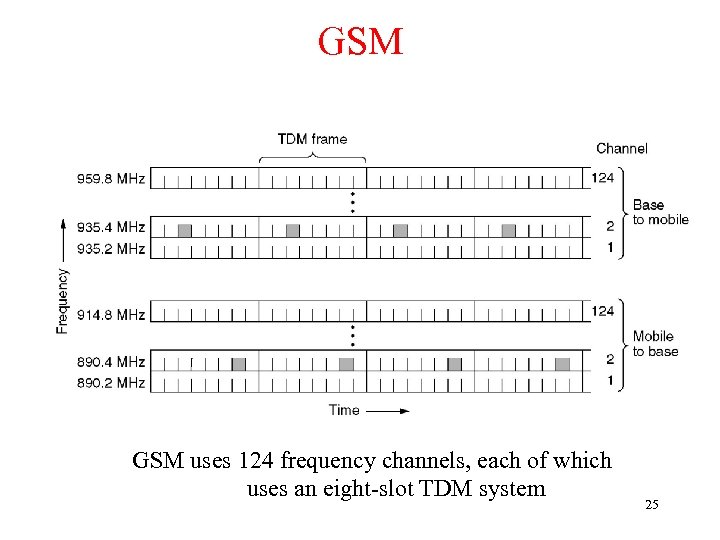 GSM uses 124 frequency channels, each of which uses an eight-slot TDM system 25
 GSM § Each MT is assigned only one slot within each frame, the maximum speed is around 34 Kbps (1/8 of the 270. 8 Kbps capacity of a 200 KHz GSM carrier). § Forward error correction (FEC) and encryption reduce the data rate to around 9. 6 Kbps. § A slot comprises four parts: • Header and footer are empty space at the beginning and end of the slot to separate a slot from its neighbors. • Training sequence (Training) helps a receiver lock on to the slot. • Stealing bits (S) identify whether the slot carries data or control information. • Traffic carries user voice/data, control information, and error correction. 26
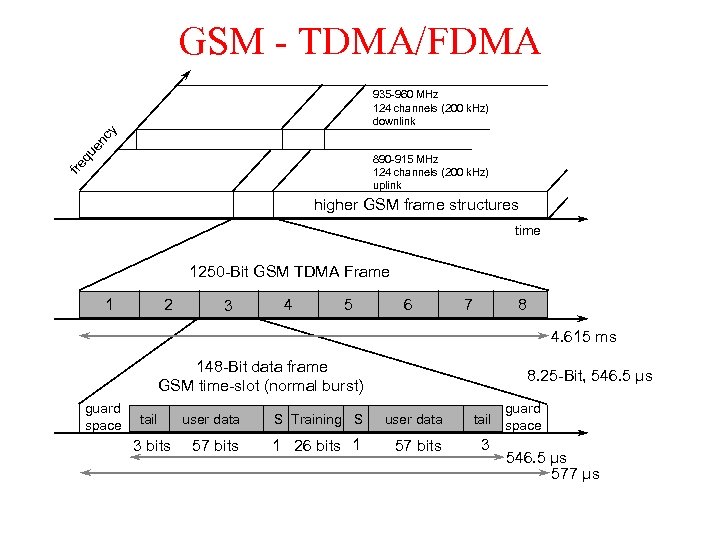 GSM - TDMA/FDMA qu en cy 935 -960 MHz 124 channels (200 k. Hz) downlink fre 890 -915 MHz 124 channels (200 k. Hz) uplink higher GSM frame structures time 1250 -Bit GSM TDMA Frame 1 2 3 4 5 6 7 8 4. 615 ms 148 -Bit data frame GSM time-slot (normal burst) guard space tail 3 bits 8. 25 -Bit, 546. 5 µs user data S Training S user data 57 bits 1 26 bits 1 57 bits guard tail space 3 546. 5 µs 577 µs
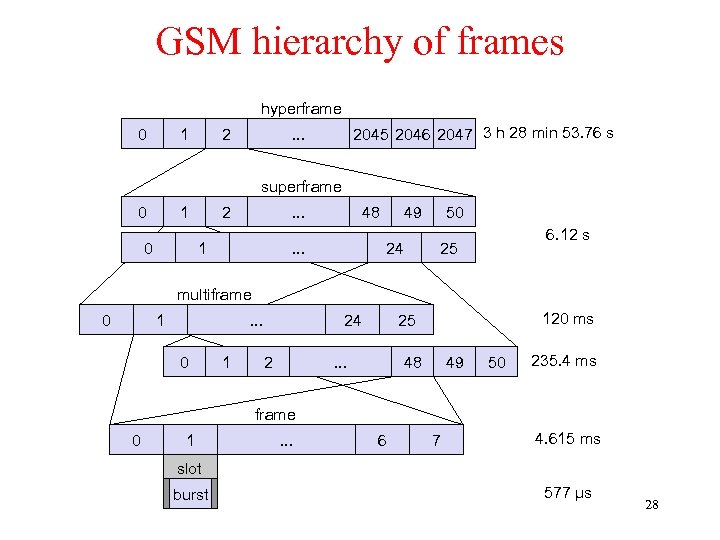 GSM hierarchy of frames hyperframe 0 1 2 2045 2046 2047 3 h 28 min 53. 76 s . . . superframe 0 1 0 2 . . . 1 48 . . . 49 24 50 6. 12 s 25 multiframe 0 1 . . . 0 1 24 2 120 ms 25 . . . 48 49 50 235. 4 ms frame 0 1 . . . 6 7 4. 615 ms slot burst 577 µs 28
 GSM Frame § A the control channels in GSM are classified into three broad categories: • Broadcast control channel (BCCH) is a downlink channel that contains the BS’s identity and channel status. All MTs monitor the BCCH to detect if they have moved into a new cell. • Dedicated control channel (DCCH) is used for call-setup, location updates, and all call-management information exchange. BS uses DCCH to keep track of all MTs in its coverage area. • Common control channel consists of: • the downlink paging channel is used to page any MT to alert it for an incoming call. • the random access channel supports ALOHA-based request from MT to BS. • the access grant channel on which the BS informs the MT of an allotted duplex channel for a call. 29
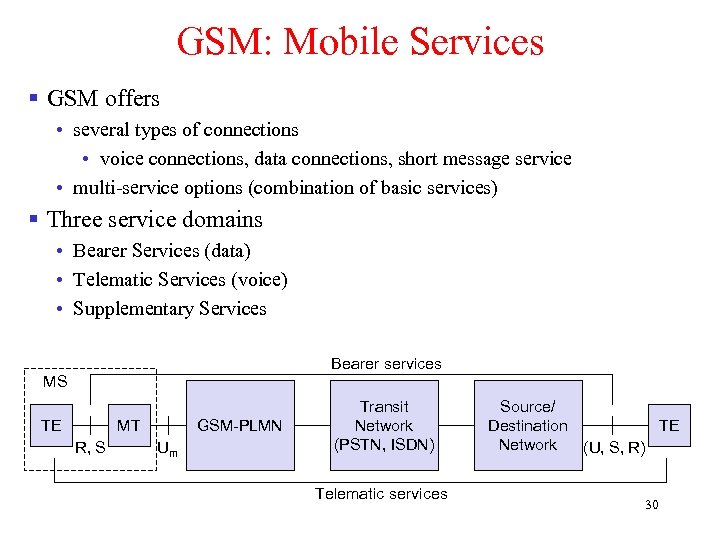 GSM: Mobile Services § GSM offers • several types of connections • voice connections, data connections, short message service • multi-service options (combination of basic services) § Three service domains • Bearer Services (data) • Telematic Services (voice) • Supplementary Services Bearer services MS TE MT R, S GSM-PLMN Um Transit Network (PSTN, ISDN) Telematic services Source/ Destination TE Network (U, S, R) 30
 Bearer Services § Telecommunication services to transfer data between access points § Specification of services up to the terminal interface (OSI layers 13) § Different data rates for voice and data (original standard) • data service (circuit switched) • synchronous: 2. 4, 4. 8 or 9. 6 kbit/s • asynchronous: 300 - 1200 bit/s • data service (packet switched) • synchronous: 2. 4, 4. 8 or 9. 6 kbit/s • asynchronous: 300 - 9600 bit/s § Today: data rates of approx. 50 kbit/s possible 31
 Telematic Services § Telecommunication services that enable voice communication via mobile phones § All these basic services have to obey cellular functions, security measurements etc. § Offered services • mobile telephony primary goal of GSM was to enable mobile telephony offering the traditional bandwidth of 3. 1 k. Hz • Emergency number common number throughout Europe (112); mandatory for all service providers; free of charge; connection with the highest priority (preemption of other connections possible) • Multinumbering several ISDN phone numbers per user possible 32
 Telematic Services § Additional services • Non-Voice-Teleservices • group 3 fax • voice mailbox (implemented in the fixed network supporting the mobile terminals) • electronic mail (MHS, Message Handling System, implemented in the fixed network) • Short Message Service (SMS) alphanumeric data transmission to/from the mobile terminal (160 characters) using the signaling channel, thus allowing simultaneous use of basic services and SMS (almost ignored in the beginning now the most successful add-on!) 33
 Supplementary Services § Services in addition to the basic services, cannot be offered standalone § Similar to ISDN services besides lower bandwidth due to the radio link § May differ between different service providers, countries and protocol versions § Important services • • • identification: forwarding of caller number suppression of number forwarding automatic call-back conferencing with up to 7 participants locking of the mobile terminal (incoming or outgoing calls) 34
 Architecture of the GSM System § GSM is a PLMN (Public Land Mobile Network) • several providers setup mobile networks following the GSM standard within each country • components • MS (mobile station) • BS (base station) • MSC (mobile switching center) • LR (location register) • subsystems • RSS (radio subsystem): covers all radio aspects • NSS (network and switching subsystem): call forwarding, handover, switching • OSS (operation subsystem): management of the network 35
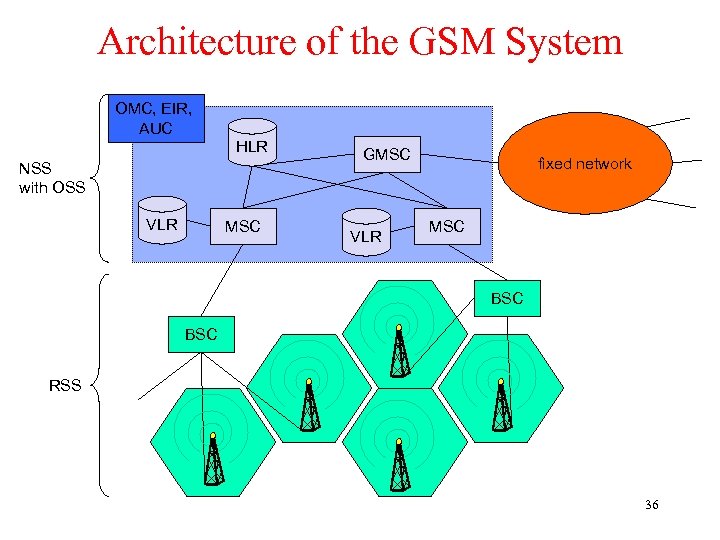 Architecture of the GSM System OMC, EIR, AUC HLR NSS with OSS VLR MSC GMSC VLR fixed network MSC BSC RSS 36
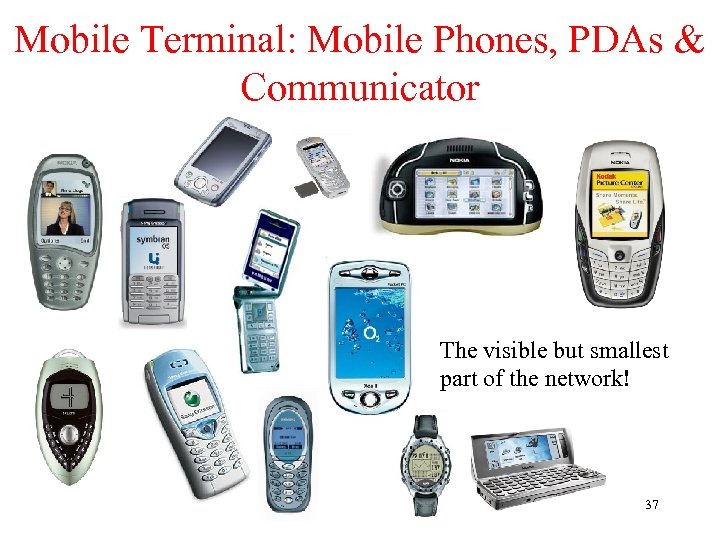 Mobile Terminal: Mobile Phones, PDAs & Communicator The visible but smallest part of the network! 37
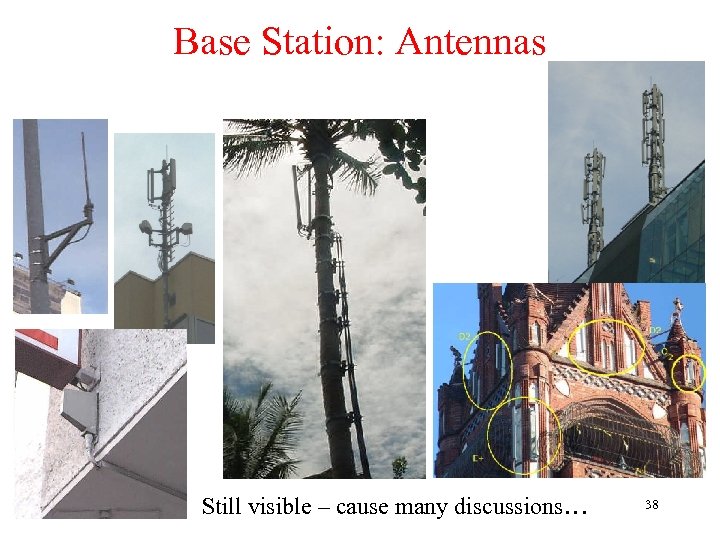 Base Station: Antennas Still visible – cause many discussions… 38
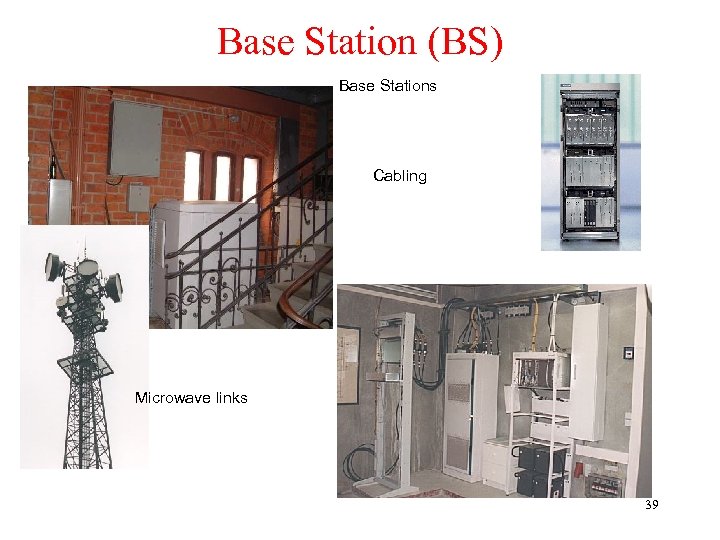 Base Station (BS) Base Stations Cabling Microwave links 39
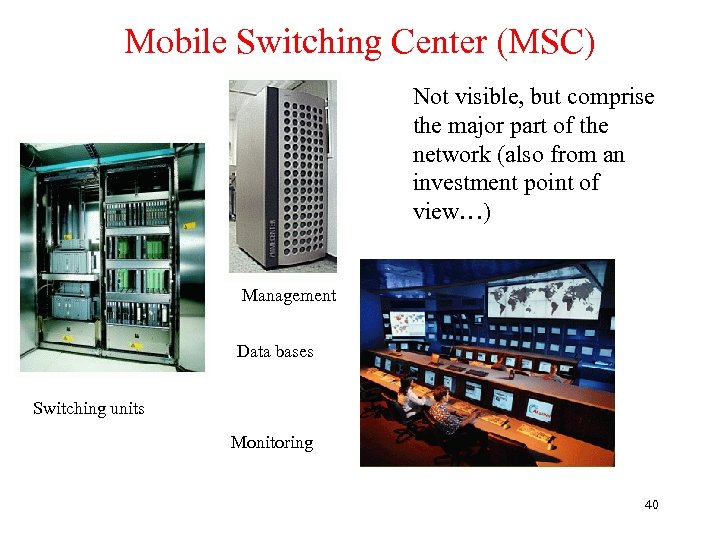 Mobile Switching Center (MSC) Not visible, but comprise the major part of the network (also from an investment point of view…) Management Data bases Switching units Monitoring 40
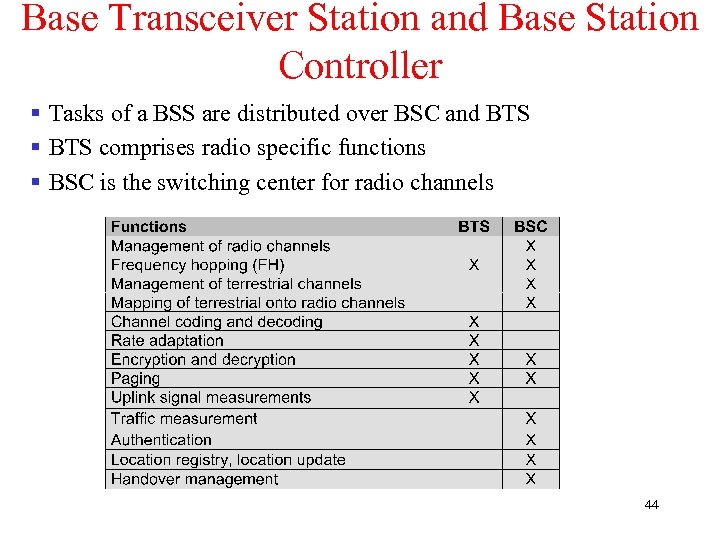
 Radio subsystem § The Radio Subsystem (RSS) comprises the cellular mobile network up to the switching centers § Components • Base Station Subsystem (BSS): • Base Transceiver Station (BTS): radio components including sender, receiver, antenna - if directed antennas are used one BTS can cover several cells • Base Station Controller (BSC): switching between BTSs, controlling BTSs, managing of network resources, mapping of radio channels (Um) onto terrestrial channels (A interface) • BSS = BSC + sum(BTS) + interconnection • Mobile Stations (MS) 41
 GSM: Cellular Network segmentation of the area into cells possible radio coverage of the cell idealized shape of the cell § use of several carrier frequencies § not the same frequency in adjoining cells § cell sizes vary from some 100 m up to 35 km depending on user density, geography, transceiver power etc. § hexagonal shape of cells is idealized (cells overlap, shapes depend on geography) § if a mobile user changes cells handover of the connection to the neighbor cell
 Example Coverage of GSM Networks (www. gsmworld. com) T-Mobile (GSM-900/1800) Germany AT&T (GSM-850/1900) USA O 2 (GSM-1800) Germany Vodacom (GSM-900) South Africa 43
 Base Transceiver Station and Base Station Controller § Tasks of a BSS are distributed over BSC and BTS § BTS comprises radio specific functions § BSC is the switching center for radio channels 44
 Mobile Station § Terminal for the use of GSM services § A mobile station (MS) comprises several functional groups • MT (Mobile Terminal): • offers common functions used by all services the MS offers • corresponds to the network termination (NT) of an ISDN access • end-point of the radio interface (Um) • TA (Terminal Adapter): • terminal adaptation, hides radio specific characteristics • TE (Terminal Equipment): • peripheral device of the MS, offers services to a user • does not contain GSM specific functions • SIM (Subscriber Identity Module): • personalization of the mobile terminal, stores user parameters TE TA R MT S Um 45
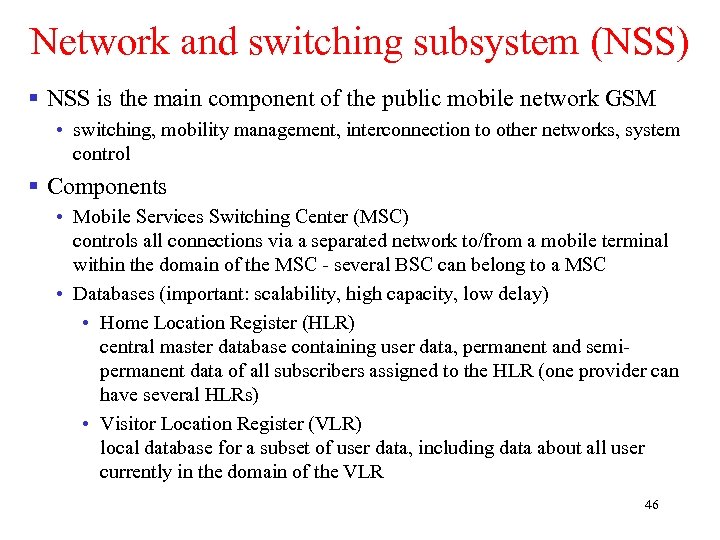 Network and switching subsystem (NSS) § NSS is the main component of the public mobile network GSM • switching, mobility management, interconnection to other networks, system control § Components • Mobile Services Switching Center (MSC) controls all connections via a separated network to/from a mobile terminal within the domain of the MSC - several BSC can belong to a MSC • Databases (important: scalability, high capacity, low delay) • Home Location Register (HLR) central master database containing user data, permanent and semipermanent data of all subscribers assigned to the HLR (one provider can have several HLRs) • Visitor Location Register (VLR) local database for a subset of user data, including data about all user currently in the domain of the VLR 46
 Mobile Services Switching Center § The MSC (mobile switching center) plays a central role in GSM • • • switching functions additional functions for mobility support management of network resources interworking functions via Gateway MSC (GMSC) integration of several databases § Functions of a MSC • • specific functions for paging and call forwarding termination of SS 7 (signaling system no. 7) mobility specific signaling location registration and forwarding of location information provision of new services (fax, data calls) support of short message service (SMS) generation and forwarding of accounting and billing information 47
 Operation subsystem § The OSS (Operation Subsystem) enables centralized operation, management, and maintenance of all GSM subsystems § Components • Authentication Center (AUC) • generates user specific authentication parameters on request of a VLR • authentication parameters used for authentication of mobile terminals and encryption of user data on the air interface within the GSM system • Equipment Identity Register (EIR) • registers GSM mobile stations and user rights • stolen or malfunctioning mobile stations can be locked and sometimes even localized • Operation and Maintenance Center (OMC) • different control capabilities for the radio subsystem and the network subsystem 48
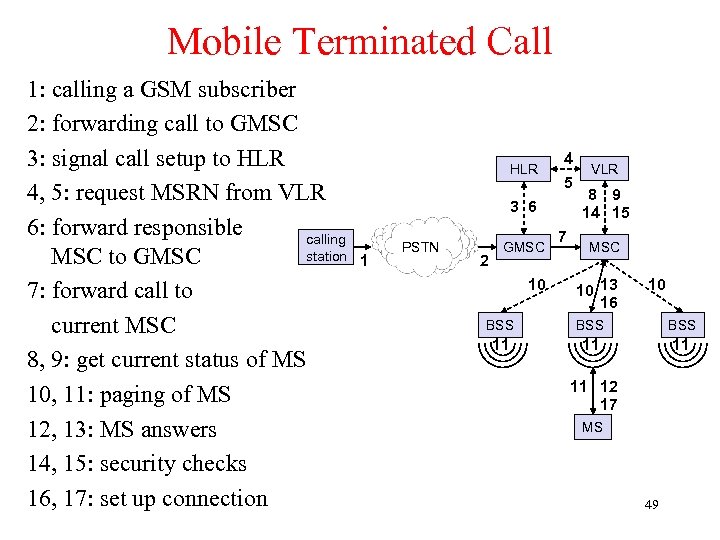 Mobile Terminated Call 1: calling a GSM subscriber 2: forwarding call to GMSC 3: signal call setup to HLR 4, 5: request MSRN from VLR 6: forward responsible calling station MSC to GMSC 7: forward call to current MSC 8, 9: get current status of MS 10, 11: paging of MS 12, 13: MS answers 14, 15: security checks 16, 17: set up connection HLR 4 5 3 6 1 PSTN 2 GMSC 10 7 VLR 8 9 14 15 MSC 10 13 16 10 BSS BSS 11 11 12 17 MS 49
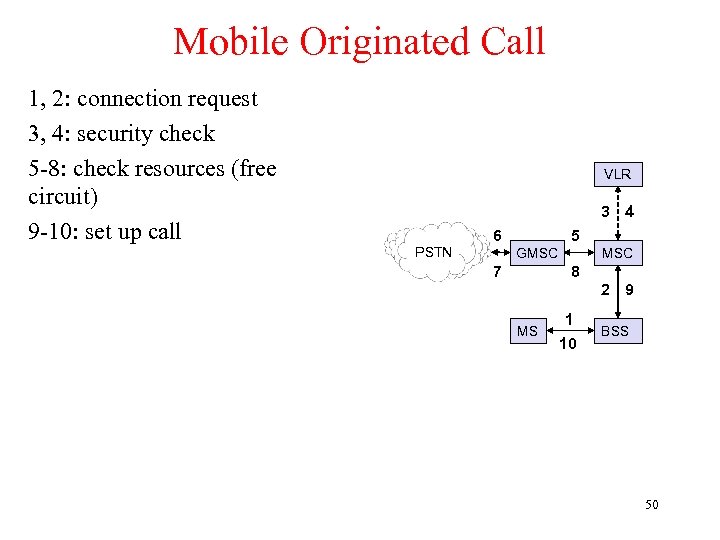 Mobile Originated Call 1, 2: connection request 3, 4: security check 5 -8: check resources (free circuit) 9 -10: set up call VLR 3 4 6 PSTN 5 GMSC 7 MSC 8 2 9 MS 1 10 BSS 50
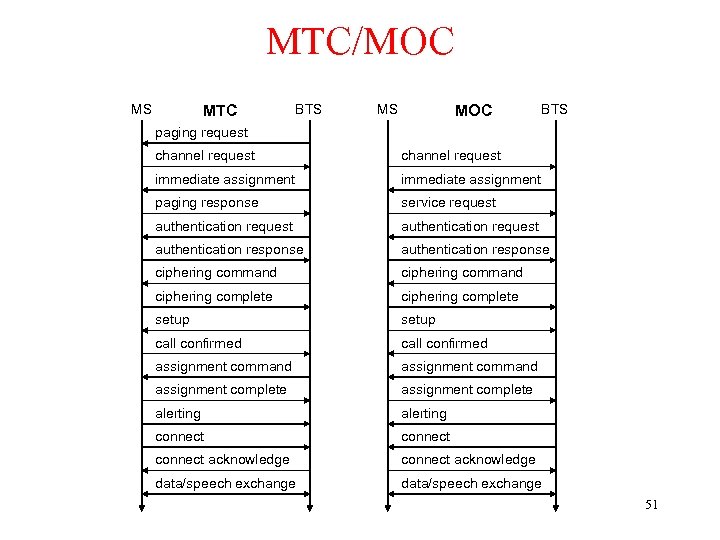 MTC/MOC MS MTC BTS MS MOC BTS paging request channel request immediate assignment paging response service request authentication response ciphering command ciphering complete setup call confirmed assignment command assignment complete alerting connect acknowledge data/speech exchange 51
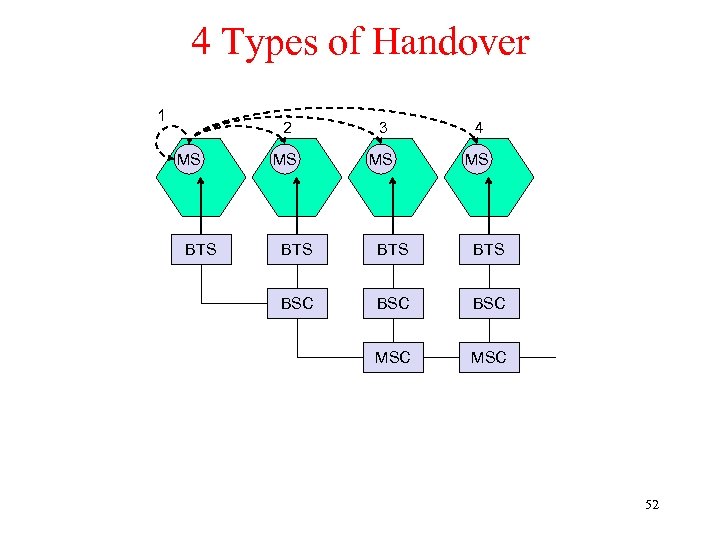 4 Types of Handover 1 2 MS BTS 3 4 MS MS MS BTS BTS BSC BSC MSC 52
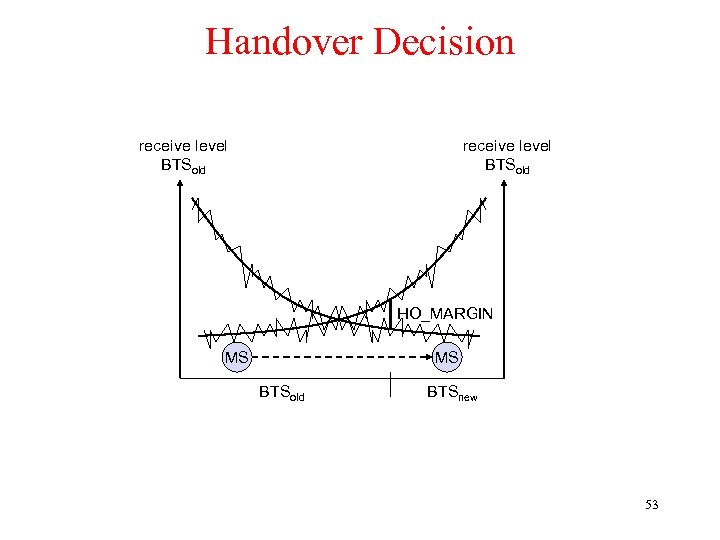 Handover Decision receive level BTSold HO_MARGIN MS MS BTSold BTSnew 53
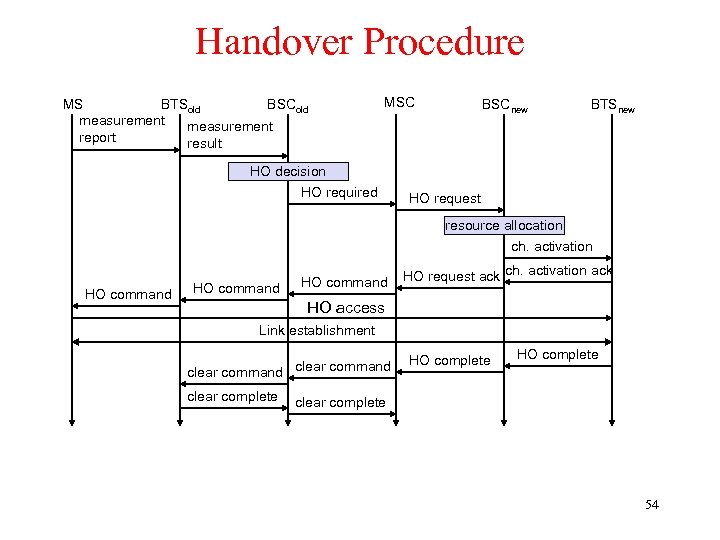 Handover Procedure MS BTSold BSCold measurement report result MSC BSCnew BTSnew HO decision HO required HO request resource allocation ch. activation HO command HO request ack ch. activation ack HO access Link establishment clear command clear complete HO complete clear complete 54
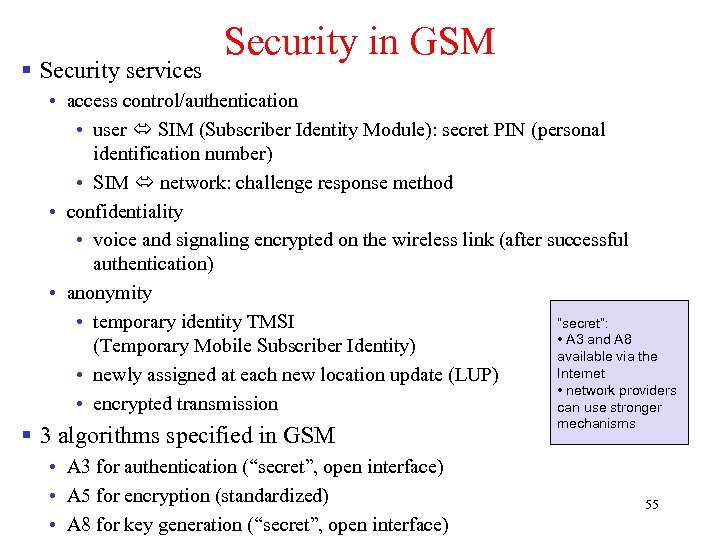 § Security services Security in GSM • access control/authentication • user SIM (Subscriber Identity Module): secret PIN (personal identification number) • SIM network: challenge response method • confidentiality • voice and signaling encrypted on the wireless link (after successful authentication) • anonymity “secret”: • temporary identity TMSI • A 3 and A 8 (Temporary Mobile Subscriber Identity) available via the Internet • newly assigned at each new location update (LUP) • network providers • encrypted transmission can use stronger § 3 algorithms specified in GSM • A 3 for authentication (“secret”, open interface) • A 5 for encryption (standardized) • A 8 for key generation (“secret”, open interface) mechanisms 55
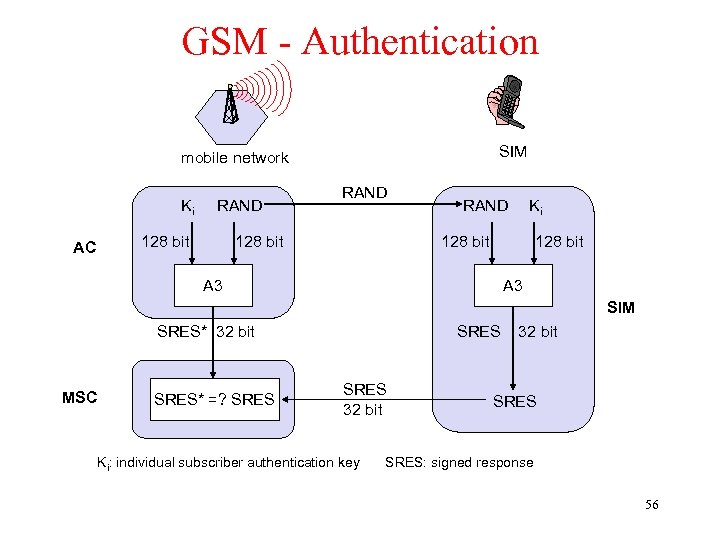 GSM - Authentication SIM mobile network Ki RAND 128 bit AC RAND 128 bit RAND Ki 128 bit A 3 SIM SRES* 32 bit MSC SRES* =? SRES 32 bit Ki: individual subscriber authentication key 32 bit SRES: signed response 56
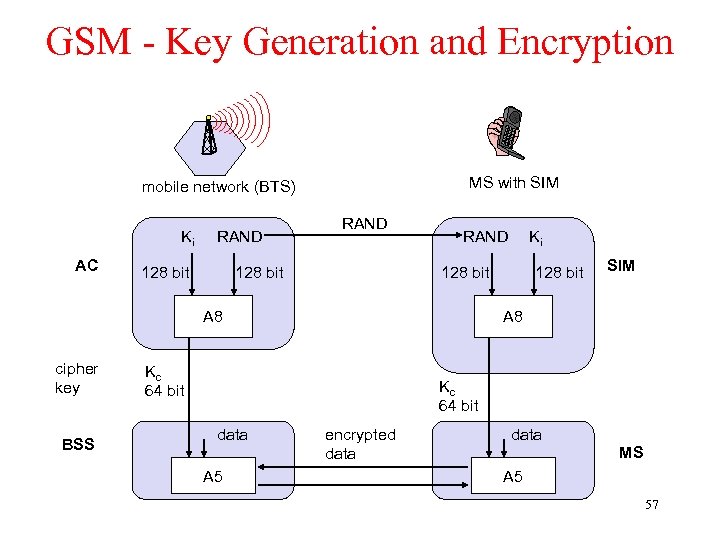 GSM - Key Generation and Encryption MS with SIM mobile network (BTS) Ki AC RAND 128 bit A 8 cipher key BSS Ki 128 bit SIM A 8 Kc 64 bit data A 5 encrypted data SRES data MS A 5 57
 Data Over Voice Channel § The main problems in using a voice network for data transmission are: • Signal distortion: Data cannot tolerate the distortion like the voice. • Handoff error: Handoffs introduce a certain delay in transfer of the call from one cell to another. • Interfacing with fixed network: The cellular network should be able to differentiate between a data call and a voice call. § To make the network recognize a data call, some possible solutions are: • A control message could be transmitted all along the path of the call to indicate a data call so that voice coding can be disabled. • A two-stage dial-up operation can be used, the cellular carrier is first dialed, and then the MT is informed of a data call. • A subscriber could be assigned separate subscriber numbers for each service he/she opts for. 58
 GSM Evolution of Data Services § Short Messaging Service (SMS) is a connectionless transfer of messages, each up to 160 alphanumeric characters in length. § High-Speed Circuit-Switched Data (HSCSD) is a circuit-switched protocol for large file transfers and multimedia data transmissions. • Offer a data rate of 57. 6 Kbps • Increase blocking probability § General Packet Radio Service (GPRS) uses TCP/IP and X. 25 to provide a high-capacity connection (up to 171. 2 Kbps) to the Internet. § Enhanced Data Rates for GSM Evolution (EDGE) uses 8 -PSK to triple the capacity of GSM. § Cellular Digital Packet Data (CDPD) is a packet-based data service on AMPS and IS-136 systems. 59
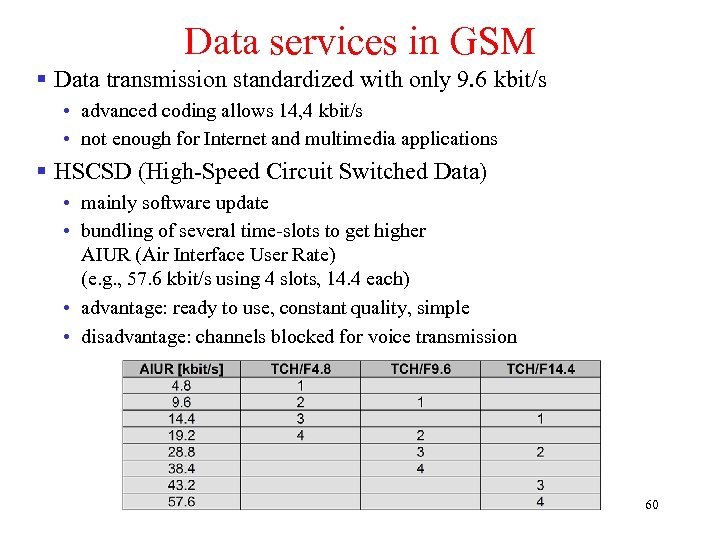 Data services in GSM § Data transmission standardized with only 9. 6 kbit/s • advanced coding allows 14, 4 kbit/s • not enough for Internet and multimedia applications § HSCSD (High-Speed Circuit Switched Data) • mainly software update • bundling of several time-slots to get higher AIUR (Air Interface User Rate) (e. g. , 57. 6 kbit/s using 4 slots, 14. 4 each) • advantage: ready to use, constant quality, simple • disadvantage: channels blocked for voice transmission 60
 Data services in GSM § GPRS (General Packet Radio Service) • packet switching • using free slots only if data packets ready to send (e. g. , 50 kbit/s using 4 slots temporarily) • standardization 1998, introduction 2001 • advantage: one step towards UMTS, more flexible • disadvantage: more investment needed (new hardware) § GPRS network elements • GSN (GPRS Support Nodes): GGSN and SGSN • GGSN (Gateway GSN) • interworking unit between GPRS and PDN (Packet Data Network) • SGSN (Serving GSN) • supports the MS (location, billing, security) • GR (GPRS Register) • user addresses 61
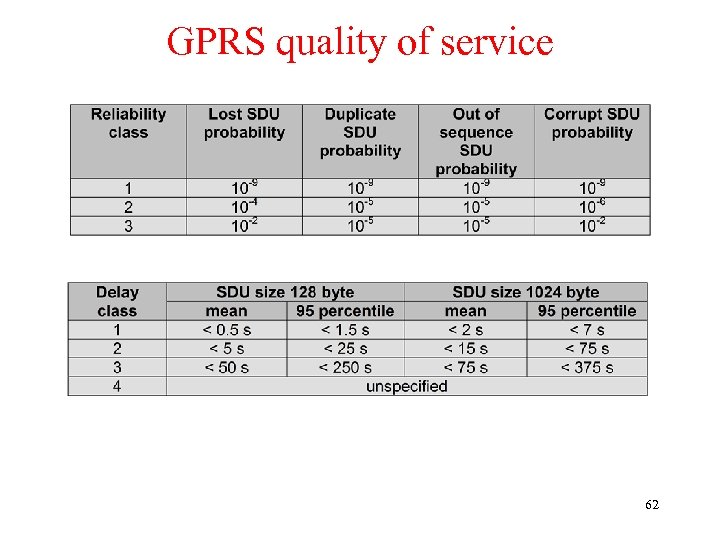 GPRS quality of service 62
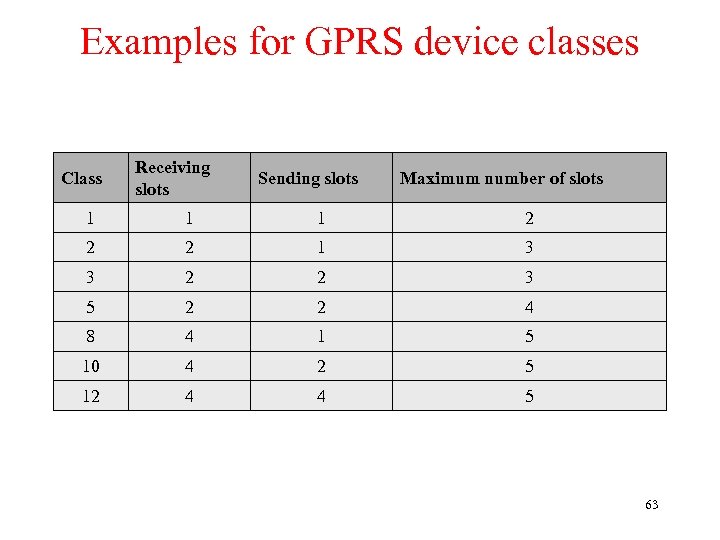 Examples for GPRS device classes Class Receiving slots Sending slots Maximum number of slots 1 1 1 2 2 2 1 3 3 2 2 3 5 2 2 4 8 4 1 5 10 4 2 5 12 4 4 5 63
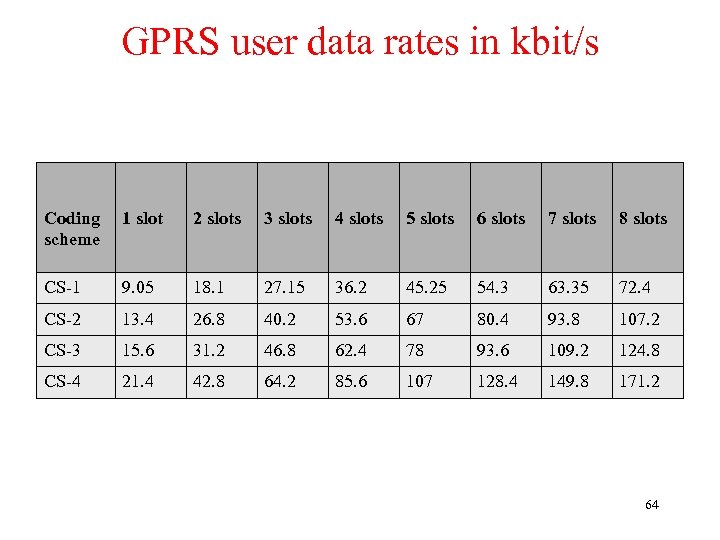 GPRS user data rates in kbit/s Coding scheme 1 slot 2 slots 3 slots 4 slots 5 slots 6 slots 7 slots 8 slots CS-1 9. 05 18. 1 27. 15 36. 2 45. 25 54. 3 63. 35 72. 4 CS-2 13. 4 26. 8 40. 2 53. 6 67 80. 4 93. 8 107. 2 CS-3 15. 6 31. 2 46. 8 62. 4 78 93. 6 109. 2 124. 8 CS-4 21. 4 42. 8 64. 2 85. 6 107 128. 4 149. 8 171. 2 64
 D-AMPS § D-AMPS (Digital-AMPS) is the first digital version (2 G) of AMPS. • It uses the 800 or 1900 MHz spectrum. • Each simplex channel is 30 k. Hz wide. • It is described in IS-54 and IS-136. § It is also known as TDMA (Time Division Multiple Access). • Several physical channels are located by dividing one frequency channel into several time slots. • The advantage of TDMA is that several channels are co-located on one carrier frequency, so there are less transmitters required. 65
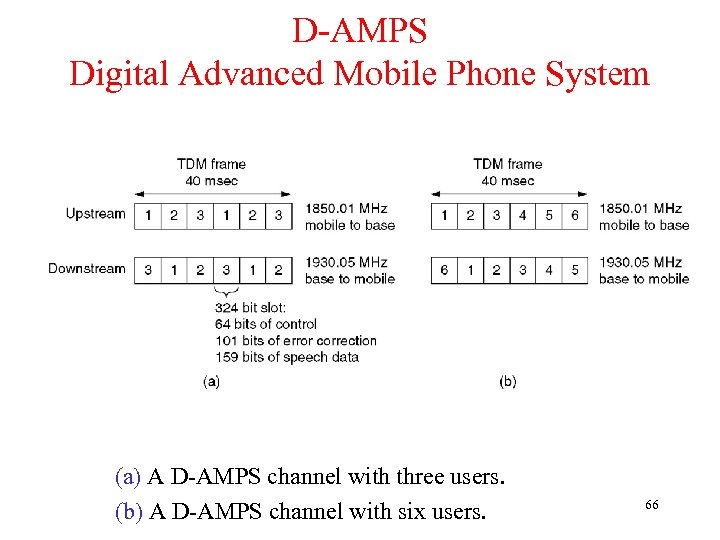 D-AMPS Digital Advanced Mobile Phone System (a) A D-AMPS channel with three users. (b) A D-AMPS channel with six users. 66
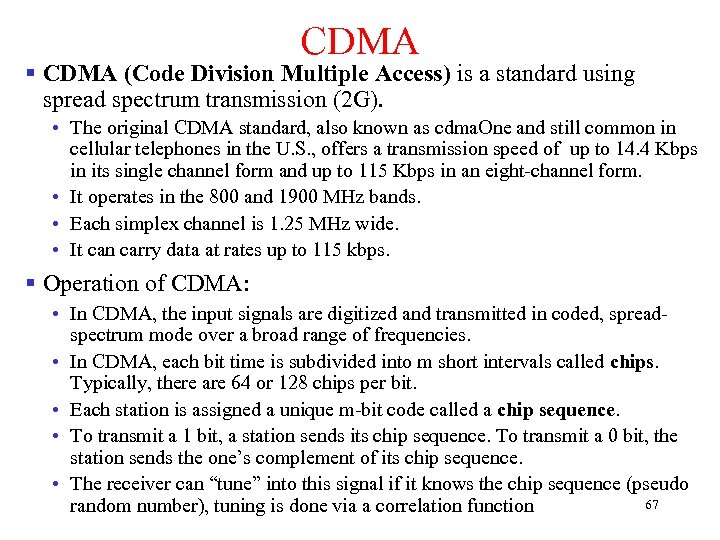 CDMA § CDMA (Code Division Multiple Access) is a standard using spread spectrum transmission (2 G). • The original CDMA standard, also known as cdma. One and still common in cellular telephones in the U. S. , offers a transmission speed of up to 14. 4 Kbps in its single channel form and up to 115 Kbps in an eight-channel form. • It operates in the 800 and 1900 MHz bands. • Each simplex channel is 1. 25 MHz wide. • It can carry data at rates up to 115 kbps. § Operation of CDMA: • In CDMA, the input signals are digitized and transmitted in coded, spreadspectrum mode over a broad range of frequencies. • In CDMA, each bit time is subdivided into m short intervals called chips. Typically, there are 64 or 128 chips per bit. • Each station is assigned a unique m-bit code called a chip sequence. • To transmit a 1 bit, a station sends its chip sequence. To transmit a 0 bit, the station sends the one’s complement of its chip sequence. • The receiver can “tune” into this signal if it knows the chip sequence (pseudo 67 random number), tuning is done via a correlation function
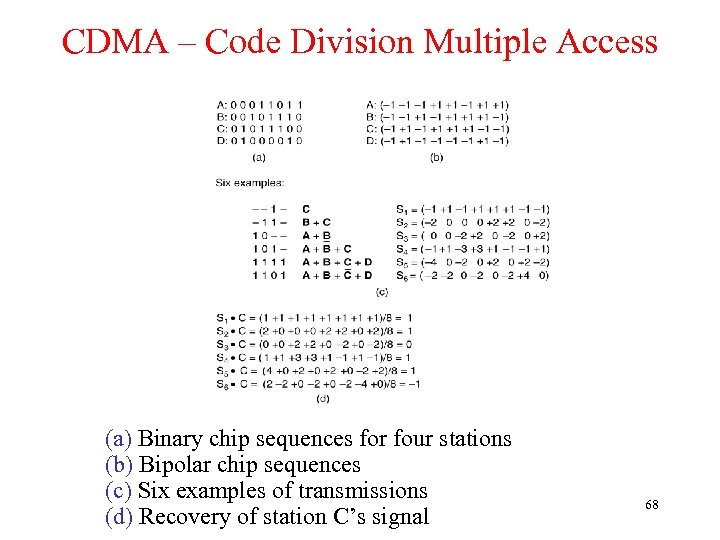 CDMA – Code Division Multiple Access (a) Binary chip sequences for four stations (b) Bipolar chip sequences (c) Six examples of transmissions (d) Recovery of station C’s signal 68
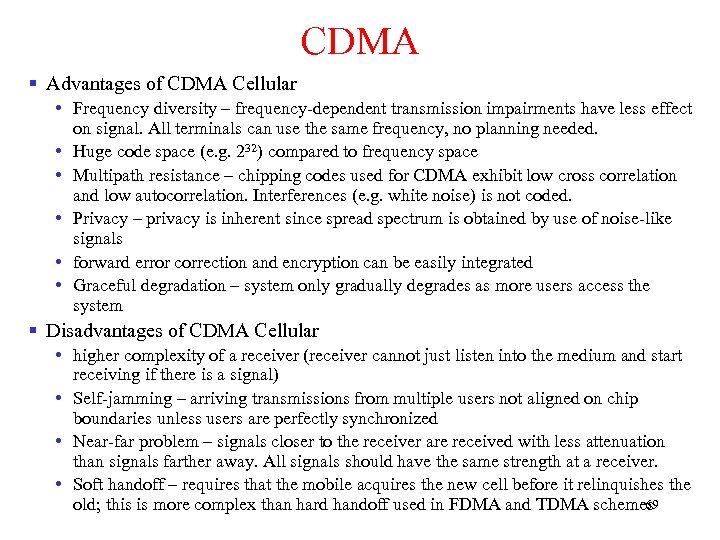 CDMA § Advantages of CDMA Cellular • Frequency diversity – frequency-dependent transmission impairments have less effect on signal. All terminals can use the same frequency, no planning needed. • Huge code space (e. g. 232) compared to frequency space • Multipath resistance – chipping codes used for CDMA exhibit low cross correlation and low autocorrelation. Interferences (e. g. white noise) is not coded. • Privacy – privacy is inherent since spread spectrum is obtained by use of noise-like signals • forward error correction and encryption can be easily integrated • Graceful degradation – system only gradually degrades as more users access the system § Disadvantages of CDMA Cellular • higher complexity of a receiver (receiver cannot just listen into the medium and start receiving if there is a signal) • Self-jamming – arriving transmissions from multiple users not aligned on chip boundaries unless users are perfectly synchronized • Near-far problem – signals closer to the receiver are received with less attenuation than signals farther away. All signals should have the same strength at a receiver. • Soft handoff – requires that the mobile acquires the new cell before it relinquishes the 69 old; this is more complex than hard handoff used in FDMA and TDMA schemes
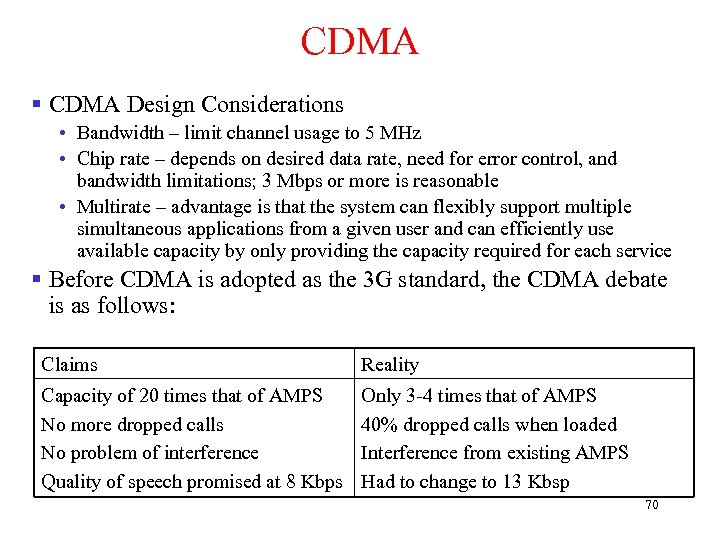 CDMA § CDMA Design Considerations • Bandwidth – limit channel usage to 5 MHz • Chip rate – depends on desired data rate, need for error control, and bandwidth limitations; 3 Mbps or more is reasonable • Multirate – advantage is that the system can flexibly support multiple simultaneous applications from a given user and can efficiently use available capacity by only providing the capacity required for each service § Before CDMA is adopted as the 3 G standard, the CDMA debate is as follows: Claims Reality Capacity of 20 times that of AMPS No more dropped calls No problem of interference Quality of speech promised at 8 Kbps Only 3 -4 times that of AMPS 40% dropped calls when loaded Interference from existing AMPS Had to change to 13 Kbsp 70
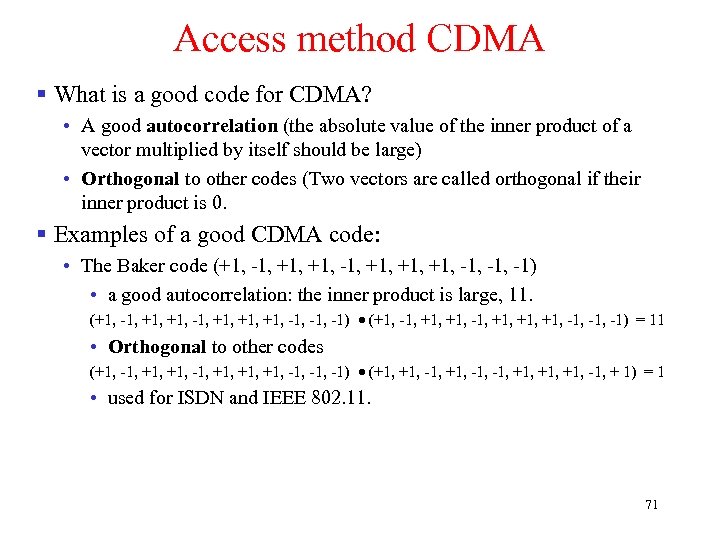 Access method CDMA § What is a good code for CDMA? • A good autocorrelation (the absolute value of the inner product of a vector multiplied by itself should be large) • Orthogonal to other codes (Two vectors are called orthogonal if their inner product is 0. § Examples of a good CDMA code: • The Baker code (+1, -1, +1, +1, -1, -1) • a good autocorrelation: the inner product is large, 11. (+1, -1, +1, +1, +1, -1, -1, -1) = 11 • Orthogonal to other codes (+1, -1, +1, +1, -1, -1) (+1, -1, +1, +1, -1, + 1) = 1 • used for ISDN and IEEE 802. 11. 71
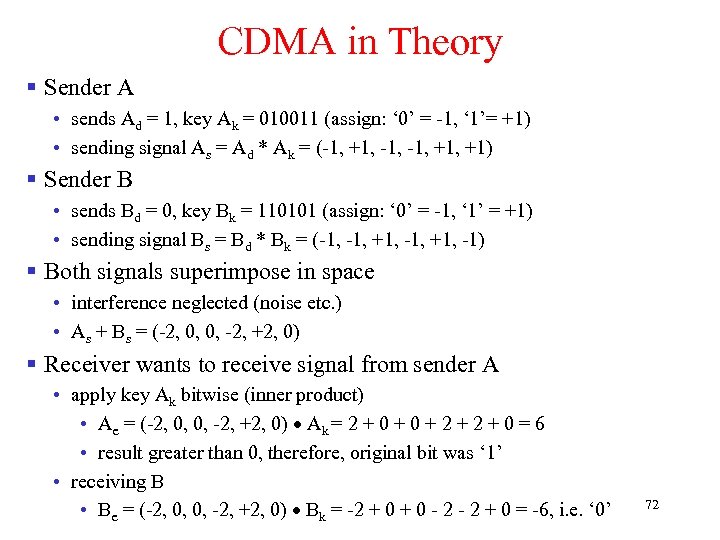 CDMA in Theory § Sender A • sends Ad = 1, key Ak = 010011 (assign: ‘ 0’ = -1, ‘ 1’= +1) • sending signal As = Ad * Ak = (-1, +1, -1, +1) § Sender B • sends Bd = 0, key Bk = 110101 (assign: ‘ 0’ = -1, ‘ 1’ = +1) • sending signal Bs = Bd * Bk = (-1, +1, -1) § Both signals superimpose in space • interference neglected (noise etc. ) • As + Bs = (-2, 0, 0, -2, +2, 0) § Receiver wants to receive signal from sender A • apply key Ak bitwise (inner product) • Ae = (-2, 0, 0, -2, +2, 0) Ak = 2 + 0 + 2 + 0 = 6 • result greater than 0, therefore, original bit was ‘ 1’ • receiving B • Be = (-2, 0, 0, -2, +2, 0) Bk = -2 + 0 - 2 + 0 = -6, i. e. ‘ 0’ 72
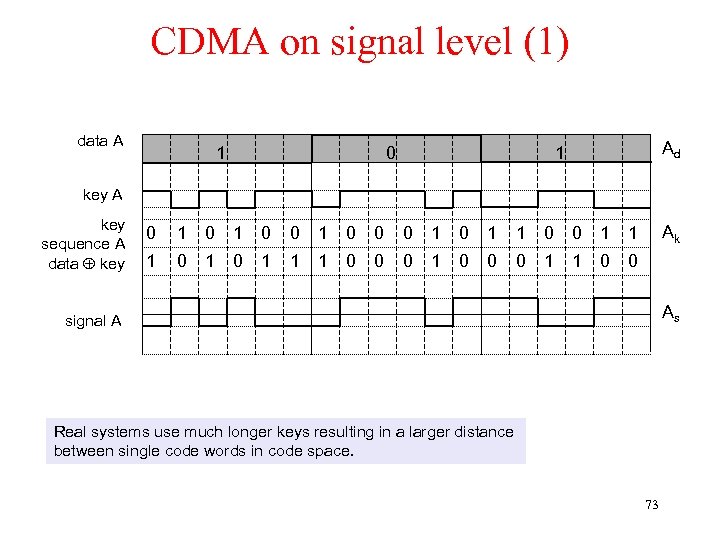 CDMA on signal level (1) data A 1 0 Ad 1 key A key sequence A data key 0 1 0 1 1 0 0 1 1 1 0 0 0 1 1 0 Ak 1 0 As signal A Real systems use much longer keys resulting in a larger distance between single code words in code space. 73
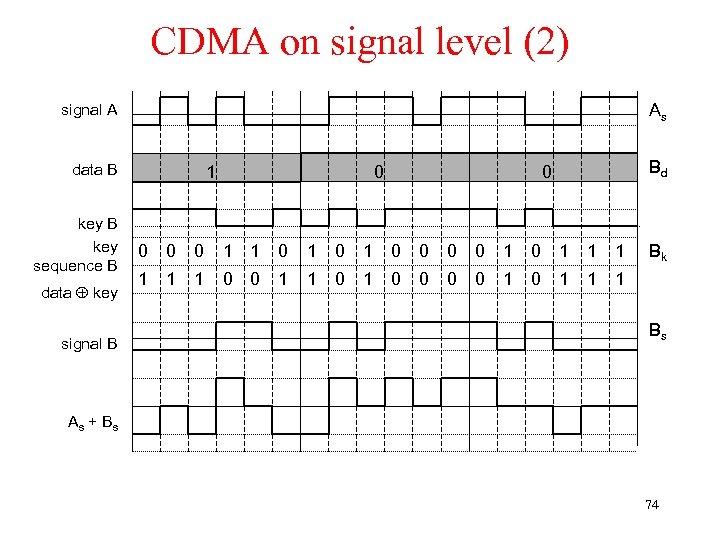 CDMA on signal level (2) As signal A data B key sequence B data key signal B 1 0 Bd 0 0 1 1 0 1 0 1 1 1 0 0 0 0 1 1 Bk 1 Bs As + Bs 74
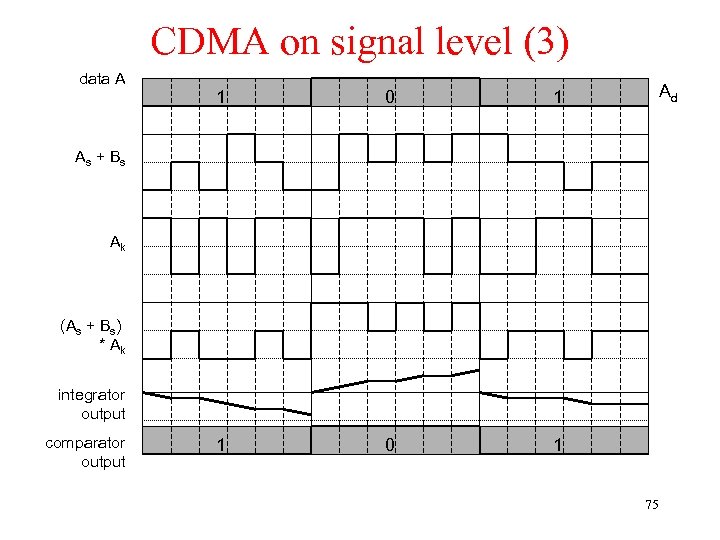 CDMA on signal level (3) data A 1 0 Ad 1 1 As + Bs Ak (As + Bs) * Ak integrator output comparator output 75
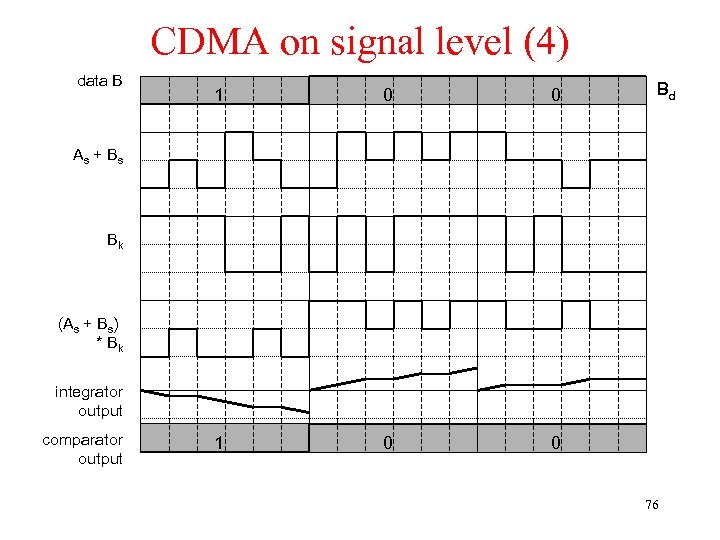 CDMA on signal level (4) data B 1 0 0 1 0 Bd 0 As + Bs Bk (As + Bs) * Bk integrator output comparator output 76
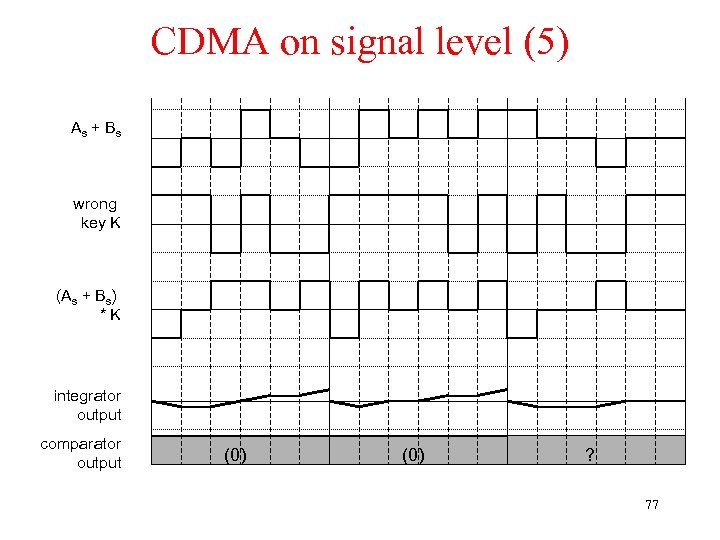 CDMA on signal level (5) As + Bs wrong key K (As + Bs) *K integrator output comparator output (0) ? 77
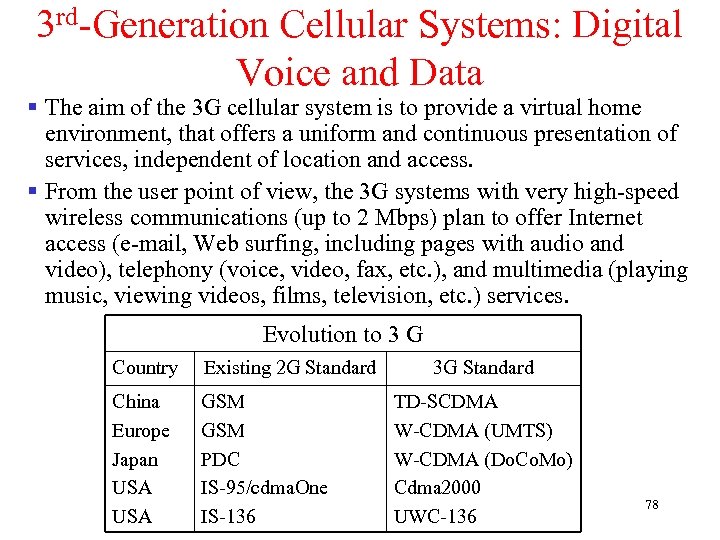 3 rd-Generation Cellular Systems: Digital Voice and Data § The aim of the 3 G cellular system is to provide a virtual home environment, that offers a uniform and continuous presentation of services, independent of location and access. § From the user point of view, the 3 G systems with very high-speed wireless communications (up to 2 Mbps) plan to offer Internet access (e-mail, Web surfing, including pages with audio and video), telephony (voice, video, fax, etc. ), and multimedia (playing music, viewing videos, films, television, etc. ) services. Evolution to 3 G Country Existing 2 G Standard China Europe Japan USA GSM PDC IS-95/cdma. One IS-136 3 G Standard TD-SCDMA W-CDMA (UMTS) W-CDMA (Do. Co. Mo) Cdma 2000 UWC-136 78
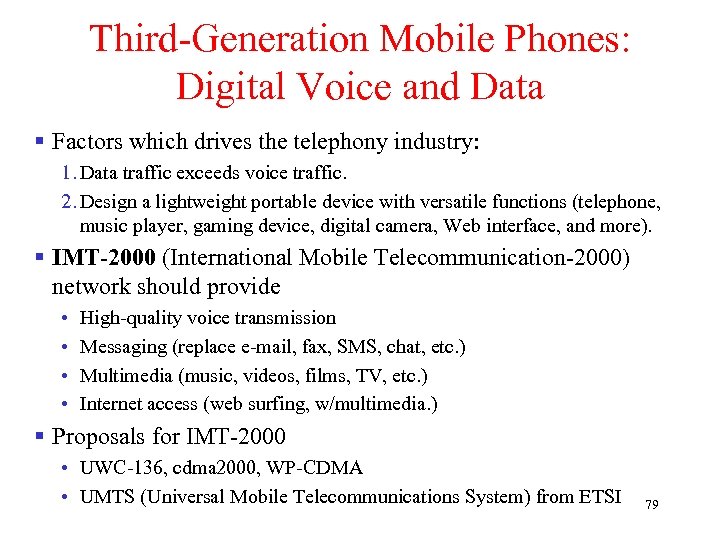 Third-Generation Mobile Phones: Digital Voice and Data § Factors which drives the telephony industry: 1. Data traffic exceeds voice traffic. 2. Design a lightweight portable device with versatile functions (telephone, music player, gaming device, digital camera, Web interface, and more). § IMT-2000 (International Mobile Telecommunication-2000) network should provide • • High-quality voice transmission Messaging (replace e-mail, fax, SMS, chat, etc. ) Multimedia (music, videos, films, TV, etc. ) Internet access (web surfing, w/multimedia. ) § Proposals for IMT-2000 • UWC-136, cdma 2000, WP-CDMA • UMTS (Universal Mobile Telecommunications System) from ETSI 79
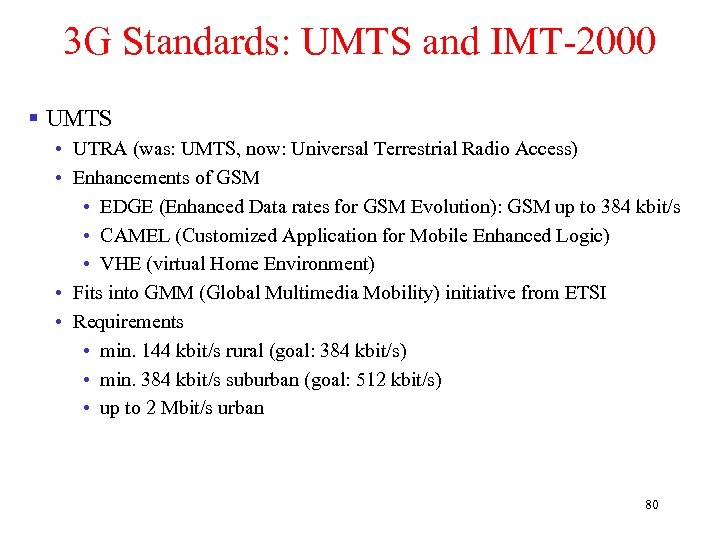 3 G Standards: UMTS and IMT-2000 § UMTS • UTRA (was: UMTS, now: Universal Terrestrial Radio Access) • Enhancements of GSM • EDGE (Enhanced Data rates for GSM Evolution): GSM up to 384 kbit/s • CAMEL (Customized Application for Mobile Enhanced Logic) • VHE (virtual Home Environment) • Fits into GMM (Global Multimedia Mobility) initiative from ETSI • Requirements • min. 144 kbit/s rural (goal: 384 kbit/s) • min. 384 kbit/s suburban (goal: 512 kbit/s) • up to 2 Mbit/s urban 80
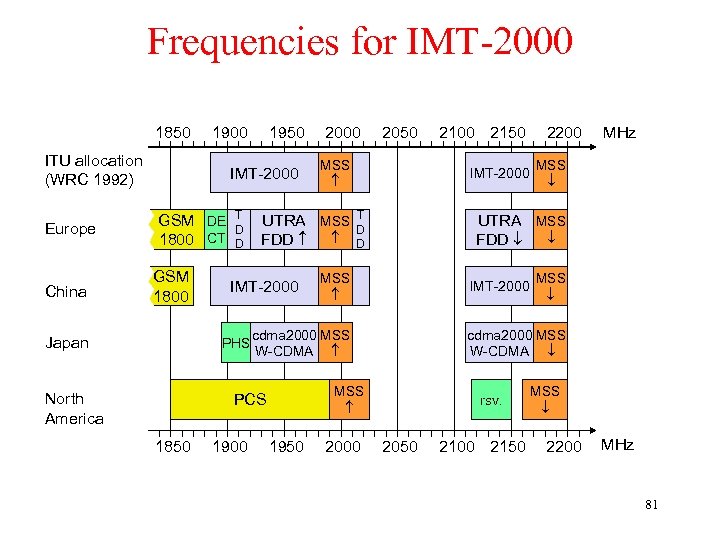 Frequencies for IMT-2000 1850 1900 ITU allocation (WRC 1992) Europe China 1950 IMT-2000 GSM DE 1800 CT GSM 1800 Japan T D D North America 1900 T D D MSS 2000 2200 MHz MSS UTRA MSS FDD IMT-2000 MSS cdma 2000 MSS W-CDMA MSS 1950 2100 2150 IMT-2000 cdma 2000 MSS W-CDMA PCS 1850 2050 MSS UTRA MSS FDD IMT-2000 PHS 2000 rsv. 2050 2100 2150 MSS 2200 MHz 81
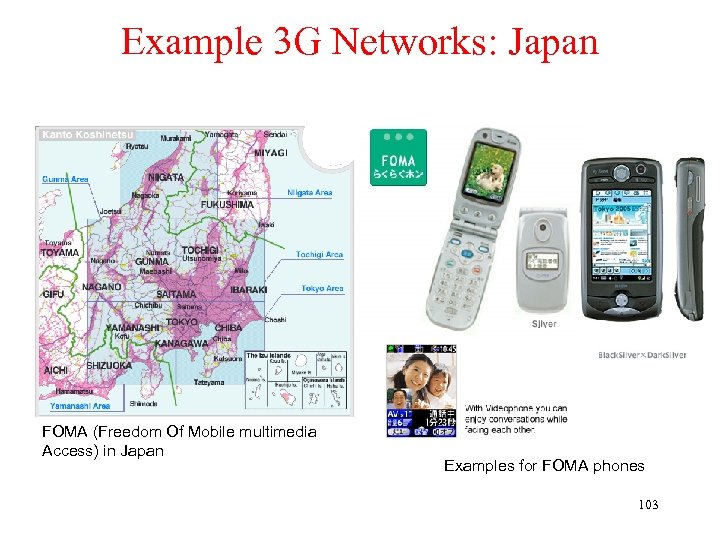
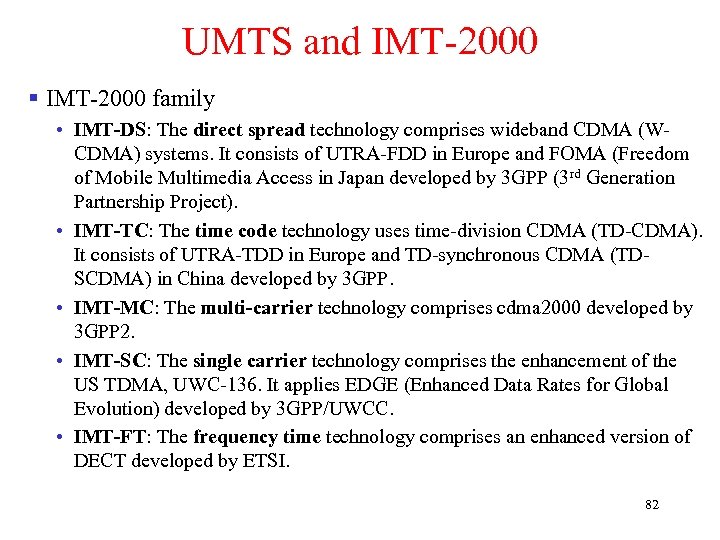 UMTS and IMT-2000 § IMT-2000 family • IMT-DS: The direct spread technology comprises wideband CDMA (WCDMA) systems. It consists of UTRA-FDD in Europe and FOMA (Freedom of Mobile Multimedia Access in Japan developed by 3 GPP (3 rd Generation Partnership Project). • IMT-TC: The time code technology uses time-division CDMA (TD-CDMA). It consists of UTRA-TDD in Europe and TD-synchronous CDMA (TDSCDMA) in China developed by 3 GPP. • IMT-MC: The multi-carrier technology comprises cdma 2000 developed by 3 GPP 2. • IMT-SC: The single carrier technology comprises the enhancement of the US TDMA, UWC-136. It applies EDGE (Enhanced Data Rates for Global Evolution) developed by 3 GPP/UWCC. • IMT-FT: The frequency time technology comprises an enhanced version of DECT developed by ETSI. 82
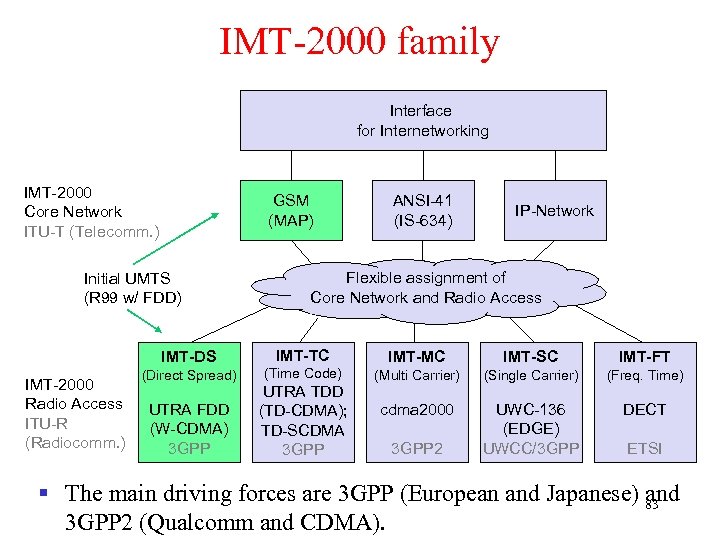 IMT-2000 family Interface for Internetworking IMT-2000 Core Network ITU-T (Telecomm. ) GSM (MAP) Initial UMTS (R 99 w/ FDD) ANSI-41 (IS-634) IP-Network Flexible assignment of Core Network and Radio Access IMT-DS IMT-2000 Radio Access ITU-R (Radiocomm. ) IMT-TC IMT-MC IMT-SC IMT-FT (Direct Spread) (Time Code) (Multi Carrier) (Single Carrier) (Freq. Time) UTRA FDD (W-CDMA) 3 GPP UTRA TDD (TD-CDMA); TD-SCDMA 3 GPP cdma 2000 UWC-136 (EDGE) UWCC/3 GPP DECT 3 GPP 2 ETSI § The main driving forces are 3 GPP (European and Japanese) and 83 3 GPP 2 (Qualcomm and CDMA).
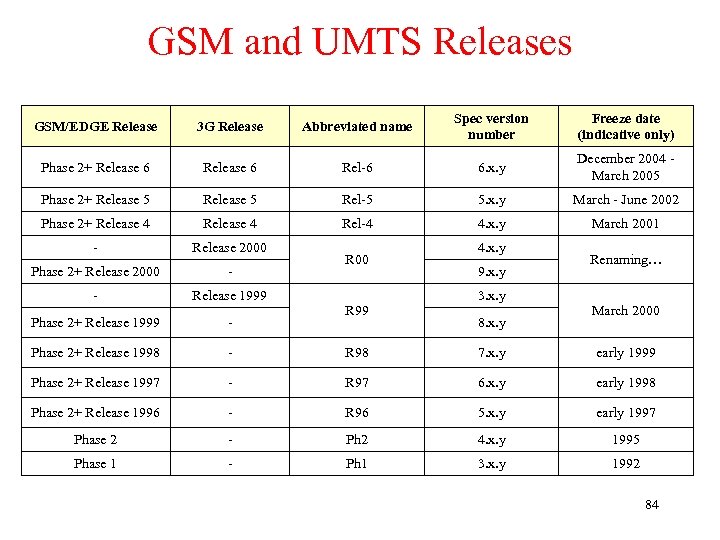 GSM and UMTS Releases GSM/EDGE Release 3 G Release Abbreviated name Spec version number Freeze date (indicative only) Phase 2+ Release 6 Rel-6 6. x. y December 2004 - March 2005 Phase 2+ Release 5 Rel-5 5. x. y March - June 2002 Phase 2+ Release 4 Rel-4 4. x. y March 2001 - Release 2000 Phase 2+ Release 2000 - - Release 1999 Phase 2+ Release 1999 - Phase 2+ Release 1998 - R 98 7. x. y early 1999 Phase 2+ Release 1997 - R 97 6. x. y early 1998 Phase 2+ Release 1996 - R 96 5. x. y early 1997 Phase 2 - Ph 2 4. x. y 1995 Phase 1 - Ph 1 3. x. y 1992 R 00 R 99 4. x. y 9. x. y 3. x. y 8. x. y Renaming… March 2000 84
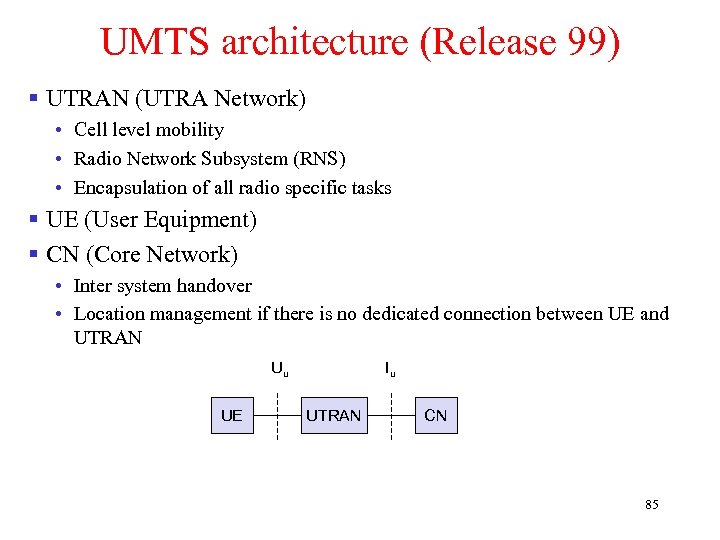 UMTS architecture (Release 99) § UTRAN (UTRA Network) • Cell level mobility • Radio Network Subsystem (RNS) • Encapsulation of all radio specific tasks § UE (User Equipment) § CN (Core Network) • Inter system handover • Location management if there is no dedicated connection between UE and UTRAN Uu UE Iu UTRAN CN 85
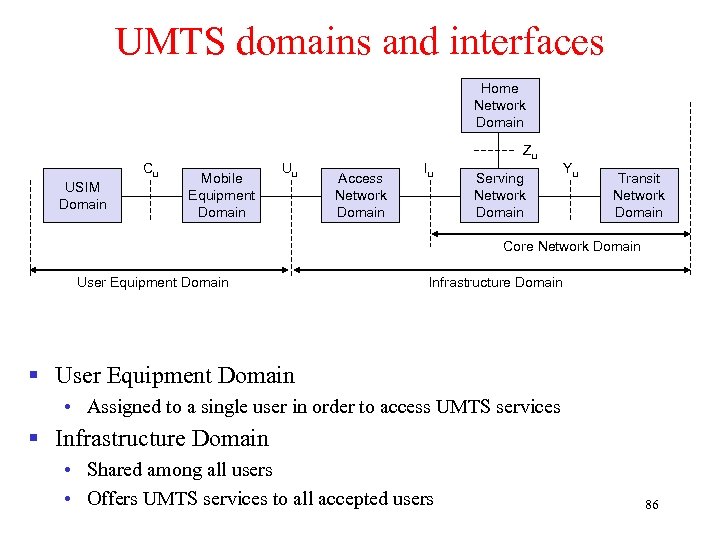 UMTS domains and interfaces Home Network Domain Cu USIM Domain Mobile Equipment Domain Uu Access Network Domain Iu Zu Serving Network Domain Yu Transit Network Domain Core Network Domain User Equipment Domain Infrastructure Domain § User Equipment Domain • Assigned to a single user in order to access UMTS services § Infrastructure Domain • Shared among all users • Offers UMTS services to all accepted users 86
 UMTS domains and interfaces § Universal Subscriber Identity Module (USIM) • Functions for encryption and authentication of users • Located on a SIM inserted into a mobile device § Mobile Equipment Domain • Functions for radio transmission • User interface for establishing/maintaining end-to-end connections § Access Network Domain • Access network dependent functions § Core Network Domain • Access network independent functions • Serving Network Domain • Network currently responsible for communication • Home Network Domain • Location and access network independent functions 87
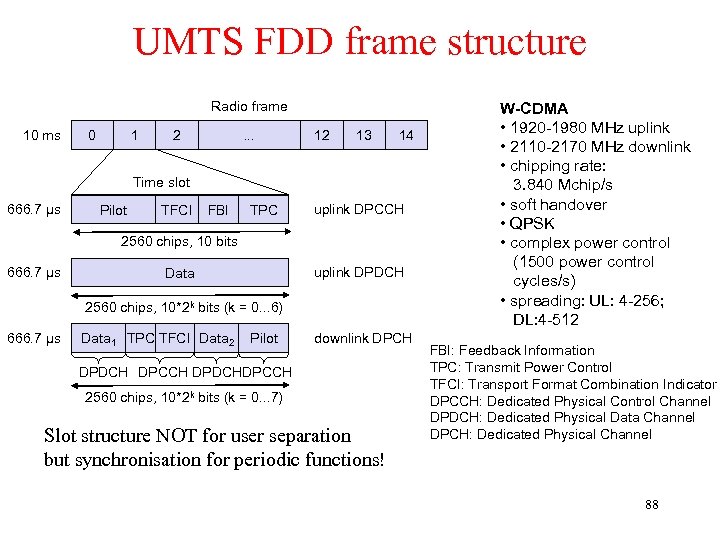 UMTS FDD frame structure Radio frame 10 ms 0 1 2 . . . 12 13 14 Time slot 666. 7 µs Pilot TFCI FBI TPC uplink DPCCH 2560 chips, 10 bits 666. 7 µs uplink DPDCH Data 2560 chips, 10*2 k bits (k = 0. . . 6) 666. 7 µs Data 1 TPC TFCI Data 2 Pilot downlink DPCH DPDCH DPCCH 2560 chips, 10*2 k bits (k = 0. . . 7) Slot structure NOT for user separation but synchronisation for periodic functions! W-CDMA • 1920 -1980 MHz uplink • 2110 -2170 MHz downlink • chipping rate: 3. 840 Mchip/s • soft handover • QPSK • complex power control (1500 power control cycles/s) • spreading: UL: 4 -256; DL: 4 -512 FBI: Feedback Information TPC: Transmit Power Control TFCI: Transport Format Combination Indicator DPCCH: Dedicated Physical Control Channel DPDCH: Dedicated Physical Data Channel DPCH: Dedicated Physical Channel 88
![Typical UTRA-FDD uplink data rates 12. 2 (voice) 64 144 384 DPDCH [kbit/s] 60](https://present5.com/presentation/0000c9047881bed18299c5d1e55ea377/image-89.jpg "Typical UTRA-FDD uplink data rates 12. 2 (voice) 64 144 384 DPDCH [kbit/s] 60") Typical UTRA-FDD uplink data rates 12. 2 (voice) 64 144 384 DPDCH [kbit/s] 60 240 480 960 DPCCH [kbit/s] 15 15 Spreading 64 16 8 4 User data rate [kbit/s] 89
Typical UTRA-FDD uplink data rates 12. 2 (voice) 64 144 384 DPDCH [kbit/s] 60 240 480 960 DPCCH [kbit/s] 15 15 Spreading 64 16 8 4 User data rate [kbit/s] 89
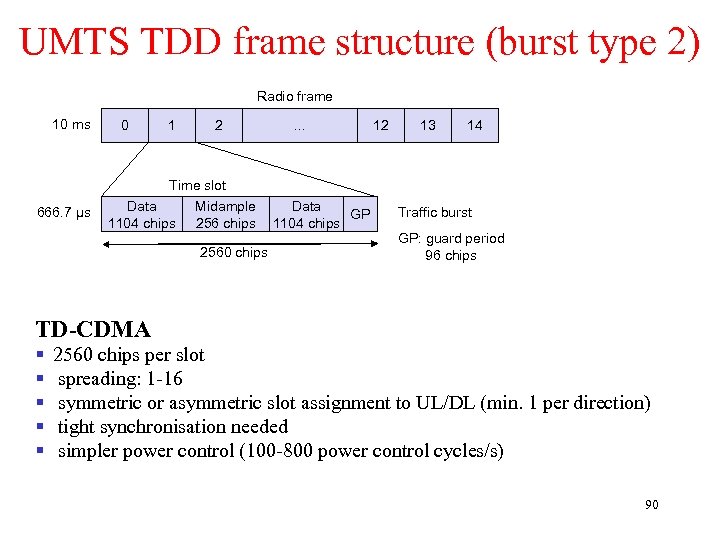 UMTS TDD frame structure (burst type 2) Radio frame 10 ms 666. 7 µs 0 1 2 Time slot Data Midample 1104 chips 2560 chips . . . Data GP 1104 chips 12 13 14 Traffic burst GP: guard period 96 chips TD-CDMA § § § 2560 chips per slot spreading: 1 -16 symmetric or asymmetric slot assignment to UL/DL (min. 1 per direction) tight synchronisation needed simpler power control (100 -800 power control cycles/s) 90
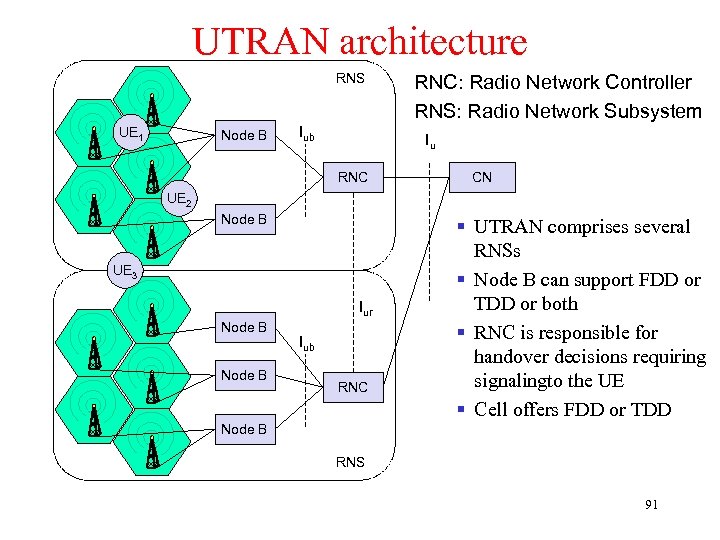 UTRAN architecture RNS UE 1 Node B Iub RNC: Radio Network Controller RNS: Radio Network Subsystem Iu RNC CN UE 2 Node B UE 3 Iur Node B Iub RNC § UTRAN comprises several RNSs § Node B can support FDD or TDD or both § RNC is responsible for handover decisions requiring signalingto the UE § Cell offers FDD or TDD Node B RNS 91
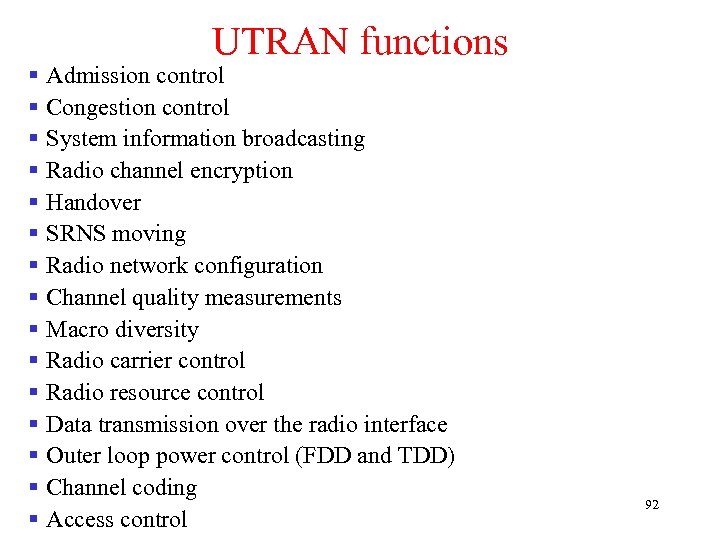 UTRAN functions § Admission control § Congestion control § System information broadcasting § Radio channel encryption § Handover § SRNS moving § Radio network configuration § Channel quality measurements § Macro diversity § Radio carrier control § Radio resource control § Data transmission over the radio interface § Outer loop power control (FDD and TDD) § Channel coding § Access control 92
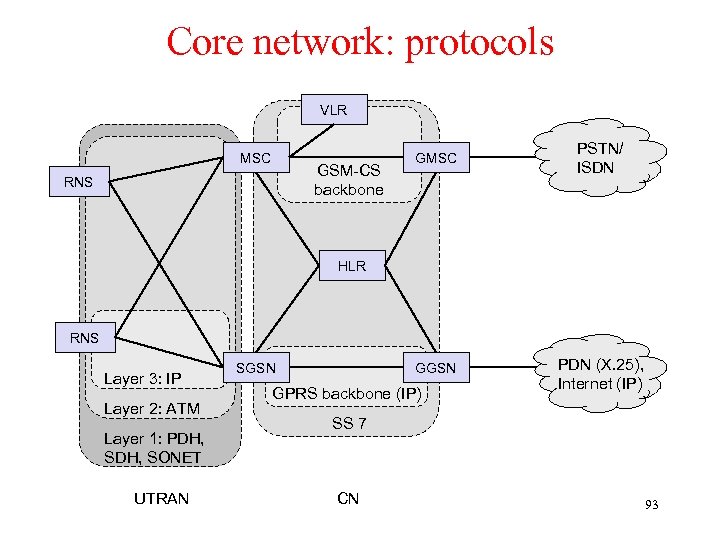 Core network: protocols VLR MSC PSTN/ ISDN GGSN GSM-CS backbone RNS GMSC PDN (X. 25), Internet (IP) HLR RNS Layer 3: IP Layer 2: ATM Layer 1: PDH, SONET UTRAN SGSN GPRS backbone (IP) SS 7 CN 93
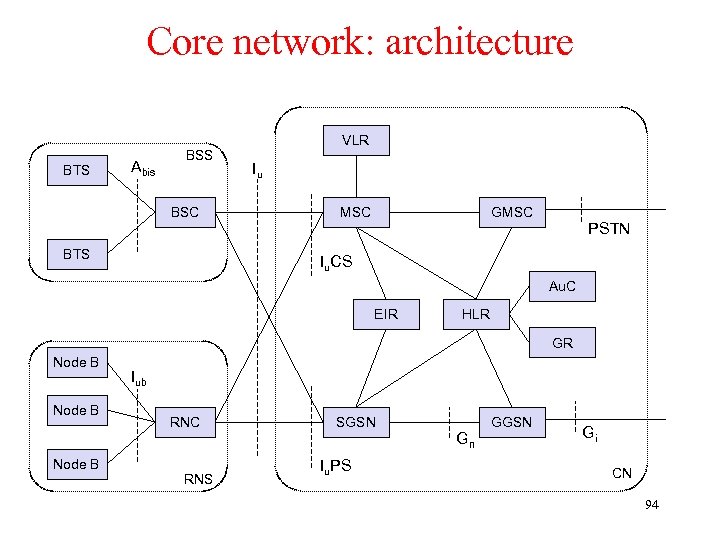 Core network: architecture BTS Abis BSS BSC Node B BTS VLR Iu MSC GMSC PSTN Iu. CS Au. C EIR HLR GR Node B Iub RNC RNS SGSN Iu. PS Gn GGSN Gi CN 94
 Core network § The Core Network (CN) and thus the Interface Iu, too, are separated into two logical domains: § Circuit Switched Domain (CSD) • • Circuit switched service incl. signaling Resource reservation at connection setup GSM components (MSC, GMSC, VLR) Iu. CS § Packet Switched Domain (PSD) • GPRS components (SGSN, GGSN) • Iu. PS § Release 99 uses the GSM/GPRS network and adds a new radio access! • Helps to save a lot of money … • Much faster deployment • Not as flexible as newer releases (5, 6) 95
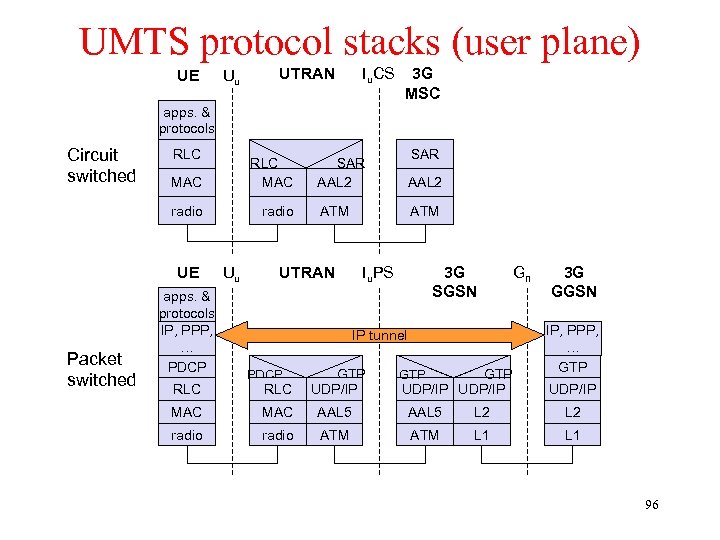 UMTS protocol stacks (user plane) UE Uu UTRAN Iu. CS 3 G MSC apps. & protocols Circuit switched RLC MAC radio UE Packet switched apps. & protocols IP, PPP, … PDCP Uu SAR AAL 2 ATM UTRAN Iu. PS 3 G SGSN Gn IP tunnel 3 G GGSN IP, PPP, … GTP RLC GTP UDP/IP MAC AAL 5 L 2 radio ATM L 1 PDCP GTP UDP/IP 96
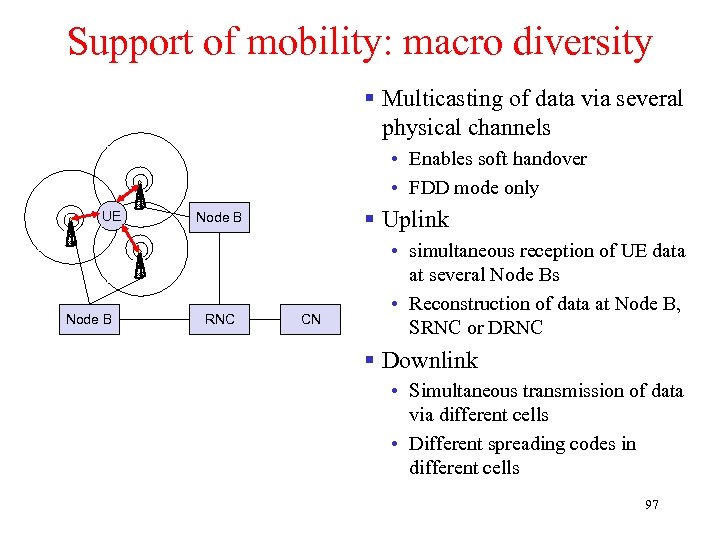 Support of mobility: macro diversity § Multicasting of data via several physical channels • Enables soft handover • FDD mode only UE Node B § Uplink Node B RNC CN • simultaneous reception of UE data at several Node Bs • Reconstruction of data at Node B, SRNC or DRNC § Downlink • Simultaneous transmission of data via different cells • Different spreading codes in different cells 97
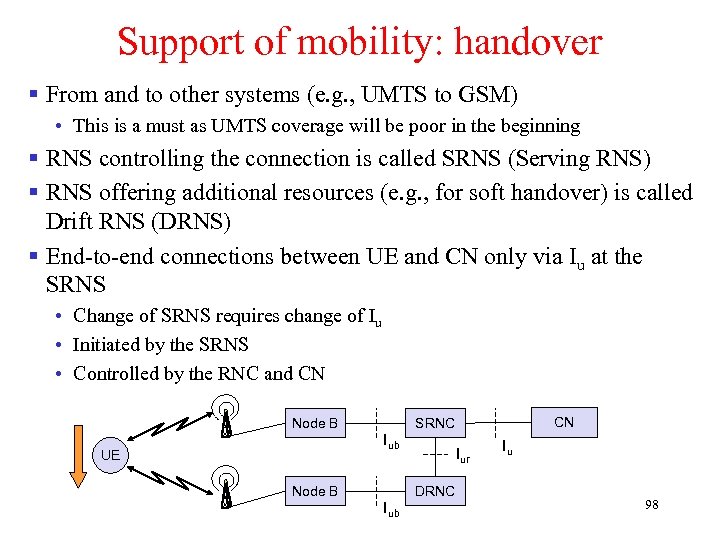 Support of mobility: handover § From and to other systems (e. g. , UMTS to GSM) • This is a must as UMTS coverage will be poor in the beginning § RNS controlling the connection is called SRNS (Serving RNS) § RNS offering additional resources (e. g. , for soft handover) is called Drift RNS (DRNS) § End-to-end connections between UE and CN only via Iu at the SRNS • Change of SRNS requires change of Iu • Initiated by the SRNS • Controlled by the RNC and CN Node B UE Node B Iub CN SRNC Iur DRNC Iu 98
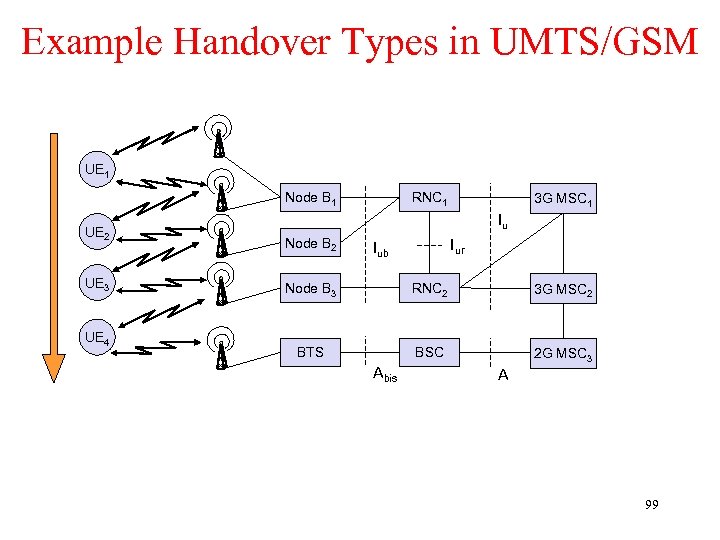 Example Handover Types in UMTS/GSM UE 1 Node B 1 UE 2 UE 3 UE 4 RNC 1 3 G MSC 1 Iu Node B 2 Iur Iub Node B 3 RNC 2 3 G MSC 2 BTS BSC 2 G MSC 3 Abis A 99
 Breathing Cells § GSM • Mobile device gets exclusive signal from the base station • Number of devices in a cell does not influence cell size § UMTS • Cell size is closely correlated to the cell capacity • Signal-to-nose ratio determines cell capacity • Noise is generated by interference from • other cells • other users of the same cell • Interference increases noise level • Devices at the edge of a cell cannot further increase their output power (max. power limit) and thus drop out of the cell no more communication possible • Limitation of the max. number of users within a cell required • Cell breathing complicates network planning 100
 Breathing Cells: Example 101
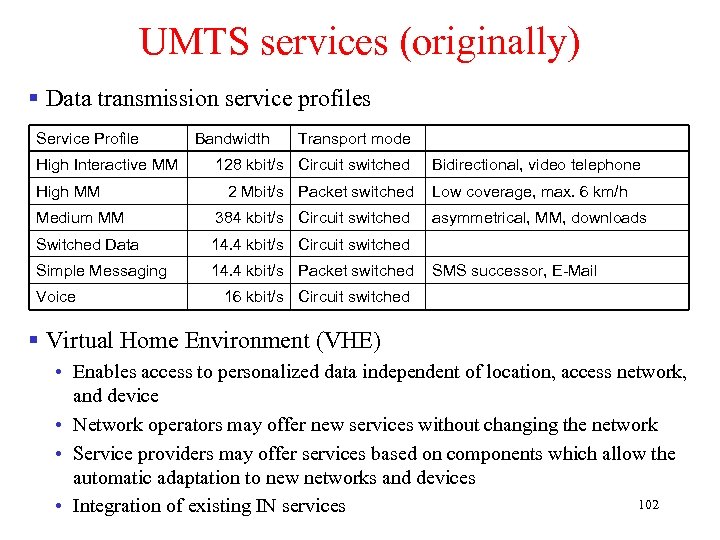 UMTS services (originally) § Data transmission service profiles Service Profile High Interactive MM High MM Bandwidth Transport mode 128 kbit/s Circuit switched 2 Mbit/s Packet switched Medium MM 384 kbit/s Circuit switched Switched Data 14. 4 kbit/s Packet switched Low coverage, max. 6 km/h 14. 4 kbit/s Circuit switched Simple Messaging Bidirectional, video telephone Voice asymmetrical, MM, downloads SMS successor, E-Mail 16 kbit/s Circuit switched § Virtual Home Environment (VHE) • Enables access to personalized data independent of location, access network, and device • Network operators may offer new services without changing the network • Service providers may offer services based on components which allow the automatic adaptation to new networks and devices 102 • Integration of existing IN services
 Example 3 G Networks: Japan FOMA (Freedom Of Mobile multimedia Access) in Japan Examples for FOMA phones 103
 Example 3 G networks: Australia cdma 2000 1 x. EV-DO in Melbourne/Australia Examples for 1 x. EV-DO devices 104
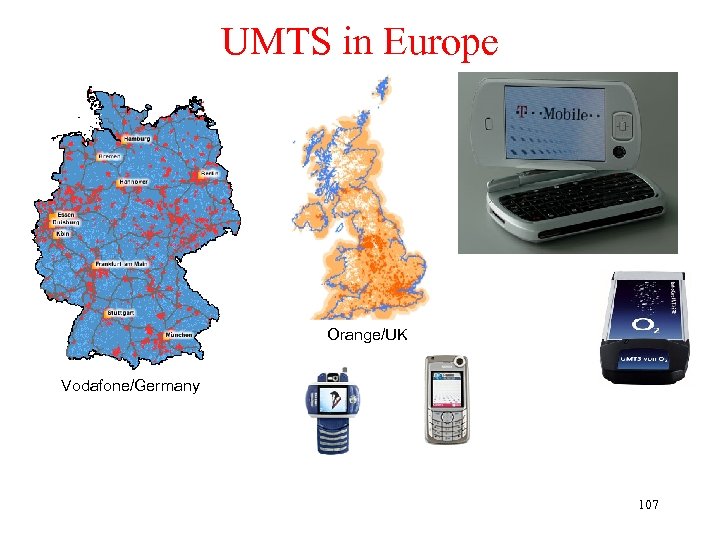
 Isle of Man – Start of UMTS in Europe as Test 105
 UMTS in Monaco 106
 UMTS in Europe Orange/UK Vodafone/Germany 107
 Some current Enhancements § GSM • EMS/MMS • EMS: 760 characters possible by chaining SMS, animated icons, ring tones, was soon replaced by MMS (or simply skipped) • MMS: transmission of images, video clips, audio • see WAP 2. 0 / chapter 10 • EDGE (Enhanced Data Rates for Global [was: GSM] Evolution) • 8 -PSK instead of GMSK, up to 384 kbit/s • new modulation and coding schemes for GPRS EGPRS • MCS-1 to MCS-4 uses GMSK at rates 8. 8/11. 2/14. 8/17. 6 kbit/s • MCS-5 to MCS-9 uses 8 -PSK at rates 22. 4/29. 6/44. 8/54. 4/59. 2 kbit/s § UMTS • HSDPA (High-Speed Downlink Packet Access) • initially up to 10 Mbit/s for the downlink, later on 20 Mbit/s using MIMO- (Multiple Input Multiple Output-) antennas 108 • uses 16 -QAM instead of QPSK
 Wireless Local Loops § Business practice of a long-distance telephone company for the local phone service: • • It must buy or lease a building for the end office. It must fill the end office with switches. It must run a fiber between the end office and the toll office. It must acquire customer. § How is the new local phone company provides the last hop (local loop) connectivity between the subscriber and PSTN? • Buy the right to lay the new wires. Costly • Buy/lease from other local phone company. Costly • Use the Wireless Local Loop (WWL), also known as fixed wireless access (FWA) • A fixed telephone using a wireless local loop is different from a mobile phone in three ways: • The wireless local loop customer often wants high-speed Internet connectivity. • A directional antenna is needs to be installed. • The user does not move. 109
 Wireless Local Loops § A WLL system consists of: • The BS is implemented by the base transceiver station system (BTS) and the base station controller (BSC). • The BTS, also called radio port (RP) or radio-transceiver unit (RTU), performs channel coding, modulation/demodulation, and implements the radio interface for transmission and reception of radio signals. • A BSC, called the radio port control unit (RPCU), controls one or more BTSs and provides them with an interface to the local exchange. • The fixed subscriber unit (FSU) or radio subscriber unit (RSU) is the interface between the subscriber’s wired devices and the WLL network. The FSU performs all physical and data-link layer functions from the subscriber end. § Cellular-based WLL systems • Based on TDMA and CDMA. • IS-95 -based CDMA WLL, 9. 6 Kbps or 14. 4 Kbps 110
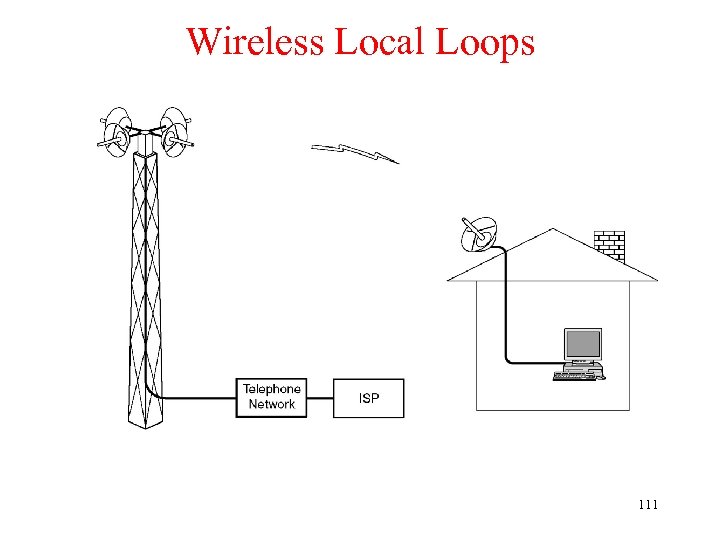 Wireless Local Loops Architecture of an LMDS system. 111
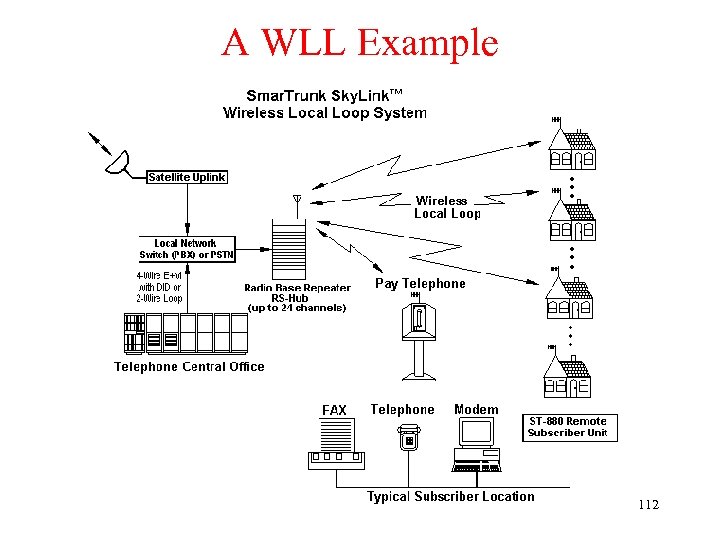 A WLL Example 112
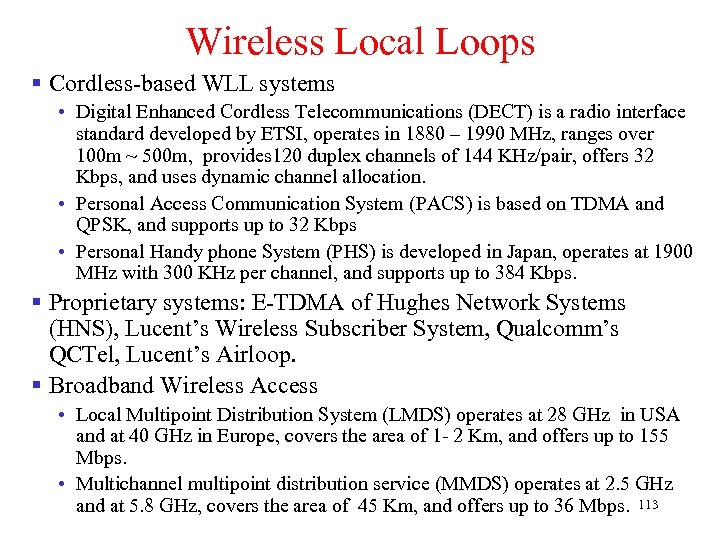 Wireless Local Loops § Cordless-based WLL systems • Digital Enhanced Cordless Telecommunications (DECT) is a radio interface standard developed by ETSI, operates in 1880 – 1990 MHz, ranges over 100 m ~ 500 m, provides 120 duplex channels of 144 KHz/pair, offers 32 Kbps, and uses dynamic channel allocation. • Personal Access Communication System (PACS) is based on TDMA and QPSK, and supports up to 32 Kbps • Personal Handy phone System (PHS) is developed in Japan, operates at 1900 MHz with 300 KHz per channel, and supports up to 384 Kbps. § Proprietary systems: E-TDMA of Hughes Network Systems (HNS), Lucent’s Wireless Subscriber System, Qualcomm’s QCTel, Lucent’s Airloop. § Broadband Wireless Access • Local Multipoint Distribution System (LMDS) operates at 28 GHz in USA and at 40 GHz in Europe, covers the area of 1 - 2 Km, and offers up to 155 Mbps. • Multichannel multipoint distribution service (MMDS) operates at 2. 5 GHz and at 5. 8 GHz, covers the area of 45 Km, and offers up to 36 Mbps. 113
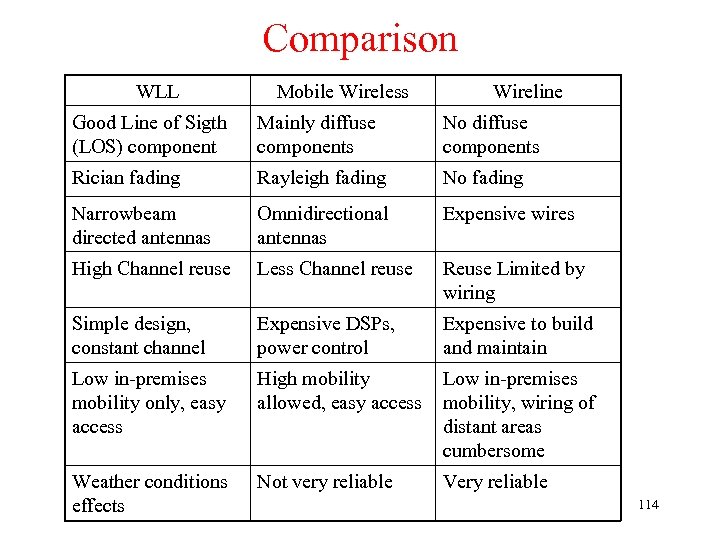 Comparison WLL Mobile Wireless Wireline Good Line of Sigth (LOS) component Mainly diffuse components No diffuse components Rician fading Rayleigh fading No fading Narrowbeam directed antennas Omnidirectional antennas Expensive wires High Channel reuse Less Channel reuse Reuse Limited by wiring Simple design, constant channel Expensive DSPs, power control Expensive to build and maintain Low in-premises mobility only, easy access High mobility allowed, easy access Low in-premises mobility, wiring of distant areas cumbersome Weather conditions effects Not very reliable Very reliable 114
 Communication Satellites § Geostationary Satellites (GEO) • VSAT (Very Small Aperture Terminals): 1 -meter antennas, Direc. PC § Medium-Earth Orbit Satellites (MEO) § Low-Earth Orbit Satellites (LEO) • Iridium: Iridium Satellite LLC provides satellite voice and data services. Iridium makes this possible through its constellation of 66 low-earth orbiting (LEO), cross-linked satellites and 12 in-orbit spares. • Globalstar provides affordable, dependable high quality satellite voice and data service through its 48 satellites. • Teledesic was a 1990 s proposal to use 30 satellites to build a commercial broadband satellite constellation for Internet services. Teledesic was notable for gaining early funding from Craig Mc. Caw and Bill Gates, and for achieving allocation of Ka band frequency spectrum for nongeostationary services. § Global Positioning System (GPS) is a system of satellites and receiving devices used to compute positions on the Earth. 115
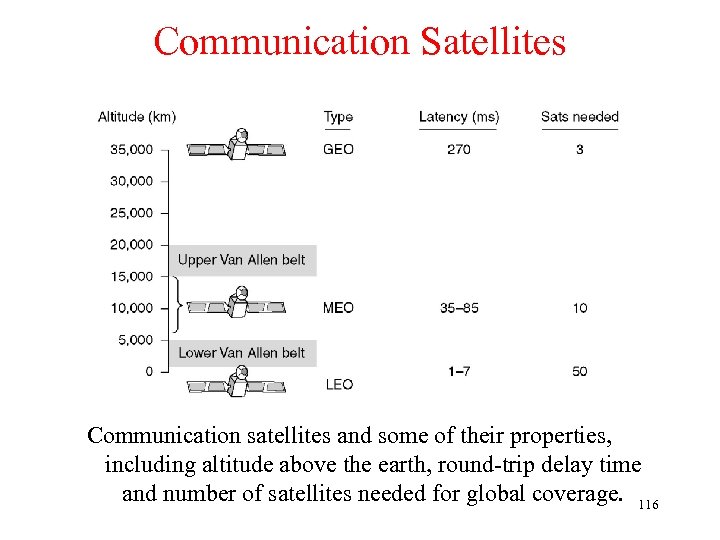 Communication Satellites Communication satellites and some of their properties, including altitude above the earth, round-trip delay time and number of satellites needed for global coverage. 116
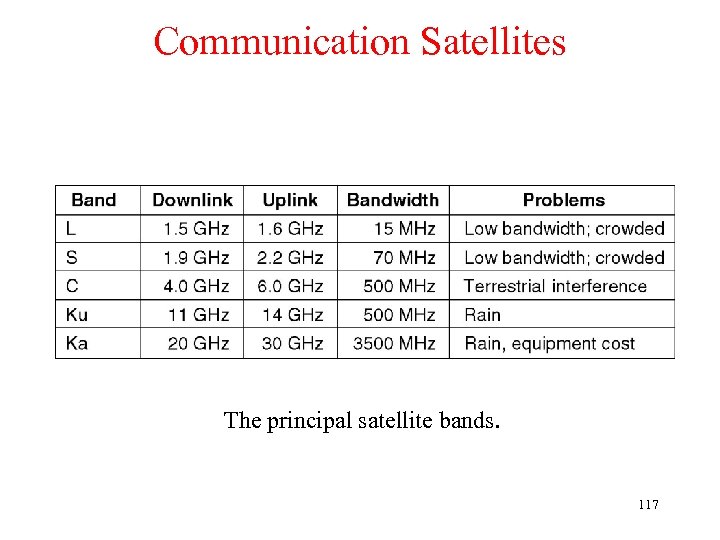 Communication Satellites The principal satellite bands. 117
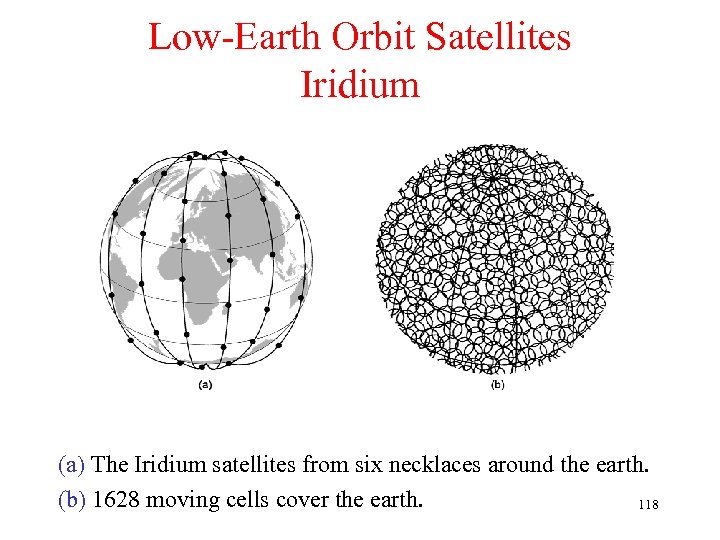 Low-Earth Orbit Satellites Iridium (a) The Iridium satellites from six necklaces around the earth. (b) 1628 moving cells cover the earth. 118
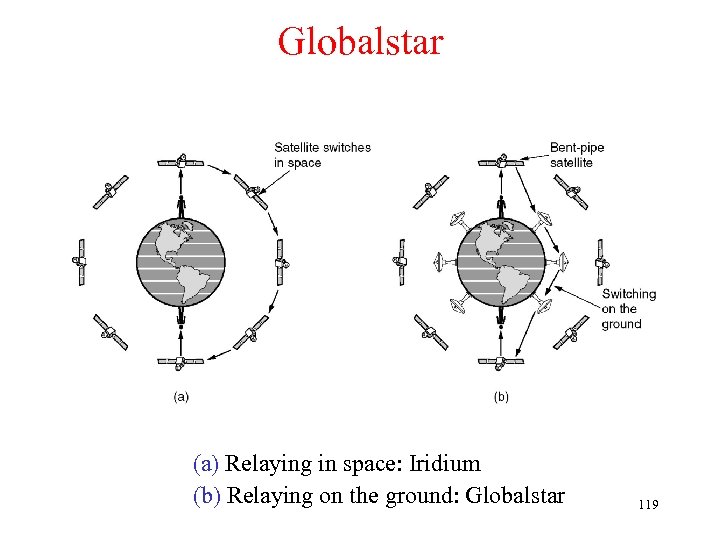 Globalstar (a) Relaying in space: Iridium (b) Relaying on the ground: Globalstar 119
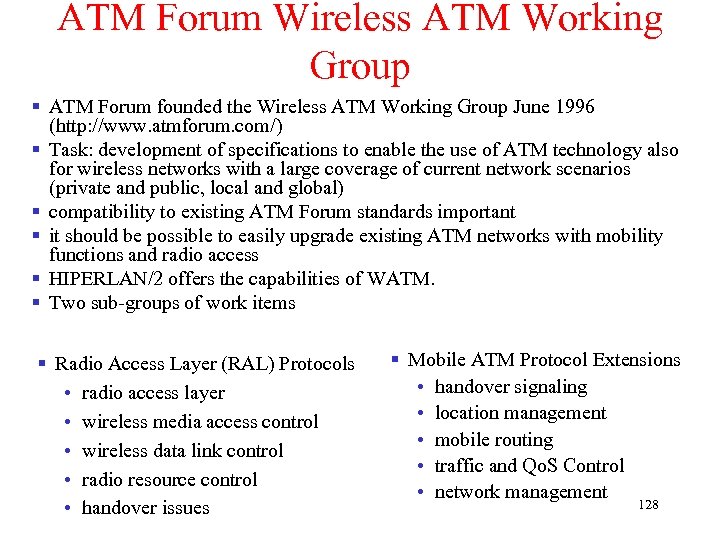
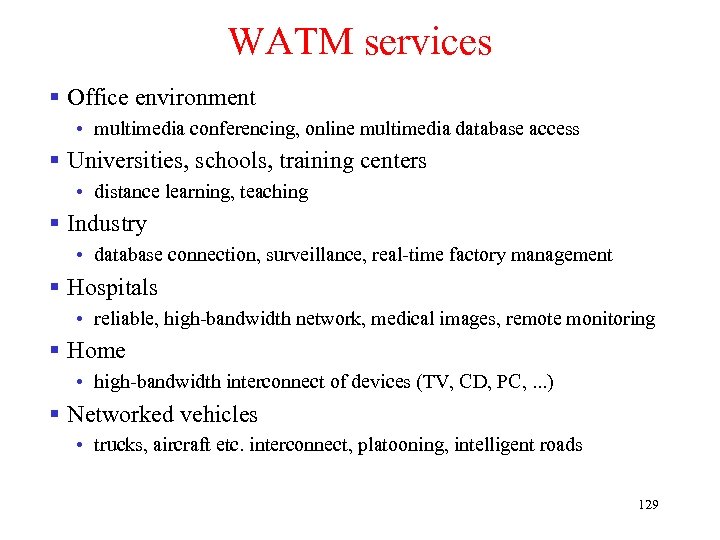
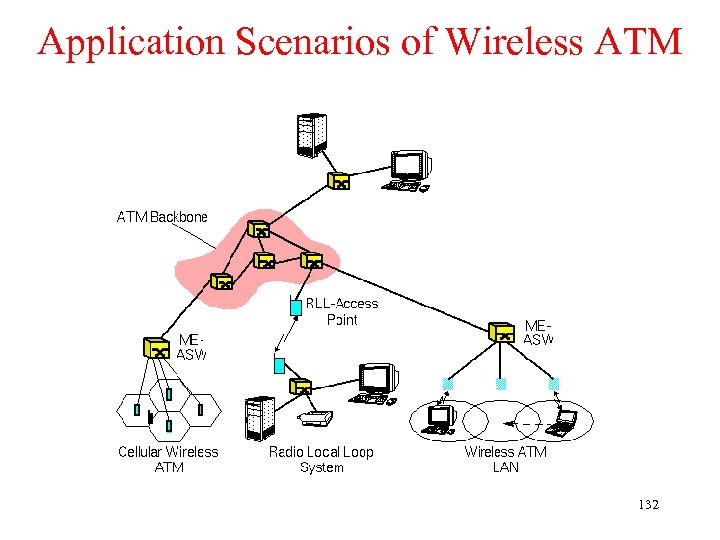
 Some History: Why wireless ATM? § Today we face two major trends in communications: broadband multimedia and mobility. § Thus there is a strong demand for broadband wireless networks which support advanced multimedia applications running on a variety of terminals and in different environments. § While fixed network technologies like ATM promise to provide differentiated Quality of Service (Qo. S), nowadays wireless cellular networks (e. g. , GSM, IS-54) and wireless LANs (e. g. , HIPERLAN 1 - HIgh PErformance Radio Local Area Network, IEEE 802. 11) are mainly single service networks which are not able to meet the above mentioned future requirements. § Therefore, the wireless ATM working group of the ATM Forum is specifying various extensions to ATM protocols in order to cope with the user mobility and wireless access 120
 Some History: Why wireless ATM? § Seamless connection to wired ATM, an integrated service highperformance network supporting different types a traffic streams. § B-ISDN (Broadband ISDN) uses ATM as backbone infrastructure and integrates several different services in one universal system. § Mobile phones and mobile communications have an ever increasing importance in everyday life. § Current wireless LANs do not offer adequate support for multimedia data streams. § Merging mobile communication and ATM leads to wireless ATM from a telecommunication provider point of view § Goal: seamless integration of mobility into B-ISDN § Problem: very high complexity of the system – never reached products 121
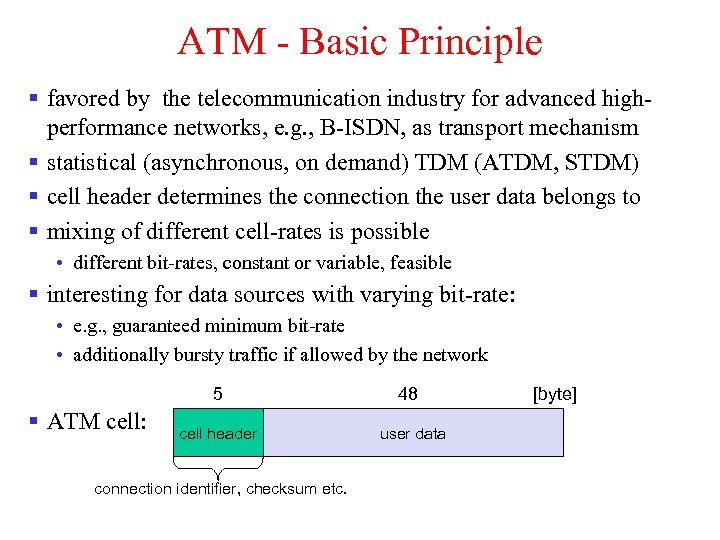 ATM - Basic Principle § favored by the telecommunication industry for advanced highperformance networks, e. g. , B-ISDN, as transport mechanism § statistical (asynchronous, on demand) TDM (ATDM, STDM) § cell header determines the connection the user data belongs to § mixing of different cell-rates is possible • different bit-rates, constant or variable, feasible § interesting for data sources with varying bit-rate: • e. g. , guaranteed minimum bit-rate • additionally bursty traffic if allowed by the network 5 § ATM cell: cell header connection identifier, checksum etc. 48 user data [byte]
 Cell-based transmission § asynchronous, cell-based transmission as basis for ATM § continuous cell-stream § additional cells necessary for operation and maintenance of the network (OAM cells; Operation and Maintenance) § OAM cells can be inserted after fixed intervals to create a logical frame structure § if a station has no data to send it automatically inserts idle cells that can be discarded at every intermediate system without further notice § if no synchronous frame is available for the transport of cells (e. g. , SDH or Sonet) cell boundaries have to be detected separately (e. g. , via the checksum in the cell header)
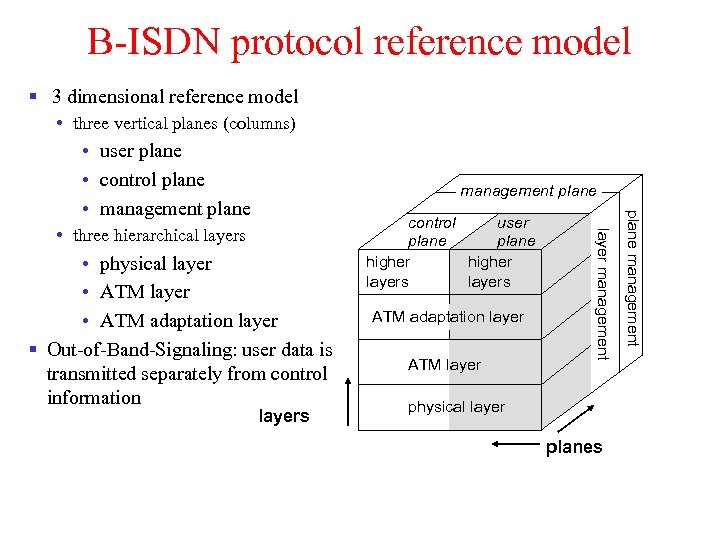 B-ISDN protocol reference model § 3 dimensional reference model • three vertical planes (columns) • user plane • control plane • management plane layers ATM adaptation layer ATM layer physical layer planes plane management • physical layer • ATM adaptation layer § Out-of-Band-Signaling: user data is transmitted separately from control information layer management • three hierarchical layers control user plane higher layers
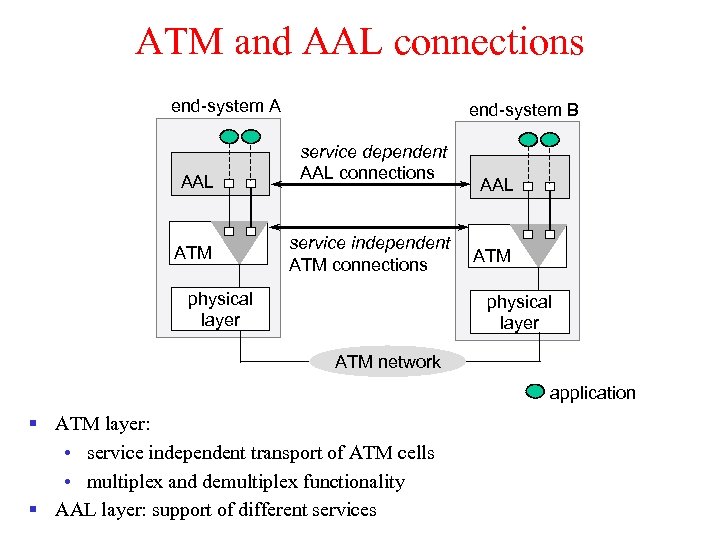
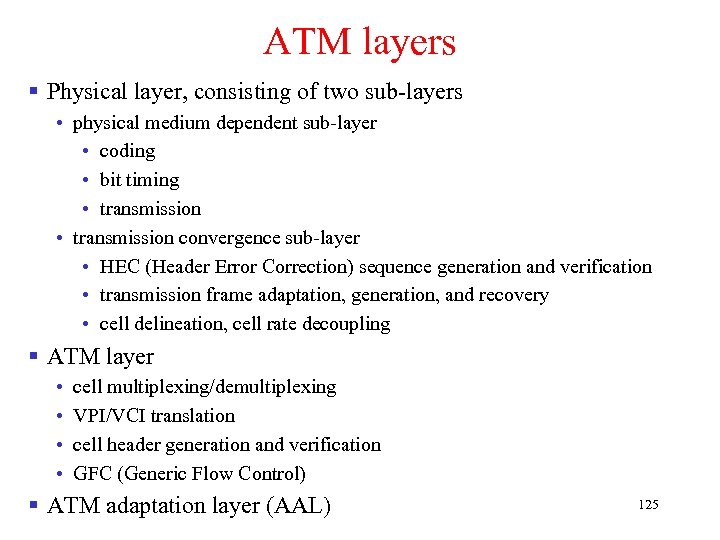 ATM layers § Physical layer, consisting of two sub-layers • physical medium dependent sub-layer • coding • bit timing • transmission convergence sub-layer • HEC (Header Error Correction) sequence generation and verification • transmission frame adaptation, generation, and recovery • cell delineation, cell rate decoupling § ATM layer • • cell multiplexing/demultiplexing VPI/VCI translation cell header generation and verification GFC (Generic Flow Control) § ATM adaptation layer (AAL) 125
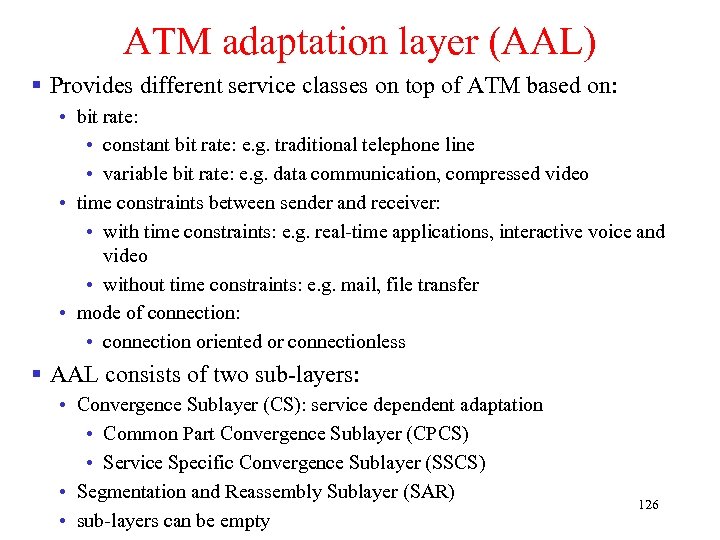 ATM adaptation layer (AAL) § Provides different service classes on top of ATM based on: • bit rate: • constant bit rate: e. g. traditional telephone line • variable bit rate: e. g. data communication, compressed video • time constraints between sender and receiver: • with time constraints: e. g. real-time applications, interactive voice and video • without time constraints: e. g. mail, file transfer • mode of connection: • connection oriented or connectionless § AAL consists of two sub-layers: • Convergence Sublayer (CS): service dependent adaptation • Common Part Convergence Sublayer (CPCS) • Service Specific Convergence Sublayer (SSCS) • Segmentation and Reassembly Sublayer (SAR) • sub-layers can be empty 126
 ATM and AAL connections end-system A AAL ATM end-system B service dependent AAL connections service independent ATM connections physical layer AAL ATM physical layer ATM network application § ATM layer: • service independent transport of ATM cells • multiplex and demultiplex functionality § AAL layer: support of different services
 ATM Forum Wireless ATM Working Group § ATM Forum founded the Wireless ATM Working Group June 1996 (http: //www. atmforum. com/) § Task: development of specifications to enable the use of ATM technology also for wireless networks with a large coverage of current network scenarios (private and public, local and global) § compatibility to existing ATM Forum standards important § it should be possible to easily upgrade existing ATM networks with mobility functions and radio access § HIPERLAN/2 offers the capabilities of WATM. § Two sub-groups of work items § Radio Access Layer (RAL) Protocols • radio access layer • wireless media access control • wireless data link control • radio resource control • handover issues § Mobile ATM Protocol Extensions • handover signaling • location management • mobile routing • traffic and Qo. S Control • network management 128
 WATM services § Office environment • multimedia conferencing, online multimedia database access § Universities, schools, training centers • distance learning, teaching § Industry • database connection, surveillance, real-time factory management § Hospitals • reliable, high-bandwidth network, medical images, remote monitoring § Home • high-bandwidth interconnect of devices (TV, CD, PC, . . . ) § Networked vehicles • trucks, aircraft etc. interconnect, platooning, intelligent roads 129
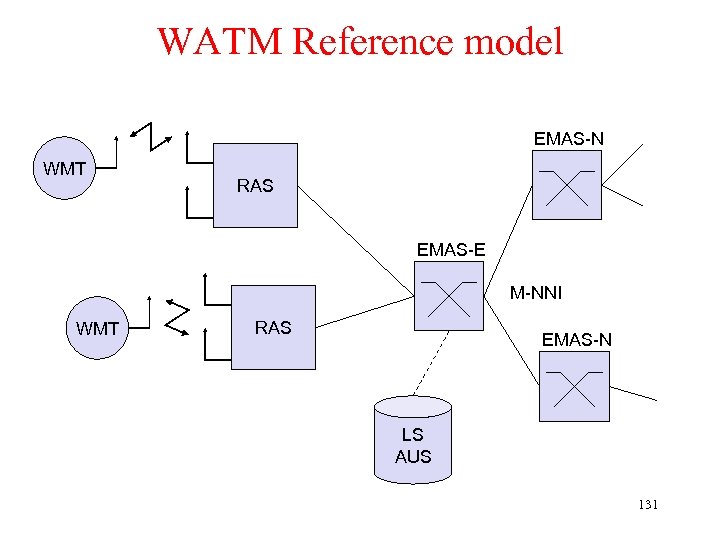
 WATM components § WMT (Wireless Mobile ATM Terminal) § RAS (Radio Access System) § EMAS-E (End-user Mobility-supporting ATM Switch - Edge) § EMAS-N (End-user Mobility-supporting ATM Switch - Network) § M-NNI (Network-to-Network Interface with Mobility support) § LS (Location Server) § AUS (Authentication Server) 130
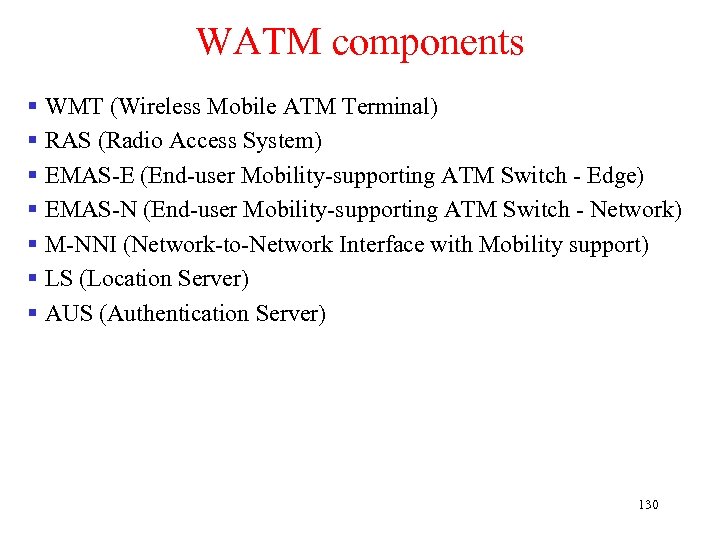
 WATM Reference model EMAS-N WMT RAS EMAS-E M-NNI WMT RAS EMAS-N LS AUS 131
 Application Scenarios of Wireless ATM 132
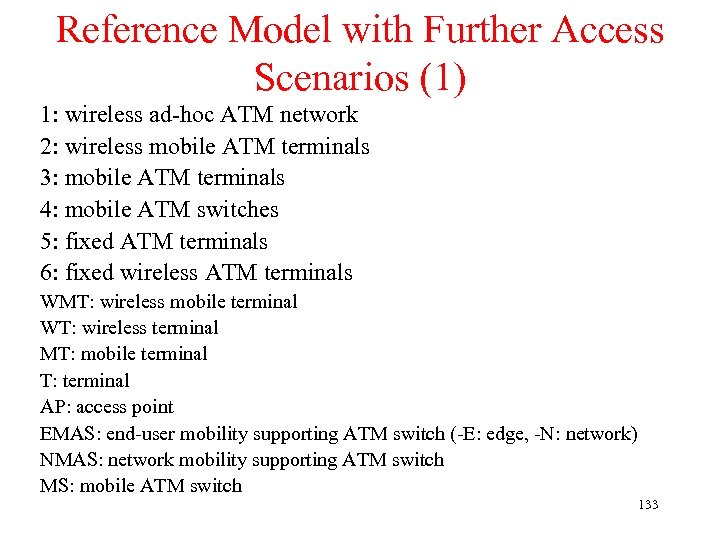 Reference Model with Further Access Scenarios (1) 1: wireless ad-hoc ATM network 2: wireless mobile ATM terminals 3: mobile ATM terminals 4: mobile ATM switches 5: fixed ATM terminals 6: fixed wireless ATM terminals WMT: wireless mobile terminal WT: wireless terminal MT: mobile terminal T: terminal AP: access point EMAS: end-user mobility supporting ATM switch (-E: edge, -N: network) NMAS: network mobility supporting ATM switch MS: mobile ATM switch 133
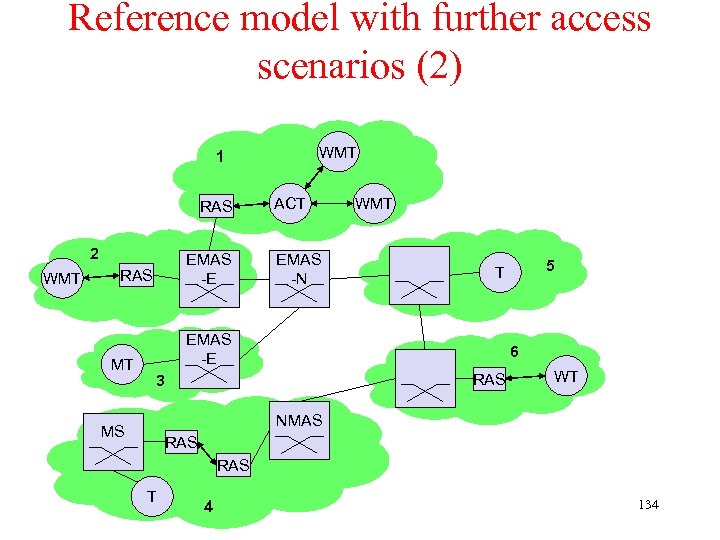 Reference model with further access scenarios (2) WMT 1 RAS 2 WMT EMAS -E RAS MT ACT EMAS -N WMT 5 T EMAS -E 6 RAS 3 WT NMAS MS RAS T 4 134
 WATM § Three MAC protocols: • Fixed assignment apportions the available resource in a definite manner. • Random assignment involves random allocation of the resource. • Demand assignment allocates the resource based on users’ requests. § Types of handoffs • Backward handoff: The MT decides the possibility of handoff and the EMAS-E chooses the next BS. • Intra AP • Inter AP/Intra EMAS-E • Inter EMAS-E • Forward handoff: The MT decides on the BS to which the handoff occurs. • Intra AP • Inter AP/Intra EMAS-E • Inter EMAS-E 135
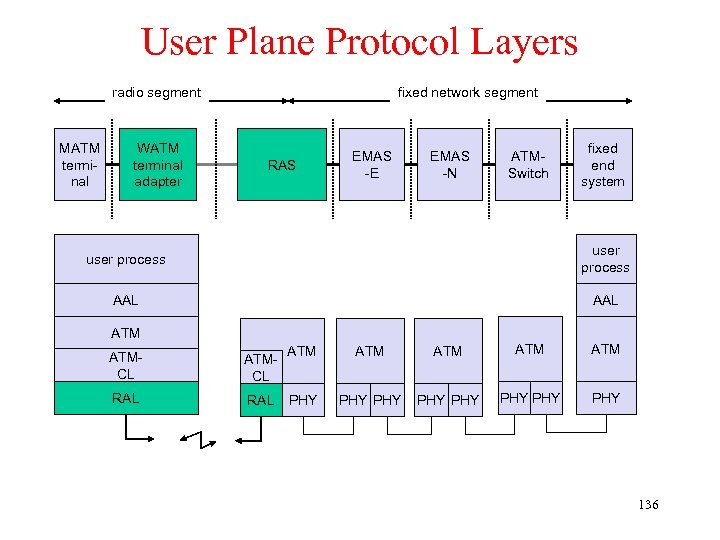 User Plane Protocol Layers fixed network segment radio segment MATM terminal WATM terminal adapter RAS EMAS -E EMAS -N ATMSwitch fixed end system user process AAL ATMCL RAL ATM ATM ATM PHY PHY 136
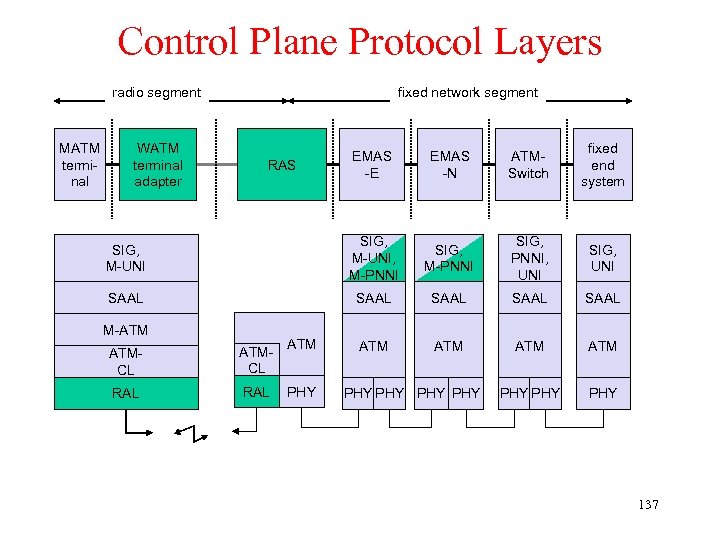 Control Plane Protocol Layers fixed network segment radio segment MATM terminal WATM terminal adapter EMAS -E EMAS -N ATMSwitch fixed end system SIG, M-UNI, M-PNNI SIG, PNNI, UNI SIG, UNI SAAL SAAL ATM ATM PHY PHY RAS M-ATM ATMCL RAL ATM PHY PHY PHY 137
 WATM – Location Management § The requirements of an location management system: • • Transparency Security Unambiguous identification Scalability § Location management should address these issues: • Addressing specifies how MTs, switches, APs, BSs are addressed. • Location updating involves updating an MT’s address. • Location server (LS) • Authentication server (Au. S) • End-user mobility-supporting ATM switch (EMAS) • Location resolution deals with obtaining the current location of an MT. 138
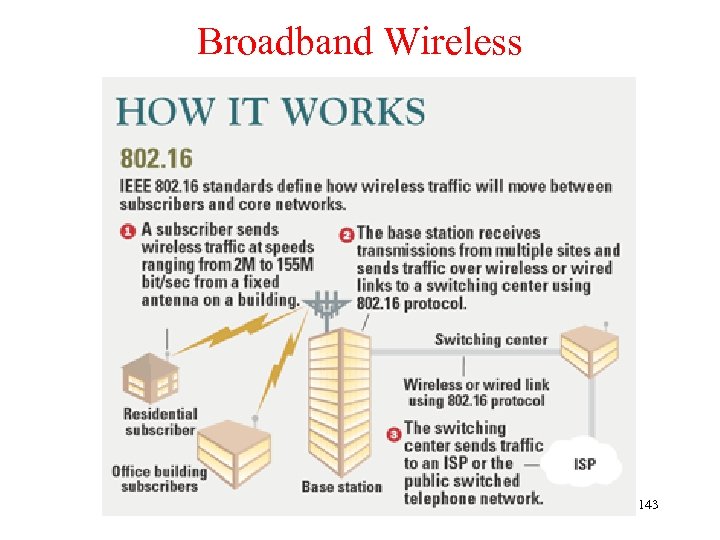
 Comparison of 802. 11 and 802. 16 § Similarity - Provide high-bandwidth wireless communications. § Differences • 802. 16 provides service to stationary buildings which can have multiple computers. High quality full-duplex link is used. Higher cost is affordable. 802. 11 provides service to individual mobile users. • Longer transmission range security/privacy • More user in each cell more spectrum is needed, operate in 10 -66 GHz absorbed by water • Qo. S is made possible for all transmissions. § Physical layer • Physical medium dependent sublayer – narrow-band radio (which means that it contains all of its power in a very narrow portion of the radio frequency bandwidth, prone to interference ) is used with conventional modulation schemes. • Transmission convergence sublayer – hide the different physical medium 139 technologies from the data link layer.
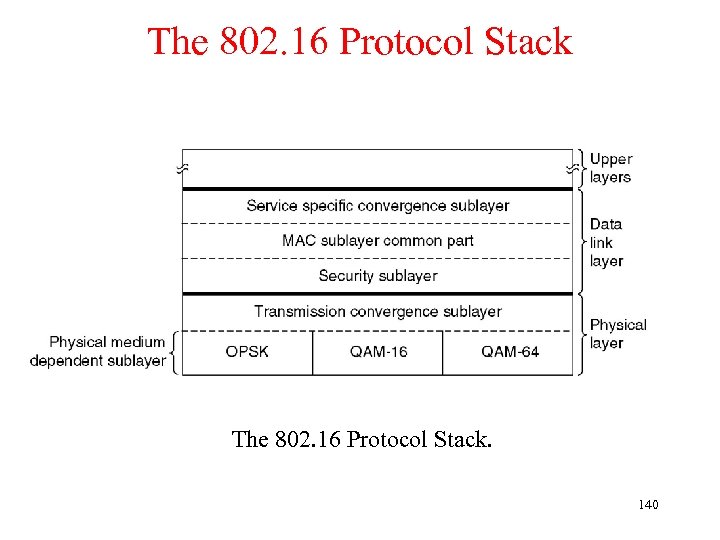 The 802. 16 Protocol Stack. 140
 The 802. 16 Protocol Stack • Data link layer • Security layer – deal with privacy and security • MAC sublayer common part – channel management • Service specific convergence sublayer – integrate with both datagram protocols (PPP, IP, and Ethernet) and ATM. § Physical media: • 10 -to-66 GHz millimeter waves travel in the straight line. • Transfer up to 155 Mbps • 30 miles range § The base station has multiple antennas, each pointing at a different sector. § The signal-to-noise ratio drops sharply with distance. Three modulation schemes are used depending on distance: • QAM-64 (6 bits/baud) • QAM-16 (4 bits/baud) • QPSK (2 bits/baud) 141
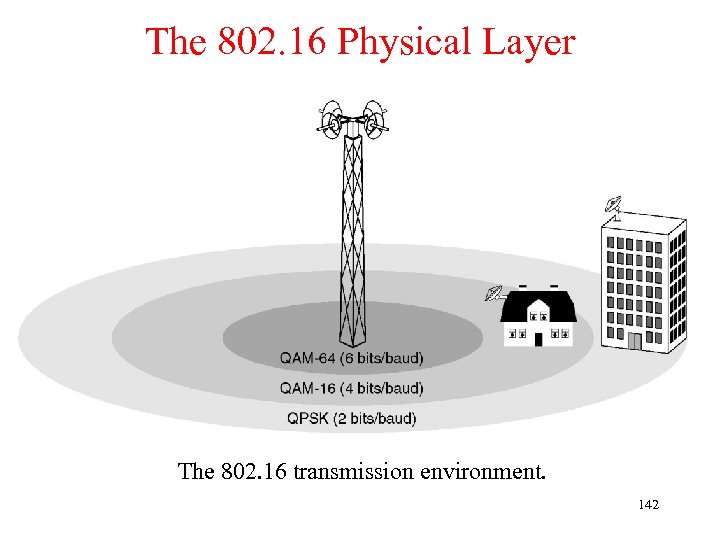 The 802. 16 Physical Layer The 802. 16 transmission environment. 142
 Broadband Wireless 143
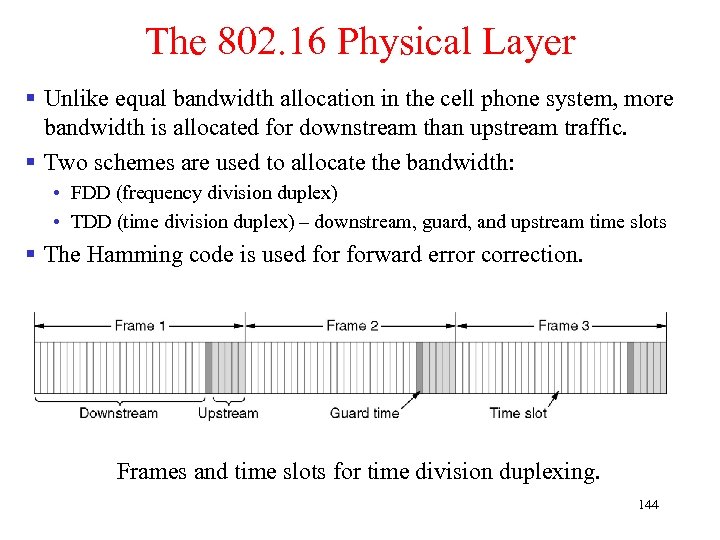 The 802. 16 Physical Layer § Unlike equal bandwidth allocation in the cell phone system, more bandwidth is allocated for downstream than upstream traffic. § Two schemes are used to allocate the bandwidth: • FDD (frequency division duplex) • TDD (time division duplex) – downstream, guard, and upstream time slots § The Hamming code is used forward error correction. Frames and time slots for time division duplexing. 144
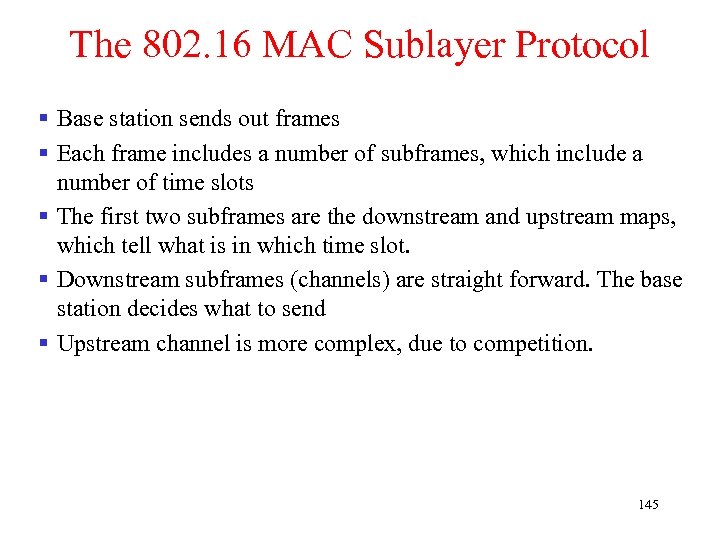 The 802. 16 MAC Sublayer Protocol § Base station sends out frames § Each frame includes a number of subframes, which include a number of time slots § The first two subframes are the downstream and upstream maps, which tell what is in which time slot. § Downstream subframes (channels) are straight forward. The base station decides what to send § Upstream channel is more complex, due to competition. 145
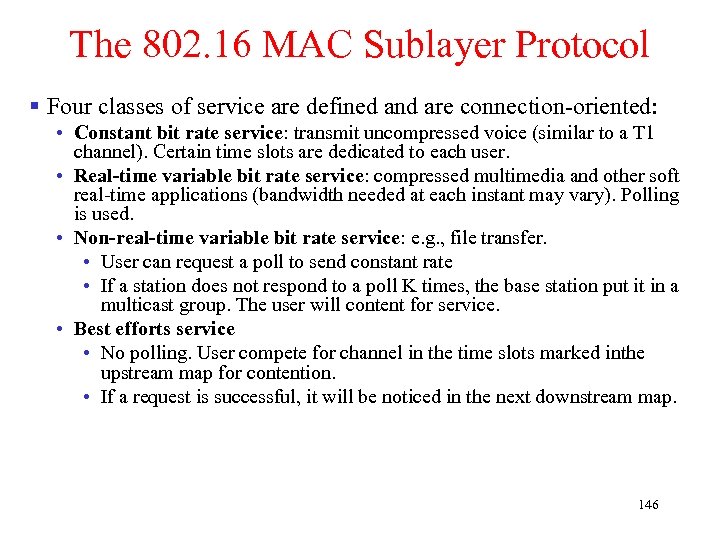 The 802. 16 MAC Sublayer Protocol § Four classes of service are defined and are connection-oriented: • Constant bit rate service: transmit uncompressed voice (similar to a T 1 channel). Certain time slots are dedicated to each user. • Real-time variable bit rate service: compressed multimedia and other soft real-time applications (bandwidth needed at each instant may vary). Polling is used. • Non-real-time variable bit rate service: e. g. , file transfer. • User can request a poll to send constant rate • If a station does not respond to a poll K times, the base station put it in a multicast group. The user will content for service. • Best efforts service • No polling. User compete for channel in the time slots marked inthe upstream map for contention. • If a request is successful, it will be noticed in the next downstream map. 146
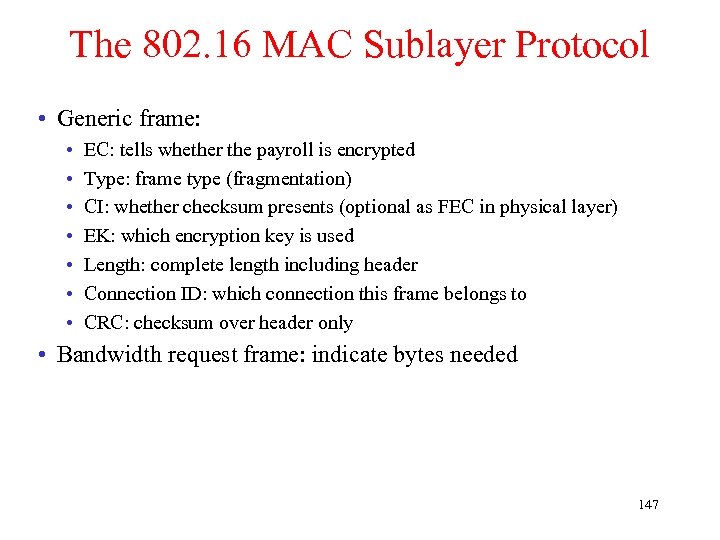 The 802. 16 MAC Sublayer Protocol • Generic frame: • • EC: tells whether the payroll is encrypted Type: frame type (fragmentation) CI: whether checksum presents (optional as FEC in physical layer) EK: which encryption key is used Length: complete length including header Connection ID: which connection this frame belongs to CRC: checksum over header only • Bandwidth request frame: indicate bytes needed 147
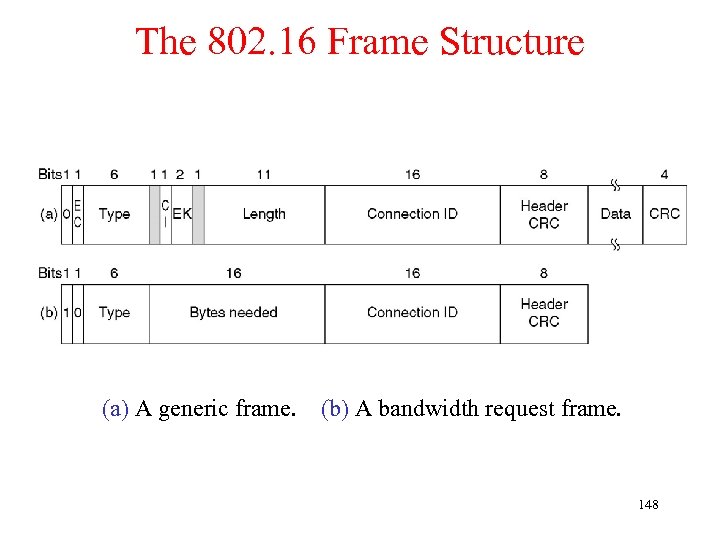 The 802. 16 Frame Structure (a) A generic frame. (b) A bandwidth request frame. 148
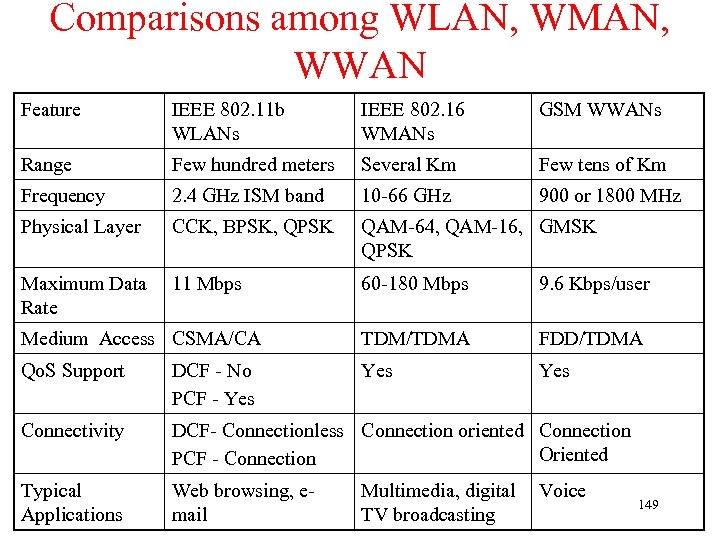 Comparisons among WLAN, WMAN, WWAN Feature IEEE 802. 11 b WLANs IEEE 802. 16 WMANs GSM WWANs Range Few hundred meters Several Km Few tens of Km Frequency 2. 4 GHz ISM band 10 -66 GHz 900 or 1800 MHz Physical Layer CCK, BPSK, QPSK QAM-64, QAM-16, GMSK QPSK Maximum Data 11 Mbps Rate 60 -180 Mbps 9. 6 Kbps/user Medium Access CSMA/CA TDM/TDMA FDD/TDMA Qo. S Support DCF - No PCF - Yes Yes Connectivity DCF- Connectionless Connection oriented Connection Oriented PCF - Connection Typical Applications Web browsing, email Multimedia, digital Voice TV broadcasting 149