


 Скачать презентацию Chapter 3 Wireless LANs This work is licensed
e3bfc10d1f9a68a964dc55f3fe806f7a.ppt
- Количество слайдов: 29
 Chapter 3 Wireless LANs This work is licensed under the Creative Commons Attribution-Non. Commercial 4. 0 International License. To view a copy of this license, visit http: //creativecommons. org/licenses/by-nc/4. 0/ or send a letter to Creative Commons, PO Box 1866, Mountain View, CA 94042, USA. Journal FDP 201 X Mr. Bhagwant Handge Email: bhagwant. handge@gmail. com
 LAN/WLAN World LANs provide connectivity for interconnecting computing resources at the local levels of an organization v Wired LANs Limitations because of physical, hardwired infrastructure v Wireless LANs provide Flexibility Portability Mobility Ease of Installation v
 Wireless LAN Applications v Medical Professionals v Education v Temporary Situations v Airlines v Security Staff v Emergency Centers
 IEEE 802. 11 Wireless LAN Standard v In response to lacking standards, IEEE developed the first internationally recognized wireless LAN standard – IEEE 802. 11 v IEEE published 802. 11 in 1997, after seven years of work v Scope of IEEE 802. 11 is limited to Physical and Data Link Layers.
 Benefits of 802. 11 Standard v Appliance Interoperability v Fast Product Development v Stable Future Migration v Price Reductions v The 802. 11 standard takes into account the following significant differences between wireless and wired LANs: Power Management Security Bandwidth
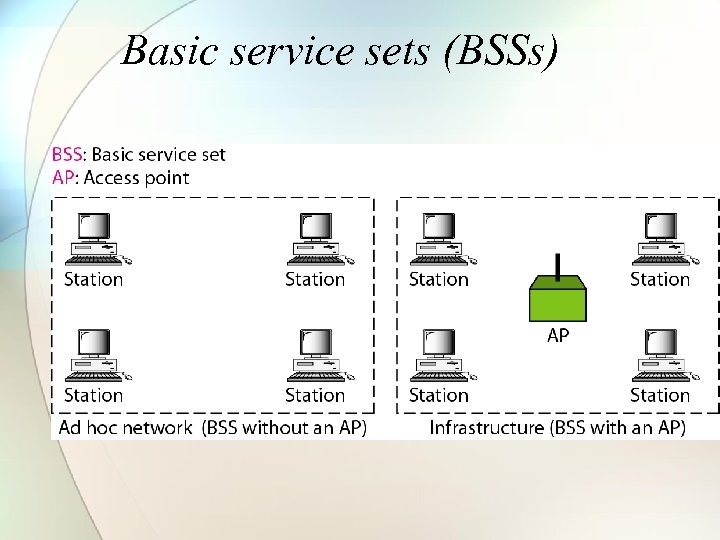
 IEEE 802. 11 Terminology v Access point (AP): A station that provides access to the DS. v Basic service set : a set is of stationary or mobile wireless stations and an optional central base station, known as the access point (AP). v Distribution system (DS): A system used to interconnect a set of BSSs to create an ESS. v DS is implementation-independent. It can be a wired 802. 3 Ethernet LAN, 802. 4 token bus, 802. 5 token ring or another 802. 11 medium. v Extended service set (ESS): Two or more BSS interconnected by DS vextended service set uses two types of stations: mobile and stationary v The mobile stations are normal stations inside a BSS. The stationary stations are AP stations that are part of a wired LAN.
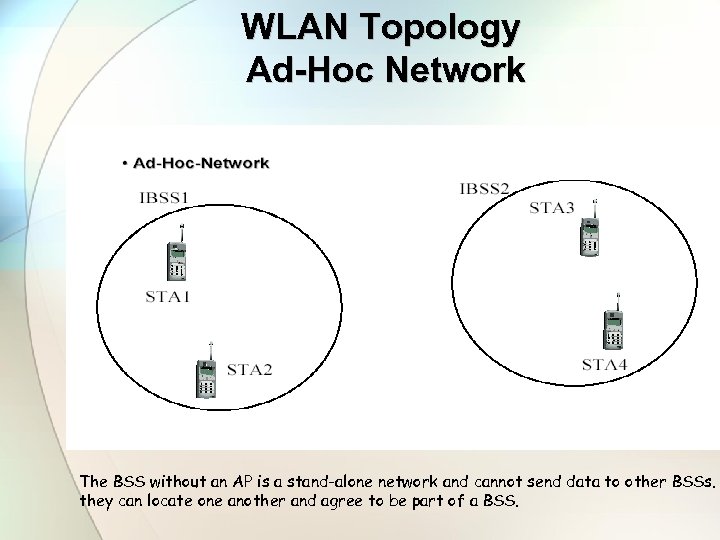 WLAN Topology Ad-Hoc Network The BSS without an AP is a stand-alone network and cannot send data to other BSSs. they can locate one another and agree to be part of a BSS.
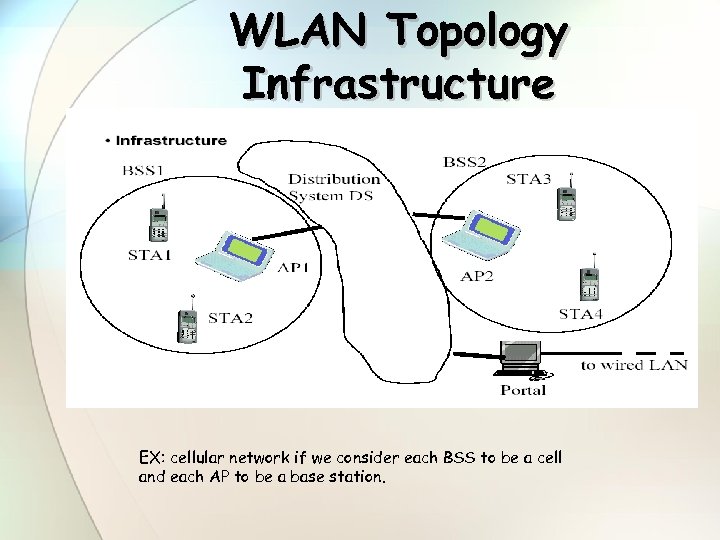 WLAN Topology Infrastructure EX: cellular network if we consider each BSS to be a cell and each AP to be a base station.
 Basic service sets (BSSs)
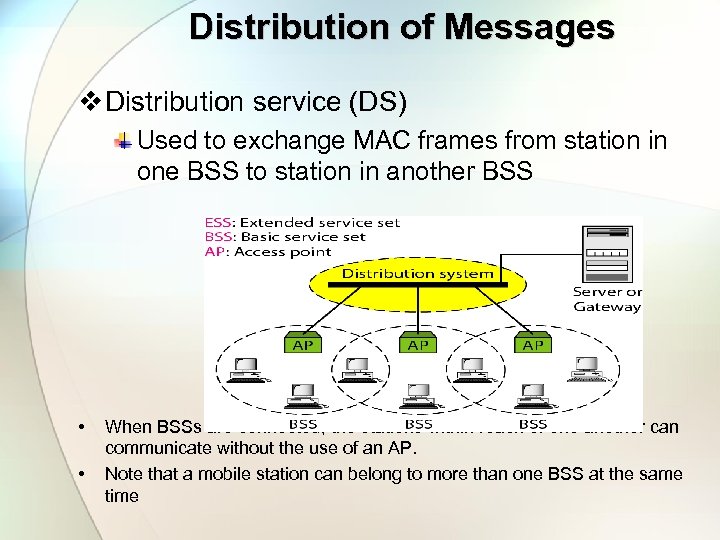 Distribution of Messages v Distribution service (DS) Used to exchange MAC frames from station in one BSS to station in another BSS • • When BSSs are connected, the stations within reach of one another can communicate without the use of an AP. Note that a mobile station can belong to more than one BSS at the same time
 IEEE 802. 11 Medium Access Control v MAC layer covers three functional areas: Reliable data delivery Access control Security
 MAC Sublayer v Distributed Coordination Function (DCF) Distributed access protocol Contention-Based Makes use of CSMA/CA rather than CSMA/CD for the following reasons: Wireless LANs cannot implement CSMAf. CD for three reasons: 1. For collision detection a station must be able to send data and receive collision signals at the same time( costly stations and increased bandwidth requirements). 2. Collision may not be detected because of the hidden station problem. 3. The distance between stations may result in Signal fading which prevent a station at one end from hearing a collision at the other end. Suited for ad hoc network and ordinary asynchronous traffic
 Fragmentation • The wireless environment is very noisy. • corrupt frame has to be retransmitted. • Fragmentation is recommended. • the division of a large frame into smaller ones. • It is more efficient to resend a small frame than a large one.
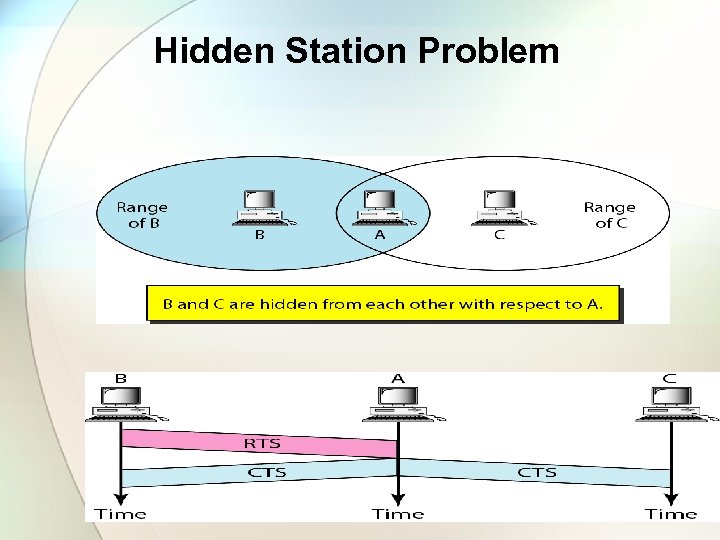 Hidden Station Problem
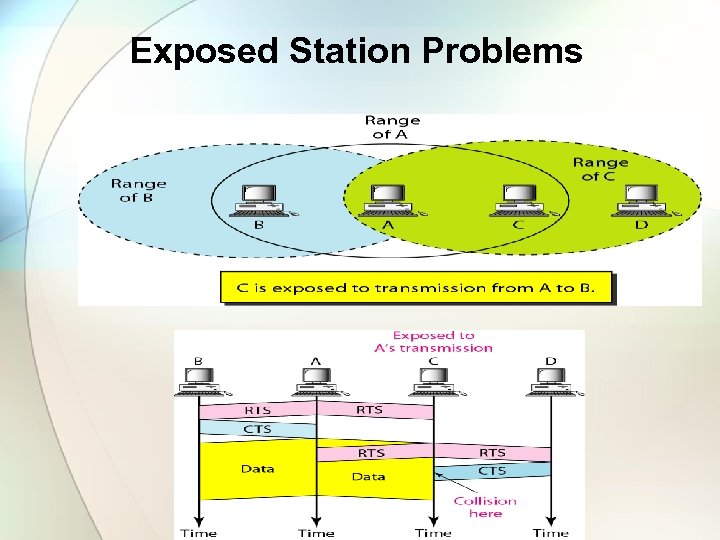 Exposed Station Problems
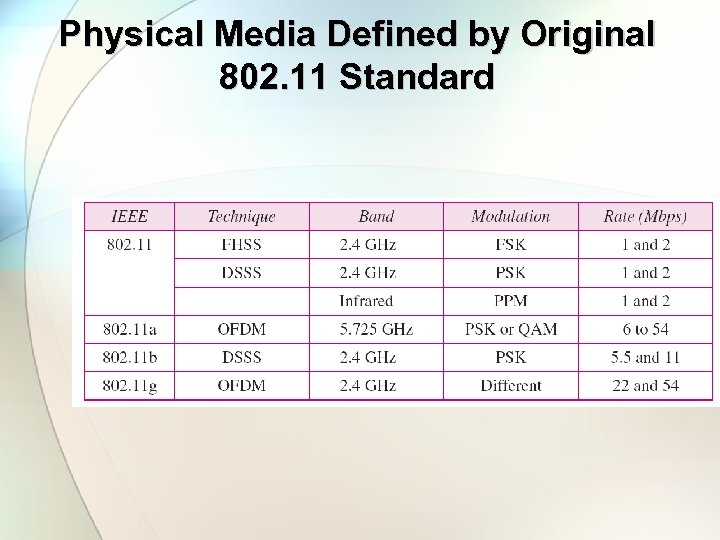 Physical Media Defined by Original 802. 11 Standard
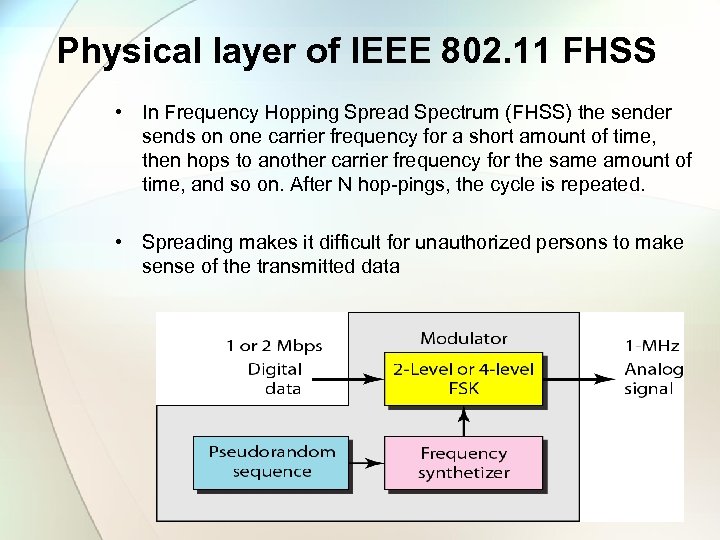 Physical layer of IEEE 802. 11 FHSS • In Frequency Hopping Spread Spectrum (FHSS) the sender sends on one carrier frequency for a short amount of time, then hops to another carrier frequency for the same amount of time, and so on. After N hop-pings, the cycle is repeated. • Spreading makes it difficult for unauthorized persons to make sense of the transmitted data
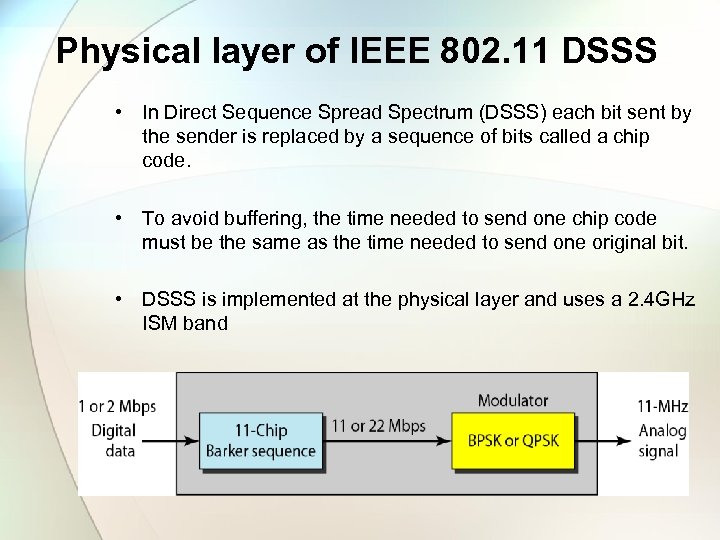 Physical layer of IEEE 802. 11 DSSS • In Direct Sequence Spread Spectrum (DSSS) each bit sent by the sender is replaced by a sequence of bits called a chip code. • To avoid buffering, the time needed to send one chip code must be the same as the time needed to send one original bit. • DSSS is implemented at the physical layer and uses a 2. 4 GHz ISM band
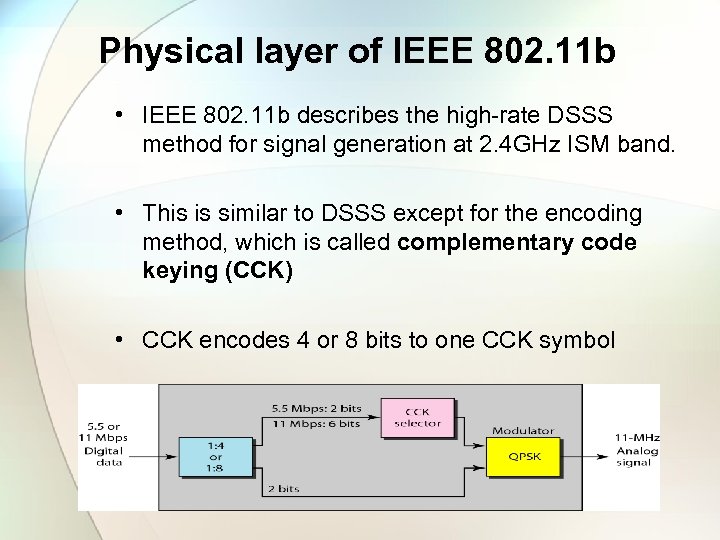 Physical layer of IEEE 802. 11 b • IEEE 802. 11 b describes the high-rate DSSS method for signal generation at 2. 4 GHz ISM band. • This is similar to DSSS except for the encoding method, which is called complementary code keying (CCK) • CCK encodes 4 or 8 bits to one CCK symbol
 Physical Media Defined by Original 802. 11 Standard v IEEE 802. 11 FHSS(Frequency-hopping spread spectrum) Operating in 2. 4 GHz ISM band Lower cost, power consumption Most tolerant to signal interference v IEEE 802. 11 DSSS (Direct-sequence spread spectrum) Operating in 2. 4 GHz ISM band Supports higher data rates More range than FH or IR physical layers v IEEE 802. 11 Infrared Lowest cost Lowest range compared to spread spectrum Doesn’t penetrate walls, so no eavesdropping
 IEEE 802. 11 a , IEEE 802. 11 b and IEEE 802. 11 g v IEEE 802. 11 a Makes use of 5 -GHz band Provides rates of 6, 9 , 12, 18, 24, 36, 48, 54 Mbps Uses orthogonal frequency division multiplexing (OFDM) v IEEE 802. 11 b operates in 2. 4 GHz band Provides data rates of 5. 5 and 11 Mbps Complementary code keying (CCK) modulation scheme v IEEE 802. 11 g operates in 2. 4 GHz band Provides data rates of 22 and 54 Mbps Uses orthogonal frequency division multiplexing (OFDM)
 BLUETOOTH • Bluetooth is a wireless LAN technology designed to connect devices of different functions such as telephones, notebooks, computers, cameras, printers, coffee makers, and so on. A Bluetooth LAN is an ad hoc network, which means that the network is formed spontaneously. • Bluetooth defines two types of networks: piconet and scatternet
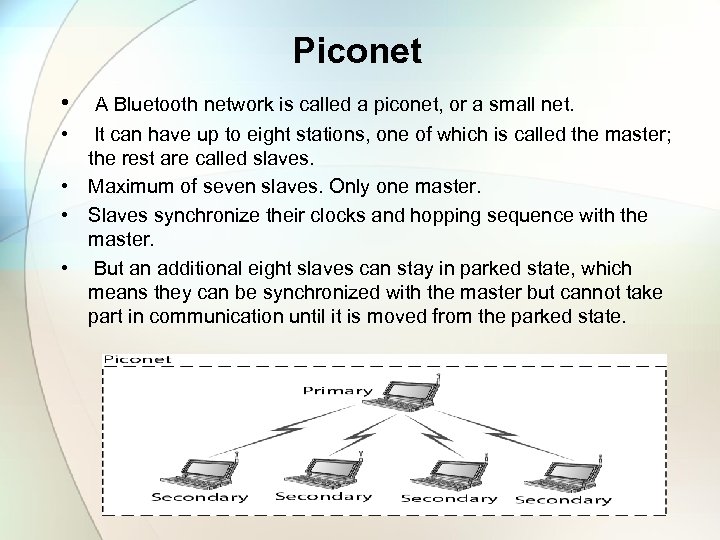 Piconet • • • A Bluetooth network is called a piconet, or a small net. It can have up to eight stations, one of which is called the master; the rest are called slaves. Maximum of seven slaves. Only one master. Slaves synchronize their clocks and hopping sequence with the master. But an additional eight slaves can stay in parked state, which means they can be synchronized with the master but cannot take part in communication until it is moved from the parked state.
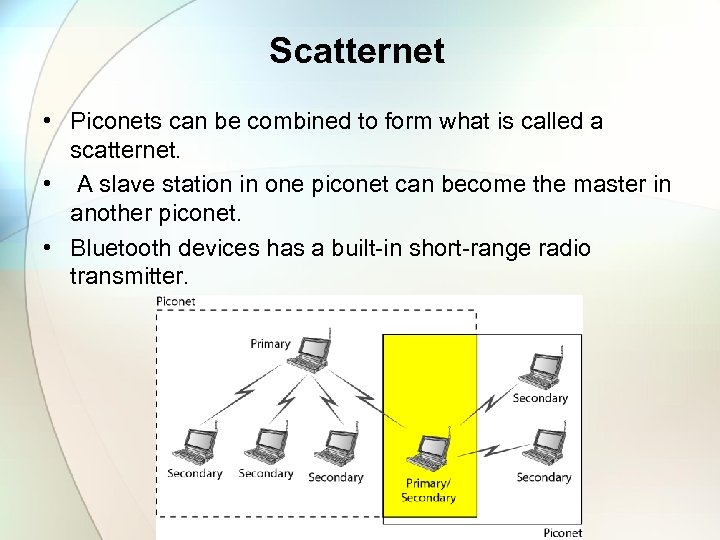 Scatternet • Piconets can be combined to form what is called a scatternet. • A slave station in one piconet can become the master in another piconet. • Bluetooth devices has a built-in short-range radio transmitter.
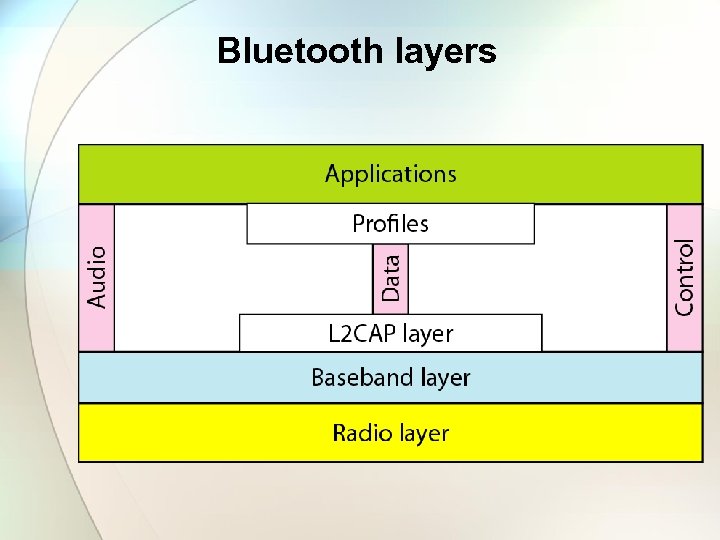
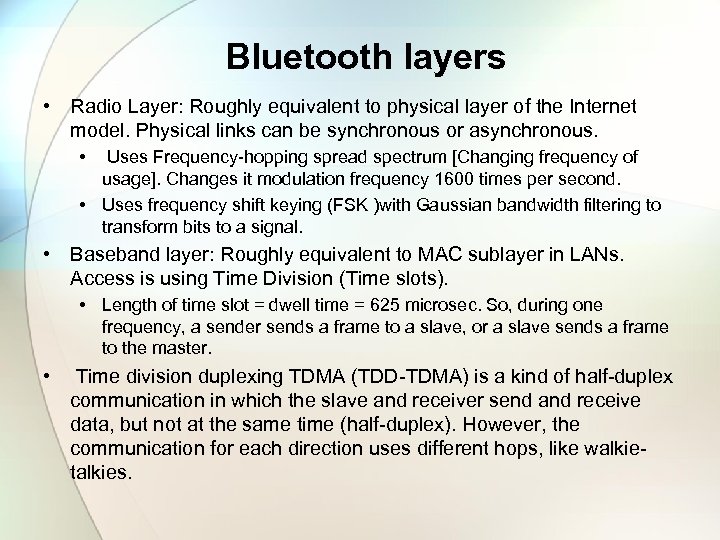 Bluetooth layers • Radio Layer: Roughly equivalent to physical layer of the Internet model. Physical links can be synchronous or asynchronous. • Uses Frequency-hopping spread spectrum [Changing frequency of usage]. Changes it modulation frequency 1600 times per second. • Uses frequency shift keying (FSK )with Gaussian bandwidth filtering to transform bits to a signal. • Baseband layer: Roughly equivalent to MAC sublayer in LANs. Access is using Time Division (Time slots). • Length of time slot = dwell time = 625 microsec. So, during one frequency, a sender sends a frame to a slave, or a slave sends a frame to the master. • Time division duplexing TDMA (TDD-TDMA) is a kind of half-duplex communication in which the slave and receiver send and receive data, but not at the same time (half-duplex). However, the communication for each direction uses different hops, like walkietalkies.
 Bluetooth layers
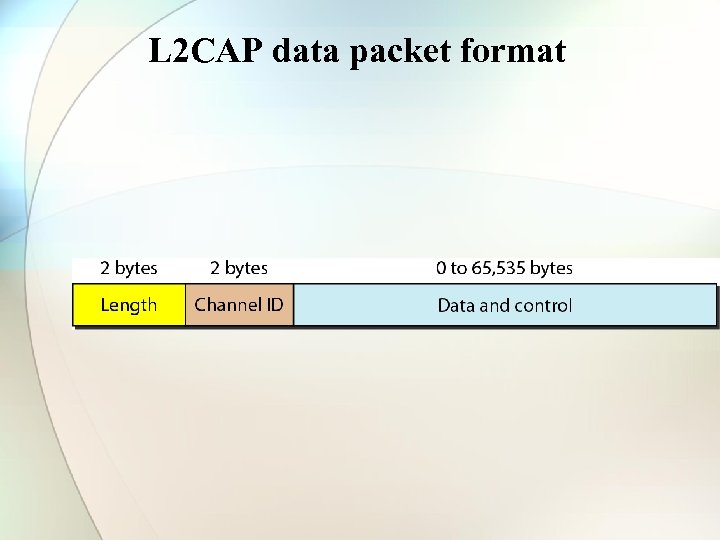
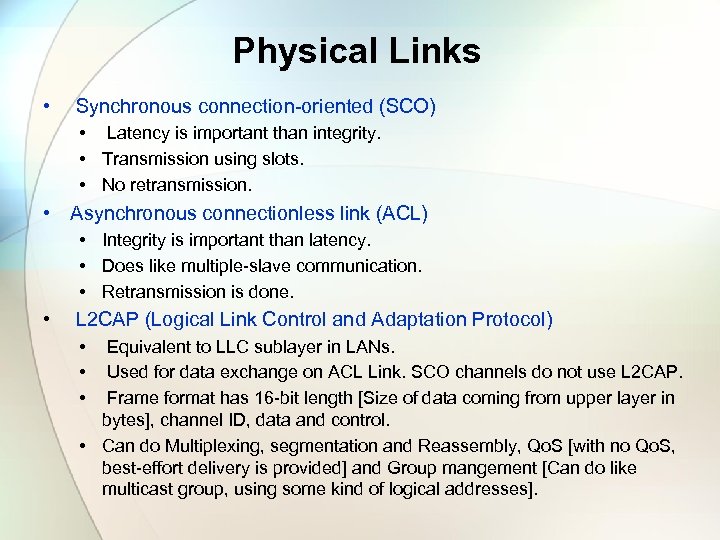 Physical Links • Synchronous connection-oriented (SCO) • Latency is important than integrity. • Transmission using slots. • No retransmission. • Asynchronous connectionless link (ACL) • Integrity is important than latency. • Does like multiple-slave communication. • Retransmission is done. • L 2 CAP (Logical Link Control and Adaptation Protocol) • • • Equivalent to LLC sublayer in LANs. Used for data exchange on ACL Link. SCO channels do not use L 2 CAP. Frame format has 16 -bit length [Size of data coming from upper layer in bytes], channel ID, data and control. • Can do Multiplexing, segmentation and Reassembly, Qo. S [with no Qo. S, best-effort delivery is provided] and Group mangement [Can do like multicast group, using some kind of logical addresses].
 L 2 CAP data packet format
 SUMMARY • • • The wireless LAN access method is CSMA/CA. The network allocation vector (NAV) is a timer for collision avoidance. The MAC layer frame has nine fields. The addressing mechanism can include up to four addresses. Wireless LANs use management frames, control frames, and data frames. Bluetooth is a wireless LAN technology that connects devices (called gadgets) in a small area. A Bluetooth network is called a piconet. Multiple piconets form a network called a scatternet. The Bluetooth radio layer performs functions similar to those in the Internet model's physcial layer. The Bluetooth baseband layer performs functions similar to those in the Internet model's MAC sublayer. A Bluetooth network consists of one master device and up to seven slave devices. • A Bluetooth frame consists of data as well as hopping and control mechanisms. A frame is one, three, or five slots in length with each slot equal to 625 μs.