


 Скачать презентацию Chapter 3 Understanding Money Management n Nominal and
c7b07a1278f33314c4ad861ec006316a.ppt
- Количество слайдов: 45
 Chapter 3 Understanding Money Management n Nominal and Effective Interest Rates n Equivalence Calculations using Effective Interest Rates n Debt Management
 Focus 1. If payments occur more frequently than annual, how do you calculate economic equivalence? 2. If interest period is other than annual, how do you calculate economic equivalence? 3. How are commercial loans structured? 4. How should you manage your debt?
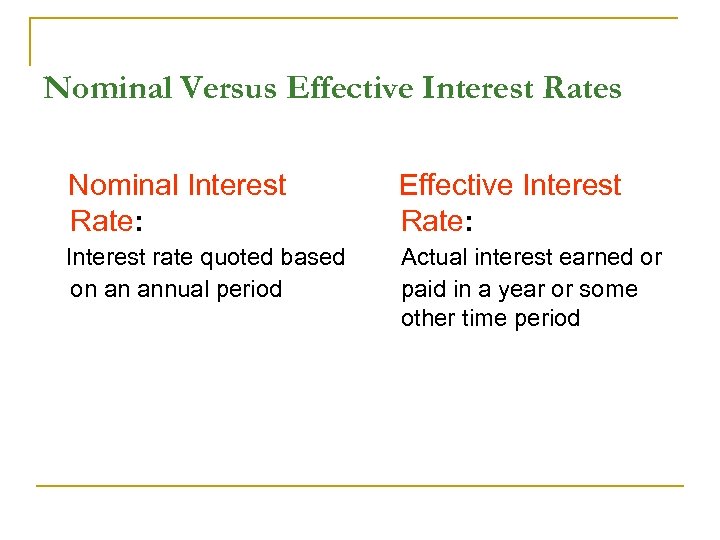 Nominal Versus Effective Interest Rates Nominal Interest Rate: Effective Interest Rate: Interest rate quoted based on an annual period Actual interest earned or paid in a year or some other time period
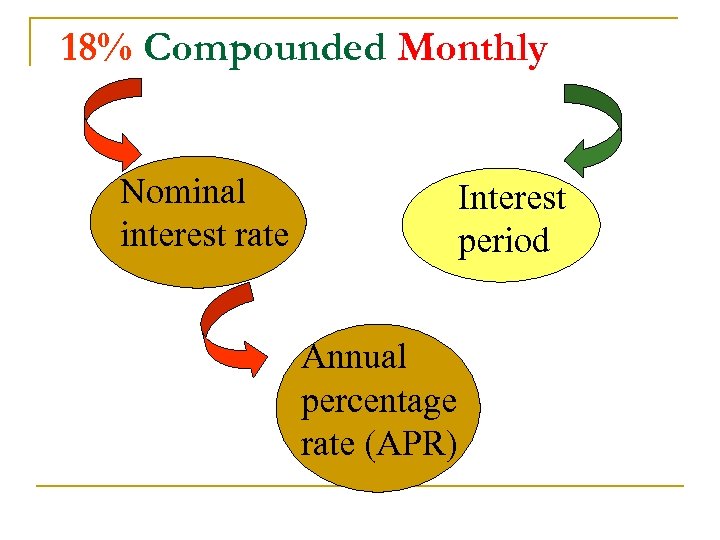 18% Compounded Monthly Nominal interest rate Interest period Annual percentage rate (APR)
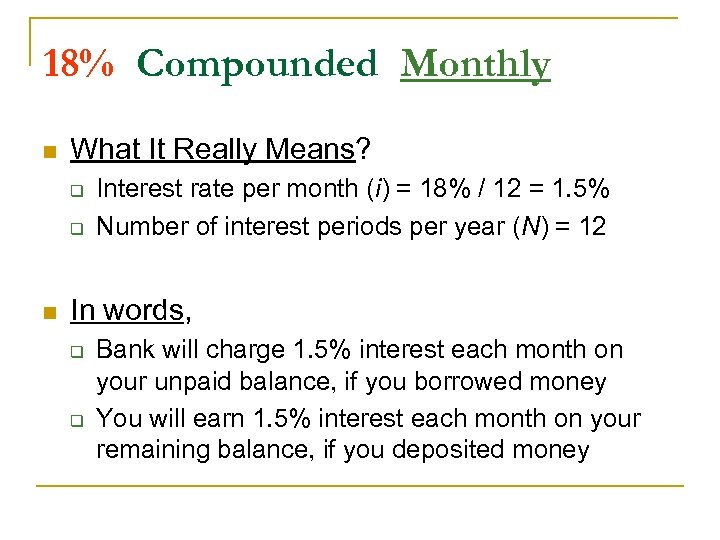 18% Compounded Monthly n What It Really Means? q q n Interest rate per month (i) = 18% / 12 = 1. 5% Number of interest periods per year (N) = 12 In words, q q Bank will charge 1. 5% interest each month on your unpaid balance, if you borrowed money You will earn 1. 5% interest each month on your remaining balance, if you deposited money
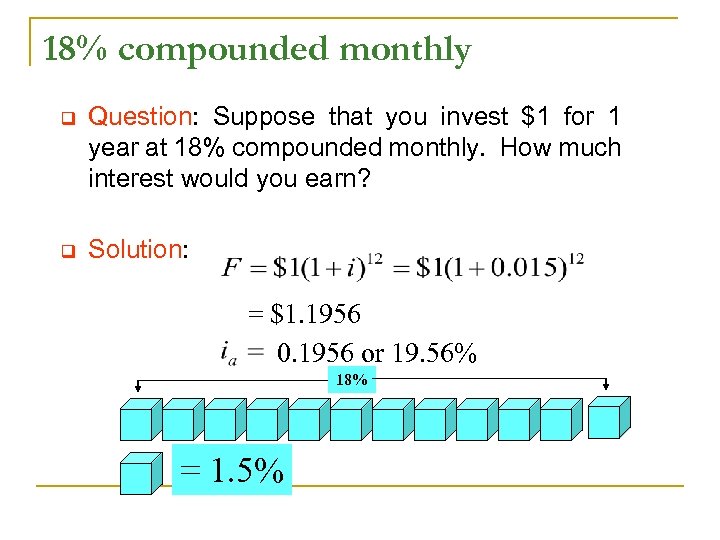 18% compounded monthly q Question: Suppose that you invest $1 for 1 year at 18% compounded monthly. How much interest would you earn? q Solution: = $1. 1956 0. 1956 or 19. 56% 18% = 1. 5%
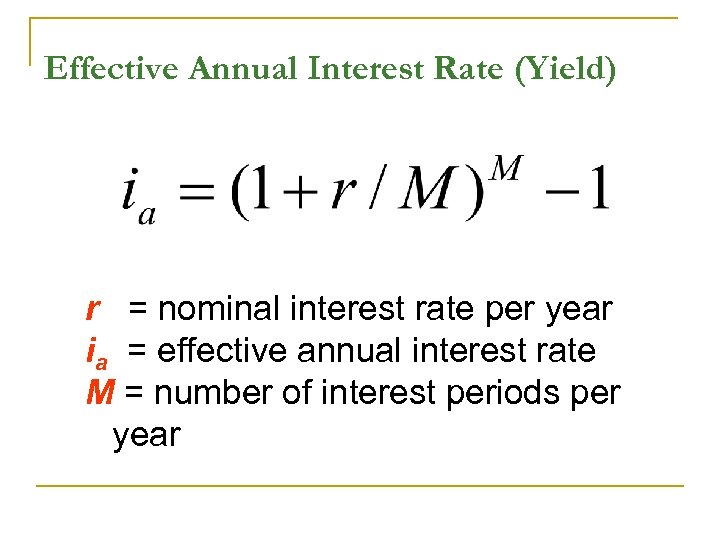 Effective Annual Interest Rate (Yield) r = nominal interest rate per year ia = effective annual interest rate M = number of interest periods per year
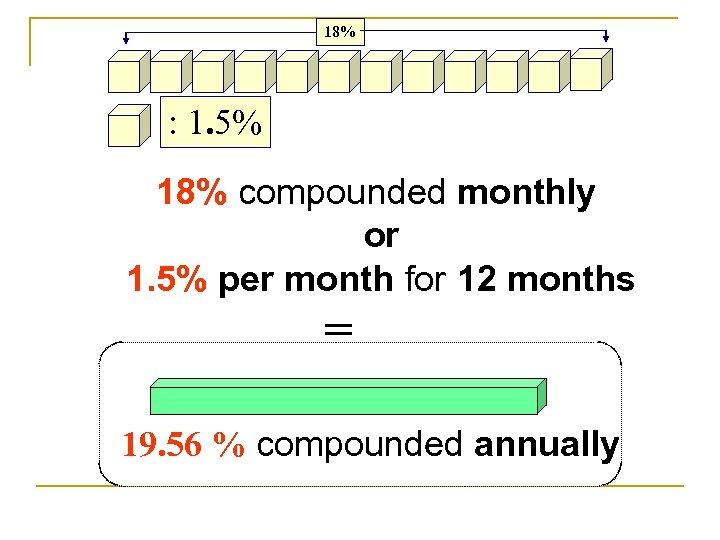 18% : 1. 5% 18% compounded monthly or 1. 5% per month for 12 months = 19. 56 % compounded annually
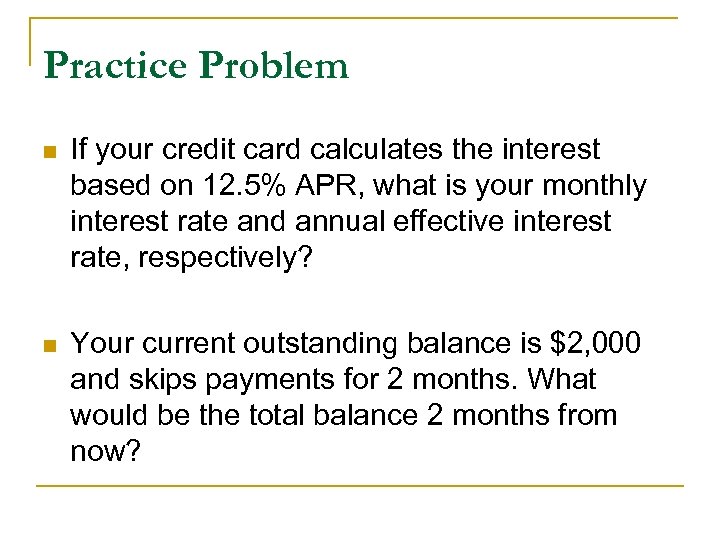 Practice Problem n If your credit card calculates the interest based on 12. 5% APR, what is your monthly interest rate and annual effective interest rate, respectively? n Your current outstanding balance is $2, 000 and skips payments for 2 months. What would be the total balance 2 months from now?
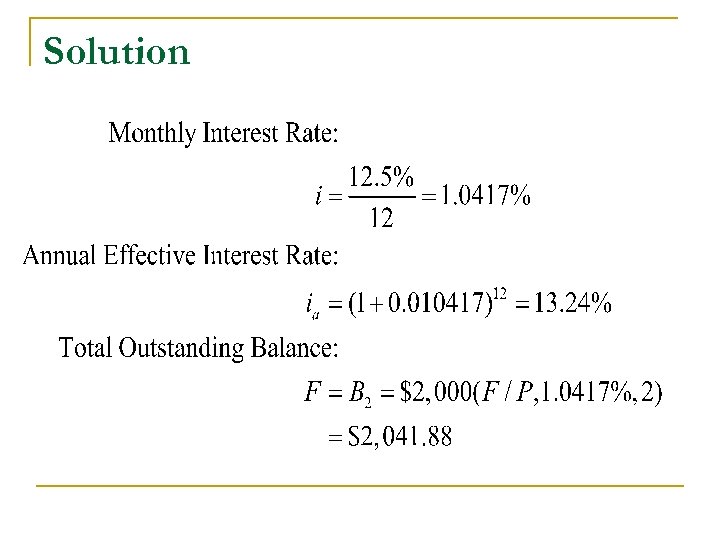 Solution
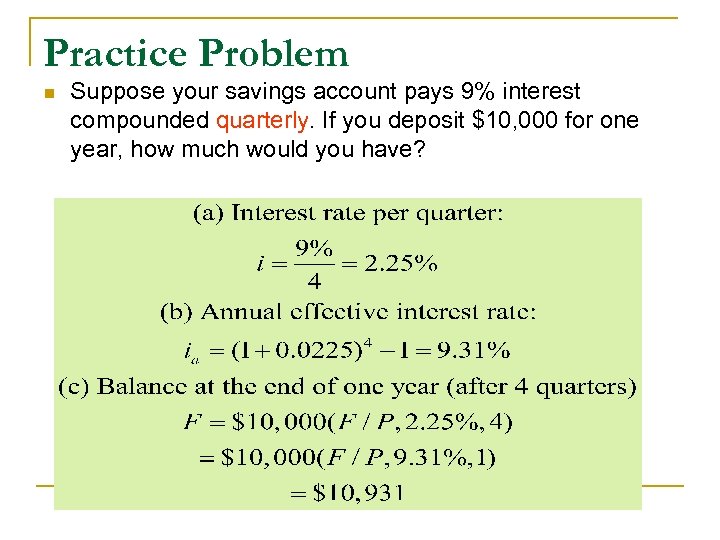 Practice Problem n Suppose your savings account pays 9% interest compounded quarterly. If you deposit $10, 000 for one year, how much would you have?
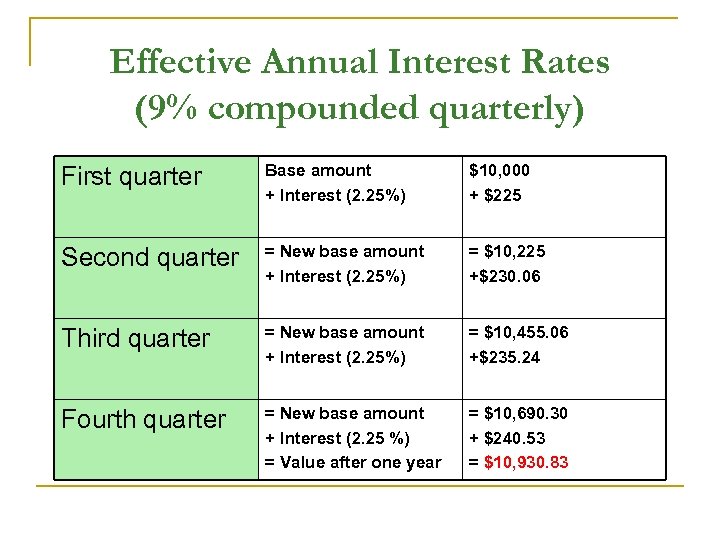 Effective Annual Interest Rates (9% compounded quarterly) First quarter Base amount + Interest (2. 25%) $10, 000 + $225 Second quarter = New base amount + Interest (2. 25%) = $10, 225 +$230. 06 Third quarter = New base amount + Interest (2. 25%) = $10, 455. 06 +$235. 24 Fourth quarter = New base amount + Interest (2. 25 %) = Value after one year = $10, 690. 30 + $240. 53 = $10, 930. 83
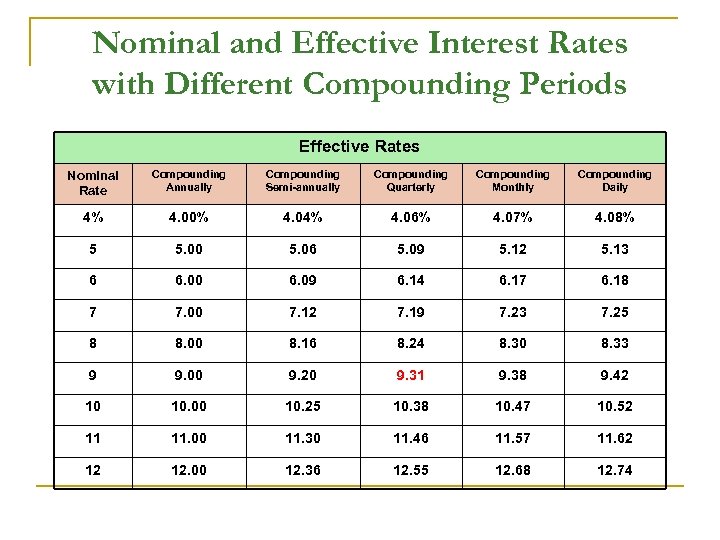 Nominal and Effective Interest Rates with Different Compounding Periods Effective Rates Nominal Rate Compounding Annually Compounding Semi-annually Compounding Quarterly Compounding Monthly Compounding Daily 4% 4. 00% 4. 04% 4. 06% 4. 07% 4. 08% 5 5. 00 5. 06 5. 09 5. 12 5. 13 6 6. 00 6. 09 6. 14 6. 17 6. 18 7 7. 00 7. 12 7. 19 7. 23 7. 25 8 8. 00 8. 16 8. 24 8. 30 8. 33 9 9. 00 9. 20 9. 31 9. 38 9. 42 10 10. 00 10. 25 10. 38 10. 47 10. 52 11 11. 00 11. 30 11. 46 11. 57 11. 62 12 12. 00 12. 36 12. 55 12. 68 12. 74
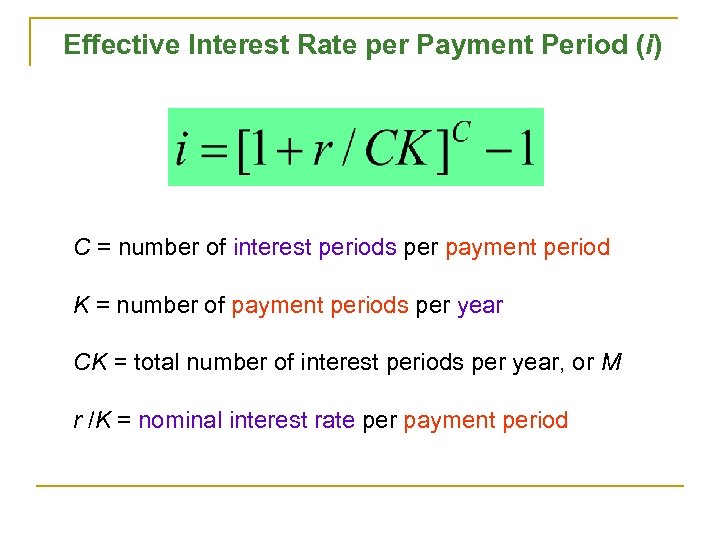 Effective Interest Rate per Payment Period (i) C = number of interest periods per payment period K = number of payment periods per year CK = total number of interest periods per year, or M r /K = nominal interest rate per payment period
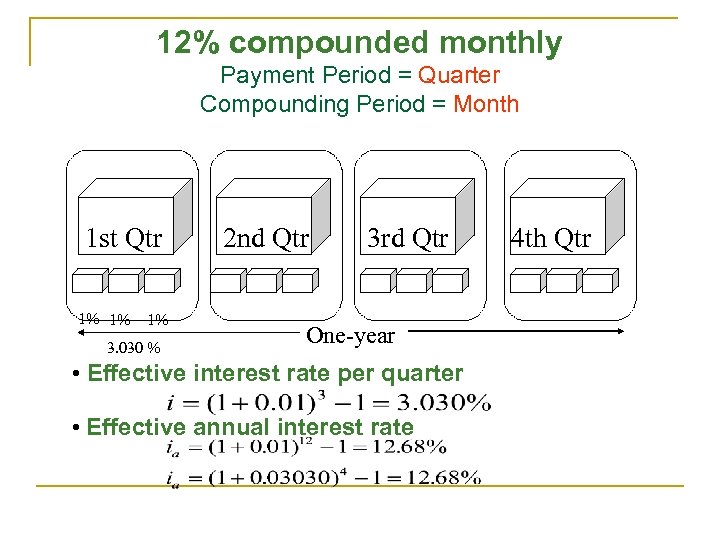 12% compounded monthly Payment Period = Quarter Compounding Period = Month 1 st Qtr 1% 1% 1% 3. 030 % 2 nd Qtr 3 rd Qtr One-year • Effective interest rate per quarter • Effective annual interest rate 4 th Qtr
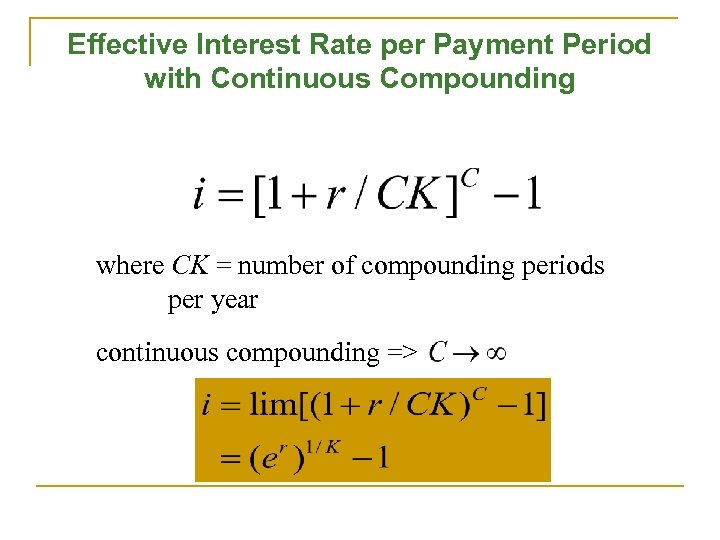 Effective Interest Rate per Payment Period with Continuous Compounding where CK = number of compounding periods per year continuous compounding =>
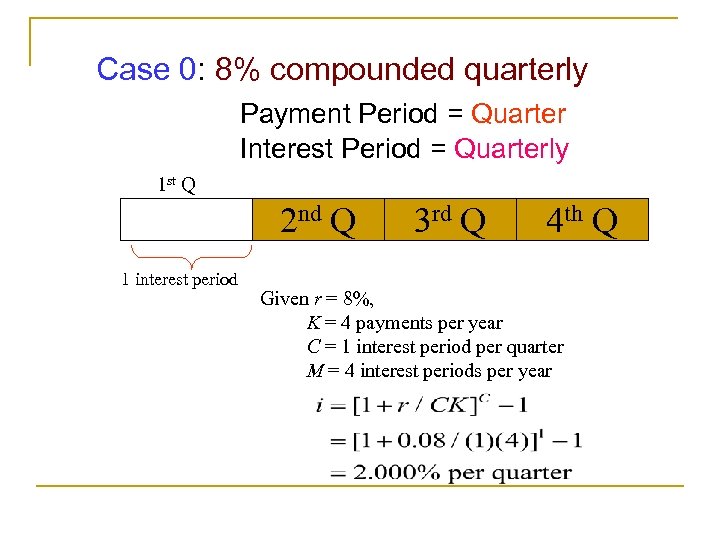 Case 0: 8% compounded quarterly Payment Period = Quarter Interest Period = Quarterly 1 st Q 2 nd Q 1 interest period 3 rd Q 4 th Q Given r = 8%, K = 4 payments per year C = 1 interest period per quarter M = 4 interest periods per year
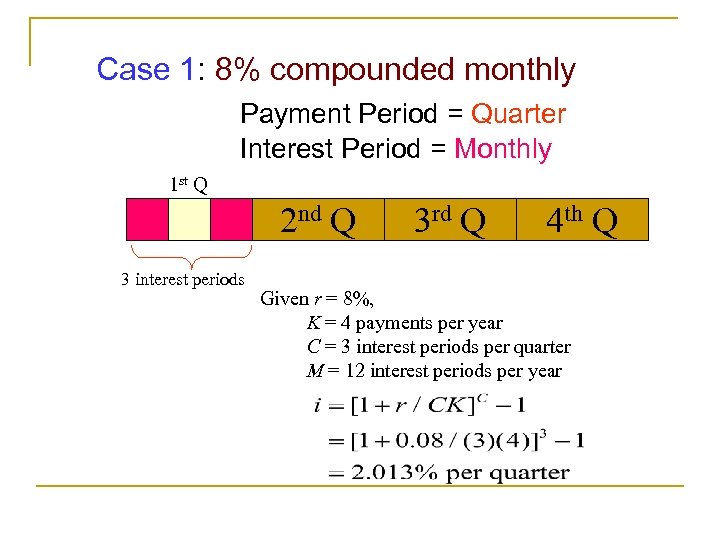 Case 1: 8% compounded monthly Payment Period = Quarter Interest Period = Monthly 1 st Q 2 nd Q 3 interest periods 3 rd Q 4 th Q Given r = 8%, K = 4 payments per year C = 3 interest periods per quarter M = 12 interest periods per year
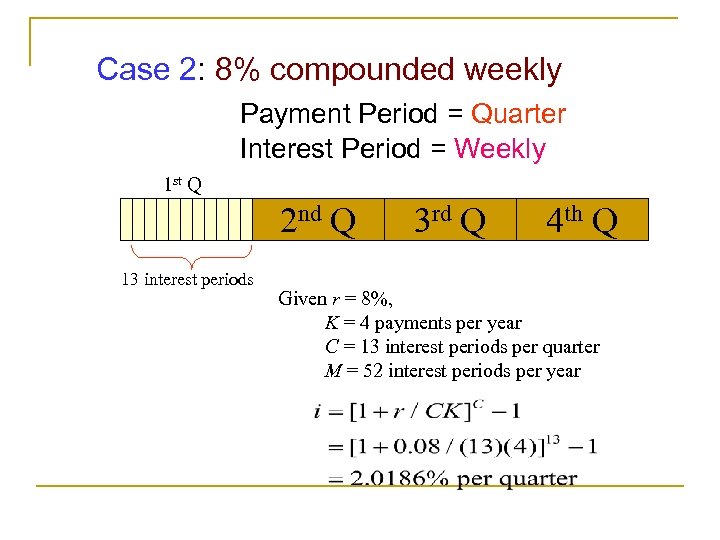 Case 2: 8% compounded weekly Payment Period = Quarter Interest Period = Weekly 1 st Q 2 nd Q 13 interest periods 3 rd Q 4 th Q Given r = 8%, K = 4 payments per year C = 13 interest periods per quarter M = 52 interest periods per year
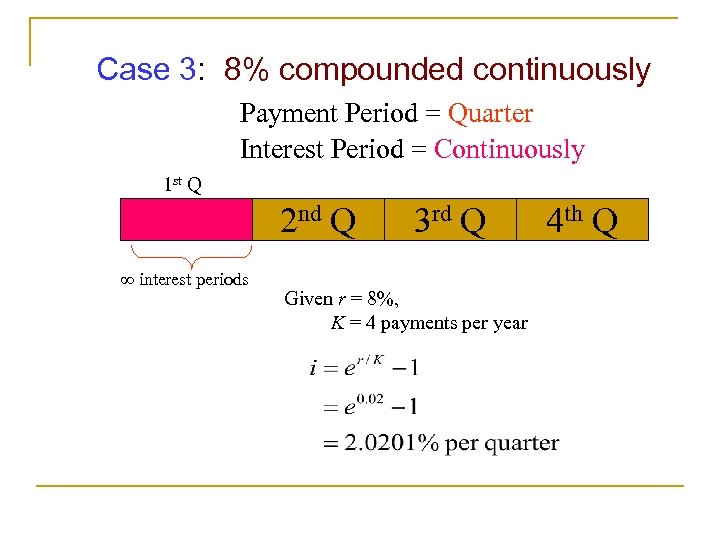 Case 3: 8% compounded continuously Payment Period = Quarter Interest Period = Continuously 1 st Q 2 nd Q interest periods 3 rd Q Given r = 8%, K = 4 payments per year 4 th Q
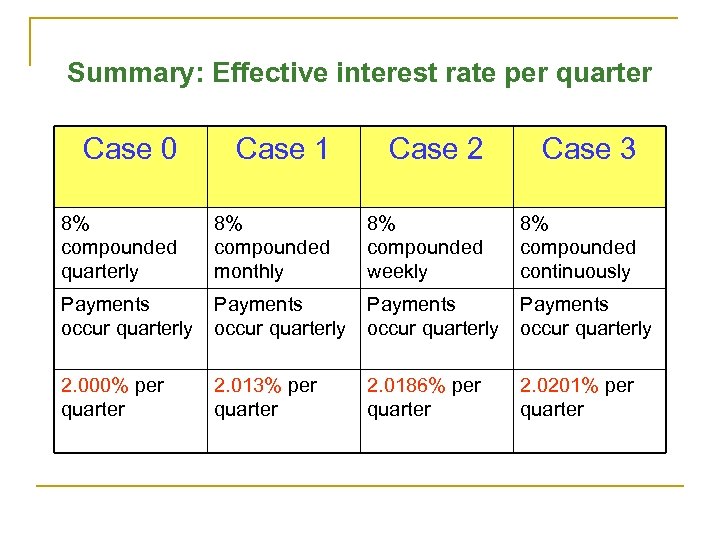 Summary: Effective interest rate per quarter Case 0 Case 1 Case 2 Case 3 8% compounded quarterly 8% compounded monthly 8% compounded weekly 8% compounded continuously Payments occur quarterly 2. 000% per quarter 2. 013% per quarter 2. 0186% per quarter 2. 0201% per quarter
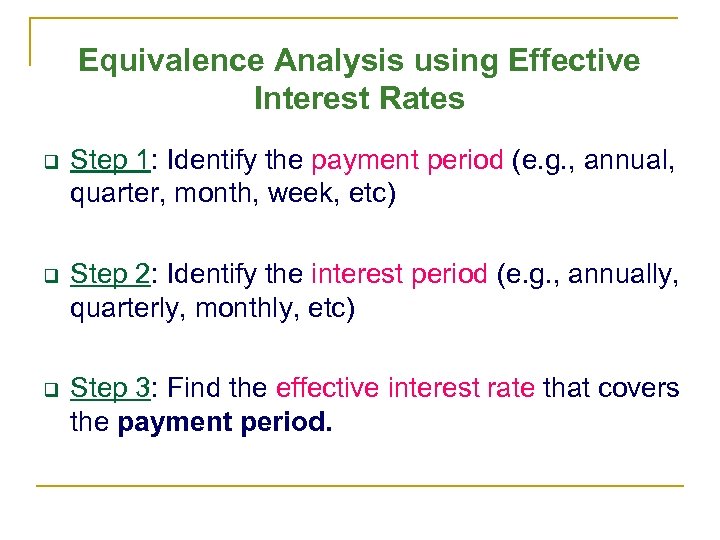 Equivalence Analysis using Effective Interest Rates q Step 1: Identify the payment period (e. g. , annual, quarter, month, week, etc) q Step 2: Identify the interest period (e. g. , annually, quarterly, monthly, etc) q Step 3: Find the effective interest rate that covers the payment period.
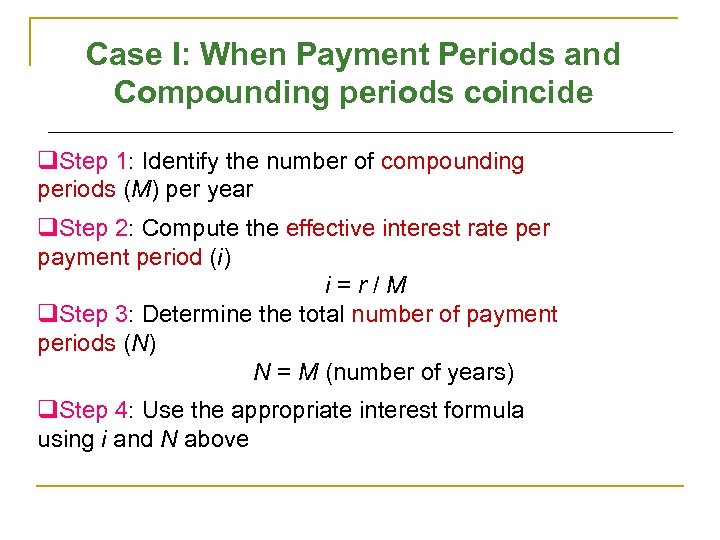 Case I: When Payment Periods and Compounding periods coincide q. Step 1: Identify the number of compounding periods (M) per year q. Step 2: Compute the effective interest rate per payment period (i) i=r/M q. Step 3: Determine the total number of payment periods (N) N = M (number of years) q. Step 4: Use the appropriate interest formula using i and N above
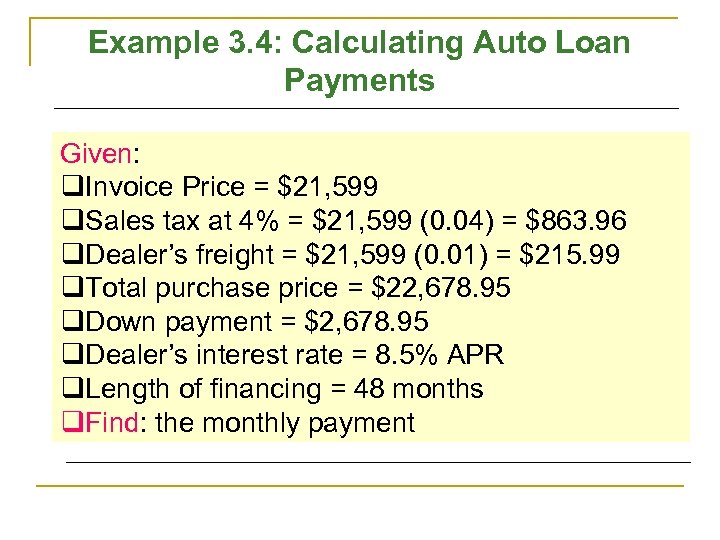 Example 3. 4: Calculating Auto Loan Payments Given: q. Invoice Price = $21, 599 q. Sales tax at 4% = $21, 599 (0. 04) = $863. 96 q. Dealer’s freight = $21, 599 (0. 01) = $215. 99 q. Total purchase price = $22, 678. 95 q. Down payment = $2, 678. 95 q. Dealer’s interest rate = 8. 5% APR q. Length of financing = 48 months q. Find: the monthly payment
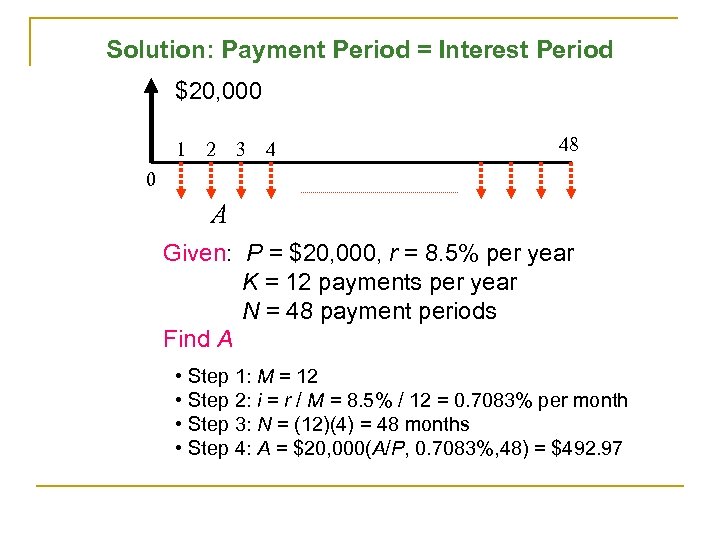 Solution: Payment Period = Interest Period $20, 000 1 2 3 4 48 0 A Given: P = $20, 000, r = 8. 5% per year K = 12 payments per year N = 48 payment periods Find A • Step 1: M = 12 • Step 2: i = r / M = 8. 5% / 12 = 0. 7083% per month • Step 3: N = (12)(4) = 48 months • Step 4: A = $20, 000(A/P, 0. 7083%, 48) = $492. 97
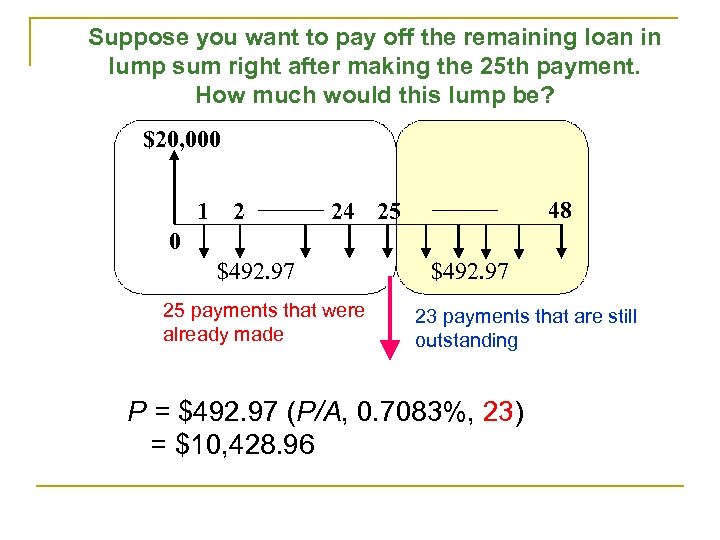 Suppose you want to pay off the remaining loan in lump sum right after making the 25 th payment. How much would this lump be? $20, 000 1 2 48 24 25 0 $492. 97 25 payments that were already made $492. 97 23 payments that are still outstanding P = $492. 97 (P/A, 0. 7083%, 23) = $10, 428. 96
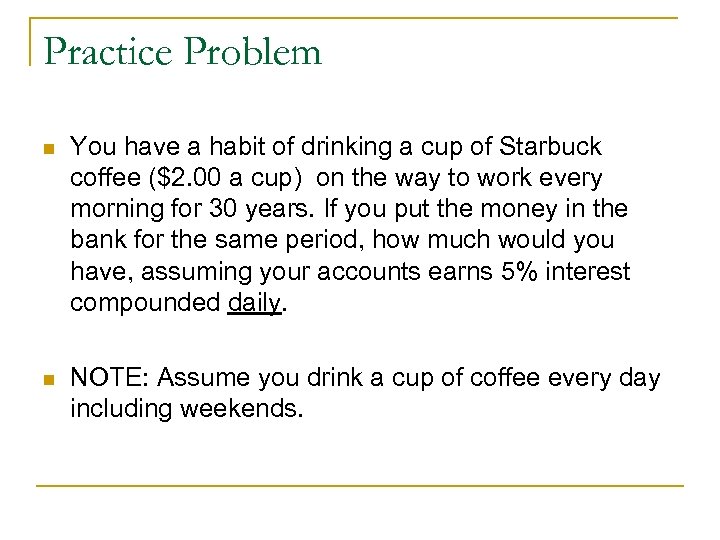 Practice Problem n You have a habit of drinking a cup of Starbuck coffee ($2. 00 a cup) on the way to work every morning for 30 years. If you put the money in the bank for the same period, how much would you have, assuming your accounts earns 5% interest compounded daily. n NOTE: Assume you drink a cup of coffee every day including weekends.
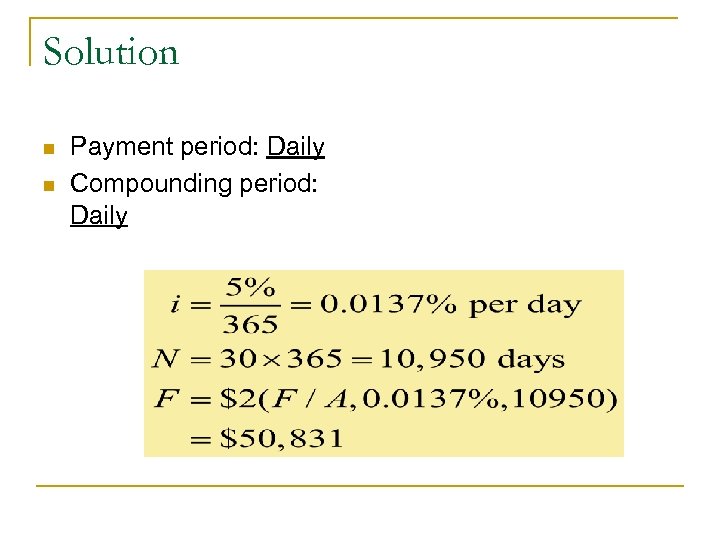 Solution n n Payment period: Daily Compounding period: Daily
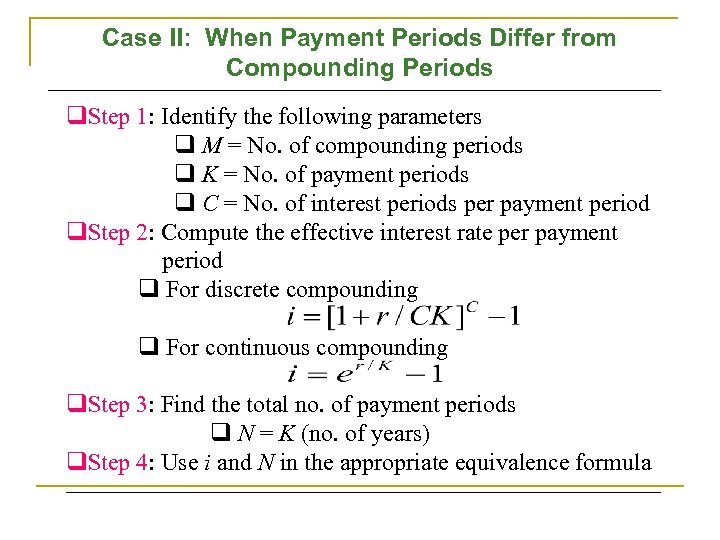 Case II: When Payment Periods Differ from Compounding Periods q. Step 1: Identify the following parameters q M = No. of compounding periods q K = No. of payment periods q C = No. of interest periods per payment period q. Step 2: Compute the effective interest rate per payment period q For discrete compounding q For continuous compounding q. Step 3: Find the total no. of payment periods q N = K (no. of years) q. Step 4: Use i and N in the appropriate equivalence formula
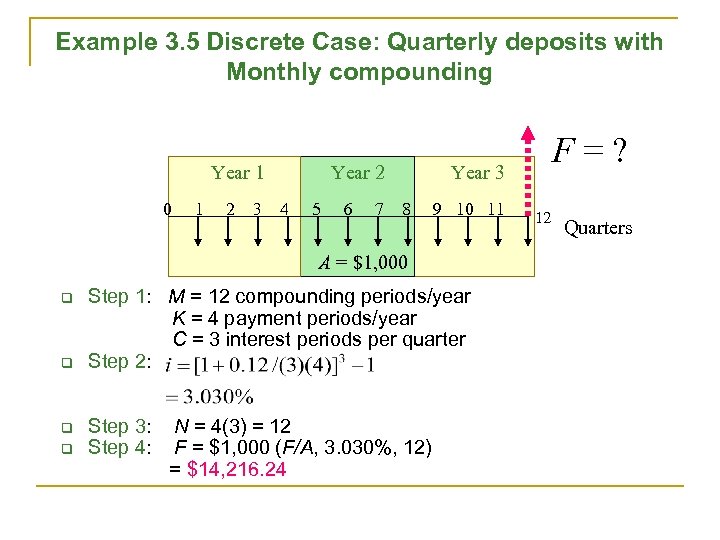 Example 3. 5 Discrete Case: Quarterly deposits with Monthly compounding Year 1 0 1 2 3 Year 2 4 5 6 7 Year 3 8 9 10 11 A = $1, 000 q q Step 1: M = 12 compounding periods/year K = 4 payment periods/year C = 3 interest periods per quarter Step 2: Step 3: Step 4: F=? N = 4(3) = 12 F = $1, 000 (F/A, 3. 030%, 12) = $14, 216. 24 12 Quarters
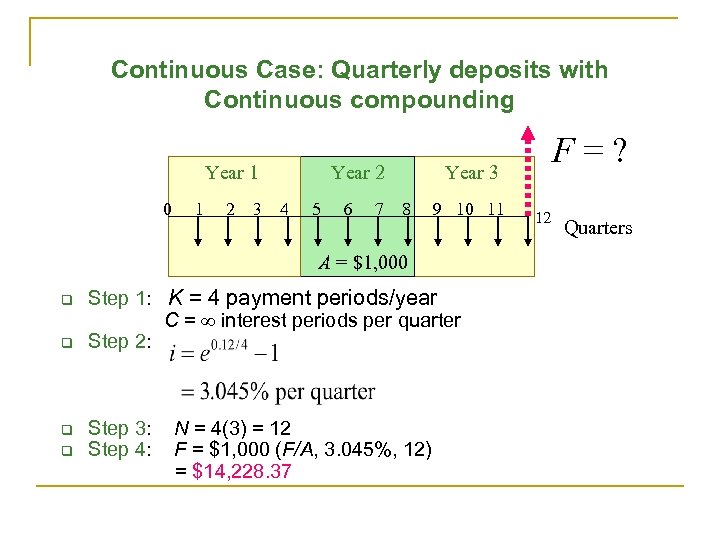 Continuous Case: Quarterly deposits with Continuous compounding Year 1 0 1 2 3 Year 2 4 5 6 7 Year 3 8 9 10 11 A = $1, 000 q q Step 1: K = 4 payment periods/year C = interest periods per quarter Step 2: Step 3: Step 4: F=? N = 4(3) = 12 F = $1, 000 (F/A, 3. 045%, 12) = $14, 228. 37 12 Quarters
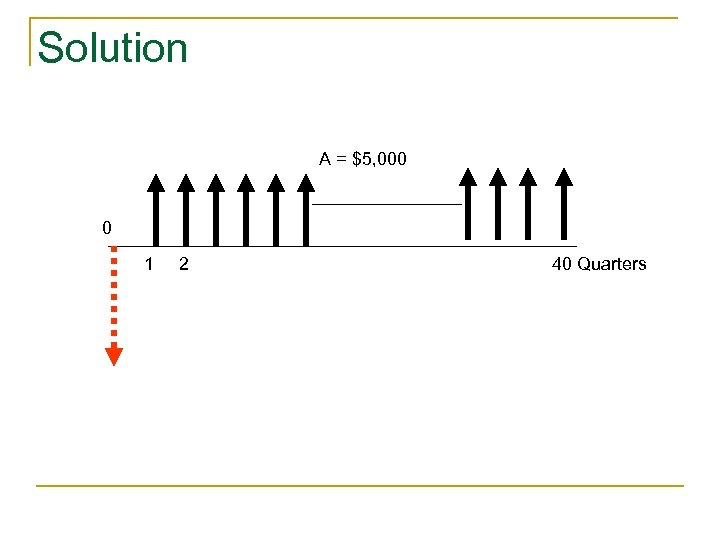
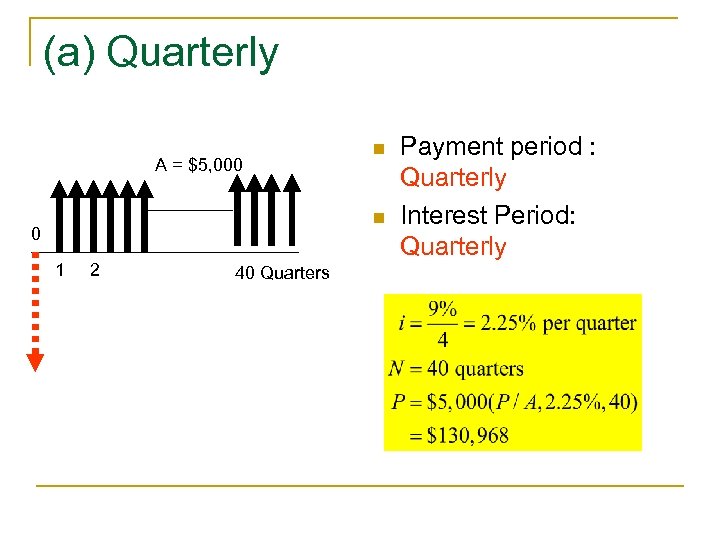
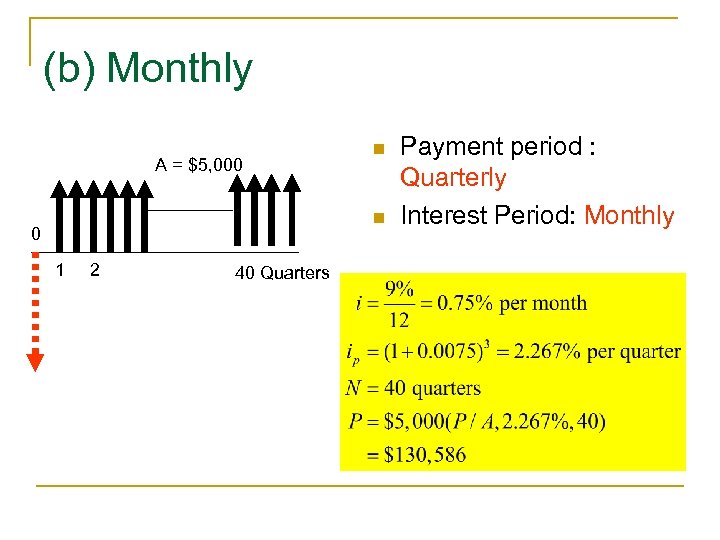
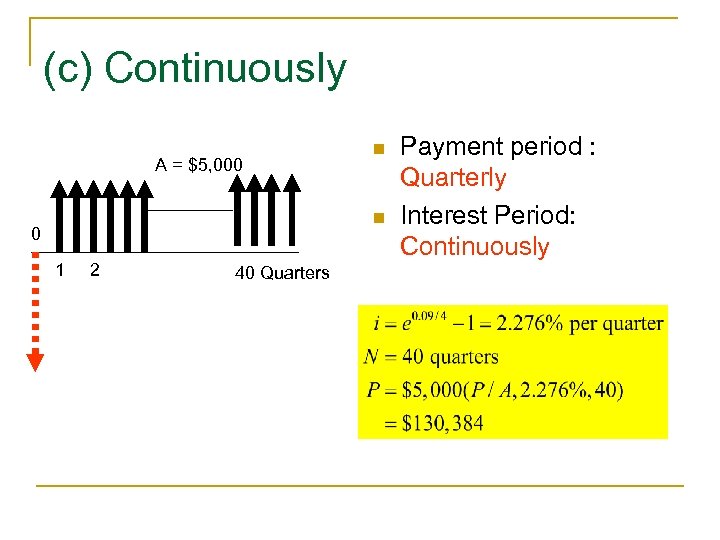
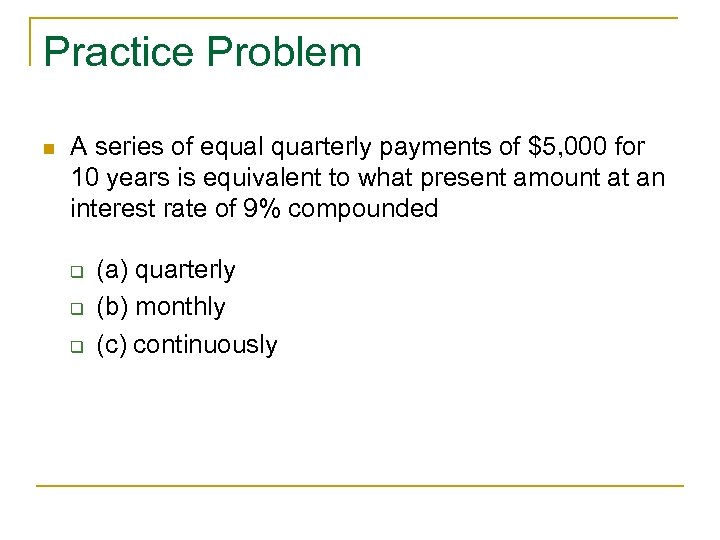 Practice Problem n A series of equal quarterly payments of $5, 000 for 10 years is equivalent to what present amount at an interest rate of 9% compounded q q q (a) quarterly (b) monthly (c) continuously
 Solution A = $5, 000 0 1 2 40 Quarters
 (a) Quarterly A = $5, 000 n n 0 1 2 40 Quarters Payment period : Quarterly Interest Period: Quarterly
 (b) Monthly A = $5, 000 n n 0 1 2 40 Quarters Payment period : Quarterly Interest Period: Monthly
 (c) Continuously A = $5, 000 n n 0 1 2 40 Quarters Payment period : Quarterly Interest Period: Continuously
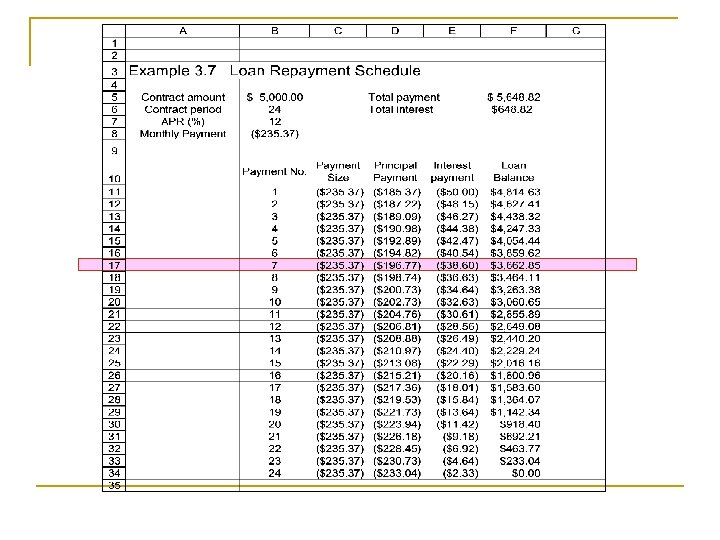
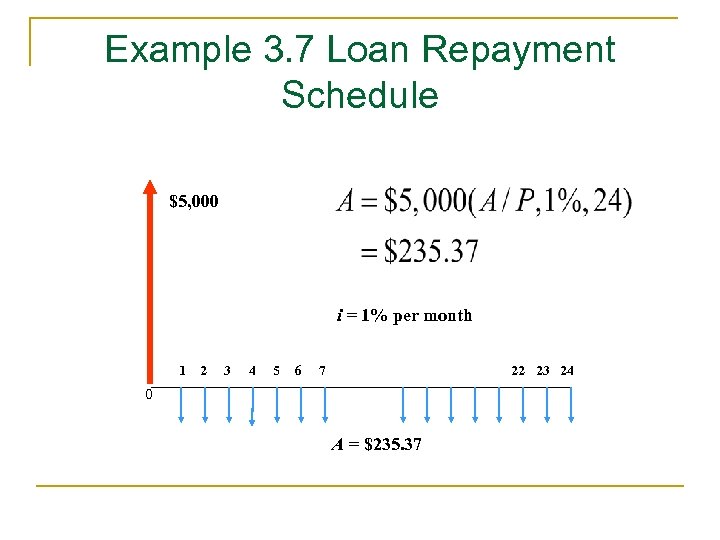 Example 3. 7 Loan Repayment Schedule $5, 000 i = 1% per month 1 2 3 4 5 6 7 22 23 24 0 A = $235. 37
 Practice Problem n Consider the 7 th payment ($235. 37) n (a) How much is the interest payment? n (b) What is the amount of principal payment?
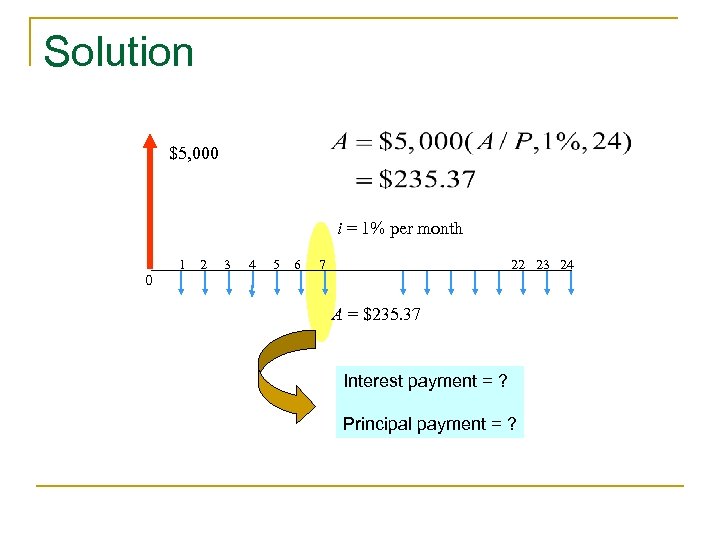 Solution $5, 000 i = 1% per month 1 2 3 4 5 6 7 22 23 24 0 A = $235. 37 Interest payment = ? Principal payment = ?
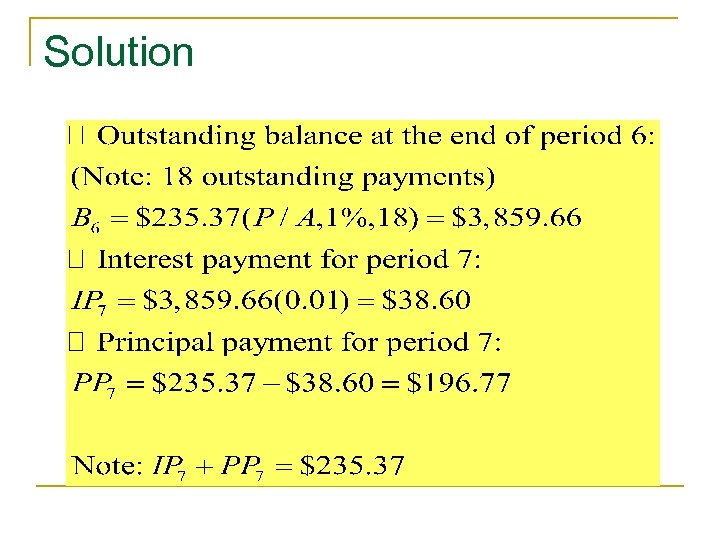 Solution
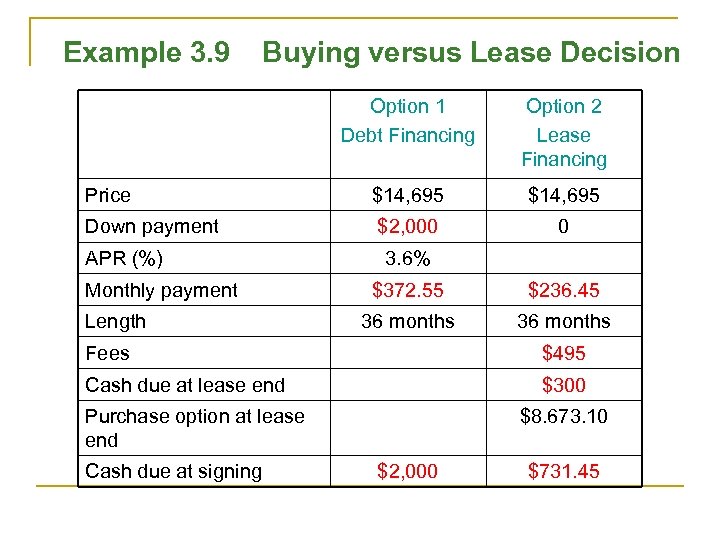 Example 3. 9 Buying versus Lease Decision Option 1 Debt Financing Option 2 Lease Financing Price $14, 695 Down payment $2, 000 0 APR (%) Monthly payment Length 3. 6% $372. 55 $236. 45 36 months Fees $495 Cash due at lease end $300 Purchase option at lease end Cash due at signing $8. 673. 10 $2, 000 $731. 45
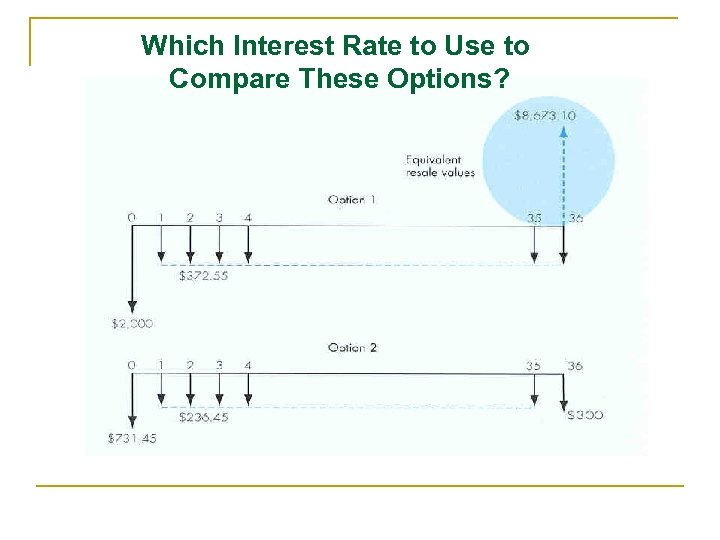 Which Interest Rate to Use to Compare These Options?
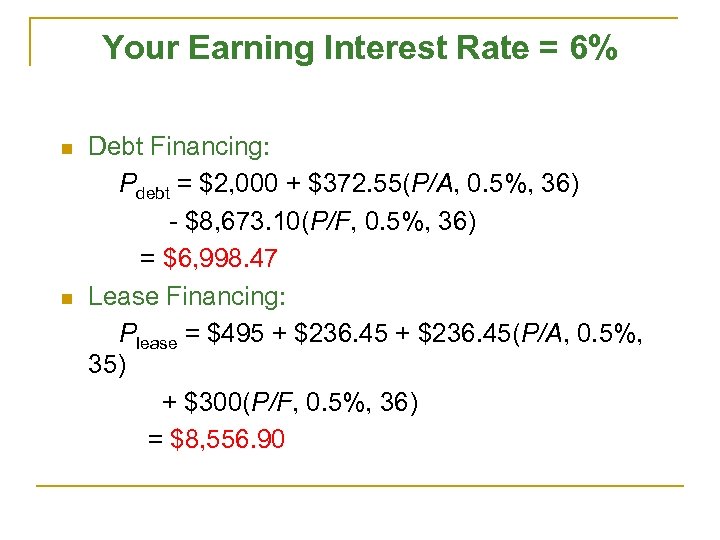 Your Earning Interest Rate = 6% n n Debt Financing: Pdebt = $2, 000 + $372. 55(P/A, 0. 5%, 36) - $8, 673. 10(P/F, 0. 5%, 36) = $6, 998. 47 Lease Financing: Please = $495 + $236. 45(P/A, 0. 5%, 35) + $300(P/F, 0. 5%, 36) = $8, 556. 90
 Summary n n n Financial institutions often quote interest rate based on an APR. In all financial analysis, we need to convert the APR into an appropriate effective interest rate based on a payment period. When payment period and interest period differ, calculate an effective interest rate that covers the payment period. Then use the appropriate interest formulas to determine the equivalent values