


 Скачать презентацию Chapter 3 Transport Layer A note on the
f56607f3d9466ff0081b3af934ffbf86.ppt
- Количество слайдов: 56
 Chapter 3 Transport Layer A note on the use of these ppt slides: We’re making these slides freely available to all (faculty, students, readers). They’re in Power. Point form so you see the animations; and can add, modify, and delete slides (including this one) and slide content to suit your needs. They obviously represent a lot of work on our part. In return for use, we only ask the following: v If you use these slides (e. g. , in a class) that you mention their source (after all, we’d like people to use our book!) v If you post any slides on a www site, that you note that they are adapted from (or perhaps identical to) our slides, and note our copyright of this material. Computer Networking: A Top Down Approach 6 th edition Jim Kurose, Keith Ross Addison-Wesley March 2012 Thanks and enjoy! JFK/KWR All material copyright 1996 -2012 J. F Kurose and K. W. Ross, All Rights Reserved Transport Layer 3 -1
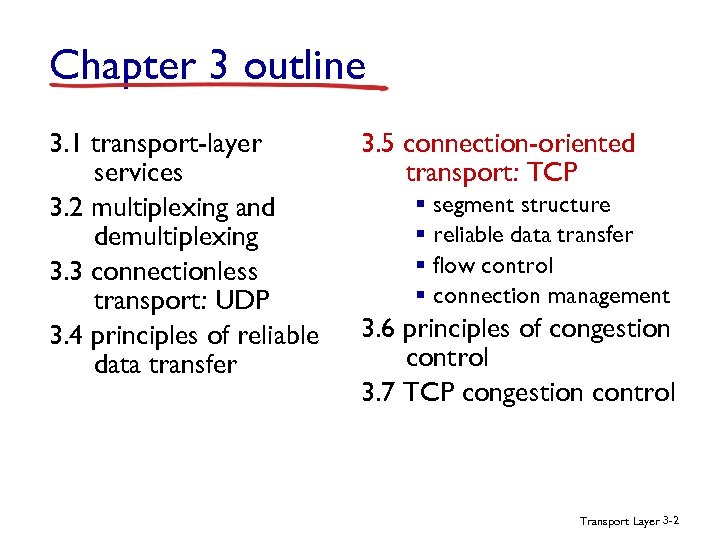 Chapter 3 outline 3. 1 transport-layer services 3. 2 multiplexing and demultiplexing 3. 3 connectionless transport: UDP 3. 4 principles of reliable data transfer 3. 5 connection-oriented transport: TCP § segment structure § reliable data transfer § flow control § connection management 3. 6 principles of congestion control 3. 7 TCP congestion control Transport Layer 3 -2
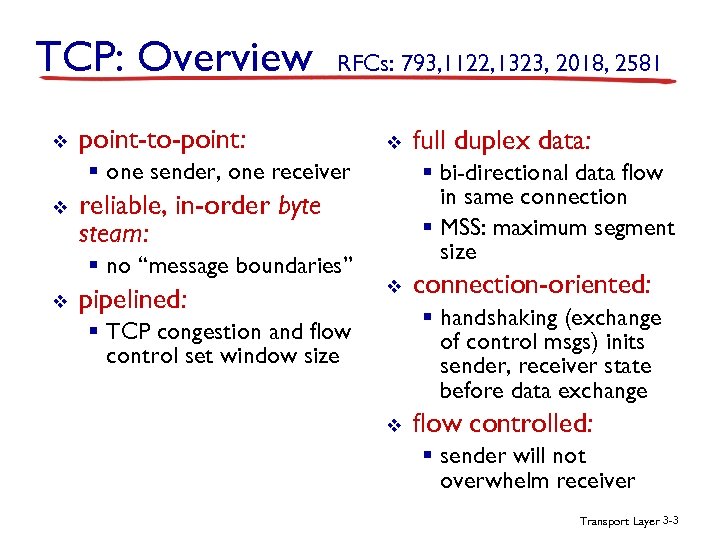 TCP: Overview v RFCs: 793, 1122, 1323, 2018, 2581 point-to-point: v § one sender, one receiver v v § bi-directional data flow in same connection § MSS: maximum segment size reliable, in-order byte steam: § no “message boundaries” pipelined: full duplex data: v connection-oriented: § handshaking (exchange of control msgs) inits sender, receiver state before data exchange § TCP congestion and flow control set window size v flow controlled: § sender will not overwhelm receiver Transport Layer 3 -3
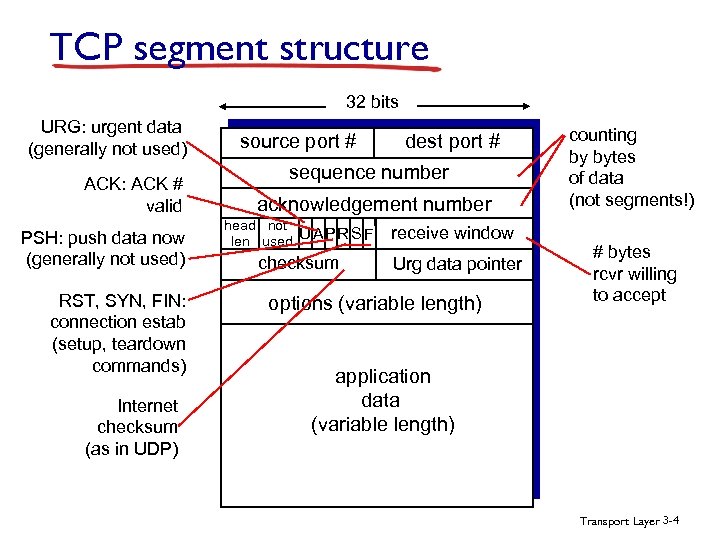 TCP segment structure 32 bits URG: urgent data (generally not used) ACK: ACK # valid PSH: push data now (generally not used) RST, SYN, FIN: connection estab (setup, teardown commands) Internet checksum (as in UDP) source port # dest port # sequence number acknowledgement number head not UAP R S F len used checksum receive window Urg data pointer options (variable length) counting by bytes of data (not segments!) # bytes rcvr willing to accept application data (variable length) Transport Layer 3 -4
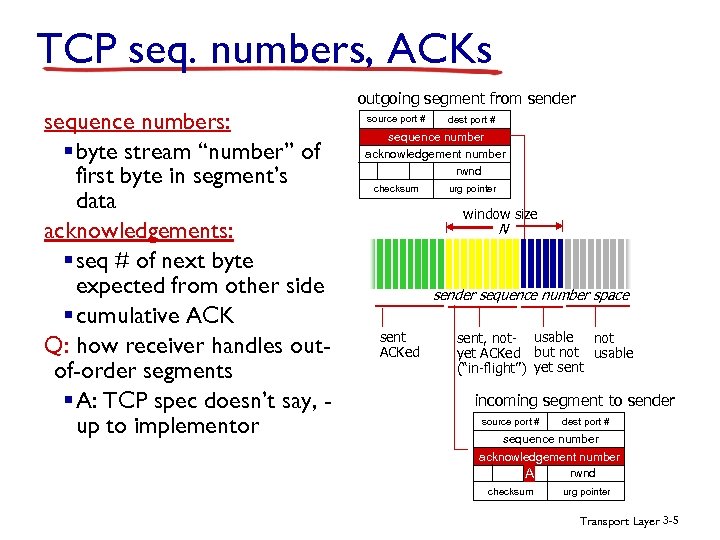 TCP seq. numbers, ACKs sequence numbers: § byte stream “number” of first byte in segment’s data acknowledgements: § seq # of next byte expected from other side § cumulative ACK Q: how receiver handles outof-order segments § A: TCP spec doesn’t say, up to implementor outgoing segment from sender source port # dest port # sequence number acknowledgement number rwnd checksum urg pointer window size N sender sequence number space sent ACKed sent, not- usable not yet ACKed but not usable (“in-flight”) yet sent incoming segment to sender source port # dest port # sequence number acknowledgement number rwnd A checksum urg pointer Transport Layer 3 -5
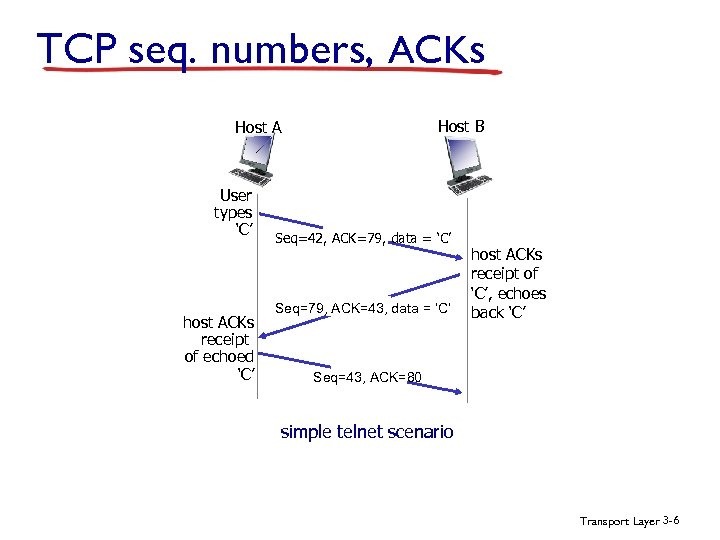 TCP seq. numbers, ACKs Host B Host A User types ‘C’ host ACKs receipt of echoed ‘C’ Seq=42, ACK=79, data = ‘C’ Seq=79, ACK=43, data = ‘C’ host ACKs receipt of ‘C’, echoes back ‘C’ Seq=43, ACK=80 simple telnet scenario Transport Layer 3 -6
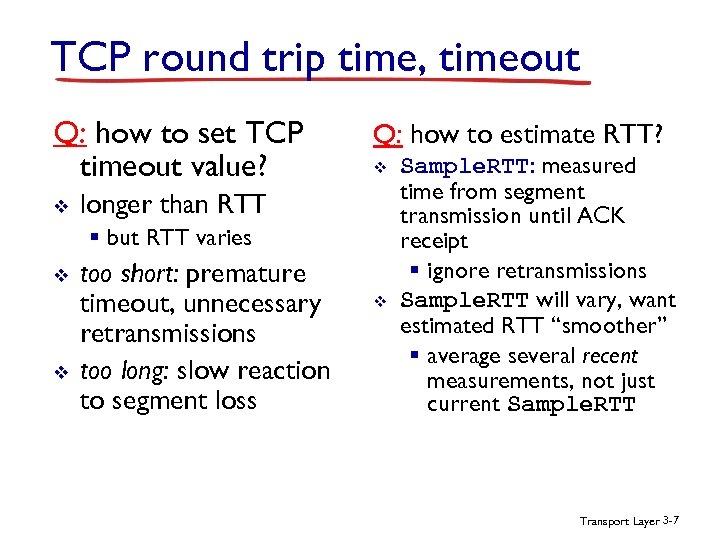 TCP round trip time, timeout Q: how to set TCP timeout value? v Q: how to estimate RTT? v longer than RTT § but RTT varies v v too short: premature timeout, unnecessary retransmissions too long: slow reaction to segment loss v Sample. RTT: measured time from segment transmission until ACK receipt § ignore retransmissions Sample. RTT will vary, want estimated RTT “smoother” § average several recent measurements, not just current Sample. RTT Transport Layer 3 -7
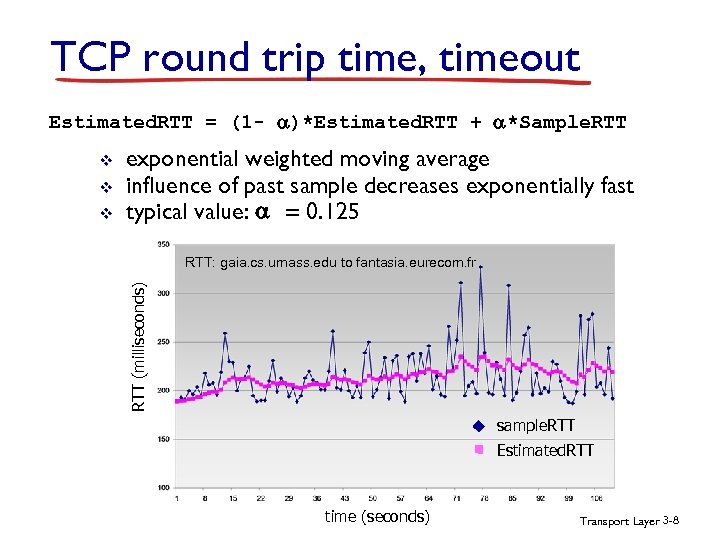 TCP round trip time, timeout Estimated. RTT = (1 - )*Estimated. RTT + *Sample. RTT v v exponential weighted moving average influence of past sample decreases exponentially fast typical value: = 0. 125 RTT: gaia. cs. umass. edu to fantasia. eurecom. fr RTT (milliseconds) v sample. RTT Estimated. RTT time (seconds) Transport Layer 3 -8
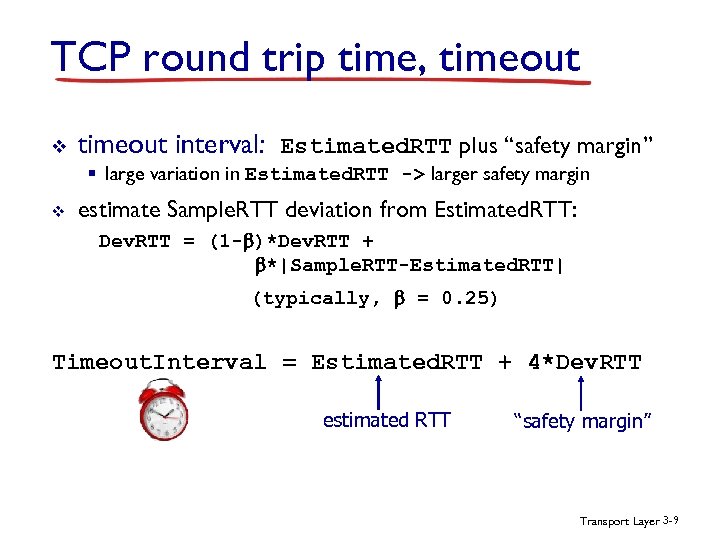 TCP round trip time, timeout v timeout interval: Estimated. RTT plus “safety margin” § large variation in Estimated. RTT -> larger safety margin v estimate Sample. RTT deviation from Estimated. RTT: Dev. RTT = (1 - )*Dev. RTT + *|Sample. RTT-Estimated. RTT| (typically, = 0. 25) Timeout. Interval = Estimated. RTT + 4*Dev. RTT estimated RTT “safety margin” Transport Layer 3 -9
 Chapter 3 outline 3. 1 transport-layer services 3. 2 multiplexing and demultiplexing 3. 3 connectionless transport: UDP 3. 4 principles of reliable data transfer 3. 5 connection-oriented transport: TCP § segment structure § reliable data transfer § flow control § connection management 3. 6 principles of congestion control 3. 7 TCP congestion control Transport Layer 3 -10
 TCP reliable data transfer v TCP creates rdt service on top of IP’s unreliable service § pipelined segments § cumulative acks § single retransmission timer v retransmissions triggered by: let’s initially consider simplified TCP sender: § ignore duplicate acks § ignore flow control, congestion control § timeout events § duplicate acks Transport Layer 3 -11
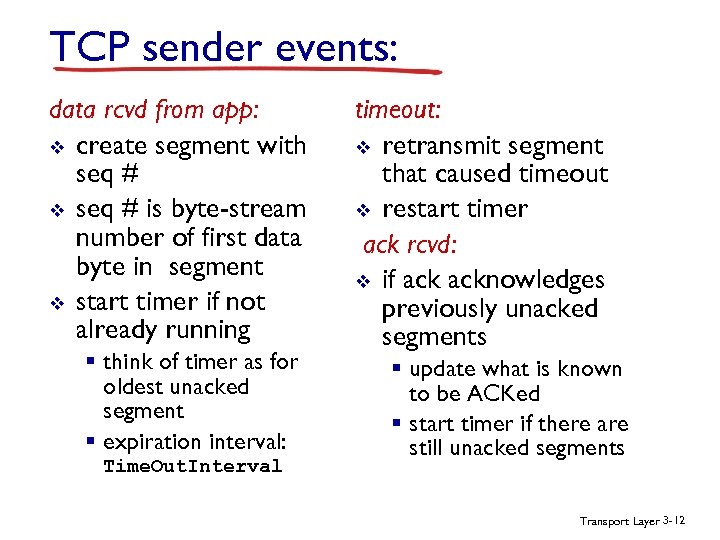 TCP sender events: data rcvd from app: v create segment with seq # v seq # is byte-stream number of first data byte in segment v start timer if not already running § think of timer as for oldest unacked segment § expiration interval: Time. Out. Interval timeout: v retransmit segment that caused timeout v restart timer ack rcvd: v if acknowledges previously unacked segments § update what is known to be ACKed § start timer if there are still unacked segments Transport Layer 3 -12
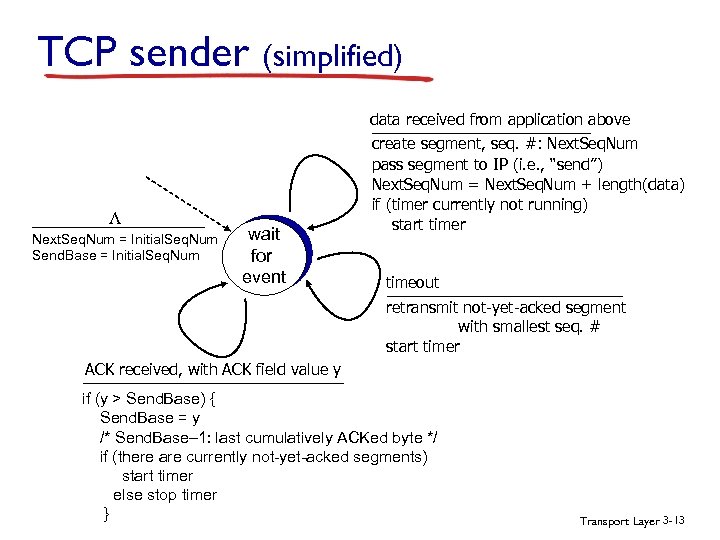 TCP sender (simplified) data received from application above L Next. Seq. Num = Initial. Seq. Num Send. Base = Initial. Seq. Num wait for event create segment, seq. #: Next. Seq. Num pass segment to IP (i. e. , “send”) Next. Seq. Num = Next. Seq. Num + length(data) if (timer currently not running) start timer timeout retransmit not-yet-acked segment with smallest seq. # start timer ACK received, with ACK field value y if (y > Send. Base) { Send. Base = y /* Send. Base– 1: last cumulatively ACKed byte */ if (there are currently not-yet-acked segments) start timer else stop timer } Transport Layer 3 -13
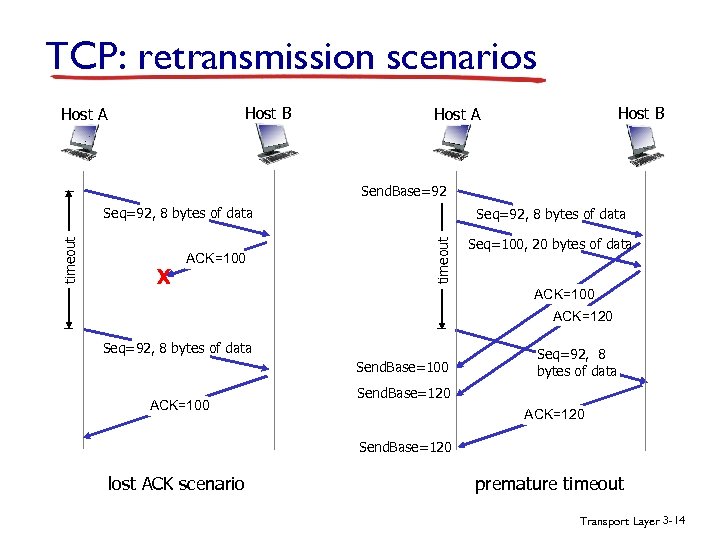 TCP: retransmission scenarios Host B Host A Send. Base=92 X ACK=100 Seq=92, 8 bytes of data timeout Seq=92, 8 bytes of data Seq=100, 20 bytes of data ACK=100 ACK=120 Seq=92, 8 bytes of data Send. Base=100 ACK=100 Seq=92, 8 bytes of data Send. Base=120 ACK=120 Send. Base=120 lost ACK scenario premature timeout Transport Layer 3 -14
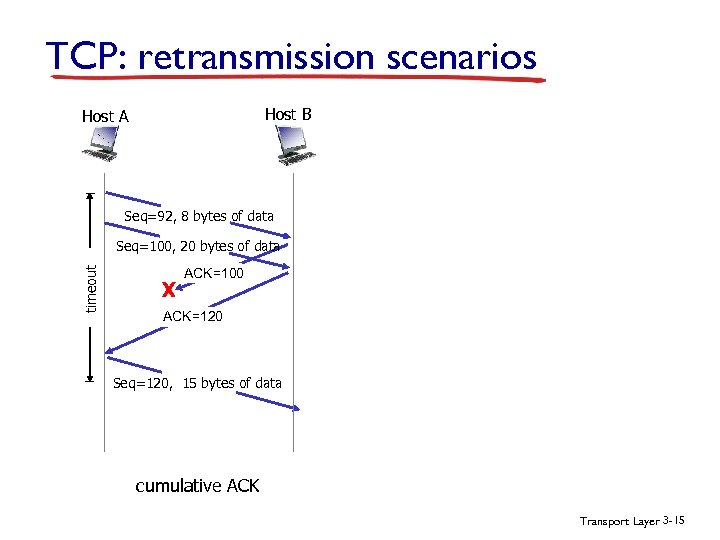 TCP: retransmission scenarios Host B Host A Seq=92, 8 bytes of data timeout Seq=100, 20 bytes of data X ACK=100 ACK=120 Seq=120, 15 bytes of data cumulative ACK Transport Layer 3 -15
![TCP ACK generation [RFC 1122, RFC 2581] event at receiver TCP receiver action arrival](https://present5.com/presentation/f56607f3d9466ff0081b3af934ffbf86/image-16.jpg "TCP ACK generation [RFC 1122, RFC 2581] event at receiver TCP receiver action arrival") TCP ACK generation [RFC 1122, RFC 2581] event at receiver TCP receiver action arrival of in-order segment with expected seq #. All data up to expected seq # already ACKed delayed ACK. Wait up to 500 ms for next segment. If no next segment, send ACK arrival of in-order segment with expected seq #. One other segment has ACK pending immediately send single cumulative ACK, ACKing both in-order segments arrival of out-of-order segment higher-than-expect seq. #. Gap detected immediately send duplicate ACK, indicating seq. # of next expected byte arrival of segment that partially or completely fills gap immediate send ACK, provided that segment starts at lower end of gap Transport Layer 3 -16
TCP ACK generation [RFC 1122, RFC 2581] event at receiver TCP receiver action arrival of in-order segment with expected seq #. All data up to expected seq # already ACKed delayed ACK. Wait up to 500 ms for next segment. If no next segment, send ACK arrival of in-order segment with expected seq #. One other segment has ACK pending immediately send single cumulative ACK, ACKing both in-order segments arrival of out-of-order segment higher-than-expect seq. #. Gap detected immediately send duplicate ACK, indicating seq. # of next expected byte arrival of segment that partially or completely fills gap immediate send ACK, provided that segment starts at lower end of gap Transport Layer 3 -16
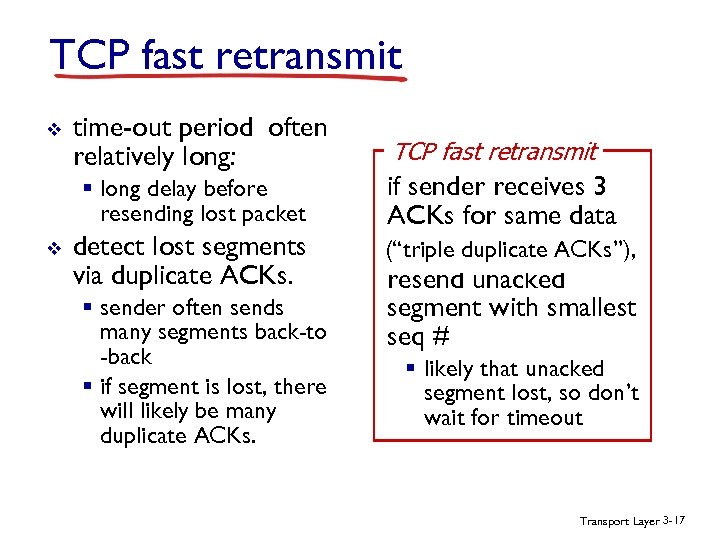 TCP fast retransmit v time-out period often relatively long: § long delay before resending lost packet v detect lost segments via duplicate ACKs. § sender often sends many segments back-to -back § if segment is lost, there will likely be many duplicate ACKs. TCP fast retransmit if sender receives 3 ACKs for same data (“triple duplicate ACKs”), resend unacked segment with smallest seq # § likely that unacked segment lost, so don’t wait for timeout Transport Layer 3 -17
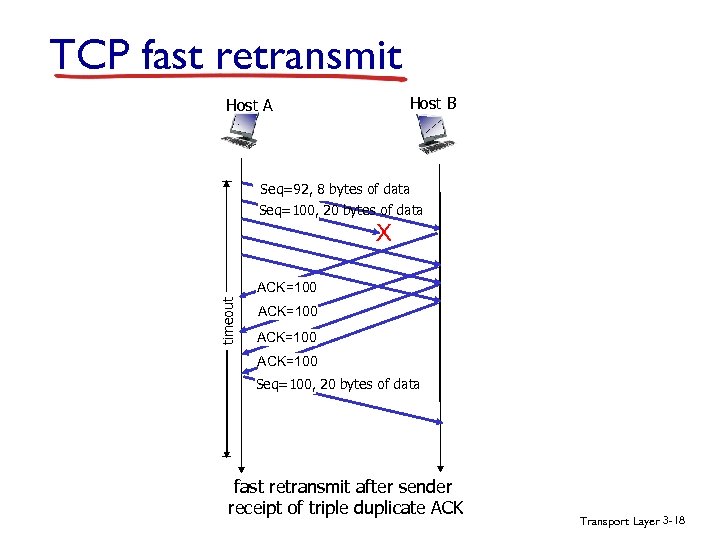 TCP fast retransmit Host B Host A Seq=92, 8 bytes of data Seq=100, 20 bytes of data X timeout ACK=100 Seq=100, 20 bytes of data fast retransmit after sender receipt of triple duplicate ACK Transport Layer 3 -18
 Chapter 3 outline 3. 1 transport-layer services 3. 2 multiplexing and demultiplexing 3. 3 connectionless transport: UDP 3. 4 principles of reliable data transfer 3. 5 connection-oriented transport: TCP § segment structure § reliable data transfer § flow control § connection management 3. 6 principles of congestion control 3. 7 TCP congestion control Transport Layer 3 -19
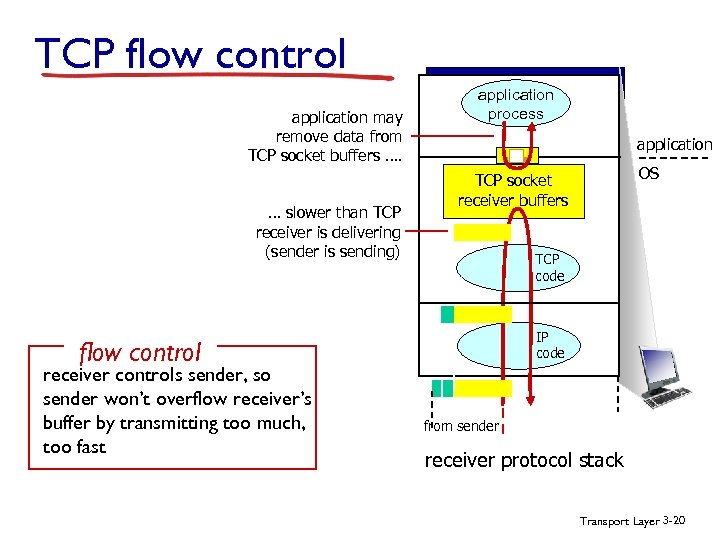 TCP flow control application may remove data from TCP socket buffers …. … slower than TCP receiver is delivering (sender is sending) application process application TCP code IP code flow control receiver controls sender, so sender won’t overflow receiver’s buffer by transmitting too much, too fast OS TCP socket receiver buffers from sender receiver protocol stack Transport Layer 3 -20
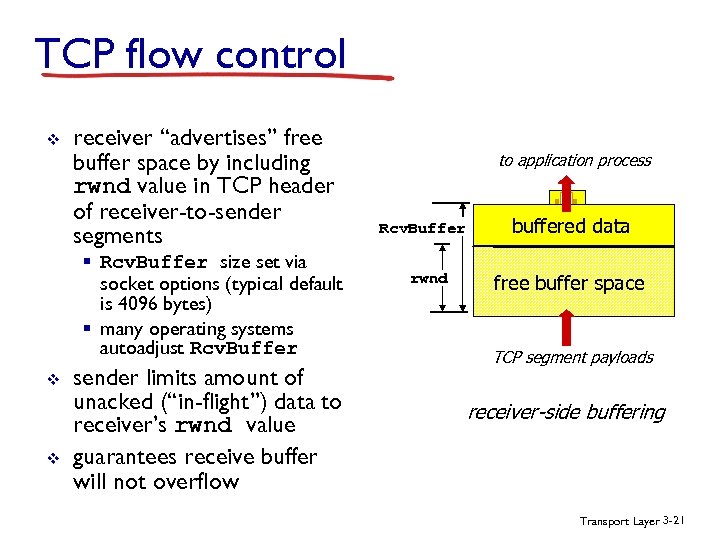 TCP flow control v receiver “advertises” free buffer space by including rwnd value in TCP header of receiver-to-sender segments § Rcv. Buffer size set via socket options (typical default is 4096 bytes) § many operating systems autoadjust Rcv. Buffer v v sender limits amount of unacked (“in-flight”) data to receiver’s rwnd value guarantees receive buffer will not overflow to application process Rcv. Buffer rwnd buffered data free buffer space TCP segment payloads receiver-side buffering Transport Layer 3 -21
 Chapter 3 outline 3. 1 transport-layer services 3. 2 multiplexing and demultiplexing 3. 3 connectionless transport: UDP 3. 4 principles of reliable data transfer 3. 5 connection-oriented transport: TCP § segment structure § reliable data transfer § flow control § connection management 3. 6 principles of congestion control 3. 7 TCP congestion control Transport Layer 3 -22
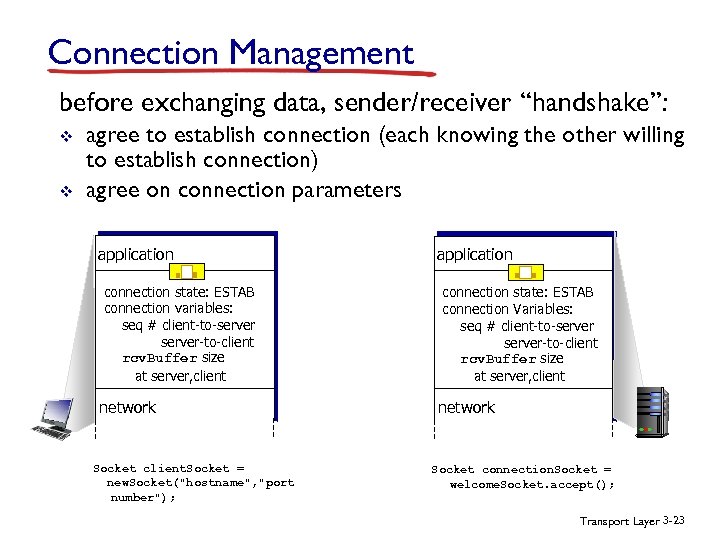 Connection Management before exchanging data, sender/receiver “handshake”: v v agree to establish connection (each knowing the other willing to establish connection) agree on connection parameters application connection state: ESTAB connection variables: seq # client-to-server-to-client rcv. Buffer size at server, client network Socket client. Socket = new. Socket("hostname", "port number"); application connection state: ESTAB connection Variables: seq # client-to-server-to-client rcv. Buffer size at server, client network Socket connection. Socket = welcome. Socket. accept(); Transport Layer 3 -23
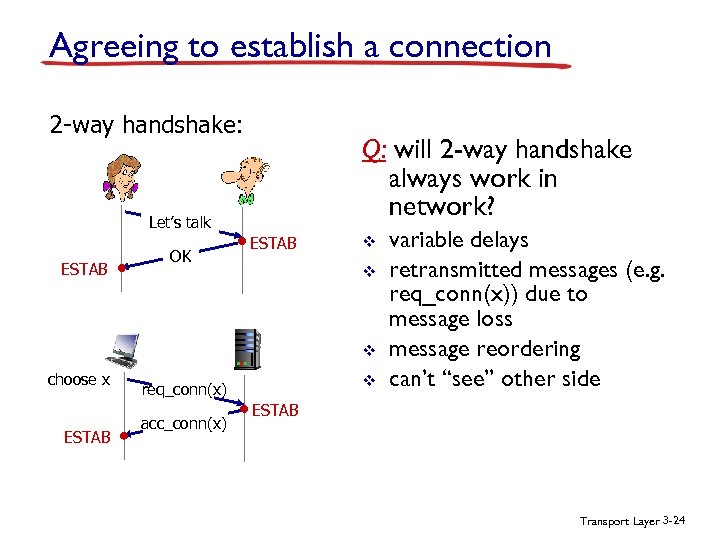 Agreeing to establish a connection 2 -way handshake: Q: will 2 -way handshake always work in network? Let’s talk ESTAB OK ESTAB v v v choose x ESTAB v req_conn(x) acc_conn(x) variable delays retransmitted messages (e. g. req_conn(x)) due to message loss message reordering can’t “see” other side ESTAB Transport Layer 3 -24
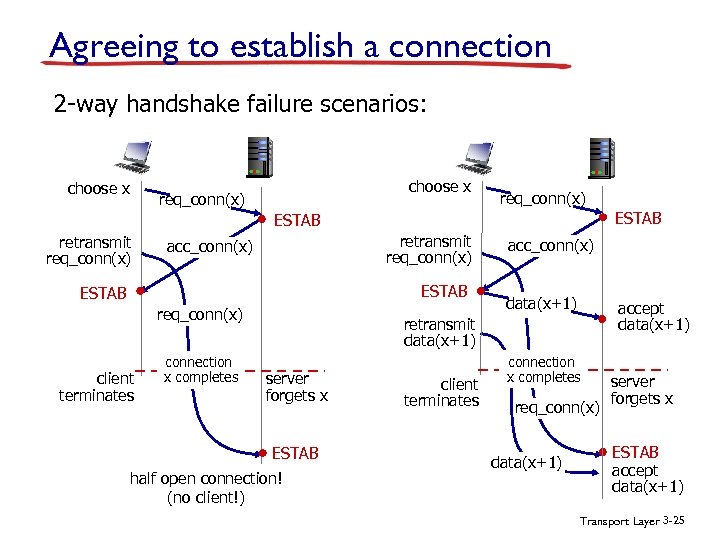 Agreeing to establish a connection 2 -way handshake failure scenarios: choose x req_conn(x) ESTAB retransmit req_conn(x) acc_conn(x) ESTAB req_conn(x) client terminates connection x completes acc_conn(x) data(x+1) accept data(x+1) retransmit data(x+1) server forgets x ESTAB half open connection! (no client!) client terminates connection x completes req_conn(x) data(x+1) server forgets x ESTAB accept data(x+1) Transport Layer 3 -25
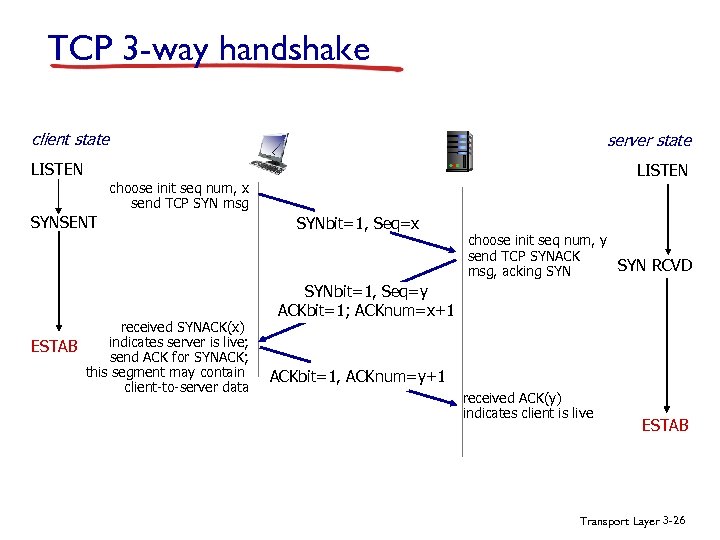 TCP 3 -way handshake client state server state LISTEN choose init seq num, x send TCP SYN msg SYNSENT received SYNACK(x) indicates server is live; ESTAB send ACK for SYNACK; this segment may contain client-to-server data SYNbit=1, Seq=x choose init seq num, y send TCP SYNACK SYN RCVD msg, acking SYNbit=1, Seq=y ACKbit=1; ACKnum=x+1 ACKbit=1, ACKnum=y+1 received ACK(y) indicates client is live ESTAB Transport Layer 3 -26
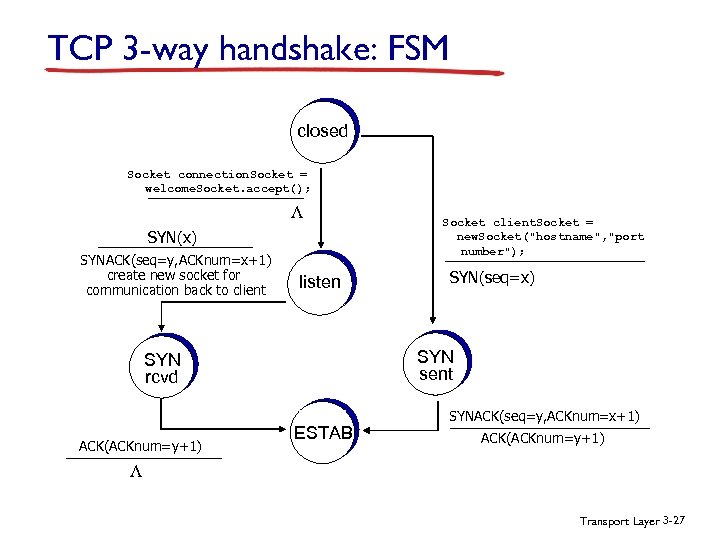 TCP 3 -way handshake: FSM closed Socket connection. Socket = welcome. Socket. accept(); L SYN(x) SYNACK(seq=y, ACKnum=x+1) create new socket for communication back to client listen SYN(seq=x) SYN sent SYN rcvd ACK(ACKnum=y+1) Socket client. Socket = new. Socket("hostname", "port number"); ESTAB SYNACK(seq=y, ACKnum=x+1) ACK(ACKnum=y+1) L Transport Layer 3 -27
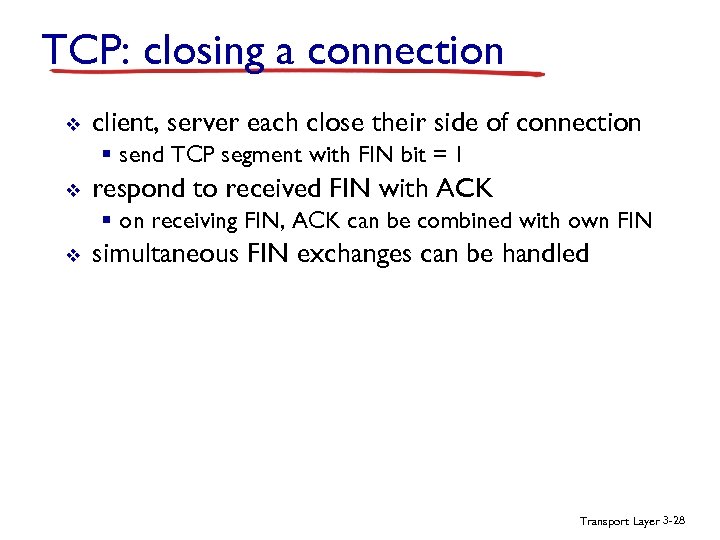 TCP: closing a connection v client, server each close their side of connection § send TCP segment with FIN bit = 1 v respond to received FIN with ACK § on receiving FIN, ACK can be combined with own FIN v simultaneous FIN exchanges can be handled Transport Layer 3 -28
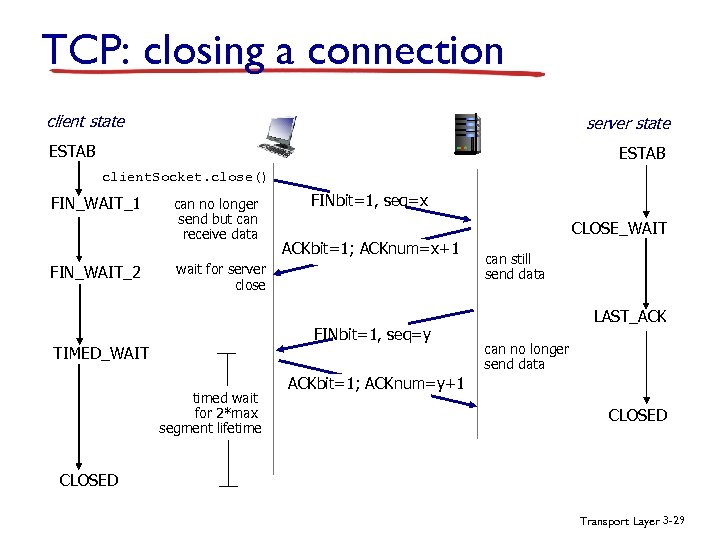 TCP: closing a connection client state server state ESTAB client. Socket. close() FIN_WAIT_1 FIN_WAIT_2 can no longer send but can receive data FINbit=1, seq=x CLOSE_WAIT ACKbit=1; ACKnum=x+1 wait for server close FINbit=1, seq=y TIMED_WAIT timed wait for 2*max segment lifetime can still send data LAST_ACK can no longer send data ACKbit=1; ACKnum=y+1 CLOSED Transport Layer 3 -29
 Chapter 3 outline 3. 1 transport-layer services 3. 2 multiplexing and demultiplexing 3. 3 connectionless transport: UDP 3. 4 principles of reliable data transfer 3. 5 connection-oriented transport: TCP § segment structure § reliable data transfer § flow control § connection management 3. 6 principles of congestion control 3. 7 TCP congestion control Transport Layer 3 -30
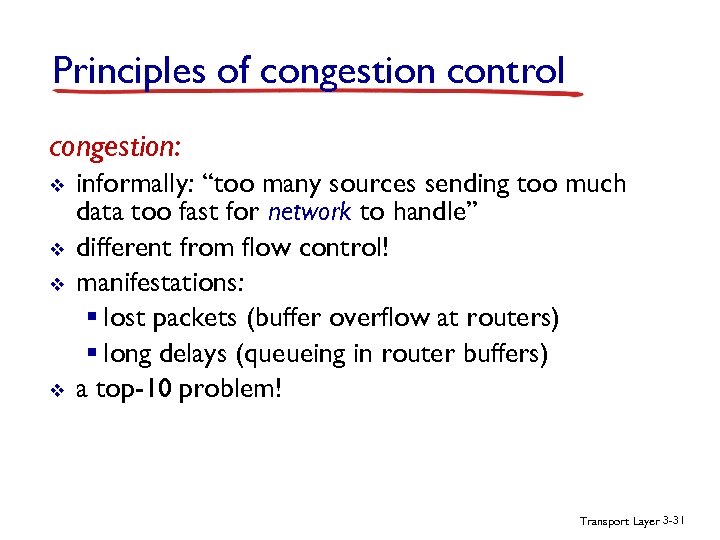 Principles of congestion control congestion: v v informally: “too many sources sending too much data too fast for network to handle” different from flow control! manifestations: § lost packets (buffer overflow at routers) § long delays (queueing in router buffers) a top-10 problem! Transport Layer 3 -31
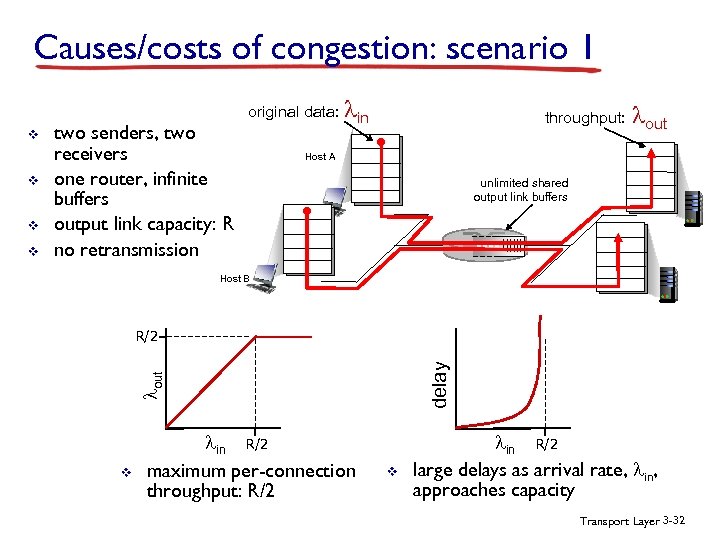 Causes/costs of congestion: scenario 1 v v lout Host A unlimited shared output link buffers Host B R/2 delay v two senders, two receivers one router, infinite buffers output link capacity: R no retransmission throughput: lout v original data: lin v lin R/2 maximum per-connection throughput: R/2 v lin R/2 large delays as arrival rate, lin, approaches capacity Transport Layer 3 -32
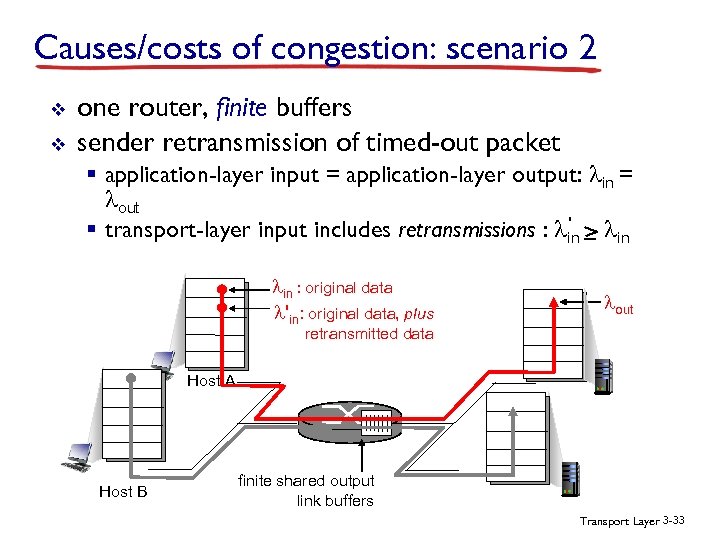 Causes/costs of congestion: scenario 2 v v one router, finite buffers sender retransmission of timed-out packet § application-layer input = application-layer output: lin = lout § transport-layer input includes retransmissions : l‘in lin : original data l'in: original data, plus lout retransmitted data Host A Host B finite shared output link buffers Transport Layer 3 -33
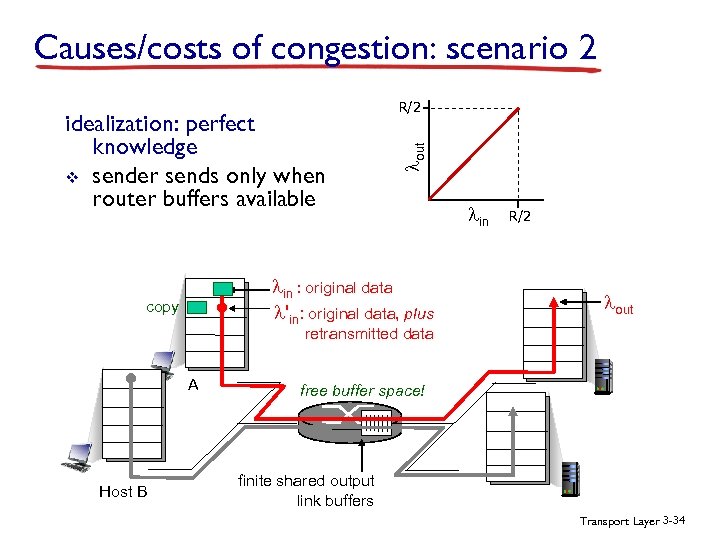 Causes/costs of congestion: scenario 2 lout idealization: perfect knowledge v sender sends only when router buffers available R/2 lin : original data l'in: original data, plus copy lin R/2 lout retransmitted data A Host B free buffer space! finite shared output link buffers Transport Layer 3 -34
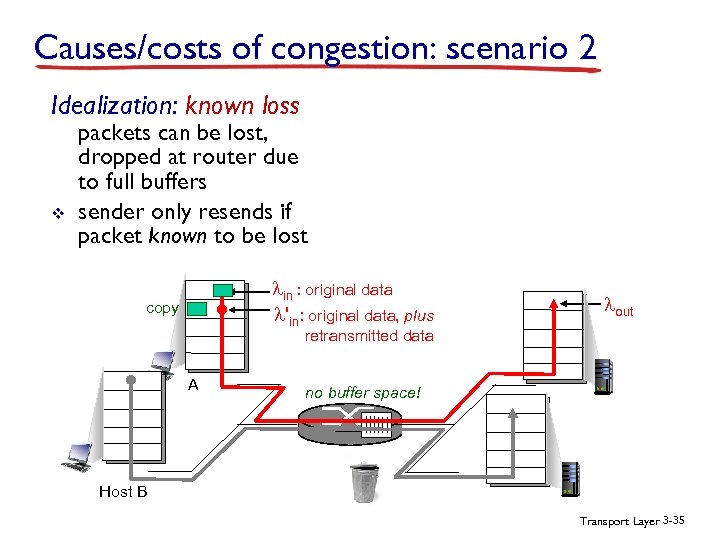 Causes/costs of congestion: scenario 2 Idealization: known loss v packets can be lost, dropped at router due to full buffers sender only resends if packet known to be lost lin : original data l'in: original data, plus copy lout retransmitted data A no buffer space! Host B Transport Layer 3 -35
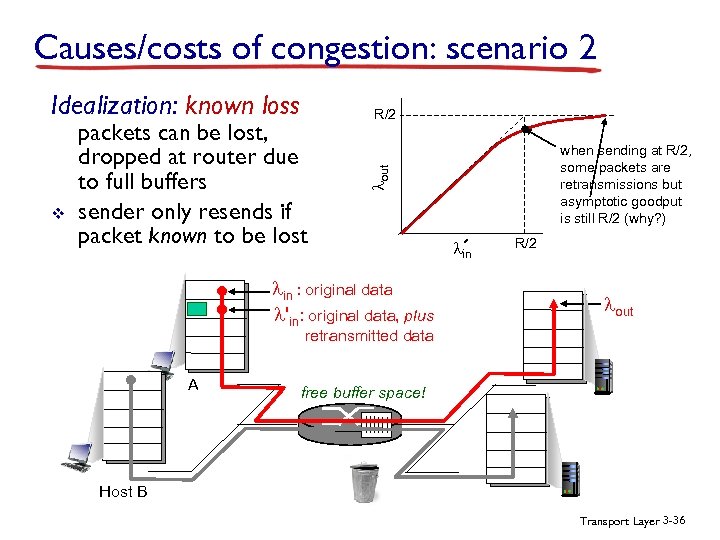 Causes/costs of congestion: scenario 2 v packets can be lost, dropped at router due to full buffers sender only resends if packet known to be lost R/2 when sending at R/2, some packets are retransmissions but asymptotic goodput is still R/2 (why? ) lout Idealization: known loss lin : original data l'in: original data, plus lin R/2 lout retransmitted data A free buffer space! Host B Transport Layer 3 -36
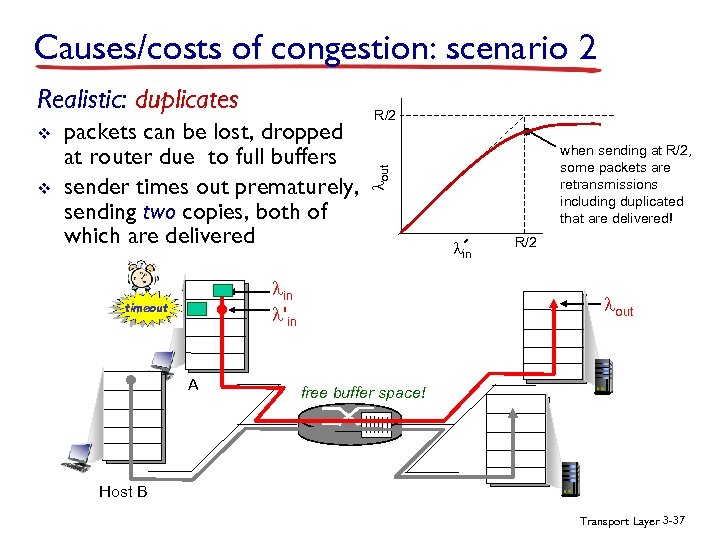 Causes/costs of congestion: scenario 2 v v packets can be lost, dropped at router due to full buffers sender times out prematurely, sending two copies, both of which are delivered R/2 lin l'in timeout copy A when sending at R/2, some packets are retransmissions including duplicated that are delivered! lout Realistic: duplicates lin R/2 lout free buffer space! Host B Transport Layer 3 -37
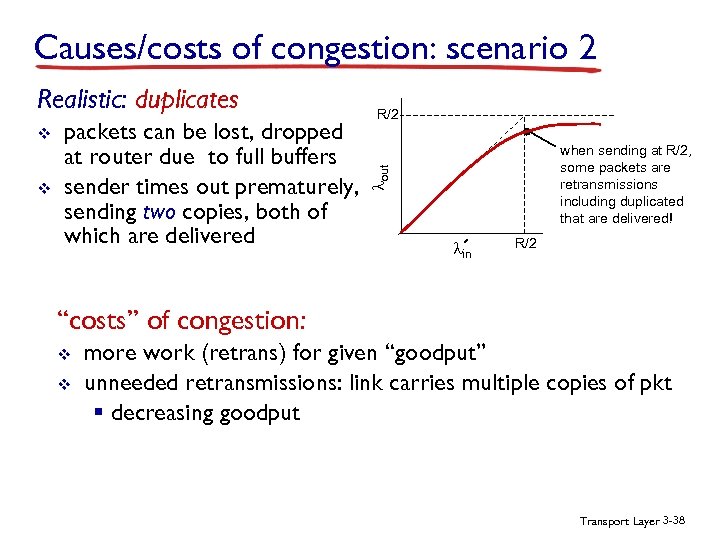 Causes/costs of congestion: scenario 2 v v packets can be lost, dropped at router due to full buffers sender times out prematurely, sending two copies, both of which are delivered R/2 when sending at R/2, some packets are retransmissions including duplicated that are delivered! lout Realistic: duplicates lin R/2 “costs” of congestion: v v more work (retrans) for given “goodput” unneeded retransmissions: link carries multiple copies of pkt § decreasing goodput Transport Layer 3 -38
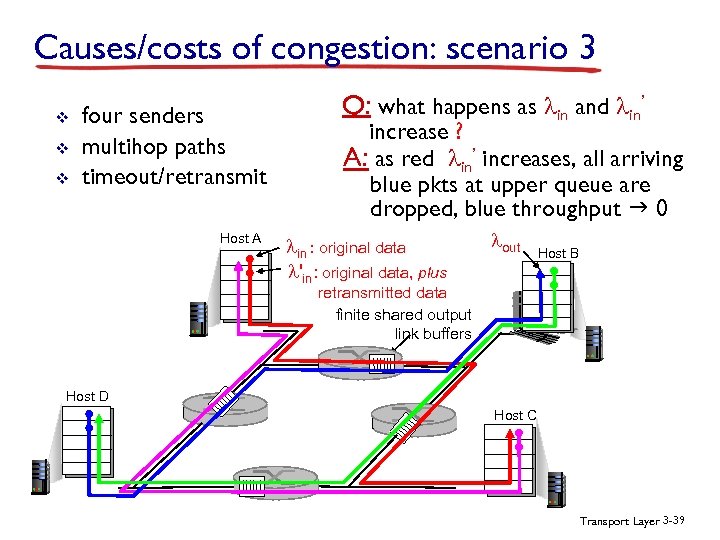 Causes/costs of congestion: scenario 3 v v v four senders multihop paths timeout/retransmit Host A Q: what happens as lin and lin’ increase ? A: as red lin’ increases, all arriving blue pkts at upper queue are dropped, blue throughput g 0 lin : original data l'in: original data, plus lout Host B retransmitted data finite shared output link buffers Host D Host C Transport Layer 3 -39
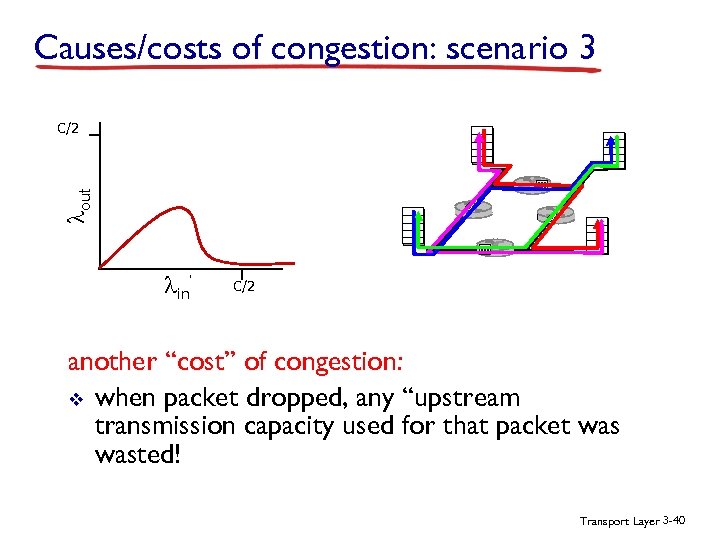 Causes/costs of congestion: scenario 3 lout C/2 lin’ C/2 another “cost” of congestion: v when packet dropped, any “upstream transmission capacity used for that packet wasted! Transport Layer 3 -40
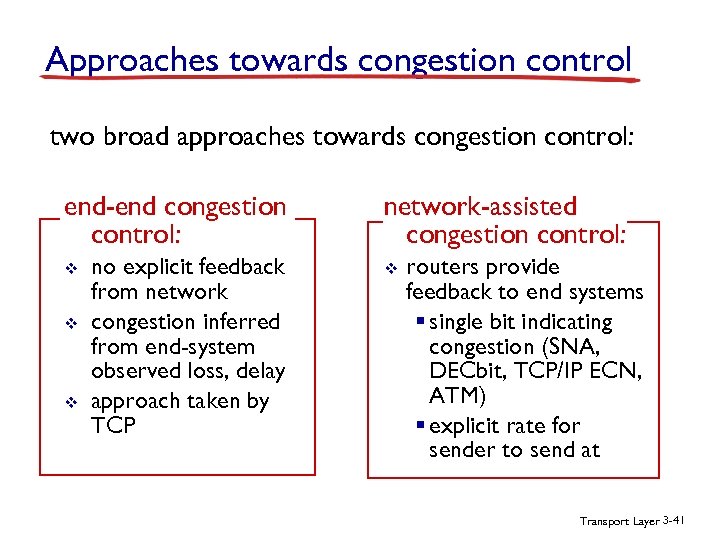 Approaches towards congestion control two broad approaches towards congestion control: end-end congestion control: v v v no explicit feedback from network congestion inferred from end-system observed loss, delay approach taken by TCP network-assisted congestion control: v routers provide feedback to end systems § single bit indicating congestion (SNA, DECbit, TCP/IP ECN, ATM) § explicit rate for sender to send at Transport Layer 3 -41
 Case study: ATM ABR congestion control ABR: available bit rate: v v v “elastic service” if sender’s path “underloaded”: § sender should use available bandwidth if sender’s path congested: § sender throttled to minimum guaranteed rate RM (resource management) cells: v v v sent by sender, interspersed with data cells bits in RM cell set by switches (“network-assisted”) § NI bit: no increase in rate (mild congestion) § CI bit: congestion indication RM cells returned to sender by receiver, with bits intact Transport Layer 3 -42
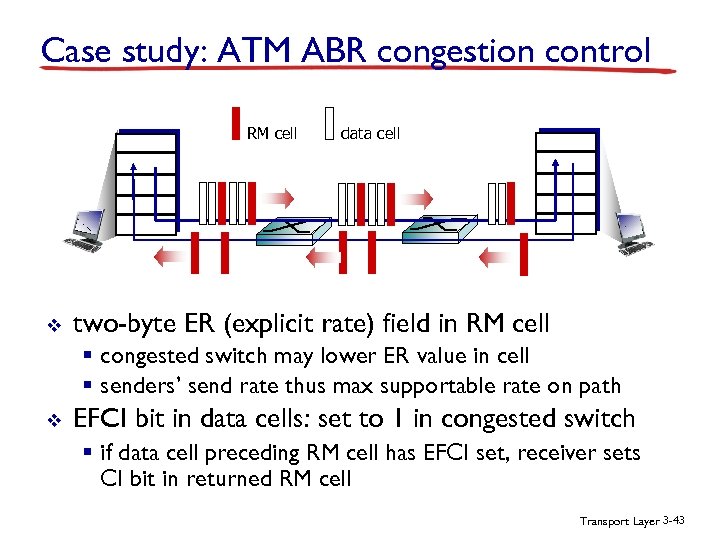 Case study: ATM ABR congestion control RM cell v data cell two-byte ER (explicit rate) field in RM cell § congested switch may lower ER value in cell § senders’ send rate thus max supportable rate on path v EFCI bit in data cells: set to 1 in congested switch § if data cell preceding RM cell has EFCI set, receiver sets CI bit in returned RM cell Transport Layer 3 -43
 Chapter 3 outline 3. 1 transport-layer services 3. 2 multiplexing and demultiplexing 3. 3 connectionless transport: UDP 3. 4 principles of reliable data transfer 3. 5 connection-oriented transport: TCP § segment structure § reliable data transfer § flow control § connection management 3. 6 principles of congestion control 3. 7 TCP congestion control Transport Layer 3 -44
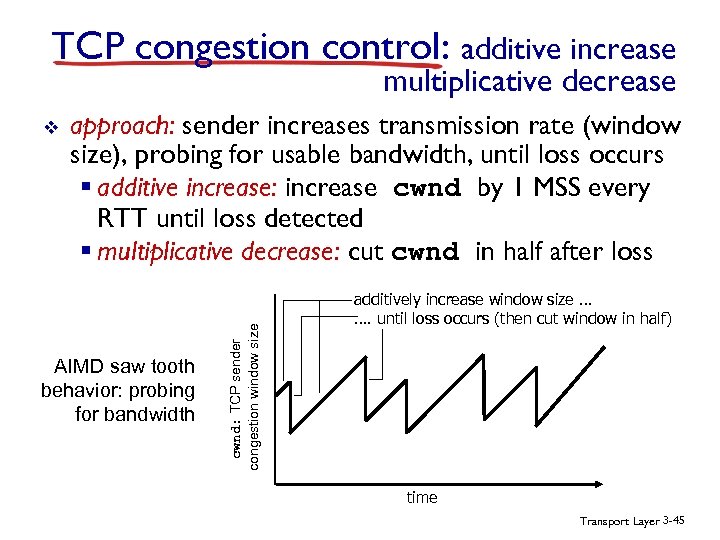 TCP congestion control: additive increase multiplicative decrease approach: sender increases transmission rate (window size), probing for usable bandwidth, until loss occurs § additive increase: increase cwnd by 1 MSS every RTT until loss detected § multiplicative decrease: cut cwnd in half after loss AIMD saw tooth behavior: probing for bandwidth cwnd: TCP sender congestion window size v additively increase window size … …. until loss occurs (then cut window in half) time Transport Layer 3 -45
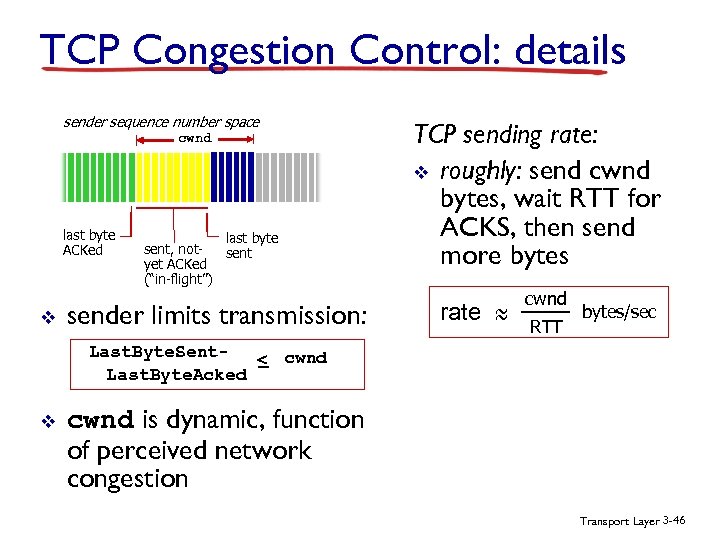 TCP Congestion Control: details sender sequence number space cwnd last byte ACKed v last byte sent, notsent yet ACKed (“in-flight”) sender limits transmission: TCP sending rate: v roughly: send cwnd bytes, wait RTT for ACKS, then send more bytes rate ~ ~ cwnd RTT bytes/sec Last. Byte. Sent< cwnd Last. Byte. Acked v cwnd is dynamic, function of perceived network congestion Transport Layer 3 -46
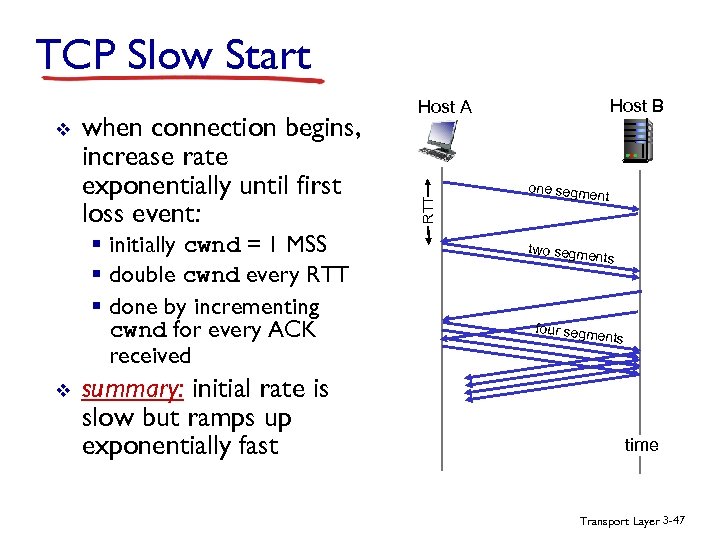 TCP Slow Start when connection begins, increase rate exponentially until first loss event: § initially cwnd = 1 MSS § double cwnd every RTT § done by incrementing cwnd for every ACK received v summary: initial rate is slow but ramps up exponentially fast RTT v Host B Host A one segm ent two segm ents four segm ents time Transport Layer 3 -47
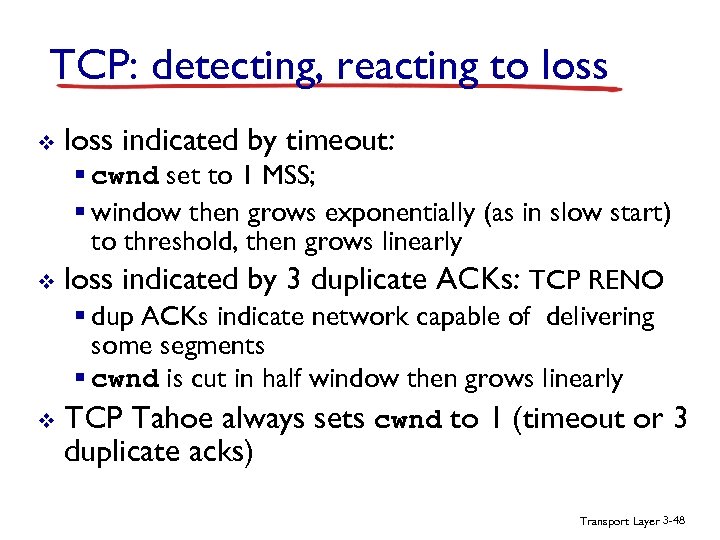 TCP: detecting, reacting to loss v loss indicated by timeout: § cwnd set to 1 MSS; § window then grows exponentially (as in slow start) to threshold, then grows linearly v loss indicated by 3 duplicate ACKs: TCP RENO § dup ACKs indicate network capable of delivering some segments § cwnd is cut in half window then grows linearly v TCP Tahoe always sets cwnd to 1 (timeout or 3 duplicate acks) Transport Layer 3 -48
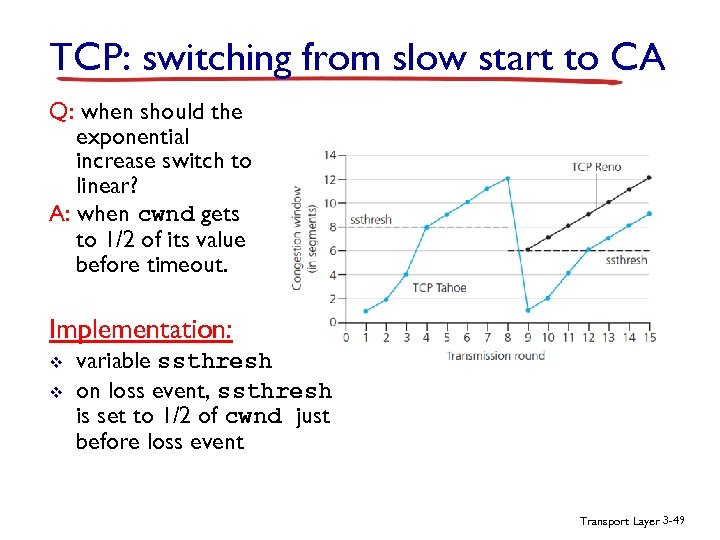 TCP: switching from slow start to CA Q: when should the exponential increase switch to linear? A: when cwnd gets to 1/2 of its value before timeout. Implementation: v v variable ssthresh on loss event, ssthresh is set to 1/2 of cwnd just before loss event Transport Layer 3 -49
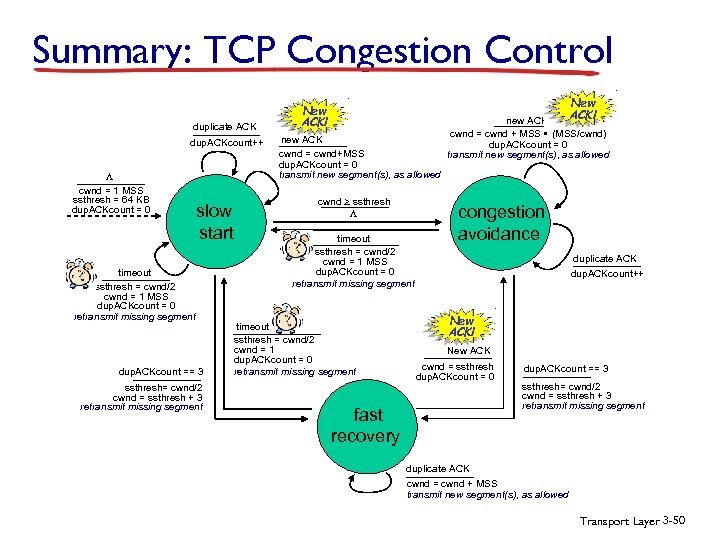 Summary: TCP Congestion Control duplicate ACK dup. ACKcount++ L cwnd = 1 MSS ssthresh = 64 KB dup. ACKcount = 0 slow start timeout ssthresh = cwnd/2 cwnd = 1 MSS dup. ACKcount = 0 retransmit missing segment dup. ACKcount == 3 ssthresh= cwnd/2 cwnd = ssthresh + 3 retransmit missing segment New ACK! new ACK cwnd = cwnd+MSS dup. ACKcount = 0 transmit new segment(s), as allowed cwnd > ssthresh L timeout ssthresh = cwnd/2 cwnd = 1 MSS dup. ACKcount = 0 retransmit missing segment timeout ssthresh = cwnd/2 cwnd = 1 dup. ACKcount = 0 retransmit missing segment . New ACK! new ACK cwnd = cwnd + MSS (MSS/cwnd) dup. ACKcount = 0 transmit new segment(s), as allowed congestion avoidance duplicate ACK dup. ACKcount++ New ACK! New ACK cwnd = ssthresh dup. ACKcount = 0 fast recovery dup. ACKcount == 3 ssthresh= cwnd/2 cwnd = ssthresh + 3 retransmit missing segment duplicate ACK cwnd = cwnd + MSS transmit new segment(s), as allowed Transport Layer 3 -50
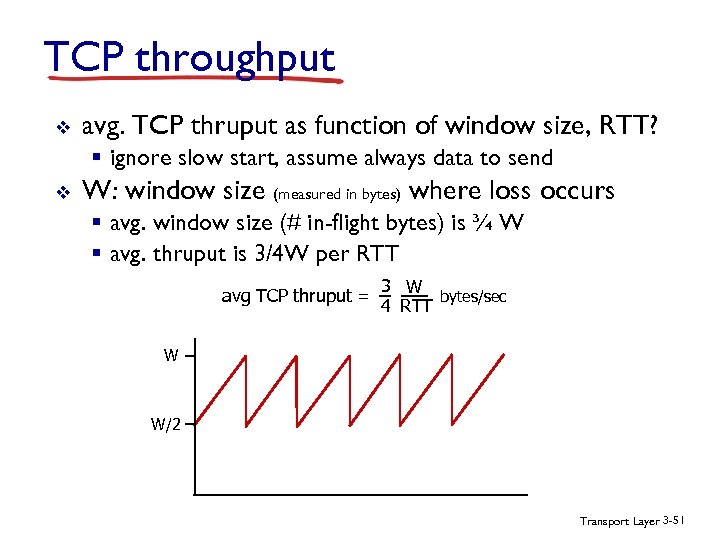 TCP throughput v avg. TCP thruput as function of window size, RTT? § ignore slow start, assume always data to send v W: window size (measured in bytes) where loss occurs § avg. window size (# in-flight bytes) is ¾ W § avg. thruput is 3/4 W per RTT avg TCP thruput = 3 W bytes/sec 4 RTT W W/2 Transport Layer 3 -51
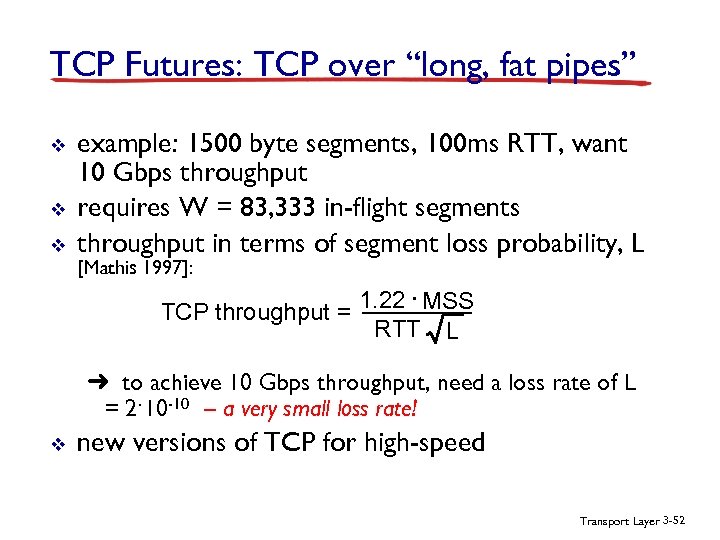 TCP Futures: TCP over “long, fat pipes” v v v example: 1500 byte segments, 100 ms RTT, want 10 Gbps throughput requires W = 83, 333 in-flight segments throughput in terms of segment loss probability, L [Mathis 1997]: 1. 22. MSS TCP throughput = RTT L ➜ to achieve 10 Gbps throughput, need a loss rate of L = 2·10 -10 – a very small loss rate! v new versions of TCP for high-speed Transport Layer 3 -52
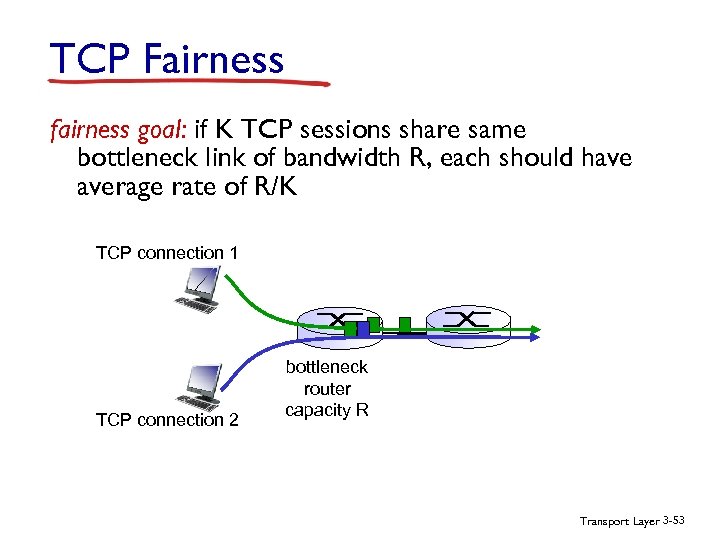 TCP Fairness fairness goal: if K TCP sessions share same bottleneck link of bandwidth R, each should have average rate of R/K TCP connection 1 TCP connection 2 bottleneck router capacity R Transport Layer 3 -53
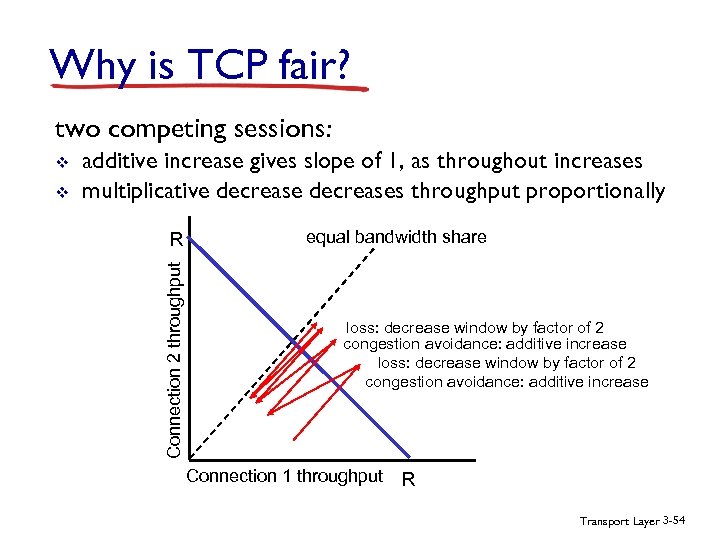 Why is TCP fair? two competing sessions: v additive increase gives slope of 1, as throughout increases multiplicative decreases throughput proportionally R Connection 2 throughput v equal bandwidth share loss: decrease window by factor of 2 congestion avoidance: additive increase Connection 1 throughput R Transport Layer 3 -54
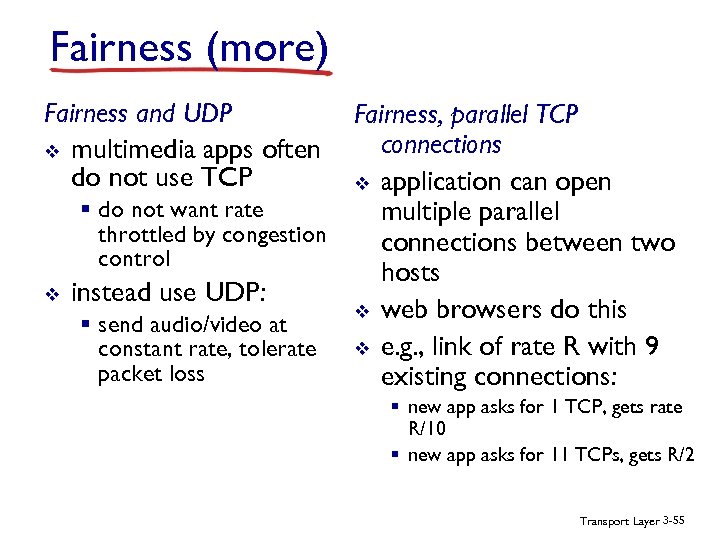 Fairness (more) Fairness and UDP v multimedia apps often do not use TCP v Fairness, parallel TCP connections v application can open § do not want rate multiple parallel throttled by congestion connections between two control hosts instead use UDP: v web browsers do this § send audio/video at v e. g. , link of rate R with 9 constant rate, tolerate packet loss existing connections: § new app asks for 1 TCP, gets rate R/10 § new app asks for 11 TCPs, gets R/2 Transport Layer 3 -55
 Chapter 3: summary v v principles behind transport layer services: § multiplexing, demultiplexing § reliable data transfer § flow control § congestion control instantiation, implementation in the Internet next: v leaving the network “edge” (application, transport layers) v into the network “core” § UDP § TCP Transport Layer 3 -56