


 Скачать презентацию Chapter 3 Transport Layer A note on the
c66afbd0177d90c3412153a6a4b85725.ppt
- Количество слайдов: 21
 Chapter 3 Transport Layer A note on the use of these ppt slides: We’re making these slides freely available to all (faculty, students, readers). They’re in Power. Point form so you see the animations; and can add, modify, and delete slides (including this one) and slide content to suit your needs. They obviously represent a lot of work on our part. In return for use, we only ask the following: v If you use these slides (e. g. , in a class) that you mention their source (after all, we’d like people to use our book!) v If you post any slides on a www site, that you note that they are adapted from (or perhaps identical to) our slides, and note our copyright of this material. Computer Networking: A Top Down Approach 6 th edition Jim Kurose, Keith Ross Addison-Wesley March 2012 Thanks and enjoy! JFK/KWR All material copyright 1996 -2012 J. F Kurose and K. W. Ross, All Rights Reserved Transport Layer 3 -1
 Chapter 3: Transport Layer our goals: v understand principles behind transport layer services: § multiplexing, demultiplexing § reliable data transfer § flow control § congestion control v learn about Internet transport layer protocols: § UDP: connectionless transport § TCP: connection-oriented reliable transport § TCP congestion control Transport Layer 3 -2
 Chapter 3 outline 3. 1 transport-layer services 3. 2 multiplexing and demultiplexing 3. 3 connectionless transport: UDP 3. 4 principles of reliable data transfer 3. 5 connection-oriented transport: TCP § segment structure § reliable data transfer § flow control § connection management 3. 6 principles of congestion control 3. 7 TCP congestion control Transport Layer 3 -3
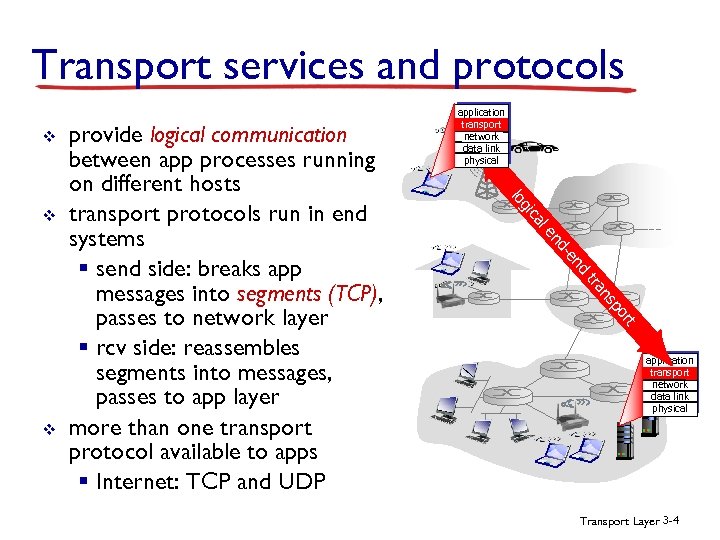 Transport services and protocols v le ca gi nd -e nd ns tra t r po v lo v provide logical communication between app processes running on different hosts transport protocols run in end systems § send side: breaks app messages into segments (TCP), passes to network layer § rcv side: reassembles segments into messages, passes to app layer more than one transport protocol available to apps § Internet: TCP and UDP application transport network data link physical Transport Layer 3 -4
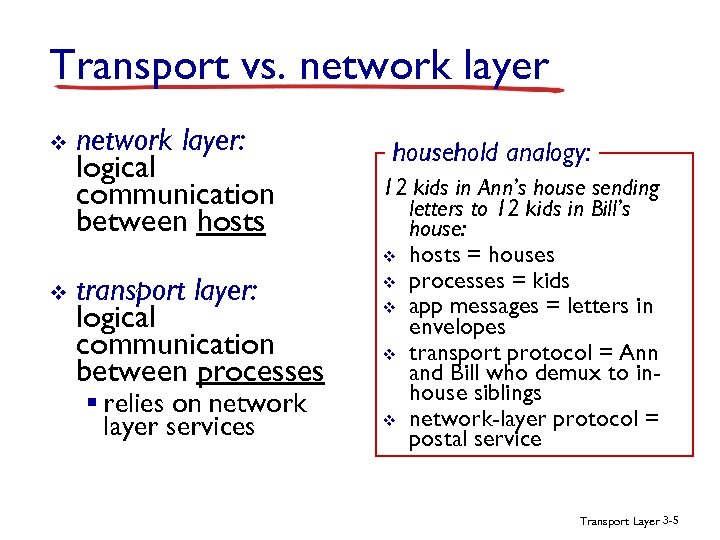 Transport vs. network layer v v network layer: logical communication between hosts transport layer: logical communication between processes § relies on network layer services household analogy: 12 kids in Ann’s house sending letters to 12 kids in Bill’s house: v hosts = houses v processes = kids v app messages = letters in envelopes v transport protocol = Ann and Bill who demux to inhouse siblings v network-layer protocol = postal service Transport Layer 3 -5
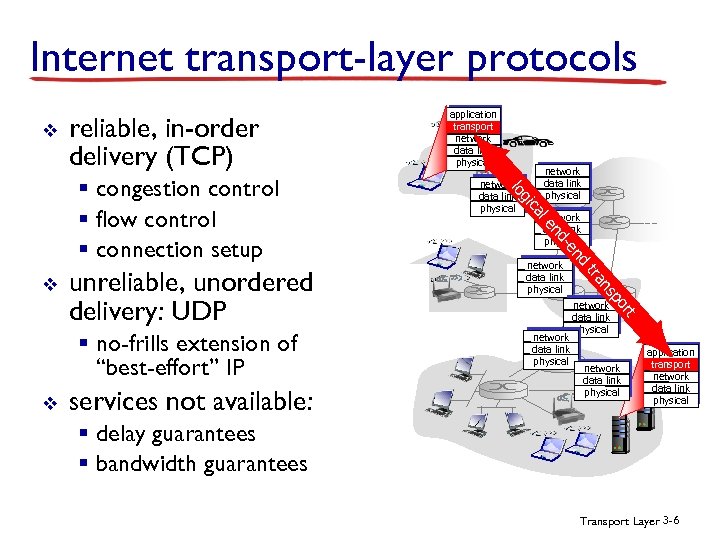 Internet transport-layer protocols v reliable, in-order delivery (TCP) ns tra network data link physical d n -e network data link physical t r po services not available: nd v network data link physical le § no-frills extension of “best-effort” IP network data link physical ca unreliable, unordered delivery: UDP gi v network data link physical lo § congestion control § flow control § connection setup application transport network data link physical § delay guarantees § bandwidth guarantees Transport Layer 3 -6
 Chapter 3 outline 3. 1 transport-layer services 3. 2 multiplexing and demultiplexing 3. 3 connectionless transport: UDP 3. 4 principles of reliable data transfer 3. 5 connection-oriented transport: TCP § segment structure § reliable data transfer § flow control § connection management 3. 6 principles of congestion control 3. 7 TCP congestion control Transport Layer 3 -7
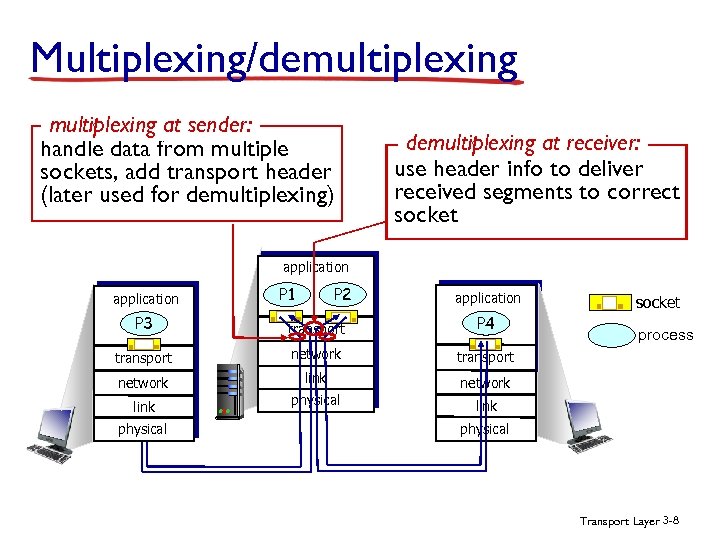 Multiplexing/demultiplexing at sender: handle data from multiple sockets, add transport header (later used for demultiplexing) demultiplexing at receiver: use header info to deliver received segments to correct socket application P 1 P 2 application P 3 transport P 4 transport network link network physical socket link physical process physical Transport Layer 3 -8
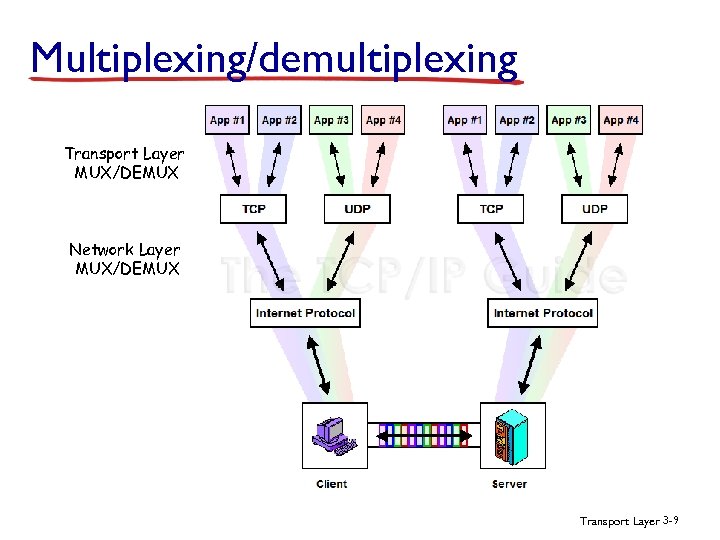 Multiplexing/demultiplexing Transport Layer MUX/DEMUX Network Layer MUX/DEMUX Transport Layer 3 -9
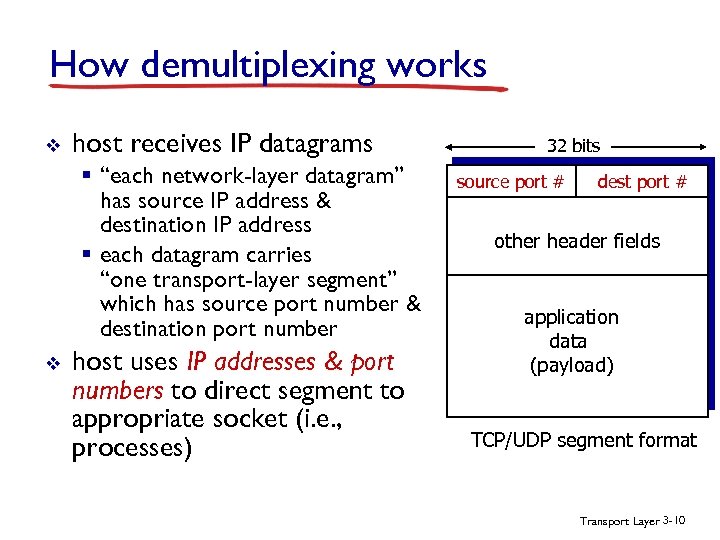 How demultiplexing works v host receives IP datagrams § “each network-layer datagram” has source IP address & destination IP address § each datagram carries “one transport-layer segment” which has source port number & destination port number v host uses IP addresses & port numbers to direct segment to appropriate socket (i. e. , processes) 32 bits source port # dest port # other header fields application data (payload) TCP/UDP segment format Transport Layer 3 -10
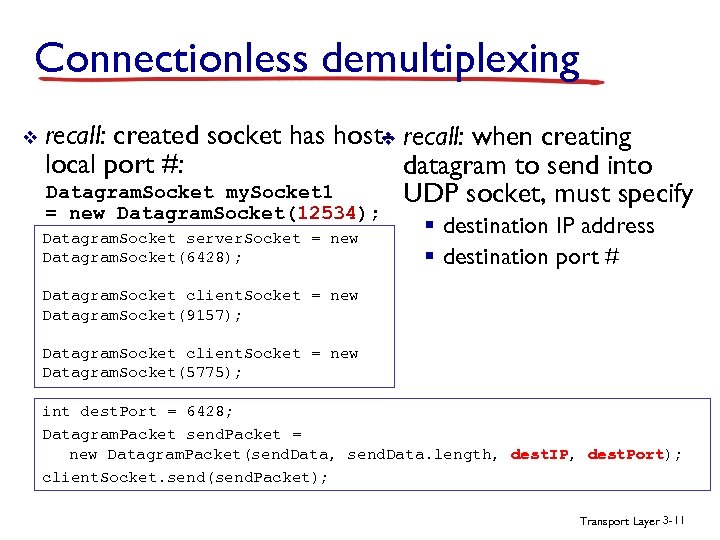 Connectionless demultiplexing v recall: created socket has host- recall: when creating v local port #: datagram to send into Datagram. Socket my. Socket 1 UDP socket, must specify = new Datagram. Socket(12534); Datagram. Socket server. Socket = new Datagram. Socket(6428); § destination IP address § destination port # Datagram. Socket client. Socket = new Datagram. Socket(9157); Datagram. Socket client. Socket = new Datagram. Socket(5775); int dest. Port = 6428; Datagram. Packet send. Packet = new Datagram. Packet(send. Data, send. Data. length, dest. IP, dest. Port); client. Socket. send(send. Packet); Transport Layer 3 -11
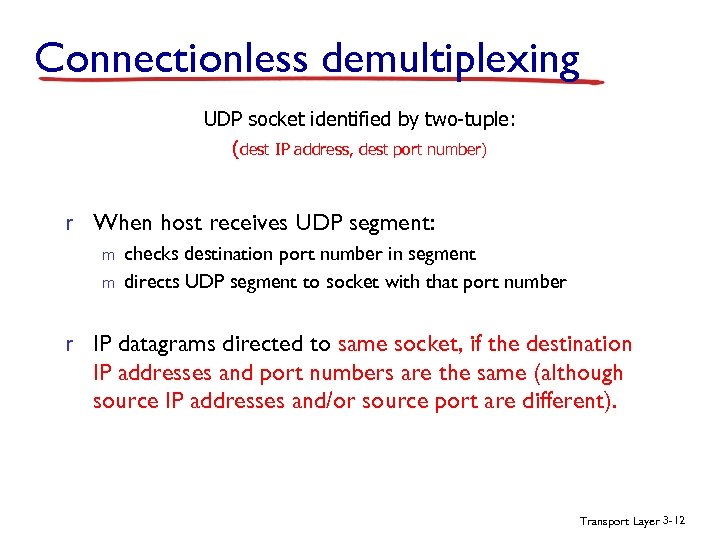 Connectionless demultiplexing UDP socket identified by two-tuple: (dest IP address, dest port number) r When host receives UDP segment: m checks destination port number in segment m directs UDP segment to socket with that port number r IP datagrams directed to same socket, if the destination IP addresses and port numbers are the same (although source IP addresses and/or source port are different). Transport Layer 3 -12
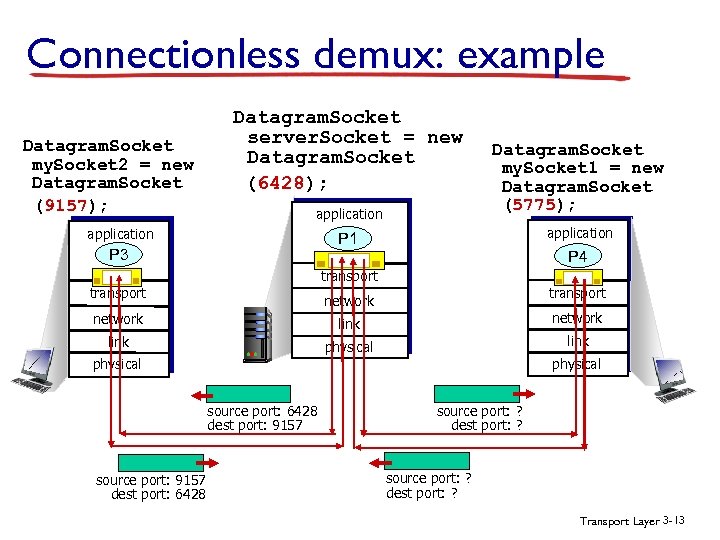 Connectionless demux: example Datagram. Socket my. Socket 2 = new Datagram. Socket (9157); Datagram. Socket server. Socket = new Datagram. Socket (6428); application Datagram. Socket my. Socket 1 = new Datagram. Socket (5775); P 1 application P 3 P 4 transport network link physical source port: 6428 dest port: 9157 source port: 9157 dest port: 6428 source port: ? dest port: ? Transport Layer 3 -13
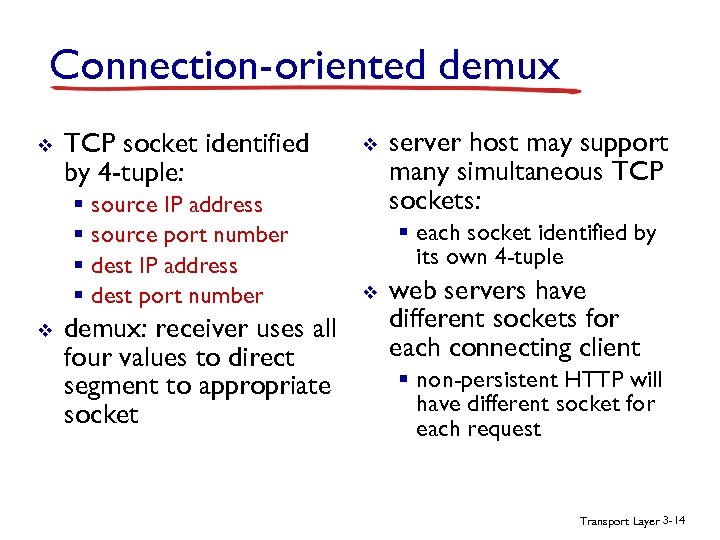 Connection-oriented demux v TCP socket identified by 4 -tuple: § source IP address § source port number § dest IP address § dest port number v demux: receiver uses all four values to direct segment to appropriate socket v server host may support many simultaneous TCP sockets: § each socket identified by its own 4 -tuple v web servers have different sockets for each connecting client § non-persistent HTTP will have different socket for each request Transport Layer 3 -14
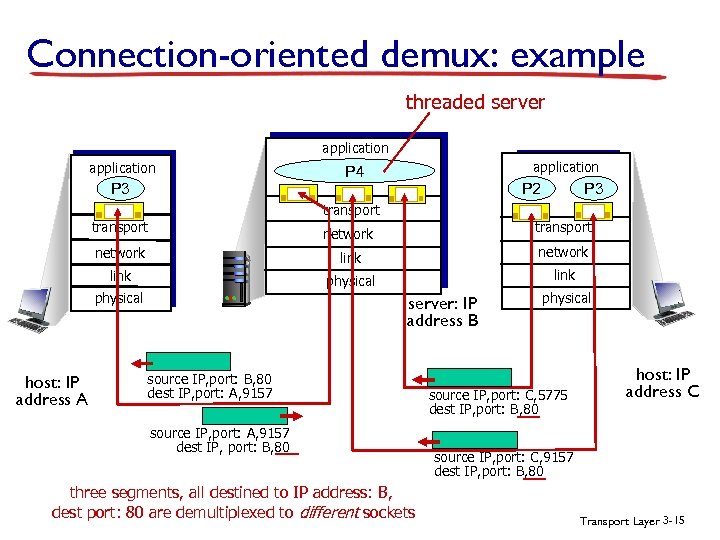 Connection-oriented demux: example threaded server application P 3 application P 4 P 3 P 2 transport network link physical host: IP address A server: IP address B source IP, port: B, 80 dest IP, port: A, 9157 source IP, port: A, 9157 dest IP, port: B, 80 three segments, all destined to IP address: B, dest port: 80 are demultiplexed to different sockets physical source IP, port: C, 5775 dest IP, port: B, 80 host: IP address C source IP, port: C, 9157 dest IP, port: B, 80 Transport Layer 3 -15
 Chapter 3 outline 3. 1 transport-layer services 3. 2 multiplexing and demultiplexing 3. 3 connectionless transport: UDP 3. 4 principles of reliable data transfer 3. 5 connection-oriented transport: TCP § segment structure § reliable data transfer § flow control § connection management 3. 6 principles of congestion control 3. 7 TCP congestion control Transport Layer 3 -16
![UDP: User Datagram Protocol [RFC 768] v v v “no frills, ” “bare bones”](https://present5.com/presentation/c66afbd0177d90c3412153a6a4b85725/image-17.jpg "UDP: User Datagram Protocol [RFC 768] v v v “no frills, ” “bare bones”") UDP: User Datagram Protocol [RFC 768] v v v “no frills, ” “bare bones” Internet transport protocol “best effort” service, UDP segments may be: § lost § delivered out-of-order to app connectionless: § no handshaking between UDP sender, receiver § each UDP segment handled independently of others v UDP use: § streaming multimedia apps (loss tolerant, rate sensitive) § DNS § SNMP (Simple Network Management Protocol) v reliable transfer over UDP: § add reliability at application layer § application-specific error recovery! Transport Layer 3 -17
UDP: User Datagram Protocol [RFC 768] v v v “no frills, ” “bare bones” Internet transport protocol “best effort” service, UDP segments may be: § lost § delivered out-of-order to app connectionless: § no handshaking between UDP sender, receiver § each UDP segment handled independently of others v UDP use: § streaming multimedia apps (loss tolerant, rate sensitive) § DNS § SNMP (Simple Network Management Protocol) v reliable transfer over UDP: § add reliability at application layer § application-specific error recovery! Transport Layer 3 -17
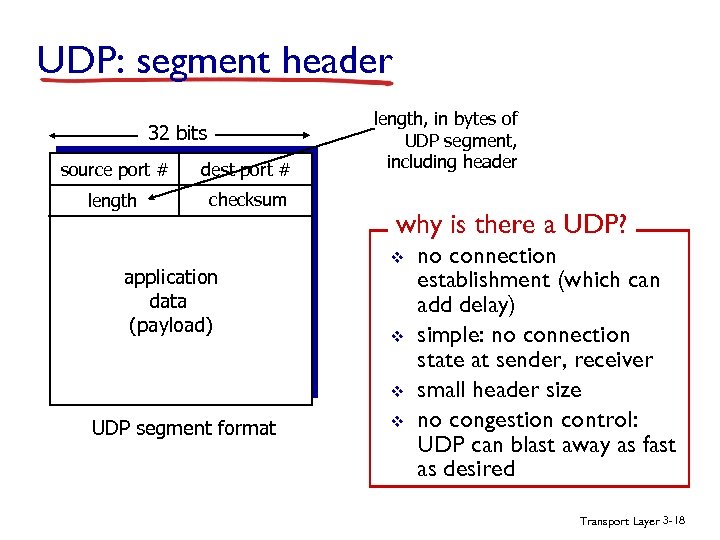 UDP: segment header 32 bits source port # dest port # length checksum application data (payload) length, in bytes of UDP segment, including header why is there a UDP? v v v UDP segment format v no connection establishment (which can add delay) simple: no connection state at sender, receiver small header size no congestion control: UDP can blast away as fast as desired Transport Layer 3 -18
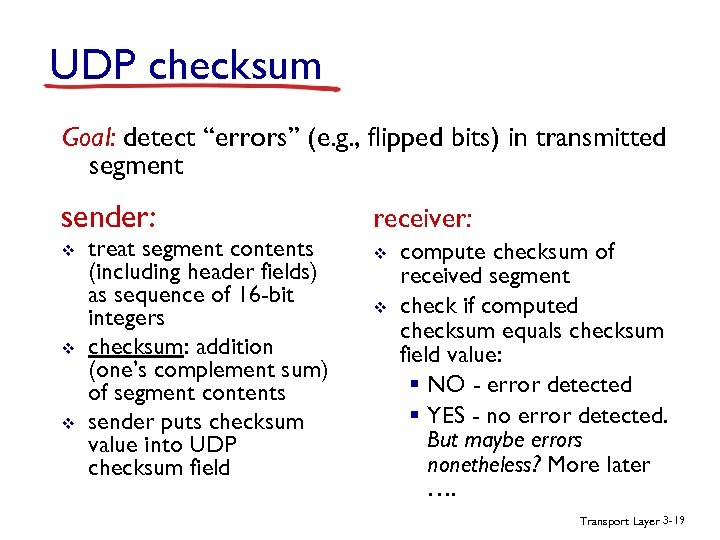 UDP checksum Goal: detect “errors” (e. g. , flipped bits) in transmitted segment sender: receiver: v v treat segment contents (including header fields) as sequence of 16 -bit integers checksum: addition (one’s complement sum) of segment contents sender puts checksum value into UDP checksum field v compute checksum of received segment check if computed checksum equals checksum field value: § NO - error detected § YES - no error detected. But maybe errors nonetheless? More later …. Transport Layer 3 -19
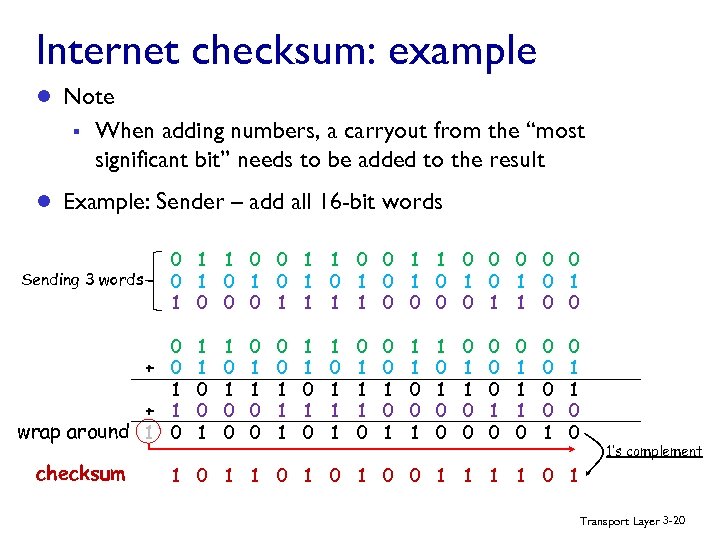 Internet checksum: example l Note § When adding numbers, a carryout from the “most significant bit” needs to be added to the result l Example: Sender – add all 16 -bit words 1 0 1 1 0 0 0 Sending 3 words 1 0 1 0 1 1 1 0 0 0 1 1 0 0 1 + wrap around 1 0 0 1 1 0 1 0 0 0 1 1 1 0 1 0 1 1 1 0 0 1 1 0 0 0 1 0 0 1 1 1 0 0 0 1 1 0 0 checksum 1 1 0 1 0 0 1 1’s complement Transport Layer 3 -20
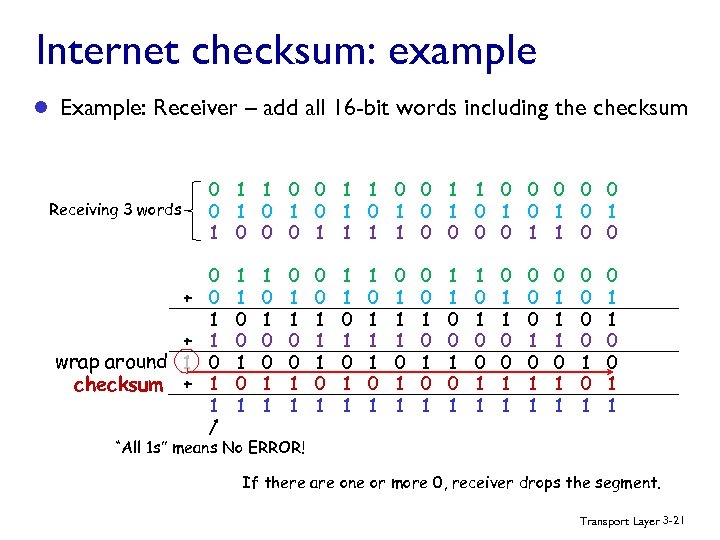 Internet checksum: example l Example: Receiver – add all 16 -bit words including the checksum 1 0 1 1 0 0 0 Receiving 3 words 1 0 1 0 1 1 1 0 0 0 1 1 0 0 1 + wrap around 1 checksum + 1 0 0 1 1 1 1 0 0 1 1 0 0 1 1 1 0 1 0 1 1 0 0 1 0 1 1 1 0 0 1 1 0 0 0 1 1 0 0 1 0 1 1 0 0 1 1 “All 1 s” means No ERROR! If there are one or more 0, receiver drops the segment. Transport Layer 3 -21