 Скачать презентацию Chapter 3 THE WORLD MARKETPLACE Business without Borders
d29827bc9647d63bf75f082b46a16ac8.ppt
- Количество слайдов: 35



Chapter 3: THE WORLD MARKETPLACE Business without Borders © 2009 South-Western, a division of Cengage Learning 1
LOOKING AHEAD • Why should today’s managers think globally? • What opportunities exist in the world economy for businesses? • Why do nations trade? • How do we measure trade? • How do companies reach global markets? • What are the barriers to international trade? • What are the benefits and criticisms of the free trade movement? © 2009 South-Western, a division of Cengage Learning 2
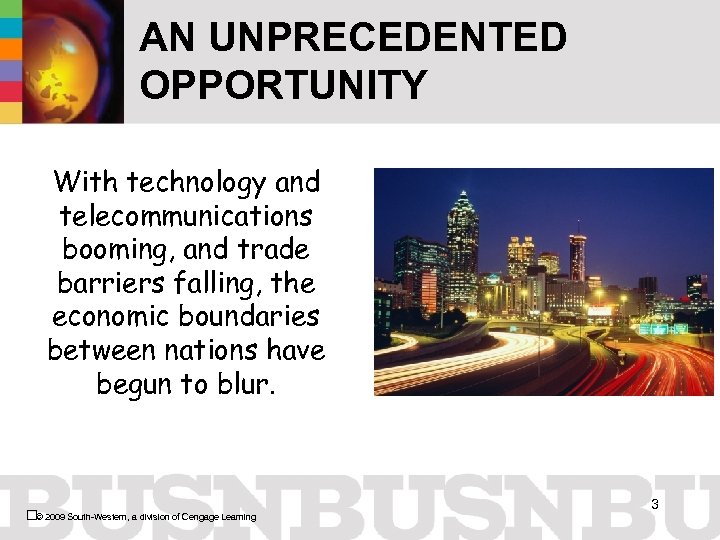
AN UNPRECEDENTED OPPORTUNITY With technology and telecommunications booming, and trade barriers falling, the economic boundaries between nations have begun to blur. © 2009 South-Western, a division of Cengage Learning 3
TRADITIONAL CAPITALISM • You have two cows. You sell one and buy a bull. Your herd multiplies, and the economy grows. You sell them and retire on the income. AN AMERICAN CORPORATION • You have two cows. You sell one, and force the other to produce the milk of four cows. You are surprised when the cow drops dead. A FRENCH CORPORATION • You have two cows. You go on strike because you want three cows. A JAPANESE CORPORATION • You have no cows. You create clever cow cartoon images called Cowkimon and market them worldwide. © 2009 South-Western, a division of Cengage Learning 4
A GERMAN CORPORATION • You have two cows. You reengineer them so they live for 100 years, eat once a month, and milk themselves. AN ITALIAN CORPORATION • You have two cows, but you don’t know where they are. You break for lunch. A RUSSIAN CORPORATION • You have 2 cows. You count them and learn you have 5 cows. You count them again and learn you have 42 cows. You count them again and learn you have 12 cows. You stop counting cows and open another bottle of vodka. © 2009 South-Western, a division of Cengage Learning 5
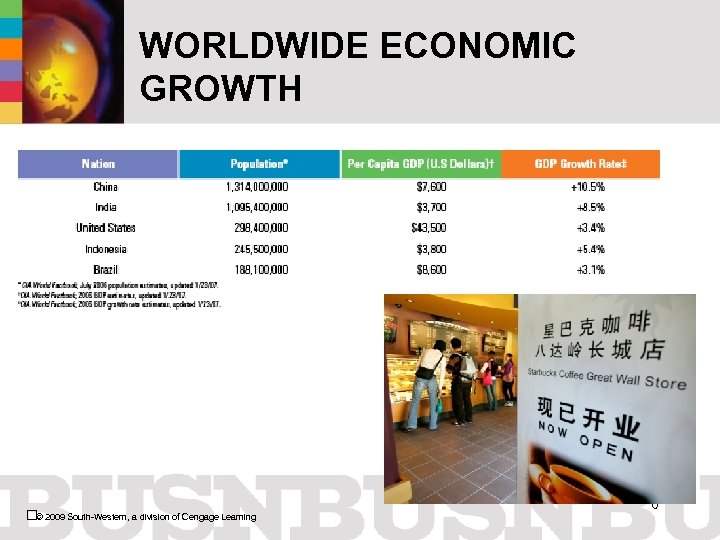
WORLDWIDE ECONOMIC GROWTH © 2009 South-Western, a division of Cengage Learning 6
GLOBAL TRADE: TAKING MEASURE • Balance of Trade – Trade Deficit – Trade Surplus • Balance of Payments – Balance of Payments Deficit – Balance of Payments Surplus © 2009 South-Western, a division of Cengage Learning 7
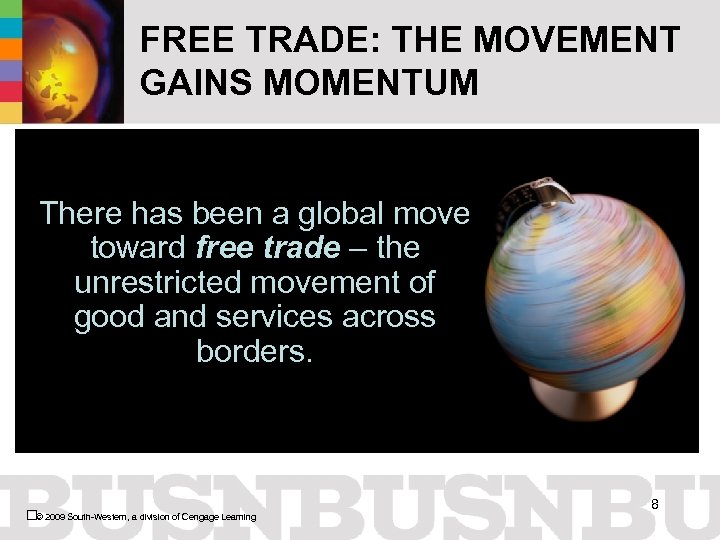
FREE TRADE: THE MOVEMENT GAINS MOMENTUM There has been a global move toward free trade – the unrestricted movement of good and services across borders. © 2009 South-Western, a division of Cengage Learning 8
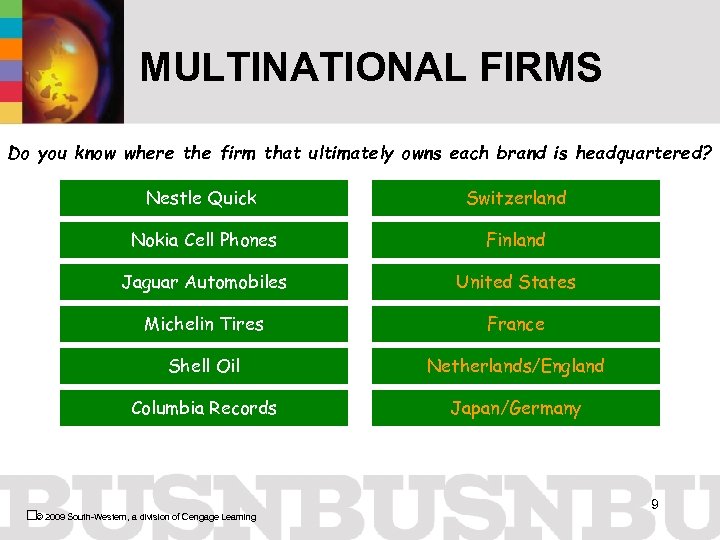
MULTINATIONAL FIRMS Do you know where the firm that ultimately owns each brand is headquartered? Nestle Quick Switzerland Nokia Cell Phones Finland Jaguar Automobiles United States Michelin Tires France Shell Oil Netherlands/England Columbia Records Japan/Germany © 2009 South-Western, a division of Cengage Learning 9
GATT AND WORLD TRADE ORGANIZATION (WTO) • General Agreement on Tariffs & Trade (GATT) – Established in 1948 – Now encompasses 125 nations – Slashed tariffs by about 30% • World Trade Organization (WTO) – Promote International Trade – Settle Trade Disputes © 2009 South-Western, a division of Cengage Learning 10
FREE TRADE • The World Bank – – 184 Member Countries Reduce World Poverty in Developing World Influence Global Economy Provide Financial Assistance • Low interest loans • The International Monetary Fund – – Support Stable Exchange Rates Facilitate International Payments Adopt Economic Policies Promote Trade © 2009 South-Western, a division of Cengage Learning 11
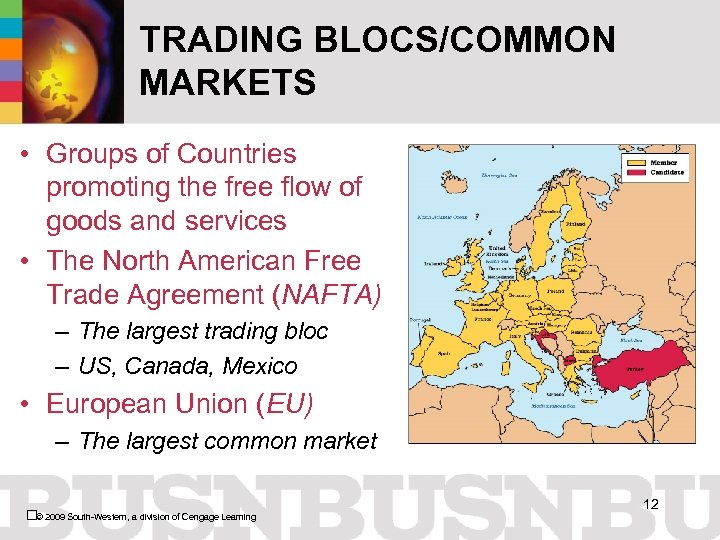
TRADING BLOCS/COMMON MARKETS • Groups of Countries promoting the free flow of goods and services • The North American Free Trade Agreement (NAFTA) – The largest trading bloc – US, Canada, Mexico • European Union (EU) – The largest common market © 2009 South-Western, a division of Cengage Learning 12
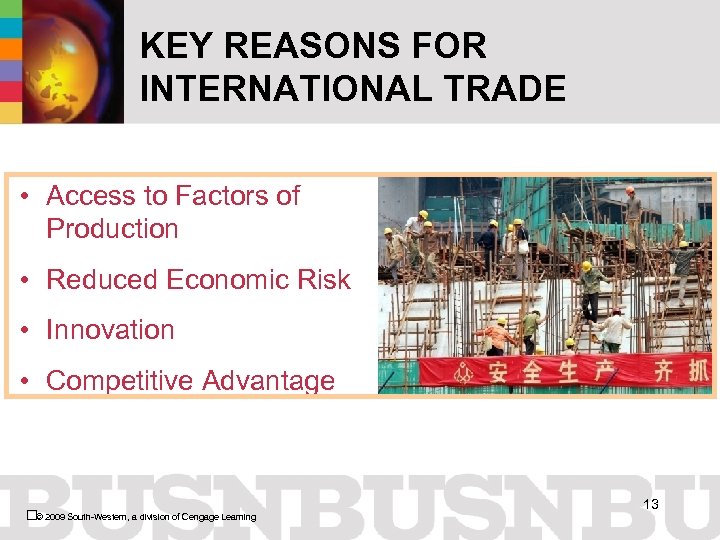
KEY REASONS FOR INTERNATIONAL TRADE • Access to Factors of Production • Reduced Economic Risk • Innovation • Competitive Advantage © 2009 South-Western, a division of Cengage Learning 13
COMPETITIVE ADVANTAGE Opportunity cost –The cost of giving up the second-best choice when making a decision. Comparative A country has an advantage - the absolute advantage when benefit a country It can produce more of a has in a given industry if good than other nations, it can make products at a using the same amount lower opportunity of resources. Cost. © 2009 South-Western, a division of Cengage Learning 14
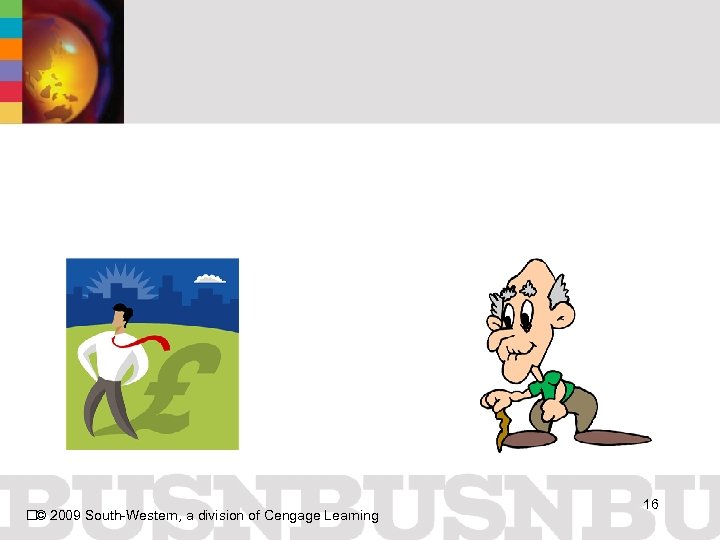
Melora Typing – better than anyone else in her village - $20 per hour produces 100 pages Surgery – better than anyone else in her village - $150 per hour © 2009 South-Western, a division of Cengage Learning 15
© 2009 South-Western, a division of Cengage Learning 16
STRATEGIES FOR FINDING GLOBAL SUPPLIERS Foreign Outsourcing/Contract Manufacturing – contracting with Foreign suppliers to produce products, usually at a fraction of the domestic cost. Importing – buying products that have been produced or grown in foreign nations. © 2009 South-Western, a division of Cengage Learning 17
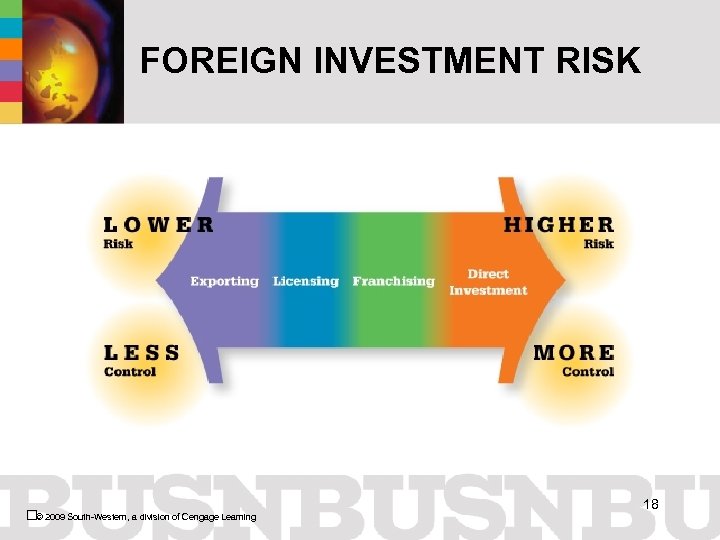
FOREIGN INVESTMENT RISK © 2009 South-Western, a division of Cengage Learning 18
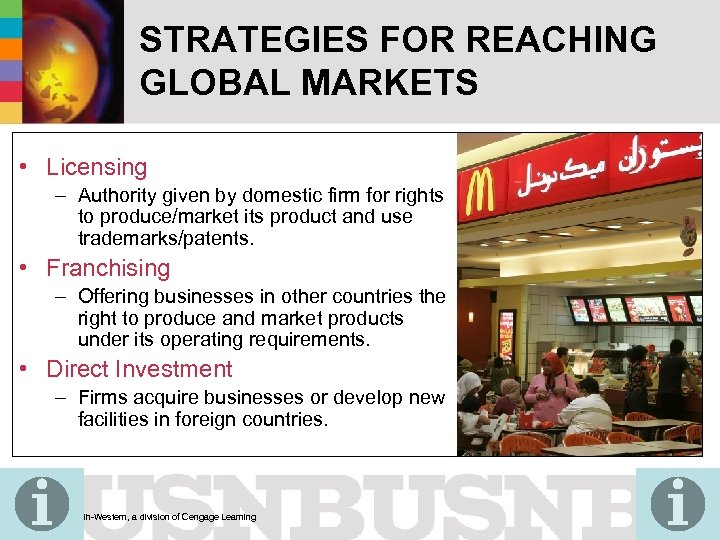
STRATEGIES FOR REACHING GLOBAL MARKETS • Licensing – Authority given by domestic firm for rights to produce/market its product and use trademarks/patents. • Franchising – Offering businesses in other countries the right to produce and market products under its operating requirements. • Direct Investment – Firms acquire businesses or develop new facilities in foreign countries. © 2009 South-Western, a division of Cengage Learning 19
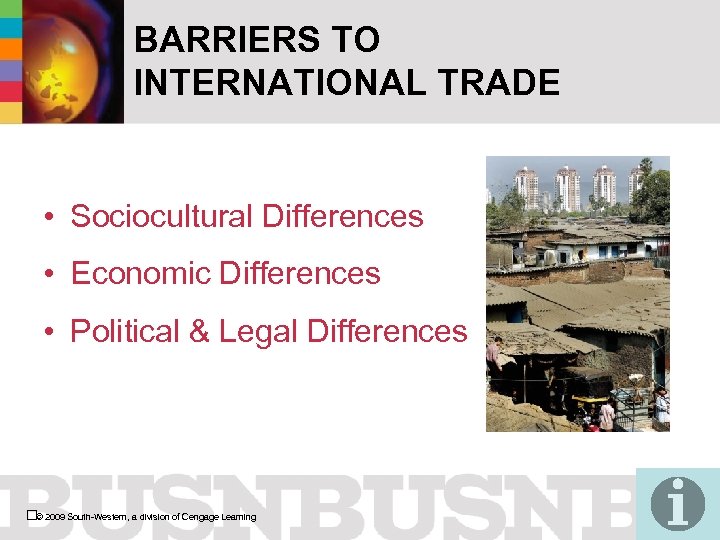
BARRIERS TO INTERNATIONAL TRADE • Sociocultural Differences • Economic Differences • Political & Legal Differences © 2009 South-Western, a division of Cengage Learning 20
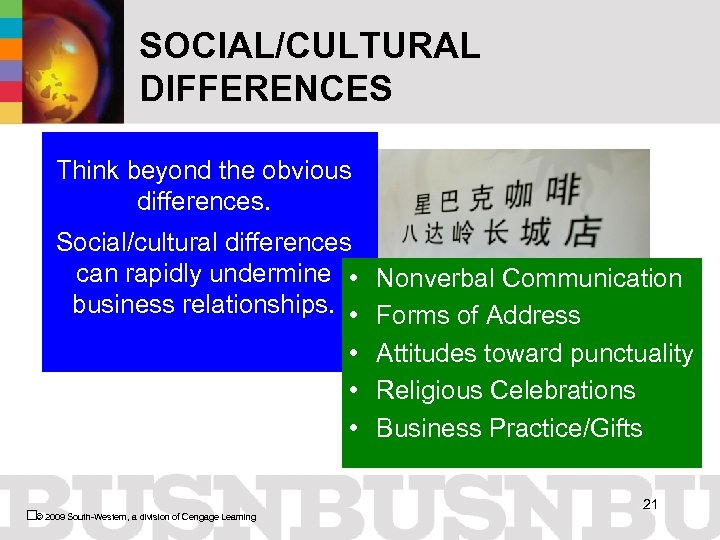
SOCIAL/CULTURAL DIFFERENCES Think beyond the obvious differences. Social/cultural differences can rapidly undermine • business relationships. • • © 2009 South-Western, a division of Cengage Learning Nonverbal Communication Forms of Address Attitudes toward punctuality Religious Celebrations Business Practice/Gifts 21
OOPS: TRANSLATION GAFFS • “It takes a virile man to make a chicken affectionate” – Perdue Farms slogan “It takes a tough man to make a chicken tender” translation in Mexico. • Irish Manure Liquor, Silver Dung Rolls Royce? – Several foreign companies have introduced products in Germany with the word “mist” which roughly translates into “dung” or “manure” • “Nothing sucks like an Electrolux” – Electrolux, a Swedish maker vacuum cleaners, introduced their vacuums in the U. S. with a literal translation of their slogan. © 2009 South-Western, a division of Cengage Learning 22
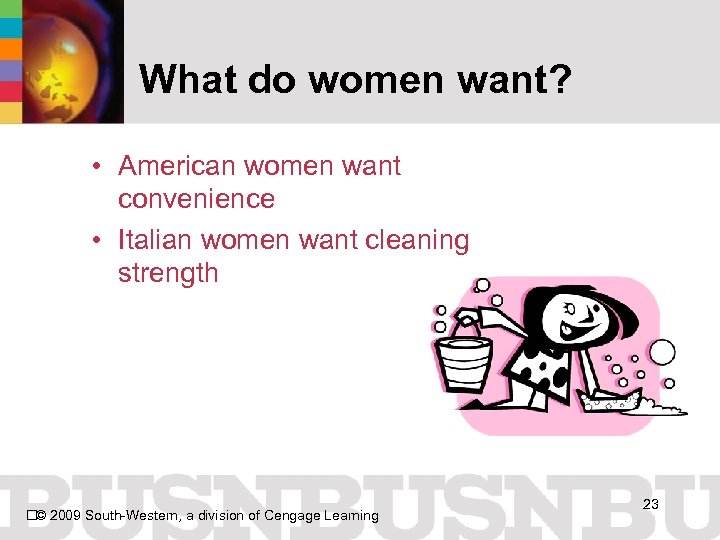
What do women want? • American women want convenience • Italian women want cleaning strength © 2009 South-Western, a division of Cengage Learning 23
ECONOMIC DIFFERENCES • • Exchange Rates Population Can you profitably Per Capita Income provide your product or Infrastructure service to meet the – Transportation – Communication – Energy Finance © 2009 South-Western, a division of Cengage Learning needs of the market? 24
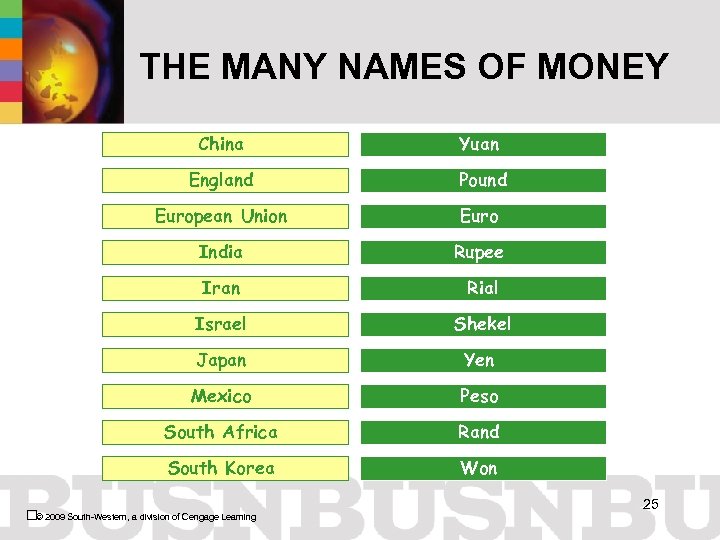
THE MANY NAMES OF MONEY China Yuan England Pound European Union Euro India Rupee Iran Rial Israel Shekel Japan Yen Mexico Peso South Africa Rand South Korea Won © 2009 South-Western, a division of Cengage Learning 25
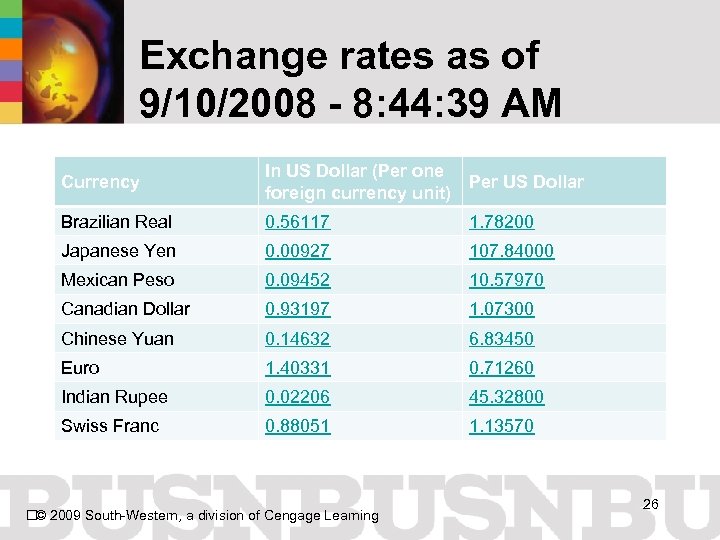
Exchange rates as of 9/10/2008 - 8: 44: 39 AM Currency In US Dollar (Per one foreign currency unit) Per US Dollar Brazilian Real 0. 56117 1. 78200 Japanese Yen 0. 00927 107. 84000 Mexican Peso 0. 09452 10. 57970 Canadian Dollar 0. 93197 1. 07300 Chinese Yuan 0. 14632 6. 83450 Euro 1. 40331 0. 71260 Indian Rupee 0. 02206 45. 32800 Swiss Franc 0. 88051 1. 13570 © 2009 South-Western, a division of Cengage Learning 26
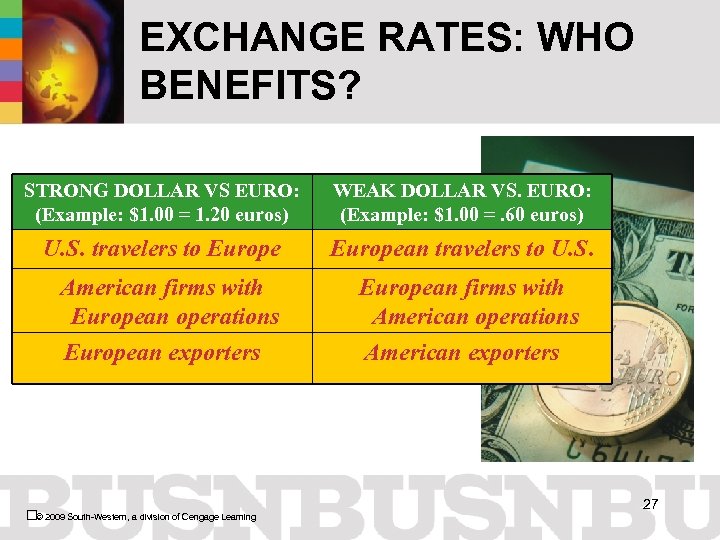
EXCHANGE RATES: WHO BENEFITS? STRONG DOLLAR VS EURO: (Example: $1. 00 = 1. 20 euros) WEAK DOLLAR VS. EURO: (Example: $1. 00 =. 60 euros) U. S. travelers to European travelers to U. S. American firms with European operations European firms with American operations European exporters American exporters © 2009 South-Western, a division of Cengage Learning 27
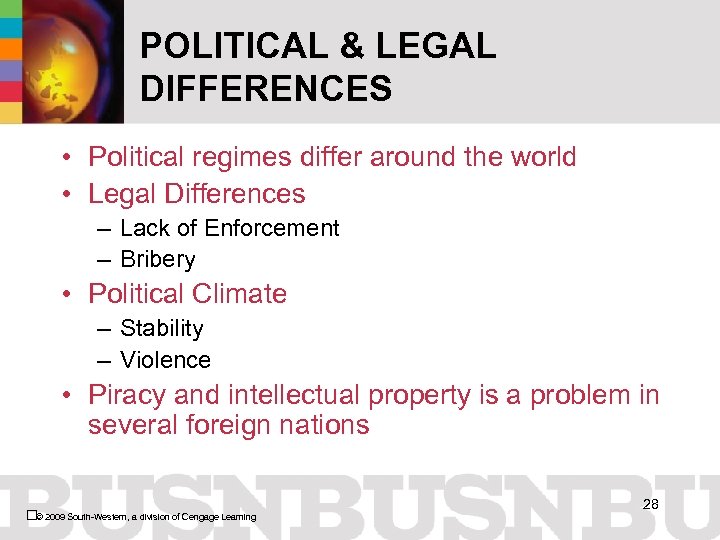
POLITICAL & LEGAL DIFFERENCES • Political regimes differ around the world • Legal Differences – Lack of Enforcement – Bribery • Political Climate – Stability – Violence • Piracy and intellectual property is a problem in several foreign nations © 2009 South-Western, a division of Cengage Learning 28
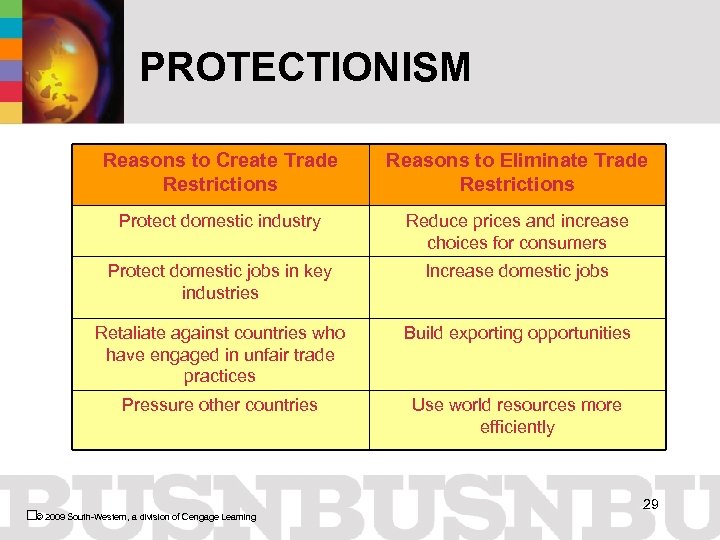
PROTECTIONISM Reasons to Create Trade Restrictions Reasons to Eliminate Trade Restrictions Protect domestic industry Reduce prices and increase choices for consumers Protect domestic jobs in key industries Increase domestic jobs Retaliate against countries who have engaged in unfair trade practices Build exporting opportunities Pressure other countries Use world resources more efficiently © 2009 South-Western, a division of Cengage Learning 29

TRADE RESTRICTIONS • • Tariffs Quotas Voluntary Export Restrictions Embargo © 2009 South-Western, a division of Cengage Learning 30
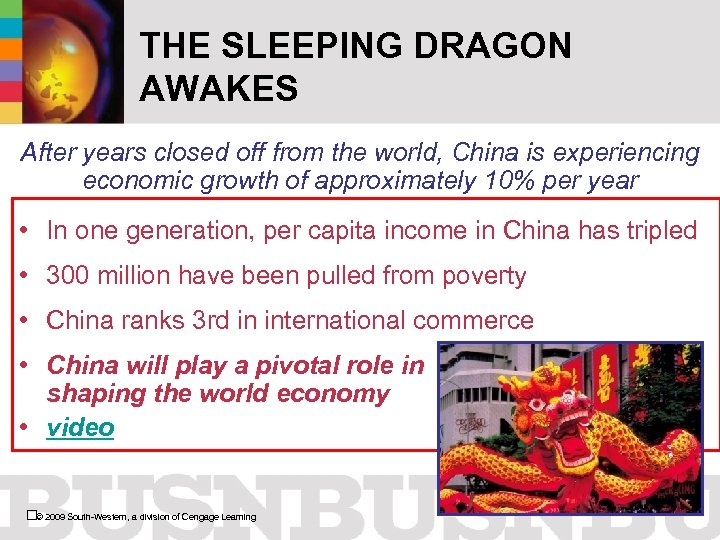
THE SLEEPING DRAGON AWAKES After years closed off from the world, China is experiencing economic growth of approximately 10% per year • In one generation, per capita income in China has tripled • 300 million have been pulled from poverty • China ranks 3 rd in international commerce • China will play a pivotal role in shaping the world economy • video © 2009 South-Western, a division of Cengage Learning 31
• http: //www. pbs. org/newshour/bb/asia/ja n-june 07/china_06 -25. html • Video © 2009 South-Western, a division of Cengage Learning 32
GLOBAL EMPLOYMENT “ A new study suggests that 2. 3 million service jobs will have moved from the United States to other countries by 2008, up from 900, 000 as of 2003. “ © 2009 South-Western, a division of Cengage Learning 33
LOOKING BACK • What barriers and opportunities are fueling the growth of the global economy? • What are strategies for reaching global markets? • How do we measure trade? • Discuss barriers to international trade? • What are strategies for promoting free trade? • What are the benefits and criticisms of free trade? © 2009 South-Western, a division of Cengage Learning 34
REVERSE BRAIN DRAIN • Many talented immigrants are moving home to take advantage of new economic opportunities. • US companies can cut costs by sourcing employees from overseas. • But is America losing potential innovators such as Sergey Brin, founder of Google? © 2009 South-Western, a division of Cengage Learning 35
Скачать презентацию Chapter 3 THE WORLD MARKETPLACE Business without Borders
d29827bc9647d63bf75f082b46a16ac8.ppt