


 Скачать презентацию Chapter 3 The Internal Environment
c5bd4614683c531bc1f2b5e9b739c3c3.ppt
- Количество слайдов: 38
 Chapter 3: The Internal Environment • • • Internal analysis – why? how? Resources – tangible and intangible Capabilities Core competencies (distinctive competence) Four criteria for sustainable competitive advantage Value chain analysis Outsourcing Core rigidities Financial performance measures SWOT analysis Copyright © 2004 South-Western. All rights reserved. 1
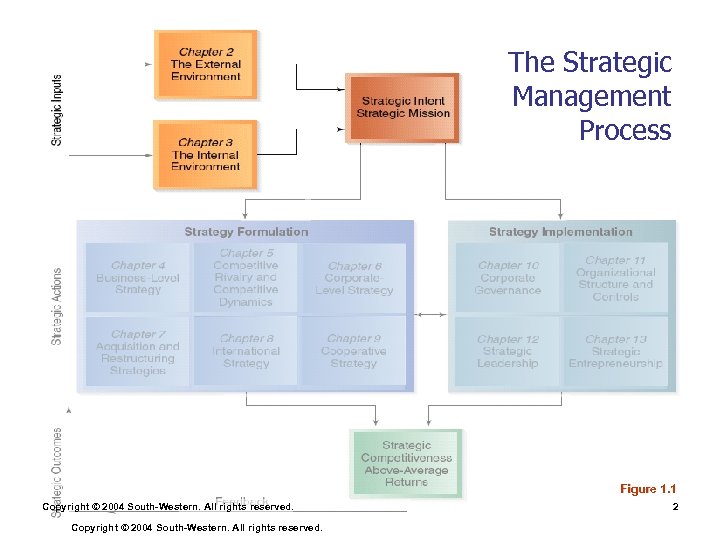 The Strategic Management Process Figure 1. 1 Copyright © 2004 South-Western. All rights reserved. 2
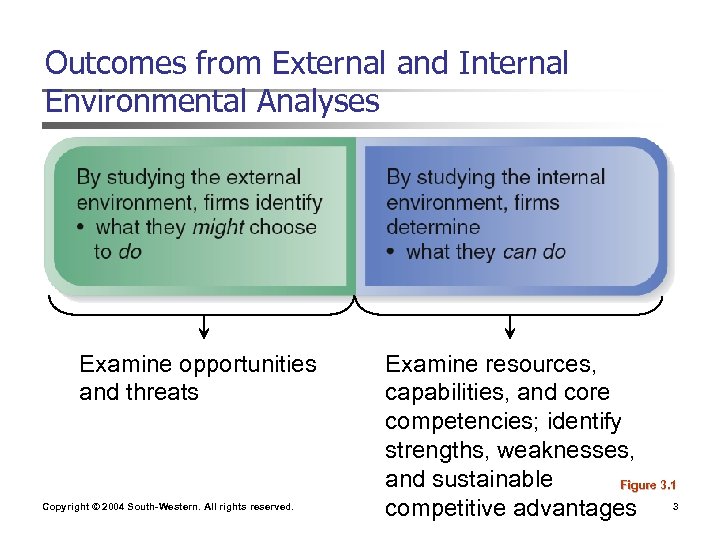 Outcomes from External and Internal Environmental Analyses Examine opportunities and threats Copyright © 2004 South-Western. All rights reserved. Examine resources, capabilities, and core competencies; identify strengths, weaknesses, and sustainable Figure 3. 1 competitive advantages 3
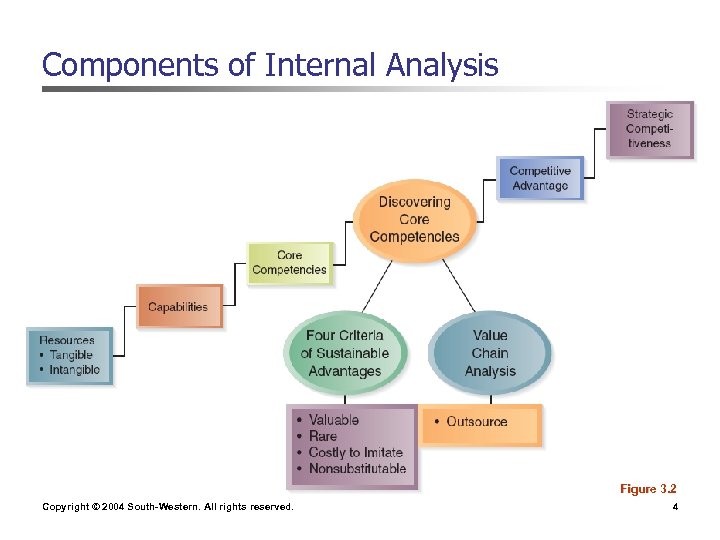 Components of Internal Analysis Figure 3. 2 Copyright © 2004 South-Western. All rights reserved. 4
 Conditions contributing to the challenge of identifying strengths and weaknesses Uncertainty Complexity Organizational conflicts Copyright © 2004 South-Western. All rights reserved. 5
 Facilitating Internal Analysis via. . . • Ongoing observation (media reports, problems, successes, MBWA) • Brainstorming • Retreats • Task forces • In-house facilitator or external consultants • Ongoing planning activities • Periodic functional audits • Value chain analysis • “Devil’s advocates”, “upstream swimmers” Copyright © 2004 South-Western. All rights reserved. 6
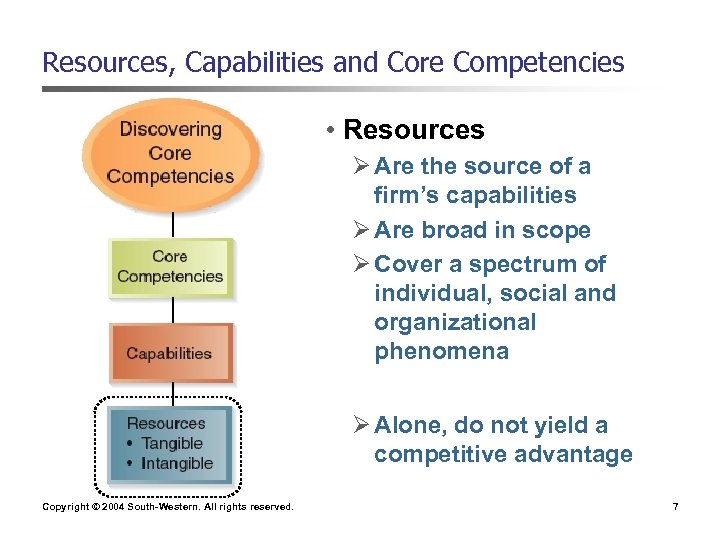 Resources, Capabilities and Core Competencies • Resources Ø Are the source of a firm’s capabilities Ø Are broad in scope Ø Cover a spectrum of individual, social and organizational phenomena Ø Alone, do not yield a competitive advantage Copyright © 2004 South-Western. All rights reserved. 7
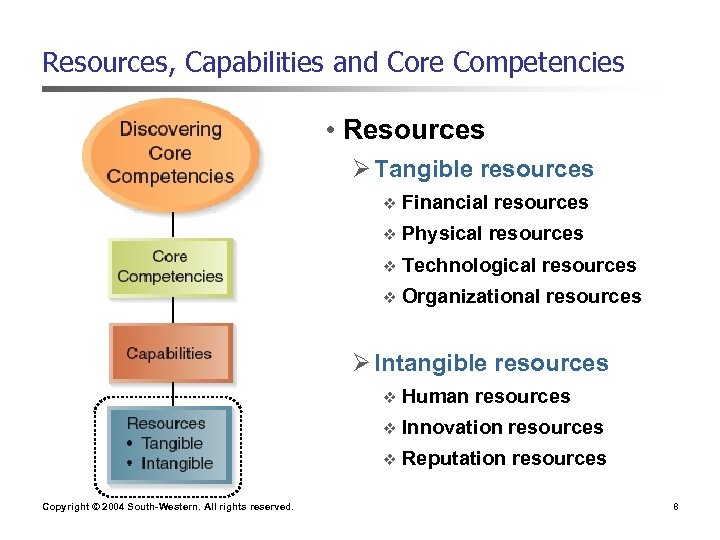 Resources, Capabilities and Core Competencies • Resources Ø Tangible resources v Financial resources v Physical resources v Technological resources v Organizational resources Ø Intangible resources v v Innovation resources v Copyright © 2004 South-Western. All rights reserved. Human resources Reputation resources 8
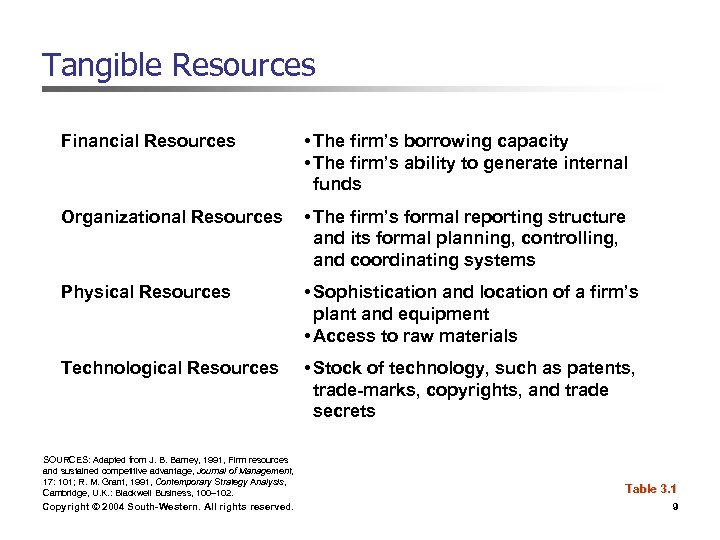 Tangible Resources Financial Resources • The firm’s borrowing capacity • The firm’s ability to generate internal funds Organizational Resources • The firm’s formal reporting structure and its formal planning, controlling, and coordinating systems Physical Resources • Sophistication and location of a firm’s plant and equipment • Access to raw materials Technological Resources • Stock of technology, such as patents, trade-marks, copyrights, and trade secrets SOURCES: Adapted from J. B. Barney, 1991, Firm resources and sustained competitive advantage, Journal of Management, 17: 101; R. M. Grant, 1991, Contemporary Strategy Analysis, Cambridge, U. K. : Blackwell Business, 100– 102. Table 3. 1 Copyright © 2004 South-Western. All rights reserved. 9
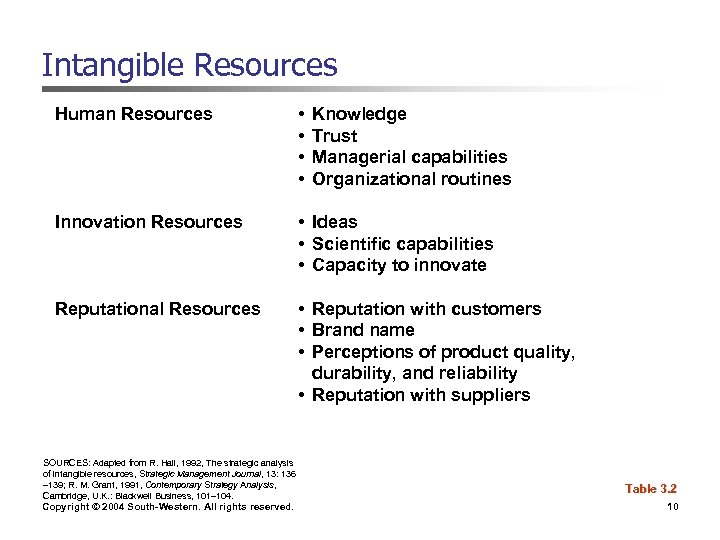 Intangible Resources Human Resources • • Innovation Resources • Ideas • Scientific capabilities • Capacity to innovate Reputational Resources • Reputation with customers • Brand name • Perceptions of product quality, durability, and reliability • Reputation with suppliers SOURCES: Adapted from R. Hall, 1992, The strategic analysis of intangible resources, Strategic Management Journal, 13: 136 – 139; R. M. Grant, 1991, Contemporary Strategy Analysis, Cambridge, U. K. : Blackwell Business, 101– 104. Copyright © 2004 South-Western. All rights reserved. Knowledge Trust Managerial capabilities Organizational routines Table 3. 2 10
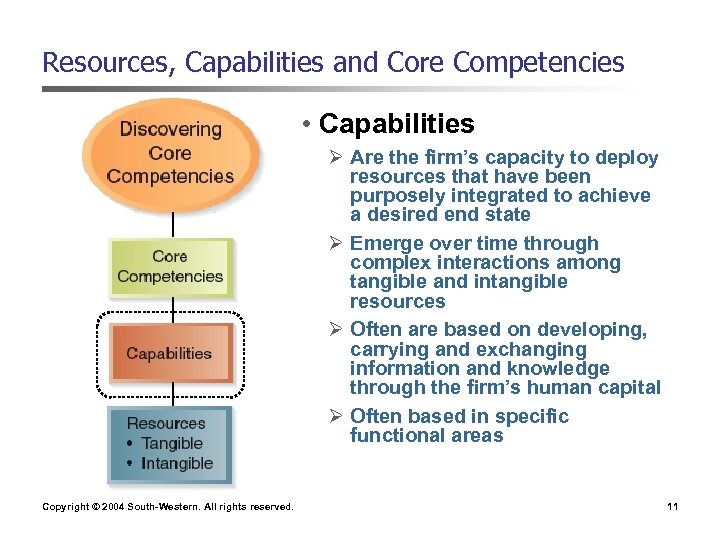 Resources, Capabilities and Core Competencies • Capabilities Ø Are the firm’s capacity to deploy resources that have been purposely integrated to achieve a desired end state Ø Emerge over time through complex interactions among tangible and intangible resources Ø Often are based on developing, carrying and exchanging information and knowledge through the firm’s human capital Ø Often based in specific functional areas Copyright © 2004 South-Western. All rights reserved. 11
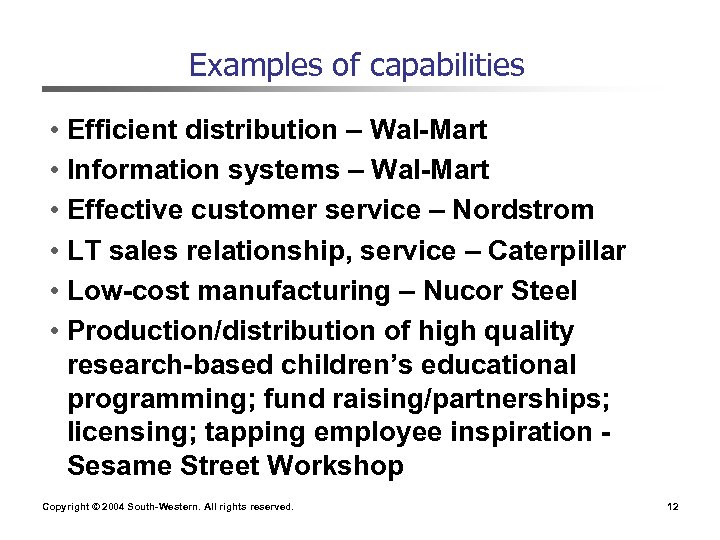 Examples of capabilities • Efficient distribution – Wal-Mart • Information systems – Wal-Mart • Effective customer service – Nordstrom • LT sales relationship, service – Caterpillar • Low-cost manufacturing – Nucor Steel • Production/distribution of high quality research-based children’s educational programming; fund raising/partnerships; licensing; tapping employee inspiration Sesame Street Workshop Copyright © 2004 South-Western. All rights reserved. 12
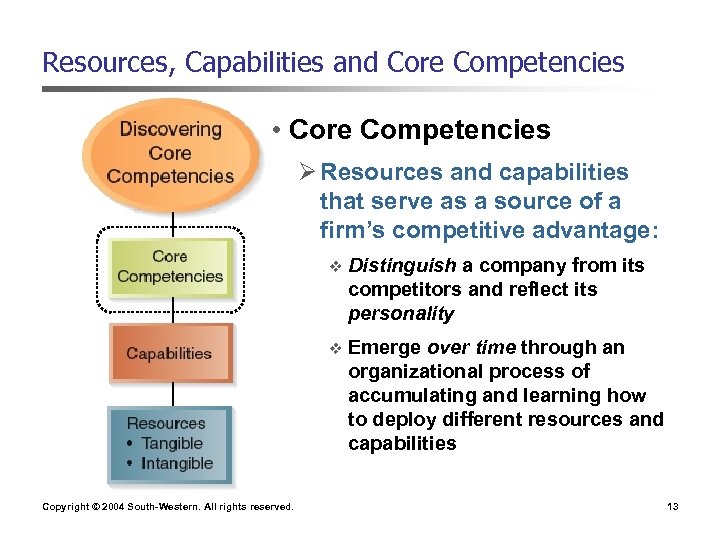 Resources, Capabilities and Core Competencies • Core Competencies Ø Resources and capabilities that serve as a source of a firm’s competitive advantage: v v Copyright © 2004 South-Western. All rights reserved. Distinguish a company from its competitors and reflect its personality Emerge over time through an organizational process of accumulating and learning how to deploy different resources and capabilities 13
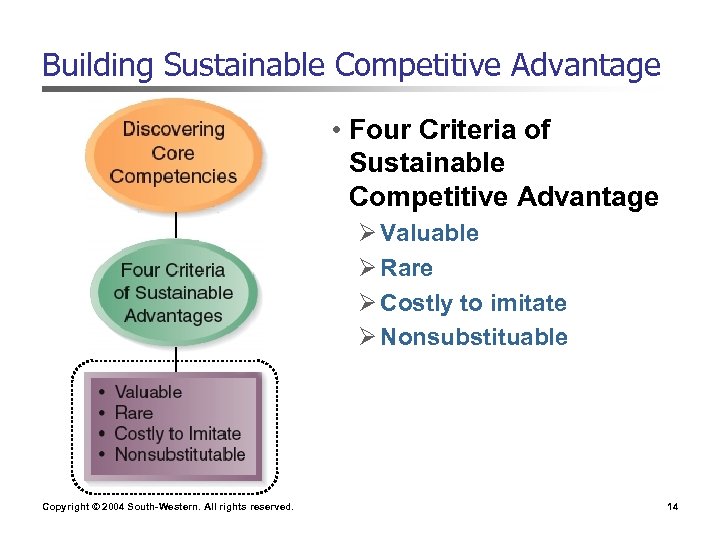 Building Sustainable Competitive Advantage • Four Criteria of Sustainable Competitive Advantage Ø Valuable Ø Rare Ø Costly to imitate Ø Nonsubstituable Copyright © 2004 South-Western. All rights reserved. 14
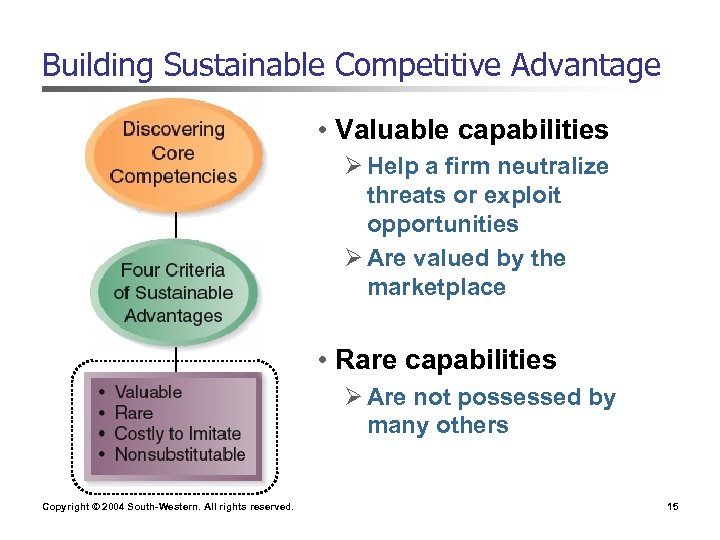 Building Sustainable Competitive Advantage • Valuable capabilities Ø Help a firm neutralize threats or exploit opportunities Ø Are valued by the marketplace • Rare capabilities Ø Are not possessed by many others Copyright © 2004 South-Western. All rights reserved. 15
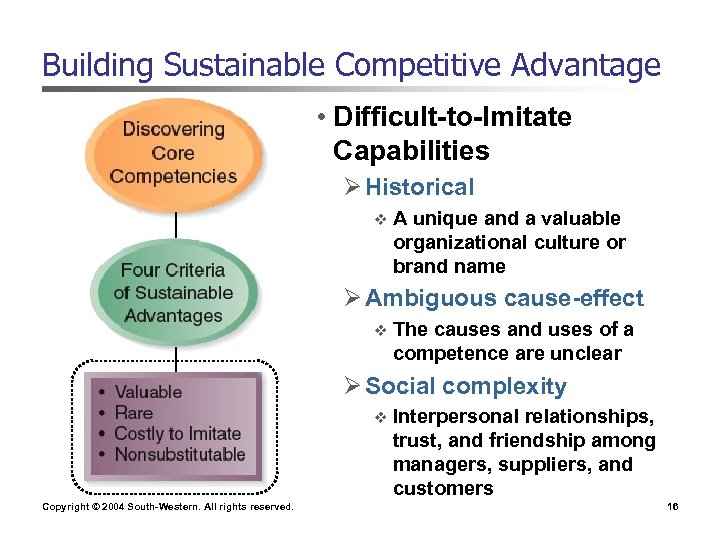 Building Sustainable Competitive Advantage • Difficult-to-Imitate Capabilities Ø Historical v A unique and a valuable organizational culture or brand name Ø Ambiguous cause-effect v The causes and uses of a competence are unclear Ø Social complexity v Copyright © 2004 South-Western. All rights reserved. Interpersonal relationships, trust, and friendship among managers, suppliers, and customers 16
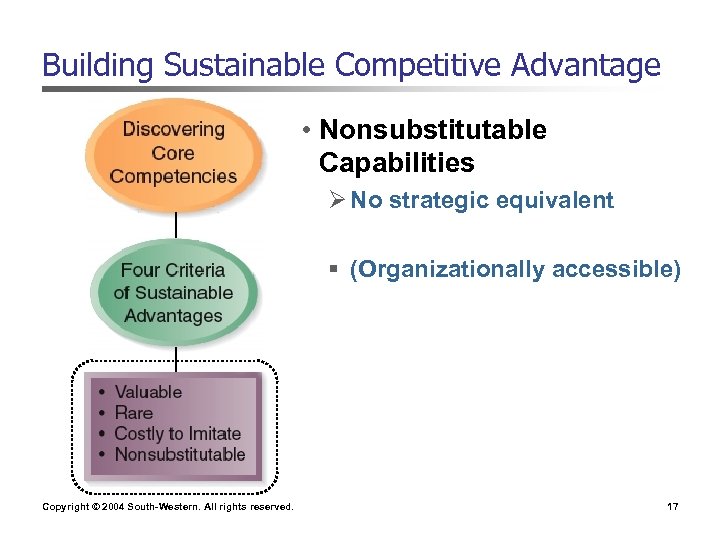 Building Sustainable Competitive Advantage • Nonsubstitutable Capabilities Ø No strategic equivalent § (Organizationally accessible) Copyright © 2004 South-Western. All rights reserved. 17
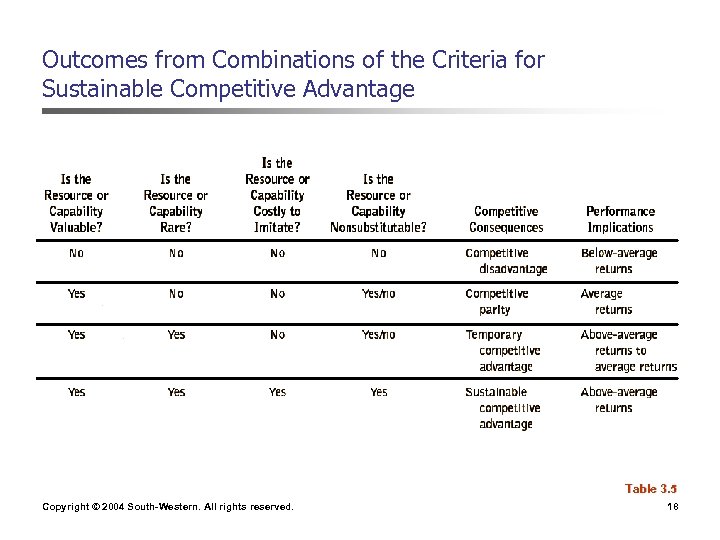 Outcomes from Combinations of the Criteria for Sustainable Competitive Advantage Table 3. 5 Copyright © 2004 South-Western. All rights reserved. 18
 Core/Distinctive Competencies – So What? Who Cares? • Identify and protect core competencies • Use your core competencies; reply on in competitive strategies • Continually develop and renew core competencies • Leverage core competencies into areas of opportunity Copyright © 2004 South-Western. All rights reserved. 19
 Value Chain Analysis • Allows the firm to understand the parts of its operations that create value and those that do not • A template that firms use to: Ø Understand their cost position Ø Identify multiple means that might be used to facilitate implementation of a chosen businesslevel strategy Copyright © 2004 South-Western. All rights reserved. 20
 Value Chain Analysis (cont’d) • Primary activities involved with: Ø A product’s physical creation Ø A product’s sale and distribution to buyers Ø The product’s service after the sale • Support activities Ø Provide the support necessary for the primary activities to take place Copyright © 2004 South-Western. All rights reserved. 21
 Value Chain Analysis (cont’d) • Value chain Ø Shows how a product moves from raw-material stage to the final customer • To be a source of competitive advantage, a resource or capability must allow the firm: Ø To perform an activity in a manner that is superior to the way competitors perform it, or Ø To perform a value-creating activity that competitors cannot complete Copyright © 2004 South-Western. All rights reserved. 22
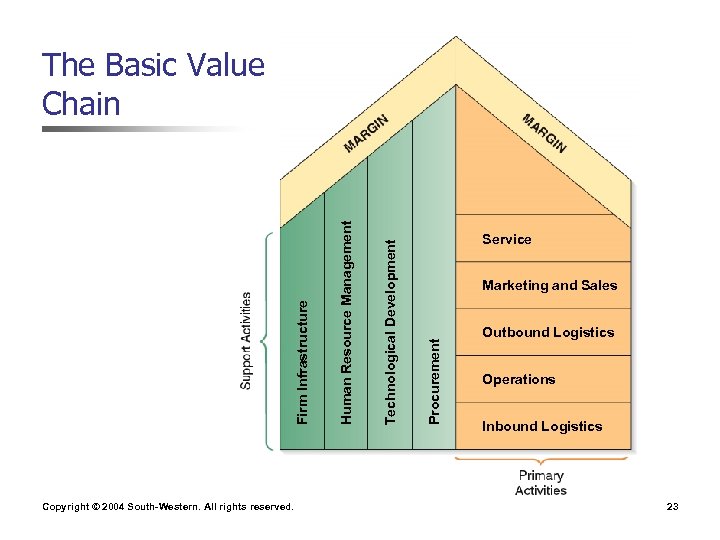 Copyright © 2004 South-Western. All rights reserved. Service Marketing and Sales Procurement Technological Development Human Resource Management Firm Infrastructure The Basic Value Chain Outbound Logistics Operations Inbound Logistics 23
 The Value-Creating Potential of Primary Activities • Inbound logistics Ø Activities used to receive, store, and disseminate inputs to a product (materials handling, warehousing, inventory control, etc. ) • Operations Ø Activities necessary to convert the inputs provided by inbound logistics into final product form (machining, packaging, assembly, etc. ) • Outbound logistics Ø Activities involved with collecting, storing, and physically distributing the product to customers (finished goods warehousing, order processing, etc. ) Copyright © 2004 South-Western. All rights reserved. 24
 The Value-Creating Potential of Primary Activities (cont’d) • Marketing and sales Ø Activities completed to provide means through which customers can purchase products and to induce them to do so (advertising, promotion, distribution channels, etc. ) • Service Ø Activities designed to enhance or maintain a product’s value (repair, training, adjustment, etc. ) Each activity should be examined relative to competitors’ abilities and rated as superior, equivalent or inferior Copyright © 2004 South-Western. All rights reserved. 25
 The Value-Creating Potential of Primary Activities: Support • Procurement Ø Activities completed to purchase the inputs needed to produce a firm’s products (raw materials and supplies, machines, laboratory equipment, etc. ) • Technological development Ø Activities completed to improve a firm’s product and the processes used to manufacture it (process equipment, basic research, product design, etc) • Human resource management Ø Activities involved with recruiting, hiring, training, developing, and compensating all personnel Copyright © 2004 South-Western. All rights reserved. 26
 The Value-Creating Potential of Primary Activities: Support (cont’d) • Firm infrastructure Ø Activities that support the work of the entire value chain (general management, planning, finance, accounting, legal, government relations, etc. ) v v v Effectively and consistently identify external opportunities and threats Identify resources and capabilities Support core competencies Each activity should be examined relative to competitors’ abilities and rated as superior, equivalent or inferior Copyright © 2004 South-Western. All rights reserved. 27
 Use of Value Chain Analysis Advantages? Copyright © 2004 South-Western. All rights reserved. Disadvantages? 28
 Useful financial analysis • Examines trends in financial measures over several (more than two) years • Analyzes entries in financial statements; consider growth rates, % composition • Calculates a rich set of financial ratios (pp. xiv-xv) • Interprets the financial calculations • Provides defensible conclusions about the organization’s overall financial situation Copyright © 2004 South-Western. All rights reserved. 29
 Outsourcing • The purchase of a value-creating activity from an external supplier Ø Few organizations possess the resources and capabilities required to achieve competitive superiority in all primary and support activities • By forming and emphasizing fewer capabilities Ø A firm can concentrate on those areas in which it can create value Ø Specialty suppliers can perform outsourced capabilities more efficiently Copyright © 2004 South-Western. All rights reserved. 30
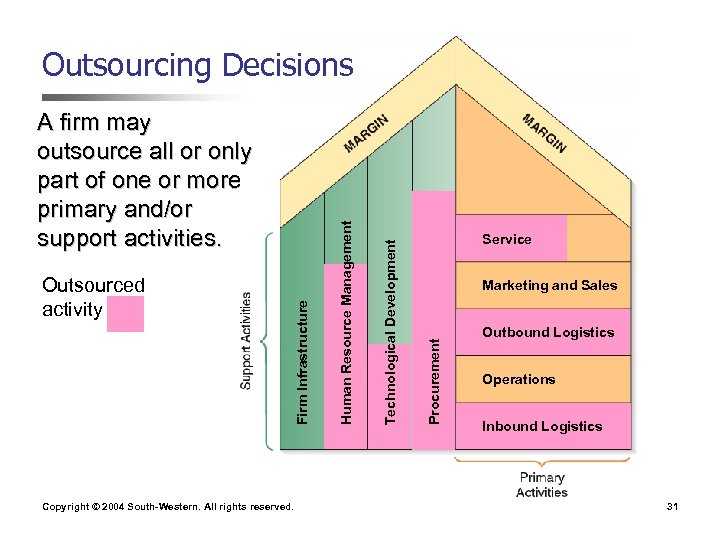 Copyright © 2004 South-Western. All rights reserved. Service Marketing and Sales Procurement Technological Development Outsourced activity Firm Infrastructure A firm may outsource all or only part of one or more primary and/or support activities. Human Resource Management Outsourcing Decisions Outbound Logistics Operations Inbound Logistics 31
 Strategic Rationale for Outsourcing • Improve business focus Ø Lets a company focus on broader business issues by having outside experts handle various operational details • Provide access to world-class capabilities Ø The specialized resources of outsourcing providers makes world-class capabilities available to firms in a wide range of applications Copyright © 2004 South-Western. All rights reserved. 32
 Strategic Rationale for Outsourcing (cont’d) • Accelerate business re-engineering benefits Ø Achieves re-engineering benefits more quickly by having outsiders—who have already achieved world-class standards—take over process • Sharing risks Ø Reduces investment requirements and makes firm more flexible, dynamic and better able to adapt to changing opportunities • Frees resources for other purposes Ø Redirects efforts from non-core activities toward those that serve customers more effectively Copyright © 2004 South-Western. All rights reserved. 33
 Outsourcing Issues • Greatest value Ø Outsource only to firms possessing a core competence in terms of performing the primary or supporting the outsourced activity • Evaluating resources and capabilities Ø Do not outsource activities in which the firm itself can create and capture value • Environmental threats and ongoing tasks Ø Do not outsource primary and support activities that are used to neutralize environmental threats or to complete necessary ongoing organizational tasks Copyright © 2004 South-Western. All rights reserved. 34
 Outsourcing Issues (cont’d) • Nonstrategic team of resources Ø Do not outsource capabilities that are critical to the firm’s success, even though the capabilities are not actual sources of competitive advantage • Firm’s knowledge base Ø Do not outsource activities that stimulate the development of new capabilities and competencies Copyright © 2004 South-Western. All rights reserved. 35
 Cautions and Reminders • BEWARE OF COMPLACENCY! Never take for granted that core competencies will continue to provide a source of competitive advantage. • Core competencies have the potential to become core rigidities. • Core rigidities are former core competencies that now generate inertia and stifle innovation. • Remaining vigilant/poised for change through continuous and effective analyses of internal and external environments increases the likelihood of long-term competitive success Copyright © 2004 South-Western. All rights reserved. 36
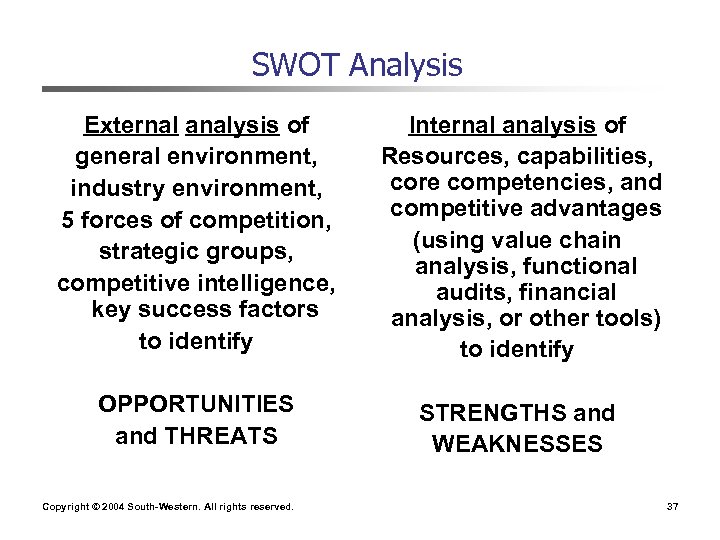 SWOT Analysis External analysis of general environment, industry environment, 5 forces of competition, strategic groups, competitive intelligence, key success factors to identify Internal analysis of Resources, capabilities, core competencies, and competitive advantages (using value chain analysis, functional audits, financial analysis, or other tools) to identify OPPORTUNITIES and THREATS STRENGTHS and WEAKNESSES Copyright © 2004 South-Western. All rights reserved. 37
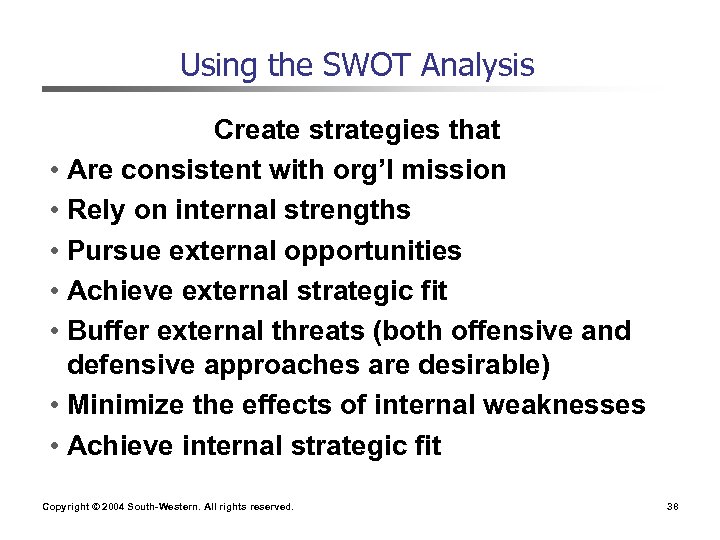 Using the SWOT Analysis Create strategies that • Are consistent with org’l mission • Rely on internal strengths • Pursue external opportunities • Achieve external strategic fit • Buffer external threats (both offensive and defensive approaches are desirable) • Minimize the effects of internal weaknesses • Achieve internal strategic fit Copyright © 2004 South-Western. All rights reserved. 38