


 Скачать презентацию Chapter 3 Supply and Demand Chapter Outline
c721cc15d19c9598c87b0ba2402561b9.ppt
- Количество слайдов: 42
 Chapter 3 Supply and Demand
 Chapter Outline • • • Market demand Market supply Market equilibrium Comparative statics analysis Supply, demand, and price Copyright © 2014 Pearson Education, Inc. All rights reserved. 3 -2
 Learning Objectives • Define supply, demand, and equilibrium price • List and provide specific examples of the non-price determinants of supply and demand • Distinguish between the short-run rationing function and long-run guiding function of price • Illustrate how the concepts of supply and demand can be used in management decisions about price and allocations of resources. • Use supply and demand diagrams to determine price in the short and long run Copyright © 2014 Pearson Education, Inc. All rights reserved. 3 -3
 Market Demand • The demand for a good or service is defined as: – Quantities of a good or service that people are ready, willing and able to buy at various prices within some given time period. (Other factors besides price held constant. ) Copyright © 2014 Pearson Education, Inc. All rights reserved. 3 -4
 Market Demand • “Ready” implies that consumers are prepared to buy a good or service both because they are: – Willing: Consumers have a preference for it. – Able: Consumers have the income to support this preference. Copyright © 2014 Pearson Education, Inc. All rights reserved. 3 -5
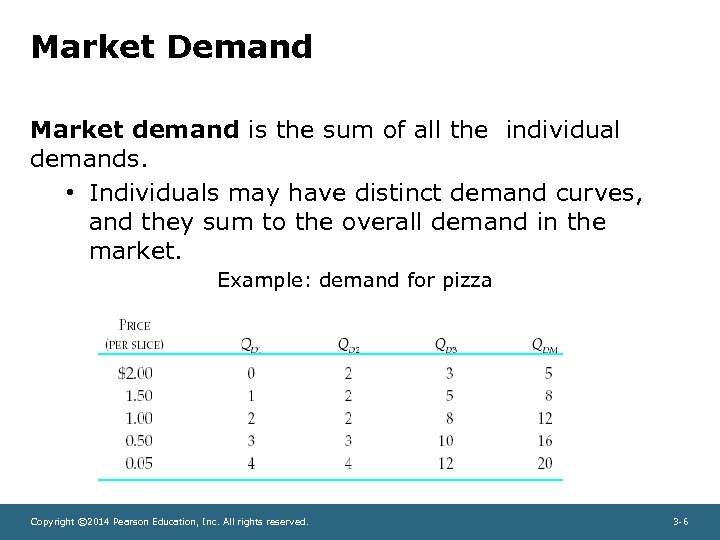 Market Demand Market demand is the sum of all the individual demands. • Individuals may have distinct demand curves, and they sum to the overall demand in the market. Example: demand for pizza Copyright © 2014 Pearson Education, Inc. All rights reserved. 3 -6
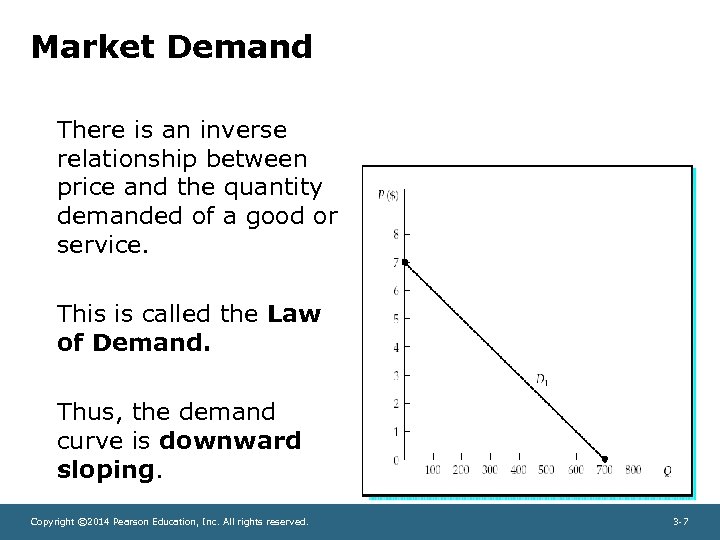 Market Demand There is an inverse relationship between price and the quantity demanded of a good or service. This is called the Law of Demand. Thus, the demand curve is downward sloping. Copyright © 2014 Pearson Education, Inc. All rights reserved. 3 -7
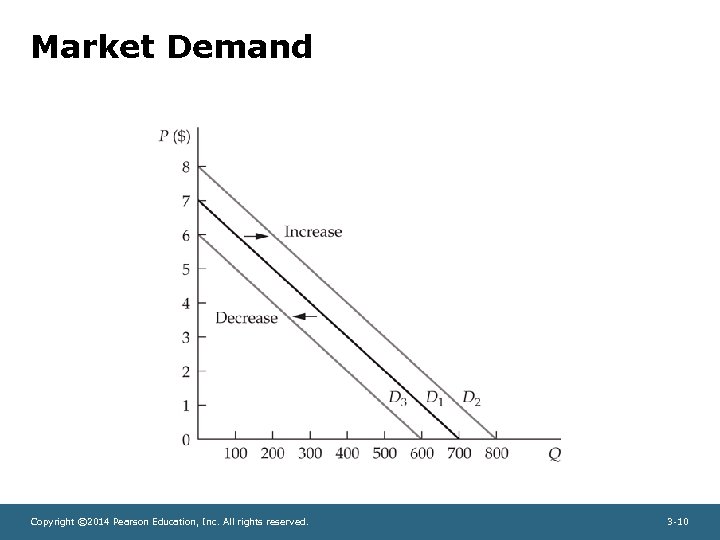
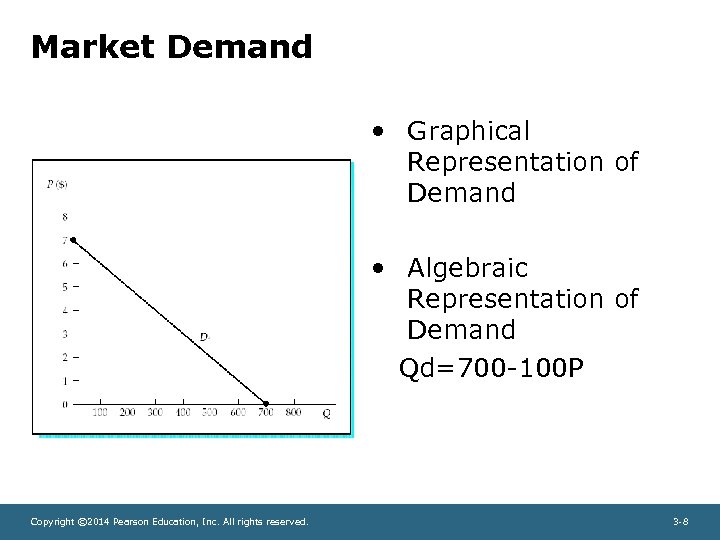 Market Demand • Graphical Representation of Demand • Algebraic Representation of Demand Qd=700 -100 P Copyright © 2014 Pearson Education, Inc. All rights reserved. 3 -8
 Market Demand • Changes in price result in changes in the quantity demanded – This is shown as movement along the demand curve. • Changes in non-price factors result in changes in demand – This is shown as a shift in the demand curve. Copyright © 2014 Pearson Education, Inc. All rights reserved. 3 -9
 Market Demand Copyright © 2014 Pearson Education, Inc. All rights reserved. 3 -10
 Market Demand • Non-price determinants of demand-result is a shift in the demand curve. – tastes and preferences – income – prices of related products – future expectations – number of buyers Copyright © 2014 Pearson Education, Inc. All rights reserved. 3 -11
 Market Supply • The supply of a good or service is defined as quantities that people are ready to sell at various prices within some given time period (Other factors besides price held constant) Copyright © 2014 Pearson Education, Inc. All rights reserved. 3 -12
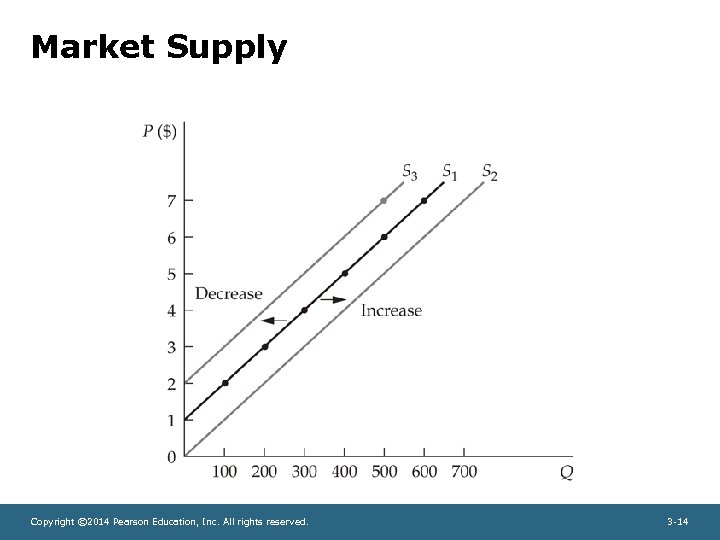
 Market Supply • Changes in price result in changes in the quantity supplied – shown as movement along the supply curve • Changes in non-price determinants result in changes in supply – shown as a shift in the supply curve Copyright © 2014 Pearson Education, Inc. All rights reserved. 3 -13
 Market Supply Copyright © 2014 Pearson Education, Inc. All rights reserved. 3 -14
 Market Supply • Non-price determinants of supply-results in a shift in the supply curve. – costs and technology – prices of other goods or services offered by the seller – future expectations – number of sellers – weather conditions Copyright © 2014 Pearson Education, Inc. All rights reserved. 3 -15
 Market Equilibrium • Equilibrium price: the price that equates the quantity demanded with the quantity supplied • Equilibrium quantity: the amount that people are willing to buy and sellers are willing to offer at the equilibrium price level Copyright © 2014 Pearson Education, Inc. All rights reserved. 3 -16
 Market Equilibrium • Shortage: a market situation in which the quantity demanded exceeds the quantity supplied – shortage occurs at a price below the equilibrium level • Surplus: a market situation in which the quantity supplied exceeds the quantity demanded – surplus occurs at a price above the equilibrium level Copyright © 2014 Pearson Education, Inc. All rights reserved. 3 -17
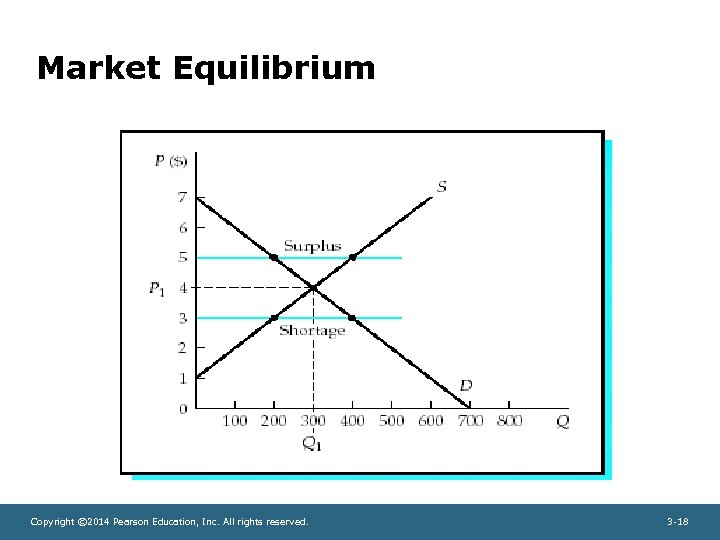 Market Equilibrium Copyright © 2014 Pearson Education, Inc. All rights reserved. 3 -18
 Comparative Statics Analysis • Comparative statics is a form of sensitivity (or what-if) analysis – Commonly used method in economic analysis Copyright © 2014 Pearson Education, Inc. All rights reserved. 3 -19
 Comparative Statics Analysis • Process of comparative statics analysis: – state all the assumptions needed to construct the model – begin by assuming that the model is in equilibrium – introduce a change in the model, so a condition of disequilibrium is created – find the new point of equilibrium – compare the new equilibrium point with the original one Copyright © 2014 Pearson Education, Inc. All rights reserved. 3 -20
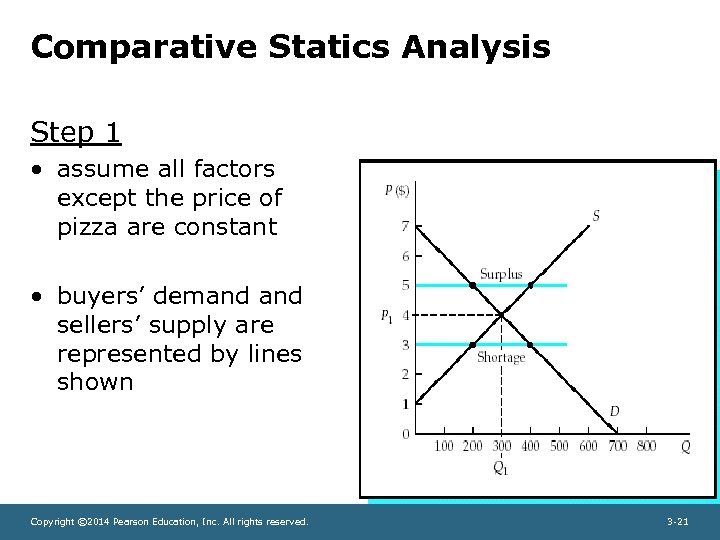 Comparative Statics Analysis Step 1 • assume all factors except the price of pizza are constant • buyers’ demand sellers’ supply are represented by lines shown Copyright © 2014 Pearson Education, Inc. All rights reserved. 3 -21
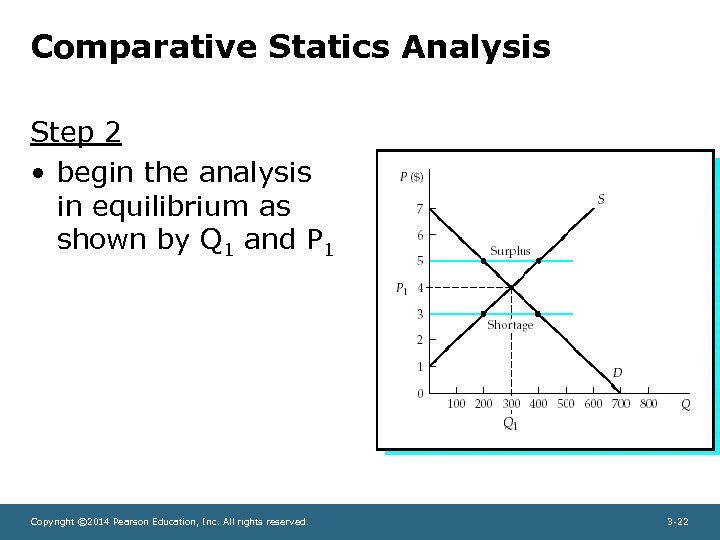 Comparative Statics Analysis Step 2 • begin the analysis in equilibrium as shown by Q 1 and P 1 Copyright © 2014 Pearson Education, Inc. All rights reserved. 3 -22
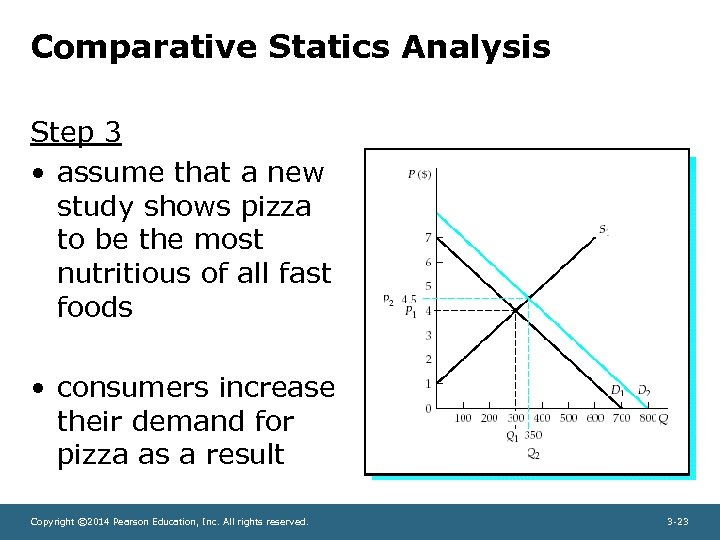 Comparative Statics Analysis Step 3 • assume that a new study shows pizza to be the most nutritious of all fast foods • consumers increase their demand for pizza as a result Copyright © 2014 Pearson Education, Inc. All rights reserved. 3 -23
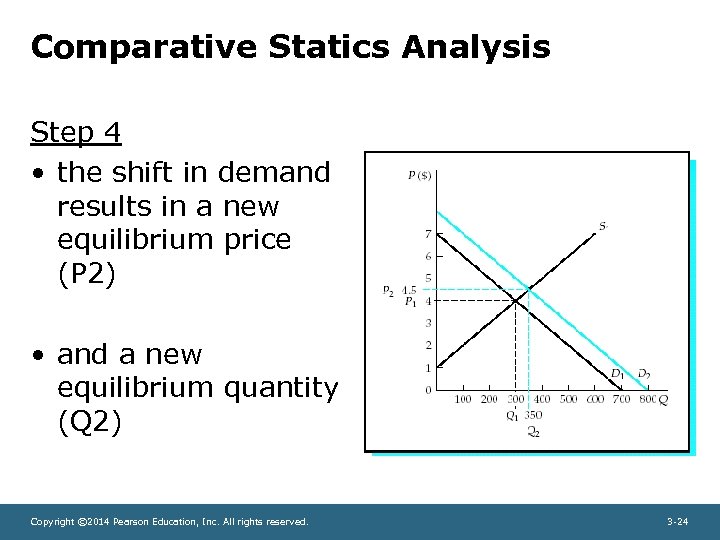 Comparative Statics Analysis Step 4 • the shift in demand results in a new equilibrium price (P 2) • and a new equilibrium quantity (Q 2) Copyright © 2014 Pearson Education, Inc. All rights reserved. 3 -24
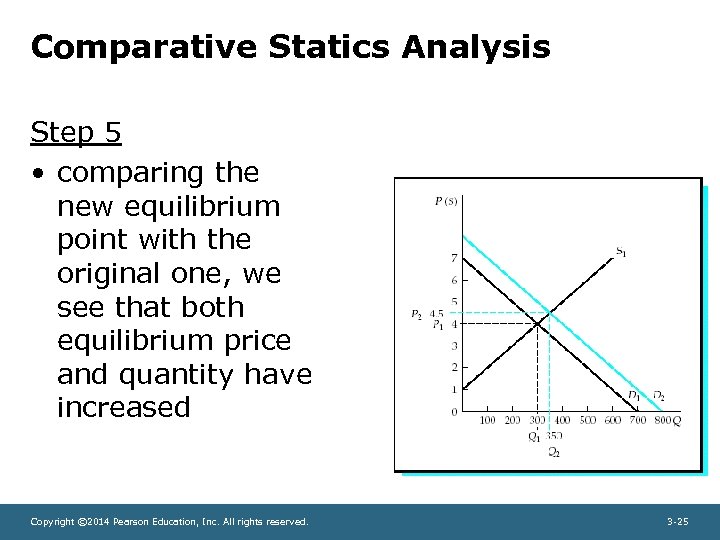 Comparative Statics Analysis Step 5 • comparing the new equilibrium point with the original one, we see that both equilibrium price and quantity have increased Copyright © 2014 Pearson Education, Inc. All rights reserved. 3 -25
 Comparative Statics Analysis • The short run is the period of time in which: – sellers already in the market respond to a change in equilibrium price by adjusting variable inputs – buyers already in the market respond to changes in equilibrium price by adjusting the quantity demanded for the good or service Copyright © 2014 Pearson Education, Inc. All rights reserved. 3 -26
 Comparative Statics Analysis • Short run changes show the rationing function of price – The rationing function of price is the change in market price to eliminate the imbalance between quantities supplied and demanded. Copyright © 2014 Pearson Education, Inc. All rights reserved. 3 -27
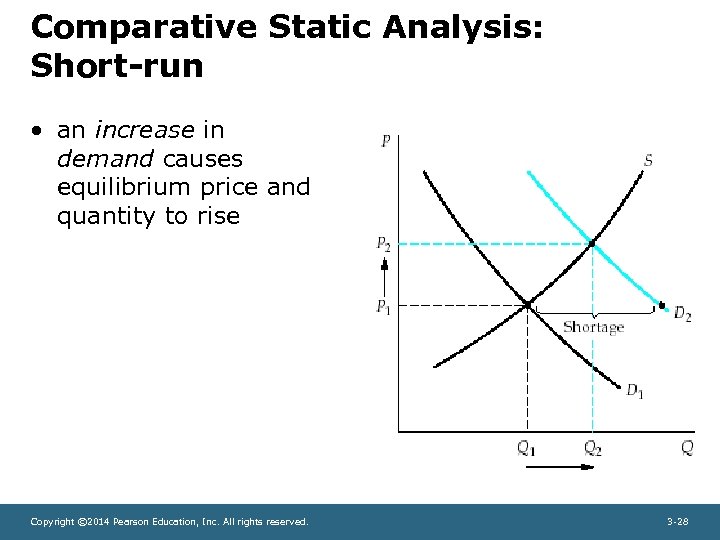 Comparative Static Analysis: Short-run • an increase in demand causes equilibrium price and quantity to rise Copyright © 2014 Pearson Education, Inc. All rights reserved. 3 -28
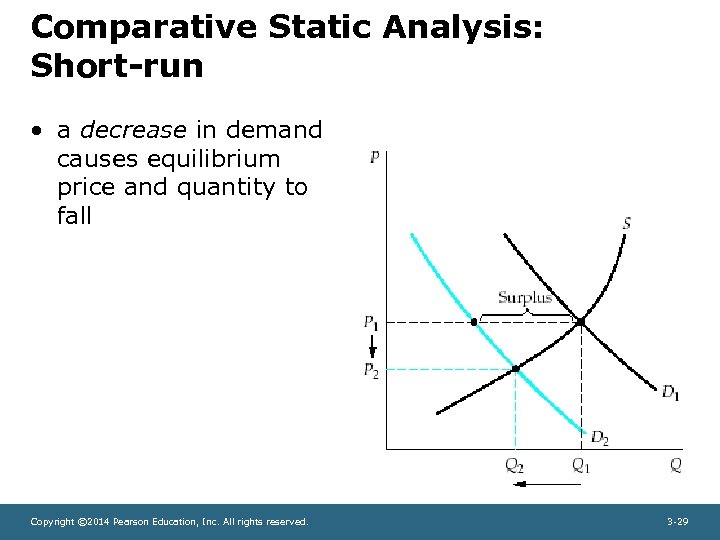 Comparative Static Analysis: Short-run • a decrease in demand causes equilibrium price and quantity to fall Copyright © 2014 Pearson Education, Inc. All rights reserved. 3 -29
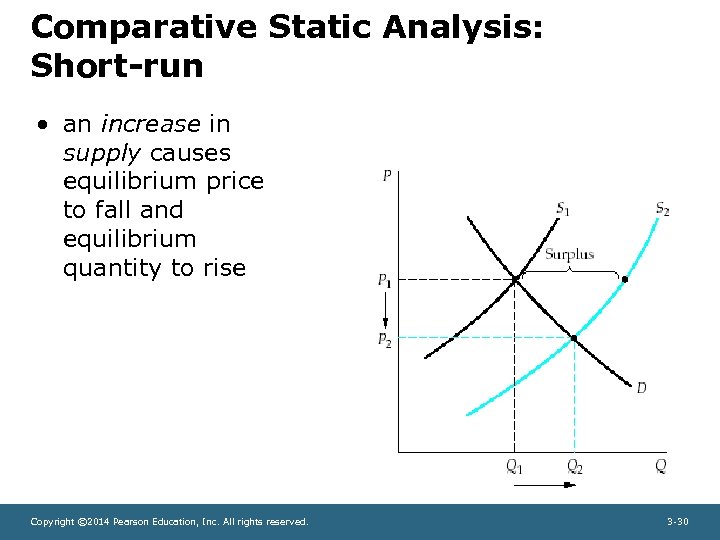 Comparative Static Analysis: Short-run • an increase in supply causes equilibrium price to fall and equilibrium quantity to rise Copyright © 2014 Pearson Education, Inc. All rights reserved. 3 -30
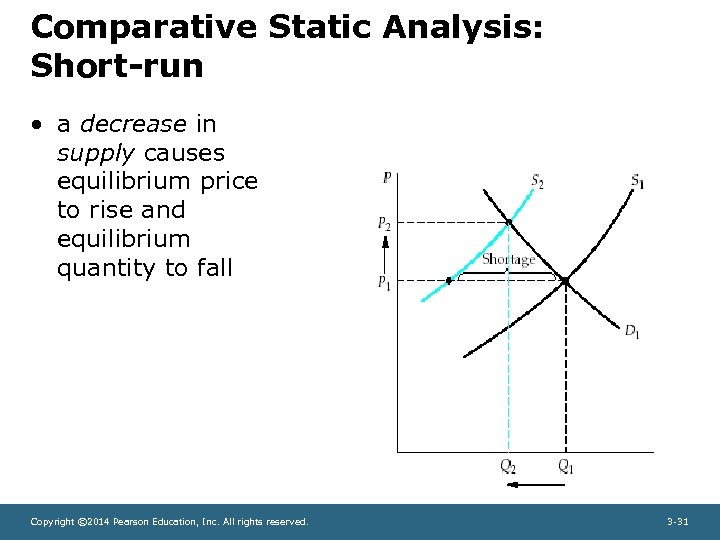 Comparative Static Analysis: Short-run • a decrease in supply causes equilibrium price to rise and equilibrium quantity to fall Copyright © 2014 Pearson Education, Inc. All rights reserved. 3 -31
 Comparative Static Analysis: Long-run • The long run is the period of time in which: – new sellers may enter a market – existing sellers may exit from a market – existing sellers may adjust fixed factors of production – buyers may react to a change in equilibrium price by changing their tastes and preferences Copyright © 2014 Pearson Education, Inc. All rights reserved. 3 -32
 Comparative Static Analysis: Long-run • Long run changes show the allocating function of price • The guiding or allocating function of price is the movement of resources into or out of markets in response to a change in the equilibrium price. Copyright © 2014 Pearson Education, Inc. All rights reserved. 3 -33
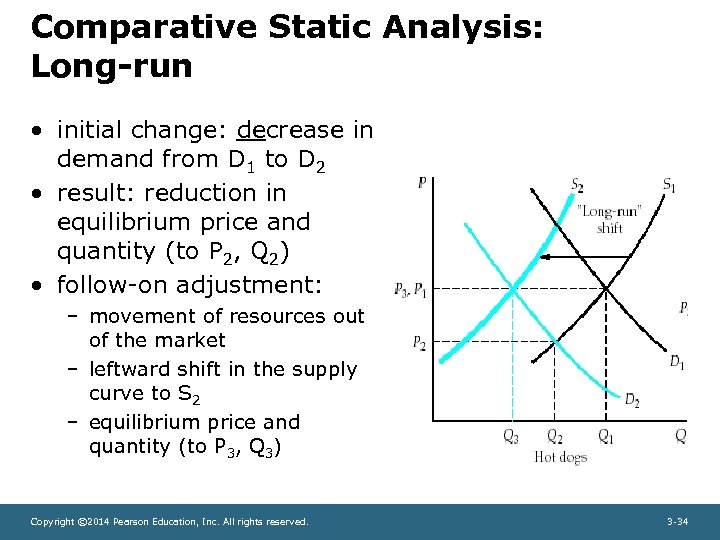 Comparative Static Analysis: Long-run • initial change: decrease in demand from D 1 to D 2 • result: reduction in equilibrium price and quantity (to P 2, Q 2) • follow-on adjustment: – movement of resources out of the market – leftward shift in the supply curve to S 2 – equilibrium price and quantity (to P 3, Q 3) Copyright © 2014 Pearson Education, Inc. All rights reserved. 3 -34
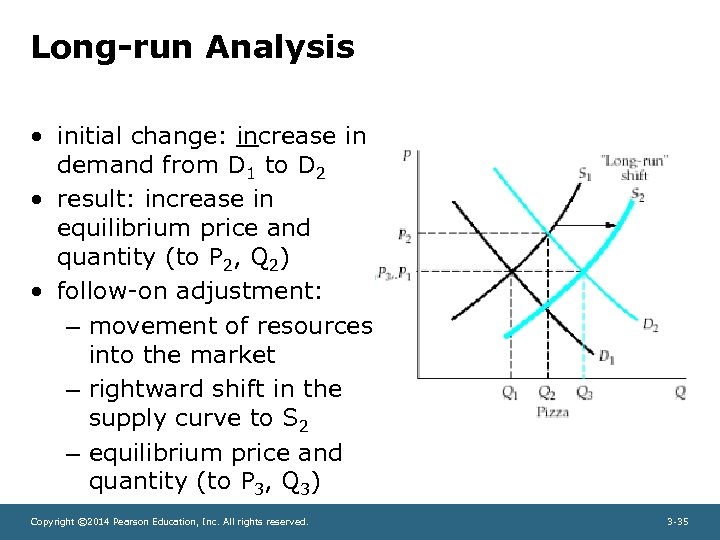 Long-run Analysis • initial change: increase in demand from D 1 to D 2 • result: increase in equilibrium price and quantity (to P 2, Q 2) • follow-on adjustment: – movement of resources into the market – rightward shift in the supply curve to S 2 – equilibrium price and quantity (to P 3, Q 3) Copyright © 2014 Pearson Education, Inc. All rights reserved. 3 -35
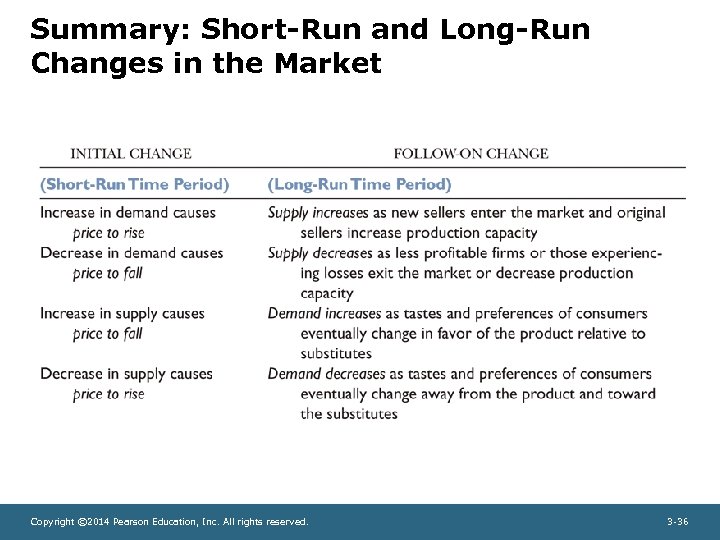 Summary: Short-Run and Long-Run Changes in the Market Copyright © 2014 Pearson Education, Inc. All rights reserved. 3 -36
 Supply, Demand, and Price • In the extreme case, the forces of supply and demand are the sole determinants of the market price, not any single firm. – this type of market is ‘perfect competition’ • In many cases, individual firms can exert market power over price because of their: – dominant size – ability to differentiate their product through advertising, brand name, features, or services Copyright © 2014 Pearson Education, Inc. All rights reserved. 3 -37
 Supply, Demand, and Price • Discussion of changes in the computer industry – Makers of PCs, notebooks and jump drives are facing slower growth in the demand for their products as technology is changing. – What impact do you think cloud computing will have on the demand for stand-alone applications such as Microsoft Office or storage devices for computers? Copyright © 2014 Pearson Education, Inc. All rights reserved. 3 -38
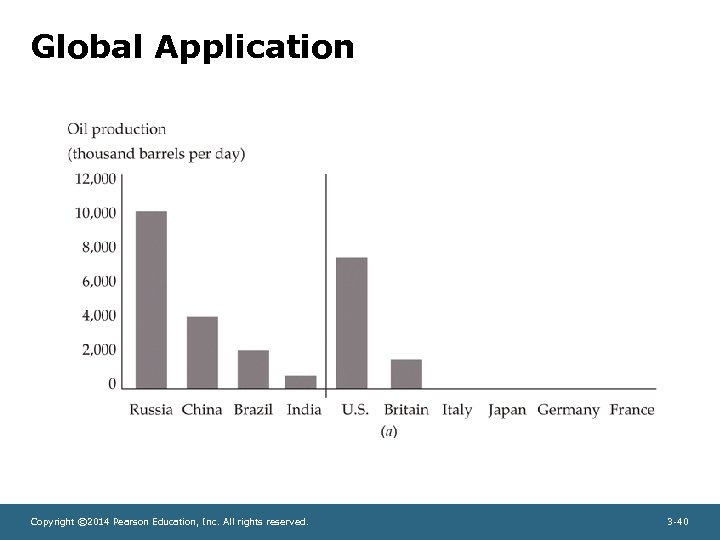
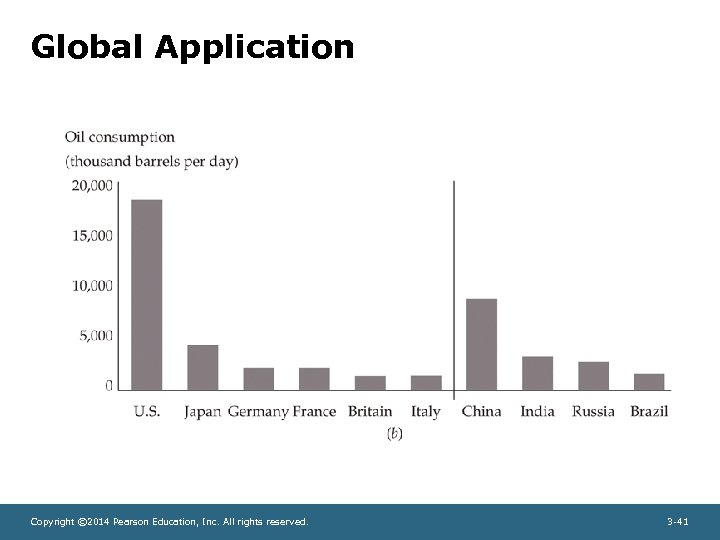
 Global Application What are the implications of rising demand for oil among developing counties? Copyright © 2014 Pearson Education, Inc. All rights reserved. 3 -39
 Global Application Copyright © 2014 Pearson Education, Inc. All rights reserved. 3 -40
 Global Application Copyright © 2014 Pearson Education, Inc. All rights reserved. 3 -41
 Summary • The law of demand states that, other factors held constant, the quantity demanded is inversely related to price. • The law of supply states that, other factors held constant, the quantity supplied is directly related to price. • Non-price factors may shift the curves. • Price serves a short-run rationing function and a long-run guiding function in the marketplace. Copyright © 2014 Pearson Education, Inc. All rights reserved. 3 -42