


 Скачать презентацию Chapter 3 Strategic Information Systems for Competitive Advantage
6a2e7c15295b1136b7ce5be74fcb9bca.ppt
- Количество слайдов: 24
 Chapter 3 Strategic Information Systems for Competitive Advantage 1
 Case: Rosenbluth International q q Rosenbluth Int. - a global player in the travel agency industry They responded with 2 strategies Ø Ø Withdrawal from the leisure travel business Implementation of web-based travel technology u u u q DACODA (Discount Analysis Containing Optimal Decision Algorithms) Electronic Messaging Services. E-Ticket Tracking Solution Res-Monitor A Globalization Network Customer-Res Intelli. Centers NOC (Network Operations Center) Lessons from the Case Ø Ø Ø Ø Need for exchange business models and strategies Importance of web-based IT Global competition over service is key Large investment over time Importance of networked infrastructure for global systems Web-based applications for superior customer service Need to patent innovative systems
 Strategic Advantage and IT q Strategic Information System (SIS) Ø Definition u Ø Competitive Advantage u u Ø An advantage over competitors in some measure such as cost, quality, or speed A difference in the Value Chain Data Improving Core Competency u u Ø Systems that support or shape a business unit’s competitive strategy Employee productivity Operational efficiency Approach u u u Outwardly - Aiming at direct competition Inwardly - Focused on enhancing the competitive position of the firm Strategic alliance
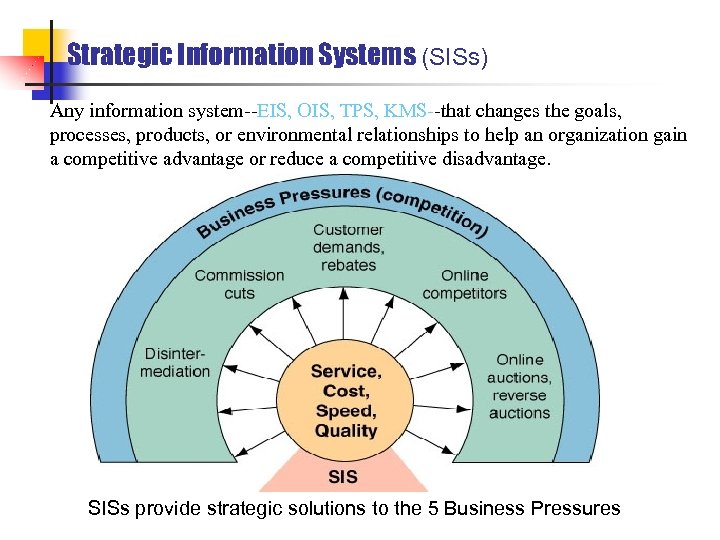 Strategic Information Systems (SISs) Any information system--EIS, OIS, TPS, KMS--that changes the goals, processes, products, or environmental relationships to help an organization gain a competitive advantage or reduce a competitive disadvantage. SISs provide strategic solutions to the 5 Business Pressures
 strategic management q Strategic management Ø q the way an organization maps or crafts the strategy of its future operations 3 Elements Ø Long-range planning Ø Response management Ø Proactive innovation
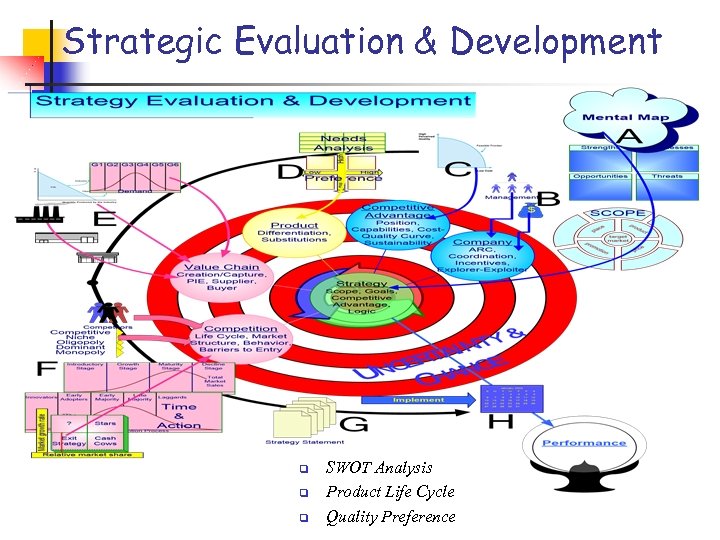 Strategic Evaluation & Development q q q SWOT Analysis Product Life Cycle Quality Preference
 The role of IT in Strategic Management q q q q Innovative applications - Create innovative applications that provide direct strategic advantage to organizations Competitive weapons - IS(s) themselves are recognized as a competitive weapon Changes in processes - IT supports changes in business processes that translate to strategic advantage Links with business partners - IT links a company with its business partners effectively and efficiently Cost reductions - IT enables companies to reduce costs Relationships with suppliers and customers -IT can be used to lock in suppliers and customers, or to build in switching costs New products -A firm can leverage its investment in IT to create new products that are in demand in the marketplace Competitive intelligence - by collecting and analyzing information about products, markets, competitors, and environmental changes
 Competitive Intelligence (cont. ) q Overview Ø One of the most important aspects in developing a competitive advantage is to acquire information on the activities and actions of competitors u u Collect information about market, technologies, and government’s actions Analyze and interpret the information Many companies monitor the activities of competitors Such activities drive business performance by ü Increasing market knowledge ü Improving internal relationships ü Raising the The Internet is central to supporting competitiv e intelligenc
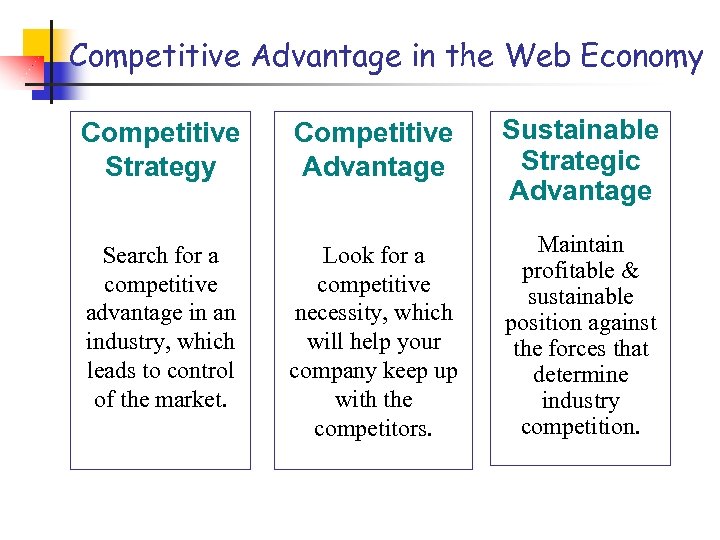 Competitive Advantage in the Web Economy Competitive Strategy Competitive Advantage Sustainable Strategic Advantage Search for a competitive advantage in an industry, which leads to control of the market. Look for a competitive necessity, which will help your company keep up with the competitors. Maintain profitable & sustainable position against the forces that determine industry competition.
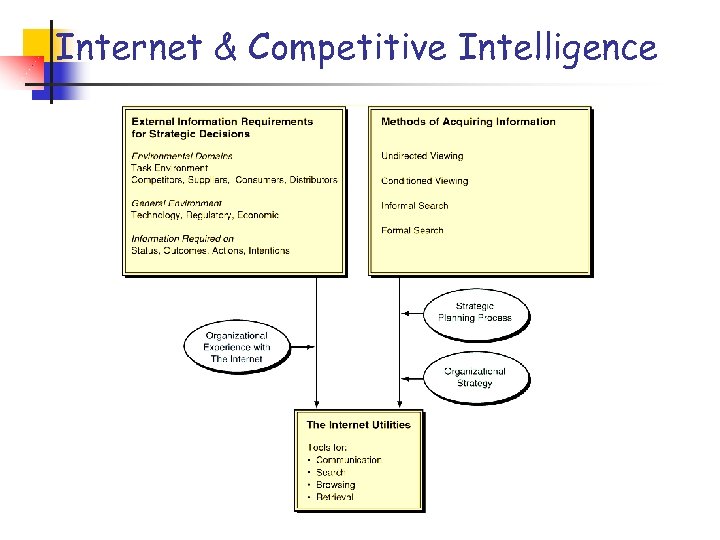 Internet & Competitive Intelligence
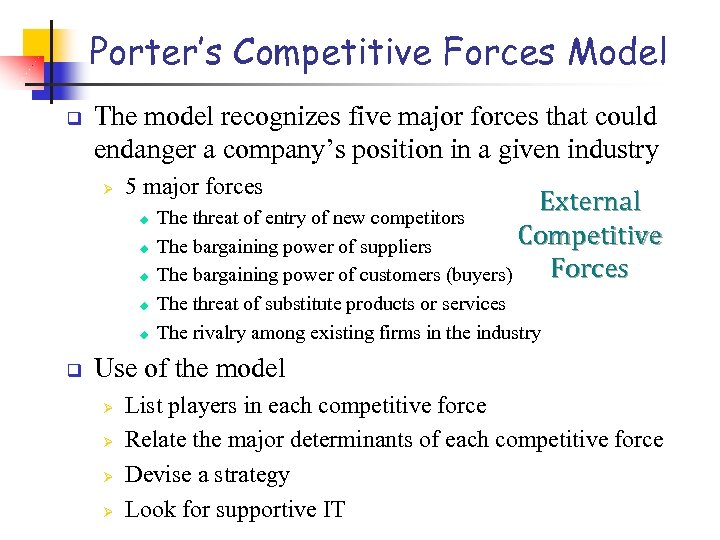 Porter’s Competitive Forces Model q The model recognizes five major forces that could endanger a company’s position in a given industry Ø 5 major forces u u u q External The threat of entry of new competitors Competitive The bargaining power of suppliers Forces The bargaining power of customers (buyers) The threat of substitute products or services The rivalry among existing firms in the industry Use of the model Ø Ø List players in each competitive force Relate the major determinants of each competitive force Devise a strategy Look for supportive IT
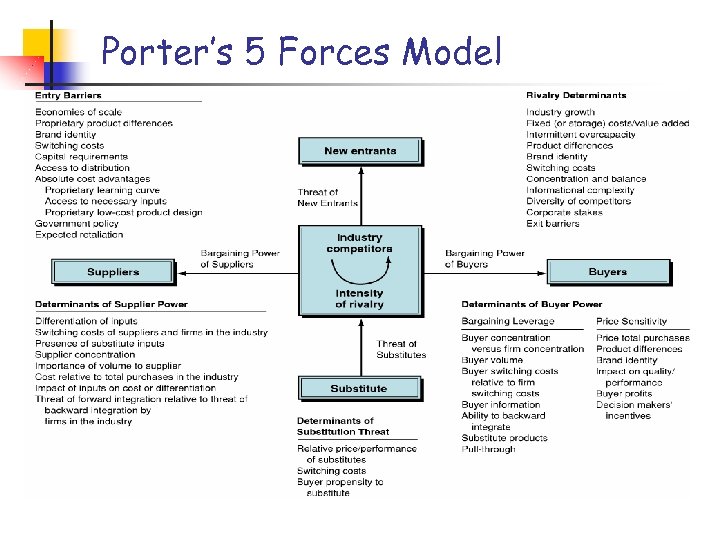 Porter’s 5 Forces Model
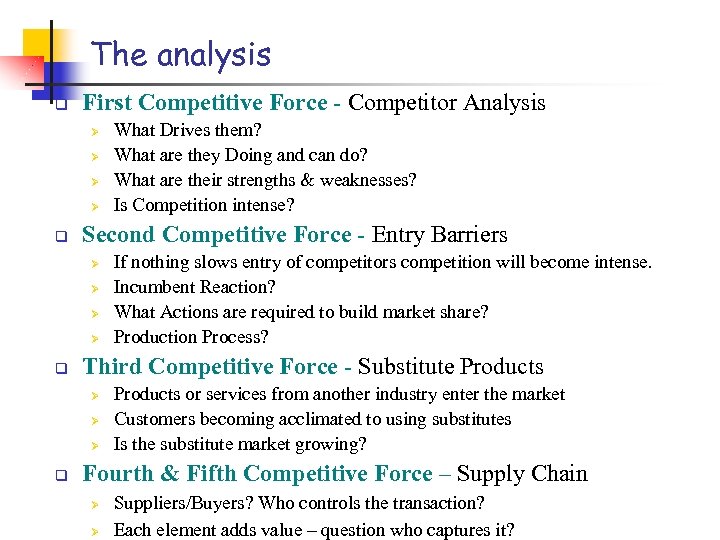 The analysis q First Competitive Force - Competitor Analysis Ø Ø q Second Competitive Force - Entry Barriers Ø Ø q If nothing slows entry of competitors competition will become intense. Incumbent Reaction? What Actions are required to build market share? Production Process? Third Competitive Force - Substitute Products Ø Ø Ø q What Drives them? What are they Doing and can do? What are their strengths & weaknesses? Is Competition intense? Products or services from another industry enter the market Customers becoming acclimated to using substitutes Is the substitute market growing? Fourth & Fifth Competitive Force – Supply Chain Ø Ø Suppliers/Buyers? Who controls the transaction? Each element adds value – question who captures it?
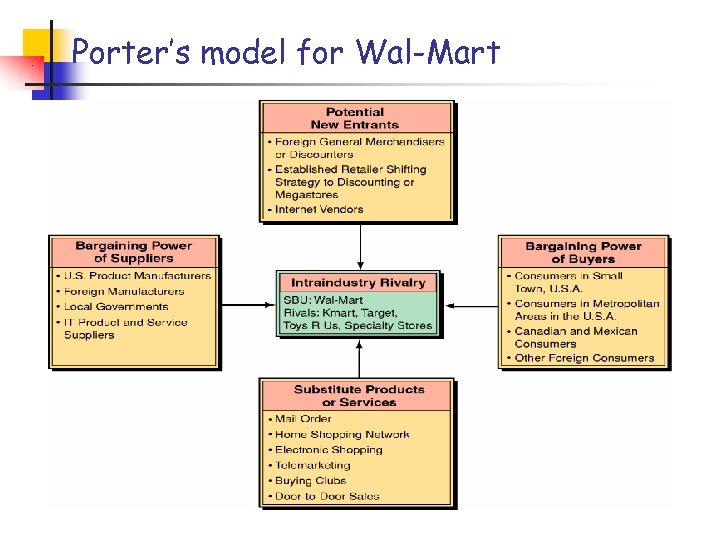 Porter’s model for Wal-Mart
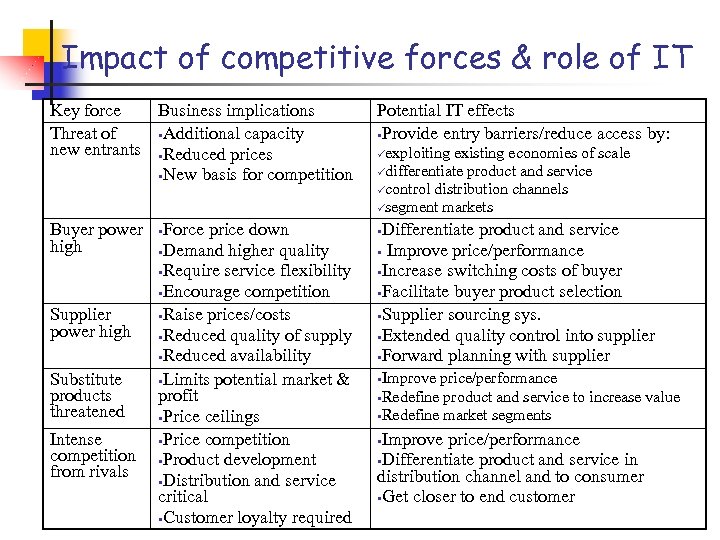 Impact of competitive forces & role of IT Key force Business implications Threat of §Additional capacity new entrants §Reduced prices §New basis for competition Potential IT effects §Provide entry barriers/reduce access by: Buyer power high §Differentiate Supplier power high Substitute products threatened Intense competition from rivals §Force price down §Demand higher quality §Require service flexibility §Encourage competition §Raise prices/costs §Reduced quality of supply §Reduced availability §Limits potential market & profit §Price ceilings §Price competition §Product development §Distribution and service critical §Customer loyalty required üexploiting existing economies of scale üdifferentiate product and service ücontrol distribution channels üsegment markets product and service § Improve price/performance §Increase switching costs of buyer §Facilitate buyer product selection §Supplier sourcing sys. §Extended quality control into supplier §Forward planning with supplier §Improve price/performance §Redefine product and service to increase value §Redefine market segments §Improve price/performance §Differentiate product and service in distribution channel and to consumer §Get closer to end customer
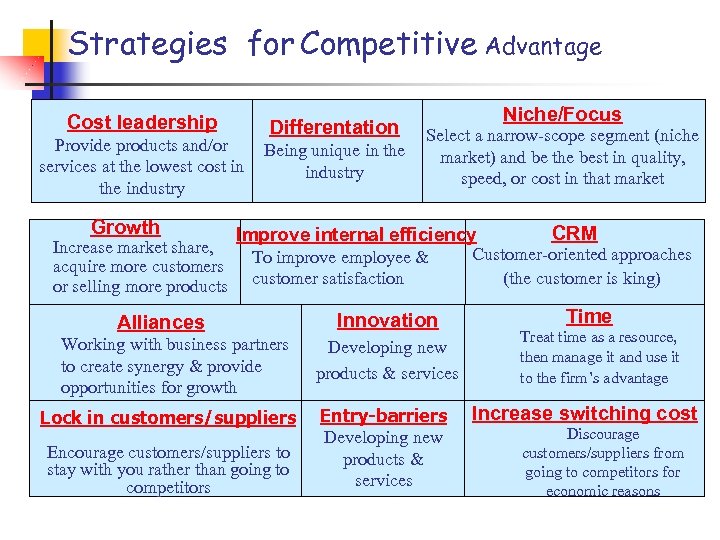 Strategies for Competitive Advantage Cost leadership Provide products and/or services at the lowest cost in the industry Growth Increase market share, acquire more customers or selling more products Differentation Being unique in the industry Niche/Focus Select a narrow-scope segment (niche market) and be the best in quality, speed, or cost in that market Improve internal efficiency To improve employee & customer satisfaction Alliances Working with business partners to create synergy & provide opportunities for growth Lock in customers/suppliers Encourage customers/suppliers to stay with you rather than going to competitors Innovation Developing new products & services Entry-barriers Developing new products & services CRM Customer-oriented approaches (the customer is king) Time Treat time as a resource, then manage it and use it to the firm’s advantage Increase switching cost Discourage customers/suppliers from going to competitors for economic reasons
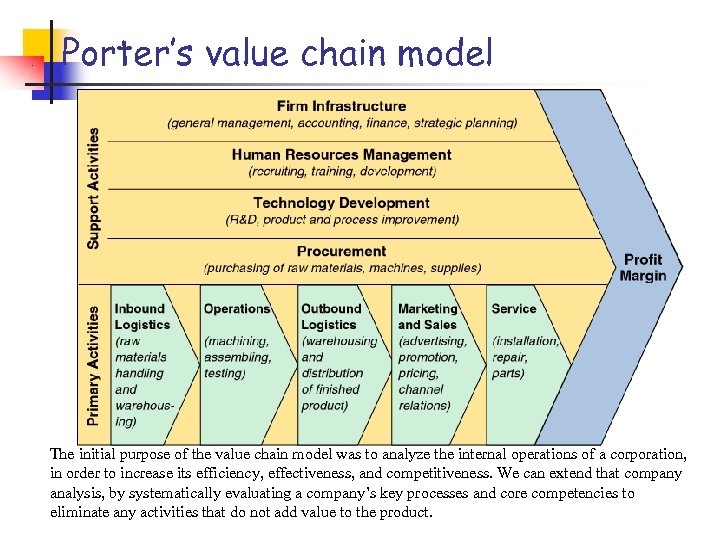 Porter’s value chain model The initial purpose of the value chain model was to analyze the internal operations of a corporation, in order to increase its efficiency, effectiveness, and competitiveness. We can extend that company analysis, by systematically evaluating a company’s key processes and core competencies to eliminate any activities that do not add value to the product.
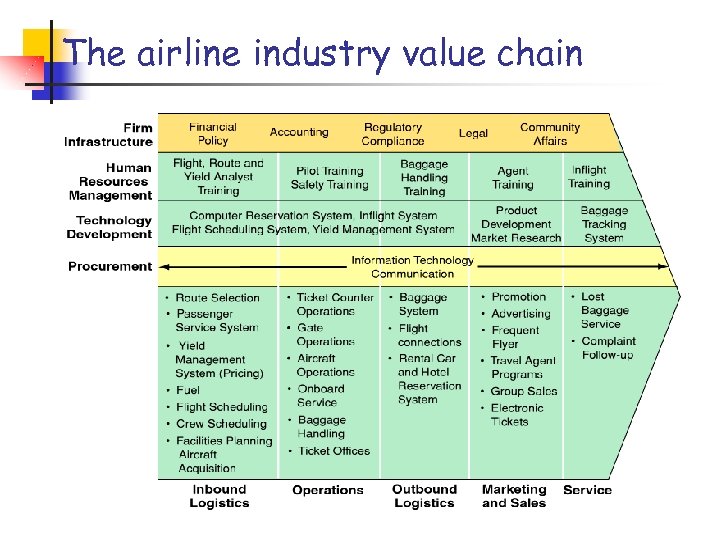 The airline industry value chain
 VALUE SYSTEM q A firm’s value chain is part of a larger stream of activities, which Porter calls a “Value System”. Ø Ø Ø Includes the suppliers that provide the necessary inputs AND their value chains Applies to both products & services, for any organization, PUBLIC or PRIVATE Is the basis for the Supply Chain Management Many of these alliances and business partnerships are based on Internet connectivity are called interorganizational information systems (IOSs) Used to u u u q Evaluate a company’s process and competencies Investigate whether adding IT supports the value chain Enable managers to assess the information intensity and the role of IT These Internet-based EDI systems offer strategic benefits Ø Ø Faster business cycle (PO to Receiving) Automation of business procedures (Automated Replenishment) Reduced operational costs Greater advantage in a fierce competitive environment
 Global Competition q Growth of Companies Operating in a Global Environment Ø Ø Ø q Fully Global or Multinational Corporations Companies that export or import Companies facing competitions of low labor cost and high natural resources Companies with low cost production facilities abroad Small companies that can now use EC to buy/sell internationally Global dimensions along which management can globalize Ø Ø Ø Ø Product Markets & Placement Promotion Where value is added to the product Competitive strategy Use of non-home-country personnel - labor Multidomestic Strategy: Zero standardization along the global dimensions. Global Strategy: Complete standardization along the seven global dimensions.
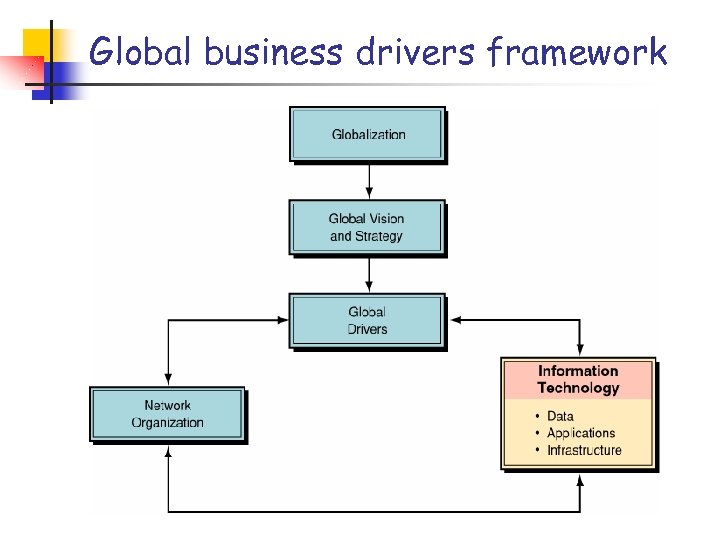 Global business drivers framework
 SISs: Examples q Cases Ø Ø Ø Wiring the “customer supply chain” at 1 -800 -Flowers Increasing Tax Collection Efforts at the Wisconsin Department of Revenue Time-based Competitive Advantage at Cannondale Southwest Airlines Flies high with SWIFT Using ERP to Meet Strategic Challenges at Turner Industries The Port of Singapore exports intelligent systems over its enterprise portal u u u Problem - The Port of Singapore, the world’s largest international port, faced increased global competition. Solution - Implementation of Intelligent Systems Results l l Reduction in Cycle Time: 4 hours versus 16 - 20 hours in neighboring ports Reduction in uploading/ loading time: 30 sec. versus 4 -5 min. / truck in neighboring ports
 SIS Implementation & Sustaining SIS q Major Issues in SIS Implementation Ø Justification u Ø Risks & Failures u Ø The magnitude, complexity, continuous changes in technology and business environment may result in failures Finding appropriate SIS u q Justifying SIS may be difficult due to the intengible nature of their benefits Identifying appropriate SIS is not a simple task Sustaining SIS & Strategic Advantage Ø Ø A Major problem that companies face is how to sustain their SIS competitive advantage. 3 Major approaches u u u Create inward systems which are not visible to competitors Provide a comprehensive, innovative & expensive system that is difficult to duplicate Combine SIS with structural changes. This would include business processes, reengineering & organizational transformation
 Managerial Issues q Implementing SIS Can Be Risky Ø q Strategic Information Systems Requires Planning Ø q Planning for an SIS is a major concern of organizations Sustaining Competitive Advantage Is Challenging. Ø q The investment involved in implementing SIS is high As companies become larger and more sophisticated, they develop resources to duplicate the systems of their competitors quickly. Ethical Issues Ø Ø Gaining competitive advantage through the use of IT may involve unethical or even illegal actions Companies can use IT to monitor the activities of other companies and may invade the privacy of individuals working there.