


 Скачать презентацию Chapter 3 SOUND RECORDING and Popular Music
8312848563a999451e06012a5e5394bb.ppt
- Количество слайдов: 28
 Chapter 3 SOUND RECORDING and Popular Music
 Some guiding questions z. How did the technologies for sound recording develop? z. How did popular music become a mass media industry? z. What was the influence of rock-and-roll on two media industries? z. What companies control the sound recording industry today?
 How has popular music made an impact upon 20 th-century American culture?
 What role has recorded music played in your life? How has it shaped and reflected your identity?
 What has been the relationship between rock music and youth culture?
 INNOVATIONS IN MEDIA TECHNOLOGY z 3 developmental stages: y. NOVELTY stage y. ENTREPRENEURIAL stage y. CONSUMER MARKETING stage
 Early sound recording technology zde. Martinville, France, 1850 s z. Edison, USA, 1877 z. Berliner, USA, 1880 s z. Victor Talking Machine, USA, 1900 s
 Forms of recording z. Edison’s wax cylinders: analog recording z. Berliner’s flat disk-->vinyl records z. Magnetic audiotape (Germany, 1940 s) zstereo sound (1950 s) zdigital recording (1970 s) zcompact discs (1980 s) zaudio DVDs
 Listening to recorded music z-Victrolas --> electric record players (1900 s 1920 s) z-1915: 30 million phonograph records sold z-Music was played and consumed individually
 THE RISE OF RADIO zissues of paying to broadcast copyrighted music z 1914: ASCAP founded to collect copyright fees for music writers and publishers z. In 1924, radio competition cut record sales in half z. However, costs of royalties forced many radio stations off the air
 1930 s: Period of courtship between radio and recording industry THEIR MARRIAGE TOOK PLACE IN THE 1950 s
 What is POP MUSIC? z. Appeals to broad public or to demographic sub-groups zappeals to popular (that is, not just highbrow) tastes and styles z. Includes blues, country, Tejano, salsa, jazz, rock, reggae, rap, hip hop, easy listening
 RISE OF POP MUSIC z. Mass-marketed publishing of sheet music: Tin Pan Alley z. Birth of JAZZ in New Orleans: fusing rhythm & blues and gospel into swing bands zpopular vocal stars (harmonies and crooners) z. ROCK AND ROLL
 ROCK AND ROLL is born! z. Fused traditions of country, R&B, pop z. Significantly merged music of black and white cultures in the American South z. No music style has ever had such widespread impact z. Transformed the structure of two mass media industries: recording and radio
 ROCK MUSIC BLURRED BOUNDARIES z. High and low culture z. Masculine and feminine z. Black and white z. North and South z. Sacred and secular
 SCANDALS in the MUSIC INDUSTRY z. Payola: the practice of record promoters paying DJ’s to play their songs on the air z. Congressional hearings in 1959 z 1998: promotional strategy called pay-for-play emerged
 A CHANGING INDUSTRY post-1960 z. The British Invasion: sound recording goes international z. Development of Soul and the Motown label z. Political impact of folk rock z. Punk and grunge movements z. Rap and the rise of black urban style
 FOLK MUSIC z. Broadly, folk music = songs performed by untrained musicians and passed down through oral traditions z. Considered a democratic and participatory form z. Folk music popularized by radio and by grassroots activists like Woody Guthrie, who championed peace and social justice
 MOTOWN and SOUL -Mix of R&B, rock, pop and gospel -Motown label founded by Berry Gordy in 1960 in Detroit
 Folk-Rock and Sixties Counterculture z. Acoustic singer-songwriters made folk popular (Dylan, Baez, Taylor, Mitchell) z. The Byrds electrified folk in early 1960 s to invent FOLK-ROCK z. Rock and Folk-Rock provided soundtrack for the Sixties Generation, became more mainstream in the 1970 s
 ALTERNATIVE SOUNDS Punk Rock: challenged commercialism of record industry -represented alienation and anarchy Grunge: spirit of punk infused with more melody
 RAP defies mainstream culture z. Like punk, developed in opposition to polished sound of commercial music industry zcombined black urban social politics, masculinity and comic lyrics zincorporated black tradition of rhythmic spoken word
 THE BUSINESS OF SOUND RECORDING
 What is the line between ARTISTIC EXPRESSION (performing) and BUSINESS (recording and selling)?
 A GLOBAL OLIGOPOLY z. Recording industry generates more revenue than all other media except TV za GLOBAL OLIGOPOLY: A few corporations control most of industry worldwide
 How does the global oligopoly affect the kinds of music you are able to buy and hear?
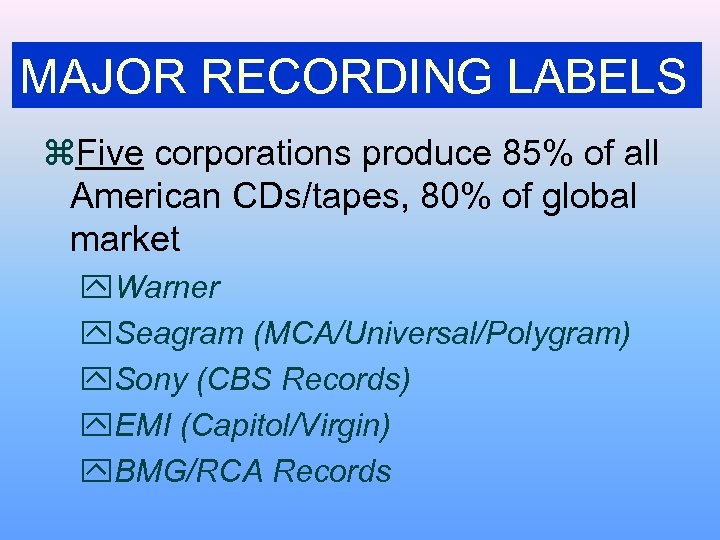 MAJOR RECORDING LABELS z. Five corporations produce 85% of all American CDs/tapes, 80% of global market y. Warner y. Seagram (MCA/Universal/Polygram) y. Sony (CBS Records) y. EMI (Capitol/Virgin) y. BMG/RCA Records
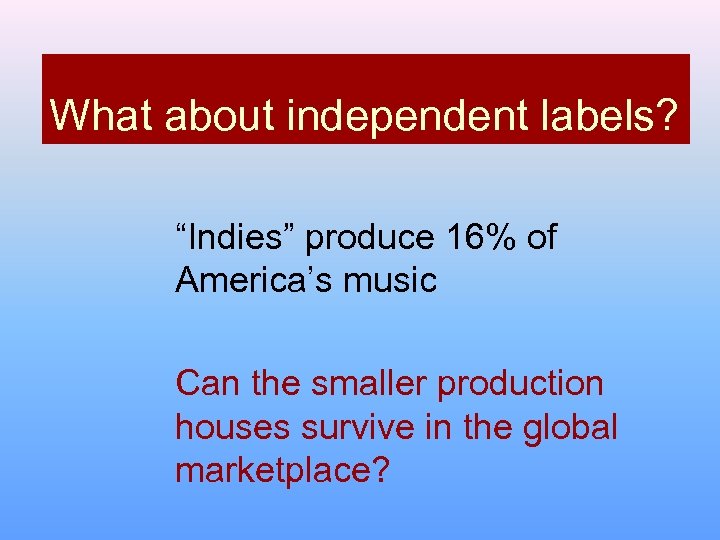 What about independent labels? “Indies” produce 16% of America’s music Can the smaller production houses survive in the global marketplace?