


 Скачать презентацию Chapter 3 Section 4 Origins of Judaism
c72fe65cecef6e2adeb1e0e623342af6.ppt
- Количество слайдов: 21
 Chapter 3 Section 4 Origins of Judaism
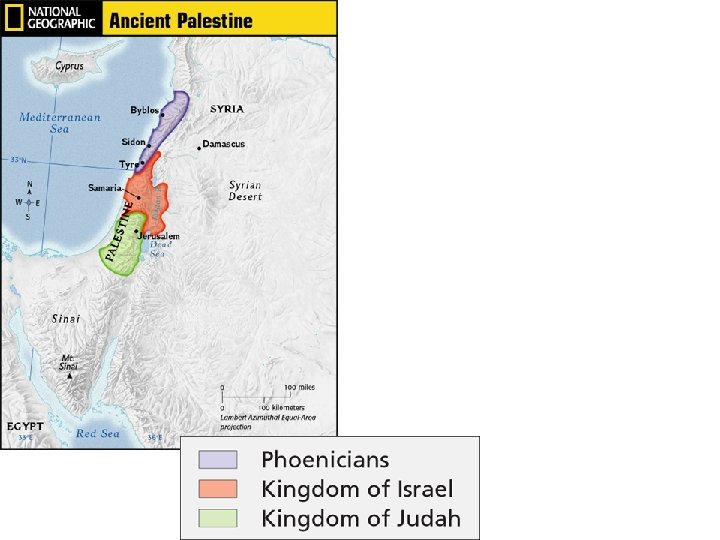
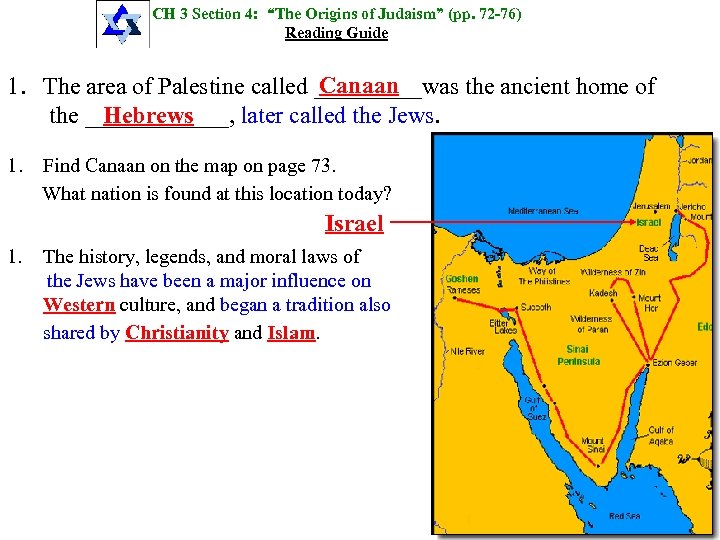 CH 3 Section 4: “The Origins of Judaism” (pp. 72 -76) Reading Guide Canaan 1. The area of Palestine called _____was the ancient home of the ______, later called the Jews. Hebrews 1. Find Canaan on the map on page 73. What nation is found at this location today? Israel 1. The history, legends, and moral laws of the Jews have been a major influence on Western culture, and began a tradition also shared by Christianity and Islam.
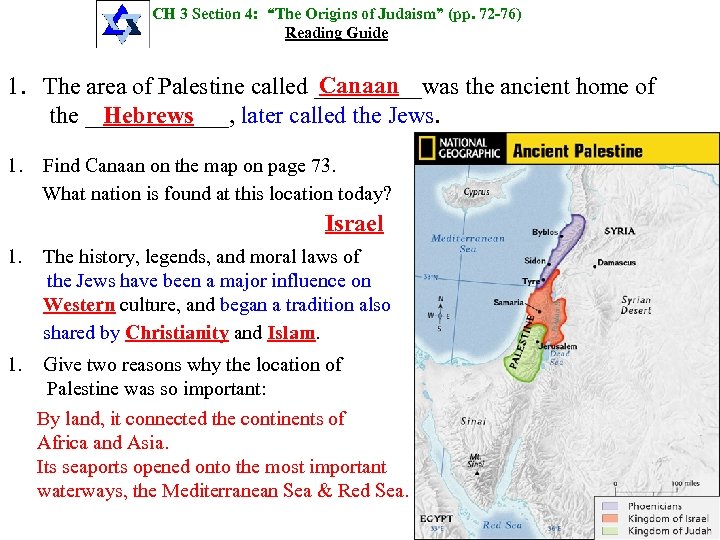 CH 3 Section 4: “The Origins of Judaism” (pp. 72 -76) Reading Guide Canaan 1. The area of Palestine called _____was the ancient home of the ______, later called the Jews. Hebrews 1. Find Canaan on the map on page 73. What nation is found at this location today? Israel 1. The history, legends, and moral laws of the Jews have been a major influence on Western culture, and began a tradition also shared by Christianity and Islam. 1. Give two reasons why the location of Palestine was so important: By land, it connected the continents of Africa and Asia. Its seaports opened onto the most important waterways, the Mediterranean Sea & Red Sea.
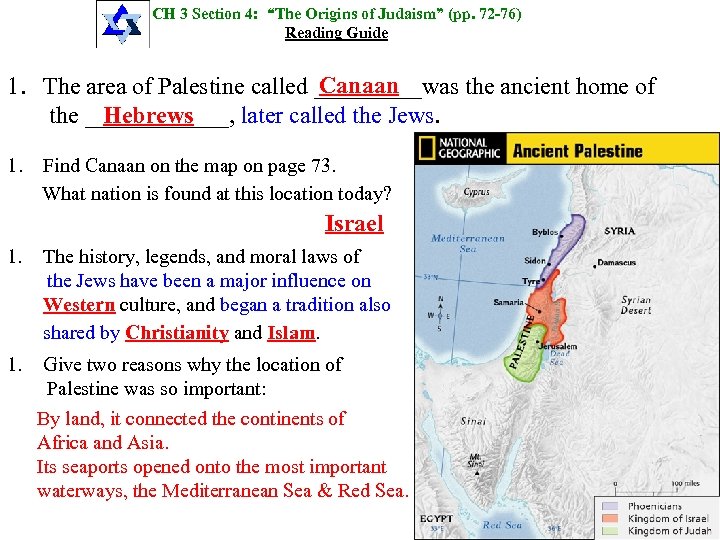 CH 3 Section 4: “The Origins of Judaism” (pp. 72 -76) Reading Guide Canaan 1. The area of Palestine called _____was the ancient home of the ______, later called the Jews. Hebrews 1. Find Canaan on the map on page 73. What nation is found at this location today? Israel 1. The history, legends, and moral laws of the Jews have been a major influence on Western culture, and began a tradition also shared by Christianity and Islam. 1. Give two reasons why the location of Palestine was so important: By land, it connected the continents of Africa and Asia. Its seaports opened onto the most important waterways, the Mediterranean Sea & Red Sea.
 CH 3 Section 4: “The Origins of Judaism” (pp. 72 -76) Reading Guide Bible 5. According to their sacred literature, the _______, Canaan (Palestine) was the land promised to them by God. 1. Jews call the first five books of the Bible the _______. Torah (Today ______also respect these sacred writings Christians as part of the Old Testament of their Bible. ) TORAH = Genesis, Exodus, Leviticus, Numbers, Deuteronomy 7. As in other sacred literatures, the books of the Torah describe both Some events that really happened, and teach important lessons Stories told to ___________(etiological stories)
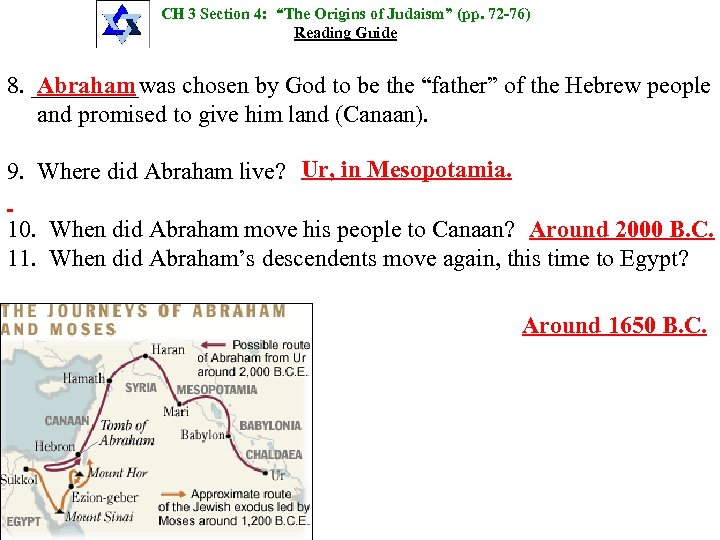 CH 3 Section 4: “The Origins of Judaism” (pp. 72 -76) Reading Guide 8. _____was chosen by God to be the “father” of the Hebrew people Abraham and promised to give him land (Canaan). 9. Where did Abraham live? Ur, in Mesopotamia. 10. When did Abraham move his people to Canaan? Around 2000 B. C. 11. When did Abraham’s descendents move again, this time to Egypt? Around 1650 B. C.
 CH 3 Section 4: “The Origins of Judaism” (pp. 72 -76) Reading Guide 12. How many gods did the Hebrews (and still Jews today) have? One Does this make them polytheistic or monotheistic? Monotheistic (worship of 1 god) 13. What did the Hebrews (Jews) name their God? Yahweh 14. In what ways did the Hebrews belief in their God differ from other peoples of the time? • a. ) only 1 God, others were polytheistic. • b. ) Not associated with any 1 place, could go wherever they went. • c. ) Believed their god, the one and only, was over all peoples, • not just them. • d. ) Yahweh was not physical, • could not make any physical images of God
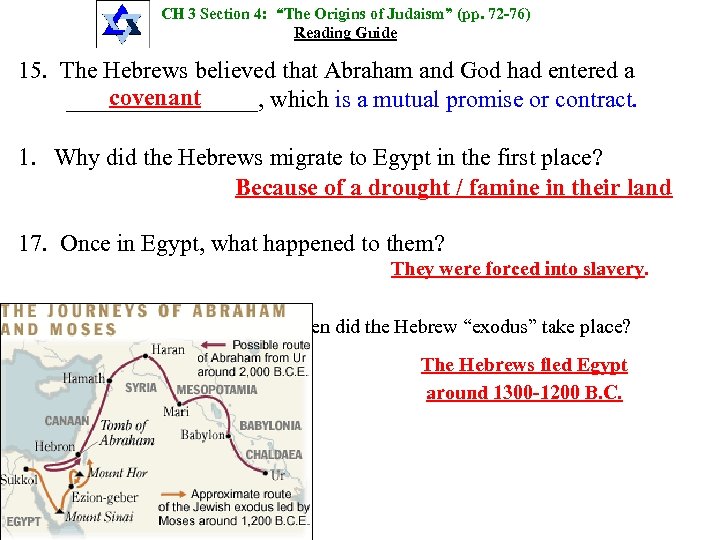 CH 3 Section 4: “The Origins of Judaism” (pp. 72 -76) Reading Guide 15. The Hebrews believed that Abraham and God had entered a covenant ________, which is a mutual promise or contract. 1. Why did the Hebrews migrate to Egypt in the first place? Because of a drought / famine in their land 17. Once in Egypt, what happened to them? They were forced into slavery. 18. When did the Hebrew “exodus” take place? The Hebrews fled Egypt around 1300 -1200 B. C.
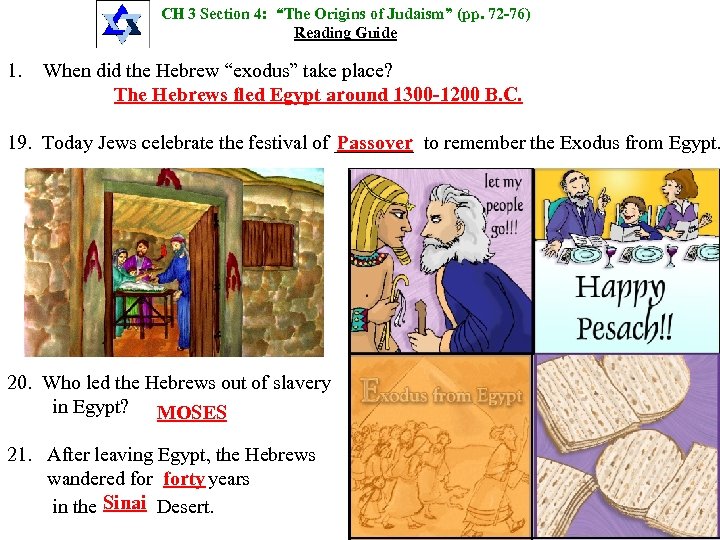 CH 3 Section 4: “The Origins of Judaism” (pp. 72 -76) Reading Guide 1. When did the Hebrew “exodus” take place? The Hebrews fled Egypt around 1300 -1200 B. C. 19. Today Jews celebrate the festival of ____ to remember the Exodus from Egypt. Passover 20. Who led the Hebrews out of slavery in Egypt? MOSES 21. After leaving Egypt, the Hebrews forty wandered for years Sinai in the Desert.
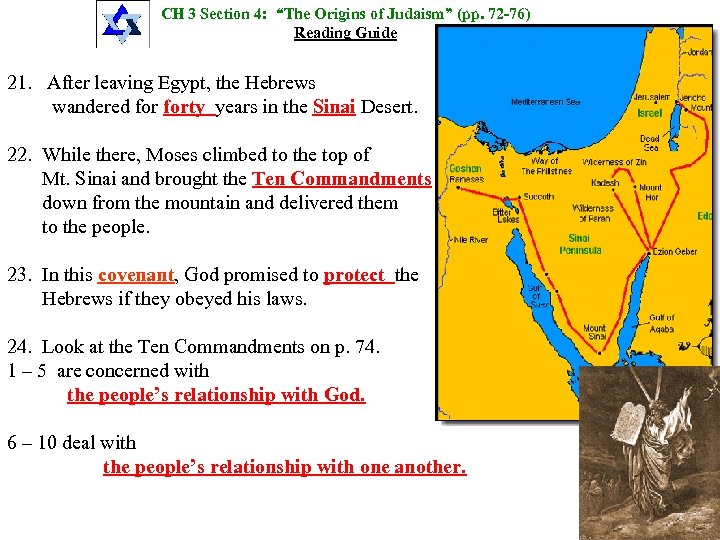 CH 3 Section 4: “The Origins of Judaism” (pp. 72 -76) Reading Guide 21. After leaving Egypt, the Hebrews wandered forty years in the Sinai Desert. 22. While there, Moses climbed to the top of Mt. Sinai and brought the Ten Commandments down from the mountain and delivered them to the people. 23. In this covenant, God promised to protect the Hebrews if they obeyed his laws. 24. Look at the Ten Commandments on p. 74. 1 – 5 are concerned with the people’s relationship with God. 6 – 10 deal with the people’s relationship with one another.
 CH 3 Section 4: “The Origins of Judaism” (pp. 72 -76) Reading Guide 1. After wandering in the desert, where did the Hebrews return to settle down? Canaan 26. The Hebrews were organized into when they arrived in Canaan. twelve tribes Were these self-governing? Or controlled by one ruler? Self-governing 27 In times of emergency they were united and led by , judges one of the most prominent of whom was a woman named Deborah. 1. The 10 Commandments were part of a more detailed code of law resembling Hammurabi’s ’s Code. However, how did the Hebrew law differ? strict laws were softened by expressions of God’s mercy and forgiveness. The Hebrew prophets emphasized both “right conduct” and “worshipping only one God. ” This type of religion is more specifically known as what? Ethical Monotheism 30. Eventually only the largest tribe, the tribe of Judah, would dominate. That is why Jews the Hebrews came to be called and their religion is known as Judaism
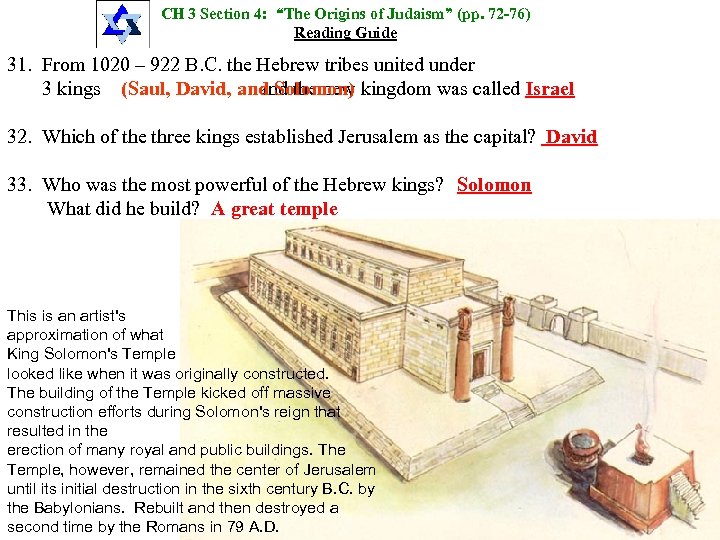 CH 3 Section 4: “The Origins of Judaism” (pp. 72 -76) Reading Guide 31. From 1020 – 922 B. C. the Hebrew tribes united under 3 kings (Saul, David, and Solomon) and the new kingdom was called Israel 32. Which of the three kings established Jerusalem as the capital? David 33. Who was the most powerful of the Hebrew kings? Solomon What did he build? A great temple This is an artist's approximation of what King Solomon's Temple looked like when it was originally constructed. The building of the Temple kicked off massive construction efforts during Solomon's reign that resulted in the erection of many royal and public buildings. The Temple, however, remained the center of Jerusalem until its initial destruction in the sixth century B. C. by the Babylonians. Rebuilt and then destroyed a second time by the Romans in 79 A. D.
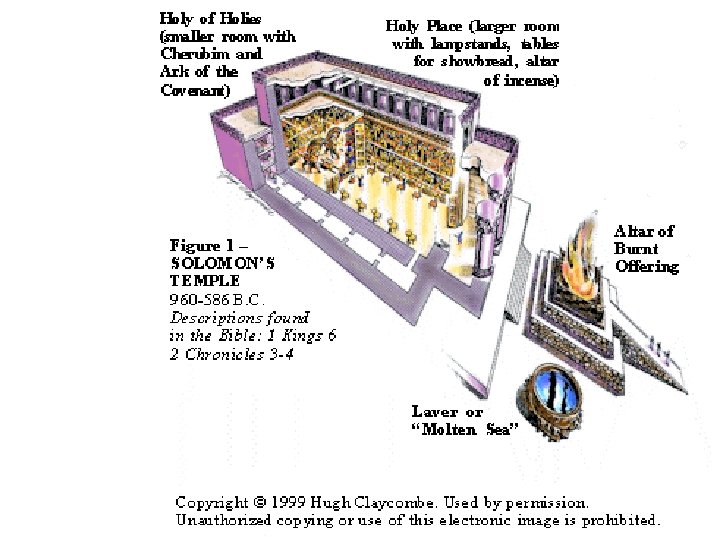
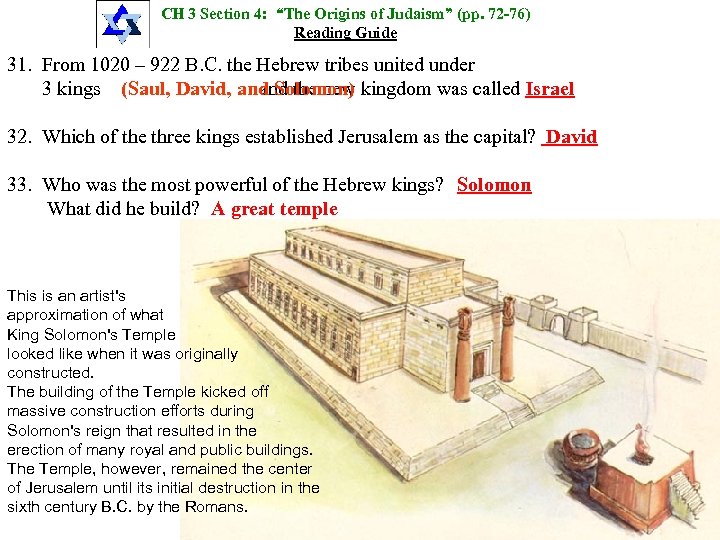 CH 3 Section 4: “The Origins of Judaism” (pp. 72 -76) Reading Guide 31. From 1020 – 922 B. C. the Hebrew tribes united under 3 kings (Saul, David, and Solomon) and the new kingdom was called Israel 32. Which of the three kings established Jerusalem as the capital? David 33. Who was the most powerful of the Hebrew kings? Solomon What did he build? A great temple This is an artist's approximation of what King Solomon's Temple looked like when it was originally constructed. The building of the Temple kicked off massive construction efforts during Solomon's reign that resulted in the erection of many royal and public buildings. The Temple, however, remained the center of Jerusalem until its initial destruction in the sixth century B. C. by the Romans.
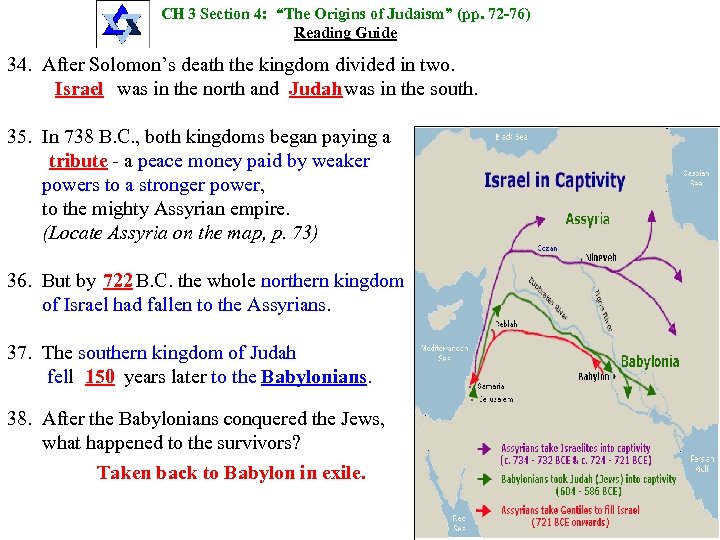 CH 3 Section 4: “The Origins of Judaism” (pp. 72 -76) Reading Guide 34. After Solomon’s death the kingdom divided in two. Israel Judah was in the north and was in the south. 35. In 738 B. C. , both kingdoms began paying a - a peace money paid by weaker tribute powers to a stronger power, to the mighty Assyrian empire. (Locate Assyria on the map, p. 73) 722 36. But by B. C. the whole northern kingdom of Israel had fallen to the Assyrians. 37. The southern kingdom of Judah 150 fell years later to the Babylonians. 38. After the Babylonians conquered the Jews, what happened to the survivors? Taken back to Babylon in exile.
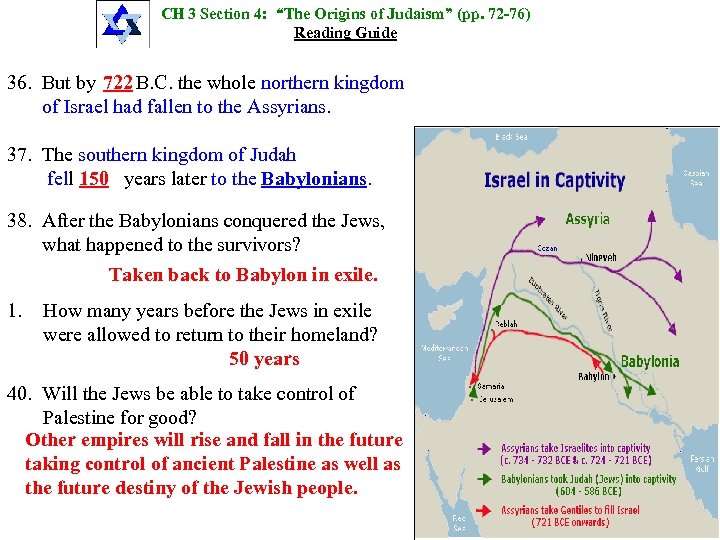 CH 3 Section 4: “The Origins of Judaism” (pp. 72 -76) Reading Guide 36. But by B. C. the whole northern kingdom 722 of Israel had fallen to the Assyrians. 37. The southern kingdom of Judah fell years later to the Babylonians. 150 38. After the Babylonians conquered the Jews, what happened to the survivors? Taken back to Babylon in exile. 1. How many years before the Jews in exile were allowed to return to their homeland? 50 years 40. Will the Jews be able to take control of Palestine for good? Other empires will rise and fall in the future taking control of ancient Palestine as well as the future destiny of the Jewish people.
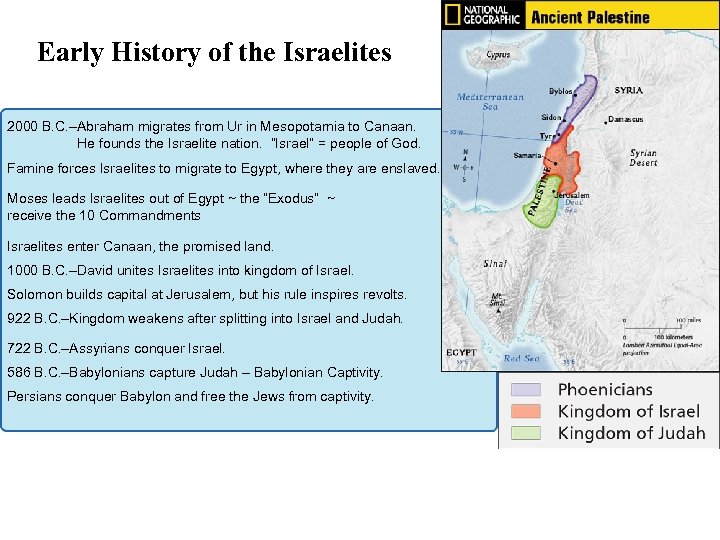 5 Early History of the Israelites 2000 B. C. –Abraham migrates from Ur in Mesopotamia to Canaan. He founds the Israelite nation. “Israel” = people of God. Famine forces Israelites to migrate to Egypt, where they are enslaved. Moses leads Israelites out of Egypt ~ the “Exodus” ~ receive the 10 Commandments Israelites enter Canaan, the promised land. 1000 B. C. –David unites Israelites into kingdom of Israel. Solomon builds capital at Jerusalem, but his rule inspires revolts. 922 B. C. –Kingdom weakens after splitting into Israel and Judah. 722 B. C. –Assyrians conquer Israel. 586 B. C. –Babylonians capture Judah – Babylonian Captivity. Persians conquer Babylon and free the Jews from captivity.
 Teachings on Law and Morality 5 The laws of the Torah address all aspects of life, from cleanliness and food preparation to criminal matters. Jews believe that God gave them a set of laws called the Ten Commandments. Jewish prophets, or spiritual leaders, preached a code of ethics, or moral standards of behavior. For this reason it is a religion known as Ethical Monotheism. Examples: • The rich and powerful must protect the poor and weak. • All people are equal under God. Unlike many ancient people, the Jews believed their leaders were fully human and bound by God’s law. Videostreaming: Religions of the World: Judaism: Sacred Words of Judaism
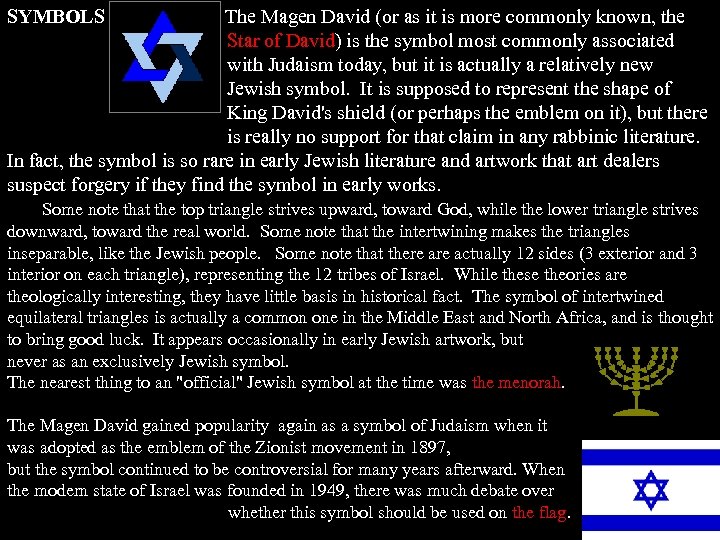 SYMBOLS The Magen David (or as it is more commonly known, the Star of David) is the symbol most commonly associated with Judaism today, but it is actually a relatively new Jewish symbol. It is supposed to represent the shape of King David's shield (or perhaps the emblem on it), but there is really no support for that claim in any rabbinic literature. In fact, the symbol is so rare in early Jewish literature and artwork that art dealers suspect forgery if they find the symbol in early works. Some note that the top triangle strives upward, toward God, while the lower triangle strives downward, toward the real world. Some note that the intertwining makes the triangles inseparable, like the Jewish people. Some note that there actually 12 sides (3 exterior and 3 interior on each triangle), representing the 12 tribes of Israel. While these theories are theologically interesting, they have little basis in historical fact. The symbol of intertwined equilateral triangles is actually a common one in the Middle East and North Africa, and is thought to bring good luck. It appears occasionally in early Jewish artwork, but never as an exclusively Jewish symbol. The nearest thing to an "official" Jewish symbol at the time was the menorah. The Magen David gained popularity again as a symbol of Judaism when it was adopted as the emblem of the Zionist movement in 1897, but the symbol continued to be controversial for many years afterward. When the modern state of Israel was founded in 1949, there was much debate over whether this symbol should be used on the flag.