 Скачать презентацию Chapter 3 Organisational culture Learning objectives
425b68fe9ecfaf3f22ee9eea7a80fc45.ppt
- Количество слайдов: 55



Chapter 3 Organisational culture
Learning objectives • • • Define the term organisational culture Identify the components of organisational culture What factors influence the company culture Describe Schein’s approach to organisational culture Describe Handy’s four cultural types Describe how organisational culture is influenced by national cultures using the Hofstede approach
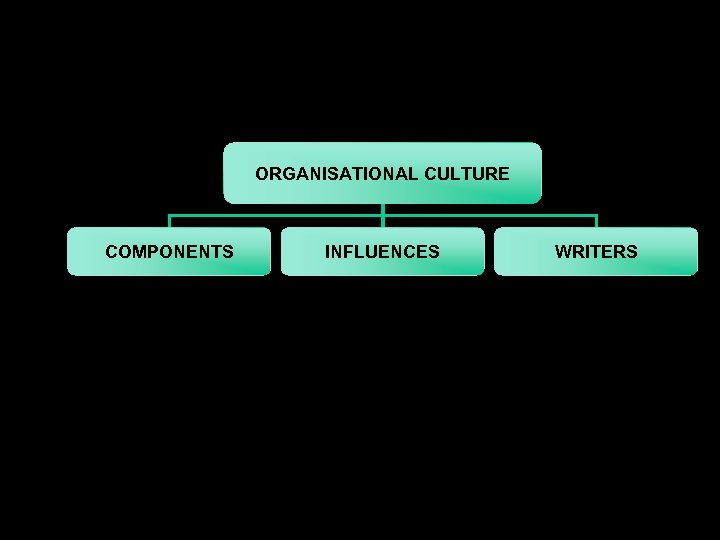
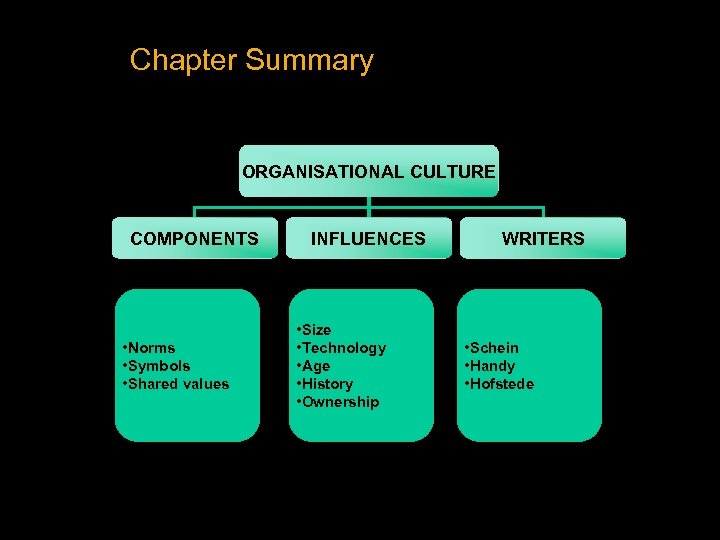
ORGANISATIONAL CULTURE COMPONENTS INFLUENCES WRITERS
Definition of organisational culture • ‘the way we do things around here. ’ (Handy) • Sum total of the belief, knowledge, attitudes, norms and customs that prevail in an organisation
Definition of organisational culture • Organisations have distinctive cultures • Behaviour acceptable in one organisational culture may be inappropriate in another • Cultures develop over time or can change instantly as a result of a single major event (e. g. death of company founder, threatened takeover)
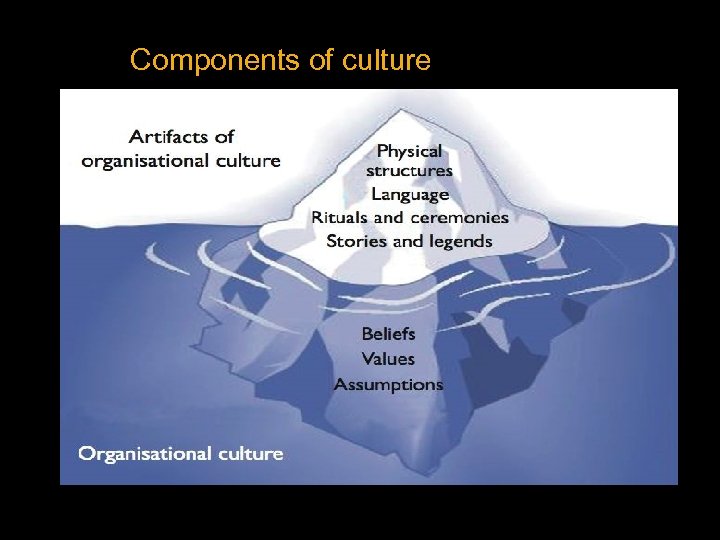
Components of culture
Factors that shape the culture • • • Organisation’s founder Organisation’s history Leadership and management style Organisation’s environment Size Technology Diversity Age Ownership
More subtle influences • • • Degree of individual initiative Degree of risk tolerance Clarity of direction Degree of integration between groups Reward system Conflict tolerance Communication patterns Formalisation of clothing and office layout Kind of people employed
Writers of culture • Schein • Handy • Hofstede
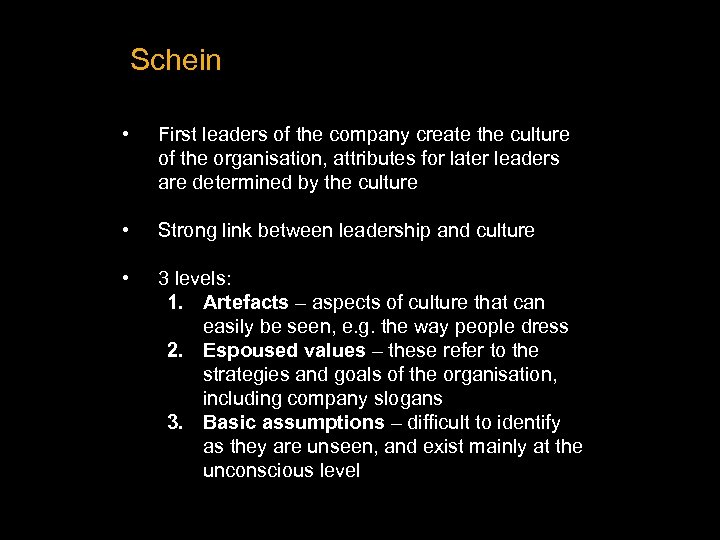
Schein • First leaders of the company create the culture of the organisation, attributes for later leaders are determined by the culture • Strong link between leadership and culture • 3 levels: 1. Artefacts – aspects of culture that can easily be seen, e. g. the way people dress 2. Espoused values – these refer to the strategies and goals of the organisation, including company slogans 3. Basic assumptions – difficult to identify as they are unseen, and exist mainly at the unconscious level
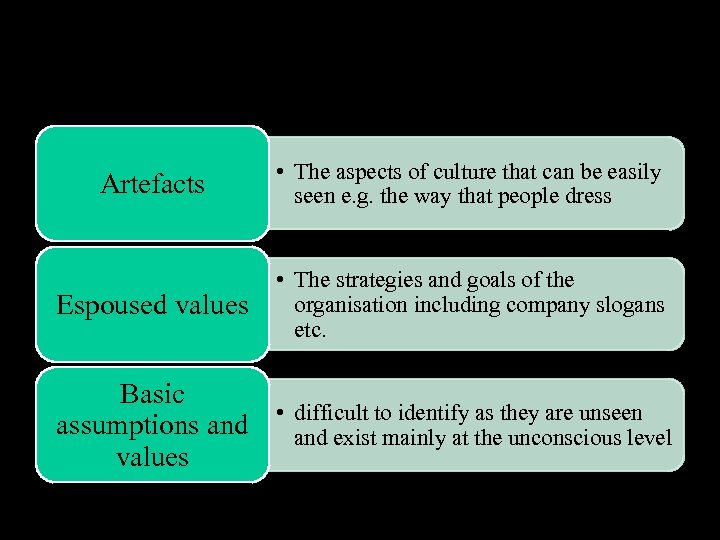
Schein – 3 levels of culture Artefacts • The aspects of culture that can be easily seen e. g. the way that people dress Espoused values • The strategies and goals of the organisation including company slogans etc. Basic assumptions and • values difficult to identify as they are unseen and exist mainly at the unconscious level
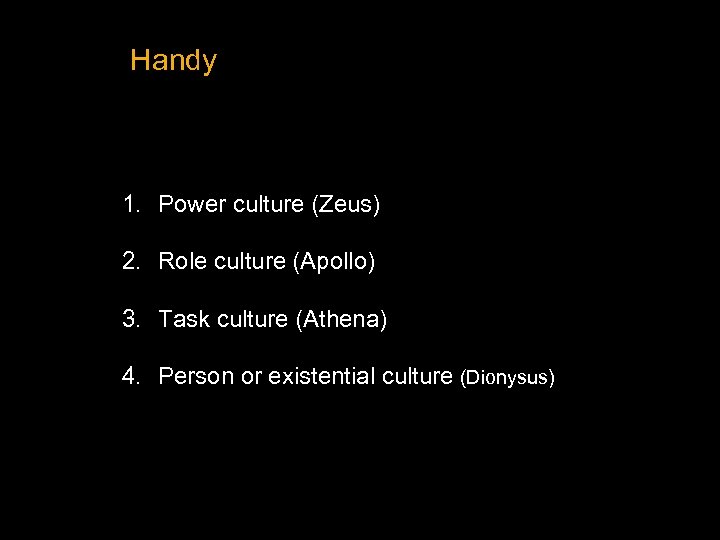
Handy 1. Power culture (Zeus) 2. Role culture (Apollo) 3. Task culture (Athena) 4. Person or existential culture (Dionysus)
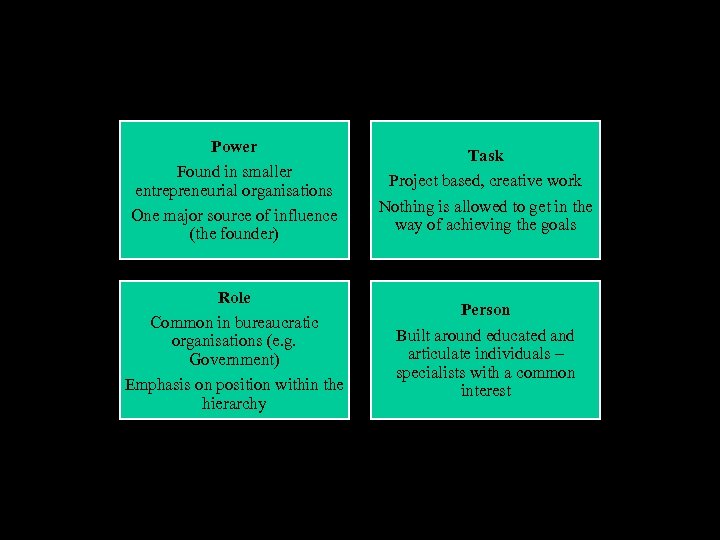
Handy’s cultural Types Power Found in smaller entrepreneurial organisations One major source of influence (the founder) Role Common in bureaucratic organisations (e. g. Government) Emphasis on position within the hierarchy Task Project based, creative work Nothing is allowed to get in the way of achieving the goals Person Built around educated and articulate individuals – specialists with a common interest
Hofstede • Study of more than 100, 000 employees in IBM in more than 40 countries • How does national culture influence business behaviour?
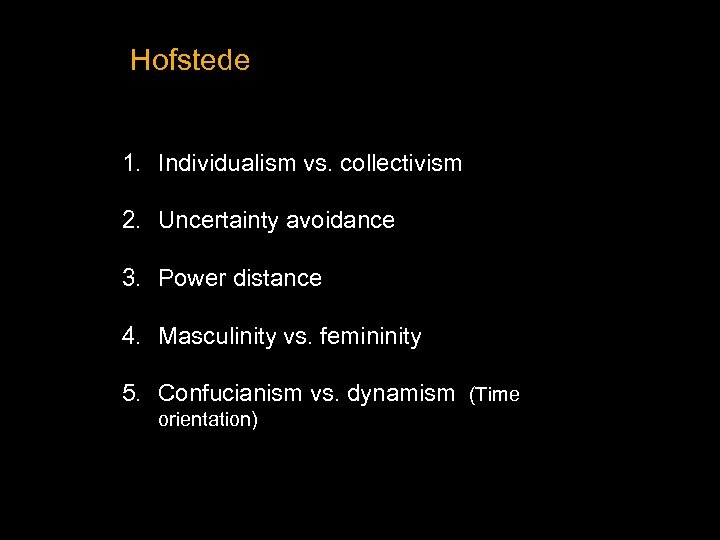
Hofstede 1. Individualism vs. collectivism 2. Uncertainty avoidance 3. Power distance 4. Masculinity vs. femininity 5. Confucianism vs. dynamism (Time orientation)
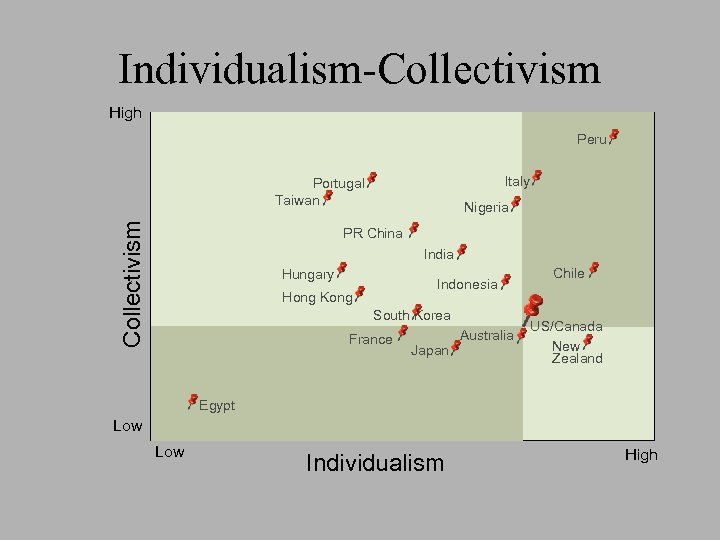
Individualism-Collectivism High Peru Italy Collectivism Portugal Taiwan Nigeria PR China India Hungary Indonesia Hong Kong South Korea France Japan Australia Chile US/Canada New Zealand Egypt Low Individualism High
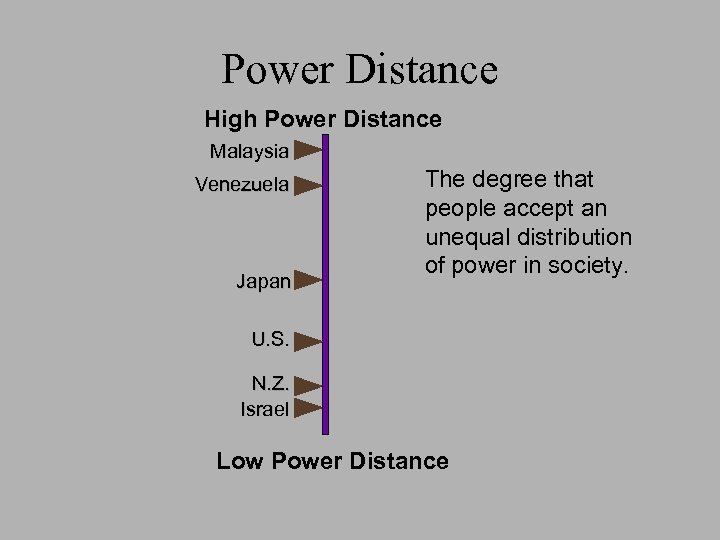
Power Distance High Power Distance Malaysia Venezuela Japan The degree that people accept an unequal distribution of power in society. U. S. N. Z. Israel Low Power Distance
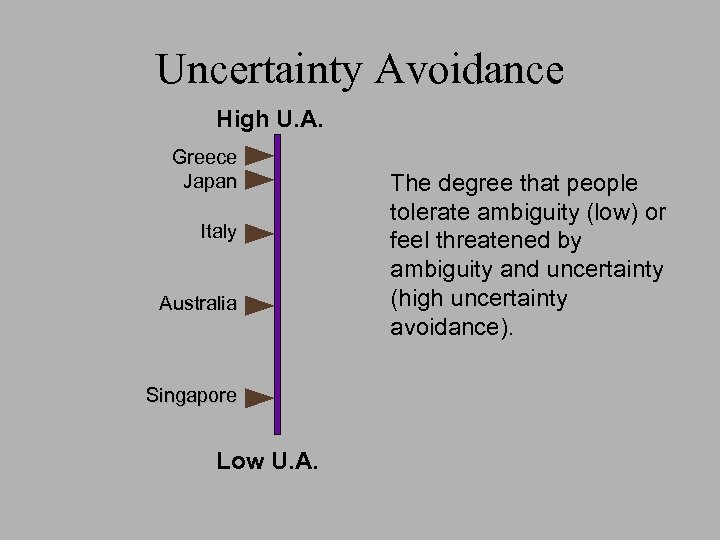
Uncertainty Avoidance High U. A. Greece Japan Italy Australia Singapore Low U. A. The degree that people tolerate ambiguity (low) or feel threatened by ambiguity and uncertainty (high uncertainty avoidance).
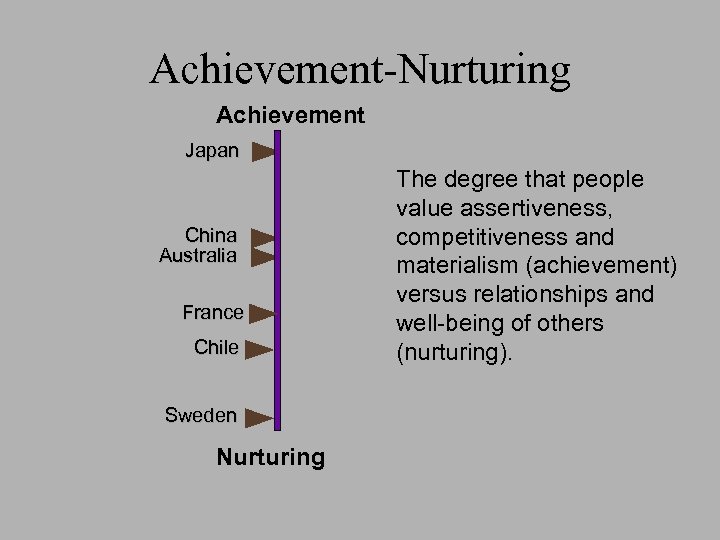
Achievement-Nurturing Achievement Japan China Australia France Chile Sweden Nurturing The degree that people value assertiveness, competitiveness and materialism (achievement) versus relationships and well-being of others (nurturing).
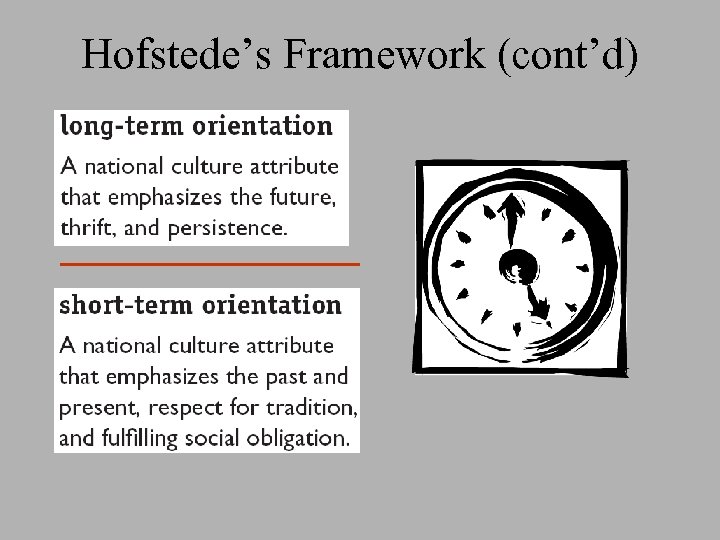
Hofstede’s Framework (cont’d)
Chapter Summary ORGANISATIONAL CULTURE COMPONENTS • Norms • Symbols • Shared values INFLUENCES • Size • Technology • Age • History • Ownership WRITERS • Schein • Handy • Hofstede
Chapter 5 Individual and group behaviour in business organisations
Learning objectives • • Define the term behaviour Explain what factors influence the way individuals act Describe the characteristics of passive, aggressive and assertive behaviour Give reasons why working in teams is more effective than working as an individual Outline the contribution teams make to the organisational success What factors are required in order to make a cohesive group? Distinguish between different approaches necessary to organise work around and individual and around the work group
INDIVIDUAL GROUP BEHAVIOUR ASSERTIVE PASSIVE AGGRESSIVE
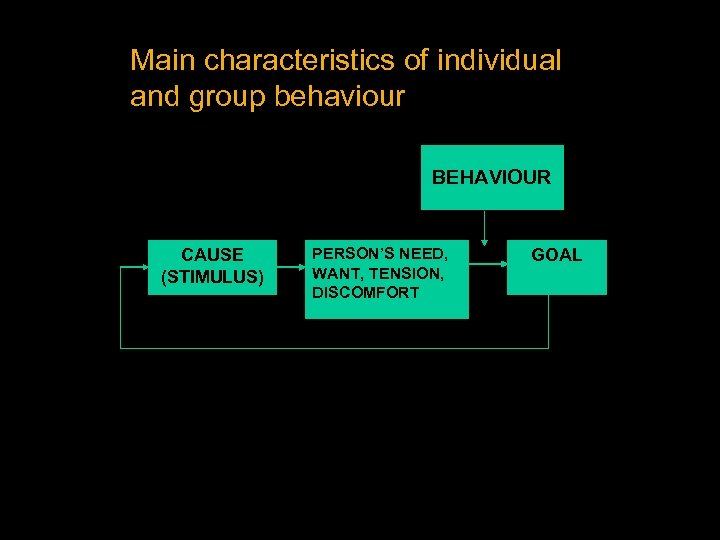
Main characteristics of individual and group behaviour BEHAVIOUR CAUSE (STIMULUS) PERSON’S NEED, WANT, TENSION, DISCOMFORT GOAL
Factors affecting behaviour and performance at work • Motivation level • Perception • Attitudes • Personality • Intelligence
Motivation • • • Physical and working conditions Safety Monetary rewards Recognition Many of the factors that motivate individuals to perform are social in nature; groups can bring out the best in people and can be essential for the delivery of social needs.
Perception • Developing a group means identifying distinct roles for each of its members. • Any individual can have several roles. • A role is the expected pattern of behaviours associated with members occupying a particular position within the structure of the organisation.
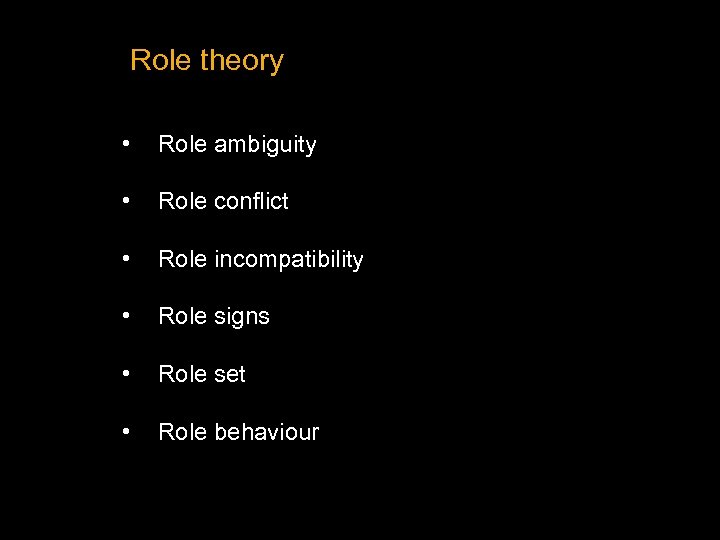
Role theory • Role ambiguity • Role conflict • Role incompatibility • Role signs • Role set • Role behaviour
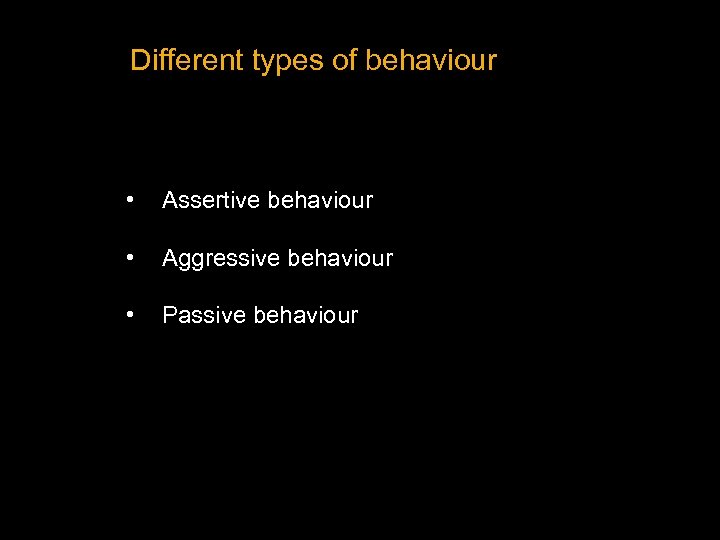
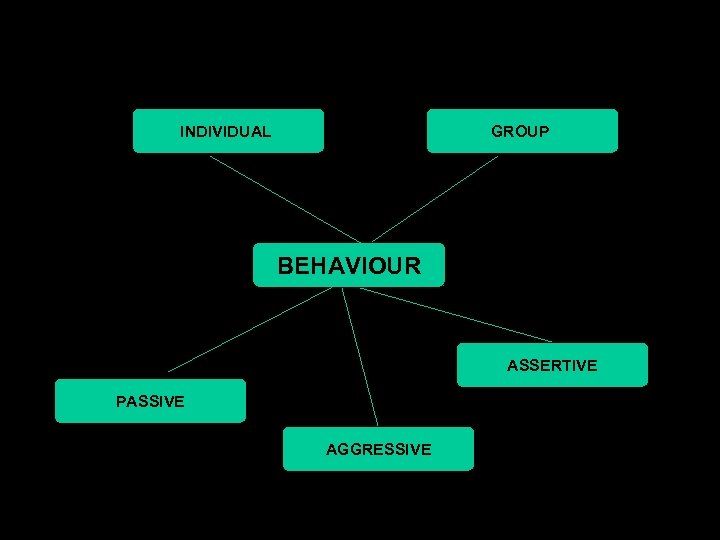
Different types of behaviour • Assertive behaviour • Aggressive behaviour • Passive behaviour
Chapter 6 Team formation, development and management
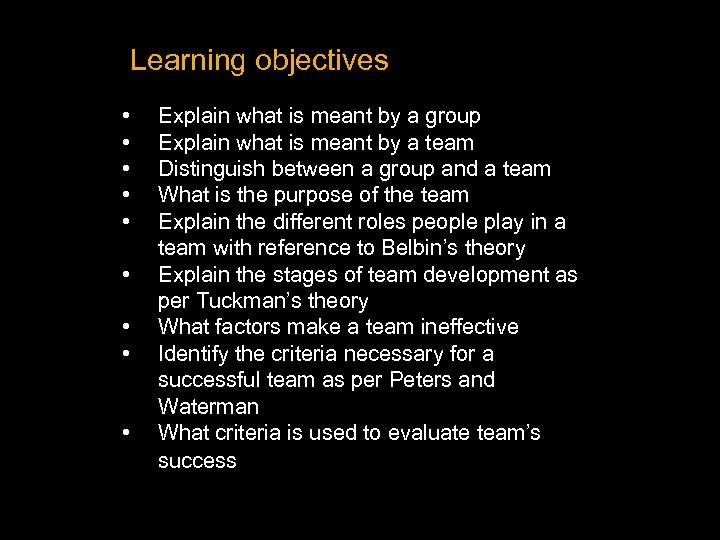
Learning objectives • • • Explain what is meant by a group Explain what is meant by a team Distinguish between a group and a team What is the purpose of the team Explain the different roles people play in a team with reference to Belbin’s theory Explain the stages of team development as per Tuckman’s theory What factors make a team ineffective Identify the criteria necessary for a successful team as per Peters and Waterman What criteria is used to evaluate team’s success
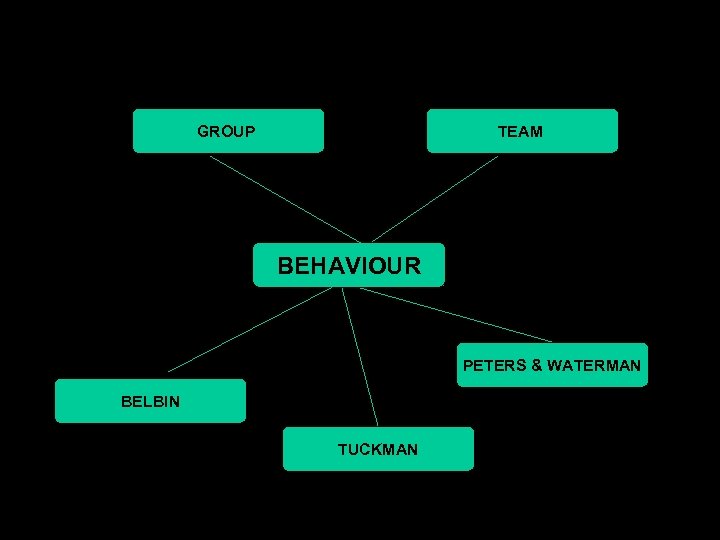
GROUP TEAM BEHAVIOUR PETERS & WATERMAN BELBIN TUCKMAN
Differences between a group and a team • Group is any collection of people who perceive themselves to be a group. • Groups have the following attributes: • A sense of identity (there acknowledged boundaries of the group, who is in and who is out) • Loyalty to the group (acceptance within the group that bind the group together) • Purpose and leadership (express purpose, choose individuals to lead them towards their goals)
Differences between a group and a team • • Practically all individual effort takes place in association with other people in groups Formal vs. informal groups
Teams • • • Any group of people who must significantly relate with each other in order to accomplish shared objectives Team is a formal group It has a leader and a distinctive culture and is geared towards a final result. Teams must have a reason for working together. They must need each other’s skills, talent and experience in order to achieve their mutual goals. Purpose of a team is to solve complex problems (diverse team of specialists & synergy)
Teams • • • Share a common goal Enjoy working together Commitment to achieve goals Diverse individuals Loyalty to the project Attain a team spirit
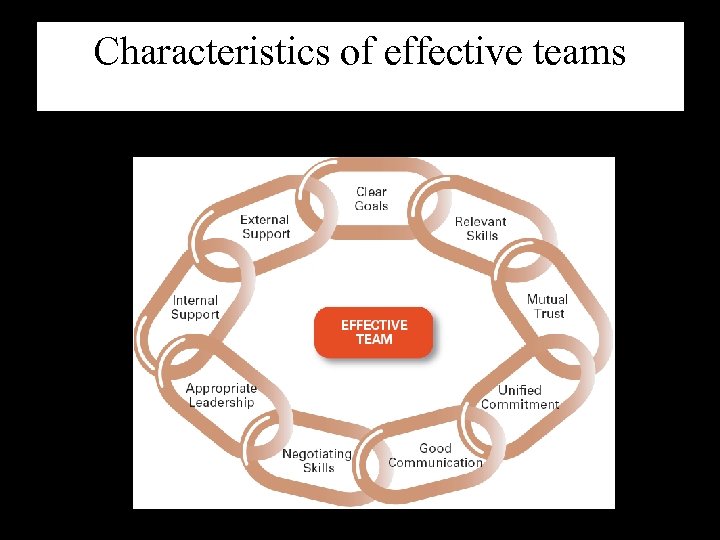
Characteristics of effective teams
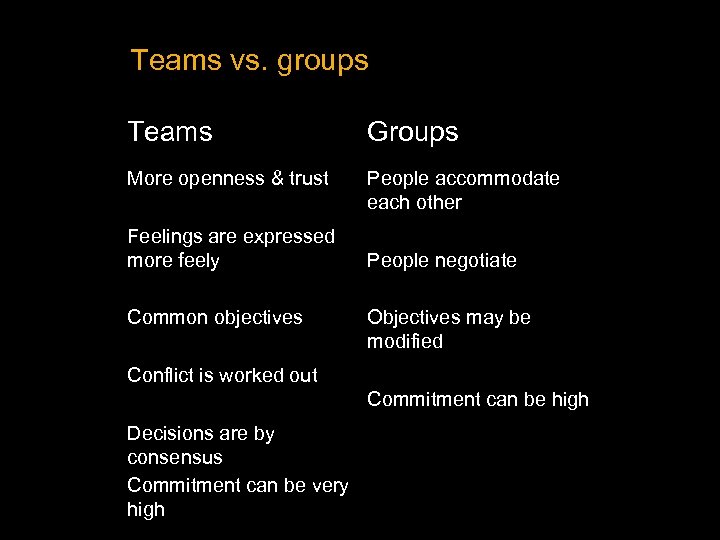
Teams vs. groups Teams Groups More openness & trust People accommodate each other Feelings are expressed more feely Common objectives People negotiate Objectives may be modified Conflict is worked out Commitment can be high Decisions are by consensus Commitment can be very high
Effective teamwork (Woodcock) • • Rights balance of skills, ability and aspiration Mistakes are faced openly and there is no ‘scape-goating’ There is pride in success, support and trust in personal relationships There is a high level of task achievement Openness and honesty is present There is healthy competition There is a happy feel to the place and good relationships with other departments
Who should belong to the team? • Team members should be selected for their potential to contribute to getting things done (task performance) and establishing good working relationships (group maintenance): • Specialist skills • Power in the wider organisation • Access to resources • Personalities and goals of the individual members of the team
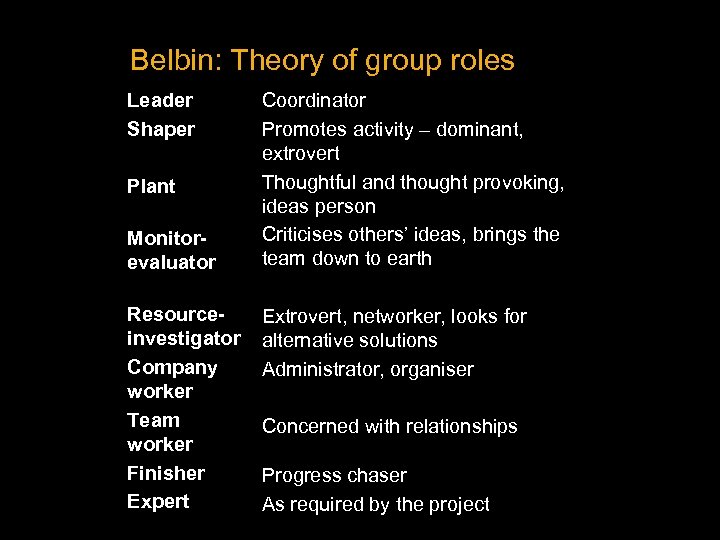
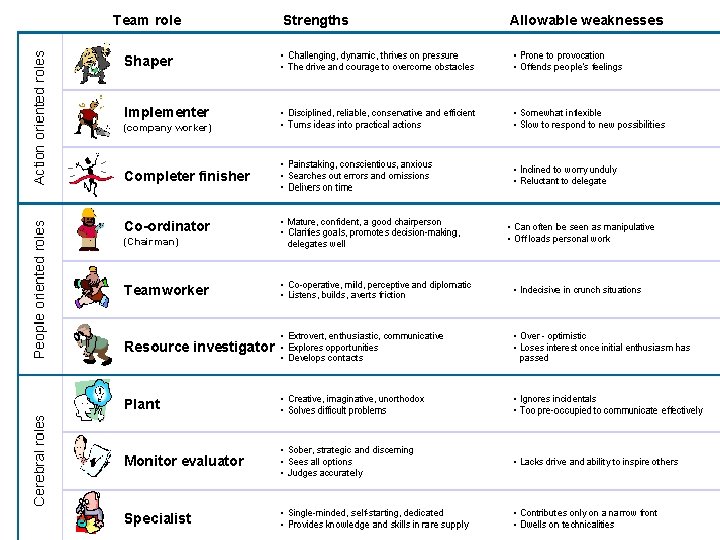
Belbin: Theory of group roles Leader Shaper Plant Monitorevaluator Resourceinvestigator Company worker Team worker Finisher Expert Coordinator Promotes activity – dominant, extrovert Thoughtful and thought provoking, ideas person Criticises others’ ideas, brings the team down to earth Extrovert, networker, looks for alternative solutions Administrator, organiser Concerned with relationships Progress chaser As required by the project
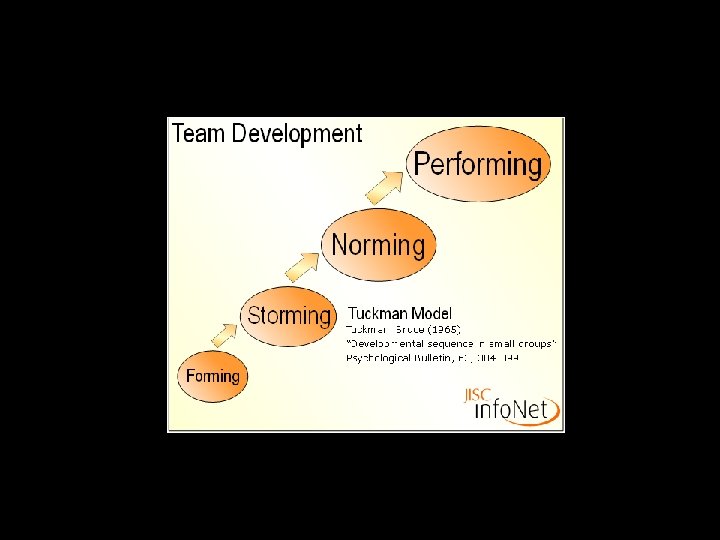
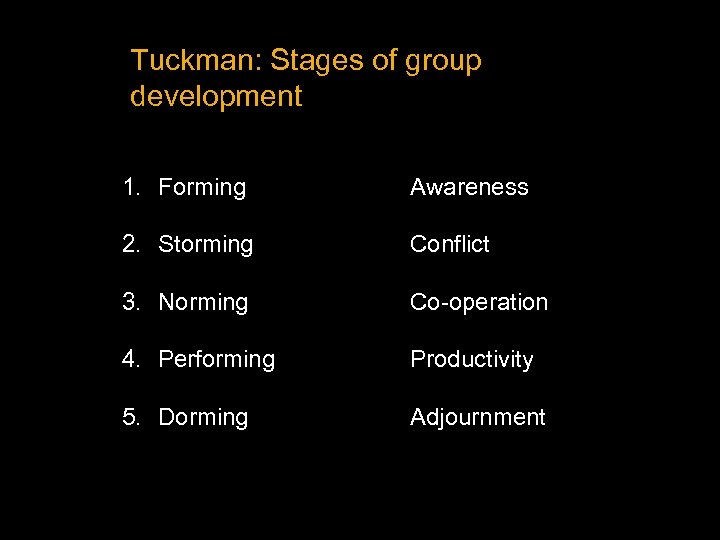
Tuckman: Stages of group development 1. Forming Awareness 2. Storming Conflict 3. Norming Co-operation 4. Performing Productivity 5. Dorming Adjournment
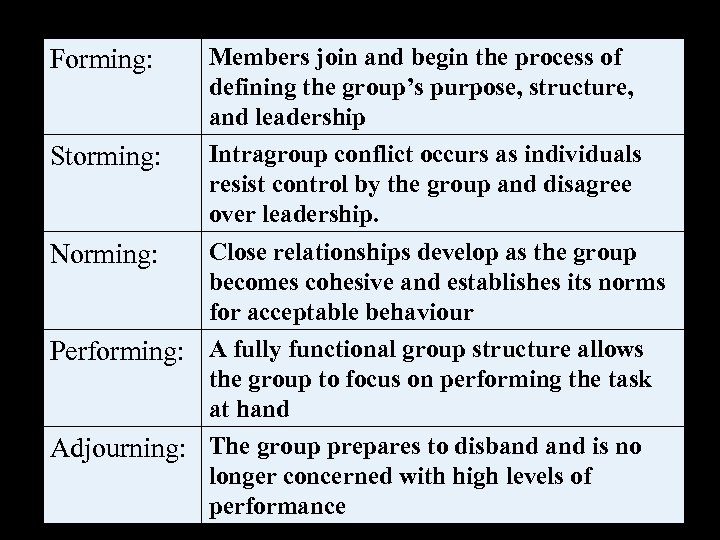
Members join and begin the process of defining the group’s purpose, structure, and leadership Intragroup conflict occurs as individuals Storming: resist control by the group and disagree over leadership. Close relationships develop as the group Norming: becomes cohesive and establishes its norms for acceptable behaviour Performing: A fully functional group structure allows the group to focus on performing the task at hand Adjourning: The group prepares to disband is no longer concerned with high levels of performance Forming:
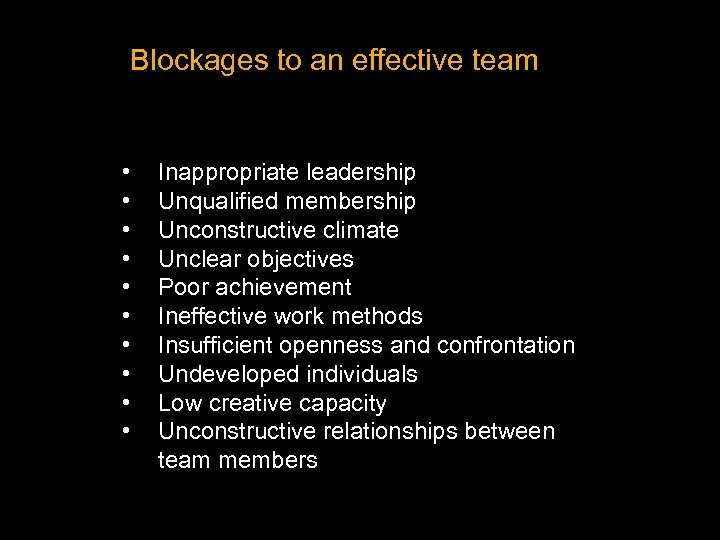
Blockages to an effective team • • • Inappropriate leadership Unqualified membership Unconstructive climate Unclear objectives Poor achievement Ineffective work methods Insufficient openness and confrontation Undeveloped individuals Low creative capacity Unconstructive relationships between team members
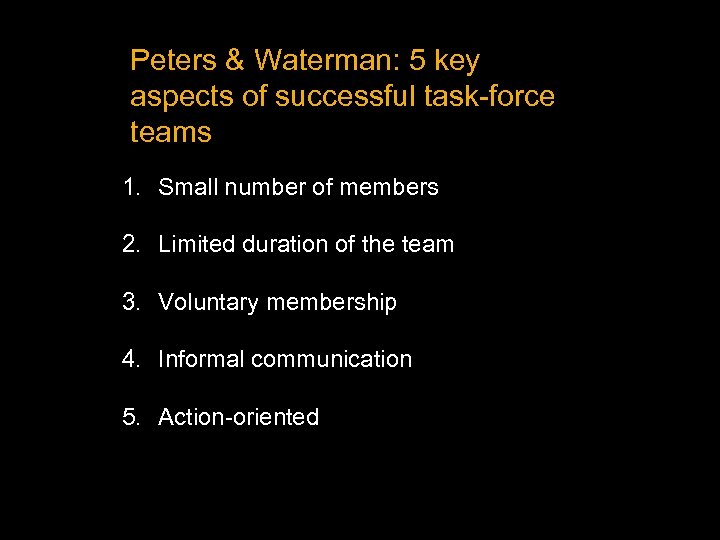
Peters & Waterman: 5 key aspects of successful task-force teams 1. Small number of members 2. Limited duration of the team 3. Voluntary membership 4. Informal communication 5. Action-oriented
How to make a cohesive group • • • Leadership Right mix of skills Clear objectives and commitment to shared goals Team identity Team solidarity
Contribution of individuals and teams to organisational success • One person cannot do everything, but a team can combine all the main areas of skill and knowledge that are needed for a particular job. • Synergy Describes the phenomenon in which the combined activity of separate entities has a greater effect than the sum of the activities of each entity working alone 2+2=5
Advantages of cohesive groups • • • Improved teamwork and problem solving Greater creativity Provide support for individuals within the group improved communication through participation Satisfaction of social needs Provides a forum for conflict resolution
Cohesive groups • • • Atmosphere Participation Commitment Communication Leadership Progress
Improving team effectiveness – Evaluation • • Effectiveness – degree to which objectives are achieved Efficiency – use of resources in achieving the objectives Team member satisfaction – motivational climate Use of • Observation • Interviews • Questionnaires
Rewarding effective teams • • Make use of team-based reward to encourage co-operation and mutual accountability. Recognise the team, rather than individual success. • • • Profit sharing schemes Gain sharing schemes Employee share options
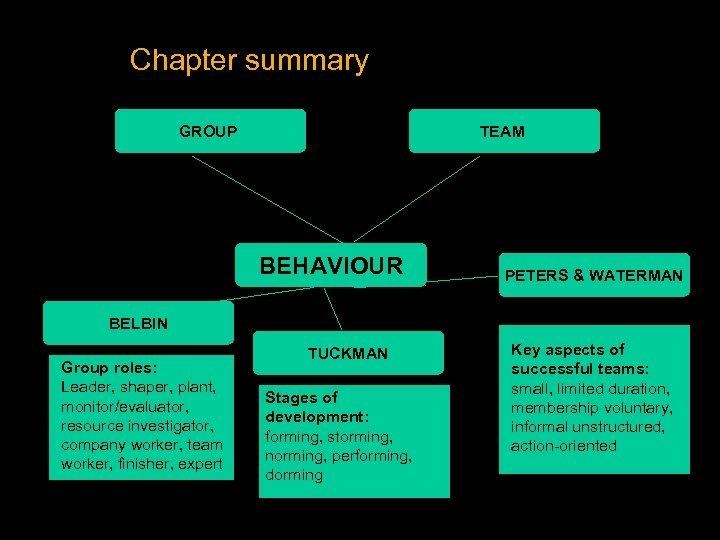
Chapter summary GROUP TEAM BEHAVIOUR PETERS & WATERMAN BELBIN Group roles: Leader, shaper, plant, monitor/evaluator, resource investigator, company worker, team worker, finisher, expert TUCKMAN Stages of development: forming, storming, norming, performing, dorming Stages of Key aspects of development: successful teams: forming, storming, small, limited duration, norming, performing, membership voluntary, dorming unstructured, informal action-oriented
Скачать презентацию Chapter 3 Organisational culture Learning objectives
425b68fe9ecfaf3f22ee9eea7a80fc45.ppt